
Leviticus 3:5

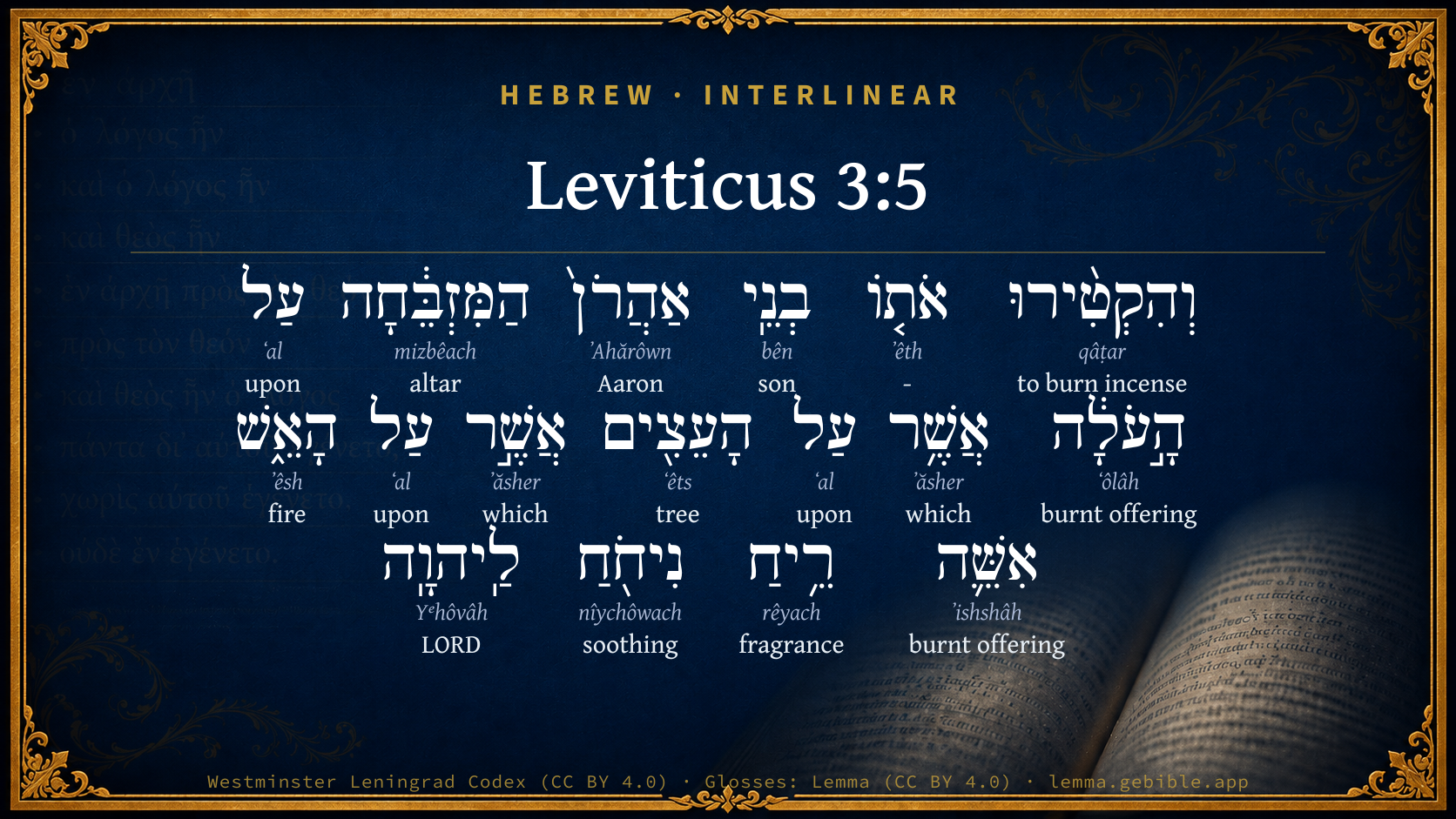
Hebrew (Westminster Leningrad Codex) Leviticus 3:5 appears in the Hebrew Old Testament. The text above is from the Westminster Leningrad Codex. Each word links to its Strong’s number, a concise gloss, and parsing drawn from the Open Scriptures Hebrew Bible morphology. Click any word for its full Brown-Driver-Briggs (BDB) entry.
Download image
Cite this verse

Leviticus 3:5 (World English Bible). Public Domain. Lemma interlinear Bible study tool, https://lemma.gebible.app/v/leviticus/3/5.

Show BibTeX & RIS
BibTeX
RIS
English Translation
Aaron's sons shall burn it on the altar on the burnt offering, which is on the wood that is on the fire: it is an offering made by fire, of a sweet savor to Yahweh.
World English Bible · Public Domain
Download a study sheet

One document with this verse’s original text, its word-by-word gloss line, the meaning frame, cross-references with their text, attributed commentary, and full source and license credits — printable, and it pastes into notes with its structure intact.

This verse Autodidact and up

Study sheet (.html) Plain text (.txt)

A passage Seminary Student

Up to 50 verses in one chapter. A passage sheet keeps up to 6 commentary sources and 12 cross-references per verse, in the order this page ranks them, and says so on the sheet whenever that leaves anything out. Ask for a single verse and you get the Autodidact verse sheet above.

Everything on this page stays free to read, with no account — the sheet is a download of what is already on screen, not access to it.

Want to remove ads? Support Godless Engineer
Compare translations 3

The same verse in 3 English versions, stacked beneath the original-language interlinear above. Click any original word for its lexicon entry.

Each is an independent rendering of the whole verse — the interlinear is not word-aligned to these translations.

Highlighted words mark where these versions differ — a whole-verse word diff, not a word-by-word alignment.

  • World English Bible Public Domain
    Aaron's sons shall burn it on the altar on the burnt offering, which is on the wood that is on the fire: it is an offering made by fire, of a sweet savor to Yahweh.
  • King James Version Public Domain
    And Aaron's sons shall burn it on the altar upon the burnt sacrifice, which is upon the wood that is on the fire: it is an offering made by fire, of a sweet savor unto the LORD.
  • unfoldingWord Literal Text CC BY-SA 4.0
    And the sons of Aaron shall cause it to become smoke on the altar with the burnt offering that on the wood that on the fire, a gift, a scent of pleasing to Yahweh.

unfoldingWord Literal Text — © unfoldingWord, licensed CC BY-SA 4.0. Word-aligned USFM3 via Door43 (git.door43.org/unfoldingWord/en_ult).

Versions to compare (up to 4)

3 of 4 selected

Show all 18 translations

Every available English version of this verse, each an independent rendering of the whole verse.

  • World English Bible Public Domain
    Aaron's sons shall burn it on the altar on the burnt offering, which is on the wood that is on the fire: it is an offering made by fire, of a sweet savor to Yahweh.
  • Berean Standard Bible Public Domain
    Then Aaron’s sons are to burn it on the altar atop the burnt offering that is on the burning wood, as an offering made by fire, a pleasing aroma to the LORD.
  • Majority Standard Bible Public Domain
    Then Aaron’s sons are to burn it on the altar atop the burnt offering that is on the burning wood, as a food offering, a pleasing aroma to the LORD.
  • King James Version Public Domain
    And Aaron's sons shall burn it on the altar upon the burnt sacrifice, which is upon the wood that is on the fire: it is an offering made by fire, of a sweet savor unto the LORD.
  • American Standard Version (1901) Public Domain
    And Aaron's sons shall burn it on the altar upon the burnt-offering, which is upon the wood that is on the fire: it is an offering made by fire, of a sweet savor unto Jehovah.
  • Revised Version (1885) Public Domain
    And Aaron’s sons shall burn it on the altar upon the burnt offering, which is upon the wood that is on the fire: it is an offering made by fire, of a sweet savour unto the LORD.
  • Geneva Bible (1599) Public Domain
    And Aarons sonnes shall burne it on the altar, with the burnt offering, which is vpon the wood, that is on the fire: this is a sacrifice made by fire for a sweete sauour vnto the Lord.
  • Douay-Rheims (1899) Public Domain
    And they shall burn them upon the altar, for a holocaust, putting fire under the wood: for an oblation of most sweet savour to the Lord.
  • Young's Literal Translation Public Domain
    and sons of Aaron have made it a perfume on the altar, on the burnt-offering which `is' on the wood, which `is' on the fire -- a fire-offering of sweet fragrance to Jehovah.
  • Literal Standard Version CC BY-SA 4.0
    and sons of Aaron have made it an incense on the altar, on the burnt-offering which [is] on the wood, which [is] on the fire, [as] a fire-offering of refreshing fragrance to YHWH.
  • Unlocked Literal Bible CC BY-SA 4.0
    Aaron's sons will burn that on the altar with the burnt offering, which is on the wood that is on the fire. This will produce a sweet aroma for Yahweh; it will be an offering made to him by fire.
  • unfoldingWord Literal Text CC BY-SA 4.0
    And the sons of Aaron shall cause it to become smoke on the altar with the burnt offering that on the wood that on the fire, a gift, a scent of pleasing to Yahweh.
  • Darby Bible Public Domain
    and Aaron's sons shall burn it on the altar upon the burnt-offering which [lieth] on the wood that is upon the fire: [it is] an offering by fire to Jehovah of a sweet odour.
  • World Messianic Bible Public Domain
    Aaron’s sons shall burn it on the altar on the burnt offering, which is on the wood that is on the fire: it is an offering made by fire, of a pleasant aroma to the LORD.
  • Webster's Bible Public Domain
    And Aaron's sons shall burn it on the altar, upon the burnt-sacrifice which is upon the wood that is on the fire: it is an offering made by fire, of a sweet savor to the LORD.
  • Free Bible Version CC BY-SA 4.0
    Aaron's sons are to burn this on the altar on top of the burnt offering that is on the burning wood, as a food offering, to be accepted by the Lord.
  • Bible in Basic English Public Domain
    That it may be burned by Aaron's sons on the altar, on the burned offering which is on the wood on the fire: it is an offering made by fire of a sweet smell to the Lord.
  • JPS Tanakh (1917) Public Domain
    And Aaron's sons shall make it smoke on the altar upon the burnt-offering, which is upon the wood that is on the fire; it is an offering made by fire, of a sweet savour unto the LORD.

Literal Standard Version (2020), Covenant Press — licensed CC BY-SA 4.0. Text via the HelloAO Bible API (eBible.org). Unlocked Literal Bible (unfoldingWord) — licensed CC BY-SA 4.0. Text via the HelloAO Bible API (eBible.org). unfoldingWord Literal Text — © unfoldingWord, licensed CC BY-SA 4.0. Word-aligned USFM3 via Door43 (git.door43.org/unfoldingWord/en_ult). Free Bible Version, Dr. Jonathan Gallagher — licensed CC BY-SA 4.0. Text via the HelloAO Bible API (eBible.org).

Word by word

More ways to search: Search by grammar → Find every occurrence → Compare this word →

Practice this passage: Drill this verse → Learn its vocabulary →

נִיחֹ֖חַ
nîychôwach
H5207
“soothing”
Noun, Common, Masculine, Singular, Absolute
Part of Speech
Noun
Type
Common
Gender
Masculine
Number
Singular
State
Absolute
Full BDB Definition

Origin: from H5117

TWOT: 1323c

soothing, quieting, tranquillising
  1. וְהִקְטִ֨ירוּ qâṭar H6999 “and · to burn incense” Conjunction + Verb, Hiphil, Sequential Perfect, 3rd Person, Common, Plural
  2. אֹת֤וֹ ʼêth H853 “- · him” Particle, Direct Object + Suffix, Personal, 3rd Person, Masculine, Singular
  3. בְנֵֽי bên H1121 “sons of” Noun, Common, Masculine, Plural, Construct
  4. אַהֲרֹן֙ ʼAhărôwn H175 “Aaron” Noun, Proper
  5. הַמִּזְבֵּ֔חָה mizbêach H4196 “the · altar · toward” Particle, Definite Article + Noun, Common, Masculine, Singular, Absolute + Suffix, Demonstrative
  6. עַל ʻal H5921 “upon” Preposition
  7. הָ֣עֹלָ֔ה ʻôlâh H5930 “the · burnt offering” Particle, Definite Article + Noun, Common, Feminine, Singular, Absolute
  8. אֲשֶׁ֥ר ʼăsher H834 “which” Particle, Relative
  9. עַל ʻal H5921 “upon” Preposition
  10. הָעֵצִ֖ים ʻêts H6086 “the · trees” Particle, Definite Article + Noun, Common, Masculine, Plural, Absolute
  11. אֲשֶׁ֣ר ʼăsher H834 “which” Particle, Relative
  12. עַל ʻal H5921 “upon” Preposition
  13. הָאֵ֑שׁ ʼêsh H784 “the · fire” Particle, Definite Article + Noun, Common, Both, Singular, Absolute
  14. אִשֵּׁ֛ה ʼishshâh H801 “burnt offering of” Noun, Common, Masculine, Singular, Construct
  15. רֵ֥יחַ rêyach H7381 “fragrance of” Noun, Common, Masculine, Singular, Construct
  16. לַֽיהוָֽה Yᵉhôvâh H3068 “to/for · LORD” Preposition + Noun, Proper

About this verse

These counts appear in no published source. They are computed here, from the morphology-tagged text and Lemma’s own curated glosses. What Lemma adds →

17
words
14
distinct lemmas
Pentateuch
section

Shared distinctive vocabulary

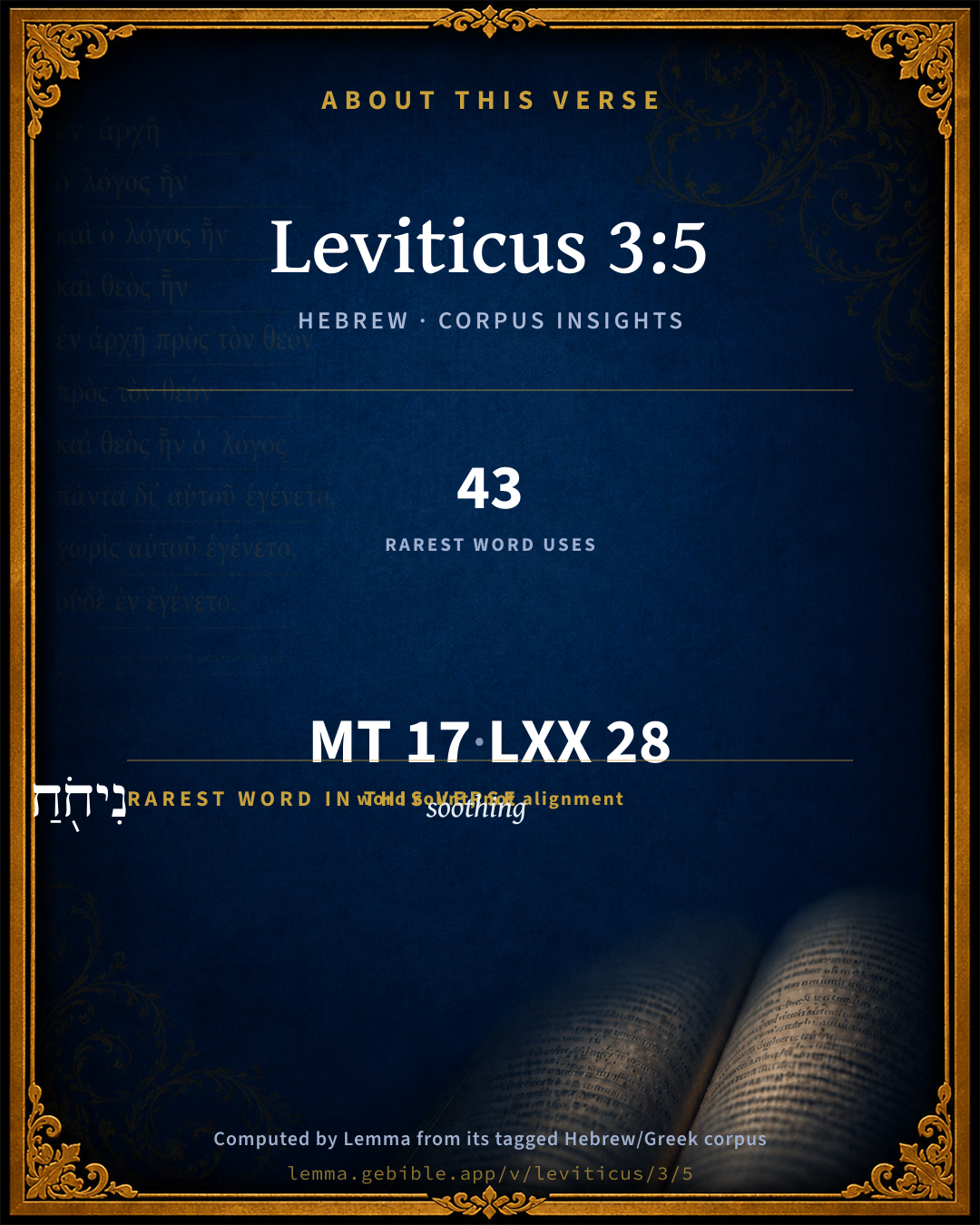
נִיחֹ֖חַ soothing H5207 occurs in 43 verses of the Hebrew Bible. Also found in:

Grammatical profile

  • 1 verb
  • 10 nouns
  • 3 prepositions
  • 3 particles

Verb forms

  • וְהִקְטִ֨ירוּ Hiphil · Sequential Perfect

Repetition

Words recur within this verse — often emphatic in Hebrew:

  • עַל upon H5921 ×3
  • אֲשֶׁ֥ר which H834 ×2

Hebrew & Septuagint length

In English translation the verse runs 35 words from the Hebrew and 41 from the Septuagint (LXX English) — closely comparable.

A rough comparison of the two English renderings, which tokenize alike — not a word-level alignment.

Word counts can differ between the Hebrew and the Greek without any difference in meaning — e.g. the Hebrew direct-object marker אֵת has no separate Greek word, and Greek often adds the article ὁ.

In the original languages it is 17 Hebrew tokens and 28 Greek tokens — but the two are counted differently (Hebrew bundles its prefixes and suffixes into one token; the Greek is in lemma form), so that isn’t a like-for-like length.

Cross-references

14

Topical passages linked to Leviticus 3:5 in the Treasury of Scripture Knowledge — connected by theme and wording, ordered by reader-vote popularity; previews shown in the World English Bible.

  • Leviticus 6:12 The fire on the altar shall be kept burning on it, it shall not go out; and the priest shall burn wood on it every morning: and he shall lay the burnt offering in order upon it, and shall burn on it the fat of the peace offerings.
  • Exodus 29:13 You shall take all the fat that covers the innards, the cover of the liver, the two kidneys, and the fat that is on them, and burn them on the altar.
  • 1 Peter 2:5 You also, as living stones, are built up as a spiritual house, to be a holy priesthood, to offer up spiritual sacrifices, acceptable to God through Jesus Christ.
  • Exodus 29:38–42 "Now this is that which you shall offer on the altar: two lambs a year old day by day continually.
  • Leviticus 1:9 but its innards and its legs he shall wash with water. The priest shall burn the whole on the altar, for a burnt offering, an offering made by fire, of a sweet savor to Yahweh.
  • Leviticus 4:31 All its fat he shall take away, like the fat is taken away from off of the sacrifice of peace offerings; and the priest shall burn it on the altar for a sweet savor to Yahweh; and the priest shall make atonement for him, and he will be forgiven.
  • Leviticus 4:35 All its fat he shall take away, like the fat of the lamb is taken away from the sacrifice of peace offerings; and the priest shall burn them on the altar, on the offerings of Yahweh made by fire; and the priest shall make atonement for him concerning his sin that he has sinned, and he will be forgiven.
  • Leviticus 7:29–34 "Speak to the children of Israel, saying, 'He who offers the sacrifice of his peace offerings to Yahweh shall bring his offering to Yahweh out of the sacrifice of his peace offerings.
  • Leviticus 9:9–10 The sons of Aaron presented the blood to him; and he dipped his finger in the blood, and put it on the horns of the altar, and poured out the blood at the base of the altar:
  • 1 Samuel 2:15–16 Yes, before they burnt the fat, the priest's servant came, and said to the man who sacrificed, Give flesh to roast for the priest; for he will not have boiled flesh of you, but raw.
  • 1 Kings 8:64 The same day did the king make the middle of the court holy that was before the house of Yahweh; for there he offered the burnt offering, and the meal-offering, and the fat of the peace-offerings, because the brazen altar that was before Yahweh was too little to receive the burnt offering, and the meal-offering, and the fat of the peace-offerings.
  • 2 Chronicles 35:14 Afterward they prepared for themselves, and for the priests, because the priests the sons of Aaron [were busied] in offering the burnt offerings and the fat until night: therefore the Levites prepared for themselves, and for the priests the sons of Aaron.
  • Ezekiel 44:7 in that you have brought in foreigners, uncircumcised in heart and uncircumcised in flesh, to be in my sanctuary, to profane it, even my house, when you offer my bread, the fat and the blood, and they have broken my covenant, [to add] to all your abominations.
  • Ezekiel 44:15 But the priests the Levites, the sons of Zadok, who kept the charge of my sanctuary when the children of Israel went astray from me, they shall come near to me to minister to me; and they shall stand before me to offer to me the fat and the blood, says the Lord Yahweh:

Cross-references courtesy of OpenBible.info (CC BY 4.0).

Hebrew and Greek witnesses Masoretic Hebrew ↔ Greek Septuagint

The same verse in the two great witnesses to the Old Testament, shown verse-for-verse.

These are two independent witnesses, not word-aligned to each other, and the Septuagint is shown in lemma (dictionary) form.

Hebrew Leviticus 3:5 Masoretic · Westminster Leningrad Codex

וְהִקְטִ֨ירוּ אֹת֤וֹ בְנֵֽי אַהֲרֹן֙ הַמִּזְבֵּ֔חָה עַל הָ֣עֹלָ֔ה אֲשֶׁ֥ר עַל הָעֵצִ֖ים אֲשֶׁ֣ר עַל הָאֵ֑שׁ אִשֵּׁ֛ה רֵ֥יחַ נִיחֹ֖חַ לַֽיהוָֽה

Aaron's sons shall burn it on the altar on the burnt offering, which is on the wood that is on the fire: it is an offering made by fire, of a sweet savor to Yahweh.

World English Bible · Public Domain

Greek LXX Leviticus 3:5 Septuagint · lemma form

καί ἀναφέρω αὐτός ὁ υἱός ἀαρών ὁ ἱερεύς ἐπί ὁ θυσιαστήριον ἐπί ὁ ὁλοκαύτωμα ἐπί ὁ ξύλον ὁ ἐπί ὁ πῦρ ἐπί ὁ θυσιαστήριον κάρπωμα ὀσμή εὐωδία κύριος

And the priests the sons of Aaron shall offer them on the altar on the burnt offering, on the wood which is on the fire upon the altar: it is a burnt offering, a smell of sweet savor to the Lord.

LXX2012 (modern English Septuagint) · Public Domain

Hebrew: Westminster Leningrad Codex (CC BY 4.0). Greek: Septuagint (public domain); English from LXX2012 (modern English Septuagint) (Public Domain). How the Septuagint differs from the Hebrew →

Targum (Aramaic paraphrase)

2

The Targum is the ancient Jewish Aramaic paraphrase of the Hebrew Scriptures — an interpretive translation, not the Hebrew text itself. Onkelos (literal) and Pseudo-Jonathan (expansive) render the Torah, and Jonathan the Prophets. Coverage is partial: where no permissively-licensed English translation exists for a verse, only the Aramaic is shown. This is verse-level text, not a word-by-word alignment to the Hebrew.

  1. Targum Onkelos Torah (Genesis–Deuteronomy)
    וְיִסְקוּן יָתֵיהּ בְּנֵי אַהֲרֹן לְמַדְבְּחָא עַל עֲלָתָא דִי עַל אָעַיָא דִי עַל אֶשָׁתָא קוּרְבַּן דְמִתְקַבֵּל בְּרַעֲוָא קֳדָם יְיָ

    (no public-domain English translation for this verse)

    Targum Onkelos — Aramaic: “Onkelos Genesis” (public domain); “Onkelos Exodus” (public domain); “Onkelos Leviticus” (public domain); “Onkelos Numbers” (public domain); “Onkelos Deuteronomy” (public domain). English: “Sefaria Community Translation” (CC0 1.0 (public-domain dedication)); “J.W. Etheridge. The Targums of Onkelos and Jonathan Ben Uzziel on the Pentateuch. London: Longmans, Green, 1862” (public domain). Text via Sefaria.

  2. Targum Pseudo-Jonathan Torah (Genesis–Deuteronomy)
    וְיִסְקוּן יָתֵיהּ בְּנֵי אַהֲרן לְמַדְבְּחָא עַל עֲלָתָא דְעַל קֵיסִין דְעַל אֵישָׁתָא קָרְבַּן דְמִתְקַבֵּיל בְּרַעֲוָא קֳדָם יְיָ

    And the sons of Aharon shall offer it on the altar with the sacrifice that is on the wood which is upon the fire, an oblation to be received with favour before the Lord.

    Targum Pseudo-Jonathan — Aramaic: “Targum Jonathan on Genesis” (public domain); “Targum Jonathan on Exodus” (public domain); “Targum Jonathan on Leviticus” (public domain); “Targum Jonathan on Numbers” (public domain); “Targum Jonathan on Deuteronomy” (public domain). English: “The Targum of Jonathan ben Uzziel, trans. J. W. Etheridge, London, 1862” (public domain). Text via Sefaria.

Commentary

Notes on Leviticus 3:5 from classic Christian and Jewish commentators (each source and its license shown beneath its notes). The classic Christian expositions comment on the surrounding passage and are grouped to its opening verse, so a note may address several verses; the Jewish commentaries on the Tanakh (Rashi and others) are per-verse, so they appear only where the commentator wrote on this verse.

Lemma curates 59 commentaries, every one of them public domain or Creative Commons licensed, each selected and text-cleaned for this edition rather than reprinted as found. About our sources →

Trapp's Complete Commentary

John Trapp

Lev 3:5 And Aaron’s sons shall burn it on the altar upon the burnt sacrifice, which [is] upon the wood that [is] on the fire: [it is] an offering made by fire, of a sweet savour unto the LORD.

Ver. 5. Upon the burnt sacrifice.] Which was first offered, to teach us that sin must be pardoned ere our thank offerings can be accepted. It is, therefore, ordinarily, best to begin our prayers with confession of sin, and petitions for pardon through Christ.

John Trapp, A Commentary or Exposition upon All the Books of the Old and New Testament (1647–1656) — public domain. Text from a community e-Sword module.

Joseph Benson's Commentary

Lev 3:5. Upon the burnt-sacrifice — Either, 1st, Upon the remainders of it, which were yet burning; or, rather, 2d, After it: for the daily burnt- offering was first to be offered, both as more eminently respecting God’s honour, and as the most solemn and stated sacrifice, which should take place of all occasional oblations, and as a sacrifice of a higher nature, being for atonement, without which no peace could be obtained, nor peace- offering offered with acceptance.

Joseph Benson's Commentary on the Old and New Testaments (1811–1818) — public domain. Text from a community e-Sword module.

Tyndale Open Study Notes

Tyndale Open Resources

3:5 The burnt offering is described in 1:3-17 and is best referred to as the “whole burnt offering.” Because it was offered twice daily (see Num 28:4), and because the need for atonement preceded fellowship, the text assumes that the burnt offering would be on the altar already. The priest was to lay the fatty portions and certain internal organs (3:3-4) of the peace offering on top of it.

Tyndale Open Study Notes — © Tyndale Open Resources, licensed CC BY-SA 4.0. Text via the HelloAO Bible API.

Adam Clarke's Commentary

Verse 5. Aaron's sons shall burn it] As the fat was deemed the most valuable part of the animal, it was offered in preference to all other parts; and the heathens probably borrowed this custom from the Jews, for they burnt the omentum or caul in honour of their gods.

Adam Clarke's Commentary on the Bible (1810–1826) — public domain. Text from a community e-Sword/MySword module.

Ellicott's Commentary for English Readers

(5) And Aaron’s sons.—After the offerer has killed the victim, taken out the choice parts and offered them to the officiating priest, the latter shall burn it, that is, the whole collection of the fat pieces described in Lev_3:3-4, upon the ashes of the continual burnt offering, which was the daily offering of the lamb. It had always the precedence, and was burning the whole day (Lev_6:12). Besides these choice pieces which had thus to be burnt, the breast and the right shoulder were reserved for the priest, whilst the remainder of the peace offering was eaten by the offerer, his family and his friends (Lev_7:15-16).

A Bible Commentary for English Readers, edited by Charles John Ellicott (1878–1897) — public domain. Text from a community e-Sword module.

The Cambridge Bible for Schools and Colleges

gen. ed. J. J. S. Perowne

5. on the altar upon the burnt offering] The remains of the daily Burnt-Offering were not removed till the following morning, when a fresh Burnt-Offering was placed on wood kindled from the fire of yesterday. The fat parts of the Peace-Offering were placed upon the Burnt-Offering of the day. Cp. Lev_6:12.

The Cambridge Bible for Schools and Colleges (gen. ed. J. J. S. Perowne; Cambridge University Press, 1878–1918) — public domain. Text from a community e-Sword module.

John Gill's Exposition

And Aaron's sons shall burn it on the altar,.... That is, the fat of the several parts before mentioned; this signified the sufferings of Christ, by which our peace is made, and by whose death we are reconciled to God: this rite of burning the fat of the inwards of sacrifices was used by the Pagans, and is still retained by the idolatrous Indians to this day (h):

upon the burnt sacrifice; which, as Gersom says, was the burnt offering of the daily sacrifice of the morning, which was offered first of all sacrifices; so Jarchi says,"we learn that the daily burnt offering preceded every other offering:''this was an eminent type of Christ's sacrifice:

which is upon the wood that is on the fire; that is, which burnt offering was laid upon the wood on the fire, and the fat of the peace offering upon that:

it is an offering made by fire, of a sweet savour unto the Lord; as Christ's sacrifice is, Eph 5:2; see Gill on Lev 1:9.

(h) See the Abridgment of Mr. Brainerd's Journal, published in 1748, p. 30.

John Gill's Exposition of the Whole Bible (1746–1763) — public domain (CC PDM 1.0). Text via the HelloAO Bible API.

Albert Barnes' Notes on the Bible

Upon the burnt sacrifice - Upon the ashes of the continual burnt-offering Exo 29:38, in accordance with Lev 6:12.

Albert Barnes' Notes on the Bible (1834–1885) — public domain. Text from a community e-Sword/MySword module.

Haydock's Catholic Bible Commentary

For a. Some translate, "upon the," others "after the burnt-sacrifice;" as if that were always to be offered first, every day. (Calmet) --- But is seems that the peace-offering was an imitation of the holocaust, with respect to the fat, caul, and kidneys, which were to be entirely consumed. (Haydock)

George Leo Haydock (1774–1849), Haydock's Catholic Family Bible and Commentary, 1859 edition — public domain. Excludes Psalms (Douay-Rheims chapter numbering differs from Protestant) and Deuterocanonical books (Catholic canon only).

Matthew Poole's English Annotations

Upon the burnt sacrifice; either,

1. Upon the remainders of it, which yet were burning; or rather,

2. After it; for the daily burnt-offering was first to be offered, both as more eminently respecting God’s honour, which ought to be preferred before all things; and as the most solemn and stated sacrifice, which should take place of all voluntary and occasional oblation, and as a sacrifice of a higher nature and use, being for expiation and atonement, without which no peace could be obtained, nor peace-offering offered with acceptance.

Matthew Poole's English Annotations on the Holy Bible (1683–1685) — public domain. Text from a community e-Sword/MySword module.

The Pulpit Commentary

Upon the burnt sacrifice. The peace offering is to be placed upon the burnt offering previously laid upon the fire. Symbolically and actually the burnt offering serves as the foundation of the peace offering. Self-surrender leads to peace; and the self-sacrifice of Christ is the cause of the peace subsisting between God and man.

"And Aaron"s sons shall burn it

on the altar upon the burnt sacrifice, which is upon the wood that is on the fire: it is an offering made by fire, of a sweet savour unto the Lord." Notice the preparation thus made for the acceptance of man"s offering. There is the altar, the fire, the wood, the burnt sacrifice, the offering of the consecrated fat. Thus Lev_6:12, it is said, "the priest shall burn wood every morning at the altar, and lay the burnt offering in order upon it; and he shall burn thereon the fat of the peace offerings." The abiding sacrifice, on the abiding altar, with the abiding fire, receives the occasional offering of the individual worshipper. Here is the great truth of an abiding merit, an ever-living intercession set forth.

I God, by his grace, has provided for us THE TRUE METHOD OF RIGHTEOUSNESS AND ACCEPTANCE.

1. The superiority of Christ"s sacrifice to all other because of his person, his active and passive obedience, his declared acceptance by his baptism, transfiguration, resurrection, ascension.

2. The simple work of faith, in laying the offering on the ashes of the burnt sacrifice, in attaching the imperfect obedience of man to the infinite merit of Christ. A peace offering in the highest sense when we thus lay all upon the altar of the true mediation. The fire consuming denoted acceptance. God, in Christ, declares himself not only well pleased in his beloved Son, but in all who spiritually are identified with him. The lesser burnt offering is absorbed into the greater and abiding burnt offering, our obedience in Christ"s.

II Thus is set forth THE TRUE ORDER OF THE ETHICAL LIFE. The lesser sacrifice upon the greater. The peace offering on the burnt offering.

1. Common mistake to attempt to reverse this order. Man supposes himself capable of building up merit by moral acts. God teaches him that all ethical worth must rest upon religious completeness. The relation between God and man must be true and perfect, otherwise morality is not real, but only disguised selfishness.

2. The offering up of human life in activity, in suffering, cannot be peace offering unless it be religious. We want the greatest motive to actuate and sustain. We seem to waste our offering unless we can see it in its relation with God"s work, with a redeemed and renewed world.

3. The sweetness of life is a return into our own hearts of what the Lordhath found delightful. The sweet savour" of a consecrated obedience pervades the whole existence, and makes it fragrant both to ourselves and others. Wonderful transmuting power of religion in giving value to the apparently worthless in human character, and beauty to the commonest, and nobleness to the humblest; the whole garment of sanctity covering the native imperfections. Yet no sweet savour without fire. There must be the reality of a spiritual life the power of God, not the mere form and appearance of the offering. R.

The Pulpit Commentary (1880–1919), ed. H.D.M. Spence-Jones & Joseph S. Exell — public domain. Text from a community e-Sword module.

John Wesley's Explanatory Notes

Upon the burnt sacrifice - Either,

1. Upon the remainders of it, which were yet burning; or rather,

2. After it; for the daily burnt-offering was first to be offered, both as more eminently respecting God's honour; and as the most solemn and stated sacrifice, which should take place of all occasional oblations, and as a sacrifice of an higher nature, being for atonement, without which no peace could be obtained, nor peace offering offered with acceptance.

John Wesley, Explanatory Notes Upon the Whole Bible (1754–1765) — public domain. Text via the GEBible commentary corpus.

Rashi

Rabbi Shlomo Yitzchaki (Rashi)

העולה ‎‎על‎ means [HE SHALL BURN IT] BESIDES THE BURNT OFFERING. Scripture thus teaches us that the continual burnt-offering should be placed on the wood-pile before any other sacrifice (cf. Zevachim 89a; Tosafot on Zevachim 89a 1.1. כל התדיר and Rashi on Exodus 6:5).

Rashi on the Tanakh — English translations: “The Judaica Press complete Tanach with Rashi, translated by A. J. Rosenberg” (CC BY 4.0); “Pentateuch with Rashi's commentary by M. Rosenbaum and A.M. Silbermann, 1929-1934” (public domain); “The Metsudah Tanach series, Lakewood, N.J” (CC BY 4.0); and “The Book of Joshua, Metsudah Publications, 1997” (CC BY 4.0). Text via Sefaria.

Ramban (Nachmanides)

Rabbi Moshe ben Nachman (Ramban / Nachmanides)

AND AARON’S SONS SHALL CAUSE IT TO ASCEND IN FUMES. This is like His saying further on, And the priest shall cause them to ascend in fumes, for there He alludes to all those portions of the offering which are burnt on the altar, [hence He refers to them in the plural, while here He alludes to the offering as such, and therefore He speaks of it in the singular]. The interpretation [of the Rabbis] on it is as follows: 14:10. “And Aaron’s sons shall cause it to ascend. And the priest shall cause it to ascend. And the priest shall cause them to ascend. Why are all these verses mentioned? And Aaron’s sons shall cause it to ascend — only if the offering is acceptable, but not if it has become disqualified. And the priest shall cause it to ascend — [this teaches] that he should not mix the fats of one offering with those of another [even though they are both of the flock]. And the priest shall cause them to ascend — [this teaches] that he should burn them all at one time.”

Ramban (Nachmanides) on the Tanakh — English translation: “Commentary on the Torah by Ramban (Nachmanides). Translated and annotated by Charles B. Chavel. New York, Shilo Pub. House, 1971-1976” (CC BY 4.0). Text via Sefaria.

Lesson kit

Teaching starters — assembled from the data on this page, not authored interpretation. Every prompt links to the verse data it draws on. Edit before teaching.

Leviticus, in the Pentateuch, opens this verse with 17 words (14 distinct Hebrew lemmas). Its most distinctive word is nîychôwach (“soothing”). A historical commentator’s framing appears above. Read the whole chapter for the surrounding context.

Discussion questions

  1. How does “soothing” (nîychôwach) shape what this verse is saying?
  2. Genesis 8:21 shares the word «soothing» with this verse. How do the two illuminate each other?
  3. “upon” occurs 3× in this one verse. What is the effect of the repetition?
  4. The translations on this page render this verse differently — a whole-verse word diff, not a word-by-word alignment. What might account for the different wordings?
  5. The verb «וְהִקְטִ֨ירוּ» is Hiphil Sequential Perfect. How does its form color the action?
  6. Reading how Trapp's Complete Commentary and Joseph Benson's Commentary read this verse, where do the two commentators agree and where do they part?

Things to notice

Reading settings

Reading text

Shown beneath each verse's original-language words.

Old Testament
Old Testament edition

Read the OT as the Masoretic Hebrew (MT) or the Greek Septuagint (LXX).

English shown for the Greek Septuagint (in the Hebrew ↔ Greek comparison).

Comparing translations? Open the Compare panel on any verse page to stack up to four side by side.