
Psalms 79:5

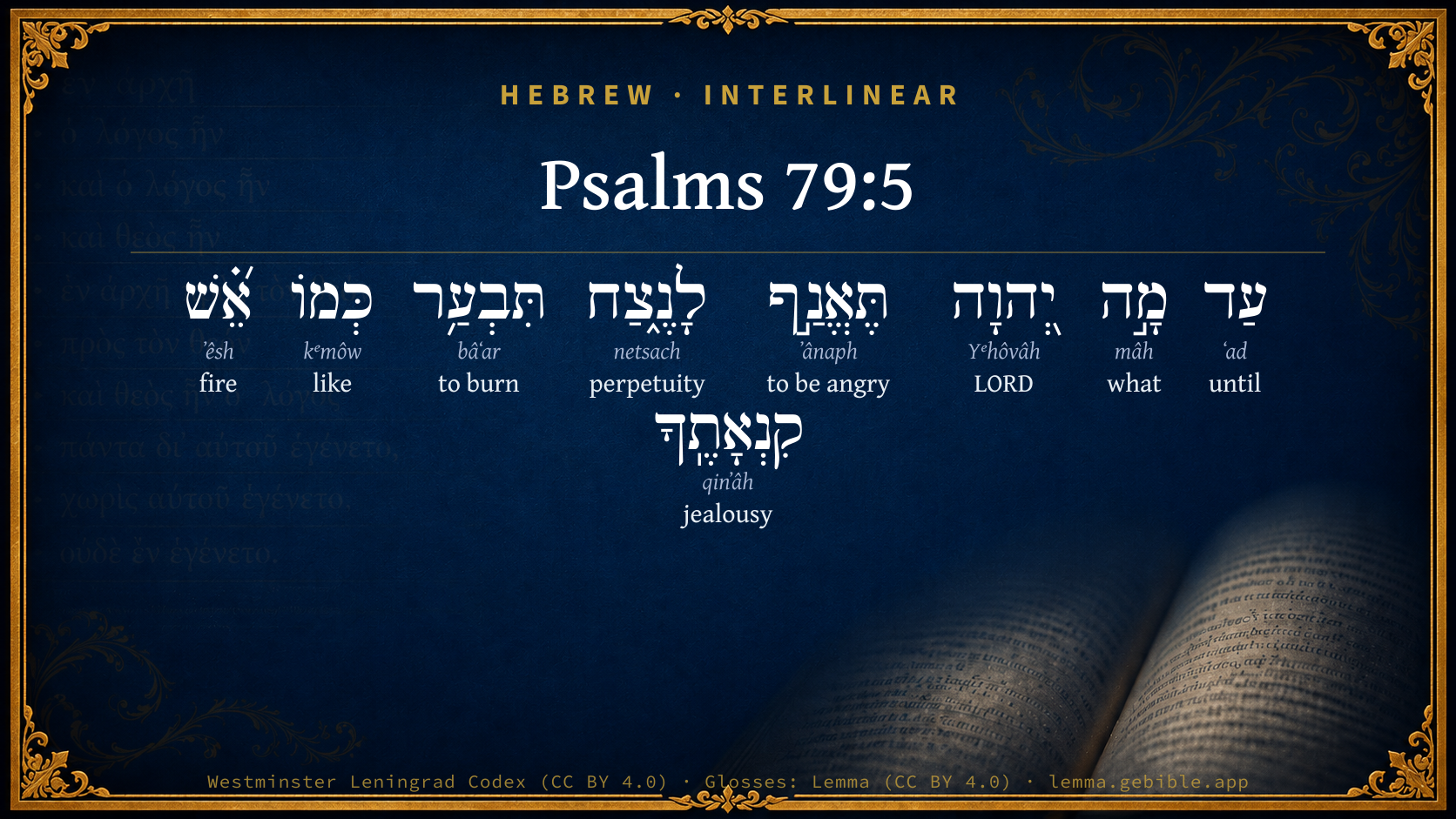
Hebrew (Westminster Leningrad Codex) Psalms 79:5 appears in the Hebrew Old Testament. The text above is from the Westminster Leningrad Codex. Each word links to its Strong’s number, a concise gloss, and parsing drawn from the Open Scriptures Hebrew Bible morphology. Click any word for its full Brown-Driver-Briggs (BDB) entry.
Download image
Cite this verse

Psalms 79:5 (World English Bible). Public Domain. Lemma interlinear Bible study tool, https://lemma.gebible.app/v/psalms/79/5.

Show BibTeX & RIS
BibTeX
RIS
English Translation
How long, Yahweh? Will you be angry forever? Will your jealousy burn like fire?
World English Bible · Public Domain
Download a study sheet

One document with this verse’s original text, its word-by-word gloss line, the meaning frame, cross-references with their text, attributed commentary, and full source and license credits — printable, and it pastes into notes with its structure intact.

This verse Autodidact and up

Study sheet (.html) Plain text (.txt)

A passage Seminary Student

Up to 50 verses in one chapter. A passage sheet keeps up to 6 commentary sources and 12 cross-references per verse, in the order this page ranks them, and says so on the sheet whenever that leaves anything out. Ask for a single verse and you get the Autodidact verse sheet above.

Everything on this page stays free to read, with no account — the sheet is a download of what is already on screen, not access to it.

Want to remove ads? Support Godless Engineer
Compare translations 3

The same verse in 3 English versions, stacked beneath the original-language interlinear above. Click any original word for its lexicon entry.

Each is an independent rendering of the whole verse — the interlinear is not word-aligned to these translations.

Highlighted words mark where these versions differ — a whole-verse word diff, not a word-by-word alignment.

  • World English Bible Public Domain
    How long, Yahweh? Will you be angry forever? Will your jealousy burn like fire?
  • King James Version Public Domain
    How long, LORD? wilt thou be angry for ever? shall thy jealousy burn like fire?
  • unfoldingWord Literal Text CC BY-SA 4.0
    Until when, Yahweh? Will you be angry forever? Will your jealousy burn like fire?

unfoldingWord Literal Text — © unfoldingWord, licensed CC BY-SA 4.0. Word-aligned USFM3 via Door43 (git.door43.org/unfoldingWord/en_ult).

Versions to compare (up to 4)

3 of 4 selected

Show all 18 translations

Every available English version of this verse, each an independent rendering of the whole verse.

  • World English Bible Public Domain
    How long, Yahweh? Will you be angry forever? Will your jealousy burn like fire?
  • Berean Standard Bible Public Domain
    How long, O LORD? Will You be angry forever? Will Your jealousy burn like fire?
  • Majority Standard Bible Public Domain
    How long, O LORD? Will You be angry forever? Will Your jealousy burn like fire?
  • King James Version Public Domain
    How long, LORD? wilt thou be angry for ever? shall thy jealousy burn like fire?
  • American Standard Version (1901) Public Domain
    How long, O Jehovah? wilt thou be angry for ever? Shall thy jealousy burn like fire?
  • Revised Version (1885) Public Domain
    How long, O LORD, wilt thou be angry for ever? shall thy jealousy burn like fire?
  • Geneva Bible (1599) Public Domain
    Lord, howe long wilt thou be angrie, for euer? shall thy gelousie burne like fire?
  • Douay-Rheims (1899) Public Domain
    How long, O Lord, wilt thou be angry for ever: shall thy zeal be kindled like a fire?
  • Young's Literal Translation Public Domain
    Till when, O Jehovah? art Thou angry for ever? Thy jealousy doth burn as fire.
  • Literal Standard Version CC BY-SA 4.0
    Until when, O YHWH? Are You angry forever? Your jealousy burns as fire.
  • Unlocked Literal Bible CC BY-SA 4.0
    How long, Yahweh? Will you stay angry forever? How long will your jealous anger burn like fire?
  • unfoldingWord Literal Text CC BY-SA 4.0
    Until when, Yahweh? Will you be angry forever? Will your jealousy burn like fire?
  • Darby Bible Public Domain
    How long, O Jehovah? wilt thou be angry for ever? Shall thy jealousy burn like fire?
  • World Messianic Bible Public Domain
    How long, LORD? Will you be angry forever? Will your jealousy burn like fire?
  • Webster's Bible Public Domain
    How long, LORD? wilt thou be angry for ever? shall thy jealousy burn like fire?
  • Free Bible Version CC BY-SA 4.0
    How long, Lord? Will you be angry with us forever? Will your jealousy always burn like fire?
  • Bible in Basic English Public Domain
    How long, O Lord? will you be angry for ever? will your wrath go on burning like fire?
  • JPS Tanakh (1917) Public Domain
    How long, O LORD, wilt Thou be angry for ever? How long will Thy jealousy burn like fire?

Literal Standard Version (2020), Covenant Press — licensed CC BY-SA 4.0. Text via the HelloAO Bible API (eBible.org). Unlocked Literal Bible (unfoldingWord) — licensed CC BY-SA 4.0. Text via the HelloAO Bible API (eBible.org). unfoldingWord Literal Text — © unfoldingWord, licensed CC BY-SA 4.0. Word-aligned USFM3 via Door43 (git.door43.org/unfoldingWord/en_ult). Free Bible Version, Dr. Jonathan Gallagher — licensed CC BY-SA 4.0. Text via the HelloAO Bible API (eBible.org).

Word by word

More ways to search: Search by grammar → Find every occurrence → Compare this word →

Practice this passage: Drill this verse → Learn its vocabulary →

About this verse

These counts appear in no published source. They are computed here, from the morphology-tagged text and Lemma’s own curated glosses. What Lemma adds →

9
words
9
distinct lemmas
Wisdom
section

Notable vocabulary

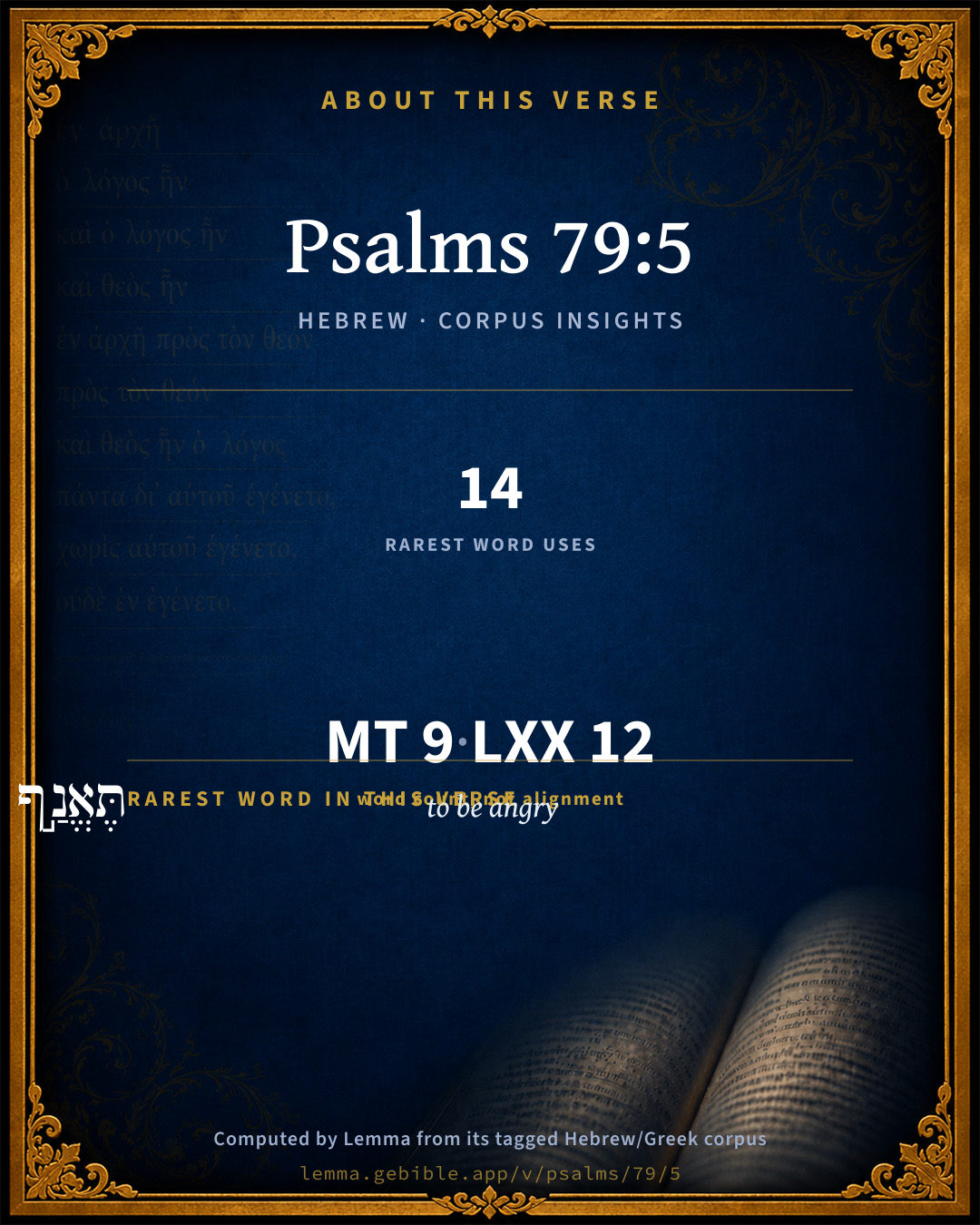
The rarest word here is תֶּאֱנַ֣ף to be angry H599 — appearing just 14 times in the whole Hebrew Bible.

Shared distinctive vocabulary

תֶּאֱנַ֣ף to be angry H599 occurs in 14 verses of the Hebrew Bible. Also found in:

Grammatical profile

  • 2 verbs
  • 4 nouns
  • 2 prepositions
  • 1 particle

Verb forms

  • תֶּאֱנַ֣ף Qal · Imperfect
  • תִּבְעַ֥ר Qal · Imperfect

Hebrew & Septuagint length

In English translation the verse runs 14 words from the Hebrew and 16 from the Septuagint (LXX English) — closely comparable.

A rough comparison of the two English renderings, which tokenize alike — not a word-level alignment.

Word counts can differ between the Hebrew and the Greek without any difference in meaning — e.g. the Hebrew direct-object marker אֵת has no separate Greek word, and Greek often adds the article ὁ.

In the original languages it is 9 Hebrew tokens and 12 Greek tokens — but the two are counted differently (Hebrew bundles its prefixes and suffixes into one token; the Greek is in lemma form), so that isn’t a like-for-like length.

Cross-references

16

Topical passages linked to Psalms 79:5 in the Treasury of Scripture Knowledge — connected by theme and wording, ordered by reader-vote popularity; previews shown in the World English Bible.

  • Psalms 89:46 How long, Yahweh? Will you hide yourself forever? Will your wrath burn like fire?
  • Psalms 74:1 God, why have you rejected us forever? Why does your anger smolder against the sheep of your pasture?
  • Psalms 85:5 Will you be angry with us forever? Will you draw out your anger to all generations?
  • Deuteronomy 29:20 Yahweh will not pardon him, but then the anger of Yahweh and his jealousy will smoke against that man, and all the curse that is written in this book shall lie on him, and Yahweh will blot out his name from under the sky.
  • Zephaniah 3:8 "Therefore wait for me," says Yahweh, "until the day that I rise up to the prey, for my determination is to gather the nations, that I may assemble the kingdoms, to pour on them my indignation, even all my fierce anger, for all the earth will be devoured with the fire of my jealousy.
  • Psalms 13:1–2 How long, Yahweh? Will you forget me forever? How long will you hide your face from me?
  • Psalms 74:9–10 We see no miraculous signs. There is no longer any prophet, Neither is there among us anyone who knows how long.
  • Psalms 80:4 Yahweh God of hosts, How long will you be angry against the prayer of your people?
  • Ezekiel 36:5 therefore thus says the Lord Yahweh: Surely in the fire of my jealousy have I spoken against the residue of the nations, and against all Edom, that have appointed my land to themselves for a possession with the joy of all their heart, with despite of soul, to cast it out for a prey.
  • Deuteronomy 32:16 They moved him to jealousy with strange [gods]; With abominations provoked they him to anger.
  • Deuteronomy 32:22 For a fire is kindled in my anger, Burns to the lowest Sheol, Devours the earth with its increase, Sets on fire the foundations of the mountains.
  • Psalms 103:9 He will not always accuse; Neither will he stay angry forever.
  • Isaiah 64:9 Don't be angry very sore, Yahweh, neither remember iniquity forever: see, look, we beg you, we are all your people.
  • Micah 7:18 Who is a God like you, who pardons iniquity, And passes over the disobedience of the remnant of his heritage? He doesn't retain his anger forever, Because he delights in loving kindness.
  • Zephaniah 1:18 Neither their silver nor their gold will be able to deliver them in the day of Yahweh's wrath, but the whole land will be devoured by the fire of his jealousy; for he will make an end, yes, a terrible end, of all those who dwell in the land.
  • Revelation 6:10 They cried with a loud voice, saying, "How long, Master, the holy and true, until you judge and avenge our blood on those who dwell on the earth?"

Cross-references courtesy of OpenBible.info (CC BY 4.0).

Hebrew and Greek witnesses Masoretic Hebrew ↔ Greek Septuagint

The same verse in the two great witnesses to the Old Testament, shown verse-for-verse.

You’re reading Greek Psalm 78 (Hebrew Psalm 79). The Septuagint counts the superscription, so verse numbers can differ from the Hebrew — chapter-level alignment, not verse-by-verse. Numbering follows Rahlfs.

These are two independent witnesses, not word-aligned to each other, and the Septuagint is shown in lemma (dictionary) form.

Hebrew Psalms 79:5 Masoretic · Westminster Leningrad Codex

עַד מָ֣ה יְ֭הוָה תֶּאֱנַ֣ף לָנֶ֑צַח תִּבְעַ֥ר כְּמוֹ אֵ֝֗שׁ קִנְאָתֶֽךָ

How long, Yahweh? Will you be angry forever? Will your jealousy burn like fire?

World English Bible · Public Domain

Greek LXX Greek Psalm 78:5 Septuagint · lemma form

ἕως πότε κύριος ὀργίζω εἰς τέλος ἐκκαύω ὡς πῦρ ὁ ζῆλος σύ

How long, O Lord? will you be angry for ever? shall your jealousy burn like fire?

LXX2012 (modern English Septuagint) · Public Domain

Hebrew: Westminster Leningrad Codex (CC BY 4.0). Greek: Septuagint (public domain); English from LXX2012 (modern English Septuagint) (Public Domain). How the Septuagint differs from the Hebrew →

Commentary

Notes on Psalms 79:5 from classic Christian and Jewish commentators (each source and its license shown beneath its notes). The classic Christian expositions comment on the surrounding passage and are grouped to its opening verse, so a note may address several verses; the Jewish commentaries on the Tanakh (Rashi and others) are per-verse, so they appear only where the commentator wrote on this verse.

Lemma curates 59 commentaries, every one of them public domain or Creative Commons licensed, each selected and text-cleaned for this edition rather than reprinted as found. About our sources →

Trapp's Complete Commentary

John Trapp

Psa 79:5 How long, LORD? wilt thou be angry for ever? shall thy jealousy burn like fire?

Ver. 5. How long wilt thou be angry? &c.] Or, how long? wilt thou be angry for ever? The psalmist knew that the enemies were but God’s executioners; and that if he were but once pacified, they should soon be put out of office.

Shall thy jealousy] viz. For our idolatry, Exo 20:3-5

John Trapp, A Commentary or Exposition upon All the Books of the Old and New Testament (1647–1656) — public domain. Text from a community e-Sword module.

J. A. Alexander on Psalms

Joseph Addison Alexander

5. (Psa 79:5) Unto what (point), until when, how long, Jehovah, wilt thou be angry for ever, will burn like fire thy zeal (or jealousy)? With the first clause compare Psa 13:1; Psa 74:1; Psa 74:10; with the second, Exo 20:5, Deu 29:20, Psa 78:58.

Joseph Addison Alexander, The Psalms Translated and Explained (1850) — public domain. Text from a community e-Sword module.

Tyndale Open Study Notes

Tyndale Open Resources

79:5-8 The intensity of God’s judgment surprises the people; they cry out in despair for compassion, forgiveness, and relief. Verses 6-7 are repeated almost verbatim in Jer 10:25.

Tyndale Open Study Notes — © Tyndale Open Resources, licensed CC BY-SA 4.0. Text via the HelloAO Bible API.

Geneva Bible (1599)

Geneva Bible translators

Wilt thou utterly consume us for our sins, before thou takest us to mercy?

Geneva Bible (1599) marginal notes — public domain. Text via Bolls.life.

Adam Clarke's Commentary

Verse 5. How long, Lord?] Wilt thou continue thine anger against us, and suffer us to be insulted, and thyself blasphemed?

Adam Clarke's Commentary on the Bible (1810–1826) — public domain. Text from a community e-Sword/MySword module.

John Calvin's Commentaries

5 How long, O Jehovah! wilt thou be wroth for ever? I have already observed that these two expressions, how long and for ever, when joined together, denote a lengthened and an uninterrupted continuance of calamities; and that there is no appearance, when looking to the future, of their coming to a termination. We may, therefore, conclude that this complaint was not ended within a month or two after persecution against the Church commenced, but at a time when the hearts of the faithful were almost broken through the weariness produced by prolonged suffering. Here they confess that the great accumulation of calamities with which they are overwhelmed, is to be traced to the wrath of God. Being fully persuaded that the wicked, whatever they may plot, cannot inflict injury, except in so far as God permits them — from this, which they regard as an indubitable principle, they at once conclude, that when he allows such ample scope to their heathen enemies in persecuting them, his anger is greatly provoked. Nor would they, without this persuasion, have looked to God in the hope that he would stretch forth his hand to save them; for it is the work of Him who hath given loose reins to draw in the bridle. Whenever God visits us with the rod, and our own conscience accuses us, it especially becomes us to look to His hand. Here his ancient people do not charge him with being unjustly displeased, but acknowledge the justice of the punishment inflicted upon them. God will always find in his servants just grounds for chastising them. He often, however, in the exercise of his mercy, pardons their sins, and exercises them with the cross for another purpose than to testify his displeasure against their sins, just as it was his will to try the patience of Job, and as he vouchsafed to call the martyrs to an honorable warfare. But here the people, of their own accord, summoning themselves before the Divine tribunal, trace the calamities which they endured to their own sins, as the procuring cause. Hence it may, with probability, be conjectured that this psalm was composed during the time of the Babylonish captivity. Under the tyranny of Antiochus Epiphanes, they employed, as we have previously seen, a different form of prayer, saying,

“All this is come upon us; yet have we not forgotten thee, neither have we dealt falsely in thy covenant. Our heart is not turned back, neither have our steps declined from thy way,” (Psalm 44:17, 18.)

We are not to suppose that, in the passage now quoted, the faithful murmured against God, but they employ this language because they knew that he had another end in view than simply to punish their sins; for, by means of these severe conflicts, he prepared them for the prize of their high calling.

John Calvin's Commentaries (1540-1563) — public domain. Text from the Calvin Translation Society English edition (1840s-50s) via the Christian Classics Ethereal Library (ccel.org). Calvin's coverage is partial (roughly two-thirds of the Bible); uncommented books and verses are honest gaps, never fabricated. The 19th-century editor's footnotes and remarks are omitted so the notes are faithfully Calvin's own voice.

Ellicott's Commentary for English Readers

(5) How long, Lord?—The dominant cry of the Maccabæan age. (See Psa_74:9.)

A Bible Commentary for English Readers, edited by Charles John Ellicott (1878–1897) — public domain. Text from a community e-Sword module.

The Cambridge Bible for Schools and Colleges

gen. ed. J. J. S. Perowne

5. How long, Jehovah, wilt thou be angry for ever?

(How long) shall thy jealousy burn like fire?

As in Psa_13:1, faith combines two questions into a self-contradictory expression. How long and for ever are characteristic words of Psalms 74 (Psa_74:1; Psa_74:10; Psa_74:19). Cp. Psa_80:4; Psa_89:46.

Shall thy jealousy burn like fire] “Jehovah thy God is a devouring fire, a jealous God” (Deu_4:24). He cannot endure a divided allegiance, and must punish Israel for its sin. Cp. Deu_29:20; Zep_1:18.

5–8. Prayer that God will cease to be angry with His own people and will punish their destroyers.

The Cambridge Bible for Schools and Colleges (gen. ed. J. J. S. Perowne; Cambridge University Press, 1878–1918) — public domain. Text from a community e-Sword module.

John Gill's Exposition

How long, Lord, wilt thou be angry? for ever?.... That is, how long wilt thou be angry? shall it be for ever? see Psa 85:4, for though what was done, or to be done, as before related, was or will be done by the enemies of the Lord's people, yet by his permission, and as a token of his anger and displeasure against them: at least it might be so understood, both by them and by their enemies; and hence this expostulation,

shall thy jealousy burn like fire? so jealousy does; its coals are coals of fire, Sol 8:6, there were, at the times referred to, such among the people, who did evil things, and provoked the Lord to jealousy and wrath: see the Apocrypha:

"And there was very great wrath upon Israel.'' (1 Maccabees 1:64)

"When this was done, and they had made a common supplication, they besought the merciful Lord to be reconciled with his servants for ever.'' (2 Maccabees 8:29)

John Gill's Exposition of the Whole Bible (1746–1763) — public domain (CC PDM 1.0). Text via the HelloAO Bible API.

Albert Barnes' Notes on the Bible

How long, Lord? - See Psa 74:1, note; Psa 74:10, note; and Psa 77:7-9, notes. This is the language, not of impatience, but of anxiety; not of complaining, but of wonder. It is language such as the people of God are often constrained to employ under heavy trials - trials which continue so long that it seems as if they would never end.

Shall thy jealousy, burn like fire? - That is, Shall it continue to burn like fire? Shall it utterly consume us? On the word jealousy, see the notes at Psa 78:58.

Albert Barnes' Notes on the Bible (1834–1885) — public domain. Text from a community e-Sword/MySword module.

The Treasury of David

Charles H. Spurgeon

Ver. 5. "How long, Lord?" Will there be no end to these chastisements? They are most sharp and overwhelming; wilt thou much longer continue them?

"Wilt thou be angry for ever?" Is thy mercy gone so that thou wilt for ever smite?

"Shall thy jealousy burn like fire?" There was great cause for the Lord to be jealous, since idols had been set up, and Israel had gone aside from his worship, but the psalmist begs the Lord not to consume his people utterly as with fire, but to abate their woes.

Whole Psalm. See Psalms on "Ps 79:1" for further information.

Ver. 5. "How long, Lord? Wilt thou be angry for ever?" The voice of complaint says not, How long, Lord, shall this wickedness of our enemy endure? How long shall we see this desolation? But, How long, O Lord? Wilt thou be angry for ever? We are admonished, therefore, in this passage, that we should recognize the anger of God against us in all our afflictions, lest as the nations are accustomed, we only accuse the malice of our enemies, and never think of our sins and the divine punishment. It cannot be that he who acknowledges the anger of God that is upon him, should not at the same time acknowledge his fault also, unless he wishes to attribute the iniquity to God of being angry and inflicting stripes upon the undeserving. Musculus.

Ver. 5. The word "jealousy" signifies not mere revenge but revenge mingled with love, for unless he loved, says Jerome, he would not be jealous, and after the manner of a husband avenge the sin of his wife. Lorinus.

Ver. 5.

I. The cause of anger: jealousy.

II. The moderation of it. If it continued for ever, the

people would perish, the promises be unfulfilled, the

covenant fail, and the Lord's honour be impeached.

III. The staying of it. By prayer; by pleading his name,

his glory, and the blood of Jesus.

Psalms 79:6*

Charles H. Spurgeon's The Treasury of David (1869–1885) — public domain. Psalms only. Text from a community e-Sword/MySword module.

Whedon's Commentary on the Bible

Daniel D. Whedon

5. How long, Lord—The “how long” and for ever would here seem to imply that the affliction had now been of long duration. Time dragged heavily under this trying dispensation of wrath.

Daniel D. Whedon (gen. ed.), Commentary on the Old and New Testaments (1874–1909) — public domain. Text from a community e-Sword module.

The Pulpit Commentary

How long, Lord? i.e. "How long, O Lord, is this condition of things to endure?". (comp. Psa_6:5 Psa_90:13 Rev_6:10) An ellipse after "how long?" is common. Wilt thou be angry forever?. (see Psa_13:1 Psa_74:12 Lam_5:20) Shall thy jealousy burn like fire? It was their worship of other gods that God especially visited on his people by the Babylonish captivity (see Jeremiah, passim).

Expected limitations of the Divine wrath.

"How long, O Jehovah, wilt thou be angry forever?" The duration of Divine judgment may seem long to pious feeling; it is known not to be long, when faith begins to read it aright. The Divine wrath is ever in the control of the Divine righteousness and the Divine love. There is no personal feeling in it. When its ends are reached, the Divine wrath is satisfied. God"s people may comfort themselves with the assurance that there are three limitations always being put on the Divine wrath.

I THE DIVINE HONOUR. Of that honour God is jealous. We may be quite sure that he will never act, or continue to act, in such ways as would reasonably give men wrong thoughts concerning him. Take one thing: the good man may be quite sure that God will never so act as to produce impressions of personal vindictiveness. We may not think of God as "hating" anything that he has made. His judgments are official, parts of the wise ordering of his kingdom. No man could have high ideas of the Divine honour who failed to realize the strict limitations of the Divine wrath. Judgments on frail men could not honour the God of righteousness and love, if they were continued forever. They end when their object is gained.

II THE DIVINE PURPOSE. This too must be seen to be official, not personal. The well being of the creature, not his own pleasure, we are to regard as the purpose ever set before God. It is, however, a moral purpose concerning a moral being; and call be best represented by the aims cherished in the family life. Parents hold ever before them the good manhood and womanhood of their children; and in their efforts to secure these things, strict limitations have to be put on times of wrath and judgment. If God"s purpose is to fit us to be with him, and to have us with him, his anger can but be a "hiding of his face for a little moment;" it cannot be forever. If God"s purpose is our betterment, no agency used by him can be unduly continued. If it were, "our souls would fail before him." Illustrate from the Church in the wilderness; the times of the prophets; such Christian times as the age of our Queen Mary. The Divine purpose of dispensations of wrath must be fully accomplished; and therefore troubles, calamities, and persecutions may have to stay wearyingly long, until the souls of the martyred cry out, "How long, O Lord, how long!" But God has the long ages to work in, and his purposes are ever "ripening fast, unfolding every hour.

III THE DIVINE PITY. The psalmist found comfort in thinking of this. "He knoweth our frame, he remembereth that we are dust." His judgments and his chastisements are always strictly limited to that which we are able to bear. There is something very like untrustfulness in the plaint of our text. He who is sure of the Divine pity and love has no voice in which to utter the fear that his judgments can be forever. R.T.

The Pulpit Commentary (1880–1919), ed. H.D.M. Spence-Jones & Joseph S. Exell — public domain. Text from a community e-Sword module.

Keil & Delitzsch

C. F. Keil & F. Delitzsch

Out of the plaintive question how long? and whether endlessly God would be angry and cause His jealousy to continue to burn like a fire (Deu 32:22), grows up the prayer (Psa 79:6) that He would turn His anger against the heathen who are estranged from the hostile towards Him, and of whom He is now making use as a rod of anger against His people. The taking over of Psa 79:6-7 from Jer 10:25 is not betrayed by the looseness of the connection of thought; but in themselves these four lines sound much more original in Jeremiah, and the style is exactly that of this prophet, cf. Jer 6:11; Jer 2:3, and frequently, Psa 49:20. The אל, instead of על, which follows שׁפך is incorrect; the singular אכל gathers all up as in one mass, as in Isa 5:26; Isa 17:13. The fact that such power over Israel is given to the heathen world has its ground in the sins of Israel. From Psa 79:8 it may be inferred that the apostasy which raged earlier is now checked. ראשׁנים is not an adjective (Job 31:28; Isa 59:2), which would have been expressed by עונותינו חראשׁנים, but a genitive: the iniquities of the forefathers (Lev 26:14, cf. Psa 39:1-13). On Psa 79:8 of Jdg 6:6. As is evident from Psa 79:9, the poet does not mean that the present generation, itself guiltless, has to expiate the guilt of the fathers (on the contrary, Deu 24:16; Kg2 14:6; Eze 18:20); he prays as one of those who have turned away from the sins of the fathers, and who can now no longer consider themselves as placed under wrath, but under sin-pardoning and redeeming grace.

Keil & Delitzsch — Biblical Commentary on the Old Testament (1861–1891) — public domain (CC PDM 1.0). Text via the HelloAO Bible API. (Old Testament only.)

Rashi

Rabbi Shlomo Yitzchaki (Rashi)

How long Heb. עד מה [lit. until what.] Until when?

Your jealousy Your wrath,

that You are jealous to wreak vengeance, an expression of (Exod. 20:5): “a jealous (קנא) God,” emportement or enprenemant in Old French, zealous anger.

Rashi on the Tanakh — English translations: “The Judaica Press complete Tanach with Rashi, translated by A. J. Rosenberg” (CC BY 4.0); “Pentateuch with Rashi's commentary by M. Rosenbaum and A.M. Silbermann, 1929-1934” (public domain); “The Metsudah Tanach series, Lakewood, N.J” (CC BY 4.0); and “The Book of Joshua, Metsudah Publications, 1997” (CC BY 4.0). Text via Sefaria.

Lesson kit

Teaching starters — assembled from the data on this page, not authored interpretation. Every prompt links to the verse data it draws on. Edit before teaching.

Psalms, in the Wisdom, opens this verse with 9 words (9 distinct Hebrew lemmas). Its most distinctive word is ʼânaph (“to be angry”). A historical commentator’s framing appears above. Read the whole chapter for the surrounding context.

Discussion questions

  1. How does “to be angry” (ʼânaph) shape what this verse is saying?
  2. How does Deuteronomy 1:37, which shares the word «to be angry», read alongside this verse?
  3. The translations on this page render this verse differently — a whole-verse word diff, not a word-by-word alignment. What might account for the different wordings?
  4. «תֶּאֱנַ֣ף» is a Qal Imperfect verb. How does that grammatical form shape the action described?
  5. Compare how Trapp's Complete Commentary and J. A. Alexander on Psalms read this verse. Where do they agree or differ?

Things to notice

Reading settings

Reading text

Shown beneath each verse's original-language words.

Old Testament
Old Testament edition

Read the OT as the Masoretic Hebrew (MT) or the Greek Septuagint (LXX).

English shown for the Greek Septuagint (in the Hebrew ↔ Greek comparison).

Comparing translations? Open the Compare panel on any verse page to stack up to four side by side.