
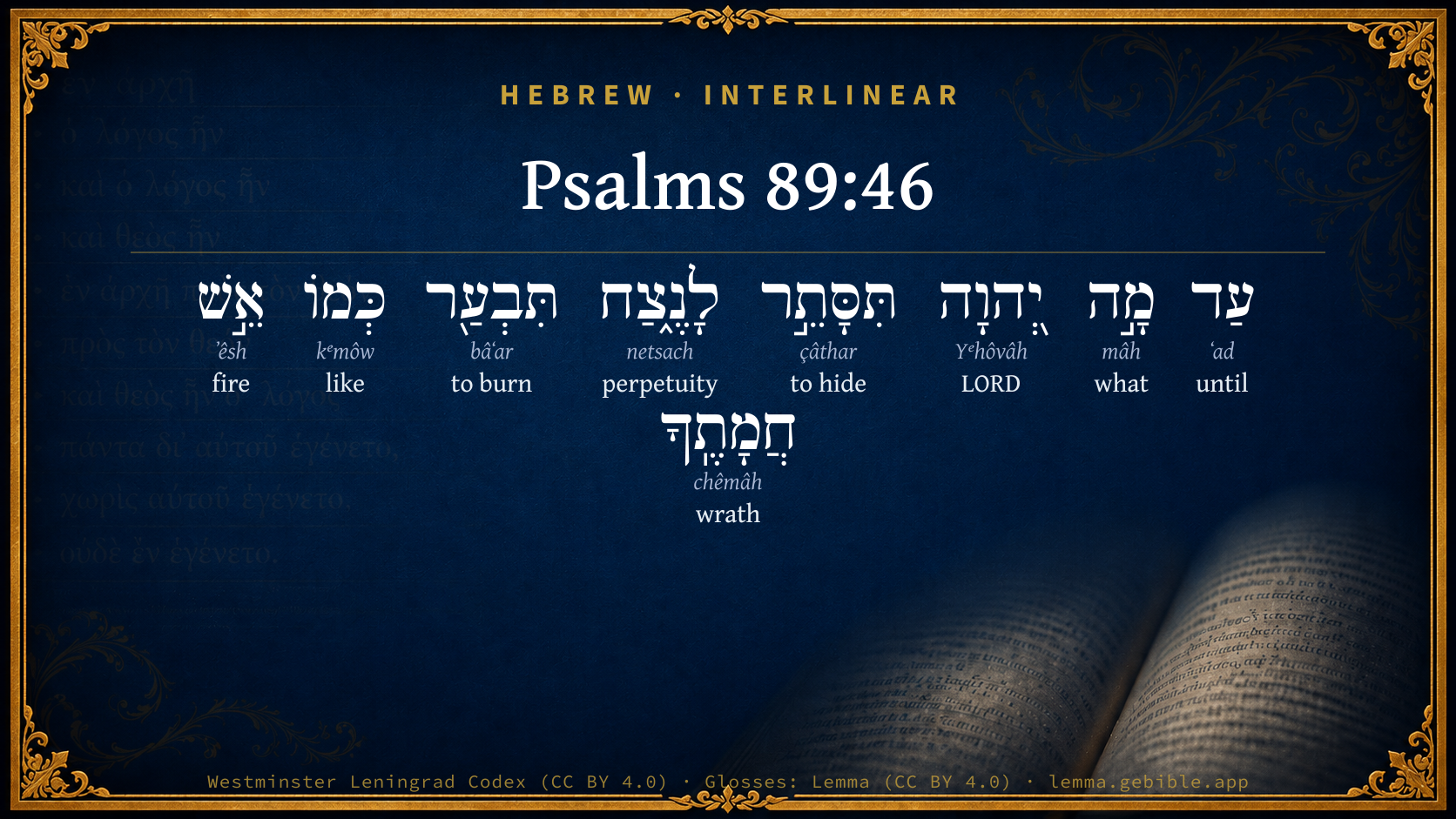
Psalms 89:46

Hebrew (Westminster Leningrad Codex) Psalms 89:46 appears in the Hebrew Old Testament. The text above is from the Westminster Leningrad Codex. Each word links to its Strong’s number, a concise gloss, and parsing drawn from the Open Scriptures Hebrew Bible morphology. Click any word for its full Brown-Driver-Briggs (BDB) entry.
Download image
Cite this verse

Psalms 89:46 (World English Bible). Public Domain. Lemma interlinear Bible study tool, https://lemma.gebible.app/v/psalms/89/46.

Show BibTeX & RIS
BibTeX
RIS
English Translation
How long, Yahweh? Will you hide yourself forever? Will your wrath burn like fire?
World English Bible · Public Domain
Download a study sheet

One document with this verse’s original text, its word-by-word gloss line, the meaning frame, cross-references with their text, attributed commentary, and full source and license credits — printable, and it pastes into notes with its structure intact.

This verse Autodidact and up

Study sheet (.html) Plain text (.txt)

A passage Seminary Student

Up to 50 verses in one chapter. A passage sheet keeps up to 6 commentary sources and 12 cross-references per verse, in the order this page ranks them, and says so on the sheet whenever that leaves anything out. Ask for a single verse and you get the Autodidact verse sheet above.

Everything on this page stays free to read, with no account — the sheet is a download of what is already on screen, not access to it.

Want to remove ads? Support Godless Engineer
Compare translations 3

The same verse in 3 English versions, stacked beneath the original-language interlinear above. Click any original word for its lexicon entry.

Each is an independent rendering of the whole verse — the interlinear is not word-aligned to these translations.

Highlighted words mark where these versions differ — a whole-verse word diff, not a word-by-word alignment.

  • World English Bible Public Domain
    How long, Yahweh? Will you hide yourself forever? Will your wrath burn like fire?
  • King James Version Public Domain
    How long, LORD? wilt thou hide thyself for ever? shall thy wrath burn like fire?
  • unfoldingWord Literal Text CC BY-SA 4.0
    Until when, Yahweh? Will you hide yourself forever? Will your wrath burn like fire?

unfoldingWord Literal Text — © unfoldingWord, licensed CC BY-SA 4.0. Word-aligned USFM3 via Door43 (git.door43.org/unfoldingWord/en_ult).

Versions to compare (up to 4)

3 of 4 selected

Show all 18 translations

Every available English version of this verse, each an independent rendering of the whole verse.

  • World English Bible Public Domain
    How long, Yahweh? Will you hide yourself forever? Will your wrath burn like fire?
  • Berean Standard Bible Public Domain
    How long, O LORD? Will You hide Yourself forever? Will Your wrath keep burning like fire?
  • Majority Standard Bible Public Domain
    How long, O LORD? Will You hide Yourself forever? Will Your wrath keep burning like fire?
  • King James Version Public Domain
    How long, LORD? wilt thou hide thyself for ever? shall thy wrath burn like fire?
  • American Standard Version (1901) Public Domain
    How long, O Jehovah? wilt thou hide thyself for ever? `How long' shall thy wrath burn like fire?
  • Revised Version (1885) Public Domain
    How long, O LORD, wilt thou hid thyself for ever? how long shall thy wrath burn like fire?
  • Geneva Bible (1599) Public Domain
    Lord, howe long wilt thou hide thy selfe, for euer? shall thy wrath burne like fire?
  • Douay-Rheims (1899) Public Domain
    Thou hast shortened the days of his time: thou hast covered him with confusion.
  • Young's Literal Translation Public Domain
    Till when, O Jehovah, art Thou hidden? For ever doth Thy fury burn as fire?
  • Literal Standard Version CC BY-SA 4.0
    Until when, O YHWH, are You hidden? Does Your fury burn as fire forever?
  • Unlocked Literal Bible CC BY-SA 4.0
    How long, Yahweh? Will you hide yourself, forever? How long will your anger burn like fire?
  • unfoldingWord Literal Text CC BY-SA 4.0
    Until when, Yahweh? Will you hide yourself forever? Will your wrath burn like fire?
  • Darby Bible Public Domain
    How long, Jehovah, wilt thou hide thyself for ever? shall thy fury burn like fire?
  • World Messianic Bible Public Domain
    How long, LORD? Will you hide yourself forever? Will your wrath burn like fire?
  • Webster's Bible Public Domain
    \\89:45\\The days of his youth hast thou shortened: thou hast covered him with shame. Selah.
  • Free Bible Version CC BY-SA 4.0
    How long, Lord? Will you hide yourself from us forever, your anger burning like fire?
  • Bible in Basic English Public Domain
    How long, O Lord, will you Keep yourself for ever from our eyes? how long will your wrath be burning like fire?
  • JPS Tanakh (1917) Public Domain
    (89-47) How long, O LORD, wilt Thou hide Thyself for ever? How long shall Thy wrath burn like fire?

Literal Standard Version (2020), Covenant Press — licensed CC BY-SA 4.0. Text via the HelloAO Bible API (eBible.org). Unlocked Literal Bible (unfoldingWord) — licensed CC BY-SA 4.0. Text via the HelloAO Bible API (eBible.org). unfoldingWord Literal Text — © unfoldingWord, licensed CC BY-SA 4.0. Word-aligned USFM3 via Door43 (git.door43.org/unfoldingWord/en_ult). Free Bible Version, Dr. Jonathan Gallagher — licensed CC BY-SA 4.0. Text via the HelloAO Bible API (eBible.org).

Word by word

More ways to search: Search by grammar → Find every occurrence → Compare this word →

Practice this passage: Drill this verse → Learn its vocabulary →

About this verse

These counts appear in no published source. They are computed here, from the morphology-tagged text and Lemma’s own curated glosses. What Lemma adds →

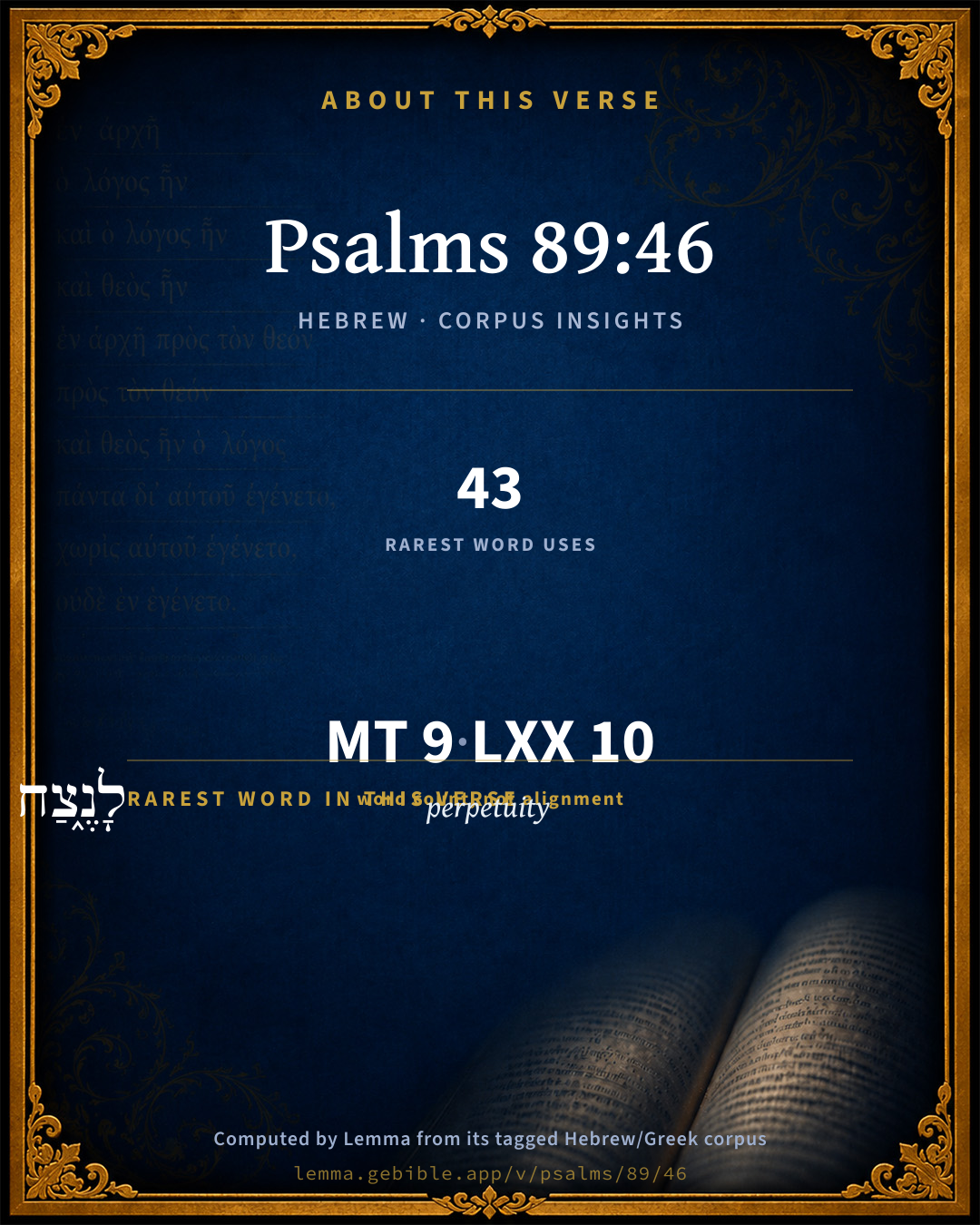
9
words
9
distinct lemmas
Wisdom
section

Shared distinctive vocabulary

לָנֶ֑צַח perpetuity H5331 occurs in 42 verses of the Hebrew Bible. Also found in:

Grammatical profile

  • 2 verbs
  • 4 nouns
  • 2 prepositions
  • 1 particle

Verb forms

  • תִּסָּתֵ֣ר Niphal · Imperfect
  • תִּבְעַ֖ר Qal · Imperfect

Hebrew & Septuagint length

In English translation the verse runs 14 words from the Hebrew and 17 from the Septuagint (LXX English) — closely comparable.

A rough comparison of the two English renderings, which tokenize alike — not a word-level alignment.

Word counts can differ between the Hebrew and the Greek without any difference in meaning — e.g. the Hebrew direct-object marker אֵת has no separate Greek word, and Greek often adds the article ὁ.

In the original languages it is 9 Hebrew tokens and 10 Greek tokens — but the two are counted differently (Hebrew bundles its prefixes and suffixes into one token; the Greek is in lemma form), so that isn’t a like-for-like length.

Cross-references

15

Topical passages linked to Psalms 89:46 in the Treasury of Scripture Knowledge — connected by theme and wording, ordered by reader-vote popularity; previews shown in the World English Bible.

  • Psalms 79:5 How long, Yahweh? Will you be angry forever? Will your jealousy burn like fire?
  • Psalms 78:63 Fire devoured their young men; Their virgins had no wedding song.
  • Psalms 88:14 Yahweh, why do you reject my soul? Why do you hide your face from me?
  • Psalms 90:13 Relent, Yahweh! How long? Have compassion on your servants!
  • Job 23:9 He works to the north, but I can't see him; He turns south, but I can't catch a glimpse of him.
  • Psalms 10:1 Why do you stand far off, Yahweh? Why do you hide yourself in times of trouble?
  • Psalms 13:1–2 How long, Yahweh? Will you forget me forever? How long will you hide your face from me?
  • Psalms 85:5 Will you be angry with us forever? Will you draw out your anger to all generations?
  • Isaiah 8:17 I will wait for Yahweh, who hides his face from the house of Jacob, and I will look for him.
  • Isaiah 45:15 Most assuredly you are a God who hid yourself, God of Israel, the Savior.'
  • Jeremiah 4:4 Circumcise yourselves to Yahweh, and take away the foreskins of your heart, you men of Judah and inhabitants of Jerusalem; lest my wrath go forth like fire, and burn so that none can quench it, because of the evil of your doings.
  • Jeremiah 21:12 House of David, thus says Yahweh, Execute justice in the morning, and deliver him who is robbed out of the hand of the oppressor, lest my wrath go forth like fire, and burn so that none can quench it, because of the evil of your doings.
  • Hosea 5:15 I will go and return to my place, until they acknowledge their offense, And seek my face. In their affliction they will seek me earnestly."
  • 2 Thessalonians 1:8 giving vengeance to those who don't know God, and to those who don't obey the Gospel of our Lord Jesus,
  • Hebrews 12:29 for our God is a consuming fire.

Cross-references courtesy of OpenBible.info (CC BY 4.0).

Hebrew and Greek witnesses Masoretic Hebrew ↔ Greek Septuagint

The same verse in the two great witnesses to the Old Testament, shown verse-for-verse.

You’re reading Greek Psalm 88 (Hebrew Psalm 89). The Septuagint counts the superscription, so verse numbers can differ from the Hebrew — chapter-level alignment, not verse-by-verse. Numbering follows Rahlfs.

These are two independent witnesses, not word-aligned to each other, and the Septuagint is shown in lemma (dictionary) form.

Hebrew Psalms 89:46 Masoretic · Westminster Leningrad Codex

עַד מָ֣ה יְ֭הוָה תִּסָּתֵ֣ר לָנֶ֑צַח תִּבְעַ֖ר כְּמוֹ אֵ֣שׁ חֲמָתֶֽךָ

How long, Yahweh? Will you hide yourself forever? Will your wrath burn like fire?

World English Bible · Public Domain

Greek LXX Greek Psalm 88:46 Septuagint · lemma form

σμικρύνω ὁ ἡμέρα ὁ χρόνος αὐτός καταχέω αὐτός αἰσχύνη διάψαλμα

How long, O Lord, will you turn away, for ever? shall your anger flame out as fire?

LXX2012 (modern English Septuagint) · Public Domain

Hebrew: Westminster Leningrad Codex (CC BY 4.0). Greek: Septuagint (public domain); English from LXX2012 (modern English Septuagint) (Public Domain). How the Septuagint differs from the Hebrew →

Commentary

Notes on Psalms 89:46 from classic Christian and Jewish commentators (each source and its license shown beneath its notes). The classic Christian expositions comment on the surrounding passage and are grouped to its opening verse, so a note may address several verses; the Jewish commentaries on the Tanakh (Rashi and others) are per-verse, so they appear only where the commentator wrote on this verse.

Lemma curates 59 commentaries, every one of them public domain or Creative Commons licensed, each selected and text-cleaned for this edition rather than reprinted as found. About our sources →

Trapp's Complete Commentary

John Trapp

Psa 89:46 How long, LORD? wilt thou hide thyself for ever? shall thy wrath burn like fire?

Ver. 46. How long, Lord? &c.] Here faith prevaileth against flesh, and falleth a praying, and at length a praising God.

John Trapp, A Commentary or Exposition upon All the Books of the Old and New Testament (1647–1656) — public domain. Text from a community e-Sword module.

J. A. Alexander on Psalms

Joseph Addison Alexander

47. (Psa 89:46) How long, Jehovah, wilt thou hide thyself for ever? (How long) shall burn, like fire, thy wrath? On the doubtful construction of the first clause, and the meaning of the combination, how long for ever, see above, on Psa 13:1; Psa 79:5. How long, literally until what, i.e. until what point (how far), or until what time (how long)"?

Joseph Addison Alexander, The Psalms Translated and Explained (1850) — public domain. Text from a community e-Sword module.

Tyndale Open Study Notes

Tyndale Open Resources

89:46-47 The psalmist wonders if he will live to see the end of the Lord’s anger. Our lifetimes are short, like a day in the Lord’s sight (90:4, 10).

Tyndale Open Study Notes — © Tyndale Open Resources, licensed CC BY-SA 4.0. Text via the HelloAO Bible API.

Geneva Bible (1599)

Geneva Bible translators

The Prophet in joining prayer with his complaint, showeth that his faith never failed.

Geneva Bible (1599) marginal notes — public domain. Text via Bolls.life.

Adam Clarke's Commentary

Verse 46. How long, Lord?] The promise cannot utterly fail. When then, O Lord, wilt thou restore the kingdom to Israel?

Adam Clarke's Commentary on the Bible (1810–1826) — public domain. Text from a community e-Sword/MySword module.

John Calvin's Commentaries

46. How long, O Jehovah? wilt thou hide thyself for ever? After having poured forth his complaints respecting the sad and calamitous condition of the Church, the Psalmist now turns himself to prayer. Whence it follows that the language of lamentation to which he had hitherto given utterance, although it emanated from carnal sense, was nevertheless conjoined with faith. Unbelievers, in the agitation of trouble, may sometimes engage in prayer, yet whatever they ask proceeds from feigned lips. But the prophet, by connecting prayer with his complaints, bears testimony that he had never lost his confidence in the truth of the Divine promises. With respect to this manner of expression, How long, for ever? we have spoken on Psalm 79:5, where we have shown that it denotes a long and continued succession of calamities. Moreover, by asking How long God will hide himself, he tacitly intimates that all will be well as soon as God is pleased to look upon his chosen people with a benignant countenance. In the second clause of the verse, he again mentions as the reason why God did not vouchsafe to look upon them with paternal favor, that his anger was incensed against them. The obvious conclusion from which is, that all the afflictions endured by us proceed from our sins; these being the scourges of an offended God.

John Calvin's Commentaries (1540-1563) — public domain. Text from the Calvin Translation Society English edition (1840s-50s) via the Christian Classics Ethereal Library (ccel.org). Calvin's coverage is partial (roughly two-thirds of the Bible); uncommented books and verses are honest gaps, never fabricated. The 19th-century editor's footnotes and remarks are omitted so the notes are faithfully Calvin's own voice.

Ellicott's Commentary for English Readers

(46) How long.—With this persistent cry of the Maccabæan age (see Psa_74:10), the poet shows that faith is not extinct, though it has a sore struggle with despair.

A Bible Commentary for English Readers, edited by Charles John Ellicott (1878–1897) — public domain. Text from a community e-Sword module.

The Cambridge Bible for Schools and Colleges

gen. ed. J. J. S. Perowne

46. How long, Jehovah, wilt thou hide thyself for ever?

(How long) shall thy wrath burn like fire?

A repetition of Psa_79:5, with slight variations.

46–51. The Psalmist appeals to God to withdraw His wrath and remove this contradiction, pleading the shortness of life and the taunts of God’s enemies as grounds for a speedy answer.

The Cambridge Bible for Schools and Colleges (gen. ed. J. J. S. Perowne; Cambridge University Press, 1878–1918) — public domain. Text from a community e-Sword module.

John Gill's Exposition

Remember how short my time is,.... In this world man's time here is fixed, and it is but a short time; his life is but a vapour, which appeareth for a little while; his days are as an hand's breadth; they pass away like a tale that is told; the common term of life is but threescore years and ten, and few arrive to that: to know and observe this is proper and useful; it may awaken a concern for a future state, excite to a vigorous discharge of duty, and animate to patience under afflictions: the clause in connection with the preceding verse seems to be a plea for mercy; that, since time was short, it might not be consumed in bearing the wrath of God; but be spent in peace and comfort, like that of Job 10:20, Compare with this Psa 103:13, the Targum is,

"remember that I am created out of the dust:''

but these words, with what follow, are the words of the psalmist, representing the apostles of Christ, and other saints, at the time of his sufferings and death, and when under the power of the grave, and when they were almost out of hope of his resurrection: see Luk 24:21, expostulating with the Lord on that account; and here entreat him to remember the shortness of their time, if there was no resurrection from the dead, as there would be none if Christ rose not; and therefore, as their life was a short one, it would be of all men's the most miserable:

wherefore hast thou made all men in vain? none of the sons of men are made in vain; for they are all made for the glory of God, which end is answered, some way or another, in everyone of them; either in the salvation of them by Christ, or in the just destruction of them through their own sin; and though the time of life is short, and afflictions many, yet men are not made in vain, and especially those of them who believe in Christ; for, for them to live is Christ, they live to his glory: whether they live a longer or shorter time, they live to the Lord; and when they die, they die to him; and their afflictions are always for good, temporal, or spiritual, and eternal: indeed, if there was no future state after this, men might seem to be made in vain, and there might be some reason for such a question or complaint; but so it is not; there is an immortal life and state after this, either of bliss or woe: also, if there was no such thing as the redemption, justification, and salvation of any of the sons of men, through the sufferings and death of Christ, and which could not be without his resurrection from the dead, with a view to which the question is put, then there would seem some room for it; but there is a redemption of them, and therefore are not made in vain; and Christ, who was delivered for their offences, is risen for their justification.

John Gill's Exposition of the Whole Bible (1746–1763) — public domain (CC PDM 1.0). Text via the HelloAO Bible API.

Albert Barnes' Notes on the Bible

How long, Lord? - How long is this to continue? Can it be that this is to continue always? Is there to be no change for the better? Are the promises which have been made, never to be fulfilled? Compare Psa 13:1, note; Psa 77:7-9, notes.

Wilt thou hide thyself for ever? - Thy favor. Wilt thou never come forth and manifest thyself as the Helper of those who trust in thee?

Shall thy wrath burn like fire? - Fire which entirely consumes; fire which never ceases as long as there is anything to burn; fire which never puts itself out, but which wholly destroys that on which it preys.

Albert Barnes' Notes on the Bible (1834–1885) — public domain. Text from a community e-Sword/MySword module.

The Treasury of David

Charles H. Spurgeon

Ver. 46. How long, Lord? The appeal is to Jehovah, and the argument is the length of the affliction endured. Chastisement with a rod is not a lengthened matter, therefore he appeals to God to cut short the time of tribulation.

Wilt thou hide thyself for ever? Hast thou not promised to appear for thor servantwilt thou then for ever forsake him?

Shall thy wrath burn like fire? Shall it go on and on evermore till it utterly consume its object? Be pleased to set a bound! How far wilt thou go? Wilt thou burn up the throne which thou hast sworn to perpetuate? Even thus we would entreat the Lord to remember the cause of Christ in these days. Can he be so angry with his church as to leave her much longer? How far will he suffer things to go? Shall truth die out, and saints exist no more? How long will he leave matters to take their course? Surely he must interpose soon, for, if he do not, true religion will be utterly consumed, as it were, with fire.

Ver. 46-47. This undoubtedly sounds like the voice of one who knows no hereafter. The Psalmist speaks as if all his hopes were bound by the grave; as if the overthrow of the united kingdom of Judah and Ephraim had bereft him of all his joy; and as if he knew no future kingdom to compensate him with its hopes. But it would be doing cruel injustice to take him thus at his word. What we hear is the language of passion, not of sedate conviction. This is well expressed by John Howe in a famous sermon. "The expostulation (he observes) was somewhat passionate, and did proceed upon the sudden view of this disconsolate case, very abstractly considered, and by itself only; and the Psalmist did not, at that instant, look beyond it to a better and more comfortable scene of things. An eye bleared with present sorrow sees not far, nor comprehends so much at one view, as it would at another time, or as it doth presently when the tear is wiped out and its own beams have cleared it up."

It would be unwarrantable, therefore, to infer from Ethan's expostulation, that the saints who lived under the early kings were strangers to the hope of everlasting life. I am inclined to go further, and to point to this very complaint as affording a presumption that there was in their hearts an irrepressible sentiment of immortality. The bird that frets and wounds itself on the bars of its cage shows thereby that its proper home is the free air. When inveterate sensuality has succeeded in quenching in a man's heart the hope of a life beyond the grave, the dreary void which succeeds utters itself, not in solemn complaints like Ethan's, but in songs of forced mirthdismal Anacreontic songs: "Let us eat and drink for tomorrow we die."

"It is time to live if I grow old,

It is time short pleasures now to take,

Of little life the best to make,

And manage wisely the last stake."

(Anacreon's Age, as translated by Cowley.) William Binnie.

Ver. 46. Shall thy wrath burn like fire? An element that hath no mercy. William Nicholson.

Ver. 46. The hand of God is to be acknowledged.

1. In the nature of affliction. "Wilt thou hide thyself", etc.

2. In the duration of affliction. "How long, Lord?"

3. In the severity of affliction. Wrath burning like fire.

4. In the issue of affliction. How long? for ever? In all these respects the words are applicable both to Christ and to his people.

Ver. 46. Remember. The prayer of the dying thief, the troubled believer, the persecuted Christian.

Psalms 89:47*

Charles H. Spurgeon's The Treasury of David (1869–1885) — public domain. Psalms only. Text from a community e-Sword/MySword module.

Whedon's Commentary on the Bible

Daniel D. Whedon

46. How long… for ever—The frequent lament and inquiry of the psalms of the captivity. Psa_74:1; Psa_74:9-10; Psa_75:5; Psa_85:5

Daniel D. Whedon (gen. ed.), Commentary on the Old and New Testaments (1874–1909) — public domain. Text from a community e-Sword module.

The Pulpit Commentary

Vers. 46-51. The psalm ends with an appeal to God long" is the present state of things to continue? How long is God"s wrath to endure? Will he not remember how weak and futile, how short-lived and fleeting, the whole race of man is? Well he not bethink him of his old loving kindnesses to David, and of the promises made to him, and confirmed by oath? Will he not therefore remove their reproach from Israel, and especially from his anointed, on whom the disgrace chiefly falls? To these questions there can be but one answer. God will assuredly make his faithfulness known (see ver. 1).

How long, Lord? wilt thou hide thyself forever; . (comp. Psa_13:1 Psa_74:10 Psa_79:5) Shall thy wrath burn like fire? i.e. furiously, without cessation, till all be consumed.

The Pulpit Commentary (1880–1919), ed. H.D.M. Spence-Jones & Joseph S. Exell — public domain. Text from a community e-Sword module.

Keil & Delitzsch

C. F. Keil & F. Delitzsch

After this statement of the present condition of things the psalmist begins to pray for the removal of all that is thus contradictory to the promise. The plaintive question, Psa 89:47, with the exception of one word, is verbatim the same as Psa 79:5. The wrath to which quousque refers, makes itself to be felt, as the intensifying (vid., Psa 13:2) לנצח implies, in the intensity and duration of everlasting wrath. חלד is this temporal life which glides past secretly and unnoticed (Psa 17:14); and זכר־אני is not equivalent to זכרני (instead of which by way of emphasis only זכרני אני can be said), but אני מה־חלד stands for מה־חלד אני - according to the sense equivalent to אני מה־חדל, Psa 39:5, cf. Psa 39:6. The conjecture of Houbigant and modern expositors, זכר אדני (cf. Psa 89:51), is not needed, since the inverted position of the words is just the same as in Psa 39:5. In Psa 89:48 it is not pointed על־מה שׁוא, "wherefore (Job 10:2; Job 13:14) hast Thou in vain (Psa 127:1) created?" (Hengstenberg), but על־מה־שּׁוא, on account of or for what a nothing (מה־שׁוא belonging together as adjective and substantive, as in Psa 30:10; Job 26:14) hast Thou created all the children of men? (De Wette, Hupfeld, and Hitzig). על, of the ground of a matter and direct motive, which is better suited to the question in Psa 89:49 than the other way of taking it: the life of all men passes on into death and Hades; why then might not God, within this brief space of time, this handbreadth, manifest Himself to His creatures as the merciful and kind, and not as the always angry God? The music strikes in here, and how can it do so otherwise than in elegiac mesto? If God's justice tarries and fails in this present world, then the Old Testament faith becomes sorely tempted and tried, because it is not able to find consolation in the life beyond. Thus it is with the faith of the poet in the present juncture of affairs, the outward appearance of which is in such perplexing contradiction to the loving-kindness sworn to David and also hitherto vouchsafed. חסדים has not the sense in this passage of the promises of favour, as in Ch2 6:42, but proofs of favour; הראשׁנים glances back at the long period of the reigns of David and of Solomon.

(Note: The Pasek between חראשׁנים and אדני is not designed merely to remove the limited predicate from the Lord, who is indeed the First and the Last, but also to secure its pronunciation to the guttural Aleph, which might be easily passed over after Mem; cf. Gen 1:27; Gen 21:17; Gen 30:20; Gen 42:21, and frequently.)

The Asaph Ps 77 and the Tephilla Isa. 63 contain similar complaints, just as in connection with Psa 89:51 one is reminded of the Asaph Psa 79:2, Psa 79:10, and in connection with Psa 89:52 of Psa 79:12. The phrase נשׂא בחיקו is used in other instances of loving nurture, Num 11:12; Isa 40:11. In this passage it must have a sense akin to חרפּת עבדיך. It is impossible on syntactic grounds to regard כּל־רבּים עמּים as still dependent upon חרפּת (Ewald) or, as Hupfeld is fond of calling it, as a "post-liminiar" genitive. Can it be that the כל is perhaps a mutilation of כּלמּת, after Eze 36:15, as Bttcher suggests? We do not need this conjecture. For (1) to carry any one in one's bosom, if he is an enemy, may signify: to be obliged to cherish him with the vexation proceeding from him (Jer 15:15), without being able to get rid of him; (2) there is no doubt that רבּים can, after the manner of numerals, be placed before the substantive to which it belongs, Eze 32:10, Pro 31:29; Ch1 28:5; Neh 9:28; cf. the other position, e.g., Jer 16:16; (3) consequently כּל־רבּים עמּים may signify the "totality of many peoples" just as well as כּל גּוים רבּים in Eze 31:6. The poet complains as a member of the nation, as a citizen of the empire, that he is obliged to foster many nations in his bosom, inasmuch as the land of Israel was overwhelmed by the Egyptians and their allies, the Libyans, Troglodytes, and Ethiopians. The אשׁר which follows in Psa 89:52 cannot now be referred back over Psa 89:51 to חרפּת (quâ calumniâ), and yet the relative sense, not the confirmatory (because, quoniam), is at issue. We therefore refer it to עמים, and take אויביך as an apposition, as in Psa 139:20 : who reproach Thee, (as) Thine enemies, Jahve, who reproach the footsteps (עקּבות as in Psa 77:20 with Dag. dirimens, which gives it an emotional turn) of Thine anointed, i.e., they follow him everywhere, wheresoever he may go, and whatsoever he may do. With these significant words, עקּבות משׁיחך, the Third Book of the Psalms dies away.

Keil & Delitzsch — Biblical Commentary on the Old Testament (1861–1891) — public domain (CC PDM 1.0). Text via the HelloAO Bible API. (Old Testament only.)

unfoldingWord translationNotes

Door43 World Missions Community

How long, Yahweh? Will you hide yourself, forever?

The writer uses these questions to emphasize that he does not want God to continue to refuse the king. AT: "Please, Yahweh, do not refuse to help the king forever." (See: Rhetorical Question)

Will you hide yourself

God not helping the king is spoken of as if God were hiding from him. AT: "Will you refuse to help the king" (See: Metaphor)

How long will your anger burn like fire?

The writer uses a question to emphasize that he does not want God to remain angry. AT: "Please do not continue being angry" (See: Rhetorical Question)

your anger burn like fire

God being very angry is spoken of as if his anger were a hot fire. (See: Simile)

for what uselessness you have created all the children of mankind

The abstract noun "uselessness" can be stated as "uselessly." AT: "that you have created all people to die uselessly" (See: Abstract Nouns)

the children of mankind

This refers to humans in general. AT: "humans" or "people" (See: When Masculine Words Include Women)

Who can live and not die, or rescue his own life from the hand of Sheol?

The writer uses these questions to emphasize that all people will die. AT: "No one can live forever or bring himself back to life after dying" (See: Rhetorical Question)

rescue his own life from the hand of Sheol

Here "hand" refers to power. The writer speaks of Sheol as if it were a person who has power over those who die. Possible meanings are 1) a person cannot bring himself back to life after dying or 2) a person cannot keep himself from dying. (See: Metonymy and Personification)

translationWords

Yahweh

anger

life

die

Hades

selah

unfoldingWord translationNotes — © Distant Shores Media and the Door43 World Missions Community, licensed CC BY-SA 4.0. Source: git.door43.org/Door43/en_tn.

Lesson kit

Teaching starters — assembled from the data on this page, not authored interpretation. Every prompt links to the verse data it draws on. Edit before teaching.

Psalms, in the Wisdom, opens this verse with 9 words (9 distinct Hebrew lemmas). Its most distinctive word is netsach (“perpetuity”). A historical commentator’s framing appears above. Read the whole chapter for the surrounding context.

Discussion questions

  1. What does “perpetuity” (netsach) contribute to the verse as a whole?
  2. How does 1 Samuel 15:29, which shares the word «perpetuity», read alongside this verse?
  3. These translations render this verse differently. What is at stake in choosing one wording over another?
  4. «תִּסָּתֵ֣ר» is a Niphal Imperfect verb. How does that grammatical form shape the action described?
  5. Compare how Trapp's Complete Commentary and J. A. Alexander on Psalms read this verse. Where do they agree or differ?

Things to notice

Reading settings

Reading text

Shown beneath each verse's original-language words.

Old Testament
Old Testament edition

Read the OT as the Masoretic Hebrew (MT) or the Greek Septuagint (LXX).

English shown for the Greek Septuagint (in the Hebrew ↔ Greek comparison).

Comparing translations? Open the Compare panel on any verse page to stack up to four side by side.