Amos 1:14

Hebrew (Westminster Leningrad Codex) Amos 1:14 appears in the Hebrew Old Testament. The text above is from the Westminster Leningrad Codex. Each word links to its Strong’s number, a concise gloss, and parsing drawn from the Open Scriptures Hebrew Bible morphology. Click any word for its full Brown-Driver-Briggs (BDB) entry.
Download image
Cite this verse

Amos 1:14 (World English Bible). Public Domain. Lemma interlinear Bible study tool, https://lemma.gebible.app/v/amos/1/14.

Show BibTeX & RIS
BibTeX
RIS
English Translation
But I will kindle a fire in the wall of Rabbah, And it will devour its palaces, With shouting in the day of battle, With a tempest in the day of the whirlwind;
World English Bible · Public Domain
Download a study sheet

One document with this verse’s original text, its word-by-word gloss line, the meaning frame, cross-references with their text, attributed commentary, and full source and license credits — printable, and it pastes into notes with its structure intact.

This verse Autodidact and up

Study sheet (.html) Plain text (.txt)

A passage Seminary Student

Up to 50 verses in one chapter. A passage sheet keeps up to 6 commentary sources and 12 cross-references per verse, in the order this page ranks them, and says so on the sheet whenever that leaves anything out. Ask for a single verse and you get the Autodidact verse sheet above.

Everything on this page stays free to read, with no account — the sheet is a download of what is already on screen, not access to it.

Want to remove ads? Support Godless Engineer
Compare translations 3

The same verse in 3 English versions, stacked beneath the original-language interlinear above. Click any original word for its lexicon entry.

Each is an independent rendering of the whole verse — the interlinear is not word-aligned to these translations.

Highlighted words mark where these versions differ — a whole-verse word diff, not a word-by-word alignment.

  • World English Bible Public Domain
    But I will kindle a fire in the wall of Rabbah, And it will devour its palaces, With shouting in the day of battle, With a tempest in the day of the whirlwind;
  • King James Version Public Domain
    But I will kindle a fire in the wall of Rabbah, and it shall devour the palaces thereof, with shouting in the day of battle, with a tempest in the day of the whirlwind:
  • unfoldingWord Literal Text CC BY-SA 4.0
    I will light a fire in the walls of Rabbah, and it will devour the palaces, with a shout in the day of battle, with a tempest in the day of the whirlwind.

unfoldingWord Literal Text — © unfoldingWord, licensed CC BY-SA 4.0. Word-aligned USFM3 via Door43 (git.door43.org/unfoldingWord/en_ult).

Versions to compare (up to 4)

3 of 4 selected

Show all 18 translations

Every available English version of this verse, each an independent rendering of the whole verse.

  • World English Bible Public Domain
    But I will kindle a fire in the wall of Rabbah, And it will devour its palaces, With shouting in the day of battle, With a tempest in the day of the whirlwind;
  • Berean Standard Bible Public Domain
    So I will kindle a fire in the walls of Rabbah to consume its citadels amid war cries on the day of battle and a violent wind on the day of tempest.
  • Majority Standard Bible Public Domain
    So I will kindle a fire in the walls of Rabbah to consume its citadels amid war cries on the day of battle and a violent wind on the day of tempest.
  • King James Version Public Domain
    But I will kindle a fire in the wall of Rabbah, and it shall devour the palaces thereof, with shouting in the day of battle, with a tempest in the day of the whirlwind:
  • American Standard Version (1901) Public Domain
    But I will kindle a fire in the wall of Rabbah, and it shall devour the palaces thereof, with shouting in the day of battle, with a tempest in the day of the whirlwind;
  • Revised Version (1885) Public Domain
    But I will kindle a fire in the wall of Rabbath and it shall devour the palaces thereof, with shouting in the day of battle, with a tempest in the day of the whirlwind:
  • Geneva Bible (1599) Public Domain
    Therefore will I kindle a fire in the wall of Rabbah, and it shall deuoure the palaces thereof, with shouting in the day of battell, and with a tempest in the day of the whirlewinde.
  • Douay-Rheims (1899) Public Domain
    And I will kindle a fire in the wall of Rabba: and it shall devour the houses thereof with shouting in the day of battle, and with a whirlwind in the day of trouble.
  • Young's Literal Translation Public Domain
    And I have kindled a fire against the wall of Rabbah, And it hath consumed her palaces, With a shout in a day of battle, With a whirlwind in a day of hurricane,
  • Literal Standard Version CC BY-SA 4.0
    And I have kindled a fire against the wall of Rabbah, || And it has consumed her palaces, || With a shout in a day of battle, || With a whirlwind in a day of windstorm,
  • Unlocked Literal Bible CC BY-SA 4.0
    I will light a fire in the walls of Rabbah, and it will devour the palaces, with a shout in the day of battle, with a tempest in the day of the whirlwind.
  • unfoldingWord Literal Text CC BY-SA 4.0
    I will light a fire in the walls of Rabbah, and it will devour the palaces, with a shout in the day of battle, with a tempest in the day of the whirlwind.
  • Darby Bible Public Domain
    And I will kindle a fire in the wall of Rabbah, and it shall devour the palaces thereof, with shouting in the day of battle, with a tempest in the day of the whirlwind.
  • World Messianic Bible Public Domain
    But I will kindle a fire in the wall of Rabbah, and it will devour its palaces, with shouting in the day of battle, with a storm in the day of the whirlwind;
  • Webster's Bible Public Domain
    But I will kindle a fire in the wall of Rabbah, and it shall devour its palaces, with shouting in the day of battle, with a tempest in the day of the whirlwind:
  • Free Bible Version CC BY-SA 4.0
    I will set fire to the walls of Rabbah and burn up its fortresses. There will be shouts on the day of battle which will whirl with rage like a windstorm.
  • Bible in Basic English Public Domain
    And I will make a fire in the wall of Rabbah, burning up its great houses, with loud cries in the days of war, with a storm in the day of the great wind:
  • JPS Tanakh (1917) Public Domain
    So will I kindle a fire in the wall of Rabbah, and it shall devour the palaces thereof, with shouting in the day of battle, with a tempest in the day of the whirlwind;

Literal Standard Version (2020), Covenant Press — licensed CC BY-SA 4.0. Text via the HelloAO Bible API (eBible.org). Unlocked Literal Bible (unfoldingWord) — licensed CC BY-SA 4.0. Text via the HelloAO Bible API (eBible.org). unfoldingWord Literal Text — © unfoldingWord, licensed CC BY-SA 4.0. Word-aligned USFM3 via Door43 (git.door43.org/unfoldingWord/en_ult). Free Bible Version, Dr. Jonathan Gallagher — licensed CC BY-SA 4.0. Text via the HelloAO Bible API (eBible.org).

Word by word

More ways to search: Search by grammar → Find every occurrence → Compare this word →

Practice this passage: Drill this verse → Learn its vocabulary →

רַבָּ֔ה
Rabbâh
H7237
“Rabbath”
Noun, Proper
Part of Speech
Noun
Type
Proper
Full BDB Definition

Origin: fem. of H7227

TWOT: None

Rabbath = "great" - the capital city of the Ammonites located east of the Jordan - a town in Judah; site uncertain
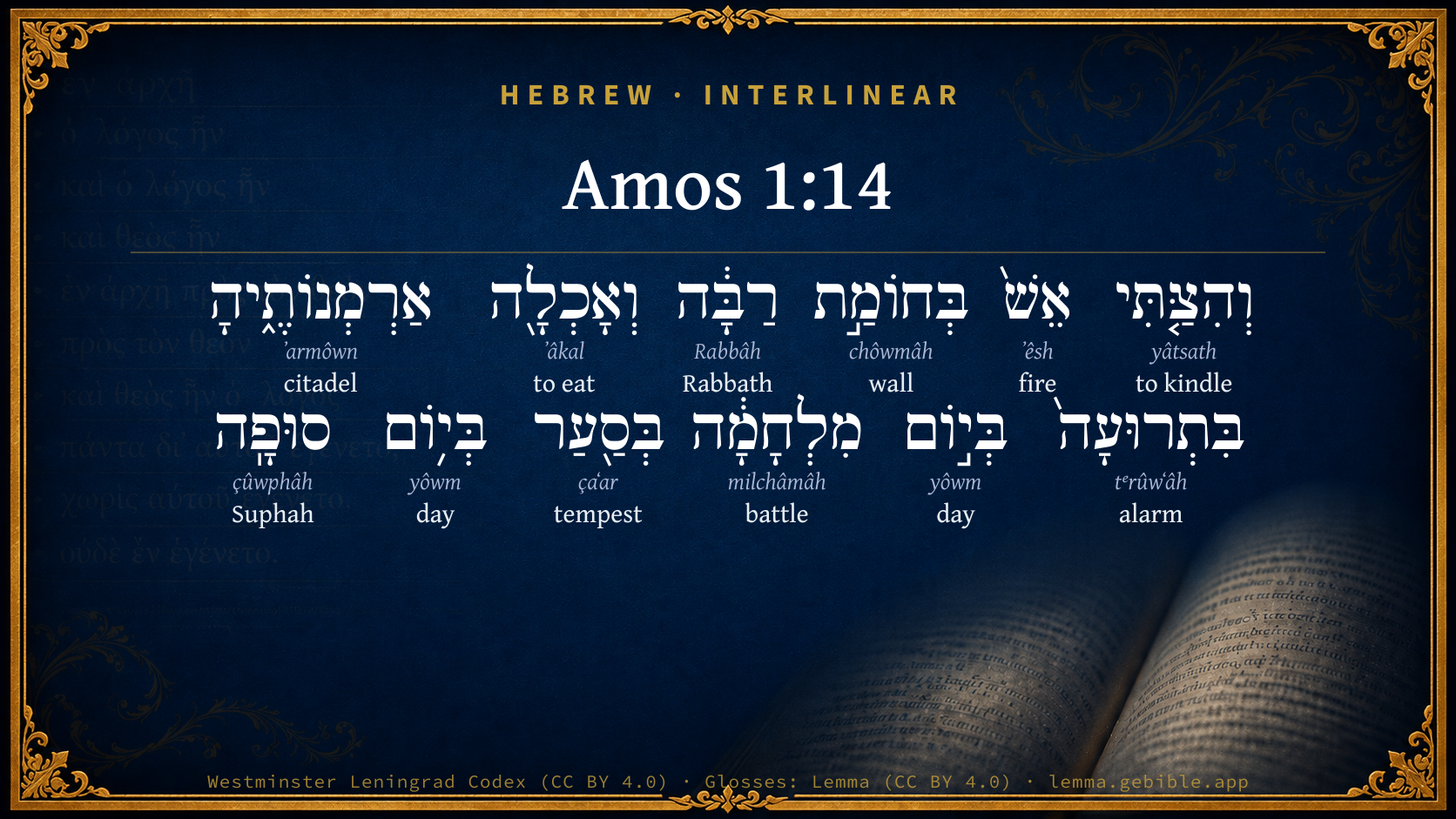
  1. וְהִצַּ֤תִּי yâtsath H3341 “and · to kindle” Conjunction + Verb, Hiphil, Sequential Perfect, 1st Person, Common, Singular
  2. אֵשׁ֙ ʼêsh H784 “fire” Noun, Common, Both, Singular, Absolute
  3. בְּחוֹמַ֣ת chôwmâh H2346 “in/at · wall of” Preposition + Noun, Common, Feminine, Singular, Construct
  4. וְאָכְלָ֖ה ʼâkal H398 “and · to eat” Conjunction + Verb, Qal, Sequential Perfect, 3rd Person, Feminine, Singular
  5. אַרְמְנוֹתֶ֑יהָ ʼarmôwn H759 “citadels · her” Noun, Common, Masculine, Plural, Construct + Suffix, Personal, 3rd Person, Feminine, Singular
  6. בִּתְרוּעָה֙ tᵉrûwʻâh H8643 “in/at · alarm” Preposition + Noun, Common, Feminine, Singular, Absolute
  7. בְּי֣וֹם yôwm H3117 “in/at · day of” Preposition + Noun, Common, Masculine, Singular, Construct
  8. מִלְחָמָ֔ה milchâmâh H4421 “battle” Noun, Common, Feminine, Singular, Absolute
  9. בְּסַ֖עַר çaʻar H5591 “in/at · tempest” Preposition + Noun, Common, Masculine, Singular, Absolute
  10. בְּי֥וֹם yôwm H3117 “in/at · day of” Preposition + Noun, Common, Masculine, Singular, Construct
  11. סוּפָֽה çûwphâh H5492 “Suphah” Noun, Common, Feminine, Singular, Absolute

About this verse

These counts appear in no published source. They are computed here, from the morphology-tagged text and Lemma’s own curated glosses. What Lemma adds →

12
words
11
distinct lemmas
Prophets
section

Notable vocabulary

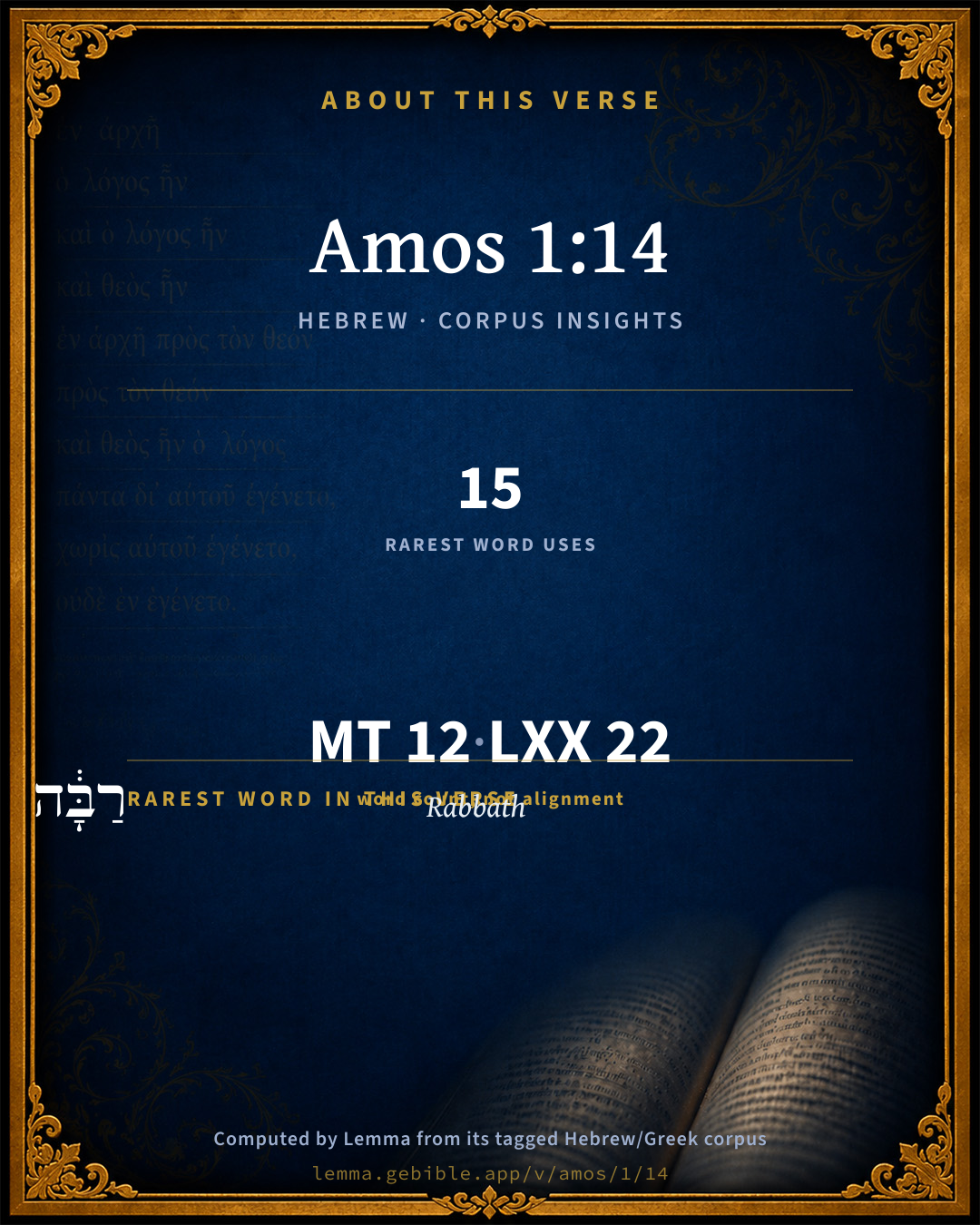
The rarest word here is רַבָּ֔ה Rabbath H7237 — appearing just 15 times in the whole Hebrew Bible.

Shared distinctive vocabulary

רַבָּ֔ה Rabbath H7237 occurs in 14 verses of the Hebrew Bible. Also found in:

Grammatical profile

  • 2 verbs
  • 10 nouns

Verb forms

  • וְהִצַּ֤תִּי Hiphil · Sequential Perfect
  • וְאָכְלָ֖ה Qal · Sequential Perfect

Repetition

A word recurs within this verse — often emphatic in Hebrew:

  • בְּי֣וֹם day H3117 ×2

Hebrew & Septuagint length

In English translation the verse runs 33 words from the Hebrew and 35 from the Septuagint (LXX English) — closely comparable.

A rough comparison of the two English renderings, which tokenize alike — not a word-level alignment.

Word counts can differ between the Hebrew and the Greek without any difference in meaning — e.g. the Hebrew direct-object marker אֵת has no separate Greek word, and Greek often adds the article ὁ.

In the original languages it is 12 Hebrew tokens and 22 Greek tokens — but the two are counted differently (Hebrew bundles its prefixes and suffixes into one token; the Greek is in lemma form), so that isn’t a like-for-like length.

Cross-references

11

Topical passages linked to Amos 1:14 in the Treasury of Scripture Knowledge — connected by theme and wording, ordered by reader-vote popularity; previews shown in the World English Bible.

  • Deuteronomy 3:11 (For only Og king of Bashan remained of the remnant of the Rephaim; behold, his bedstead was a bedstead of iron; isn't it in Rabbah of the children of Ammon? nine cubits was the length of it, and four cubits the breadth of it, after the cubit of a man.)
  • Jeremiah 49:2 Therefore, behold, the days come, says Yahweh, that I will cause an alarm of war to be heard against Rabbah of the children of Ammon; and it shall become a desolate heap, and her daughters shall be burned with fire: then shall Israel possess those who did possess him, says Yahweh.
  • Amos 2:2 But I will send a fire on Moab, And it will devour the palaces of Kerioth; And Moab will die with tumult, with shouting, and with the sound of the trumpet;
  • 2 Samuel 12:26 Now Joab fought against Rabbah of the children of Ammon, and took the royal city.
  • Isaiah 30:30 Yahweh will cause his glorious voice to be heard, and will show the lighting down of his arm, with the indignation of [his] anger, and the flame of a devouring fire, with a blast, and tempest, and hailstones.
  • Job 39:25 As often as the trumpet sounds he snorts, 'Aha!' He smells the battle afar off, The thunder of the captains, and the shouting.
  • Psalms 83:15 So pursue them with your tempest, And terrify them with your storm.
  • Isaiah 9:5 For all the armor of the armed man in the tumult, and the garments rolled in blood, shall be for burning, for fuel of fire.
  • Ezekiel 25:5 I will make Rabbah a stable for camels, and the children of Ammon a couching-place for flocks: and you shall know that I am Yahweh.
  • Daniel 11:40 At the time of the end shall the king of the south contend with him; and the king of the north shall come against him like a whirlwind, with chariots, and with horsemen, and with many ships; and he shall enter into the countries, and shall overflow and pass through.
  • Zechariah 7:14 "but I will scatter them with a whirlwind among all the nations which they have not known. Thus the land was desolate after them, so that no man passed through nor returned: for they made the pleasant land desolate."

Cross-references courtesy of OpenBible.info (CC BY 4.0).

Hebrew and Greek witnesses Masoretic Hebrew ↔ Greek Septuagint

The same verse in the two great witnesses to the Old Testament, shown verse-for-verse.

These are two independent witnesses, not word-aligned to each other, and the Septuagint is shown in lemma (dictionary) form.

Hebrew Amos 1:14 Masoretic · Westminster Leningrad Codex

וְהִצַּ֤תִּי אֵשׁ֙ בְּחוֹמַ֣ת רַבָּ֔ה וְאָכְלָ֖ה אַרְמְנוֹתֶ֑יהָ בִּתְרוּעָה֙ בְּי֣וֹם מִלְחָמָ֔ה בְּסַ֖עַר בְּי֥וֹם סוּפָֽה

But I will kindle a fire in the wall of Rabbah, And it will devour its palaces, With shouting in the day of battle, With a tempest in the day of the whirlwind;

World English Bible · Public Domain

Greek LXX Amos 1:14 Septuagint · lemma form

καί ἀναἅπτω πῦρ ἐπί ὁ τεῖχος ραββα καί καταἐσθίω θεμέλιον αὐτός μετά κραυγή ἐν ἡμέρα πόλεμος καί σείω ἐν ἡμέρα συντέλεια αὐτός

And I will kindle a fire on the walls of Rabbath, and it shall devour her foundations with shouting in the day of war, and she shall be shaken in the days of her destruction:

LXX2012 (modern English Septuagint) · Public Domain

Hebrew: Westminster Leningrad Codex (CC BY 4.0). Greek: Septuagint (public domain); English from LXX2012 (modern English Septuagint) (Public Domain). How the Septuagint differs from the Hebrew →

Targum (Aramaic paraphrase)

1

The Targum is the ancient Jewish Aramaic paraphrase of the Hebrew Scriptures — an interpretive translation, not the Hebrew text itself. Onkelos (literal) and Pseudo-Jonathan (expansive) render the Torah, and Jonathan the Prophets. Coverage is partial: where no permissively-licensed English translation exists for a verse, only the Aramaic is shown. This is verse-level text, not a word-by-word alignment to the Hebrew.

  1. Targum Jonathan Prophets (Joshua–Malachi)
    וְאַדְלֵיק אֶשְׁתָּא בְּשׁוּרֵי רַבָּה וּתְשֵׁיצֵי בִּרְנְיָתָהָא בְּיַבָּבָא בְּיוֹמָא דִקְרָבָא בְּעַלְעוֹל בְּיוֹם רוּח:

    (no public-domain English translation for this verse)

    Targum Jonathan — Aramaic: “Mikraot Gedolot” (public domain). English: “Sefaria Community Translation” (CC0 1.0 (public-domain dedication)); “London "Chaldee Paraphrase," 1871” (public domain). Text via Sefaria.

Commentary

Notes on Amos 1:14 from classic Christian and Jewish commentators (each source and its license shown beneath its notes). The classic Christian expositions comment on the surrounding passage and are grouped to its opening verse, so a note may address several verses; the Jewish commentaries on the Tanakh (Rashi and others) are per-verse, so they appear only where the commentator wrote on this verse.

Lemma curates 59 commentaries, every one of them public domain or Creative Commons licensed, each selected and text-cleaned for this edition rather than reprinted as found. About our sources →

Trapp's Complete Commentary

John Trapp

Amo 1:14 But I will kindle a fire in the wall of Rabbah, and it shall devour the palaces thereof, with shouting in the day of battle, with a tempest in the day of the whirlwind:

Ver. 14. But I will kindle a fire, &c.] With mine own hands (not only send a fire, as before, Amo 1:10; Amo 1:12); as Charles V Emperor of Germany (when it was told him how that Farnesius, the Pope’s general, had ravished certain ladies), brake out into these hot words: If I had the villain here I would kill him with mine own hands; neither was he ever heard to speak anything with so great anger in all his days.

With shooting in the day of battle] Cum clangore, vel ululatu, with noise of trumpets and soldiers, so terrible, haply, as that in the bloody fight beween the great Turk, Amurath III, and Lazarus, despot of Servia; where the noise was so great that the wild beasts in the mountains stood astonished, and the birds fell to the earth amazed thereat.

With a tempest] i.e. with incredible swiftness, and all on the sudden; and so the more terrible, because impetuous.

John Trapp, A Commentary or Exposition upon All the Books of the Old and New Testament (1647–1656) — public domain. Text from a community e-Sword module.

Tyndale Open Study Notes

Tyndale Open Resources

1:14 Rabbah was the chief city of the Ammonites (2 Sam 12:26). • Ammon (Amos 1:13) was crushed by the Assyrians in the 800s BC, then attacked and depopulated by the Babylonians in the 700s.

Tyndale Open Study Notes — © Tyndale Open Resources, licensed CC BY-SA 4.0. Text via the HelloAO Bible API.

Jamieson, Fausset & Brown

Robert Jamieson, A. R. Fausset & David Brown

Rabbah--the capital of Ammon: meaning "the Great." Distinct from Rabbah of Moab. Called Philadelphia, afterwards, from Ptolemy Philadelphus.

tempest--that is, with an onset swift, sudden, and resistless as a hurricane.

day of the whirlwind--parallel to "the day of battle"; therefore meaning "the day of the foe's tumultuous assault."

Jamieson, Fausset & Brown — Commentary Critical and Explanatory on the Whole Bible (1871) — public domain (CC PDM 1.0). Text via the HelloAO Bible API.

Adam Clarke's Commentary

Verse 14. With shouting in the day of battle] They shall be totally subdued. This was done by Nebuchadnezzar. See Jer 27:3; Jer 27:6.

Adam Clarke's Commentary on the Bible (1810–1826) — public domain. Text from a community e-Sword/MySword module.

John Calvin's Commentaries

I will therefore kindle a fire in the wall of רבה, Rabe, which shall devour its palaces, (the Prophet adds nothing new, I shall therefore go on,) and this by tumult, or by clamour, in the day of war. The Prophet means that enemies would come and suddenly lay waste the kingdom of Ammon; and that this would be the case, as a sudden fire lays hold on wood, in the day of war; that is as soon as the enemy attacked them, it would immediately put them to fight, and execute the vengeance they deserved, by a whirlwind in the day of tempest By these figurative terms the Prophet intimates that the calamity destructive to the Ammonites, would be sudden.

John Calvin's Commentaries (1540-1563) — public domain. Text from the Calvin Translation Society English edition (1840s-50s) via the Christian Classics Ethereal Library (ccel.org). Calvin's coverage is partial (roughly two-thirds of the Bible); uncommented books and verses are honest gaps, never fabricated. The 19th-century editor's footnotes and remarks are omitted so the notes are faithfully Calvin's own voice.

Ellicott's Commentary for English Readers

(14) Jeremiah gives a vivid account of the impending doom of Ammon, quoting and expanding this very passage (Jer_49:1-3).

A Bible Commentary for English Readers, edited by Charles John Ellicott (1878–1897) — public domain. Text from a community e-Sword module.

The Cambridge Bible for Schools and Colleges

gen. ed. J. J. S. Perowne

14. But I will kindle a fire] Varied from I will send of the other cases: see on Amo_1:4.

in the wall of Rabbah] The capital city of the Ammonites, and indeed the only Ammonite city mentioned in the O.T.: named elsewhere, 2Sa_11:1; 2Sa_12:27; 2Sa_12:29 (1Ch_20:1); Jos_13:25; Jer_49:3; Eze_25:5; called more fully ‘Rabbah of the Ammonites,’ Deu_3:11; 2Sa_12:26; 2Sa_17:27; Jer_49:2; Eze_21:25 (Heb. 20). From Ptolemy Philadelphia (b.c. 287–245) it received the name of Philadelpheia: in the Middle Ages it was known as ‘Ammân, a name which it still bears. It was situated about 25 miles N.E. of the N. end of the Dead Sea, in the valley forming the upper course of the Jabbok, now called the Wâdy ‘Ammân. The stream is perennial, and is well-stocked with fish: one of its sources, the ‘Ain ‘Ammân, is a little above the city, to the W. The present remains are chiefly of the Roman period, comprising a fortress, theatre, odeum, baths, a street of columns and gate, mausolea, &c. The fortress stands upon a hill, which rises on a triangular piece of ground on the N. of the stream to a height of some 300–400 ft., the city lying in the valley to the South. This lower city, situated on the banks of the ‘Ammân, is probably the “city of the waters” stated to have been taken by Joab in 2Sa_12:27. There is a full description, with plan and views, of the existing ruins, in the Survey of Eastern Palestine (published by the Palestine Exploration Society) 19–64: see also D.B[138]1 s.v. (with a view).

[138] .B. … Smith’s Dictionary of the Bible, ed. 1, or (from A to J) ed. 2.

with shouting in the day of battle] The ‘shouting’ is the battle-cry of the advancing foe: cf. Job_39:25; Jer_4:19; Jer_49:2 (A.V., R.V., ‘alarm’), &c., and the corresponding verb, Jdg_7:21; 1Sa_17:52.

with a tempest in the day of the whirlwind] A figurative description of the onslaught of the foe: it will level all before it, like a destructive hurricane.

The Cambridge Bible for Schools and Colleges (gen. ed. J. J. S. Perowne; Cambridge University Press, 1878–1918) — public domain. Text from a community e-Sword module.

John Gill's Exposition

But I will kindle a fire in the wall of Rabbah,.... Which was the metropolis of the children of Ammon, and their royal city, Sa2 12:26. This is to be understood of an enemy that should destroy it, perhaps Nebuchadnezzar; or of war being kindled and raised in their country; this place being put for the whole; See Gill on Jer 49:2;

and it shall devour the palaces thereof; the palaces of the king, and his nobles:

with shouting in the day of battle; with the noise of soldiers when they make their onset, or have gained the victory; see Jer 49:2;

with a tempest in the day of the whirlwind; denoting that this judgment should come suddenly, and at an unawares, with great force, irresistibly; and a tempest added to fire, if literally taken, must spread the desolation more abundantly, and make it more terrible.

John Gill's Exposition of the Whole Bible (1746–1763) — public domain (CC PDM 1.0). Text via the HelloAO Bible API.

Albert Barnes' Notes on the Bible

I will kindle afire in the wall of Rabbah - Rabbah, literally, “the great,” called by Moses “Rabbah of the children of Ammon” Deu 3:11, and by later Greeks, “Rabathammana” , was a strong city with a yet stronger citadel. Ruins still exist, some of which probably date back to these times. The lower city “lay in a valley bordered on both sides by barren hills of flint,” at 12 an hour from its entrance. It lay on a stream, still called by its name Moyet or Nahr Amman, “waters” or “river of Ammon,” which ultimately falls into the Zurka (the Jabbok) . “On the top of the highest of the northern hills,” where at the divergence of two valleys it abuts upon the ruins of the town, “stands the castle of Ammon, a very extensive rectangular building,” following the shape of the hill and wholly occupying its crest. “Its walls are thick, and denote a remote antiquity; large blocks of stone are piled up without cement, and still hold together as well as if they had been recently placed; the greater part of the wall is entire. Within the castle are several deep cisterns.”

There are remains of foundations of a wall of the lower city at its eastern extremity . This lower city, as lying on a river in a waterless district, was called the “city of waters” 2Sa 12:27, which Joab had taken when he sent to David to come and besiege the Upper City. In later times, that Upper City was resolutely defended against Antiochus the Great, and taken, not by force but by thirst . On a conspicuous place on this castle-hill, stood a large temple, some of its broken columns 3 12 feet in diameter , probably the Grecian successor of the temple of its idol Milchom. Rabbah, the capital of Ammon, cannot have escaped, when Nebuchadnezzar , “in the 5th year of his reign, led an army against Coele-Syria, and, having possessed himself of it, warred against the Ammonites and Moabites, and having made all these nations subject to him, invaded Egypt, to subdue it.”

Afterward, it was tossed to and fro in the desolating wars between Syria and Egypt. Ptolemy II called it from his own surname Philadelphia , and so probably had had to restore it. It brought upon itself the attack of Antiochus III and its own capture, by its old habit of marauding against the Arabs in alliance with him. At the time of our Lord, it, with “Samaria, Galilee and Jericho,” is said by a pagan to be “inhabited by a mingled race of Egyptians, Arabians and Phoenicians.” It had probably already been given over to “the children of the East,” the Arabs, as Ezekiel had foretold Eze 25:4. In early Christian times Milchom was still worshiped there under its Greek name of Hercules . Trajan recovered it to the Roman empire , and in the 4th century it, with Bostra , was still accounted a “vast town most secured by strong walls,” as a frontier fortress “to repel the incursions of neighboring nations.” It was counted to belong to Arabia . An Arabic writer says that it perished before the times of Muhammed, and covered a large tract with its ruins . It became a station of pilgrims to Mecca, and then, until now, as Ezekiel foretold , a stable for camels and a couching place.

I will kindle a fire in the wall - It may be that the prophet means to speak of some conflagration from within, in that he says not, as elsewhere, “I will send afire upon,” but, “I will kindle a fire in” Amo 1:4, Amo 1:7, Amo 1:10, Amo 1:12; Amo 2:2, Amo 2:5. But “the shouting” is the battle-cry (Job 39:25; Jer 20:16; Zep 1:16, etc.) of the victorious enemy, the cheer of exultation, anticipating its capture. That onslaught was to be resistless, sweeping, like a whirlwind, all before it. The fortress and walls of Rabbah were to yield before the onset of the enemy, as the tents of their caravans were whirled flat on the ground before the eddying of the whirlwinds from the desert, burying all beneath them.

Albert Barnes' Notes on the Bible (1834–1885) — public domain. Text from a community e-Sword/MySword module.

Haydock's Catholic Bible Commentary

Babba, the capital, called also Philadelphia. Ozias and Joatham attacked the people with advantage. (Calmet)

George Leo Haydock (1774–1849), Haydock's Catholic Family Bible and Commentary, 1859 edition — public domain. Excludes Psalms (Douay-Rheims chapter numbering differs from Protestant) and Deuterocanonical books (Catholic canon only).

Matthew Poole's English Annotations

I will kindle a fire in the wall: see Amo 1:4, where the phrase is explained: as to the time when this prophecy was fulfilled, it was partly when the Assyrian kingdom flourished, and partly by Nebuchadnezzar, as was foretold by Ezekiel, Eze 25:1-3, &c., which see.

Rabbah; the chief city of the kingdom of Ammon, 2Sa 11:1; 12:26, which by a usual figure compriseth all the Ammonites, and all their strength, wealth, and glory, all which shall be devoured. It shall devour the palaces thereof: see Amo 1:4.

With shouting in the day of battle; a mixed and horrid noise of trumpets, and alarms of war, with howlings of the distressed, groans of the dying, and acclamations of the conquerors.

With a tempest in the day of the whirlwind, i.e. with irresistible force, and surprising swiftness, as the similitude imports.

Matthew Poole's English Annotations on the Holy Bible (1683–1685) — public domain. Text from a community e-Sword/MySword module.

The Pulpit Commentary

Rabbah, "the Great," or Rabbath-Ammon, the capital of Ammon, was situated on the southern arm of the Jabbok, and was a place of remarkable strength. (see Deu_3:11; 2Sa_11:1 2Sa_12:26, etc.; 1Ch_20:1-3) "For picturesqueness of situation, I know of no ruins to compare with Ammon. The most striking feature is the citadel, which formerly contained not merely the garrison, but an upper town, and covered an extensive area. The lofty plateau on which it was situated is triangular in shape; two sides are formed by the valleys which diverge from the apex, where they are divided by a low neck, and thence separating, fall into the valley of the Jabbok, which forms the base of the triangle, and contained the lower town. Climbing up the citadel, we can trace the remains of the moat, and, crossing it, find ourselves in a maze of ruins. The massive walls the lower parts of which still remain, and which, rising from the precipitous sides of the cliff, rendered any attempt at scaling impossible were evidently Ammonite. As I leant over them and looked sheer down about three hundred feet into one wady, and four hundred feet into the other, I did not wonder at its having occurred to King David that the leader of a forlorn hope against these ramparts would meet with certain death, and consequently assigning the position to Uriah. Joab afterwards took the lower city, which he called "the city of waters," indicating very probably that the Jabbok was dammed into a lake near the lower city, to which the conformation of the valley would lend itself" (Oliphant, "Land of Gilead," p. 259, etc.). There is a sketch of the citadel hill in the "Dictionary of the Bible," 2:985. The city was taken by Nebuchadnezzar, (Jer_27:3, 6 49:2, 3) either at the time of the destruction of Jerusalem, or in the course of his Egyptian campaign (Josephus, "Ant.," 10:9. 7). The expression, I will kindle a fire (not "send," as elsewhere), possibly implies, as Pusey suggests, a conflagration from within. The shouting is the battle cry of the opposing host, which adds to the horror of the scene. (Job_39:25) With a tempest. The idea is that the walls should fall before the invaders, as if they were teats swept away in a whirlwind.

The Pulpit Commentary (1880–1919), ed. H.D.M. Spence-Jones & Joseph S. Exell — public domain. Text from a community e-Sword module.

John Wesley's Explanatory Notes

With a tempest - With irresistible force, and surprising swiftness.

John Wesley, Explanatory Notes Upon the Whole Bible (1754–1765) — public domain. Text via the GEBible commentary corpus.

unfoldingWord translationNotes

Door43 World Missions Community

Connecting Statement:

Yahweh continues his message of judgment on the people of Ammon.

it will devour the palaces

Here Yahweh's judgment is spoken of as if it were a fire that was consuming the palaces. (See: Metaphor)

with a tempest in the day of the whirlwind

The fighting against the people of Ammon is spoken of as if it were a violent storm. AT: "and the fighting will be like a great storm" (See: Metaphor)

tempest ... whirlwind

These are two kinds of violent storms.

whirlwind

a strong wind that spins very quickly as it moves and can cause damage

Their king will go into captivity

The abstract noun "captivity" can be translated as the verb "capture." This can be translated in active form. AT: "Their enemies will capture their king and take him away as a prisoner" (See: Abstract Nouns and Active or Passive)

translationWords

Rabbah

captive

unfoldingWord translationNotes — © Distant Shores Media and the Door43 World Missions Community, licensed CC BY-SA 4.0. Source: git.door43.org/Door43/en_tn.

Lesson kit

Teaching starters — assembled from the data on this page, not authored interpretation. Every prompt links to the verse data it draws on. Edit before teaching.

Amos, in the Prophets, opens this verse with 12 words (11 distinct Hebrew lemmas). Its most distinctive word is Rabbâh (“Rabbath”). A historical commentator’s framing appears above. Read the whole chapter for the surrounding context.

Discussion questions

  1. How does “Rabbath” (Rabbâh) shape what this verse is saying?
  2. Deuteronomy 3:11 shares the word «Rabbath» with this verse. How do the two illuminate each other?
  3. “day” occurs 2× in this one verse. What is the effect of the repetition?
  4. These translations render this verse differently. What is at stake in choosing one wording over another?
  5. The verb «וְהִצַּ֤תִּי» is Hiphil Sequential Perfect. How does its form color the action?
  6. Reading how Trapp's Complete Commentary and Tyndale Open Study Notes read this verse, where do the two commentators agree and where do they part?

Things to notice

Reading settings

Reading text

Shown beneath each verse's original-language words.

Old Testament
Old Testament edition

Read the OT as the Masoretic Hebrew (MT) or the Greek Septuagint (LXX).

English shown for the Greek Septuagint (in the Hebrew ↔ Greek comparison).

Comparing translations? Open the Compare panel on any verse page to stack up to four side by side.