
Deuteronomy 9:21

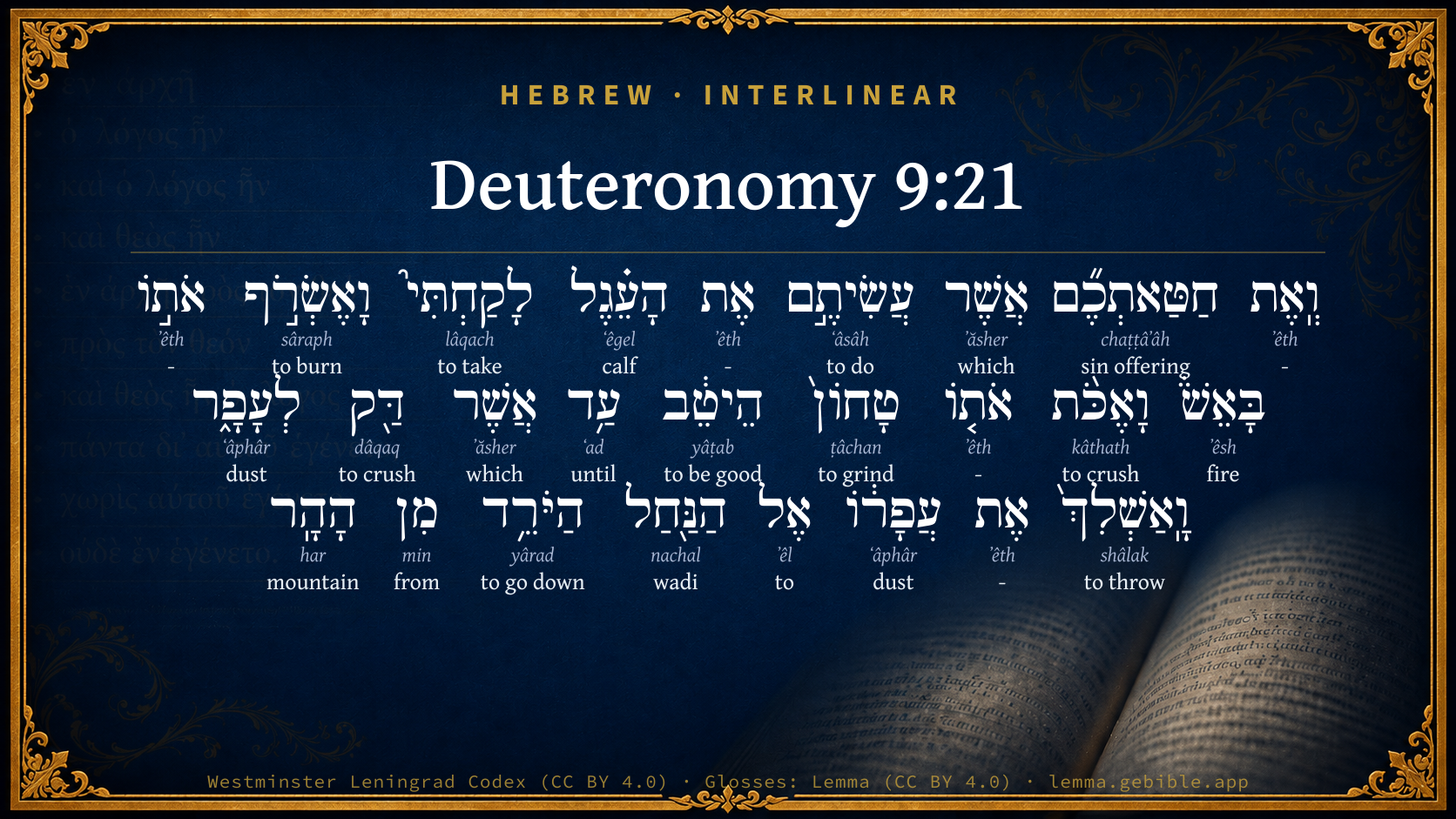
Hebrew (Westminster Leningrad Codex) Deuteronomy 9:21 appears in the Hebrew Old Testament. The text above is from the Westminster Leningrad Codex. Each word links to its Strong’s number, a concise gloss, and parsing drawn from the Open Scriptures Hebrew Bible morphology. Click any word for its full Brown-Driver-Briggs (BDB) entry.
Download image
Cite this verse

Deuteronomy 9:21 (World English Bible). Public Domain. Lemma interlinear Bible study tool, https://lemma.gebible.app/v/deuteronomy/9/21.

Show BibTeX & RIS
BibTeX
RIS
English Translation
I took your sin, the calf which you had made, and burnt it with fire, and stamped it, grinding it very small, until it was as fine as dust: and I cast the dust of it into the brook that descended out of the mountain.
World English Bible · Public Domain
Download a study sheet

One document with this verse’s original text, its word-by-word gloss line, the meaning frame, cross-references with their text, attributed commentary, and full source and license credits — printable, and it pastes into notes with its structure intact.

This verse Autodidact and up

Study sheet (.html) Plain text (.txt)

A passage Seminary Student

Up to 50 verses in one chapter. A passage sheet keeps up to 6 commentary sources and 12 cross-references per verse, in the order this page ranks them, and says so on the sheet whenever that leaves anything out. Ask for a single verse and you get the Autodidact verse sheet above.

Everything on this page stays free to read, with no account — the sheet is a download of what is already on screen, not access to it.

Want to remove ads? Support Godless Engineer
Compare translations 3

The same verse in 3 English versions, stacked beneath the original-language interlinear above. Click any original word for its lexicon entry.

Each is an independent rendering of the whole verse — the interlinear is not word-aligned to these translations.

Highlighted words mark where these versions differ — a whole-verse word diff, not a word-by-word alignment.

  • World English Bible Public Domain
    I took your sin, the calf which you had made, and burnt it with fire, and stamped it, grinding it very small, until it was as fine as dust: and I cast the dust of it into the brook that descended out of the mountain.
  • King James Version Public Domain
    And I took your sin, the calf which ye had made, and burnt it with fire, and stamped it, and ground it very small, even until it was as small as dust: and I cast the dust thereof into the brook that descended out of the mount.
  • unfoldingWord Literal Text CC BY-SA 4.0
    And I took your sin, the calf that you had made, and burned it in the fire and crushed it and ground well, until crushed to dust. And I threw its dust into the stream coming down from the mountain.

unfoldingWord Literal Text — © unfoldingWord, licensed CC BY-SA 4.0. Word-aligned USFM3 via Door43 (git.door43.org/unfoldingWord/en_ult).

Versions to compare (up to 4)

3 of 4 selected

Show all 18 translations

Every available English version of this verse, each an independent rendering of the whole verse.

  • World English Bible Public Domain
    I took your sin, the calf which you had made, and burnt it with fire, and stamped it, grinding it very small, until it was as fine as dust: and I cast the dust of it into the brook that descended out of the mountain.
  • Berean Standard Bible Public Domain
    And I took that sinful thing, the calf you had made, and burned it in the fire. Then I crushed it and ground it to powder as fine as dust, and I cast it into the stream that came down from the mountain.
  • Majority Standard Bible Public Domain
    And I took that sinful thing, the calf you had made, and burned it in the fire. Then I crushed it and ground it to powder as fine as dust, and I cast it into the stream that came down from the mountain.
  • King James Version Public Domain
    And I took your sin, the calf which ye had made, and burnt it with fire, and stamped it, and ground it very small, even until it was as small as dust: and I cast the dust thereof into the brook that descended out of the mount.
  • American Standard Version (1901) Public Domain
    And I took your sin, the calf which ye had made, and burnt it with fire, and stamped it, grinding it very small, until it was as fine as dust: and I cast the dust thereof into the brook that descended out of the mount.
  • Revised Version (1885) Public Domain
    And I took your sin, the calf which ye had made, and burnt it with fire, and stamped it, grinding it very small, until it was as fine as dust: and I cast the dust thereof into the brook that descended out of the mount.
  • Geneva Bible (1599) Public Domain
    And I tooke your sinne, I meane the calfe which ye had made, and burnt him with fire, and stamped him and ground him small, euen vnto very dust: and I cast the dust thereof into the riuer, that descended out of the mount.
  • Douay-Rheims (1899) Public Domain
    And your sin that you had committed, that is, the calf, I took, and burned it with fire, and breaking it into pieces, until it was as small as dust, I threw it into the torrent, which cometh down from the mountain.
  • Young's Literal Translation Public Domain
    and your sin, which ye have made -- the calf -- I have taken, and I burn it with fire, and beat it, grinding well till that it `is' small as dust, and I cast its dust unto the brook which is going down out of the mount.
  • Literal Standard Version CC BY-SA 4.0
    And I have taken your sin, the calf which you have made, and I burn it with fire, and beat it, grinding well until it [is] small as dust, and I cast its dust into the brook which is going down out of the mountain.
  • Unlocked Literal Bible CC BY-SA 4.0
    I took your sin, the calf that you had made, and burned it, beat it, and ground it very small, until it was as fine as dust. I threw its dust into the stream that came down from the mountain.
  • unfoldingWord Literal Text CC BY-SA 4.0
    And I took your sin, the calf that you had made, and burned it in the fire and crushed it and ground well, until crushed to dust. And I threw its dust into the stream coming down from the mountain.
  • Darby Bible Public Domain
    And I took your sin, the calf which ye had made, and burned it with fire, and crushed it, and ground it very small, until it became fine dust; and I cast the dust thereof into the brook that flowed down from the mountain.
  • World Messianic Bible Public Domain
    I took your sin, the calf which you had made, and burned it with fire, and crushed it, grinding it very small, until it was as fine as dust. I threw its dust into the brook that descended out of the mountain.
  • Webster's Bible Public Domain
    And I took your sin, the calf which ye had made, and burnt it with fire, and stamped it, and ground it very small, even until it was as small as dust: and I cast the dust of it into the brook that descended from the mount.
  • Free Bible Version CC BY-SA 4.0
    I took that abominable thing, the calf you'd made, and burned it. Then I crushed it up and ground it into dust, and I threw it into the stream that descended from the mountain.
  • Bible in Basic English Public Domain
    And I took your sin, the image which you had made, and put it in the fire and had it hammered and crushed very small till it was only dust: and the dust I put in the stream flowing down from the mountain.
  • JPS Tanakh (1917) Public Domain
    And I took your sin, the calf which ye had made, and burnt it with fire, and beat it in pieces, grinding it very small, until it was as fine as dust; and I cast the dust thereof into the brook that descended out of the mount. —

Literal Standard Version (2020), Covenant Press — licensed CC BY-SA 4.0. Text via the HelloAO Bible API (eBible.org). Unlocked Literal Bible (unfoldingWord) — licensed CC BY-SA 4.0. Text via the HelloAO Bible API (eBible.org). unfoldingWord Literal Text — © unfoldingWord, licensed CC BY-SA 4.0. Word-aligned USFM3 via Door43 (git.door43.org/unfoldingWord/en_ult). Free Bible Version, Dr. Jonathan Gallagher — licensed CC BY-SA 4.0. Text via the HelloAO Bible API (eBible.org).

Word by word

More ways to search: Search by grammar → Find every occurrence → Compare this word →

Practice this passage: Drill this verse → Learn its vocabulary →

טָחוֹן֙
ṭâchan
H2912
“to grind”
Verb, Qal, Infinitive Absolute
Part of Speech
Verb
Stem
Qal
Form
Infinitive Absolute
Full BDB Definition

Origin: a primitive root

TWOT: 802

(Qal) to grind, crush
  1. וְֽאֶת ʼêth H853 “and · -” Conjunction + Particle, Direct Object
  2. חַטַּאתְכֶ֞ם chaṭṭâʼâh H2403 “sin offering · your” Noun, Common, Feminine, Singular, Construct + Suffix, Personal, 2nd Person, Masculine, Plural
  3. אֲשֶׁר ʼăsher H834 “which” Particle, Relative
  4. עֲשִׂיתֶ֣ם ʻâsâh H6213 “to do” Verb, Qal, Perfect, 2nd Person, Masculine, Plural
  5. אֶת ʼêth H853 “-” Particle, Direct Object
  6. הָעֵ֗גֶל ʻêgel H5695 “the · calf” Particle, Definite Article + Noun, Common, Masculine, Singular, Absolute
  7. לָקַחְתִּי֮ lâqach H3947 “to take” Verb, Qal, Perfect, 1st Person, Common, Singular
  8. וָאֶשְׂרֹ֣ף sâraph H8313 “and · to burn” Conjunction + Verb, Qal, Sequential Imperfect, 1st Person, Common, Singular
  9. אֹת֣וֹ ʼêth H853 “- · him” Particle, Direct Object + Suffix, Personal, 3rd Person, Masculine, Singular
  10. בָּאֵשׁ֒ ʼêsh H784 “in/at the · fire” Preposition, Determined + Noun, Common, Both, Singular, Absolute
  11. וָאֶכֹּ֨ת kâthath H3807 “and · to crush” Conjunction + Verb, Qal, Sequential Imperfect, 1st Person, Common, Singular
  12. אֹת֤וֹ ʼêth H853 “- · him” Particle, Direct Object + Suffix, Personal, 3rd Person, Masculine, Singular
  13. הֵיטֵ֔ב yâṭab H3190 “to be good” Verb, Hiphil, Infinitive Absolute
  14. עַ֥ד ʻad H5704 “until” Preposition
  15. אֲשֶׁר ʼăsher H834 “which” Particle, Relative
  16. דַּ֖ק dâqaq H1854 “to crush” Verb, Qal, Perfect, 3rd Person, Masculine, Singular
  17. לְעָפָ֑ר ʻâphâr H6083 “to/for · dust” Preposition + Noun, Common, Masculine, Singular, Absolute
  18. וָֽאַשְׁלִךְ֙ shâlak H7993 “and · to throw” Conjunction + Verb, Hiphil, Sequential Imperfect, 1st Person, Common, Singular
  19. אֶת ʼêth H853 “-” Particle, Direct Object
  20. עֲפָר֔וֹ ʻâphâr H6083 “dust · his” Noun, Common, Masculine, Singular, Construct + Suffix, Personal, 3rd Person, Masculine, Singular
  21. אֶל ʼêl H413 “to” Preposition
  22. הַנַּ֖חַל nachal H5158 “the · wadi” Particle, Definite Article + Noun, Common, Masculine, Singular, Absolute
  23. הַיֹּרֵ֥ד yârad H3381 “the · going down” Particle, Definite Article + Verb, Qal, Participle Active, Masculine, Singular, Absolute
  24. מִן min H4480 “from” Preposition
  25. הָהָֽר har H2022 “the · mountain” Particle, Definite Article + Noun, Common, Masculine, Singular, Absolute

About this verse

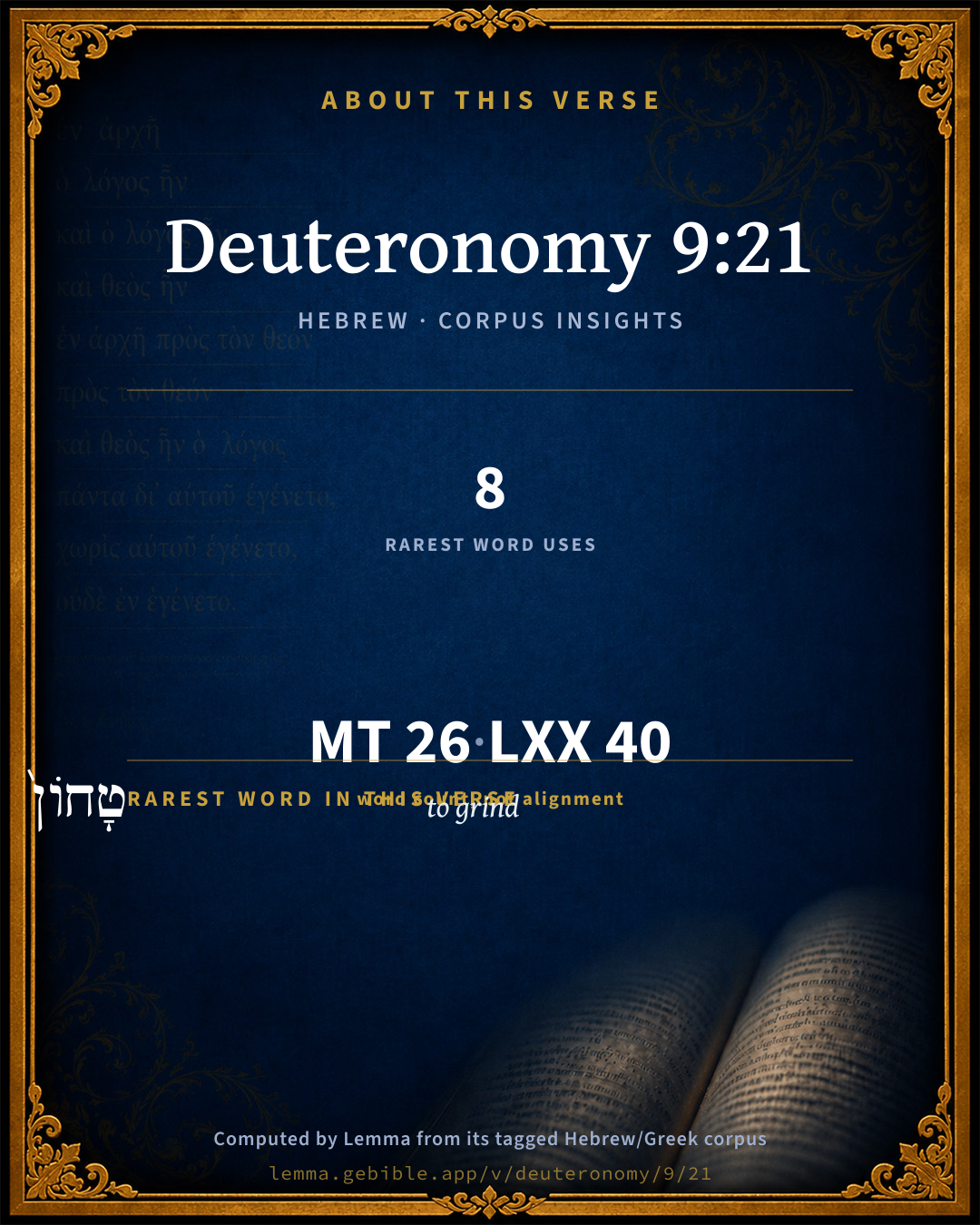
These counts appear in no published source. They are computed here, from the morphology-tagged text and Lemma’s own curated glosses. What Lemma adds →

26
words
20
distinct lemmas
Pentateuch
section

Notable vocabulary

The rarest word here is טָחוֹן֙ to grind H2912 — appearing just 8 times in the whole Hebrew Bible.

Shared distinctive vocabulary

טָחוֹן֙ to grind H2912 occurs in 8 verses of the Hebrew Bible. Also found in:

Grammatical profile

  • 9 verbs
  • 7 nouns
  • 3 prepositions
  • 7 particles

Verb forms

  • עֲשִׂיתֶ֣ם Qal · Perfect
  • לָקַחְתִּי֮ Qal · Perfect
  • וָאֶשְׂרֹ֣ף Qal · Sequential Imperfect
  • וָאֶכֹּ֨ת Qal · Sequential Imperfect
  • טָחוֹן֙ Qal · Infinitive Absolute
  • הֵיטֵ֔ב Hiphil · Infinitive Absolute
  • דַּ֖ק Qal · Perfect
  • וָֽאַשְׁלִךְ֙ Hiphil · Sequential Imperfect
  • הַיֹּרֵ֥ד Qal · Participle Active

Repetition

Words recur within this verse — often emphatic in Hebrew:

  • לְעָפָ֑ר dust H6083 ×2
  • אֲשֶׁר which H834 ×2

Hebrew & Septuagint length

In English translation the verse runs 45 words from the Hebrew and 46 from the Septuagint (LXX English) — closely comparable.

A rough comparison of the two English renderings, which tokenize alike — not a word-level alignment.

Word counts can differ between the Hebrew and the Greek without any difference in meaning — e.g. the Hebrew direct-object marker אֵת has no separate Greek word, and Greek often adds the article ὁ.

In the original languages it is 26 Hebrew tokens and 40 Greek tokens — but the two are counted differently (Hebrew bundles its prefixes and suffixes into one token; the Greek is in lemma form), so that isn’t a like-for-like length.

Cross-references

5

Topical passages linked to Deuteronomy 9:21 in the Treasury of Scripture Knowledge — connected by theme and wording, ordered by reader-vote popularity; previews shown in the World English Bible.

  • Exodus 32:20 He took the calf which they had made, and burnt it with fire, ground it to powder, and scattered it on the water, and made the children of Israel drink of it.
  • Isaiah 31:7 For in that day they shall cast away every man his idols of silver, and his idols of gold, which your own hands have made to you for a sin.
  • Isaiah 2:18–21 The idols shall utterly pass away.
  • Isaiah 30:22 You shall defile the overlaying of your engraved images of silver, and the plating of your molten images of gold: you shall cast them away as an unclean thing; you shall tell it, Get you hence.
  • Hosea 8:11 Because Ephraim has multiplied altars for sinning, They became for him altars for sinning.

Cross-references courtesy of OpenBible.info (CC BY 4.0).

Hebrew and Greek witnesses Masoretic Hebrew ↔ Greek Septuagint

The same verse in the two great witnesses to the Old Testament, shown verse-for-verse.

These are two independent witnesses, not word-aligned to each other, and the Septuagint is shown in lemma (dictionary) form.

Hebrew Deuteronomy 9:21 Masoretic · Westminster Leningrad Codex

וְֽאֶת חַטַּאתְכֶ֞ם אֲשֶׁר עֲשִׂיתֶ֣ם אֶת הָעֵ֗גֶל לָקַחְתִּי֮ וָאֶשְׂרֹ֣ף אֹת֣וֹ בָּאֵשׁ֒ וָאֶכֹּ֨ת אֹת֤וֹ טָחוֹן֙ הֵיטֵ֔ב עַ֥ד אֲשֶׁר דַּ֖ק לְעָפָ֑ר וָֽאַשְׁלִךְ֙ אֶת עֲפָר֔וֹ אֶל הַנַּ֖חַל הַיֹּרֵ֥ד מִן הָהָֽר

I took your sin, the calf which you had made, and burnt it with fire, and stamped it, grinding it very small, until it was as fine as dust: and I cast the dust of it into the brook that descended out of the mountain.

World English Bible · Public Domain

Greek LXX Deuteronomy 9:21 Septuagint · lemma form

καί ὁ ἁμαρτία σύ ὅς ποιέω ὁ μόσχος λαμβάνω αὐτός καί κατακαίω αὐτός ἐν πῦρ καί συνκόπτω αὐτός καταἀλέω σφόδρα ἕως ὅς γίγνομαι λεπτός καί γίγνομαι ὡσεί κονιορτός καί ῥίπτω ὁ κονιορτός εἰς ὁ χειμάρρους ὁ καταβαίνω ἐκ ὁ ὄρος

And your sin which you⌃ had made, even the calf, I took, and burnt it with fire, and pounded it and ground it down till it became fine; and it became like dust, and I cast the dust into the brook that descended from the mountain.

LXX2012 (modern English Septuagint) · Public Domain

Hebrew: Westminster Leningrad Codex (CC BY 4.0). Greek: Septuagint (public domain); English from LXX2012 (modern English Septuagint) (Public Domain). How the Septuagint differs from the Hebrew →

Targum (Aramaic paraphrase)

2

The Targum is the ancient Jewish Aramaic paraphrase of the Hebrew Scriptures — an interpretive translation, not the Hebrew text itself. Onkelos (literal) and Pseudo-Jonathan (expansive) render the Torah, and Jonathan the Prophets. Coverage is partial: where no permissively-licensed English translation exists for a verse, only the Aramaic is shown. This is verse-level text, not a word-by-word alignment to the Hebrew.

  1. Targum Onkelos Torah (Genesis–Deuteronomy)
    וְיָת חוֹבָתְכוֹן דִי עֲבַדְתּוּן יָת עֶגְלָא נְסֵבִית וְאוֹקֵדִית יָתֵהּ בְּנוּרָא וְשָׁפִית יָתֵהּ בְּשׁוּפִינָא יָאוּת עַד דִי הֲוָה דַקִיק לְעַפְרָא וּרְמֵת יָת עַפְרֵהּ לְנַחֲלָא דְנָחֵת מִן טוּרָא

    (no public-domain English translation for this verse)

    Targum Onkelos — Aramaic: “Onkelos Genesis” (public domain); “Onkelos Exodus” (public domain); “Onkelos Leviticus” (public domain); “Onkelos Numbers” (public domain); “Onkelos Deuteronomy” (public domain). English: “Sefaria Community Translation” (CC0 1.0 (public-domain dedication)); “J.W. Etheridge. The Targums of Onkelos and Jonathan Ben Uzziel on the Pentateuch. London: Longmans, Green, 1862” (public domain). Text via Sefaria.

  2. Targum Pseudo-Jonathan Torah (Genesis–Deuteronomy)
    וְיַת סוּרְחַנְתְּכוֹן דַּעֲבַדְתּוּן יַת עֵיגְלָא נְסֵיבִית וְאוֹקֵדִית יָתֵיהּ בְּנוּרָא וְשַׁפְיַית יָתֵיהּ בְּשׁוֹפָנָא טַבְאוּת עַד דַּהֲוָה דָקִיק כְּעַפְרָא וּטְלָקִית יַת עַפְרֵיהּ לְנַחֲלָא דְנָחִית מִן טַוְורָא

    And your sin, the calf which you had made, I took, and burned it in fire, and crushed it well with crushing until I had bruised it into dust; and I threw the dust into the stream that descended from the mountain.

    Targum Pseudo-Jonathan — Aramaic: “Targum Jonathan on Genesis” (public domain); “Targum Jonathan on Exodus” (public domain); “Targum Jonathan on Leviticus” (public domain); “Targum Jonathan on Numbers” (public domain); “Targum Jonathan on Deuteronomy” (public domain). English: “The Targum of Jonathan ben Uzziel, trans. J. W. Etheridge, London, 1862” (public domain). Text via Sefaria.

Commentary

Notes on Deuteronomy 9:21 from classic Christian and Jewish commentators (each source and its license shown beneath its notes). The classic Christian expositions comment on the surrounding passage and are grouped to its opening verse, so a note may address several verses; the Jewish commentaries on the Tanakh (Rashi and others) are per-verse, so they appear only where the commentator wrote on this verse.

Lemma curates 59 commentaries, every one of them public domain or Creative Commons licensed, each selected and text-cleaned for this edition rather than reprinted as found. About our sources →

Joseph Benson's Commentary

Deu 9:21. I cast the dust thereof into the brook — That there might be no monument nor remembrance of the calf left.

Joseph Benson's Commentary on the Old and New Testaments (1811–1818) — public domain. Text from a community e-Sword module.

Geneva Bible (1599)

Geneva Bible translators

Horeb, or Sinai.

Geneva Bible (1599) marginal notes — public domain. Text via Bolls.life.

Jamieson, Fausset & Brown

Robert Jamieson, A. R. Fausset & David Brown

I cast the dust thereof into the brook that descended out of the mount--that is, "the smitten rock" (El Leja) which was probably contiguous to, or a part of, Sinai. It is too seldom borne in mind that though the Israelites were supplied with water from this rock when they were stationed at Rephidim (Wady Feiran), there is nothing in the Scripture narrative which should lead us to suppose that the rock was in the immediate neighborhood of that place (see on Exo 17:5). The water on this smitten rock was probably the brook that descended from the mount. The water may have flowed at the distance of many miles from the rock, as the winter torrents do now through the wadies of Arabia-Petræa (Psa 78:15-16). And the rock may have been smitten at such a height, and at a spot bearing such a relation to the Sinaitic valleys, as to furnish in this way supplies of water to the Israelites during the journey from Horeb by the way of mount Seir and Kadesh-barnea (Deu 1:1-2). On this supposition new light is, perhaps, cast on the figurative language of the apostle, when he speaks of "the rock following" the Israelites (Co1 10:4) [WILSON, Land of the Bible].

Jamieson, Fausset & Brown — Commentary Critical and Explanatory on the Whole Bible (1871) — public domain (CC PDM 1.0). Text via the HelloAO Bible API.

Adam Clarke's Commentary

Verse 21. I took your sin, the calf which ye had made] See this fully explained, Clarke "Ex 32:20".

Adam Clarke's Commentary on the Bible (1810–1826) — public domain. Text from a community e-Sword/MySword module.

Ellicott's Commentary for English Readers

(21) I took your sin . . . and I cast the dust thereof into the brook.—The stream from the rock in Horeb not only gave Israel drink, but bore away their “sin” upon its waters. “And that Rock was Christ.” This identification of the sin with the material object is in harmony with the Law in Leviticus, where “sin” and “sin-offering”—“trespass” and “trespass offering”—are respectively denoted by a single word.

A Bible Commentary for English Readers, edited by Charles John Ellicott (1878–1897) — public domain. Text from a community e-Sword module.

The Cambridge Bible for Schools and Colleges

gen. ed. J. J. S. Perowne

21. Characteristically expanded, with variations, from Exo_32:20 : one item in the latter, and made the children of Israel drink of it, is omitted.

The Cambridge Bible for Schools and Colleges (gen. ed. J. J. S. Perowne; Cambridge University Press, 1878–1918) — public domain. Text from a community e-Sword module.

John Gill's Exposition

And I took your sin, the calf which ye had made,.... Which was the object of their sin, which lay in making and worshipping it; see Isa 31:7.

and burnt it with fire, and stamped it; with his feet after it was burnt, to bring it into small pieces:

and ground it very small; or, as the Targum of Jonathan,"ground it in a mortar well;''the burnt and broken pieces:

even until it was as small as dust; being ground to powder, as in Exo 32:20.

and I cast the dust thereof into the brook that descended out of the mount; and made the children of Israel to drink of it, as in the previously mentioned place; See Gill on Exo 32:2; all this was done before the prayer for Aaron and the people.

John Gill's Exposition of the Whole Bible (1746–1763) — public domain (CC PDM 1.0). Text via the HelloAO Bible API.

Haydock's Catholic Bible Commentary

Sin. The Scripture designates by this name not only the evil action, but also the propensity to it, the object, matter, occasion, punishment , or victim of sin. --- The calf. He broke the idol in pieces, and then ground it small, Exodus xxxii. 20. (Calmet)

George Leo Haydock (1774–1849), Haydock's Catholic Family Bible and Commentary, 1859 edition — public domain. Excludes Psalms (Douay-Rheims chapter numbering differs from Protestant) and Deuterocanonical books (Catholic canon only).

Matthew Poole's English Annotations

Your sin, i.e. the object and matter of your sin, as sin is taken Isa 31:7.

I cast the dust thereof into the brook, that there might be no monument or remembrance of it left.

Matthew Poole's English Annotations on the Holy Bible (1683–1685) — public domain. Text from a community e-Sword/MySword module.

Whedon's Commentary on the Bible

Daniel D. Whedon

21. I took your sin, the calf — The word which is here translated sin is used sometimes for that which is the occasion of sin. Comp. Hos_10:8.

Daniel D. Whedon (gen. ed.), Commentary on the Old and New Testaments (1874–1909) — public domain. Text from a community e-Sword module.

John Wesley's Explanatory Notes

Into the brook - That there might be no monument or remembrance of it left.

John Wesley, Explanatory Notes Upon the Whole Bible (1754–1765) — public domain. Text via the GEBible commentary corpus.

unfoldingWord translationNotes

Door43 World Missions Community

General Information:

Moses continues reminding the people of Israel about what happened in the past.

I took ... burned ... beat ... ground ... threw

Moses probably commanded other men to do the actual work. AT: "I had people take ... burn ... beat ... grind ... throw"

your sin, the calf that you had made

Here the gold calf itself referred to as their "sin." AT: "the calf, which you sinfully made" (See: Metonymy)

translationWords

sin

cow

unfoldingWord translationNotes — © Distant Shores Media and the Door43 World Missions Community, licensed CC BY-SA 4.0. Source: git.door43.org/Door43/en_tn.

Rashi

Rabbi Shlomo Yitzchaki (Rashi)

טחון — This is a present tense of continuous action like הלוך וכלות “going on destroying”; moulant in O. F. English grinding (cf. Rashi on Deuteronomy 3:6).

Rashi on the Tanakh — English translations: “The Judaica Press complete Tanach with Rashi, translated by A. J. Rosenberg” (CC BY 4.0); “Pentateuch with Rashi's commentary by M. Rosenbaum and A.M. Silbermann, 1929-1934” (public domain); “The Metsudah Tanach series, Lakewood, N.J” (CC BY 4.0); and “The Book of Joshua, Metsudah Publications, 1997” (CC BY 4.0). Text via Sefaria.

Ramban (Nachmanides)

Rabbi Moshe ben Nachman (Ramban / Nachmanides)

AND I CAST THE DUST THEREOF INTO THE BROOK THAT DESCENDED OUT OF THE MOUNT. He did not mention that he made them drink [of the water mixed with the dust of the calf] by way of humiliating them for their deeds, because he did not want to tell them that he had done to them what is done to wives suspected of adultery.

Ramban (Nachmanides) on the Tanakh — English translation: “Commentary on the Torah by Ramban (Nachmanides). Translated and annotated by Charles B. Chavel. New York, Shilo Pub. House, 1971-1976” (CC BY 4.0). Text via Sefaria.

Lesson kit

Teaching starters — assembled from the data on this page, not authored interpretation. Every prompt links to the verse data it draws on. Edit before teaching.

Deuteronomy, in the Pentateuch, opens this verse with 26 words (20 distinct Hebrew lemmas). Its most distinctive word is ṭâchan (“to grind”). A historical commentator’s framing appears above. Read the whole chapter for the surrounding context.

Discussion questions

  1. What does “to grind” (ṭâchan) contribute to the verse as a whole?
  2. How does Exodus 32:20, which shares the word «to grind», read alongside this verse?
  3. What does the repetition of “dust” (2× in this one verse) do in this verse?
  4. The translations on this page render this verse differently — a whole-verse word diff, not a word-by-word alignment. What might account for the different wordings?
  5. «עֲשִׂיתֶ֣ם» is a Qal Perfect verb. How does that grammatical form shape the action described?
  6. Compare how Joseph Benson's Commentary and Geneva Bible (1599) read this verse. Where do they agree or differ?

Things to notice

Reading settings

Reading text

Shown beneath each verse's original-language words.

Old Testament
Old Testament edition

Read the OT as the Masoretic Hebrew (MT) or the Greek Septuagint (LXX).

English shown for the Greek Septuagint (in the Hebrew ↔ Greek comparison).

Comparing translations? Open the Compare panel on any verse page to stack up to four side by side.