
Psalms 39:3

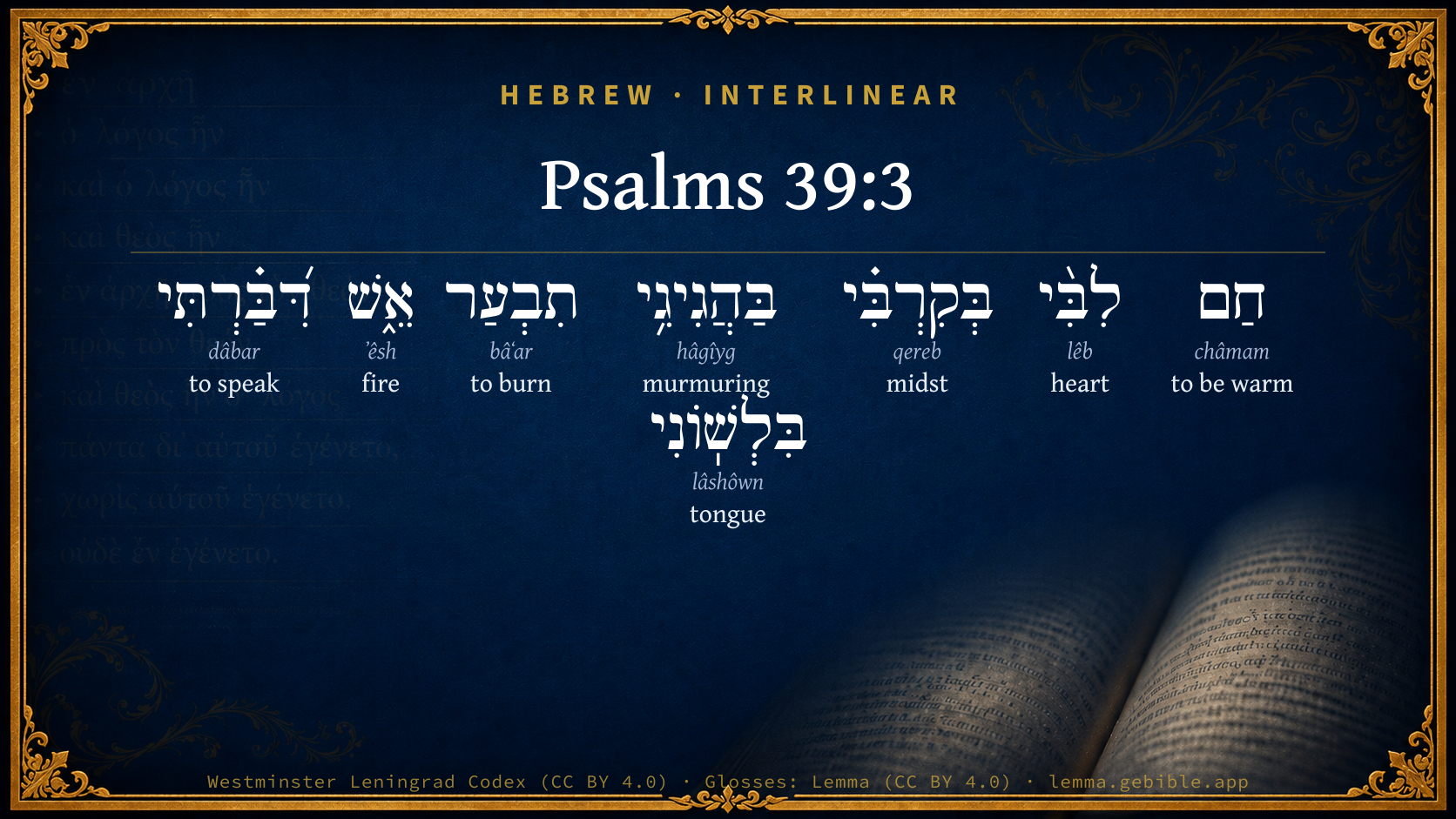
Hebrew (Westminster Leningrad Codex) Psalms 39:3 appears in the Hebrew Old Testament. The text above is from the Westminster Leningrad Codex. Each word links to its Strong’s number, a concise gloss, and parsing drawn from the Open Scriptures Hebrew Bible morphology. Click any word for its full Brown-Driver-Briggs (BDB) entry.
Download image
Cite this verse

Psalms 39:3 (World English Bible). Public Domain. Lemma interlinear Bible study tool, https://lemma.gebible.app/v/psalms/39/3.

Show BibTeX & RIS
BibTeX
RIS
English Translation
My heart was hot within me. While I meditated, the fire burned: I spoke with my tongue:
World English Bible · Public Domain
Download a study sheet

One document with this verse’s original text, its word-by-word gloss line, the meaning frame, cross-references with their text, attributed commentary, and full source and license credits — printable, and it pastes into notes with its structure intact.

This verse Autodidact and up

Study sheet (.html) Plain text (.txt)

A passage Seminary Student

Up to 50 verses in one chapter. A passage sheet keeps up to 6 commentary sources and 12 cross-references per verse, in the order this page ranks them, and says so on the sheet whenever that leaves anything out. Ask for a single verse and you get the Autodidact verse sheet above.

Everything on this page stays free to read, with no account — the sheet is a download of what is already on screen, not access to it.

Want to remove ads? Support Godless Engineer
Compare translations 3

The same verse in 3 English versions, stacked beneath the original-language interlinear above. Click any original word for its lexicon entry.

Each is an independent rendering of the whole verse — the interlinear is not word-aligned to these translations.

Highlighted words mark where these versions differ — a whole-verse word diff, not a word-by-word alignment.

  • World English Bible Public Domain
    My heart was hot within me. While I meditated, the fire burned: I spoke with my tongue:
  • King James Version Public Domain
    My heart was hot within me, while I was musing the fire burned: then spake I with my tongue,
  • unfoldingWord Literal Text CC BY-SA 4.0
    My heart became hot within me; in my sighing, fire burned. I spoke with my tongue:

unfoldingWord Literal Text — © unfoldingWord, licensed CC BY-SA 4.0. Word-aligned USFM3 via Door43 (git.door43.org/unfoldingWord/en_ult).

Versions to compare (up to 4)

3 of 4 selected

Show all 18 translations

Every available English version of this verse, each an independent rendering of the whole verse.

  • World English Bible Public Domain
    My heart was hot within me. While I meditated, the fire burned: I spoke with my tongue:
  • Berean Standard Bible Public Domain
    My heart grew hot within me; as I mused, the fire burned. Then I spoke with my tongue:
  • Majority Standard Bible Public Domain
    My heart grew hot within me; as I mused, the fire burned. Then I spoke with my tongue:
  • King James Version Public Domain
    My heart was hot within me, while I was musing the fire burned: then spake I with my tongue,
  • American Standard Version (1901) Public Domain
    My heart was hot within me; While I was musing the fire burned: `Then' spake I with my tongue:
  • Revised Version (1885) Public Domain
    My heart was hot within me; while I was musing the fire kindled: then spake I with my tongue:
  • Geneva Bible (1599) Public Domain
    Mine heart was hote within me, and while I was musing, the fire kindeled, and I spake with my tongue, saying,
  • Douay-Rheims (1899) Public Domain
    I was dumb, and was humbled, and kept silence from good things: and my sorrow was renewed.
  • Young's Literal Translation Public Domain
    Hot `is' my heart within me, In my meditating doth the fire burn, I have spoken with my tongue.
  • Literal Standard Version CC BY-SA 4.0
    My heart [is] hot within me, || In my meditating the fire burns, || I have spoken with my tongue.
  • Unlocked Literal Bible CC BY-SA 4.0
    My heart became hot; when I thought about these things, it burned like a fire. Then finally I spoke.
  • unfoldingWord Literal Text CC BY-SA 4.0
    My heart became hot within me; in my sighing, fire burned. I spoke with my tongue:
  • Darby Bible Public Domain
    My heart burned within me; the fire was kindled in my musing: I spoke with my tongue,
  • World Messianic Bible Public Domain
    My heart was hot within me. While I meditated, the fire burned. I spoke with my tongue:
  • Webster's Bible Public Domain
    \\39:2\\I was dumb with silence, I held my peace, even from good; and my sorrow was stirred.
  • Free Bible Version CC BY-SA 4.0
    My mind burned as if on fire; I had to say what I was thinking:
  • Bible in Basic English Public Domain
    My heart was burning in my breast; while I was deep in thought the fire was lighted; then I said with my tongue,
  • JPS Tanakh (1917) Public Domain
    (39-4) My heart waxed hot within me; while I was musing, the fire kindled; then spoke I with my tongue:

Literal Standard Version (2020), Covenant Press — licensed CC BY-SA 4.0. Text via the HelloAO Bible API (eBible.org). Unlocked Literal Bible (unfoldingWord) — licensed CC BY-SA 4.0. Text via the HelloAO Bible API (eBible.org). unfoldingWord Literal Text — © unfoldingWord, licensed CC BY-SA 4.0. Word-aligned USFM3 via Door43 (git.door43.org/unfoldingWord/en_ult). Free Bible Version, Dr. Jonathan Gallagher — licensed CC BY-SA 4.0. Text via the HelloAO Bible API (eBible.org).

Word by word

More ways to search: Search by grammar → Find every occurrence → Compare this word →

Practice this passage: Drill this verse → Learn its vocabulary →

בַּהֲגִיגִ֥י
hâgîyg
H1901
“in/at · murmuring · my”
Preposition + Noun, Common, Masculine, Singular, Construct + Suffix, Personal, 1st Person, Common, Singular
Part of Speech
Preposition + Noun
Type
Common
Gender
Masculine
Number
Singular
State
Construct
Full BDB Definition

Origin: from an unused root akin to H1897

TWOT: 466a

whisper, musing, murmuring - murmuring - musing
  1. חַם châmam H2552 “to be warm” Verb, Qal, Perfect, 3rd Person, Masculine, Singular
  2. לִבִּ֨י lêb H3820 “heart · my” Noun, Common, Masculine, Singular, Construct + Suffix, Personal, 1st Person, Common, Singular
  3. בְּקִרְבִּ֗י qereb H7130 “in/at · midst · my” Preposition + Noun, Common, Masculine, Singular, Construct + Suffix, Personal, 1st Person, Common, Singular
  4. תִבְעַר bâʻar H1197 “to burn” Verb, Qal, Imperfect, 3rd Person, Feminine, Singular
  5. אֵ֑שׁ ʼêsh H784 “fire” Noun, Common, Both, Singular, Absolute
  6. דִּ֝בַּ֗רְתִּי dâbar H1696 “to speak” Verb, Piel, Perfect, 1st Person, Common, Singular
  7. בִּלְשֽׁוֹנִי lâshôwn H3956 “in/at · tongue · my” Preposition + Noun, Common, Both, Singular, Construct + Suffix, Personal, 1st Person, Common, Singular

About this verse

These counts appear in no published source. They are computed here, from the morphology-tagged text and Lemma’s own curated glosses. What Lemma adds →

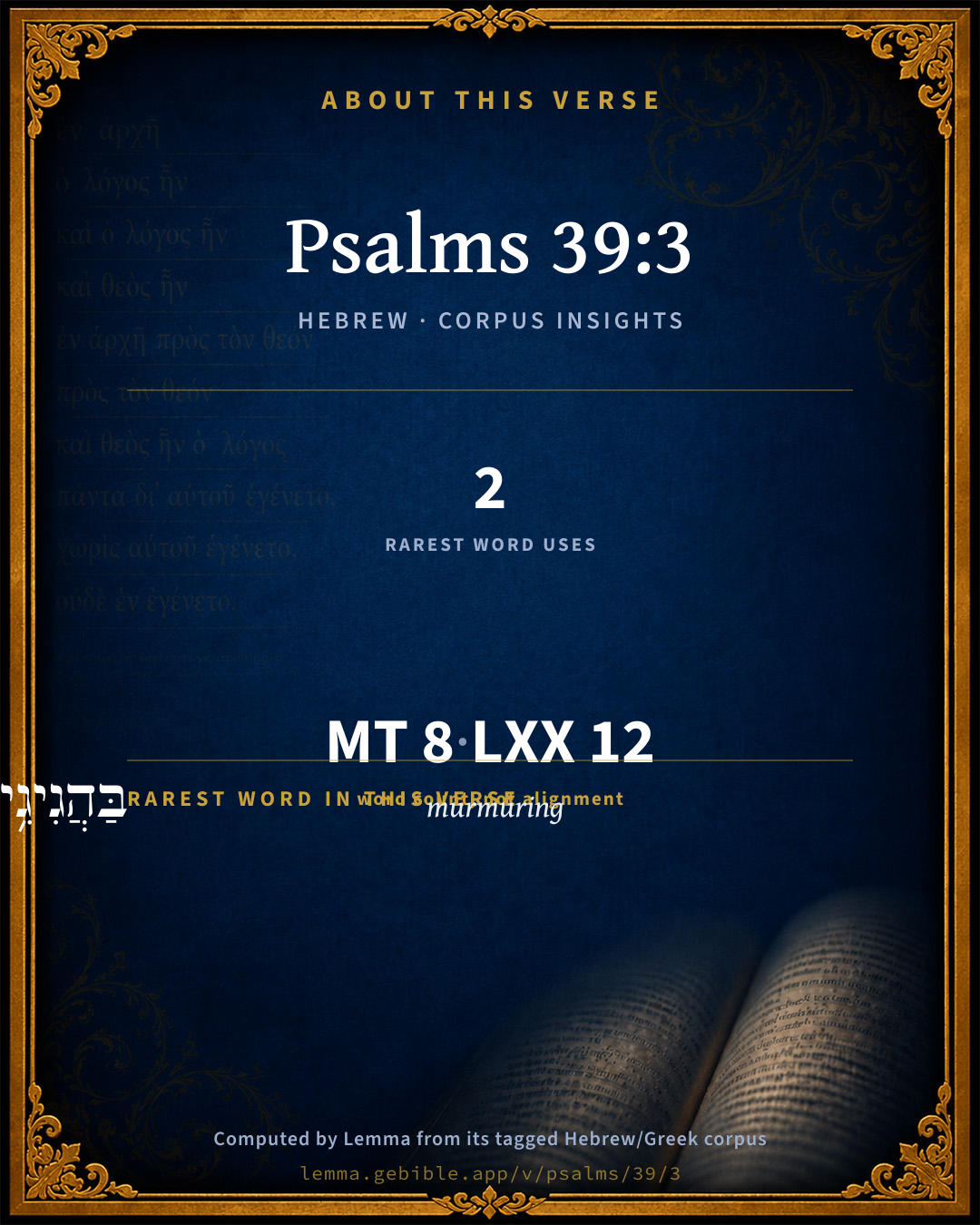
8
words
8
distinct lemmas
Wisdom
section

Notable vocabulary

The rarest word here is בַּהֲגִיגִ֥י murmuring H1901 — appearing just 2 times in the whole Hebrew Bible.

Shared distinctive vocabulary

בַּהֲגִיגִ֥י murmuring H1901 occurs in 2 verses of the Hebrew Bible. Also found in:

Grammatical profile

  • 3 verbs
  • 5 nouns

Verb forms

  • חַם Qal · Perfect
  • תִבְעַר Qal · Imperfect
  • דִּ֝בַּ֗רְתִּי Piel · Perfect

Hebrew & Septuagint length

In English translation the verse runs 17 words from the Hebrew and 19 from the Septuagint (LXX English) — closely comparable.

A rough comparison of the two English renderings, which tokenize alike — not a word-level alignment.

Word counts can differ between the Hebrew and the Greek without any difference in meaning — e.g. the Hebrew direct-object marker אֵת has no separate Greek word, and Greek often adds the article ὁ.

In the original languages it is 8 Hebrew tokens and 12 Greek tokens — but the two are counted differently (Hebrew bundles its prefixes and suffixes into one token; the Greek is in lemma form), so that isn’t a like-for-like length.

Cross-references

3

Topical passages linked to Psalms 39:3 in the Treasury of Scripture Knowledge — connected by theme and wording, ordered by reader-vote popularity; previews shown in the World English Bible.

  • Jeremiah 20:9 If I say, I will not make mention of him, nor speak any more in his name, then there is in my heart as it were a burning fire shut up in my bones, and I am weary with forbearing, and I can't [contain].
  • Luke 24:32 They said one to another, "Weren't our hearts burning within us, while he spoke to us along the way, and while he opened the Scriptures to us?"
  • Ezekiel 3:14 So the Spirit lifted me up, and took me away; and I went in bitterness, in the heat of my spirit; and the hand of Yahweh was strong on me.

Cross-references courtesy of OpenBible.info (CC BY 4.0).

Hebrew and Greek witnesses Masoretic Hebrew ↔ Greek Septuagint

The same verse in the two great witnesses to the Old Testament, shown verse-for-verse.

You’re reading Greek Psalm 38 (Hebrew Psalm 39). The Septuagint counts the superscription, so verse numbers can differ from the Hebrew — chapter-level alignment, not verse-by-verse. Numbering follows Rahlfs.

These are two independent witnesses, not word-aligned to each other, and the Septuagint is shown in lemma (dictionary) form.

Hebrew Psalms 39:3 Masoretic · Westminster Leningrad Codex

חַם לִבִּ֨י בְּקִרְבִּ֗י בַּהֲגִיגִ֥י תִבְעַר אֵ֑שׁ דִּ֝בַּ֗רְתִּי בִּלְשֽׁוֹנִי

My heart was hot within me. While I meditated, the fire burned: I spoke with my tongue:

World English Bible · Public Domain

Greek LXX Greek Psalm 38:3 Septuagint · lemma form

κωφάω καί ταπεινόω καί σιγάω ἐκ ἀγαθός καί ὁ ἄλγημα ἐγώ ἀνακαινίζω

My heart grew hot within me, and a fire would kindle in my meditation: I spoke with my tongue,

LXX2012 (modern English Septuagint) · Public Domain

Hebrew: Westminster Leningrad Codex (CC BY 4.0). Greek: Septuagint (public domain); English from LXX2012 (modern English Septuagint) (Public Domain). How the Septuagint differs from the Hebrew →

Commentary

Notes on Psalms 39:3 from classic Christian and Jewish commentators (each source and its license shown beneath its notes). The classic Christian expositions comment on the surrounding passage and are grouped to its opening verse, so a note may address several verses; the Jewish commentaries on the Tanakh (Rashi and others) are per-verse, so they appear only where the commentator wrote on this verse.

Lemma curates 59 commentaries, every one of them public domain or Creative Commons licensed, each selected and text-cleaned for this edition rather than reprinted as found. About our sources →

Trapp's Complete Commentary

John Trapp

Psa 39:3 My heart was hot within me, while I was musing the fire burned: [then] spake I with my tongue,

Ver. 3. My heart was hot within me] It was almost suffocated for want of vent. By heat of heart and fire kindled, saith one, the prophet meaneth, not only the greatness of his grief, as they that are grievously sick feel great force and power of heat; but he meaneth also some motions that he had to impatience and fretting; to which fault they are very much subject that are hot, and given to heat: thus he. This distemper to prevent, God and Nature have placed the heart near unto the lungs, ut cum ira accenditur, pulmonis humore temperetur, that, when it is heated with wrath, it may be cooled and qualified by the allay of the lungs.

While I was musing the fire burned] This showeth that thoughts and affections are the mutual causes one of another; so that thoughts kindle affections, and these cause thoughts to boil. And hence it is, saith a reverend man (Dr Goodwin), that new converts, having new and strong affections, can with more pleasure think of God than any.

Then spake I with my tongue] But better he had held his tongue, according to his first resolution. The Greeks have a saying, Let a man either keep silence or speak that which is better than silence. Austin paraphraseth thus: When I refrained so from speaking, for fear of speaking evil, that I spake no good, I was troubled at this my silence, lest my sin should be counted greater for this silence than my virtue in refraining from speaking evil.

John Trapp, A Commentary or Exposition upon All the Books of the Old and New Testament (1647–1656) — public domain. Text from a community e-Sword module.

Joseph Benson's Commentary

Psa 39:3. My heart was hot within me — Though I said nothing, I could not but have many affecting thoughts: and “the fire of divine charity, thus prevented from diffusing itself for the illumination and warmth of those around it, presently ascended, in a flame of devotion, toward heaven.” While I was musing — While this fire “continued to be fed, and preserved in brightness and vigour, by meditation on the goodness of God, and the ingratitude of man; the transient miseries of time, and the durable glories of eternity;” the fire burned — My thoughts kindled into passions, which could no longer be confined. Then spake I with my tongue — The ardour of my soul broke forth into such expressions as these that follow. “It is remarkable,” says Dr. Dodd, “in the poetical parts of Scripture, that the whole energy and beauty of the passages are frequently spoiled by the addition of connective particles, which are not in the Hebrew. There is a remarkable instance in this verse, which, in the original, is very expressive, My heart grew hot within me — while I was musing, the fire flamed out: I spake with my tongue.

Joseph Benson's Commentary on the Old and New Testaments (1811–1818) — public domain. Text from a community e-Sword module.

J. A. Alexander on Psalms

Joseph Addison Alexander

4. (Psa 39:3). Hot was my heart within me; while I muse the fire is kindling; (then) spake I with my tongue. His compulsory silence only rendered more intense the feelings which it was intended to conceal. The less he said the more he thought and felt, until at last it burst forth with more violence than if expressed at first. My heart glowed, or was hot, with angry discontent and envious repining. Within me, literally in my inner part, or inside, an emphatic phrase referring to the studied absence of all outward indications. Without, all seethed calm and cool; within, his heart was in a glow on fire. While I muse, literally in my meditation. See above, on Psa 5:2 (1). The future verb in this clause marks a transition. The fire will bnrn, or is about to burn, is kindling. The gradation is completed by the laconic phrase, I spake. "I did what I had fully resolved not to do." The reference to Psa 39:2 is made more obvious by the additional words, with my tongue, which would else be unmeaning and superfluous. "That very tongue, with which I had determined not to sin, I nevertheless spake with, in unadvised and unbecoming manner."

Joseph Addison Alexander, The Psalms Translated and Explained (1850) — public domain. Text from a community e-Sword module.

Geneva Bible (1599)

Geneva Bible translators

He confesseth that he grudged against God, considering the greatness of his sorrows, and the shortness of his life.

Geneva Bible (1599) marginal notes — public domain. Text via Bolls.life.

Jamieson, Fausset & Brown

Robert Jamieson, A. R. Fausset & David Brown

His emotions, as a smothered flame, burst forth.

Jamieson, Fausset & Brown — Commentary Critical and Explanatory on the Whole Bible (1871) — public domain (CC PDM 1.0). Text via the HelloAO Bible API.

Adam Clarke's Commentary

Verse 3. My heart was hot within me] A natural feeling of repressed grief.

While I was musing] What was at first a simple sensation of heat produced a flame; the fire broke out that had long been smothered. It is a metaphor taken from vegetables, which, being heaped together, begin to heat and ferment, if not scattered and exposed to the air; and will soon produce a flame, and consume themselves and every thing within their reach.

Adam Clarke's Commentary on the Bible (1810–1826) — public domain. Text from a community e-Sword/MySword module.

John Calvin's Commentaries

3. My heart became hot within me He now illustrates the greatness of his grief by the introduction of a simile, telling us that his sorrow, being internally suppressed, became so much the more inflamed, until the ardent passion of his soul continued to increase in strength. From this we may learn the very profitable lesson, that the more strenuously any one sets himself to obey God, and employs all his endeavors to attain the exercise of patience, the more vigorously is he assailed by temptation: for Satan, whilst he is not so troublesome to the indifferent and careless, and seldom looks near them, displays all his forces in hostile array against that individual. If, therefore, at any time we feel ardent emotions struggling and raising a commotion in our breasts, we should call to remembrance this conflict of David, that our courage may not fail us, or at least that our infirmity may not drive us headlong to despair. The dry and hot exhalations which the sun causes to arise in summer, if nothing occurred in the atmosphere to obstruct their progress, would ascend into the air without commotion; but when intervening clouds prevent their free ascent, a conflict arises, from which the thunders are produced. It is similar with respect to the godly who desire to lift up their hearts to God. If they would resign themselves to the vain imaginations which arise in their minds, they might enjoy a sort of unrestrained liberty to indulge in every fancy; but because they endeavor to resist their influence, and seek to devote themselves to God, obstructions which arise from the opposition of the flesh begin to trouble them. Whenever, therefore, the flesh shall put forth its efforts, and shall kindle up a fire in our hearts, let us know that we are exercised with the same kind of temptation which occasioned so much pain and trouble to David. In the end of the verse he acknowledges that the severity of the affliction with which he was visited had at length overcome him, and that he allowed foolish and unadvised words to pass from his lips. In his own person he sets before us a mirror of human infirmity, that, being warned by the danger to which we are exposed, we may learn betimes to seek protection under the shadow of God’s wings. When he says that he spake with his tongue, it is not a superfluous mode of expression, but a true and fuller confession of his sin, in that he had not only given way to sinful murmuring, but had even uttered loud complaints.

John Calvin's Commentaries (1540-1563) — public domain. Text from the Calvin Translation Society English edition (1840s-50s) via the Christian Classics Ethereal Library (ccel.org). Calvin's coverage is partial (roughly two-thirds of the Bible); uncommented books and verses are honest gaps, never fabricated. The 19th-century editor's footnotes and remarks are omitted so the notes are faithfully Calvin's own voice.

Ellicott's Commentary for English Readers

(3) The fire burned.—The attempt at repression only makes the inward flame of feeling burn the more fiercely, till at last it is too much for the resolution that has been formed, and the passion of the heart breaks out in words. Like the modern poet, the Hebrew bard had felt

“Twere better not to breathe or speak

Than cry for strength, remaining weak,

And seem to find, but still to seek.”

“But thought is too much for him, and he breaks into speech, not, however, fretfully, still less with bitter invective against others. It is a dialogue with the ruler of destiny, in which frail man wants to face his condition, and know the worst.

A Bible Commentary for English Readers, edited by Charles John Ellicott (1878–1897) — public domain. Text from a community e-Sword module.

The Cambridge Bible for Schools and Colleges

gen. ed. J. J. S. Perowne

3. burned] Better, as R.V. from Coverdale and P.B.V., kindled. The smouldering fire of passion within could no longer be restrained from bursting into a flame of words. Comp. (though the cause was different) Jer_20:9.

The Cambridge Bible for Schools and Colleges (gen. ed. J. J. S. Perowne; Cambridge University Press, 1878–1918) — public domain. Text from a community e-Sword module.

John Gill's Exposition

My heart was hot within me,.... Either with zeal for God; or rather with envy at the prosperity of wicked men, and with impatience at his own afflictions;

while I was musing the fire burned; not the fire of the divine word, while he was meditating upon it, which caused his heart to burn within him; nor the fire of divine love, the coals whereof give a most vehement flame, when the love of God is shed abroad in the heart, and the thoughts of it are directed by the Spirit of God to dwell in meditation on it; but the fire of passion, anger, and resentment, while meditating on his own adversity, and the prosperity of others;

then spake I with my tongue; and so broke the resolution he had made, Psa 39:1; he spoke not for God, though to him; not by way of thankfulness for his grace and goodness to him, in supporting him under his exercises; but in a way of complaint, because of his afflictions; it was in prayer he spoke to God with his tongue, and it was unadvisedly with his lips, as follows.

John Gill's Exposition of the Whole Bible (1746–1763) — public domain (CC PDM 1.0). Text via the HelloAO Bible API.

Albert Barnes' Notes on the Bible

My heart was hot within me - My mind became more and more excited; my feelings more and more intense. The attempt to suppress my emotions only more and more enkindled them.

While I was musing the fire burned - literally, “in my meditation the fire burned.” That is, while I was dwelling on the subject; while I was agitating it in my mind; while I thought about it - the flame was enkindled, and my thoughts found utterance. He was unable longer to suppress his feelings, and he gave vent to them in words. Compare Jer 20:9; Job 32:18-19.

Then spake I with my tongue - That is, in the words which are recorded in this psalm. He gave vent to his pent-up feelings in the language which follows. Even though there was a feeling of murmuring and complaining, he sought relief in stating his real difficulties before God, and in seeking from him direction and support.

Albert Barnes' Notes on the Bible (1834–1885) — public domain. Text from a community e-Sword/MySword module.

Matthew Poole's English Annotations

Musing, i.e. considering in my own thoughts the great wickedness and successfulness of mine enemies, and other wicked men; and withal mine own and other good mews integrity, attended with great troubles and miseries in this life.

The fire burned; my thoughts kindled my passions. Then spake I with my tongue, to wit, such words as I had purposed not to speak, Psa 39:1; rash and impatient words: either,

1. Some words not here expressed; which having uttered to men, he turneth his speech to God, Psa 39:4. Or,

2. Those which here follow.

Matthew Poole's English Annotations on the Holy Bible (1683–1685) — public domain. Text from a community e-Sword/MySword module.

The Treasury of David

Charles H. Spurgeon

Ver. 3. My heart was hot within me. The friction of inward thoughts produced an intense mental heat. The door of his heart was shut, and with the fire of sorrow burning within, the chamber of his soul soon grew unbearable with heat. Silence is an awful thing for a sufferer, it is the surest method to produce madness. Mourner, tell your sorrow; do it first and most fully to God, but even to pour it out before some wise and godly friend is far from being wasted breath. While I was musing the fire burned. As he thought upon the ease of the wicked and his own daily affliction, he could not unravel the mystery of providence, and therefore he became greatly agitated. While his heart was musing it was fusing, for the subject was confusing. It became harder every moment to be quiet; his volcanic soul was tossed with an inward ocean of fire, and heaved to and fro with a mental earthquake; and eruption was imminent, the burning lava must pour forth in a fiery stream. Then spake I with my tongue. The original is grandly laconic. I spake. The muzzled tongue burst all its bonds. The gag was hurled away. Misery, like murder, will out. You can silence praise, but anguish is clamorous. Resolve or no resolve, heed or no heed, sin or no sin, the impetuous torrent forced for itself a channel and swept away every restraint.

Ver. 3. My heart was hot within me, while I was musing the fire burned. They say of the lodestone (that wonder in nature), when either by carelessness in keeping it, or by some accident it loses its virtue, yet by laying it some good space of time in the filings of steel, it will again recover its virtues: when the spirit of a Christian by not looking well to it, loses of its heavenly heat and liveliness, the way of recovery is by laying it asleep in this so warming and quickening meditation. Oh, how burning and flaming may we often observe the spirit of the holy psalmist David, in his acting of meditation! Musing made him hot, yea, burning hot at the heart. Thus often in the beginning of a Psalm we find his heart low and discouraged, but as this musing was acted and heightened, his spirit grew hotter, and at last flies all on a flame, flies up to a very high pitch of heavenly heat. Oh, how do all the conscientious practisers of meditation, ever and anon experience these happy, heavenly heats, and heart enlargements! Ah, if all the saints' so glorious heart quickenings were gathered together, what a rich chain of pearls, pearls of rare experiences, would they make up of the heart warming efficacies of meditation! Nathanael Ranew.

Ver. 3. I was musing. What a blessed (shall I say duty or) privilege is prayer! Now meditation is a help to prayer. Gersom calls it the nurse of prayer. Meditation is like oil to the lamp; the lamp of prayer will soon go out unless meditation cherish and support it. Meditation and prayer are like two turtles, if you separate one the other dies; a cunning angler observes the time and season when the fish bite best, and then he throws in the angle, when the heart is warmed by meditation, now is the best season to throw in the angle of prayer, and fish for mercy. After Isaac had been in the field meditating he was fit for prayer when he came home. When the gun is full of powder it is fittest to discharge. So when the mind is full of good thoughts, a Christian is fittest by prayer for discharge; now he sends up whole volleys of sighs and groans to heaven. Meditation hath a double benefit in it, it pours in and pours out; first it pours good thoughts into the mind, and then it pours out those thoughts again into prayer; meditation first furnishes with matter to pray and then it furnishes with a heart to pray. I was musing, saith David, and the very next words are a prayer, "Lord, make me to know mine end." I muse on the works of thy hands, I stretch forth my hands to thee. The musing of his head made way for the stretching forth of his hands in prayer. When Christ was upon the Mount, then he prayed: so when the soul is upon the mount of meditation, now it is in tune for prayer. Prayer is the child of meditation: meditation leads the van, and prayer brings up the rear. Thomas Watson.

Ver. 3. Musing. Meditation is prayer in bullion, prayer in the ore, soon melted and run into holy desires. The laden cloud soon drops into rain, the piece charged soon goes off when fire is put to it. A meditating soul is in proxima potentia to prayer. This was an ejaculatory prayer shot from his soul when in the company of the wicked. William Gurnall.

Ver. 3. The fire burned. My thoughts kindled my passions. Matthew Pool.

Ver. 3. The fire burned. Meditate so long till thou findest thy heart grow warm in this duty. If, when a man is cold you ask how long he should stand by the fire? sure, till he be thoroughly warm, and made fit for his work. So, Christian, thy heart is cold; never a day, no, not the hottest day in summer, but it freezes there; now stand at the fire of meditation till thou findest thy affections warmed, and thou art made fit for spiritual service. David mused till his heart waxed hot within him. I will conclude this with that excellent saying of Bernard: "Lord, I will never come away from thee without thee." Let this be a Christian's resolution, not to leave off his meditations of God till he find something of God in him; some moving of the bowels after God; some flamings of love, So 5:4. Thomas Watson.

Ver. 3. His company was bad, but his thoughts were good; even while the wicked was before him his heart was hot within him, while he was musing the fire burned. His thoughts inflame his affections with holy zeal, and this holy fore, as by an ante-peristasis, burnt so much the hotter for the frost of cursed contrariety that was about it. When the careful magistrates or officers of a company break into a suspected house in the nighttime, the great question is, What company have you here? So when God breaks in upon our dark hearts, the enquiry is, What thoughts have you here? Why do thoughts arise in your minds? Are ye not become judges of evil thoughts? Lu 24:38 Jas 2:4. Faithful Teat.

Ver. 3. The spake I with my tongue, Lord, etc. It is, indeed, a happy circumstance when that silence which has long been preserved is first broken before the Lord. John Morison.

None.

Psalms 39:4*

Charles H. Spurgeon's The Treasury of David (1869–1885) — public domain. Psalms only. Text from a community e-Sword/MySword module.

Whedon's Commentary on the Bible

Daniel D. Whedon

3. While I was musing the fire burned—My meditations increased the trouble and perplexity of my heart until the heat of my sorrow impelled me to speak.

Daniel D. Whedon (gen. ed.), Commentary on the Old and New Testaments (1874–1909) — public domain. Text from a community e-Sword module.

The Pulpit Commentary

My heart was hot within me; or, grew hot (Kay). And while I was musing the fire burned; or, kindled (Revised Version). Then spake I with my tongue; i.e. aloud, articulately. I could not at any rate, I did not refrain myself. I burst out in speech, and made my moan to God.

The Pulpit Commentary (1880–1919), ed. H.D.M. Spence-Jones & Joseph S. Exell — public domain. Text from a community e-Sword module.

Lesson kit

Teaching starters — assembled from the data on this page, not authored interpretation. Every prompt links to the verse data it draws on. Edit before teaching.

Psalms, in the Wisdom, opens this verse with 8 words (8 distinct Hebrew lemmas). Its most distinctive word is hâgîyg (“murmuring”). A historical commentator’s framing appears above. Read the whole chapter for the surrounding context.

Discussion questions

  1. How does “murmuring” (hâgîyg) shape what this verse is saying?
  2. How does Psalms 5:1, which shares the word «murmuring», read alongside this verse?
  3. These translations render this verse differently. What is at stake in choosing one wording over another?
  4. «חַם» is a Qal Perfect verb. How does that grammatical form shape the action described?
  5. Compare how Trapp's Complete Commentary and Joseph Benson's Commentary read this verse. Where do they agree or differ?

Things to notice

Reading settings

Reading text

Shown beneath each verse's original-language words.

Old Testament
Old Testament edition

Read the OT as the Masoretic Hebrew (MT) or the Greek Septuagint (LXX).

English shown for the Greek Septuagint (in the Hebrew ↔ Greek comparison).

Comparing translations? Open the Compare panel on any verse page to stack up to four side by side.