
Exodus 29:34

Hebrew (Westminster Leningrad Codex) Exodus 29:34 appears in the Hebrew Old Testament. The text above is from the Westminster Leningrad Codex. Each word links to its Strong’s number, a concise gloss, and parsing drawn from the Open Scriptures Hebrew Bible morphology. Click any word for its full Brown-Driver-Briggs (BDB) entry.
Download image
Cite this verse

Exodus 29:34 (World English Bible). Public Domain. Lemma interlinear Bible study tool, https://lemma.gebible.app/v/exodus/29/34.

Show BibTeX & RIS
BibTeX
RIS
English Translation
If anything of the flesh of the consecration, or of the bread, remains to the morning, then you shall burn the remainder with fire: it shall not be eaten, because it is holy.
World English Bible · Public Domain
Download a study sheet

One document with this verse’s original text, its word-by-word gloss line, the meaning frame, cross-references with their text, attributed commentary, and full source and license credits — printable, and it pastes into notes with its structure intact.

This verse Autodidact and up

Study sheet (.html) Plain text (.txt)

A passage Seminary Student

Up to 50 verses in one chapter. A passage sheet keeps up to 6 commentary sources and 12 cross-references per verse, in the order this page ranks them, and says so on the sheet whenever that leaves anything out. Ask for a single verse and you get the Autodidact verse sheet above.

Everything on this page stays free to read, with no account — the sheet is a download of what is already on screen, not access to it.

Want to remove ads? Support Godless Engineer
Compare translations 3

The same verse in 3 English versions, stacked beneath the original-language interlinear above. Click any original word for its lexicon entry.

Each is an independent rendering of the whole verse — the interlinear is not word-aligned to these translations.

Highlighted words mark where these versions differ — a whole-verse word diff, not a word-by-word alignment.

  • World English Bible Public Domain
    If anything of the flesh of the consecration, or of the bread, remains to the morning, then you shall burn the remainder with fire: it shall not be eaten, because it is holy.
  • King James Version Public Domain
    And if ought of the flesh of the consecrations, or of the bread, remain unto the morning, then thou shalt burn the remainder with fire: it shall not be eaten, because it is holy.
  • unfoldingWord Literal Text CC BY-SA 4.0
    And if any meat of the consecration or any of the bread remains until the morning, then you shall burn the remainder with fire. It shall not be eaten, because it is set apart.

unfoldingWord Literal Text — © unfoldingWord, licensed CC BY-SA 4.0. Word-aligned USFM3 via Door43 (git.door43.org/unfoldingWord/en_ult).

Versions to compare (up to 4)

3 of 4 selected

Show all 18 translations

Every available English version of this verse, each an independent rendering of the whole verse.

  • World English Bible Public Domain
    If anything of the flesh of the consecration, or of the bread, remains to the morning, then you shall burn the remainder with fire: it shall not be eaten, because it is holy.
  • Berean Standard Bible Public Domain
    And if any of the meat of ordination or any bread is left until the morning, you are to burn up the remainder. It must not be eaten, because it is sacred.
  • Majority Standard Bible Public Domain
    And if any of the meat of ordination or any bread is left until the morning, you are to burn up the remainder. It must not be eaten, because it is sacred.
  • King James Version Public Domain
    And if ought of the flesh of the consecrations, or of the bread, remain unto the morning, then thou shalt burn the remainder with fire: it shall not be eaten, because it is holy.
  • American Standard Version (1901) Public Domain
    And if aught of the flesh of the consecration, or of the bread, remain unto the morning, then thou shalt burn the remainder with fire: it shall not be eaten, because it is holy.
  • Revised Version (1885) Public Domain
    And if aught of the flesh of the consecration, or of the bread, remain unto the morning, then thou shalt burn the remainder with fire: it shall not be eaten, because it is holy.
  • Geneva Bible (1599) Public Domain
    Now if ought of the flesh of the consecration, or of the bread remaine vnto the morning, then thou shalt burne the rest with fire: it shall not be eaten, because it is an holie thing.
  • Douay-Rheims (1899) Public Domain
    And if there remain of the consecrated flash, or of the bread till the morning, thou shalt burn the remainder with fire: they shall not be eaten, because they are sanctified.
  • Young's Literal Translation Public Domain
    and if there be left of the flesh of the consecration or of the bread till the morning, then thou hast burned that which is left with fire; it is not eaten, for it `is' holy.
  • Literal Standard Version CC BY-SA 4.0
    and if there is left of the flesh of the consecration or of the bread until the morning, then you have burned that which is left with fire; it is not eaten, for it [is] holy.
  • Unlocked Literal Bible CC BY-SA 4.0
    If any of the meat of the ordination offering, or any of the bread, remains to the next morning, then you must burn it. It must not be eaten because it has been set apart to me.
  • unfoldingWord Literal Text CC BY-SA 4.0
    And if any meat of the consecration or any of the bread remains until the morning, then you shall burn the remainder with fire. It shall not be eaten, because it is set apart.
  • Darby Bible Public Domain
    And if [any] of the flesh of the consecration, and of the bread, remain until the morning, then thou shalt burn the remainder with fire: it shall not be eaten, for it is holy.
  • World Messianic Bible Public Domain
    If anything of the meat of the consecration, or of the bread, remains to the morning, then you shall burn the remainder with fire. It shall not be eaten, because it is holy.
  • Webster's Bible Public Domain
    And if aught of the flesh of the consecration, or of the bread, shall remain till the morning, then thou shalt burn the remainder with fire: it shall not be eaten, because it is holy.
  • Free Bible Version CC BY-SA 4.0
    If any of the meat of ordination or any bread remains until the morning, burn what's left. It must not be eaten, because it's holy.
  • Bible in Basic English Public Domain
    And if any of the flesh of the offering or of the bread is over till the morning, let it be burned with fire; it is not to be used for food, for it is holy.
  • JPS Tanakh (1917) Public Domain
    And if aught of the flesh of the consecration, or of the bread, remain unto the morning, then thou shalt burn the remainder with fire; it shall not be eaten, because it is holy.

Literal Standard Version (2020), Covenant Press — licensed CC BY-SA 4.0. Text via the HelloAO Bible API (eBible.org). Unlocked Literal Bible (unfoldingWord) — licensed CC BY-SA 4.0. Text via the HelloAO Bible API (eBible.org). unfoldingWord Literal Text — © unfoldingWord, licensed CC BY-SA 4.0. Word-aligned USFM3 via Door43 (git.door43.org/unfoldingWord/en_ult). Free Bible Version, Dr. Jonathan Gallagher — licensed CC BY-SA 4.0. Text via the HelloAO Bible API (eBible.org).

Word by word

More ways to search: Search by grammar → Find every occurrence → Compare this word →

Practice this passage: Drill this verse → Learn its vocabulary →

הַמִּלֻּאִ֛ים
milluʼ
H4394
“the · installations”
Particle, Definite Article + Noun, Common, Masculine, Plural, Absolute
Part of Speech
Particle + Noun
Type
Common
Gender
Masculine
Number
Plural
State
Absolute
Full BDB Definition

Origin: from H4390

TWOT: 1195e

setting, installation - setting, stones for setting - installation (of priests)
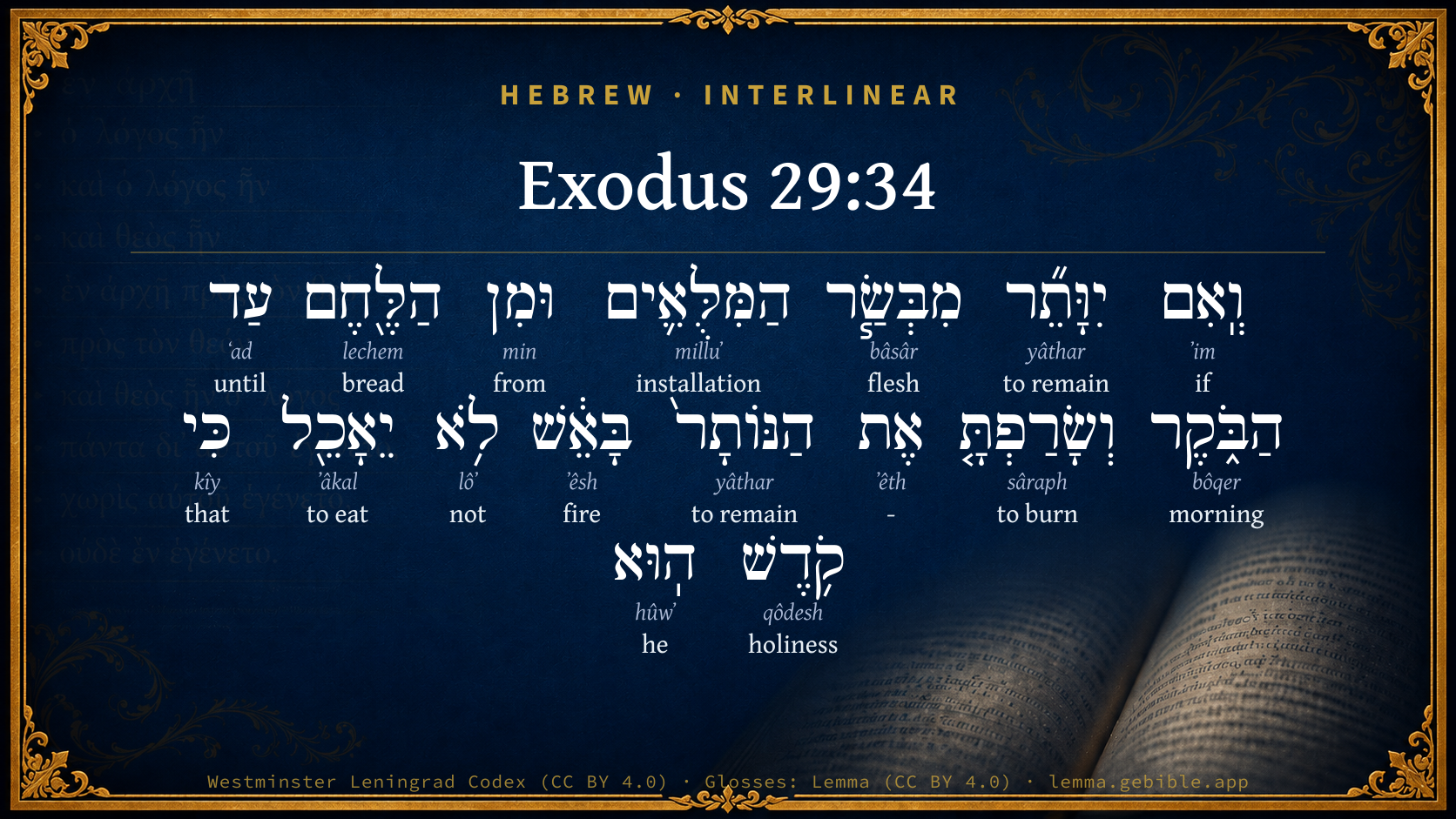
  1. וְֽאִם ʼim H518 “and · if” Conjunction + Conjunction
  2. יִוָּתֵ֞ר yâthar H3498 “to remain” Verb, Niphal, Imperfect, 3rd Person, Masculine, Singular
  3. מִבְּשַׂ֧ר bâsâr H1320 “from · flesh of” Preposition + Noun, Common, Masculine, Singular, Construct
  4. וּמִן min H4480 “and · from” Conjunction + Preposition
  5. הַלֶּ֖חֶם lechem H3899 “the · bread” Particle, Definite Article + Noun, Common, Both, Singular, Absolute
  6. עַד ʻad H5704 “until” Preposition
  7. הַבֹּ֑קֶר bôqer H1242 “the · morning” Particle, Definite Article + Noun, Common, Masculine, Singular, Absolute
  8. וְשָׂרַפְתָּ֤ sâraph H8313 “and · to burn” Conjunction + Verb, Qal, Sequential Perfect, 2nd Person, Masculine, Singular
  9. אֶת ʼêth H853 “-” Particle, Direct Object
  10. הַנּוֹתָר֙ yâthar H3498 “the · remaining” Particle, Definite Article + Verb, Niphal, Participle Active, Masculine, Singular, Absolute
  11. בָּאֵ֔שׁ ʼêsh H784 “in/at the · fire” Preposition, Determined + Noun, Common, Both, Singular, Absolute
  12. לֹ֥א lôʼ H3808 “not” Particle, Negative
  13. יֵאָכֵ֖ל ʼâkal H398 “to eat” Verb, Niphal, Imperfect, 3rd Person, Masculine, Singular
  14. כִּי kîy H3588 “that” Conjunction
  15. קֹ֥דֶשׁ qôdesh H6944 “holiness” Noun, Common, Masculine, Singular, Absolute
  16. הֽוּא hûwʼ H1931 “he” Pronoun, Personal, 3rd Person, Masculine, Singular

About this verse

These counts appear in no published source. They are computed here, from the morphology-tagged text and Lemma’s own curated glosses. What Lemma adds →

17
words
16
distinct lemmas
Pentateuch
section

Notable vocabulary

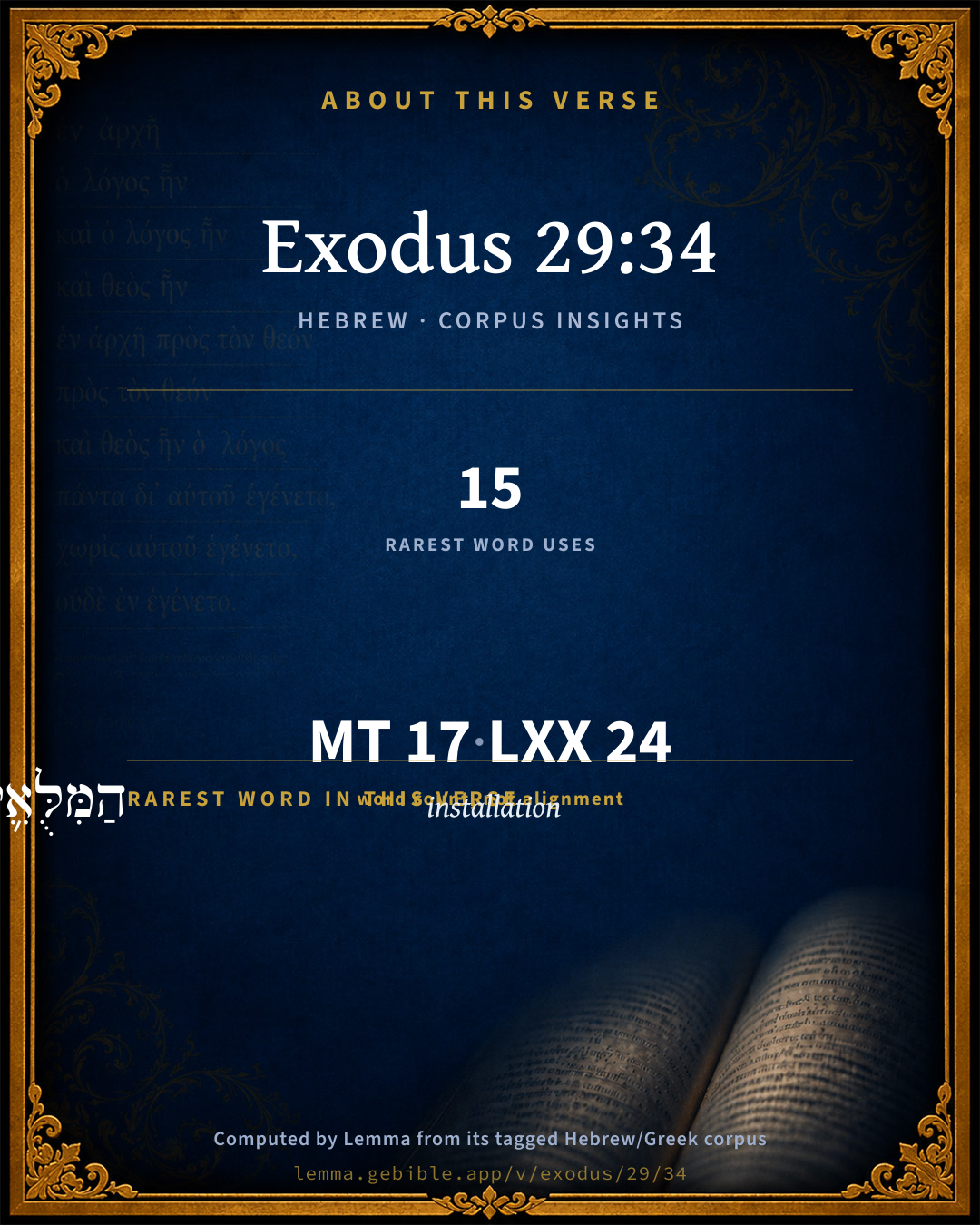
The rarest word here is הַמִּלֻּאִ֛ים installation H4394 — appearing just 15 times in the whole Hebrew Bible.

Shared distinctive vocabulary

הַמִּלֻּאִ֛ים installation H4394 occurs in 15 verses of the Hebrew Bible. Also found in:

Grammatical profile

  • 4 verbs
  • 6 nouns
  • 1 pronoun
  • 2 prepositions
  • 2 conjunctions
  • 2 particles

Verb forms

  • יִוָּתֵ֞ר Niphal · Imperfect
  • וְשָׂרַפְתָּ֤ Qal · Sequential Perfect
  • הַנּוֹתָר֙ Niphal · Participle Active
  • יֵאָכֵ֖ל Niphal · Imperfect

Repetition

A word recurs within this verse — often emphatic in Hebrew:

  • יִוָּתֵ֞ר to remain H3498 ×2

Hebrew & Septuagint length

In English translation the verse runs 33 words from the Hebrew and 38 from the Septuagint (LXX English) — closely comparable.

A rough comparison of the two English renderings, which tokenize alike — not a word-level alignment.

Word counts can differ between the Hebrew and the Greek without any difference in meaning — e.g. the Hebrew direct-object marker אֵת has no separate Greek word, and Greek often adds the article ὁ.

In the original languages it is 17 Hebrew tokens and 24 Greek tokens — but the two are counted differently (Hebrew bundles its prefixes and suffixes into one token; the Greek is in lemma form), so that isn’t a like-for-like length.

Cross-references

8

Topical passages linked to Exodus 29:34 in the Treasury of Scripture Knowledge — connected by theme and wording, ordered by reader-vote popularity; previews shown in the World English Bible.

  • Exodus 12:10 You shall let nothing of it remain until the morning; but that which remains of it until the morning you shall burn with fire.
  • Leviticus 8:32 What remains of the flesh and of the bread you shall burn with fire.
  • Exodus 16:19 Moses said to them, "Let no one leave of it until the morning."
  • Exodus 29:22 Also you shall take some of the ram's fat, the fat tail, the fat that covers the innards, the cover of the liver, the two kidneys, the fat that is on them, and the right thigh (for it is a ram of consecration),
  • Exodus 29:26 "You shall take the breast of Aaron's ram of consecration, and wave it for a wave-offering before Yahweh: and it shall be your portion.
  • Exodus 29:28 and it shall be for Aaron and his sons as their portion forever from the children of Israel; for it is a heave-offering: and it shall be a heave-offering from the children of Israel of the sacrifices of their peace-offerings, even their heave-offering to Yahweh.
  • Leviticus 7:18–19 If any of the flesh of the sacrifice of his peace offerings is eaten on the third day, it will not be accepted, neither shall it be imputed to him who offers it. It will be an abomination, and the soul who eats any of it will bear his iniquity.
  • Leviticus 10:16 Moses diligently inquired about the goat of the sin offering, and, behold, it was burned: and he was angry with Eleazar and with Ithamar, the sons of Aaron who were left, saying,

Cross-references courtesy of OpenBible.info (CC BY 4.0).

Hebrew and Greek witnesses Masoretic Hebrew ↔ Greek Septuagint

The same verse in the two great witnesses to the Old Testament, shown verse-for-verse.

These are two independent witnesses, not word-aligned to each other, and the Septuagint is shown in lemma (dictionary) form.

Hebrew Exodus 29:34 Masoretic · Westminster Leningrad Codex

וְֽאִם יִוָּתֵ֞ר מִבְּשַׂ֧ר הַמִּלֻּאִ֛ים וּמִן הַלֶּ֖חֶם עַד הַבֹּ֑קֶר וְשָׂרַפְתָּ֤ אֶת הַנּוֹתָר֙ בָּאֵ֔שׁ לֹ֥א יֵאָכֵ֖ל כִּי קֹ֥דֶשׁ הֽוּא

If anything of the flesh of the consecration, or of the bread, remains to the morning, then you shall burn the remainder with fire: it shall not be eaten, because it is holy.

World English Bible · Public Domain

Greek LXX Exodus 29:34 Septuagint · lemma form

ἐάν δέ καταλείπω ἀπό ὁ κρέας ὁ θυσία ὁ τελείωσις καί ὁ ἄρτος ἕως πρωΐ κατακαίω ὁ λοιπός πῦρ οὐ βιβρώσκω ἁγίασμα γάρ εἰμί

And if anything be left of the flesh of the sacrifice of consecration and of the loaves until the morning, you shall burn the remainder with fire: it shall not be eaten, for it is a holy thing.

LXX2012 (modern English Septuagint) · Public Domain

Hebrew: Westminster Leningrad Codex (CC BY 4.0). Greek: Septuagint (public domain); English from LXX2012 (modern English Septuagint) (Public Domain). How the Septuagint differs from the Hebrew →

Targum (Aramaic paraphrase)

2

The Targum is the ancient Jewish Aramaic paraphrase of the Hebrew Scriptures — an interpretive translation, not the Hebrew text itself. Onkelos (literal) and Pseudo-Jonathan (expansive) render the Torah, and Jonathan the Prophets. Coverage is partial: where no permissively-licensed English translation exists for a verse, only the Aramaic is shown. This is verse-level text, not a word-by-word alignment to the Hebrew.

  1. Targum Onkelos Torah (Genesis–Deuteronomy)
    וְאִם יִשְׁתָּאַר מִבְּסַר קֻרְבָּנַיָא וּמִן לַחְמָא עַד צַפְרָא וְתוֹקִיד יָת דְאִשְׁתָּאַר בְּנוּרָא לָא יִתְאֲכֵל אֲרֵי קוּדְשָׁא הוּא:

    (no public-domain English translation for this verse)

    Targum Onkelos — Aramaic: “Onkelos Genesis” (public domain); “Onkelos Exodus” (public domain); “Onkelos Leviticus” (public domain); “Onkelos Numbers” (public domain); “Onkelos Deuteronomy” (public domain). English: “Sefaria Community Translation” (CC0 1.0 (public-domain dedication)); “J.W. Etheridge. The Targums of Onkelos and Jonathan Ben Uzziel on the Pentateuch. London: Longmans, Green, 1862” (public domain). Text via Sefaria.

  2. Targum Pseudo-Jonathan Torah (Genesis–Deuteronomy)
    וְאִין יִשְׁתְּיַיר מִבְּשַר קוּרְבָּנַיָא וּמִן לַחְמָא עַד צַפְרָא וְתוֹקֵיד יַת דְּמִשְׁתְּיַיר בְּנוּרָא לָא יִתְאָכֵיל אֲרוּם קוּדְשָׁא הוּא

    And if any of the flesh of the oblation and of the bread remain until the morning, thou shalt burn that which remaineth with fire; it shall not be eaten; for it is sacred.

    Targum Pseudo-Jonathan — Aramaic: “Targum Jonathan on Genesis” (public domain); “Targum Jonathan on Exodus” (public domain); “Targum Jonathan on Leviticus” (public domain); “Targum Jonathan on Numbers” (public domain); “Targum Jonathan on Deuteronomy” (public domain). English: “The Targum of Jonathan ben Uzziel, trans. J. W. Etheridge, London, 1862” (public domain). Text via Sefaria.

Commentary

Notes on Exodus 29:34 from classic Christian and Jewish commentators (each source and its license shown beneath its notes). The classic Christian expositions comment on the surrounding passage and are grouped to its opening verse, so a note may address several verses; the Jewish commentaries on the Tanakh (Rashi and others) are per-verse, so they appear only where the commentator wrote on this verse.

Lemma curates 59 commentaries, every one of them public domain or Creative Commons licensed, each selected and text-cleaned for this edition rather than reprinted as found. About our sources →

Trapp's Complete Commentary

John Trapp

Exo 29:34 And if ought of the flesh of the consecrations, or of the bread, remain unto the morning, then thou shalt burn the remainder with fire: it shall not be eaten, because it [is] holy.

Ver. 34. Thou shalt burn the remainder.] The thank offering was not to be kept till the morrow, to teach us to be prompt and present in praising God and applying Christ.

John Trapp, A Commentary or Exposition upon All the Books of the Old and New Testament (1647–1656) — public domain. Text from a community e-Sword module.

Adam Clarke's Commentary

Verse 34. Burn the remainder with fire] Common, voluntary, and peace-offerings, might be eaten even on the second day; see Le 7:16; Le 19:5-6. But this being a peculiar consecration, in order to qualify a person to offer sacrifices for sin, like that great sacrifice, the paschal lamb, that typified the atonement made by Christ, none of it was to be left till the morning lest putrefaction should commence, which would be utterly improper in a sacrifice that was to make expiation for sin, and bring the soul into a state of holiness and perfection with God. See Clarke on Ex 12:10.

Adam Clarke's Commentary on the Bible (1810–1826) — public domain. Text from a community e-Sword/MySword module.

The Cambridge Bible for Schools and Colleges

gen. ed. J. J. S. Perowne

34. Cf. Lev_7:15 (P), Exo_22:30 (H), both of a peace-offering; also above, Exo_12:10.

consecration] installation (-sacrifice). See v. 31.

The Cambridge Bible for Schools and Colleges (gen. ed. J. J. S. Perowne; Cambridge University Press, 1878–1918) — public domain. Text from a community e-Sword module.

John Gill's Exposition

And if ought of the flesh of the consecrations, or of the bread, remain unto the morning,.... Being more than the priests could eat:

then thou shalt burn the remainder with fire; that it might not be used in a contemptuous manner, or abused to superstitious uses; the same orders with those respecting what was left of the passover: Exo 12:10,

it shall not be eaten, because it is holy; which is the reason before given why it should not be eaten by a stranger, and being kept till the next morning it was ordered to be burnt, that it might not then be eaten at all; it was not to be given to a stranger, nor to be cast to dogs, because it had been devoted to sacred uses; and it seems as if it was not to be eaten by the priests themselves the next day, who were to live upon the daily provision made for them.

John Gill's Exposition of the Whole Bible (1746–1763) — public domain (CC PDM 1.0). Text via the HelloAO Bible API.

Matthew Poole's English Annotations

Thou shalt burn the remainder, according to the law of all peace-offerings, except those which were vows or voluntary offerings, Lev 7:16,17, which these were not: compare Exo 12:10.

Matthew Poole's English Annotations on the Holy Bible (1683–1685) — public domain. Text from a community e-Sword/MySword module.

The Pulpit Commentary

Thou shalt burn the remainder with fire. Compare above, Exo_12:10.

The Pulpit Commentary (1880–1919), ed. H.D.M. Spence-Jones & Joseph S. Exell — public domain. Text from a community e-Sword module.

Lesson kit

Teaching starters — assembled from the data on this page, not authored interpretation. Every prompt links to the verse data it draws on. Edit before teaching.

Exodus, in the Pentateuch, opens this verse with 17 words (16 distinct Hebrew lemmas). Its most distinctive word is milluʼ (“installation”). A historical commentator’s framing appears above. Read the whole chapter for the surrounding context.

Discussion questions

  1. How does “installation” (milluʼ) shape what this verse is saying?
  2. Exodus 25:7 shares the word «installation» with this verse. How do the two illuminate each other?
  3. “to remain” occurs 2× in this one verse. What is the effect of the repetition?
  4. These translations render this verse differently; the difference is in the English rendering, not the original. What questions does that raise?
  5. The verb «יִוָּתֵ֞ר» is Niphal Imperfect. How does its form color the action?
  6. Reading how Trapp's Complete Commentary and Adam Clarke's Commentary read this verse, where do the two commentators agree and where do they part?

Things to notice

Reading settings

Reading text

Shown beneath each verse's original-language words.

Old Testament
Old Testament edition

Read the OT as the Masoretic Hebrew (MT) or the Greek Septuagint (LXX).

English shown for the Greek Septuagint (in the Hebrew ↔ Greek comparison).

Comparing translations? Open the Compare panel on any verse page to stack up to four side by side.