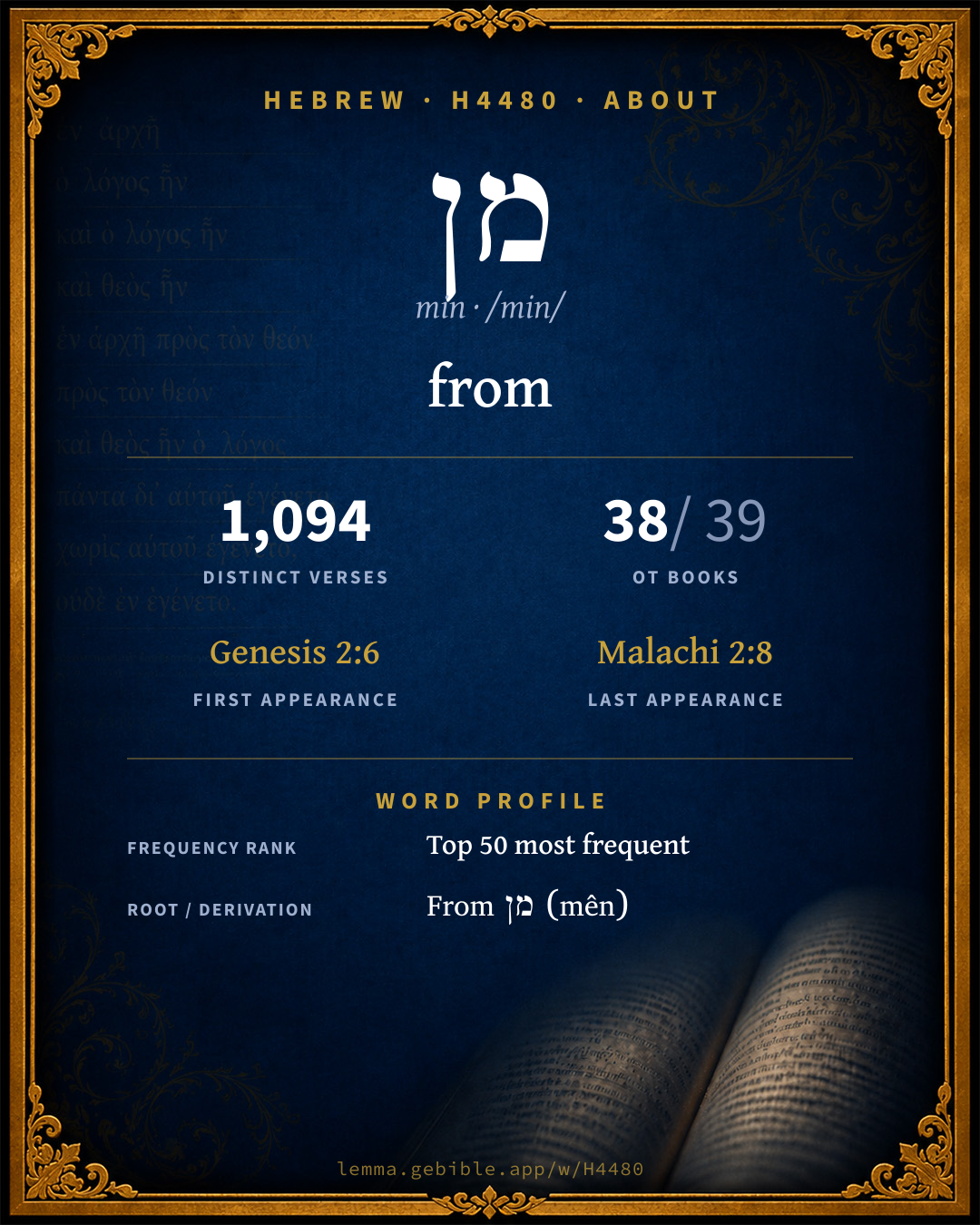
מן
from
also: out of, on account of, off, since fuller range ↓
Full lexicon entry — Brown-Driver-Briggs (BDB)
From Brown-Driver-Briggs (BDB)
Where this word appears
Grammar key — what these labels mean
Part of speech
- Preposition
- A relational word (e.g. “in,” “to,” “from”) governing a noun.
- Noun
- A naming word — a person, place, thing, or idea.
Noun type
- Common
- A common noun — a general class of person, place, or thing (“king,” “city,” “water”), not a specific name.
State
- Construct
- A noun bound to a following noun in a possessive / “of” relationship (the construct chain).
Gender
- Masculine
- Grammatically masculine.
Number
- Singular
- One.
Grammatical forms
- Preposition 1,229 times (100%)
- Noun, Common, Masculine, Singular, Construct 1 time (0%)
Parsed forms decoded from the imported morphology (morphhb / Westminster Leningrad Codex — WLC text public domain, morphhb tagging CC BY 4.0), counted across 1,230 parsed occurrences — not distinct verses.
Page 1 of 6 — showing verses 1–200 of 1,094 distinct verses where H4480 appears, across 38 books. Click any verse to open its interlinear word-by-word view. Verse text shown in the World English Bible for context — . Each verse’s Hebrew form is shown with its reference; the English is not keyword-highlighted, since the data carries no word-level English alignment. Use “Compare translations” on any verse to read it across multiple English versions. This concordance covers the Hebrew Bible; Septuagint (Greek Old Testament) occurrences are not indexed here.
Genesis 68 verses
- Genesis 2:6 מִן prep but a mist went up from the earth, and watered the whole surface of the ground.
- Genesis 2:7 מִן prep Yahweh God formed man from the dust of the ground, and breathed into his nostrils the breath of life; and man became a living soul.
- Genesis 2:9 מִן prep Out of the ground Yahweh God made every tree to grow that is pleasant to the sight, and good for food; the tree of life also in the midst of the garden, and the tree of the knowledge of good and evil.
- Genesis 2:17 מִמֶּ֑/נּוּ מִמֶּ֖/נּוּ prep + sfx pers 1cp prep + sfx pers 1cp but of the tree of the knowledge of good and evil, you shall not eat of it: for in the day that you eat of it you will surely die."
- Genesis 2:19 מִן prep Out of the ground Yahweh God formed every animal of the field, and every bird of the sky, and brought them to the man to see what he would call them. Whatever the man called every living creature, that was its name.
- Genesis 2:22 מִן prep He made the rib, which Yahweh God had taken from the man, into a woman, and brought her to the man.
- Genesis 3:3 מִמֶּ֔/נּוּ prep + sfx pers 1cp but of the fruit of the tree which is in the midst of the garden, God has said, 'You shall not eat of it, neither shall you touch it, lest you die.'"
- Genesis 3:5 מִמֶּ֔/נּוּ prep + sfx pers 3ms for God knows that in the day you eat it, your eyes will be opened, and you will be like God, knowing good and evil."
- Genesis 3:11 הֲ/מִן מִמֶּ֖/נּוּ ptcl inter + prep prep + sfx pers 1cp God said, "Who told you that you were naked? Have you eaten from the tree that I commanded you not to eat from?"
- Genesis 3:12 מִן prep The man said, "The woman whom you gave to be with me, she gave me of the tree, and I ate."
- Genesis 3:17 מִן מִמֶּ֑/נּוּ prep prep + sfx pers 1cp To Adam he said, "Because you have listened to your wife's voice, and have eaten of the tree, of which I commanded you, saying, 'You shall not eat of it,' cursed is the ground for your sake. In toil you will eat of it all the days of your life.
- Genesis 3:19 מִמֶּ֖/נָּה prep + sfx pers 3fs By the sweat of your face will you eat bread until you return to the ground, for out of it you were taken. For you are dust, and to dust you shall return."
- Genesis 3:22 מִמֶּ֔/נּוּ prep + sfx pers 1cp Yahweh God said, "Behold, the man has become like one of us, knowing good and evil. Now, lest he put forth his hand, and also take of the tree of life, and eat, and live forever..."
- Genesis 4:10 מִן prep Yahweh said, "What have you done? The voice of your brother's blood cries to me from the ground.
- Genesis 4:11 מִן prep Now you are cursed because of the ground, which has opened its mouth to receive your brother's blood from your hand.
- Genesis 5:29 מִן prep and he named him Noah, saying, "This same will comfort us in our work and in the toil of our hands, because of the ground which Yahweh has cursed."
- Genesis 6:20 וּ/מִן conj + prep Of the birds after their kind, of the cattle after their kind, of every creeping thing of the ground after its kind, two of every sort shall come to you, to keep them alive.
- Genesis 7:2 וּ/מִן conj + prep You shall take seven pairs of every clean animal with you, the male and his female. Of the animals that are not clean, take two, the male and his female.
- Genesis 7:8 מִן וּ/מִן וּ/מִ֨ן prep conj + prep conj + prep Clean animals, animals that are not clean, birds, and everything that creeps on the ground
- Genesis 7:23 מִן prep Every living thing was destroyed that was on the surface of the ground, including man, cattle, creeping things, and birds of the sky. They were destroyed from the earth. Only Noah was left, and those who were with him in the ark.
- Genesis 8:2 מִן prep The deep's fountains and the sky's windows were also stopped, and the rain from the sky was restrained.
- Genesis 8:10 מִן prep He stayed yet another seven days; and again he sent forth the dove out of the ark.
- Genesis 8:16 מִן prep "Go forth from the ark, you, and your wife, and your sons, and your sons' wives with you.
- Genesis 8:19 מִן prep Every animal, every creeping thing, and every bird, whatever moves on the earth, after their families, went forth out of the ark.
- Genesis 9:18 מִן prep The sons of Noah who went forth from the ark were Shem, Ham, and Japheth. Ham is the father of Canaan.
- Genesis 9:21 מִן prep He drank of the wine, and got drunk. He was uncovered within his tent.
- Genesis 10:11 מִן prep Out of that land he went forth into Assyria, and built Nineveh, Rehoboth Ir, Calah,
- Genesis 13:14 מִן prep Yahweh said to Abram, after Lot was separated from him, "Now, lift up your eyes, and look from the place where you are, northward and southward and eastward and westward,
- Genesis 16:2 מִמֶּ֑/נָּה prep + sfx pers 3fs Sarai said to Abram," See now, Yahweh has restrained me from bearing. Please go in to my handmaid. It may be that I will obtain children by her." Abram listened to the voice of Sarai.
- Genesis 17:6 מִמְּ/ךָ֥ prep + sfx pers 2ms I will make you exceeding fruitful, and I will make nations of you. Kings will come out of you.
- Genesis 17:16 מִמֶּ֛/נָּה מִמֶּ֥/נָּה prep + sfx pers 3fs prep + sfx pers 3fs I will bless her, and moreover I will give you a son by her. Yes, I will bless her, and she will be a mother of nations. Kings of peoples will come from her."
- Genesis 19:12 מִן prep The men said to Lot, "Do you have anybody else here? Sons-in-law, your sons, your daughters, and whoever you have in the city, bring them out of the place:
- Genesis 19:14 מִן prep Lot went out, and spoke to his sons-in-law, who were pledged to marry his daughters, and said, "Get up! Get out of this place, for Yahweh will destroy the city." But he seemed to his sons-in-law to be joking.
- Genesis 19:24 מִן prep Then Yahweh rained on Sodom and on Gomorrah sulfur and fire from Yahweh out of the sky.
- Genesis 21:15 מִן prep The water in the bottle was spent, and she cast the child under one of the shrubs.
- Genesis 21:17 מִן prep God heard the voice of the boy. The angel of God called to Hagar out of the sky, and said to her, "What ails you, Hagar? Don't be afraid. For God has heard the voice of the boy where he is.
- Genesis 22:11 מִן prep The angel of Yahweh called to him out of the sky, and said, "Abraham, Abraham!" He said, "Here I am."
- Genesis 22:12 מִמֶּֽ/נִּי prep + sfx pers 1cs He said, "Don't lay your hand on the boy, neither do anything to him. For now I know that you fear God, seeing you have not withheld your son, your only son, from me."
- Genesis 22:15 מִן prep The angel of Yahweh called to Abraham a second time out of the sky,
- Genesis 23:6 מִמֶּ֔/נּוּ מִמְּ/ךָ֖ prep + sfx pers 1cp prep + sfx pers 2ms "Hear us, my lord. You are a prince of God among us. In the choice of our tombs bury your dead. None of us will withhold from you his tomb, but that you may bury your dead."
- Genesis 23:13 מִמֶּ֔/נִּי prep + sfx pers 1cs He spoke to Ephron in the audience of the people of the land, saying, "But if you will, please hear me. I will give the price of the field. Take it from me, and I will bury my dead there."
- Genesis 25:29 מִן prep Jacob boiled stew. Esau came in from the field, and he was famished.
- Genesis 25:30 מִן prep Esau said to Jacob, "Please feed me with that same red stew, for I am famished." Therefore his name was called Edom.
- Genesis 26:16 מִמֶּ֖/נּוּ prep + sfx pers 1cp Abimelech said to Isaac, "Go from us, for you are much mightier than we."
- Genesis 27:45 מִמְּ/ךָ֗ prep + sfx pers 2ms until your brother's anger turn away from you, and he forgets what you have done to him. Then I will send, and get you from there. Why should I be bereaved of you both in one day?"
- Genesis 29:2 מִן prep He looked, and behold, a well in the field, and, behold, three flocks of sheep lying there by it. For out of that well they watered the flocks. The stone on the well's mouth was great.
- Genesis 30:2 מִמֵּ֖/ךְ prep + sfx pers 2fs Jacob's anger was kindled against Rachel, and he said, "Am I in God's place, who has withheld from you the fruit of the womb?"
- Genesis 30:3 מִמֶּֽ/נָּה prep + sfx pers 3fs She said, "Behold, my maid Bilhah. Go in to her, that she may bear on my knees, and I also may obtain children by her."
- Genesis 30:16 מִן prep Jacob came from the field in the evening, and Leah went out to meet him, and said, "You must come in to me; for I have surely hired you with my son's mandrakes." He lay with her that night.
- Genesis 31:13 מִן prep I am the God of Bethel, where you anointed a pillar, where you vowed a vow to me. Now arise, get out from this land, and return to the land of your birth."
- Genesis 32:13 מִן prep He lodged there that night, and took from that which he had with him, a present for Esau, his brother:
- Genesis 33:15 מִן prep Esau said, "Let me now leave with you some of the folk who are with me." He said, "Why? Let me find favor in the sight of my lord."
- Genesis 34:7 מִן prep The sons of Jacob came in from the field when they heard it. The men were grieved, and they were very angry, because he had done folly in Israel in lying with Jacob's daughter; which thing ought not to be done.
- Genesis 35:11 מִמֶּ֑/ךָּ prep + sfx pers 2ms God said to him, "I am God Almighty. Be fruitful and multiply. A nation and a company of nations will be from you, and kings will come out of your loins.
- Genesis 37:28 מִן prep Midianites who were merchants passed by, and they drew and lifted up Joseph out of the pit, and sold Joseph to the Ishmaelites for twenty pieces of silver. They brought Joseph into Egypt.
- Genesis 38:17 מִן prep He said, "I will send you a kid of the goats from the flock." She said, "Will you give me a pledge, until you send it?"
- Genesis 38:26 מִמֶּ֔/נִּי prep + sfx pers 1cs Judah acknowledged them, and said, "She is more righteous than I, because I didn't give her to Shelah, my son." He knew her again no more.
- Genesis 39:9 מִמֶּ/נִּי֒ מִמֶּ֨/נִּי֙ prep + sfx pers 1cs prep + sfx pers 1cs He isn't greater in this house than I, neither has he kept back anything from me but you, because you are his wife. How then can I do this great wickedness, and sin against God?"
- Genesis 40:14 מִן prep But remember me when it will be well with you, and show kindness, please, to me, and make mention of me to Pharaoh, and bring me out of this house.
- Genesis 40:17 מִן prep In the uppermost basket there was all kinds of baked food for Pharaoh, and the birds ate them out of the basket on my head."
- Genesis 41:2 מִן prep Behold, there came up out of the river seven cattle, well-favored and fat-fleshed, and they fed in the reed-grass.
- Genesis 41:3 מִן prep Behold, seven other cattle came up after them out of the river, ill-favored and lean-fleshed, and stood by the other cattle on the brink of the river.
- Genesis 41:14 מִן prep Then Pharaoh sent and called Joseph, and they brought him hastily out of the dungeon. He shaved himself, changed his clothing, and came in to Pharaoh.
- Genesis 41:18 מִן prep and, behold, there came up out of the river seven cattle, fat-fleshed and well-favored. They fed in the reed-grass,
- Genesis 41:40 מִמֶּֽ/ךָּ prep + sfx pers 2ms You shall be over my house, and according to your word will all my people be ruled. Only in the throne I will be greater than you."
- Genesis 42:16 מִ/כֶּ֣ם prep + sfx pers 2mp Send one of you, and let him get your brother, and you shall be bound, that your words may be tested, whether there is truth in you, or else by the life of Pharaoh surely you are spies."
- Genesis 48:19 מִמֶּ֔/נּוּ prep + sfx pers 1cp His father refused, and said, "I know, my son, I know. He also will become a people, and he also will be great. However, his younger brother will be greater than he, and his seed will become a multitude of nations."
- Genesis 50:24 מִן prep Joseph said to his brothers, "I am dying, but God will surely visit you, and bring you up out of this land to the land which he swore to Abraham, to Isaac, and to Jacob."
Exodus 76 verses
- Exodus 1:9 מִמֶּֽ/נּוּ prep + sfx pers 1cp He said to his people, "Behold, the people of the children of Israel are more and mightier than we.
- Exodus 1:10 מִן prep Come, let us deal wisely with them, lest they multiply, and it happen that when any war breaks out, they also join themselves to our enemies, and fight against us, and escape out of the land."
- Exodus 2:7 מִ֖ן prep Then his sister said to Pharaoh's daughter, "Should I go and call a nurse for you from the Hebrew women, that she may nurse the child for you?"
- Exodus 2:10 מִן prep The child grew, and she brought him to Pharaoh's daughter, and he became her son. She named him Moses, and said, "Because I drew him out of the water."
- Exodus 2:23 מִן מִן prep prep It happened in the course of those many days, that the king of Egypt died, and the children of Israel sighed because of the bondage, and they cried, and their cry came up to God because of the bondage.
- Exodus 3:8 מִן prep I have come down to deliver them out of the hand of the Egyptians, and to bring them up out of that land to a good and large land, to a land flowing with milk and honey; to the place of the Canaanite, the Hittite, the Amorite, the Perizzite, the Hivite, and the Jebusite.
- Exodus 4:9 מִן prep It will happen, if they will not believe even these two signs, neither listen to your voice, that you shall take of the water of the river, and pour it on the dry land. The water which you take out of the river will become blood on the dry land."
- Exodus 4:26 מִמֶּ֑/נּוּ prep + sfx pers 1cp So he let him alone. Then she said, "You are a bridegroom of blood," because of the circumcision.
- Exodus 5:8 מִמֶּ֑/נּוּ prep + sfx pers 1cp The number of the bricks, which they made before, you require from them. You shall not diminish anything of it, for they are idle; therefore they cry, saying, 'Let us go and sacrifice to our God.'
- Exodus 7:18 מִן prep The fish that are in the river shall die, and the river shall become foul; and the Egyptians shall loathe to drink water from the river."'"
- Exodus 7:21 מִן prep The fish that were in the river died; and the river became foul, and the Egyptians couldn't drink water from the river; and the blood was throughout all the land of Egypt.
- Exodus 8:8 מִמֶּ֖/נִּי prep + sfx pers 1cs Then Pharaoh called for Moses and Aaron, and said, "Entreat Yahweh, that he take away the frogs from me, and from my people; and I will let the people go, that they may sacrifice to Yahweh."
- Exodus 8:9 מִמְּ/ךָ֖ prep + sfx pers 2ms Moses said to Pharaoh, "I give you the honor of setting the time that I should pray for you, and for your servants, and for your people, that the frogs be destroyed from you and your houses, and remain in the river only."
- Exodus 8:11 מִמְּ/ךָ֙ prep + sfx pers 2ms The frogs shall depart from you, and from your houses, and from your servants, and from your people. They shall remain in the river only."
- Exodus 8:13 מִן מִן וּ/מִן prep prep conj + prep Yahweh did according to the word of Moses, and the frogs died out of the houses, out of the courts, and out of the fields.
- Exodus 9:15 מִן prep For now I would have put forth my hand, and struck you and your people with pestilence, and you would have been cut off from the earth;
- Exodus 9:18 לְ/מִן prep + prep Behold, tomorrow about this time I will cause it to rain a very grievous hail, such as has not been in Egypt since the day it was founded even until now.
- Exodus 10:5 מִן מִן prep prep and they shall cover the surface of the earth, so that one won't be able to see the earth. They shall eat the residue of that which has escaped, which remains to you from the hail, and shall eat every tree which grows for you out of the field.
- Exodus 10:26 מִמֶּ֣/נּוּ prep + sfx pers 1cp Our cattle also shall go with us. There shall not a hoof be left behind, for of it we must take to serve Yahweh our God; and we don't know with what we must serve Yahweh, until we come there."
- Exodus 12:5 מִן וּ/מִן prep conj + prep Your lamb shall be without blemish, a male a year old. You shall take it from the sheep, or from the goats:
- Exodus 12:7 מִן prep They shall take some of the blood, and put it on the two side-posts and on the lintel, on the houses in which they shall eat it.
- Exodus 12:9 מִמֶּ֨/נּוּ֙ prep + sfx pers 1cp Don't eat it raw, nor boiled at all with water, but roasted with fire; with its head, its legs and its inner parts.
- Exodus 12:10 מִמֶּ֖/נּוּ מִמֶּ֛/נּוּ prep + sfx pers 1cp prep + sfx pers 1cp You shall let nothing of it remain until the morning; but that which remains of it until the morning you shall burn with fire.
- Exodus 12:22 מִן prep You shall take a bunch of hyssop, and dip it in the blood that is in the basin, and strike the lintel and the two side-posts with the blood that is in the basin; and none of you shall go out of the door of his house until the morning.
- Exodus 12:33 מִן prep The Egyptians were urgent with the people, to send them out of the land in haste, for they said, "We are all dead men."
- Exodus 12:46 מִן מִן prep prep In one house shall it be eaten; you shall not carry forth anything of the flesh abroad out of the house; neither shall you break a bone of it.
- Exodus 14:12 מִמֶּ֖/נּוּ prep + sfx pers 1cp Isn't this the word that we spoke to you in Egypt, saying, 'Leave us alone, that we may serve the Egyptians?' For it were better for us to serve the Egyptians, than that we should die in the wilderness."
- Exodus 16:4 מִן prep Then said Yahweh to Moses, "Behold, I will rain bread from the sky for you, and the people shall go out and gather a day's portion every day, that I may test them, whether they will walk in my law, or not.
- Exodus 16:16 מִמֶּ֔/נּוּ prep + sfx pers 1cp This is the thing which Yahweh has commanded: "Gather of it everyone according to his eating; an omer a head, according to the number of your persons, shall you take it, every man for those who are in his tent."
- Exodus 16:19 מִמֶּ֖/נּוּ prep + sfx pers 1cp Moses said to them, "Let no one leave of it until the morning."
- Exodus 16:20 מִמֶּ֨/נּוּ֙ prep + sfx pers 1cp Notwithstanding they didn't listen to Moses, but some of them left of it until the morning, and it bred worms, and became foul: and Moses was angry with them.
- Exodus 16:27 מִן prep It happened on the seventh day, that some of the people went out to gather, and they found none.
- Exodus 16:32 מִמֶּ֔/נּוּ prep + sfx pers 1cp Moses said, "This is the thing which Yahweh has commanded, 'Let an omer-full of it be kept throughout your generations, that they may see the bread with which I fed you in the wilderness, when I brought you forth from the land of Egypt."
- Exodus 17:6 מִמֶּ֛/נּוּ prep + sfx pers 1cp Behold, I will stand before you there on the rock in Horeb. You shall strike the rock, and water will come out of it, that the people may drink." Moses did so in the sight of the elders of Israel.
- Exodus 18:13 מִן prep It happened on the next day, that Moses sat to judge the people, and the people stood around Moses from the morning to the evening.
- Exodus 18:14 מִן prep When Moses' father-in-law saw all that he did to the people, he said, "What is this thing that you do for the people? Why do you sit alone, and all the people stand around you from morning to evening?"
- Exodus 18:18 מִמְּ/ךָ֙ prep + sfx pers 2ms You will surely wear away, both you, and this people that is with you; for the thing is too heavy for you. You are not able to perform it yourself alone.
- Exodus 19:3 מִן prep Moses went up to God, and Yahweh called to him out of the mountain, saying, "This is what you shall tell the house of Jacob, and tell the children of Israel:
- Exodus 19:14 מִן prep Moses went down from the mountain to the people, and sanctified the people; and they washed their clothes.
- Exodus 19:17 מִן prep Moses led the people out of the camp to meet God; and they stood at the lower part of the mountain.
- Exodus 19:21 מִמֶּ֖/נּוּ prep + sfx pers 1cp Yahweh said to Moses, "Go down, charge the people, lest they break through to Yahweh to gaze, and many of them perish.
- Exodus 20:22 מִן prep Yahweh said to Moses, "This is what you shall tell the children of Israel: 'You yourselves have seen that I have talked with you from heaven.
- Exodus 23:16 מִן prep And the feast of harvest, the first fruits of your labors, which you sow in the field: and the feast of harvest, at the end of the year, when you gather in your labors out of the field.
- Exodus 25:15 מִמֶּֽ/נּוּ prep + sfx pers 3ms The poles shall be in the rings of the ark. They shall not be taken from it.
- Exodus 25:19 מִן prep Make one cherub at the one end, and one cherub at the other end. You shall make the cherubim on its two ends of one piece with the mercy seat.
- Exodus 25:31 מִמֶּ֥/נָּה prep + sfx pers 3fs "You shall make a lampstand of pure gold. Of hammered work shall the lampstand be made, even its base, its shaft, its cups, its buds, and its flowers, shall be of one piece with it.
- Exodus 25:33 מִן prep three cups made like almond blossoms in one branch, a bud and a flower; and three cups made like almond blossoms in the other branch, a bud and a flower, so for the six branches going out of the lampstand;
- Exodus 25:35 מִמֶּ֗/נָּה מִמֶּ֔/נָּה מִמֶּ֑/נָּה מִן prep + sfx pers 3fs prep + sfx pers 3fs prep + sfx pers 3fs prep and a bud under two branches of one piece with it, and a bud under two branches of one piece with it, and a bud under two branches of one piece with it, for the six branches going out of the lampstand.
- Exodus 25:36 מִמֶּ֣/נָּה prep + sfx pers 3fs Their buds and their branches shall be of one piece with it, the whole of it one beaten work of pure gold.
- Exodus 26:28 מִן prep The middle bar in the midst of the boards shall pass through from end to end.
- Exodus 27:2 מִמֶּ֖/נּוּ prep + sfx pers 1cp You shall make its horns on its four corners; its horns shall be of one piece with it; and you shall overlay it with brass.
- Exodus 28:8 מִמֶּ֣/נּוּ prep + sfx pers 1cp The skillfully woven band, which is on it, that is on him, shall be like its work and of the same piece; of gold, of blue, and purple, and scarlet, and fine twined linen.
- Exodus 29:21 מִן prep You shall take of the blood that is on the altar, and of the anointing oil, and sprinkle it on Aaron, and on his garments, and on his sons, and on the garments of his sons with him: and he shall be made holy, and his garments, and his sons, and his sons' garments with him.
- Exodus 29:22 מִן prep Also you shall take some of the ram's fat, the fat tail, the fat that covers the innards, the cover of the liver, the two kidneys, the fat that is on them, and the right thigh (for it is a ram of consecration),
- Exodus 29:34 וּ/מִן conj + prep If anything of the flesh of the consecration, or of the bread, remains to the morning, then you shall burn the remainder with fire: it shall not be eaten, because it is holy.
- Exodus 30:2 מִמֶּ֖/נּוּ prep + sfx pers 1cp Its length shall be a cubit, and its breadth a cubit. It shall be square, and its height shall be two cubits. Its horns shall be of one piece with it.
- Exodus 30:19 מִמֶּ֑/נּוּ prep + sfx pers 1cp Aaron and his sons shall wash their hands and their feet in it.
- Exodus 30:33 מִמֶּ֖/נּוּ prep + sfx pers 1cp Whoever compounds any like it, or whoever puts any of it on a stranger, he shall be cut off from his people.'"
- Exodus 30:36 מִמֶּ/נָּה֮ מִמֶּ֜/נָּה prep + sfx pers 3fs prep + sfx pers 3fs and you shall beat some of it very small, and put some of it before the testimony in the tent of meeting, where I will meet with you. It shall be to you most holy.
- Exodus 32:1 מִן prep When the people saw that Moses delayed to come down from the mountain, the people gathered themselves together to Aaron, and said to him, "Come, make us gods, which shall go before us; for as for this Moses, the man who brought us up out of the land of Egypt, we don't know what has become of him."
- Exodus 32:8 מִן prep They have turned aside quickly out of the way which I commanded them. They have made themselves a molten calf, and have worshiped it, and have sacrificed to it, and said, 'These are your gods, Israel, which brought you up out of the land of Egypt.'"
- Exodus 32:15 מִן prep Moses turned, and went down from the mountain, with the two tablets of the testimony in his hand; tablets that were written on both their sides; on the one side and on the other they were written.
- Exodus 32:28 מִן prep The sons of Levi did according to the word of Moses: and there fell of the people that day about three thousand men.
- Exodus 33:7 מִן prep Now Moses used to take the tent and to pitch it outside the camp, far away from the camp, and he called it "The tent of meeting." It happened that everyone who sought Yahweh went out to the tent of meeting, which was outside the camp.
- Exodus 34:29 מִן prep It happened, when Moses came down from Mount Sinai with the two tablets of the testimony in Moses' hand, when he came down from the mountain, that Moses didn't know that the skin of his face shone by reason of his speaking with him.
- Exodus 36:33 מִן prep He made the middle bar to pass through in the midst of the boards from the one end to the other.
- Exodus 37:8 מִן prep one cherub at the one end, and one cherub at the other end. He made the cherubim of one piece with the mercy seat at its two ends.
- Exodus 37:17 מִמֶּ֥/נָּה prep + sfx pers 3fs He made the lampstand of pure gold. He made the lampstand of beaten work. Its base, its shaft, its cups, its buds, and its flowers were of one piece with it.
- Exodus 37:19 מִן prep three cups made like almond-blossoms in one branch, a bud and a flower, and three cups made like almond-blossoms in the other branch, a bud and a flower: so for the six branches going out of the lampstand.
- Exodus 37:21 מִמֶּ֗/נָּה מִמֶּ֔/נָּה מִמֶּ֑/נָּה מִמֶּֽ/נָּה prep + sfx pers 3fs prep + sfx pers 3fs prep + sfx pers 3fs prep + sfx pers 3fs and a bud under two branches of one piece with it, and a bud under two branches of one piece with it, and a bud under two branches of one piece with it, for the six branches going out of it.
- Exodus 37:22 מִמֶּ֣/נָּה prep + sfx pers 3fs Their buds and their branches were of one piece with it. The whole thing was one beaten work of pure gold.
- Exodus 37:25 מִמֶּ֖/נּוּ prep + sfx pers 1cp He made the altar of incense of acacia wood. It was square: its length was a cubit, and its breadth a cubit. Its height was two cubits. Its horns were of one piece with it.
- Exodus 38:2 מִמֶּ֖/נּוּ prep + sfx pers 1cp He made its horns on its four corners. Its horns were of one piece with it, and he overlaid it with brass.
- Exodus 39:1 וּ/מִן conj + prep Of the blue, purple, and scarlet, they made finely worked garments, for ministering in the holy place, and made the holy garments for Aaron; as Yahweh commanded Moses.
- Exodus 39:5 מִמֶּ֣/נּוּ prep + sfx pers 1cp The skillfully woven band that was on it, with which to fasten it on, was of the same piece, like its work; of gold, of blue, purple, scarlet, and fine twined linen; as Yahweh commanded Moses.
- Exodus 40:31 מִמֶּ֔/נּוּ prep + sfx pers 1cp Moses, Aaron, and his sons washed their hands and their feet there.
Leviticus 90 verses
- Leviticus 1:2 מִ/כֶּ֛ם מִן מִן וּ/מִן prep + sfx pers 2mp prep prep conj + prep "Speak to the children of Israel, and tell them, 'When anyone of you offers an offering to Yahweh, you shall offer your offering of the cattle, from the herd and from the flock.
- Leviticus 1:3 מִן prep "'If his offering is a burnt offering from the herd, he shall offer a male without blemish. He shall offer it at the door of the Tent of Meeting, that he may be accepted before Yahweh.
- Leviticus 1:10 מִן מִן מִן prep prep prep "'If his offering is from the flock, from the sheep, or from the goats, for a burnt offering, he shall offer a male without blemish.
- Leviticus 1:14 מִן מִן מִן prep prep prep "'If his offering to Yahweh is a burnt offering of birds, then he shall offer his offering of turtledoves, or of young pigeons.
- Leviticus 2:3 מִן prep That which is left of the meal offering shall be Aaron's and his sons'. It is a most holy thing of the offerings of Yahweh made by fire.
- Leviticus 2:9 מִן prep The priest shall take from the meal offering its memorial, and shall burn it on the altar, an offering made by fire, of a sweet savor to Yahweh.
- Leviticus 2:10 מִן prep That which is left of the meal offering shall be Aaron's and his sons'. It is a thing most holy of the offerings of Yahweh made by fire.
- Leviticus 2:11 מִמֶּ֛/נּוּ prep + sfx pers 1cp "'No meal offering, which you shall offer to Yahweh, shall be made with yeast; for you shall burn no yeast, nor any honey, as an offering made by fire to Yahweh.
- Leviticus 3:1 מִן prep "'If his offering is a sacrifice of peace offerings; if he offers it from the herd, whether male or female, he shall offer it without blemish before Yahweh.
- Leviticus 3:6 מִן prep "'If his offering for a sacrifice of peace offerings to Yahweh is from the flock; male or female, he shall offer it without blemish.
- Leviticus 3:14 מִמֶּ֨/נּוּ֙ prep + sfx pers 1cp He shall offer from it as his offering, an offering made by fire to Yahweh; the fat that covers the innards, and all the fat that is on the innards,
- Leviticus 4:6 מִן prep The priest shall dip his finger in the blood, and sprinkle some of the blood seven times before Yahweh, before the veil of the sanctuary.
- Leviticus 4:7 מִן prep The priest shall put some of the blood on the horns of the altar of sweet incense before Yahweh, which is in the tent of meeting; and he shall pour out all the blood of the bull out at the base of the altar of burnt offering, which is at the door of the Tent of Meeting.
- Leviticus 4:8 מִמֶּ֑/נּוּ prep + sfx pers 1cp He shall take all the fat of the bull of the sin offering off of it; the fat that covers the innards, and all the fat that is on the innards,
- Leviticus 4:17 מִן prep and the priest shall dip his finger in the blood, and sprinkle it seven times before Yahweh, before the veil.
- Leviticus 4:18 וּ/מִן conj + prep He shall put some of the blood on the horns of the altar which is before Yahweh, that is in the Tent of Meeting; and the rest of the blood he shall pour out at the base of the altar of burnt offering, which is at the door of the Tent of Meeting.
- Leviticus 4:19 מִמֶּ֑/נּוּ prep + sfx pers 1cp All its fat he shall take from it, and burn it on the altar.
- Leviticus 5:2 מִמֶּ֔/נּוּ prep + sfx pers 1cp "'Or if anyone touches any unclean thing, whether it is the carcass of an unclean animal, or the carcass of unclean cattle, or the carcass of unclean creeping things, and it is hidden from him, and he is unclean, then he shall be guilty.
- Leviticus 5:3 מִמֶּ֔/נּוּ prep + sfx pers 1cp "'Or if he touches the uncleanness of man, whatever his uncleanness is with which he is unclean, and it is hidden from him; when he knows of it, then he shall be guilty.
- Leviticus 5:4 מִמֶּ֑/נּוּ prep + sfx pers 1cp "'Or if anyone swears rashly with his lips to do evil, or to do good, whatever it is that a man might utter rashly with an oath, and it is hidden from him; when he knows of it, then he shall be guilty of one of these.
- Leviticus 5:6 מִן prep and he shall bring his trespass offering to Yahweh for his sin which he has sinned, a female from the flock, a lamb or a goat, for a sin offering; and the priest shall make atonement for him concerning his sin.
- Leviticus 5:12 מִ֠מֶּ/נָּה prep + sfx pers 3fs He shall bring it to the priest, and the priest shall take his handful of it as the memorial portion, and burn it on the altar, on the offerings of Yahweh made by fire. It is a sin offering.
- Leviticus 5:15 מִן prep "If anyone commits a trespass, and sins unwittingly, in the holy things of Yahweh; then he shall bring his trespass offering to Yahweh, a ram without blemish from the flock, according to your estimation in silver by shekels, after the shekel of the sanctuary, for a trespass offering.
- Leviticus 5:16 מִן prep He shall make restitution for that which he has done wrong in the holy thing, and shall add a fifth part to it, and give it to the priest; and the priest shall make atonement for him with the ram of the trespass offering, and he will be forgiven.
- Leviticus 5:18 מִן prep He shall bring a ram without blemish from of the flock, according to your estimation, for a trespass offering, to the priest; and the priest shall make atonement for him concerning the thing in which he sinned and didn't know it, and he will be forgiven.
- Leviticus 6:6 מִן prep He shall bring his trespass offering to Yahweh, a ram without blemish from the flock, according to your estimation, for a trespass offering, to the priest.
- Leviticus 6:15 מִמֶּ֜/נּוּ prep + sfx pers 1cp He shall take from there his handful of the fine flour of the meal offering, and of its oil, and all the frankincense which is on the meal offering, and shall burn it on the altar for a sweet savor, as its memorial, to Yahweh.
- Leviticus 6:16 מִמֶּ֔/נָּה prep + sfx pers 3fs That which is left of it Aaron and his sons shall eat. It shall be eaten without yeast in a holy place. They shall eat it in the court of the Tent of Meeting
- Leviticus 7:3 מִמֶּ֑/נּוּ prep + sfx pers 1cp He shall offer all of its fat: the fat tail, and the fat that covers the innards,
- Leviticus 7:14 מִמֶּ֤/נּוּ prep + sfx pers 1cp Of it he shall offer one out of each offering for a heave offering to Yahweh. It shall be the priest's who sprinkles the blood of the peace offerings.
- Leviticus 7:15 מִמֶּ֖/נּוּ prep + sfx pers 1cp The flesh of the sacrifice of his peace offerings for thanksgiving shall be eaten on the day of his offering. He shall not leave any of it until the morning.
- Leviticus 7:16 מִמֶּ֖/נּוּ prep + sfx pers 1cp "'But if the sacrifice of his offering is a vow, or a freewill offering, it shall be eaten on the day that he offers his sacrifice; and on the next day what remains of it shall be eaten:
- Leviticus 7:18 מִמֶּ֖/נּוּ prep + sfx pers 1cp If any of the flesh of the sacrifice of his peace offerings is eaten on the third day, it will not be accepted, neither shall it be imputed to him who offers it. It will be an abomination, and the soul who eats any of it will bear his iniquity.
- Leviticus 7:25 מִן מִמֶּ֛/נָּה prep prep + sfx pers 3fs For whoever eats the fat of the animal, of which men offer an offering made by fire to Yahweh, even the soul who eats it shall be cut off from his people.
- Leviticus 8:11 מִמֶּ֛/נּוּ prep + sfx pers 1cp He sprinkled it on the altar seven times, and anointed the altar and all its vessels, and the basin and its base, to sanctify them.
- Leviticus 8:24 מִן prep He brought Aaron's sons; and Moses put some of the blood on the tip of their right ear, and on the thumb of their right hand, and on the great toe of their right foot; and Moses sprinkled the blood on the altar round about.
- Leviticus 8:30 וּ/מִן conj + prep Moses took some of the anointing oil, and some of the blood which was on the altar, and sprinkled it on Aaron, on his garments, and on his sons, and on his sons' garments with him, and sanctified Aaron, his garments, and his sons, and his sons' garments with him.
- Leviticus 9:10 מִן מִן prep prep but the fat, and the kidneys, and the cover from the liver of the sin offering, he burned upon the altar; as Yahweh commanded Moses.
- Leviticus 9:17 מִמֶּ֔/נָּה prep + sfx pers 3fs He presented the meal offering, and filled his hand from there, and burned it upon the altar, besides the burnt offering of the morning.
- Leviticus 9:19 מִן וּ/מִן prep conj + prep and the fat of the ox and of the ram, the fat tail, and that which covers the innards, and the kidneys, and the cover of the liver:
- Leviticus 11:13 מִן prep "'These you shall detest among the birds; they shall not be eaten, they are an abomination: the eagle, and the vulture, and the black vulture,
- Leviticus 11:39 מִן prep "'If any animal, of which you may eat, dies; he who touches its carcass shall be unclean until the evening.
- Leviticus 13:4 מִן prep If the bright spot is white in the skin of his body, and the appearance of it isn't deeper than the skin, and the hair of it hasn't turned white, then the priest shall isolate the infected person for seven days.
- Leviticus 13:20 מִן prep and the priest shall examine it; and, behold, if the appearance of it is lower than the skin, and the hair of it has turned white, then the priest shall pronounce him unclean. It is the plague of leprosy. It has broken out in the boil.
- Leviticus 13:21 מִן prep But if the priest examines it, and, behold, there are no white hairs in it, and it isn't deeper than the skin, but is dim, then the priest shall isolate him seven days.
- Leviticus 13:25 מִן prep then the priest shall examine it; and, behold, if the hair in the bright spot has turned white, and the appearance of it is deeper than the skin; it is leprosy. It has broken out in the burning, and the priest shall pronounce him unclean. It is the plague of leprosy.
- Leviticus 13:26 מִן prep But if the priest examines it, and, behold, there is no white hair in the bright spot, and it isn't lower than the skin, but is faded; then the priest shall isolate him seven days.
- Leviticus 13:30 מִן prep then the priest shall examine the plague; and, behold, if the appearance of it is deeper than the skin, and the hair in it is yellow and thin, then the priest shall pronounce him unclean: it is an itch, it is leprosy of the head or of the beard.
- Leviticus 13:31 מִן prep If the priest examines the plague of itching, and, behold, its appearance isn't deeper than the skin, and there is no black hair in it, then the priest shall isolate him the person infected with itching seven days.
- Leviticus 13:32 מִן prep On the seventh day the priest shall examine the plague; and, behold, if the itch hasn't spread, and there is no yellow hair in it, and the appearance of the itch isn't deeper than the skin,
- Leviticus 13:34 מִן prep On the seventh day, the priest shall examine the itch; and, behold, if the itch hasn't spread in the skin, and its appearance isn't deeper than the skin, then the priest shall pronounce him clean. He shall wash his clothes, and be clean.
- Leviticus 13:56 מִן מִן מִן מִן prep prep prep prep If the priest looks, and, behold, the plague has faded after it is washed, then he shall tear it out of the garment, or out of the skin, or out of the warp, or out of the woof:
- Leviticus 14:3 מִן prep and the priest shall go forth out of the camp. The priest shall examine him, and, behold, if the plague of leprosy is healed in the leper,
- Leviticus 14:7 מִן prep He shall sprinkle on him who is to be cleansed from the leprosy seven times, and shall pronounce him clean, and shall let the living bird go into the open field.
- Leviticus 14:16 מִן מִן prep prep The priest shall dip his right finger in the oil that is in his left hand, and shall sprinkle some of the oil with his finger seven times before Yahweh.
- Leviticus 14:26 וּ/מִן conj + prep The priest shall pour some of the oil into the palm of his own left hand;
About this entry
At a glance — auto-summarized from this page’s data, not written by a person. Every figure links to its source below. This summary describes the numbers; it doesn’t interpret them.
“from” is the headline sense of the Hebrew word מן (min). Scripture first uses it in Genesis 2:6. It appears 1,094 verses across 38 books of the Hebrew Bible, among its most common vocabulary. Not a single-sense word, it carries 2 senses, among them “out of”, “on account of”, and “off”. It shares a root with מן, מן and מנית. See the sense tree, 1,094-verse concordance, and the renderings breakdown below.
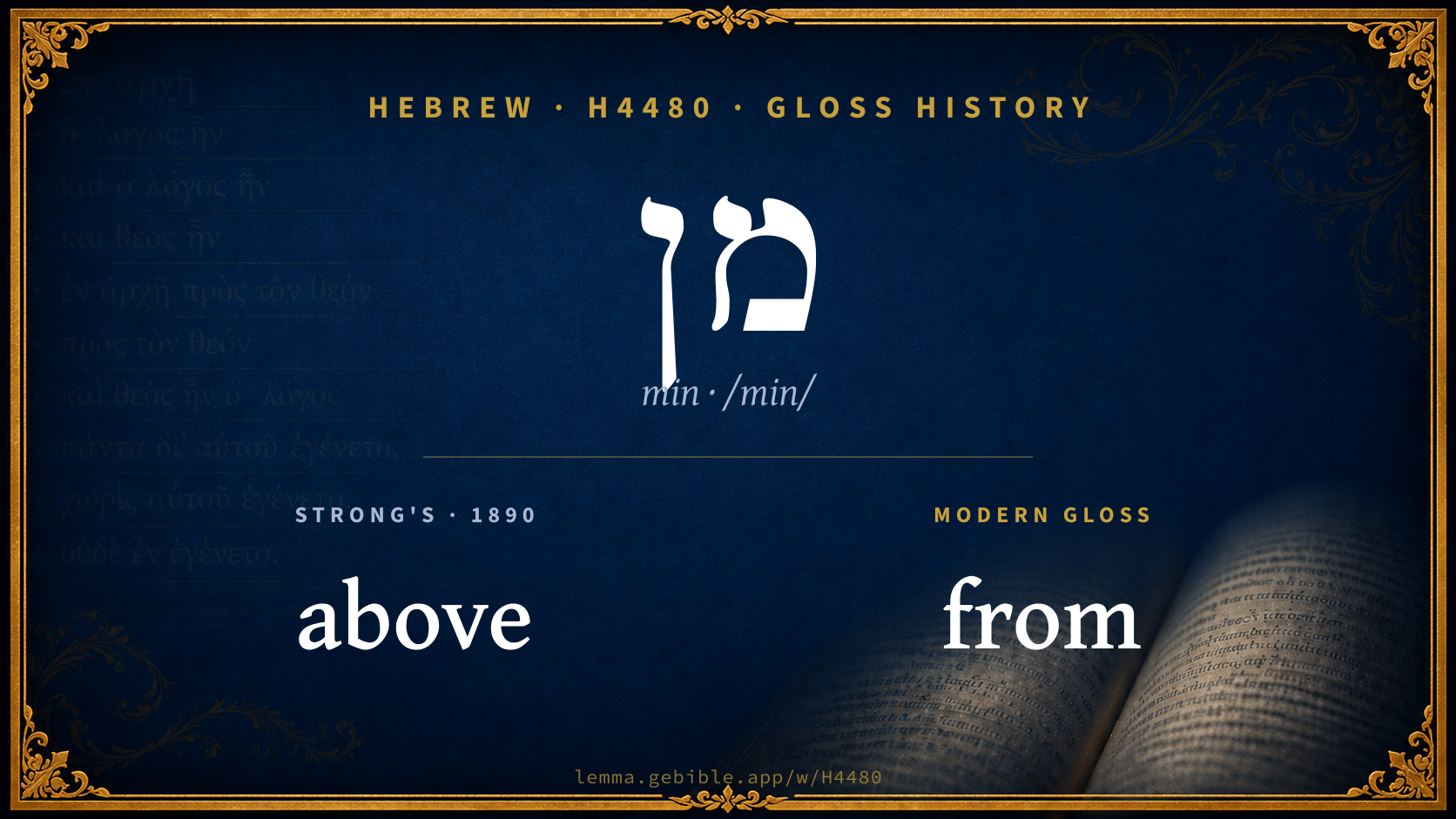
Gloss history
Strong's 1890 vs modern scholarship
About this word
Strong's H4480 catalogs a Hebrew word from the Hebrew Old Testament.
These counts are not copied from any lexicon or concordance. They are computed here, from the morphology-tagged Hebrew Old Testament. What Lemma adds →
- 1,094
- distinct verses
- The word appears in 1,094 distinct verses.
- 38 / 39
- OT books
- The word appears in 38 of 39 Old Testament books.
- #29
- by frequency
- Top 50 most frequent Hebrew words (rank 29 of 8,640 Hebrew words by occurrence).
View all 1,094 occurrences in the concordance →
By section of the Old Testament
By traditional corpus
Conventional, traditional groupings — biblical authorship is debated, so this is a traditional corpus grouping, not an authorship claim. Each share is this word’s portion of its verses in that division of the Hebrew canon. Each figure is a share of the word’s 1,094 distinct verses.
- Prophets (Nevi'im) 421 verses · 38%
- Writings (Ketuvim) 340 verses · 31%
- Torah (Pentateuch) 333 verses · 30%
How translations render this word
Counts come from each version’s own published word-to-Strong’s tagging or interlinear alignment — an approximate guide to how each version renders this word, not a word-level alignment the data otherwise carries. Because each total is that version’s own tagged count, the per-version totals vary from one another and need not match the appearance or distinct-verse counts above. These counts may also differ from a printed concordance because Lemma counts each distinctly tagged rendering and does not collapse phrase taggings into a single head-word total. This is a fixed set of word-tagged versions (KJV, ASV, BSB, ULT) and does not change with the reading translation you choose elsewhere. Each version’s license is shown beside its name below (and on Sources).
BDB lists this Strong’s number as 2 distinct words (homographs). Each count above pools all of them and is not split by sense — see the Senses section below. A low-frequency rendering may belong to a different one of those words, not the primary meaning.
- King James Version†: From 2×, Of 2×
- American Standard Version†: From 3×, Of 2×
- Berean Standard Bible†: From 380×, Of 91×, Me 61×
- unfoldingWord Literal Text†: From 617×, It 83×, You 80×
King James Version Public Domain
Renders H4480 across 25† tagged occurrences — most commonly:
Plus 21 renderings that appear only once — usually multi-word phrases or single function words the recovered tagging swept in, not distinct renderings.
American Standard Version Public Domain
Renders H4480 across 24† tagged occurrences — most commonly:
Plus 19 renderings that appear only once — usually multi-word phrases or single function words the recovered tagging swept in, not distinct renderings.
Berean Standard Bible Public Domain
Renders H4480 across 983† tagged occurrences — most commonly:
Plus other, less common renderings. Plus 82 renderings that appear only once — usually multi-word phrases or single function words the recovered tagging swept in, not distinct renderings. Not rendered by a distinct English word in 199 further occurrences.
unfoldingWord Literal Text CC BY-SA 4.0
Renders H4480 across 1,217† tagged occurrences — most commonly:
Plus other, less common renderings. Plus 68 renderings that appear only once — usually multi-word phrases or single function words the recovered tagging swept in, not distinct renderings.
Senses in the full BDB
What do BDB’s symbols mean?
BDB uses these scholarly abbreviations:
| Symbol | Meaning |
|---|---|
| 𝔊 | the Septuagint (the ancient Greek translation, LXX) |
| 𝔙 | the Vulgate (the Latin translation) |
| 𝔖 | the Syriac version (the Peshitta) |
| 𝔗 | the Targum (the Aramaic translation) |
| ψ | the Psalms |
| √ | root (the underlying root or stem) |
| ‖ | parallel passage (a synonymous or contrasted parallel) |
| † | the dagger: every passage where the word occurs is cited |
The 0 senses and sub-senses the full Brown-Driver-Briggs lexicon distinguishes for this word, in lexicon order (not ranked by frequency), with BDB’s own verbatim wording and sub-sense lettering. Shown in Hebrew script with BDB’s own scholarly abbreviations. The condensed entry is in the Lexicon Entry tab. See also the Forms in the corpus table below.
מן I div. Menî, god of fate (award, apportionment
מן II region of Armenia
Senses from the full Brown-Driver-Briggs lexicon (Brown, Driver, Briggs; Oxford 1906 — public domain), digitized via Sefaria, supplemented by the OpenScriptures HebrewLexicon (CC BY 4.0). Full attribution on Sources.
Word origin
I. n.pr.div. Menî, god of fate (award, apportionment; cf. Arabic n.pr. div. Maniyyat, and perhaps Manât, WeSkizzen iii. 22 f. 189, مَنَوَاتٌ NöZMG xl. 1886, 709; in Nab. מנותו EutNab. No. 2, 1. 5, etc.);—מִלֵּא לַמְנִי מִמְסָךְ Is 65:11 (‖ לַגַּד)—v. Che Di BaeSem. Rel. 79.
I. n.pr.terr. region of Armenia;—Je 51:27 (‖ אֲרָרָט, אַשְׁכְּנַז);=Assyrian Mannai Schr.COT ad loc.; KGF 174, 212, 520.
— Brown-Driver-Briggs (Oxford 1906, public domain), digitized via Sefaria, supplemented by the OpenScriptures HebrewLexicon (CC BY 4.0). See Sources.
Derived from מן (mên) (H4482) — string.
Jastrow Dictionary
A second Hebrew/Aramaic lexicon for comparison, covering Aramaic and post-biblical (Talmudic, Targumic, Midrashic) usage that the biblical-Hebrew BDB does not. Matched by lemma rather than by Strong’s number, so a lemma may carry more than one Jastrow headword (shown separately below), and the entries cover usage well beyond the Bible.
מִן
- (b. h.) from, of; more (or less) than. Ab. Zar. 18ᵃ מן השמים ירחמו from heaven they will have mercy (on me), i.e. I trust in God. Sabb. 21ᵇ המהדרין מן המהדרין v. הָדַר.—מן המובחר, v. בָּחַר; מן המומחה, v. מוּמְחֶה.—Tem. 28ᵃ מן הבהמה להוציא וכ׳ ‘of the cattle’ (Lev. I, 2) intimates the exclusion of &c.; a. v. fr.—Prefix מִ־, מָי־, מֵ־, מֵי־ q. v.—מִנַּיִן, מִנַּיִין, מִינַּיִין (= b. h. מֵאַיִן, v. אַיִן) whence?, whence is it proven?—Yoma 32ᵃ מ׳ לחמש וכ׳ whence is derived the regulation about five immersions &c.? Ib. ומ׳ שכל טבילה וכ׳ and whence is the rule derived that each immersion requires &c.? Ib. 44ᵃ אין לי אלא … מ׳ this would prove to me only in favor of …, whence do you derive that the same applies to …?; a. v. fr. e.g. Leviticus 1:2
מִן ²
- Targ. Gen. I, 2; a. v. fr.—With suffixes of pers. pron. מִנִּי, מִי׳ from me; מִנָּךְ, מִי׳ from thee; מִנֵּיה, מִי׳ from him, it &c. Ib. XXII, 12. Ib. III, 3; a. fr.—Y. Ber. II, 5ᵃ bot. מן הן דסלק to where he had come from. Sabb. 80ᵇ מן דיליה דא ליה this came to him from his own doing. Sot. 40ᵃ ומאי נפקא ליך מִינָּהּ and what difference does it make? מִנִּי ומִנֵּיה יתקלס וכ׳ through myself and him the Most High is exalted. B. Kam. 18ᵃ קאזיל מיניה מיניה it was lost through its (the chicken’s) action alone. Y. Peah VII, 20ᵇ מיניה וביה הוא (the sweetness) is entirely its own (no honey has been added). Snh. 39ᵇ, v. אִבָּא; a. fr.—לא כולא מיניה, לא כל כמיניה it is not at all in his power; v. כּוֹלָא.—מן ד־ from the time that, after; from the fact that; when; because. Lam. R. to II, 2 מן דאכלון after they had eaten; a. v. fr.; v. מִדְּ־.
מָן I
- portion, food. Num. R. s. 12 (play on א̇ר̇ג̇מ̇ן̇) the sun שיצרו הקב"ה לארוג מן וכ׳ whom the Lord has created to weave (ripen) food for creatures; ואין מן אלא פירות וכ׳ man means fruits and food (with ref. to וימן, Dan. I, 5).—Esp. מָּן(הַ) the manna of the desert. Ex. R. s. 25. Tanḥ. B’shall. 20; Mekh. ib., Vayassa, s. 2 אוכלי המן those eating manna (not troubling themselves about to-morrow). Yoma 75ᵃ; a. fr. e.g. Daniel 1:5
מַן I
- (a day’s) support. Succ. 39ᵇ בכדי מן for as much only as is needed for the day. Ib. דהאי מ׳ וכ׳ that man means support, v. preced.—Esp. מַנָּא the manna. Targ. Ex. XVI, 31. Targ. Y. ib. 27; a. e. (some ed. מָנָא).
מַן
- who?, what?, v. מַאן. Targ. Gen. XXIV, 23. Ib. XXXIII, 8 (ed. Berl. מָא; oth. ed. מאן); a. fr.—Emphatic. (מָנָא) מְנָא. Targ. Ps. XXXIX, 5. Targ. Prov. IV, 19; a. fr.
מָן III
- thing, vessel, garment; coulter, v. מָאן.
A Dictionary of the Targumim, the Talmud Babli and Yerushalmi, and the Midrashic Literature (Marcus Jastrow; London, Luzac, 1903) — Public Domain. Digitized via Sefaria. Digitized via Sefaria. Full attribution on Sources.
Forms in the corpus
The 115 distinct written forms H4480 takes in the Hebrew Bible, most frequent first — each parse links to that state’s occurrences in the concordance. Hebrew forms include their vowel points and cantillation, so a single lemma takes many written forms.
| Form | Parsing | Example | Uses |
|---|---|---|---|
| מִן | Preposition | Amos 3:5 | 607 |
| וּ/מִן | Preposition | Daniel 1:3 | 95 |
| מִמֶּ֖/נּוּ | Preposition | Deuteronomy 22:3 | 35 |
| מִמֶּֽ/נּוּ | Preposition | Deuteronomy 9:14 | 31 |
| מִמֶּ֔/נּוּ | Preposition | Amos 5:11 | 25 |
| מִמֶּ֑/נּוּ | Preposition | Deuteronomy 2:36 | 25 |
| מִמֶּֽ/נִּי | Preposition | Ecclesiastes 2:25 | 23 |
| מִנִּי | Preposition | Isaiah 46:3 | 23 |
| מִמֶּ֑/נִּי | Preposition | Deuteronomy 7:17 | 20 |
| מִמֶּ֨/נּוּ֙ | Preposition | Deuteronomy 26:14 | 16 |
| מִמֶּֽ/נָּה | Preposition | Esther 1:19 | 15 |
| מִֽן | Preposition | Ecclesiastes 6:8 | 12 |
| לְ/מִן | Preposition | Deuteronomy 4:32 | 11 |
| מִמֶּ֖/נָּה | Preposition | Ezekiel 14:13 | 11 |
| מִמֶּֽ/ךָּ | Preposition | Deuteronomy 7:1 | 11 |
| מִמְּ/ךָ֖ | Preposition | Deuteronomy 4:38 | 10 |
| מִמֶּ֛/נּוּ | Preposition | Exodus 12:10 | 9 |
| מִ/כֶּ֖ם | Preposition | Hosea 5:13 | 8 |
| מִמֶּ֑/נָּה | Preposition | Exodus 25:35 | 8 |
| מִמֶּ֔/נִּי | Preposition | Genesis 23:13 | 8 |
| מִמֶּ֔/נָּה | Preposition | Ecclesiastes 7:26 | 8 |
| מִמֶּ֣/נּוּ | Preposition | Daniel 11:31 | 8 |
| מִמֶּ֗/נּוּ | Preposition | Deuteronomy 26:14 | 7 |
| מִ/כֶּ֔ם | Preposition | Deuteronomy 1:17 | 6 |
| מִ/כֶּֽם | Preposition | Deuteronomy 11:23 | 6 |
| מִ/כֶּם֙ | Preposition | Deuteronomy 1:23 | 6 |
| מִמְּ/ךָ֙ | Preposition | Deuteronomy 14:24 | 6 |
| מִ֝מֶּ֗/נִּי | Preposition | Job 7:16 | 5 |
| מִ֝מֶּ֗/נּוּ | Preposition | Proverbs 4:23 | 5 |
| מִמֵּ֖/ךְ | Preposition | Ezekiel 21:3 | 5 |
| מִמֶּ֑/ךָּ | Preposition | Deuteronomy 9:1 | 5 |
| מִמֶּ֨/נִּי֙ | Preposition | Deuteronomy 9:14 | 5 |
| מִ֭מֶּ/נִּי | Preposition | Job 13:13 | 4 |
| מִמְּ/ךָ֛ | Preposition | Ezekiel 24:16 | 4 |
| מִמְּ/ךָ֣ | Preposition | 1 Chronicles 29:14 | 4 |
| מִמְּ/ךָ֥ | Preposition | Genesis 17:6 | 4 |
| מִמֵּ֑/ךְ | Preposition | Ezekiel 16:42 | 4 |
| מִמֵּ֔/ךְ | Preposition | Ezekiel 16:61 | 4 |
| מִמֶּ֛/נָּה | Preposition | Genesis 17:16 | 4 |
| מִמֶּ֥/נָּה | Preposition | Exodus 25:31 | 4 |
| הֲ/מִן | Preposition | Genesis 3:11 | 3 |
| וּ/מִ֨ן | Preposition | Genesis 7:8 | 3 |
| וּ/מִֽן | Preposition | Ezra 10:23 | 3 |
| מִ/כֶּ֗ם | Preposition | Ezekiel 20:38 | 3 |
| מִ/כֶּ֜ם | Preposition | Amos 4:7 | 3 |
| מִ֭מְּ/ךָ | Preposition | Job 15:11 | 3 |
| מִמְּ/ךָ֔ | Preposition | Deuteronomy 20:1 | 3 |
| מִמֶּ֖/נִּי | Preposition | Exodus 8:8 | 3 |
| מִמֶּ֗/נִּי | Preposition | Job 30:1 | 3 |
| מִמֶּ֜/נּוּ | Preposition | 1 Chronicles 18:4 | 3 |
| מִמֶּ֣/נִּי | Preposition | Judges 16:17 | 3 |
| מִמֶּ֤/נּוּ | Preposition | Judges 15:19 | 3 |
| מִמֶּ֥/נִּי | Preposition | Jeremiah 44:28 | 3 |
| מִנִּ֣י | Preposition | Judges 5:14 | 3 |
| מֶֽ/נִּי | Preposition | Job 21:16 | 3 |
| מִ/כֶּ֛ם | Preposition | 1 Samuel 22:8 | 2 |
| מִ/נִּ֖י | Preposition | Isaiah 22:4 | 2 |
| מִ֥ן | Preposition | Job 38:1 | 2 |
| מִ֫מֶּ֥/נִּי | Preposition | Psalms 28:1 | 2 |
| מִמְּ/ךָ֗ | Preposition | Genesis 27:45 | 2 |
The 60 most common forms are shown; 55 rarer forms follow in the full concordance.
Same root — word family
Other BDB entries built from the same root as H4480, grouped by Strong’s listed origin. These share a root / origin per the lexicon — not necessarily a shared meaning. Each links to that word’s own entry.
Derives from
Derived from this word
Proper names from this root
People and places named from this root — a name, not an additional meaning of the word.
Compare all same-root words → Showing 4 of 5 — not the complete family. 2 of the same-root words are proper names (people or places). They share a root, not necessarily a meaning.
Septuagint verse parallels
This word appears in 1,027 verses that also exist in the Greek Old Testament (Septuagint), out of the 1,094 Hebrew verses it occurs in. You can read those verses in Greek by switching the Old Testament edition to the Septuagint.
Read these verses in the Septuagint
- Genesis 2:6
- Exodus 1:9
- Leviticus 1:2
- Numbers 5:2
- Deuteronomy 1:17
- Joshua 1:7
- Judges 1:13
- Ruth 1:7
- 1 Samuel 1:1
- 2 Samuel 1:2
- 1 Kings 1:39
- 2 Kings 1:4
This is a verse-level parallel only — the same verses exist in both the Hebrew and Greek Old Testaments. No word-level Hebrew↔Greek correspondence is claimed: the data carries no such alignment, so no Greek word is shown as this Hebrew word’s translation. Coverage is not total — the Septuagint omits the deuterocanon and renumbers the Psalms, so some Hebrew verses have no direct Greek parallel.