Exodus 19:17

Hebrew (Westminster Leningrad Codex) Exodus 19:17 appears in the Hebrew Old Testament. The text above is from the Westminster Leningrad Codex. Each word links to its Strong’s number, a concise gloss, and parsing drawn from the Open Scriptures Hebrew Bible morphology. Click any word for its full Brown-Driver-Briggs (BDB) entry.
Download image
Cite this verse

Exodus 19:17 (World English Bible). Public Domain. Lemma interlinear Bible study tool, https://lemma.gebible.app/v/exodus/19/17.

Show BibTeX & RIS
BibTeX
RIS
English Translation
Moses led the people out of the camp to meet God; and they stood at the lower part of the mountain.
World English Bible · Public Domain
Download a study sheet

One document with this verse’s original text, its word-by-word gloss line, the meaning frame, cross-references with their text, attributed commentary, and full source and license credits — printable, and it pastes into notes with its structure intact.

This verse Autodidact and up

Study sheet (.html) Plain text (.txt)

A passage Seminary Student

Up to 50 verses in one chapter. A passage sheet keeps up to 6 commentary sources and 12 cross-references per verse, in the order this page ranks them, and says so on the sheet whenever that leaves anything out. Ask for a single verse and you get the Autodidact verse sheet above.

Everything on this page stays free to read, with no account — the sheet is a download of what is already on screen, not access to it.

Want to remove ads? Support Godless Engineer
Compare translations 3

The same verse in 3 English versions, stacked beneath the original-language interlinear above. Click any original word for its lexicon entry.

Each is an independent rendering of the whole verse — the interlinear is not word-aligned to these translations.

Highlighted words mark where these versions differ — a whole-verse word diff, not a word-by-word alignment.

  • World English Bible Public Domain
    Moses led the people out of the camp to meet God; and they stood at the lower part of the mountain.
  • King James Version Public Domain
    And Moses brought forth the people out of the camp to meet with God; and they stood at the nether part of the mount.
  • unfoldingWord Literal Text CC BY-SA 4.0
    And Moses brought the people out from the camp to meet God, and they stationed themselves at the bottom of the mountain.

unfoldingWord Literal Text — © unfoldingWord, licensed CC BY-SA 4.0. Word-aligned USFM3 via Door43 (git.door43.org/unfoldingWord/en_ult).

Versions to compare (up to 4)

3 of 4 selected

Show all 18 translations

Every available English version of this verse, each an independent rendering of the whole verse.

  • World English Bible Public Domain
    Moses led the people out of the camp to meet God; and they stood at the lower part of the mountain.
  • Berean Standard Bible Public Domain
    Then Moses brought the people out of the camp to meet with God, and they stood at the foot of the mountain.
  • Majority Standard Bible Public Domain
    Then Moses brought the people out of the camp to meet with God, and they stood at the foot of the mountain.
  • King James Version Public Domain
    And Moses brought forth the people out of the camp to meet with God; and they stood at the nether part of the mount.
  • American Standard Version (1901) Public Domain
    And Moses brought forth the people out of the camp to meet God; and they stood at the nether part of the mount.
  • Revised Version (1885) Public Domain
    And Moses brought forth the people out of the camp to meet God; and they stood at the nether part of the mount.
  • Geneva Bible (1599) Public Domain
    Then Moses brought the people out of the tents to meete with God, and they stoode in the nether part of the mount.
  • Douay-Rheims (1899) Public Domain
    And when Moses had brought them forth to meet God from the place of the camp, they stood at the bottom of the mount.
  • Young's Literal Translation Public Domain
    And Moses bringeth out the people to meet God from the camp, and they station themselves at the lower part of the mount,
  • Literal Standard Version CC BY-SA 4.0
    And Moses brings out the people from the camp to meet God, and they station themselves at the lower part of the mountain,
  • Unlocked Literal Bible CC BY-SA 4.0
    Moses brought the people out of the camp to meet God, and they stood at the foot of the mountain.
  • unfoldingWord Literal Text CC BY-SA 4.0
    And Moses brought the people out from the camp to meet God, and they stationed themselves at the bottom of the mountain.
  • Darby Bible Public Domain
    And Moses brought the people out of the camp to meet with God; and they stood at the foot of the mountain.
  • World Messianic Bible Public Domain
    Moses led the people out of the camp to meet God; and they stood at the lower part of the mountain.
  • Webster's Bible Public Domain
    And Moses brought forth the people out of the camp to meet with God; and they stood at the nether part of the mount.
  • Free Bible Version CC BY-SA 4.0
    Moses led the people out from the camp to meet God. They stood at the foot of the mountain.
  • Bible in Basic English Public Domain
    And Moses made the people come out of their tents and take their places before God; and they came to the foot of the mountain,
  • JPS Tanakh (1917) Public Domain
    And Moses brought forth the people out of the camp to meet God; and they stood at the nether part of the mount.

Literal Standard Version (2020), Covenant Press — licensed CC BY-SA 4.0. Text via the HelloAO Bible API (eBible.org). Unlocked Literal Bible (unfoldingWord) — licensed CC BY-SA 4.0. Text via the HelloAO Bible API (eBible.org). unfoldingWord Literal Text — © unfoldingWord, licensed CC BY-SA 4.0. Word-aligned USFM3 via Door43 (git.door43.org/unfoldingWord/en_ult). Free Bible Version, Dr. Jonathan Gallagher — licensed CC BY-SA 4.0. Text via the HelloAO Bible API (eBible.org).

Word by word

More ways to search: Search by grammar → Find every occurrence → Compare this word →

Practice this passage: Drill this verse → Learn its vocabulary →

בְּתַחְתִּ֥ית
tachtîy
H8482
“in/at · low of”
Preposition + Noun, Common, Feminine, Singular, Construct
Part of Speech
Preposition + Noun
Type
Common
Gender
Feminine
Number
Singular
State
Construct
Full BDB Definition

Origin: from H8478

TWOT: 2504b

low, lower, lowest - lowest (as adjective) - the lower parts (substantive)
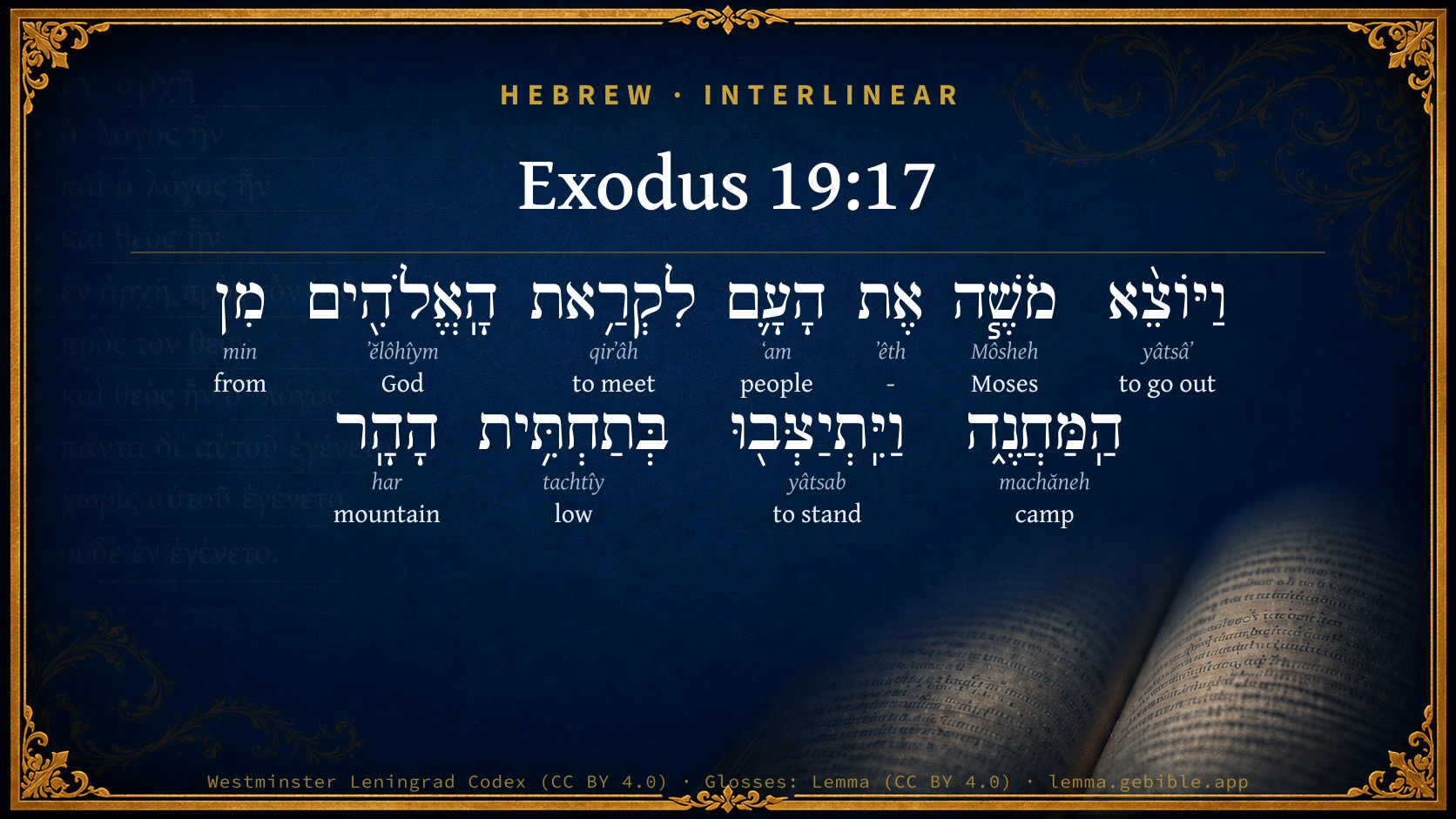
  1. וַיּוֹצֵ֨א yâtsâʼ H3318 “and · to go out” Conjunction + Verb, Hiphil, Sequential Imperfect, 3rd Person, Masculine, Singular
  2. מֹשֶׁ֧ה Môsheh H4872 “Moses” Noun, Proper
  3. אֶת ʼêth H853 “-” Particle, Direct Object
  4. הָעָ֛ם ʻam H5971 “the · people” Particle, Definite Article + Noun, Common, Masculine, Singular, Absolute
  5. לִקְרַ֥את qirʼâh H7125 “to meet” Preposition + Verb, Qal, Infinitive Construct
  6. הָֽאֱלֹהִ֖ים ʼĕlôhîym H430 “the · God(s)” Particle, Definite Article + Noun, Common, Masculine, Plural, Absolute
  7. מִן min H4480 “from” Preposition
  8. הַֽמַּחֲנֶ֑ה machăneh H4264 “the · camp” Particle, Definite Article + Noun, Common, Both, Singular, Absolute
  9. וַיִּֽתְיַצְּב֖וּ yâtsab H3320 “and · to stand” Conjunction + Verb, Hithpael, Sequential Imperfect, 3rd Person, Masculine, Plural
  10. הָהָֽר har H2022 “the · mountain” Particle, Definite Article + Noun, Common, Masculine, Singular, Absolute

About this verse

These counts appear in no published source. They are computed here, from the morphology-tagged text and Lemma’s own curated glosses. What Lemma adds →

11
words
11
distinct lemmas
Pentateuch
section

Notable vocabulary

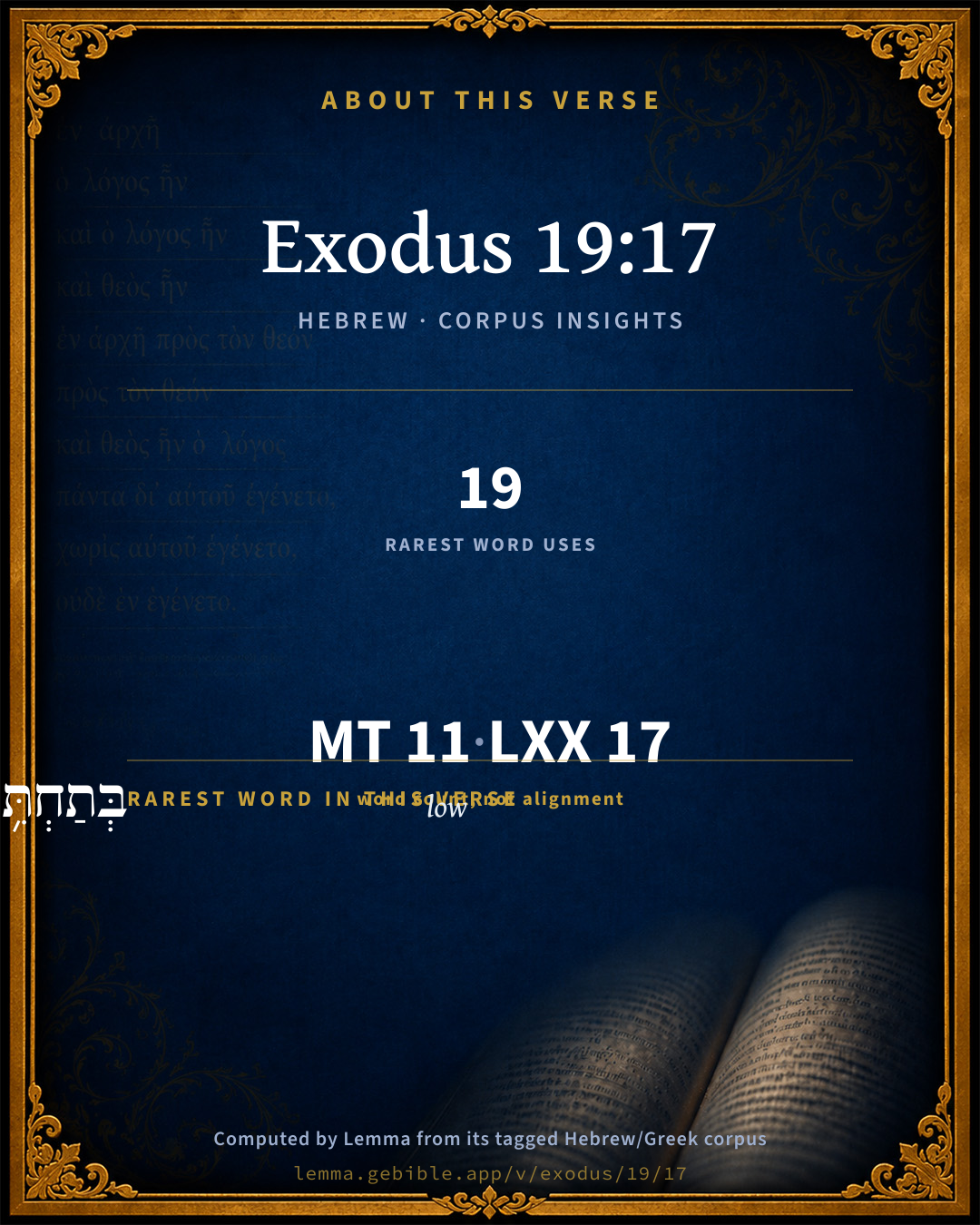
The rarest word here is בְּתַחְתִּ֥ית low H8482 — appearing just 19 times in the whole Hebrew Bible.

Shared distinctive vocabulary

בְּתַחְתִּ֥ית low H8482 occurs in 19 verses of the Hebrew Bible. Also found in:

Grammatical profile

  • 3 verbs
  • 6 nouns
  • 1 preposition
  • 1 particle

Verb forms

  • וַיּוֹצֵ֨א Hiphil · Sequential Imperfect
  • לִקְרַ֥את Qal · Infinitive Construct
  • וַיִּֽתְיַצְּב֖וּ Hithpael · Sequential Imperfect

Hebrew & Septuagint length

In English translation the verse runs 21 words from the Hebrew and 20 from the Septuagint (LXX English) — closely comparable.

A rough comparison of the two English renderings, which tokenize alike — not a word-level alignment.

Word counts can differ between the Hebrew and the Greek without any difference in meaning — e.g. the Hebrew direct-object marker אֵת has no separate Greek word, and Greek often adds the article ὁ.

In the original languages it is 11 Hebrew tokens and 17 Greek tokens — but the two are counted differently (Hebrew bundles its prefixes and suffixes into one token; the Greek is in lemma form), so that isn’t a like-for-like length.

Cross-references

2

Topical passages linked to Exodus 19:17 in the Treasury of Scripture Knowledge — connected by theme and wording, ordered by reader-vote popularity; previews shown in the World English Bible.

  • Deuteronomy 4:10 the day that you stood before Yahweh your God in Horeb, when Yahweh said to me, Assemble me the people, and I will make them hear my words, that they may learn to fear me all the days that they live on the earth, and that they may teach their children.
  • Deuteronomy 5:5 (I stood between Yahweh and you at that time, to show you the word of Yahweh: for you were afraid because of the fire, and didn't go up onto the mountain;) saying,

Cross-references courtesy of OpenBible.info (CC BY 4.0).

Hebrew and Greek witnesses Masoretic Hebrew ↔ Greek Septuagint

The same verse in the two great witnesses to the Old Testament, shown verse-for-verse.

These are two independent witnesses, not word-aligned to each other, and the Septuagint is shown in lemma (dictionary) form.

Hebrew Exodus 19:17 Masoretic · Westminster Leningrad Codex

וַיּוֹצֵ֨א מֹשֶׁ֧ה אֶת הָעָ֛ם לִקְרַ֥את הָֽאֱלֹהִ֖ים מִן הַֽמַּחֲנֶ֑ה וַיִּֽתְיַצְּב֖וּ בְּתַחְתִּ֥ית הָהָֽר

Moses led the people out of the camp to meet God; and they stood at the lower part of the mountain.

World English Bible · Public Domain

Greek LXX Exodus 19:17 Septuagint · lemma form

καί ἐκἄγω μωυσῆς ὁ λαός εἰς συνάντησις ὁ θεός ἐκ ὁ παρεμβολή καί παραἵστημι ὑπό ὁ ὄρος

And Moses led the people forth out of the camp to meet God, and they stood by under the camp.

LXX2012 (modern English Septuagint) · Public Domain

Hebrew: Westminster Leningrad Codex (CC BY 4.0). Greek: Septuagint (public domain); English from LXX2012 (modern English Septuagint) (Public Domain). How the Septuagint differs from the Hebrew →

Targum (Aramaic paraphrase)

2

The Targum is the ancient Jewish Aramaic paraphrase of the Hebrew Scriptures — an interpretive translation, not the Hebrew text itself. Onkelos (literal) and Pseudo-Jonathan (expansive) render the Torah, and Jonathan the Prophets. Coverage is partial: where no permissively-licensed English translation exists for a verse, only the Aramaic is shown. This is verse-level text, not a word-by-word alignment to the Hebrew.

  1. Targum Onkelos Torah (Genesis–Deuteronomy)
    וְאַפֵיק משֶׁה יָת עַמָא לְקַדָמוּת מֵימְרָא דַיְיָ מִן מַשְׁרִיתָא וְאִתְעַתָּדוּ בְּשִׁפּוֹלֵי טוּרָא:

    (no public-domain English translation for this verse)

    Targum Onkelos — Aramaic: “Onkelos Genesis” (public domain); “Onkelos Exodus” (public domain); “Onkelos Leviticus” (public domain); “Onkelos Numbers” (public domain); “Onkelos Deuteronomy” (public domain). English: “Sefaria Community Translation” (CC0 1.0 (public-domain dedication)); “J.W. Etheridge. The Targums of Onkelos and Jonathan Ben Uzziel on the Pentateuch. London: Longmans, Green, 1862” (public domain). Text via Sefaria.

  2. Targum Pseudo-Jonathan Torah (Genesis–Deuteronomy)
    וְאַנְפֵּיק משֶׁה יַת עַמָּא לִקְדָמוּת שְׁכִינְתָּא דַיְיָ מִן מַשְׁרִיתָא וּמִן יַד תָּלִישׁ מָארֵי עַלְמָא יַת טַוְורָא וְזַקְפֵיהּ בְּאַוִירָא וַהֲוָה זַיֵיג הֵי כְּאִסְפַּקְלַרְיָא וְאִתְעַתָּדוּ תְּחוֹתֵי טַוְורָא

    And Mosheh brought forth the people from the camp to meet the glorious Presence of the Lord; and suddenly the Lord of the world uprooted the mountain, and lifted it in the air, and it became luminous as a beacon, and they stood beneath the mountain.

    Targum Pseudo-Jonathan — Aramaic: “Targum Jonathan on Genesis” (public domain); “Targum Jonathan on Exodus” (public domain); “Targum Jonathan on Leviticus” (public domain); “Targum Jonathan on Numbers” (public domain); “Targum Jonathan on Deuteronomy” (public domain). English: “The Targum of Jonathan ben Uzziel, trans. J. W. Etheridge, London, 1862” (public domain). Text via Sefaria.

Commentary

Notes on Exodus 19:17 from classic Christian and Jewish commentators (each source and its license shown beneath its notes). The classic Christian expositions comment on the surrounding passage and are grouped to its opening verse, so a note may address several verses; the Jewish commentaries on the Tanakh (Rashi and others) are per-verse, so they appear only where the commentator wrote on this verse.

Lemma curates 59 commentaries, every one of them public domain or Creative Commons licensed, each selected and text-cleaned for this edition rather than reprinted as found. About our sources →

Trapp's Complete Commentary

John Trapp

Exo 19:17 And Moses brought forth the people out of the camp to meet with God; and they stood at the nether part of the mount.

Ver. 17. To meet with God.] Who "came with ten thousands of his saints," as Moses, that climbed up that hill, and alone saw it, says. {Deu 33:2} And if he thus gave the law, how shall he require it at the last day

John Trapp, A Commentary or Exposition upon All the Books of the Old and New Testament (1647–1656) — public domain. Text from a community e-Sword module.

Jamieson, Fausset & Brown

Robert Jamieson, A. R. Fausset & David Brown

Moses brought forth the people out of the camp to meet with God--Wady-er-Raheh, where they stood, has a spacious sandy plain; immediately in front of Es Suksafeh, considered by ROBINSON to be the mount from which the law was given. "We measured it, and estimate the whole plain at two geographical miles long, and ranging in breadth from one-third to two-thirds of a mile, or as equivalent to a surface of one square mile. This space is nearly doubled by the recess on the west, and by the broad and level area of Wady-es-Sheikh on the east, which issues at right angles to the plain, and is equally in view of the front and summit of the mount. The examination convinced us that here was space enough to satisfy all the requisitions of the Scripture narrative, so far as it relates to the assembling of the congregation to receive the law. Here, too, one can see the fitness of the injunction to set bounds around the mount, that neither man nor beast might approach too near, for it rises like a perpendicular wall." But Jebel Musa, the old traditional Sinai, and the highest peak, has also a spacious valley, Wady Sebaiyeh, capable of holding the people. It is not certain on which of these two they stood.

Jamieson, Fausset & Brown — Commentary Critical and Explanatory on the Whole Bible (1871) — public domain (CC PDM 1.0). Text via the HelloAO Bible API.

Adam Clarke's Commentary

Verse 17. And Moses brought forth the people - to meet with God] For though they might not touch the mount till they had permission, yet when the trumpet sounded long, it appears they might come up to the nether part of the mount, (see Ex 19:13, and De 4:11); and when the trumpet had ceased to sound, they might then go up unto the mountain, as to any other place.

It was absolutely necessary that God should give the people at large some particular evidence of his being and power, that they might be saved from idolatry, to which they were most deplorably prone; and that they might the more readily credit Moses, who was to be the constant mediator between God and them. God, therefore, in his indescribable majesty, descended on the mount; and, by the thick dark cloud, the violent thunders, the vivid lightnings, the long and loud blasts of the trumpet, the smoke encompassing the whole mountain, and the excessive earthquake, proclaimed his power, his glory, and his holiness; so that the people, however unfaithful and disobedient afterwards, never once doubted the Divine interference, or suspected Moses of any cheat or imposture. Indeed, so absolute and unequivocal were the proofs of supernatural agency, that it was impossible these appearances could be attributed to any cause but the unlimited power of the author of Nature.

It is worthy of remark that the people were informed three days before, Ex 19:9-11, that such an appearance was to take place; and this answered two excellent purposes:

1. They had time to sanctify and prepare themselves for this solemn transaction; and,

2. Those who might be skeptical had sufficient opportunity to make use of every precaution to prevent and detect an imposture; so this previous warning strongly serves the cause of Divine revelation.

Their being at first prohibited from touching the mount on the most awful penalties, and secondly, being permitted to see manifestations of the Divine majesty, and hear the words of God, subserved the same great purposes. Their being prohibited in the first instance would naturally whet their curiosity, make them cautious of being deceived, and ultimately impress them with a due sense of God's justice and their own sinfulness; and their being permitted afterwards to go up to the mount, must have deepened the conviction that all was fair and real, that there could be no imposture in the case, and that though the justice and purity of God forbade them to draw nigh for a time, yet his mercy, which had prescribed the means of purification, had permitted an access to his presence. The directions given from Ex 19:10-15 inclusive show, not only the holiness of God, but the purity he requires in his worshippers.

Besides, the whole scope and design of the chapter prove that no soul can possibly approach this holy and terrible Being but through a mediator; and this is the use made of this whole transaction by the author of the Epistle to the Hebrews, Heb 12:18-24.

Adam Clarke's Commentary on the Bible (1810–1826) — public domain. Text from a community e-Sword/MySword module.

Ellicott's Commentary for English Readers

(17) Out of the camp.—An open space must have intervened between the camp and the “bounds.” Into this Moses led the representatives of the people, so bringing them as near to God as was permitted.

At the nether part of the mount.—In the plain directly in front of the Ras Sufsafeh, and almost under it.

A Bible Commentary for English Readers, edited by Charles John Ellicott (1878–1897) — public domain. Text from a community e-Sword module.

The Cambridge Bible for Schools and Colleges

gen. ed. J. J. S. Perowne

17. stood] better, took their stand.

The Cambridge Bible for Schools and Colleges (gen. ed. J. J. S. Perowne; Cambridge University Press, 1878–1918) — public domain. Text from a community e-Sword module.

John Gill's Exposition

And Moses brought forth the people out of the camp,.... Which was before the mountain and near it, when the above tokens were given of the divine Presence on it; as they were thrown into a panic upon the sound of the trumpet, it was, perhaps, with some difficulty that they were brought out of the camp, or persuaded to quit it; and nothing short of the presence of Moses at the head of them, to go before them, and lead them to the foot of the mountain, could have prevailed upon them to have done it:

to meet with God; who came forth in such an awful and solemn manner, as their King and lawgiver, to deliver a body of laws to them, to be the rule of their future conduct:

and they stood at the nether part of the mount; at the bottom of it, where bounds were set, and a fence made, that they should proceed no further, and yet near enough to hear what God said to Moses and to them.

John Gill's Exposition of the Whole Bible (1746–1763) — public domain (CC PDM 1.0). Text via the HelloAO Bible API.

Albert Barnes' Notes on the Bible

Out of the camp - The encampment must have extended far and wide over the plain in front of the mountain. From one entrance of the plain to the other there is space for the whole host of the Israelites.

Albert Barnes' Notes on the Bible (1834–1885) — public domain. Text from a community e-Sword/MySword module.

Matthew Poole's English Annotations

Therefore one part of the mount they might come to, though not to another, to wit, the higher; which may clear the difficulty and seeming contradiction betwixt Exo 19:12,13.

Matthew Poole's English Annotations on the Holy Bible (1683–1685) — public domain. Text from a community e-Sword/MySword module.

The Pulpit Commentary

Moses brought forth the people out of the camp. The camp itself must have been withdrawn to some little distance from the foot of the mount, so that a vacant space intervened between the first tents and the "fence" which Moses had caused to be erected almost close to the mount. Into this vacant space Moses now led "the peoplei.e. , the chief of the people so bringing them as near as they might come to God.

HOMILIES BY G. A. GOODHART

Prepare to meet thy God.

God"s revelation of himself to man is gradual, as man can bear it. Cf. the way in which a parent reveals himself to his child, Isa_28:11, with stammering lips and a feigned tongue.) Israel had learnt to know God as a deliverer; must learn to know him further as a lawgiver and ruler.

I THE SCENE. A long, broad valley. Rocks on each side widening out into a natural amphitheatre. Facing down the valley is a steep, precipitous mountain; grey, streaked with red. The whole scene, not unlike, on a huge scale, that presented by the avenues leading up to the Egyptian temples. It is a place where those accustomed to Egypt might expect to meet with God. "Now" probably the people may have thought, "we shall see for ourselves this mysterious Jehovah; he has brought us to his temple; he will introduce us to his shrine.

II THE MEDIATOR AND HIS MESSAGE. Israel is encamped. Moses ascends the mountain (ver. 3). Again God meets with him and sends a message by him to the people. Notice:

1. Reminder of what he has done for them already (ver. 4).

2. Obedience the condition of future favour (ver. 5). Fulfil the conditionand the promise is secure. The earth itself is God"s temple; if Israel will obey and keep his covenant they shall be "a kingdom of priests, and a holy nation.

3. The answer given (ver. 8). No hesitation, no expression of doubt. Thepromised blessing so attractive that they are ready to promise anything, never doubting their ability to fulfil their promise. It is easy enough to say "I will the hard thing is to translate it into "I do.

III THE PROMISED INTERVIEW. The people shall be conscious of the presence of their God. Jehovah will publicly attest the authority of his servant, Notice:

1. The preparation. God requires it. It is easy for familiarity to breed irreverence; and irreverence soon leads on to low views of the Divine character. Love is degraded into mere kindliness; an easy-going people believe in an easy-going God. See here:

(1) The people have to prepare themselves for the meeting (ver. 10).

(2) The place has to be prepared. God reveals himself to prepared people in a prepared place. Why do so few have revelations nowadays? Some come to the prepared place, but they omit the personal preparation; others, even after personal preparation, lose much through neglecting the prepared place. We need to remember Ecc_5:1, and Heb_10:25.

2. The revelation. The third day comes (ver. 16). Storm, sound of trumpet, assembly of people without the camp, trembling, earthquake, intense suspense. "Now surely God will show himself. Can we endure the sight and live?" At length (ver. 19) "a voice cf. Deu_4:12; "no similitude, only a voice." For the present it is enough; reverence is the first lesson those whom God has delivered have to learn; "Hallowed be thy Name" is the first petition they are taught to offer. For effect (cf. Exo_20:18-22) which also teaches the object of the revelation. "That his fear may be before your faces that ye sin not.

Conclusion. We have learnt many more lessons about God than the Israelites could then learn. Have we not too often slurred over or half-forgotten that first lesson?

Let knowledge grow from more to more, But more of reverence in us dwell; That mind and soul, according well, May make our music as before,

But vaster. We axe fools and slight; We mock thee when we do not fear; But help thy foolish ones to bear; Help thy vain worlds to bear thy light. G.

The Pulpit Commentary (1880–1919), ed. H.D.M. Spence-Jones & Joseph S. Exell — public domain. Text from a community e-Sword module.

Rashi

Rabbi Shlomo Yitzchaki (Rashi)

לקראת האלהים [AND MOSES BROUGHT FORTH THE PEOPLE …] TO MEET GOD — This (the word לקראת, “to meet”, which is used when two persons are approaching one another) tells us that the Shechina was going forth to meet them, as a bridegroom who goes forth to meet his bride. This is what Scripture means when it says, (Deuteronomy 33:2) “The Lord came from Sinai”, and it is not said, “[The Lord came to Sinai” (Mekhilta).

בתחתית ההר AT THE NETHER PART OF THE MOUNTAIN — According to its literal meaning this signifies “at the foot of the mountain”. But a Midrashic explanation is, that the mountain was plucked up from its place and was arched over them as a cask, so that they were standing בתחתית beneath (under) the mountain itself (Mekhilta; Shabbat 88a).

Rashi on the Tanakh — English translations: “The Judaica Press complete Tanach with Rashi, translated by A. J. Rosenberg” (CC BY 4.0); “Pentateuch with Rashi's commentary by M. Rosenbaum and A.M. Silbermann, 1929-1934” (public domain); “The Metsudah Tanach series, Lakewood, N.J” (CC BY 4.0); and “The Book of Joshua, Metsudah Publications, 1997” (CC BY 4.0). Text via Sefaria.

Lesson kit

Teaching starters — assembled from the data on this page, not authored interpretation. Every prompt links to the verse data it draws on. Edit before teaching.

Exodus, in the Pentateuch, opens this verse with 11 words (11 distinct Hebrew lemmas). Its most distinctive word is tachtîy (“low”). A historical commentator’s framing appears above. Read the whole chapter for the surrounding context.

Discussion questions

  1. How does “low” (tachtîy) shape what this verse is saying?
  2. Genesis 6:16 shares the word «low» with this verse. How do the two illuminate each other?
  3. These translations render this verse differently. What is at stake in choosing one wording over another?
  4. The verb «וַיּוֹצֵ֨א» is Hiphil Sequential Imperfect. How does its form color the action?
  5. Reading how Trapp's Complete Commentary and Jamieson, Fausset & Brown read this verse, where do the two commentators agree and where do they part?

Things to notice

Reading settings

Reading text

Shown beneath each verse's original-language words.

Old Testament
Old Testament edition

Read the OT as the Masoretic Hebrew (MT) or the Greek Septuagint (LXX).

English shown for the Greek Septuagint (in the Hebrew ↔ Greek comparison).

Comparing translations? Open the Compare panel on any verse page to stack up to four side by side.