
Leviticus 4:7

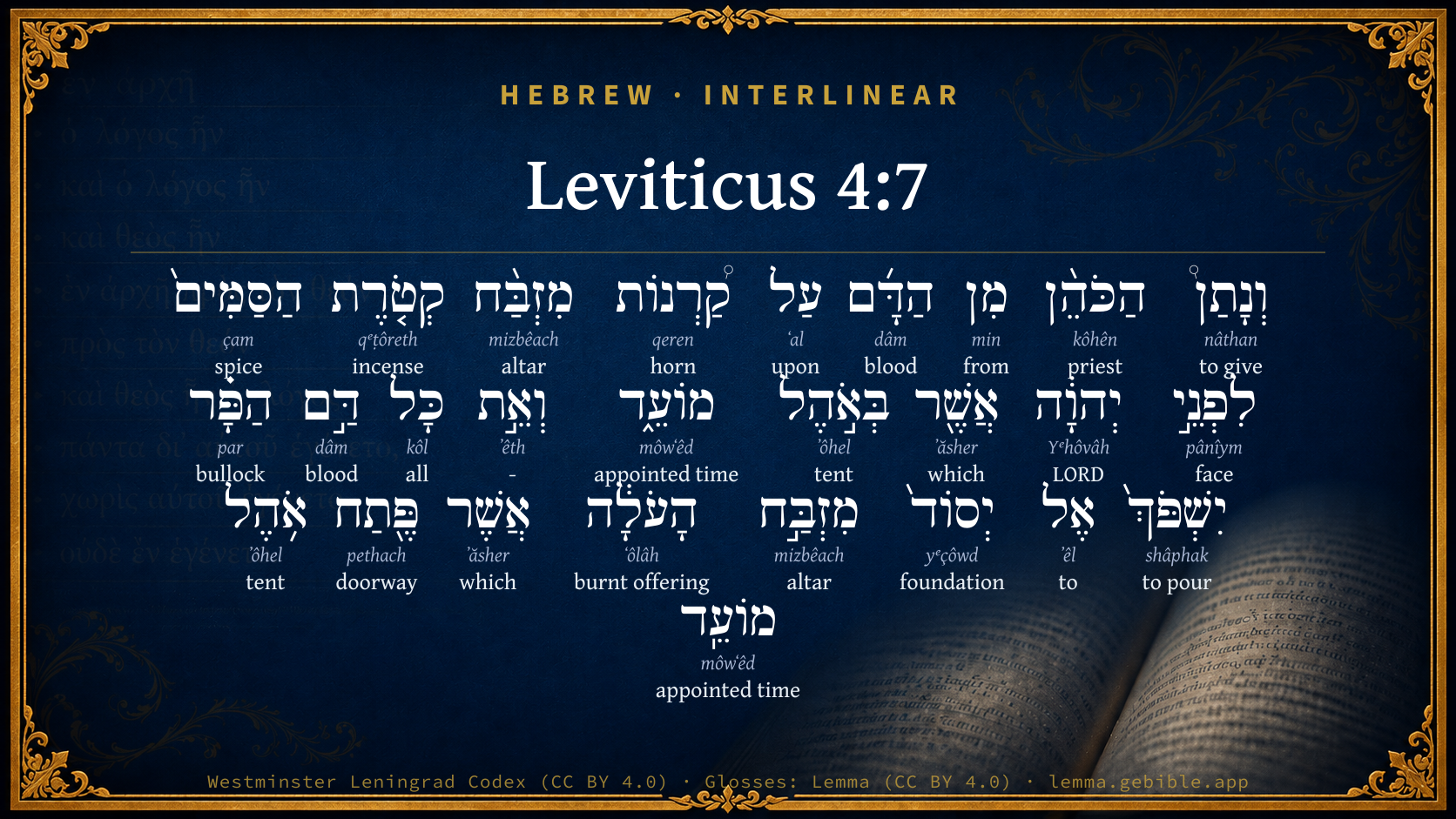
Hebrew (Westminster Leningrad Codex) Leviticus 4:7 appears in the Hebrew Old Testament. The text above is from the Westminster Leningrad Codex. Each word links to its Strong’s number, a concise gloss, and parsing drawn from the Open Scriptures Hebrew Bible morphology. Click any word for its full Brown-Driver-Briggs (BDB) entry.
Download image
Cite this verse

Leviticus 4:7 (World English Bible). Public Domain. Lemma interlinear Bible study tool, https://lemma.gebible.app/v/leviticus/4/7.

Show BibTeX & RIS
BibTeX
RIS
English Translation
The priest shall put some of the blood on the horns of the altar of sweet incense before Yahweh, which is in the tent of meeting; and he shall pour out all the blood of the bull out at the base of the altar of burnt offering, which is at the door of the Tent of Meeting.
World English Bible · Public Domain
Download a study sheet

One document with this verse’s original text, its word-by-word gloss line, the meaning frame, cross-references with their text, attributed commentary, and full source and license credits — printable, and it pastes into notes with its structure intact.

This verse Autodidact and up

Study sheet (.html) Plain text (.txt)

A passage Seminary Student

Up to 50 verses in one chapter. A passage sheet keeps up to 6 commentary sources and 12 cross-references per verse, in the order this page ranks them, and says so on the sheet whenever that leaves anything out. Ask for a single verse and you get the Autodidact verse sheet above.

Everything on this page stays free to read, with no account — the sheet is a download of what is already on screen, not access to it.

Want to remove ads? Support Godless Engineer
Compare translations 3

The same verse in 3 English versions, stacked beneath the original-language interlinear above. Click any original word for its lexicon entry.

Each is an independent rendering of the whole verse — the interlinear is not word-aligned to these translations.

Highlighted words mark where these versions differ — a whole-verse word diff, not a word-by-word alignment.

  • World English Bible Public Domain
    The priest shall put some of the blood on the horns of the altar of sweet incense before Yahweh, which is in the tent of meeting; and he shall pour out all the blood of the bull out at the base of the altar of burnt offering, which is at the door of the Tent of Meeting.
  • King James Version Public Domain
    And the priest shall put some of the blood upon the horns of the altar of sweet incense before the LORD, which is in the tabernacle of the congregation; and shall pour all the blood of the bullock at the bottom of the altar of the burnt offering, which is at the door of the tabernacle of the congregation.
  • unfoldingWord Literal Text CC BY-SA 4.0
    And the priest shall put some of the blood on the horns of the altar of incense of the spices to the face of Yahweh, which in the tent of meeting. And all the blood of the bull he shall pour out at the base of the altar of the burnt offering, which the entrance of the tent of meeting.

unfoldingWord Literal Text — © unfoldingWord, licensed CC BY-SA 4.0. Word-aligned USFM3 via Door43 (git.door43.org/unfoldingWord/en_ult).

Versions to compare (up to 4)

3 of 4 selected

Show all 18 translations

Every available English version of this verse, each an independent rendering of the whole verse.

  • World English Bible Public Domain
    The priest shall put some of the blood on the horns of the altar of sweet incense before Yahweh, which is in the tent of meeting; and he shall pour out all the blood of the bull out at the base of the altar of burnt offering, which is at the door of the Tent of Meeting.
  • Berean Standard Bible Public Domain
    The priest must then put some of the blood on the horns of the altar of fragrant incense that is before the LORD in the Tent of Meeting. And he is to pour out the rest of the bull’s blood at the base of the altar of burnt offering at the entrance to the Tent of Meeting.
  • Majority Standard Bible Public Domain
    The priest must then put some of the blood on the horns of the altar of fragrant incense that is before the LORD in the Tent of Meeting. And he is to pour out the rest of the bull’s blood at the base of the altar of burnt offering at the entrance to the Tent of Meeting.
  • King James Version Public Domain
    And the priest shall put some of the blood upon the horns of the altar of sweet incense before the LORD, which is in the tabernacle of the congregation; and shall pour all the blood of the bullock at the bottom of the altar of the burnt offering, which is at the door of the tabernacle of the congregation.
  • American Standard Version (1901) Public Domain
    And the priest shall put of the blood upon the horns of the altar of sweet incense before Jehovah, which is in the tent of meeting; and all the blood of the bullock shall he pour out at the base of the altar of burnt-offering, which is at the door of the tent of meeting.
  • Revised Version (1885) Public Domain
    And the priest shall put of the blood upon the horns of the altar of sweet incense before the LORD, which is in the tent of meeting; and all the blood of the bullock shall he pour out at the base of the altar of burnt offering, which is at the door of the tent of meeting.
  • Geneva Bible (1599) Public Domain
    The Priest also shall put some of the blood before the Lord, vpon the hornes of the altar of sweete incense, which is in the Tabernacle of the Congregation, then shall hee powre all the rest of the blood of the bullocke at the foote of the altar of burnt offring, which is at the doore of the Tabernacle of the Congregation.
  • Douay-Rheims (1899) Public Domain
    And he shall put some of the same blood upon the horns of the altar of the sweet incense most acceptable to the Lord, which is in the tabernacle of the testimony. And he shall pour all the rest of the blood at the foot of the altar of holocaust in the entry of the tabernacle.
  • Young's Literal Translation Public Domain
    and the priest hath put of the blood on the horns of the altar of spice-perfume before Jehovah, which `is' in the tent of meeting, and all the blood of the bullock he doth pour out at the foundation of the altar of the burnt-offering, which `is' at the opening of the tent of meeting.
  • Literal Standard Version CC BY-SA 4.0
    and the priest has put of the blood on the horns of the altar of spice-incense before YHWH, which [is] in the Tent of Meeting, and he pours out all the blood of the bullock at the foundation of the altar of the burnt-offering, which [is] at the opening of the Tent of Meeting.
  • Unlocked Literal Bible CC BY-SA 4.0
    Then the priest will put some of the blood on the horns of the altar of fragrant incense before Yahweh, which is in the tent of meeting, and he will pour out all the rest of the blood of the bull at the base of the altar for burnt offerings, which is at the entrance of the tent of meeting.
  • unfoldingWord Literal Text CC BY-SA 4.0
    And the priest shall put some of the blood on the horns of the altar of incense of the spices to the face of Yahweh, which in the tent of meeting. And all the blood of the bull he shall pour out at the base of the altar of the burnt offering, which the entrance of the tent of meeting.
  • Darby Bible Public Domain
    and the priest shall put of the blood on the horns of the altar of fragrant incense, which is in the tent of meeting, before Jehovah; and he shall pour all the blood of the bullock at the bottom of the altar of burnt-offering, which is at the entrance of the tent of meeting.
  • World Messianic Bible Public Domain
    The priest shall put some of the blood on the horns of the altar of sweet incense before the LORD, which is in the Tent of Meeting; and he shall pour out the rest of the blood of the bull at the base of the altar of burnt offering, which is at the door of the Tent of Meeting.
  • Webster's Bible Public Domain
    And the priest shall put some of the blood upon the horns of the altar of sweet incense before the LORD, which is in the tabernacle of the congregation; and shall pour all the blood of the bullock at the bottom of the altar of the burnt-offering, which is at the door of the tabernacle of the congregation.
  • Free Bible Version CC BY-SA 4.0
    The priest shall put some of the blood on the horns of the altar of aromatic incense that stands before the Lord in the Tent of Meeting. The rest of the bull's blood he is to pour out at the bottom of the altar of burnt offering at the entrance to the Tent of Meeting.
  • Bible in Basic English Public Domain
    And the priest is to put some of the blood on the horns of the altar on which perfume is burned before the Lord in the Tent of meeting, draining out all the rest of the blood of the ox at the base of the altar of burned offering which is at the door of the Tent of meeting.
  • JPS Tanakh (1917) Public Domain
    And the priest shall put of the blood upon the horns of the altar of sweet incense before the LORD, which is in the tent of meeting; and all the remaining blood of the bullock shall he pour out at the base of the altar of burnt-offering, which is at the door of the tent of meeting.

Literal Standard Version (2020), Covenant Press — licensed CC BY-SA 4.0. Text via the HelloAO Bible API (eBible.org). Unlocked Literal Bible (unfoldingWord) — licensed CC BY-SA 4.0. Text via the HelloAO Bible API (eBible.org). unfoldingWord Literal Text — © unfoldingWord, licensed CC BY-SA 4.0. Word-aligned USFM3 via Door43 (git.door43.org/unfoldingWord/en_ult). Free Bible Version, Dr. Jonathan Gallagher — licensed CC BY-SA 4.0. Text via the HelloAO Bible API (eBible.org).

Word by word

More ways to search: Search by grammar → Find every occurrence → Compare this word →

Practice this passage: Drill this verse → Learn its vocabulary →

הַסַּמִּים֙
çam
H5561
“the · spices”
Particle, Definite Article + Noun, Common, Masculine, Plural, Absolute
Part of Speech
Particle + Noun
Type
Common
Gender
Masculine
Number
Plural
State
Absolute
Full BDB Definition

Origin: from an unused root meaning to smell sweet

TWOT: 1516a

spice - a spice used in incense
  1. וְנָתַן֩ nâthan H5414 “and · to give” Conjunction + Verb, Qal, Sequential Perfect, 3rd Person, Masculine, Singular
  2. הַכֹּהֵ֨ן kôhên H3548 “the · priest” Particle, Definite Article + Noun, Common, Masculine, Singular, Absolute
  3. מִן min H4480 “from” Preposition
  4. הַדָּ֜ם dâm H1818 “the · blood” Particle, Definite Article + Noun, Common, Masculine, Singular, Absolute
  5. עַל ʻal H5921 “upon” Preposition
  6. קַ֠רְנוֹת qeren H7161 “horns of” Noun, Common, Both, Plural, Construct
  7. מִזְבַּ֨ח mizbêach H4196 “altar of” Noun, Common, Masculine, Singular, Construct
  8. קְטֹ֤רֶת qᵉṭôreth H7004 “incense of” Noun, Common, Feminine, Singular, Construct
  9. לִפְנֵ֣י pânîym H6440 “to/for · face(s) of” Preposition + Noun, Common, Both, Plural, Construct
  10. יְהוָ֔ה Yᵉhôvâh H3068 “LORD” Noun, Proper
  11. אֲשֶׁ֖ר ʼăsher H834 “which” Particle, Relative
  12. בְּאֹ֣הֶל ʼôhel H168 “in/at · tent of” Preposition + Noun, Common, Masculine, Singular, Construct
  13. מוֹעֵ֑ד môwʻêd H4150 “appointed time” Noun, Common, Masculine, Singular, Absolute
  14. וְאֵ֣ת ʼêth H853 “and · -” Conjunction + Particle, Direct Object
  15. כָּל kôl H3605 “all of” Noun, Common, Masculine, Singular, Construct
  16. דַּ֣ם dâm H1818 “blood of” Noun, Common, Masculine, Singular, Construct
  17. הַפָּ֗ר par H6499 “the · bullock” Particle, Definite Article + Noun, Common, Masculine, Singular, Absolute
  18. יִשְׁפֹּךְ֙ shâphak H8210 “to pour” Verb, Qal, Imperfect, 3rd Person, Masculine, Singular
  19. אֶל ʼêl H413 “to” Preposition
  20. יְסוֹד֙ yᵉçôwd H3247 “foundation of” Noun, Common, Masculine, Singular, Construct
  21. מִזְבַּ֣ח mizbêach H4196 “altar of” Noun, Common, Masculine, Singular, Construct
  22. הָעֹלָ֔ה ʻôlâh H5930 “the · burnt offering” Particle, Definite Article + Noun, Common, Feminine, Singular, Absolute
  23. אֲשֶׁר ʼăsher H834 “which” Particle, Relative
  24. פֶּ֖תַח pethach H6607 “doorway of” Noun, Common, Masculine, Singular, Construct
  25. אֹ֥הֶל ʼôhel H168 “tent of” Noun, Common, Masculine, Singular, Construct
  26. מוֹעֵֽד môwʻêd H4150 “appointed time” Noun, Common, Masculine, Singular, Absolute

About this verse

These counts appear in no published source. They are computed here, from the morphology-tagged text and Lemma’s own curated glosses. What Lemma adds →

27
words
22
distinct lemmas
Pentateuch
section

Notable vocabulary

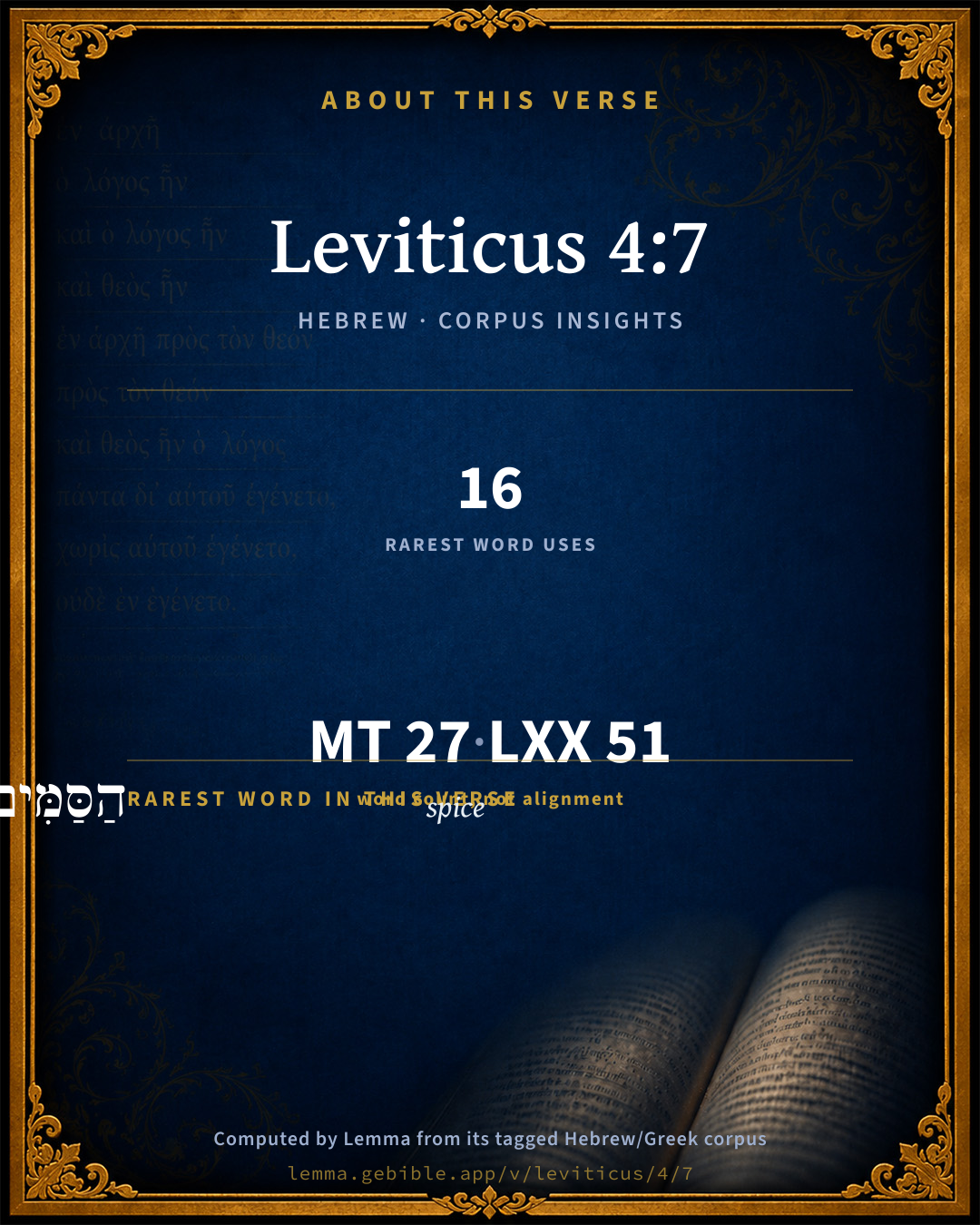
The rarest word here is הַסַּמִּים֙ spice H5561 — appearing just 16 times in the whole Hebrew Bible.

Shared distinctive vocabulary

הַסַּמִּים֙ spice H5561 occurs in 15 verses of the Hebrew Bible. Also found in:

Grammatical profile

  • 2 verbs
  • 19 nouns
  • 3 prepositions
  • 3 particles

Verb forms

  • וְנָתַן֩ Qal · Sequential Perfect
  • יִשְׁפֹּךְ֙ Qal · Imperfect

Repetition

Words recur within this verse — often emphatic in Hebrew:

  • הַדָּ֜ם blood H1818 ×2
  • מִזְבַּ֨ח altar H4196 ×2
  • בְּאֹ֣הֶל tent H168 ×2
  • מוֹעֵ֑ד appointed time H4150 ×2
  • אֲשֶׁ֖ר which H834 ×2

Hebrew & Septuagint length

In English translation the verse runs 57 words from the Hebrew and 64 from the Septuagint (LXX English) — closely comparable.

A rough comparison of the two English renderings, which tokenize alike — not a word-level alignment.

Word counts can differ between the Hebrew and the Greek without any difference in meaning — e.g. the Hebrew direct-object marker אֵת has no separate Greek word, and Greek often adds the article ὁ.

In the original languages it is 27 Hebrew tokens and 51 Greek tokens — but the two are counted differently (Hebrew bundles its prefixes and suffixes into one token; the Greek is in lemma form), so that isn’t a like-for-like length.

Cross-references

12

Topical passages linked to Leviticus 4:7 in the Treasury of Scripture Knowledge — connected by theme and wording, ordered by reader-vote popularity; previews shown in the World English Bible.

  • Leviticus 8:15 He killed it; and Moses took the blood, and put it on the horns of the altar round about with his finger, and purified the altar, and poured out the blood at the base of the altar, and sanctified it, to make atonement for it.
  • Leviticus 9:9 The sons of Aaron presented the blood to him; and he dipped his finger in the blood, and put it on the horns of the altar, and poured out the blood at the base of the altar:
  • Leviticus 4:18 He shall put some of the blood on the horns of the altar which is before Yahweh, that is in the Tent of Meeting; and the rest of the blood he shall pour out at the base of the altar of burnt offering, which is at the door of the Tent of Meeting.
  • Leviticus 4:34 The priest shall take some of the blood of the sin offering with his finger, and put it on the horns of the altar of burnt offering; and all the rest of its blood he shall pour out at the base of the altar.
  • Leviticus 5:9 He shall sprinkle some of the blood of the sin offering on the side of the altar; and the rest of the blood shall be drained out at the base of the altar. It is a sin offering.
  • Leviticus 16:18 "He shall go out to the altar that is before Yahweh and make atonement for it, and shall take some of the bull's blood, and some of the goat's blood, and put it on the horns of the altar round about.
  • Leviticus 4:30 The priest shall take some of its blood with his finger, and put it on the horns of the altar of burnt offering; and the rest of its blood he shall pour out at the base of the altar.
  • Exodus 30:1–10 "You shall make an altar to burn incense on. You shall make it of acacia wood.
  • Psalms 118:27 Yahweh is God, and he has given us light. Bind the sacrifice with cords, even to the horns of the altar.
  • Ephesians 2:13 But now in Christ Jesus you who once were far off are made near in the blood of Christ.
  • Hebrews 9:15 For this reason he is the mediator of a new covenant, since a death has occurred for the redemption of the transgressions that were under the first covenant, that those who have been called may receive the promise of the eternal inheritance.
  • Hebrews 9:21 Moreover he sprinkled the tabernacle and all the vessels of the ministry in like manner with the blood.

Cross-references courtesy of OpenBible.info (CC BY 4.0).

Hebrew and Greek witnesses Masoretic Hebrew ↔ Greek Septuagint

The same verse in the two great witnesses to the Old Testament, shown verse-for-verse.

These are two independent witnesses, not word-aligned to each other, and the Septuagint is shown in lemma (dictionary) form.

Hebrew Leviticus 4:7 Masoretic · Westminster Leningrad Codex

וְנָתַן֩ הַכֹּהֵ֨ן מִן הַדָּ֜ם עַל קַ֠רְנוֹת מִזְבַּ֨ח קְטֹ֤רֶת הַסַּמִּים֙ לִפְנֵ֣י יְהוָ֔ה אֲשֶׁ֖ר בְּאֹ֣הֶל מוֹעֵ֑ד וְאֵ֣ת כָּל דַּ֣ם הַפָּ֗ר יִשְׁפֹּךְ֙ אֶל יְסוֹד֙ מִזְבַּ֣ח הָעֹלָ֔ה אֲשֶׁר פֶּ֖תַח אֹ֥הֶל מוֹעֵֽד

The priest shall put some of the blood on the horns of the altar of sweet incense before Yahweh, which is in the tent of meeting; and he shall pour out all the blood of the bull out at the base of the altar of burnt offering, which is at the door of the Tent of Meeting.

World English Bible · Public Domain

Greek LXX Leviticus 4:7 Septuagint · lemma form

καί ἐπιτίθημι ὁ ἱερεύς ἀπό ὁ αἷμα ὁ μόσχος ἐπί ὁ κέρας ὁ θυσιαστήριον ὁ θυμίαμα ὁ σύνθεσις ὁ ἐναντίον κύριος ὅς εἰμί ἐν ὁ σκηνή ὁ μαρτύριον καί πᾶς ὁ αἷμα ὁ μόσχος ἐκχέω παρά ὁ βάσις ὁ θυσιαστήριον ὁ ὁλοκαύτωμα ὅς εἰμί παρά ὁ θύρα ὁ σκηνή ὁ μαρτύριον

And the priest shall put of the blood of the calf on the horns of the altar of the compound incense which is before the Lord, which is in the tabernacle of witness; and all the blood of the calf shall he pour out by the foot of the altar of whole burnt offerings, which is by the doors of the tabernacle of witness.

LXX2012 (modern English Septuagint) · Public Domain

Hebrew: Westminster Leningrad Codex (CC BY 4.0). Greek: Septuagint (public domain); English from LXX2012 (modern English Septuagint) (Public Domain). How the Septuagint differs from the Hebrew →

Targum (Aramaic paraphrase)

2

The Targum is the ancient Jewish Aramaic paraphrase of the Hebrew Scriptures — an interpretive translation, not the Hebrew text itself. Onkelos (literal) and Pseudo-Jonathan (expansive) render the Torah, and Jonathan the Prophets. Coverage is partial: where no permissively-licensed English translation exists for a verse, only the Aramaic is shown. This is verse-level text, not a word-by-word alignment to the Hebrew.

  1. Targum Onkelos Torah (Genesis–Deuteronomy)
    וְיִתֵּן כַּהֲנָא מִן דְמָא עַל קַרְנַת מַדְבַּח קְטוֹרֶת בּוּסְמַיָא קֳדָם יְיָ דִי בְּמַשְׁכַּן זִמְנָא וְיָת כָּל דְמָא דְתוֹרָא יֵישׁוּד לִיסוֹדָא דְּמַדְבְּחָא דַעֲלָתָא דִי בִתְרַע מַשְׁכַּן זִ מְנָא

    (no public-domain English translation for this verse)

    Targum Onkelos — Aramaic: “Onkelos Genesis” (public domain); “Onkelos Exodus” (public domain); “Onkelos Leviticus” (public domain); “Onkelos Numbers” (public domain); “Onkelos Deuteronomy” (public domain). English: “Sefaria Community Translation” (CC0 1.0 (public-domain dedication)); “J.W. Etheridge. The Targums of Onkelos and Jonathan Ben Uzziel on the Pentateuch. London: Longmans, Green, 1862” (public domain). Text via Sefaria.

  2. Targum Pseudo-Jonathan Torah (Genesis–Deuteronomy)
    וְיִתֵּן כַּהֲנָא מִן אַדְמָא עַל קַרְנַת מַדְבְּחָא דִקְטוֹרֶת בּוּסְמַיָא דִקְדָם יְיָ דִבְּמַשְׁכַּן זִמְנָא וְיַת כָּל אַדְמָא דְתוֹרָא יֵישׁוֹד לִיסוֹדָא דְמַדְבְּחָא דְעָלָתָא דְבִתְרַע מַשְׁכַּן זִימְנָא

    And the priest shall put some of the blood upon the horns of the altar of sweet incense that is before the Lord in the tabernacle of ordinance, and all the rest of the blood of the bullock he shall pour out at the foundation of the altar of burnt sacrifice which is at the gate of the tabernacle of ordinance.

    Targum Pseudo-Jonathan — Aramaic: “Targum Jonathan on Genesis” (public domain); “Targum Jonathan on Exodus” (public domain); “Targum Jonathan on Leviticus” (public domain); “Targum Jonathan on Numbers” (public domain); “Targum Jonathan on Deuteronomy” (public domain). English: “The Targum of Jonathan ben Uzziel, trans. J. W. Etheridge, London, 1862” (public domain). Text via Sefaria.

Commentary

Notes on Leviticus 4:7 from classic Christian and Jewish commentators (each source and its license shown beneath its notes). The classic Christian expositions comment on the surrounding passage and are grouped to its opening verse, so a note may address several verses; the Jewish commentaries on the Tanakh (Rashi and others) are per-verse, so they appear only where the commentator wrote on this verse.

Lemma curates 59 commentaries, every one of them public domain or Creative Commons licensed, each selected and text-cleaned for this edition rather than reprinted as found. About our sources →

Trapp's Complete Commentary

John Trapp

Lev 4:7 And the priest shall put [some] of the blood upon the horns of the altar of sweet incense before the LORD, which [is] in the tabernacle of the congregation; and shall pour all the blood of the bullock at the bottom of the altar of the burnt offering, which [is at] the door of the tabernacle of the congregation.

Ver. 7. Upon the horns of the altar.] To signify, saith one, that the preaching of the gospel concerning the blood of Christ, should be published and proclaimed to the four corners of the earth. To show, saith another, that by faith in the blood of Christ, our prayers are acceptable unto God, and our infirmities pardoned and purged.

John Trapp, A Commentary or Exposition upon All the Books of the Old and New Testament (1647–1656) — public domain. Text from a community e-Sword module.

Tyndale Open Study Notes

Tyndale Open Resources

4:7 The altar for fragrant incense stood in front of the inner curtain, just outside the Most Holy Place (4:6). It had four protrusions resembling horns, as did the altar for burnt offerings (see study note on Exod 27:2). The priests burned incense on this altar to the Lord each morning and evening (Exod 30:1-10).

Tyndale Open Study Notes — © Tyndale Open Resources, licensed CC BY-SA 4.0. Text via the HelloAO Bible API.

Geneva Bible (1599)

Geneva Bible translators

Which was in the court: meaning by the Tabernacle the Sanctuary: and in the end of this verse it is taken for the court.

Geneva Bible (1599) marginal notes — public domain. Text via Bolls.life.

Ellicott's Commentary for English Readers

(7) And the priest shall put.—That is, the high priest. With the finger thus dipped into it, he is to put some of the blood on each of the four horns of the golden altar on which the incense was offered.

This process, too, was peculiar to the sacrifice of the sin offering. The altar was placed in the holy place before the vail which separated off the holy of holies (Exo_30:1-6). According to the practice which obtained in the time of Christ, the priest began by putting the blood first on the north-east horn, then on the north-west, then on the south-west, and, lastly, on the south-east horn. He dipped his finger in the blood of the bowl at the sprinkling of each horn, and wiped his finger on the edge of the bowl between the separate sprinklings, as the blood which remained on his finger from one horn was not deemed fit to be put on the other.

And shall pour all the blood.—That is, all the remaining blood. The bulk of the blood which remained, after expending the small quantity on the horns of the incense altar inside the sanctuary, the priest poured out at the bottom of the altar of burnt offering, which stood outside the holy place. At the time of the second Temple, there were at the southwest horn of this altar two holes, like two nostrils, through which the blood ran into a drain conveying it into the brook of Kedron.

A Bible Commentary for English Readers, edited by Charles John Ellicott (1878–1897) — public domain. Text from a community e-Sword module.

The Cambridge Bible for Schools and Colleges

gen. ed. J. J. S. Perowne

7. The ‘altar of sweet incense’ does not appear in Exodus 27-29 (Pg). It must therefore be ascribed to a secondary addition (p[43]) to the groundwork of the Priestly Code. See App. on P, pp. 174 f.

[43] (secondary enactments) combined with the earlier strata. See further, pp. 174 ff.

before the Lord] The cloud was on the mercy-seat upon the ark in tie Holy of Holies; the sprinkling before the veil of the sanctuary was a sprinkling ‘before the Lord.’ The two phrases describe the same action.

at the base of the altar] The base (bottom A.V.) is mentioned only in connexion with pouring out the blood of the Sin-Offering in this ch., and in Lev_5:9, Lev_8:15 (= Exo_29:12), Lev_9:9.

the altar of burnt offering] A designation which marks ps[44]. In the legislation of Pg (see last note) there was no need for this distinction. There, accordingly, it was simply called ‘the altar’ (Lev_9:7-8 etc.) and so in Pt (ancient tôrôth; see App. on P, pp. 174 f.), e.g. in Lev_1:7 ff., Lev_2:2, Lev_3:2 ff. etc.

[44] (secondary enactments) combined with the earlier strata. See further, pp. 174 ff.

The Cambridge Bible for Schools and Colleges (gen. ed. J. J. S. Perowne; Cambridge University Press, 1878–1918) — public domain. Text from a community e-Sword module.

John Gill's Exposition

And he shall take off from it all the fat of the bullock for the sin offering,.... When the priest had killed the bullock, and sprinkled and poured the blood, as before commanded; he then cut up the bullock, and took out its inwards, and put them in a vessel, and salted them, and strowed them on the fires (z), and burnt them, and the fat of them, as he did with the sacrifice of the peace offerings; so that what is here said, and in the two next verses Lev 4:9, is the same with what is ordered concerning them in Lev 3:3; see Gill on Lev 3:3, Lev 3:4, Lev 3:5. Jarchi and Gersom both observe that they agree, that as one brings peace into the world, so does the other.

(z) Maimon. ib. (Maasch Hakorbanot) c. 7. sect. 2.

John Gill's Exposition of the Whole Bible (1746–1763) — public domain (CC PDM 1.0). Text via the HelloAO Bible API.

Albert Barnes' Notes on the Bible

Pour - All the blood that was left after the sprinkling and the smearing should be disposed of in such a manner as to suit the decorum of divine service. It had no sacrificial significance.

Albert Barnes' Notes on the Bible (1834–1885) — public domain. Text from a community e-Sword/MySword module.

Matthew Poole's English Annotations

The altar of sweet incense which is in the tabernacle; the altar of burnt-offerings was without the tabernacle.

All the blood; so also below, Lev 4:18,30,34, to wit, all the rest, as it is expressed Lev 5:9, for part was disposed elsewhere.

Matthew Poole's English Annotations on the Holy Bible (1683–1685) — public domain. Text from a community e-Sword/MySword module.

Whedon's Commentary on the Bible

Daniel D. Whedon

7. Blood… horns of the altar — These horns are not supposed to have been made of horn, but to have been projections from the four corners covered with the metal with which the altar was overlaid. Josephus describes the altars in use in his day as having these projections in the shape of horns. Others are of the opinion that the horns of the original altars were perpendicular cones rising from each corner of the altar to half its height. There is much discussion respecting their purpose. They could not, in the case of the altar of incense, have been for binding the victim before killing it, (Psa_118:27,) because no victim was ever burned on this altar. The horn is with the Hebrews a favourite symbol of power. Its presence on every altar may have been to suggest the glory of Jehovah’s omnipotence. Previous to the appointment of the six cities of refuge, the altar was the asylum for the accidental manslayer. Exo_21:14. The refugee was accustomed to lay hold of the horns of the altar. 1Ki_1:50. The horns were to be smeared with blood, perhaps to set forth the great truth that the blood of Christ is the only inviolable refuge, and that the penitent sinner can lay hold of the protecting power of God only as he lays hold of sacrificial blood. See Introduction, (6.)

Altar of sweet incense — This, being covered with gold, was called the golden altar, to distinguish it from the brazen altar of burnt offering. Exo_38:30; Exo_39:38. The Hebrew name for altar, signifying “the killing-place,” as applied to the altar of incense is not strictly appropriate. It is not here used in its etymological sense. For a description, see notes on Exo_30:1-10.

Before the Lord — This altar was situated in the holy place. In apparent contradiction to this, the writer to the Hebrews (Heb_9:4) enumerates it among the objects which were within the second vail, that is, in the holy of holies. In 1Ki_6:21-22, it is said to belong to “the oracle,” or most holy place. The best explanation is that suggested by Bleek and adopted by Tholuck, namely, that the author of the epistle “treats the holy of holies, irrespective of the vail, as symbolical of the heavenly sanctuary, and had also a motive to include in it the altar of incense, whose offerings of incense are the symbol of the prayers of the saints. See note on Heb_9:4.

Pour all the blood… bottom of the altar — In the temple there was a duct by which the blood was conveyed to the brook Kedron. There was doubtless some such way of disposing of the blood in the tabernacle, of which the temple was only an enlarged copy.

Daniel D. Whedon (gen. ed.), Commentary on the Old and New Testaments (1874–1909) — public domain. Text from a community e-Sword module.

John Wesley's Explanatory Notes

All the blood - All the rest; for part was disposed elsewhere.

John Wesley, Explanatory Notes Upon the Whole Bible (1754–1765) — public domain. Text via the GEBible commentary corpus.

Rashi

Rabbi Shlomo Yitzchaki (Rashi)

ואת כל דם AND ALL THE BLOOD — i. e. all the remainder of the blood (since part of it had already been sprinkled) (Zevachim 25a).

Rashi on the Tanakh — English translations: “The Judaica Press complete Tanach with Rashi, translated by A. J. Rosenberg” (CC BY 4.0); “Pentateuch with Rashi's commentary by M. Rosenbaum and A.M. Silbermann, 1929-1934” (public domain); “The Metsudah Tanach series, Lakewood, N.J” (CC BY 4.0); and “The Book of Joshua, Metsudah Publications, 1997” (CC BY 4.0). Text via Sefaria.

Lesson kit

Teaching starters — assembled from the data on this page, not authored interpretation. Every prompt links to the verse data it draws on. Edit before teaching.

Leviticus, in the Pentateuch, opens this verse with 27 words (22 distinct Hebrew lemmas). Its most distinctive word is çam (“spice”). A historical commentator’s framing appears above. Read the whole chapter for the surrounding context.

Discussion questions

  1. The word çam carries the sense “spice.” How does it shape the verse?
  2. How does Exodus 25:6, which shares the word «spice», read alongside this verse?
  3. What does the repetition of “blood” (2× in this one verse) do in this verse?
  4. These translations render this verse differently; the difference is in the English rendering, not the original. What questions does that raise?
  5. «וְנָתַן֩» is a Qal Sequential Perfect verb. How does that grammatical form shape the action described?
  6. Compare how Trapp's Complete Commentary and Tyndale Open Study Notes read this verse. Where do they agree or differ?

Things to notice

Reading settings

Reading text

Shown beneath each verse's original-language words.

Old Testament
Old Testament edition

Read the OT as the Masoretic Hebrew (MT) or the Greek Septuagint (LXX).

English shown for the Greek Septuagint (in the Hebrew ↔ Greek comparison).

Comparing translations? Open the Compare panel on any verse page to stack up to four side by side.