
Exodus 17:6

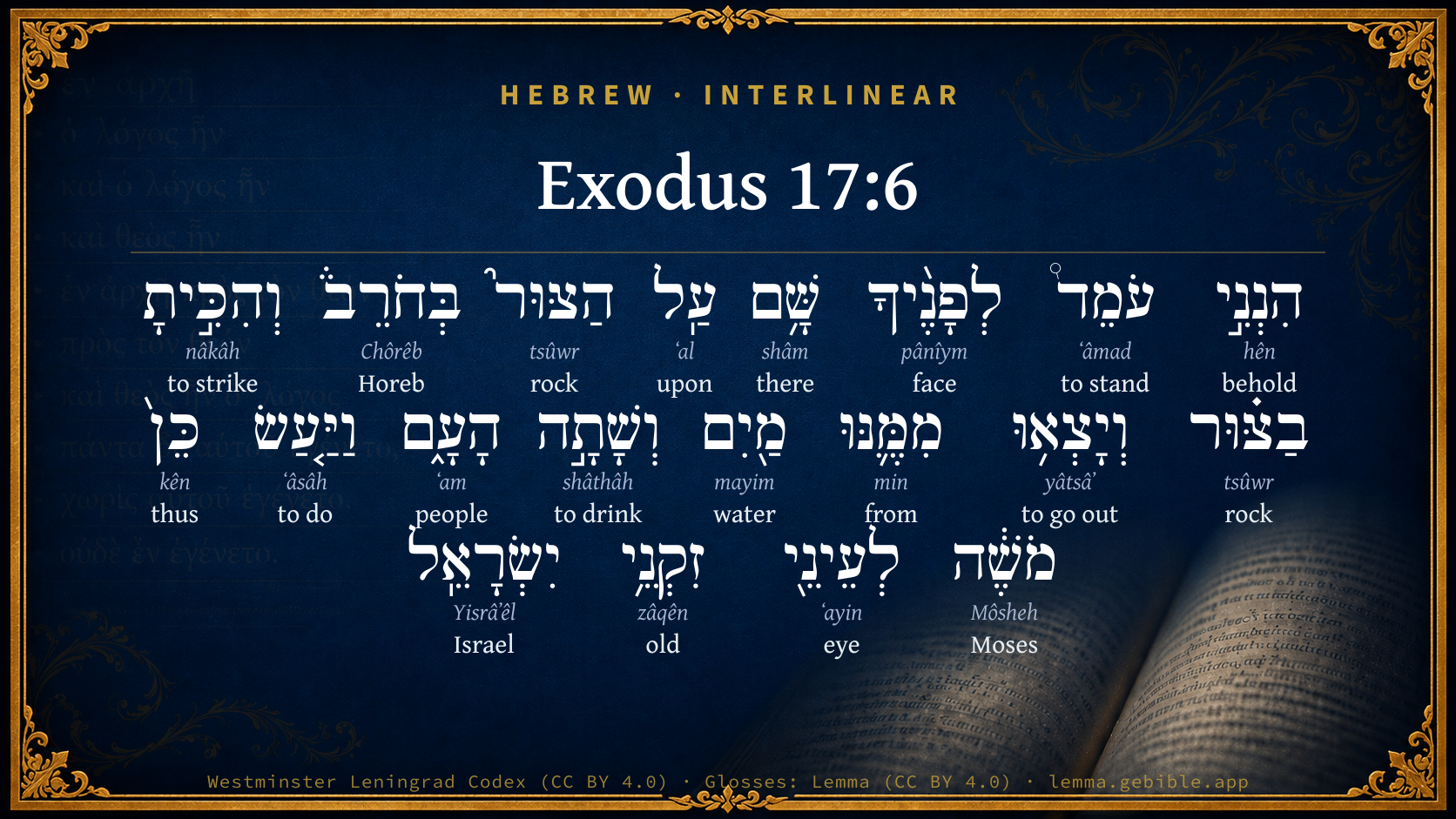
Hebrew (Westminster Leningrad Codex) Exodus 17:6 appears in the Hebrew Old Testament. The text above is from the Westminster Leningrad Codex. Each word links to its Strong’s number, a concise gloss, and parsing drawn from the Open Scriptures Hebrew Bible morphology. Click any word for its full Brown-Driver-Briggs (BDB) entry.
Download image
Cite this verse

Exodus 17:6 (World English Bible). Public Domain. Lemma interlinear Bible study tool, https://lemma.gebible.app/v/exodus/17/6.

Show BibTeX & RIS
BibTeX
RIS
English Translation
Behold, I will stand before you there on the rock in Horeb. You shall strike the rock, and water will come out of it, that the people may drink." Moses did so in the sight of the elders of Israel.
World English Bible · Public Domain
Highlights
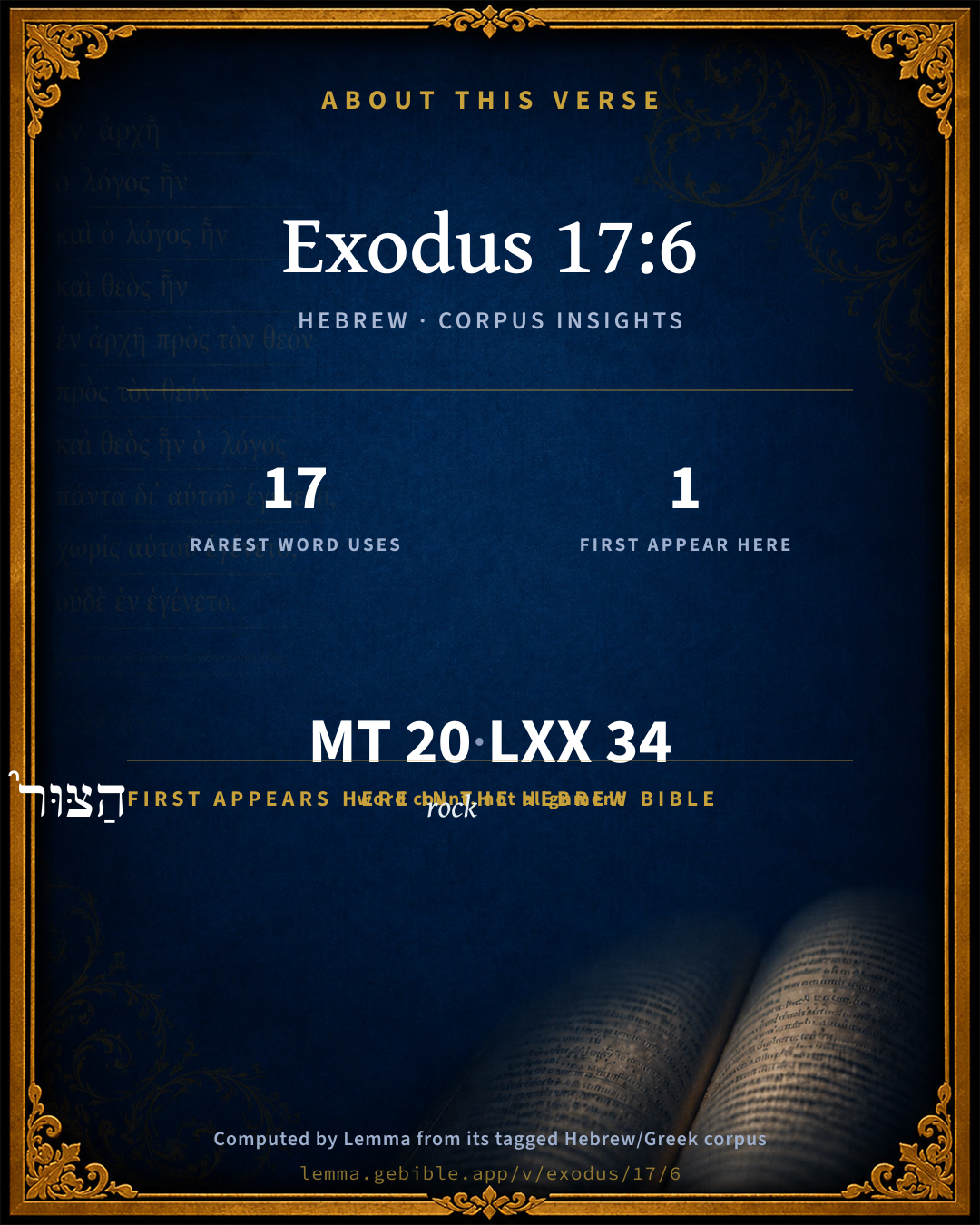
  • 1 first appearance in the Hebrew Bible
Full analysis ↓
Download a study sheet

One document with this verse’s original text, its word-by-word gloss line, the meaning frame, cross-references with their text, attributed commentary, and full source and license credits — printable, and it pastes into notes with its structure intact.

This verse Autodidact and up

Study sheet (.html) Plain text (.txt)

A passage Seminary Student

Up to 50 verses in one chapter. A passage sheet keeps up to 6 commentary sources and 12 cross-references per verse, in the order this page ranks them, and says so on the sheet whenever that leaves anything out. Ask for a single verse and you get the Autodidact verse sheet above.

Everything on this page stays free to read, with no account — the sheet is a download of what is already on screen, not access to it.

Want to remove ads? Support Godless Engineer
Compare translations 3

The same verse in 3 English versions, stacked beneath the original-language interlinear above. Click any original word for its lexicon entry.

Each is an independent rendering of the whole verse — the interlinear is not word-aligned to these translations.

Highlighted words mark where these versions differ — a whole-verse word diff, not a word-by-word alignment.

  • World English Bible Public Domain
    Behold, I will stand before you there on the rock in Horeb. You shall strike the rock, and water will come out of it, that the people may drink." Moses did so in the sight of the elders of Israel.
  • King James Version Public Domain
    Behold, I will stand before thee there upon the rock in Horeb; and thou shalt smite the rock, and there shall come water out of it, that the people may drink. And Moses did so in the sight of the elders of Israel.
  • unfoldingWord Literal Text CC BY-SA 4.0
    Behold me! I will stand before your face there on the rock at Horeb. And you will strike on the rock, and water will come from it, and the people will drink.” And Moses did so in the eyes of the elders of Israel.

unfoldingWord Literal Text — © unfoldingWord, licensed CC BY-SA 4.0. Word-aligned USFM3 via Door43 (git.door43.org/unfoldingWord/en_ult).

Versions to compare (up to 4)

3 of 4 selected

Show all 18 translations

Every available English version of this verse, each an independent rendering of the whole verse.

  • World English Bible Public Domain
    Behold, I will stand before you there on the rock in Horeb. You shall strike the rock, and water will come out of it, that the people may drink." Moses did so in the sight of the elders of Israel.
  • Berean Standard Bible Public Domain
    Behold, I will stand there before you by the rock at Horeb. And when you strike the rock, water will come out of it for the people to drink.” So Moses did this in the sight of the elders of Israel.
  • Majority Standard Bible Public Domain
    Behold, I will stand there before you by the rock at Horeb. And when you strike the rock, water will come out of it for the people to drink.” So Moses did this in the sight of the elders of Israel.
  • King James Version Public Domain
    Behold, I will stand before thee there upon the rock in Horeb; and thou shalt smite the rock, and there shall come water out of it, that the people may drink. And Moses did so in the sight of the elders of Israel.
  • American Standard Version (1901) Public Domain
    Behold, I will stand before thee there upon the rock in Horeb; and thou shalt smite the rock, and there shall come water out of it, that the people may drink. And Moses did so in the sight of the elders of Israel.
  • Revised Version (1885) Public Domain
    Behold, I will stand before thee there upon the rock in Horeb; and thou shalt smite the rock, and there shall come water out of it, that the people may drink. And Moses did so in the sight of the elders of Israel.
  • Geneva Bible (1599) Public Domain
    Behold, I will stand there before thee vpon the rocke in Horeb, and thou shalt smite on the rocke, and water shall come out of it, that the people may drinke. And Moses did so in the sight of the Elders of Israel.
  • Douay-Rheims (1899) Public Domain
    Behold I will stand there before thee, upon the rock Horeb: and thou shalt strike the rock, and water shall come out of it that the people may drink. Moses did so before the ancients of Israel:
  • Young's Literal Translation Public Domain
    Lo, I am standing before thee there on the rock in Horeb, and thou hast smitten on the rock, and waters have come out from it, and the people have drunk.' And Moses doth so before the eyes of the elders of Israel,
  • Literal Standard Version CC BY-SA 4.0
    Behold, I am standing before you there on the rock in Horeb, and you have struck on the rock, and waters have come out from it, and the people have drunk.” And Moses does so before the eyes of [the] elderly of Israel,
  • Unlocked Literal Bible CC BY-SA 4.0
    I will stand before you there on the rock at Horeb, and you will strike the rock. Water will come out of it for the people to drink.” Then Moses did so in the sight of the elders of Israel.
  • unfoldingWord Literal Text CC BY-SA 4.0
    Behold me! I will stand before your face there on the rock at Horeb. And you will strike on the rock, and water will come from it, and the people will drink.” And Moses did so in the eyes of the elders of Israel.
  • Darby Bible Public Domain
    Behold, I will stand before thee there upon the rock on Horeb; and thou shalt strike the rock, and there shall come water out of it, that the people may drink. And Moses did so before the eyes of the elders of Israel.
  • World Messianic Bible Public Domain
    Behold, I will stand before you there on the rock in Horeb. You shall strike the rock, and water will come out of it, that the people may drink.” Moses did so in the sight of the elders of Israel.
  • Webster's Bible Public Domain
    Behold, I will stand before thee there on the rock in Horeb; and thou shalt smite the rock, and water shall come out of it, that the people may drink. And Moses did so in the sight of the elders of Israel.
  • Free Bible Version CC BY-SA 4.0
    Look, I will stand there beside you by the rock at Horeb. When you hit the rock water will pour out for the people to drink.” So Moses did this as the elders of Israel watched.
  • Bible in Basic English Public Domain
    See, I will take my place before you on the rock in Horeb; and when you give the rock a blow, water will come out of it, and the people will have drink. And Moses did so before the eyes of the chiefs of Israel.
  • JPS Tanakh (1917) Public Domain
    Behold, I will stand before thee there upon the rock in Horeb; and thou shalt smite the rock, and there shall come water out of it, that the people may drink.' And Moses did so in the sight of the elders of Israel.

Literal Standard Version (2020), Covenant Press — licensed CC BY-SA 4.0. Text via the HelloAO Bible API (eBible.org). Unlocked Literal Bible (unfoldingWord) — licensed CC BY-SA 4.0. Text via the HelloAO Bible API (eBible.org). unfoldingWord Literal Text — © unfoldingWord, licensed CC BY-SA 4.0. Word-aligned USFM3 via Door43 (git.door43.org/unfoldingWord/en_ult). Free Bible Version, Dr. Jonathan Gallagher — licensed CC BY-SA 4.0. Text via the HelloAO Bible API (eBible.org).

Word by word

More ways to search: Search by grammar → Find every occurrence → Compare this word →

Practice this passage: Drill this verse → Learn its vocabulary →

בְּחֹרֵב֒
Chôrêb
H2722
“in/at · Horeb”
Preposition + Noun, Proper
Part of Speech
Preposition + Noun
Type
Proper
Full BDB Definition

Origin: from H2717

TWOT: 731c

Horeb = "desert" - another name for Mount Sinai from which God gave the law to Moses and the Israelites
  1. הִנְנִ֣י hên H2005 “behold · me” Particle, Demonstrative + Suffix, Personal, 1st Person, Common, Singular
  2. עֹמֵד֩ ʻâmad H5975 “standing” Verb, Qal, Participle Active, Masculine, Singular, Absolute
  3. לְפָנֶ֨יךָ pânîym H6440 “to/for · face(s) · your” Preposition + Noun, Common, Both, Plural, Construct + Suffix, Personal, 2nd Person, Masculine, Singular
  4. שָּׁ֥ם shâm H8033 “there” Adverb
  5. עַֽל ʻal H5921 “upon” Preposition
  6. הַצּוּר֮ tsûwr H6697 “the · rock” Particle, Definite Article + Noun, Common, Masculine, Singular, Absolute
  7. וְהִכִּ֣יתָ nâkâh H5221 “and · to strike” Conjunction + Verb, Hiphil, Sequential Perfect, 2nd Person, Masculine, Singular
  8. בַצּ֗וּר tsûwr H6697 “in/at the · rock” Preposition, Determined + Noun, Common, Masculine, Singular, Absolute
  9. וְיָצְא֥וּ yâtsâʼ H3318 “and · to go out” Conjunction + Verb, Qal, Sequential Perfect, 3rd Person, Common, Plural
  10. מִמֶּ֛נּוּ min H4480 “from · us” Preposition + Suffix, Personal, 1st Person, Common, Plural
  11. מַ֖יִם mayim H4325 “water(s)” Noun, Common, Masculine, Plural, Absolute
  12. וְשָׁתָ֣ה shâthâh H8354 “and · to drink” Conjunction + Verb, Qal, Sequential Perfect, 3rd Person, Masculine, Singular
  13. הָעָ֑ם ʻam H5971 “the · people” Particle, Definite Article + Noun, Common, Masculine, Singular, Absolute
  14. וַיַּ֤עַשׂ ʻâsâh H6213 “and · to do” Conjunction + Verb, Qal, Sequential Imperfect, 3rd Person, Masculine, Singular
  15. כֵּן֙ kên H3651 “thus” Particle, Demonstrative
  16. מֹשֶׁ֔ה Môsheh H4872 “Moses” Noun, Proper
  17. לְעֵינֵ֖י ʻayin H5869 “to/for · eyes of” Preposition + Noun, Common, Both, Dual, Construct
  18. זִקְנֵ֥י zâqên H2205 “old of” Adjective, Adjective, Masculine, Plural, Construct
  19. יִשְׂרָאֵֽל Yisrâʼêl H3478 “Israel” Noun, Proper

About this verse

These counts appear in no published source. They are computed here, from the morphology-tagged text and Lemma’s own curated glosses. What Lemma adds →

20
words
19
distinct lemmas
Pentateuch
section

Notable vocabulary

The rarest word here is בְּחֹרֵב֒ Horeb H2722 — appearing just 17 times in the whole Hebrew Bible.

First appearance in Scripture

This word makes its first canonical appearance in the Hebrew Bible here:

  • הַצּוּר֮ rock H6697

Shared distinctive vocabulary

בְּחֹרֵב֒ Horeb H2722 occurs in 17 verses of the Hebrew Bible. Also found in:

Grammatical profile

  • 5 verbs
  • 9 nouns
  • 1 adjective
  • 2 prepositions
  • 1 adverb
  • 2 particles

Verb forms

  • עֹמֵד֩ Qal · Participle Active
  • וְהִכִּ֣יתָ Hiphil · Sequential Perfect
  • וְיָצְא֥וּ Qal · Sequential Perfect
  • וְשָׁתָ֣ה Qal · Sequential Perfect
  • וַיַּ֤עַשׂ Qal · Sequential Imperfect

Repetition

A word recurs within this verse — often emphatic in Hebrew:

  • הַצּוּר֮ rock H6697 ×2

Hebrew & Septuagint length

In English translation the verse runs 40 words from the Hebrew and 39 from the Septuagint (LXX English) — closely comparable.

A rough comparison of the two English renderings, which tokenize alike — not a word-level alignment.

Word counts can differ between the Hebrew and the Greek without any difference in meaning — e.g. the Hebrew direct-object marker אֵת has no separate Greek word, and Greek often adds the article ὁ.

In the original languages it is 20 Hebrew tokens and 34 Greek tokens — but the two are counted differently (Hebrew bundles its prefixes and suffixes into one token; the Greek is in lemma form), so that isn’t a like-for-like length.

Cross-references

18

Topical passages linked to Exodus 17:6 in the Treasury of Scripture Knowledge — connected by theme and wording, ordered by reader-vote popularity; previews shown in the World English Bible.

  • 1 Corinthians 10:4 and all drank the same spiritual drink. For they drank of a spiritual rock that followed them, and the rock was Christ.
  • Numbers 20:9–11 Moses took the rod from before Yahweh, as he commanded him.
  • Nehemiah 9:15 and gave them bread from the sky for their hunger, and brought forth water for them out of the rock for their thirst, and commanded those who they should go in to possess the land which you had sworn to give them.
  • Psalms 105:41 He opened the rock, and waters gushed out. They ran as a river in the dry places.
  • Deuteronomy 8:15 who led you through the great and terrible wilderness, [in which were] fiery serpents and scorpions, and thirsty ground where was no water; who brought you forth water out of the rock of flint;
  • Psalms 78:15–16 He split rocks in the wilderness, And gave them drink abundantly as out of the depths.
  • John 4:10 Jesus answered her, "If you knew the gift of God, and who it is who says to you, 'Give me a drink,' you would have asked him, and he would have given you living water."
  • Psalms 78:20 Behold, he struck the rock, so that waters gushed out, Streams overflowed. Can he give bread also? Will he provide flesh for his people?"
  • Psalms 114:8 Who turned the rock into a pool of water, The flint into a spring of waters.
  • Isaiah 41:17–18 The poor and needy seek water, and there is none, and their tongue fails for thirst; I, Yahweh, will answer them, I, the God of Israel, will not forsake them.
  • Psalms 46:4 There is a river, the streams of which make the city of God glad, The holy place of the tents of the Most High.
  • Isaiah 43:19–20 Behold, I will do a new thing; now shall it spring forth; shall you not know it? I will even make a way in the wilderness, and rivers in the desert.
  • Isaiah 48:21 They didn't thirst when he led them through the deserts; he caused the waters to flow out of the rock for them; he split the rock also, and the waters gushed out.
  • John 4:14 but whoever drinks of the water that I will give him will never thirst again; but the water that I will give him will become in him a well of water springing up to eternal life."
  • John 7:37–38 Now on the last and greatest day of the feast, Jesus stood and cried out, "If anyone is thirsty, let him come to me and drink!
  • Revelation 22:17 The Spirit and the bride say, "Come!" He who hears, let him say, "Come!" He who is thirsty, let him come. He who desires, let him take the water of life freely.
  • Exodus 3:1–5 Now Moses was keeping the flock of Jethro, his father-in-law, the priest of Midian, and he led the flock to the back of the wilderness, and came to God's mountain, to Horeb.
  • Exodus 16:10 It happened, as Aaron spoke to the whole congregation of the children of Israel, that they looked toward the wilderness, and, behold, the glory of Yahweh appeared in the cloud.

Cross-references courtesy of OpenBible.info (CC BY 4.0).

Hebrew and Greek witnesses Masoretic Hebrew ↔ Greek Septuagint

The same verse in the two great witnesses to the Old Testament, shown verse-for-verse.

These are two independent witnesses, not word-aligned to each other, and the Septuagint is shown in lemma (dictionary) form.

Hebrew Exodus 17:6 Masoretic · Westminster Leningrad Codex

הִנְנִ֣י עֹמֵד֩ לְפָנֶ֨יךָ שָּׁ֥ם עַֽל הַצּוּר֮ בְּחֹרֵב֒ וְהִכִּ֣יתָ בַצּ֗וּר וְיָצְא֥וּ מִמֶּ֛נּוּ מַ֖יִם וְשָׁתָ֣ה הָעָ֑ם וַיַּ֤עַשׂ כֵּן֙ מֹשֶׁ֔ה לְעֵינֵ֖י זִקְנֵ֥י יִשְׂרָאֵֽל

Behold, I will stand before you there on the rock in Horeb. You shall strike the rock, and water will come out of it, that the people may drink." Moses did so in the sight of the elders of Israel.

World English Bible · Public Domain

Greek LXX Exodus 17:6 Septuagint · lemma form

ὅδε ἐγώ ἵστημι πρό ὁ σύ ἐκεῖ ἐπί ὁ πέτρα ἐν χωρηβ καί πατάσσω ὁ πέτρα καί ἐκἔρχομαι ἐκ αὐτός ὕδωρ καί πίνω ὁ λαός ἐγώ ποιέω δέ μωυσῆς οὕτως ἐναντίον ὁ υἱός ἰσραήλ

Behold, I stand there before you come, on the rock in Choreb, and you shall strike the rock, and water shall come out from it, and the people shall drink. And Moses did so before the sons of Israel.

LXX2012 (modern English Septuagint) · Public Domain

Hebrew: Westminster Leningrad Codex (CC BY 4.0). Greek: Septuagint (public domain); English from LXX2012 (modern English Septuagint) (Public Domain). How the Septuagint differs from the Hebrew →

Targum (Aramaic paraphrase)

2

The Targum is the ancient Jewish Aramaic paraphrase of the Hebrew Scriptures — an interpretive translation, not the Hebrew text itself. Onkelos (literal) and Pseudo-Jonathan (expansive) render the Torah, and Jonathan the Prophets. Coverage is partial: where no permissively-licensed English translation exists for a verse, only the Aramaic is shown. This is verse-level text, not a word-by-word alignment to the Hebrew.

  1. Targum Onkelos Torah (Genesis–Deuteronomy)
    הָא אֲנָא קָאֵם קֳדָמָךְ תַּמָן עַל טִנָרָא בְּחוֹרֵב וְתִמְחֵי בְטִנָרָא וְיִפְּקוּן מִנֵהּ מַיָא וְיִשְׁתֵּי עַמָא וַעֲבַד כֵּן משֶׁה לְעֵינֵי סָבֵי יִשְׂרָאֵל:

    (no public-domain English translation for this verse)

    Targum Onkelos — Aramaic: “Onkelos Genesis” (public domain); “Onkelos Exodus” (public domain); “Onkelos Leviticus” (public domain); “Onkelos Numbers” (public domain); “Onkelos Deuteronomy” (public domain). English: “Sefaria Community Translation” (CC0 1.0 (public-domain dedication)); “J.W. Etheridge. The Targums of Onkelos and Jonathan Ben Uzziel on the Pentateuch. London: Longmans, Green, 1862” (public domain). Text via Sefaria.

  2. Targum Pseudo-Jonathan Torah (Genesis–Deuteronomy)
    הָאֲנָא קָאִים קֳדָמָךְ תַּמָּן בְּאַתְרָא דְתֶחֱמֵי רוֹשֶׁם רִיגְלָא בְּחוֹרֵב וְתִמְחֵי בֵיהּ בְּטִינָר בְּחוּטְרָךְ וְיִפְקוּן מִינֵהּ מוֹי לְמִשְׁתֵּי וְיִשְׁתּוּן עַמָּא וְעָבַד הֵיכְדֵין משֶׁה קֳדָם סָבֵי יִשְרָאֵל

    Behold, I will stand before thee there, on the spot where thou sawest the impress of the foot on Horeb; and thou shalt smite the rock with thy rod, and therefrom shall come forth waters for drinking, and the people shall drink. And Mosheh did so before the elders of Israel.

    Targum Pseudo-Jonathan — Aramaic: “Targum Jonathan on Genesis” (public domain); “Targum Jonathan on Exodus” (public domain); “Targum Jonathan on Leviticus” (public domain); “Targum Jonathan on Numbers” (public domain); “Targum Jonathan on Deuteronomy” (public domain). English: “The Targum of Jonathan ben Uzziel, trans. J. W. Etheridge, London, 1862” (public domain). Text via Sefaria.

Commentary

Notes on Exodus 17:6 from classic Christian and Jewish commentators (each source and its license shown beneath its notes). The classic Christian expositions comment on the surrounding passage and are grouped to its opening verse, so a note may address several verses; the Jewish commentaries on the Tanakh (Rashi and others) are per-verse, so they appear only where the commentator wrote on this verse.

Lemma curates 59 commentaries, every one of them public domain or Creative Commons licensed, each selected and text-cleaned for this edition rather than reprinted as found. About our sources →

Trapp's Complete Commentary

John Trapp

Exo 17:6 Behold, I will stand before thee there upon the rock in Horeb; and thou shalt smite the rock, and there shall come water out of it, that the people may drink. And Moses did so in the sight of the elders of Israel.

Ver. 6. Upon the rock.] If God had not stood upon the rock, in vain had Moses struck it. Means must be used, but God only depended upon for success. It is he alone that sets the rock abroaeh.

Thou shalt smite the rock.] Herein a type of Christ "stricken, smitten of God, and afflicted." {Isa 53:4 1Co 10:4}

And there shall come water out of it.] Not fire - that had not been so miraculous - but water. This "cleaving the" hard "rock," {Psa 78:15} this "turning of the flint into a fountain," {Psa 114:8} was a work of Onmipoteney, and is therefore much celebrated. {Deu 8:15 Psa 105:41 Neh 9:15} Dioseorides tells us of the stone Galactites, quod succum emittat lacteum, that it yields a kind of moisture like milk: which, if it "be true, is very strange.

That the people may drink.] And so be cooled and comforted in their weariness and wanderings. "Ho, every one that thirsteth," &c. {Isa 55:1}

John Trapp, A Commentary or Exposition upon All the Books of the Old and New Testament (1647–1656) — public domain. Text from a community e-Sword module.

Tyndale Open Study Notes

Tyndale Open Resources

17:6 Mount Sinai: See study note on 3:1. • water gushed out: Note the similar provision in Num 20:11 (see also Ps 78:15-16; 105:41; 114:8; Isa 48:21).

Tyndale Open Study Notes — © Tyndale Open Resources, licensed CC BY-SA 4.0. Text via the HelloAO Bible API.

Adam Clarke's Commentary

Verse 6. I will stand before thee there, upon the rock in Horeb] THE rock, הצור hatstsur. It seems as if God had directed the attention of Moses to a particular rock, with which he was well acquainted; for every part of the mount and its vicinity must have been well known to Moses during the time he kept Jethro's flocks in those quarters. Dr. Priestley has left the following sensible observations upon this miracle: -

"The luminous cloud, the symbol of the Divine presence, would appear on the rock, and Horeb was probably a part of the same mountain with Sinai. This supply of water, on Moses only striking the rock, where no water had been before nor has been since, was a most wonderful display of the Divine power. The water must have been in great abundance to supply two millions of persons, which excluded all possibility of artifice or imposture in the case. The miracle must also have been of some continuance, no doubt so long as they continued in that neighbourhood, which was more than a year. There are sufficient traces of this extraordinary miracle remaining at this day. This rock has been visited, drawn, and described by Dr. Shaw, Dr. Pocock, and others; and holes and channels appear in the stone, which could only have been formed by the bursting out and running of the water. No art of man could have done it, if any motive could be supposed for the undertaking in such a place as this."

This miracle has not escaped the notice of the ancient Greek poets. Callimachus represents Rhea bringing forth water from a rock in the same way, after the birth of Jupiter.

Πληξεν ορος σκηπτρῳ, το δε οἱ δεχα πουλυ διεστη.

Εκ δ' εχεεν μεγα χευμα.

Hymn ad Jov., ver. 31.

_____________ With her sceptre struck

The yawning cliff; from its disparted height

Adown the mount the gushing torrent ran.

PRIOR.

The rock mentioned above has been seen and described by Norden, p. 144, 8vo.; Dr. Shaw, p. 314, 4to., where there is an accurate drawing of it; Dr. Pocock, vol. i., p. 143, &c., where the reader may find some fine plates of Mount Horeb and Sinai, and four different views of the wonderful rock of Meribah. It is a vast block of red granite, fifteen feet long, ten broad, and twelve high. See Dr. Shaw's account at the end of Exodus. My nephew, who visited this rock in 1823, confirms the account of the preceding travellers, and has brought a piece of this wonderful stone. The granite is fine, and the quartz mica, and feldspar equally mixed in it. This rock or block of granite is the only type of Christ now existing.

Adam Clarke's Commentary on the Bible (1810–1826) — public domain. Text from a community e-Sword/MySword module.

The Cambridge Bible for Schools and Colleges

gen. ed. J. J. S. Perowne

6. stand before thee] be present with My omnipotence (Di.): a fine and striking anthropomorphism.

the rock] Not a particular rock, but the rocky mass in general (cf. Exo_33:21-22).

in Horeb] The statement occasions great difficulty,—at least for those who place Rephidim in W. Feiran, and identify Sinai (substantially = Horeb) with J. Mûsâ, by the shortest route 24 miles (see above) beyond W. Feiran. If Sinai were J. Serbâl, the mountain above W. Feiran, on the S., there would be no difficulty; nor would there be any, if Sinai were J. Mûsâ, and Rephidim were where Keil places it, at the SE. entrance to the plain er-Râḥah, just N. of J. Mûsâ. ‘Horeb,’ however, is equally with ‘Sinai’ the scene of the lawgiving (see Deu_4:15); so, even though (see on Exo_3:1) it may have been a somewhat wider term than ‘Sinai,’ it is scarcely likely that it will have included territory separated from it by a rough mountainous country, and only to be reached by a mountain valley at least 24 miles long. If, therefore, Rephidim is rightly placed in W. Feiran, and J. Mûsâ is rightly identified with Sinai, the most natural supposition is that the author wrote without an accurate knowledge of the topography, and did not realize how far ‘Horeb’ was from ‘Rephidim.’ It is, however, a question whether ch. 17–18 did not originally stand at a later point of the narrative, after ch. 34 (cf. p. 162), in which case Rephidim might be near ‘Horeb.’

The Cambridge Bible for Schools and Colleges (gen. ed. J. J. S. Perowne; Cambridge University Press, 1878–1918) — public domain. Text from a community e-Sword module.

John Gill's Exposition

Behold, I will stand before thee there upon the rock in Horeb,.... Or "upon that rock" (k), a particular rock which was pointed unto, where the Lord in the pillar of cloud would stand; not as a mere spectator of this affair, but as a director of Moses where to smite the rock; and to exert his power in producing water from it, and by his presence to encourage Moses to do it, and to expect and believe the issue of it:

and thou shalt smite the rock: or "on the rock", or "in it" (l); which made Jarchi fancy that the rod of Moses was something very hard, that it was a sapphire by which the rock was cleft:

and there shall come water out of it, that the people may drink, they, their children, and their cattle, ready to die for thirst. Thus God showed himself gracious and merciful to a murmuring and ungrateful people:

and Moses did so in the sight of the elders of Israel; he smote the rock with his rod, and the waters gushed out in great abundance, like streams and rivers, for the refreshment of the people, and their flocks, Psa 78:20. The Heathens have preserved some footsteps of this miracle in their writings, though disguised. Pausanias (m) speaks of a fountain of cold water springing out of a rock, and reports how Atalantes, coming from hunting thirsty, smote a rock with his spear, and water flowed out. This rock at Rephidim, and the apertures through which the waters flowed, are to be seen to this day, as travellers of veracity relate. Monsieur Thevenot (n) says the rock at Rephidim is only a stone of a prodigious height and thickness, rising out of the ground: on the two sides of that stone we saw several holes, by which the water hath run, as may be easily known by the prints of the water, which hath much hollowed it, but at present no water issues out of them. A later traveller (o) gives us a more distinct account of it: after we had descended the western side of this Mount (Sinai), says he, we came into the plain or wilderness of Rephidim, where we saw that extraordinary antiquity, the rock of Meribah, which was continued to this day, without the least injury from time or accidents. This is rightly called, from its hardness, Deu 8:15, , "a rock of flint", though, from the purple or reddish colour of it, it may be rather rendered the rock of or amethyst, or the amethystine, or granite rock. It is about six yards square, lying tottering as it were, and loose, near the middle of the valley, and seems to have been formerly a cliff of Mount Sinai, which hangs in a variety of precipices all over this plain; the water which gushed out, and the stream which flowed withal, Psa 78:20 have hollowed across one corner of this rock, a channel about two inches deep, and twenty wide, all over incrusted like the inside of a tea kettle that has been long used. Besides several mossy productions that are still preserved by the dew, we see all over this channel a great number of holes, some of them four or five inches deep, and one or two in diameter, the lively and demonstrative tokens of their having been formerly so many fountains. Neither could art nor chance be concerned in the contrivance, inasmuch as every circumstance points out to us a miracle; and, in the same manner with the rent in the rock of Mount Calvary at Jerusalem, never fails to produce the greatest seriousness and devotion in all who see it. The Arabs, who were our guards, were ready to stone me in attempting to break off a corner of it: and another late traveller (p) informs us, that the stone called the stone of the fountains, or the solitary rock, is about twelve feet high, and about eight or ten feet broad, though it is not all of one equal breadth. It is a granite marble, of a kind of brick colour, composed of red and white spots, which are both dusky in their kind; and it stands by itself in the fore mentioned valley (the valley of Rephidim) as if it had grown out of the earth, on the right hand of the road toward the northeast: there remains on it to this day the lively impression of the miracle then wrought; for there are still to be seen the places where the water gushed out, six openings towards the southwest, and six towards the northeast; and in those places where the water flowed the clefts are still to be seen in the rock, as it were with lips. The account Dr. Pocock (q) gives of it is this,"it is on the foot of Mount Seriah, and is a red granite stone, fifteen feet long, ten wide, and about twelve high: on both sides of it toward the south end, and at the top of it for about the breadth of eight inches, it is discoloured as by the running of water; and all down this part, and both sides, and at top, are a sort of openings and mouths, some of which resemble the lion's mouth that is sometimes cut in stone spouts, but appear not to be the work of a tool. There are about twelve on each side, and within everyone is an horizontal crack, and in some also a crack down perpendicularly. There is also a crack from one of the mouths next to the hill, that extends two or three feet to the north, and all round to the south. The Arabs call this the stone of Moses; and other late travellers (r) say, that about a mile and a half, in the vale of Rephidim, is this rock; this, say they, is a vast stone, of a very compact and hard granite, and as it were projecting out of the ground; on both sides are twelve fissures, which the monk our guide applied to the twelve apostles, and possibly not amiss, had he joined the twelve tribes of Israel with them: as we were observing these fissures, out of which the water gushed, one would be tempted to think, added he, it is no longer ago than yesterday the water flowed out; and indeed there is such an appearance, that at a distance one would think it to be a small waterfall lately dried up: and one (s) that travelled hither in the beginning of the sixteenth century says, that to this day out of one of the marks or holes there sweats a sort of moisture, which we saw and licked.''We are taught by the Apostle Paul the mystical and spiritual meaning of this rock, which he says was Christ, that is, a type of him, Co1 10:4 as it was for his external unpromising appearance among men at his birth, in his life and death; for his height, being higher than the kings of the earth, than the angels of heaven, and than the heavens themselves, and for strength, firmness, and solidity. The water that flowed from this rock was typical of the grace of Christ, and the blessings of it, which flow from him in great abundance to the refreshment and comfort of his people, and to be had freely; and of the blood of Christ, which flowed from him when stricken and smitten. And the rock being smitten with the rod of Moses, typified Christ being smitten by the rod of the law in the hand of justice, for the transgressions of his people; and how that through his having being made sin, and a curse for them, whereby the law and justice of God are satisfied, the blessings of grace flow freely to them, and follow them all the days of their lives, as the waters of the rock followed the Israelites through the wilderness.

(k) "super illam petram", Junius & Tremellius; "super illa petra", Piscator. (l) "in petram", Pagninus, Montanus, "in petra seu rupe"; so Jarchi, and the Targums. (m) Laconic sive, l. 3. p. 209. (n) Travels into the Levant, par. 1. B. 2. ch. 26. p. 167. (o) Dr. Shaw's Travels, p. 317. Ed. 2. (p) Journal from Cairo to Mount Sinai, A. D. 1722, 35, 36, 37. Ed. 2. (q) Travels, p. 148. (r) Egmont and Heyman's Travels, vol. 2. p. 174, 175. (s) Baumgarten. Peregrinatio, l. 1. c. 24. p. 62.

John Gill's Exposition of the Whole Bible (1746–1763) — public domain (CC PDM 1.0). Text via the HelloAO Bible API.

Albert Barnes' Notes on the Bible

The rock in Horeb - (a rock situated, according to Arab tradition, in Wady Feiran. Horeb was a name given to the whole desert of Sinai and subsequently attached to the mountain. Palmer).

It is questioned whether the water thus supplied ceased with the immediate occasion; see 1Co 10:4, the general meaning of which appears to be that their wants were ever supplied from Him, of whom the rock was but a symbol, and who accompanied them in all their wanderings.

Albert Barnes' Notes on the Bible (1834–1885) — public domain. Text from a community e-Sword/MySword module.

Haydock's Catholic Bible Commentary

Before thee, ready to grant thy request at Horeb, a rock to the west of Sinai, and a figure of Jesus Christ, according to St. Paul; who says, (1 Corinthians x. 4,) that the spiritual rock followed the Hebrews. Some say a part of the real rock was carried in a chariot. (St. Chrysostom) Others, that the rivulet of waters accompanied them till it fell into the sea near Asiengaber. (Usher.) --- The Rabbins say, that these waters never failed the Israelites till the death of Mary, for whose sake they were given, and that the bright cloud disappeared with Aaron, and manna at the decease of Moses.

George Leo Haydock (1774–1849), Haydock's Catholic Family Bible and Commentary, 1859 edition — public domain. Excludes Psalms (Douay-Rheims chapter numbering differs from Protestant) and Deuterocanonical books (Catholic canon only).

Matthew Poole's English Annotations

I will stand before thee there, in my cloudy pillar, which shall stand over that place.

Horeb and Sinai are sometimes spoken of as the same place, and sometimes as two differing places, as here, compared with Exo 19:2. The learned write, that this was one long mountain, whereof there were two eminent parts or tops, the one at a considerable distance from the other, and Horeb was the first part of it, and near Rephidim; and Sinai the more remote, to which they came afterwards.

Moses did so, i.e. smote the rock, and the waters flowed out plentifully and continually, making a river, which God caused to follow them to their several stations. See 1Co 10:4.

Matthew Poole's English Annotations on the Holy Bible (1683–1685) — public domain. Text from a community e-Sword/MySword module.

Whedon's Commentary on the Bible

Daniel D. Whedon

6. I will stand before thee — In the pillar of cloud.

In Horeb — The name of the mountain cluster, or district, towards which Israel was now advancing. The Sinai peak, or mountain of the law, was one of the summits of this cluster.

In the sight of the elders — Chosen witnesses who could bear record to the reality of the miracle. In endeavouring to rationalize away this miracle, men have imagined arrangements of rocks and fountains, etc., more miraculous far than anything in the narrative.

Palmer’s account of a rock and its accompanying tradition, at this place, is interesting. He says: “It is a significant fact that in Wady Feiran, immediately before the part of the valley where the fertility commences, I discovered a rock, (a large mass of granite fallen from the wady wall,) which Arab tradition regards as the site of the miracle. This rock, which has never before been noticed by travellers, is called Hesy el Khattatin, and is surrounded by small heaps of pebbles, placed upon every available stone in the immediate neighbourhood.” It will be noticed that this is a totally different rock from that shown by the monks of St. Katharine as the Rock of Moses. That is near their convent at Jebel Musa, and is a large, cubical block of red granite, traversed obliquely from top to bottom by a seam of finer materials, twelve or fifteen inches wide, which contains several horizontal crevices, which are shown by the monks as the mouths from which the water gushed. (Robinson, Olin.) But it is wholly impossible for Rephidim to have been at Mount Sinai; and the monks, in forming their traditions, seem to have been wholly careless, if not ignorant, of the Scripture narrative. They have simply grouped all the holy sites within easy walking distance of their convent.

The allusion which the Roman historian Tacitus makes to this miracle, as well as to the exode and wandering of the Israelites, is most instructive, as showing what confused ideas the most enlightened Romans had of Hebrew history, and also what a deep impression this miracle made, even upon the heathen world. Having stated that the Egyptian king drove the Israelites into a vast desert, he says: “While the others were stupefied with grief, Moses, one of the exiles, advised them not to look for help to gods or men, seeing that they now were abandoned by both, but trust him as a celestial leader, who had first helped them in their present missions. To this they agreed, and began their random journey, ignorant of every thing. But nothing exhausted them so much as the want of water. And now they had thrown themselves down over all the ground, near unto death, when a herd of wild asses came from feeding, and went to a rock overshadowed by a grove of trees. Moses followed them, conjecturing that there was grassy soil there, and opened great sources of water, (largas aquarum venas operit.) This was a relief, and, after journeying continually for six days, they on the seventh drove out the inhabitants, (allusion to the Jewish week and Sabbath,) and obtained the lands in which their city and temple were dedicated. They consecrated, in the most holy place of their temple, an image of the animal who saved them from their thirst, and their wandering(!)” — TACITUS’ History, 5:2-5. And in this way history is written by one of the most famous of historians!

Daniel D. Whedon (gen. ed.), Commentary on the Old and New Testaments (1874–1909) — public domain. Text from a community e-Sword module.

The Pulpit Commentary

Behold, I will stand before thee there. A visible Divine appearance seems to be intended, which would guide Moses to the exact place where he should strike. The rock in Horeb must have been a remarkable object, already known to Moses during the time that he dwelt in the Sinai-Horeb region; but its exact locality cannot be pointed out. It cannot, however, have been very far distant from Rephidim. (See ver. 8.)

That rock was Christ.

In the statement of Paul drank of that spiritual Rock that followed them, and that Rock was Christ" (1Co_10:4) we have a clear assertion of the typical character of this transaction at Rephidim. We may either suppose the term "Rock" in the first clause to be used by metonymy for the water which flowed from the rock, or we may understand the allusion to be to hint of whom the rock was but a symbol, and who did accompany the Israelites in their wanderings, abundantly supplying their wants. The latter view, which conserves the grain of truth in the Rabbinical traditions above referred to, to which the apostle seems to make allusion, is most in keeping with the further statement, "that Rock was Christ." An interesting comparison is with the words of Christ himself, when, on "the rest day, that great day of the feast," he "stood and cried, saying, If any man thirst, let him come unto me and drink". (Joh_7:37) The libation of water from the pool of Siloam, which was a ceremony connected with the feast of tabernacles, and which most commentators take to be the subject of Christ"s allusion in these memorable words, was commemorative of this miraculous supply of water in the desert. Dr. Godet goes further, and takes this passage in Exodus to be itself the "scripture", (Joh_7:38) and the bringing of the water from the rock the evert, which Jesus had in view when he gave his invitation. "Why," he says, "should not Jesus, instead of stopping at the emblem, go back to the Divine fact which this rite commemorated ..... He had in ch. 2. (of John"s Gospel) represented himself as the true temple, in ch. 3. as the true brazen serpent, in ch. 6. as the bread of heaven; in ch. 7. he is the true rock: in ch. 8. he will be the true light-giving cloud, and so on till ch. 19., when he will at length realise the type of the Paschal Lamb". (Godet on Joh_7:37) The points to be noted here are these:

I HUMAN NATURE IS IN A CONDITION OF THIRST. Its state is figured by that of the Israelites in the desert. It thirsts for a satisfaction which the world cannot give it. Give man all of the world he asks for, and still his soul is deeply athirst. His increasing cry is, who will show us any. (Psa_4:6) Learning does not satisify this thirst (Ecclesiastes, Goethe"s "Faust"). Pleasures do not satisfy it (Byron"s "Childe Harold"). Colonel Gardiner told Dr. Doddridge how, on one occasion, when his companions were congratulating him on his distinguished felicity, a dog happening to conic into the room, he could not help groaning inwardly, and saying to himself, "Oh, that I were that dog." Riches do not satisfy it. It is, however, when spiritual awakening comes, and the sinner is brought to realise his true condition as alienated from the life of God, that his thirst enters on the phase which makes satisfaction of it possible. It is now spiritual thirst thirst for pardon, for holiness, for salvation. Note, in passing, how this deep-seated thirst of man testifies to his spiritual dignity. If man is merely a natural being the highest of the animals why does not nature satisfy him? Why are all. things thus full of labour the eye not satisfied with seeing, nor the ear filled with hearing? (Ecc_1:8) The mere animal is easily satisfied, and returns into its rest. How different with man! His bodily comforts may be every one attended to; his senses filled with grateful pleasures; his imagination fed with the most gorgeous images, of beauty; his intellect stored with the facts and laws of every department of finite science, but all does not slake the thirst of his spirit. His soul still cries, "Give, give; I want not this, nor this; give me living water, of which, if a man drink he will never thirst again.

II CHRIST IS THE SATISFACTION OF THIS THIRST. He says any man thirst, let him come unto me and drink". (Joh_7:37) He understands better than any one else the nature, causes, and intensity of our thirst, yet he promises to gratify it. And who that puts his word to the test is ever sent disappointed away? His salvation is found by every one that tries it, to have really this property of quenching spiritual thirst. He meets the special thirst of the sinful soul, by satisfying its desires for pardon and holiness. He meets the more fundamental thirst of our nature the thirst for blessed life by admitting us to fellowship with himself, the perfect embodiment of truth, purity, and goodness; by giving us a true end in our existence; by furnishing the soul, in the living God

(1) with a spiritual object, congruous to its own nature;

(2) with an adequate object, capable of filling and occupying all its powers;

(3) with a living object, in communion with whom it specially attains to the blessedness of life eternal: finally, by imparting to us, in fullest measure, the influences of the Spirit, source of all light, joy, strength, and powers of holy obedience.

III CHRIST SATISFIES THIS THIRST IN VIRTUE OF HIS HAVING BEEN SMITTEN. It was only as a rock "smitten" that Jesus could yield waters of salvation to mankind. Atonement must be made for sins. The Christ must be smitten for the transgressions of the world. He came to save. He must appear as the Lamb of God, that taketh away the sin of the. (Joh_1:29) Jesus was thus smitten in the garden and on Calvary. John notes how from his wounded side there came forth the water and the blood. (Joh_19:34, Joh_19:35) "Rock of Ages," etc.

IV THE WATERS OF CHRIST"S SALVATION ARE FREE AND PLENTIFUL.

1. Free. "Ho, every one that thirsteth" etc., (Isa_55:1) "Whosoever. (Rev_22:17)

2. Plentiful. "Preach the Gospel to every creature". J.O. (Mar_16:15)

HOMILIES BY J. ORR Vers. 8-16. Amalek.

Various circumstances are to be noted in connection with this attack of Amalek on Israel.

1. It was unprovoked. "Then came Amalek" (ver. 8).

2. It was unfriendly. The Amalekites were descended from a grandson of Esau, and so were related to the Israelites. (Gen_36:12)

3. It was bitterly hostile. This fierce and warlike tribe attacked Israel in the rear, and with great cruelty smote those who had fallen behind, whether from natural infirmity or from weariness and faintness in the march. (Deu_25:18) This was a peculiarly malignant and vindictive act, and as perpetrated upon the people with whose well-being God had specially identified himself, was never to be forgotten. It was in truth one of those wrongs which burn themselves into the memory of a nation, and never can be forgotten. A special Nemesis waits on acts of flagrant inhumanity.

4. It was not without knowledge of the mighty works which God had wrought for Israel. We may be certain of that from what was said in ch. 1. of the effects produced on the surrounding peoples by the deliveranceof the Red Sea. The Amalekites knew that the children of Israel were the people of Jehovah. They knew what great things Jehovah had done for his nation. They probably shared in the fear which these wonders of Jehovah had inspired. Their hostility to Israel, indeed, may partly have sprung from this cause. The opportunity seemed given them of making a successful raid upon a people whom they both dreaded and despised, and they hastened to avail themselves of it. Knowing that the Israelites were inexperienced in war, and being themselves numerous and powerful, they may have counted on an easy victory, especially as the people were fatigued with marching and. encumbered with baggage, with women and children, and with the aged and infirm. It was a time well chosen for delivering an attack, and for inflicting a mortal injury on the advancing host.

5. It was the first attack of its kind. And this circumstance gives it a very special significance. It makes it typical. In the issue of the conflict with Amalek is to be seen the result of the whole conflict, prolonged down the ages, between the friends and the enemies of God, between the Church of living believers and the world that hates and seeks to destroy it, waging against it an incessant warfare. Consider

I THE BATTLE.

1. HOW fought. Observe

(1) Fighting was in this case called for. It was not a case, like that at the Red Sea, where the Israelites could do nothing to help themselves. The command, accordingly, is not, "Stand still, and see the salvation of the, (Exo_14:13) but, "Go out, fight with Amalek" (ver. 9). When means of help are put within our reach, God expects us to use them. He would have us exercise our own powers, still, however, in the spirit of due dependence upon him. "Work out your own salvation with fear and trembling, for it is God which worketh in you," etc.. (Php_2:12, 13)

(2) The conflict was entered upon with a full appreciation of the gravity of the crisis. The leaders did not commit the error of despising their enemy. They knew how ill-prepared they were for entering upon a contest of the kind. There was no disguising the fact that the men of Israel were raw, undisciplined, wanting in courage, and prone to panic, while those of Amalek were men of the desert, bold, warlike, fierce, able to hold their own with the stoutest foe. This was the first battle of the former; it was but an episode in the life of continual warfare of the latter. Judged by appearances, the chances of war were, therefore, greatly against the Israelites, and it was felt that the most strenuous efforts, aided by earnest intercessions, would be needed to gain a victory. The Church, in like manner, will do well not to take too poor an estimate of her spiritual enemies. They are not to be made light of. They are not to be fought with sham weapons, or in the indolent, half-in-earnest spirit, with which so many are content to attempt the conquest. "We wrestle not against flesh and blood," etc.. (Eph_6:12) The Church need not count on cheap victories.

(3) The dispositions for the fight were made with skill and judgment. The men sent into the battle were picked men, and over them was appointed a brave general Joshua (ver. 9). This is the first appearance of Joshua in the history, but he must have been already known to Israel as a man possessed of the strategical and other qualifications needful in a military commander. Another lesson as to the use of means, and as to the adaptation of means to ends in God"s service. The battle was God"s, but it was to be fought through human instrumentalities. The strongest, bravest, most valorous men in the camp were, accordingly, selected for the service. No measure was omitted which was likely to ensure success. It is the old law of the economy of miracles. What man can do for himself, God will not work miracles to do for him. Doubtless, but for Moses" intercession on the hill, the battle would still have been lost; on the other hand, had the military arrangements been less perfect, even Moses" prayers might not have turned the tide of conflict so decisively in favour of the Israelites. Cf. Cromwell"s advice to his men in Providence, and keep your powder dry." Note, further, how the same God who gave the Israelites a Moses, gave them also a Joshua, when a man of Joshua"s gifts was specially required. Cf. with the promise as to Christ, Isa_55:4. It is for our own benefitthat God thus summons our gifts into exercise, and furnishes occasions for their trial and development.

2. How won. First, as seen above, by dint of hard fighting, but second, and more specially, by Moses" intercessions. This portion of the narrative (vers. 10-12) is full of richest instruction. Observe

(1) Moses took with him Aaron and Hur, and ascended to the hill summit, to watch the battle, and to pray (ver. 10). Advanced in years, he could not personally take part in the melee; but he could pray for those who were in it. His prayer was as essential to success as their fighting. It was fighting of its own kind. (cf. Col_4:12) Real prayer is hard, exhausting work. Even had Moses been physically capable of taking part in the conflict, he was better employed where he was, in this work of earnest intercession. Gifts differ. Joshua"s right place was on the field; that of Moses, on the hill. Many can pray who are debarred from fighting, e.g. , invalids Moses sitting on the stone (ver. 12), they, perhaps, lying on their couches and it is well for them to realise the value of their work, how much they can still do, how useful they are. Note, also, it was in view of the battle that this intercession of Moses was carried on. Prayer needs to be fed by knowledge, by watchful interest in events as they shape themselves around us, by study of the special needs of circumstances of the time. Of what essential service would it be in the warfare of the Church were praying men and women to act more on this principle seeking, as far as possible, to keep themselves informed of the progress and vicissitudes of the Lord"s work at home and abroad, and endeavouring to order their prayers with constant reference to the fluctuations in the battle! Moses praying on the hill may remind us of Christ in heaven, interceding for his Church militant on earth.

(2) Moses interceded, while holding up in his hands the rod of God (vers. 9, 11). The rod was the symbol of God"s power as pledged for the defence of Israel. Faith holds up the rod in laying hold on God"s word and promise, and pleading the same before him.

(3) Moses had able coadjutors. Aaron and Hur stayed up his hands when they grew heavy through fatigue (ver. 12). It is a happy circumstance when those who bear the principal burden of responsibility in spiritual work can rely on being aided by the sympathy and co-operation of others, "likeminded", (Php_2:20) with themselves in their desire to see God"s kingdom making progress. God"s people hold up the hands of ministers by praying for them. (1Th_5:25)

(4) The intercession of Moses had a decisive influence upon the tide of battle. When Moses held up his hands, Israel prevailed; when he let down his hands, Amalek prevailed (ver. 11). His hands being steadily supported till the going down of the sun, Amalek was completely discomfited (ver. 13). The letting down of Moses" hands may have been accompanied by a corresponding flagging in the earnestness of his supplications; or it may have been that the outward act, as indicative of the need of sustained and persevering entreaty of God, was itself made essential to the victory. In either case, we have a testimony to the power of prayer. Would that the Church were more alive to this secret of gaining victories by earnest supplication! The influence of prayer cannot be overrated. It decides battles. It sways the tides of history. It opens and shuts the windows of heaven. (Jam_5:17, Jam_5:18) It puts to the rout spiritual enemies. Paul made use of this mighty power. (Rom_1:9, Rom_1:10; Php_1:4, 9, etc.) But even Paul did not pray so much as Christ. (Mat_14:23; Mar_1:35; Luk_6:12, etc.)

3. Connection with previous miracle. Is it fanciful to trace in the boldness, valour, and spiritual confidence of the Israelites in this battle, some relation to the wonderful deliverance they have just experienced? It was "at Rephidim," the scene of the miraculous supply of water, that the attack of Amalek took place (ver. 8). This water, in the first place, refreshed the Israelites physically, and so enabled them to fight; but we may believe that it had also a powerful, if temporary, effect upon their minds. It would banish doubt, restore trust, inspire enthusiasm. They drank of the brook by the way, and now lifted up the head. (Psa_110:7) Thus does God time his mercies to our trials, and make the one a preparation for the other.

II THE RECORD IN THE BOOK (ver. 14). This command to insert in "the book" an account of the battle with Amalek was connected:

1. With God"s design to give his Church a Bible. A "book" is presupposed, in which, apparently, a journal was kept of the transactions of the march. Such a contemporary record was plainly necessary, if exact accounts of these mighty acts of God in the desert were to be preserved. In no other way could the knowledge of them have been handed down to posterity without distortion, mutilation and adulteration. And God was not giving these mighty revelations of himself, to waste them on the air of the wilderness, or to leave them to the risk of being mixed up with legendary matter of man"s adding. This part of Israel"s history was being shaped and guided with a view to the instruction of the Church to the end of time; (1Co_10:6, 1Co_10:11) and it was requisite that a proper account should be kept of its memorable events. Hence the existence of "the book," out of the contents of which, we may believe, these narratives in the book of Exodus are principally compiled.

2. With a special significance attaching to this particular event. Amalek"s attack on Israel was, as already observed, the first of its kind. "In Amalek the heathen world commenced that conflict with the people of God, which, while it aims at their destruction, can only be terminated by the complete annihilation of the ungodly powers of the world" (Keil). This explains the severe sentence pronounced upon the tribe, as also the weighty significance attached to this first defeat. It takes many types to set forth completely the many-sided enmity of the world to God and to his Church. Pharaoh was one type, Amalek is another. Pharaoh was more especially the type of the enmity of the world against the church, viewed as having escaped from its power. Amalek, as Edom afterwards, is peculiarly the type of vindictive hostility to the kingdom of God as such of implacable hate. Between Amalek (spiritually) and the church, therefore, there can never be aught but warfare. "Because his hand is against the throne of the Lord" (marg.), therefore "the Lord will have war with Amalek from generation to generation" (ver. 16). In this first defeat we have the type of all.

III JEHOVAH-NISSI Moses reared an altar in commemoration of the victory, and inscribed upon it the name my banner" (ver. 15). This name inscribed upon the altar is at the same time a name of God. It extracts and generalises the principle involved in the victory over Amalek, as a former name, "Jehovah-jireh" (Gen_22:14) extracted and generalised the principle involved in the interposition on Moriah; and as the words, "I am Jehovah that healeth them", (Exo_15:26) extracted and generalised the principle involved in the miracle at Marah. The truth taught by the name is precious and consolatory. Jehovah is the Church"s banner. His invisible presence goes with her in her conflicts. His help is certain. With him on her side, she is assured of victory. His name is her sure and all-sufficient trust. Learn

1. God"s deeds reveal His name. The revelation of the Bible is a fact-revelation.

2. It is the Church"s duty gratefully to remember the interpositions of God on her behalf.

3. It is her duty to seek to apprehend the principle of God"s dealings with her, and to treasure up the knowledge for further use. J.O.

The Pulpit Commentary (1880–1919), ed. H.D.M. Spence-Jones & Joseph S. Exell — public domain. Text from a community e-Sword module.

Scofield Reference Notes

C. I. Scofield

rock

The rock, type of life through the Spirit by grace:

(1) Christ the Rock 1Co 10:4

(2) The people utterly unworthy Exo 17:2; Eph 2:1-6.

(3) Characteristics of life through grace:

The Scofield Reference Bible (1917 edition), notes by C. I. Scofield — public domain. Text from a community e-Sword module.

Rashi

Rabbi Shlomo Yitzchaki (Rashi)

והכית בצור AND THOU SHALT SMITE THE ROCK — It does not say here “thou shalt smite על הצור”, upon the surface of the rock, but בצור, right into the rock — from this it follows that the rod must have been composed of a kind of hard material the name of which is sapphire, and the rock was split by it (Mekhilta).

Rashi on the Tanakh — English translations: “The Judaica Press complete Tanach with Rashi, translated by A. J. Rosenberg” (CC BY 4.0); “Pentateuch with Rashi's commentary by M. Rosenbaum and A.M. Silbermann, 1929-1934” (public domain); “The Metsudah Tanach series, Lakewood, N.J” (CC BY 4.0); and “The Book of Joshua, Metsudah Publications, 1997” (CC BY 4.0). Text via Sefaria.

Ramban (Nachmanides)

Rabbi Moshe ben Nachman (Ramban / Nachmanides)

BEHOLD, I WILL STAND BEFORE THEE THERE UPON THE ROCK IN HOREB. Since the wonder with the water in this place was now to become a permanent feature as long as they would be in the wilderness, as our Rabbis have said, this was why the Divine Glory was revealed upon it at this place, just as it says concerning the manna, And in the morning, then ye shall see the Glory of the Eternal, since it remained a continuous wonder.

Ramban (Nachmanides) on the Tanakh — English translation: “Commentary on the Torah by Ramban (Nachmanides). Translated and annotated by Charles B. Chavel. New York, Shilo Pub. House, 1971-1976” (CC BY 4.0). Text via Sefaria.

Lesson kit

Teaching starters — assembled from the data on this page, not authored interpretation. Every prompt links to the verse data it draws on. Edit before teaching.

Exodus, in the Pentateuch, opens this verse with 20 words (19 distinct Hebrew lemmas). Its most distinctive word is Chôrêb (“Horeb”). A historical commentator’s framing appears above. Read the whole chapter for the surrounding context.

Discussion questions

  1. What does “Horeb” (Chôrêb) contribute to the verse as a whole?
  2. The word “rock” first appears here in Scripture. What is being introduced at this debut?
  3. Exodus 3:1 shares the word «Horeb» with this verse. How do the two illuminate each other?
  4. “rock” occurs 2× in this one verse. What is the effect of the repetition?
  5. These translations render this verse differently; the difference is in the English rendering, not the original. What questions does that raise?
  6. The verb «עֹמֵד֩» is Qal Participle Active. How does its form color the action?
  7. Reading how Trapp's Complete Commentary and Tyndale Open Study Notes read this verse, where do the two commentators agree and where do they part?

Things to notice

Reading settings

Reading text

Shown beneath each verse's original-language words.

Old Testament
Old Testament edition

Read the OT as the Masoretic Hebrew (MT) or the Greek Septuagint (LXX).

English shown for the Greek Septuagint (in the Hebrew ↔ Greek comparison).

Comparing translations? Open the Compare panel on any verse page to stack up to four side by side.