
Genesis 19:14

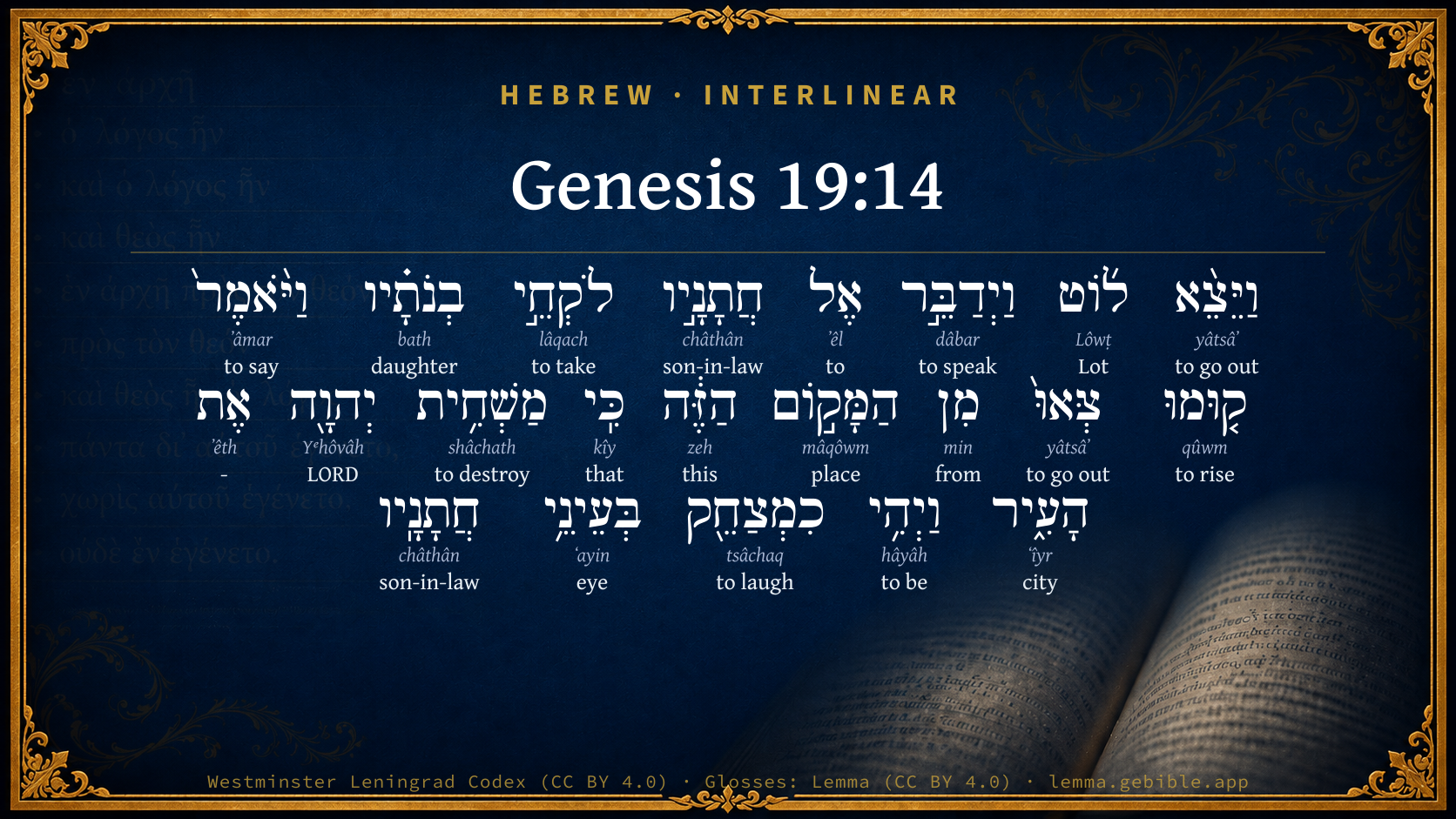
Hebrew (Westminster Leningrad Codex) Genesis 19:14 appears in the Hebrew Old Testament. The text above is from the Westminster Leningrad Codex. Each word links to its Strong’s number, a concise gloss, and parsing drawn from the Open Scriptures Hebrew Bible morphology. Click any word for its full Brown-Driver-Briggs (BDB) entry.
Download image
Cite this verse

Genesis 19:14 (World English Bible). Public Domain. Lemma interlinear Bible study tool, https://lemma.gebible.app/v/genesis/19/14.

Show BibTeX & RIS
BibTeX
RIS
English Translation
Lot went out, and spoke to his sons-in-law, who were pledged to marry his daughters, and said, "Get up! Get out of this place, for Yahweh will destroy the city." But he seemed to his sons-in-law to be joking.
World English Bible · Public Domain
Download a study sheet

One document with this verse’s original text, its word-by-word gloss line, the meaning frame, cross-references with their text, attributed commentary, and full source and license credits — printable, and it pastes into notes with its structure intact.

This verse Autodidact and up

Study sheet (.html) Plain text (.txt)

A passage Seminary Student

Up to 50 verses in one chapter. A passage sheet keeps up to 6 commentary sources and 12 cross-references per verse, in the order this page ranks them, and says so on the sheet whenever that leaves anything out. Ask for a single verse and you get the Autodidact verse sheet above.

Everything on this page stays free to read, with no account — the sheet is a download of what is already on screen, not access to it.

Want to remove ads? Support Godless Engineer
Compare translations 3

The same verse in 3 English versions, stacked beneath the original-language interlinear above. Click any original word for its lexicon entry.

Each is an independent rendering of the whole verse — the interlinear is not word-aligned to these translations.

Highlighted words mark where these versions differ — a whole-verse word diff, not a word-by-word alignment.

  • World English Bible Public Domain
    Lot went out, and spoke to his sons-in-law, who were pledged to marry his daughters, and said, "Get up! Get out of this place, for Yahweh will destroy the city." But he seemed to his sons-in-law to be joking.
  • King James Version Public Domain
    And Lot went out, and spake unto his sons in law, which married his daughters, and said, Up, get you out of this place; for the LORD will destroy this city. But he seemed as one that mocked unto his sons in law.
  • unfoldingWord Literal Text CC BY-SA 4.0
    Then Lot went out and spoke to his sons-in-law who were to take his daughters, and he said, “Get up, get out of this place, because Yahweh is destroying the city!” But it seemed like he was joking in the eyes of his sons-in-law.

unfoldingWord Literal Text — © unfoldingWord, licensed CC BY-SA 4.0. Word-aligned USFM3 via Door43 (git.door43.org/unfoldingWord/en_ult).

Versions to compare (up to 4)

3 of 4 selected

Show all 18 translations

Every available English version of this verse, each an independent rendering of the whole verse.

  • World English Bible Public Domain
    Lot went out, and spoke to his sons-in-law, who were pledged to marry his daughters, and said, "Get up! Get out of this place, for Yahweh will destroy the city." But he seemed to his sons-in-law to be joking.
  • Berean Standard Bible Public Domain
    So Lot went out and spoke to the sons-in-law who were pledged in marriage to his daughters. “Get up,” he said. “Get out of this place, for the LORD is about to destroy the city!” But his sons-in-law thought he was joking.
  • Majority Standard Bible Public Domain
    So Lot went out and spoke to the sons-in-law who were pledged in marriage to his daughters. “Get up,” he said. “Get out of this place, for the LORD is about to destroy the city!” But his sons-in-law thought he was joking.
  • King James Version Public Domain
    And Lot went out, and spake unto his sons in law, which married his daughters, and said, Up, get you out of this place; for the LORD will destroy this city. But he seemed as one that mocked unto his sons in law.
  • American Standard Version (1901) Public Domain
    And Lot went out, and spake unto his sons-in-law, who married his daughters, and said, Up, get you out of this place; for Jehovah will destroy the city. But he seemed unto his sons-in-law as one that mocked.
  • Revised Version (1885) Public Domain
    And Lot went out, and spake unto his sons in law, which married his daughters, and said, Up, get you out of this place; for the LORD will destroy the city. But he seemed unto his sons in law as one that mocked.
  • Geneva Bible (1599) Public Domain
    Then Lot went out and spake vnto his sonnes in lawe, which maried his daughters, and said, Arise, get you out of this place: for the Lord will destroy the citie: but he seemed to his sonnes in lawe as though he had mocked.
  • Douay-Rheims (1899) Public Domain
    So Lot went out, and spoke to his sons in law that were to have his daughters, and said: Arise: get you out of this place, because the Lord will destroy this city. And he seemed to them to speak as it were in jest.
  • Young's Literal Translation Public Domain
    And Lot goeth out, and speaketh unto his sons-in-law, those taking his daughters, and saith, `Rise, go out from this place, for Jehovah is destroying the city;' and he is as `one' mocking in the eyes of his sons-in-law.
  • Literal Standard Version CC BY-SA 4.0
    And Lot goes out and speaks to his sons-in-law, those taking his daughters, and says, “Rise, go out from this place, for YHWH is destroying the city”; and he is as [one] mocking in the eyes of his sons-in-law.
  • Unlocked Literal Bible CC BY-SA 4.0
    Lot went out and spoke to his sons-in-law, the men who had promised to marry his daughters, and said, “Quick, get out of this place, for Yahweh is about to destroy the city.” But to his sons-in-law he seemed to be joking.
  • unfoldingWord Literal Text CC BY-SA 4.0
    Then Lot went out and spoke to his sons-in-law who were to take his daughters, and he said, “Get up, get out of this place, because Yahweh is destroying the city!” But it seemed like he was joking in the eyes of his sons-in-law.
  • Darby Bible Public Domain
    And Lot went out, and spoke to his sons-in-law, who had married his daughters, and said, Up, go out of this place, for Jehovah will destroy the city. But he was as if he jested, in the sight of his sons-in-law.
  • World Messianic Bible Public Domain
    Lot went out, and spoke to his sons-in-law, who were pledged to marry his daughters, and said, “Get up! Get out of this place, for the LORD will destroy the city!” But he seemed to his sons-in-law to be joking.
  • Webster's Bible Public Domain
    And Lot went out and spoke to his sons-in-law, who married his daughters, and said, Arise, depart from this place; for the LORD will destroy this city: but he seemed to his sons-in-law as one that mocked.
  • Free Bible Version CC BY-SA 4.0
    Lot went immediately to speak to the men who were engaged to marry his daughters. “Get up quickly and leave,” he said, “because the Lord is about to destroy the town!” But they thought it was just a joke.
  • Bible in Basic English Public Domain
    And Lot went out and said to his sons-in-law, who were married to his daughters, Come, let us go out of this place, for the Lord is about to send destruction on the town. But his sons-in-law did not take him seriously.
  • JPS Tanakh (1917) Public Domain
    And Lot went out, and spoke unto his sons-in-law, who married his daughters, and said: 'Up, get you out of this place; for the LORD will destroy the city.' But he seemed unto his sons-in-law as one that jested.

Literal Standard Version (2020), Covenant Press — licensed CC BY-SA 4.0. Text via the HelloAO Bible API (eBible.org). Unlocked Literal Bible (unfoldingWord) — licensed CC BY-SA 4.0. Text via the HelloAO Bible API (eBible.org). unfoldingWord Literal Text — © unfoldingWord, licensed CC BY-SA 4.0. Word-aligned USFM3 via Door43 (git.door43.org/unfoldingWord/en_ult). Free Bible Version, Dr. Jonathan Gallagher — licensed CC BY-SA 4.0. Text via the HelloAO Bible API (eBible.org).

Word by word

More ways to search: Search by grammar → Find every occurrence → Compare this word →

Practice this passage: Drill this verse → Learn its vocabulary →

כִמְצַחֵ֖ק
tsâchaq
H6711
“like/as · laughing”
Preposition + Verb, Piel, Participle Active, Masculine, Singular, Absolute
Part of Speech
Preposition + Verb
Stem
Piel
Form
Participle Active
Gender
Masculine
Number
Singular
State
Absolute
Full BDB Definition

Origin: a primitive root

TWOT: 1905

to laugh, mock, play - (Qal) to laugh - (Piel) - to jest - to sport, play, make sport, toy with, make a toy of
  1. וַיֵּצֵ֨א yâtsâʼ H3318 “and · to go out” Conjunction + Verb, Qal, Sequential Imperfect, 3rd Person, Masculine, Singular
  2. ל֜וֹט Lôwṭ H3876 “Lot” Noun, Proper
  3. וַיְדַבֵּ֣ר dâbar H1696 “and · to speak” Conjunction + Verb, Piel, Sequential Imperfect, 3rd Person, Masculine, Singular
  4. אֶל ʼêl H413 “to” Preposition
  5. חֲתָנָ֣יו châthân H2860 “sons-in-law · his” Noun, Common, Masculine, Plural, Construct + Suffix, Personal, 3rd Person, Masculine, Singular
  6. לֹקְחֵ֣י lâqach H3947 “taking” Verb, Qal, Participle Active, Masculine, Plural, Construct
  7. בְנֹתָ֗יו bath H1323 “daughters · his” Noun, Common, Feminine, Plural, Construct + Suffix, Personal, 3rd Person, Masculine, Singular
  8. וַיֹּ֨אמֶר֙ ʼâmar H559 “and · to say” Conjunction + Verb, Qal, Sequential Imperfect, 3rd Person, Masculine, Singular
  9. ק֤וּמוּ qûwm H6965 “rise” Verb, Qal, Imperative, 2nd Person, Masculine, Plural
  10. צְּאוּ֙ yâtsâʼ H3318 “go out” Verb, Qal, Imperative, 2nd Person, Masculine, Plural
  11. מִן min H4480 “from” Preposition
  12. הַמָּק֣וֹם mâqôwm H4725 “the · place” Particle, Definite Article + Noun, Common, Masculine, Singular, Absolute
  13. הַזֶּ֔ה zeh H2088 “the · this” Particle, Definite Article + Pronoun, Demonstrative, Masculine, Singular
  14. כִּֽי kîy H3588 “that” Conjunction
  15. מַשְׁחִ֥ית shâchath H7843 “destroying” Verb, Hiphil, Participle Active, Masculine, Singular, Absolute
  16. יְהוָ֖ה Yᵉhôvâh H3068 “LORD” Noun, Proper
  17. אֶת ʼêth H853 “-” Particle, Direct Object
  18. הָעִ֑יר ʻîyr H5892 “the · city” Particle, Definite Article + Noun, Common, Feminine, Singular, Absolute
  19. וַיְהִ֥י hâyâh H1961 “and · to be” Conjunction + Verb, Qal, Sequential Imperfect, 3rd Person, Masculine, Singular
  20. בְּעֵינֵ֥י ʻayin H5869 “in/at · eyes of” Preposition + Noun, Common, Both, Dual, Construct
  21. חֲתָנָֽיו châthân H2860 “sons-in-law · his” Noun, Common, Masculine, Plural, Construct + Suffix, Personal, 3rd Person, Masculine, Singular

About this verse

These counts appear in no published source. They are computed here, from the morphology-tagged text and Lemma’s own curated glosses. What Lemma adds →

22
words
20
distinct lemmas
Pentateuch
section

Notable vocabulary

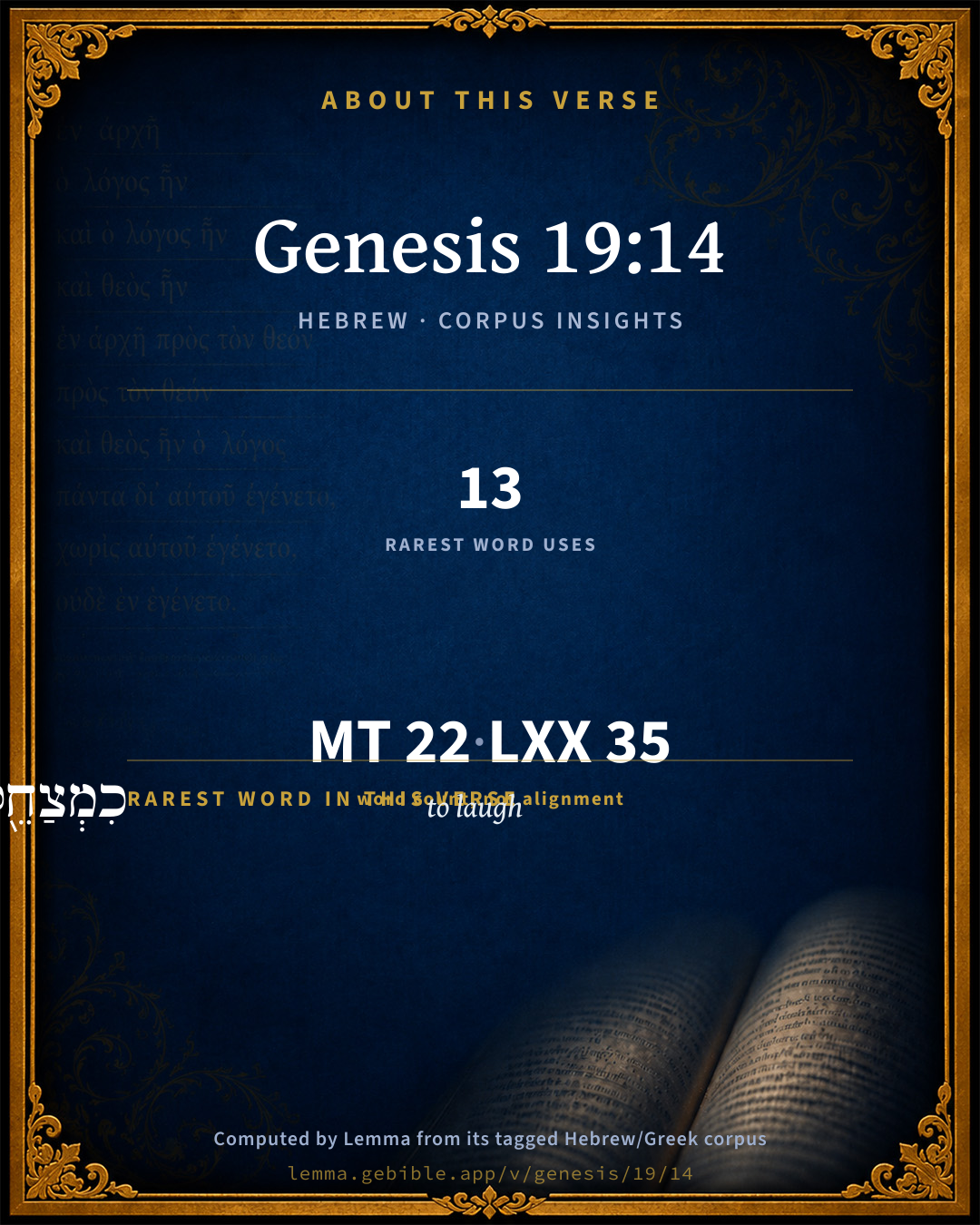
The rarest word here is כִמְצַחֵ֖ק to laugh H6711 — appearing just 13 times in the whole Hebrew Bible.

Shared distinctive vocabulary

כִמְצַחֵ֖ק to laugh H6711 occurs in 12 verses of the Hebrew Bible. Also found in:

Grammatical profile

  • 9 verbs
  • 8 nouns
  • 1 pronoun
  • 2 prepositions
  • 1 conjunction
  • 1 particle

Verb forms

  • וַיֵּצֵ֨א Qal · Sequential Imperfect
  • וַיְדַבֵּ֣ר Piel · Sequential Imperfect
  • לֹקְחֵ֣י Qal · Participle Active
  • וַיֹּ֨אמֶר֙ Qal · Sequential Imperfect
  • ק֤וּמוּ Qal · Imperative
  • צְּאוּ֙ Qal · Imperative
  • מַשְׁחִ֥ית Hiphil · Participle Active
  • וַיְהִ֥י Qal · Sequential Imperfect
  • כִמְצַחֵ֖ק Piel · Participle Active

Repetition

Words recur within this verse — often emphatic in Hebrew:

  • וַיֵּצֵ֨א to go out H3318 ×2
  • חֲתָנָ֣יו son-in-law H2860 ×2

Hebrew & Septuagint length

In English translation the verse runs 39 words from the Hebrew and 43 from the Septuagint (LXX English) — closely comparable.

A rough comparison of the two English renderings, which tokenize alike — not a word-level alignment.

Word counts can differ between the Hebrew and the Greek without any difference in meaning — e.g. the Hebrew direct-object marker אֵת has no separate Greek word, and Greek often adds the article ὁ.

In the original languages it is 22 Hebrew tokens and 35 Greek tokens — but the two are counted differently (Hebrew bundles its prefixes and suffixes into one token; the Greek is in lemma form), so that isn’t a like-for-like length.

Cross-references

23

Topical passages linked to Genesis 19:14 in the Treasury of Scripture Knowledge — connected by theme and wording, ordered by reader-vote popularity; previews shown in the World English Bible.

  • Numbers 16:21 Separate yourselves from among this congregation, that I may consume them in a moment.
  • Numbers 16:26 He spoke to the congregation, saying, Depart, I pray you, from the tents of these wicked men, and touch nothing of theirs, lest you be consumed in all their sins.
  • Jeremiah 51:6 Flee out of the midst of Babylon, and save every man his life; don't be cut off in her iniquity: for it is the time of Yahweh's vengeance; he will render to her a recompense.
  • Numbers 16:45 Get away from among this congregation, that I may consume them in a moment. They fell on their faces.
  • 2 Chronicles 30:10 So the posts passed from city to city through the country of Ephraim and Manasseh, even to Zebulun: but they ridiculed them, and mocked them.
  • Revelation 18:4–8 I heard another voice from heaven, saying, "Come out of her, my people, that you have no participation in her sins, and that you don't receive of her plagues,
  • 2 Chronicles 36:16 but they mocked the messengers of God, and despised his words, and scoffed at his prophets, until the wrath of Yahweh arose against his people, until there was no remedy.
  • Proverbs 29:1 He who is often rebuked and stiffens his neck Will be destroyed suddenly, with no remedy.
  • Isaiah 28:22 Now therefore don't you be scoffers, lest your bonds be made strong; for a decree of destruction have I heard from the Lord, Yahweh of Hosts, on the whole earth.
  • Jeremiah 5:12–14 They have denied Yahweh, and said, It is not he; neither shall evil come on us; neither shall we see sword nor famine:
  • Jeremiah 20:7 Yahweh, you have persuaded me, and I was persuaded; you are stronger than I, and have prevailed: I am become a laughing-stock all the day, every one mocks me.
  • Ezekiel 20:49 Then said I, Ah Lord Yahweh! they say of me, Isn't he a speaker of parables?
  • Matthew 9:24 he said to them, "Make room, because the girl isn't dead, but sleeping." They were ridiculing him.
  • Luke 17:28–30 Likewise, even as it happened in the days of Lot: they ate, they drank, they bought, they sold, they planted, they built;
  • Luke 24:11 These words seemed to them to be nonsense, and they didn't believe them.
  • Genesis 19:17 It came to pass, when they had taken them out, that he said, "Escape for your life! Don't look behind you, neither stay anywhere in the plain. Escape to the mountain, lest you be consumed!"
  • Genesis 19:22 Hurry, escape there, for I can't do anything until you get there." Therefore the name of the city was called Zoar.
  • Exodus 9:21 Whoever didn't regard the word of Yahweh left his servants and his cattle in the field.
  • Exodus 12:31 He called for Moses and Aaron by night, and said, "Rise up, get out from among my people, both you and the children of Israel; and go, serve Yahweh, as you have said!
  • Matthew 1:18 Now the birth of Jesus Christ was like this; for after his mother, Mary, was engaged to Joseph, before they came together, she was found pregnant by the Holy Spirit.
  • Luke 9:42 While he was still coming, the demon threw him down and convulsed him violently. But Jesus rebuked the unclean spirit, and healed the boy, and gave him back to his father.
  • Acts 17:32 Now when they heard of the resurrection of the dead, some mocked; but others said, "We want to hear you again concerning this."
  • 1 Thessalonians 5:3 For when they are saying, "Peace and safety," then sudden destruction will come on them, like birth pains on a pregnant woman; and they will in no way escape.

Cross-references courtesy of OpenBible.info (CC BY 4.0).

Hebrew and Greek witnesses Masoretic Hebrew ↔ Greek Septuagint

The same verse in the two great witnesses to the Old Testament, shown verse-for-verse.

These are two independent witnesses, not word-aligned to each other, and the Septuagint is shown in lemma (dictionary) form.

Hebrew Genesis 19:14 Masoretic · Westminster Leningrad Codex

וַיֵּצֵ֨א ל֜וֹט וַיְדַבֵּ֣ר אֶל חֲתָנָ֣יו לֹקְחֵ֣י בְנֹתָ֗יו וַיֹּ֨אמֶר֙ ק֤וּמוּ צְּאוּ֙ מִן הַמָּק֣וֹם הַזֶּ֔ה כִּֽי מַשְׁחִ֥ית יְהוָ֖ה אֶת הָעִ֑יר וַיְהִ֥י כִמְצַחֵ֖ק בְּעֵינֵ֥י חֲתָנָֽיו

Lot went out, and spoke to his sons-in-law, who were pledged to marry his daughters, and said, "Get up! Get out of this place, for Yahweh will destroy the city." But he seemed to his sons-in-law to be joking.

World English Bible · Public Domain

Greek LXX Genesis 19:14 Septuagint · lemma form

ἐκἔρχομαι δέ λωτ καί λαλέω πρός ὁ γαμβρός αὐτός ὁ λαμβάνω ὁ θυγάτηρ αὐτός καί εἶπον ἀναἵστημι καί ἐκἔρχομαι ἐκ ὁ τόπος οὗτος ὅτι ἐκτρίβω κύριος ὁ πόλις δοκέω δέ γελοιάζω ἐναντίον ὁ γαμβρός αὐτός

And Lot went out, and spoke to his sons-in-law who had married his daughters, and said, Rise up, and depart out of this place, for the Lord is about to destroy the city; but he seemed to be speaking absurdly before his sons-in-law.

LXX2012 (modern English Septuagint) · Public Domain

On this verse, The Cambridge Bible for Schools and Colleges discusses the Septuagint’s reading. Read the note in Commentary ↓

Hebrew: Westminster Leningrad Codex (CC BY 4.0). Greek: Septuagint (public domain); English from LXX2012 (modern English Septuagint) (Public Domain). How the Septuagint differs from the Hebrew →

Targum (Aramaic paraphrase)

2

The Targum is the ancient Jewish Aramaic paraphrase of the Hebrew Scriptures — an interpretive translation, not the Hebrew text itself. Onkelos (literal) and Pseudo-Jonathan (expansive) render the Torah, and Jonathan the Prophets. Coverage is partial: where no permissively-licensed English translation exists for a verse, only the Aramaic is shown. This is verse-level text, not a word-by-word alignment to the Hebrew.

  1. Targum Onkelos Torah (Genesis–Deuteronomy)
    וּנְפַק לוֹט וּמַלֵּיל עִם חַתְנוֹהִי נָסְבֵי בְנָתֵהּ וְאֲמַר קוּמוּ פּוּקוּ מִן אַתְרָא הָדֵין אֲרֵי מְחַבֵּל יְיָ יָת קַרְתָּא וַהֲוָה כִּמְחָיִךְ בְּעֵינֵי חַתְנוֹהִי

    (no public-domain English translation for this verse)

    Targum Onkelos — Aramaic: “Onkelos Genesis” (public domain); “Onkelos Exodus” (public domain); “Onkelos Leviticus” (public domain); “Onkelos Numbers” (public domain); “Onkelos Deuteronomy” (public domain). English: “Sefaria Community Translation” (CC0 1.0 (public-domain dedication)); “J.W. Etheridge. The Targums of Onkelos and Jonathan Ben Uzziel on the Pentateuch. London: Longmans, Green, 1862” (public domain). Text via Sefaria.

  2. Targum Pseudo-Jonathan Torah (Genesis–Deuteronomy)
    וּנְפַק לוֹט וּמַלֵיל עִם חַתְנוֹי דִנְסִיבוּ בְּרַתּוֹי וַאֲמַר קוּמוּ פּוּקוּ מִן אַתְרָא הָדֵין אֲרוּם מְחַבֵּל יְיָ יַת קַרְתָּא וַהֲוָה פִּתְגָמָא כְּתִימְהָא כִּגְבַר מְגַחֵיךְ בְּעֵינֵי חַתְנוֹי

    And Lot went forth, and spake with his sons-in-law who had taken his daughters, and said, Arise, come forth from this place; for the Lord destroyeth the city. But the word was as a wonder, (and he) as a man ranting, in the eyes of his sons-in-law.

    Targum Pseudo-Jonathan — Aramaic: “Targum Jonathan on Genesis” (public domain); “Targum Jonathan on Exodus” (public domain); “Targum Jonathan on Leviticus” (public domain); “Targum Jonathan on Numbers” (public domain); “Targum Jonathan on Deuteronomy” (public domain). English: “The Targum of Jonathan ben Uzziel, trans. J. W. Etheridge, London, 1862” (public domain). Text via Sefaria.

Commentary

Notes on Genesis 19:14 from classic Christian and Jewish commentators (each source and its license shown beneath its notes). The classic Christian expositions comment on the surrounding passage and are grouped to its opening verse, so a note may address several verses; the Jewish commentaries on the Tanakh (Rashi and others) are per-verse, so they appear only where the commentator wrote on this verse.

Lemma curates 59 commentaries, every one of them public domain or Creative Commons licensed, each selected and text-cleaned for this edition rather than reprinted as found. About our sources →

Trapp's Complete Commentary

John Trapp

Gen 19:14 And Lot went out, and spake unto his sons in law, which married his daughters, and said, Up, get you out of this place; for the LORD will destroy this city. But he seemed as one that mocked unto his sons in law.

Ver. 14. But he seemed as one that mocked.] Sed fuit habitus tanquam iocabundus . Graceless hearts jeer, when they should fear, and are senseless and secure, as if they were out of the reach of God’s rod, and needed not to fear his wrath. Lot here is counted but a Lob, of his own sons-in-law. {a} Wonder not, if we meet with the same measure.

{a} Ridetur cum suo Iehova: sed risus impiorum est, Sardonius . - Par.

John Trapp, A Commentary or Exposition upon All the Books of the Old and New Testament (1647–1656) — public domain. Text from a community e-Sword module.

The Biblical Illustrator

Joseph S. Exell

Gen_19:14

He seemed as one that mocked unto his sons-in-law

Danger despised

I.

LET US ATTEND TO THE EXHORTATION ADDRESSED BY LOT TO HIS SONS-IN-LAW. THERE IS A CLOSE PARALLEL BETWEEN THEIR SITUATION AND OUR OWN.

1. We are living, like them, amongst wicked men.

2. We are exposed, like them, to Divine judgment.

3. We are plied, like them, with overtures of mercy.

II. LET US ATTEND TO THE MANNER IN WHICH THE SONS-IN-LAW OF LOT RECEIVED HIS EXHORTATION. THERE IS A CLOSE PARALLEL BETWEEN THEIR CONDUCT AND THAT OF MANY OF OURSELVES.

1. Like them, we reject as mockery the demonstration of our danger.

2. Like them, we reject as mockery the offer of a method of escape.

3. Like them, we reject as mockery all earnestness in pressing on our attention the means of deliverance.

III. LET US ATTEND TO THE CONSEQUENCES OF THE MANNER IN WHICH THE SONS-IN-LAW OF LOT RECEIVED HIS EXHORTATION. THERE IS A CLOSE PARALLEL BETWEEN THEIR DOOM AND OURS IF WE DIE IN A STATE OF UNBELIEF. Here we may appeal--

1. To the declarations of the Almighty.

2. To the facts of history. The old world. The cities of the plain.

3. To the dictates of reason.

4. To the attributes of God. His truth and holiness. (G. Brooks.)

Lots message to his sons-in-law: an illustration of the preachers message to the ungodly world

The context strikes several things forcibly on our attention.

1. The incongruity between the material and moral departments of existence in this world. In Sodom we find natural beauty and harmony in conjunction with moral deformity and discord.

2. The amazing power which prayer has with the Governor of the Gen_18:23-33).

3. The existence of a moral government in connection with the conduct of man.

4. The deep interest of angelic intelligences in human history.

I. LOTS MESSAGE TO HIS SONS-IN-LAW WAS ALARMING IN ITS NATURE. The Lord will destroy the city.

1. Their peril was great.

2. Their peril was the result of sin.

3. Their peril was just at hand.

4. Their peril at this moment was unavoidable.

II. HIS MESSAGE TO HIS SONS-IN-LAW WAS FOUNDED ON THE DIVINE AUTHORITY.

1. The danger of which the gospel preacher warns the unconverted is not a dream of his own; it is a fact of Divine revelation.

2. The proclamation of this danger to the unconverted is not optional on the preachers part; he is bound by heaven to do it

III. His MESSAGE TO HIS SONS-IN-LAW WAS SCEPTICALLY RECEIVED.

1. The appearance of things remaining unchanged. Since the fathers fell asleep, &c.

2. The force of old associations.

3. A false trust in the mercy of God. (Homilist.)

Disregard of religion and its consequences

Lots sons-in-law were probably void of faith and of the fear of God, minding only the things of this world, and resolved not to leave the possessions and conveniences which they enjoyed in that wicked country. And if so, they might easily frame to themselves objections to their fathers counsel, and a plea for their own conduct. But they learned, when it was too late, that his advice was sober and true.

I. NOTHING IS MORE IMPORTANT AND SERIOUS, AS NOTHING IS MORE CERTAIN, THAN ARE THE TRUTHS WHICH RELIGION PRESENTS TO OUR CONSIDERATION.

II. And yet, secondly, THERE ARE MANY WHO TREAT RELIGION WITH DISDAIN AND DISREGARD. In worldly affairs persons are seen to act usually with attention and earnestness; they made a due use of their reason, and consider what they are about. Thus they act, not only in things of great consequence, relating to their life, their health, their liberty, their fortunes, their family, their honour and credit, but even in slighter matters, to obtain a small profit, or to escape a small inconvenience. Nothing is neglected, nothing is put off to an uncertain day; instruction is attentively received and put in execution. But as to religion, there is not this zeal and activity; it is not carefully weighed, scarcely can it obtain a fair hearing; favourable opportunities are neglected, opportunities which slip away, and are never to be recalled, and everything that should be done is left undone.

III. Let us consider, thirdly, WHENCE PROCEEDS THIS STRANGE INDIFFERENCE AND NEGLECT. It proceeds in a great measure from want of faith, which is an evil more common than is imagined. Some men there are who have received good natural abilities, which they employ to bad purposes. Of these talents God giveth them the use, and the devil teacheth them the application. They argue themselves out of their religion, and then apply themselves to debauch the minds of others, and to treat serious and sacred things with levity, licentiousness, and ridicule. Pernicious books and corrupt conversation spread the contagious disease. (J. Jortin, D. D.)

On the guilt and the consequences of despising the Divine threatenings

I. Let us, in the first place, ATTEND TO THE EXHORTATION ADDRESSED BY LOT TO HIS SONS-IN-LAW. Up; get you out of this place: for the Lord will destroy this city. Consider what was the situation of these men. They dwelt in a city subject to the dominion of sin. They dwelt in a city which, in consequence of its sinfulness, deserved immediate destruction; in a city which, when time and opportunity abundantly sufficient for trial and repentance had been afforded, was devoted to immediate destruction. The Divine mercy still extended to them one respite, one opportunity, one warning more. Such, then, is your situation. Such is the situation of every one who hears the sound of the gospel. Contagion surrounds you; destruction lies before you. You are defiled, miserable, and helpless. Yet still there is a call of mercy; still there is a way to escape. The God whom you have offended places deliverance within your reach. The Son of God becomes man, and gives His life to purchase your salvation.

II. Consider, in the next place, THE MANNER IN WHICH THE SONS-IN-LAW OF LOT RECEIVED HIS AWFUL ADMONITION. He seemed unto them as one that mocked. Their conduct discloses to us their character. They had evidently set their hearts on the worldly advantages which, in their apprehension, attended the place where they resided; and they made little account of its wickedness. In many respects the conduct of a large portion of the world bears at this day a close resemblance to that of the sons-in-laws of Lot, and arises from the same principles. When the great doctrines of the gospel are proposed as comprehending and disclosing the appointed method of salvation; what numbers disregard or despise them! When the holy commandments of God are explained and enforced as indispensably and in every particular binding upon every man, what numbers withhold their assent from the strictness of such interpretations of the Scriptures! When the terrors of the world to come are displayed, when the wrath and vengeance of God are revealed against all ungodliness and unrighteousness of men, what numbers refuse to credit the tremendous truth! The minister of the gospel seemeth unto them as one that mocketh.

III. Consider, in the third place, THE CONSEQUENCES OF TREATING AS AN IDLE TALE, AS THE WORDS OF ONE THAT MOCKETH, THE DECLARATIONS OF ALMIGHTY GOD. They brought ruin upon themselves and their posterity. (T. Gisborne, D. D.)

Lessons

1. Good fathers make haste in midst of dangers to keep their children from destruction, being fore-warned of Gods judgments.

2. Gracious parents are earnest with children to press on counsels for their good and safety.

3. Near relations in the flesh, though wicked, yet are dear unto gracious souls to save them.

4. Faith concerning Gods judgments revealed will put gracious hearts upon hastening others out of them.

5. Places of habitation when they be places of vengeance, as well as of sin, must be abhorred and forsaken by Gods saints.

6. Cities though ever so strong and stately cannot secure sinners from ruin. It and they shall perish.

7. Jehovah is the author of destruction upon places of wickedness, who cannot be resisted.

8. God sends messengers of salvation sometimes to the vilest of men, to Lots sons, &c.

9. God, His messengers, and His messages of vengeance, are all but scorns and derisions to wicked men.

10. Secure scorning of destruction from God is the immediate forerunner of it, as here. (G. Hughes, B. D.)

The last night in Sodom

If you had been in Sodom on that solemn, awful evening you would never have suspected it. There was nothing outwardly to show that terrible scenes were at hand, even at the door. No weird omens were observed that night; no strange sounds disturbed the superstitious. No fiery sword was seen hanging over the city, in token that the sword of the Almightys wrath was at last unsheathed. No signs appeared in the sun as he sank peacefully to rest. The cattle came lowing home from the fields, and the sheep-dogs barked, and the voices of children at play were heard. And then darkness fell; and the chirping of a myriad insects rose on the stillness of the Eastern night; and the stars looked down upon the quiet scene; and the moon shone, for the last time, on the great doomed city. But within Lots dwelling a solemn conference was being held, and Lots heart was heavy and disturbed. Full of sadness was he for the heedless, unrepenting people; full of anxiety for those dear to him in that place. And then he hurried out in the darkness to warn his relatives, and to urge on them immediate flight; and they--how true to life it all is!--laughed at him! They treated the matter as a fine joke, and the more earnest his entreaties, the more boisterous grew their mirth. And so the night wore on, and then the day began to break, and the angels hurried, nay, forced Lot out of the city. But with the morning light the scoffer waxed bolder still. What of thy coward fears of the night, O righteous Lot? he mockingly begins, but the words die away on his lips. Ah! what means this strange, unearthly gloom--this lurid, awful flame, in which earth and heaven seem joined in one? What this terrible sense of suffocation--this scorching, choking downpour? The lightning plays, and the thunder rolls--shock upon shock is felt--shriek rises upon shriek--confusion, horror, uproar! Woe! woe! woe! . . . A few hours later, and a silence still more awful . . . And the sun, as he rides high in the heavens, looks down upon a smoking mass of desolation--And the smoke of the city went up as the smoke of a furnace! (J. B. C. Murphy, B. A.)

Warnings disregarded by sinners

What a chance (which never came again) the sons of Lot missed that evening! But do you know what they said? They said he was an alarmist! The old man is in his dotage, laughed one, and some one has been frightening him. Never heed him, cried another, he is ever thus, croaking about the wickedness of the place, and telling us we are all going to be destroyed. He has been saying it for years--and nothing has ever happened yet! Ah, thats just where it is! Nothing has ever happened yet! And so, when the preacher warns the open sinner of his danger, and urges him to escape from his sin--to escape for his life--he is laughed at, and he is called an alarmist. But every one who has ever tried to press home a truth that has been unwelcome--to warn people of a danger that they would rather believe to be impossible--has been called an Alarmist. Noah was an Alarmist. Lot was an Alarmist. The prophets who foretold the destruction of Jerusalem were Alarmists, and many a one who foresaw and foretold the Indian Mutiny of 1857 was called an Alarmist. And so, at the risk of being called an Alarmist I would take up and echo this cry. Art thou living in a Sodom of wilful sin--a Sodom of uncleanness, or drunkenness, or not?--then Escape for thy life! (J. B. C. Murphy, B. A.)

As one that mocked

Look at Lot going through the streets of Sodom at midnight to warn his sons of the approaching destruction of the city, only to be reviled and mocked by them. Mr. Moody once said that he remembered being in an American city a few years ago, and there came unto the after-meeting an old grey-headed man, who for years had been wandering from God. In early life that old man had walked with God, and had found fellowship with Him; but for a number of years past he had been wandering in the darkness and agony of sin. He (Mr. Moody) said to him, God is very merciful, and He will forgive you, and gave him a number of passages of Scripture, and sat up with him until midnight. About that hour the light broke in upon the old man, and the Lord restored to him the joy of his salvation, and the old man went on his way rejoicing. The next night the old man came into the meeting looking the very picture of despair; he did not think he had ever seen a sadder countenance, and he asked him what his trouble was. The old man replied that he had spent the most wretched day of his life. His family had grown up and lived in that city. He had that day wandered from house to house, and had not seen a child who did not mock him. The old man added that he now realized what he had done; he had taken his children into the world, and could not get them out again.

The Biblical Illustrator, edited by Joseph S. Exell (c. 1880s–1900s) — public domain. Text from a community e-Sword module.

Joseph Benson's Commentary

Gen 19:14. Lot spake to his sons-in-law, &c. — It is likely these sons-in- law had married other daughters of Lot, who were now dead, or who afterward perished in the destruction of the city. Up, get you out of this place — The manner of expression is startling. It was not a time to trifle, when the destruction was just at the door. But he seemed to them as one that mocked — They thought perhaps that the assault which the Sodomites had just now made upon his house had disturbed his head, and put him into such a fright that he knew not what he said. They that made a jest of every thing made a jest of that, and so perished in the overthrow. Thus many, who are warned of the danger they are in by sin, make a light matter of it; such will perish with their blood upon their heads.

Joseph Benson's Commentary on the Old and New Testaments (1811–1818) — public domain. Text from a community e-Sword module.

Tyndale Open Study Notes

Tyndale Open Resources

19:14 Lot’s warning words were not taken seriously because of his hypocrisy. It seemed that there would not be even ten righteous people in the city.

Tyndale Open Study Notes — © Tyndale Open Resources, licensed CC BY-SA 4.0. Text via the HelloAO Bible API.

Geneva Bible (1599)

Geneva Bible translators

Or, should marry.

Geneva Bible (1599) marginal notes — public domain. Text via Bolls.life.

John Calvin's Commentaries

14. And Lot went out. The faith of the holy man, Lot, appeared first in this, that he was completely awed and humbled at the threatening of God; secondly, that in the midst of destruction, he yet laid hold of the salvation promised to him. In inviting his sons-in-law to join him, he manifests such diligence as becomes the sons of God; who ought to labor, by all means, to rescue their own families from destruction. But when Moses says, ‘he appeared as one who mocked;’ the meaning is, that the pious old man was despised and derided and that what he said was accounted a fable; because his sons-in-law supposed him to be seized with delirium, and to be vainly framing imaginary dangers. Lot, therefore, did not seem to them to mock purposely or to have come for the sake of trifling with them; but they deemed his language fabulous; because, where there is no religion, and no fear of God, whatever is said concerning the punishment of the wicked, vanishes as a vain and illusory thing. And hence we perceive how fatal an evil security is, which son inebriates, yea, fascinates, the minds of the wicked, that they no longer think God sits as Judge in heaven; and thus they stupidly sleep in sin, till, while they’re saying, Peace and safety, they are overwhelmed in sudden ruin. And especially, the nearer the vengeance of God approaches, the more does their obstinacy increase and become desperate. There is nothing more full of fear, and even of terror, than wicked men are, when the hand of God presses closely on them; but until, constrained by force, they perceive their destruction to be imminent, they either reject all threats with proud scorn, or contemptuously pass them by. But their indolence ought to awaken us to the fear of God, so that we may be always careful; but more especially when some token of the wrath of God presents itself before us.

John Calvin's Commentaries (1540-1563) — public domain. Text from the Calvin Translation Society English edition (1840s-50s) via the Christian Classics Ethereal Library (ccel.org). Calvin's coverage is partial (roughly two-thirds of the Bible); uncommented books and verses are honest gaps, never fabricated. The 19th-century editor's footnotes and remarks are omitted so the notes are faithfully Calvin's own voice.

Ellicott's Commentary for English Readers

(14) Which married his daughters.—Heb., the takers of his daughters—a present participle, for which reason Ewald, Tuch, and others translate “who were to marry his daughters.” The traditional view is that given in our Version, and is confirmed by Gen_19:15, where the words—“thy two daughters which are here,” Heb., which are found—certainly suggest the idea that Lot had other daughters, besides the two which escaped with him.

As one that mocked.—Heb., as one that was laughing, or joking, and so not in earnest.

A Bible Commentary for English Readers, edited by Charles John Ellicott (1878–1897) — public domain. Text from a community e-Sword module.

The Cambridge Bible for Schools and Colleges

gen. ed. J. J. S. Perowne

14. married his daughters] Better, as R.V. marg., were to marry, as Lat. qui accepturi erant. This seems more probable than the rendering of the R.V., and LXX τοὺς εἰληφότας. The verb used here means literally “the takers of.” For Lot’s daughters were in the house with him: Lot went out to find his “sons in law”: the word “sons in law” may mean “the betrothed.” If the daughters had been married, they would not have been living with Lot.

as one that mocked] The same word in the Hebrew as that rendered “laughed” in Gen_18:12, and “sporting” in Gen_26:8. The Lat. has quasi ludens = “as one who was playing.”

The Cambridge Bible for Schools and Colleges (gen. ed. J. J. S. Perowne; Cambridge University Press, 1878–1918) — public domain. Text from a community e-Sword module.

John Gill's Exposition

And Lot went out,.... From his house, after the men of Sodom were gone from it, and before the morning, very probably about midnight:

and spake unto his sons in law, which married his daughters: according to Aben Ezra, he had two other daughters that perished in Sodom, which he gathers from Gen 19:15, "which are here", as if he had some elsewhere; and so Jarchi says, he had two daughters married in the city. And the Jewish writers (q) speak of one of them, whose name was Pelothith, married to one of the grandees of Sodom: but it seems rather, that these were the daughters Lot had at home with him; who, according to Josephus (r) were espoused to men in the city, but not yet married; and on account of such espousals, as were usual in the eastern countries, Lot calls them his sons-in-law, as they were intended, and so the words may be rendered, "that were about to take his daughters" (s); to take them for wives, and to their own houses, neither of which they had as yet done; for if these had been daughters of his married, and taken home, he would not only have spoke unto their husbands, but to them also; and would have been still more pressing upon them to arise and make their escape; of which nothing is said, nor of any answer of theirs to him, only of his sons-in-law, as they are called on the above account:

and said, up, get ye out of this place; that is, get up from your beds, anne immediately, and make your escape out of the city:

for the Lord will destroy this city; now, directly, immediately; therefore there is no time to be lost, but at once prepare for your safety:

but he seemed as one that mocked to his sons in law; as one that was in jest, and had a mind to have a little sport with them, to get them out of their beds, and put them into a flight, and then laugh at them.

(q) Pirke Eliezer, c. 25. (r) Antiqu. l. 1. c. 11. sect. 4. (s) "qui brevi fuerant ducturi filias suas", Junius & Tremellius, Piscator; so some in Vatablus & Drusius.

John Gill's Exposition of the Whole Bible (1746–1763) — public domain (CC PDM 1.0). Text via the HelloAO Bible API.

Haydock's Catholic Bible Commentary

Sons-in-law. Perhaps they also were among the crowd, (ver. 4,) and therefore deserved to be abandoned to their incredulity; though, if they would have consented to follow Lot, the angels would have saved them for his sake. --- In jest. So little did they suffer God’s judgments to disturb them!

George Leo Haydock (1774–1849), Haydock's Catholic Family Bible and Commentary, 1859 edition — public domain. Excludes Psalms (Douay-Rheims chapter numbering differs from Protestant) and Deuterocanonical books (Catholic canon only).

Matthew Poole's English Annotations

Which married his daughters; Heb. took, or were taking, or about to take, to wit, either to espouse, or to marry. Compare Gen 6:2; 24:3; 28:6; Deu 7:3. Anciently persons were first espoused, and after some time the marriage was consummated.

Matthew Poole's English Annotations on the Holy Bible (1683–1685) — public domain. Text from a community e-Sword/MySword module.

Whedon's Commentary on the Bible

Daniel D. Whedon

14. Which married his daughters — Hebrews, takers of his daughters. The Vulgate renders, who were about to take his daughters; and hence it has been generally supposed that his daughters were only betrothed, not actually married. The Hebrew expression will, however, allow the meaning of actual marriage, and Gen_19:15 distinguishes the two daughters “which are here,” as if to imply other daughters not present with Lot at the time. No mention is made of sons, except incidentally by the angel, in Gen_19:12, and there by way of question as to whether he had any in the city. No other mention of sons being made, and the fact that he went and alarmed his sons-in-law, argues rather that he had no sons.

Seemed as one that mocked — This is usually explained as meaning, he seemed to them to be jesting, or trifling. But this verb, in the Piel form, is everywhere used of lascivious sports, or carnal intercourse. His sons-in-law, familiar with the lewd practices so common in the streets of Sodom, supposed Lot was out indulging lascivious passions. See note on Gen_21:9.

Daniel D. Whedon (gen. ed.), Commentary on the Old and New Testaments (1874–1909) — public domain. Text from a community e-Sword module.

The Pulpit Commentary

And Lot went out (obviously that same evening), and spake unto his sons in law, which married his daughters, literally, those taking his daughters, meaning either those who had taken them (LXX, Targums, Knobel, Delitzsch), or more probably those intending to take them, their affianced husbands (Josephus, Vulgate, Clericus, Rosenm Ewald, Keil, Kalisch) and said, Up, get you out of this place; for the Lord (Jehovah) will destroy this (literally, the) city. But (literally, and) he seemed as one that mocked as one that made laughter; from the same root as the word Isaac. (Gen_17:19; cf. Jud_1:16:25) unto his sons in law.

The Pulpit Commentary (1880–1919), ed. H.D.M. Spence-Jones & Joseph S. Exell — public domain. Text from a community e-Sword module.

John Wesley's Explanatory Notes

Up, get you out this place - The manner of expression is startling. It was not time to trifle, when the destruction was just at the door. But he seemed to them as one that mocked - They thought perhaps that the assault which the Sodomites had just now made upon his house had disturbed his head, and put him into such a fright that be knew not what he said. They that made a jest of every thing, made a jest of that, and so perished in the overthrow. Thus many who are warned of the danger they are in by sin, make a light matter of it; such will perish with their blood upon their heads.

John Wesley, Explanatory Notes Upon the Whole Bible (1754–1765) — public domain. Text via the GEBible commentary corpus.

Scofield Reference Notes

C. I. Scofield

Lot

Lot had utterly lost his testimony. In gaining influence Gen 19:1 he had lost power, even in his own family.

The Scofield Reference Bible (1917 edition), notes by C. I. Scofield — public domain. Text from a community e-Sword module.

unfoldingWord translationNotes

Door43 World Missions Community

Lot went out

"So Lot left the house"

his sons-in-law, the men who had promised to marry his daughters

The phrase "the men who had promised to marry his daughters" explains what "sons-in-law" means here. AT: "the men who were going to marry his daughters" or "his daughters' fiancés" (See: Parallelism)

When the morning dawned

"Just before the sun came up"

Get going

"Go now"

you are not swept away in the punishment of the city

This can be stated in active form. AT: "so Yahweh does not also destroy you when he punishes the people of this city" (See: Active or Passive)

not swept away in the punishment

God destroying the people of the city is spoken of as if a person were sweeping away dust. (See: Metaphor)

of the city

Here "city" stands for the people. (See: Metonymy)

translationWords

Lot

Yahweh

angel

sweep

punish

unfoldingWord translationNotes — © Distant Shores Media and the Door43 World Missions Community, licensed CC BY-SA 4.0. Source: git.door43.org/Door43/en_tn.

Rashi

Rabbi Shlomo Yitzchaki (Rashi)

חתניו SONS- IN-LAW — he had two married daughters in the city (Genesis Rabbah 50:9).

לוקחי בנותיו THOSE WHO WERE MARRYING HIS DAUGHTERS — those to whom his daughters at home were betrothed (Genesis Rabbah 50:9).

Rashi on the Tanakh — English translations: “The Judaica Press complete Tanach with Rashi, translated by A. J. Rosenberg” (CC BY 4.0); “Pentateuch with Rashi's commentary by M. Rosenbaum and A.M. Silbermann, 1929-1934” (public domain); “The Metsudah Tanach series, Lakewood, N.J” (CC BY 4.0); and “The Book of Joshua, Metsudah Publications, 1997” (CC BY 4.0). Text via Sefaria.

Radak

Rabbi David Kimhi (Radak)

ויצא לוט...לקחי בנותיו, they had become the sons-in-law having already betrothed his daughters to them. The Torah does not report that Lot spoke to his daughters, as it was understood that the daughters would concur with their husbands’ decision.

Radak on the Tanakh — English translations: “Sefaria Community Translation” (CC0 1.0 (public-domain dedication)); “Eliyahu Munk, HaChut Hameshulash” (CC BY 4.0); “Rabbi Mike Feuer, Jerusalem Anthology” (CC BY 4.0); and “R. David Kimhi on the first book of Psalms, Translated by R.G. Finch, London, 1919” (public domain). Text via Sefaria.

Lesson kit

Teaching starters — assembled from the data on this page, not authored interpretation. Every prompt links to the verse data it draws on. Edit before teaching.

Genesis, in the Pentateuch, opens this verse with 22 words (20 distinct Hebrew lemmas). Its most distinctive word is tsâchaq (“to laugh”). A historical commentator’s framing appears above. Read the whole chapter for the surrounding context.

Discussion questions

  1. How does “to laugh” (tsâchaq) shape what this verse is saying?
  2. How does Genesis 17:17, which shares the word «to laugh», read alongside this verse?
  3. What does the repetition of “to go out” (2× in this one verse) do in this verse?
  4. These translations render this verse differently; the difference is in the English rendering, not the original. What questions does that raise?
  5. «וַיֵּצֵ֨א» is a Qal Sequential Imperfect verb. How does that grammatical form shape the action described?
  6. Compare how Trapp's Complete Commentary and The Biblical Illustrator read this verse. Where do they agree or differ?

Things to notice

Reading settings

Reading text

Shown beneath each verse's original-language words.

Old Testament
Old Testament edition

Read the OT as the Masoretic Hebrew (MT) or the Greek Septuagint (LXX).

English shown for the Greek Septuagint (in the Hebrew ↔ Greek comparison).

Comparing translations? Open the Compare panel on any verse page to stack up to four side by side.