Genesis 33:15

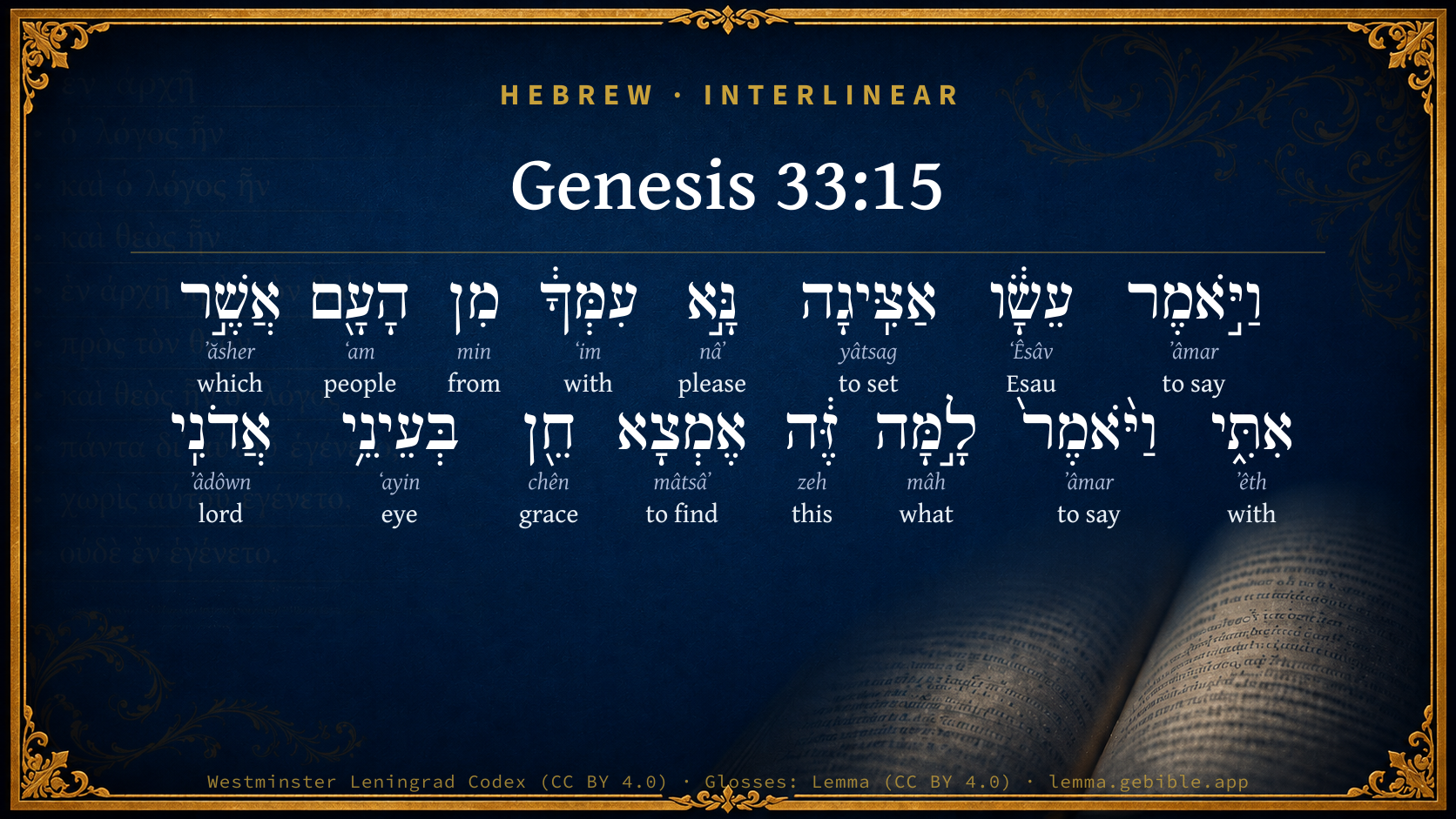
Hebrew (Westminster Leningrad Codex) Genesis 33:15 appears in the Hebrew Old Testament. The text above is from the Westminster Leningrad Codex. Each word links to its Strong’s number, a concise gloss, and parsing drawn from the Open Scriptures Hebrew Bible morphology. Click any word for its full Brown-Driver-Briggs (BDB) entry.
Download image
Cite this verse

Genesis 33:15 (World English Bible). Public Domain. Lemma interlinear Bible study tool, https://lemma.gebible.app/v/genesis/33/15.

Show BibTeX & RIS
BibTeX
RIS
English Translation
Esau said, "Let me now leave with you some of the folk who are with me." He said, "Why? Let me find favor in the sight of my lord."
World English Bible · Public Domain
Download a study sheet

One document with this verse’s original text, its word-by-word gloss line, the meaning frame, cross-references with their text, attributed commentary, and full source and license credits — printable, and it pastes into notes with its structure intact.

This verse Autodidact and up

Study sheet (.html) Plain text (.txt)

A passage Seminary Student

Up to 50 verses in one chapter. A passage sheet keeps up to 6 commentary sources and 12 cross-references per verse, in the order this page ranks them, and says so on the sheet whenever that leaves anything out. Ask for a single verse and you get the Autodidact verse sheet above.

Everything on this page stays free to read, with no account — the sheet is a download of what is already on screen, not access to it.

Want to remove ads? Support Godless Engineer
Compare translations 3

The same verse in 3 English versions, stacked beneath the original-language interlinear above. Click any original word for its lexicon entry.

Each is an independent rendering of the whole verse — the interlinear is not word-aligned to these translations.

Highlighted words mark where these versions differ — a whole-verse word diff, not a word-by-word alignment.

  • World English Bible Public Domain
    Esau said, "Let me now leave with you some of the folk who are with me." He said, "Why? Let me find favor in the sight of my lord."
  • King James Version Public Domain
    And Esau said, Let me now leave with thee some of the folk that are with me. And he said, What needeth it? let me find grace in the sight of my lord.
  • unfoldingWord Literal Text CC BY-SA 4.0
    And Esau said, “Please let me leave with you some of the people who with me.” But he said, “Why that? Let me find favor in the eyes of my lord.”

unfoldingWord Literal Text — © unfoldingWord, licensed CC BY-SA 4.0. Word-aligned USFM3 via Door43 (git.door43.org/unfoldingWord/en_ult).

Versions to compare (up to 4)

3 of 4 selected

Show all 18 translations

Every available English version of this verse, each an independent rendering of the whole verse.

  • World English Bible Public Domain
    Esau said, "Let me now leave with you some of the folk who are with me." He said, "Why? Let me find favor in the sight of my lord."
  • Berean Standard Bible Public Domain
    “Let me leave some of my people with you,” Esau said. But Jacob replied, “Why do that? Let me find favor in the sight of my lord.”
  • Majority Standard Bible Public Domain
    “Let me leave some of my people with you,” Esau said. But Jacob replied, “Why do that? Let me find favor in the sight of my lord.”
  • King James Version Public Domain
    And Esau said, Let me now leave with thee some of the folk that are with me. And he said, What needeth it? let me find grace in the sight of my lord.
  • American Standard Version (1901) Public Domain
    And Esau said, Let me now leave with thee some of the folk that are with me. And he said, What needeth it? let me find favor in the sight of my lord.
  • Revised Version (1885) Public Domain
    And Esau said, Let me now leave with thee some of the folk that are with me. And he said, What needeth it? let me find grace in the sight of my lord.
  • Geneva Bible (1599) Public Domain
    Then Esau said, I will leaue then some of my folke with thee. And he answered, what needeth this? let me finde grace in the sight of my lorde.
  • Douay-Rheims (1899) Public Domain
    Esau answered: I beseech thee, that some of the people at least, who are with me, may stay to accompany thee in the way. And he said: There is no necessity: I want nothing else but only to find favor, my lord, in thy sight.
  • Young's Literal Translation Public Domain
    And Esau saith, `Let me, I pray thee, place with thee some of the people who `are' with me;' and he said, `Why `is' this? I find grace in the eyes of my lord.'
  • Literal Standard Version CC BY-SA 4.0
    And Esau says, “Please let me place with you some of the people who [are] with me”; and he said, “Why [is] this? I find grace in the eyes of my lord.”
  • Unlocked Literal Bible CC BY-SA 4.0
    Esau said, “Let me leave with you some of my men who are with me.” But Jacob said, “Why do that? Let me find favor in the sight of my lord.”
  • unfoldingWord Literal Text CC BY-SA 4.0
    And Esau said, “Please let me leave with you some of the people who with me.” But he said, “Why that? Let me find favor in the eyes of my lord.”
  • Darby Bible Public Domain
    And Esau said, Let me now leave with thee [some] of the people that are with me. And he said, What need? Let me find favour in the eyes of my lord.
  • World Messianic Bible Public Domain
    Esau said, “Let me now leave with you some of the people who are with me.” He said, “Why? Let me find favor in the sight of my lord.”
  • Webster's Bible Public Domain
    And Esau said, Let me now leave with thee some of the people that are with me: And he said, What needeth it? Let me find grace in the sight of my lord.
  • Free Bible Version CC BY-SA 4.0
    “Fine, but let me leave some of my men with you,” said Esau. “You're very kind, but there's no need to do that,” Jacob replied.
  • Bible in Basic English Public Domain
    And Esau said, Then keep some of my men with you. And he said, What need is there for that, if my lord is pleased with me?
  • JPS Tanakh (1917) Public Domain
    And Esau said: 'Let me now leave with thee some of the folk that are with me.' And he said: 'What needeth it? let me find favour in the sight of my lord.'

Literal Standard Version (2020), Covenant Press — licensed CC BY-SA 4.0. Text via the HelloAO Bible API (eBible.org). Unlocked Literal Bible (unfoldingWord) — licensed CC BY-SA 4.0. Text via the HelloAO Bible API (eBible.org). unfoldingWord Literal Text — © unfoldingWord, licensed CC BY-SA 4.0. Word-aligned USFM3 via Door43 (git.door43.org/unfoldingWord/en_ult). Free Bible Version, Dr. Jonathan Gallagher — licensed CC BY-SA 4.0. Text via the HelloAO Bible API (eBible.org).

Word by word

More ways to search: Search by grammar → Find every occurrence → Compare this word →

Practice this passage: Drill this verse → Learn its vocabulary →

אַצִּֽיגָה
yâtsag
H3322
“to set”
Verb, Hiphil, Cohortative, 1st Person, Common, Singular
Part of Speech
Verb
Stem
Hiphil
Form
Cohortative
Person
1st Person
Gender
Common
Number
Singular
Full BDB Definition

Origin: a primitive root

TWOT: 895

to place, set, establish - (Hiphil) - to set, place - to present - to exhibit - (Hophal) to be stopped, be stayed, be detained
  1. וַיֹּ֣אמֶר ʼâmar H559 “and · to say” Conjunction + Verb, Qal, Sequential Imperfect, 3rd Person, Masculine, Singular
  2. עֵשָׂ֔ו ʻÊsâv H6215 “Esau” Noun, Proper
  3. נָּ֣א nâʼ H4994 “please” Particle, Interjection
  4. עִמְּךָ֔ ʻim H5973 “with · you” Preposition + Suffix, Personal, 2nd Person, Masculine, Singular
  5. מִן min H4480 “from” Preposition
  6. הָעָ֖ם ʻam H5971 “the · people” Particle, Definite Article + Noun, Common, Masculine, Singular, Absolute
  7. אֲשֶׁ֣ר ʼăsher H834 “which” Particle, Relative
  8. אִתִּ֑י ʼêth H854 “with · me” Preposition + Suffix, Personal, 1st Person, Common, Singular
  9. וַיֹּ֨אמֶר֙ ʼâmar H559 “and · to say” Conjunction + Verb, Qal, Sequential Imperfect, 3rd Person, Masculine, Singular
  10. לָ֣מָּה mâh H4100 “to/for · what” Preposition + Particle, Interrogative
  11. זֶּ֔ה zeh H2088 “this” Pronoun, Demonstrative, Masculine, Singular
  12. אֶמְצָא mâtsâʼ H4672 “to find” Verb, Qal, Cohortative, 1st Person, Common, Singular
  13. חֵ֖ן chên H2580 “grace” Noun, Common, Masculine, Singular, Absolute
  14. בְּעֵינֵ֥י ʻayin H5869 “in/at · eyes of” Preposition + Noun, Common, Both, Dual, Construct
  15. אֲדֹנִֽי ʼâdôwn H113 “lord · my” Noun, Common, Masculine, Singular, Construct + Suffix, Personal, 1st Person, Common, Singular

About this verse

These counts appear in no published source. They are computed here, from the morphology-tagged text and Lemma’s own curated glosses. What Lemma adds →

16
words
15
distinct lemmas
Pentateuch
section

Notable vocabulary

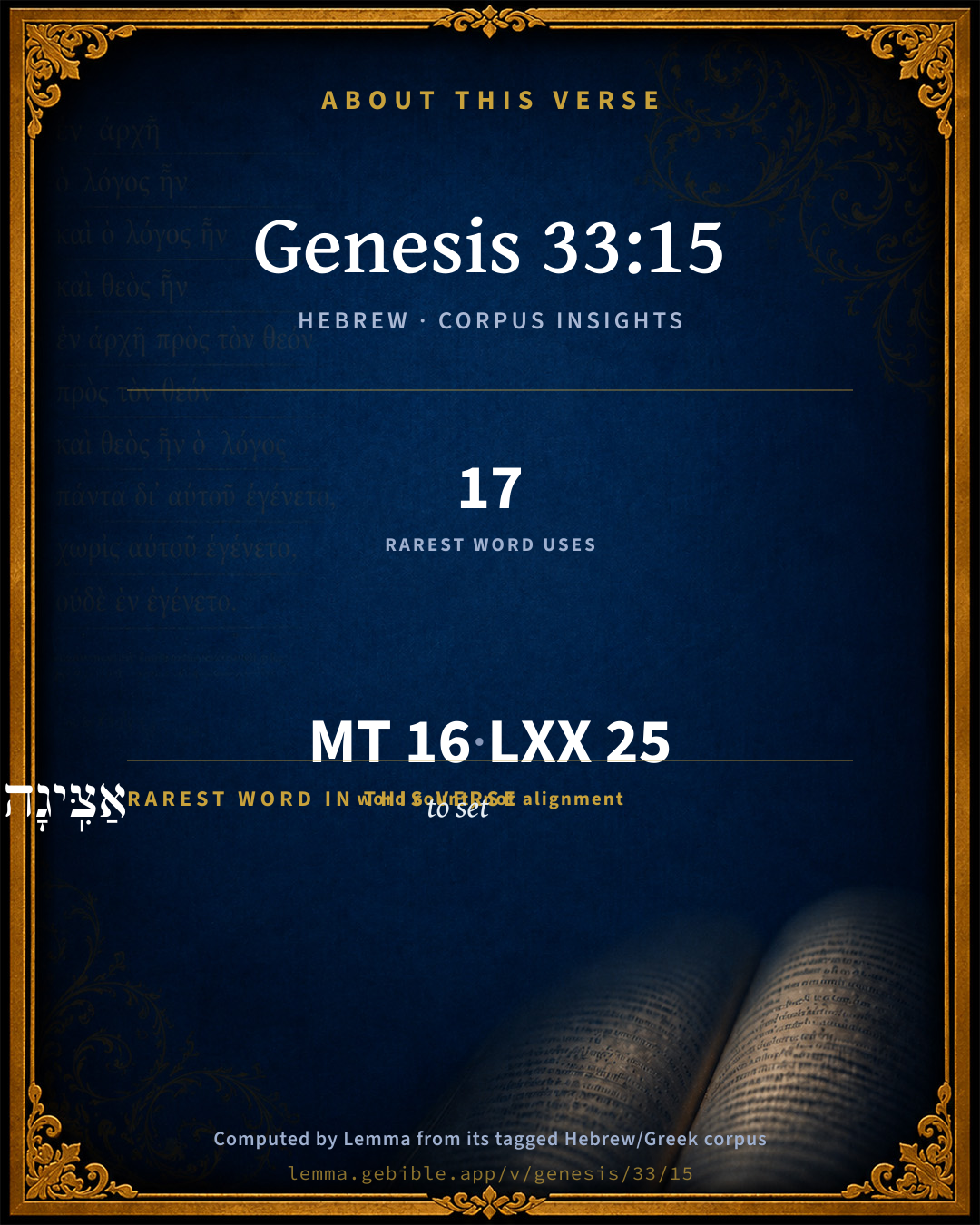
The rarest word here is אַצִּֽיגָה to set H3322 — appearing just 17 times in the whole Hebrew Bible.

Shared distinctive vocabulary

אַצִּֽיגָה to set H3322 occurs in 16 verses of the Hebrew Bible. Also found in:

Grammatical profile

  • 4 verbs
  • 5 nouns
  • 1 pronoun
  • 3 prepositions
  • 3 particles

Verb forms

  • וַיֹּ֣אמֶר Qal · Sequential Imperfect
  • אַצִּֽיגָה Hiphil · Cohortative
  • וַיֹּ֨אמֶר֙ Qal · Sequential Imperfect
  • אֶמְצָא Qal · Cohortative

Repetition

A word recurs within this verse — often emphatic in Hebrew:

  • וַיֹּ֣אמֶר to say H559 ×2

Hebrew & Septuagint length

In English translation the verse runs 29 words from the Hebrew and 33 from the Septuagint (LXX English) — closely comparable.

A rough comparison of the two English renderings, which tokenize alike — not a word-level alignment.

Word counts can differ between the Hebrew and the Greek without any difference in meaning — e.g. the Hebrew direct-object marker אֵת has no separate Greek word, and Greek often adds the article ὁ.

In the original languages it is 16 Hebrew tokens and 25 Greek tokens — but the two are counted differently (Hebrew bundles its prefixes and suffixes into one token; the Greek is in lemma form), so that isn’t a like-for-like length.

Cross-references

5

Topical passages linked to Genesis 33:15 in the Treasury of Scripture Knowledge — connected by theme and wording, ordered by reader-vote popularity; previews shown in the World English Bible.

  • Ruth 2:13 Then she said, Let me find favor in your sight, my lord, because you have comforted me, and because you have spoken kindly to your handmaid, though I am not as one of your handmaidens.
  • Genesis 34:11 Shechem said to her father and to her brothers, "Let me find favor in your eyes, and whatever you will tell me I will give.
  • Genesis 47:25 They said, "You have saved our lives! Let us find favor in the sight of my lord, and we will be Pharaoh's servants."
  • 1 Samuel 25:8 Ask your young men, and they will tell you: therefore let the young men find favor in your eyes; for we come in a good day. Please give whatever comes to your hand, to your servants, and to your son David.
  • 2 Samuel 16:4 Then said the king to Ziba, Behold, all that pertains to Mephibosheth is yours. Ziba said, I do obeisance; let me find favor in your sight, my lord, O king.

Cross-references courtesy of OpenBible.info (CC BY 4.0).

Hebrew and Greek witnesses Masoretic Hebrew ↔ Greek Septuagint

The same verse in the two great witnesses to the Old Testament, shown verse-for-verse.

These are two independent witnesses, not word-aligned to each other, and the Septuagint is shown in lemma (dictionary) form.

Hebrew Genesis 33:15 Masoretic · Westminster Leningrad Codex

וַיֹּ֣אמֶר עֵשָׂ֔ו אַצִּֽיגָה נָּ֣א עִמְּךָ֔ מִן הָעָ֖ם אֲשֶׁ֣ר אִתִּ֑י וַיֹּ֨אמֶר֙ לָ֣מָּה זֶּ֔ה אֶמְצָא חֵ֖ן בְּעֵינֵ֥י אֲדֹנִֽי

Esau said, "Let me now leave with you some of the folk who are with me." He said, "Why? Let me find favor in the sight of my lord."

World English Bible · Public Domain

Greek LXX Genesis 33:15 Septuagint · lemma form

εἶπον δέ ησαυ καταλείπω μετά σύ ἀπό ὁ λαός ὁ μετά ἐγώ ὁ δέ εἶπον ἵνα τίς οὗτος ἱκανός ὅτι εὑρίσκω χάρις ἐναντίον σύ κύριος

And Esau said, I will leave with you some of the people who are with me. And he said, Why so? it is enough that I have found favor before you, my lord.

LXX2012 (modern English Septuagint) · Public Domain

On this verse, The Pulpit Commentary discusses the Septuagint’s reading. Read the note in Commentary ↓

Hebrew: Westminster Leningrad Codex (CC BY 4.0). Greek: Septuagint (public domain); English from LXX2012 (modern English Septuagint) (Public Domain). How the Septuagint differs from the Hebrew →

Targum (Aramaic paraphrase)

2

The Targum is the ancient Jewish Aramaic paraphrase of the Hebrew Scriptures — an interpretive translation, not the Hebrew text itself. Onkelos (literal) and Pseudo-Jonathan (expansive) render the Torah, and Jonathan the Prophets. Coverage is partial: where no permissively-licensed English translation exists for a verse, only the Aramaic is shown. This is verse-level text, not a word-by-word alignment to the Hebrew.

  1. Targum Onkelos Torah (Genesis–Deuteronomy)
    וַאֲמַר עֵשָׂו אֶשְׁבּוֹק כְּעַן עִמָּךְ מִן עַמָּא דְּעִמִּי וַאֲמַר לְמָא דְנַן אַשְׁכַּח רַחֲמִין בְּעֵינֵי רִבּוֹנִי

    (no public-domain English translation for this verse)

    Targum Onkelos — Aramaic: “Onkelos Genesis” (public domain); “Onkelos Exodus” (public domain); “Onkelos Leviticus” (public domain); “Onkelos Numbers” (public domain); “Onkelos Deuteronomy” (public domain). English: “Sefaria Community Translation” (CC0 1.0 (public-domain dedication)); “J.W. Etheridge. The Targums of Onkelos and Jonathan Ben Uzziel on the Pentateuch. London: Longmans, Green, 1862” (public domain). Text via Sefaria.

  2. Targum Pseudo-Jonathan Torah (Genesis–Deuteronomy)
    וַאֲמַר עֵשָו אֶשְׁבּוֹק כְּדוּן עִמָךְ מִן פּוֹלְמוּסִין דְעִמִי וַאֲמַר לְמָא דְנַן אַשְׁכַּח רַחֲמִין קֳדָם רִבּוֹנִי

    And Esau said, Let me now leave with thee some of the soldiers who are with me. But he said, Why this? Let me find favour before thee, my lord.

    Targum Pseudo-Jonathan — Aramaic: “Targum Jonathan on Genesis” (public domain); “Targum Jonathan on Exodus” (public domain); “Targum Jonathan on Leviticus” (public domain); “Targum Jonathan on Numbers” (public domain); “Targum Jonathan on Deuteronomy” (public domain). English: “The Targum of Jonathan ben Uzziel, trans. J. W. Etheridge, London, 1862” (public domain). Text via Sefaria.

Commentary

Notes on Genesis 33:15 from classic Christian and Jewish commentators (each source and its license shown beneath its notes). The classic Christian expositions comment on the surrounding passage and are grouped to its opening verse, so a note may address several verses; the Jewish commentaries on the Tanakh (Rashi and others) are per-verse, so they appear only where the commentator wrote on this verse.

Lemma curates 59 commentaries, every one of them public domain or Creative Commons licensed, each selected and text-cleaned for this edition rather than reprinted as found. About our sources →

Trapp's Complete Commentary

John Trapp

Gen 33:15 And Esau said, Let me now leave with thee [some] of the folk that [are] with me. And he said, What needeth it? let me find grace in the sight of my lord.

Ver. 15. Let me find grace.] That is, Condescend unto me, and leave none.

John Trapp, A Commentary or Exposition upon All the Books of the Old and New Testament (1647–1656) — public domain. Text from a community e-Sword module.

Joseph Benson's Commentary

Gen 33:15. He said, What needeth it? — Esau having offered some of his men to be his guard and convoy, Jacob humbly refuses his offer. He is under the divine protection, and needs no other. Those are sufficiently guarded who have God for their guard, and are under a convoy of his hosts, as Jacob was. Jacob adds only, Let me find grace in the sight of my lord — Having thy favour, I have all I need, all I desire from thee.

Joseph Benson's Commentary on the Old and New Testaments (1811–1818) — public domain. Text from a community e-Sword module.

The Cambridge Bible for Schools and Colleges

gen. ed. J. J. S. Perowne

15. What needeth it?] i.e. why should you do so? Jacob courteously declines his brother’s offer.

Esau here is withdrawn from the scene. The part which he has played in this chapter is dignified and chivalrous. He forgives and forgets. He has the force at his command, but will not make an unworthy use of it.

The Cambridge Bible for Schools and Colleges (gen. ed. J. J. S. Perowne; Cambridge University Press, 1878–1918) — public domain. Text from a community e-Sword module.

John Gill's Exposition

And Esau said, let me now leave with thee some of the folk that are with me,.... To show him the way, and guard him on the road, and he appear the more honourable when he entered into Seir:

and he said, what needeth it? Jacob saw not the necessity of it; he knew the direct way very probably; he thought himself in no danger, since he was at peace with Esau, and he did not affect the grandeur of an equipage:

let me find grace in the sight of my lord; having his favour and good will, that was enough for him; and among the rest of the favours he received from him, he begged this might be added, that he might be excused retaining any of his retinue with him.

John Gill's Exposition of the Whole Bible (1746–1763) — public domain (CC PDM 1.0). Text via the HelloAO Bible API.

Whedon's Commentary on the Bible

Daniel D. Whedon

15. What needeth it — Hebrews, Why this? Jacob politely declines a body of Esau’s men stationed as a guard around him. Such an arrangement would have only been likely to lead to difficulties which it were altogether better to avoid.

Daniel D. Whedon (gen. ed.), Commentary on the Old and New Testaments (1874–1909) — public domain. Text from a community e-Sword module.

The Pulpit Commentary

And Esau said, Let me now leave (literally, set, or place) with thee (as an escort or guard) some of the folki.e. armed followers (vide ver. 1)that are with me. But of even this proposal Jacob appears to have been apprehensive. And he said, What needeth it! (literally, For what, or wherefore, this?) let me find grace in the sight of my lord meaning either, I am satisfied, since thou art gracious to me (Vatablus), iJkanorin ejnantion sou kurie (LXX); hoc uno tantum indigeo, ut inveniam gratiam in conspectu tuo (Vulgate), or, be gracious to me in this also, and leave none of thy followers (Ainsworth, Patrick), though the two clauses might perhaps be connected thus: "Wherefore do I thus find grace in the eyes of my lord?" (Kalisch).

The Pulpit Commentary (1880–1919), ed. H.D.M. Spence-Jones & Joseph S. Exell — public domain. Text from a community e-Sword module.

John Wesley's Explanatory Notes

Esau offers some of his men to be his guard and convoy; but Jacob humbly refuseth his offer, only desiring he would not take it amiss that he did not accept it. What needs it? He is under the Divine protection. Those are sufficiently guarded that have God for their guard, and are under a convoy of his hosts, as Jacob was. Jacob adds, only let me find grace in the sight of my Lord - Having thy favour I have all I need, all I desire from thee.

John Wesley, Explanatory Notes Upon the Whole Bible (1754–1765) — public domain. Text via the GEBible commentary corpus.

unfoldingWord translationNotes

Door43 World Missions Community

Why do that?

Jacob uses a question to emphasize that Esau does not need to leave men. AT: "Do not do that!" or "You do not need to do that!" (See: Rhetorical Question)

my lord

This is a polite and formal way of referring to Esau. AT: "you, my lord" (See: First, Second, or Third Person)

Succoth

Translators may also add a footnote that says, "The name Succoth means 'shelters.'" (See: How to Translate Names)

built himself a house

It is implied that the house is also for his family. AT: "built a house for himself and his family" (See: Assumed Knowledge and Implicit Information)

for his livestock

"for the animals he looked after"

translationWords

Esau

Jacob

Succoth

refuge

unfoldingWord translationNotes — © Distant Shores Media and the Door43 World Missions Community, licensed CC BY-SA 4.0. Source: git.door43.org/Door43/en_tn.

Rashi

Rabbi Shlomo Yitzchaki (Rashi)

ויאמר למה זה means AND HE SAID, WHY IS IT— that thou shouldst do me a favour which I do not need?”

אמצא חן בעיני אדני LET ME FIND FAVOUR IN THE EYES OF MY LORD and do not give me any recompense at present for the gifts I have made you.

Rashi on the Tanakh — English translations: “The Judaica Press complete Tanach with Rashi, translated by A. J. Rosenberg” (CC BY 4.0); “Pentateuch with Rashi's commentary by M. Rosenbaum and A.M. Silbermann, 1929-1934” (public domain); “The Metsudah Tanach series, Lakewood, N.J” (CC BY 4.0); and “The Book of Joshua, Metsudah Publications, 1997” (CC BY 4.0). Text via Sefaria.

Ramban (Nachmanides)

Rabbi Moshe ben Nachman (Ramban / Nachmanides)

WHY THIS? LET ME FIND FAVOUR IN THE EYES OF MY LORD. Why this, that you should do me a favor which I do not need? Let me find favour in your eyes, and do not give me any recompense at present [for the gift which I have presented to you]. This is the language of Rashi. Now Jacob’s meaning was that he did not want them and their company at all, the more so since he intended to go another way.Our Rabbis have further seen an advisory aspect in this entire chapter. Thus they have said: “Before embarking on a journey to the Roman ruler, Rabbi Yanai would peruse this section of the Torah, and he never took Romans with him as an escort on the return journey. One time he did not peruse this section and he took Romans with him, and he had not yet reached Acco when he was compelled to sell his travelling cloak for bribery money.” [The significance attached to this chapter] was because of the Rabbinical tradition that this was the section of the exile. Therefore when Rabbi Yanai entered Rome, in the court of the kings of Edom, [on a mission] concerning public matters, he would peruse this section of the Torah in order to follow the advice of the wise patriarch, for it is he that the generations are to see and emulate. Thus he would not accept the company of the Romans as an escort for they draw no man near to them except for their own interest and take liberties with people’s belongings.

Ramban (Nachmanides) on the Tanakh — English translation: “Commentary on the Torah by Ramban (Nachmanides). Translated and annotated by Charles B. Chavel. New York, Shilo Pub. House, 1971-1976” (CC BY 4.0). Text via Sefaria.

Radak

Rabbi David Kimhi (Radak)

ויאמר למה זה אמצא חן בעיני אדוני, this is Yaakov speaking, saying to Esau that he need not bother to honour him so excessively. We find a similar verse in Ruth 2,10 מדוע מצאתי חן בעיניך להכירני, where Ruth expresses her disbelief about the kindly interest taken in her the alien, the widowed stranger, by Boaz.

Radak on the Tanakh — English translations: “Sefaria Community Translation” (CC0 1.0 (public-domain dedication)); “Eliyahu Munk, HaChut Hameshulash” (CC BY 4.0); “Rabbi Mike Feuer, Jerusalem Anthology” (CC BY 4.0); and “R. David Kimhi on the first book of Psalms, Translated by R.G. Finch, London, 1919” (public domain). Text via Sefaria.

Lesson kit

Teaching starters — assembled from the data on this page, not authored interpretation. Every prompt links to the verse data it draws on. Edit before teaching.

Genesis, in the Pentateuch, opens this verse with 16 words (15 distinct Hebrew lemmas). Its most distinctive word is yâtsag (“to set”). A historical commentator’s framing appears above. Read the whole chapter for the surrounding context.

Discussion questions

  1. What does “to set” (yâtsag) contribute to the verse as a whole?
  2. Genesis 30:38 shares the word «to set» with this verse. How do the two illuminate each other?
  3. “to say” occurs 2× in this one verse. What is the effect of the repetition?
  4. These translations render this verse differently; the difference is in the English rendering, not the original. What questions does that raise?
  5. The verb «וַיֹּ֣אמֶר» is Qal Sequential Imperfect. How does its form color the action?
  6. Reading how Trapp's Complete Commentary and Joseph Benson's Commentary read this verse, where do the two commentators agree and where do they part?

Things to notice

Reading settings

Reading text

Shown beneath each verse's original-language words.

Old Testament
Old Testament edition

Read the OT as the Masoretic Hebrew (MT) or the Greek Septuagint (LXX).

English shown for the Greek Septuagint (in the Hebrew ↔ Greek comparison).

Comparing translations? Open the Compare panel on any verse page to stack up to four side by side.