

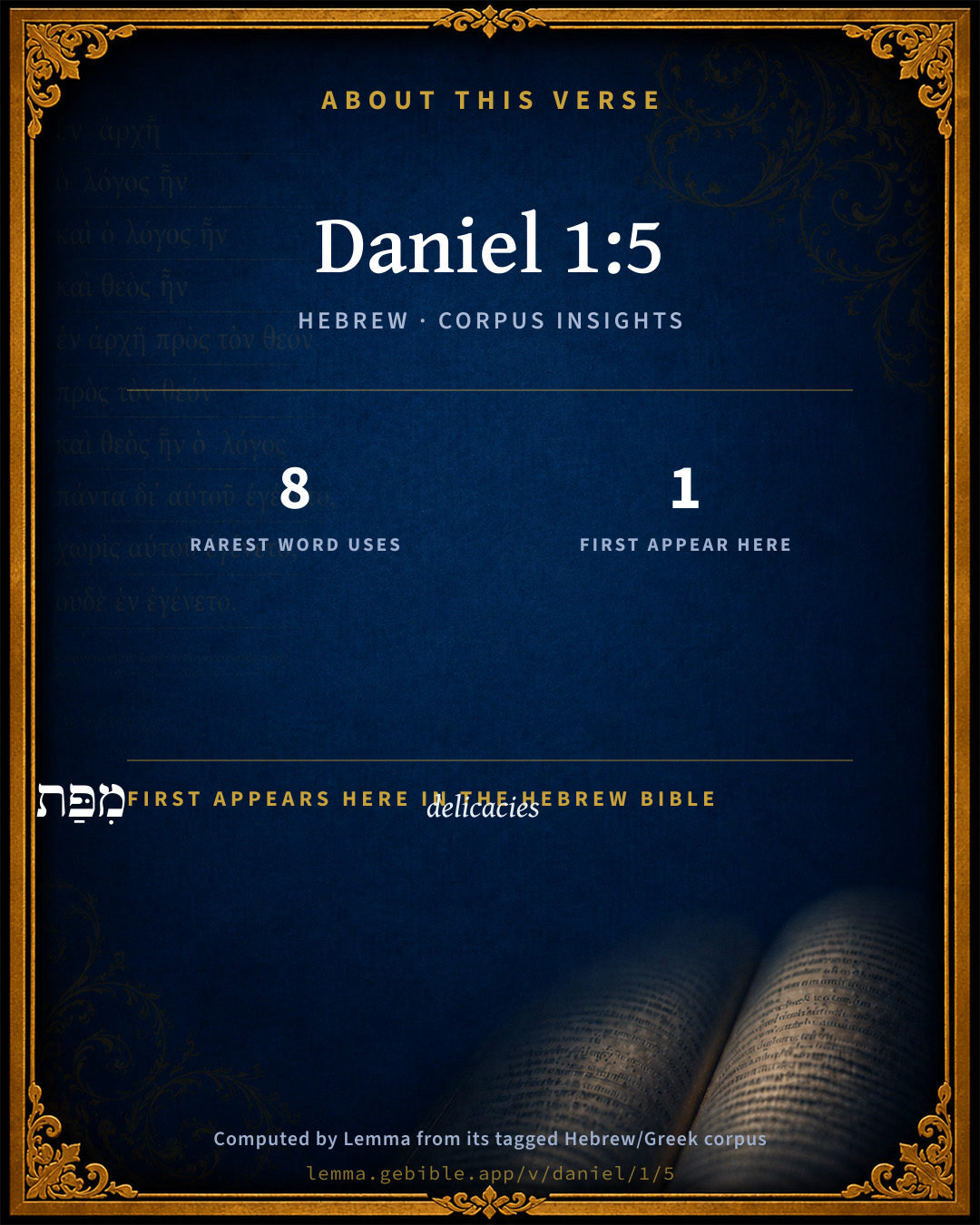
Daniel 1:5

Hebrew (Westminster Leningrad Codex) Daniel 1:5 appears in the Hebrew Old Testament. The text above is from the Westminster Leningrad Codex. Each word links to its Strong’s number, a concise gloss, and parsing drawn from the Open Scriptures Hebrew Bible morphology. Click any word for its full Brown-Driver-Briggs (BDB) entry.
Download image
Cite this verse

Daniel 1:5 (World English Bible). Public Domain. Lemma interlinear Bible study tool, https://lemma.gebible.app/v/daniel/1/5.

Show BibTeX & RIS
BibTeX
RIS
English Translation
The king appointed for them a daily portion of the king's dainties, and of the wine which he drank, and that they should be nourished three years; that at the end of it they should stand before the king.
World English Bible · Public Domain
Highlights
  • 1 first appearance in the Hebrew Bible
Full analysis ↓
Download a study sheet

One document with this verse’s original text, its word-by-word gloss line, the meaning frame, cross-references with their text, attributed commentary, and full source and license credits — printable, and it pastes into notes with its structure intact.

This verse Autodidact and up

Study sheet (.html) Plain text (.txt)

A passage Seminary Student

Up to 50 verses in one chapter. A passage sheet keeps up to 6 commentary sources and 12 cross-references per verse, in the order this page ranks them, and says so on the sheet whenever that leaves anything out. Ask for a single verse and you get the Autodidact verse sheet above.

Everything on this page stays free to read, with no account — the sheet is a download of what is already on screen, not access to it.

Want to remove ads? Support Godless Engineer
Compare translations 3

The same verse in 3 English versions, stacked beneath the original-language interlinear above. Click any original word for its lexicon entry.

Each is an independent rendering of the whole verse — the interlinear is not word-aligned to these translations.

Highlighted words mark where these versions differ — a whole-verse word diff, not a word-by-word alignment.

  • World English Bible Public Domain
    The king appointed for them a daily portion of the king's dainties, and of the wine which he drank, and that they should be nourished three years; that at the end of it they should stand before the king.
  • King James Version Public Domain
    And the king appointed them a daily provision of the king's meat, and of the wine which he drank: so nourishing them three years, that at the end thereof they might stand before the king.
  • unfoldingWord Literal Text CC BY-SA 4.0
    The king assigned them a daily portion of the choice food of the king and of the wine that he drank. They were to be trained for three years, and at the end of which they were to stand before the king.

unfoldingWord Literal Text — © unfoldingWord, licensed CC BY-SA 4.0. Word-aligned USFM3 via Door43 (git.door43.org/unfoldingWord/en_ult).

Versions to compare (up to 4)

3 of 4 selected

Show all 18 translations

Every available English version of this verse, each an independent rendering of the whole verse.

  • World English Bible Public Domain
    The king appointed for them a daily portion of the king's dainties, and of the wine which he drank, and that they should be nourished three years; that at the end of it they should stand before the king.
  • Berean Standard Bible Public Domain
    The king assigned them daily provisions of the royal food and wine. They were to be trained for three years, after which they were to enter the king’s service.
  • Majority Standard Bible Public Domain
    The king assigned them daily provisions of the royal food and wine. They were to be trained for three years, after which they were to enter the king’s service.
  • King James Version Public Domain
    And the king appointed them a daily provision of the king's meat, and of the wine which he drank: so nourishing them three years, that at the end thereof they might stand before the king.
  • American Standard Version (1901) Public Domain
    And the king appointed for them a daily portion of the king's dainties, and of the wine which he drank, and that they should be nourished three years; that at the end thereof they should stand before the king.
  • Revised Version (1885) Public Domain
    And the king appointed for them a daily portion of the king’s meat, and of the wine which he drank, and that they should be nourished three years; that at the end thereof they might stand before the king.
  • Geneva Bible (1599) Public Domain
    And the King appointed them prouision euery day of a portion of the Kings meate, and and of the wine, which he dranke, so nourishing them three yeere, that at the ende thereof, they might stande before the King.
  • Douay-Rheims (1899) Public Domain
    And the king appointed them a daily provision, of his own meat, and of the wine of which he drank himself, that being nourished three years, afterwards they might stand before the king.
  • Young's Literal Translation Public Domain
    And the king doth appoint for them a rate, day by day, of the king's portion of food, and of the wine of his drinking, so as to nourish them three years, that at the end thereof they may stand before the king.
  • Literal Standard Version CC BY-SA 4.0
    And the king appoints for them a rate, day by day, of the king’s portion of food, and of the wine of his drinking, so as to nourish them three years, that at the end thereof they may stand before the king.
  • Unlocked Literal Bible CC BY-SA 4.0
    The king counted out for them a daily portion of his delicacies and some of the wine that he drank. These young men were to be trained for three years, and after that, they would serve the king.
  • unfoldingWord Literal Text CC BY-SA 4.0
    The king assigned them a daily portion of the choice food of the king and of the wine that he drank. They were to be trained for three years, and at the end of which they were to stand before the king.
  • Darby Bible Public Domain
    And the king appointed unto them a daily provision of the king's delicate food, and of the wine that he drank, to nourish them three years, that at the end thereof they might stand before the king.
  • World Messianic Bible Public Domain
    The king appointed for them a daily portion of the king’s delicacies and of the wine which he drank, and that they should be nourished three years, that at its end they should stand before the king.
  • Webster's Bible Public Domain
    And the king appointed them a daily provision of the king's food, and of the wine which he drank: so nourishing them three years, that at the end of them they might stand before the king.
  • Free Bible Version CC BY-SA 4.0
    The king also provided them with a daily allowance of the same kind of rich food and wine he was served. At the end of their three years of education they would enter the king's service.
  • Bible in Basic English Public Domain
    And a regular amount of food and wine every day from the king's table was ordered for them by the king; and they were to be cared for for three years so that at the end of that time they might take their places before the king.
  • JPS Tanakh (1917) Public Domain
    And the king appointed for them a daily portion of the king's food, and of the wine which he drank, and that they should be nourished three years; that at the end thereof they might stand before the king.

Literal Standard Version (2020), Covenant Press — licensed CC BY-SA 4.0. Text via the HelloAO Bible API (eBible.org). Unlocked Literal Bible (unfoldingWord) — licensed CC BY-SA 4.0. Text via the HelloAO Bible API (eBible.org). unfoldingWord Literal Text — © unfoldingWord, licensed CC BY-SA 4.0. Word-aligned USFM3 via Door43 (git.door43.org/unfoldingWord/en_ult). Free Bible Version, Dr. Jonathan Gallagher — licensed CC BY-SA 4.0. Text via the HelloAO Bible API (eBible.org).

Word by word

More ways to search: Search by grammar → Find every occurrence → Compare this word →

Practice this passage: Drill this verse → Learn its vocabulary →

מִפַּת
pathbag
H6598
“from · delicacies of”
Preposition + Noun, Common, Masculine, Singular, Construct
Part of Speech
Preposition + Noun
Type
Common
Gender
Masculine
Number
Singular
State
Construct
Full BDB Definition

Origin: of Persian origin

TWOT: 1851

portion of food for king, delicacies
  1. וַיְמַן֩ mânâh H4487 “and · to count” Conjunction + Verb, Piel, Sequential Imperfect, 3rd Person, Masculine, Singular
  2. הַמֶּ֜לֶךְ melek H4428 “the · king” Particle, Definite Article + Noun, Common, Masculine, Singular, Absolute
  3. דְּבַר dâbâr H1697 “word of” Noun, Common, Masculine, Singular, Construct
  4. י֣וֹם yôwm H3117 “day” Noun, Common, Masculine, Singular, Absolute
  5. בְּיוֹמ֗וֹ yôwm H3117 “in/at · day · his” Preposition + Noun, Common, Masculine, Singular, Construct + Suffix, Personal, 3rd Person, Masculine, Singular
  6. בַּ֤ג pathbag H6598 “delicacies of” Noun, Common, Masculine, Singular, Construct
  7. הַמֶּ֨לֶךְ֙ melek H4428 “the · king” Particle, Definite Article + Noun, Common, Masculine, Singular, Absolute
  8. וּמִיֵּ֣ין yayin H3196 “and · from · wine of” Conjunction + Preposition + Noun, Common, Masculine, Singular, Construct
  9. מִשְׁתָּ֔יו mishteh H4960 “feast · his” Noun, Common, Masculine, Singular, Construct + Suffix, Personal, 3rd Person, Masculine, Singular
  10. וּֽלְגַדְּלָ֖ם gâdal H1431 “and · to grow · them” Conjunction + Preposition + Verb, Piel, Infinitive Construct + Suffix, Personal, 3rd Person, Masculine, Plural
  11. שָׁנִ֣ים shâneh H8141 “years” Noun, Common, Feminine, Plural, Absolute
  12. שָׁל֑וֹשׁ shâlôwsh H7969 “three” Adjective, Cardinal number, Feminine, Singular, Absolute
  13. וּמִ֨קְצָתָ֔ם qᵉtsâth H7117 “and · from · end · their” Conjunction + Preposition + Noun, Common, Feminine, Singular, Construct + Suffix, Personal, 3rd Person, Masculine, Plural
  14. יַֽעַמְד֖וּ ʻâmad H5975 “to stand” Verb, Qal, Imperfect, 3rd Person, Masculine, Plural
  15. לִפְנֵ֥י pânîym H6440 “to/for · face(s) of” Preposition + Noun, Common, Both, Plural, Construct
  16. הַמֶּֽלֶךְ melek H4428 “the · king” Particle, Definite Article + Noun, Common, Masculine, Singular, Absolute

About this verse

These counts appear in no published source. They are computed here, from the morphology-tagged text and Lemma’s own curated glosses. What Lemma adds →

18
words
13
distinct lemmas
Prophets
section

Notable vocabulary

The rarest word here is מִפַּת delicacies H6598 — appearing just 8 times in the whole Hebrew Bible.

First appearance in Scripture

This word makes its first canonical appearance in the Hebrew Bible here:

  • מִפַּת delicacies H6598

Shared distinctive vocabulary

מִפַּת delicacies H6598 occurs in 6 verses of the Hebrew Bible. Also found in:

Grammatical profile

  • 3 verbs
  • 13 nouns
  • 1 adjective
  • 1 preposition

Verb forms

  • וַיְמַן֩ Piel · Sequential Imperfect
  • וּֽלְגַדְּלָ֖ם Piel · Infinitive Construct
  • יַֽעַמְד֖וּ Qal · Imperfect

Repetition

Words recur within this verse — often emphatic in Hebrew:

  • הַמֶּ֜לֶךְ king H4428 ×3
  • י֣וֹם day H3117 ×2
  • מִפַּת delicacies H6598 ×2

Hebrew & Septuagint length

In English translation the verse runs 39 words from the Hebrew and 36 from the Septuagint (LXX English) — closely comparable.

A rough comparison of the two English renderings, which tokenize alike — not a word-level alignment.

Word counts can differ between the Hebrew and the Greek without any difference in meaning — e.g. the Hebrew direct-object marker אֵת has no separate Greek word, and Greek often adds the article ὁ.

Cross-references

13

Topical passages linked to Daniel 1:5 in the Treasury of Scripture Knowledge — connected by theme and wording, ordered by reader-vote popularity; previews shown in the World English Bible.

  • Daniel 1:19 The king talked with them; and among them all was found none like Daniel, Hananiah, Mishael, and Azariah: therefore stood they before the king.
  • 1 Kings 10:8 Happy are your men, happy are these your servants, who stand continually before you, [and] who hear your wisdom.
  • Daniel 1:8 But Daniel purposed in his heart that he would not defile himself with the king's dainties, nor with the wine which he drank: therefore he requested of the prince of the eunuchs that he might not defile himself.
  • Genesis 41:46 Joseph was thirty years old when he stood before Pharaoh king of Egypt. Joseph went out from the presence of Pharaoh, and went throughout all the land of Egypt.
  • 1 Samuel 16:22 Saul sent to Jesse, saying, Please let David stand before me; for he has found favor in my sight.
  • 1 Kings 4:22–23 Solomon's provision for one day was thirty measures of fine flour, and sixty measures of meal,
  • 2 Kings 25:30 and for his allowance, there was a continual allowance given him of the king, every day a portion, all the days of his life.
  • 2 Chronicles 9:7 Happy are your men, and happy are these your servants, who stand continually before you, and hear your wisdom.
  • Jeremiah 15:19 Therefore thus says Yahweh, If you return, then will I bring you again, that you may stand before me; and if you take forth the precious from the vile, you shall be as my mouth: they shall return to you, but you shall not return to them.
  • Matthew 6:11 Give us today our daily bread.
  • Luke 11:3 Give us day by day our daily bread.
  • Luke 21:36 Therefore be watchful all the time, asking that you may be counted worthy to escape all these things that will happen, and to stand before the Son of Man."
  • Luke 1:19 The angel answered him, "I am Gabriel, who stands in the presence of God. I was sent to speak to you, and to bring you this good news.

Cross-references courtesy of OpenBible.info (CC BY 4.0).

Hebrew and Greek witnesses Masoretic Hebrew ↔ Greek Septuagint

The same verse in the two great witnesses to the Old Testament, shown verse-for-verse.

These are two independent witnesses, not word-aligned to each other, and the Septuagint is shown in lemma (dictionary) form.

Hebrew Daniel 1:5 Masoretic · Westminster Leningrad Codex

וַיְמַן֩ לָהֶ֨ם הַמֶּ֜לֶךְ דְּבַר י֣וֹם בְּיוֹמ֗וֹ מִפַּת בַּ֤ג הַמֶּ֨לֶךְ֙ וּמִיֵּ֣ין מִשְׁתָּ֔יו וּֽלְגַדְּלָ֖ם שָׁנִ֣ים שָׁל֑וֹשׁ וּמִ֨קְצָתָ֔ם יַֽעַמְד֖וּ לִפְנֵ֥י הַמֶּֽלֶךְ

The king appointed for them a daily portion of the king's dainties, and of the wine which he drank, and that they should be nourished three years; that at the end of it they should stand before the king.

World English Bible · Public Domain

Greek LXX Daniel 1:5 Septuagint · lemma form

καί δίδωμι αὐτός ἔκθεσις ἐκ ὁ οἶκος ὁ βασιλεύς κατά ἕκαστος ἡμέρα καί ἀπό ὁ βασιλικός τράπεζα καί ἀπό ὁ οἶνος ὅς πίνω ὁ βασιλεύς καί ἐκπαιδεύω αὐτός ἔτος τρεῖς καί ἐκ οὗτος ἵστημι ἔμπροσθεν ὁ βασιλεύς

And the king appointed them a daily portion from the king's table, and from the wine which he drank; and gave orders to nourish them three years, and that afterwards they should stand before the king.

LXX2012 (modern English Septuagint) · Public Domain

On this verse, The Pulpit Commentary discusses the Septuagint’s reading. Read the note in Commentary ↓

Hebrew: Westminster Leningrad Codex (CC BY 4.0). Greek: Septuagint (public domain); English from LXX2012 (modern English Septuagint) (Public Domain). How the Septuagint differs from the Hebrew →

Commentary

Notes on Daniel 1:5 from classic Christian and Jewish commentators (each source and its license shown beneath its notes). The classic Christian expositions comment on the surrounding passage and are grouped to its opening verse, so a note may address several verses; the Jewish commentaries on the Tanakh (Rashi and others) are per-verse, so they appear only where the commentator wrote on this verse.

Lemma curates 59 commentaries, every one of them public domain or Creative Commons licensed, each selected and text-cleaned for this edition rather than reprinted as found. About our sources →

Trapp's Complete Commentary

John Trapp

Dan 1:5 And the king appointed them a daily provision of the king’s meat, and of the wine which he drank: so nourishing them three years, that at the end thereof they might stand before the king.

Ver. 5. And the king appointed them a daily provision.] A competent and comfortable subsistence and maintenance, such as whereof, in time past, those abbey lubbers had too much, and now universities and schools of learning have too little, but far less should have, might some brain-sick sectaries be heard, such as was that Weigelius, who said that in no university in the world was Christ to be found, and that Christ would not have his gospel to be preached by devils, and therefore not by academics, with a great deal more of such paltry stuff, vented by that illiterate widgeon. {a}

So nourishing them three years.] Those that stay overly long in the universities, standing there till they are sour again, and preaching only now and then, to air their great learning, shall have the rust and canker of their abilities to be a swift witness against them at that great day.

{a} Dr Arrowsmith, Orat. Anti-Weigel. ad Calc. Tact. Sacr.

John Trapp, A Commentary or Exposition upon All the Books of the Old and New Testament (1647–1656) — public domain. Text from a community e-Sword module.

Albert Barnes' Notes on the Bible

And the king appointed them - Calvin supposes that this arrangement was resorted to in order to render them effeminate, and, by a course of luxurious living, to induce them gradually to forget their own country, and that with the same view their names were changed. But there is no evidence that this was the object. The purpose was manifestly to train them in the manner in which it was supposed they would be best fitted, in bodily health, in personal beauty, and in intellectual attainments, to appear at court; and it was presumed that the best style of living which the realm furnished would conduce to this end. That the design was not to make them effeminate, is apparent from Dan 1:15.

A daily provision - Hebrew, “The thing of a day in his day;” that is, he assigned to them each day a portion of what had been prepared for the royal meal. It was not a permanent provision, but one which was made each day. The word rendered “provision” - פת path - means a bit, “crumb,” “morsel,” Gen 18:5; Jdg 19:5; Psa 147:17.

Of the king’s meat - The word “meat” here means “food,” as it does uniformly in the Bible, the Old English word having this signification when the translation was made, and not being limited then, as it is now, to animal food. The word in the original - בג bag - is of Persian origin, meaning “food.” The two words are frequently compounded - פתבג pathebag Dan 1:5, Dan 1:8, Dan 1:13, Dan 1:15-16; Dan 11:26; and the compound means delicate food, dainties; literally, food of the father, i. e., the king; or, according to Lorsbach, in Archiv. f. “Morgenl.” Litt. II., 313, food for idols, or the gods; - in either case denoting delicate food; luxurious living. - Gesenius, “Lex.”

And of the wine which he drank - Margin, “of his drink.” Such wine as the king was accustomed to drink. It may be presumed that this was the best kind of wine. From anything that appears, this was furnished to them in abundance; and with the leisure which they had, they could hardly be thrown into stronger temptation to excessive indulgence.

So nourishing them three years - As long as was supposed to be necessary in order to develop their physical beauty and strength, and to make them well acquainted with the language and learning of the Chaldeans. The object was to prepare them to give as much dignity and ornament to the court as possible.

That at the end thereof they might stand before the king - Notes, Dan 1:4. On the arrangements made to bring forward these youths, the editor of the “Pictorial Bible” makes the following remarks, showing the correspondence between these arrangements and what usually occurs in the East: “There is not a single intimation which may not be illustrated from the customs of the Turkish seraglio until some alterations were made in this, as in other matters, by the present sultan (Mahmoud). The pages of the seraglio, and officers of the court, as well as the greater part of the public functionaries and governors of provinces, were originally Christian boys, taken captive in war, or bought or stolen in time of peace. The finest and most capable of these were sent to the palace, and, if accepted, were placed under the charge of the chief of the white eunuchs. The lads did not themselves become eunuchs; which we notice, because it has been erroneously inferred, that Daniel and the other Hebrew youths “must” have been made eunuchs, “because” they were committed to the care of the chief eunuch.

The accepted lads were brought up in the religion of their masters; and there were schools in the palace where they received such complete instruction in Turkish learning and science as it was the lot of few others to obtain. Among their accomplishments we find it mentioned, that the greatest pains were taken to teach them to speak the Turkish language (a foreign one to them) with the greatest purity, as spoken at court. Compare this with “Teach them the learning and tongue of the Chaldeans.” The lads were clothed very neatly, and well, but temperately dieted. They slept in large chambers, where there were rows of beds. Every one slept separately; and between every third or fourth bed lay a white eunuch, who served as a sort of guard, and was bound to keep a careful eye upon the lads near him, and report his observations to his superior. When any of them arrived at a proper age, they were instructed in military exercises, and pains taken to make them active, robust, and brave.

Every one, also, according to the custom of the country, was taught some mechanical or liberal art, to serve him as a resource in adversity. When their education was completed in all its branches, those who had displayed the most capacity and valor were employed about the person of the king, and the rest given to the service of the treasury, and the other offices of the extensive establishment to which they belonged. In due time the more talented or successful young men got promoted to the various high court offices which gave them access to the private apartments of the seraglio, so that they at almost any time could see and speak to their great master. This advantage soon paved the way for their promotion to the government of provinces, and to military commands; and it has often happened that favorite court officers have stepped at once into the post of grand vizier, or chief minister, and other high offices of state, without having previously been abroad in the world as pashas and military commanders. How well this agrees to, and illustrates the usage of the Babylonian court, will clearly appear to the reader without particular indication. See Habesci’s “Ottoman Empire;” Tavernier’s “Relation de l’Interieur du Sérail du Grand Seigneur.”

Albert Barnes' Notes on the Bible (1834–1885) — public domain. Text from a community e-Sword/MySword module.

The Biblical Illustrator

Joseph S. Exell

Dan_1:5

A daily provision of the Kings meat.

The Unnamed Captive Royal Children

1. That we should abstain from the least appearance of evil. Daniel and his three companions, alone of the royal children, refrained from partaking of the meat that probably had been offered to idols. They would avoid the least appearance of evil. They would model their conduct so that, placed as they were in a conspicuous position, their public profession and public acts should be such as were calculated to incite in the hearts of their humbler captive fellow countrymen, a spirit of patriotism and a spirit of reverence. They determined to take their stand at the very outset on the side of the right, instead of on the side of the expedient, and to resist the very first appearance of evil, however plausible and outwardly harmless these appearances may be. The first step in the path of sin or crime, the first wandering from the path of righteousness, must be carefully guarded against, lest, inadvertently and heedlessly, if not wilfully--we do violence to the dictates of our own conscience, or cause in any way a weak brother to offend.

2. That the road to eminence is through the gate of self-denial. Their countenance appeared fairer and fatter in flesh than all the children which did eat the portion of the King s meat. So in religious matters as well as secular, it is eternally true.

3. That it is not what we receive, but what we assimilate, that enriches us. It is not what we eat, but what we digest, that nourishes the body. It is not what we read, but what we apprehend, that strengthens the mind. It is not what we profess but what we believe, that edifies the soul. Spirituality is not composed of doctrinal accuracy, or of ceremonial observances, but of practical Christian morality, and of unsullied Christian faith.

4. That the issues of events are in the hands of God. Through Gods blessing the pulse and water were rendered more powerfully nutritious than the diet provided by the king. Gods ways are not as mans ways.

5. That the education of these royal captives is typical of the course of human life. We are sent into this world as into a training school, by the King of kings, that we may be fitly taught the heavenly knowledge, and the celestial language we need to make us able duly to appreciate the beauties and to join in the hallelujahs of the strange land wherein hereafter we are destined to abide. Our great King, too, of His bounty, gives us each our daily bread for body, mind, and soul, and pours out for us freely the wine from the true vine. This heavenly food some grossly abuse, some foolishly neglect, some ascetically reject, simply from human ignorance or conceit. Asceticism in itself, any more than worldly-mindedness in itself, or sensualism in itself, cannot render anyone fit for the presence of the heavenly King. A proud, a vain, an envious, a jealous, an uncharitable heart may beat as well under the hair shirt of the self-torturing flagellist as under the purple robe of the monarch; and Antony in his dreary cell, and Simon Stylites on his lonely pillar may have been as far from the kingdom of heaven as the sensual Belshazzar at his luxurious banquet, or the worldly-minded Pilate in his tesselated hall. (R. Young.)

Wine wisely avoided

Charles Lamb, who made all the world laugh at his humour, and then afterward made all the world weep at his fate, who outwitted everybody, and was at last outwitted of his own appetites, wrote thus: The waters have gone over me; but out of the depths, could I be heard, I would cry out to all those who have set a foot in the perilous flood. Could the youth to whom the flavour of the first wine is delicious as the opening scenes of his life, or the entering upon some newly-discovered paradise--could he look into my desolation, and be made to understand what a dreary thing it is when a man shall feel himself going down a precipice with open eyes and a passive will; to see his destruction and have no power to stop it, yet feel it all the way emanating from himself; to see all godliness empty out of him, and yet not able to forget the time when it was otherwise; to bear about the piteous spectacle of his own ruin--could he see my feverish eye, feverish with last nights drinking, and feverishly looking for to-nights repetition of that folly--could he but feel the body of the death out of which I cry hourly with feeble outcry to be delivered, it were enough to make him dash the sparkling beverage to the earth in all the pride of its mantling temptation. (T. De Witt Talmage.)

The Early Life of Daniel

In the first instance there was a religious difficulty. Daniel had been brought up in the Mosaic institutions, and therefore he had been trained to abjure all meat that had been offered to idols, and all drink that had been laid on the altar of forbidden gods. He was a religious man from home! He was a man who took the commandments into captivity with him! Alas! there are some of us who can throw off our old selves, and do in Rome as the Romans do with a vengeance. Daniel, driven into captivity, took his religion with him. When we are thrown into difficult circumstances, do we take our religious faith with us? When we go to other countries, do we take the old home training? Do we repeat the commandments as they were thundered from Sinai, and do we re-pronounce the oath we took when we gave ourselves to the Saviour, as He hung upon the cross, and welcomed us to His love, and kingdom, and service? That is a poor religion which can be put off like a garment we are tired of for the time being, and can be put on again to serve occasion. How independent man is who has risen above the point of the merely animal life! Temperance all the world over is independence. Moderation means mastery. There are some men in the world who will not be pampered; Daniel was one of them; his compeers belonged to the same class. In order to hold yourselves masters of your appetites, begin early. It is no use a man of fort-five years of age beginning to say he is going to turn over a new leaf; the leaves wont be turned then. You cannot go anywhere where discipline will be a disadvantage to you, and where the the power of saying no to appetites and tastes will go against you. To the young I am a severe disciplinarian. See how right doing is always willing to be proved. Daniel was willing to take a space of ten days for the proof of the proposition which he submitted to the men who had charge of him and his companions. (J. Parker, D.D.)

Life in Babylon

The opening chapter of the Book of the Prophet Daniel contains the key and clue to all that follows, for it tells us of what stuff that man was made who gives his name to the book. The policy of Nebuchadnezzar must be admitted to have been admirable. He clearly wished to avail himself in the interest of his own kingdom, of the best talent and capability of the kingdom he had conquered. He first of all chose out the best material wad then proceeded (as he hoped) to subject it to the habits and discipline which should naturalise it in its new country. As he had poured the treasure taken from the Temple of the God of Israel into the Temple of his own god, so he hoped to adapt the human treasure he had acquired to the purposes of his religion and its institutions. He thought they might be cured, not only of all homesickness, as ordinarily understood--the wasting regret and longing for Zion, and the God of Zion, but ofthose home ideas and affections which are at the root of all patriotism worthy of the name. And among other means which the sagacity of their royal master devised for the accomplishment of this purpose, was that they should be fed, as well as taught, after a fashion to which they were not born. Nominally, the motive assigned for this special treatment of his prisoners was that they should grow physically strong and well-liking: that they should be well-nourished as befitted the attendants of a court. But can we doubt that the wily king was not regarding only the bodily condition of his pupils, but knew well enough that if he could but once acclimatise them in this respect also--if he could once foster a liking, an appetite for these flesh-pots of Babylon, and make these things, at first luxuries, to become in time necessaries, he would have gained a still closer hold upon the future services of his young counsellors and administrators? And he had no suspicion that the body and the mind, or whatever he held to be the seat and origin of wisdom, needed any separate treatment and regimen. Doubtless he honestly believed that body, soul and spirit would thrive alike, and together, upon this more generous diet. But he little knew the man with whom he was dealing. The young student in the wisdom and learning of the Chaldeans may well have felt the temptations of his novel position, for the brain is not independent of the rest of the animal economy, and the stimulant and support of the Kings meat might have seemed even necessary and allowable to sustain him in the ardent pursuit of this new learning. But he had a past experience to which he could appeal. He had laboured and striven thus far upon simpler fare, and he would make no change. Daniel, the young and wise and spiritual, was in training to be a Prophet of the Most High; and his story shows, only with more detail and circumstance, what we had already gathered from the whole prophetic class before him, that to be a prophet--in that wide sense in which the prophet is a model to the least able and cultivated, the most common-place person among us--the man must be trained upon a food, and in surroundings, which are not those of the reigning influences of the land on which he is to leave his mark The Prophets of Israel and Judah were no doubt exceptional persons--exceptional in the greatness of their intellectual gifts, as well as moral excellencies. The very mention of a prophet suggests to us one set apart from his brethren because of his superior endowments to teach and guide his fellows. But is not the truer representation of the prophet one who, because he has lived and walked with God, and has not lived the life of the world, has grown up in that wisdom and insight which form three parts of the prophetic faculty? Not chosen to be a prophet because of his eloquence and intellectual force, but because the training of his heart and conscience had fitted him to teach, and to influence by example, the men of his day and habitation. It is the prophet, nourished and growing daily in wisdom and in moral power on his homely porridge, that is the precious image and model of the life that is in a fit state and position for hearing the voice and doing the will of God. Not in the occasional pang and spur of total abstinence, but in the daily moderation; not in the excitement of a ceremonial observance, but in the habitual self-discipline, is the condition of daily growth. But I have said that this history is for us an allegory. The kings house and the kings meat have a wide-reaching moral and meaning. The very name of Babylon itself has already, in the vivid imagination of men, been seized upon to express certain modern parallels. The great metropolis was long ago nicknamed the modern Babylon, and in its wealth and splendour, in the height to which the arts and resources of human capacity have been cultivated, the parallel is ingenious and happy. But the parallel has another side to it than that of wealth and the cultivation of the liberal arts. We shall miss altogether the deeper lessons of the story of Daniel, unless we recognise strongly that Babylon, for us, is not a city, or a place at all, but a Spirit, the Spirit of our habitual surroundings. The ideals, the habits, the standards, the hopes and fears, among which we are content to live; the atmosphere of which we are content to breathe; these constitute for us, whether we are young men, just arrived like Daniel from purer, wholesomer surroundings, into the glare and glitter, the luxury and beauty, the stimulating food, and the stimulating culture and ideas, of some new centre of life and action; or whether we are living and travelling elsewhere (for we change our climate but not ourselves, for all the seas we cross), these constitute for us our Babylon. There may be no defined and concrete head and king of this country, no one building that can be called the kings house; no one diet that can be called the kings meat. Yet there is a governing power which we may be living in subjection to, though we do not see anywhere set down its rules and codes. To live in Babylon, and yet to be the true citizen of a far different country; to be in the world, yet not of it; this is for us the translation of Daniels action with regard to the kings meat. The very object and design of supporting him from the kings table was to wean him from the food of his native land. He would live apart, with the nourishment and the associations that were bound up with the service of a very different master; lest in this now world of his exile he should forget the imperial palace whence he came. The resolve of Daniel and his companions was just this: Though we are in the country and the policy and the religion of Nebuchadnezzar, we will not have this man to reign over us. And in order that they might preserve their faith in their own God, they would not live a life that was organically bound up with the god of Nebuchadnezzar. So subtle, so intangible, is this hold over us, this Babylonian sovereignty, that many a man is first awakened to a suspicion that he is in slavery to it, by discovering that his allegiance to another master once prayed to and believed in, is slipping from him. How many a young man coming from afar to live in the Babylon of London, or the Babylon of a University, has come after longer or shorter time to be aware that convictions which he had once hoped never to part with are becoming weaker, without obvious and apparent reason. Before the glitter and the enchantment of Babylon, before the interest and fascination of the new learning of the Chaldeans, the old duties and worships of the faith of his fathers seem to pale their ineffectual fires. Without apparent cause, the arguments for the truth of the old Gospel of Jesus Christ seem less valid than before. Why is this? Why is it so difficult to preserve the faiths and standards of Zion in the streets of Babylon? The answer surely is because it is so difficult for a strength that is merely human, to live in the streets of Babylon and not to imbibe the spirit of Babylon, even though the avowed philosophies and worships of Babylon are not yet by name accepted. So difficult to resist the contagion of its example, its habits, its easy toleration of things evil and debased; so difficult not to ascribe our changed relations to the faith of Christ to the cogent power of anti-religious argument, rather than to the corroding influences of the world, which do their work silently but surely, even as the noble stonework of some city cathedral crumbles beneath the acids of the mere citys breath. There are many Babylons in which it may fall to our lot to take up our abode, and make choice of our lifes gods. There are the Babylons of great cities where boundless wealth and luxury are found, and boundless pleasure for eye and ear and fancy. There are the Babylons of great centres of education, where the god of the country takes a fairer and loftier shape--the god of knowledge:--the Nebo--the god of the learning of the Chaldeans. It is not the grosser idolatries--the rites of Baal and Ashtaroth--that the nobler and better spirits among us have to guard against, but the more specious idolatry of things in themselves justly beautiful and engaging--the ever developing knowledge and culture of a still growing civilisation. Difficult it is--we know it--in any strength of our own to live in Babylon, and not to be of Babylon. So difficult, unless we set ourselves, with the ever-shadowing might of a power not our own, to walk with God. To traverse the common ways of men, and eat temperately of their common meat, and to do the duties and pursue the studies that are the immediate purpose of our being here, and yet to be strengthened by another food that the world knows not of--this is to live as Daniel lived. (Canon Ainger.)

The Saintly Captive

Realising Daniels captivity, we gather three familiar elemental and important lessons:

I. THAT SEVERE TROUBLES BEFALL THE GOOD. All that Daniel had to endure was in strange reversal of what we might have thought the blameless, noble, devout character of a man so well-beloved, deserved or needed. This fact may well be a voice to all of us.

1. Teaching us not to regard the present state of things as final. The social wrongs of this life involve the need of a future life as a justification of a Righteous Governor of the Universe. Daniel was a captive. His coronation is to come.

2. Teaching us not to judge mens character by their circumstances. We may never conclude, because a man is healthy, affluent, famous, that he is, as a cause of all this, unselfish, humble, devout. Nor must we conclude, because a man is wasting with disease, sunk in poverty, obscure amongst even the meanest, that he is therefore false, ungenerous, Christless. You find Daniels among the captives.

3. Teaching us not to be surprised when, notwithstanding our conscious integrity, adversity befalls us. Think it not strange, etc.

II. THAT STRENGTH OF CHARACTER CAN OVERCOME THE EVIL OF CIRCUMSTANCE. He, though a youth in a pagan and profligate court, was not overborne by its evil influences. There seem in him to have been four sources of strength.

1. His incorruptible conscience. This manifested its present vigour, and prophesied its victorious manhood, when, in his youth, it led him to refuse the kings meats. He who has and obeys a robust conscience, is before a contending world as David was before Goliath.

2. His chosen companions. The three Hebrew youths, fellows in misfortune, were evidently also his companions for counsel and prayer. Men are energized for battle with half a world by the true words, the hallowing influence of but two or three choice souls. The friends of the true heroes of history are amongst the most beautiful clusters of human lives.

3. His direct communications from heaven. A dream is from God. Daniels dreams opened another world above him, around him, before him, and under its power he became mighty to do, or to dare, or to bear.

4. His habitual prayers. Some are recorded. It is implied that it was his lifelong custom to pray three times a day. Such devotion clothed him as in asbestos garments that, no temptation could burn.

III. THE ADVERSE EXPERIENCES OF ONE PERIOD OF LIFE QUALIFY FOR RIGHT USE OF A SUCCEEDING PERIOD. The ways in which Daniel was, in his youthful captivity, being prepared for successive stages of his life, were very like the ways in which all may be prepared by any adverse days or years for some usefuller, and it may be happier lot in coming times. Such a life as that of Daniels youth was an apprenticeship for the work of the Statesman, the Dreamer, the man he afterward became. To us this ought to be clearer than to the men of the prophetic age: for have we not read of Jesus, that he was made perfect through suffering. (Homilist)

The Biblical Illustrator, edited by Joseph S. Exell (c. 1880s–1900s) — public domain. Text from a community e-Sword module.

Joseph Benson's Commentary

Dan 1:5. The king appointed them a daily provision of the king’s meat — Such as he had at his own table; wherein his humanity and bounty appeared toward them the more conspicuous, they being captives. So nourishing them, &c. — The Vulgate renders it, Ut enutriti, &c.; that, being nourished three years, they might afterward stand in the presence of the king. It seems from what is here said, that the Chaldeans entertained a notion that a diet of the best sort contributed both to the beauty of the body and the improvement of the mind.

Joseph Benson's Commentary on the Old and New Testaments (1811–1818) — public domain. Text from a community e-Sword module.

Tyndale Open Study Notes

Tyndale Open Resources

1:5 The king attempted to create a bond of dependence, gratitude, and loyalty by giving them food and wine from his own kitchens.

Tyndale Open Study Notes — © Tyndale Open Resources, licensed CC BY-SA 4.0. Text via the HelloAO Bible API.

Ibn Ezra

Rabbi Abraham ibn Ezra

[Daniel 1:5] Vayman (וַיְמַן - And the king allotted): This is a transitive verb (po'al yotze - פֹּעַל יוֹצֵא). And the meaning is: to give them portions/allotments (manot - מָנוֹת). And the meaning of pat-bag (פַּת־בַּג) is provisions/food (ma'achal - מַאֲכָל). And it is written in Scripture [using a related root word]: “And I will give you le-vag (כתיב: לְבַג - written form) / le-vaz (קרי: לְבַז - read form, for plunder)” [Ezekiel 25:7 - referring to the K'tiv/K'ri]. And the meaning [of bag and baz] is close. Perhaps the specific meaning of bag [here in Daniel] is cooked meat.

[Daniel 1:5] U-mi-yein mishtav (וּמִיֵּין מִשְׁתָּיו - And from the wine of his drinkings): And it is not written "and from the wine of his drinking" [using the singular form mishtehu (מִשְׁתֵּהוּ)]. Because there is a specific day [or designated type] for drinking white wine, or red, or wine from a specific known place [implying the plural mishtav refers to the variety of wines the king drank on different occasions or made available].

[Daniel 1:5] Ul’gadlam (וּלְגַדְּלָם - And to educate them): [The purpose was] to accustom them to stand [in service] and to know the protocols/procedures of royalty (mishpetei ha-meluchah - מִשְׁפְּטֵי הַמְּלוּכָה). And this is [related to the requirement that they have] “ability/strength in them” [Daniel 1:4].

[Daniel 1:5] U-mi-ketzatam (וּמִקְצָתָם - And at the end of which): [This word literally means "from their end".] Some say [it refers back to the earlier use of the root ק-צ-ה meaning "some", as in] "some of the youths" [were chosen, like] "some of the vessels of the House of God" [were taken, Daniel 1:2]. And [the construction using mi-ketzeh (מִקְצֵה) meaning "from the end/some of"] as in “from the edge/some of his brothers” [Genesis 47:2] is also relevant grammatically. And it [the word u-mi-ketzatam here] means: at the end of the aforementioned years [i.e., the three years]. And behold, similar to it is [the usage in Daniel 1:15]: “And at the end of (u-mi-ketzat - וּמִקְצָת) ten days...”

Ibn Ezra on the Tanakh — English translations: “Sefaria Community Translation” (CC0 1.0 (public-domain dedication)); “Yalkut, Sifsei Chachomim Chumash, Metsudah Publications, 2009” (CC BY 4.0); and “Commentary of Ibn Ezra on Isaiah - trans. by M. Friedlander, 1873” (public domain). Text via Sefaria.

Geneva Bible (1599)

Geneva Bible translators

As well to serve at the table, as in other offices.

That by their good entertainment they might learn to forget the mediocrity of their own people.

To the intent that in this time they might both learn the manners of the Chaldeans, and also their tongue.

Geneva Bible (1599) marginal notes — public domain. Text via Bolls.life.

Jamieson, Fausset & Brown

Robert Jamieson, A. R. Fausset & David Brown

king's meat--It is usual for an Eastern king to entertain, from the food of his table, many retainers and royal captives (Jer 52:33-34). The Hebrew for "meat" implies delicacies.

stand before the king--as attendant courtiers; not as eunuchs.

Jamieson, Fausset & Brown — Commentary Critical and Explanatory on the Whole Bible (1871) — public domain (CC PDM 1.0). Text via the HelloAO Bible API.

Adam Clarke's Commentary

Verse 5. A daily provision] Athenaeus, lib. iv., c. 10, says: The kings of Persia, (who succeeded the kings of Babylon, on whose empire they had seized,) were accustomed to order the food left at their own tables to be delivered to their courtiers.

So nourishing them three years] This was deemed a sufficient time to acquire the Chaldee language, and the sciences peculiar to that people. I suppose they had good introductory books, able teachers, and a proper method; else they would have been obliged, like us, to send their children seven years to school, and as many to the university, to teach them any tolerable measure of useful and ornamental literature! O how reproachful to the nations of Europe, and particularly to our own, is this backward mode of instruction. And what is generally learned after this vast expense of time and money? A little Latin, Greek, and mathematics; perhaps a little moral philosophy; and by this they are entitled, not qualified, to teach others, and especially to teach the people the important science of salvation! To such shepherds, (and there are many such,) the hungry sheep look up, and are not fed; and if all are not such, no thanks to our plan of national education.

Adam Clarke's Commentary on the Bible (1810–1826) — public domain. Text from a community e-Sword/MySword module.

John Calvin's Commentaries

In this verse, Daniel shews that the king had ordered some youths to be brought to him from Judea, and to be so nourished as to be intoxicated with delicacies, and thus rendered forgetful of their own nation. For we know that wherever there is any cunning in the world, it reigns especially in kings palaces! So Nebuchadnezzar, when he perceived he was dealing with an obstinate people, (and we know the Jews to have been of a hard and unsubdued spirit,) wished to acquire servants spontaneously obedient, aid thus endeavored to soften them with luxuries. This was the reason why he provided for them an allotment of his own meat and drink; as at present it is the greatest honor at princes’ tables to be served with a bon-bouche, as they say. Nebuchadnezzar wished this Daniel and his companions, though but captives and exiles, to be brought up not only splendidly but royally, if of the royal race. Through his right of conquest he, had drawn them away violently from their country, as we said yesterday. Hence he does not act thus from any feeling of liberality, and his feeding those miserable exiles from his own table should not be esteemed a virtuous action; but, as we have said, he cleverly reconciles the minds of the boys to be reckoned Chaldeans rather than Jews, and thus to deny their own race. This, then, was the king’s intention; but we shall see how God governed Daniel and his companions by His Spirit, and how they became aware of these snares of the devil, and abstained from the royal diet, lest they should become polluted by it. This point will hereafter be treated in its place — we are now only commenting on the craftiness of the king. He, commanded a daily portion of diet to be distributed to them, not that the spirit of parsimony dictated this daily portion, but the king wished their food should be exactly the same as his own and that of the chiefs.

He adds, that they should be educated for three years; meaning, until they were thoroughly skilled in both the language and knowledge of the Chaldeans. Three years were sufficient for both these objects, since he had selected youths of sufficient talent to learn with ease both languages and sciences. As they were endued with such capacity, it is not surprising that the space of three years had been prescribed by the king. At length, he says, at the end of them, meaning of the three years. We have shown how this ought not to be referred to the boys, as if the king afterwards selected some of them, for we shall see in its own place that a distinct time was fixed beforehand; hence no long refutation is needed. It is certain, then, that the Prophet speaks of the close of the three years. It had been said just before, that they with stand in the palace; but this ought also to be understood of the time of which mention has been made. They did not stand before the king immediately, but were reserved for this purpose. Since the king commanded them to be brought up for the purpose of using their services afterwards Daniel twice repeats — they were splendidly educated — seeing the king wished them to become his servants at table and in other duties.

John Calvin's Commentaries (1540-1563) — public domain. Text from the Calvin Translation Society English edition (1840s-50s) via the Christian Classics Ethereal Library (ccel.org). Calvin's coverage is partial (roughly two-thirds of the Bible); uncommented books and verses are honest gaps, never fabricated. The 19th-century editor's footnotes and remarks are omitted so the notes are faithfully Calvin's own voice.

Ellicott's Commentary for English Readers

(5) A daily portion.—(Comp. Jer_52:34.) The meat was solid food, as opposed to the wine and vegetables which formed so important a part of Babylonian diet. The food appears to have been sent from the king’s table.

Three years.—The king appears to have had sufficient insight into the extraordinary character of these youths, to enable him to prescribe not only the subjects of their studies, but also the length of their course of instruction. It appears that Nebuchadnezzar was a man of far higher character than many Assyrian and Babylonian kings. We shall see, in the course of the boot, that his heart was fitted for the reception of Divine truth, and that in the end he was brought to know the true God.

A Bible Commentary for English Readers, edited by Charles John Ellicott (1878–1897) — public domain. Text from a community e-Sword module.

The Cambridge Bible for Schools and Colleges

gen. ed. J. J. S. Perowne

5. a daily portion of the king’s delicacies] Superior food, such as was served at the table of the king himself, was to be provided for the selected youths. It was a compliment to send anyone a portion of food from the table of a king or great man (Gen_43:34, in Egypt; 2Sa_11:8, in Israel: 2Ki_25:30, in Babylon, may be similar); and at least in Persia the principal attendants of the king, especially his military ones, seem to have had their provision from the royal table (Plut. Quaest. Conv. VII. iv. 5; Athen. iv. 26, p. 145 e, f.). The word rendered ‘delicacies’ (pathbâg) is a peculiar one, found in the O.T. only in Dan.: it is of Persian origin, and passed (like many other Persian words) into Syriac (Payne Smit[180] Thes. Syr. col. 3086 f.), as well as into late Hebrew. The Persian original would be patibâga, ‘offering,’ ‘tribute’ (from pati, Sanskr. prati, Greek ποτί, προτί, to, and bâg, tribute, Sk. bhâga, portion). The Sansk. pratibhâga actually occurs, and means ‘a share of small articles, as fruit, flowers, &c., paid daily to the Rája for household expenditure[181].’ The Pers. patibâga originally, no doubt, denoted similarly choice food offered to the king[182], though in Heb. and Syriac pathbâg was used more widely of choice food, or delicacies, in general. The word recurs in Dan_1:8; Dan_1:13; Dan_1:15-16, Dan_9:26.

[180] yne Smith R. Payne Smith, Thesaurus Syriacus.

[181] Gildemeister, as quoted by Max Müller, ap. Pusey, p. 565.

[182] Dinon in his Persica, writing c. 340 b.c., says (ap. Athen. xi. 503) that ποτίβαζις (which must be the same word) denoted a repast of cakes and wine, such as was prepared for the kings of Persia (ἔστι δὲ ποτίβαζις ἅρτος κρίθινος καὶ πύρινος ὀπτὸς καὶ κυπαρίσσου στέφανος καὶ οἶνος κεκραμένος ἐν ᾠῷ χρυσῷ οὗ αὐ αὐτὸς βασιλεὺς πίνει).

and that they should be nourished] or brought up: lit. made great: so Isa_1:2; Isa_23:4 al.

stand before the king] as his attendants, to wait upon him: Deu_1:38; 1Ki_10:8; 1Ki_12:8.

The Cambridge Bible for Schools and Colleges (gen. ed. J. J. S. Perowne; Cambridge University Press, 1878–1918) — public domain. Text from a community e-Sword module.

John Gill's Exposition

And the king appointed them a daily provision of the king's meat,.... Every day a portion was ordered them, from the king's table, of the richest dainties he himself ate of; which was done not only as an act of royal munificence and generosity, and in respect of their birth and breeding; but also as a bait and snare to allure and entice them, to make them in love with the country and condition in which they were, and to forget their own; as well also in order to preserve their well favoured look and good complexion, and fit them for their study of language and literature; which might be hindered for want of the necessaries of life, or by living on gross and coarse food:

and of the wine which he drank; which, as it was of various sorts, so of the best and most excellent; and which, moderately drank, conduces to the health of the body, and cheerfulness of the mind; and which are both useful to forward learned studies:

so nourishing them three years; this was the time fixed for their acquiring the learning and language of the Chaldeans; during which they were to be provided for from the king's table, and at his expense, as above; which term of time was judged sufficient for their learning everything necessary to qualify them for the king's service; and in which time it might be thought they would forget their own country, customs, religion, and language, and be inured to the place and persons where they were, and be satisfied and easy with their condition and circumstances:

that at the end thereof they might stand before the king; that is, at the end of three years they might be presented to the king for his examination and approbation, and be appointed to what service he should think fit; and particularly that they might be in his court, and minister to him in what post it should be his pleasure to place them. Some in Aben Ezra, and which he himself inclines to, read and interpret it, "that some of them might stand before the king"; such as he should choose out of them, that were most accomplished and most fit for his service; so Jacchiades.

John Gill's Exposition of the Whole Bible (1746–1763) — public domain (CC PDM 1.0). Text via the HelloAO Bible API.

Haydock's Catholic Bible Commentary

Meat: more exquisite. (De Dieu.) --- All was first served on the king’s table. (Atheneus vi. 14.)

George Leo Haydock (1774–1849), Haydock's Catholic Family Bible and Commentary, 1859 edition — public domain. Excludes Psalms (Douay-Rheims chapter numbering differs from Protestant) and Deuterocanonical books (Catholic canon only).

Matthew Poole's English Annotations

Of the king’s meat; such as he had at his own table, wherein his bounty and humanity appeared towards them the more conspicuous, they being captives. By this preparation they were judged fit to stand before the king. Men of ingenuity and proficiency are fit to stand before kings, Pro 22:29.

Matthew Poole's English Annotations on the Holy Bible (1683–1685) — public domain. Text from a community e-Sword/MySword module.

Whedon's Commentary on the Bible

Daniel D. Whedon

5. Meat — Rather, dainties.

Daniel D. Whedon (gen. ed.), Commentary on the Old and New Testaments (1874–1909) — public domain. Text from a community e-Sword module.

The Pulpit Commentary

And the king appointed them a daily provision of the king"s meat, and of the wine which he drank: so nourishing them three years, that at the end thereof they might stand before the king. The only thing to be noticed in the LXX Version of this verse is the fact that hn; m; is taken to mean "give a portion a meaning which seems to be implied in twOnm; , (Neh_8:10) hence the translation didosqai... ejkqesin. Further, the translator must have had tae me Mj as in 2Ki_25:29. The mysterious gbAtP (path-bag), translated "meat," has caused differences of rendering. The Syriac Peshitta transfers it. Professor Bevan speaks as if it were common in Syriac, but Castell gives no reference beyond Daniel. (Brockei-mann adds, Ephrem Syrus, Isaac Antiochenus, Bar Hebraeus). It is to be observed that the Syriac form of the word has teth, not tan, for the second radical. This is a change that would not likely take place had the Hebrew form been the original, whereas from the fact that path means in Hebrew "a portion," if the Hebrew were derived from the Syriac the change would be intelligible. It is confounded in Dan_11:26 with arWtp ( pathura), "a table." It seems not improbable that both the LXX and Theodotion read pathura. The word path-bag does not seem to have been known in Palestine; it does not occur in Chaldee, but does in Syriac. This is intelligible if the chapter before us is condensation from a Syriac original rendered into Hebrew: the word path-bag, being unintelligible, is transferred. The etymology of the word is alleged to be Persian, hut on this assumption it is a matter of dispute what that etymology is. One derivation is from pad or fad, "father" or "prince," or pat or fat, idol," and bag (fagw), food; another is from pati-bhagu, "a portion." The question is complicated by the fact that in Eze_25:7 we have in the K"tbib gb (bag), meaning "food." In that case path-bag would mean "a portion of food." The reading of the K"thib is not supported by the versions. In Daniel the word simply means "food," such as was supplied to the king"s table. We see in the slabs from the palace of Kou-youn-jik the nature of a royal feast. Animal food predominated. We cannot avoid referring to a singular argumentative axiom implied in all the discussions on Daniel. Critics seem to think that when they prove that certain words in Daniel are Persian, they thus prove Daniel was written nearly a couple of centuries after the Persian domination had disappeared. Of the wine which he drank. It is to be noted that there is a restriction. The wine supplied was the wine which the king drank wine of which an oblation had been offered to idols. In thus bringing up hostages at his own table, Nebuchadnezzar was following a practice which has continued down to our own day. The son of Theodore of Magdala was brought up at the court of our queen. It was the regular practice, as we know, in Imperial Rome. Sennacherib speaks of Belibus, whom he made deputy-king in Babylon, as brought up "as a little dog at his table" (Bellino Cylinder, Sehrader, vol. 2. p. 32, Engl, trans.). So nourishing them three years. This was the period during which the education of a Persian youth was continued. It is probable, as we have seen, that these youths were about sixteen or seventeen. At the end of three years they would still be very young. The grammatical connection of the word legaddelam is somewhat singular. The Septuagint reading probably had the first word in this verse in the infinitive also. This is more grammatical, as it brings the whole under the regimen of the opening clause of ver. 3. The force of the word before us is represented in "bringing up." The verb in its simple form means "to be strong," "to be great," hence in the intensive form before us, "to make great," "to bring up." That at the end thereof they might stand before the king. "Standing before the king" means usually becoming members of the council of the monarch, but in the present instance this does not seem to be the meaning. They were to be presented before the king, and in his presence they were to be examined. They were, then, possibly to be admitted into the college of astrologers and soothsayers, but only in lowly grade. Irrespective of the fact that they would at the latest be twenty or twenty-one when this season of education was over, and, even making all allowance for Eastern precocity, this is too young an age for being a member of a royal privy council. But the next chapter relates an event which appears to be the occasion when they stood before the king, for they were not summoned with the wise men to the king"s presence to interpret his dream.

Vers. 5-21.

Moral heroism.

Daniel purposed in his heart that he would not defile himself" (ver. 8).

I THE VARYING CONDITIONS OF IMMORTALITY. The reference is to subjective immortality, i.e. in the memories of men. The principal stable condition seems to be the possession of soul-power. (see Luk_1:80 Luk_2:40) But this may develop itself:

1. Evilly. The immortality then is one of infamy.

2. Continuously; e.g. Daniel, through a long life.

3. Specially at a crisis. These thoughts are suggested by the little we know of the three Hebrew children. One heroic resolve made them immortal. But how much in their antecedents did that heroism imply? Picture the parental culture of the Jerusalem home, etc. The lesson, Live not for fame; but to do that which God may think worthy of being held in everlasting remembrance.

II THE ELEMENTS OF MORAL HEROISM Describe the offence in the king"s portion.

(1) Food forbidden by the Mosaic Law.

(2) Food consecrated by presentation to idols. In moral heroism there will be one, or some, or all of these constituent elements.

1. Resistance; he. to strong and overwhelming temptation. In this case:

(1) The tempted were away from home.

(2) Early religious associations had been broken down. Note the change of names (ver. 7), and the significance of it.

(3) There was temptation to regard the matter as a trifle, of no account; but great principles are often involved in the trivialities of life.

(4) To regard the circumstances as peculiar.

(5) To be afraid of undue self-assertion. It might have seemed to Daniel that he was about to be righteous over-much.

(6) The heroic act was against their own interests.

(7) And imperilled the lives of others.

1. A certain obscurity of origin. "Purposed in his heart." The resolution took its rise in the depths of the soul, like a river in the hills far away.

2. Fortitude. Daniel thoroughly and irrevocably made up his mind.

3. Gentleness. No mock-heroics with him; but, having made up his mind, combined the suaviter in modo with the fortiter in re. "He requested," etc. (ver. 8).

4. Perseverance. Defeated temporarily with Ashpenaz, Daniel tried Melzar.

5. Wisdom. Proposed only an experiment for ten days.

6. Inspiration. Daniel"s resolve seems to have stirred up the others.

III THE PREVENTIONS OF GOD. (Ver. 9.) When men resolve on the right, they soon find that God has gone before them to prepare the way. (Psa_21:3) (See a grand and suggestive sermon from this verse in "Westminster Chapel Pulpit," 1st series, No. 2, by Rev. S. Martin.)

IV THE SEQUENCES OF GOD. Very encouraging is it to know that God is alike our vanguard and our rearguard on our moral way. In this case (and always is it so more or less) the sequences were:

1. Physical health and vigour. Not miraculous.

2. Intellectual attainment and strength.

3. Moral and spiritual power. For proof, see after-history.

4. Continued prosperity and influence. (Ver. 21; Job_17:9) R.

The Pulpit Commentary (1880–1919), ed. H.D.M. Spence-Jones & Joseph S. Exell — public domain. Text from a community e-Sword module.

John Wesley's Explanatory Notes

The king's meat - Such as he had at his own table.

John Wesley, Explanatory Notes Upon the Whole Bible (1754–1765) — public domain. Text via the GEBible commentary corpus.

Rashi

Rabbi Shlomo Yitzchaki (Rashi)

allotted Heb. וַיְמַן, an expression of preparation.

of... food Heb. מִפַּת־בַּג. That is the name of the king’s fare in the language of the Chaldeans. Some interpret פַּת־בַּג, [as] bread, but it does not appear correct, for it is written (below verse 16): “The steward would take away פַּת־בָּגָם... and give them pulse.” Now pulse is not a substitute for bread, but a substitute for cooked food.

Rashi on the Tanakh — English translations: “The Judaica Press complete Tanach with Rashi, translated by A. J. Rosenberg” (CC BY 4.0); “Pentateuch with Rashi's commentary by M. Rosenbaum and A.M. Silbermann, 1929-1934” (public domain); “The Metsudah Tanach series, Lakewood, N.J” (CC BY 4.0); and “The Book of Joshua, Metsudah Publications, 1997” (CC BY 4.0). Text via Sefaria.

Lesson kit

Teaching starters — assembled from the data on this page, not authored interpretation. Every prompt links to the verse data it draws on. Edit before teaching.

Daniel, in the Prophets, opens this verse with 18 words (13 distinct Hebrew lemmas). Its most distinctive word is pathbag (“delicacies”). A historical commentator’s framing appears above. Read the whole chapter for the surrounding context.

Discussion questions

  1. The word pathbag carries the sense “delicacies.” How does it shape the verse?
  2. This is the first place “delicacies” appears in Scripture (first appears here). What does its debut here establish?
  3. How does Daniel 1:8, which shares the word «delicacies», read alongside this verse?
  4. What does the repetition of “king” (3× in this one verse) do in this verse?
  5. These translations render this verse differently. What is at stake in choosing one wording over another?
  6. «וַיְמַן֩» is a Piel Sequential Imperfect verb. How does that grammatical form shape the action described?
  7. Compare how Trapp's Complete Commentary and Albert Barnes' Notes on the Bible read this verse. Where do they agree or differ?

Things to notice

  • 1 word makes its first canonical appearance in Scripture here.
  • These translations choose different wording for 15 words in this verse.
  • “king” occurs 3× in this single verse.
  • 13 distinct Hebrew lemmas span 18 words in this verse.

Reading settings

Reading text

Shown beneath each verse's original-language words.

Old Testament
Old Testament edition

Read the OT as the Masoretic Hebrew (MT) or the Greek Septuagint (LXX).

English shown for the Greek Septuagint (in the Hebrew ↔ Greek comparison).

Comparing translations? Open the Compare panel on any verse page to stack up to four side by side.