Amos 3:5

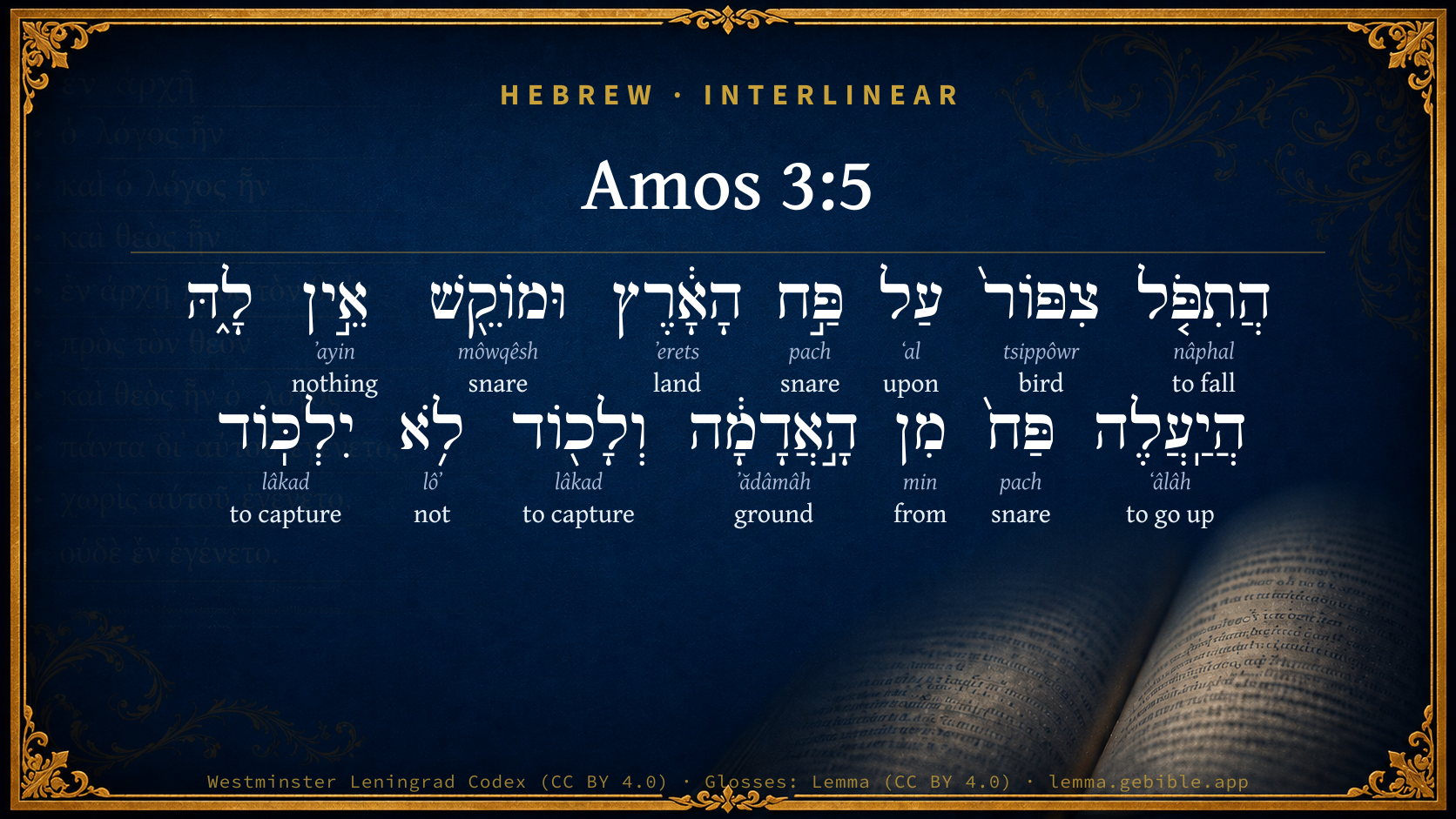
Hebrew (Westminster Leningrad Codex) Amos 3:5 appears in the Hebrew Old Testament. The text above is from the Westminster Leningrad Codex. Each word links to its Strong’s number, a concise gloss, and parsing drawn from the Open Scriptures Hebrew Bible morphology. Click any word for its full Brown-Driver-Briggs (BDB) entry.
Download image
Cite this verse

Amos 3:5 (World English Bible). Public Domain. Lemma interlinear Bible study tool, https://lemma.gebible.app/v/amos/3/5.

Show BibTeX & RIS
BibTeX
RIS
English Translation
Can a bird fall in a trap on the earth, Where no snare is set for him? Does a snare spring up from the ground, When there is nothing to catch?
World English Bible · Public Domain
Download a study sheet

One document with this verse’s original text, its word-by-word gloss line, the meaning frame, cross-references with their text, attributed commentary, and full source and license credits — printable, and it pastes into notes with its structure intact.

This verse Autodidact and up

Study sheet (.html) Plain text (.txt)

A passage Seminary Student

Up to 50 verses in one chapter. A passage sheet keeps up to 6 commentary sources and 12 cross-references per verse, in the order this page ranks them, and says so on the sheet whenever that leaves anything out. Ask for a single verse and you get the Autodidact verse sheet above.

Everything on this page stays free to read, with no account — the sheet is a download of what is already on screen, not access to it.

Want to remove ads? Support Godless Engineer
Compare translations 3

The same verse in 3 English versions, stacked beneath the original-language interlinear above. Click any original word for its lexicon entry.

Each is an independent rendering of the whole verse — the interlinear is not word-aligned to these translations.

Highlighted words mark where these versions differ — a whole-verse word diff, not a word-by-word alignment.

  • World English Bible Public Domain
    Can a bird fall in a trap on the earth, Where no snare is set for him? Does a snare spring up from the ground, When there is nothing to catch?
  • King James Version Public Domain
    Can a bird fall in a snare upon the earth, where no gin is for him? shall one take up a snare from the earth, and have taken nothing at all?
  • unfoldingWord Literal Text CC BY-SA 4.0
    Can a bird fall in a trap on the ground when no bait is set for him? Will a trap spring up from the ground when it has not caught anything?

unfoldingWord Literal Text — © unfoldingWord, licensed CC BY-SA 4.0. Word-aligned USFM3 via Door43 (git.door43.org/unfoldingWord/en_ult).

Versions to compare (up to 4)

3 of 4 selected

Show all 18 translations

Every available English version of this verse, each an independent rendering of the whole verse.

  • World English Bible Public Domain
    Can a bird fall in a trap on the earth, Where no snare is set for him? Does a snare spring up from the ground, When there is nothing to catch?
  • Berean Standard Bible Public Domain
    Does a bird land in a snare where no bait has been set? Does a trap spring from the ground when it has nothing to catch?
  • Majority Standard Bible Public Domain
    Does a bird land in a snare where no bait has been set? Does a trap spring from the ground when it has nothing to catch?
  • King James Version Public Domain
    Can a bird fall in a snare upon the earth, where no gin is for him? shall one take up a snare from the earth, and have taken nothing at all?
  • American Standard Version (1901) Public Domain
    Can a bird fall in a snare upon the earth, where no gin is `set' for him? shall a snare spring up from the ground, and have taken nothing at all?
  • Revised Version (1885) Public Domain
    Can a bird fall in a snare upon the earth, where no gin is set for him? shall a snare spring up from the ground, and have taken nothing at all?
  • Geneva Bible (1599) Public Domain
    Can a birde fall in a snare vpon the earth, where no fouler is? or will he take vp the snare from the earth, and haue taken nothing at all?
  • Douay-Rheims (1899) Public Domain
    Will the bird fall into the snare upon the earth, if there be no fowler? Shall the snare be taken up from the earth, before it hath taken somewhat?
  • Young's Literal Translation Public Domain
    Doth a bird fall into a snare of the earth, And there is no gin for it? Doth a snare go up from the ground, And prey it captureth not?
  • Literal Standard Version CC BY-SA 4.0
    Does a bird fall into a snare of the earth, || And there is no trap for it? Does a snare go up from the ground, || And it does not capture prey?
  • Unlocked Literal Bible CC BY-SA 4.0
    Can a bird fall in a trap on the ground when no bait is set for him? Will a trap spring up from the ground when it has not caught anything?
  • unfoldingWord Literal Text CC BY-SA 4.0
    Can a bird fall in a trap on the ground when no bait is set for him? Will a trap spring up from the ground when it has not caught anything?
  • Darby Bible Public Domain
    Can a bird fall in a snare upon the earth when no gin [is laid] for him? Will the snare spring up from the earth when nothing at all hath been taken?
  • World Messianic Bible Public Domain
    Can a bird fall in a trap on the earth, where no snare is set for him? Does a snare spring up from the ground, when there is nothing to catch?
  • Webster's Bible Public Domain
    Can a bird fall in a snare upon the earth, where no gin is for him? shall one take up a snare from the earth, and have taken nothing at all?
  • Free Bible Version CC BY-SA 4.0
    Does a bird fall into a trap and get caught unless the spring is set? Does a trap spring shut if there's nothing there to catch?
  • Bible in Basic English Public Domain
    Is it possible for a bird to be taken in a net on the earth where no net has been put for him? will the net come up from the earth if it has taken nothing at all?
  • JPS Tanakh (1917) Public Domain
    Will a bird fall in a snare upon the earth, where there is no lure for it? Will a snare spring up from the ground, and have taken nothing at all?

Literal Standard Version (2020), Covenant Press — licensed CC BY-SA 4.0. Text via the HelloAO Bible API (eBible.org). Unlocked Literal Bible (unfoldingWord) — licensed CC BY-SA 4.0. Text via the HelloAO Bible API (eBible.org). unfoldingWord Literal Text — © unfoldingWord, licensed CC BY-SA 4.0. Word-aligned USFM3 via Door43 (git.door43.org/unfoldingWord/en_ult). Free Bible Version, Dr. Jonathan Gallagher — licensed CC BY-SA 4.0. Text via the HelloAO Bible API (eBible.org).

Word by word

More ways to search: Search by grammar → Find every occurrence → Compare this word →

Practice this passage: Drill this verse → Learn its vocabulary →

פַּ֣ח
pach
H6341
“snare”
Noun, Common, Masculine, Singular, Absolute
Part of Speech
Noun
Type
Common
Gender
Masculine
Number
Singular
State
Absolute
Full BDB Definition

Origin: from H6351

TWOT: 1759a , 1759b

bird trap, trap, snare - bird trap (literal) - of calamities, plots, source or agent of calamity (figuratively) - plate (of metal)
  1. הֲתִפֹּ֤ל nâphal H5307 “to fall” Particle, Interrogative + Verb, Qal, Imperfect, 3rd Person, Feminine, Singular
  2. צִפּוֹר֙ tsippôwr H6833 “bird” Noun, Common, Both, Singular, Absolute
  3. עַל ʻal H5921 “upon” Preposition
  4. הָאָ֔רֶץ ʼerets H776 “the · land” Particle, Definite Article + Noun, Common, Both, Singular, Absolute
  5. וּמוֹקֵ֖שׁ môwqêsh H4170 “and · snare” Conjunction + Noun, Common, Masculine, Singular, Absolute
  6. אֵ֣ין ʼayin H369 “nothing” Particle, Negative
  7. הֲיַֽעֲלֶה ʻâlâh H5927 “to go up” Particle, Interrogative + Verb, Qal, Imperfect, 3rd Person, Masculine, Singular
  8. פַּח֙ pach H6341 “snare” Noun, Common, Masculine, Singular, Absolute
  9. מִן min H4480 “from” Preposition
  10. הָ֣אֲדָמָ֔ה ʼădâmâh H127 “the · ground” Particle, Definite Article + Noun, Common, Feminine, Singular, Absolute
  11. וְלָכ֖וֹד lâkad H3920 “and · to capture” Conjunction + Verb, Qal, Infinitive Absolute
  12. לֹ֥א lôʼ H3808 “not” Particle, Negative
  13. יִלְכּֽוֹד lâkad H3920 “to capture” Verb, Qal, Imperfect, 3rd Person, Masculine, Singular

About this verse

These counts appear in no published source. They are computed here, from the morphology-tagged text and Lemma’s own curated glosses. What Lemma adds →

15
words
12
distinct lemmas
Prophets
section

Shared distinctive vocabulary

פַּ֣ח snare H6341 occurs in 25 verses of the Hebrew Bible. Also found in:

Grammatical profile

  • 4 verbs
  • 6 nouns
  • 3 prepositions
  • 2 particles

Verb forms

  • הֲתִפֹּ֤ל Qal · Imperfect
  • הֲיַֽעֲלֶה Qal · Imperfect
  • וְלָכ֖וֹד Qal · Infinitive Absolute
  • יִלְכּֽוֹד Qal · Imperfect

Repetition

Words recur within this verse — often emphatic in Hebrew:

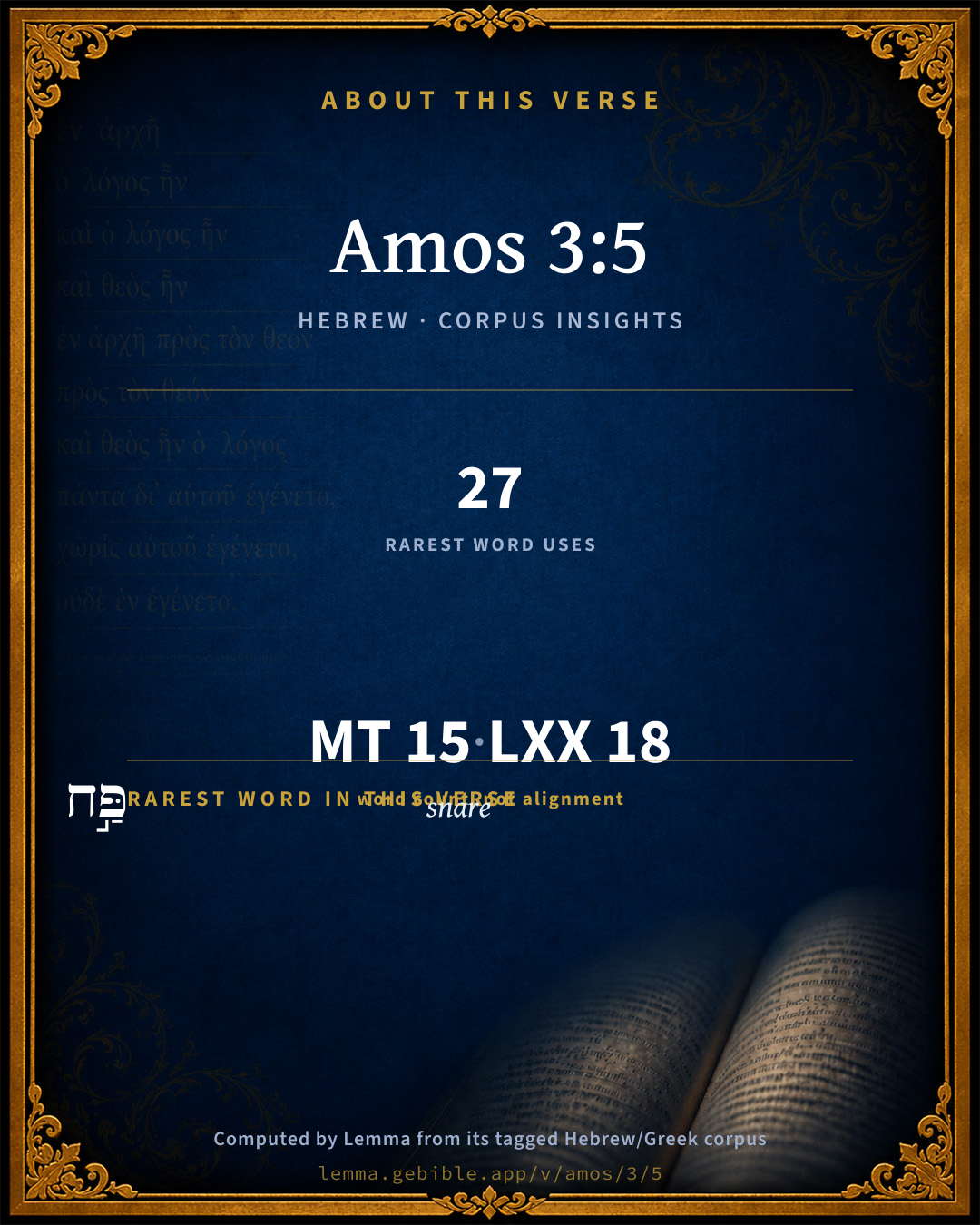
  • פַּ֣ח snare H6341 ×2
  • וְלָכ֖וֹד to capture H3920 ×2

Hebrew & Septuagint length

In English translation the verse runs 31 words from the Hebrew and 23 from the Septuagint (LXX English) — closely comparable.

A rough comparison of the two English renderings, which tokenize alike — not a word-level alignment.

Word counts can differ between the Hebrew and the Greek without any difference in meaning — e.g. the Hebrew direct-object marker אֵת has no separate Greek word, and Greek often adds the article ὁ.

In the original languages it is 15 Hebrew tokens and 18 Greek tokens — but the two are counted differently (Hebrew bundles its prefixes and suffixes into one token; the Greek is in lemma form), so that isn’t a like-for-like length.

Cross-references

3

Topical passages linked to Amos 3:5 in the Treasury of Scripture Knowledge — connected by theme and wording, ordered by reader-vote popularity; previews shown in the World English Bible.

  • Ecclesiastes 9:12 For man also doesn't know his time. As the fish that are taken in an evil net, and as the birds that are caught in the snare, even so are the sons of men snared in an evil time, when it falls suddenly on them.
  • Jeremiah 31:28 It shall happen that, like as I have watched over them to pluck up and to break down and to overthrow and to destroy and to afflict, so will I watch over them to build and to plant, says Yahweh.
  • Daniel 9:14 Therefore has Yahweh watched over the evil, and brought it on us; for Yahweh our God is righteous in all his works which he does, and we have not obeyed his voice.

Cross-references courtesy of OpenBible.info (CC BY 4.0).

Hebrew and Greek witnesses Masoretic Hebrew ↔ Greek Septuagint

The same verse in the two great witnesses to the Old Testament, shown verse-for-verse.

These are two independent witnesses, not word-aligned to each other, and the Septuagint is shown in lemma (dictionary) form.

Hebrew Amos 3:5 Masoretic · Westminster Leningrad Codex

הֲתִפֹּ֤ל צִפּוֹר֙ עַל פַּ֣ח הָאָ֔רֶץ וּמוֹקֵ֖שׁ אֵ֣ין לָ֑הּ הֲיַֽעֲלֶה פַּח֙ מִן הָ֣אֲדָמָ֔ה וְלָכ֖וֹד לֹ֥א יִלְכּֽוֹד

Can a bird fall in a trap on the earth, Where no snare is set for him? Does a snare spring up from the ground, When there is nothing to catch?

World English Bible · Public Domain

Greek LXX Amos 3:5 Septuagint · lemma form

εἰ πίπτω ὄρνεον ἐπί ὁ γῆ ἄνευ ἰξευτής εἰ σχάζω παγίς ἐπί ὁ γῆ ἄνευ ὁ συνλαμβάνω τις

Will a bird fall on the earth without a fowler? will a snare be taken up from the earth without having taken anything?

LXX2012 (modern English Septuagint) · Public Domain

On this verse, The Pulpit Commentary discusses the Septuagint’s reading. Read the note in Commentary ↓

Hebrew: Westminster Leningrad Codex (CC BY 4.0). Greek: Septuagint (public domain); English from LXX2012 (modern English Septuagint) (Public Domain). How the Septuagint differs from the Hebrew →

Targum (Aramaic paraphrase)

1

The Targum is the ancient Jewish Aramaic paraphrase of the Hebrew Scriptures — an interpretive translation, not the Hebrew text itself. Onkelos (literal) and Pseudo-Jonathan (expansive) render the Torah, and Jonathan the Prophets. Coverage is partial: where no permissively-licensed English translation exists for a verse, only the Aramaic is shown. This is verse-level text, not a word-by-word alignment to the Hebrew.

  1. Targum Jonathan Prophets (Joshua–Malachi)
    הֲתִפּוֹל צִפְּרָא בְּקוּלָא עַל אַרְעָא וְצַיִד לֵית לֵיהּ הֲיִסַק קוּלָא מִן אַרְעָא וּמֵחַד לָא אֲחָד:

    (no public-domain English translation for this verse)

    Targum Jonathan — Aramaic: “Mikraot Gedolot” (public domain). English: “Sefaria Community Translation” (CC0 1.0 (public-domain dedication)); “London "Chaldee Paraphrase," 1871” (public domain). Text via Sefaria.

Commentary

Notes on Amos 3:5 from classic Christian and Jewish commentators (each source and its license shown beneath its notes). The classic Christian expositions comment on the surrounding passage and are grouped to its opening verse, so a note may address several verses; the Jewish commentaries on the Tanakh (Rashi and others) are per-verse, so they appear only where the commentator wrote on this verse.

Lemma curates 59 commentaries, every one of them public domain or Creative Commons licensed, each selected and text-cleaned for this edition rather than reprinted as found. About our sources →

Trapp's Complete Commentary

John Trapp

Amo 3:5 Can a bird fall in a snare upon the earth, where no gin [is] for him? shall [one] take up a snare from the earth, and have taken nothing at all?

Ver. 5. Can a bird fall in a snare upon the earth? &c.] Think you that all things are carried here by blind fortune, and not by a particular providence, as if

“ mundo nullus inesset

Rector, et incerto fluerent mortalia casu? ”

Will you say of the evils you have suffered, in the language of Ashdod, "It is a chance?" 1Sa 6:9. Is that heathen idol fortune anything in the world, 1Co 10:19, more than a blasphemy, spued out by the devil against the Divine providence? Can a sparrow fall to the ground, or any the least bird into a snare upon the earth, without your heavenly Father? Mat 10:29. Birds flying seem to be at liberty, yet are guided by an overruling hand. They fall sometimes into a gin; and do not you thereupon conclude that some fowler’s hand is in it? Lo, you are ensnared and ensnarled by your enemies; and can you not discern that it is the Lord who hath done it? Lam 3:37-38 Act 17:25; Act 17:28 Ecc 9:12, "For man knoweth not his time" (nor his chance, Amo 3:11): "as the fishes that are taken in an evil net, and as the birds that are caught in the snare; so are the sons of men snared in an evil time, when it falleth suddenly" (but providentially) "upon them."

Or shall one take up a snare from the earth, &c.] No wise fowler will take up his nets till he have gotten his prey; no more will God withdraw his hand, or call off the enemy and the avenger, till he have his design; till he hath either reformed or ruined you.

John Trapp, A Commentary or Exposition upon All the Books of the Old and New Testament (1647–1656) — public domain. Text from a community e-Sword module.

Tyndale Open Study Notes

Tyndale Open Resources

3:5 The trap pictures the consequences of Israel’s sin. Israel fully deserved the judgment that Amos proclaimed.

Tyndale Open Study Notes — © Tyndale Open Resources, licensed CC BY-SA 4.0. Text via the HelloAO Bible API.

Geneva Bible (1599)

Geneva Bible translators

Can anything come without God’s providence?

Shall his threatenings be in vain?

Geneva Bible (1599) marginal notes — public domain. Text via Bolls.life.

Jamieson, Fausset & Brown

Robert Jamieson, A. R. Fausset & David Brown

When a bird trying to fly upwards is made to fall upon the earth snare, it is a plain proof that the snare is there; so, Israel, now that thou art falling, infer thence, that it is in the snare of the divine judgment that thou art entangled [LUDOVICUS DE DIEU].

shall one take up a snare from the earth, and have taken nothing--The bird-catcher does not remove his snare off the ground till he has caught some prey; so God will not withdraw the Assyrians, &c., the instruments of punishment, until they have had the success against you which God gives them. The foe corresponds to the "snare," suddenly springing from the ground and enclosing the bird on the latter touching it; the Hebrew is literally, "Shall the snare spring from the earth?" Israel entangled in judgments answers to the bird "taken."

Jamieson, Fausset & Brown — Commentary Critical and Explanatory on the Whole Bible (1871) — public domain (CC PDM 1.0). Text via the HelloAO Bible API.

Adam Clarke's Commentary

Verse 5. Can a bird fall in a snare] Can ye, as a sinful people, fall into calamities which I have not appointed?

Shall one take up a snare - and have taken nothing] Will the snare be removed before it has caught the expected prey? - shall I remove my judgments till they are fully accomplished? This is a curious passage, and deserves farther consideration. The original, literally translated, is nearly as follows: "Shall the trap arise from the ground; and catching, shall it not catch?" Here is a plain allusion to such traps as we employ to catch rats, foxes, c. The jaws of the trap opening backward, press strongly upon a spring so as to keep it down and a key passing over one jaw, and hooking on a table in the centre, the trap continues with expanded jaws, till any thing touch the table, when the key, by the motion of the table, being loosened, the spring recovers all its elastic power, and throws up the jaws of the trap, and their serrated edges either close in each other, or on the prey that has moved the table of the trap. Will then the jaws of such a trap suddenly spring up from the ground, on which before they were lying flat, and catch nothing? Shall they let the prey that was within them escape? Certainly not. So my trap is laid for these offenders; and when it springs up, (and they themselves will soon by their transgressions free the key,) shall not the whole family of Israel be inclosed in it? Most certainly they shall. This is a singular and very remarkable passage, and, when properly understood, is beautifully expressive.

Adam Clarke's Commentary on the Bible (1810–1826) — public domain. Text from a community e-Sword/MySword module.

John Calvin's Commentaries

The third similitude now follows, Will a bird fall on the earth, he says, without a fowler? The Prophet means here that nothing happens without being foreseen by God; for as nets are laid for birds, so God ensnares men by his hidden punishments. Unexpectedly indeed calamity comes, and it is commonly ascribed to chance; but the Prophet here reminds us that God stretches his nets, in which men are caught, though they think that chance rules, and observe not the hand of God. They are deceived, he says; for the bird foresees not the ensnaring prepared for him; but yet he falls not on the earth without the fowler: for nets weave not themselves by chance, but they are made by the industry of the man who catches birds. So also calamities do not happen by chance, but proceed from the secret purpose of God. But we must observe, that similitudes ought not to be too strictly applied to the subject in hand. Were one to asks how God could compare himself here to a fowler, as there is craft and artifice employed in catching innocent birds, when nets are laid for them, it would be a frivolous question; for it is evident enough what the Prophet meant, and that the design of his words was to show, that punishments fall on men, and that they are ensnared through the secret purpose of God; for God has long ago foreseen what he will do, though men act heedlessly, as the birds who foresee nothing.

Then it follows in the fourth place, Will the fowler remove his snare before he has made a capture? In this second clause the Prophet intimates that the threatening of God would not be without effect; for he will execute whatever he declares. It is indeed certain, that fowlers often return home empty, and gather their nets though they have taken nothing; but the Prophet, as I have said, in using these similitudes, only states what fowlers usually do, when they are in hope of some prey. As for instance, when one spreads his nets, he will wait, and will not gather his nets until he takes some prey, if so be that a prey should come; he may indeed wait in vain all night. Then as fowlers are not wearied, and wish not to lose their labor after they have spread their nets, so also the Prophet says that God does not in vain proclaim his threatenings to serve as empty bugbears, but that his nets remain until he has taken his prey; which means, that God will really execute what he has threatened by his Prophets. The meaning then is, that God’s word is not ineffectual, but when God declares any thing, it is sure to be accomplished: and hence he reproves the Israelites for receiving so heedlessly and with deaf ears all God’s threatening, as though he was only trifling with them. “It will not be,” he says, “as you expect; for God will take his prey before he takes up his nets.”

John Calvin's Commentaries (1540-1563) — public domain. Text from the Calvin Translation Society English edition (1840s-50s) via the Christian Classics Ethereal Library (ccel.org). Calvin's coverage is partial (roughly two-thirds of the Bible); uncommented books and verses are honest gaps, never fabricated. The 19th-century editor's footnotes and remarks are omitted so the notes are faithfully Calvin's own voice.

Ellicott's Commentary for English Readers

(5) Can a bird.—Better, Does the snare rise up from the ground, and take nothing at all?” E.V. “take up” is due to ambiguity of the Hebrew. The idea is that Israel “like a silly dove” is falling into snares. The snare, even now, may be seen springing from the earth. The armies and politics of the nation that will enclose Israel are already in motion.

A Bible Commentary for English Readers, edited by Charles John Ellicott (1878–1897) — public domain. Text from a community e-Sword module.

The Cambridge Bible for Schools and Colleges

gen. ed. J. J. S. Perowne

5. Will a bird fall into a net upon the earth, when there is no bait for it?] The paḥ must have been a kind of net; not improbably like the bird-traps figured in Wilkinson-Birch, Ancient Egyptians, ed. 1878, ii. 103, consisting of network strained over two semicircular flaps, moving on a common axis: this was laid upon the ground, and when the bait in the middle was touched by a bird, the two flaps, by a mechanical contrivance, flew up and closed, entrapping the bird.

gin] bait. The môḳçsh (lit. a fowling-instrument) is shewn by the present passage to have been something connected with the paḥ, without which the latter was useless: elsewhere it often denotes metaphorically that which allures a person to destruction (e.g. Exo_23:33; Deu_7:16; 1Sa_18:21): hence it must have been something more definite than gin, and probably corresponded nearly to what we should term the bait.

will a net spring up from the ground without taking (something)?] The construction of the paḥ was such that the flaps would not start up from the ground without a bird being there for the net to enclose.

The Cambridge Bible for Schools and Colleges (gen. ed. J. J. S. Perowne; Cambridge University Press, 1878–1918) — public domain. Text from a community e-Sword module.

John Gill's Exposition

Shall a trumpet be blown in the city,.... Meaning not any trumpet blown, as the silver trumpet for the gathering of the people to worship, or the jubilee trumpet, which proclaimed liberty to them, or any other, expressive of joy and gladness; but the sound of the trumpet, the alarm of war, or what is blown by the watchmen on the walls, descrying an enemy, or some danger, near:

and the people not be afraid? they must, they usually are, lest their lives, and their children's, should be taken away, and their substance become a prey to the enemy: or, "and the people not run together" (f); into some one place for shelter, or to consult together how to provide for their safety, and secure themselves from danger. So when the prophets of the Lord, by his order, lift up their voice like a trumpet, to show his people their transgressions; or when, as watchmen, they blow the trumpet, to give notice of approaching danger; can they hear such denunciations of his wrath for their sins, and not tremble at them, or not take some ways and methods to escape it?

shall there be evil in a city, and the Lord hath not done it? which is not to be understood of the evil of sin, of which God is not the author, it being contrary to his nature and will; and though he permits it to be done by others, yet he never does it himself, nor so much as tempts men to it, Jam 1:13; unless the words should be rendered, as they may be, "shall there be evil in a city, and shall not the Lord do" or "work" (g)? shall sin be committed in a city, all sorts of sin, in the most bold and extravagant manner, and will not the Lord do something to show his resentment of it? is it not time for him to arise and work for his name's sake? will he not visit for these things, and be avenged on such a city, and the inhabitants of it? but this may be interpreted of the evil of affliction or judgment; which, wherever it comes, is by the order and appointment of God, and is inflicted by him; thus evil, as well as good, comes out of the mouth and hand of the most High; and he creates the evil of adversity, as well as makes peace and prosperity; see Job 2:10.

(f) "non accurrit", Drusius, Tarnovius. (g) "and shall not the Lord do somewhat?" margin of our Bibles.

John Gill's Exposition of the Whole Bible (1746–1763) — public domain (CC PDM 1.0). Text via the HelloAO Bible API.

Albert Barnes' Notes on the Bible

Can a bird fall in a snare - Again, the bird taken in the snare is the image of those drawn down from heaven, where ‘our conversation is Phi 3:20 and the soul may rise free toward its God , “drawn up by the Spirit to high and heavenly things.” Such souls being allured by the things of earth, are entangled and taken by Satan; as, on the other hand, “the soul, escaped as a bird out of the snare of the fowler Psa 124:7, is a soul, set free by Christ and restored to heaven.

In the last likeness, the prophet comes nearer to the people themselves, and the trumpet is, at once, the well-known token of alarm among people, and of the loud voice of God, wakening them to repentance Isa 58:1; Joe 2:15 and still oftener, warning them of the approach of judgment Isa 18:3; Jer 4:5; Jer 6:1; Eze 33:2-6; Hos 5:8; Hos 8:1; Rev 8:1-13, or summoning man before Him 1Co 15:52; 1Th 4:16. Rup.: “God’s Voice will not always be ‘a still small voice,’ or whispered only among the Angels, or heard as from the ground. It will be heard terribly in the whole world.” Jerome: “Whatever is said in Holy Scripture is a trumpet threatening, and with loud voice sinking into the hearts of believers. If we are righteous, we are called by the trumpet of Christ to bliss. If we are sinners, we know that we are to suffer torment.”

Albert Barnes' Notes on the Bible (1834–1885) — public domain. Text from a community e-Sword/MySword module.

Haydock's Catholic Bible Commentary

Somewhat? When the prophet speaks, has he no reason? God shews that he has sent him, by inflicting the punishments which he denounces.

George Leo Haydock (1774–1849), Haydock's Catholic Family Bible and Commentary, 1859 edition — public domain. Excludes Psalms (Douay-Rheims chapter numbering differs from Protestant) and Deuterocanonical books (Catholic canon only).

Matthew Poole's English Annotations

A bird; a sparrow properly, one kind put for all sorts.

Fall in a snare: these are taken by nets spread on the earth for that end, and these nets are watched by the fowler, attending till the birds are within the shrape, then he draws the net over them: so here, For your sins, O Israel, God will spread his net, he will as a watchful fowler attend and keep his eye upon you, and cast the net over you.

Shall one take up a snare, and have taken nothing at all? flatter not yourselves as if you should finally escape because you have so long been safe and prosperous; though the fowler doth long wait, he will not take up the snare before all the prey, or some of it at least, be taken in it: so the Lord, against whom you have sinned, and who hath spread his net for you, will certainly let it lie till you are taken in it.

Matthew Poole's English Annotations on the Holy Bible (1683–1685) — public domain. Text from a community e-Sword/MySword module.

The Pulpit Commentary

The thought here is that the punishment is deserved as well as certain. A bird is not caught unless a trap is set for it. The trap which the sinner sets for himself is sin. Can a bird fall in a snare (pach) upon the earth, where no gin (moqesh) is for him? i.e. is set for him? The "gin" is a net with a stick for a spring, which flew up when touched, carrying part of the net with it, and thus the bird was enclosed and caught (see Kitto, "Cyclop.," s.v. "Fowling," 2:36). The LXX probably read yoqesh, as they translate, aneu ejxeutou, "without a fowler." So the Vulgate, absque aucupe. The second clause should be, Shall a snare (pach) spring up from the ground without taking anything? The snare, or trap stick, would not rise if it had not caught something. The sin is there, and the sinners shall surely not escape. When God appoints retributive punishments for the guilty, and announces the same by his prophets, they may be expected with absolute certainty.

The Pulpit Commentary (1880–1919), ed. H.D.M. Spence-Jones & Joseph S. Exell — public domain. Text from a community e-Sword module.

John Wesley's Explanatory Notes

Can a bird fall - So here for your sins, God will cast the net over you. Shall one take up a snare - The fowler will not take up the snare, before the prey be taken in it.

John Wesley, Explanatory Notes Upon the Whole Bible (1754–1765) — public domain. Text via the GEBible commentary corpus.

unfoldingWord translationNotes

Door43 World Missions Community

General Information:

Amos uses the questions in verses 3-6 to present examples of things that people already know about what causes things to happen and what are the results of things that happen. (See: Rhetorical Question)

Can a bird fall in a trap on the ground when no bait is set for him?

Amos uses this question to remind people of what they already know about what causes a bird to fall into a trap. This can be translated as a statement. AT: "A bird can fall into a trap on the ground only when bait has been set for him." (See: Rhetorical Question)

Will a trap spring up from the ground when it has not caught anything?

Amos uses this question to remind people of what they already know about what causes a trap to spring up. This question can be translated as a statement. AT: "A trap will spring up from the ground only when it has caught something." (See: Rhetorical Question)

Will a trap spring up from the ground

This refers to a trap closing. When an animal steps on a trap, the trap closes and the animal cannot get out of it. AT: "Will a trap close"

If a trumpet sounds in a city, will the people not tremble?

Amos uses this question to remind people of what they already know about what happens when a trumpet sounds. This question can be translated as a statement. AT: "When the trumpet sounds in the city, the people will tremble." or "When the trumpet sounds in the city, we expect that people will tremble." (See: Rhetorical Question)

If a trumpet sounds in a city

The purpose of sounding the trumpet is to warn people that enemies are about to attack the city. AT: "If someone blows the trumpet in the city to warn the people about an enemy attack" or "If the warning trumpet is blown in the city" (See: Assumed Knowledge and Implicit Information)

tremble

The reason for trembling can be stated clearly. AT: "tremble because they are afraid" or "be afraid of the enemy and tremble" (See: Assumed Knowledge and Implicit Information)

If disaster overtakes a city, has Yahweh not sent it?

Amos uses this question to remind the people of what they should already know about what causes a disaster. This question can be translated as a statement. AT: "If disaster overtakes a city, Yahweh has sent it." or "If disaster overtakes a city, we know that Yahweh has sent it." (See: Rhetorical Question)

If disaster overtakes a city,

Something terrible happening to a city is spoken of as if disaster overtakes it. (See: Metaphor)

translationWords

trumpet

unfoldingWord translationNotes — © Distant Shores Media and the Door43 World Missions Community, licensed CC BY-SA 4.0. Source: git.door43.org/Door43/en_tn.

Rashi

Rabbi Shlomo Yitzchaki (Rashi)

Will a bird fall on a net upon the ground unless it has a snare—in the net which has fallen upon it?

Will a net ascend from the ground—from the place it was laid unless a bird was caught in it? When it wishes to escape, it pulls up the net and lifts it from its place a little, and at that time it is caught.

Rashi on the Tanakh — English translations: “The Judaica Press complete Tanach with Rashi, translated by A. J. Rosenberg” (CC BY 4.0); “Pentateuch with Rashi's commentary by M. Rosenbaum and A.M. Silbermann, 1929-1934” (public domain); “The Metsudah Tanach series, Lakewood, N.J” (CC BY 4.0); and “The Book of Joshua, Metsudah Publications, 1997” (CC BY 4.0). Text via Sefaria.

Lesson kit

Teaching starters — assembled from the data on this page, not authored interpretation. Every prompt links to the verse data it draws on. Edit before teaching.

Amos, in the Prophets, opens this verse with 15 words (12 distinct Hebrew lemmas). Its most distinctive word is pach (“snare”). A historical commentator’s framing appears above. Read the whole chapter for the surrounding context.

Discussion questions

  1. What does “snare” (pach) contribute to the verse as a whole?
  2. Exodus 39:3 shares the word «snare» with this verse. How do the two illuminate each other?
  3. “snare” occurs 2× in this one verse. What is the effect of the repetition?
  4. These translations render this verse differently. What is at stake in choosing one wording over another?
  5. The verb «הֲתִפֹּ֤ל» is Qal Imperfect. How does its form color the action?
  6. Reading how Trapp's Complete Commentary and Tyndale Open Study Notes read this verse, where do the two commentators agree and where do they part?

Things to notice

Reading settings

Reading text

Shown beneath each verse's original-language words.

Old Testament
Old Testament edition

Read the OT as the Masoretic Hebrew (MT) or the Greek Septuagint (LXX).

English shown for the Greek Septuagint (in the Hebrew ↔ Greek comparison).

Comparing translations? Open the Compare panel on any verse page to stack up to four side by side.