Genesis 3:11

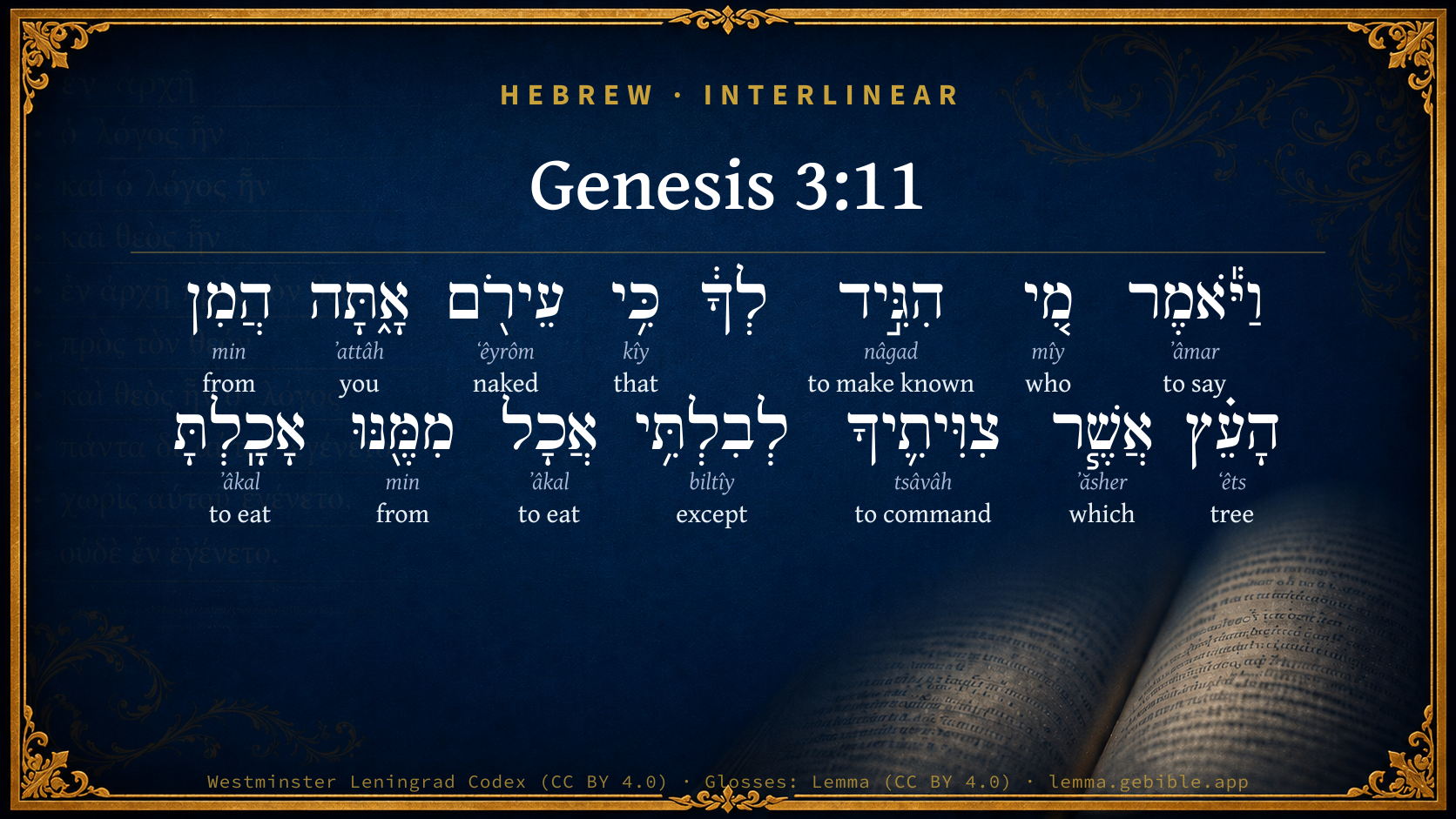
Hebrew (Westminster Leningrad Codex) Genesis 3:11 appears in the Hebrew Old Testament. The text above is from the Westminster Leningrad Codex. Each word links to its Strong’s number, a concise gloss, and parsing drawn from the Open Scriptures Hebrew Bible morphology. Click any word for its full Brown-Driver-Briggs (BDB) entry.
Download image
Cite this verse

Genesis 3:11 (World English Bible). Public Domain. Lemma interlinear Bible study tool, https://lemma.gebible.app/v/genesis/3/11.

Show BibTeX & RIS
BibTeX
RIS
English Translation
God said, "Who told you that you were naked? Have you eaten from the tree that I commanded you not to eat from?"
World English Bible · Public Domain
Highlights
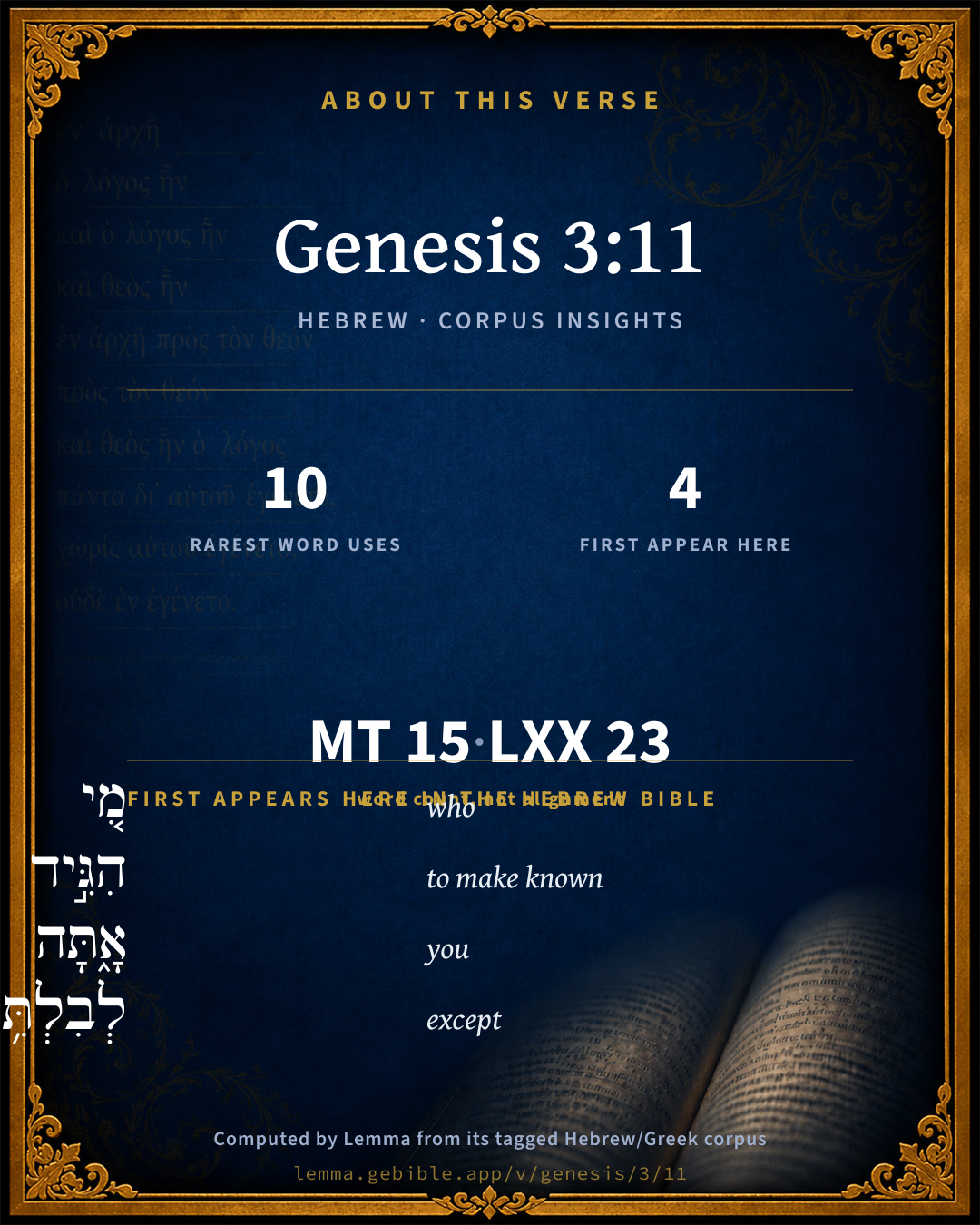
  • 4 first appearances in the Hebrew Bible
Full analysis ↓
Download a study sheet

One document with this verse’s original text, its word-by-word gloss line, the meaning frame, cross-references with their text, attributed commentary, and full source and license credits — printable, and it pastes into notes with its structure intact.

This verse Autodidact and up

Study sheet (.html) Plain text (.txt)

A passage Seminary Student

Up to 50 verses in one chapter. A passage sheet keeps up to 6 commentary sources and 12 cross-references per verse, in the order this page ranks them, and says so on the sheet whenever that leaves anything out. Ask for a single verse and you get the Autodidact verse sheet above.

Everything on this page stays free to read, with no account — the sheet is a download of what is already on screen, not access to it.

Want to remove ads? Support Godless Engineer
Compare translations 3

The same verse in 3 English versions, stacked beneath the original-language interlinear above. Click any original word for its lexicon entry.

Each is an independent rendering of the whole verse — the interlinear is not word-aligned to these translations.

Highlighted words mark where these versions differ — a whole-verse word diff, not a word-by-word alignment.

  • World English Bible Public Domain
    God said, "Who told you that you were naked? Have you eaten from the tree that I commanded you not to eat from?"
  • King James Version Public Domain
    And he said, Who told thee that thou wast naked? Hast thou eaten of the tree, whereof I commanded thee that thou shouldest not eat?
  • unfoldingWord Literal Text CC BY-SA 4.0
    Then he said, “Who told you that you naked? Did you eat from the tree that I commanded you not to eat from?”

unfoldingWord Literal Text — © unfoldingWord, licensed CC BY-SA 4.0. Word-aligned USFM3 via Door43 (git.door43.org/unfoldingWord/en_ult).

Versions to compare (up to 4)

3 of 4 selected

Show all 18 translations

Every available English version of this verse, each an independent rendering of the whole verse.

  • World English Bible Public Domain
    God said, "Who told you that you were naked? Have you eaten from the tree that I commanded you not to eat from?"
  • Berean Standard Bible Public Domain
    “Who told you that you were naked?” asked the LORD God. “Have you eaten from the tree of which I commanded you not to eat?”
  • Majority Standard Bible Public Domain
    “Who told you that you were naked?” asked the LORD God. “Have you eaten from the tree of which I commanded you not to eat?”
  • King James Version Public Domain
    And he said, Who told thee that thou wast naked? Hast thou eaten of the tree, whereof I commanded thee that thou shouldest not eat?
  • American Standard Version (1901) Public Domain
    And he said, Who told thee that thou wast naked? Hast thou eaten of the tree, whereof I commanded thee that thou shouldest not eat?
  • Revised Version (1885) Public Domain
    And he said, Who told thee that thou wast naked? Hast thou eaten of the tree, whereof I commanded thee that thou shouldest not eat?
  • Geneva Bible (1599) Public Domain
    And he saide, Who tolde thee, that thou wast naked? Hast thou eaten of the tree, whereof I commanded thee that thou shouldest not eate?
  • Douay-Rheims (1899) Public Domain
    And he said to him: And who hath told thee that thou wast naked, but that thou hast eaten of the tree whereof I commanded thee that thou shouldst not eat?
  • Young's Literal Translation Public Domain
    And He saith, `Who hath declared to thee that thou `art' naked? of the tree of which I have commanded thee not to eat, hast thou eaten?'
  • Literal Standard Version CC BY-SA 4.0
    And He says, “Who has declared to you that you [are] naked? Have you eaten from the tree of which I have commanded you not to eat?”
  • Unlocked Literal Bible CC BY-SA 4.0
    God said, “Who told you that you were naked? Have you eaten from the tree that I commanded you not to eat from?”
  • unfoldingWord Literal Text CC BY-SA 4.0
    Then he said, “Who told you that you naked? Did you eat from the tree that I commanded you not to eat from?”
  • Darby Bible Public Domain
    And he said, Who told thee that thou art naked? Hast thou eaten of the tree of which I commanded thee not to eat?
  • World Messianic Bible Public Domain
    God said, “Who told you that you were naked? Have you eaten from the tree that I commanded you not to eat from?”
  • Webster's Bible Public Domain
    And he said, Who told thee that thou wast naked? Hast thou eaten of the tree of which I commanded thee, that thou shouldest not eat?
  • Free Bible Version CC BY-SA 4.0
    “Who told you that you were naked?” asked the Lord God. “Did you eat fruit from the tree I ordered you not to?”
  • Bible in Basic English Public Domain
    And he said, Who gave you the knowledge that you were without clothing? Have you taken of the fruit of the tree which I said you were not to take?
  • JPS Tanakh (1917) Public Domain
    And He said: 'Who told thee that thou wast naked? Hast thou eaten of the tree, whereof I commanded thee that thou shouldest not eat?'

Literal Standard Version (2020), Covenant Press — licensed CC BY-SA 4.0. Text via the HelloAO Bible API (eBible.org). Unlocked Literal Bible (unfoldingWord) — licensed CC BY-SA 4.0. Text via the HelloAO Bible API (eBible.org). unfoldingWord Literal Text — © unfoldingWord, licensed CC BY-SA 4.0. Word-aligned USFM3 via Door43 (git.door43.org/unfoldingWord/en_ult). Free Bible Version, Dr. Jonathan Gallagher — licensed CC BY-SA 4.0. Text via the HelloAO Bible API (eBible.org).

Word by word

More ways to search: Search by grammar → Find every occurrence → Compare this word →

Practice this passage: Drill this verse → Learn its vocabulary →

עֵירֹ֖ם
ʻêyrôm
H5903
“naked”
Adjective, Adjective, Masculine, Singular, Absolute
Part of Speech
Adjective
Type
Adjective
Gender
Masculine
Number
Singular
State
Absolute
Full BDB Definition

Origin: from H6191

TWOT: 1588b

naked (adjective) - nakedness (noun masculine)
  1. וַיֹּ֕אמֶר ʼâmar H559 “and · to say” Conjunction + Verb, Qal, Sequential Imperfect, 3rd Person, Masculine, Singular
  2. מִ֚י mîy H4310 “who” Particle, Interrogative
  3. הִגִּ֣יד nâgad H5046 “to make known” Verb, Hiphil, Perfect, 3rd Person, Masculine, Singular
  4. כִּ֥י kîy H3588 “that” Conjunction
  5. אָ֑תָּה ʼattâh H859 “you” Pronoun, Personal, 2nd Person, Masculine, Singular
  6. הֲמִן min H4480 “from” Particle, Interrogative + Preposition
  7. הָעֵ֗ץ ʻêts H6086 “the · tree” Particle, Definite Article + Noun, Common, Masculine, Singular, Absolute
  8. אֲשֶׁ֧ר ʼăsher H834 “which” Particle, Relative
  9. צִוִּיתִ֛יךָ tsâvâh H6680 “to command · you” Verb, Piel, Perfect, 1st Person, Common, Singular + Suffix, Personal, 2nd Person, Masculine, Singular
  10. לְבִלְתִּ֥י biltîy H1115 “to/for · except” Preposition + Conjunction
  11. אֲכָל ʼâkal H398 “to eat” Verb, Qal, Infinitive Construct
  12. מִמֶּ֖נּוּ min H4480 “from · us” Preposition + Suffix, Personal, 1st Person, Common, Plural
  13. אָכָֽלְתָּ ʼâkal H398 “to eat” Verb, Qal, Perfect, 2nd Person, Masculine, Singular

About this verse

These counts appear in no published source. They are computed here, from the morphology-tagged text and Lemma’s own curated glosses. What Lemma adds →

15
words
12
distinct lemmas
Pentateuch
section

Notable vocabulary

The rarest word here is עֵירֹ֖ם naked H5903 — appearing just 10 times in the whole Hebrew Bible.

First appearance in Scripture

These words make their first canonical appearance in the Hebrew Bible here:

  • מִ֚י who H4310
  • הִגִּ֣יד to make known H5046
  • אָ֑תָּה you H859
  • לְבִלְתִּ֥י except H1115

Shared distinctive vocabulary

עֵירֹ֖ם naked H5903 occurs in 10 verses of the Hebrew Bible. Also found in:

Grammatical profile

  • 5 verbs
  • 1 noun
  • 1 adjective
  • 1 pronoun
  • 3 prepositions
  • 2 conjunctions
  • 2 particles

Verb forms

  • וַיֹּ֕אמֶר Qal · Sequential Imperfect
  • הִגִּ֣יד Hiphil · Perfect
  • צִוִּיתִ֛יךָ Piel · Perfect
  • אֲכָל Qal · Infinitive Construct
  • אָכָֽלְתָּ Qal · Perfect

Repetition

Words recur within this verse — often emphatic in Hebrew:

  • אֲכָל to eat H398 ×2
  • הֲמִן from H4480 ×2

Hebrew & Septuagint length

In English translation the verse runs 23 words from the Hebrew and 30 from the Septuagint (LXX English) — closely comparable.

A rough comparison of the two English renderings, which tokenize alike — not a word-level alignment.

Word counts can differ between the Hebrew and the Greek without any difference in meaning — e.g. the Hebrew direct-object marker אֵת has no separate Greek word, and Greek often adds the article ὁ.

In the original languages it is 15 Hebrew tokens and 23 Greek tokens — but the two are counted differently (Hebrew bundles its prefixes and suffixes into one token; the Greek is in lemma form), so that isn’t a like-for-like length.

Cross-references

3

Topical passages linked to Genesis 3:11 in the Treasury of Scripture Knowledge — connected by theme and wording, ordered by reader-vote popularity; previews shown in the World English Bible.

  • Romans 3:20 Because by the works of the law, no flesh will be justified in his sight. For through the law comes the knowledge of sin.
  • Genesis 4:10 Yahweh said, "What have you done? The voice of your brother's blood cries to me from the ground.
  • Psalms 50:21 You have done these things, and I kept silent. You thought that the "I AM" was just like you. I will rebuke you, and accuse you in front of your eyes.

Cross-references courtesy of OpenBible.info (CC BY 4.0).

Hebrew and Greek witnesses Masoretic Hebrew ↔ Greek Septuagint

The same verse in the two great witnesses to the Old Testament, shown verse-for-verse.

These are two independent witnesses, not word-aligned to each other, and the Septuagint is shown in lemma (dictionary) form.

Hebrew Genesis 3:11 Masoretic · Westminster Leningrad Codex

וַיֹּ֕אמֶר מִ֚י הִגִּ֣יד לְךָ֔ כִּ֥י עֵירֹ֖ם אָ֑תָּה הֲמִן הָעֵ֗ץ אֲשֶׁ֧ר צִוִּיתִ֛יךָ לְבִלְתִּ֥י אֲכָל מִמֶּ֖נּוּ אָכָֽלְתָּ

God said, "Who told you that you were naked? Have you eaten from the tree that I commanded you not to eat from?"

World English Bible · Public Domain

Greek LXX Genesis 3:11 Septuagint · lemma form

καί εἶπον αὐτός τίς ἀναἀγγέλλω σύ ὅτι γυμνός εἰμί μή ἀπό ὁ ξύλον ὅς ἐντέλλομαι σύ οὗτος μόνος μή ἐσθίω ἀπό αὐτός ἐσθίω

And God said to him, Who told you that you were naked, unless you have eaten of the tree concerning which I charged you of it alone not to eat?

LXX2012 (modern English Septuagint) · Public Domain

Hebrew: Westminster Leningrad Codex (CC BY 4.0). Greek: Septuagint (public domain); English from LXX2012 (modern English Septuagint) (Public Domain). How the Septuagint differs from the Hebrew →

Targum (Aramaic paraphrase)

2

The Targum is the ancient Jewish Aramaic paraphrase of the Hebrew Scriptures — an interpretive translation, not the Hebrew text itself. Onkelos (literal) and Pseudo-Jonathan (expansive) render the Torah, and Jonathan the Prophets. Coverage is partial: where no permissively-licensed English translation exists for a verse, only the Aramaic is shown. This is verse-level text, not a word-by-word alignment to the Hebrew.

  1. Targum Onkelos Torah (Genesis–Deuteronomy)
    וַאֲמַר מָן חַוֵי לָךְ אֲרֵי עַרְטִילַאי אָתְּ הֲמִן אִילָנָא דִּפַקֶּדְתָּךְ בְּדִיל דְּלָא לְמֵיכַל מִנֵּהּ אֲכָלְתְּ

    (no public-domain English translation for this verse)

    Targum Onkelos — Aramaic: “Onkelos Genesis” (public domain); “Onkelos Exodus” (public domain); “Onkelos Leviticus” (public domain); “Onkelos Numbers” (public domain); “Onkelos Deuteronomy” (public domain). English: “Sefaria Community Translation” (CC0 1.0 (public-domain dedication)); “J.W. Etheridge. The Targums of Onkelos and Jonathan Ben Uzziel on the Pentateuch. London: Longmans, Green, 1862” (public domain). Text via Sefaria.

  2. Targum Pseudo-Jonathan Torah (Genesis–Deuteronomy)
    וַאֲמַר מַן חַוִי לָּךְ אֲרוּם עַרְטִילָאִי אַתְּ דִלְמָא מִן פֵּירֵי אִילָנָא דְפַקֵידְתָּךְ דְלָא לְמֵיכַל מִינֵיהּ אֲכַלְתְּ

    And He said, Who showed thee that thou art naked? Unless thou hast eaten of the fruit of the tree of which I commanded that thou shouldst not eat.

    Targum Pseudo-Jonathan — Aramaic: “Targum Jonathan on Genesis” (public domain); “Targum Jonathan on Exodus” (public domain); “Targum Jonathan on Leviticus” (public domain); “Targum Jonathan on Numbers” (public domain); “Targum Jonathan on Deuteronomy” (public domain). English: “The Targum of Jonathan ben Uzziel, trans. J. W. Etheridge, London, 1862” (public domain). Text via Sefaria.

Commentary

Notes on Genesis 3:11 from classic Christian and Jewish commentators (each source and its license shown beneath its notes). The classic Christian expositions comment on the surrounding passage and are grouped to its opening verse, so a note may address several verses; the Jewish commentaries on the Tanakh (Rashi and others) are per-verse, so they appear only where the commentator wrote on this verse.

Lemma curates 59 commentaries, every one of them public domain or Creative Commons licensed, each selected and text-cleaned for this edition rather than reprinted as found. About our sources →

Matthew Henry's Commentary

We have here the offenders found guilty by their own confession, and yet endeavouring to excuse and extenuate their fault. They could not confess and justify what they had done, but they confess and palliate it. Observe,

I. How their confession was extorted from them. God put it to the man: Who told thee that thou wast naked? Gen 3:11. "How camest thou to be sensible of thy nakedness as thy shame?" Hast thou eaten of the forbidden tree? Note, Though God knows all our sins, yet he will know them from us, and requires from us an ingenuous confession of them; not that he may be informed, but that we may be humbled. In this examination, God reminds him of the command he had given him: "I commanded thee not to eat of it, I thy Maker, I thy Master, I thy benefactor; I commanded thee to the contrary." Sin appears most plain and most sinful in the glass of the commandment, therefore God here sets it before Adam; and in it we should see our faces. The question put to the woman was, What is this that thou hast done? Gen 3:13. "Wilt thou also own thy fault, and make confession of it? And wilt thou see what an evil thing it was?" Note, It concerns those who have eaten forbidden fruit themselves, and especially those who have enticed others to eat it likewise, seriously to consider what they have done. In eating forbidden fruit, we have offended a great and gracious God, broken a just and righteous law, violated a sacred and most solemn covenant, and wronged our own precious souls by forfeiting God's favour and exposing ourselves to his wrath and curse: in enticing others to eat of it, we do the devil's work, make ourselves guilty of other men's sins, and accessory to their ruin. What is this that we have done?

II. How their crime was extenuated by them in their confession. It was to no purpose to plead not guilty. The show of their countenances testified against them; therefore they become their own accusers: "I did eat," says the man, "And so did I," says the woman; for when God judges he will overcome. But these do not look like penitent confessions; for instead of aggravating the sin, and taking shame to themselves, they excuse the sin, and lay the shame and blame on others. 1. Adam lays all the blame upon his wife. "She gave me of the tree, and pressed me to eat of it, which I did, only to oblige her" - a frivolous excuse. He ought to have taught her, not to have been taught by her; and it was no hard matter to determine which of the two he must be ruled by, his God or his wife. Learn, hence, never to be brought to sin by that which will not bring us off in the judgment; let not that bear us up in the commission which will not bear us out in the trial; let us therefore never be overcome by importunity to act against our consciences, nor ever displease God, to please the best friend we have in the world. But this is not the worst of it. He not only lays the blame upon his wife, but expresses it so as tacitly to reflect on God himself: "It is the woman whom thou gavest me, and gavest to be with me as my companion, my guide, and my acquaintance; she gave me of the tree, else I had not eaten of it." Thus he insinuates that God was accessory to his sin: he gave him the woman, and she gave him the fruit; so that he seemed to have it at but one remove from God's own hand. Note, There is a strange proneness in those that are tempted to say that they are tempted of God, as if our abusing God's gifts would excuse our violation of God's laws. God gives us riches, honours, and relations, that we may serve him cheerfully in the enjoyment of them; but, if we take occasion from them to sin against him, instead of blaming Providence for putting us into such a condition, we must blame ourselves for perverting the gracious designs of Providence therein. 2. Eve lays all the blame upon the serpent: The serpent beguiled me. Sin is a brat that nobody is willing to own, a sign that it is a scandalous thing. Those that are willing enough to take the pleasure and profit of sin are backward enough to take the blame and shame of it. "The serpent, that subtle creature of thy making, which thou didst permit to come into paradise to us, he beguiled me," or made me to err; for our sins are our errors. Learn hence, (1.) That Satan's temptations are all beguilings, his arguments are all fallacies, his allurements are all cheats; when he speaks fair, believe him not. Sin deceives us, and, by deceiving, cheats us. It is by the deceitfulness of sin that the heart is hardened. See Rom 7:11; Heb 3:13. (2.) That though Satan's subtlety drew us into sin, yet it will not justify us in sin: though he is the tempter, we are the sinners; and indeed it is our own lust that draws us aside and entices us, Jam 1:14. Let it not therefore lessen our sorrow and humiliation for sin that we are beguiled into it; but rather let it increase our self-indignation that we should suffer ourselves to be beguiled by a known cheat and a sworn enemy. Well, this is all the prisoners at the bar have to say why sentence should not be passed and execution awarded, according to law; and this all is next to nothing, in some respects worse than nothing.

Matthew Henry's Commentary on the Whole Bible (1708–1710) — public domain (CC PDM 1.0). Text via the HelloAO Bible API.

Trapp's Complete Commentary

John Trapp

Gen 3:11 And he said, Who told thee that thou [wast] naked? Hast thou eaten of the tree, whereof I commanded thee that thou shouldest not eat?

Ver. 11. Who told thee.] His own conscience, awakened and cited by God’s voice, "told him" - as the woman of Samaria said of our Saviour - "all {Joh 4:29} that ever he did." Before and in the acting of sin, we will hear nothing; but afterwards, conscience will send forth a shrill and sharp voice, that shall be heard all the soul over; such as was that of Reuben to his brethren: "Spake I not unto you, saying, Do not sin against the child?" &c. {Gen 42:22} The books of our consciences are now sealed up, and the woeful contents are not read by the law. They remain as letters written with the juice of oranges or onions, which are only to be made legible by the fire of God’s wrath. Then shall the wicked run away (but all in vain). with those words in their mouths, "Who amongst us shall dwell with the devouring fire? who shall dwell with everlasting burnings?" {Isa 33:14} Then shall they tire the mountains with their hideous outcries, Fall upon us, hide us, crush us in pieces, grind us to powder. But how can that be, when the mountains melt, and the rocks rend asunder at the presence of the Lord, at the presence of the God of Jacob?

John Trapp, A Commentary or Exposition upon All the Books of the Old and New Testament (1647–1656) — public domain. Text from a community e-Sword module.

Joseph Benson's Commentary

Gen 3:11. Who told thee thou wast naked? — That is, how camest thou to be sensible of thy nakedness as thy shame? Hast thou eaten of the tree — Though God knows all our sins, yet he will know them from us, and requires from us an ingenuous confession of them, not that he may be informed, but that we may be humbled; whereof I commanded thee — Not to eat of it; I thy Maker, I thy Master, I thy Benefactor, I commanded thee to the contrary. Sin appears most plain and most sinful in the glass of the commandment.

Joseph Benson's Commentary on the Old and New Testaments (1811–1818) — public domain. Text from a community e-Sword module.

John Calvin's Commentaries

11. Who told thee that thou wast naked ? An indirect reprimand to reprove the sottishness of Adam in not perceiving his fault in his punishment, as if it had been said, not simply that Adam was afraid at the voice of God, but that the voice of his judge was formidable to him because he was a sinner. Also, that not his nakedness, but the turpitude of the vice by which he had defiled himself, was the cause of fear; and certainly he was guilty of intolerable impiety against God in seeking the origin of evil in nature. Not that he would accuse God in express terms; but deploring his own misery, and dissembling the fact that he was himself the author of it, he malignantly transfers to God the charge which he ought to have brought against himself. What the Vulgate translates, ‘Unless it be that thou hast eaten of the tree,’ is rather an interrogation. God asks, in the language of doubt, not as if he were searching into some disputable matter, but for the purpose of piercing more acutely the stupid man, who, laboring under fatal disease, is yet unconscious of his malady; just as a sick man, who complains that he is burning, yet thinks not of fever. Let us, however remember that we shall profit nothing by any prevarications but that God will always bind us by a most just accusation in the sin of Adam. The clause, “whereof I commanded thee that thou shouldest not eat,” is added to remove the pretext of ignorance. For God intimates that Adam was admonished in time; and that he fell from no other cause than this, that he knowingly and voluntarily brought destruction upon himself. Again, the atrocious nature of sin is marked in this transgression and rebellion; for, as nothing is more acceptable to God than obedience, so nothing is more intolerable than when men, having spurned his commandments, obey Satan and their own lust.

John Calvin's Commentaries (1540-1563) — public domain. Text from the Calvin Translation Society English edition (1840s-50s) via the Christian Classics Ethereal Library (ccel.org). Calvin's coverage is partial (roughly two-thirds of the Bible); uncommented books and verses are honest gaps, never fabricated. The 19th-century editor's footnotes and remarks are omitted so the notes are faithfully Calvin's own voice.

Ellicott's Commentary for English Readers

(11) Who told thee that thou wast naked?—Adam had given as his excuse that which was really the consequence of his sin; but by this question God awakens his conscience, and makes him feel that what he had described as a want or imperfection was really the result of his own act. And as long as a man feels sorrow only for the results of his actions there is no repentance, and no wish to return to the Divine presence. God, therefore, in order to win Adam back to better thoughts, carries his mind from the effect to the sin that had caused it.

A Bible Commentary for English Readers, edited by Charles John Ellicott (1878–1897) — public domain. Text from a community e-Sword module.

The Cambridge Bible for Schools and Colleges

gen. ed. J. J. S. Perowne

11. Who told thee, &c.?] To this question no answer is expected. The knowledge could only come in one way. The sense of shame implies contact with sin.

Hast thou eaten, &c.?] An opportunity is given for a full confession of disobedience and for the expression of contrition.

The Cambridge Bible for Schools and Colleges (gen. ed. J. J. S. Perowne; Cambridge University Press, 1878–1918) — public domain. Text from a community e-Sword module.

John Gill's Exposition

And he said,.... The Lord God, or the Word of the Lord:

who told thee that thou wast naked? or showed it to thee; by what means hast thou got knowledge of it? what hast thou done that thou perceivest it, so as to cause shame and fear? man was made naked, and so he continued, and he must be sensible of it, but it gave him no uneasiness, because he was without shame on account of it; so that it was as if it was not, and he was regardless of it, as if he was not naked; but now, having sinned, he could not look upon his nakedness without blushing, and sin being what had produced this sensation, he was afraid to appear before God, against whom he had sinned; though he did not choose to acknowledge it, only alleges his outward nakedness, without confessing the inward nakedness of his soul, and being humbled for that as he ought to have been; and in order to bring him to this, is this question and the following put unto him:

hast thou eaten of the tree, wherever I commanded thee that thou shouldest not eat? The Lord knew he had; but he puts this question to bring him to a confession of it, as well as to aggravate his crime; that it was a violation of a precept of his, who had been so kind and bountiful to him, who had crowned him with glory and honour, and set him over the works of his hands, and had put all creatures under his feet, and had allowed him to eat of every tree in the garden but one; there was but one tree restrained from him, but one command he gave him, and this he broke; sin is a transgression of the law, Jo1 3:4. And in this light it is here put to bring Adam under a conviction, and to a confession of it; though he made it in a very lame manner, having covered it as long as he could; being found he excuses it, as loath to bear the blame and scandal of it. See Job 31:33.

John Gill's Exposition of the Whole Bible (1746–1763) — public domain (CC PDM 1.0). Text via the HelloAO Bible API.

Matthew Poole's English Annotations

That thou wast naked; or, that thy nakedness, which lately was thy glory, was now become matter of shame.

Whereof I commanded thee; concerning which I gave thee so severe a charge upon pain of death.

Matthew Poole's English Annotations on the Holy Bible (1683–1685) — public domain. Text from a community e-Sword/MySword module.

Whedon's Commentary on the Bible

Daniel D. Whedon

11. Who told thee — A question adapted to suggest to him the cause of his sense of nakedness. How is it that thou wast never conscious of thy nakedness before? This plea of nakedness was itself a confession of guilt.

Daniel D. Whedon (gen. ed.), Commentary on the Old and New Testaments (1874–1909) — public domain. Text from a community e-Sword module.

The Pulpit Commentary

Vers. 11, 12. And he said. "To reprove the sottishness of Adam" (Calvin); "to awaken in him a sense of sin" (Keil). Who told thee that thou wast naked? Delitzsch finds in ymi an indication that a personal power was the prime cause of man"s disobedience; but, as Lange rightly observes, it is the occasion not of sin, but of the consciousness of nakedness that is here inquired after. Hast thou eaten of the tree (at once pointing Adam to the true cause of his nakedness, and intimating the Divine cognizance of his transgression) whereof I commanded thee that thou shouldest not eat? "Added to remove the pretext of ignorance" (Calvin), and also to aggravate the guilt of his offence, as having been done in direct violation of the Divine prohibition. The question was fitted to carry conviction to Adam"s conscience, and halt the instantaneous effect of eliciting a confession, though neither a frank one nor a generous. And the man said (beginning with apology and ending with confession, thus reversing the natural order, and practically rolling back the blame on God), The woman whom thou gavest to be with me (accusing the gift and the Giver in one), she gave me of the tree. Cf. with the cold and unfeeling terms in which Adam speaks of Eve the similar language in Luk_15:30; Joh_9:12. Without natural affection" is one of the bitter fruits of sin. (cf. Rom_1:31) Equally with the blasphemy, ingratitude, unkindness, and meanness of this excuse, its frivolity is apparent; as if, though Eve gave, that was any reason why Adam should have eaten. And I did eat. Reluctantly elicited, the confession of his sin is very mildly stated. A cold expression, manifesting neither any grief nor shame at so foul an act, but rather a desire to cover his sin" (White).

The Pulpit Commentary (1880–1919), ed. H.D.M. Spence-Jones & Joseph S. Exell — public domain. Text from a community e-Sword module.

John Wesley's Explanatory Notes

Who told thee that thou wast naked? - That is, how camest thou to be sensible of thy nakedness as thy shame? Hast thou eaten of the tree? - Tho' God knows all our sins, yet he will know them from us, and requires from us an ingenuous confession of them, not that he may be informed, but that we may be humbled. Whereof I commanded thee not to eat of it, I thy maker, I thy master, I thy benefactor, I commanded thee to the contrary. Sin appears most plain and most sinful in the glass of the commandment.

John Wesley, Explanatory Notes Upon the Whole Bible (1754–1765) — public domain. Text via the GEBible commentary corpus.

Rashi

Rabbi Shlomo Yitzchaki (Rashi)

מי הגיד לך WHO TOLD THEE? — Whence has the knowledge come to you what shame there is in standing naked?

המן העץ HAST THOU EATEN OF THE TREE — The ' ה of the word המן expresses a question.

Rashi on the Tanakh — English translations: “The Judaica Press complete Tanach with Rashi, translated by A. J. Rosenberg” (CC BY 4.0); “Pentateuch with Rashi's commentary by M. Rosenbaum and A.M. Silbermann, 1929-1934” (public domain); “The Metsudah Tanach series, Lakewood, N.J” (CC BY 4.0); and “The Book of Joshua, Metsudah Publications, 1997” (CC BY 4.0). Text via Sefaria.

Radak

Rabbi David Kimhi (Radak)

ויאמר...המן העץ, the letter ה in the word המן is like the letter ה in Kings I 29,19 הרצחת וגם ירשת, “did you really expect to get away with murder and inheriting (the murdered man)?” The question is merely rhetorical, it does not require an answer.

Radak on the Tanakh — English translations: “Sefaria Community Translation” (CC0 1.0 (public-domain dedication)); “Eliyahu Munk, HaChut Hameshulash” (CC BY 4.0); “Rabbi Mike Feuer, Jerusalem Anthology” (CC BY 4.0); and “R. David Kimhi on the first book of Psalms, Translated by R.G. Finch, London, 1919” (public domain). Text via Sefaria.

Lesson kit

Teaching starters — assembled from the data on this page, not authored interpretation. Every prompt links to the verse data it draws on. Edit before teaching.

Genesis, in the Pentateuch, opens this verse with 15 words (12 distinct Hebrew lemmas). Its most distinctive word is ʻêyrôm (“naked”). A historical commentator’s framing appears above. Read the whole chapter for the surrounding context.

Discussion questions

  1. What does “naked” (ʻêyrôm) contribute to the verse as a whole?
  2. 4 words make their first appearance in Scripture here. What does this debut establish?
  3. How does Genesis 3:7, which shares the word «naked», read alongside this verse?
  4. What does the repetition of “to eat” (2× in this one verse) do in this verse?
  5. These translations render this verse differently. What is at stake in choosing one wording over another?
  6. «וַיֹּ֕אמֶר» is a Qal Sequential Imperfect verb. How does that grammatical form shape the action described?
  7. Compare how Matthew Henry's Commentary and Trapp's Complete Commentary read this verse. Where do they agree or differ?

Things to notice

Reading settings

Reading text

Shown beneath each verse's original-language words.

Old Testament
Old Testament edition

Read the OT as the Masoretic Hebrew (MT) or the Greek Septuagint (LXX).

English shown for the Greek Septuagint (in the Hebrew ↔ Greek comparison).

Comparing translations? Open the Compare panel on any verse page to stack up to four side by side.