Isaiah 22:4

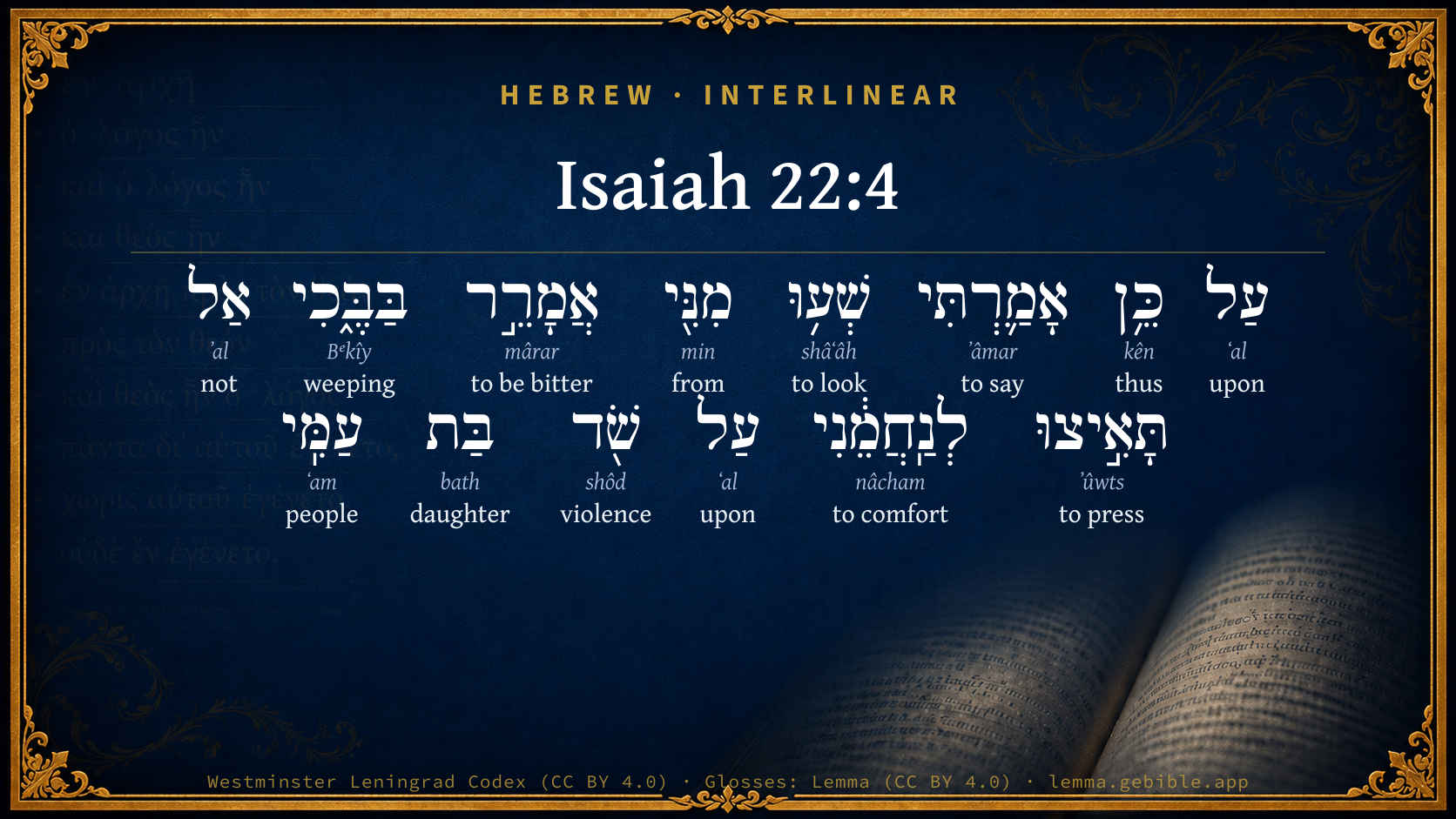
Hebrew (Westminster Leningrad Codex) Isaiah 22:4 appears in the Hebrew Old Testament. The text above is from the Westminster Leningrad Codex. Each word links to its Strong’s number, a concise gloss, and parsing drawn from the Open Scriptures Hebrew Bible morphology. Click any word for its full Brown-Driver-Briggs (BDB) entry.
Download image
Cite this verse

Isaiah 22:4 (World English Bible). Public Domain. Lemma interlinear Bible study tool, https://lemma.gebible.app/v/isaiah/22/4.

Show BibTeX & RIS
BibTeX
RIS
English Translation
Therefore said I, Look away from me, I will weep bitterly; don't labor to comfort me for the destruction of the daughter of my people.
World English Bible · Public Domain
Download a study sheet

One document with this verse’s original text, its word-by-word gloss line, the meaning frame, cross-references with their text, attributed commentary, and full source and license credits — printable, and it pastes into notes with its structure intact.

This verse Autodidact and up

Study sheet (.html) Plain text (.txt)

A passage Seminary Student

Up to 50 verses in one chapter. A passage sheet keeps up to 6 commentary sources and 12 cross-references per verse, in the order this page ranks them, and says so on the sheet whenever that leaves anything out. Ask for a single verse and you get the Autodidact verse sheet above.

Everything on this page stays free to read, with no account — the sheet is a download of what is already on screen, not access to it.

Want to remove ads? Support Godless Engineer
Compare translations 3

The same verse in 3 English versions, stacked beneath the original-language interlinear above. Click any original word for its lexicon entry.

Each is an independent rendering of the whole verse — the interlinear is not word-aligned to these translations.

Highlighted words mark where these versions differ — a whole-verse word diff, not a word-by-word alignment.

  • World English Bible Public Domain
    Therefore said I, Look away from me, I will weep bitterly; don't labor to comfort me for the destruction of the daughter of my people.
  • King James Version Public Domain
    Therefore said I, Look away from me; I will weep bitterly, labour not to comfort me, because of the spoiling of the daughter of my people.
  • unfoldingWord Literal Text CC BY-SA 4.0
    Therefore I said, “Look away from me; let me be bitter in weeping. May you not try to comfort me about the destruction of the daughter of my people.”

unfoldingWord Literal Text — © unfoldingWord, licensed CC BY-SA 4.0. Word-aligned USFM3 via Door43 (git.door43.org/unfoldingWord/en_ult).

Versions to compare (up to 4)

3 of 4 selected

Show all 18 translations

Every available English version of this verse, each an independent rendering of the whole verse.

  • World English Bible Public Domain
    Therefore said I, Look away from me, I will weep bitterly; don't labor to comfort me for the destruction of the daughter of my people.
  • Berean Standard Bible Public Domain
    Therefore I said, “Turn away from me, let me weep bitterly! Do not try to console me over the destruction of the daughter of my people.”
  • Majority Standard Bible Public Domain
    Therefore I said, “Turn away from me, let me weep bitterly! Do not try to console me over the destruction of the daughter of my people.”
  • King James Version Public Domain
    Therefore said I, Look away from me; I will weep bitterly, labour not to comfort me, because of the spoiling of the daughter of my people.
  • American Standard Version (1901) Public Domain
    Therefore said I, Look away from me, I will weep bitterly; labor not to comfort me for the destruction of the daughter of my people.
  • Revised Version (1885) Public Domain
    Therefore said I, Look away from me, I will weep bitterly; labour not to comfort me, for the spoiling of the daughter of my people.
  • Geneva Bible (1599) Public Domain
    Therefore said I, Turne away from me: I wil weepe bitterly: labour not to comfort mee for the destruction of the daughter of my people.
  • Douay-Rheims (1899) Public Domain
    Therefore have I said: Depart from me, I will weep bitterly: labour not to comfort me, for the devastation of the daughter of my people.
  • Young's Literal Translation Public Domain
    Therefore I said, `Look ye from me, I am bitter in my weeping, Haste not to comfort me, For the destruction of the daughter of my people.'
  • Literal Standard Version CC BY-SA 4.0
    Therefore I said, “Look [away] from me, || I am bitter in my weeping, do not hurry to comfort me, || For the destruction of the daughter of my people.”
  • Unlocked Literal Bible CC BY-SA 4.0
    Therefore I said, “Do not look at me, I will weep bitterly; do not try to comfort me concerning the destruction of the daughter of my people.”
  • unfoldingWord Literal Text CC BY-SA 4.0
    Therefore I said, “Look away from me; let me be bitter in weeping. May you not try to comfort me about the destruction of the daughter of my people.”
  • Darby Bible Public Domain
    Therefore said I, Look away from me; let me weep bitterly: labour not to comfort me, because of the spoiling of the daughter of my people.
  • World Messianic Bible Public Domain
    Therefore I said, “Look away from me. I will weep bitterly. Don’t labor to comfort me for the destruction of the daughter of my people.
  • Webster's Bible Public Domain
    Therefore said I, Look away from me; I will weep bitterly, labor not to comfort me, because of the devastation of the daughter of my people.
  • Free Bible Version CC BY-SA 4.0
    That's why I said, “Go away! Let me mourn in peace. Don't insist on comforting me as the daughter of my people is ruined.”
  • Bible in Basic English Public Domain
    For this cause I have said, Let your eyes be turned away from me in my bitter weeping; I will not be comforted for the wasting of the daughter of my people.
  • JPS Tanakh (1917) Public Domain
    Therefore said I: 'Look away from me, I will weep bitterly; strain not to comfort me, for the destruction of the daughter of my people.'

Literal Standard Version (2020), Covenant Press — licensed CC BY-SA 4.0. Text via the HelloAO Bible API (eBible.org). Unlocked Literal Bible (unfoldingWord) — licensed CC BY-SA 4.0. Text via the HelloAO Bible API (eBible.org). unfoldingWord Literal Text — © unfoldingWord, licensed CC BY-SA 4.0. Word-aligned USFM3 via Door43 (git.door43.org/unfoldingWord/en_ult). Free Bible Version, Dr. Jonathan Gallagher — licensed CC BY-SA 4.0. Text via the HelloAO Bible API (eBible.org).

Word by word

More ways to search: Search by grammar → Find every occurrence → Compare this word →

Practice this passage: Drill this verse → Learn its vocabulary →

תָּאִ֣יצוּ
ʼûwts
H213
“to press”
Verb, Hiphil, Jussive, 2nd Person, Masculine, Plural
Part of Speech
Verb
Stem
Hiphil
Form
Jussive
Person
2nd Person
Gender
Masculine
Number
Plural
Full BDB Definition

Origin: a primitive root

TWOT: 51

to press, be pressed, make haste, urge, be narrow - (Qal) - to press, hasten - to be pressed, confined, narrow - to hasten, make haste - be narrow - (Hiphil) - to urge, insist - to hasten
  1. עַל ʻal H5921 “upon” Preposition
  2. כֵּ֥ן kên H3651 “thus” Particle, Demonstrative
  3. אָמַ֛רְתִּי ʼâmar H559 “to say” Verb, Qal, Perfect, 1st Person, Common, Singular
  4. שְׁע֥וּ shâʻâh H8159 “look” Verb, Qal, Imperative, 2nd Person, Masculine, Plural
  5. מִנִּ֖י min H4480 “from · me” Preposition + Suffix, Personal, 1st Person, Common, Singular
  6. אֲמָרֵ֣ר mârar H4843 “to be bitter” Verb, Piel, Imperfect, 1st Person, Common, Singular
  7. בַּבֶּ֑כִי Bᵉkîy H1065 “in/at the · weeping” Preposition, Determined + Noun, Common, Masculine, Singular, Absolute
  8. אַל ʼal H408 “not” Particle, Negative
  9. לְנַֽחֲמֵ֔נִי nâcham H5162 “to comfort · me” Preposition + Verb, Piel, Infinitive Construct + Suffix, Personal, 1st Person, Common, Singular
  10. עַל ʻal H5921 “upon” Preposition
  11. שֹׁ֖ד shôd H7701 “violence of” Noun, Common, Masculine, Singular, Construct
  12. בַּת bath H1323 “daughter of” Noun, Common, Feminine, Singular, Construct
  13. עַמִּֽי ʻam H5971 “people · my” Noun, Common, Masculine, Singular, Construct + Suffix, Personal, 1st Person, Common, Singular

About this verse

These counts appear in no published source. They are computed here, from the morphology-tagged text and Lemma’s own curated glosses. What Lemma adds →

14
words
13
distinct lemmas
Prophets
section

Notable vocabulary

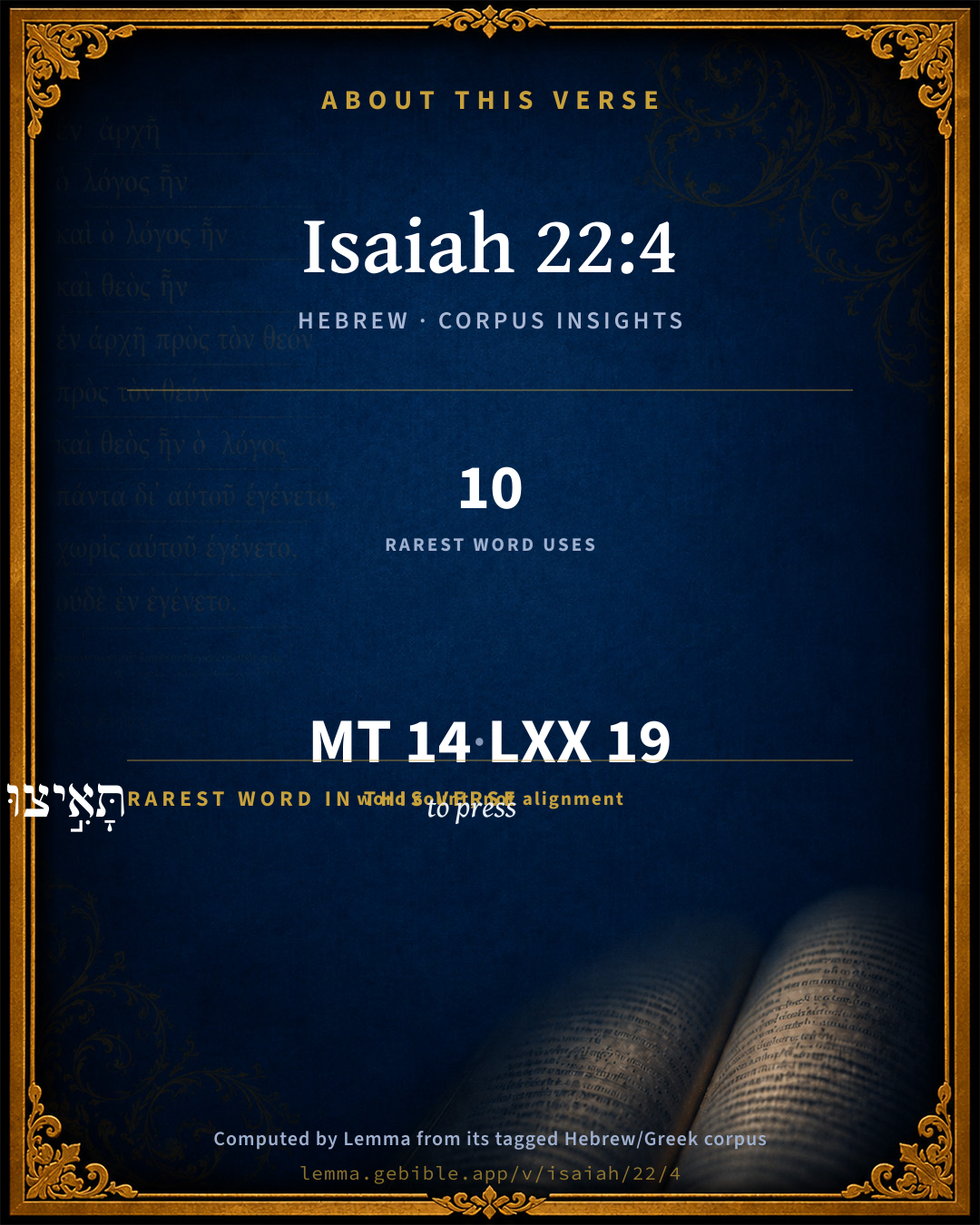
The rarest word here is תָּאִ֣יצוּ to press H213 — appearing just 10 times in the whole Hebrew Bible.

Shared distinctive vocabulary

תָּאִ֣יצוּ to press H213 occurs in 10 verses of the Hebrew Bible. Also found in:

Grammatical profile

  • 5 verbs
  • 4 nouns
  • 3 prepositions
  • 2 particles

Verb forms

  • אָמַ֛רְתִּי Qal · Perfect
  • שְׁע֥וּ Qal · Imperative
  • אֲמָרֵ֣ר Piel · Imperfect
  • תָּאִ֣יצוּ Hiphil · Jussive
  • לְנַֽחֲמֵ֔נִי Piel · Infinitive Construct

Repetition

A word recurs within this verse — often emphatic in Hebrew:

Hebrew & Septuagint length

In English translation the verse runs 25 words from the Hebrew and 24 from the Septuagint (LXX English) — closely comparable.

A rough comparison of the two English renderings, which tokenize alike — not a word-level alignment.

Word counts can differ between the Hebrew and the Greek without any difference in meaning — e.g. the Hebrew direct-object marker אֵת has no separate Greek word, and Greek often adds the article ὁ.

In the original languages it is 14 Hebrew tokens and 19 Greek tokens — but the two are counted differently (Hebrew bundles its prefixes and suffixes into one token; the Greek is in lemma form), so that isn’t a like-for-like length.

Cross-references

15

Topical passages linked to Isaiah 22:4 in the Treasury of Scripture Knowledge — connected by theme and wording, ordered by reader-vote popularity; previews shown in the World English Bible.

  • Jeremiah 9:1 Oh that my head were waters, and my eyes a spring of tears, that I might weep day and night for the slain of the daughter of my people!
  • Matthew 2:18 "A voice was heard in Ramah, Lamentation, weeping and great mourning, Rachel weeping for her children; She wouldn't be comforted, Because they are no more."
  • Psalms 77:2 In the day of my trouble I sought the Lord. My hand was stretched out in the night, and didn't get tired. My soul refused to be comforted.
  • Jeremiah 13:17 But if you will not hear it, my soul shall weep in secret for [your] pride; and my eye shall weep sore, and run down with tears, because Yahweh's flock is taken captive.
  • Jeremiah 31:15 Thus says Yahweh: A voice is heard in Ramah, lamentation, and bitter weeping, Rachel weeping for her children; she refuses to be comforted for her children, because they are no more.
  • Micah 1:8 For this I will lament and wail; I will go stripped and naked; I will howl like the jackals, And moan like the daughters of owls.
  • Ruth 1:20–21 She said to them, "Don't call me Naomi, call me Mara; for the Almighty has dealt very bitterly with me.
  • Isaiah 15:3 In their streets they gird themselves with sackcloth; on their housetops, and in their broad places, everyone wails, weeping abundantly.
  • Isaiah 33:7 Behold, their valiant ones cry outside; the ambassadors of peace weep bitterly.
  • Jeremiah 4:19 My anguish, my anguish! I am pained at my very heart; my heart is disquieted in me; I can't hold my peace; because you have heard, O my soul, the sound of the trumpet, the alarm of war.
  • Jeremiah 6:26 Daughter of my people, gird you with sackcloth, and wallow yourself in ashes: make you mourning, as for an only son, most bitter lamentation; for the destroyer shall suddenly come on us.
  • Jeremiah 8:18 Oh that I could comfort myself against sorrow! my heart is faint within me.
  • Matthew 26:75 Peter remembered the word which Jesus had said to him, "Before the rooster crows, you will deny me three times." He went out and wept bitterly.
  • Luke 1:2 even as those who from the beginning were eyewitnesses and ministers of the word delivered them to us,
  • Luke 19:41 When he drew near, he saw the city and wept over it,

Cross-references courtesy of OpenBible.info (CC BY 4.0).

Hebrew and Greek witnesses Masoretic Hebrew ↔ Greek Septuagint

The same verse in the two great witnesses to the Old Testament, shown verse-for-verse.

These are two independent witnesses, not word-aligned to each other, and the Septuagint is shown in lemma (dictionary) form.

Hebrew Isaiah 22:4 Masoretic · Westminster Leningrad Codex

עַל כֵּ֥ן אָמַ֛רְתִּי שְׁע֥וּ מִנִּ֖י אֲמָרֵ֣ר בַּבֶּ֑כִי אַל תָּאִ֣יצוּ לְנַֽחֲמֵ֔נִי עַל שֹׁ֖ד בַּת עַמִּֽי

Therefore said I, Look away from me, I will weep bitterly; don't labor to comfort me for the destruction of the daughter of my people.

World English Bible · Public Domain

Greek LXX Isaiah 22:4 Septuagint · lemma form

διά οὗτος εἶπον ἀποἵημι ἐγώ πικρῶς κλαίω μή καταἰσχύω παρακαλέω ἐγώ ἐπί ὁ σύντριμμα ὁ θυγάτηρ ὁ γένος ἐγώ

Therefore I said, Let me alone, I will weep bitterly; labor not to comfort me for the breach of the daughter of my people.

LXX2012 (modern English Septuagint) · Public Domain

Hebrew: Westminster Leningrad Codex (CC BY 4.0). Greek: Septuagint (public domain); English from LXX2012 (modern English Septuagint) (Public Domain). How the Septuagint differs from the Hebrew →

Targum (Aramaic paraphrase)

1

The Targum is the ancient Jewish Aramaic paraphrase of the Hebrew Scriptures — an interpretive translation, not the Hebrew text itself. Onkelos (literal) and Pseudo-Jonathan (expansive) render the Torah, and Jonathan the Prophets. Coverage is partial: where no permissively-licensed English translation exists for a verse, only the Aramaic is shown. This is verse-level text, not a word-by-word alignment to the Hebrew.

  1. Targum Jonathan Prophets (Joshua–Malachi)
    עַל כֵּן אֲמַרֵית שְׁבוּקוּ מִנִי אֶבְכֵּי בִמְרָר לָא תִתְבְּעִיתוּ לְנַחֲמוּתִי עַל תְּבַר כְּנִשְׁתָּא דְעַמִי:

    Wherefore I said: Leave off from me, I will weep bitterly, seek ye not to comfort me for the desolation of the congregation of my people.

    Targum Jonathan — Aramaic: “Mikraot Gedolot” (public domain). English: “Sefaria Community Translation” (CC0 1.0 (public-domain dedication)); “London "Chaldee Paraphrase," 1871” (public domain). Text via Sefaria.

Commentary

Notes on Isaiah 22:4 from classic Christian and Jewish commentators (each source and its license shown beneath its notes). The classic Christian expositions comment on the surrounding passage and are grouped to its opening verse, so a note may address several verses; the Jewish commentaries on the Tanakh (Rashi and others) are per-verse, so they appear only where the commentator wrote on this verse.

Lemma curates 59 commentaries, every one of them public domain or Creative Commons licensed, each selected and text-cleaned for this edition rather than reprinted as found. About our sources →

Trapp's Complete Commentary

John Trapp

Isa 22:4 Therefore said I, Look away from me; I will weep bitterly, labour not to comfort me, because of the spoiling of the daughter of my people.

Ver. 4. Therefore said I, Look away from me.] Ut luctui et lamentis me totum dedam; that unseen I may soak myself in the salt tears of sorrow for Zion.

John Trapp, A Commentary or Exposition upon All the Books of the Old and New Testament (1647–1656) — public domain. Text from a community e-Sword module.

Joseph Benson's Commentary

Isa 22:4-5. Therefore said I, &c. — “Behold the prophet here anticipating those lamentations which he was afterward to pour forth, and which Jeremiah so pathetically poured forth, an eye-witness of this calamity. For the expressions here are too strong to be applied to any other calamity than the great and final one, when the Jews were carried captives to Babylon;”

of which the prophet had a clear foresight. Look away from me — Take off your eyes and thoughts from me, and leave me alone, that I may take my fill of sorrow. Labour not to comfort me — For all your labour will be lost. I neither can nor will receive any consolation. Because of the spoiling, &c. — Of that city and nation, whereof I am a member. The title of daughter is often given both to cities and nations, as hath been observed before. For it is a day of treadling down — In which my people are trodden under foot by their insolent enemies; and of perplexity by the Lord of hosts — This is added, partly to show, that this did not happen without God’s providence; and partly to aggravate their calamity, because, not only men, but God himself fought against them; breaking down the walls — Of the strong cities of Judah; which was done both by Sennacherib and by Nebuchadnezzar; and of crying to the mountains — With such loud and dismal outcries as should reach to the neighbouring mountains. “Who does not see,” says Vitringa, “in Isaiah, thus weeping over Jerusalem, a type of Jesus weeping over this same city in its last extremity?”

Joseph Benson's Commentary on the Old and New Testaments (1811–1818) — public domain. Text from a community e-Sword module.

Tyndale Open Study Notes

Tyndale Open Resources

22:4 Leave me alone to weep: Isaiah mourned the victims and the decimation of his people (see 6:13).

Tyndale Open Study Notes — © Tyndale Open Resources, licensed CC BY-SA 4.0. Text via the HelloAO Bible API.

Geneva Bible (1599)

Geneva Bible translators

He showeth what is the duty of the godly, when God’s plagues hang over the Church, and especially of the ministers, Jer. 9:1.

Geneva Bible (1599) marginal notes — public domain. Text via Bolls.life.

Jamieson, Fausset & Brown

Robert Jamieson, A. R. Fausset & David Brown

Look . . . from me--Deep grief seeks to be alone; while others feast joyously, Isaiah mourns in prospect of the disaster coming on Jerusalem (Mic 1:8-9).

daughter, &c.--(see on Isa 1:8; Lam 2:11).

Jamieson, Fausset & Brown — Commentary Critical and Explanatory on the Whole Bible (1871) — public domain (CC PDM 1.0). Text via the HelloAO Bible API.

Ellicott's Commentary for English Readers

(4) Therefore said I, Look away from me.—The tone is that of one who wishes to be alone in his sorrow. It is too deep for visits of consolation. He “refuses to be comforted.” Isaiah bewails the destruction of “the daughter of his people” in much the same strain as that of Jeremiah over a later catastrophe (Lam_3:48).

A Bible Commentary for English Readers, edited by Charles John Ellicott (1878–1897) — public domain. Text from a community e-Sword module.

The Cambridge Bible for Schools and Colleges

gen. ed. J. J. S. Perowne

4. Look away from me] i.e. “leave me alone,” as Job_7:19.

labour not is strictly press not upon me, and spoiling should be destruction. The prophet’s gaze is already on the future.

daughter of my people] The phrase, common in Jeremiah and Lamentations, occurs only here in Isaiah.

The Cambridge Bible for Schools and Colleges (gen. ed. J. J. S. Perowne; Cambridge University Press, 1878–1918) — public domain. Text from a community e-Sword module.

John Gill's Exposition

Therefore said I,.... Not God to the ministering angels, as Jarchi; but the prophet to those that were about him, his relations, friends, and acquaintance:

look away from me; turn away from me, look another way; cease from me, let me alone; leave me to myself, that I may weep in secret, take my fill of sorrow, and give full vent to it:

I will weep bitterly; or, "I will be bitter", or, "bitter myself in weeping" (n); it denotes the vehemence of his grief, the greatness of his sorrow, and the strength of his passion:

labour not to comfort me; make use of no arguments to persuade me to lay aside my mourning; do not be urgent and importunate with me to receive consolation, for my soul refuses to be comforted:

because of the spoiling of the daughter of my people; his countrymen, which were as dear to him as a daughter to a tender parent, now spoiled, plundered, and made desolate by the ravages of the enemy, in many cities of Judea.

(n) "amarificabo me in fletu", Montanus; "amaritudine afficiam me in isto fletu", Junius & Tremellius.

John Gill's Exposition of the Whole Bible (1746–1763) — public domain (CC PDM 1.0). Text via the HelloAO Bible API.

Albert Barnes' Notes on the Bible

Look away from me - Do not look upon me - an indication of deep grief, for sorrow seeks to be alone, and grief avoids publicity and exposure.

I will weep bitterly - Hebrew, ‘I will be bitter in weeping.’ Thus we speak of “bitter” sorrow, indicating excessive grief (see the note at Isa 15:5; compare Jer 13:17; Jer 14:17; Lam 1:16; Lam 2:11; Mic 1:8-9).

Labour not - The sense is, ‘My grief is so great that I cannot be comforted. There are no topics of consolation that can be presented. I must be alone, and allowed to indulge in deep and overwhelming sorrow at the calamities that are coming upon my nation and people.’

Because of the spoiling - The desolation; the ruin that is coming upon them.

The daughter of my people - Jerusalem (see the note at Isa 1:8; compare Jer 4:11; Jer 6:14; Jer 8:19, Jer 8:21-22; Lam 2:11; Lam 4:3, Lam 4:6, Lam 4:10).

Albert Barnes' Notes on the Bible (1834–1885) — public domain. Text from a community e-Sword/MySword module.

Haydock's Catholic Bible Commentary

People. He saw this in spirit, though he might not live to witness it. (Calmet)

George Leo Haydock (1774–1849), Haydock's Catholic Family Bible and Commentary, 1859 edition — public domain. Excludes Psalms (Douay-Rheims chapter numbering differs from Protestant) and Deuterocanonical books (Catholic canon only).

Matthew Poole's English Annotations

Look away from me; take off your eyes and thoughts from me, and leave me alone, that I may take my fill of sorrows.

Labour not to comfort me; for all your labour will be lost, I neither can nor will receive any consolation.

Of the daughter of my people; of that city and nation whereof I am a member. The title of daughter is oft given both to cities and nations, as hath been noted before.

Matthew Poole's English Annotations on the Holy Bible (1683–1685) — public domain. Text from a community e-Sword/MySword module.

Whedon's Commentary on the Bible

Daniel D. Whedon

4, 5. Therefore… Look away from me — Advice to let the prophet alone, to obtrude not on his sorrow. No consolation can reach him.

Daughter of my people — Inhabitants of Jerusalem.

Trouble… treading down… perplexity — Mental anguish extreme to the prophet, while the thoughtless people are insensible to coming woes. Terrible day in prospect, but Jehovah sends it as the last recourse with a view to correction.

Crying — Wails which reach to and echo back from the mountains, allusive of the valley whence they come.

Daniel D. Whedon (gen. ed.), Commentary on the Old and New Testaments (1874–1909) — public domain. Text from a community e-Sword module.

The Pulpit Commentary

Therefore said I The prophet turns from the description of the scene before him to an account of his own feelings. Look away from me, he says; "leave me free to vent my sorrow without restraint; I wish for no consolation only leave me to myself." Because of the spoiling. The word used sometimes means" destruction;" but" spoiling" is a better rendering here. Sennacherib describes his "spoiling" of Jerusalem on this occasion as follows: "Thirty talents of gold, eight hundred talents of silver, precious carbuncles, great... stones, couches of ivory, lofty thrones of ivory, skins of buffaloes, horns of buffaloes, weapons, everything, a great treasure, and his daughters, the eunuchs of his palace, male musicians, and female musicians, to Nineveh, the city of my dominion, did Hezekiah send after me" (G. Smith, "Eponym Canon," p. 135, II 29-37). To what straits Hezekiah was reduced in order to collect a sufficient amount of the precious metals we learn from 2Ki_18:15, 2Ki_18:16.

Vers. 4-6. Isaiah weeping for the daughter of his people a type of Christ lamenting over Jerusalem.

Isaiah was in many respects a type of Christ. His name, which sight ties "Salvation of Jehovah," is a near equivalent of "Jesus," which means "Jehovah is Savior." Tradition says that he was of royal lineage, like Jesus. The sphere of his teaching was in the main Jerusalem, where our Lord"s principal discourses were delivered. He reproved sin, yet pitied the sinner, like Jesus (see Homiletics on Isa_15:5). He was, like Jesus, martyred at Jerusalem. We may, therefore, without impropriety, regard the "bitter weeping" of ver. 4 as in some respect the counterpart of our Lord"s lament on the day of his triumphal entry into the city, when he beheld it from the brow of Olivet. They were alike in several respects.

I BOTH WERE CAUSED BY PROPHETIC VISION OF THE HORRORS OF A SIEGE. In Isaiah"s time the siege had begun. The enemy was investing the place (ver. 7). But his tears flowed on account of the future "spoiling" of his people on that "day of trouble and treading down and perplexity;" when there was to be "breaking down of walls and crying to the mountains" (ver. 5), and Elam was to "bear the quiver," and Kir to "uncover the shield." Jesus wept because the days were coming upon Jerusalem, when "her enemies would cast a trench about her, and compass her round, and keep her in on every side, "and at last" lay her even with the ground, and her children within her". (Luk_19:43, Luk_19:44) In the one case Rome was the enemy, in the other Assyria, both equally truculent. In the one case final destruction impended; in the other a punishment far short of final destruction, but still a very severe punishment. In both cases grievous sins had provoked the catastrophe, yet the thought of these did not prevent the tears from being shed on account of it.

II BOTH DERIVED THEIR BITTERNESS FROM THE FACT THAT THE SUFFERER WAS OF KIN TO THE MOURNER. "I will weep," said Isaiah, "because of the spoiling of the daughter of my people." The woes of other peoples shocked and distressed him to some extent; (Isa_15:5 Isa_16:9-11 Isa_21:3, Isa_21:4) but not as those of his own nation, his "kinsmen according to the flesh." And so it was with Jesus. Patriotism moved the spirits of both mourners, and rendered their grief especially poignant.

III BOTH WERE AGGRAVATED BY THE THOUGHT THAT THE SUFFERING WAS UNEXPECTED. Isaiah tells us that at Sennacherib"s siege no preparations had been made to resist the foe, until the choice valleys were full of troops, and the horsemen set in array at the gates (vers. 7-10). Our Lord gives it as the climax of the horrors at the siege by Titus, that Jerusalem had not "known the day of her visitation". (Luk_19:44) Jerusalem was at the time expecting the Messiah, who would enable them to cast off the Roman yoke. She did not know that her Messiah had come. Just when she was looking for a glorious deliverance, there came a crushing disaster. So Hezekiah was probably looking for victory by the help of Egypt, when he had to make the most abject submission to strip the temple in order to satisfy the cravings of the conqueror for "spoil," and to see a large part of his people carried into captivity (G. Smith, "Eponym Canon," p. 134).

Christian patriotism.

The profound concern which the prophet of the Lord displays for "the daughter of his people," showing us that the reception and the record of the prophetic vision did not interfere with his strong feelings as a Hebrew patriot, may suggest thoughts on Christian patriotism. This is to be clearly distinguished from:

1. The exaggerated self-consciousness or vain-gloriousness which some "patriots" exhibit.

2. The exclusiveness of spirit which others betray.

3. The diseased sensitiveness which leads many to catch at the first apparent international wrong as a valid casus belli. A great deal passes current as patriotism which would have been allowable, if not creditable, under heathenism, but which is simply false and guilty under the Divine teaching we have received who have learned of Christ. That man is the true friend of his country who takes

I A DEEP AND PRACTICAL INTEREST IN ITS POLITICAL WELFARE. A part of the "spoiling" to which Isaiah refers is to be found in the threatened seizure of his country"s political independence, its being made subcut and tributary to the invader; this could not be other than a calamity of the first consequence in his eyes. The Christian patriot, while he ought to oppose most strenuously all unrighteous projects on the part of his own people, does well to be earnestly concerned for the integrity, the independence, the reputation, of his native land.

II A PRACTICAL INTEREST IN ITS MATERIAL WELL-BEING. No doubt this "spoiling" included, in the prophet"s thought, the destruction of its property and the deportation of its wealth. Considering how all the citizens, the wage-receiving multitudes as welt as the wealthier minority, are affected by the material prosperity of the land, it is right and Christian for us to make this a matter of careful and conscientious effort.

III A PROFOUND INTEREST IN ITS MORAL AND SPIRITUAL CONDITION. It was

(1) the moral condition of Jerusalem, feasting and making merry on the day of its humiliation (vers. 12, 13); and also

(2) its spiritual condition, forgetting its true Deliverer (ver. 11), and slighting his discipline (ver. 12), which so much distressed the holy prophet.

And it should be the moral and spiritual condition of our country which should create in us and call forth from us our most profound solicitude. And this because

(1) that is the matter of most intrinsic importance;

(2) that is the thing on which the Divine judgment and determination will depend; and

(3) that will be ultimately decisive of our country"s political and material interests. If we would do our whole duty in relation thereto, we shall:

1. Join in prayer for Divine mercies.

2. Be careful to exert the influence of a godly and irreproachable example.

3. Exert all our power as individual men and through useful organizations for the guidance and the elevation of the people. C.

"A time to weep.

"Therefore I say, Look away from me; let me weep bitterly." Eastern weeping is excessive, unrestrained. Westerns go to the other extreme, and severely repress all expressions and signs "of emotion. Eastern grief is often exaggerated, and it is in danger of being conventional and even hypocritical. Public weeping, at least on the part of the prophets, became a testimony and a warning. It belonged to their teaching by signs. Isaiah"s weeping here drew public attention, and led to inquiries as to the meaning of such exceeding distress. The following points are sufficiently suggestive to need no more than brief statement.

I WE MAY WEEP IN ANTICIPATION. If we can see trouble ahead, and our distress can be the means of awakening others who are careless, but who ought to be preparing to meet the trouble, our very griefs may be a "fore-warning.

II WE MAY WEEP IN TIME OF TROUBLE. Because tears are the natural expressions of feeling, and the natural relief of overcharged feeling. Danger to brain and heart attend undue restraint of tears.

III WE MAY WEEP IN SYMPATHY WITH OTHERS. Often such silent sympathy is more effective than any words. To feel with another so as to join in the same expression of feeling is most soothing and comforting. The sublime illustration of this is our Redeemer weeping in human sympathy with gentle Mary at the grave of Lazarus.

IV WE MUST NOT LET OUR WEEPING BECOME A SELFINDULGENCE. This is a greater peril to us all than we are wont to estimate. There is a luxury of grief; a keeping it up for the sake of the comforting and petting it brings; a pleasant giving way. Weeping is wrong, is mischievous, the moment it passes beyond the bounds of what is necessary for relief. As soon as self comes in, and we will to give way, our weeping becomes sin.

V WE MAY WEEP AS A TESTIMONY. For this we have the example of our Divine Lord and Master, who" when he beheld the city of Jerusalem the very city concerning which Isaiah wept, wept over it, saying, Oh that thou hadst known, in this thy day, the things that make for thy peace!" John Howe most suggestively calls this "The Redeemer"s tears wept over lost souls. R.T.

The Pulpit Commentary (1880–1919), ed. H.D.M. Spence-Jones & Joseph S. Exell — public domain. Text from a community e-Sword module.

John Wesley's Explanatory Notes

Look away - Take off your eyes and thoughts from me, and leave me alone.

John Wesley, Explanatory Notes Upon the Whole Bible (1754–1765) — public domain. Text via the GEBible commentary corpus.

Keil & Delitzsch

C. F. Keil & F. Delitzsch

"Therefore I say, Look away from me, that I may weep bitterly; press me not with consolations for the destruction of the daughter of my people! For a day of noise, and of treading down, and of confusion, cometh from the Lord, Jehovah of hosts, in the valley of vision, breaking down walls; and a cry of woe echoes against the mountains." The note struck by Isaiah here is the note of the kinah that is continued in the Lamentations of Jeremiah. Jeremiah says sheber for shod (Lam 3:48), and bath-ammi (daughter of my people) is varied with batḣZion (daughter of Zion) and bath-yehudah (daughter of Judah). Mērēr babbeci (weep bitterly) is more than bâcâh mar (Isa 33:7): it signifies to give one's self thoroughly up to bitter weeping, to exhaust one's self with weeping. The two similar sounds which occur in Isa 22:5, in imitation of echoes, can hardly be translated. The day of divine judgment is called a day in which masses of men crowd together with great noise (mehūmâh), in which Jerusalem and its inhabitants are trodden down by foes (mebūsâh) and are thrown into wild confusion (mebūcâh). This is one play upon words. The other makes the crashing of the walls audible, as they are hurled down by the siege-artillery (mekarkar kir). Kirkēr is not a denom. of kı̄r, as Kimchi and Ewald suppose (unwalling walls), but is to be explained in accordance with Num 24:17, "he undermines," i.e., throws down by removing the supports, in other words, "to the very foundations" (kur, to dig, hence karkârâh, the bottom of a vessel, Kelim ii. 2; kurkoreth, the bottom of a net, ib. xxviii. 10, or of a cask, Ahaloth ix. 16). When this takes place, then a cry of woe echoes against the mountain (shōa‛, like shūa‛, sheva‛), i.e., strikes against the mountains that surround Jerusalem, and is echoed back again. Knobel understands it as signifying a cry for help addressed to the mountain where Jehovah dwells; but this feature is altogether unsuitable to the God - forgetting worldly state in which Jerusalem is found. It is also to be observed, in opposition to Knobel, that the description does not move on in the same natural and literal way as in a historical narrative. The prophet is not relating, but looking; and in Isa 22:5 he depicts the day of Jehovah according to both its ultimate intention and its ultimate result.

Keil & Delitzsch — Biblical Commentary on the Old Testament (1861–1891) — public domain (CC PDM 1.0). Text via the HelloAO Bible API. (Old Testament only.)

J. A. Alexander on Isaiah

Joseph Addison Alexander

“Therefore I said (or say), Look away from me; let me be bitter in weeping (or weep bitterly); try not to comfort me for the desolation of the daughter of my people.” These are not the words of Jerusalem in answer to the question in v. 1, but those of the Prophet expressing his sympathy with the sufferings which he foresees and foretells, as in Isa 16:11. ‘The daughter of my people’ means the people itself, poetically represented as a woman, and affectionately spoken of as a daughter.

Joseph Addison Alexander, The Prophecies of Isaiah (1846–1847; New York: Scribner, 1870–1878) — public domain. Text from a community e-Sword module.

Rashi

Rabbi Shlomo Yitzchaki (Rashi)

Leave Me alone (שְׁעוּ מִנִּי). Leave Me alone. So says the Holy One, blessed be He, to the ministering angels.

Rashi on the Tanakh — English translations: “The Judaica Press complete Tanach with Rashi, translated by A. J. Rosenberg” (CC BY 4.0); “Pentateuch with Rashi's commentary by M. Rosenbaum and A.M. Silbermann, 1929-1934” (public domain); “The Metsudah Tanach series, Lakewood, N.J” (CC BY 4.0); and “The Book of Joshua, Metsudah Publications, 1997” (CC BY 4.0). Text via Sefaria.

Ibn Ezra

Rabbi Abraham ibn Ezra

Therefore said I. The first person refers to the prophet.

שעו ממני Look away from me. Root שעה to let loose, to turn away; comp. תשעה Thou wilt depart (Job 7:19).

אמרר בבכי I will embitter by weeping. I will embitter those that listen.

Ibn Ezra on the Tanakh — English translations: “Sefaria Community Translation” (CC0 1.0 (public-domain dedication)); “Yalkut, Sifsei Chachomim Chumash, Metsudah Publications, 2009” (CC BY 4.0); and “Commentary of Ibn Ezra on Isaiah - trans. by M. Friedlander, 1873” (public domain). Text via Sefaria.

Lesson kit

Teaching starters — assembled from the data on this page, not authored interpretation. Every prompt links to the verse data it draws on. Edit before teaching.

Isaiah, in the Prophets, opens this verse with 14 words (13 distinct Hebrew lemmas). Its most distinctive word is ʼûwts (“to press”). A historical commentator’s framing appears above. Read the whole chapter for the surrounding context.

Discussion questions

  1. The word ʼûwts carries the sense “to press.” How does it shape the verse?
  2. How does Genesis 19:15, which shares the word «to press», read alongside this verse?
  3. What does the repetition of “upon” (2× in this one verse) do in this verse?
  4. The translations on this page render this verse differently — a whole-verse word diff, not a word-by-word alignment. What might account for the different wordings?
  5. «אָמַ֛רְתִּי» is a Qal Perfect verb. How does that grammatical form shape the action described?
  6. Compare how Trapp's Complete Commentary and Joseph Benson's Commentary read this verse. Where do they agree or differ?

Things to notice

Reading settings

Reading text

Shown beneath each verse's original-language words.

Old Testament
Old Testament edition

Read the OT as the Masoretic Hebrew (MT) or the Greek Septuagint (LXX).

English shown for the Greek Septuagint (in the Hebrew ↔ Greek comparison).

Comparing translations? Open the Compare panel on any verse page to stack up to four side by side.