
Exodus 37:17

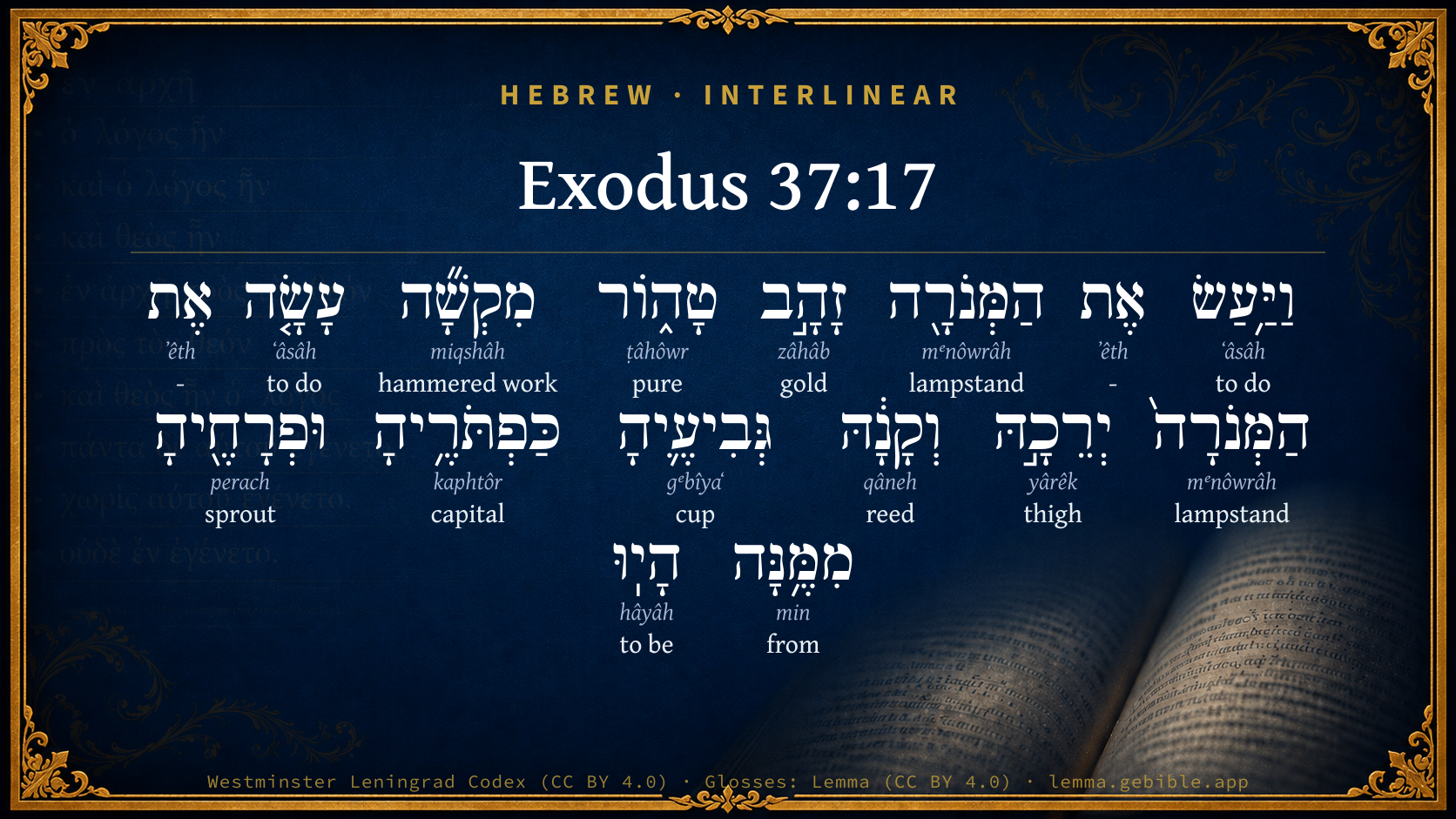
Hebrew (Westminster Leningrad Codex) Exodus 37:17 appears in the Hebrew Old Testament. The text above is from the Westminster Leningrad Codex. Each word links to its Strong’s number, a concise gloss, and parsing drawn from the Open Scriptures Hebrew Bible morphology. Click any word for its full Brown-Driver-Briggs (BDB) entry.
Download image
Cite this verse

Exodus 37:17 (World English Bible). Public Domain. Lemma interlinear Bible study tool, https://lemma.gebible.app/v/exodus/37/17.

Show BibTeX & RIS
BibTeX
RIS
English Translation
He made the lampstand of pure gold. He made the lampstand of beaten work. Its base, its shaft, its cups, its buds, and its flowers were of one piece with it.
World English Bible · Public Domain
Download a study sheet

One document with this verse’s original text, its word-by-word gloss line, the meaning frame, cross-references with their text, attributed commentary, and full source and license credits — printable, and it pastes into notes with its structure intact.

This verse Autodidact and up

Study sheet (.html) Plain text (.txt)

A passage Seminary Student

Up to 50 verses in one chapter. A passage sheet keeps up to 6 commentary sources and 12 cross-references per verse, in the order this page ranks them, and says so on the sheet whenever that leaves anything out. Ask for a single verse and you get the Autodidact verse sheet above.

Everything on this page stays free to read, with no account — the sheet is a download of what is already on screen, not access to it.

Want to remove ads? Support Godless Engineer
Compare translations 3

The same verse in 3 English versions, stacked beneath the original-language interlinear above. Click any original word for its lexicon entry.

Each is an independent rendering of the whole verse — the interlinear is not word-aligned to these translations.

Highlighted words mark where these versions differ — a whole-verse word diff, not a word-by-word alignment.

  • World English Bible Public Domain
    He made the lampstand of pure gold. He made the lampstand of beaten work. Its base, its shaft, its cups, its buds, and its flowers were of one piece with it.
  • King James Version Public Domain
    And he made the candlestick of pure gold: of beaten work made he the candlestick; his shaft, and his branch, his bowls, his knops, and his flowers, were of the same:
  • unfoldingWord Literal Text CC BY-SA 4.0
    And he made the lampstand of pure gold. The lampstand—its base and its shaft—were made of hammered work. Its cups, its buds, and its blossoms were from it.

unfoldingWord Literal Text — © unfoldingWord, licensed CC BY-SA 4.0. Word-aligned USFM3 via Door43 (git.door43.org/unfoldingWord/en_ult).

Versions to compare (up to 4)

3 of 4 selected

Show all 18 translations

Every available English version of this verse, each an independent rendering of the whole verse.

  • World English Bible Public Domain
    He made the lampstand of pure gold. He made the lampstand of beaten work. Its base, its shaft, its cups, its buds, and its flowers were of one piece with it.
  • Berean Standard Bible Public Domain
    Then he made the lampstand out of pure hammered gold, all of one piece: its base and shaft, its cups, and its buds and petals.
  • Majority Standard Bible Public Domain
    Then he made the lampstand out of pure hammered gold, all of one piece: its base and shaft, its cups, and its buds and petals.
  • King James Version Public Domain
    And he made the candlestick of pure gold: of beaten work made he the candlestick; his shaft, and his branch, his bowls, his knops, and his flowers, were of the same:
  • American Standard Version (1901) Public Domain
    And he made the candlestick of pure gold: of beaten work made he the candlestick, even its base, and its shaft; its cups, it knops, and its flowers, were of one piece with it:
  • Revised Version (1885) Public Domain
    And he made the candlestick of pure gold: of beaten work made he the candlestick, even its base, and its shaft; its cups, its knops, and its flowers, were of one piece with it:
  • Geneva Bible (1599) Public Domain
    Likewise he made the Candlesticke of pure golde: of worke beaten out with the hammer made he the Candlesticke: and his shaft, and his branche, his bolles, his knops, and his floures were of one piece.
  • Douay-Rheims (1899) Public Domain
    He made also the candlestick of beaten work of the finest gold. From the shaft whereof its branches, its cups, and bowls, and lilies came out:
  • Young's Literal Translation Public Domain
    And he maketh the candlestick of pure gold; of beaten work he hath made the candlestick, its base, and its branch, its calyxes, its knops, and its flowers, have been of the same;
  • Literal Standard Version CC BY-SA 4.0
    And he makes the lampstand of pure gold; he has made the lampstand of beaten work, its base, and its branch, its calyxes, its knobs, and its flowers, have been of the same;
  • Unlocked Literal Bible CC BY-SA 4.0
    He made the lampstand of pure hammered gold. He made the lampstand with its base and shaft. Its cups, its leafy bases, and its flowers were all made of one piece with it.
  • unfoldingWord Literal Text CC BY-SA 4.0
    And he made the lampstand of pure gold. The lampstand—its base and its shaft—were made of hammered work. Its cups, its buds, and its blossoms were from it.
  • Darby Bible Public Domain
    And he made the candlestick of pure gold; [of] beaten work he made the candlestick: its base, and its shaft, its cups, its knobs, and its flowers were of itself.
  • World Messianic Bible Public Domain
    He made the lamp stand of pure gold. He made the lamp stand of beaten work. Its base, its shaft, its cups, its buds, and its flowers were of one piece with it.
  • Webster's Bible Public Domain
    And he made the candlestick of pure gold; of beaten work he made the candlestick; its shaft, and its branch, its bowls, its knobs, and its flowers were of the same:
  • Free Bible Version CC BY-SA 4.0
    He made the lampstand of pure, hammered gold. The whole of it was made of one piece—its base, shaft, cups, buds, and flowers.
  • Bible in Basic English Public Domain
    Then he made the support for the lights, all of the best gold; its base and its pillar were of hammered gold; its cups and buds and flowers were all made out of the same metal:
  • JPS Tanakh (1917) Public Domain
    And he made the candlestick of pure gold: of beaten work made he the candlestick, even its base, and its shaft; its cups, its knops, and its flowers, were of one piece with it.

Literal Standard Version (2020), Covenant Press — licensed CC BY-SA 4.0. Text via the HelloAO Bible API (eBible.org). Unlocked Literal Bible (unfoldingWord) — licensed CC BY-SA 4.0. Text via the HelloAO Bible API (eBible.org). unfoldingWord Literal Text — © unfoldingWord, licensed CC BY-SA 4.0. Word-aligned USFM3 via Door43 (git.door43.org/unfoldingWord/en_ult). Free Bible Version, Dr. Jonathan Gallagher — licensed CC BY-SA 4.0. Text via the HelloAO Bible API (eBible.org).

Word by word

More ways to search: Search by grammar → Find every occurrence → Compare this word →

Practice this passage: Drill this verse → Learn its vocabulary →

מִקְשָׁ֞ה
miqshâh
H4749
“hammered work”
Noun, Common, Feminine, Singular, Absolute
Part of Speech
Noun
Type
Common
Gender
Feminine
Number
Singular
State
Absolute
Full BDB Definition

Origin: from H4748

TWOT: 2086b

hammered work, finely decorated cultic objects of gold or silver
  1. וַיַּ֥עַשׂ ʻâsâh H6213 “and · to do” Conjunction + Verb, Qal, Sequential Imperfect, 3rd Person, Masculine, Singular
  2. אֶת ʼêth H853 “-” Particle, Direct Object
  3. הַמְּנֹרָ֖ה mᵉnôwrâh H4501 “the · lampstand” Particle, Definite Article + Noun, Common, Feminine, Singular, Absolute
  4. זָהָ֣ב zâhâb H2091 “gold” Noun, Common, Masculine, Singular, Absolute
  5. טָה֑וֹר ṭâhôwr H2889 “pure” Adjective, Adjective, Masculine, Singular, Absolute
  6. עָשָׂ֤ה ʻâsâh H6213 “to do” Verb, Qal, Perfect, 3rd Person, Masculine, Singular
  7. אֶת ʼêth H853 “-” Particle, Direct Object
  8. הַמְּנֹרָה֙ mᵉnôwrâh H4501 “the · lampstand” Particle, Definite Article + Noun, Common, Feminine, Singular, Absolute
  9. יְרֵכָ֣הּ yârêk H3409 “thigh · her” Noun, Common, Feminine, Singular, Construct + Suffix, Personal, 3rd Person, Feminine, Singular
  10. וְקָנָ֔הּ qâneh H7070 “and · reed · her” Conjunction + Noun, Common, Masculine, Singular, Construct + Suffix, Personal, 3rd Person, Feminine, Singular
  11. גְּבִיעֶ֛יהָ gᵉbîyaʻ H1375 “cups · her” Noun, Common, Masculine, Plural, Construct + Suffix, Personal, 3rd Person, Feminine, Singular
  12. כַּפְתֹּרֶ֥יהָ kaphtôr H3730 “capitals · her” Noun, Common, Masculine, Plural, Construct + Suffix, Personal, 3rd Person, Feminine, Singular
  13. וּפְרָחֶ֖יהָ perach H6525 “and · sprouts · her” Conjunction + Noun, Common, Masculine, Plural, Construct + Suffix, Personal, 3rd Person, Feminine, Singular
  14. מִמֶּ֥נָּה min H4480 “from · her” Preposition + Suffix, Personal, 3rd Person, Feminine, Singular
  15. הָיֽוּ hâyâh H1961 “to be” Verb, Qal, Perfect, 3rd Person, Common, Plural

About this verse

These counts appear in no published source. They are computed here, from the morphology-tagged text and Lemma’s own curated glosses. What Lemma adds →

16
words
13
distinct lemmas
Pentateuch
section

Notable vocabulary

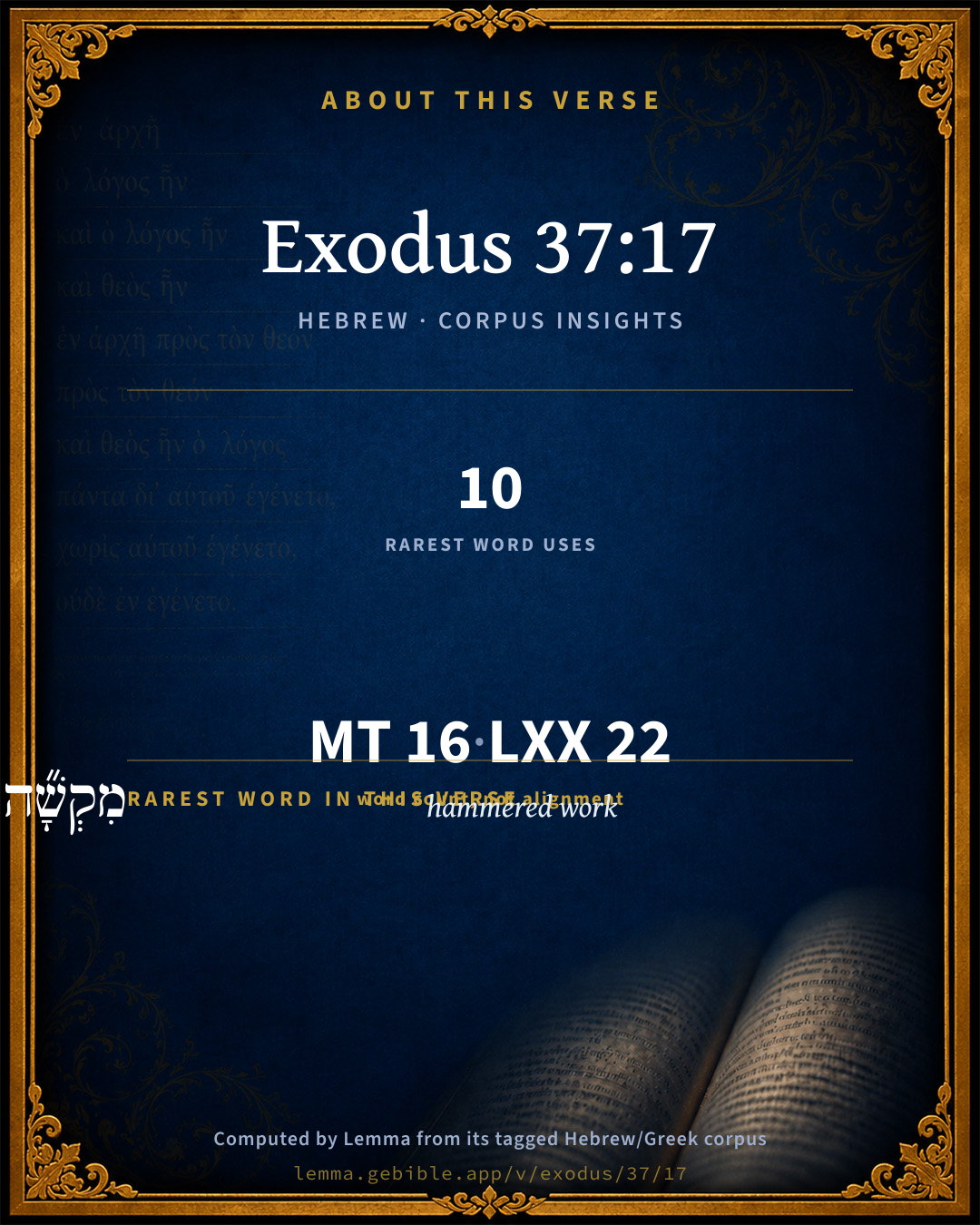
The rarest word here is מִקְשָׁ֞ה hammered work H4749 — appearing just 10 times in the whole Hebrew Bible.

Shared distinctive vocabulary

מִקְשָׁ֞ה hammered work H4749 occurs in 9 verses of the Hebrew Bible. Also found in:

Grammatical profile

  • 3 verbs
  • 9 nouns
  • 1 adjective
  • 1 preposition
  • 2 particles

Verb forms

  • וַיַּ֥עַשׂ Qal · Sequential Imperfect
  • עָשָׂ֤ה Qal · Perfect
  • הָיֽוּ Qal · Perfect

Repetition

Words recur within this verse — often emphatic in Hebrew:

  • וַיַּ֥עַשׂ to do H6213 ×2
  • הַמְּנֹרָ֖ה lampstand H4501 ×2

Hebrew & Septuagint length

In English translation the verse runs 31 words from the Hebrew and 21 from the Septuagint (LXX English) — the Septuagint runs noticeably shorter here. See the side-by-side →

A rough comparison of the two English renderings, which tokenize alike — not a word-level alignment.

Word counts can differ between the Hebrew and the Greek without any difference in meaning — e.g. the Hebrew direct-object marker אֵת has no separate Greek word, and Greek often adds the article ὁ.

In the original languages it is 16 Hebrew tokens and 22 Greek tokens — but the two are counted differently (Hebrew bundles its prefixes and suffixes into one token; the Greek is in lemma form), so that isn’t a like-for-like length.

Cross-references

12

Topical passages linked to Exodus 37:17 in the Treasury of Scripture Knowledge — connected by theme and wording, ordered by reader-vote popularity; previews shown in the World English Bible.

  • Exodus 25:31–39 "You shall make a lampstand of pure gold. Of hammered work shall the lampstand be made, even its base, its shaft, its cups, its buds, and its flowers, shall be of one piece with it.
  • Hebrews 9:2 For there was a tabernacle prepared. In the first part were the lampstand, the table, and the show bread; which is called the Holy Place.
  • Exodus 40:24–25 He put the lampstand in the tent of meeting, opposite the table, on the side of the tent southward.
  • Leviticus 24:4 He shall keep in order the lamps on the pure gold lampstand before Yahweh continually.
  • 1 Chronicles 28:15 by weight also for the lampstands of gold, and for the lamps of it, of gold, by weight for every lampstand and for the lamps of it; and for the lampstands of silver, [silver] by weight for [every] lampstand and for the lamps of it, according to the use of every lampstand;
  • 2 Chronicles 13:11 and they burn to Yahweh every morning and every evening burnt offerings and sweet incense: the show bread also [set they] in order on the pure table; and the lampstand of gold with the lamps of it, to burn every evening: for we keep the charge of Yahweh our God; but you have forsaken him.
  • Zechariah 4:2 He said to me, "What do you see?" I said, "I have seen, and, behold, a lampstand all of gold, with its bowl on the top of it, and its seven lamps thereon; there are seven pipes to each of the lamps, which are on the top of it;
  • Zechariah 4:11 Then I asked him, "What are these two olive trees on the right side of the lampstand and on the left side of it?"
  • Matthew 5:15 Neither do you light a lamp, and put it under a measuring basket, but on a stand; and it shines to all who are in the house.
  • John 1:4–9 In him was life, and the life was the light of men.
  • Philippians 2:15 that you may become blameless and harmless, children of God without blemish in the midst of a crooked and perverse generation, among whom you are seen as lights in the world,
  • Revelation 1:12–2:5 I turned to see the voice that spoke with me. Having turned, I saw seven golden lampstands.

Cross-references courtesy of OpenBible.info (CC BY 4.0).

Hebrew and Greek witnesses Masoretic Hebrew ↔ Greek Septuagint

The same verse in the two great witnesses to the Old Testament, shown verse-for-verse.

Here the Septuagint runs noticeably shorter than the Hebrew — LXX2012 (modern English Septuagint) 21 words vs World English Bible 31. A rough length comparison of the two English translations, not a word-level alignment — read both below.

These are two independent witnesses, not word-aligned to each other, and the Septuagint is shown in lemma (dictionary) form.

Hebrew Exodus 37:17 Masoretic · Westminster Leningrad Codex

וַיַּ֥עַשׂ אֶת הַמְּנֹרָ֖ה זָהָ֣ב טָה֑וֹר מִקְשָׁ֞ה עָשָׂ֤ה אֶת הַמְּנֹרָה֙ יְרֵכָ֣הּ וְקָנָ֔הּ גְּבִיעֶ֛יהָ כַּפְתֹּרֶ֥יהָ וּפְרָחֶ֖יהָ מִמֶּ֥נָּה הָיֽוּ

He made the lampstand of pure gold. He made the lampstand of beaten work. Its base, its shaft, its cups, its buds, and its flowers were of one piece with it.

World English Bible · Public Domain

Greek LXX Exodus 37:17 Septuagint · lemma form

καί ὁ στῦλος αὐτός τέσσαρες καί ὁ βάσις αὐτός τέσσαρες χαλκοῦς καί ὁ ἀγκύλη αὐτός ἀργυροῦς καί ὁ κεφαλίς αὐτός περιἀργυρόω ἀργύριον

and their pillars four, and their sockets four of brass, and their hooks of silver, and their capitals overlaid with silver.

LXX2012 (modern English Septuagint) · Public Domain

Hebrew: Westminster Leningrad Codex (CC BY 4.0). Greek: Septuagint (public domain); English from LXX2012 (modern English Septuagint) (Public Domain). How the Septuagint differs from the Hebrew →

Targum (Aramaic paraphrase)

2

The Targum is the ancient Jewish Aramaic paraphrase of the Hebrew Scriptures — an interpretive translation, not the Hebrew text itself. Onkelos (literal) and Pseudo-Jonathan (expansive) render the Torah, and Jonathan the Prophets. Coverage is partial: where no permissively-licensed English translation exists for a verse, only the Aramaic is shown. This is verse-level text, not a word-by-word alignment to the Hebrew.

  1. Targum Onkelos Torah (Genesis–Deuteronomy)
    וַעֲבַד יָת מְנַרְתָּא דְהַב דְכֵי נְגִיד עֲבַד יָת מְנַרְתָּא שִׁידַהּ וּקְנַהּ כַּלִידָהָא חֵזוּרָהָא וְשׁוֹשַׁנָהָא מִנַהּ הֲווֹ:

    (no public-domain English translation for this verse)

    Targum Onkelos — Aramaic: “Onkelos Genesis” (public domain); “Onkelos Exodus” (public domain); “Onkelos Leviticus” (public domain); “Onkelos Numbers” (public domain); “Onkelos Deuteronomy” (public domain). English: “Sefaria Community Translation” (CC0 1.0 (public-domain dedication)); “J.W. Etheridge. The Targums of Onkelos and Jonathan Ben Uzziel on the Pentateuch. London: Longmans, Green, 1862” (public domain). Text via Sefaria.

  2. Targum Pseudo-Jonathan Torah (Genesis–Deuteronomy)
    וַעֲבַד יַת מְנַרְתָּא דִּדְהַב דְּכֵי נְגִיד עֲבַד יַת מְנַרְתָּא בָּסִיס דִּידָהּ וּקְנָהָא כַּלִידָהָא חֲזוֹרְיָיהָא וְשׁוֹשַׁנְהָא מִינָהּ הֲווֹן

    And he made the CANDELABRUM of pure gold, beaten made he the candelabrum; its base and its shaft, its cups, its apples, and its lilies were of the same.

    Targum Pseudo-Jonathan — Aramaic: “Targum Jonathan on Genesis” (public domain); “Targum Jonathan on Exodus” (public domain); “Targum Jonathan on Leviticus” (public domain); “Targum Jonathan on Numbers” (public domain); “Targum Jonathan on Deuteronomy” (public domain). English: “The Targum of Jonathan ben Uzziel, trans. J. W. Etheridge, London, 1862” (public domain). Text via Sefaria.

Commentary

Notes on Exodus 37:17 from classic Christian and Jewish commentators (each source and its license shown beneath its notes). The classic Christian expositions comment on the surrounding passage and are grouped to its opening verse, so a note may address several verses; the Jewish commentaries on the Tanakh (Rashi and others) are per-verse, so they appear only where the commentator wrote on this verse.

Lemma curates 59 commentaries, every one of them public domain or Creative Commons licensed, each selected and text-cleaned for this edition rather than reprinted as found. About our sources →

Joseph Benson's Commentary

Exo 37:17. This candlestick, which was not of wood overlaid with gold, but all beaten work of pure gold only, signified that light of divine revelation with which God’s church upon earth (which is his tabernacle among men) hath always been enlightened, being always supplied with fresh oil from Christ the good olive, Zec 4:2-3. The Bible is a golden candlestick, it is of pure gold; from it light is diffused to every part of God’s tabernacle, that by it the spiritual priests may see to do the service of his sanctuary. This candlestick has not only its bowls for necessary use, but its knops and flowers for ornament; many things which God saw fit to beautify his word with, which we can no more give a reason for than for these knops and flowers, and yet must be sure they were added for some good purpose. Let us bless God for this candlestick, have an eye to it continually, and dread the removal of it out of its place!

Joseph Benson's Commentary on the Old and New Testaments (1811–1818) — public domain. Text from a community e-Sword module.

unfoldingWord translationNotes

Door43 World Missions Community

Connecting Statement:

Bezalel's work crew continues to build the tabernacle and furniture.

General Information:

(See: Numbers)

He made ... from the lampstand

For Exo 37:17-19 see how you translated many of these words in Exodus 25:31-32 and Exodus 25:33.

Its cups, its leafy bases, and its flowers were all made of one piece with it

This can be stated in active form. AT: "He made the cups, its leafy bases, and its flowers as one piece with the lampstand" (See: Active or Passive)

three cups made like almond blossoms

This can be stated in active form. AT: "he made the 3 cups look like almond blossoms" (See: Active or Passive)

almond blossoms

An almond blossom is a white or pink flower with five petals that grows on an almond tree.

translationWords

lampstand

pure

gold

unfoldingWord translationNotes — © Distant Shores Media and the Door43 World Missions Community, licensed CC BY-SA 4.0. Source: git.door43.org/Door43/en_tn.

Jamieson, Fausset & Brown

Robert Jamieson, A. R. Fausset & David Brown

he made the candlestick of pure gold--Practical readers will be apt to say, "Why do such works with the hammer, when they could have been cast so much easier--a process they were well acquainted with?" The only answer that can be given is, that it was done according to order. We have no doubt but there were reasons for so distinctive an order, something significant, which has not been revealed to us [NAPIER]. The whole of that sacred building was arranged with a view to inculcate through every part of its apparatus the great fundamental principles of revelation. Every object was symbolical of important truth--every piece of furniture was made the hieroglyphic of a doctrine or a duty--on the floor and along the sides of that movable edifice was exhibited, by emblematic signs addressed to the eye, the whole remedial scheme of the gospel. How far this spiritual instruction was received by every successive generation of the Israelites, it may not be easy to determine. But the tabernacle, like the law of which it was a part, was a schoolmaster to Christ [Gal 3:24-25]. Just as the walls of schools are seen studded with pictorial figures, by which the children, in a manner level to their capacities and suited to arrest their volatile minds, are kept in constant and familiar remembrance of the lessons of piety and virtue, so the tabernacle was intended by its furniture and all its arrangements to serve as a "shadow of good things to come" [Heb 10:1]. In this view, the minute description given in this chapter respecting the ark and mercy seat, the table of showbread, the candlestick, the altar of incense, and the holy oil, were of the greatest utility and importance; and though there are a few things that are merely ornamental appendages, such as the knops and the flowers, yet, in introducing these into the tabernacle, God displayed the same wisdom and goodness as He has done by introducing real flowers into the kingdom of nature to engage and gratify the eye of man.

Next: Exodus Chapter 38

Jamieson, Fausset & Brown — Commentary Critical and Explanatory on the Whole Bible (1871) — public domain (CC PDM 1.0). Text via the HelloAO Bible API.

Adam Clarke's Commentary

Verse 17. He made the candlestick] See this described in the note on Ex 25:31. See Clarke on Ex 25:31.

Adam Clarke's Commentary on the Bible (1810–1826) — public domain. Text from a community e-Sword/MySword module.

John Wesley's Explanatory Notes

This candlestick, which was not of wood overlaid with gold, but all beaten-work of pure gold only, signified that light of divine Revelation with which God's church upon earth (which is his tabernacle among men) hath always been enlightened, being always supplied with fresh oil from Christ the good olive, Zech. iv, 2, 3. The bible is a golden candlestick, it is of pure gold; from it light is diffused to every part of God's tabernacle, that by it the spiritual priests may see to do the service of his sanctuary. The candlestick has not only its bowls for necessary use, but its knops and flowers for ornament; many things which God saw fit to beautify his word with, which we can no more give a reason for than for these knops and flowers, and yet must be sure they wert added for good purpose. Let us bless God for this candlestick, have an eye to it continually, and dread the removal of it out of its place!

John Wesley, Explanatory Notes Upon the Whole Bible (1754–1765) — public domain. Text via the GEBible commentary corpus.

Kretzmann's Popular Commentary

Paul E. Kretzmann

The Candlestick

v. 17. And he made the candlestick of pure gold; of beaten work made he the candlestick, of chased workmanship; his shaft, the base, and his branch, the heavy upright holder, his bowls, his knops, and his flowers, were of the same;

v. 18. and six branches going out of the sides thereof; three branches of the candlestick out of the one side thereof and three branches of the candlestick out of the other side thereof;

v. 19. three bowls made after the fashion of almonds, shaped like the blossoms of the almond-tree, in one branch, a knop and a flower; and three bowls made like almonds in another branch, a knop and a flower; so throughout the six branches going out of the candlestick.

v. 20. And in the candlestick, in the shaft itself, were four bowls made like almonds, his knops, and his flowers;

v. 21. and a knop under two branches of the same, and a knop under two branches of the same, and a knop under two branches of the same, according to the six branches going out of it, the knobs thus serving as ornaments at the branching of the arms.

v. 22. Their knops and their branches were of the same; all of it was one beaten work of pure gold.

v. 23. And he made his seven lamps, which were set into the bowls, and his snuffers and his snuff-dishes, the shears and pincers for trimming the wicks and the small plates for the trimmings, of pure gold.

v. 24. of a talent of pure gold made he it, and all the vessels thereof, their value, by a rough estimate, being some $30,000. Cf Exo 25:31-40.

Paul E. Kretzmann, Popular Commentary of the Bible (1921–1924) — public domain. Text from a community e-Sword module.

Lesson kit

Teaching starters — assembled from the data on this page, not authored interpretation. Every prompt links to the verse data it draws on. Edit before teaching.

Exodus, in the Pentateuch, opens this verse with 16 words (13 distinct Hebrew lemmas). Its most distinctive word is miqshâh (“hammered work”). The Greek Septuagint runs shorter here. A historical commentator’s framing appears above. Read the whole chapter for the surrounding context.

Discussion questions

  1. The word miqshâh carries the sense “hammered work.” How does it shape the verse?
  2. Exodus 25:18 shares the word «hammered work» with this verse. How do the two illuminate each other?
  3. “to do” occurs 2× in this one verse. What is the effect of the repetition?
  4. Compared with the Hebrew, the Septuagint runs shorter here. What questions does that raise?
  5. These translations render this verse differently; the difference is in the English rendering, not the original. What questions does that raise?
  6. The verb «וַיַּ֥עַשׂ» is Qal Sequential Imperfect. How does its form color the action?
  7. Reading how Joseph Benson's Commentary and unfoldingWord translationNotes read this verse, where do the two commentators agree and where do they part?

Things to notice

Reading settings

Reading text

Shown beneath each verse's original-language words.

Old Testament
Old Testament edition

Read the OT as the Masoretic Hebrew (MT) or the Greek Septuagint (LXX).

English shown for the Greek Septuagint (in the Hebrew ↔ Greek comparison).

Comparing translations? Open the Compare panel on any verse page to stack up to four side by side.