
Leviticus 14:7

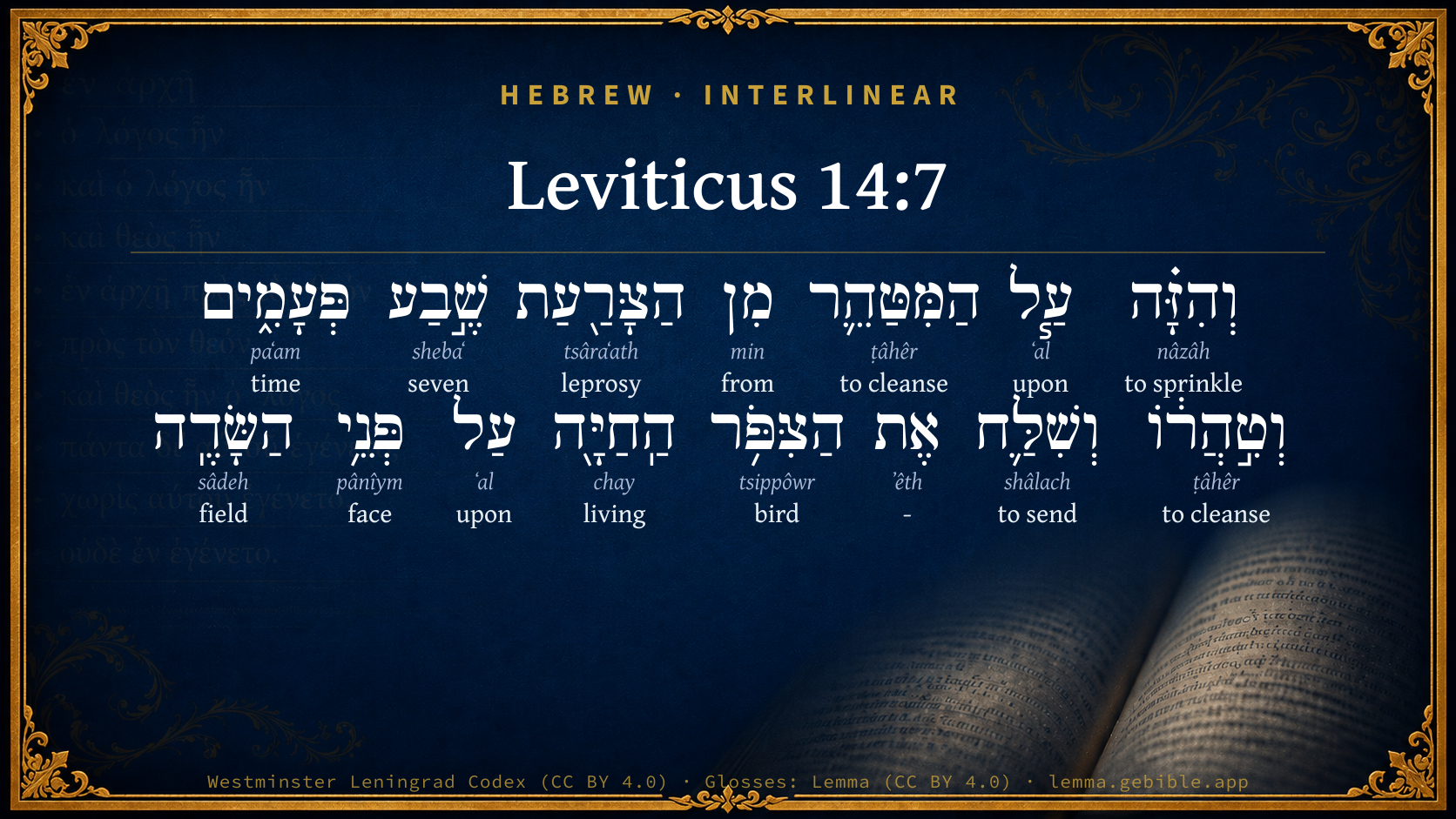
Hebrew (Westminster Leningrad Codex) Leviticus 14:7 appears in the Hebrew Old Testament. The text above is from the Westminster Leningrad Codex. Each word links to its Strong’s number, a concise gloss, and parsing drawn from the Open Scriptures Hebrew Bible morphology. Click any word for its full Brown-Driver-Briggs (BDB) entry.
Download image
Cite this verse

Leviticus 14:7 (World English Bible). Public Domain. Lemma interlinear Bible study tool, https://lemma.gebible.app/v/leviticus/14/7.

Show BibTeX & RIS
BibTeX
RIS
English Translation
He shall sprinkle on him who is to be cleansed from the leprosy seven times, and shall pronounce him clean, and shall let the living bird go into the open field.
World English Bible · Public Domain
Download a study sheet

One document with this verse’s original text, its word-by-word gloss line, the meaning frame, cross-references with their text, attributed commentary, and full source and license credits — printable, and it pastes into notes with its structure intact.

This verse Autodidact and up

Study sheet (.html) Plain text (.txt)

A passage Seminary Student

Up to 50 verses in one chapter. A passage sheet keeps up to 6 commentary sources and 12 cross-references per verse, in the order this page ranks them, and says so on the sheet whenever that leaves anything out. Ask for a single verse and you get the Autodidact verse sheet above.

Everything on this page stays free to read, with no account — the sheet is a download of what is already on screen, not access to it.

Want to remove ads? Support Godless Engineer
Compare translations 3

The same verse in 3 English versions, stacked beneath the original-language interlinear above. Click any original word for its lexicon entry.

Each is an independent rendering of the whole verse — the interlinear is not word-aligned to these translations.

Highlighted words mark where these versions differ — a whole-verse word diff, not a word-by-word alignment.

  • World English Bible Public Domain
    He shall sprinkle on him who is to be cleansed from the leprosy seven times, and shall pronounce him clean, and shall let the living bird go into the open field.
  • King James Version Public Domain
    And he shall sprinkle upon him that is to be cleansed from the leprosy seven times, and shall pronounce him clean, and shall let the living bird loose into the open field.
  • unfoldingWord Literal Text CC BY-SA 4.0
    And he shall sprinkle on the person who is being cleansed from the skin disease seven times, and he shall pronounce him clean. And he will send the live bird over the face of the field.

unfoldingWord Literal Text — © unfoldingWord, licensed CC BY-SA 4.0. Word-aligned USFM3 via Door43 (git.door43.org/unfoldingWord/en_ult).

Versions to compare (up to 4)

3 of 4 selected

Show all 18 translations

Every available English version of this verse, each an independent rendering of the whole verse.

  • World English Bible Public Domain
    He shall sprinkle on him who is to be cleansed from the leprosy seven times, and shall pronounce him clean, and shall let the living bird go into the open field.
  • Berean Standard Bible Public Domain
    Seven times he shall sprinkle the one to be cleansed of the skin disease. Then he shall pronounce him clean and release the live bird into the open field.
  • Majority Standard Bible Public Domain
    Seven times he shall sprinkle the one to be cleansed of the skin disease. Then he shall pronounce him clean and release the live bird into the open field.
  • King James Version Public Domain
    And he shall sprinkle upon him that is to be cleansed from the leprosy seven times, and shall pronounce him clean, and shall let the living bird loose into the open field.
  • American Standard Version (1901) Public Domain
    And he shall sprinkle upon him that is to be cleansed from the leprosy seven times, and shall pronounce him clean, and shall let go the living bird into the open field.
  • Revised Version (1885) Public Domain
    And he shall sprinkle upon him that is to be cleansed from the leprosy seven times, and shall pronounce him clean, and shall let go the living bird into the open field.
  • Geneva Bible (1599) Public Domain
    And hee shall sprinkle vpon him, that must be clensed of his leprosie, seuen times, and clense him, and shall let goe the liue sparowe into the broad fielde.
  • Douay-Rheims (1899) Public Domain
    Wherewith he shall sprinkle him that is to be cleansed seven times, that he may be rightly purified: and he shall let go the living sparrow, that it may fly into the field.
  • Young's Literal Translation Public Domain
    and he hath sprinkled on him who is to be cleansed from the leprosy seven times, and hath pronounced him clean, and hath sent out the living bird on the face of the field.
  • Literal Standard Version CC BY-SA 4.0
    and he has sprinkled on him who is to be cleansed from the leprosy seven times, and has pronounced him clean, and has sent out the living bird over the face of the field.
  • Unlocked Literal Bible CC BY-SA 4.0
    Then the priest will sprinkle this water seven times onto the person who is to be cleansed from the disease, and then the priest will pronounce him to be clean. Then the priest will release the living bird into the open fields.
  • unfoldingWord Literal Text CC BY-SA 4.0
    And he shall sprinkle on the person who is being cleansed from the skin disease seven times, and he shall pronounce him clean. And he will send the live bird over the face of the field.
  • Darby Bible Public Domain
    and he shall sprinkle upon him that is to be cleansed from the leprosy seven times, and shall pronounce him clean, and shall let the living bird loose into the open field.
  • World Messianic Bible Public Domain
    He shall sprinkle on him who is to be cleansed from the leprosy seven times, and shall pronounce him clean, and shall let the living bird go into the open field.
  • Webster's Bible Public Domain
    And he shall sprinkle upon him that is to be cleansed from the leprosy seven times, and shall pronounce him clean, and shall let the living bird loose into the open field.
  • Free Bible Version CC BY-SA 4.0
    He will use the blood to sprinkle seven times the person being made clean of the skin disease. Then the priest will declare them clean and let the live bird fly away.
  • Bible in Basic English Public Domain
    And shaking it seven times over the man who is to be made clean, he will say that he is clean and will let the living bird go free into the open country.
  • JPS Tanakh (1917) Public Domain
    And he shall sprinkle upon him that is to be cleansed from the leprosy seven times, and shall pronounce him clean, and shall let go the living bird into the open field.

Literal Standard Version (2020), Covenant Press — licensed CC BY-SA 4.0. Text via the HelloAO Bible API (eBible.org). Unlocked Literal Bible (unfoldingWord) — licensed CC BY-SA 4.0. Text via the HelloAO Bible API (eBible.org). unfoldingWord Literal Text — © unfoldingWord, licensed CC BY-SA 4.0. Word-aligned USFM3 via Door43 (git.door43.org/unfoldingWord/en_ult). Free Bible Version, Dr. Jonathan Gallagher — licensed CC BY-SA 4.0. Text via the HelloAO Bible API (eBible.org).

Word by word

More ways to search: Search by grammar → Find every occurrence → Compare this word →

Practice this passage: Drill this verse → Learn its vocabulary →

וְהִזָּ֗ה
nâzâh
H5137
“and · to sprinkle”
Conjunction + Verb, Hiphil, Sequential Perfect, 3rd Person, Masculine, Singular
Part of Speech
Conjunction + Verb
Stem
Hiphil
Form
Sequential Perfect
Person
3rd Person
Gender
Masculine
Number
Singular
Full BDB Definition

Origin: a primitive root

TWOT: 1335 , 1336

to spurt, spatter, sprinkle - (Qal) to spurt, spatter - (Hiphil) to cause to spurt, sprinkle upon - to spring, leap - (Hiphil) to cause to leap, startle
  1. עַ֧ל ʻal H5921 “upon” Preposition
  2. הַמִּטַּהֵ֛ר ṭâhêr H2891 “the · cleansing” Particle, Definite Article + Verb, Hithpael, Participle Active, Masculine, Singular, Absolute
  3. מִן min H4480 “from” Preposition
  4. הַצָּרַ֖עַת tsâraʻath H6883 “the · leprosy” Particle, Definite Article + Noun, Common, Feminine, Singular, Absolute
  5. שֶׁ֣בַע shebaʻ H7651 “seven” Adjective, Cardinal number, Feminine, Singular, Absolute
  6. פְּעָמִ֑ים paʻam H6471 “times” Noun, Common, Feminine, Plural, Absolute
  7. וְטִ֣הֲר֔וֹ ṭâhêr H2891 “and · to cleanse · him” Conjunction + Verb, Piel, Sequential Perfect, 3rd Person, Masculine, Singular + Suffix, Personal, 3rd Person, Masculine, Singular
  8. וְשִׁלַּ֛ח shâlach H7971 “and · to send” Conjunction + Verb, Piel, Sequential Perfect, 3rd Person, Masculine, Singular
  9. אֶת ʼêth H853 “-” Particle, Direct Object
  10. הַצִּפֹּ֥ר tsippôwr H6833 “the · bird” Particle, Definite Article + Noun, Common, Both, Singular, Absolute
  11. הַֽחַיָּ֖ה chay H2416 “the · living” Particle, Definite Article + Adjective, Adjective, Feminine, Singular, Absolute
  12. עַל ʻal H5921 “upon” Preposition
  13. פְּנֵ֥י pânîym H6440 “face(s) of” Noun, Common, Both, Plural, Construct
  14. הַשָּׂדֶֽה sâdeh H7704 “the · field” Particle, Definite Article + Noun, Common, Masculine, Singular, Absolute

About this verse

These counts appear in no published source. They are computed here, from the morphology-tagged text and Lemma’s own curated glosses. What Lemma adds →

15
words
13
distinct lemmas
Pentateuch
section

Notable vocabulary

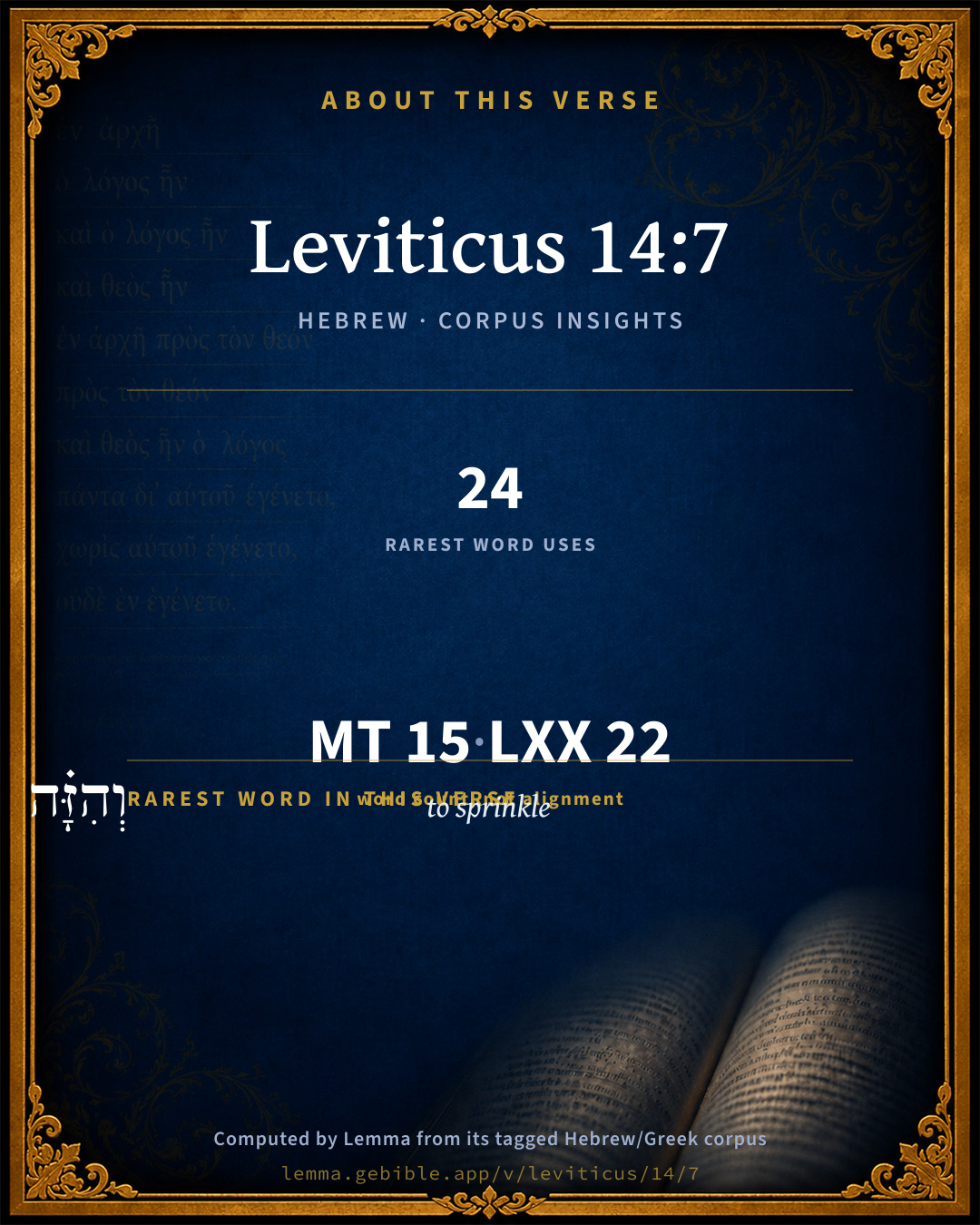
The rarest word here is וְהִזָּ֗ה to sprinkle H5137 — appearing just 24 times in the whole Hebrew Bible.

Shared distinctive vocabulary

וְהִזָּ֗ה to sprinkle H5137 occurs in 22 verses of the Hebrew Bible. Also found in:

Grammatical profile

  • 4 verbs
  • 5 nouns
  • 2 adjectives
  • 3 prepositions
  • 1 particle

Verb forms

  • וְהִזָּ֗ה Hiphil · Sequential Perfect
  • הַמִּטַּהֵ֛ר Hithpael · Participle Active
  • וְטִ֣הֲר֔וֹ Piel · Sequential Perfect
  • וְשִׁלַּ֛ח Piel · Sequential Perfect

Repetition

Words recur within this verse — often emphatic in Hebrew:

  • עַ֧ל upon H5921 ×2
  • הַמִּטַּהֵ֛ר to cleanse H2891 ×2

Hebrew & Septuagint length

In English translation the verse runs 31 words from the Hebrew and 30 from the Septuagint (LXX English) — closely comparable.

A rough comparison of the two English renderings, which tokenize alike — not a word-level alignment.

Word counts can differ between the Hebrew and the Greek without any difference in meaning — e.g. the Hebrew direct-object marker אֵת has no separate Greek word, and Greek often adds the article ὁ.

In the original languages it is 15 Hebrew tokens and 22 Greek tokens — but the two are counted differently (Hebrew bundles its prefixes and suffixes into one token; the Greek is in lemma form), so that isn’t a like-for-like length.

Cross-references

28

Topical passages linked to Leviticus 14:7 in the Treasury of Scripture Knowledge — connected by theme and wording, ordered by reader-vote popularity; previews shown in the World English Bible.

  • 2 Kings 5:10 Elisha sent a messenger to him, saying, Go and wash in the Jordan seven times, and your flesh shall come again to you, and you shall be clean.
  • 2 Kings 5:14 Then went he down, and dipped [himself] seven times in the Jordan, according to the saying of the man of God; and his flesh came again like the flesh of a little child, and he was clean.
  • Isaiah 52:15 so shall he sprinkle many nations; kings shall shut their mouths at him: for that which had not been told them shall they see; and that which they had not heard shall they understand.
  • Ezekiel 36:25 I will sprinkle clean water on you, and you shall be clean: from all your filthiness, and from all your idols, will I cleanse you.
  • Hebrews 9:13 For if the blood of goats and bulls, and the ashes of a heifer sprinkling those who have been defiled, sanctify to the cleanness of the flesh:
  • Hebrews 9:19 For when every commandment had been spoken by Moses to all the people according to the law, he took the blood of the calves and the goats, with water and scarlet wool and hyssop, and sprinkled both the book itself and all the people,
  • 1 Peter 1:2 according to the foreknowledge of God the Father, in sanctification of the Spirit, that you may obey Jesus Christ and be sprinkled in his blood: Grace to you and peace be multiplied.
  • Leviticus 4:6 The priest shall dip his finger in the blood, and sprinkle some of the blood seven times before Yahweh, before the veil of the sanctuary.
  • Leviticus 4:17 and the priest shall dip his finger in the blood, and sprinkle it seven times before Yahweh, before the veil.
  • Leviticus 8:11 He sprinkled it on the altar seven times, and anointed the altar and all its vessels, and the basin and its base, to sanctify them.
  • Leviticus 13:13 then the priest shall examine him; and, behold, if the leprosy has covered all his flesh, he shall pronounce him clean of the plague. It has all turned white: he is clean.
  • Leviticus 13:17 and the priest shall examine him; and, behold, if the plague has turned white, then the priest shall pronounce him clean of the plague. He is clean.
  • Leviticus 14:51 He shall take the cedar wood, and the hyssop, and the scarlet, and the living bird, and dip them in the blood of the slain bird, and in the running water, and sprinkle the house seven times.
  • Leviticus 16:14 He shall take some of the blood of the bull, and sprinkle it with his finger on the mercy seat on the east; and before the mercy seat he shall sprinkle some of the blood with his finger seven times.
  • Leviticus 16:19 He shall sprinkle some of the blood on it with his finger seven times, and cleanse it, and make it holy from the uncleanness of the children of Israel.
  • Leviticus 16:22 The goat shall carry all their iniquities on himself to a solitary land, and he shall let the goat go in the wilderness.
  • Numbers 19:18–19 and a clean person shall take hyssop, and dip it in the water, and sprinkle it on the tent, and on all the vessels, and on the persons who were there, and on him who touched the bone, or the slain, or the dead, or the grave:
  • Psalms 51:2 Wash me thoroughly from my iniquity. Cleanse me from my sin.
  • Psalms 51:7 Purify me with hyssop, and I will be clean. Wash me, and I will be whiter than snow.
  • Daniel 9:24 Seventy weeks are decreed on your people and on your holy city, to finish disobedience, and to make an end of sins, and to make reconciliation for iniquity, and to bring in everlasting righteousness, and to seal up vision and prophecy, and to anoint the most holy.
  • Micah 7:19 He will again have compassion on us. He will tread our iniquities under foot; And you will cast all their sins into the depths of the sea.
  • John 19:34 However one of the soldiers pierced his side with a spear, and immediately blood and water came out.
  • Ephesians 5:26–27 that he might sanctify it, having cleansed it by the washing of water with the word,
  • Hebrews 9:21 Moreover he sprinkled the tabernacle and all the vessels of the ministry in like manner with the blood.
  • Hebrews 9:26 or else he must have suffered often since the foundation of the world. But now once at the end of the ages, he has been revealed to put away sin by the sacrifice of himself.
  • Hebrews 10:22 let's draw near with a true heart in fullness of faith, having our hearts sprinkled from an evil conscience, and having our body washed with pure water,
  • Hebrews 12:24 to Jesus, the mediator of a new covenant, and to the blood of sprinkling that speaks better than that of Abel.
  • 1 John 5:6 This is he who came by water and blood, Jesus Christ; not with the water only, but with the water and the blood. It is the Spirit who testifies, because the Spirit is the truth.

Cross-references courtesy of OpenBible.info (CC BY 4.0).

Hebrew and Greek witnesses Masoretic Hebrew ↔ Greek Septuagint

The same verse in the two great witnesses to the Old Testament, shown verse-for-verse.

These are two independent witnesses, not word-aligned to each other, and the Septuagint is shown in lemma (dictionary) form.

Hebrew Leviticus 14:7 Masoretic · Westminster Leningrad Codex

וְהִזָּ֗ה עַ֧ל הַמִּטַּהֵ֛ר מִן הַצָּרַ֖עַת שֶׁ֣בַע פְּעָמִ֑ים וְטִ֣הֲר֔וֹ וְשִׁלַּ֛ח אֶת הַצִּפֹּ֥ר הַֽחַיָּ֖ה עַל פְּנֵ֥י הַשָּׂדֶֽה

He shall sprinkle on him who is to be cleansed from the leprosy seven times, and shall pronounce him clean, and shall let the living bird go into the open field.

World English Bible · Public Domain

Greek LXX Leviticus 14:7 Septuagint · lemma form

καί περιῥαίνω ἐπί ὁ καθαρίζω ἀπό ὁ λέπρα ἑπτάκις καί καθαρός εἰμί καί ἐκ ἀποστέλλω ὁ ὀρνίθιον ὁ ζάω εἰς ὁ πεδίον

And he shall sprinkle seven times upon him that was cleansed of his leprosy, and he shall be clean; and he shall let go the living bird into the field.

LXX2012 (modern English Septuagint) · Public Domain

Hebrew: Westminster Leningrad Codex (CC BY 4.0). Greek: Septuagint (public domain); English from LXX2012 (modern English Septuagint) (Public Domain). How the Septuagint differs from the Hebrew →

Targum (Aramaic paraphrase)

2

The Targum is the ancient Jewish Aramaic paraphrase of the Hebrew Scriptures — an interpretive translation, not the Hebrew text itself. Onkelos (literal) and Pseudo-Jonathan (expansive) render the Torah, and Jonathan the Prophets. Coverage is partial: where no permissively-licensed English translation exists for a verse, only the Aramaic is shown. This is verse-level text, not a word-by-word alignment to the Hebrew.

  1. Targum Onkelos Torah (Genesis–Deuteronomy)
    וְיַדִי עַל דְמִדַכֵּי מִן סְגִירוּתָא שְׁבַע זִמְנִין וִידַכִּנֵהּ וִישַׁלַח יָת צִפְּרָא חַיְתָא עַל אַפֵּי חַקְלָא

    (no public-domain English translation for this verse)

    Targum Onkelos — Aramaic: “Onkelos Genesis” (public domain); “Onkelos Exodus” (public domain); “Onkelos Leviticus” (public domain); “Onkelos Numbers” (public domain); “Onkelos Deuteronomy” (public domain). English: “Sefaria Community Translation” (CC0 1.0 (public-domain dedication)); “J.W. Etheridge. The Targums of Onkelos and Jonathan Ben Uzziel on the Pentateuch. London: Longmans, Green, 1862” (public domain). Text via Sefaria.

  2. Targum Pseudo-Jonathan Torah (Genesis–Deuteronomy)
    וְיַדֵי עַל בֵּית אַפּוֹהִי דְמִידְכֵּי מִן סְגִירוּתָא שִׁבְעָתֵי זִמְנִין וִידַכִּינֵיהּ וְיִפְטוֹר יַת צִיפּוֹרָא חַיְיתָא עַל אַנְפֵּי חַקְלָא וִיהֵי אִין אִיטִימוֹס הַהוּא גַבְרָא לְמִילְקֵי תוּב בְצוֹרָעָא תַיְיבָא צִיפּוֹרָא חַיְיתָא לְבֵיתֵיהּ בְּיוֹמָא הַהוּא וּמִתְכַשְׁרָא לְמֵיכְלָא וְיַת צִפּוֹרָא נְכִיסָא הֲוָה מִקְבָּר כַּהֲנָא בְּמֵיחְמֵי מְצוֹרָע

    And let him sprinkle it upon the face of him who is to be cleansed of the leprosy seven times, and cleanse him; and send forth. the living bird over the face of the field. And it will be that if that man is again to be stricken with leprosy, the living bird will come back to his house on that day, and may be held fit to be eaten. But the bird that had been killed the priest shall bury in the presence of the leper.

    Targum Pseudo-Jonathan — Aramaic: “Targum Jonathan on Genesis” (public domain); “Targum Jonathan on Exodus” (public domain); “Targum Jonathan on Leviticus” (public domain); “Targum Jonathan on Numbers” (public domain); “Targum Jonathan on Deuteronomy” (public domain). English: “The Targum of Jonathan ben Uzziel, trans. J. W. Etheridge, London, 1862” (public domain). Text via Sefaria.

Commentary

Notes on Leviticus 14:7 from classic Christian and Jewish commentators (each source and its license shown beneath its notes). The classic Christian expositions comment on the surrounding passage and are grouped to its opening verse, so a note may address several verses; the Jewish commentaries on the Tanakh (Rashi and others) are per-verse, so they appear only where the commentator wrote on this verse.

Lemma curates 59 commentaries, every one of them public domain or Creative Commons licensed, each selected and text-cleaned for this edition rather than reprinted as found. About our sources →

Trapp's Complete Commentary

John Trapp

Lev 14:7 And he shall sprinkle upon him that is to be cleansed from the leprosy seven times, and shall pronounce him clean, and shall let the living bird loose into the open field.

Ver. 7. And he shall sprinkle.] This led them to that blood of sprinkling, {Heb 12:23-24} applied unto them by that hyssop branch of faith, whereby the heart is purified.

And shall let the living bird loose.] This figured, say some, that neither Christ’s deity without the shedding of his blood, nor Christ’s blood, but for the quickening life of the Godhead personally dwelling in him, could have been available for the purging of sin. Both which himself declareth. {Joh 6:53; Joh 6:63} And hither belongeth 2Co 5:19 Act 20:28. Moreover it figured, that Christ by his death conquered him that had the power of death, {Heb 2:15} whilst he fled as a bird to the everlasting mountains, from the jaws of death to the joys of heaven. {Heb 7:26}

John Trapp, A Commentary or Exposition upon All the Books of the Old and New Testament (1647–1656) — public domain. Text from a community e-Sword module.

Joseph Benson's Commentary

Lev 14:7. Into the open field — The place of its former abode, signifying the taking off that restraint which was laid upon the leper, and that he was restored to free conversation with his neighbours.

Joseph Benson's Commentary on the Old and New Testaments (1811–1818) — public domain. Text from a community e-Sword module.

Tyndale Open Study Notes

Tyndale Open Resources

14:7 Just as the goat released to Azazel symbolized the removal of sin from the community on the Day of Atonement (16:10, 20-22), the release of the live bird symbolized the removal of the individual’s uncleanness.

Tyndale Open Study Notes — © Tyndale Open Resources, licensed CC BY-SA 4.0. Text via the HelloAO Bible API.

Geneva Bible (1599)

Geneva Bible translators

Signifying, that he that was made clean, was set at liberty, and restored to the company of others.

Geneva Bible (1599) marginal notes — public domain. Text via Bolls.life.

Adam Clarke's Commentary

Verse 7. Shall let the living bird loose] The Jews teach that wild birds were employed on this occasion, no tame or domestic animal was used. Mr. Ainsworth piously conjectures that the living and dead birds were intended to represent the death and resurrection of Christ, by which an atonement was made to purify the soul from its spiritual leprosy. The bird let loose bears a near analogy to the scapegoat. See Le 16:5-10.

Adam Clarke's Commentary on the Bible (1810–1826) — public domain. Text from a community e-Sword/MySword module.

Ellicott's Commentary for English Readers

(7) And he shall sprinkle.—Having thus dipped the hyssop fastened to the cedar stick into the blood and water, the priest is to sprinkle with it the back of the hand and the forehead of the patient seven times. The seven times symbolised the complete cleansing. (See Lev_4:6.) Hence Naaman the leper washed himself seven times in the Jordan (2Ki_5:10; 2Ki_5:14).

And shall let the living bird loose.—Whereupon the priest not only pronounced the cured man clean and restored to his liberty, but at the same time liberated the bird also. The release of the bird symbolised the freedom restored to the patient, who, like the bird, was now at liberty to go where he liked without any restraint. Because it is here said that the bird is to be let loose “into the open field,” or, more literally, towards the face of the field, the ancient canons decreed that he who lets it loose must not turn his face towards the sea, wilderness, or city, but towards the field. The cedar wood, the crimson thread, and the hyssop, as well as the bird, if caught again, could be used again in the cleansing of other lepers.

A Bible Commentary for English Readers, edited by Charles John Ellicott (1878–1897) — public domain. Text from a community e-Sword module.

The Cambridge Bible for Schools and Colleges

gen. ed. J. J. S. Perowne

7. seven times] As in Lev_14:27; Lev_14:51 and so in Lev_4:6; Lev_4:17, Lev_8:11, Lev_16:14; Lev_16:19; Num_19:4. Cp. 2Ki_5:10 and Art. Number in HDB. iii. specially p. 565.

let go the living bird] The similarity between the two birds and the two goats brought on the Day of Atonement has been noted by Jewish and Christian commentators; it is necessary to point out the differences. On that Day the high priest officiated; the slain goat was a Sin-Offering, and on the goat that was sent away all the sins of the children of Israel were solemnly laid. The whole service was at the sanctuary, its inner shrine was entered on that day only; and there was no physical contact between the two goats. The two birds brought for the cleansing of the leper were respectively killed and set free outside the camp by an ordinary priest; the blood of the slain bird was not brought near the altar nor treated sacrificially, but applied to the living bird which was let go. The ritual is not markedly Hebraic, but antique in character, and similar to that followed by tribes whose ideas about the removal of impurity are in the most elementary stage. Some parts of it were probably in use among Semites before the age of Moses, as an inheritance from a distant past. The time when these rites were adopted into Israel’s cultus cannot be fixed with certainty; when they became part of that system which requires holiness from the worshippers of a holy God, their significance was spiritualized, and the superstitious beliefs of an earlier age were eliminated, though not entirely forgotten.

We find among primitive peoples that sicknesses are in many cases transferred to a bird or beast which thus becomes a kind of scapegoat (Frazer, G. B.2 iii. 15 f., 101 f.) or are sent away in boats (ib. 97 f. Cp. Rob.-Sm. Rel. Sem. 422, Berth. ad loc.).

The Heb. word for ‘cedar’ includes, besides the Lebanon variety, juniper and some sorts of pine; the Gk. κέδρος has a correspondingly broad significance. The ‘hyssop’ is supposed to be a kind of marjoram; the plant now known as hyssop does not grow in Egypt or Syria. For further details see Dillm. in loc. and Arts. Juniper, Cedar, in HDB. and Enc. Bib.

The cedar is regarded as a sacred tree. Instances of its use are given in Frazer, G. B.3 49 f., where it is described as Juniperus excelsa.

The Cambridge Bible for Schools and Colleges (gen. ed. J. J. S. Perowne; Cambridge University Press, 1878–1918) — public domain. Text from a community e-Sword module.

John Gill's Exposition

And he shall sprinkle upon him that is to be cleansed from the leprosy seven times,.... With the hyssop fastened to the cedar stick, with the scarlet wool or thread bound about it, dipped into the blood and water in the earthen vessel; to which the psalmist alludes, Psa 51:7; the Egyptians had a great notion of "hyssop", as of a purifying nature, and therefore used to eat it with bread, to take off the strength of that (d): upon what part of the leper this sprinkling was made is not said; the Targum of Jonathan says, upon the house of his face, that is, upon the vail that was over his face: but in the Misnah (e) it is said to be on the back of his hand; and so Gersom, though some say it was on his forehead; and sprinkling was typical of Christ's blood of sprinkling, and of the application of it, and of sharing in all the blessings of it; and this was done seven times, to denote the thorough and perfect cleansing of him, and of every part, every faculty of the soul, and every member of the body, and that from all sin, and the frequent application of it: the last mentioned writer says, at every sprinkling there was a dipping, and that the sense is, that he should sprinkle and dip seven times, as Naaman the Syrian leper did in Jordan; but of the washing of the leper mention is afterwards made:

and shall pronounce him clean; from his leprosy, and so fit for civil and religious conversation, to come into the camp or city, and into the tabernacle:

and shall let the living bird loose into the open field; as a token of the freedom of the leper, and that he was at liberty to go where he pleased: the Misnic doctors say (f), when he came to let go the living bird, he did not turn its face neither to the sea, nor to the city, nor to the wilderness, as it is said, "but he shall let go the living bird out of the city into the open field", as in Lev 14:53; the Targum of Jonathan here adds, if the man should be prepared to be smitten with the leprosy again, the live bird may return to his house the same day, and be fit to be eaten, but the slain bird he shall bury in the sight of the leper: some say, if the bird returned ever so many times, it was to be let go again: this may be a figure of the resurrection of Christ from the dead, and of his justification upon it, as the head and representative of his people, and of their free and full discharge from guilt, condemnation, and death, through him, and of his and their being received up into heaven, and whither their hearts should be directed, in affection and thankfulness for their great deliverance and salvation; see Ti1 3:16.

(d) Chaeremon apud Porphyr. de Abstinentia, l. 4. sect. 6. (e) Ut supra. (Misn. Negaim, c. 11. sect. 4.) (f) Ib. sect. 2.

John Gill's Exposition of the Whole Bible (1746–1763) — public domain (CC PDM 1.0). Text via the HelloAO Bible API.

Albert Barnes' Notes on the Bible

Seven times - The seal of the covenant, expressed in the number seven (compare Lev 14:9), was renewed in sprinkling him who, during his leprosy, had lived as an outcast. The details of a restoration to health and freedom appear to be well expressed in the whole ceremony. Each of the birds represented the leper. They were to be of a clean kind, because they stood for one of the chosen race. The death-like state of the leper during his exclusion from the camp was expressed by killing one of the birds. The living bird was identified with the slain one by being dipped in his blood mixed with the spring water that figured the process of purification, while the cured leper was identified with the rite by having the same water and blood sprinkled over him. The bird then liberated was a sign that the leper left behind him all the symbols of the death disease and of the remedies associated with it, and was free to enjoy health and social freedom with his kind. Compare Col 2:12.

Albert Barnes' Notes on the Bible (1834–1885) — public domain. Text from a community e-Sword/MySword module.

Haydock's Catholic Bible Commentary

Rightly. According to law. (Haydock) --- The number seven is used to denote perfection, ver. 15, &c. (Menochius) --- Field. An emblem of the liberty which the leper would soon enjoy. (Haydock) --- The pagans cast over their head the things which had been used for their purification. (Virgil, Eclogues viii. 102.) Fer cineres, Amarilli, foras, rivoque fluenti---Transque caput jace, ne respexeris. --- There were afraid to trample upon them. (Gell. x. 15.; Metam. xiii. 954.) There were also accustomed to set birds at liberty in honour of their gods. Demosthenes accuses Conon of having eaten those which had been used in his purification. Bonfrere believes that Moses does not here prescribe any sacrifice. Why then is a priest employed to make these aspersions? (Calmet)

George Leo Haydock (1774–1849), Haydock's Catholic Family Bible and Commentary, 1859 edition — public domain. Excludes Psalms (Douay-Rheims chapter numbering differs from Protestant) and Deuterocanonical books (Catholic canon only).

Matthew Poole's English Annotations

Seven times, to signify his perfect cleansing and restoration to all his former privileges. Compare Lev 4:17.

Into the open field, the place of its former abode, signifying the taking off that restraint which was laid upon the leper, and the liberty which the leper now had to return to his former habitation and conversation with other men.

Matthew Poole's English Annotations on the Holy Bible (1683–1685) — public domain. Text from a community e-Sword/MySword module.

The Pulpit Commentary

And he shall sprinkle upon him that is to be cleansed from the leprosy seven times. It is not certain whether the seven sprinklings were made upon the forehead of the person to be cleansed, or on the back of his hand. The feathers of the bird and the bunch of hyssop would be specially instrumental in the seven sprinklings. And shall pronounce him clean. Having assured himself that he was healed (verse 3), the priest now pronounces him to be clean, he looses as well as binds. It had been his office to declare the man a leper, and thereby to shut him out from the people of the Lord. (Lev_13:8, Lev_13:15, Lev_13:22, Lev_13:25, Lev_13:36, Lev_13:44, Lev_13:46) Now he pronounces him to be no leper, and therefore, after some further ceremonies, readmits him (verses 8, 20, 31). And shall let the living bird loose into the open field. The symbolism of the two birds, which has been much misinterpreted, is essentially the same as that of the two goats on the day of atonement, though each ceremony has its distinctive features. The killing of the living bird was not a true sacrifice, as was the offering of the goat to Jehovah, but by its death it represented the state in which the leper had legally been, and to which he would have been physically reduced had not a remedy been found. The deathly and unclean state of the leper having been symbolically transferred from the dead bird to the living bird by the latter"s being sprinkled in the former"s blood, the living bird stands in the position of the scapegoat, on whom the sins of the people were laid. The bird is then let loose into the open field; literally, upon the face of the field; and it flies off, carrying with it the leper"s uncleanness, and assuring him by every forward movement that it makes that the living death has passed from him, just as each step or" the scapegoat appeared to the Israelites to remove their sins from them. A large number of commentators, on the other hand, consider the released bird to symbolize the health and freedom now given back to the leper, and they dwell on the rapid and uncontrolled movement of birds as being peculiarly suitable for representing this recovered liberty. But this interpretation, to which there are many objections, appears to be altogether incompatible with the fact that the same ceremony is used in the cleansing of the leprous house, whereas the house could certainly not be represented as "recovered to unrestrained liberty" (Lunge). The common patristic view, that the two birds represent the two natures of the one Great Sacrifice offered to redeem man from sin, seems to be out of place here.

The Pulpit Commentary (1880–1919), ed. H.D.M. Spence-Jones & Joseph S. Exell — public domain. Text from a community e-Sword module.

John Wesley's Explanatory Notes

Into the open field - The place of its former abode, signifying the taking off that restraint which was laid upon the leper.

John Wesley, Explanatory Notes Upon the Whole Bible (1754–1765) — public domain. Text via the GEBible commentary corpus.

Lesson kit

Teaching starters — assembled from the data on this page, not authored interpretation. Every prompt links to the verse data it draws on. Edit before teaching.

Leviticus, in the Pentateuch, opens this verse with 15 words (13 distinct Hebrew lemmas). Its most distinctive word is nâzâh (“to sprinkle”). A historical commentator’s framing appears above. Read the whole chapter for the surrounding context.

Discussion questions

  1. What does “to sprinkle” (nâzâh) contribute to the verse as a whole?
  2. Exodus 29:21 shares the word «to sprinkle» with this verse. How do the two illuminate each other?
  3. “upon” occurs 2× in this one verse. What is the effect of the repetition?
  4. These translations render this verse differently. What is at stake in choosing one wording over another?
  5. The verb «וְהִזָּ֗ה» is Hiphil Sequential Perfect. How does its form color the action?
  6. Reading how Trapp's Complete Commentary and Joseph Benson's Commentary read this verse, where do the two commentators agree and where do they part?

Things to notice

Reading settings

Reading text

Shown beneath each verse's original-language words.

Old Testament
Old Testament edition

Read the OT as the Masoretic Hebrew (MT) or the Greek Septuagint (LXX).

English shown for the Greek Septuagint (in the Hebrew ↔ Greek comparison).

Comparing translations? Open the Compare panel on any verse page to stack up to four side by side.