
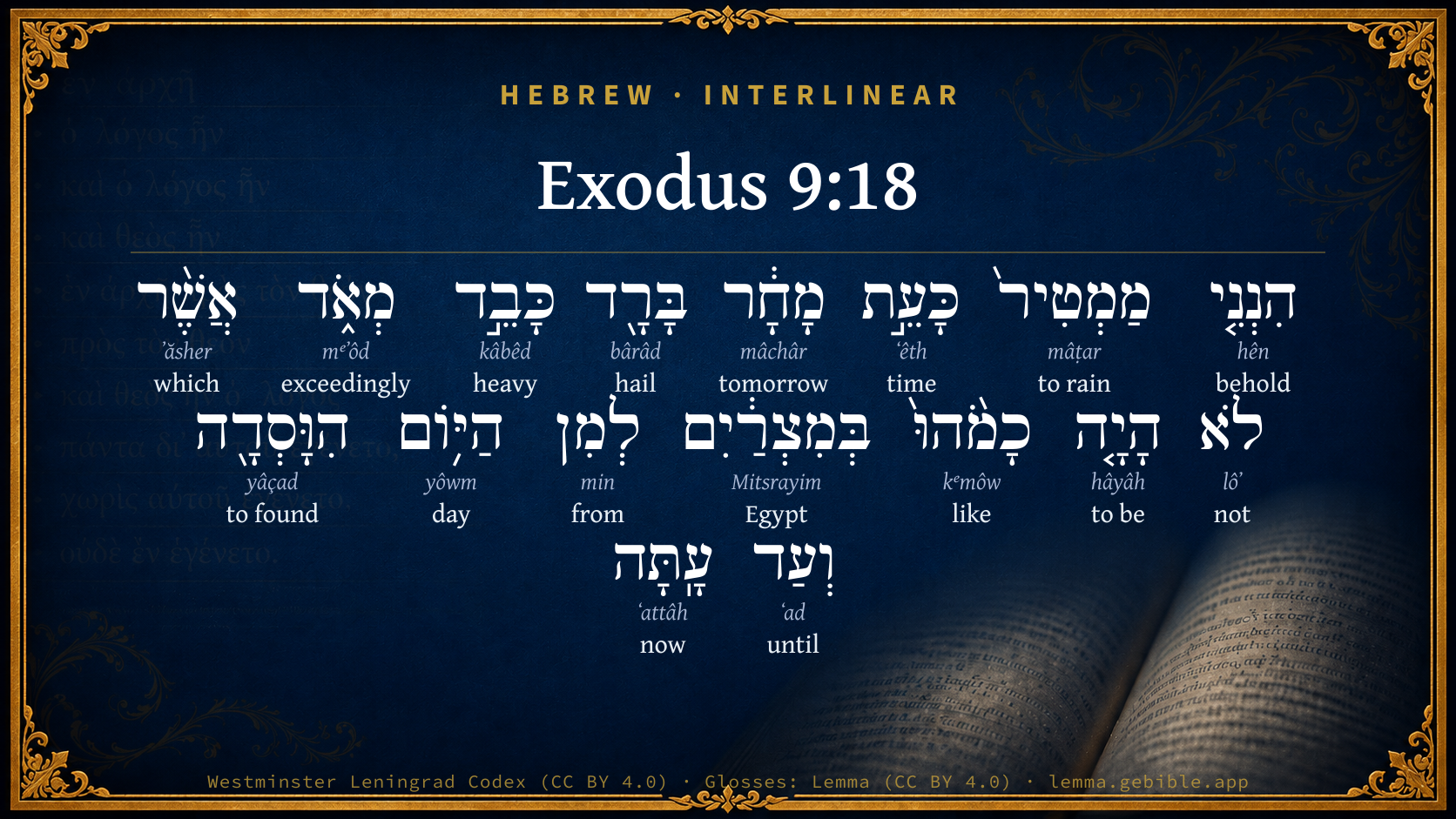
Exodus 9:18

Hebrew (Westminster Leningrad Codex) Exodus 9:18 appears in the Hebrew Old Testament. The text above is from the Westminster Leningrad Codex. Each word links to its Strong’s number, a concise gloss, and parsing drawn from the Open Scriptures Hebrew Bible morphology. Click any word for its full Brown-Driver-Briggs (BDB) entry.
Download image
Cite this verse

Exodus 9:18 (World English Bible). Public Domain. Lemma interlinear Bible study tool, https://lemma.gebible.app/v/exodus/9/18.

Show BibTeX & RIS
BibTeX
RIS
English Translation
Behold, tomorrow about this time I will cause it to rain a very grievous hail, such as has not been in Egypt since the day it was founded even until now.
World English Bible · Public Domain
Highlights
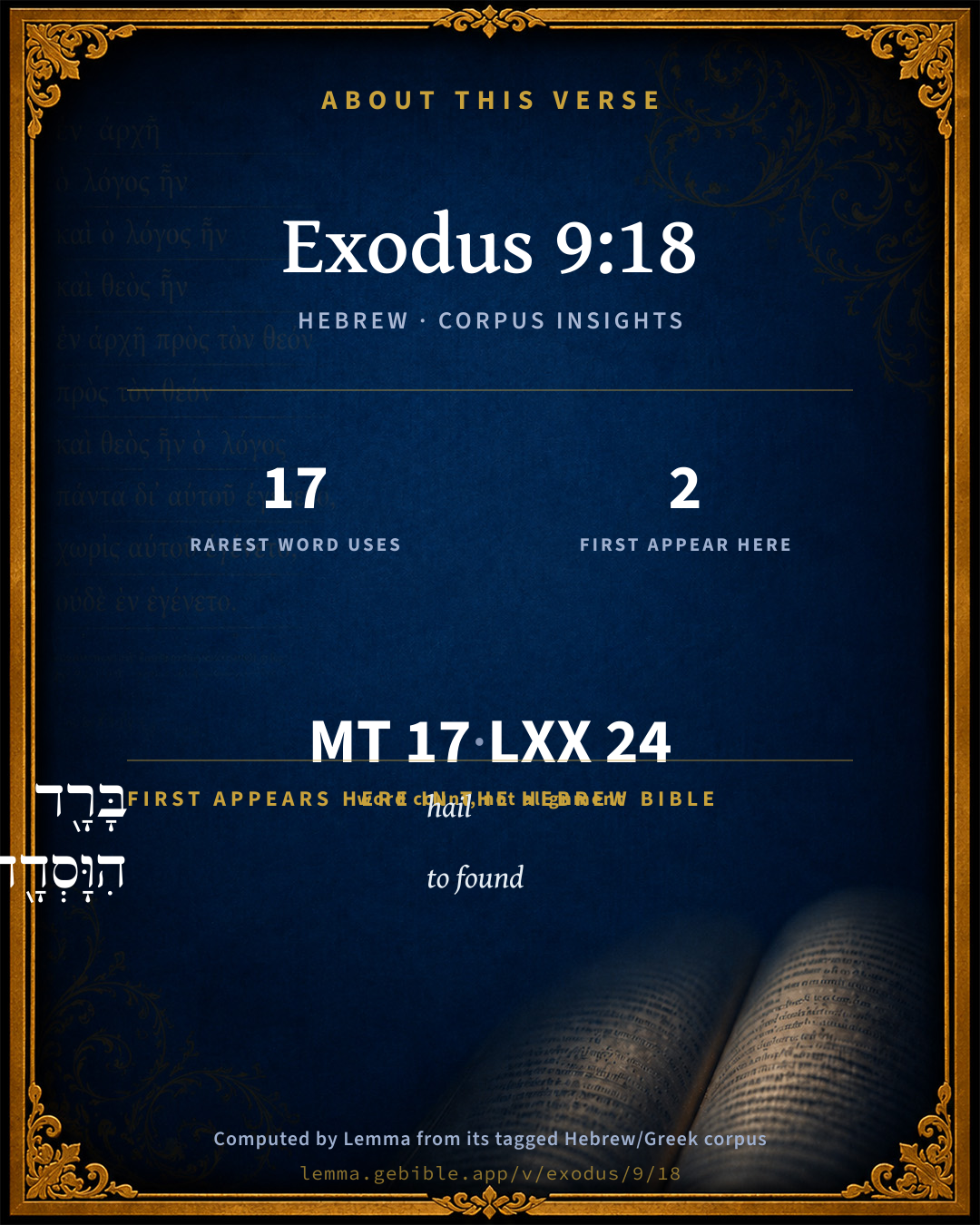
  • 2 first appearances in the Hebrew Bible
Full analysis ↓
Download a study sheet

One document with this verse’s original text, its word-by-word gloss line, the meaning frame, cross-references with their text, attributed commentary, and full source and license credits — printable, and it pastes into notes with its structure intact.

This verse Autodidact and up

Study sheet (.html) Plain text (.txt)

A passage Seminary Student

Up to 50 verses in one chapter. A passage sheet keeps up to 6 commentary sources and 12 cross-references per verse, in the order this page ranks them, and says so on the sheet whenever that leaves anything out. Ask for a single verse and you get the Autodidact verse sheet above.

Everything on this page stays free to read, with no account — the sheet is a download of what is already on screen, not access to it.

Want to remove ads? Support Godless Engineer
Compare translations 3

The same verse in 3 English versions, stacked beneath the original-language interlinear above. Click any original word for its lexicon entry.

Each is an independent rendering of the whole verse — the interlinear is not word-aligned to these translations.

Highlighted words mark where these versions differ — a whole-verse word diff, not a word-by-word alignment.

  • World English Bible Public Domain
    Behold, tomorrow about this time I will cause it to rain a very grievous hail, such as has not been in Egypt since the day it was founded even until now.
  • King James Version Public Domain
    Behold, to morrow about this time I will cause it to rain a very grievous hail, such as hath not been in Egypt since the foundation thereof even until now.
  • unfoldingWord Literal Text CC BY-SA 4.0
    Behold me! I am about to cause extremely heavy hail to rain tomorrow at this time, which there has never been anything like in Egypt from the day it was founded until now.

unfoldingWord Literal Text — © unfoldingWord, licensed CC BY-SA 4.0. Word-aligned USFM3 via Door43 (git.door43.org/unfoldingWord/en_ult).

Versions to compare (up to 4)

3 of 4 selected

Show all 18 translations

Every available English version of this verse, each an independent rendering of the whole verse.

  • World English Bible Public Domain
    Behold, tomorrow about this time I will cause it to rain a very grievous hail, such as has not been in Egypt since the day it was founded even until now.
  • Berean Standard Bible Public Domain
    Behold, at this time tomorrow I will rain down the worst hail that has ever fallen on Egypt, from the day it was founded until now.
  • Majority Standard Bible Public Domain
    Behold, at this time tomorrow I will rain down the worst hail that has ever fallen on Egypt, from the day it was founded until now.
  • King James Version Public Domain
    Behold, to morrow about this time I will cause it to rain a very grievous hail, such as hath not been in Egypt since the foundation thereof even until now.
  • American Standard Version (1901) Public Domain
    Behold, to-morrow about this time I will cause it to rain a very grievous hail, such as hath not been in Egypt since the day it was founded even until now.
  • Revised Version (1885) Public Domain
    Behold, tomorrow about this time I will cause it to rain a very grievous hail, such as hath not been in Egypt since the day it was founded even until now.
  • Geneva Bible (1599) Public Domain
    Beholde, to morowe this time I will cause to raine a mightie great haile, such as was not in Egypt since the foundation thereof was laid vnto this time.
  • Douay-Rheims (1899) Public Domain
    Behold I will cause it to rain to morrow at this same hour, an exceeding great hail: such as hath not been in Egypt from the day that it was founded, until this present time.
  • Young's Literal Translation Public Domain
    lo, I am raining about `this' time to-morrow hail very grievous, such as hath not been in Egypt, even from the day of its being founded, even until now.
  • Literal Standard Version CC BY-SA 4.0
    behold, I am raining very grievous hail about [this] time tomorrow, such as has not been in Egypt from the day of its founding and until now.
  • Unlocked Literal Bible CC BY-SA 4.0
    Listen! Tomorrow about this time I will bring a very strong hail storm, such as has not been seen in Egypt since the day it was begun until now.
  • unfoldingWord Literal Text CC BY-SA 4.0
    Behold me! I am about to cause extremely heavy hail to rain tomorrow at this time, which there has never been anything like in Egypt from the day it was founded until now.
  • Darby Bible Public Domain
    Behold, to-morrow about this time I will cause it to rain a very grievous hail, such as hath not been in Egypt since its foundation until now.
  • World Messianic Bible Public Domain
    Behold, tomorrow about this time I will cause it to rain a very grievous hail, such as has not been in Egypt since the day it was founded even until now.
  • Webster's Bible Public Domain
    Behold, to-morrow about this time I will cause it to rain a very grievous hail, such as hath not been in Egypt since its foundation even until now.
  • Free Bible Version CC BY-SA 4.0
    So watch out! About this time tomorrow I will send down the worst hailstorm that has ever fallen on Egypt, from the beginning of its history until now.
  • Bible in Basic English Public Domain
    Truly, tomorrow about this time I will send down an ice-storm, such as never was in Egypt from its earliest days till now.
  • JPS Tanakh (1917) Public Domain
    Behold, tomorrow about this time I will cause it to rain a very grievous hail, such as hath not been in Egypt since the day it was founded even until now.

Literal Standard Version (2020), Covenant Press — licensed CC BY-SA 4.0. Text via the HelloAO Bible API (eBible.org). Unlocked Literal Bible (unfoldingWord) — licensed CC BY-SA 4.0. Text via the HelloAO Bible API (eBible.org). unfoldingWord Literal Text — © unfoldingWord, licensed CC BY-SA 4.0. Word-aligned USFM3 via Door43 (git.door43.org/unfoldingWord/en_ult). Free Bible Version, Dr. Jonathan Gallagher — licensed CC BY-SA 4.0. Text via the HelloAO Bible API (eBible.org).

Word by word

More ways to search: Search by grammar → Find every occurrence → Compare this word →

Practice this passage: Drill this verse → Learn its vocabulary →

מַמְטִיר֙
mâṭar
H4305
“raining”
Verb, Hiphil, Participle Active, Masculine, Singular, Absolute
Part of Speech
Verb
Stem
Hiphil
Form
Participle Active
Gender
Masculine
Number
Singular
State
Absolute
Full BDB Definition

Origin: a primitive root

TWOT: 1187

to rain - (Niphal) to be rained on or upon - (Hiphil) - to rain, send rain - to rain hail, send hail
  1. הִנְנִ֤י hên H2005 “behold · me” Particle, Demonstrative + Suffix, Personal, 1st Person, Common, Singular
  2. כָּעֵ֣ת ʻêth H6256 “like/as the · time” Preposition, Determined + Noun, Common, Both, Singular, Absolute
  3. מָחָ֔ר mâchâr H4279 “tomorrow” Noun, Common, Masculine, Singular, Absolute
  4. בָּרָ֖ד bârâd H1259 “hail” Noun, Common, Masculine, Singular, Absolute
  5. כָּבֵ֣ד kâbêd H3515 “heavy” Adjective, Adjective, Masculine, Singular, Absolute
  6. מְאֹ֑ד mᵉʼôd H3966 “exceedingly” Adverb
  7. אֲשֶׁ֨ר ʼăsher H834 “which” Particle, Relative
  8. לֹא lôʼ H3808 “not” Particle, Negative
  9. הָיָ֤ה hâyâh H1961 “to be” Verb, Qal, Perfect, 3rd Person, Masculine, Singular
  10. כָמֹ֨הוּ֙ kᵉmôw H3644 “like · him” Preposition + Suffix, Personal, 3rd Person, Masculine, Singular
  11. בְּמִצְרַ֔יִם Mitsrayim H4714 “in/at · Egypt” Preposition + Noun, Proper
  12. לְמִן min H4480 “to/for · from” Preposition + Preposition
  13. הַיּ֥וֹם yôwm H3117 “the · day” Particle, Definite Article + Noun, Common, Masculine, Singular, Absolute
  14. הִוָּסְדָ֖ה yâçad H3245 “to found · her” Verb, Niphal, Infinitive Construct + Suffix, Personal, 3rd Person, Feminine, Singular
  15. וְעַד ʻad H5704 “and · until” Conjunction + Preposition
  16. עָֽתָּה ʻattâh H6258 “now” Adverb

About this verse

These counts appear in no published source. They are computed here, from the morphology-tagged text and Lemma’s own curated glosses. What Lemma adds →

17
words
17
distinct lemmas
Pentateuch
section

Notable vocabulary

The rarest word here is מַמְטִיר֙ to rain H4305 — appearing just 17 times in the whole Hebrew Bible.

First appearance in Scripture

These words make their first canonical appearance in the Hebrew Bible here:

  • בָּרָ֖ד hail H1259
  • הִוָּסְדָ֖ה to found H3245

Shared distinctive vocabulary

מַמְטִיר֙ to rain H4305 occurs in 14 verses of the Hebrew Bible. Also found in:

Grammatical profile

  • 3 verbs
  • 5 nouns
  • 1 adjective
  • 3 prepositions
  • 2 adverbs
  • 3 particles

Verb forms

  • מַמְטִיר֙ Hiphil · Participle Active
  • הָיָ֤ה Qal · Perfect
  • הִוָּסְדָ֖ה Niphal · Infinitive Construct

Hebrew & Septuagint length

In English translation the verse runs 31 words from the Hebrew and 28 from the Septuagint (LXX English) — closely comparable.

A rough comparison of the two English renderings, which tokenize alike — not a word-level alignment.

Word counts can differ between the Hebrew and the Greek without any difference in meaning — e.g. the Hebrew direct-object marker אֵת has no separate Greek word, and Greek often adds the article ὁ.

In the original languages it is 17 Hebrew tokens and 24 Greek tokens — but the two are counted differently (Hebrew bundles its prefixes and suffixes into one token; the Greek is in lemma form), so that isn’t a like-for-like length.

Cross-references

6

Topical passages linked to Exodus 9:18 in the Treasury of Scripture Knowledge — connected by theme and wording, ordered by reader-vote popularity; previews shown in the World English Bible.

  • Exodus 9:22–25 Yahweh said to Moses, "Stretch forth your hand toward the sky, that there may be hail in all the land of Egypt, on man, and on animal, and on every herb of the field, throughout the land of Egypt."
  • 1 Kings 19:2 Then Jezebel send a messenger to Elijah, saying, So let the gods do to me, and more also, if I don't make your life as the life of one of them by tomorrow about this time.
  • 1 Kings 20:6 but I will send my servants to you tomorrow about this time, and they shall search your house, and the houses of your servants; and it shall be, that whatever is pleasant in your eyes, they shall put it in their hand, and take it away.
  • 2 Kings 7:1 Elisha said, Hear you the word of Yahweh: thus says Yahweh, Tomorrow about this time shall a measure of fine flour be [sold] for a shekel, and two measures of barley for a shekel, in the gate of Samaria.
  • Psalms 83:15 So pursue them with your tempest, And terrify them with your storm.
  • 2 Kings 7:18 It happened, as the man of God had spoken to the king, saying, Two measures of barley for a shekel, and a measure of fine flour for a shekel, shall be tomorrow about this time in the gate of Samaria;

Cross-references courtesy of OpenBible.info (CC BY 4.0).

Hebrew and Greek witnesses Masoretic Hebrew ↔ Greek Septuagint

The same verse in the two great witnesses to the Old Testament, shown verse-for-verse.

These are two independent witnesses, not word-aligned to each other, and the Septuagint is shown in lemma (dictionary) form.

Hebrew Exodus 9:18 Masoretic · Westminster Leningrad Codex

הִנְנִ֤י מַמְטִיר֙ כָּעֵ֣ת מָחָ֔ר בָּרָ֖ד כָּבֵ֣ד מְאֹ֑ד אֲשֶׁ֨ר לֹא הָיָ֤ה כָמֹ֨הוּ֙ בְּמִצְרַ֔יִם לְמִן הַיּ֥וֹם הִוָּסְדָ֖ה וְעַד עָֽתָּה

Behold, tomorrow about this time I will cause it to rain a very grievous hail, such as has not been in Egypt since the day it was founded even until now.

World English Bible · Public Domain

Greek LXX Exodus 9:18 Septuagint · lemma form

ἰδού ἐγώ ὕω οὗτος ὁ ὥρα αὔριον χάλαζα πολύς σφόδρα ὅστις τοιοῦτος οὐ γίγνομαι ἐν αἴγυπτος ἀπό ὅς ἡμέρα κτίζω ἕως ὁ ἡμέρα οὗτος

Behold, to-morrow at this hour I will rain a very great hail, such as has not been in Egypt, from the time it was created until this day.

LXX2012 (modern English Septuagint) · Public Domain

On this verse, The Pulpit Commentary discusses the Septuagint’s reading. Read the note in Commentary ↓

Hebrew: Westminster Leningrad Codex (CC BY 4.0). Greek: Septuagint (public domain); English from LXX2012 (modern English Septuagint) (Public Domain). How the Septuagint differs from the Hebrew →

Targum (Aramaic paraphrase)

2

The Targum is the ancient Jewish Aramaic paraphrase of the Hebrew Scriptures — an interpretive translation, not the Hebrew text itself. Onkelos (literal) and Pseudo-Jonathan (expansive) render the Torah, and Jonathan the Prophets. Coverage is partial: where no permissively-licensed English translation exists for a verse, only the Aramaic is shown. This is verse-level text, not a word-by-word alignment to the Hebrew.

  1. Targum Onkelos Torah (Genesis–Deuteronomy)
    הָא אֲנָא מָחֵית מִטְרָא בְּעִדָנָא הָדֵין מְחַר בַּרְדָא תַּקִיף לַחֲדָא דִי לָא הֲוָה דִכְוָתֵהּ בְּמִצְרַיִם לְמִן יוֹמָא דְאִשְׁתַּכְלָלַת וְעַד כְּעָן:

    (no public-domain English translation for this verse)

    Targum Onkelos — Aramaic: “Onkelos Genesis” (public domain); “Onkelos Exodus” (public domain); “Onkelos Leviticus” (public domain); “Onkelos Numbers” (public domain); “Onkelos Deuteronomy” (public domain). English: “Sefaria Community Translation” (CC0 1.0 (public-domain dedication)); “J.W. Etheridge. The Targums of Onkelos and Jonathan Ben Uzziel on the Pentateuch. London: Longmans, Green, 1862” (public domain). Text via Sefaria.

  2. Targum Pseudo-Jonathan Torah (Genesis–Deuteronomy)
    הָאֲנָא מָחִית בְּעִידַן הָדֵין לְמָחָר מִן אוֹצְרֵי שְׁמַיָא בַּרְדָא תַּקִיף לַחֲדָא דְלָא הֲוֵי דִכְוָותָא בְּמִצְרַיִם מִן יוֹמָא דְאִשְתַּכְלָלוּ אַנְשָׁהָא וְעַד כְּדוֹן

    Behold, at this time tomorrow I will cause to come down from the treasures of the heavens a mighty hall, the like of which hath never been in Mizraim since the day when men were settled upon it until now.

    Targum Pseudo-Jonathan — Aramaic: “Targum Jonathan on Genesis” (public domain); “Targum Jonathan on Exodus” (public domain); “Targum Jonathan on Leviticus” (public domain); “Targum Jonathan on Numbers” (public domain); “Targum Jonathan on Deuteronomy” (public domain). English: “The Targum of Jonathan ben Uzziel, trans. J. W. Etheridge, London, 1862” (public domain). Text via Sefaria.

Commentary

Notes on Exodus 9:18 from classic Christian and Jewish commentators (each source and its license shown beneath its notes). The classic Christian expositions comment on the surrounding passage and are grouped to its opening verse, so a note may address several verses; the Jewish commentaries on the Tanakh (Rashi and others) are per-verse, so they appear only where the commentator wrote on this verse.

Lemma curates 59 commentaries, every one of them public domain or Creative Commons licensed, each selected and text-cleaned for this edition rather than reprinted as found. About our sources →

Jamieson, Fausset & Brown

Robert Jamieson, A. R. Fausset & David Brown

PLAGUE OF HAIL. (Exo. 9:18-35)

I will cause it to rain a very grievous hail, &c.--The seventh plague which Pharaoh's hardened heart provoked was that of hail, a phenomenon which must have produced the greatest astonishment and consternation in Egypt as rain and hailstones, accompanied by thunder and lightning, were very rare occurrences.

such as hath not been in Egypt--In the Delta, or lower Egypt, where the scene is laid, rain occasionally falls between January and March--hail is not unknown, and thunder sometimes heard. But a storm, not only exhibiting all these elements, but so terrific that hailstones of immense size fell, thunder pealed in awful volleys, and lightning swept the ground like fire, was an unexampled calamity.

Jamieson, Fausset & Brown — Commentary Critical and Explanatory on the Whole Bible (1871) — public domain (CC PDM 1.0). Text via the HelloAO Bible API.

Trapp's Complete Commentary

John Trapp

Exo 9:18 Behold, to morrow about this time I will cause it to rain a very grievous hail, such as hath not been in Egypt since the foundation thereof even until now.

Ver. 18. Such as hath not been in Egypt.] Dio maketh mention of a shower of blood and of water, that fell in Egypt a little before it was subjected by Augustus, in quae loca ne stilla quidem aquae ante ceciderat, saith he; where never any drop of water, much less of blood, ever fell before. {a}

{a} Dio, in Aug.

John Trapp, A Commentary or Exposition upon All the Books of the Old and New Testament (1647–1656) — public domain. Text from a community e-Sword module.

The Biblical Illustrator

Joseph S. Exell

Exo_9:18-26

The hail shall come down upon them.

Brought home

I. God is the true home of the soul. Everything the soul needs is to be found in Him: nowhere else. Here is inviolable security, and everlasting peace.

II. Christ has come to bring us home to God.

III. The eternal blessedness of all who are brought home to God by christ. This is seen in two ways.

1. By what is escaped. The hail. Gods judgments. We have all been solemnly warned. The voice of God cries gather, (Exo_9:19). If we slight the call, our blood be upon our own heads! (Heb_12:25).

2. By what is enjoyed (Exo_9:26). The security of the children of Israel in Goshen, while the storm raged so terribly all around them, touchingly represents the peace of Gods people in time and in eternity (Isa_32:18).

IV. The subject suggests solemn questions.

1. Where art thou? In the field, exposed, and defenceless, or, at home?

2. Dost thou fear God? (Exo_9:20-21). True fear leads to obedience. But many are heedless of counsel and warning, and Gods judgments are put out of sight (Psa_10:5).

3. What are you doing to bring others home? If we believe in the wrath to come, we cannot rest in inaction. (W. Forsyth, M. A.)

Lessons

1. Human faith of Gods threatenings may make men fear and tremble at Gods word. Human it may be called in respect of the principle, though the testimony on which it was grounded were Divine.

2. Such fear may make men careful to shun temporal judgments.

3. Wicked men, through fear, may flee from temporal plagues but not eternal (Exo_9:20).

4. Among wicked men some may refuse human faith which some embrace.

5. Unbelief will not suffer men to lay any of Gods words to heart.

6. Regardless of Gods threatenings, maketh men leave them and theirs to vengeance (Exo_9:21). (G. Hughes, B. D.)

Lessons

1. Gods warnings of judgments being not regarded, He quickly gives the word for execution.

2. To encourage faith, God calleth His servants to assist in working vengeance.

3. God makes use of signals to induce judgments sometimes by the hand of His instruments.

4. Gods word maketh such signs effectual that they may be feared.

5. Gods word creates hail for vengeance, as sometimes in mercy.

6. Man and beast, herbs and all to the utmost extent, are subjected to Gods hail at His command (Exo_9:22). (G. Hughes, B. D.)

Salutary fears

Threatened judgments test men. Some are more susceptible to the presence of God than others.

I. These men feared Gods threatened judgment. Fear often arises from faith in Gods word. Fear is the alarum of the soul. It is often the first emotion in a new life. It often brings in love, as the needle draws in the thread.

II. Their fear led to appropriate action. They prepared for the coming storm. There is shelter for all in Christ, and in Him alone.

III. Their fear led to welcome safety. Obedience brought its reward. Mens property would be safer if they had greater respect for the word of God. (J. S. Exell, M. A.)

Belief of the word of God

1. Makes men tremble.

2. Makes men wise.

3. Makes men safe.

4. Makes men singular. (J. S. Exell, M. A.)

Disregard of God

1. Ruinous.

2. Presumptuous.

3. Foolish.

4. Common.

5. Inexcusable. (J. S. Exell, M. A.)

Gods command over the elements

I. That the material universe is gifted with numerous and contrary agencies and elements.

1. The elements of nature called into exercise by this plague were numerous. There was rain, hail, fire and thunder.

2. The elements of nature called into existence by this plague were contrary. The rain was contrary to the fire. There are very opposite elements in the great universe around us; yet all exist in harmony. One element counteracts and yet co-operates with another. The elements of nature blend in one glorious ministry for man; though sin often turns them into messengers of justice.

3. The elements of nature called into existence by this plague were emphatic. When the elements of the material universe are arrayed against man they are emphatic in their message. The thunder speaks in loud voice. It has a message to the soul. There is a moral significance in the storm.

II. That God has complete control over all the elements of the material universe.

1. So that He can commission His servants to use them according to His will.

2. So that He can make them rebuke the sin of man. He can arm the universe against a wicked soul.

3. God can prevent them from working injury to the good. The heathen imagined that divers Gods were over divers things; some ruling the air, some the fire, some the water, some the mountains, and some the plains. But God here demonstrates to the Egyptians His complete authority over the whole of nature. This truth is consoling to the good.

III. That the material prosperity of a nation is greatly dependent upon the elements of nature, and that therefore God alone can give true prosperity to a people.

1. The fields and gardens of Egypt were ruined.

2. The flax and barley of Egypt were ruined. Egypt was from early times the granary of the world (Gen_41:57). And thus we see how the prosperity of a nation is dependent upon the natural government of God in the material world. Let rulers remember this. And let not the people forget it. Sin is a curse to any nation. National righteousness is national prosperity and elevation.

Lessons:

1. That the material universe is under the rule of God.

2. That the good are Divinely protected in danger.

3. The national prosperity is the gift of heaven. (J. S. Exell, M. A.)

The plague of hail

A plague of hail, with lightning and thunder, must have been far more awful and portentous in Egypt than in any other country; for there rain was almost unknown, thunderstorms were of rare occurrence, and lightning, when it appeared, was generally of a harmless kind. Modern travellers, indeed, speak of snowstorms, and of thunder and lightning happening occasionally in lower Egypt; but such phenomena appear to have been almost unknown in earlier times. Herodotus says--During the reign of Psammenitus, Egypt beheld a most remarkable prodigy. There was rain at the Egyptian Thebes, a circumstance which never happened before, and which, as the Thebans themselves assert, has never occurred since. In the higher parts of Egypt it never rains; but at that period it rained in distinct drops (1. iii, c. 10). Plutarch also observes that In Egypt no moisture of the air is ever condensed into showers (de facie, c. 25). Pococke mentions a storm of hail followed by rain in the province of Arsinoe, which the natives were so far from considering as a blessing, that they observed rain was productive of scarcity, and that the inundation of the Nile alone was serviceable. The Egyptians were much given to the observance of all unusual phenomena, and looked upon them as portentous. According to Herodotus, Whenever any unusual circumstance occurs they commit the particulars of it to writing, and mark the events which follow (1. 2, c. 38). If distinct drops of rain were regarded as a prodigy worthy of being thus recorded, what must have been the effect of a storm like this, when the hail fell with sufficient violence to destroy both man and beast, and the fire also ran along the ground? The Egyptians, says Diodorus, denominated fire Hephaistos, esteeming it a mighty deity, which contributed largely towards the generation and ultimate perfection of to Lucian, The Persians sacrifice to fire and the Egyptians to water (de Jove trag. c. 24). Porphyry says--Even to this day, at the opening of the temple of Serapis, the worship is made by fire and water, for they reverence water and fire above all the elements. These deities now came down upon Egypt with destruction and terror; the very gods in which they trusted turned against them. (T. S. Millington.)

Folly of disregarding warning

Foolhardiness is not bravery! it is wicked waste of life. At one of the naval engagements between the Federal and Confederate forces, the officer in charge kept ordering the men at the ships guns to Look out! and when a shot came bursting near them to Lie down! Most of them obeyed; but some, either from a spirit of bravado or a belief in the doctrine of fatalism, disregarded, saying it was useless to dodge a cannon-ball, and they would chance the risks. By and by a shot came, glanced on the gun, taking off the gunners cap and the heads of three of the young men who defied the order. It came with a hissing sound, three sharp spats and a heavy report told their sad fate. (H. O. Mackey.)

A warning disregarded

A gentleman was travelling in Italy in the summer months. As he left Rome he was warned of the danger of sleeping at Baccano. He was told to travel all night rather than stop at that place, as a malignant fever prevailed there. He arrived there about bed-time. The air was balmy and the accommodation inviting. He concluded to stop for the night. Those whose interests would be promoted by his doing so told him there was no danger. He rose in the morning and proceeded on his journey. Some days after he had reached Florence the fever developed itself, and he was soon in his grave. Sinners are warned of the consequences of sinful acts. They are persuaded to disregard the warning. They sin, and the threatened consequences do not immediately appear. They think they shall escape; but ere long Gods immutable law overtakes them, and they perish. The soul that sinneth, it shall die.

Safe amidst danger

A walk along our New York streets has an occasional surprise for the man who keeps his eyes open. Not often, however, does he meet one so pleasant as that which greeted the eye of a pedestrian hurrying along a block near the North River. A brilliant scarlet spot in the cobble stone pavement constantly trodden by horses feet, and worn by wheels of ice waggons, ash carts and heavy business trucks, drew the passer to a nearer look; and, behold, there, from the scorching sand of a crevice in the pavement had sprung up a thin stem of the portulaca; a single flower had opened its scarlet petals, and was lifting its orange tinted stamens to the sun. There seemed not one chance in a million that the tender plant could have escaped the crushing hoofs and wheels and the tools of the workmen at that moment repairing the pavement; yet there was the lovely blossom, and there at sunset it folded its tiny wings to sleep. Could one fail to learn a lesson of implicit trust in an ever-watchful Father above?

Gods regard for His own

Miss Gordon Cumming tells the following thrilling story of a Chinese convert at Oiong, whose piety had obtained for him the sobriquet of Praise the Lord. Miss Cumming says: A fire broke out in one of the streets of the town, and at first it was not expected to reach as far as where Praise the Lord lived. As it spread, however, it neared the street where his house stood, and it was evident to the onlookers that all the buildings were doomed. His heathen neighbours hastily collected all their idols, and placed them as a barricade against the approaching flames. The zealous old Christian, seizing his mattock, and swinging it round him, soon reduced the gods of wood and clay to a mass of fragments. Then, having denounced the folly which could trust in senseless images, he lifted up his hands to heaven, and in the hearing of the already wildly excited mob he called upon the great Creator, the true God, his heavenly Father, to save the homes of himself and his neighbours from the threatening fire. It was not the first time that he had proved the promise, While they are yet speaking I will hear, and now he looked for an immediate answer, which would show to the heathen that the God who could stay the fire was the true God. Nor was he disappointed; almost before they could note any physical reason for the change the flames seemed blown back upon themselves--the wind had suddenly veered round, and though many of the houses close by had been scorched, those of the old man and his neighbours escaped unharmed, and the marvelling crowd saw the conflagration recede as swiftly as it had approached.

The flax and barley of Egypt

Herodotus says--The manufacture of linen is peculiar to the Colchians and the Egyptians. The linen which comes from Colchis, the Greeks call Sardonian; the linen of Egypt, Egyptian (1. 2, c. 105). Plinys account of it is--The flax of Egypt, though the least strong of all as a tissue, is that from which the greatest profits are derived. There is no tissue known that is superior to those made from the thread of the Egyptian xylon, either for whiteness and softness, or dressing; the most esteemed vestments worn by the priests of Egypt are made by it (Hist. Nat. 1. 19, c. 2). Pliny mentions four varieties of flax, and first among them the Tanaitic, growing in the lower district of Egypt, Zoan, which was the seat of Pharaohs government. The destruction of the flax deprived the people of the material for their chief manufacture, and put a stop to the trade which they carried on with neighbouring nations, who sent their treasure into the country to pay for it. The ruin of the barley was equally injurious. Egypt appears to have been from a very early period the granary of the world. Thither Abraham went down to sojourn when the land in which he dwelt was visited with famine; and thither the sons of Jacob, under similar necessity, naturally turned for help. (T. S. Millington.)

The Biblical Illustrator, edited by Joseph S. Exell (c. 1880s–1900s) — public domain. Text from a community e-Sword module.

Adam Clarke's Commentary

The SEVENTH plague - the HAIL.

Verse 18. To-morrow about this time] The time of this plague is marked thus circumstantially to show Pharaoh that Jehovah was Lord of heaven and earth, and that the water, the fire, the earth, and the air, which were all objects of Egyptian idolatry, were the creatures of his power; and subservient to his will; and that, far from being able to help them, they were now, in the hands of God, instruments of their destruction.

To rain a very grievous hail] To rain hail may appear to some superficial observers as an unphilosophical mode of expression, but nothing can be more correct. "Drops of rain falling through a cold region of the atmosphere are frozen and converted into hail;" and thus the hail is produced by rain. When it begins to fall it is rain; when it is falling it is converted into hail; thus it is literally true that it rains hail. The farther a hail-stone falls the larger it generally is, because in its descent it meets with innumerable particles of water, which, becoming attached to it, are also frozen, and thus its bulk is continualy increasing till it reaches the earth. In the case in question, if natural means were at all used, we may suppose a highly electrified state of an atmosphere loaded with vapours, which, becoming condensed and frozen, and having a considerable space to fall through, were of an unusually large size. Though this was a supernatural storm, there have been many of a natural kind, that have been exceedingly dreadful. A storm of hail fell near Liverpool, in Lancashire, in the year 1795, which greatly damaged the vegetation, broke windows, c., &c. Many of the stones measured five inches in circumference. Dr. Halley mentions a similar storm of hail in Lancashire, Cheshire, &c., in 1697, April 29, that for sixty miles in length and two miles in breadth did immense damage, by splitting trees, killing fowls and all small animals, knocking down men and horses, &c., &c. Mezeray, in his History of France, says "that in Italy, in 1510, there was for some time a horrible darkness, thicker than that of night, after which the clouds broke into thunder and lightning, and there fell a shower of hail-stones which destroyed all the beasts, birds, and even fish of the country. It was attended with a strong smell of sulphur, and the stones were of a bluish colour, some of them weighing one hundred pounds' weight." The Almighty says to Job: "Hast thou seen the treasures of the hail, which I have reserved against the time of trouble, against the day of battle and war?" Job 38:22-23. While God has such artillery at his command, how soon may he desolate a country or a world! See the account of a remarkable hail-storm in Jos 10:11.

Adam Clarke's Commentary on the Bible (1810–1826) — public domain. Text from a community e-Sword/MySword module.

Ellicott's Commentary for English Readers

(18) Such as hath not been in Egypt since the foundation thereof.—Rain, and even hail, are not unknown at the present day in Lower Egypt, though they are, comparatively speaking, rare phenomena. Thunderstorms are especially uncommon, and when they occur are for the most part mild and harmless. A thunderstorm which killed a man in Thevenot’s time (Voyages, vol. i., p. 344) was regarded as most extraordinary, and “spread universal consternation.” There is hail from time to time between November and March; but it very seldom does any considerable damage.

A Bible Commentary for English Readers, edited by Charles John Ellicott (1878–1897) — public domain. Text from a community e-Sword module.

The Cambridge Bible for Schools and Colleges

gen. ed. J. J. S. Perowne

18. to-morrow] as vv. 5, 6. Comp. on Exo_8:23.

grievous] i.e. severe: see on Exo_8:24.

The Cambridge Bible for Schools and Colleges (gen. ed. J. J. S. Perowne; Cambridge University Press, 1878–1918) — public domain. Text from a community e-Sword module.

John Gill's Exposition

Behold, tomorrow about this time,.... It was now the fourth day of the month Abib, and the fifth when the following was inflicted:

I will cause it to rain a very grievous hail; which should fall very thick, and the hailstones be very numerous and heavy, and the storm last long:

such as hath not been in Egypt since the foundation thereof, even until now; not since the earth or land itself was founded, for that was founded when the rest of the world was, and the sense then would be the same as since the foundation of the world; and so the Targum of Jonathan seems to understand it, paraphrasing the words,"from the day that men were made, even until now.''And a like expression is used of a storm of hail, thunder, and lightning, and earthquakes yet to come, which will be such as has not been since men were upon the earth, with which this plague may be compared, Rev 16:19, but here is meant since Egypt was inhabited, or rather formed into a kingdom, and founded as such, which had been many hundreds of years before this time; there was a king of Egypt in Abraham's time; the first founder of this empire, and king of it, was Mizraim, the son of Ham, from whom it had its name, by which it is usually called in Scripture. This supposes that it did sometimes rain in Egypt, contrary to a vulgar notion, or otherwise there would have been no room for the comparison; though it must be owned that rain is rare in Egypt, especially in some parts of it; See Gill on Zac 14:18.

John Gill's Exposition of the Whole Bible (1746–1763) — public domain (CC PDM 1.0). Text via the HelloAO Bible API.

Matthew Poole's English Annotations

Since they were a kingdom or a nation.

Matthew Poole's English Annotations on the Holy Bible (1683–1685) — public domain. Text from a community e-Sword/MySword module.

Whedon's Commentary on the Bible

Daniel D. Whedon

18. A very grievous hail — Hail is rare in Egypt, although it sometimes occurs. Thunderstorms are seldom experienced, and do no damage except washing away the mud walls of the poorer sort of dwellings.

Daniel D. Whedon (gen. ed.), Commentary on the Old and New Testaments (1874–1909) — public domain. Text from a community e-Sword module.

The Pulpit Commentary

To-morrow about this time. As it might have been thought that Moses had done nothing very extraordinary in predicting a storm for the next day, a more exact note of time than usual was here given. Compare Exo_8:23 Exo_9:5. I will cause it to rain a very grievous hail. Rain, and, still more, hail are comparatively rare in Egypt, though not so rare as stated by some ancient authors (Herod, 3:10; Pomp. Mela, De Situ Orbis, 1:9). A good deal of rain falls in the Lower Country, where the north wind brings air loaded with vapour from the Mediterranean; particularly in the winter months from December to March. Snow, and hail, and thunder are during those months not very uncommon, having been witnessed by many modern travellers, as Pococke, Wansleben, Seetzen, Perry, Tooke, and others. They are seldom, however, of any great severity. Such a storm as here described (see especially vers. 23, 24) would be quite strange and abnormal; no Egyptian would have experienced anything approaching to it, and hence the deep impression that it made (ver. 27). Since the foundation thereof. Not "since the original formation of the country" at the Creation, or by subsequent alluvial deposits, as Herodotus thought (2:5-11), but "since Egypt became a nation" (see ver. 24). Modern Egyptologists, or at any rate a large number of them, carry back this event to a date completely irreconcilable with the Biblical chronology Bockh to B.C. 5702, Unger to B.C. 5613, Mariette and Lenormant to B.C. 5004, Brugsch to B.C. 4455, Lepsius to B.C. 3852, and Bunsen (in one place) to B.C. 3623. The early Egyptian chronology is, however, altogether uncerrain, as the variety in these dates sufficiently intimates. Of the dynasties before the (so-called) eighteenth, only seven are proved to be historical, and the time that the Old and Middle Empires lasted is exceedingly doubtful. All the known facts are sufficiently met by such a date as B.C. 2500-2400 for the Pyramid Kings, before whose time we have nothing authentic. This is a date which comes well within the period allowed for the formation of nations by the chronology of the Septuagint and Samaritan versions.

The Pulpit Commentary (1880–1919), ed. H.D.M. Spence-Jones & Joseph S. Exell — public domain. Text from a community e-Sword module.

John Wesley's Explanatory Notes

Since the foundation thereof - Since it was a kingdom.

John Wesley, Explanatory Notes Upon the Whole Bible (1754–1765) — public domain. Text via the GEBible commentary corpus.

unfoldingWord translationNotes

Door43 World Missions Community

Listen!

"Pay attention to the important thing I am about to tell you"

translationWords

Egypt

cow

die

unfoldingWord translationNotes — © Distant Shores Media and the Door43 World Missions Community, licensed CC BY-SA 4.0. Source: git.door43.org/Door43/en_tn.

Rashi

Rabbi Shlomo Yitzchaki (Rashi)

כעת מחר means AT THIS TIME (כָּעֵת not כְּעֵת) TO-MORROW — He scratched a mark on the wall, saying, “To-morrow when the sun-rays reach here the hail will descend” (Exodus Rabbah 12:2; cf. Rashi on Genesis 21:2).

הוסדה means [FROM THE DAY] WHEN IT WAS FOUNDED (נתיסדה). Every word (verb) the first root-letter of which is י, as יסד and ילד and ידע and יסר, when it is used in the Hithpael sense (Rashi means our Niphal which often is the reflexive of the Kal), a ו replaces this י; e. g., הוסדה here, from יסד; (Hosea 2:5) “her being born (הִוָלְדָּהּ)”; (Esther 2:22) “and it was known (ויודע)”; (Genesis 66:20) “and there was born (ויולד) to Joseph”; (Proverbs 29:19) A servant will not be corrected (יוסר) by words”.

Rashi on the Tanakh — English translations: “The Judaica Press complete Tanach with Rashi, translated by A. J. Rosenberg” (CC BY 4.0); “Pentateuch with Rashi's commentary by M. Rosenbaum and A.M. Silbermann, 1929-1934” (public domain); “The Metsudah Tanach series, Lakewood, N.J” (CC BY 4.0); and “The Book of Joshua, Metsudah Publications, 1997” (CC BY 4.0). Text via Sefaria.

Ramban (Nachmanides)

Rabbi Moshe ben Nachman (Ramban / Nachmanides)

In view of the fact that Scripture states, A very grievous hail, such as hath not been in Egypt since the day it was founded, and repeats it again, Very grievous, such as had not been in all the land of Egypt since it became a nation, there is an allusion that there are other places in the world where such hail did come down, such as is mentioned in the verse, And the Eternal cast down great stones from heaven upon them, or as is mentioned in connection with [the destruction of] Sodom, brimstone, and salt, and fire. But in the land of Egypt, where there is no rain or hail, this was a great wonder.I have not understood what is said in Midrash Rabbah: “The verse does not say, ‘as hath not been in Egypt like it,’ but instead it says, ‘as hath not been like it in Egypt,’ which means there has neither been like it in the world nor in Egypt.” And the expression, since the day it was founded, is equivalent to saying: “Your fathers and your grandfathers have never seen the like of it.” But it is not possible to say that it suggests that the like of it occurred before the world was founded or before the inception of nations. Perhaps because this hail came as a punishment upon the inhabitants of Egypt and was not in the natural order, [the verse] is saying that nothing like it has ever occurred because of the sins of the fathers, for before the inception of Egypt as a nation, surely there was no [reason for] such hail to come.

BEHOLD, TOMORROW ABOUT THIS TIME I WILL CAUSE IT TO RAIN A VERY GRIEVOUS HAIL, etc. 19. NOW THEREFORE SEND, HASTEN IN THY CATTLE. All this is G-d’s word to Moses, and it is self-understood that Moses came and told Pharaoh all the words of G-d that He sent him to speak, and there was no need to prolong the account [of Moses’ going to Pharaoh and so telling him]. Scripture only states, He that feared the word of the Eternal among the servants of Pharaoh made his servants and his cattle flee into the houses, from which it is clear that Moses had told them [G-d’s words]. This advice was on account of G-d’s being merciful to them, since the plague of hail was sent only against the produce of the earth and not against man, therefore doth He instruct sinners in the way to save them from the plague.

Ramban (Nachmanides) on the Tanakh — English translation: “Commentary on the Torah by Ramban (Nachmanides). Translated and annotated by Charles B. Chavel. New York, Shilo Pub. House, 1971-1976” (CC BY 4.0). Text via Sefaria.

Lesson kit

Teaching starters — assembled from the data on this page, not authored interpretation. Every prompt links to the verse data it draws on. Edit before teaching.

Exodus, in the Pentateuch, opens this verse with 17 words (17 distinct Hebrew lemmas). Its most distinctive word is mâṭar (“to rain”). A historical commentator’s framing appears above. Read the whole chapter for the surrounding context.

Discussion questions

  1. What does “to rain” (mâṭar) contribute to the verse as a whole?
  2. 2 words here appear for the first time in Scripture. What is being introduced at this debut?
  3. Genesis 2:5 shares the word «to rain» with this verse. How do the two illuminate each other?
  4. These translations render this verse differently; the difference is in the English rendering, not the original. What questions does that raise?
  5. The verb «מַמְטִיר֙» is Hiphil Participle Active. How does its form color the action?
  6. Reading how Jamieson, Fausset & Brown and Trapp's Complete Commentary read this verse, where do the two commentators agree and where do they part?

Things to notice

Reading settings

Reading text

Shown beneath each verse's original-language words.

Old Testament
Old Testament edition

Read the OT as the Masoretic Hebrew (MT) or the Greek Septuagint (LXX).

English shown for the Greek Septuagint (in the Hebrew ↔ Greek comparison).

Comparing translations? Open the Compare panel on any verse page to stack up to four side by side.