Genesis 25:30

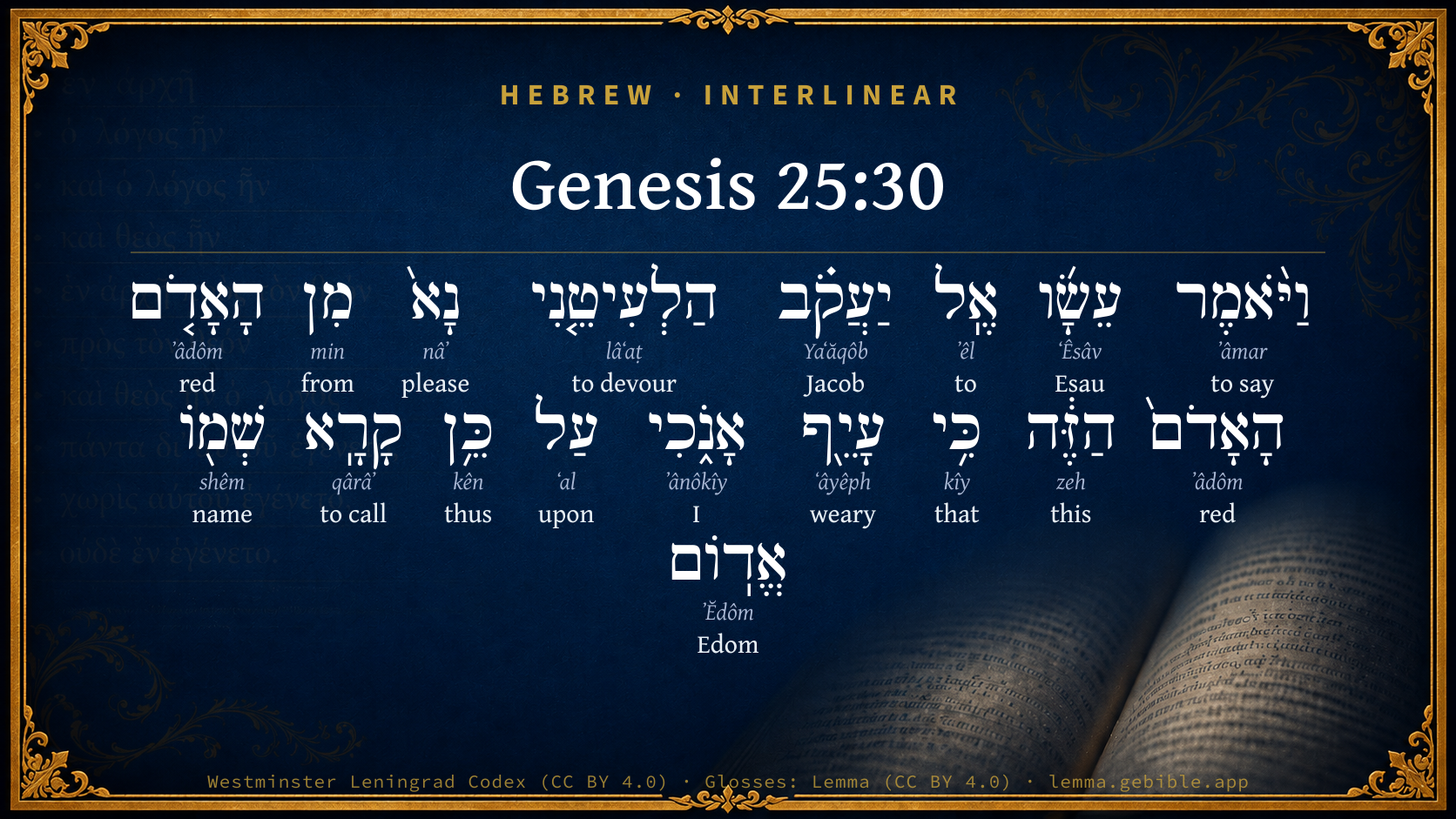
Hebrew (Westminster Leningrad Codex) Genesis 25:30 appears in the Hebrew Old Testament. The text above is from the Westminster Leningrad Codex. Each word links to its Strong’s number, a concise gloss, and parsing drawn from the Open Scriptures Hebrew Bible morphology. Click any word for its full Brown-Driver-Briggs (BDB) entry.
Download image
Cite this verse

Genesis 25:30 (World English Bible). Public Domain. Lemma interlinear Bible study tool, https://lemma.gebible.app/v/genesis/25/30.

Show BibTeX & RIS
BibTeX
RIS
English Translation
Esau said to Jacob, "Please feed me with that same red stew, for I am famished." Therefore his name was called Edom.
World English Bible · Public Domain
Highlights
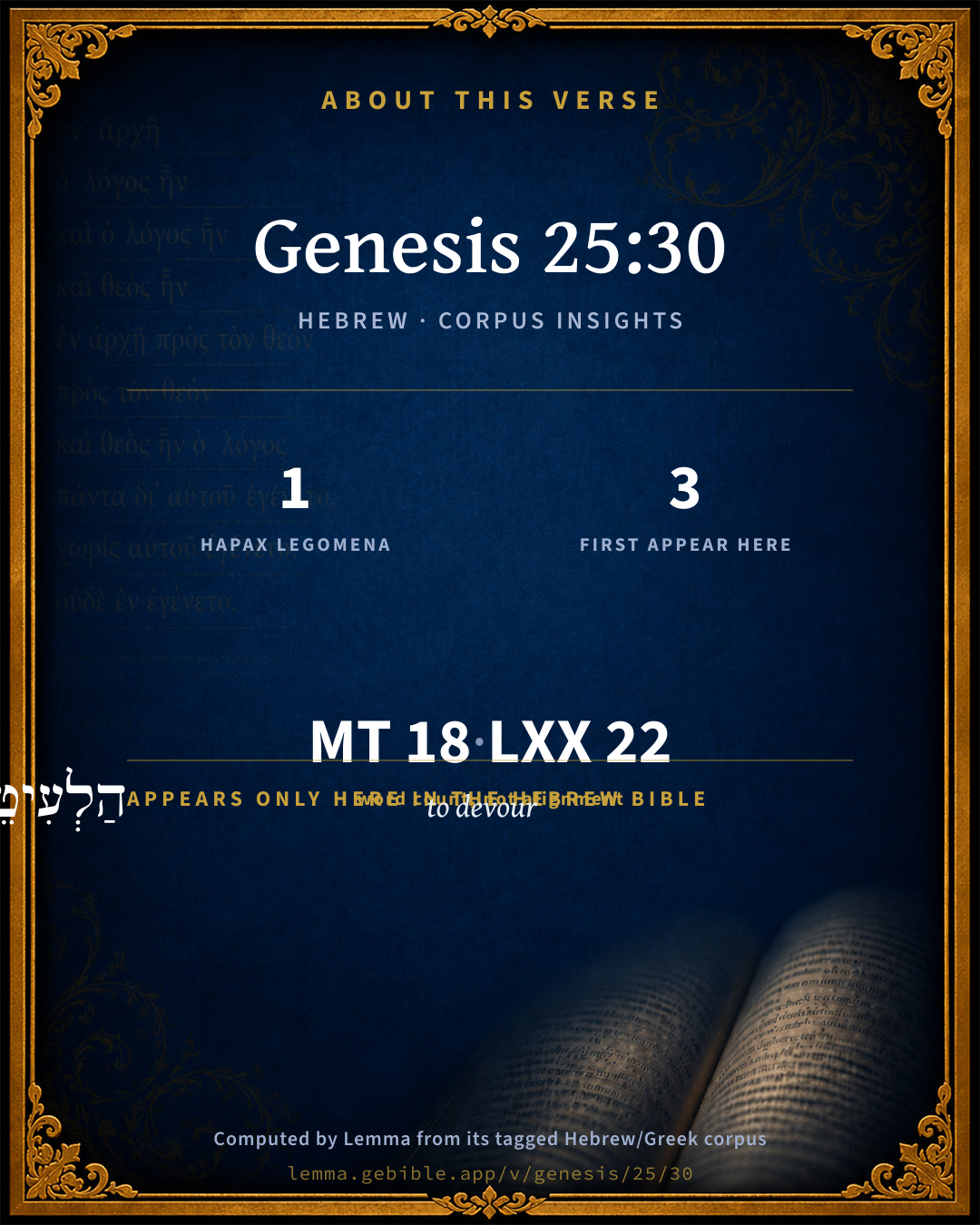
  • 1 hapax legomenon — only here in the Hebrew Bible
  • 3 first appearances in the Hebrew Bible
Full analysis ↓
Download a study sheet

One document with this verse’s original text, its word-by-word gloss line, the meaning frame, cross-references with their text, attributed commentary, and full source and license credits — printable, and it pastes into notes with its structure intact.

This verse Autodidact and up

Study sheet (.html) Plain text (.txt)

A passage Seminary Student

Up to 50 verses in one chapter. A passage sheet keeps up to 6 commentary sources and 12 cross-references per verse, in the order this page ranks them, and says so on the sheet whenever that leaves anything out. Ask for a single verse and you get the Autodidact verse sheet above.

Everything on this page stays free to read, with no account — the sheet is a download of what is already on screen, not access to it.

Want to remove ads? Support Godless Engineer
Compare translations 3

The same verse in 3 English versions, stacked beneath the original-language interlinear above. Click any original word for its lexicon entry.

Each is an independent rendering of the whole verse — the interlinear is not word-aligned to these translations.

Highlighted words mark where these versions differ — a whole-verse word diff, not a word-by-word alignment.

  • World English Bible Public Domain
    Esau said to Jacob, "Please feed me with that same red stew, for I am famished." Therefore his name was called Edom.
  • King James Version Public Domain
    And Esau said to Jacob, Feed me, I pray thee, with that same red pottage; for I am faint: therefore was his name called Edom.
  • unfoldingWord Literal Text CC BY-SA 4.0
    Then Esau said to Jacob, “Please let me devour some of that very red stuff because I exhausted!” For that they called his name Edom.

unfoldingWord Literal Text — © unfoldingWord, licensed CC BY-SA 4.0. Word-aligned USFM3 via Door43 (git.door43.org/unfoldingWord/en_ult).

Versions to compare (up to 4)

3 of 4 selected

Show all 18 translations

Every available English version of this verse, each an independent rendering of the whole verse.

  • World English Bible Public Domain
    Esau said to Jacob, "Please feed me with that same red stew, for I am famished." Therefore his name was called Edom.
  • Berean Standard Bible Public Domain
    He said to Jacob, “Let me eat some of that red stew, for I am famished.” (That is why he was also called Edom.)
  • Majority Standard Bible Public Domain
    He said to Jacob, “Let me eat some of that red stew, for I am famished.” (That is why he was also called Edom.)
  • King James Version Public Domain
    And Esau said to Jacob, Feed me, I pray thee, with that same red pottage; for I am faint: therefore was his name called Edom.
  • American Standard Version (1901) Public Domain
    And Esau said to Jacob, Feed me, I pray thee, with that same red `pottage'. For I am faint. Therefore was his name called Edom.
  • Revised Version (1885) Public Domain
    and Esau said to Jacob, Feed me, I pray thee, with that same red pottage; for I am faint: therefore was his name called Edom.
  • Geneva Bible (1599) Public Domain
    Then Esau sayd to Iaakob, Let me eate, I pray thee, of that pottage so red, for I am wearie. Therefore was his name called Edom.
  • Douay-Rheims (1899) Public Domain
    Said: Give me of this red pottage, for I am exceeding faint. For which reason his name was called Edom.
  • Young's Literal Translation Public Domain
    and Esau saith unto Jacob, `Let me eat, I pray thee, some of this red red thing, for I `am' weary;' therefore hath `one' called his name Edom `Red';
  • Literal Standard Version CC BY-SA 4.0
    and Esau says to Jacob, “Please let me eat some of this red-red thing, for I [am] weary”; therefore [one] has called his name Edom;
  • Unlocked Literal Bible CC BY-SA 4.0
    Esau said to Jacob, “Feed me with that red stew. Please, I am exhausted!” That is why his name was called Edom.
  • unfoldingWord Literal Text CC BY-SA 4.0
    Then Esau said to Jacob, “Please let me devour some of that very red stuff because I exhausted!” For that they called his name Edom.
  • Darby Bible Public Domain
    And Esau said to Jacob, Feed me, I pray thee, with the red -- the red thing there, for I am faint. Therefore was his name called Edom.
  • World Messianic Bible Public Domain
    Esau said to Jacob, “Please feed me with some of that red stew, for I am famished.” Therefore his name was called Edom.
  • Webster's Bible Public Domain
    And Esau said to Jacob, Feed me, I pray thee, with that same red pottage; for I am faint: therefore was his name called Edom.
  • Free Bible Version CC BY-SA 4.0
    “Give me some of that red stew,” Esau told Jacob. “I'm absolutely starving!” (That's how Esau got his other name, “Edom,” meaning “red.”)
  • Bible in Basic English Public Domain
    And Esau said to Jacob, Give me a full meal of that red soup, for I am overcome with need for food: for this reason he was named Edom.
  • JPS Tanakh (1917) Public Domain
    And Esau said to Jacob: 'Let me swallow, I pray thee, some of this red, red pottage; for I am faint.' Therefore was his name called Edom.

Literal Standard Version (2020), Covenant Press — licensed CC BY-SA 4.0. Text via the HelloAO Bible API (eBible.org). Unlocked Literal Bible (unfoldingWord) — licensed CC BY-SA 4.0. Text via the HelloAO Bible API (eBible.org). unfoldingWord Literal Text — © unfoldingWord, licensed CC BY-SA 4.0. Word-aligned USFM3 via Door43 (git.door43.org/unfoldingWord/en_ult). Free Bible Version, Dr. Jonathan Gallagher — licensed CC BY-SA 4.0. Text via the HelloAO Bible API (eBible.org).

Word by word

More ways to search: Search by grammar → Find every occurrence → Compare this word →

Practice this passage: Drill this verse → Learn its vocabulary →

הַלְעִיטֵ֤נִי
lâʻaṭ
H3938
“devour · me”
Verb, Hiphil, Imperative, 2nd Person, Masculine, Singular + Suffix, Personal, 1st Person, Common, Singular
Part of Speech
Verb
Stem
Hiphil
Form
Imperative
Person
2nd Person
Gender
Masculine
Number
Singular
Full BDB Definition

Origin: a primitive root

TWOT: 1120

(Hiphil) to swallow greedily, devour
  1. וַיֹּ֨אמֶר ʼâmar H559 “and · to say” Conjunction + Verb, Qal, Sequential Imperfect, 3rd Person, Masculine, Singular
  2. עֵשָׂ֜ו ʻÊsâv H6215 “Esau” Noun, Proper
  3. אֶֽל ʼêl H413 “to” Preposition
  4. יַעֲקֹ֗ב Yaʻăqôb H3290 “Jacob” Noun, Proper
  5. נָא֙ nâʼ H4994 “please” Particle, Exhortation
  6. מִן min H4480 “from” Preposition
  7. הָאָדֹ֤ם ʼâdôm H122 “the · red” Particle, Definite Article + Adjective, Adjective, Masculine, Singular, Absolute
  8. הָאָדֹם֙ ʼâdôm H122 “the · red” Particle, Definite Article + Adjective, Adjective, Masculine, Singular, Absolute
  9. הַזֶּ֔ה zeh H2088 “the · this” Particle, Definite Article + Pronoun, Demonstrative, Masculine, Singular
  10. כִּ֥י kîy H3588 “that” Conjunction
  11. עָיֵ֖ף ʻâyêph H5889 “weary” Adjective, Adjective, Masculine, Singular, Absolute
  12. אָנֹ֑כִי ʼânôkîy H595 “I” Pronoun, Personal, 1st Person, Common, Singular
  13. עַל ʻal H5921 “upon” Preposition
  14. כֵּ֥ן kên H3651 “thus” Particle, Demonstrative
  15. קָרָֽא qârâʼ H7121 “to call” Verb, Qal, Perfect, 3rd Person, Masculine, Singular
  16. שְׁמ֖וֹ shêm H8034 “name · his” Noun, Common, Masculine, Singular, Construct + Suffix, Personal, 3rd Person, Masculine, Singular
  17. אֱדֽוֹם ʼĔdôm H123 “Edom” Noun, Proper

About this verse

These counts appear in no published source. They are computed here, from the morphology-tagged text and Lemma’s own curated glosses. What Lemma adds →

18
words
17
distinct lemmas
Pentateuch
section

Notable vocabulary

1 hapax legomenon — a word that appears only here in the entire Hebrew Bible:

  • הַלְעִיטֵ֤נִי to devour H3938

First appearance in Scripture

These words make their first canonical appearance in the Hebrew Bible here:

  • הַלְעִיטֵ֤נִי to devour H3938
  • הָאָדֹ֤ם red H122
  • אֱדֽוֹם Edom H123

Shared distinctive vocabulary

הָאָדֹ֤ם red H122 occurs in 7 verses of the Hebrew Bible. Also found in:

Grammatical profile

  • 3 verbs
  • 4 nouns
  • 3 adjectives
  • 2 pronouns
  • 3 prepositions
  • 1 conjunction
  • 2 particles

Verb forms

  • וַיֹּ֨אמֶר Qal · Sequential Imperfect
  • הַלְעִיטֵ֤נִי Hiphil · Imperative
  • קָרָֽא Qal · Perfect

Repetition

A word recurs within this verse — often emphatic in Hebrew:

  • הָאָדֹ֤ם red H122 ×2

Hebrew & Septuagint length

In English translation the verse runs 22 words from the Hebrew and 22 from the Septuagint (LXX English) — the same length.

A rough comparison of the two English renderings, which tokenize alike — not a word-level alignment.

Word counts can differ between the Hebrew and the Greek without any difference in meaning — e.g. the Hebrew direct-object marker אֵת has no separate Greek word, and Greek often adds the article ὁ.

In the original languages it is 18 Hebrew tokens and 22 Greek tokens — but the two are counted differently (Hebrew bundles its prefixes and suffixes into one token; the Greek is in lemma form), so that isn’t a like-for-like length.

Cross-references

7

Topical passages linked to Genesis 25:30 in the Treasury of Scripture Knowledge — connected by theme and wording, ordered by reader-vote popularity; previews shown in the World English Bible.

  • Genesis 36:1 Now this is the history of the generations of Esau (the same is Edom).
  • Genesis 36:9 This is the history of the generations of Esau the father of the Edomites in the hill country of Seir:
  • Genesis 36:43 chief Magdiel, and chief Iram. These are the chiefs of Edom, according to their habitations in the land of their possession. This is Esau, the father of the Edomites.
  • Exodus 15:15 Then the chiefs of Edom were dismayed. Trembling takes hold of the mighty men of Moab. All the inhabitants of Canaan are melted away.
  • Numbers 20:14–21 Moses sent messengers from Kadesh to the king of Edom, Thus says your brother Israel, You know all the travail that has happened to us:
  • Deuteronomy 23:7 You shall not abhor an Edomite; for he is your brother: you shall not abhor an Egyptian, because you lived as a foreigner in his land.
  • 2 Kings 8:20 In his days Edom revolted from under the hand of Judah, and made a king over themselves.

Cross-references courtesy of OpenBible.info (CC BY 4.0).

Hebrew and Greek witnesses Masoretic Hebrew ↔ Greek Septuagint

The same verse in the two great witnesses to the Old Testament, shown verse-for-verse.

These are two independent witnesses, not word-aligned to each other, and the Septuagint is shown in lemma (dictionary) form.

Hebrew Genesis 25:30 Masoretic · Westminster Leningrad Codex

וַיֹּ֨אמֶר עֵשָׂ֜ו אֶֽל יַעֲקֹ֗ב הַלְעִיטֵ֤נִי נָא֙ מִן הָאָדֹ֤ם הָאָדֹם֙ הַזֶּ֔ה כִּ֥י עָיֵ֖ף אָנֹ֑כִי עַל כֵּ֥ן קָרָֽא שְׁמ֖וֹ אֱדֽוֹם

Esau said to Jacob, "Please feed me with that same red stew, for I am famished." Therefore his name was called Edom.

World English Bible · Public Domain

Greek LXX Genesis 25:30 Septuagint · lemma form

καί εἶπον ησαυ ὁ ἰακώβ γεύω ἐγώ ἀπό ὁ ἕψεμα ὁ πυρρός οὗτος ὅτι ἐκλείπω διά οὗτος καλέω ὁ ὄνομα αὐτός εδωμ

And Esau said to Jacob, Let me taste of that red pottage, because I am fainting; therefore his name was called Edom.

LXX2012 (modern English Septuagint) · Public Domain

Hebrew: Westminster Leningrad Codex (CC BY 4.0). Greek: Septuagint (public domain); English from LXX2012 (modern English Septuagint) (Public Domain). How the Septuagint differs from the Hebrew →

Targum (Aramaic paraphrase)

2

The Targum is the ancient Jewish Aramaic paraphrase of the Hebrew Scriptures — an interpretive translation, not the Hebrew text itself. Onkelos (literal) and Pseudo-Jonathan (expansive) render the Torah, and Jonathan the Prophets. Coverage is partial: where no permissively-licensed English translation exists for a verse, only the Aramaic is shown. This is verse-level text, not a word-by-word alignment to the Hebrew.

  1. Targum Onkelos Torah (Genesis–Deuteronomy)
    וַאֲמַר עֵשָׂו לְיַעֲקֹב אַטְעֵמְנִי כְעַן מִן סִמּוֹקָא סִמּוֹקָא הָדֵין אֲרֵי מְשַׁלְהֵי אֲנָא עַל כֵּן קְרָא שְׁמֵהּ אֱדוֹם

    (no public-domain English translation for this verse)

    Targum Onkelos — Aramaic: “Onkelos Genesis” (public domain); “Onkelos Exodus” (public domain); “Onkelos Leviticus” (public domain); “Onkelos Numbers” (public domain); “Onkelos Deuteronomy” (public domain). English: “Sefaria Community Translation” (CC0 1.0 (public-domain dedication)); “J.W. Etheridge. The Targums of Onkelos and Jonathan Ben Uzziel on the Pentateuch. London: Longmans, Green, 1862” (public domain). Text via Sefaria.

  2. Targum Pseudo-Jonathan Torah (Genesis–Deuteronomy)
    וַאֲמַר עֵשָו לְיַעֲקב אַטְעִים יָתִי כְּדוֹן מִן תַּבְשִׁילָא סִמוּקָא סִמוּקָא הָדֵין אֲרוּם מְשַׁלְהֵי אֲנָא בְּגִין כֵּן קְרָא שְׁמֵיהּ אֱדוֹם

    And Esau said to Jakob, Let me now taste that red pottage, for I am faint, -- therefore he called his name Edom.

    Targum Pseudo-Jonathan — Aramaic: “Targum Jonathan on Genesis” (public domain); “Targum Jonathan on Exodus” (public domain); “Targum Jonathan on Leviticus” (public domain); “Targum Jonathan on Numbers” (public domain); “Targum Jonathan on Deuteronomy” (public domain). English: “The Targum of Jonathan ben Uzziel, trans. J. W. Etheridge, London, 1862” (public domain). Text via Sefaria.

Commentary

Notes on Genesis 25:30 from classic Christian and Jewish commentators (each source and its license shown beneath its notes). The classic Christian expositions comment on the surrounding passage and are grouped to its opening verse, so a note may address several verses; the Jewish commentaries on the Tanakh (Rashi and others) are per-verse, so they appear only where the commentator wrote on this verse.

Lemma curates 59 commentaries, every one of them public domain or Creative Commons licensed, each selected and text-cleaned for this edition rather than reprinted as found. About our sources →

Trapp's Complete Commentary

John Trapp

Gen 25:30 And Esau said to Jacob, Feed me, I pray thee, with that same red [pottage]; for I [am] faint: therefore was his name called Edom.

Ver. 30. Feed me, I pray thee, with that red, red.] He doubleth it, and could not, for haste and hunger, tell what to call it, to show his greediness. {a} And saith, "Feed me," or let me swallow at once; as camels are fed by casting gobbets into their mouth. He thought he should never have enough Our proverb is, As hungry as a hunter: but this hunter hath no he with him, and is therefore branded for a "profane" {Heb 12:16} sensualist, Edom. The word used for a glutton, {Deu 21:20} is used for a vile person, or a worthless person. {Jer 15:19}

{a} Geminatio indicat vehementiam appetitus - Pareus.

John Trapp, A Commentary or Exposition upon All the Books of the Old and New Testament (1647–1656) — public domain. Text from a community e-Sword module.

Tyndale Open Study Notes

Tyndale Open Resources

25:30 Esau was preoccupied with his appetite. Being driven by one’s appetites leaves no place for spiritual values. The text emphasizes this by using a Hebrew word (translated give) that was normally used for feeding animals. • Edom, which means “red”: See study note on 25:25.

Tyndale Open Study Notes — © Tyndale Open Resources, licensed CC BY-SA 4.0. Text via the HelloAO Bible API.

Geneva Bible (1599)

Geneva Bible translators

Or, feed me quickly.

Geneva Bible (1599) marginal notes — public domain. Text via Bolls.life.

Adam Clarke's Commentary

Verse 30. I am faint] It appears from the whole of this transaction, that Esau was so completely exhausted by fatigue that he must have perished had he not obtained some immediate refreshment. He had been either hunting or labouring in the field, and was now returning for the purpose of getting some food, but had been so exhausted that his strength utterly failed before he had time to make the necessary preparations.

Adam Clarke's Commentary on the Bible (1810–1826) — public domain. Text from a community e-Sword/MySword module.

John Calvin's Commentaries

30. Feed me, I pray thee, with that same red pottage Although Esau declares in these words that he by no means desires delicacies, but is content with food of any kind, (seeing that he contemptuously designates the pottage from its color only, without regard to its taste,) we may yet lawfully conjecture that the affair was viewed in a serious light by his parents; for his own name had not been given him on account of any ludicrous matter. In desiring and asking food he commits nothing worthy of reprehension; but when he says, Behold I am at the point to die, and what profit shall this birthright do to me? he betrays a profane desire entirely addicted to the earth and to the flesh. It is not, indeed, to be doubted that he spake sincerely, when he declared that he was impelled by a sense of the approach of death. For they are under a misapprehension who understand him to use the words, “Behold I die,” as if he meant merely to say, that his life would not be long, because, by hunting daily among wild beasts, his life was in constant danger. Therefore, in order to escape immediate death, he exchanges his birthright for food; notwithstanding, he grievously sins in so doing, because he regards his birthright as of no value, unless it may be made profitable in the present life. For, hence it happens, that he barters a spiritual for an earthly and fading good. On this account the Apostle calls him a “profane person,” (Hebrews 12:16,) as one who settles in the present life, and will not aspire higher. But it would have been his true wisdom rather to undergo a thousand deaths than to renounce his birthright; which, so far from being confined within the narrow limits of one age alone, was capable of transmitting the perpetuity of a heavenly life to his posterity also. Now, let each of us look well to himself; for since the disposition of us all is earthly, if we follow nature as our leader, we shall easily renounce the celestial inheritance. Therefore, we should frequently recall to mind the Apostle’s exhortation, “Let us not be profane persons as Esau was.”

John Calvin's Commentaries (1540-1563) — public domain. Text from the Calvin Translation Society English edition (1840s-50s) via the Christian Classics Ethereal Library (ccel.org). Calvin's coverage is partial (roughly two-thirds of the Bible); uncommented books and verses are honest gaps, never fabricated. The 19th-century editor's footnotes and remarks are omitted so the notes are faithfully Calvin's own voice.

The Cambridge Bible for Schools and Colleges

gen. ed. J. J. S. Perowne

30. Feed me … with] i.e. “let me, I pray thee, swallow a little of.”

that same red pottage] Heb. the red pottage, this red pottage. Esau’s words repeat the adjective “red”: either this was the name by which the pottage was known, or else Esau in his faintness and weariness is represented as simply pointing and gasping out “that red, red mess1[22].”

[22] “The phrase ‘mess of pottage’ does not occur in the A.V. of 1611, but is used proverbially of the means whereby Esau sold his birthright (Genesis 25.). The actual phrase was used in the heading to this chapter of Genesis in the Bibles of 1537 and 1539, and in the Geneva Bible of 1560. Coverdale, in his Bible of 1535, used the phrase in other passages, viz. in 1Ch_16:3 and Pro_20:7, but not in Genesis 25. See A New English Dictionary (Oxford University Press),” Spectator, Nov. 29, 1913.

therefore was his name called] A separate tradition accounting for the origin of the name “Edom”: see note on Gen_25:25.

Edom] That is, Red.

The Cambridge Bible for Schools and Colleges (gen. ed. J. J. S. Perowne; Cambridge University Press, 1878–1918) — public domain. Text from a community e-Sword module.

John Gill's Exposition

And Esau said to Jacob, feed me, I pray thee, with that same red pottage,.... Or, "with that same red (l), red"; not knowing what it was, or what it was made of, and therefore only calls it by its colour; and the word being doubled, may denote that it was very red; or he, being in haste and greedy of it through hunger, repeats it in a quick and short way: this pottage was made of lentiles, as we learn from Gen 25:34; which sort of food was much in use with the Egyptians, Egypt abounding with lentiles; and particularly Alexandria was famous for them, from whence they were carried into other countries, as Austin (m) relates. The lentiles of Pelusium, a city in Egypt, are made mention of by Virgil (n) and Martial (o), for which that place was famous; where, as Servius says (p), lentiles were first found, or where they grew the best; and, in the Misnah (q), an Egyptian lentil is spoken of, as neither large nor small, but middling. Pliny (r) speaks of two sorts of it in Egypt, and says he found it in some authors, that eating of these makes men even tempered, good humoured, and patient; and observes (s), that they delight in red earth, or where there is much ruddle, or red ochre, from whence they may receive a red tincture; and the pottage made of them is of such a colour. And Dr. Shaw (t) says, that lentiles dissolve easily into a mass, and make a pottage or soup of a chocolate colour, much used in the eastern countries: and, as Scheuchzer observes (u), coffee is of the bean kind, and not unlike a lentil, and makes a red decoction. The colour of it took with Esau, as well as it was sweet and savoury, as Athenaeus (w) reports; and especially, he being faint and hungry, desires his brother to give him some of it, and even to feed him with it:

for I am faint; so faint that he could not feed himself, or however wanted immediate sustenance, and could not wait till other food he had used to live upon was dressed:

therefore was his name called Edom; not from his red hair, but from this red pottage; for Edom signifies "red", and is the same with the names Pyrrhus and Rufus.

(l) "de rufo, rufo isto", Pagninus, Montanus, Drusius; so Piscator, Schmidt. (m) Comment. in Psal. xlvi. tom. 8. p. 174. (n) Virgil. Georgic. l. 1. ver. 228. (o) Martial. l. 13. epigr. 9. (p) In Virgil. ut supra. (Georgic. l. 1. ver. 228) (q) Misn. Celim. c. 17. sect. 8. (r) Nat. Hist. l. 18. c. 12. (s) lbid. c. 17. (t) Travels, p. 140. Ed. 2. (u) Physica Sacra, vol. 1. p. 78. (w) Deipno Sophist. l. 4. c. 14, 15.

John Gill's Exposition of the Whole Bible (1746–1763) — public domain (CC PDM 1.0). Text via the HelloAO Bible API.

Haydock's Catholic Bible Commentary

Give me, &c. Hebrew, "make me devour this red;" which denotes, the very red quality of the pottage, and the greediness of Esau. (Calmet)

George Leo Haydock (1774–1849), Haydock's Catholic Family Bible and Commentary, 1859 edition — public domain. Excludes Psalms (Douay-Rheims chapter numbering differs from Protestant) and Deuterocanonical books (Catholic canon only).

Matthew Poole's English Annotations

Red pottage; red by the infusion of lentiles, or saffron, or some other things of that colour. The word is doubled in the Hebrew text, to show how vehemently he desired it.

Edom, which signifies red; as he was at first so called from the colour of his hair, so now that name was confirmed and given to him afresh upon this occasion: q.d. He was rightly called Edom, or red, not only historically for his colour, but prophetically for this accident.

Matthew Poole's English Annotations on the Holy Bible (1683–1685) — public domain. Text from a community e-Sword/MySword module.

The Pulpit Commentary

And Esau said unto Jacob, Feed me (literally, let me swallow, an expression for eating greedily), I pray thee, with that same red pottage; literally, of that red, red (sc. pottage), or thing, in his excitement forgetting the name of the dish (Knobel), or indicative of the haste produced by his voracious appetite (Wordsworth, Luther), though the duplication of the term red has been explained as a witty play upon the resemblance of the lentil broth to his own red skin, as thus: "Feed with that red me the red one" (Lange)for I am faint (vide supra, ver. 29): therefore was his name called Edomi.e. red. "There is no discrepancy in ascribing his name both to his complexion and the color of the lentil broth. The propriety of a name may surely be marked by different circumstances" (A. G. in Lunge). The Arabians are fond of giving surnames of that kind to famous persons. Cf. Akil-al Murat, which was given to Hodjr, king of the Kendites, owing to his wife saying in a passion, "He is like a camel that devours bushes" (vide Havernick, "Introduction,"

The Pulpit Commentary (1880–1919), ed. H.D.M. Spence-Jones & Joseph S. Exell — public domain. Text from a community e-Sword module.

John Wesley's Explanatory Notes

Edom - That is, red.

John Wesley, Explanatory Notes Upon the Whole Bible (1754–1765) — public domain. Text via the GEBible commentary corpus.

Rashi

Rabbi Shlomo Yitzchaki (Rashi)

הלעיטני LET ME SWALLOW — I will open my mouth and you pour a lot in. The word is really used of feeding animals as we find the word in the Mishna, (Shabbat 155b) “One may not fatten up a camel on the Sabbath but one may put food (מלעיטין) into its mouth. ”

מן האדם האדם הזה FROM THIS RED, EVEN THIS RED THING —red lentils. On that day Abraham had died in order that he might not see his grandson Esau falling into degenerate ways. This would not have been the “good old age” (cf. 25:8) which God had promised him; therefore the Holy One, blessed be He, cut his life short by five years — for Isaac lived 180 years and he only one hundred and seventy five. Jacob was boiling lentils to provide the customary first meal for the immediate mourners. Why should lentils be the mourner’s food? Because they are round like a wheel and mourning (sorrow) is a wheel that revolves in the world (it touches everyone sooner or later as a revolving wheel touches every spot in turn) (Bava Batra 16b). And a further reason is: just as lentils have no mouth — (the word mouth פה is used in Hebrew of a serrated edge) — so, too, mourners have no mouth (appear dumb), for speech (greeting others) is forbidden to them. For this reason, also, it is customary to give eggs to a mourner as his first meal, because they are round and have no mouth (serrated edge) and similarly a mourner has no mouth (may not greet others), just as we say in Moed Katan 21b. “A mourner during the first three days (of the week of mourning) may not respond to the greeting of any person — it follows, of course, that he may not be the first to greet anyone — and from the third to the seventh day he may respond to a greeting but may not be the first to offer a greeting etc.” From “And a further reason” is to be found in an old Rashi text.

Rashi on the Tanakh — English translations: “The Judaica Press complete Tanach with Rashi, translated by A. J. Rosenberg” (CC BY 4.0); “Pentateuch with Rashi's commentary by M. Rosenbaum and A.M. Silbermann, 1929-1934” (public domain); “The Metsudah Tanach series, Lakewood, N.J” (CC BY 4.0); and “The Book of Joshua, Metsudah Publications, 1997” (CC BY 4.0). Text via Sefaria.

Ramban (Nachmanides)

Rabbi Moshe ben Nachman (Ramban / Nachmanides)

OF THIS RED, RED POTTAGE. The dish was either reddened by the lentils which were red, or it had been compounded with some red substance, and Esau, not knowing what it was, called it edom (red). Therefore was his name called Edom since they mocked at him for having sold an honorable birthright for a small dish. For the drunkard and the glutton shall come to poverty.

Ramban (Nachmanides) on the Tanakh — English translation: “Commentary on the Torah by Ramban (Nachmanides). Translated and annotated by Charles B. Chavel. New York, Shilo Pub. House, 1971-1976” (CC BY 4.0). Text via Sefaria.

Radak

Rabbi David Kimhi (Radak)

ויאמר...הלעיטני נא, the word הלעיטני is equivalent to האכילני, “feed me!” Our sages in Shabbat 155 in dealing with methods permissible to feed one’s livestock on the Sabbath, say אין ממארים את העגלים אבל מלעיטים אותן, “whereas it is forbidden to use mechanical devices to feed one’s animals one may do so by hand.” In other words, הלעטה describes the crudest form of introducing food into one’s mouth.

מן האדם האדם הזה, a reference to the lentils, which when peeled, look reddish. The reason why he repeated the word האדם unnecessarily was that it reflects his intense desire for them. This is why he called his name Edom, to reflect the fact that he was always attracted, nay, fascinated by anything red.

Radak on the Tanakh — English translations: “Sefaria Community Translation” (CC0 1.0 (public-domain dedication)); “Eliyahu Munk, HaChut Hameshulash” (CC BY 4.0); “Rabbi Mike Feuer, Jerusalem Anthology” (CC BY 4.0); and “R. David Kimhi on the first book of Psalms, Translated by R.G. Finch, London, 1919” (public domain). Text via Sefaria.

Lesson kit

Teaching starters — assembled from the data on this page, not authored interpretation. Every prompt links to the verse data it draws on. Edit before teaching.

Genesis, in the Pentateuch, opens this verse with 18 words (17 distinct Hebrew lemmas). Its most distinctive word is lâʻaṭ (“to devour”). A historical commentator’s framing appears above. Read the whole chapter for the surrounding context.

Discussion questions

  1. How does “to devour” (lâʻaṭ) shape what this verse is saying?
  2. This verse holds 1 word here found nowhere else in the Hebrew Bible. What might the rare word draw attention to?
  3. 3 words here appear for the first time in Scripture. What is being introduced at this debut?
  4. Numbers 19:2 shares the word «red» with this verse. How do the two illuminate each other?
  5. “red” occurs 2× in this one verse. What is the effect of the repetition?
  6. The translations on this page render this verse differently — a whole-verse word diff, not a word-by-word alignment. What might account for the different wordings?
  7. The verb «וַיֹּ֨אמֶר» is Qal Sequential Imperfect. How does its form color the action?
  8. Reading how Trapp's Complete Commentary and Tyndale Open Study Notes read this verse, where do the two commentators agree and where do they part?

Things to notice

  • 1 word in this verse appears nowhere else in the Hebrew Bible.
  • 3 words make their first canonical appearance in Scripture here.
  • This verse counts 18 Hebrew ↔ 22 Greek words.
  • These translations choose different wording for 17 words in this verse.
  • “red” occurs 2× in this single verse.

Reading settings

Reading text

Shown beneath each verse's original-language words.

Old Testament
Old Testament edition

Read the OT as the Masoretic Hebrew (MT) or the Greek Septuagint (LXX).

English shown for the Greek Septuagint (in the Hebrew ↔ Greek comparison).

Comparing translations? Open the Compare panel on any verse page to stack up to four side by side.