
Exodus 25:35

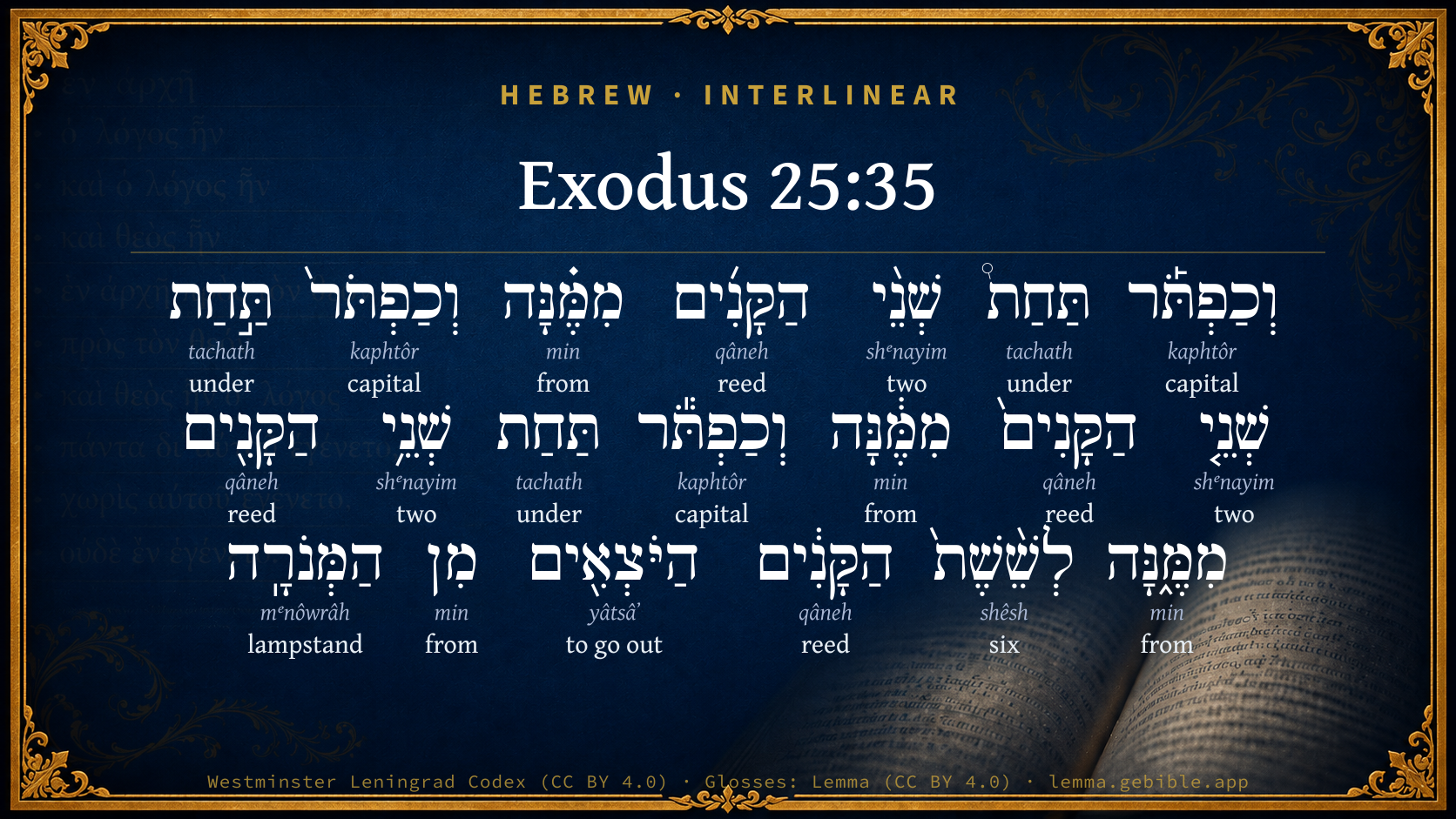
Hebrew (Westminster Leningrad Codex) Exodus 25:35 appears in the Hebrew Old Testament. The text above is from the Westminster Leningrad Codex. Each word links to its Strong’s number, a concise gloss, and parsing drawn from the Open Scriptures Hebrew Bible morphology. Click any word for its full Brown-Driver-Briggs (BDB) entry.
Download image
Cite this verse

Exodus 25:35 (World English Bible). Public Domain. Lemma interlinear Bible study tool, https://lemma.gebible.app/v/exodus/25/35.

Show BibTeX & RIS
BibTeX
RIS
English Translation
and a bud under two branches of one piece with it, and a bud under two branches of one piece with it, and a bud under two branches of one piece with it, for the six branches going out of the lampstand.
World English Bible · Public Domain
Download a study sheet

One document with this verse’s original text, its word-by-word gloss line, the meaning frame, cross-references with their text, attributed commentary, and full source and license credits — printable, and it pastes into notes with its structure intact.

This verse Autodidact and up

Study sheet (.html) Plain text (.txt)

A passage Seminary Student

Up to 50 verses in one chapter. A passage sheet keeps up to 6 commentary sources and 12 cross-references per verse, in the order this page ranks them, and says so on the sheet whenever that leaves anything out. Ask for a single verse and you get the Autodidact verse sheet above.

Everything on this page stays free to read, with no account — the sheet is a download of what is already on screen, not access to it.

Want to remove ads? Support Godless Engineer
Compare translations 3

The same verse in 3 English versions, stacked beneath the original-language interlinear above. Click any original word for its lexicon entry.

Each is an independent rendering of the whole verse — the interlinear is not word-aligned to these translations.

Highlighted words mark where these versions differ — a whole-verse word diff, not a word-by-word alignment.

  • World English Bible Public Domain
    and a bud under two branches of one piece with it, and a bud under two branches of one piece with it, and a bud under two branches of one piece with it, for the six branches going out of the lampstand.
  • King James Version Public Domain
    And there shall be a knop under two branches of the same, and a knop under two branches of the same, and a knop under two branches of the same, according to the six branches that proceed out of the candlestick.
  • unfoldingWord Literal Text CC BY-SA 4.0
    And a bulb will be under two of the branches from it, and a bulb will be under two of the branches from it, and a bulb will be under two of the branches from it—for all six branches extending out from the lampstand.

unfoldingWord Literal Text — © unfoldingWord, licensed CC BY-SA 4.0. Word-aligned USFM3 via Door43 (git.door43.org/unfoldingWord/en_ult).

Versions to compare (up to 4)

3 of 4 selected

Show all 18 translations

Every available English version of this verse, each an independent rendering of the whole verse.

  • World English Bible Public Domain
    and a bud under two branches of one piece with it, and a bud under two branches of one piece with it, and a bud under two branches of one piece with it, for the six branches going out of the lampstand.
  • Berean Standard Bible Public Domain
    For the six branches that extend from the lampstand, a bud must be under the first pair of branches, a bud under the second pair, and a bud under the third pair.
  • Majority Standard Bible Public Domain
    For the six branches that extend from the lampstand, a bud must be under the first pair of branches, a bud under the second pair, and a bud under the third pair.
  • King James Version Public Domain
    And there shall be a knop under two branches of the same, and a knop under two branches of the same, and a knop under two branches of the same, according to the six branches that proceed out of the candlestick.
  • American Standard Version (1901) Public Domain
    and a knop under two branches of one piece with it, and a knop under two branches of one piece with it, and a knop under two branches of one piece with it, for the six branches going out of the candlestick.
  • Revised Version (1885) Public Domain
    and a knop under two branches of one piece with it, and a knop under two branches of one piece with it, and a knop under two branches of one piece with it, for the six branches going out of the candlestick.
  • Geneva Bible (1599) Public Domain
    And there shalbe a knop vnder two branches made thereof: and a knop vnder two branches made thereof: and a knop vnder two branches made thereof, according to the sixe branches comming out of the Candlesticke.
  • Douay-Rheims (1899) Public Domain
    Bowls under two branches in three places, which together make six coming forth out of one shaft.
  • Young's Literal Translation Public Domain
    and a knop under two branches of the same, and a knop under two branches of the same, and a knop under two branches of the same, `are' to the six branches which are coming out of the candlestick;
  • Literal Standard Version CC BY-SA 4.0
    and a knob under two branches of the same, and a knob under two branches of the same, and a knob under two branches of the same, for the six branches which are coming out of the lampstand;
  • Unlocked Literal Bible CC BY-SA 4.0
    There must be a leafy base under the first pair of branches—made as one piece with it, and a leafy base under the second pair of branches—also made as one piece with it. In the same way there must be a leafy base under the third pair of branches, made as one piece with it. It must be the same for all six branches extending out from the lampstand.
  • unfoldingWord Literal Text CC BY-SA 4.0
    And a bulb will be under two of the branches from it, and a bulb will be under two of the branches from it, and a bulb will be under two of the branches from it—for all six branches extending out from the lampstand.
  • Darby Bible Public Domain
    and a knob under two branches of it, and [again] a knob under two branches of it, and [again] a knob under two branches of it, for the six branches that proceed out of the lamp-stand.
  • World Messianic Bible Public Domain
    and a bud under two branches of one piece with it, and a bud under two branches of one piece with it, and a bud under two branches of one piece with it, for the six branches going out of the lamp stand.
  • Webster's Bible Public Domain
    And there shall be a knob under two branches of the same, and a knob under two branches of the same, and a knob under two branches of the same, according to the six branches that project from the candlestick.
  • Free Bible Version CC BY-SA 4.0
    On the six branches that come out from the lampstand, place a bud under the first pair of branches, a bud under the second pair, and a bud under the third pair.
  • Bible in Basic English Public Domain
    And under every two branches a bud, made with the branch, for all the six branches of it.
  • JPS Tanakh (1917) Public Domain
    And a knop under two branches of one piece with it, and a knop under two branches of one piece with it, and a knop under two branches of one piece with it, for the six branches going out of the candlestick.

Literal Standard Version (2020), Covenant Press — licensed CC BY-SA 4.0. Text via the HelloAO Bible API (eBible.org). Unlocked Literal Bible (unfoldingWord) — licensed CC BY-SA 4.0. Text via the HelloAO Bible API (eBible.org). unfoldingWord Literal Text — © unfoldingWord, licensed CC BY-SA 4.0. Word-aligned USFM3 via Door43 (git.door43.org/unfoldingWord/en_ult). Free Bible Version, Dr. Jonathan Gallagher — licensed CC BY-SA 4.0. Text via the HelloAO Bible API (eBible.org).

Word by word

More ways to search: Search by grammar → Find every occurrence → Compare this word →

Practice this passage: Drill this verse → Learn its vocabulary →

וְכַפְתֹּ֡ר
kaphtôr
H3730
“and · capital”
Conjunction + Noun, Common, Masculine, Singular, Absolute
Part of Speech
Conjunction + Noun
Type
Common
Gender
Masculine
Number
Singular
State
Absolute
Full BDB Definition

Origin: probably from an unused root meaning to encircle

TWOT: 1029

bulb, knob, capital, capital of a pillar - knob, bulb (as ornament) - capital (of a pillar)
  1. תַּחַת֩ tachath H8478 “under” Preposition
  2. שְׁנֵ֨י shᵉnayim H8147 “two” Adjective, Cardinal number, Masculine, Dual, Construct
  3. הַקָּנִ֜ים qâneh H7070 “the · reeds” Particle, Definite Article + Noun, Common, Masculine, Plural, Absolute
  4. מִמֶּ֗נָּה min H4480 “from · her” Preposition + Suffix, Personal, 3rd Person, Feminine, Singular
  5. וְכַפְתֹּר֙ kaphtôr H3730 “and · capital” Conjunction + Noun, Common, Masculine, Singular, Absolute
  6. תַּ֣חַת tachath H8478 “under” Preposition
  7. שְׁנֵ֤י shᵉnayim H8147 “two” Adjective, Cardinal number, Masculine, Dual, Construct
  8. הַקָּנִים֙ qâneh H7070 “the · reeds” Particle, Definite Article + Noun, Common, Masculine, Plural, Absolute
  9. מִמֶּ֔נָּה min H4480 “from · her” Preposition + Suffix, Personal, 3rd Person, Feminine, Singular
  10. וְכַפְתֹּ֕ר kaphtôr H3730 “and · capital” Conjunction + Noun, Common, Masculine, Singular, Absolute
  11. תַּחַת tachath H8478 “under” Preposition
  12. שְׁנֵ֥י shᵉnayim H8147 “two” Adjective, Cardinal number, Masculine, Dual, Construct
  13. הַקָּנִ֖ים qâneh H7070 “the · reeds” Particle, Definite Article + Noun, Common, Masculine, Plural, Absolute
  14. מִמֶּ֑נָּה min H4480 “from · her” Preposition + Suffix, Personal, 3rd Person, Feminine, Singular
  15. לְשֵׁ֨שֶׁת֙ shêsh H8337 “to/for · six” Preposition + Adjective, Cardinal number, Masculine, Singular, Construct
  16. הַקָּנִ֔ים qâneh H7070 “the · reeds” Particle, Definite Article + Noun, Common, Masculine, Plural, Absolute
  17. הַיֹּצְאִ֖ים yâtsâʼ H3318 “the · going out” Particle, Definite Article + Verb, Qal, Participle Active, Masculine, Plural, Absolute
  18. מִן min H4480 “from” Preposition
  19. הַמְּנֹרָֽה mᵉnôwrâh H4501 “the · lampstand” Particle, Definite Article + Noun, Common, Feminine, Singular, Absolute

About this verse

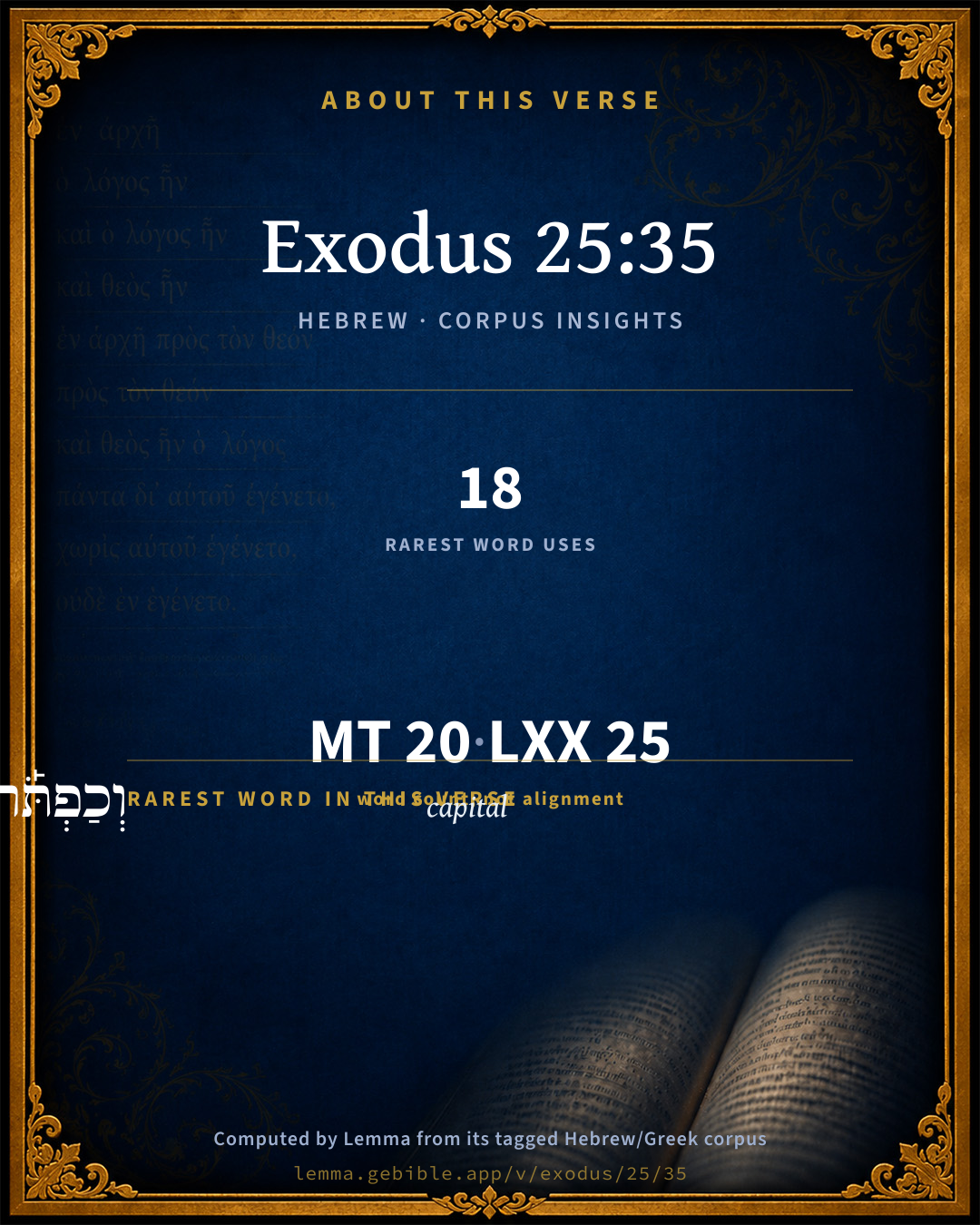
These counts appear in no published source. They are computed here, from the morphology-tagged text and Lemma’s own curated glosses. What Lemma adds →

20
words
8
distinct lemmas
Pentateuch
section

Notable vocabulary

The rarest word here is וְכַפְתֹּ֡ר capital H3730 — appearing just 18 times in the whole Hebrew Bible.

Shared distinctive vocabulary

וְכַפְתֹּ֡ר capital H3730 occurs in 12 verses of the Hebrew Bible. Also found in:

Grammatical profile

  • 1 verb
  • 8 nouns
  • 4 adjectives
  • 7 prepositions

Verb forms

  • הַיֹּצְאִ֖ים Qal · Participle Active

Repetition

Words recur within this verse — often emphatic in Hebrew:

  • הַקָּנִ֜ים reed H7070 ×4
  • וְכַפְתֹּ֡ר capital H3730 ×3
  • תַּחַת֩ under H8478 ×3
  • שְׁנֵ֨י two H8147 ×3
  • מִמֶּ֗נָּה from H4480 ×4

Hebrew & Septuagint length

In English translation the verse runs 42 words from the Hebrew and 35 from the Septuagint (LXX English) — closely comparable.

A rough comparison of the two English renderings, which tokenize alike — not a word-level alignment.

Word counts can differ between the Hebrew and the Greek without any difference in meaning — e.g. the Hebrew direct-object marker אֵת has no separate Greek word, and Greek often adds the article ὁ.

In the original languages it is 20 Hebrew tokens and 25 Greek tokens — but the two are counted differently (Hebrew bundles its prefixes and suffixes into one token; the Greek is in lemma form), so that isn’t a like-for-like length.

Hebrew and Greek witnesses Masoretic Hebrew ↔ Greek Septuagint

The same verse in the two great witnesses to the Old Testament, shown verse-for-verse.

These are two independent witnesses, not word-aligned to each other, and the Septuagint is shown in lemma (dictionary) form.

Hebrew Exodus 25:35 Masoretic · Westminster Leningrad Codex

וְכַפְתֹּ֡ר תַּחַת֩ שְׁנֵ֨י הַקָּנִ֜ים מִמֶּ֗נָּה וְכַפְתֹּר֙ תַּ֣חַת שְׁנֵ֤י הַקָּנִים֙ מִמֶּ֔נָּה וְכַפְתֹּ֕ר תַּחַת שְׁנֵ֥י הַקָּנִ֖ים מִמֶּ֑נָּה לְשֵׁ֨שֶׁת֙ הַקָּנִ֔ים הַיֹּצְאִ֖ים מִן הַמְּנֹרָֽה

and a bud under two branches of one piece with it, and a bud under two branches of one piece with it, and a bud under two branches of one piece with it, for the six branches going out of the lampstand.

World English Bible · Public Domain

Greek LXX Exodus 25:35 Septuagint · lemma form

ὁ σφαιρωτήρ ὑπό ὁ δύο καλαμίσκος ἐκ αὐτός καί σφαιρωτήρ ὑπό ὁ τέσσαρες καλαμίσκος ἐκ αὐτός οὕτως ὁ ἕξ καλαμίσκος ὁ ἐκπορεύομαι ἐκ ὁ λυχνία

A knop under two branches out of it, and a knop under four branches out of it; so to the six branches proceeding from the candlestick; and in the candlestick four bowls fashioned like almonds.

LXX2012 (modern English Septuagint) · Public Domain

Hebrew: Westminster Leningrad Codex (CC BY 4.0). Greek: Septuagint (public domain); English from LXX2012 (modern English Septuagint) (Public Domain). How the Septuagint differs from the Hebrew →

Targum (Aramaic paraphrase)

2

The Targum is the ancient Jewish Aramaic paraphrase of the Hebrew Scriptures — an interpretive translation, not the Hebrew text itself. Onkelos (literal) and Pseudo-Jonathan (expansive) render the Torah, and Jonathan the Prophets. Coverage is partial: where no permissively-licensed English translation exists for a verse, only the Aramaic is shown. This is verse-level text, not a word-by-word alignment to the Hebrew.

  1. Targum Onkelos Torah (Genesis–Deuteronomy)
    וְחֵזוּר תְּחוֹת תְּרֵין קְנִין מִנַהּ וְחֵזוּר תְּחוֹת תְּרֵין קְנִין מִנַהּ וְחֵזוּר תְּחוֹת תְּרֵין קְנִין מִנַהּ לְשִׁתָּא קְנִין דְנָפְקִין מִן מְנַרְתָּא:

    (no public-domain English translation for this verse)

    Targum Onkelos — Aramaic: “Onkelos Genesis” (public domain); “Onkelos Exodus” (public domain); “Onkelos Leviticus” (public domain); “Onkelos Numbers” (public domain); “Onkelos Deuteronomy” (public domain). English: “Sefaria Community Translation” (CC0 1.0 (public-domain dedication)); “J.W. Etheridge. The Targums of Onkelos and Jonathan Ben Uzziel on the Pentateuch. London: Longmans, Green, 1862” (public domain). Text via Sefaria.

  2. Targum Pseudo-Jonathan Torah (Genesis–Deuteronomy)
    וְחֵיזוֹר תְּחוֹת תְּרֵין קְנִין דְּמִינָהּ וְחֵיזוּר תְּחוֹת תְּרֵין קְנִין דְמִינָהּ וְחֵיזוּר תְּחוֹת תְּרֵין קְנִין דְּמִינָהּ לְשִׁיתָּא קְנִין דְּנַפְקִין מִן מְנַרְתָּא

    And there shall be an apple under two branches of it, and an apple under two branches of it, and an apple under two branches of it, for the six branches which extend from the candelabrum.

    Targum Pseudo-Jonathan — Aramaic: “Targum Jonathan on Genesis” (public domain); “Targum Jonathan on Exodus” (public domain); “Targum Jonathan on Leviticus” (public domain); “Targum Jonathan on Numbers” (public domain); “Targum Jonathan on Deuteronomy” (public domain). English: “The Targum of Jonathan ben Uzziel, trans. J. W. Etheridge, London, 1862” (public domain). Text via Sefaria.

Commentary

Notes on Exodus 25:35 from classic Christian and Jewish commentators (each source and its license shown beneath its notes). The classic Christian expositions comment on the surrounding passage and are grouped to its opening verse, so a note may address several verses; the Jewish commentaries on the Tanakh (Rashi and others) are per-verse, so they appear only where the commentator wrote on this verse.

Lemma curates 59 commentaries, every one of them public domain or Creative Commons licensed, each selected and text-cleaned for this edition rather than reprinted as found. About our sources →

Rashi

Rabbi Shlomo Yitzchaki (Rashi)

וכפתר תחת שני הקנים AND THERE SHALL BE A KNOB UNDER TWO BRANCHES — The branches were drawn out from the two sides of the knob to this direction and to that. Thus we are taught in the Baraitha dealing with the construction of the Tabernacle (ch. 10): The full height of the candlestick was eighteen handbreadths, the legs and the flower taking up three handbreadths. — This is the flower mentioned in connection with the base, as it says, (Numbers 8:4) “unto the base thereof, unto the flower thereof”. — Then there was a space of two handbreadths that was plain; then one handbreadth in which was one of the four goblets (mentioned Exodus 25:34) and a knob and a flower of those two knobs and those two flowers that are mentioned together with the candlestick proper — for it states, (v. 34) “[And on the candelabrum (i. e. on the shaft) there shall be four cups] made like unto almonds with their knobs and their flowers,” which teaches us that there were on the middle branch two knobs and two flowers (the plural כפתריה ופרחיה without stating the number suggesting “two” of each kind; besides the three knobs from which the branches emerged and of which it is said, (Exodus 25:35) “And there shall be a knob under the two branches etc.” — Then there were the following: two handbreadths that were plain; a handbreadth made up of a knob from which two branches emerged on each side, extending upward to the level of the candlestick proper; one handbreadth plain; one handbreadth made up of a knob with two branches emerging from it; one handbreadth plain, and a handbreadth made up of a knob from which two branches emerged and rose to the level of the candlestick proper; two handbreadths plain. Thus there remained three handbreadths in which were three goblets (three of the four mentioned in v. 34) and one knob and one flower (of the two mentioned Exodus 25:34-35). Consequently the goblets were twenty-two — eighteen on the six branches, there being three on each, and four on the candlestick proper, making altogether twenty-two; — and there were eleven knobs, — six on the six branches, one on each, and three on the candlestick proper from which the branches emerged, and two more knobs on the candlestick proper, — for it says, “made like unto almonds with its knobs”, and the minimum number implied by the plural כפתורים, is two. One of these was below near the base and the other in the upper three handbreadths together with the three goblets. Furthermore it had nine flowers, six on the six branches, — as it says, (Exodus 25:33) “with a knob and a flower on the one branch” — and three on the candlestick proper, viz., two as is implied in what is said “made like unto almonds with its knobs and its flowers” — and the minimum number to be understood by the plural פרחים is two, and one that is mentioned in the section בהעלתך, (Numbers 8:4) “unto the base thereof and the flower thereof.” If you will study the above quoted Boraitha minutely you will find them (the different parts of the candlestick) enumerated according to their number, each in its position as laid down in this section (Menachot 28b).

Rashi on the Tanakh — English translations: “The Judaica Press complete Tanach with Rashi, translated by A. J. Rosenberg” (CC BY 4.0); “Pentateuch with Rashi's commentary by M. Rosenbaum and A.M. Silbermann, 1929-1934” (public domain); “The Metsudah Tanach series, Lakewood, N.J” (CC BY 4.0); and “The Book of Joshua, Metsudah Publications, 1997” (CC BY 4.0). Text via Sefaria.

The Cambridge Bible for Schools and Colleges

gen. ed. J. J. S. Perowne

35. of one piece with it (thrice)] i.e. with the candlestick.

The Cambridge Bible for Schools and Colleges (gen. ed. J. J. S. Perowne; Cambridge University Press, 1878–1918) — public domain. Text from a community e-Sword module.

John Gill's Exposition

And thou shall make the seven lamps thereof,.... Which were, six of them, on the top of the six branches that came out of the sides of the candlestick, and the seventh on the top of the shaft which ran up in the middle of it; which no doubt were made of gold as well as the rest, and may signify the many members of churches bearing the lamp of a profession: or the several gifts and graces of the Spirit, which are sometimes, because of the perfection of them, called the seven spirits of God, and are compared to seven lamps of fire burning before the throne, Rev 4:5 or else the ministers of the Gospel, who are the lights of the world:

and they shall light the lamps thereof; Aaron and his sons, the priests in successive generations:

that they may give light over against it to the table of shewbread, which was opposite to it on the north side of the tabernacle, and so by the light of these lamps the priests could see to place the shewbread in its order; or the candlestick itself, the lamps being so placed as to give light to the whole body of it, that it might be seen in all its parts very distinctly; unless it can be thought that these lamps were separate from the candlestick, and set around the sides of the holy place, and gave light to it: and this may rather seem to be the case, since these lamps are spoken of after the whole of it is said to be one beaten work of pure gold; but then we have no account of the lamps of the candlestick, unless they are supposed to be included in the branches; wherefore the first sense seems best.

John Gill's Exposition of the Whole Bible (1746–1763) — public domain (CC PDM 1.0). Text via the HelloAO Bible API.

Matthew Poole's English Annotations

And, to complete the number of four, mentioned in the foregoing verse, we must understand that there was another knop and bowl and flower in the upper part of the shaft, above all the branches, as the rules of proportion, and common use in making such things, will easily evince.

Matthew Poole's English Annotations on the Holy Bible (1683–1685) — public domain. Text from a community e-Sword/MySword module.

Whedon's Commentary on the Bible

Daniel D. Whedon

35. Under two branches of the same, according to the six branches — That is, immediately underneath the point at which the side stems, or branches, proceeded out of the main stem there was a knop, each connected with its cup, (bowl, Exo_25:31, note,) and its flower, (Exo_25:33.) This leaves us to infer that the fourth bowl (Exo_25:34) was above, between the two upper branches and the top of the main stem. Thus is explained the position of the four bowls of Exo_25:34.

Daniel D. Whedon (gen. ed.), Commentary on the Old and New Testaments (1874–1909) — public domain. Text from a community e-Sword module.

unfoldingWord translationNotes

Door43 World Missions Community

General Information:

Yahweh continues telling Moses what the people must do. Yahweh is describing the lampstand. (See: Exodus 25:31-32)

made as one piece with it

This can be stated in active form. AT: "you must make them as one piece with the lampstand" (See: Active or Passive)

translationWords

lampstand

pure

gold

unfoldingWord translationNotes — © Distant Shores Media and the Door43 World Missions Community, licensed CC BY-SA 4.0. Source: git.door43.org/Door43/en_tn.

Lesson kit

Teaching starters — assembled from the data on this page, not authored interpretation. Every prompt links to the verse data it draws on. Edit before teaching.

Exodus, in the Pentateuch, opens this verse with 20 words (8 distinct Hebrew lemmas). Its most distinctive word is kaphtôr (“capital”). A historical commentator’s framing appears above. Read the whole chapter for the surrounding context.

Discussion questions

  1. What does “capital” (kaphtôr) contribute to the verse as a whole?
  2. How does Exodus 25:31, which shares the word «capital», read alongside this verse?
  3. What does the repetition of “reed” (4× in this one verse) do in this verse?
  4. The translations on this page render this verse differently — a whole-verse word diff, not a word-by-word alignment. What might account for the different wordings?
  5. «הַיֹּצְאִ֖ים» is a Qal Participle Active verb. How does that grammatical form shape the action described?
  6. Compare how Rashi and The Cambridge Bible for Schools and Colleges read this verse. Where do they agree or differ?

Things to notice

Reading settings

Reading text

Shown beneath each verse's original-language words.

Old Testament
Old Testament edition

Read the OT as the Masoretic Hebrew (MT) or the Greek Septuagint (LXX).

English shown for the Greek Septuagint (in the Hebrew ↔ Greek comparison).

Comparing translations? Open the Compare panel on any verse page to stack up to four side by side.