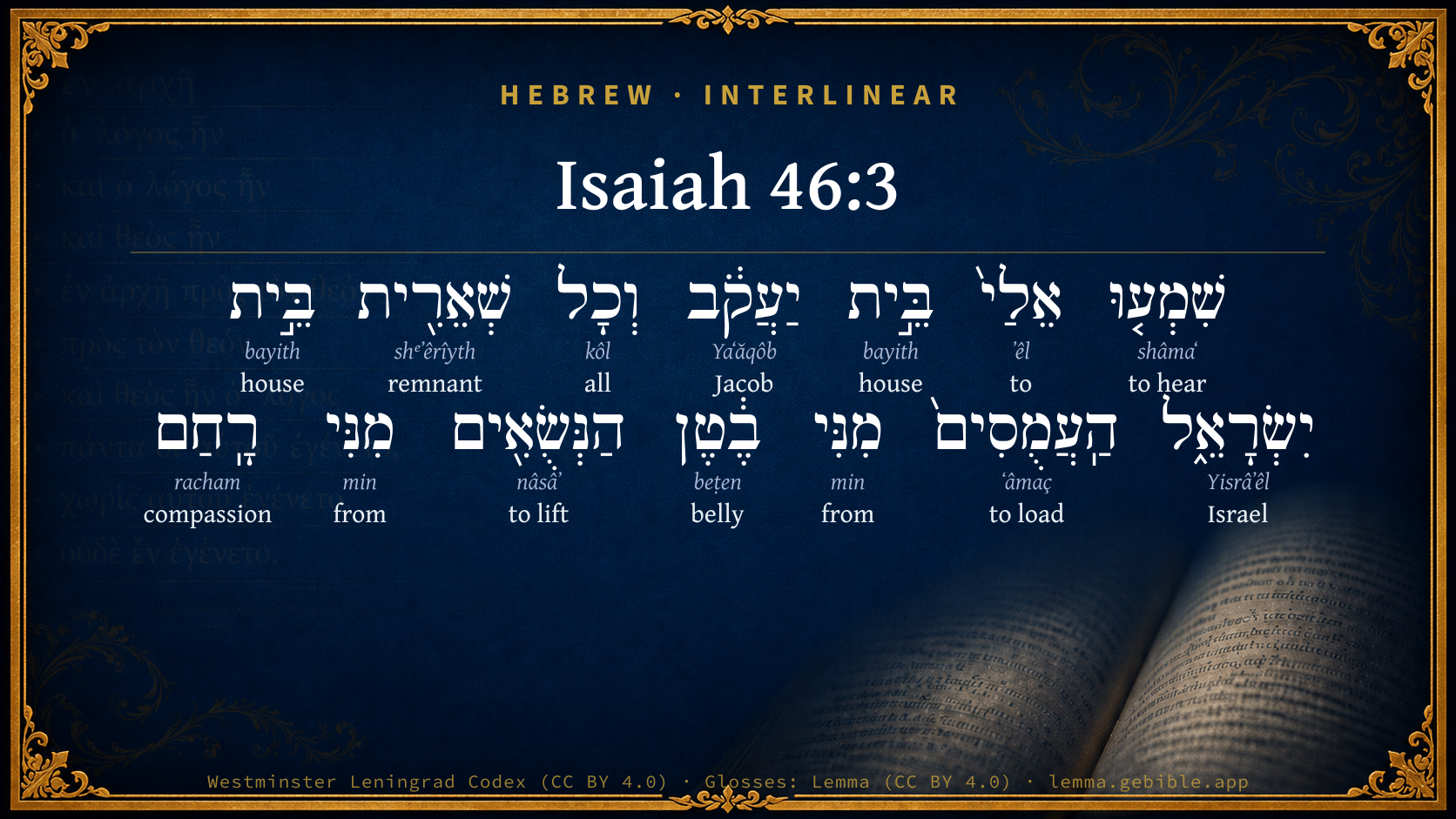
Isaiah 46:3

Hebrew (Westminster Leningrad Codex) Isaiah 46:3 appears in the Hebrew Old Testament. The text above is from the Westminster Leningrad Codex. Each word links to its Strong’s number, a concise gloss, and parsing drawn from the Open Scriptures Hebrew Bible morphology. Click any word for its full Brown-Driver-Briggs (BDB) entry.
Download image
Cite this verse

Isaiah 46:3 (World English Bible). Public Domain. Lemma interlinear Bible study tool, https://lemma.gebible.app/v/isaiah/46/3.

Show BibTeX & RIS
BibTeX
RIS
English Translation
Listen to me, house of Jacob, and all the remnant of the house of Israel, that have been borne [by me] from their birth, that have been carried from the womb;
World English Bible · Public Domain
Download a study sheet

One document with this verse’s original text, its word-by-word gloss line, the meaning frame, cross-references with their text, attributed commentary, and full source and license credits — printable, and it pastes into notes with its structure intact.

This verse Autodidact and up

Study sheet (.html) Plain text (.txt)

A passage Seminary Student

Up to 50 verses in one chapter. A passage sheet keeps up to 6 commentary sources and 12 cross-references per verse, in the order this page ranks them, and says so on the sheet whenever that leaves anything out. Ask for a single verse and you get the Autodidact verse sheet above.

Everything on this page stays free to read, with no account — the sheet is a download of what is already on screen, not access to it.

Want to remove ads? Support Godless Engineer
Compare translations 3

The same verse in 3 English versions, stacked beneath the original-language interlinear above. Click any original word for its lexicon entry.

Each is an independent rendering of the whole verse — the interlinear is not word-aligned to these translations.

Highlighted words mark where these versions differ — a whole-verse word diff, not a word-by-word alignment.

  • World English Bible Public Domain
    Listen to me, house of Jacob, and all the remnant of the house of Israel, that have been borne [by me] from their birth, that have been carried from the womb;
  • King James Version Public Domain
    Hearken unto me, O house of Jacob, and all the remnant of the house of Israel, which are borne by me from the belly, which are carried from the womb:
  • unfoldingWord Literal Text CC BY-SA 4.0
    “Listen to me, house of Jacob, and all of the remnant of the house of Israel, the ones loaded from the belly, the ones carried from the womb.

unfoldingWord Literal Text — © unfoldingWord, licensed CC BY-SA 4.0. Word-aligned USFM3 via Door43 (git.door43.org/unfoldingWord/en_ult).

Versions to compare (up to 4)

3 of 4 selected

Show all 18 translations

Every available English version of this verse, each an independent rendering of the whole verse.

  • World English Bible Public Domain
    Listen to me, house of Jacob, and all the remnant of the house of Israel, that have been borne [by me] from their birth, that have been carried from the womb;
  • Berean Standard Bible Public Domain
    “Listen to Me, O house of Jacob, all the remnant of the house of Israel, who have been sustained from the womb, carried along since birth.
  • Majority Standard Bible Public Domain
    “Listen to Me, O house of Jacob, all the remnant of the house of Israel, who have been sustained from the womb, carried along since birth.
  • King James Version Public Domain
    Hearken unto me, O house of Jacob, and all the remnant of the house of Israel, which are borne by me from the belly, which are carried from the womb:
  • American Standard Version (1901) Public Domain
    Hearken unto me, O house of Jacob, and all the remnant of the house of Israel, that have been borne `by me' from their birth, that have been carried from the womb;
  • Revised Version (1885) Public Domain
    Hearken unto me, O house of Jacob, and all the remnant of the house of Israel, which have been borne by me from the belly, which have been carried from the womb:
  • Geneva Bible (1599) Public Domain
    Heare ye me, O house of Iaakob, and all that remaine of the house of Israel, which are borne of me from the wombe, and brought vp of me from the birth.
  • Douay-Rheims (1899) Public Domain
    Hearken unto me, O house of Jacob, all the remnant of the house of Israel, who are carried by my bowels, are borne up by my womb.
  • Young's Literal Translation Public Domain
    Hearken unto Me, O house of Jacob, And all the remnant of Israel, Who are borne from the belly, Who are carried from the womb,
  • Literal Standard Version CC BY-SA 4.0
    “Listen to Me, O house of Jacob, || And all the remnant of Israel, || Who are borne from the belly, || Who are carried from the womb,
  • Unlocked Literal Bible CC BY-SA 4.0
    Listen to me, house of Jacob, all the remnant of the house of Israel, who have been carried by me from before your birth, carried from the womb.
  • unfoldingWord Literal Text CC BY-SA 4.0
    “Listen to me, house of Jacob, and all of the remnant of the house of Israel, the ones loaded from the belly, the ones carried from the womb.
  • Darby Bible Public Domain
    Hearken unto me, house of Jacob, and all the remnant of the house of Israel, ye who have been borne from the belly, who have been carried from the womb:
  • World Messianic Bible Public Domain
    “Listen to me, house of Jacob, and all the remnant of the house of Israel, that have been carried from their birth, that have been carried from the womb.
  • Webster's Bible Public Domain
    Hearken to me, O house of Jacob, and all the remnant of the house of Israel, which are borne by me from the birth, which are carried from the womb:
  • Free Bible Version CC BY-SA 4.0
    Listen to me, descendants of Jacob, all those who are left of the people of Israel. I have looked after you since you were born, carrying you from birth.
  • Bible in Basic English Public Domain
    Give ear to me, O family of Jacob, and all the rest of the people of Israel, who have been supported by me from their birth, and have been my care from their earliest days:
  • JPS Tanakh (1917) Public Domain
    Hearken unto Me, O house of Jacob, and all the remnant of the house of Israel, that are borne by Me from the birth, that are carried from the womb:

Literal Standard Version (2020), Covenant Press — licensed CC BY-SA 4.0. Text via the HelloAO Bible API (eBible.org). Unlocked Literal Bible (unfoldingWord) — licensed CC BY-SA 4.0. Text via the HelloAO Bible API (eBible.org). unfoldingWord Literal Text — © unfoldingWord, licensed CC BY-SA 4.0. Word-aligned USFM3 via Door43 (git.door43.org/unfoldingWord/en_ult). Free Bible Version, Dr. Jonathan Gallagher — licensed CC BY-SA 4.0. Text via the HelloAO Bible API (eBible.org).

Word by word

More ways to search: Search by grammar → Find every occurrence → Compare this word →

Practice this passage: Drill this verse → Learn its vocabulary →

הַֽעֲמֻסִים֙
ʻâmaç
H6006
“the · loaded”
Particle, Definite Article + Verb, Qal, Participle Passive, Masculine, Plural, Absolute
Part of Speech
Particle + Verb
Stem
Qal
Form
Participle Passive
Gender
Masculine
Number
Plural
State
Absolute
Full BDB Definition

Origin: a primitive root

TWOT: 1643

to load, carry, carry a load - (Qal) - to load - to carry a load - (Hiphil) to lay a load on
  1. שִׁמְע֤וּ shâmaʻ H8085 “hear” Verb, Qal, Imperative, 2nd Person, Masculine, Plural
  2. אֵלַי֙ ʼêl H413 “to · me” Preposition + Suffix, Personal, 1st Person, Common, Singular
  3. בֵּ֣ית bayith H1004 “house of” Noun, Common, Masculine, Singular, Construct
  4. יַעֲקֹ֔ב Yaʻăqôb H3290 “Jacob” Noun, Proper
  5. וְכָל kôl H3605 “and · all of” Conjunction + Noun, Common, Masculine, Singular, Construct
  6. שְׁאֵרִ֖ית shᵉʼêrîyth H7611 “remnant of” Noun, Common, Feminine, Singular, Construct
  7. בֵּ֣ית bayith H1004 “house of” Noun, Common, Masculine, Singular, Construct
  8. יִשְׂרָאֵ֑ל Yisrâʼêl H3478 “Israel” Noun, Proper
  9. מִנִּי min H4480 “from” Preposition
  10. בֶ֔טֶן beṭen H990 “belly” Noun, Common, Feminine, Singular, Absolute
  11. הַנְּשֻׂאִ֖ים nâsâʼ H5375 “the · lifted” Particle, Definite Article + Verb, Qal, Participle Passive, Masculine, Plural, Absolute
  12. מִנִּי min H4480 “from” Preposition
  13. רָֽחַם racham H7356 “compassion” Noun, Common, Both, Singular, Absolute

About this verse

These counts appear in no published source. They are computed here, from the morphology-tagged text and Lemma’s own curated glosses. What Lemma adds →

14
words
12
distinct lemmas
Prophets
section

Notable vocabulary

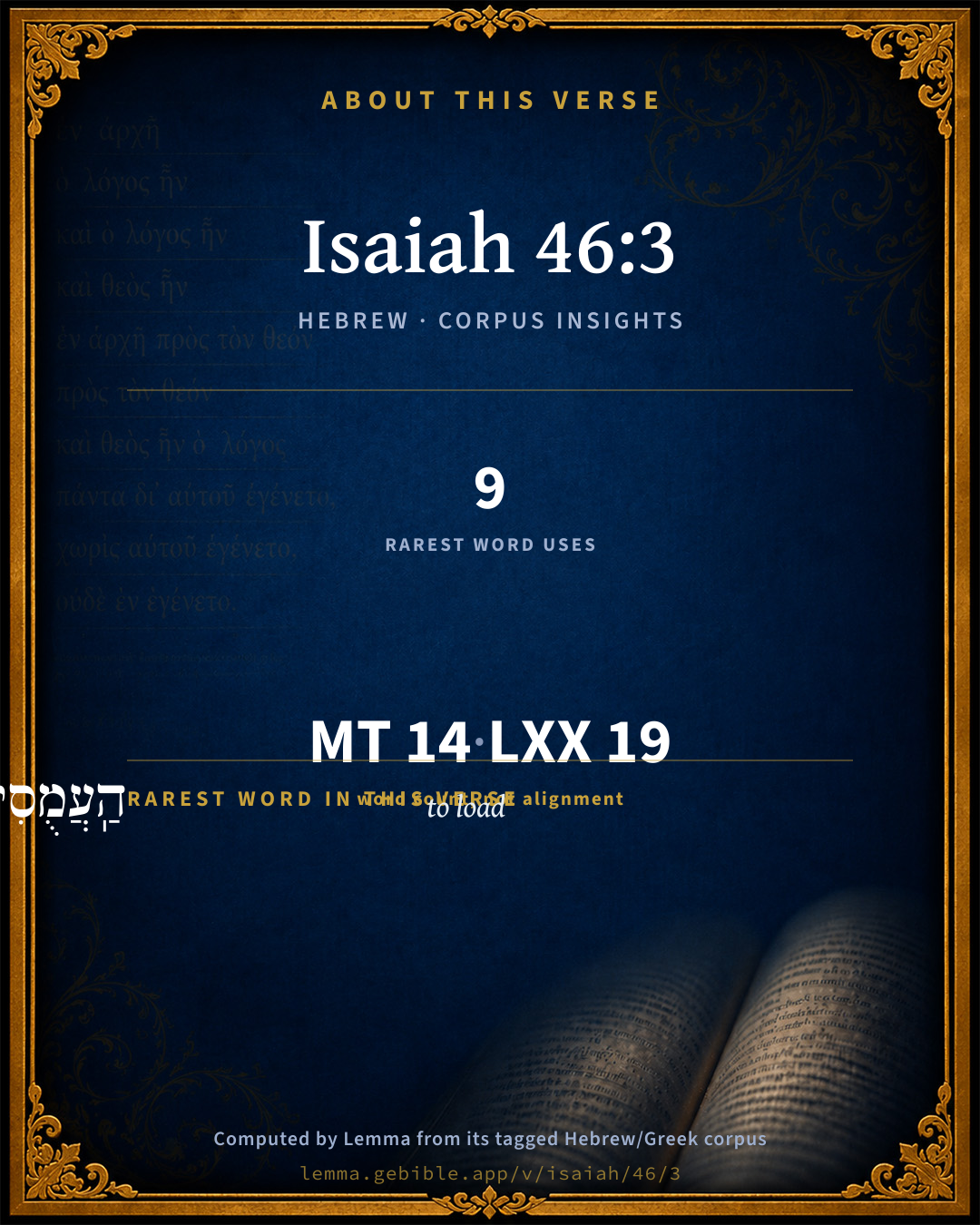
The rarest word here is הַֽעֲמֻסִים֙ to load H6006 — appearing just 9 times in the whole Hebrew Bible.

Shared distinctive vocabulary

הַֽעֲמֻסִים֙ to load H6006 occurs in 9 verses of the Hebrew Bible. Also found in:

Grammatical profile

  • 3 verbs
  • 8 nouns
  • 3 prepositions

Verb forms

  • שִׁמְע֤וּ Qal · Imperative
  • הַֽעֲמֻסִים֙ Qal · Participle Passive
  • הַנְּשֻׂאִ֖ים Qal · Participle Passive

Repetition

Words recur within this verse — often emphatic in Hebrew:

  • בֵּ֣ית house H1004 ×2
  • מִנִּי from H4480 ×2

Hebrew & Septuagint length

In English translation the verse runs 31 words from the Hebrew and 30 from the Septuagint (LXX English) — closely comparable.

A rough comparison of the two English renderings, which tokenize alike — not a word-level alignment.

Word counts can differ between the Hebrew and the Greek without any difference in meaning — e.g. the Hebrew direct-object marker אֵת has no separate Greek word, and Greek often adds the article ὁ.

In the original languages it is 14 Hebrew tokens and 19 Greek tokens — but the two are counted differently (Hebrew bundles its prefixes and suffixes into one token; the Greek is in lemma form), so that isn’t a like-for-like length.

Cross-references

20

Topical passages linked to Isaiah 46:3 in the Treasury of Scripture Knowledge — connected by theme and wording, ordered by reader-vote popularity; previews shown in the World English Bible.

  • Deuteronomy 1:31 and in the wilderness, where you have seen how that Yahweh your God bore you, as a man does bear his son, in all the way that you went, until you came to this place.
  • Isaiah 51:7 Listen to me, you who know righteousness, the people in whose heart is my law; don't you fear the reproach of men, neither be you dismayed at their insults.
  • Psalms 71:6 I have relied on you from the womb. You are he who took me out of my mother's womb. I will always praise you.
  • Isaiah 51:1 Listen to me, you who follow after righteousness, you who seek Yahweh: look to the rock whence you were hewn, and to the hold of the pit whence you were dug.
  • Exodus 19:4 'You have seen what I did to the Egyptians, and how I bore you on eagles' wings, and brought you to myself.
  • Deuteronomy 32:11–12 As an eagle that stirs up her nest, That flutters over her young, He spread abroad his wings, he took them, He bore them on his feathers.
  • Psalms 22:9–10 But you brought me out of the womb. You made me trust at my mother's breasts.
  • Isaiah 1:9 Unless Yahweh of hosts had left to us a very small remnant, We would have been as Sodom; We would have been like Gomorrah.
  • Isaiah 10:22 For though your people, Israel, be as the sand of the sea, [only] a remnant of them shall return: a destruction [is] determined, overflowing with righteousness.
  • Isaiah 44:1–2 Yet now hear, Jacob my servant, and Israel, who I have chosen:
  • Isaiah 48:1 Hear you this, house of Jacob, who are called by the name of Israel, and are come forth out of the waters of Judah; who swear by the name of Yahweh, and make mention of the God of Israel, but not in truth, nor in righteousness
  • Isaiah 49:1–2 Listen, isles, to me; and listen, you peoples, from far: Yahweh has called me from the womb; from the bowels of my mother has he made mention of my name:
  • Psalms 81:8–13 "Hear, my people, and I will testify to you, Israel, if you would listen to me!
  • Isaiah 11:11 It shall happen in that day, that the Lord will set his hand again the second time to recover the remnant of his people, who shall remain, from Assyria, and from Egypt, and from Pathros, and from Cush, and from Elam, and from Shinar, and from Hamath, and from the islands of the sea.
  • Isaiah 37:4 It may be Yahweh your God will hear the words of Rabshakeh, whom the king of Assyria his master has sent to defy the living God, and will rebuke the words which Yahweh your God has heard. Therefore lift up your prayer for the remnant that is left.
  • Isaiah 46:12 Listen to me, you stout-hearted, who are far from righteousness:
  • Isaiah 44:21 Remember these things, Jacob, and Israel; for you are my servant: I have formed you; you are my servant: Israel, you shall not be forgotten by me.
  • Isaiah 48:17–18 Thus says Yahweh, your Redeemer, the Holy One of Israel: I am Yahweh your God, who teaches you to profit, who leads you by the way that you should go.
  • Ezekiel 16:6–16 When I passed by you, and saw you weltering in your blood, I said to you, [Though you are] in your blood, live; yes, I said to you, [Though you are] in your blood, live.
  • Isaiah 63:9 In all their affliction he was afflicted, and the angel of his presence saved them: in his love and in his pity he redeemed them; and he bore them, and carried them all the days of old.

Cross-references courtesy of OpenBible.info (CC BY 4.0).

Hebrew and Greek witnesses Masoretic Hebrew ↔ Greek Septuagint

The same verse in the two great witnesses to the Old Testament, shown verse-for-verse.

These are two independent witnesses, not word-aligned to each other, and the Septuagint is shown in lemma (dictionary) form.

Hebrew Isaiah 46:3 Masoretic · Westminster Leningrad Codex

שִׁמְע֤וּ אֵלַי֙ בֵּ֣ית יַעֲקֹ֔ב וְכָל שְׁאֵרִ֖ית בֵּ֣ית יִשְׂרָאֵ֑ל הַֽעֲמֻסִים֙ מִנִּי בֶ֔טֶן הַנְּשֻׂאִ֖ים מִנִּי רָֽחַם

Listen to me, house of Jacob, and all the remnant of the house of Israel, that have been borne [by me] from their birth, that have been carried from the womb;

World English Bible · Public Domain

Greek LXX Isaiah 46:3 Septuagint · lemma form

ἀκούω ἐγώ οἶκος ὁ ἰακώβ καί πᾶς ὁ κατάλοιπος ὁ ἰσραήλ ὁ αἴρω ἐκ κοιλία καί παιδεύω ἐκ παιδίον

Hear me, O house of Jacob, and all the remnant of Israel, who are borne by me from the womb, and taught by me from infancy, even to old age:

LXX2012 (modern English Septuagint) · Public Domain

On this verse, Haydock's Catholic Bible Commentary discusses the Septuagint’s reading. Read the note in Commentary ↓

Hebrew: Westminster Leningrad Codex (CC BY 4.0). Greek: Septuagint (public domain); English from LXX2012 (modern English Septuagint) (Public Domain). How the Septuagint differs from the Hebrew →

Targum (Aramaic paraphrase)

1

The Targum is the ancient Jewish Aramaic paraphrase of the Hebrew Scriptures — an interpretive translation, not the Hebrew text itself. Onkelos (literal) and Pseudo-Jonathan (expansive) render the Torah, and Jonathan the Prophets. Coverage is partial: where no permissively-licensed English translation exists for a verse, only the Aramaic is shown. This is verse-level text, not a word-by-word alignment to the Hebrew.

  1. Targum Jonathan Prophets (Joshua–Malachi)
    קַבִּילוּ לְמֵימְרִי דְבֵית יַעֲקֹב וְכָל שְׁאָרָא דְבֵית יִשְׂרָאֵל דִרְחִימִין מִכָּל עַמְמַיָא וַחֲבִיבִין מִכָּל מַלְכְּוָתָא:

    Hearken unto me, O house of Jacob, and all the remnant of the house of Israel, who are beloved above all nations, yea, beloved above all kingdoms.

    Targum Jonathan — Aramaic: “Mikraot Gedolot” (public domain). English: “Sefaria Community Translation” (CC0 1.0 (public-domain dedication)); “London "Chaldee Paraphrase," 1871” (public domain). Text via Sefaria.

Commentary

Notes on Isaiah 46:3 from classic Christian and Jewish commentators (each source and its license shown beneath its notes). The classic Christian expositions comment on the surrounding passage and are grouped to its opening verse, so a note may address several verses; the Jewish commentaries on the Tanakh (Rashi and others) are per-verse, so they appear only where the commentator wrote on this verse.

Lemma curates 59 commentaries, every one of them public domain or Creative Commons licensed, each selected and text-cleaned for this edition rather than reprinted as found. About our sources →

Trapp's Complete Commentary

John Trapp

Isa 46:3 Hearken unto me, O house of Jacob, and all the remnant of the house of Israel, which are borne [by me] from the belly, which are carried from the womb:

Ver. 3. Which are borne by me from the belly.] You do not bear me, as they do their idols in procession and otherwise; but I bear you, and so have done from the first, and shall do the last; like as the tender mother doth her beloved babe, or as the eagle doth her young upon her wings. {Exo 19:4 Deu 32:11}

John Trapp, A Commentary or Exposition upon All the Books of the Old and New Testament (1647–1656) — public domain. Text from a community e-Sword module.

Joseph Benson's Commentary

Isa 46:3-4. Hearken, &c., all the remnant of the house of Israel — All that remain of the twelve tribes. He terms them a remnant, either because the ten tribes were already carried into captivity by Shalmaneser, or because he addresses that remnant of the two tribes, which he foresaw would return from Babylon; which are borne by me, &c. — Whom I have nourished and cared for from time to time, ever since you were a people, and came out of Egypt, and that as affectionately and tenderly as parents bring up their own children. Even to hoar hairs will I carry you — That kindness which I have shown you, and that care which I have taken of you, I will continue to you to the end, never forsaking you, unless you wilfully and obstinately cast me off; which the Jews did when their Messiah came. I have made you, and will carry, and deliver you — You are my workmanship, both as you are men, and as you are my peculiar people; and therefore I will preserve and deliver you. The reader will observe, that the prophet here “very ingeniously, and with great force, contrasts the power of God, and his tender goodness effectually exerted toward his people with the inability of the false gods of the heathen: he, like an indulgent father, had carried his people, in his arms, ‘as a man carrieth his son,’

Deu 1:31; he had protected them and delivered them in their distresses; whereas the idols of the heathen were forced to be carried about themselves, and removed from place to place, with a great labour and fatigue to their worshippers; nor could they answer, or deliver their votaries, when they cried unto them.” See Num 11:12.

Joseph Benson's Commentary on the Old and New Testaments (1811–1818) — public domain. Text from a community e-Sword module.

Tyndale Open Study Notes

Tyndale Open Resources

46:3 Those who remain in Israel refers to the remnant that would be left alive after the destruction of Jerusalem in 586 BC. • The Lord, the Creator of humanity, cares for and carries his people (contrast the Babylonian idols that must be carried instead). • since you were born . . . before you were born: The Lord chose Israel even before they were a nation (see also 49:5).

Tyndale Open Study Notes — © Tyndale Open Resources, licensed CC BY-SA 4.0. Text via the HelloAO Bible API.

Geneva Bible (1599)

Geneva Bible translators

He showeth the difference between the idols and the true God: for they must be carried of others, but God himself carrieth his, as Deut. 32:11.

Geneva Bible (1599) marginal notes — public domain. Text via Bolls.life.

Jamieson, Fausset & Brown

Robert Jamieson, A. R. Fausset & David Brown

in contrast to what precedes: Babylon's idols, so far from bearing its people safely are themselves borne off, a burden to the laden beast; but Jehovah bears His people in safety even from the womb to old age (Isa 63:9; Deu 32:11; Psa 71:6, Psa 71:18). God compares Himself to a nurse tenderly carrying a child; contrast Moses' language (Num 11:12).

Jamieson, Fausset & Brown — Commentary Critical and Explanatory on the Whole Bible (1871) — public domain (CC PDM 1.0). Text via the HelloAO Bible API.

Adam Clarke's Commentary

Verse 3. Which are borne by me from the belly - "Ye that have been borne by me from the birth"] The prophet very ingeniously, and with great force, contrasts the power of God, and his tender goodness effectually exerted towards his people, with the inability of the false gods of the heathen. He like an indulgent father had carried his people in his arms, "as a man carrieth his son," De 1:31. He had protected them, and delivered them from their distresses: whereas the idols of the heathen are forced to be carried about themselves and removed from place to place, with great labour and fatigue, by their worshippers; nor can they answer, or deliver their votaries, when they cry unto them.

Moses, expostulating with God on the weight of the charge laid upon him as leader of his people, expresses that charge under the same image of a parent's carrying his children, in very strong terms: "Have I conceived all this people? have I begotten them? that thou shouldest say unto me, Carry them in thy bosom, as a nursing father beareth the sucking child, unto the land which thou swarest unto their fathers;" Nu 11:12.

Adam Clarke's Commentary on the Bible (1810–1826) — public domain. Text from a community e-Sword/MySword module.

Ellicott's Commentary for English Readers

(3) Hearken unto me.—The prophet’s choice of words is singularly emphatic. The false gods are borne away as a burden. The true God bears, i.e., supports, His people. He is able to bear that burden. Every “I” is emphasised in the Hebrew.

A Bible Commentary for English Readers, edited by Charles John Ellicott (1878–1897) — public domain. Text from a community e-Sword module.

The Cambridge Bible for Schools and Colleges

gen. ed. J. J. S. Perowne

3. all the remnant of the house of Israel] It is doubtful whether there is a reference here to the scattered survivors of the Ten Tribes. More probably, the clause is a rhetorical variation of the previous “house of Jacob.” The participles borne and carried are repeated from Isa_46:1, although in inverse order (“carried things” and “made a load”). The words “by me” are better omitted.

3, 4. In the scene which he has just described the prophet sees an emblem of the inherent weakness of heathenism. There man carries his gods, and the result is that gods and worshippers are involved in common ruin. Israel has had a far different experience of its relation to its God, having known Jehovah as One who has carried it from the beginning of its history (Exo_19:4; Deu_1:31; Deu_32:11; Hos_11:3; cf. ch. Isa_40:11, Isa_63:9), and is able to bear it on to final salvation. The profound insight into the nature of religion which is characteristic of the writer is nowhere more clearly exhibited than in this striking and original contrast.

The Cambridge Bible for Schools and Colleges (gen. ed. J. J. S. Perowne; Cambridge University Press, 1878–1918) — public domain. Text from a community e-Sword module.

John Gill's Exposition

Hearken unto me, O house of Jacob,.... The Jews, the descendants of Jacob:

and all the remnant of the house of Israel; those that remained of the ten tribes that had been carried captive long ago. These may, in a spiritual sense, design those who are Israelites indeed; the household of the God of Jacob; the chosen of God, and called; the remnant according to the election of grace:

which are borne by me from the belly, which are carried from the womb: here the Lord distinguishes himself from the idols of the Babylonians; they were laid as burdens upon beasts, and bore and carried by them; but the Lord is born and carried by none, but bears and carries his people. The allusion is to tender parents that have compassion on their children as soon as born, and take care of them, and bear them in their bosoms, and carry them in their arms; and may have respect, in the literal sense, to the infant state of the Jews, both as a church and commonwealth, when the Lord took pity on them, and care of them, and bore them as a father bears his son; and bore with their manners too, and carried them all the days of old through the wilderness to Canaan's land; see Num 11:12. It may be applied to the care of God in the preservation of men by his providence, especially his own people, whose God he is from their mother's belly; who takes them under his protection as soon as born, and carries them through every state of infancy, youth, manhood, and old age, and never leaves nor forsakes them; see Psa 22:10, and with great propriety may be applied to regenerate persons, who, as soon as born again, are regarded by the Lord in a very visible, tender, and compassionate manner; he "bears" them in his bosom, and on his heart; he bears them in his arms; he puts his everlasting arms underneath them; he bears with them, with all their weakness and infirmities, their peevishness and frowardness; he bears them up under all their afflictions, and sustains all their burdens; he bears them through and out of all their troubles and difficulties: he "carries" them, in like manner, in his bosom, and in his arms; he "carries" them into his house, the church, which is the nursery for them, where they are nursed and fed, and have the breasts of consolation drawn out to them; he carries on the good work of grace in them; he carries them through all their trials and exercises safe to heaven and eternal happiness; for they are poor, weak, helpless creatures, like newly born babes, cannot go alone, but must be bore up and carried.

John Gill's Exposition of the Whole Bible (1746–1763) — public domain (CC PDM 1.0). Text via the HelloAO Bible API.

Albert Barnes' Notes on the Bible

Hearken unto me - From this view of the captive gods, the address is now turned to the Jews. The utter vanity of the idols had been set before them; and in view of that, God now addresses his own people, and entreats them to put their trust in him. The address he commences with words of great tenderness and endearment, designed to lead them to confide in him as their Father and friend.

And all the remnant - All who were left from slaughter, and all who were borne into captivity to Babylon. The language here is all full of tenderness, and is suited to inspire them with confidence in God. The idols of the pagan, so far from being able to protect their worshippers, were themselves carried away into ignoble bondage, but Yahweh was himself able to carry his people, and to sustain them.

Which are borne by me - Like an indulgent father, or a tender nurse, he had carried them from the very infancy of their nation. The same image occurs in Deu 1:31 : ‘And in the wilderness, where thou hast seen how that the Lord thy God bare thee, as a man doth bear his son, in all the way that ye went, until ye came into thins place.’ A similar figure occurs in Exo 19:4 : ‘Ye have seen, how I bare you on eagles’ wings, and brought you unto myself’ (so Deu 32:11-12; compare Num 11:12; Isa 63:9). All this here stands opposed to the idols of the Babylonians. They were unable to protect their people. They were themselves made captive. But God had shown the part of a father and a protector to his people in all times. He had sustained and guided them; he had never forsaken them; he had never, like the idol-gods, been compelled to leave them in the power of their enemies. From the fact that he had always, even from the infancy of their nation, thus protected them, they are called on to put their trust in him.

Albert Barnes' Notes on the Bible (1834–1885) — public domain. Text from a community e-Sword/MySword module.

Haydock's Catholic Bible Commentary

By my. Vulgate may have read a me ab, (Calmet) instead of a meo. Hebrew and Septuagint, "taken from the womb," (Haydock) and treated with the utmost tenderness. (Calmet)

George Leo Haydock (1774–1849), Haydock's Catholic Family Bible and Commentary, 1859 edition — public domain. Excludes Psalms (Douay-Rheims chapter numbering differs from Protestant) and Deuterocanonical books (Catholic canon only).

Matthew Poole's English Annotations

All the remnant of the house of Israel; fitly so called, with respect either,

1. To all the tribes of Israel, ten of which were now lost and gone; or,

2. To the state of the Jews at their return from Babylon, there being only a remnant of the two tribes which did return.

Which are carried from the womb; whom I have nourished and cared for from time to time, ever since you were a people, and carne out of Egypt, and that as affectionately and tenderly as parents bring up their own children.

Matthew Poole's English Annotations on the Holy Bible (1683–1685) — public domain. Text from a community e-Sword/MySword module.

Whedon's Commentary on the Bible

Daniel D. Whedon

3, 4. I will carry, and will deliver — The prophet shows the nation very differently cared for by its Lord Jehovah, who attended “its birth at the exodus, its infancy in the desert, its manhood under David and Solomon, its old age under the later prophets, when the first covenant was ready to decay.” Idols do no such thing to their adherents and worshippers. See Num_11:12.

Daniel D. Whedon (gen. ed.), Commentary on the Old and New Testaments (1874–1909) — public domain. Text from a community e-Sword module.

The Pulpit Commentary

Vers. 3-8. AN ADMONITION TO ISRAEL. Israel should learn from the fate of the Babylonian idols to trust in Jehovah, who can and will deliver them, rather than in gods of gold and silver, which can give no aid, either to themselves or others.

All the remnant of the house of Israel. The address is not to those who had remained faithful of the ten tribes (as Delitzsch supposes), but to the captives of Babylon, designated in these later chapters indifferently as "Jacob" or "Israel", (Isa_40:27 Isa_41:8, 14 42:24 43:1, 28 44:1, 21, 23 45:4, etc.) never as "Judah," and constantly mentioned as a "remnant all that was left of the oppressed and downtrodden nation. (see Isa_1:9 Isa_10:20-22 Isa_11:16. etc.) Borne by me. Carried in the everlasting arms, as a child in the arms of its nurse or mother. (Isa_63:9) From the belly... from the womb. From the very beginning of the national existence.

The Pulpit Commentary (1880–1919), ed. H.D.M. Spence-Jones & Joseph S. Exell — public domain. Text from a community e-Sword module.

John Wesley's Explanatory Notes

Carried - Whom I have nourished, ever since you were a people, and came out of Egypt; and that as tenderly, as parents bring up their own children.

John Wesley, Explanatory Notes Upon the Whole Bible (1754–1765) — public domain. Text via the GEBible commentary corpus.

Keil & Delitzsch

C. F. Keil & F. Delitzsch

From this approaching reduction of the gods of Babylon to their original nothingness, several admonitions are now derived. The first admonition is addressed to all Israel. "Hearken unto me, O house of Jacob, and all the remnant of the house of Israel: ye, lifted up from the womb; ye, carried from the mother's lap! And till old age it is I, and to grey hair I shall bear you on my shoulder: I have done it, and I shall carry; and I put upon my shoulder, and deliver. To whom can ye compare me, and liken, and place side by side, that we should be equal?" The house of Jacob is Judah here, as in Oba 1:18 (see Caspari on the passage), Nah 2:3, and the house of Israel the same as the house of Joseph in Obadiah; whereas in Amo 3:13; Amo 6:8; Amo 7:2, Jacob stands for Israel, in distinction from Judah. The Assyrian exile was earlier than the Babylonian, and had already naturalized the greater part of the exiles in a heathen land, and robbed them of their natural character, so that there was only a remnant left by whom there was any hope that the prophet's message would be received. What the exiles of both houses were to hear was the question in Isa 46:5, which called upon them to consider the incomparable nature of their God, as deduced from what Jehovah could say of Himself in relation to all Israel, and what He does say from העמסים onwards. Babylon carried its idols, but all in vain: they were carried forth, without being able to save themselves; but Jehovah carried His people, and saved them. The expressions, "from the womb, and from the mother's lap," point back to the time when the nation which had been in process of formation from the time of Abraham onwards came out of Egypt, and was born, as it were, into the light of the world. From this time forward it had lain upon Jehovah like a willingly adopted burden, and He had carried it as a nurse carries a suckling (Num 11:12), and an eagle its young (Deu 32:11). In Isa 46:4 the attributes of the people are carried on in direct (not relative) self-assertions on the part of Jehovah. The senectus and canities are obviously those of the people - not, however, as though it was already in a state of dotage (as Hitzig maintains, appealing erroneously to Isa 47:6), but as denoting the future and latest periods of its history. Even till then Jehovah is He, i.e., the Absolute, and always the same (see Isa 41:4). As He has acted in the past, so will He act at all times - supporting and saving His people. Hence He could properly ask, Whom could you place by the side of me, so that we should be equal? (Vav consec. as in Isa 40:25).

Keil & Delitzsch — Biblical Commentary on the Old Testament (1861–1891) — public domain (CC PDM 1.0). Text via the HelloAO Bible API. (Old Testament only.)

J. A. Alexander on Isaiah

Joseph Addison Alexander

“Hearken unto me, oh house of Jacob, and all the remnant of the house of Israel, those borne from the belly, those carried from the womb.” This repetition, analogous to that in Isa 42:2-3, is intended to suggest a contrast between the failure of the idols to protect their worshippers and God’s incessant care of His own people. The gods of the heathen had to be borne by them; but Jehovah was Himself the bearer of His followers. And this was no new thing, but coeval with their national existence. The specific reference to Egypt or the Exodus is no more necessary here than in Isa 44:2; Isa 44:24; Isa 48:8. The carrying meant is that of children by the nurse or parent. The same comparison is frequent elsewhere. (See Num 11:12; Deu 1:31; Exo 19:4; Isa 63:9, and compare Deu 32:11-12; Hos 11:3; Isa 40:11).

Joseph Addison Alexander, The Prophecies of Isaiah (1846–1847; New York: Scribner, 1870–1878) — public domain. Text from a community e-Sword module.

unfoldingWord translationNotes

Door43 World Missions Community

Listen to me

Here "me" refers to Yahweh.

who have been carried by me from before your birth, carried from the womb

Yahweh speaks of the nation of Israel as if it were a person, and of the nation's beginning as if it were its birth. (See: Metaphor)

who have been carried by me

Yahweh speaks of helping and rescuing the people of Israel as if he were carrying them. This can be stated in active form. AT: "whom I have carried" (See: Metaphor and Active or Passive)

Even to your old age I am he, and until your hair is gray I will carry you

Yahweh speaks of the nation of Israel becoming very old as if it were an old man with gray hair. (See: Metaphor)

translationWords

house

Jacob

remnant

womb

unfoldingWord translationNotes — © Distant Shores Media and the Door43 World Missions Community, licensed CC BY-SA 4.0. Source: git.door43.org/Door43/en_tn.

Rashi

Rabbi Shlomo Yitzchaki (Rashi)

who are borne from birth Since you were born in the house of Laban the Aramean, I bore you on My arms, for since then, adversaries stand up against you in every generation and not like the idolaters (other nations [K’li Paz and mss.]) who are laden and carry their Gods, as is mentioned above, but you are laden and borne in My arms.

Rashi on the Tanakh — English translations: “The Judaica Press complete Tanach with Rashi, translated by A. J. Rosenberg” (CC BY 4.0); “Pentateuch with Rashi's commentary by M. Rosenbaum and A.M. Silbermann, 1929-1934” (public domain); “The Metsudah Tanach series, Lakewood, N.J” (CC BY 4.0); and “The Book of Joshua, Metsudah Publications, 1997” (CC BY 4.0). Text via Sefaria.

Ibn Ezra

Rabbi Abraham ibn Ezra

Which are borne by me, etc. The idols of Babylon are carried by their worshippers, but I, the God of Israel, carry the Israelites.

From the belly, that is, since the day they were born.

Ibn Ezra on the Tanakh — English translations: “Sefaria Community Translation” (CC0 1.0 (public-domain dedication)); “Yalkut, Sifsei Chachomim Chumash, Metsudah Publications, 2009” (CC BY 4.0); and “Commentary of Ibn Ezra on Isaiah - trans. by M. Friedlander, 1873” (public domain). Text via Sefaria.

Lesson kit

Teaching starters — assembled from the data on this page, not authored interpretation. Every prompt links to the verse data it draws on. Edit before teaching.

Isaiah, in the Prophets, opens this verse with 14 words (12 distinct Hebrew lemmas). Its most distinctive word is ʻâmaç (“to load”). A historical commentator’s framing appears above. Read the whole chapter for the surrounding context.

Discussion questions

  1. What does “to load” (ʻâmaç) contribute to the verse as a whole?
  2. Genesis 44:13 shares the word «to load» with this verse. How do the two illuminate each other?
  3. “house” occurs 2× in this one verse. What is the effect of the repetition?
  4. The translations on this page render this verse differently — a whole-verse word diff, not a word-by-word alignment. What might account for the different wordings?
  5. The verb «שִׁמְע֤וּ» is Qal Imperative. How does its form color the action?
  6. Reading how Trapp's Complete Commentary and Joseph Benson's Commentary read this verse, where do the two commentators agree and where do they part?

Things to notice

Reading settings

Reading text

Shown beneath each verse's original-language words.

Old Testament
Old Testament edition

Read the OT as the Masoretic Hebrew (MT) or the Greek Septuagint (LXX).

English shown for the Greek Septuagint (in the Hebrew ↔ Greek comparison).

Comparing translations? Open the Compare panel on any verse page to stack up to four side by side.