Exodus 8:11

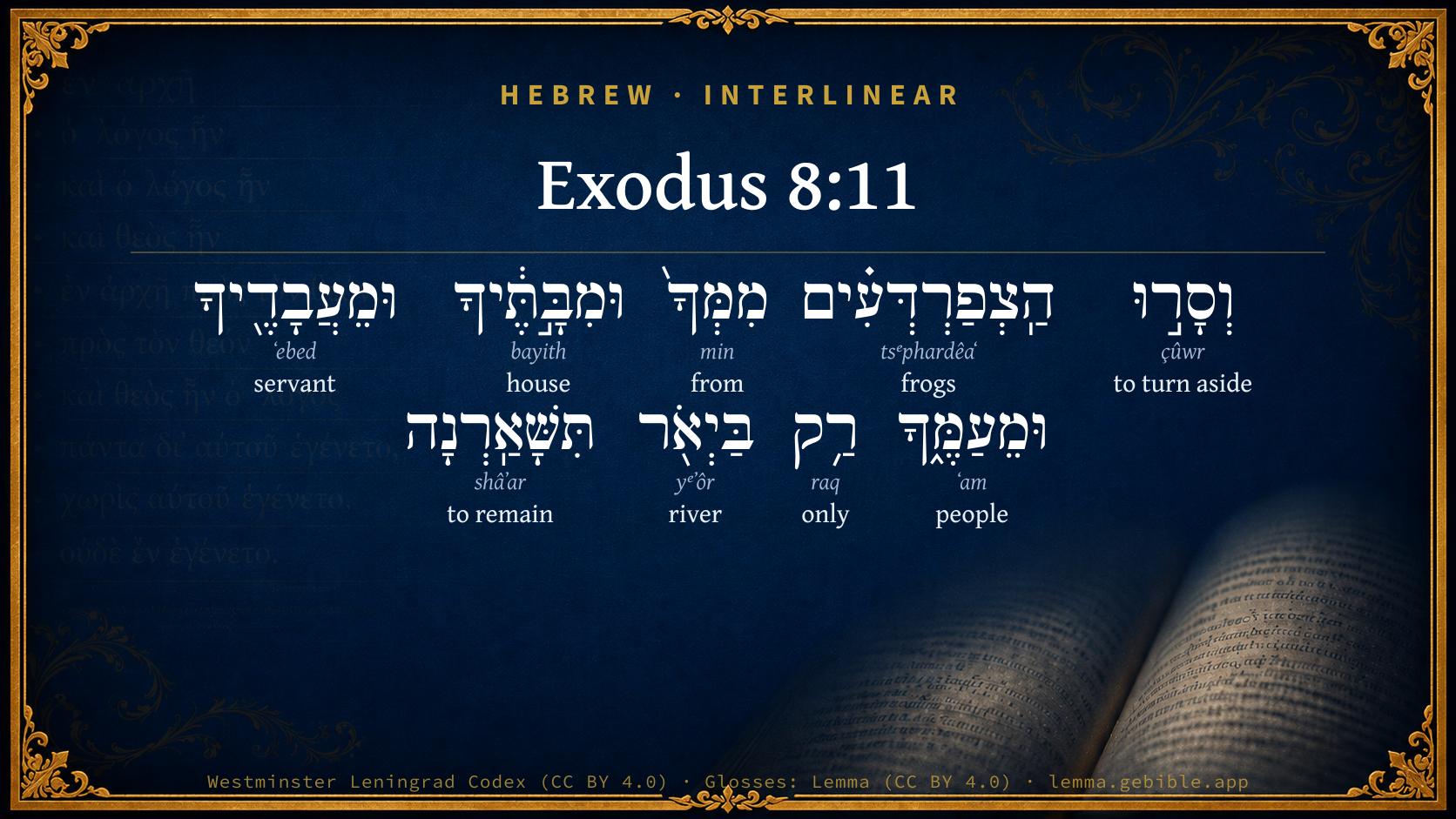
Hebrew (Westminster Leningrad Codex) Exodus 8:11 appears in the Hebrew Old Testament. The text above is from the Westminster Leningrad Codex. Each word links to its Strong’s number, a concise gloss, and parsing drawn from the Open Scriptures Hebrew Bible morphology. Click any word for its full Brown-Driver-Briggs (BDB) entry.
Download image
Cite this verse

Exodus 8:11 (World English Bible). Public Domain. Lemma interlinear Bible study tool, https://lemma.gebible.app/v/exodus/8/11.

Show BibTeX & RIS
BibTeX
RIS
English Translation
The frogs shall depart from you, and from your houses, and from your servants, and from your people. They shall remain in the river only."
World English Bible · Public Domain
Download a study sheet

One document with this verse’s original text, its word-by-word gloss line, the meaning frame, cross-references with their text, attributed commentary, and full source and license credits — printable, and it pastes into notes with its structure intact.

This verse Autodidact and up

Study sheet (.html) Plain text (.txt)

A passage Seminary Student

Up to 50 verses in one chapter. A passage sheet keeps up to 6 commentary sources and 12 cross-references per verse, in the order this page ranks them, and says so on the sheet whenever that leaves anything out. Ask for a single verse and you get the Autodidact verse sheet above.

Everything on this page stays free to read, with no account — the sheet is a download of what is already on screen, not access to it.

Want to remove ads? Support Godless Engineer
Compare translations 3

The same verse in 3 English versions, stacked beneath the original-language interlinear above. Click any original word for its lexicon entry.

Each is an independent rendering of the whole verse — the interlinear is not word-aligned to these translations.

Highlighted words mark where these versions differ — a whole-verse word diff, not a word-by-word alignment.

  • World English Bible Public Domain
    The frogs shall depart from you, and from your houses, and from your servants, and from your people. They shall remain in the river only."
  • King James Version Public Domain
    And the frogs shall depart from thee, and from thy houses, and from thy servants, and from thy people; they shall remain in the river only.
  • unfoldingWord Literal Text CC BY-SA 4.0
    And the frogs will withdraw from you and from your houses and from your servants and from your people. They will be left in the river only.”

unfoldingWord Literal Text — © unfoldingWord, licensed CC BY-SA 4.0. Word-aligned USFM3 via Door43 (git.door43.org/unfoldingWord/en_ult).

Versions to compare (up to 4)

3 of 4 selected

Show all 18 translations

Every available English version of this verse, each an independent rendering of the whole verse.

  • World English Bible Public Domain
    The frogs shall depart from you, and from your houses, and from your servants, and from your people. They shall remain in the river only."
  • Berean Standard Bible Public Domain
    The frogs will depart from you and your houses and your officials and your people; they will remain only in the Nile.”
  • Majority Standard Bible Public Domain
    The frogs will depart from you and your houses and your officials and your people; they will remain only in the Nile.”
  • King James Version Public Domain
    And the frogs shall depart from thee, and from thy houses, and from thy servants, and from thy people; they shall remain in the river only.
  • American Standard Version (1901) Public Domain
    And the frogs shall depart from thee, and from thy houses, and from thy servants, and from thy people; they shall remain in the river only.
  • Revised Version (1885) Public Domain
    And the frogs shall depart from thee, and from thy houses, and from thy servants, and from thy people; they shall remain in the river only.
  • Geneva Bible (1599) Public Domain
    So the frogges shall depart from thee, and from thine houses, and from thy seruantes, and from thy people: onely they shall remaine in the riuer.
  • Douay-Rheims (1899) Public Domain
    And the frogs shall depart from thee, and from thy house, and from thy servants, and from thy people; and shall remain only in the river.
  • Young's Literal Translation Public Domain
    and the frogs have turned aside from thee, and from thy houses, and from thy servants, and from thy people; only in the River they do remain.'
  • Literal Standard Version CC BY-SA 4.0
    and the frogs have turned aside from you, and from your houses, and from your servants, and from your people; only in the River they remain.”
  • Unlocked Literal Bible CC BY-SA 4.0
    The frogs will go from you, your houses, your servants, and your people. They will stay only in the river.”
  • unfoldingWord Literal Text CC BY-SA 4.0
    And the frogs will withdraw from you and from your houses and from your servants and from your people. They will be left in the river only.”
  • Darby Bible Public Domain
    And the frogs shall depart from thee, and from thy houses, and from thy bondmen, and from thy people: they shall remain in the river only.
  • World Messianic Bible Public Domain
    The frogs shall depart from you, and from your houses, and from your servants, and from your people. They shall remain in the river only.”
  • Webster's Bible Public Domain
    And the frogs shall depart from thee, and from thy houses, and from thy servants, and from thy people; they shall remain in the river only.
  • Free Bible Version CC BY-SA 4.0
    The frogs will leave you and your houses, your officials and your people, and they will remain only in the Nile.”
  • Bible in Basic English Public Domain
    And the frogs will be gone from you and from your houses and from your servants and from your people and will be only in the Nile.
  • JPS Tanakh (1917) Public Domain
    (8-7) And the frogs shall depart from thee, and from thy houses, and from thy servants, and from thy people; they shall remain in the river only.'

Literal Standard Version (2020), Covenant Press — licensed CC BY-SA 4.0. Text via the HelloAO Bible API (eBible.org). Unlocked Literal Bible (unfoldingWord) — licensed CC BY-SA 4.0. Text via the HelloAO Bible API (eBible.org). unfoldingWord Literal Text — © unfoldingWord, licensed CC BY-SA 4.0. Word-aligned USFM3 via Door43 (git.door43.org/unfoldingWord/en_ult). Free Bible Version, Dr. Jonathan Gallagher — licensed CC BY-SA 4.0. Text via the HelloAO Bible API (eBible.org).

Word by word

More ways to search: Search by grammar → Find every occurrence → Compare this word →

Practice this passage: Drill this verse → Learn its vocabulary →

הַֽצְפַרְדְּעִ֗ים
tsᵉphardêaʻ
H6854
“the · frogs”
Particle, Definite Article + Noun, Common, Feminine, Plural, Absolute
Part of Speech
Particle + Noun
Type
Common
Gender
Feminine
Number
Plural
State
Absolute
Full BDB Definition

Origin: from H6852 and a word elsewhere unused meaning a swamp

TWOT: 1963

frogs
  1. וְסָר֣וּ çûwr H5493 “and · to turn aside” Conjunction + Verb, Qal, Sequential Perfect, 3rd Person, Common, Plural
  2. מִמְּךָ֙ min H4480 “from · you” Preposition + Suffix, Personal, 2nd Person, Masculine, Singular
  3. וּמִבָּ֣תֶּ֔יךָ bayith H1004 “and · from · houses · your” Conjunction + Preposition + Noun, Common, Masculine, Plural, Construct + Suffix, Personal, 2nd Person, Masculine, Singular
  4. וּמֵעֲבָדֶ֖יךָ ʻebed H5650 “and · from · servants · your” Conjunction + Preposition + Noun, Common, Masculine, Plural, Construct + Suffix, Personal, 2nd Person, Masculine, Singular
  5. וּמֵעַמֶּ֑ךָ ʻam H5971 “and · from · people · your” Conjunction + Preposition + Noun, Common, Masculine, Singular, Construct + Suffix, Personal, 2nd Person, Masculine, Singular
  6. רַ֥ק raq H7535 “only” Particle, Accusative
  7. בַּיְאֹ֖ר yᵉʼôr H2975 “in/at the · river” Preposition, Determined + Noun, Proper
  8. תִּשָּׁאַֽרְנָה shâʼar H7604 “to remain” Verb, Niphal, Imperfect, 3rd Person, Feminine, Plural

About this verse

These counts appear in no published source. They are computed here, from the morphology-tagged text and Lemma’s own curated glosses. What Lemma adds →

9
words
9
distinct lemmas
Pentateuch
section

Notable vocabulary

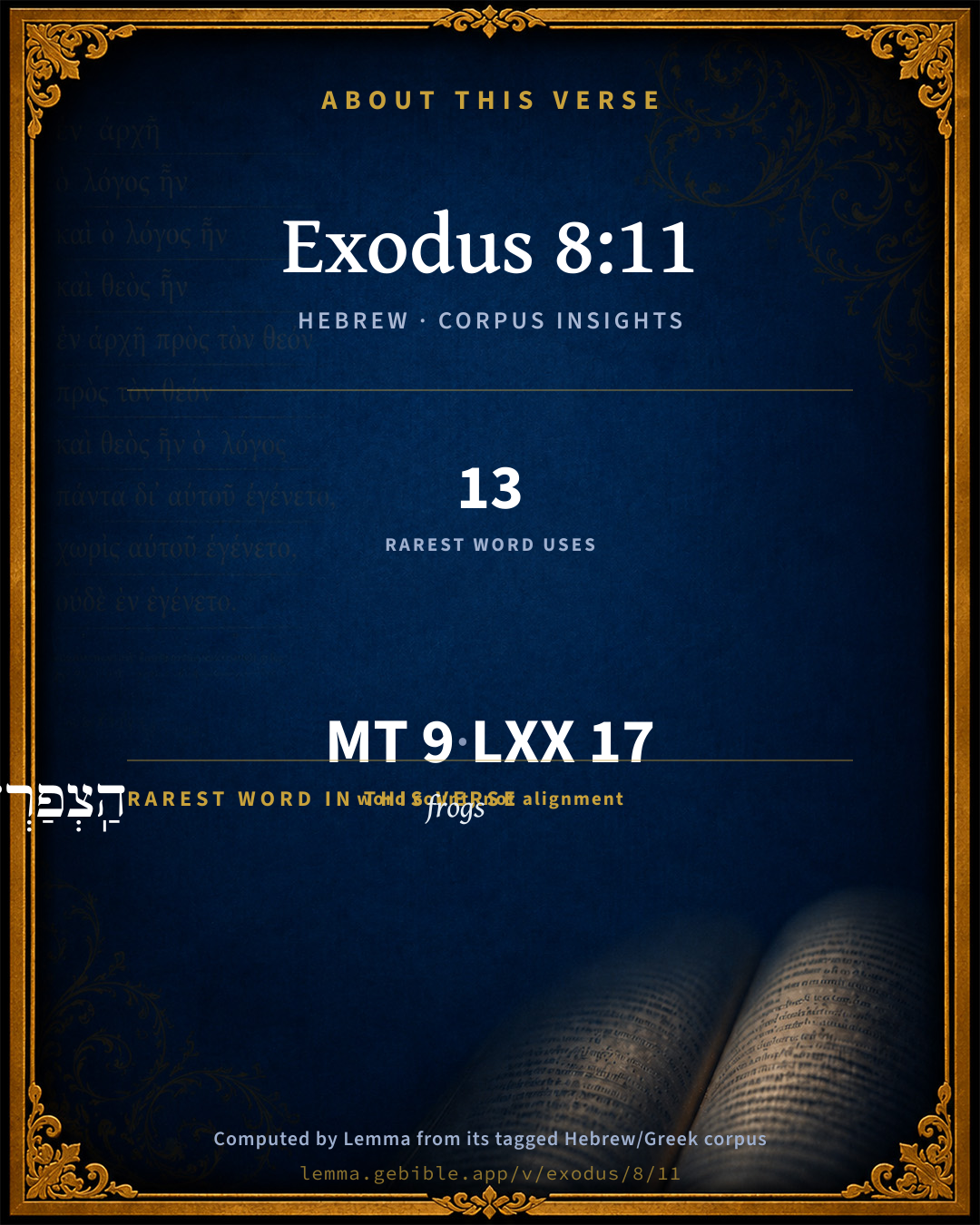
The rarest word here is הַֽצְפַרְדְּעִ֗ים frogs H6854 — appearing just 13 times in the whole Hebrew Bible.

Shared distinctive vocabulary

הַֽצְפַרְדְּעִ֗ים frogs H6854 occurs in 13 verses of the Hebrew Bible. Also found in:

Grammatical profile

  • 2 verbs
  • 5 nouns
  • 1 preposition
  • 1 particle

Verb forms

  • וְסָר֣וּ Qal · Sequential Perfect
  • תִּשָּׁאַֽרְנָה Niphal · Imperfect

Hebrew & Septuagint length

In English translation the verse runs 25 words from the Hebrew and 33 from the Septuagint (LXX English) — closely comparable.

A rough comparison of the two English renderings, which tokenize alike — not a word-level alignment.

Word counts can differ between the Hebrew and the Greek without any difference in meaning — e.g. the Hebrew direct-object marker אֵת has no separate Greek word, and Greek often adds the article ὁ.

In the original languages it is 9 Hebrew tokens and 17 Greek tokens — but the two are counted differently (Hebrew bundles its prefixes and suffixes into one token; the Greek is in lemma form), so that isn’t a like-for-like length.

Cross-references

2

Topical passages linked to Exodus 8:11 in the Treasury of Scripture Knowledge — connected by theme and wording, ordered by reader-vote popularity; previews shown in the World English Bible.

  • Exodus 8:3 and the river shall swarm with frogs, which shall go up and come into your house, and into your bedchamber, and on your bed, and into the house of your servants, and on your people, and into your ovens, and into your kneading-troughs:
  • Exodus 8:9 Moses said to Pharaoh, "I give you the honor of setting the time that I should pray for you, and for your servants, and for your people, that the frogs be destroyed from you and your houses, and remain in the river only."

Cross-references courtesy of OpenBible.info (CC BY 4.0).

Hebrew and Greek witnesses Masoretic Hebrew ↔ Greek Septuagint

The same verse in the two great witnesses to the Old Testament, shown verse-for-verse.

These are two independent witnesses, not word-aligned to each other, and the Septuagint is shown in lemma (dictionary) form.

Hebrew Exodus 8:11 Masoretic · Westminster Leningrad Codex

וְסָר֣וּ הַֽצְפַרְדְּעִ֗ים מִמְּךָ֙ וּמִבָּ֣תֶּ֔יךָ וּמֵעֲבָדֶ֖יךָ וּמֵעַמֶּ֑ךָ רַ֥ק בַּיְאֹ֖ר תִּשָּׁאַֽרְנָה

The frogs shall depart from you, and from your houses, and from your servants, and from your people. They shall remain in the river only."

World English Bible · Public Domain

Greek LXX Exodus 8:11 Septuagint · lemma form

ὁράω δέ φαραώ ὅτι γίγνομαι ἀνάψυξις βαρύνω ὁ καρδία αὐτός καί οὐ εἰςἀκούω αὐτός καθάπερ λαλέω κύριος

And the frogs shall be removed away from you, and from your houses and from the villages, and from your servants, and from your people, only in the river they shall be left.

LXX2012 (modern English Septuagint) · Public Domain

Hebrew: Westminster Leningrad Codex (CC BY 4.0). Greek: Septuagint (public domain); English from LXX2012 (modern English Septuagint) (Public Domain). How the Septuagint differs from the Hebrew →

Targum (Aramaic paraphrase)

2

The Targum is the ancient Jewish Aramaic paraphrase of the Hebrew Scriptures — an interpretive translation, not the Hebrew text itself. Onkelos (literal) and Pseudo-Jonathan (expansive) render the Torah, and Jonathan the Prophets. Coverage is partial: where no permissively-licensed English translation exists for a verse, only the Aramaic is shown. This is verse-level text, not a word-by-word alignment to the Hebrew.

  1. Targum Onkelos Torah (Genesis–Deuteronomy)
    וַחֲזָא פַרְעֹה אֲרֵי הֲוַת רְוַחְתָּא וְיִתְיַקַר יָת לִבֵּהּ וְלָא קַבִּיל מִנְהוֹן כְּמָא דְמַלִיל יְיָ:

    (no public-domain English translation for this verse)

    Targum Onkelos — Aramaic: “Onkelos Genesis” (public domain); “Onkelos Exodus” (public domain); “Onkelos Leviticus” (public domain); “Onkelos Numbers” (public domain); “Onkelos Deuteronomy” (public domain). English: “Sefaria Community Translation” (CC0 1.0 (public-domain dedication)); “J.W. Etheridge. The Targums of Onkelos and Jonathan Ben Uzziel on the Pentateuch. London: Longmans, Green, 1862” (public domain). Text via Sefaria.

  2. Targum Pseudo-Jonathan Torah (Genesis–Deuteronomy)
    וַחֲמָא פַרְעה אֲרוּם הֲוָה רְוַוחְתָּא לְעַקְתֵיהּ וִיקַר יַת לִבֵּיהּ וְלָא קַבֵּיל מִנְהוֹן הֵיכְמָא דְמַלֵל יְיָ

    And Pharoh saw that he was refreshed from his molestation, but hardened his heart, and would not hearken to them, as the Lord had said.

    Targum Pseudo-Jonathan — Aramaic: “Targum Jonathan on Genesis” (public domain); “Targum Jonathan on Exodus” (public domain); “Targum Jonathan on Leviticus” (public domain); “Targum Jonathan on Numbers” (public domain); “Targum Jonathan on Deuteronomy” (public domain). English: “The Targum of Jonathan ben Uzziel, trans. J. W. Etheridge, London, 1862” (public domain). Text via Sefaria.

Commentary

Notes on Exodus 8:11 from classic Christian and Jewish commentators (each source and its license shown beneath its notes). The classic Christian expositions comment on the surrounding passage and are grouped to its opening verse, so a note may address several verses; the Jewish commentaries on the Tanakh (Rashi and others) are per-verse, so they appear only where the commentator wrote on this verse.

Lemma curates 59 commentaries, every one of them public domain or Creative Commons licensed, each selected and text-cleaned for this edition rather than reprinted as found. About our sources →

Trapp's Complete Commentary

John Trapp

Exo 8:11 And the frogs shall depart from thee, and from thy houses, and from thy servants, and from thy people; they shall remain in the river only.

Ver. 11. In the river only.] {See Trapp on "Exo 8:9"}

John Trapp, A Commentary or Exposition upon All the Books of the Old and New Testament (1647–1656) — public domain. Text from a community e-Sword module.

John Gill's Exposition

And Moses and Aaron went from Pharaoh,.... To the place where they used to pray to the Lord, and meet with him, and receive messages from him; this they did the same day the plague was inflicted, the day before the morrow came when the frogs were to be removed:

and Moses cried unto the Lord: prayed unto him with great fervency, and with a loud voice, most fervently entreating that the frogs might be removed on the morrow, as he had promised, that so he might not be covered with shame and confusion before Pharaoh; his faith of the miracle being wrought did not hinder the use of prayer to God for it:

because of the frogs which he had brought against Pharaoh; as an army: or "put upon" (z) him, as a judgment on him; or rather the sense is, as it may be rendered, "because of the business of the frogs, which he had proposed or promised to Pharaoh" (a); that is, for the taking of them away, he had proposed to Pharaoh to fix the time when he should entreat the Lord for the removal of them; and he having fixed on the morrow, Moses promised it should be done according to his word; and now he is importunate with the Lord, that it may be done as he had promised.

(z) "posuit", Parhoni, Pagninus, Montanus; "imposuerat", Junius & Tremellius. (a) "Super causa vel negotio ranarum quod proposuerat Pharaoni", Fagius.

John Gill's Exposition of the Whole Bible (1746–1763) — public domain (CC PDM 1.0). Text via the HelloAO Bible API.

Rashi

Rabbi Shlomo Yitzchaki (Rashi)

והכבד את לבו HE ALLOWED HIS HEART TO BE HARDENED — The word הַכְבֵּד expresses doing something (the Hebrew infinitive but having a past meaning) just as, (Genesis 12:9) “going (הלוך) and journeying (ונסוע)”. So, too, (2 Kings 3:24) “and smiting (והכת) Moab”; (I Samuel 22:13) “and enquiring (ושאול) of God for him”; (1 Kings 20:37); “smiting (הכה) and wounding (ופצוע)”.

‎ כאשר דבר ה׳ AS THE LORD HAD SPOKEN — And where had He said this? When He said, (Exodus 7:4) “Pharaoh will not hearken to you”.

Rashi on the Tanakh — English translations: “The Judaica Press complete Tanach with Rashi, translated by A. J. Rosenberg” (CC BY 4.0); “Pentateuch with Rashi's commentary by M. Rosenbaum and A.M. Silbermann, 1929-1934” (public domain); “The Metsudah Tanach series, Lakewood, N.J” (CC BY 4.0); and “The Book of Joshua, Metsudah Publications, 1997” (CC BY 4.0). Text via Sefaria.

Lesson kit

Teaching starters — assembled from the data on this page, not authored interpretation. Every prompt links to the verse data it draws on. Edit before teaching.

Exodus, in the Pentateuch, opens this verse with 9 words (9 distinct Hebrew lemmas). Its most distinctive word is tsᵉphardêaʻ (“frogs”). A historical commentator’s framing appears above. Read the whole chapter for the surrounding context.

Discussion questions

  1. What does “frogs” (tsᵉphardêaʻ) contribute to the verse as a whole?
  2. Exodus 8:2 shares the word «frogs» with this verse. How do the two illuminate each other?
  3. These translations render this verse differently; the difference is in the English rendering, not the original. What questions does that raise?
  4. The verb «וְסָר֣וּ» is Qal Sequential Perfect. How does its form color the action?
  5. Reading how Trapp's Complete Commentary and John Gill's Exposition read this verse, where do the two commentators agree and where do they part?

Things to notice

Reading settings

Reading text

Shown beneath each verse's original-language words.

Old Testament
Old Testament edition

Read the OT as the Masoretic Hebrew (MT) or the Greek Septuagint (LXX).

English shown for the Greek Septuagint (in the Hebrew ↔ Greek comparison).

Comparing translations? Open the Compare panel on any verse page to stack up to four side by side.