
Genesis 29:2

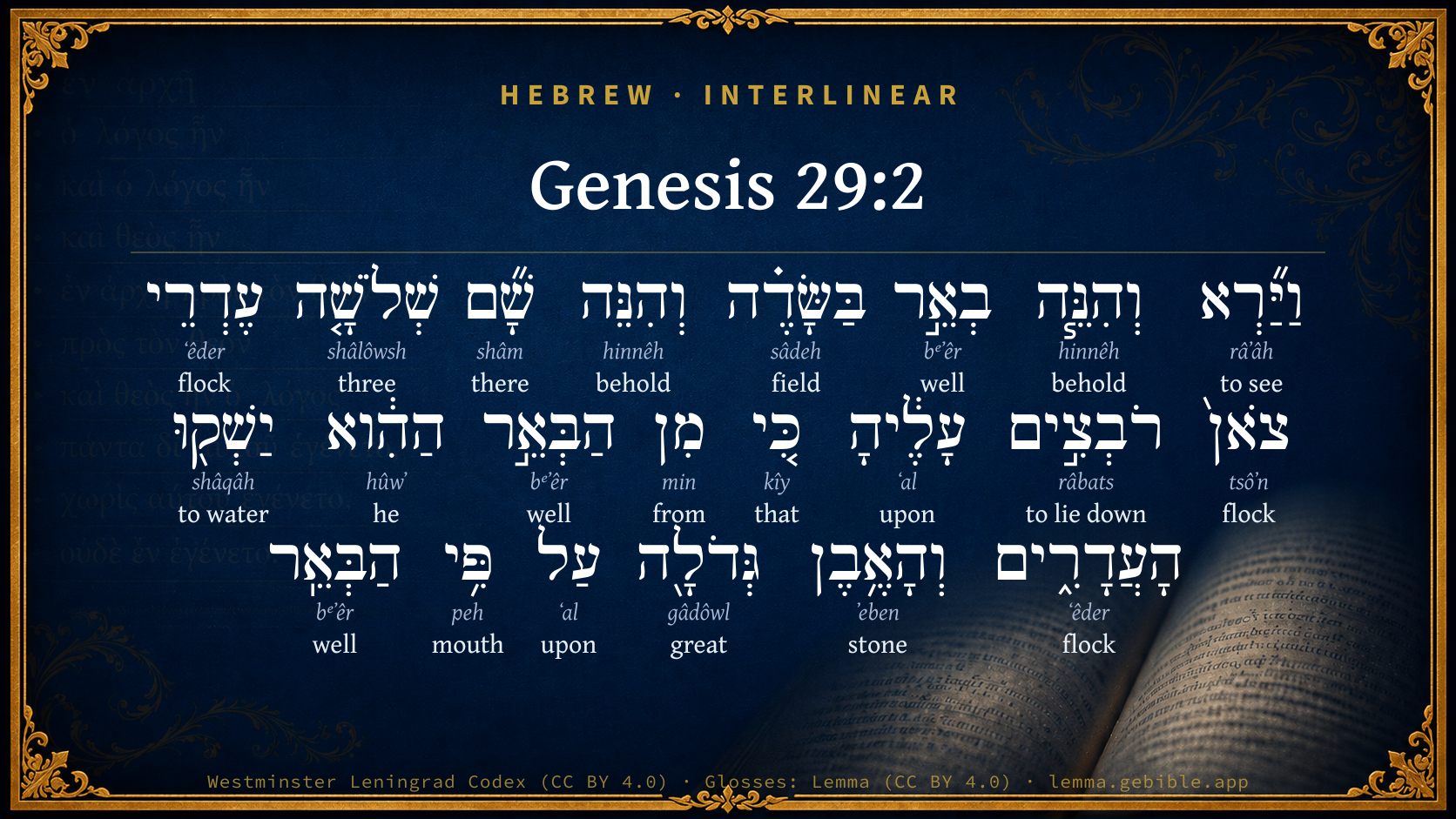
Hebrew (Westminster Leningrad Codex) Genesis 29:2 appears in the Hebrew Old Testament. The text above is from the Westminster Leningrad Codex. Each word links to its Strong’s number, a concise gloss, and parsing drawn from the Open Scriptures Hebrew Bible morphology. Click any word for its full Brown-Driver-Briggs (BDB) entry.
Download image
Cite this verse

Genesis 29:2 (World English Bible). Public Domain. Lemma interlinear Bible study tool, https://lemma.gebible.app/v/genesis/29/2.

Show BibTeX & RIS
BibTeX
RIS
English Translation
He looked, and behold, a well in the field, and, behold, three flocks of sheep lying there by it. For out of that well they watered the flocks. The stone on the well's mouth was great.
World English Bible · Public Domain
Highlights
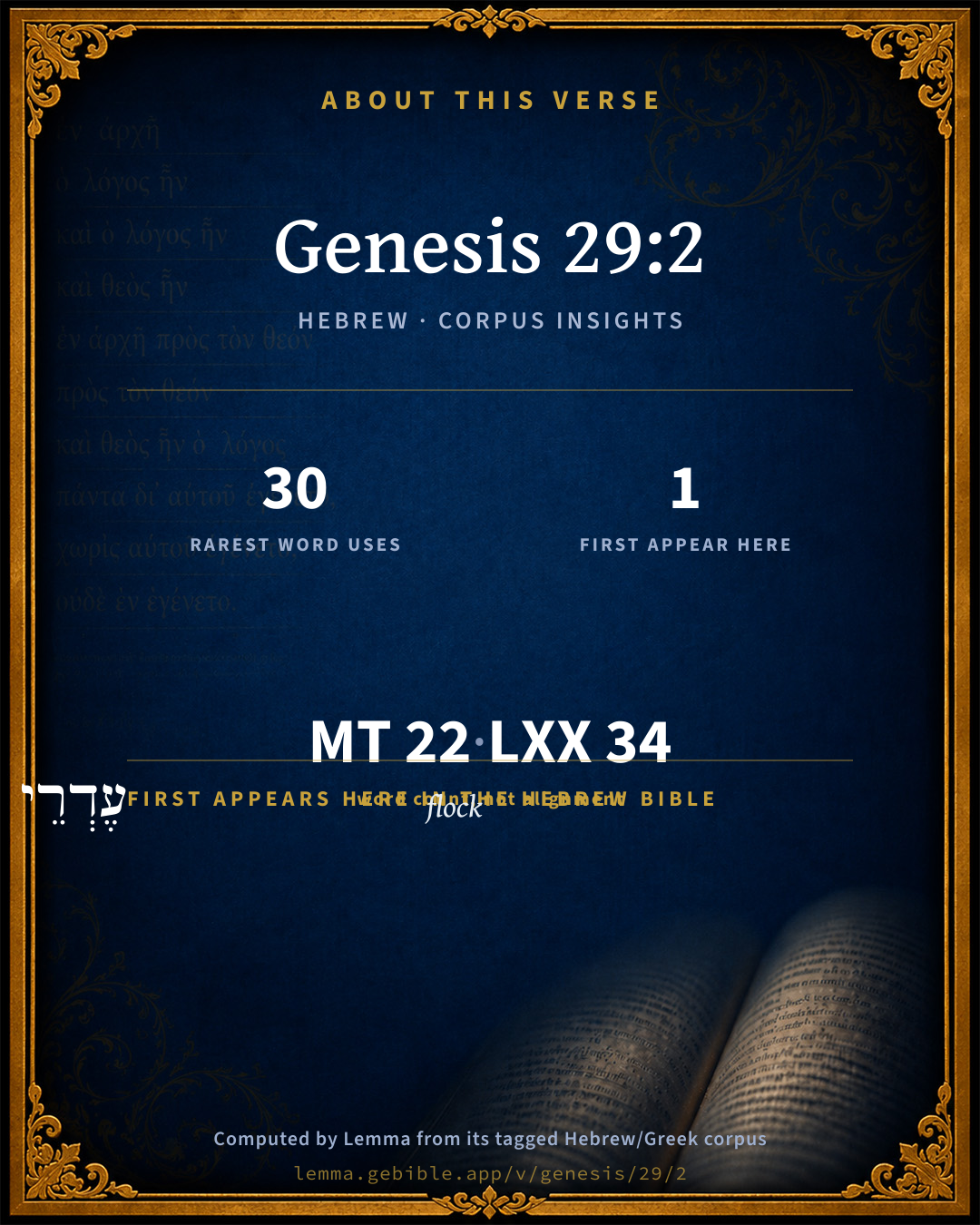
  • 1 first appearance in the Hebrew Bible
Full analysis ↓
Download a study sheet

One document with this verse’s original text, its word-by-word gloss line, the meaning frame, cross-references with their text, attributed commentary, and full source and license credits — printable, and it pastes into notes with its structure intact.

This verse Autodidact and up

Study sheet (.html) Plain text (.txt)

A passage Seminary Student

Up to 50 verses in one chapter. A passage sheet keeps up to 6 commentary sources and 12 cross-references per verse, in the order this page ranks them, and says so on the sheet whenever that leaves anything out. Ask for a single verse and you get the Autodidact verse sheet above.

Everything on this page stays free to read, with no account — the sheet is a download of what is already on screen, not access to it.

Want to remove ads? Support Godless Engineer
Compare translations 3

The same verse in 3 English versions, stacked beneath the original-language interlinear above. Click any original word for its lexicon entry.

Each is an independent rendering of the whole verse — the interlinear is not word-aligned to these translations.

Highlighted words mark where these versions differ — a whole-verse word diff, not a word-by-word alignment.

  • World English Bible Public Domain
    He looked, and behold, a well in the field, and, behold, three flocks of sheep lying there by it. For out of that well they watered the flocks. The stone on the well's mouth was great.
  • King James Version Public Domain
    And he looked, and behold a well in the field, and, lo, there were three flocks of sheep lying by it; for out of that well they watered the flocks: and a great stone was upon the well's mouth.
  • unfoldingWord Literal Text CC BY-SA 4.0
    And he looked, and behold, a well in the field, and behold, three flocks of sheep were lying there near it, because from that well the flocks were watered, and the stone over the mouth of the well large.

unfoldingWord Literal Text — © unfoldingWord, licensed CC BY-SA 4.0. Word-aligned USFM3 via Door43 (git.door43.org/unfoldingWord/en_ult).

Versions to compare (up to 4)

3 of 4 selected

Show all 18 translations

Every available English version of this verse, each an independent rendering of the whole verse.

  • World English Bible Public Domain
    He looked, and behold, a well in the field, and, behold, three flocks of sheep lying there by it. For out of that well they watered the flocks. The stone on the well's mouth was great.
  • Berean Standard Bible Public Domain
    He looked and saw a well in the field, and near it lay three flocks of sheep, because the sheep were watered from this well. And a large stone covered the mouth of the well.
  • Majority Standard Bible Public Domain
    He looked and saw a well in the field, and near it lay three flocks of sheep, because the sheep were watered from this well. And a large stone covered the mouth of the well.
  • King James Version Public Domain
    And he looked, and behold a well in the field, and, lo, there were three flocks of sheep lying by it; for out of that well they watered the flocks: and a great stone was upon the well's mouth.
  • American Standard Version (1901) Public Domain
    And he looked, and behold, a well in the field, and, lo, three flocks of sheep lying there by it. For out of that well they watered the flocks. And the stone upon the well's mouth was great.
  • Revised Version (1885) Public Domain
    And he looked, and behold a well in the field, and, lo, three flocks of sheep lying there by it; for out of that well they watered the flocks: and the stone upon the well’s mouth was great.
  • Geneva Bible (1599) Public Domain
    And as he looked about, behold there was a well in the field, and lo, three flocks of sheepe lay thereby (for at that well were the flockes watered) and there was a great stone vpon the welles mouth.
  • Douay-Rheims (1899) Public Domain
    And he saw a well in the field, and three flocks of sheep lying by it: for the beasts were watered out of it, and the mouth thereof was closed with a great stone.
  • Young's Literal Translation Public Domain
    and he looketh, and lo, a well in the field, and lo, there three droves of a flock crouching by it, for from that well they water the droves, and the great stone `is' on the mouth of the well.
  • Literal Standard Version CC BY-SA 4.0
    and he looks, and behold, a well in the field, and behold, there [are] three droves of a flock crouching by it, for they water the droves from that well, and the great stone [is] on the mouth of the well.
  • Unlocked Literal Bible CC BY-SA 4.0
    As he looked, he saw a well in the field, and, behold, three flocks of sheep were lying there by it. For out of that well they would water the flocks, and the stone over the well's mouth was large.
  • unfoldingWord Literal Text CC BY-SA 4.0
    And he looked, and behold, a well in the field, and behold, three flocks of sheep were lying there near it, because from that well the flocks were watered, and the stone over the mouth of the well large.
  • Darby Bible Public Domain
    And he looked, and behold, there was a well in the fields, and behold there, three flocks of sheep were lying by it; for out of that well they watered the flocks, and a great stone was at the mouth of the well.
  • World Messianic Bible Public Domain
    He looked, and saw a well in the field, and saw three flocks of sheep lying there by it. For out of that well they watered the flocks. The stone on the well’s mouth was large.
  • Webster's Bible Public Domain
    And he looked, and behold, a well in the field, and lo, there were three flocks of sheep lying by it; for out of that well they watered the flocks: and a great stone was upon the well's mouth.
  • Free Bible Version CC BY-SA 4.0
    As he looked around he saw a well in a field with three flocks of sheep lying down beside it, waiting to be given water. A large stone covered the top of the well.
  • Bible in Basic English Public Domain
    And there he saw a water-hole in a field, and by the side of it three flocks of sheep, for there they got water for the sheep: and on the mouth of the water-hole there was a great stone.
  • JPS Tanakh (1917) Public Domain
    And he looked, and behold a well in the field, and, lo, three flocks of sheep lying there by it. — For out of that well they watered the flocks. And the stone upon the well's mouth was great.

Literal Standard Version (2020), Covenant Press — licensed CC BY-SA 4.0. Text via the HelloAO Bible API (eBible.org). Unlocked Literal Bible (unfoldingWord) — licensed CC BY-SA 4.0. Text via the HelloAO Bible API (eBible.org). unfoldingWord Literal Text — © unfoldingWord, licensed CC BY-SA 4.0. Word-aligned USFM3 via Door43 (git.door43.org/unfoldingWord/en_ult). Free Bible Version, Dr. Jonathan Gallagher — licensed CC BY-SA 4.0. Text via the HelloAO Bible API (eBible.org).

Word by word

More ways to search: Search by grammar → Find every occurrence → Compare this word →

Practice this passage: Drill this verse → Learn its vocabulary →

רֹבְצִ֣ים
râbats
H7257
“lying down”
Verb, Qal, Participle Active, Masculine, Plural, Absolute
Part of Speech
Verb
Stem
Qal
Form
Participle Active
Gender
Masculine
Number
Plural
State
Absolute
Full BDB Definition

Origin: a primitive root

TWOT: 2109

to stretch oneself out, lie down, lie stretched out - (Qal) to lie down, lie - (Hiphil) to cause to lie down - laying (stones)
  1. וַיַּ֞רְא râʼâh H7200 “and · to see” Conjunction + Verb, Qal, Sequential Imperfect, 3rd Person, Masculine, Singular
  2. וְהִנֵּ֧ה hinnêh H2009 “and · behold” Conjunction + Particle, Demonstrative
  3. בְאֵ֣ר bᵉʼêr H875 “well” Noun, Common, Feminine, Singular, Absolute
  4. בַּשָּׂדֶ֗ה sâdeh H7704 “in/at the · field” Preposition, Determined + Noun, Common, Masculine, Singular, Absolute
  5. וְהִנֵּה hinnêh H2009 “and · behold” Conjunction + Particle, Demonstrative
  6. שָׁ֞ם shâm H8033 “there” Adverb
  7. שְׁלֹשָׁ֤ה shâlôwsh H7969 “three” Adjective, Cardinal number, Masculine, Singular, Absolute
  8. עֶדְרֵי ʻêder H5739 “flocks of” Noun, Common, Masculine, Plural, Construct
  9. צֹאן֙ tsôʼn H6629 “flock” Noun, Common, Both, Singular, Absolute
  10. עָלֶ֔יהָ ʻal H5921 “upon · her” Preposition + Suffix, Personal, 3rd Person, Feminine, Singular
  11. כִּ֚י kîy H3588 “that” Conjunction
  12. מִן min H4480 “from” Preposition
  13. הַבְּאֵ֣ר bᵉʼêr H875 “the · well” Particle, Definite Article + Noun, Common, Feminine, Singular, Absolute
  14. הַהִ֔וא hûwʼ H1931 “the · he” Particle, Definite Article + Pronoun, Personal, 3rd Person, Feminine, Singular
  15. יַשְׁק֖וּ shâqâh H8248 “to water” Verb, Hiphil, Imperfect, 3rd Person, Masculine, Plural
  16. הָעֲדָרִ֑ים ʻêder H5739 “the · flocks” Particle, Definite Article + Noun, Common, Masculine, Plural, Absolute
  17. וְהָאֶ֥בֶן ʼeben H68 “and · the · stone” Conjunction + Particle, Definite Article + Noun, Common, Feminine, Singular, Absolute
  18. גְּדֹלָ֖ה gâdôwl H1419 “great” Adjective, Adjective, Feminine, Singular, Absolute
  19. עַל ʻal H5921 “upon” Preposition
  20. פִּ֥י peh H6310 “mouth of” Noun, Common, Masculine, Singular, Construct
  21. הַבְּאֵֽר bᵉʼêr H875 “the · well” Particle, Definite Article + Noun, Common, Feminine, Singular, Absolute

About this verse

These counts appear in no published source. They are computed here, from the morphology-tagged text and Lemma’s own curated glosses. What Lemma adds →

22
words
17
distinct lemmas
Pentateuch
section

First appearance in Scripture

This word makes its first canonical appearance in the Hebrew Bible here:

  • עֶדְרֵי flock H5739

Shared distinctive vocabulary

רֹבְצִ֣ים to lie down H7257 occurs in 30 verses of the Hebrew Bible. Also found in:

Grammatical profile

  • 3 verbs
  • 9 nouns
  • 2 adjectives
  • 1 pronoun
  • 3 prepositions
  • 1 conjunction
  • 1 adverb
  • 2 particles

Verb forms

  • וַיַּ֞רְא Qal · Sequential Imperfect
  • רֹבְצִ֣ים Qal · Participle Active
  • יַשְׁק֖וּ Hiphil · Imperfect

Repetition

Words recur within this verse — often emphatic in Hebrew:

  • בְאֵ֣ר well H875 ×3
  • וְהִנֵּ֧ה behold H2009 ×2
  • עֶדְרֵי flock H5739 ×2
  • עָלֶ֔יהָ upon H5921 ×2

Hebrew & Septuagint length

In English translation the verse runs 36 words from the Hebrew and 42 from the Septuagint (LXX English) — closely comparable.

A rough comparison of the two English renderings, which tokenize alike — not a word-level alignment.

Word counts can differ between the Hebrew and the Greek without any difference in meaning — e.g. the Hebrew direct-object marker אֵת has no separate Greek word, and Greek often adds the article ὁ.

In the original languages it is 22 Hebrew tokens and 34 Greek tokens — but the two are counted differently (Hebrew bundles its prefixes and suffixes into one token; the Greek is in lemma form), so that isn’t a like-for-like length.

Cross-references

9

Topical passages linked to Genesis 29:2 in the Treasury of Scripture Knowledge — connected by theme and wording, ordered by reader-vote popularity; previews shown in the World English Bible.

  • John 4:14 but whoever drinks of the water that I will give him will never thirst again; but the water that I will give him will become in him a well of water springing up to eternal life."
  • Isaiah 49:10 They shall not hunger nor thirst; neither shall the heat nor sun strike them: for he who has mercy on them will lead them, even by springs of water will he guide them.
  • John 4:6 Jacob's well was there. Jesus therefore, being tired from his journey, sat down by the well. It was about the sixth hour.
  • Genesis 24:11 He made the camels kneel down outside the city by the well of water at the time of evening, the time that women go out to draw water.
  • Genesis 24:13 Behold, I am standing by the spring of water. The daughters of the men of the city are coming out to draw water.
  • Exodus 2:15–16 Now when Pharaoh heard this thing, he sought to kill Moses. But Moses fled from the face of Pharaoh, and lived in the land of Midian, and he sat down by a well.
  • Psalms 23:2 He makes me lie down in green pastures. He leads me beside still waters.
  • Song of Solomon 1:6–7 Don't stare at me because I am dark, Because the sun has scorched me. My mother's sons were angry with me. They made me keeper of the vineyards. I haven't kept my own vineyard.
  • Revelation 7:17 for the Lamb who is in the midst of the throne shepherds them, and leads them to springs of waters of life. And God will wipe away every tear from their eyes."

Cross-references courtesy of OpenBible.info (CC BY 4.0).

Hebrew and Greek witnesses Masoretic Hebrew ↔ Greek Septuagint

The same verse in the two great witnesses to the Old Testament, shown verse-for-verse.

These are two independent witnesses, not word-aligned to each other, and the Septuagint is shown in lemma (dictionary) form.

Hebrew Genesis 29:2 Masoretic · Westminster Leningrad Codex

וַיַּ֞רְא וְהִנֵּ֧ה בְאֵ֣ר בַּשָּׂדֶ֗ה וְהִנֵּה שָׁ֞ם שְׁלֹשָׁ֤ה עֶדְרֵי צֹאן֙ רֹבְצִ֣ים עָלֶ֔יהָ כִּ֚י מִן הַבְּאֵ֣ר הַהִ֔וא יַשְׁק֖וּ הָעֲדָרִ֑ים וְהָאֶ֥בֶן גְּדֹלָ֖ה עַל פִּ֥י הַבְּאֵֽר

He looked, and behold, a well in the field, and, behold, three flocks of sheep lying there by it. For out of that well they watered the flocks. The stone on the well's mouth was great.

World English Bible · Public Domain

Greek LXX Genesis 29:2 Septuagint · lemma form

καί ὁράω καί ἰδού φρέαρ ἐν ὁ πεδίον εἰμί δέ ἐκεῖ τρεῖς ποίμνιον πρόβατον ἀναπαύω ἐπί αὐτός ἐκ γάρ ὁ φρέαρ ἐκεῖνος ποτίζω ὁ ποίμνιον λίθος δέ εἰμί μέγας ἐπί ὁ στόμα ὁ φρέαρ

And he looks, and behold! a well in the plain; and there were there three flocks of sheep resting at it, for out of that well they watered the flocks, but there was a great stone at the mouth of the well.

LXX2012 (modern English Septuagint) · Public Domain

Hebrew: Westminster Leningrad Codex (CC BY 4.0). Greek: Septuagint (public domain); English from LXX2012 (modern English Septuagint) (Public Domain). How the Septuagint differs from the Hebrew →

Targum (Aramaic paraphrase)

2

The Targum is the ancient Jewish Aramaic paraphrase of the Hebrew Scriptures — an interpretive translation, not the Hebrew text itself. Onkelos (literal) and Pseudo-Jonathan (expansive) render the Torah, and Jonathan the Prophets. Coverage is partial: where no permissively-licensed English translation exists for a verse, only the Aramaic is shown. This is verse-level text, not a word-by-word alignment to the Hebrew.

  1. Targum Onkelos Torah (Genesis–Deuteronomy)
    וַחֲזָא וְהָא בֵירָא בְחַקְלָא וְהָא תַמָּן תְּלָתָא עֶדְרִין דְּעָן רְבֵעִין עֲלַהּ אֲרֵי מִן בֵּירָא הַהִיא מַשְׁקָן עֲדָרַיָּא וְאַבְנָא רַבְּתָא עַל פּוּמָא דְבֵירָא

    (no public-domain English translation for this verse)

    Targum Onkelos — Aramaic: “Onkelos Genesis” (public domain); “Onkelos Exodus” (public domain); “Onkelos Leviticus” (public domain); “Onkelos Numbers” (public domain); “Onkelos Deuteronomy” (public domain). English: “Sefaria Community Translation” (CC0 1.0 (public-domain dedication)); “J.W. Etheridge. The Targums of Onkelos and Jonathan Ben Uzziel on the Pentateuch. London: Longmans, Green, 1862” (public domain). Text via Sefaria.

  2. Targum Pseudo-Jonathan Torah (Genesis–Deuteronomy)
    וַחֲמָא וְהָא בֵּירָא בְּחַקְלָא וְהָא תַּמָן תְּלָתָא עֶדְרִין דְעָאן רְבִיעִין עֲלָהּ אֲרוּם מִן בֵּירָא הַהוּא מַשְׁקַן עֶדְרַיָא וְאַבְנָא רַבְּתָא מַחְתָא עַל פּוּם בֵּירָא

    And he looked and saw, and behold (there was) a well in a field, and behold there three flocks of sheep lying near it; because from that well they watered the flocks; and a great stone was laid upon the mouth of the well.

    Targum Pseudo-Jonathan — Aramaic: “Targum Jonathan on Genesis” (public domain); “Targum Jonathan on Exodus” (public domain); “Targum Jonathan on Leviticus” (public domain); “Targum Jonathan on Numbers” (public domain); “Targum Jonathan on Deuteronomy” (public domain). English: “The Targum of Jonathan ben Uzziel, trans. J. W. Etheridge, London, 1862” (public domain). Text via Sefaria.

Commentary

Notes on Genesis 29:2 from classic Christian and Jewish commentators (each source and its license shown beneath its notes). The classic Christian expositions comment on the surrounding passage and are grouped to its opening verse, so a note may address several verses; the Jewish commentaries on the Tanakh (Rashi and others) are per-verse, so they appear only where the commentator wrote on this verse.

Lemma curates 59 commentaries, every one of them public domain or Creative Commons licensed, each selected and text-cleaned for this edition rather than reprinted as found. About our sources →

Trapp's Complete Commentary

John Trapp

Gen 29:2 And he looked, and behold a well in the field, and, lo, there [were] three flocks of sheep lying by it; for out of that well they watered the flocks: and a great stone [was] upon the well’s mouth.

Ver. 2. Three flocks of sheep lying by it.] Semblably Christ, the chief Shepherd, "feeds" and "leads his flock to the lively fountains of waters"; {Rev 7:16-17 Psa 23:2} commanding his under shepherds, the ministers, to roll away the stone, by opening the promises, that his sheep may drink "water with joy out of those wells of salvation". {Isa 12:3}

John Trapp, A Commentary or Exposition upon All the Books of the Old and New Testament (1647–1656) — public domain. Text from a community e-Sword module.

Joseph Benson's Commentary

Gen 29:2. Behold a well in the field — Providence brought him to the very field where his uncle’s flocks were to be watered, and there he met with Rachel, who was to be his wife. The Divine Providence is to be acknowledged in all the little circumstances which concur to make a journey or other undertaking comfortable and successful. If, when we are at a loss, we meet with those seasonably that can direct us; if we meet with a disaster, and those are at hand that will help us; we must not impute it to chance, but to the providence of God. Our ways are ways of pleasantness, if we continually acknowledge God in them. A great stone was on the well’s mouth — This might be intended either to prevent the lambs of the flock from being drowned in it; or to secure the water, which was and still is scarce in that country; or to save the well from receiving damage from the heat of the sun, or the sand put into motion by the winds, which, probably, would soon have filled and stopped it up. This last we know is the reason why they cover their wells in Arabia, and several other parts of the East.

Joseph Benson's Commentary on the Old and New Testaments (1811–1818) — public domain. Text from a community e-Sword module.

Tyndale Open Study Notes

Tyndale Open Resources

29:2-12 Jacob’s meeting Rachel at the well was providentially timed by the sovereign God who was leading Jacob to fulfillment of the promises (cp. 24:12-20). The well was a reminder of God’s blessing (cp. 16:13-14; 21:19; 26:19-25, 33).

Tyndale Open Study Notes — © Tyndale Open Resources, licensed CC BY-SA 4.0. Text via the HelloAO Bible API.

Geneva Bible (1599)

Geneva Bible translators

Thus he was directed by the only providence of God, who brought him also to Laban’s house.

Geneva Bible (1599) marginal notes — public domain. Text via Bolls.life.

Jamieson, Fausset & Brown

Robert Jamieson, A. R. Fausset & David Brown

And he looked, &c.--As he approached the place of his destination, he, according to custom, repaired to the well adjoining the town where he would obtain an easy introduction to his relatives.

Jamieson, Fausset & Brown — Commentary Critical and Explanatory on the Whole Bible (1871) — public domain (CC PDM 1.0). Text via the HelloAO Bible API.

Adam Clarke's Commentary

Verse 2. Three flocks of sheep] צאן tson, small cattle, such as sheep, goats, c. See Clarke on Ge 12:16. Sheep, in a healthy state, seldom drink in cold and comparatively cold countries: but it was probably different in hot climates. The three flocks, if flocks and not shepherds be meant, which were lying now at the well, did not belong to Laban, but to three other chiefs; for Laban's flock was yet to come, under the care of Rachel, Ge 29:6.

Adam Clarke's Commentary on the Bible (1810–1826) — public domain. Text from a community e-Sword/MySword module.

Ellicott's Commentary for English Readers

(2) Behold a well in the field.—This was not the well whence Rebekah drew the water; for it was in the field, the open pasture ground, whereas Rebekah’s well was just outside the city (Gen_24:11), and she obtained the water by going down the steps which led to it (Gen_24:16).

A great stone was upon the well’s mouth.—The region round Haran, though fertile, is very dry, and the chief use of the stone was to prevent the well from being choked with sand. As the proper translation is the stone upon the well’s mouth was great, it would also serve to prevent the well from being used, except at fixed times; for it probably required the strength of two or three men (comp. Robinson, Bibl. Res. ii. 180) to remove it; nor does the language of Gen_29:10 necessarily imply that Jacob rolled it away without the aid of others. Besides this, the stone may have marked that the well was private property: for, as we have seen in the account of the covenants of Abraham and Isaac with Abimelech, no possession was morevalued than that of wells. And as we find the shepherds all waiting for Rachel, and that immediately on her arrival the stone is rolled away, and her sheep watered first, while the rest, though they had been there long before her, yet have to bide their time till her wants are supplied, it is probable that Laban had at least a first claim upon its enjoyment. No such courtesy was shown to the daughters of Jethro (Exo_2:17).

A Bible Commentary for English Readers, edited by Charles John Ellicott (1878–1897) — public domain. Text from a community e-Sword module.

The Cambridge Bible for Schools and Colleges

gen. ed. J. J. S. Perowne

2. in the field] There is no exact description of the place where this well was. It was not, apparently, the same as “the well of water,” “without the city,” in Gen_24:11.

for out of that well] This clause and Gen_29:3 are parenthetical, describing the custom of the country, i.e. “they were wont to water”: “were wont to roll and put the stone again.”

the stone upon the well’s mouth] A well was a cistern or tank, often covered with a large stone requiring two or three men to remove it. This stone protected the water from the rays of the sun and from mischief or pollution. In the present instance the well seems to have belonged to the community, and was not opened for use, until all the herdsmen and shepherds had come.

The Cambridge Bible for Schools and Colleges (gen. ed. J. J. S. Perowne; Cambridge University Press, 1878–1918) — public domain. Text from a community e-Sword module.

John Gill's Exposition

And he looked, and behold a well in the field,.... Near Haran; he might purposely look out for a well, as knowing that there people frequently came for water for their families, or shepherds to water their flocks, of whom he might get intelligence concerning Laban's family, and where they dwelt; or he might lookout for this particular well, where his grandfather's servant had met with his mother Rebekah, of which he had been informed, and very probably had some directions how to find it: of this well; see Gill on Gen 24:11; to which may be added what another traveller says (z), there is in this city (Orpha, the same with Haran) a fountain, which both Jews, Armenians, and Turks, reported unto us was Jacob's well, and that here he served his uncle Laban: near Alexandretta is a fine well, called Jacob's well, and its water is excellent; not far from which the Greeks say are the remains of Laban's house (a):

and, lo, there were three flocks of sheep lying by it; in order to be watered, when it should be opened:

for out of that well they watered the flocks; the shepherds:

and a great stone was upon the well's mouth; so that until that was rolled off, they could not be watered, which was the reason of their lying by it: this stone was laid upon it, partly to keep the water from flowing out, and being wasted, that there might be a sufficiency for the flocks; and partly to keep the water pure and clean, that it might be wholesome for the flocks, as well as entire for the use of those that had a property in it.

(z) Cartwright's Preacher's Travels, p. 15. (a) Egmont and Heyman's Travels, vol. 2. p. 329.

John Gill's Exposition of the Whole Bible (1746–1763) — public domain (CC PDM 1.0). Text via the HelloAO Bible API.

Haydock's Catholic Bible Commentary

Stone. Not of such an immoderate size but that Jacob could remove it. In that country water was scarce, and preserved with care. (Calmet)

George Leo Haydock (1774–1849), Haydock's Catholic Family Bible and Commentary, 1859 edition — public domain. Excludes Psalms (Douay-Rheims chapter numbering differs from Protestant) and Deuterocanonical books (Catholic canon only).

Matthew Poole's English Annotations

They, i.e. the people belonging to that place, watered; or, the flocks were watered; it is an impersonal speech.

A great stone was upon the well’s mouth, to preserve the water, which was scarce in those parts, and to keep it pure.

Matthew Poole's English Annotations on the Holy Bible (1683–1685) — public domain. Text from a community e-Sword/MySword module.

Whedon's Commentary on the Bible

Daniel D. Whedon

2. Behold a well in the field — Compare the similar account of Eliezer meeting Rebekah at a well. Gen_24:11-28. That well, however, was “without the city,” but evidently quite near the city; this is more remote, in the field. There the women came out towards evening to draw water for drinking; here shepherds with their flocks were resting, waiting for the time to open the well. That well was not covered, and one could go down to it; this was covered by a great stone, and seems to have been a cistern, like those of which Robinson writes: “Over most of the cisterns is laid a broad and thick flat stone, with a round hole cut in the middle, forming the mouth of the cistern. This hole we found in many cases covered with a heavy stone, which it would require two or three men to roll away.” — Biblical Researches, vol. i, p. 490.

Daniel D. Whedon (gen. ed.), Commentary on the Old and New Testaments (1874–1909) — public domain. Text from a community e-Sword module.

John Wesley's Explanatory Notes

Providence brought him to the very field where his uncle's flock's were to be watered, and there he met with Rachel that was to be his wife. The Divine Providence is to be acknowledged in all the little circumstances which concur to make a journey or other undertaking comfortable and successful. If, when we are at a loss, we meet with those seasonably that can direct us; if we meet with a disaster, and those are at hand that will help us; we must not say it was by chance, but it was by providence: our ways are ways of pleasantness, if we continually acknowledge God in them. The stone on the well's mouth was either to secure their property in it, for water was scarce, to save the well from receiving damage from the heat of the sun, or to prevent the lambs of the flock from being drowned in it.

John Wesley, Explanatory Notes Upon the Whole Bible (1754–1765) — public domain. Text via the GEBible commentary corpus.

Rashi

Rabbi Shlomo Yitzchaki (Rashi)

ישקו העדרים THEY GAVE THE DROVES DRINK —the shepherds used to water the flocks: this verse uses an elliptical phrase (omitting the subject “the shepherds”).

Rashi on the Tanakh — English translations: “The Judaica Press complete Tanach with Rashi, translated by A. J. Rosenberg” (CC BY 4.0); “Pentateuch with Rashi's commentary by M. Rosenbaum and A.M. Silbermann, 1929-1934” (public domain); “The Metsudah Tanach series, Lakewood, N.J” (CC BY 4.0); and “The Book of Joshua, Metsudah Publications, 1997” (CC BY 4.0). Text via Sefaria.

Ramban (Nachmanides)

Rabbi Moshe ben Nachman (Ramban / Nachmanides)

AND HE LOOKED, AND BEHOLD A WELL IN THE FIELD, AND LO THREE FLOCKS OF SHEEP LYING THERE BY IT. Scripture tells this story at length in order to let us know that they that wait for the Eternal shall renew their strength, and the fear of Him gives strength. For here our father Jacob is coming from the journey and he is tired, yet he alone rolls away the stone, a task which required all the shepherds. The many shepherds and all the watchmen of the three flocks of sheep could not shift the rock.With respect to this chapter, our Rabbis in Bereshith Rabbah also have a secret which alludes to the future. For it happened to him that he came to Haran by way of the well, and only three of all the flocks were gathered. He arrived at the time when the stone was yet upon the mouth of the well, and the flocks waited for the water thereof. Likewise, the matter which is narrated here is all for the purpose of letting it be known that Jacob will succeed in this venture and will have children worthy of the fulfillment of this allusion. For the well alludes to the Sanctuary, and the three flocks of sheep are symbolic of the pilgrims ascending to the Sanctuary during the three festivals., and Succoth. See Deuteronomy 16:16. The expression, For out of that well they watered the flocks, alludes to the fact that they drew holy inspiration from the pilgrimages to the Sanctuary. It may be that it alludes to the verse, For out of Zion shall go forth Torah — which has been likened to water, 55:1, Baba Kamma 17a. and the word of the Eternal from Jerusalem. — And thither were all the flocks gathered — from the entrance of Hamath unto the Brook of Egypt.. — And they rolled the stone from the well’s mouth and watered, for they drew holy inspiration therefrom. And they put the stone back to lie dormant until the next festival.

Ramban (Nachmanides) on the Tanakh — English translation: “Commentary on the Torah by Ramban (Nachmanides). Translated and annotated by Charles B. Chavel. New York, Shilo Pub. House, 1971-1976” (CC BY 4.0). Text via Sefaria.

Radak

Rabbi David Kimhi (Radak)

וירא והנה באר.. רבצים עליה, the word עליה means “near it,” just as in Numbers 2,20 when the positions of the various army groups of the Israelites are described and the Torah writes ועליו מטה מנשה. The meaning clearly cannot be that the tribe of Menashe was positioned on top of the tribe of the tribe of Ephrayim, but that the tribe of Menashe was positioned close to the tribe of Ephrayim. The term על in the sense of “near, close by,” occurs numerous times in Scripture.

והאבן גדולה, seeing that there was no other source of water nearby to water the flocks of the people of Charan, the local people had placed an extremely large and heavy rock on top of it so that only in the presence of all the shepherds would the flocks be watered so as to ensure a fair distribution of the available water. This would also help to avoid wasting water remaining in the troughs when no other flock had already lined up at the troughs. Placing such a large stone on the well then was a device designed to help everyone entitled to this water to receive his fair share in the presence of all the shepherds.

Radak on the Tanakh — English translations: “Sefaria Community Translation” (CC0 1.0 (public-domain dedication)); “Eliyahu Munk, HaChut Hameshulash” (CC BY 4.0); “Rabbi Mike Feuer, Jerusalem Anthology” (CC BY 4.0); and “R. David Kimhi on the first book of Psalms, Translated by R.G. Finch, London, 1919” (public domain). Text via Sefaria.

Lesson kit

Teaching starters — assembled from the data on this page, not authored interpretation. Every prompt links to the verse data it draws on. Edit before teaching.

Genesis, in the Pentateuch, opens this verse with 22 words (17 distinct Hebrew lemmas). Its most distinctive word is râbats (“to lie down”). A historical commentator’s framing appears above. Read the whole chapter for the surrounding context.

Discussion questions

  1. What does “to lie down” (râbats) contribute to the verse as a whole?
  2. This is the first place “flock” appears in Scripture (first appears here). What does its debut here establish?
  3. How does Genesis 4:7, which shares the word «to lie down», read alongside this verse?
  4. What does the repetition of “well” (3× in this one verse) do in this verse?
  5. These translations render this verse differently. What is at stake in choosing one wording over another?
  6. «וַיַּ֞רְא» is a Qal Sequential Imperfect verb. How does that grammatical form shape the action described?
  7. Compare how Trapp's Complete Commentary and Joseph Benson's Commentary read this verse. Where do they agree or differ?

Things to notice

Reading settings

Reading text

Shown beneath each verse's original-language words.

Old Testament
Old Testament edition

Read the OT as the Masoretic Hebrew (MT) or the Greek Septuagint (LXX).

English shown for the Greek Septuagint (in the Hebrew ↔ Greek comparison).

Comparing translations? Open the Compare panel on any verse page to stack up to four side by side.