
Esther 1:19

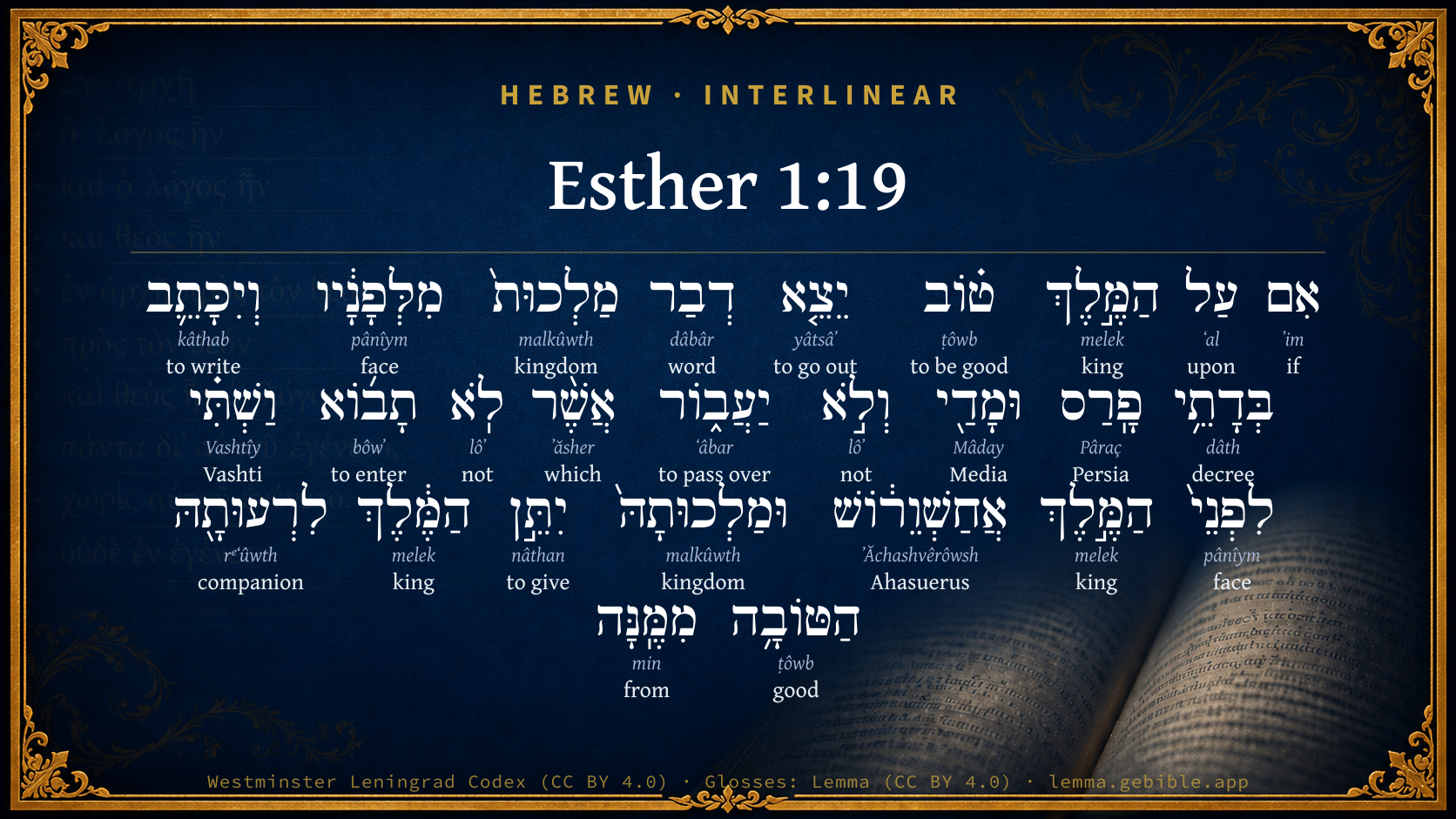
Hebrew (Westminster Leningrad Codex) Esther 1:19 appears in the Hebrew Old Testament. The text above is from the Westminster Leningrad Codex. Each word links to its Strong’s number, a concise gloss, and parsing drawn from the Open Scriptures Hebrew Bible morphology. Click any word for its full Brown-Driver-Briggs (BDB) entry.
Download image
Cite this verse

Esther 1:19 (World English Bible). Public Domain. Lemma interlinear Bible study tool, https://lemma.gebible.app/v/esther/1/19.

Show BibTeX & RIS
BibTeX
RIS
English Translation
If it please the king, let there go forth a royal commandment from him, and let it be written among the laws of the Persians and the Medes, that it not be altered, that Vashti come no more before king Ahasuerus; and let the king give her royal estate to another who is better than she.
World English Bible · Public Domain
Download a study sheet

One document with this verse’s original text, its word-by-word gloss line, the meaning frame, cross-references with their text, attributed commentary, and full source and license credits — printable, and it pastes into notes with its structure intact.

This verse Autodidact and up

Study sheet (.html) Plain text (.txt)

A passage Seminary Student

Up to 50 verses in one chapter. A passage sheet keeps up to 6 commentary sources and 12 cross-references per verse, in the order this page ranks them, and says so on the sheet whenever that leaves anything out. Ask for a single verse and you get the Autodidact verse sheet above.

Everything on this page stays free to read, with no account — the sheet is a download of what is already on screen, not access to it.

Want to remove ads? Support Godless Engineer
Compare translations 3

The same verse in 3 English versions, stacked beneath the original-language interlinear above. Click any original word for its lexicon entry.

Each is an independent rendering of the whole verse — the interlinear is not word-aligned to these translations.

Highlighted words mark where these versions differ — a whole-verse word diff, not a word-by-word alignment.

  • World English Bible Public Domain
    If it please the king, let there go forth a royal commandment from him, and let it be written among the laws of the Persians and the Medes, that it not be altered, that Vashti come no more before king Ahasuerus; and let the king give her royal estate to another who is better than she.
  • King James Version Public Domain
    If it please the king, let there go a royal commandment from him, and let it be written among the laws of the Persians and the Medes, that it be not altered, That Vashti come no more before king Ahasuerus; and let the king give her royal estate unto another that is better than she.
  • unfoldingWord Literal Text CC BY-SA 4.0
    If it is good to the king, let a decree of royalty go out from before his face, and let it be written in the laws of Persia and Media (which do not pass away) that Vashti shall never come before the face of the king Ahasuerus. And let the king give her royalty to her female neighbor, the woman who is better than she.

unfoldingWord Literal Text — © unfoldingWord, licensed CC BY-SA 4.0. Word-aligned USFM3 via Door43 (git.door43.org/unfoldingWord/en_ult).

Versions to compare (up to 4)

3 of 4 selected

Show all 18 translations

Every available English version of this verse, each an independent rendering of the whole verse.

  • World English Bible Public Domain
    If it please the king, let there go forth a royal commandment from him, and let it be written among the laws of the Persians and the Medes, that it not be altered, that Vashti come no more before king Ahasuerus; and let the king give her royal estate to another who is better than she.
  • Berean Standard Bible Public Domain
    So if it pleases the king, let him issue a royal decree, and let it be recorded in the laws of Persia and Media so that it cannot be repealed, that Vashti shall never again enter the presence of King Xerxes, and that her royal position shall be given to a woman better than she.
  • Majority Standard Bible Public Domain
    So if it pleases the king, let him issue a royal decree, and let it be recorded in the laws of Persia and Media so that it cannot be repealed, that Vashti shall never again enter the presence of King Xerxes, and that her royal position shall be given to a woman better than she.
  • King James Version Public Domain
    If it please the king, let there go a royal commandment from him, and let it be written among the laws of the Persians and the Medes, that it be not altered, That Vashti come no more before king Ahasuerus; and let the king give her royal estate unto another that is better than she.
  • American Standard Version (1901) Public Domain
    If it please the king, let there go forth a royal commandment from him, and let it be written among the laws of the Persians and the Medes, that it be not altered, that Vashti come no more before king Ahasuerus; and let the king give her royal estate unto another that is better than she.
  • Revised Version (1885) Public Domain
    If it please the king, let there go forth a royal commandment from him, and let it be written among the laws of the Persians and the Medes, that it be not altered, that Vashti come no more before king Ahasuerus; and let the king give her royal estate unto another that is better than she.
  • Geneva Bible (1599) Public Domain
    If it please the King, let a royal decree proceede from him, and let it be written among the statutes of Persia, and Media, (and let it not be transgressed) that Vashti come no more before King Ahashuerosh: and let the King giue her royal estate vnto her companion that is better then she.
  • Douay-Rheims (1899) Public Domain
    If it please thee, let an edict go out from thy presence, and let it be written according to the law of the Persians and of the Medes, which must not be altered, that Vasthi come in no more to the king, but another, that is better than her, be made queen in her place.
  • Young's Literal Translation Public Domain
    `If to the king `it be' good, there goeth forth a royal word from before him, and it is written with the laws of Persia and Media, and doth not pass away, that Vashti doth not come in before the king Ahasuerus, and her royalty doth the king give to her companion who `is' better than she;
  • Literal Standard Version CC BY-SA 4.0
    If to the king [it be] good, there goes forth a royal word from before him, and it is written with the laws of Persia and Media, and does not pass away, that Vashti does not come in before King Ahasuerus, and the king gives her royalty to her companion who [is] better than she;
  • Unlocked Literal Bible CC BY-SA 4.0
    If it pleases the king, let a royal decree be sent out from him, and let it be written in the laws of the Persians and the Medes, which cannot be repealed, that Vashti may no longer come before him. Let the king give her position as queen to another who is better than she.
  • unfoldingWord Literal Text CC BY-SA 4.0
    If it is good to the king, let a decree of royalty go out from before his face, and let it be written in the laws of Persia and Media (which do not pass away) that Vashti shall never come before the face of the king Ahasuerus. And let the king give her royalty to her female neighbor, the woman who is better than she.
  • Darby Bible Public Domain
    If it please the king, let a royal order go forth from him, and let it be written among the laws of the Persians and the Medes, that it may not pass, That Vashti come no more before king Ahasuerus; and let the king give her royal estate to another that is better than she;
  • World Messianic Bible Public Domain
    “If it pleases the king, let a royal commandment go from him, and let it be written among the laws of the Persians and the Medes, so that it cannot be altered, that Vashti may never again come before King Ahasuerus; and let the king give her royal estate to another who is better than she.
  • Webster's Bible Public Domain
    If it pleaseth the king, let a royal commandment go from him, and let it be written among the laws of the Persians and the Medes, that it be not altered, That Vashti come no more before king Ahasuerus; and let the king give her royal estate to another that is better than she.
  • Free Bible Version CC BY-SA 4.0
    If it please Your Majesty, issue a royal decree, in accordance with the laws of Persia and Media which cannot be changed, that Vashti is banished from the presence of King Xerxes, and that Your Majesty will give her royal position to another, one who is better than her.
  • Bible in Basic English Public Domain
    If it is pleasing to the king, let an order go out from him, and let it be recorded among the laws of the Persians and the Medes, so that it may never be changed, that Vashti is never again to come before King Ahasuerus; and let the king give her place to another who is better than she.
  • JPS Tanakh (1917) Public Domain
    If it please the king, let there go forth a royal commandment from him, and let it be written among the laws of the Persians and the Medes, that it be not altered, that Vashti come no more before king Ahasuerus, and that the king give her royal estate unto another that is better than she.

Literal Standard Version (2020), Covenant Press — licensed CC BY-SA 4.0. Text via the HelloAO Bible API (eBible.org). Unlocked Literal Bible (unfoldingWord) — licensed CC BY-SA 4.0. Text via the HelloAO Bible API (eBible.org). unfoldingWord Literal Text — © unfoldingWord, licensed CC BY-SA 4.0. Word-aligned USFM3 via Door43 (git.door43.org/unfoldingWord/en_ult). Free Bible Version, Dr. Jonathan Gallagher — licensed CC BY-SA 4.0. Text via the HelloAO Bible API (eBible.org).

Word by word

More ways to search: Search by grammar → Find every occurrence → Compare this word →

Practice this passage: Drill this verse → Learn its vocabulary →

לִרְעוּתָ֖הּ
rᵉʻûwth
H7468
“to/for · companion · her”
Preposition + Noun, Common, Feminine, Singular, Construct + Suffix, Personal, 3rd Person, Feminine, Singular
Part of Speech
Preposition + Noun
Type
Common
Gender
Feminine
Number
Singular
State
Construct
Full BDB Definition

Origin: from H7462 in the sense of H7453

TWOT: 2186e

female companion, mate, neighbour woman
  1. אִם ʼim H518 “if” Conjunction
  2. עַל ʻal H5921 “upon” Preposition
  3. הַמֶּ֣לֶךְ melek H4428 “the · king” Particle, Definite Article + Noun, Common, Masculine, Singular, Absolute
  4. ט֗וֹב ṭôwb H2895 “good” Adjective, Adjective, Masculine, Singular, Absolute
  5. יֵצֵ֤א yâtsâʼ H3318 “to go out” Verb, Qal, Jussive, 3rd Person, Masculine, Singular
  6. דְבַר dâbâr H1697 “word of” Noun, Common, Masculine, Singular, Construct
  7. מַלְכוּת֙ malkûwth H4438 “kingdom” Noun, Common, Feminine, Singular, Absolute
  8. מִלְּפָנָ֔יו pânîym H6440 “from · to/for · face(s) · his” Preposition + Preposition + Noun, Common, Both, Plural, Construct + Suffix, Personal, 3rd Person, Masculine, Singular
  9. וְיִכָּתֵ֛ב kâthab H3789 “and · to write” Conjunction + Verb, Niphal, Imperfect, 3rd Person, Masculine, Singular
  10. בְּדָתֵ֥י dâth H1881 “in/at · decrees of” Preposition + Noun, Common, Feminine, Plural, Construct
  11. פָֽרַס Pâraç H6539 “Persia” Noun, Proper
  12. וּמָדַ֖י Mâday H4074 “and · Media” Conjunction + Noun, Proper
  13. וְלֹ֣א lôʼ H3808 “and · not” Conjunction + Particle, Negative
  14. יַעֲב֑וֹר ʻâbar H5674 “to pass over” Verb, Qal, Imperfect, 3rd Person, Masculine, Singular
  15. אֲשֶׁ֨ר ʼăsher H834 “which” Particle, Relative
  16. לֹֽא lôʼ H3808 “not” Particle, Negative
  17. תָב֜וֹא bôwʼ H935 “to enter” Verb, Qal, Imperfect, 3rd Person, Feminine, Singular
  18. וַשְׁתִּ֗י Vashtîy H2060 “Vashti” Noun, Proper
  19. לִפְנֵי֙ pânîym H6440 “to/for · face(s) of” Preposition + Noun, Common, Both, Plural, Construct
  20. הַמֶּ֣לֶךְ melek H4428 “the · king” Particle, Definite Article + Noun, Common, Masculine, Singular, Absolute
  21. אֲחַשְׁוֵר֔וֹשׁ ʼĂchashvêrôwsh H325 “Ahasuerus” Noun, Proper
  22. וּמַלְכוּתָהּ֙ malkûwth H4438 “and · kingdom · her” Conjunction + Noun, Common, Feminine, Singular, Construct + Suffix, Personal, 3rd Person, Feminine, Singular
  23. יִתֵּ֣ן nâthan H5414 “to give” Verb, Qal, Imperfect, 3rd Person, Masculine, Singular
  24. הַמֶּ֔לֶךְ melek H4428 “the · king” Particle, Definite Article + Noun, Common, Masculine, Singular, Absolute
  25. הַטּוֹבָ֥ה ṭôwb H2896 “the · good” Particle, Definite Article + Adjective, Adjective, Feminine, Singular, Absolute
  26. מִמֶּֽנָּה min H4480 “from · her” Preposition + Suffix, Personal, 3rd Person, Feminine, Singular

About this verse

These counts appear in no published source. They are computed here, from the morphology-tagged text and Lemma’s own curated glosses. What Lemma adds →

27
words
22
distinct lemmas
Historical
section

Notable vocabulary

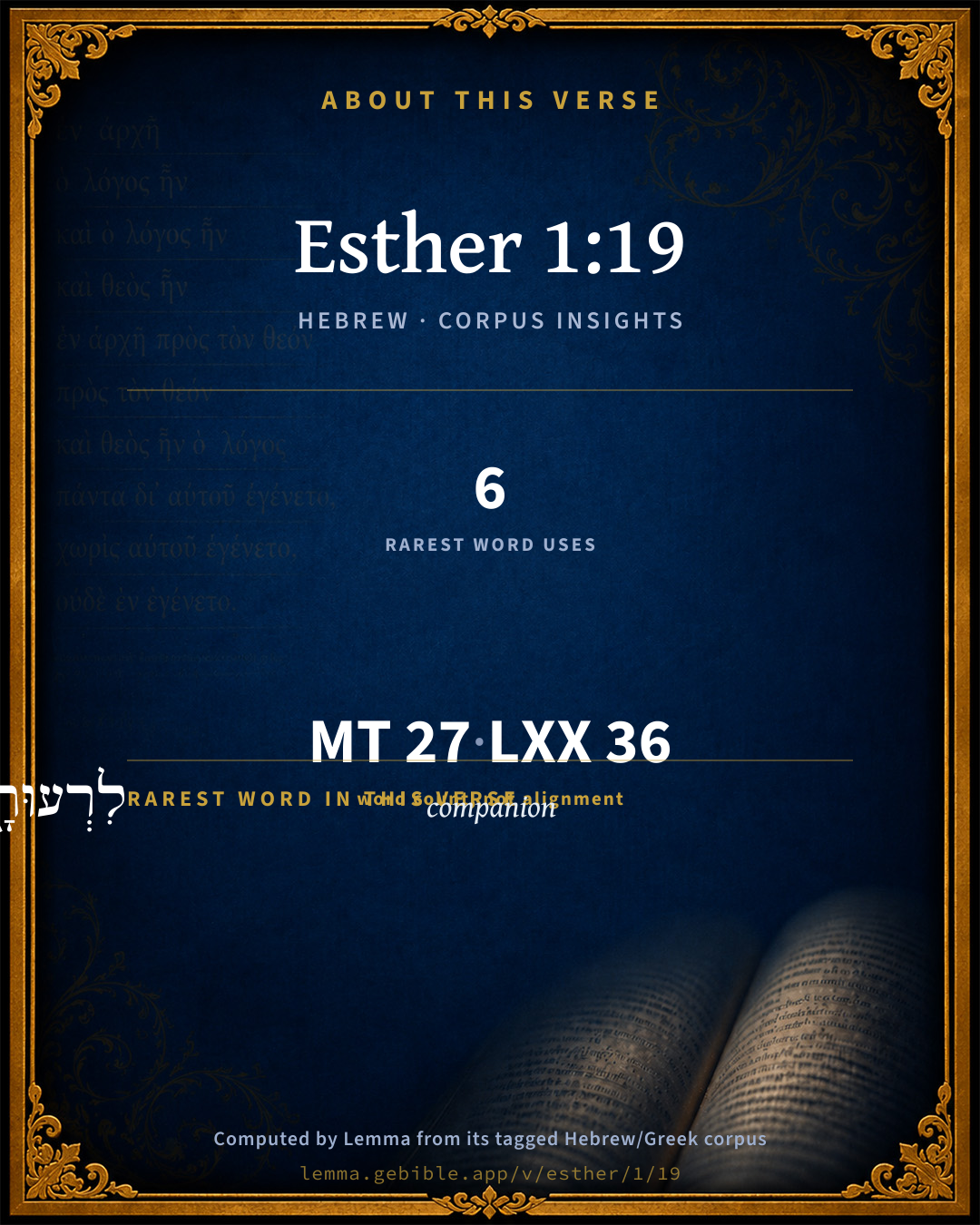
The rarest word here is לִרְעוּתָ֖הּ companion H7468 — appearing just 6 times in the whole Hebrew Bible.

Shared distinctive vocabulary

לִרְעוּתָ֖הּ companion H7468 occurs in 6 verses of the Hebrew Bible. Also found in:

Grammatical profile

  • 5 verbs
  • 14 nouns
  • 2 adjectives
  • 2 prepositions
  • 1 conjunction
  • 3 particles

Verb forms

  • יֵצֵ֤א Qal · Jussive
  • וְיִכָּתֵ֛ב Niphal · Imperfect
  • יַעֲב֑וֹר Qal · Imperfect
  • תָב֜וֹא Qal · Imperfect
  • יִתֵּ֣ן Qal · Imperfect

Repetition

Words recur within this verse — often emphatic in Hebrew:

  • הַמֶּ֣לֶךְ king H4428 ×3
  • מַלְכוּת֙ kingdom H4438 ×2
  • מִלְּפָנָ֔יו face H6440 ×2
  • וְלֹ֣א not H3808 ×2

Hebrew & Septuagint length

In English translation the verse runs 56 words from the Hebrew and 58 from the Septuagint (LXX English) — closely comparable.

A rough comparison of the two English renderings, which tokenize alike — not a word-level alignment.

Word counts can differ between the Hebrew and the Greek without any difference in meaning — e.g. the Hebrew direct-object marker אֵת has no separate Greek word, and Greek often adds the article ὁ.

In the original languages it is 27 Hebrew tokens and 36 Greek tokens — but the two are counted differently (Hebrew bundles its prefixes and suffixes into one token; the Greek is in lemma form), so that isn’t a like-for-like length.

Cross-references

8

Topical passages linked to Esther 1:19 in the Treasury of Scripture Knowledge — connected by theme and wording, ordered by reader-vote popularity; previews shown in the World English Bible.

  • 1 Samuel 15:28 Samuel said to him, Yahweh has torn the kingdom of Israel from you this day, and has given it to a neighbor of yours who is better than you.
  • Esther 8:8 Write you also to the Jews, as it pleases you, in the king's name, and seal it with the king's ring; for the writing which is written in the king's name, and sealed with the king's ring, may no man reverse.
  • Esther 3:9 If it please the king, let it be written that they be destroyed: and I will pay ten thousand talents of silver into the hands of those who have the charge of the [king's] business, to bring it into the king's treasuries.
  • Esther 8:5 She said, If it please the king, and if I have found favor in his sight, and the thing seem right before the king, and I be pleasing in his eyes, let it be written to reverse the letters devised by Haman, the son of Hammedatha the Agagite, which he wrote to destroy the Jews who are in all the king's provinces:
  • Daniel 6:8–15 Now, O king, establish the interdict, and sign the writing, that it not be changed, according to the law of the Medes and Persians, which doesn't alter.
  • Daniel 6:17 A stone was brought, and laid on the mouth of the den; and the king sealed it with his own signet, and with the signet of his lords; that nothing might be changed concerning Daniel.
  • 1 Kings 3:28 All Israel heard of the judgment which the king had judged; and they feared the king: for they saw that the wisdom of God was in him, to do justice.
  • Esther 1:21 The saying pleased the king and the princes; and the king did according to the word of Memucan:

Cross-references courtesy of OpenBible.info (CC BY 4.0).

Hebrew and Greek witnesses Masoretic Hebrew ↔ Greek Septuagint

The same verse in the two great witnesses to the Old Testament, shown verse-for-verse.

These are two independent witnesses, not word-aligned to each other, and the Septuagint is shown in lemma (dictionary) form.

Hebrew Esther 1:19 Masoretic · Westminster Leningrad Codex

אִם עַל הַמֶּ֣לֶךְ ט֗וֹב יֵצֵ֤א דְבַר מַלְכוּת֙ מִלְּפָנָ֔יו וְיִכָּתֵ֛ב בְּדָתֵ֥י פָֽרַס וּמָדַ֖י וְלֹ֣א יַעֲב֑וֹר אֲשֶׁ֨ר לֹֽא תָב֜וֹא וַשְׁתִּ֗י לִפְנֵי֙ הַמֶּ֣לֶךְ אֲחַשְׁוֵר֔וֹשׁ וּמַלְכוּתָהּ֙ יִתֵּ֣ן הַמֶּ֔לֶךְ לִרְעוּתָ֖הּ הַטּוֹבָ֥ה מִמֶּֽנָּה

If it please the king, let there go forth a royal commandment from him, and let it be written among the laws of the Persians and the Medes, that it not be altered, that Vashti come no more before king Ahasuerus; and let the king give her royal estate to another who is better than she.

World English Bible · Public Domain

Greek LXX Esther 1:19 Septuagint · lemma form

εἰ οὖν δοκέω ὁ βασιλεύς προςτάσσω βασιλικός καί γράφω κατά ὁ νόμος μῆδοι καί πέρσης καί μή ἄλλως χράω μηδέ εἰςἔρχομαι ἔτι ὁ βασίλισσα πρός αὐτός καί ὁ βασιλεία αὐτός δίδωμι ὁ βασιλεύς γυνή κρείσσων αὐτός

If then it seem good to the king, let him make a royal decree, and let it be written according to the laws of the Medes and Persians, and let him not alter it: and let not the queen come in to him any more; and let the king give her royalty to a woman better than she.

LXX2012 (modern English Septuagint) · Public Domain

Hebrew: Westminster Leningrad Codex (CC BY 4.0). Greek: Septuagint (public domain); English from LXX2012 (modern English Septuagint) (Public Domain). How the Septuagint differs from the Hebrew →

Commentary

Notes on Esther 1:19 from classic Christian and Jewish commentators (each source and its license shown beneath its notes). The classic Christian expositions comment on the surrounding passage and are grouped to its opening verse, so a note may address several verses; the Jewish commentaries on the Tanakh (Rashi and others) are per-verse, so they appear only where the commentator wrote on this verse.

Lemma curates 59 commentaries, every one of them public domain or Creative Commons licensed, each selected and text-cleaned for this edition rather than reprinted as found. About our sources →

Trapp's Complete Commentary

John Trapp

Est 1:19 If it please the king, let there go a royal commandment from him, and let it be written among the laws of the Persians and the Medes, that it be not altered, That Vashti come no more before king Ahasuerus; and let the king give her royal estate unto another that is better than she.

Ver. 19. If it please the king] Courtier-like; lest he should seem to prescribe to the king, or to prejudice the rest of the royal counsellors, he thus modestly prefaceth to his ensuing harsh and hard sentence. He knew well enough it would please the king at present, in the mind he now was in; and to prevent any alteration, he moves to have it made sure by an irrevocable law, that he might not hereafter be censured for this his immoderate and unmerciful censure, but be sure to save one howsoever.

Let it be written, saith he, among the laws of the Persians] Which the king himself could not repeal, Dan 6:8; Dan 6:15, but once passed and registered, they remained binding for ever. I have read of a people among whom the laws they had lasted in force but for three days at utmost. This was a fault in the other extreme. Laws are to be made with due deliberation, Legem dicimus, νομον, quasi μενοντα νοον (Plato), and then to be established, and not altered without very great reason, as sometimes there is, since

Tempora mutantur, nos et mutamur in illis.

That Vashti come no more before king Ahasuerus] But be absolutely deposed and divorced. Here was no proportion between the offence and the sentence. This judgment was like the laws of Draco; of which Aristotle saith, that they were not worth remembrance, but only for their great severity; as being written not with black, but with blood.

And let the king give her royal estate unto another] The more to vex her. Surely such an exauthoration of so great a personage, with so great disgrace and ignominy, could not but be very grievous, yea, worse than death. High seats, as they are never but uneasy; so the fall from them must needs be dangerous and dismal. How well might holy Esther sing with the Virgin Mary, God putteth down the mighty from their thrones, and exalteth them of low degree, Luk 1:52.

John Trapp, A Commentary or Exposition upon All the Books of the Old and New Testament (1647–1656) — public domain. Text from a community e-Sword module.

Joseph Benson's Commentary

Est 1:19. If it please the king — Which this cunning politician knew it would do. That it be not altered — Which caution was necessary for his own security, lest the king’s anger should cool, and the queen should recover her former state, and the king’s favour, in which case this lord would, most likely, have fallen under his displeasure: but the order being once registered as a law of the kingdom, the king could not alter his decree without disgracing himself.

Joseph Benson's Commentary on the Old and New Testaments (1811–1818) — public domain. Text from a community e-Sword module.

Tyndale Open Study Notes

Tyndale Open Resources

1:19 issue a written decree . . . that cannot be revoked: The written decree would become unalterable law that could not be changed (8:8; Dan 6:8, 12).

Tyndale Open Study Notes — © Tyndale Open Resources, licensed CC BY-SA 4.0. Text via the HelloAO Bible API.

Geneva Bible (1599)

Geneva Bible translators

Let her be divorced, and another made Queen.

Geneva Bible (1599) marginal notes — public domain. Text via Bolls.life.

Adam Clarke's Commentary

Verse 19. That it be not altered] Let it be inserted among the permanent laws, and made a part of the constitution of the empire. Perhaps the Persians affected such a degree of wisdom in the construction of their laws, that they never could be amended, and should never be repeated. And this we may understand to be the ground of the saying, The laws of the Medes and Persians, that change not.

Adam Clarke's Commentary on the Bible (1810–1826) — public domain. Text from a community e-Sword/MySword module.

Ellicott's Commentary for English Readers

(19) That it be not altered.—Literally, that it pass not away. The order having been committed to writing was, in theory at any rate, immutable. The best illustration is the well-known case of Daniel; see also below (Est_8:8). Probably a strong-willed monarch would interpret this inviolability rather freely.

A Bible Commentary for English Readers, edited by Charles John Ellicott (1878–1897) — public domain. Text from a community e-Sword module.

The Cambridge Bible for Schools and Colleges

gen. ed. J. J. S. Perowne

19. If it please the king] a standing formula in proposing royal decrees. So often in this book: cp. Neh_2:5.

a royal commandment] lit. a commandment of the kingdom, i.e. an edict which, though directed against an individual, should be registered as a public ordinance, in order that it might come under the class of laws which could not be altered. Memucan had reason to insist upon this course, as he and those sympathising with him in the advice tendered to the king, would have good cause to dread the vengeance of Vashti, if she should regain her position as queen. Another case of making into an unalterable edict what from its nature was but a temporary measure is to be seen in Dan_6:8 f. As regards the whole question, how far the king was bound by any laws, there existed evidently a certain elasticity. Cambyses, desiring to marry his sister (see on Est_1:13), was told by his advisers that, although there was no law permitting such an act, yet there was one to the effect that the king might do as he pleased.

The Cambridge Bible for Schools and Colleges (gen. ed. J. J. S. Perowne; Cambridge University Press, 1878–1918) — public domain. Text from a community e-Sword module.

John Gill's Exposition

If it please the king, let there go a royal commandment from him,.... Not only a proclamation made, but a law enacted and published by royal authority:

and let it be written among the laws of the Persians and Medes that it be not altered; for so it was, that when a law was made, and signed, and sealed, and registered among the laws of the kingdom, it remained unalterable, Dan 6:8, this precaution Memucan took for his own safety; for had the king acted upon his advice, without passing it into a law in such form, he might change his mind, and recall Vashti, who would not fail of venting her wrath upon the counsellor, and so he be in danger of losing his life for it:

that Vashti come no more before King Ahasuerus; but be entirely divorced, never to be received any more:

and let the king give her royal estate unto another that is better than she; or "to her companions" (z); that was with her in the house of the women in the seraglio; one that was fairer, as the Targum, or of a better disposition than her; let her be made queen, and enjoy all the honour, and dignity, and marks of royalty Vashti did; her throne, her crown, and royal apparel, as it is interpreted in an ancient Jewish writing (a).

(z) "sodali ejus", Montanus; "sociae ejus", Tigurine version, Drusius, Rambachius. (a) Tikkune Zohar, correct. 21. fol. 59. 2.

John Gill's Exposition of the Whole Bible (1746–1763) — public domain (CC PDM 1.0). Text via the HelloAO Bible API.

Albert Barnes' Notes on the Bible

That it be not altered - Compare the margin reference. This was the theory. Practically, the monarch, if he chose, could always dispense with the law. It was therefore quite within his power to restore Vashti to her queenly dignity notwithstanding the present decree, if he so pleased.

Albert Barnes' Notes on the Bible (1834–1885) — public domain. Text from a community e-Sword/MySword module.

Haydock's Catholic Bible Commentary

Altered. This regarded the more solemn acts, signed by the counsellors, Daniel vi. 17. (Grotius) --- Some decrees were neglected or changed, chap. viii. 9., and 1 Esdras iv. 5, 21., and vi. 1. (Calmet)

George Leo Haydock (1774–1849), Haydock's Catholic Family Bible and Commentary, 1859 edition — public domain. Excludes Psalms (Douay-Rheims chapter numbering differs from Protestant) and Deuterocanonical books (Catholic canon only).

Matthew Poole's English Annotations

If it please the king, which this cunning politician knew it would do.

That it be not altered; which caution was necessary for his own security; for if the queen should recover her state and the king’s favour, he was most likely to fall into his displeasure.

Matthew Poole's English Annotations on the Holy Bible (1683–1685) — public domain. Text from a community e-Sword/MySword module.

Whedon's Commentary on the Bible

Daniel D. Whedon

19. That it be not altered — Literally, and it shall not pass away; that is, it shall remain as a precedent, and be a permanent law for such matters in the empire. On the proverbial inviolability of the laws of the Medes and Persians, compare the marginal references. It originated, probably, in a desire to enhance in the national mind the sacredness of law, and also to forestall capricious and hasty changes in administration. But it was a defective and pernicious principle, making no provision against the capricious enactment of rash and harmful laws, and then allowing no repeal nor modification of them. Practically, however, it was often evaded, and the monarch found some way to make it lawful to do as he pleased.

Her royal estate — The queenly privileges and honours with which the king had been pleased to distinguish her.

Unto another — Hebrew, her female companion. This expression indicates that she herself was but a concubine, for the monarch’s legitimate marriage with one who was to be principal wife, and who, according to Persian law, (Herod., 3:84,) could be taken only from one of the seven princely families of the empire, would hardly be spoken of in this way.

Daniel D. Whedon (gen. ed.), Commentary on the Old and New Testaments (1874–1909) — public domain. Text from a community e-Sword module.

The Pulpit Commentary

A royal commandment. Literally, "a command of the kingdomi.e. a public, not a domestic, order. Under ordinary circumstances such a matter as the disgrace of a favourite wife would have been settled in the secrecy of the seraglio, without calling general attention to it. In Memu-can"s opinion, the publicity of Vashti"s disobedience had made it expedient that she should be disgraced publicly. Let it be written among the laws of the Persians and the Medes. A sentence upon an individual was not a very suitable thing to add to a national code of laws; but we see from Daniel (Dan_6:8, Dan_6:9) that decrees of quite a temporary character were sometimes attached to the code for the express purpose of rendering them unalterable; and so it seems to have been in this instance. Unto another. Literally, as in the margin, "unto her companion." Memucan assumes that one of the existing inmates of the seraglio will be elevated into the place vacated by Vashti. This was the ordinary course, but on the present occasion was not followed.

Penalties.

In connection with the penalty imposed on Vashti the following remarks may be made:

I PENALTIES ARE INTENDED TO ENFORCE LAWS, or, in other words, to deter men from crime. With many law would have little power apart from the penalties attached to the transgression of it. Those who are not governed by virtue, or the love of God and truth, may be commanded by fear.

II PENALTIES OUGHT TO BE EQUITABLE. As the servants of justice, they should have some real proportion to the trespass committed. Even supposing Vashti to have failed in temper or in wisdom, her punishment was out of all proportion to her fault most cruel and unjust. Excessive penalties are themselves an injustice, and, as all experience testifies, rather encourage than repress crime.

III PENALTIES, while being adequate to the offence, SHOULD CONTEMPLATE THE IMPROVEMENT OF THE OFFENDER. The king"s decree against Vashti gave no room for explanation, repentance, or amendment, When penalties do nothing more than inflict pain and privation, they are likely to harden transgressors in evil, and thus to prepare new and weightier scourges for the society which they are designed to protect.

IV PENALTIES SHOULD NEVER BE THE INSTRUMENTS OF VENGEANCE OR WRATH. They should be the award of impartial and unimpassioned justice. Of the punishment of Vashti a burning anger was the spring.

V PENALTIES SHOULD NEVER BE INFLICTED EXCEPT WHEN GUILT HAS BEEN CLEARLY PROVED. In the action of our law courts the maxim is recognised that it is better to let the guilty escape than to allow punishment to fall on the innocent. The benefit of any doubt is given to the accused.

VI PENALTIES FURNISH A MOTIVE FOR THE AVOIDANCE OF CRIME ONLY TO THE EVIL-DISPOSED. The good honour and love the principles on which just laws are founded, and freely live by them. If all men were governed by a pure conscience and the love of God there would be no need for penal codes.

VII PENALTIES ARE ATTACHED TO DIVINE AS WELL AS TO HUMAN LEGISLATION. No law of God can be broken with impunity. In the cross of Jesus Christ mercy and justice meet, and through that sacrifice an infinite mercy is justly offered to all men. As to the future punishment of the impenitent we can say little, because little is revealed; that we must leave trustfully with him whose judgments are truth and whose ways are righteous. It should be the prayerful aim of all Christians so to enter into the love of God in Christ as to be raised above the fear of the law. "Fear hath torment;" "but perfect love casteth out fear". D. (1Jn_4:18)

The Pulpit Commentary (1880–1919), ed. H.D.M. Spence-Jones & Joseph S. Exell — public domain. Text from a community e-Sword module.

Keil & Delitzsch

C. F. Keil & F. Delitzsch

That Vashti come no more before king Ahasuerus; and let the king give her royal estate unto another that is better than she. After this argument on the queen's conduct, follows the proposal: "If it please the king (על טּוב like Neh 2:5), let there go from him a word of the kingdom (i.e., a royal edict), and let it be written (entered) in the laws of the Persians and the Medes, and not pass away, that Vashti come no more before King Ahashverosh; and let the king give her queenship (her royal rank) to another who is better than she." An edict issued by the king, entered among the laws of the Persians and Medes, and sealed with the royal signet (Est 8:8), does not pass away, i.e., remains in force, is irrevocable (comp. Dan 6:9). The counsellors press for the issue of such an edict, for the purpose of making it impossible to the king to take Vashti again into favour, lest they should experience her vengeance on the restoration of her influence. רעוּתהּ, her companion, is any other woman, Vashti being here regarded merely as a woman. הטּובה includes both beauty and good behaviour (Berth.). By this means, add the counsellors in Est 1:20, all the ill effects of Vashti's contumacy will be obviated. "And when the king's decree, which he shall make, is heard in his whole kingdom, for it is great, all wives shall give honour to their husbands, from great to small." פּתגּן is according to the Keri to be pointed as the constructive state, פּתגּם. The expression עשׂה פּתגּן is explained by the circumstance, that פתגם signifies not only edict, decree, but also thing (see on Dan 3:16): to do a thing. In the present verse also it might be so understood: when the thing is heard which the king will do in his whole kingdom. The parenthetical clause, for it is great, is intended to flatter the king's vanity, and induce an inclination to agree to the proposal. "From great to small" signifies high and low, old and young.

Keil & Delitzsch — Biblical Commentary on the Old Testament (1861–1891) — public domain (CC PDM 1.0). Text via the HelloAO Bible API. (Old Testament only.)

unfoldingWord translationNotes

Door43 World Missions Community

Connecting Statement:

Meremoth continues to answer the king.

If it pleases the king ... from him ... before him ... Let the king ... the king's decree ... his vast kingdom

Meremoth speaks to the king in third person as a form of respect. AT: If it pleases your Majesty ... from you ... before you ... Please ... your decree ... your vast kingdom" (See: First, Second, or Third Person)

which cannot be repealed

This can be stated in active form. AT: "which no one can change" (See: Active or Passive)

When the king's decree is proclaimed

This can be stated in active form. AT: "When they hear the king's decree" or "When they hear what you have commanded" (See: Active or Passive)

vast

very wide

from the greatest to the least significant

This is a merism that refers to both extremes and everyone in between. This probably refers to the husbands, but it is possible that it refers to the wives. (See: Merism)

translationWords

king

royal

decree

written

law, laws

Persia

Medes

Vashti

preach

unfoldingWord translationNotes — © Distant Shores Media and the Door43 World Missions Community, licensed CC BY-SA 4.0. Source: git.door43.org/Door43/en_tn.

Rashi

Rabbi Shlomo Yitzchaki (Rashi)

a royal edict a royal edict of revenge, i.e., that he commanded to execute her.

and let it be inscribed in the laws of Persia and Media in the books of the statutes and the customs of the kingdom.

and let it not be revoked this statute from among them; this should be a statute and a law for anyone who shows contempt for her husband.

that Vashti did not come and therefore, she was executed.

Rashi on the Tanakh — English translations: “The Judaica Press complete Tanach with Rashi, translated by A. J. Rosenberg” (CC BY 4.0); “Pentateuch with Rashi's commentary by M. Rosenbaum and A.M. Silbermann, 1929-1934” (public domain); “The Metsudah Tanach series, Lakewood, N.J” (CC BY 4.0); and “The Book of Joshua, Metsudah Publications, 1997” (CC BY 4.0). Text via Sefaria.

Lesson kit

Teaching starters — assembled from the data on this page, not authored interpretation. Every prompt links to the verse data it draws on. Edit before teaching.

Esther, in the Historical, opens this verse with 27 words (22 distinct Hebrew lemmas). Its most distinctive word is rᵉʻûwth (“companion”). A historical commentator’s framing appears above. Read the whole chapter for the surrounding context.

Discussion questions

  1. How does “companion” (rᵉʻûwth) shape what this verse is saying?
  2. Exodus 11:2 shares the word «companion» with this verse. How do the two illuminate each other?
  3. “king” occurs 3× in this one verse. What is the effect of the repetition?
  4. The translations on this page render this verse differently — a whole-verse word diff, not a word-by-word alignment. What might account for the different wordings?
  5. The verb «יֵצֵ֤א» is Qal Jussive. How does its form color the action?
  6. Reading how Trapp's Complete Commentary and Joseph Benson's Commentary read this verse, where do the two commentators agree and where do they part?

Things to notice

Reading settings

Reading text

Shown beneath each verse's original-language words.

Old Testament
Old Testament edition

Read the OT as the Masoretic Hebrew (MT) or the Greek Septuagint (LXX).

English shown for the Greek Septuagint (in the Hebrew ↔ Greek comparison).

Comparing translations? Open the Compare panel on any verse page to stack up to four side by side.