
Exodus 10:26

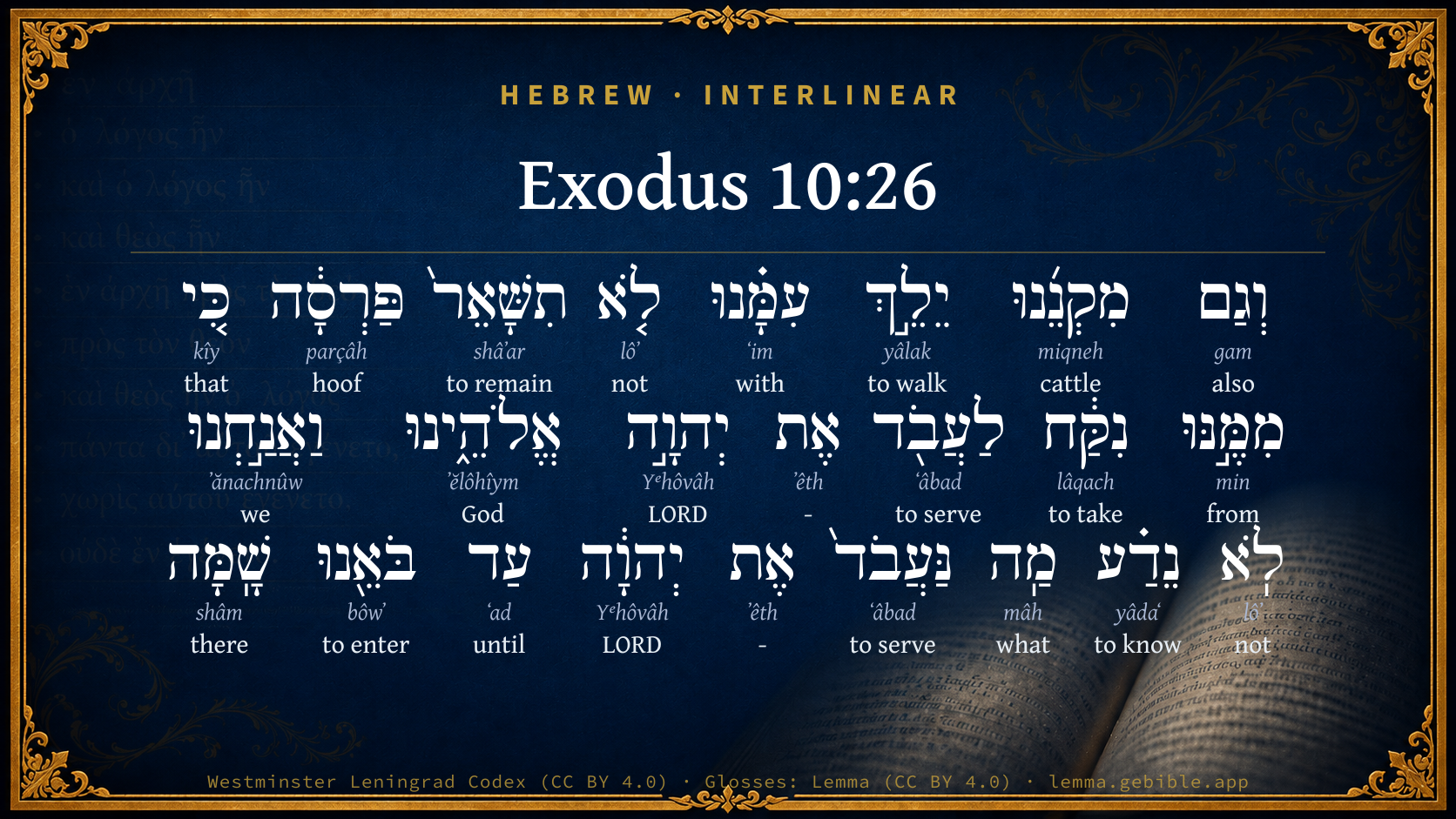
Hebrew (Westminster Leningrad Codex) Exodus 10:26 appears in the Hebrew Old Testament. The text above is from the Westminster Leningrad Codex. Each word links to its Strong’s number, a concise gloss, and parsing drawn from the Open Scriptures Hebrew Bible morphology. Click any word for its full Brown-Driver-Briggs (BDB) entry.
Download image
Cite this verse

Exodus 10:26 (World English Bible). Public Domain. Lemma interlinear Bible study tool, https://lemma.gebible.app/v/exodus/10/26.

Show BibTeX & RIS
BibTeX
RIS
English Translation
Our cattle also shall go with us. There shall not a hoof be left behind, for of it we must take to serve Yahweh our God; and we don't know with what we must serve Yahweh, until we come there."
World English Bible · Public Domain
Highlights
  • 1 first appearance in the Hebrew Bible
Full analysis ↓
Download a study sheet

One document with this verse’s original text, its word-by-word gloss line, the meaning frame, cross-references with their text, attributed commentary, and full source and license credits — printable, and it pastes into notes with its structure intact.

This verse Autodidact and up

Study sheet (.html) Plain text (.txt)

A passage Seminary Student

Up to 50 verses in one chapter. A passage sheet keeps up to 6 commentary sources and 12 cross-references per verse, in the order this page ranks them, and says so on the sheet whenever that leaves anything out. Ask for a single verse and you get the Autodidact verse sheet above.

Everything on this page stays free to read, with no account — the sheet is a download of what is already on screen, not access to it.

Want to remove ads? Support Godless Engineer
Compare translations 3

The same verse in 3 English versions, stacked beneath the original-language interlinear above. Click any original word for its lexicon entry.

Each is an independent rendering of the whole verse — the interlinear is not word-aligned to these translations.

Highlighted words mark where these versions differ — a whole-verse word diff, not a word-by-word alignment.

  • World English Bible Public Domain
    Our cattle also shall go with us. There shall not a hoof be left behind, for of it we must take to serve Yahweh our God; and we don't know with what we must serve Yahweh, until we come there."
  • King James Version Public Domain
    Our cattle also shall go with us; there shall not an hoof be left behind; for thereof must we take to serve the LORD our God; and we know not with what we must serve the LORD, until we come thither.
  • unfoldingWord Literal Text CC BY-SA 4.0
    And even our livestock shall go with us. Not a hoof shall be left behind, for we shall take from them to serve Yahweh our God. And as for us, we will not know with what we must serve Yahweh until we arrive there.”

unfoldingWord Literal Text — © unfoldingWord, licensed CC BY-SA 4.0. Word-aligned USFM3 via Door43 (git.door43.org/unfoldingWord/en_ult).

Versions to compare (up to 4)

3 of 4 selected

Show all 18 translations

Every available English version of this verse, each an independent rendering of the whole verse.

  • World English Bible Public Domain
    Our cattle also shall go with us. There shall not a hoof be left behind, for of it we must take to serve Yahweh our God; and we don't know with what we must serve Yahweh, until we come there."
  • Berean Standard Bible Public Domain
    Even our livestock must go with us; not a hoof will be left behind, for we will need some of them to worship the LORD our God, and we will not know how we are to worship the LORD until we arrive.”
  • Majority Standard Bible Public Domain
    Even our livestock must go with us; not a hoof will be left behind, for we will need some of them to worship the LORD our God, and we will not know how we are to worship the LORD until we arrive.”
  • King James Version Public Domain
    Our cattle also shall go with us; there shall not an hoof be left behind; for thereof must we take to serve the LORD our God; and we know not with what we must serve the LORD, until we come thither.
  • American Standard Version (1901) Public Domain
    Our cattle also shall go with us; there shall not a hoof be left behind: for thereof must we take to serve Jehovah our God; and we know not with what we must serve Jehovah, until we come thither.
  • Revised Version (1885) Public Domain
    Our cattle also shall go with us; there shall not an hoof be left behind; for thereof must we take to serve the LORD our God; and we know not with what we must serve the LORD, until we come thither.
  • Geneva Bible (1599) Public Domain
    Therefore our cattell also shall go with vs: there shall not an hoofe bee left, for thereof must we take to serue the Lord our God: neither doe wee knowe howe we shall serue the Lord, vntill we come thither.
  • Douay-Rheims (1899) Public Domain
    All the flocks shall go with us: there shall not a hoof remain of them: for they are necessary for the service of the Lord our God: especially as we know not what must be offered, till we come to the very place.
  • Young's Literal Translation Public Domain
    and also our cattle doth go with us, there is not left a hoof, for from it we do take to serve Jehovah our God; and we -- we know not how we do serve Jehovah till our going thither.'
  • Literal Standard Version CC BY-SA 4.0
    and also our livestock go with us—there is not left a hoof, for we take from it to serve our God YHWH; and we do not know how we serve YHWH until our going there.”
  • Unlocked Literal Bible CC BY-SA 4.0
    Our cattle must also go with us; not a hoof of them may be left behind, for we must take them to worship Yahweh our God. For we do not know with what we must worship Yahweh until we arrive there.”
  • unfoldingWord Literal Text CC BY-SA 4.0
    And even our livestock shall go with us. Not a hoof shall be left behind, for we shall take from them to serve Yahweh our God. And as for us, we will not know with what we must serve Yahweh until we arrive there.”
  • Darby Bible Public Domain
    Our cattle also must go with us: there shall not a hoof be left behind; for we must take thereof to serve Jehovah our God; and we do not know with what we must serve Jehovah, until we come there.
  • World Messianic Bible Public Domain
    Our livestock also shall go with us. Not a hoof shall be left behind, for of it we must take to serve the LORD our God; and we don’t know with what we must serve the LORD, until we come there.”
  • Webster's Bible Public Domain
    Our cattle also shall go with us; there shall not a hoof be left behind; for of them must we take to serve the LORD our God; and we know not with what we must serve the LORD, until we come thither.
  • Free Bible Version CC BY-SA 4.0
    Our livestock have to go with us too—not a single animal will be left behind. We'll need some of them to worship the Lord our God, and we won't know how we are to worship the Lord until we get there.”
  • Bible in Basic English Public Domain
    So our cattle will have to go with us, not one may be kept back; for they are needed for the worship of the Lord our God; we have no knowledge what offering we have to give till we come to the place.
  • JPS Tanakh (1917) Public Domain
    Our cattle also shall go with us; there shall not a hoof be left behind; for thereof must we take to serve the LORD our God; and we know not with what we must serve the LORD, until we come thither.'

Literal Standard Version (2020), Covenant Press — licensed CC BY-SA 4.0. Text via the HelloAO Bible API (eBible.org). Unlocked Literal Bible (unfoldingWord) — licensed CC BY-SA 4.0. Text via the HelloAO Bible API (eBible.org). unfoldingWord Literal Text — © unfoldingWord, licensed CC BY-SA 4.0. Word-aligned USFM3 via Door43 (git.door43.org/unfoldingWord/en_ult). Free Bible Version, Dr. Jonathan Gallagher — licensed CC BY-SA 4.0. Text via the HelloAO Bible API (eBible.org).

Word by word

More ways to search: Search by grammar → Find every occurrence → Compare this word →

Practice this passage: Drill this verse → Learn its vocabulary →

פַּרְסָ֔ה
parçâh
H6541
“hoof”
Noun, Common, Feminine, Singular, Absolute
Part of Speech
Noun
Type
Common
Gender
Feminine
Number
Singular
State
Absolute
Full BDB Definition

Origin: from H6538

TWOT: 1821b

hoof - of ruminants - of horses (undivided hooves)
  1. וְגַם gam H1571 “and · also” Conjunction + Particle, Accusative
  2. מִקְנֵ֜נוּ miqneh H4735 “cattle · our” Noun, Common, Masculine, Singular, Construct + Suffix, Personal, 1st Person, Common, Plural
  3. יֵלֵ֣ךְ yâlak H3212 “to walk” Verb, Qal, Imperfect, 3rd Person, Masculine, Singular
  4. עִמָּ֗נוּ ʻim H5973 “with · us” Preposition + Suffix, Personal, 1st Person, Common, Plural
  5. לֹ֤א lôʼ H3808 “not” Particle, Negative
  6. תִשָּׁאֵר֙ shâʼar H7604 “to remain” Verb, Niphal, Imperfect, 3rd Person, Feminine, Singular
  7. כִּ֚י kîy H3588 “that” Conjunction
  8. מִמֶּ֣נּוּ min H4480 “from · us” Preposition + Suffix, Personal, 1st Person, Common, Plural
  9. נִקַּ֔ח lâqach H3947 “to take” Verb, Qal, Imperfect, 1st Person, Common, Plural
  10. לַעֲבֹ֖ד ʻâbad H5647 “to serve” Preposition + Verb, Qal, Infinitive Construct
  11. אֶת ʼêth H853 “-” Particle, Direct Object
  12. יְהוָ֣ה Yᵉhôvâh H3068 “LORD” Noun, Proper
  13. אֱלֹהֵ֑ינוּ ʼĕlôhîym H430 “God(s) · our” Noun, Common, Masculine, Plural, Construct + Suffix, Personal, 1st Person, Common, Plural
  14. וַאֲנַ֣חְנוּ ʼănachnûw H587 “and · we” Conjunction + Pronoun, Personal, 1st Person, Common, Plural
  15. לֹֽא lôʼ H3808 “not” Particle, Negative
  16. נֵדַ֗ע yâdaʻ H3045 “to know” Verb, Qal, Imperfect, 1st Person, Common, Plural
  17. מַֽה mâh H4100 “what” Particle, Interrogative
  18. נַּעֲבֹד֙ ʻâbad H5647 “to serve” Verb, Qal, Imperfect, 1st Person, Common, Plural
  19. אֶת ʼêth H853 “-” Particle, Direct Object
  20. יְהוָ֔ה Yᵉhôvâh H3068 “LORD” Noun, Proper
  21. עַד ʻad H5704 “until” Preposition
  22. בֹּאֵ֖נוּ bôwʼ H935 “to enter · us” Verb, Qal, Infinitive Construct + Suffix, Personal, 1st Person, Common, Plural
  23. שָֽׁמָּה shâm H8033 “there · toward” Adverb + Suffix, Demonstrative

About this verse

These counts appear in no published source. They are computed here, from the morphology-tagged text and Lemma’s own curated glosses. What Lemma adds →

24
words
20
distinct lemmas
Pentateuch
section

Notable vocabulary

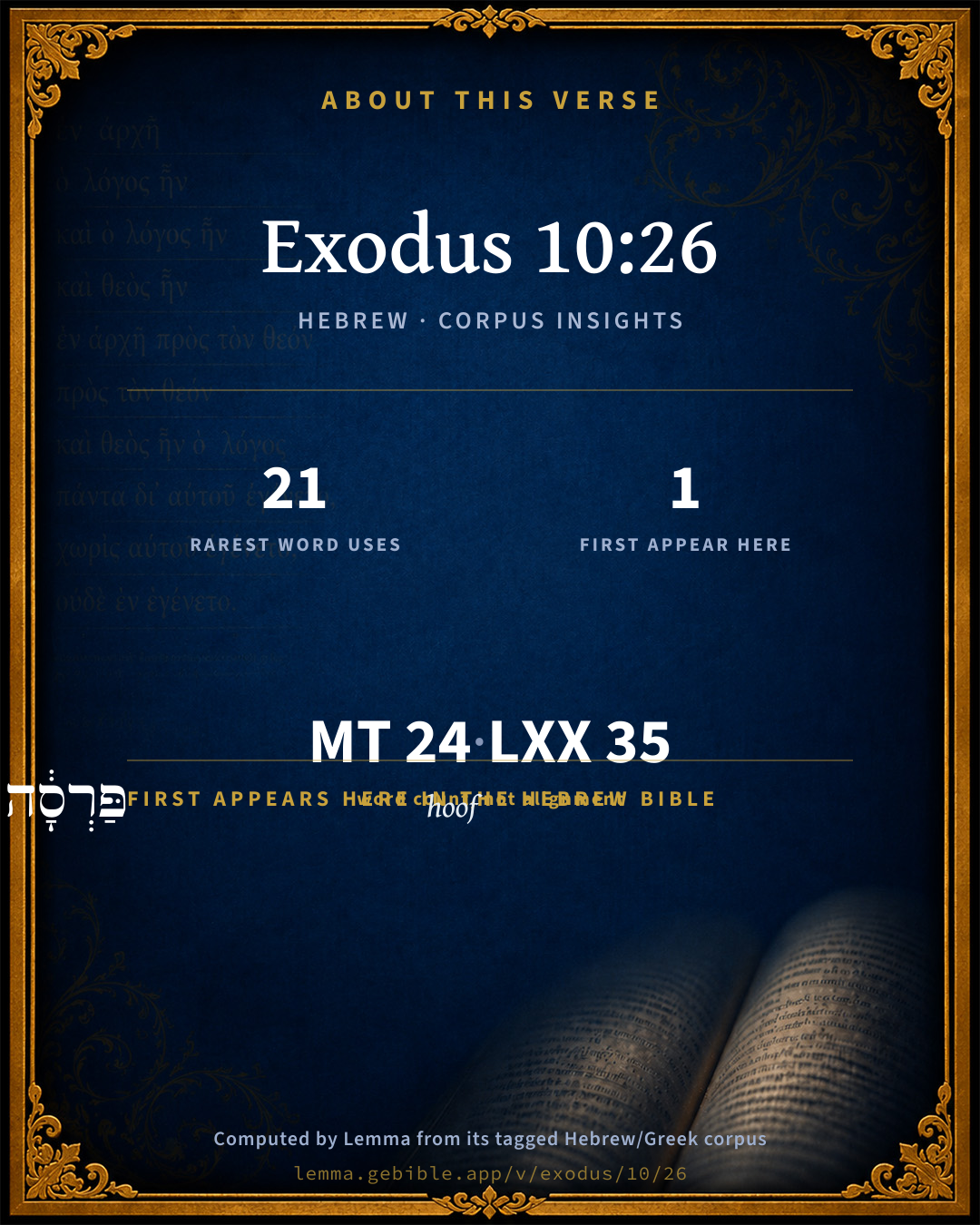
The rarest word here is פַּרְסָ֔ה hoof H6541 — appearing just 21 times in the whole Hebrew Bible.

First appearance in Scripture

This word makes its first canonical appearance in the Hebrew Bible here:

  • פַּרְסָ֔ה hoof H6541

Shared distinctive vocabulary

פַּרְסָ֔ה hoof H6541 occurs in 16 verses of the Hebrew Bible. Also found in:

Grammatical profile

  • 7 verbs
  • 5 nouns
  • 1 pronoun
  • 3 prepositions
  • 1 conjunction
  • 1 adverb
  • 6 particles

Verb forms

  • יֵלֵ֣ךְ Qal · Imperfect
  • תִשָּׁאֵר֙ Niphal · Imperfect
  • נִקַּ֔ח Qal · Imperfect
  • לַעֲבֹ֖ד Qal · Infinitive Construct
  • נֵדַ֗ע Qal · Imperfect
  • נַּעֲבֹד֙ Qal · Imperfect
  • בֹּאֵ֖נוּ Qal · Infinitive Construct

Repetition

Words recur within this verse — often emphatic in Hebrew:

  • לַעֲבֹ֖ד to serve H5647 ×2
  • יְהוָ֣ה LORD H3068 ×2
  • לֹ֤א not H3808 ×2

Hebrew & Septuagint length

In English translation the verse runs 40 words from the Hebrew and 45 from the Septuagint (LXX English) — closely comparable.

A rough comparison of the two English renderings, which tokenize alike — not a word-level alignment.

Word counts can differ between the Hebrew and the Greek without any difference in meaning — e.g. the Hebrew direct-object marker אֵת has no separate Greek word, and Greek often adds the article ὁ.

In the original languages it is 24 Hebrew tokens and 35 Greek tokens — but the two are counted differently (Hebrew bundles its prefixes and suffixes into one token; the Greek is in lemma form), so that isn’t a like-for-like length.

Cross-references

9

Topical passages linked to Exodus 10:26 in the Treasury of Scripture Knowledge — connected by theme and wording, ordered by reader-vote popularity; previews shown in the World English Bible.

  • Exodus 12:32 Take both your flocks and your herds, as you have said, and be gone; and bless me also!"
  • Proverbs 3:9 Honor Yahweh with your substance, With the first fruits of all your increase:
  • Isaiah 23:18 Her merchandise and her hire shall be holiness to Yahweh: it shall not be treasured nor laid up; for her merchandise shall be for those who dwell before Yahweh, to eat sufficiently, and for durable clothing.
  • Isaiah 60:5–10 Then you shall see and be radiant, and your heart shall thrill and be enlarged; because the abundance of the sea shall be turned to you, the wealth of the nations shall come to you.
  • Hosea 5:6 They will go with their flocks and with their herds to seek Yahweh; But they won't find him. He has withdrawn himself from them.
  • Zechariah 14:20 In that day there will be on the bells of the horses, "HOLY TO YAHWEH;" and the pots in Yahweh's house will be like the bowls before the altar.
  • Acts 2:44–45 All who believed were together, and had all things in common.
  • 2 Corinthians 8:5 This was not as we had hoped, but first they gave their own selves to the Lord, and to us through the will of God.
  • Hebrews 11:8 By faith, Abraham, when he was called, obeyed to go out to the place which he was to receive for an inheritance. He went out, not knowing where he went.

Cross-references courtesy of OpenBible.info (CC BY 4.0).

Hebrew and Greek witnesses Masoretic Hebrew ↔ Greek Septuagint

The same verse in the two great witnesses to the Old Testament, shown verse-for-verse.

These are two independent witnesses, not word-aligned to each other, and the Septuagint is shown in lemma (dictionary) form.

Hebrew Exodus 10:26 Masoretic · Westminster Leningrad Codex

וְגַם מִקְנֵ֜נוּ יֵלֵ֣ךְ עִמָּ֗נוּ לֹ֤א תִשָּׁאֵר֙ פַּרְסָ֔ה כִּ֚י מִמֶּ֣נּוּ נִקַּ֔ח לַעֲבֹ֖ד אֶת יְהוָ֣ה אֱלֹהֵ֑ינוּ וַאֲנַ֣חְנוּ לֹֽא נֵדַ֗ע מַֽה נַּעֲבֹד֙ אֶת יְהוָ֔ה עַד בֹּאֵ֖נוּ שָֽׁמָּה

Our cattle also shall go with us. There shall not a hoof be left behind, for of it we must take to serve Yahweh our God; and we don't know with what we must serve Yahweh, until we come there."

World English Bible · Public Domain

Greek LXX Exodus 10:26 Septuagint · lemma form

καί ὁ κτῆνος ἐγώ πορεύομαι μετά ἐγώ καί οὐ ὑπολείπω ὁπλή ἀπό αὐτός γάρ λαμβάνω λατρεύω κύριος ὁ θεός ἐγώ ἐγώ δέ οὐ οἶδα τίς λατρεύω κύριος ὁ θεός ἐγώ ἕως ὁ ἔρχομαι ἐγώ ἐκεῖ

And our cattle shall go with us, and we will not leave a hoof behind, for of them we will take to serve the Lord our God: but we know not in what manner we shall serve the Lord our God, until we arrive there.

LXX2012 (modern English Septuagint) · Public Domain

Hebrew: Westminster Leningrad Codex (CC BY 4.0). Greek: Septuagint (public domain); English from LXX2012 (modern English Septuagint) (Public Domain). How the Septuagint differs from the Hebrew →

Targum (Aramaic paraphrase)

2

The Targum is the ancient Jewish Aramaic paraphrase of the Hebrew Scriptures — an interpretive translation, not the Hebrew text itself. Onkelos (literal) and Pseudo-Jonathan (expansive) render the Torah, and Jonathan the Prophets. Coverage is partial: where no permissively-licensed English translation exists for a verse, only the Aramaic is shown. This is verse-level text, not a word-by-word alignment to the Hebrew.

  1. Targum Onkelos Torah (Genesis–Deuteronomy)
    וְאַף בְּעִירָנָא יֵזֵיל עִמָנָא לָא תִשְׁתָּאַר מִדַעַם אֲרֵי מִנֵהּ אֲנַחְנָא נָסְבִין לְמִפְלַח קֳדָם יְיָ אֱלָהָנָא וַאֲנַחְנָא לֵית אֲנַחְנָא יָדְעִין מָה נִפְלַח קֳדָם יְיָ עַד מֵיתָנָא תַּמָן:

    (no public-domain English translation for this verse)

    Targum Onkelos — Aramaic: “Onkelos Genesis” (public domain); “Onkelos Exodus” (public domain); “Onkelos Leviticus” (public domain); “Onkelos Numbers” (public domain); “Onkelos Deuteronomy” (public domain). English: “Sefaria Community Translation” (CC0 1.0 (public-domain dedication)); “J.W. Etheridge. The Targums of Onkelos and Jonathan Ben Uzziel on the Pentateuch. London: Longmans, Green, 1862” (public domain). Text via Sefaria.

  2. Targum Pseudo-Jonathan Torah (Genesis–Deuteronomy)
    וְאוּף גֵּיתָנָא יֵזִיל עִמָּנָא לָא תִשְׁתַּיֵּיר מִנְהוֹן פַּרְסָתָא חָדָא אֲרוּם מִנְהוֹן נִסַּב לְמִפְלַח קֳדָם יְיָ אֱלָהָן וַאֲנַחְנָא אִין נַשְׁבִּיקִינוּן לֵית אֲנַן יַדְעִין מִמָא נִפְלַח קֳדָם יְיָ עַד מֵיתָנָא לְתַמָּן

    Our flocks, moreover, must go with us; not one hoof of them shall remain; for from them we are to take, to do service before the Lord our God. We cannot leave them; for we know not (as yet) in what manner we are to worship before the Lord, until we come thither.

    Targum Pseudo-Jonathan — Aramaic: “Targum Jonathan on Genesis” (public domain); “Targum Jonathan on Exodus” (public domain); “Targum Jonathan on Leviticus” (public domain); “Targum Jonathan on Numbers” (public domain); “Targum Jonathan on Deuteronomy” (public domain). English: “The Targum of Jonathan ben Uzziel, trans. J. W. Etheridge, London, 1862” (public domain). Text via Sefaria.

Commentary

Notes on Exodus 10:26 from classic Christian and Jewish commentators (each source and its license shown beneath its notes). The classic Christian expositions comment on the surrounding passage and are grouped to its opening verse, so a note may address several verses; the Jewish commentaries on the Tanakh (Rashi and others) are per-verse, so they appear only where the commentator wrote on this verse.

Lemma curates 59 commentaries, every one of them public domain or Creative Commons licensed, each selected and text-cleaned for this edition rather than reprinted as found. About our sources →

Trapp's Complete Commentary

John Trapp

Exo 10:26 Our cattle also shall go with us; there shall not an hoof be left behind; for thereof must we take to serve the LORD our God; and we know not with what we must serve the LORD, until we come thither.

Ver. 26. Not a hoof.] God’s law must be kept as the apple of our eye. {Pro 7:2} A dispensatory conscience is an evil conscience. Repentance makes clean work: as the flood drowned all, even Noah’s friends also.

John Trapp, A Commentary or Exposition upon All the Books of the Old and New Testament (1647–1656) — public domain. Text from a community e-Sword module.

Geneva Bible (1599)

Geneva Bible translators

The ministers of God ought not to yield one iota to the wicked, as touching their charge.

That is, with what beasts, or how many.

Geneva Bible (1599) marginal notes — public domain. Text via Bolls.life.

Adam Clarke's Commentary

Verse 26. We know not with what we must serve the Lord, c.] The law was not yet given the ordinances concerning the different kinds of sacrifices and offerings not known. What kind and what number of animals God should require to be sacrificed, even Moses himself could not as yet tell. He therefore very properly insists on taking the whole of their herds with them, and not leaving even one hoof behind.

Adam Clarke's Commentary on the Bible (1810–1826) — public domain. Text from a community e-Sword/MySword module.

Ellicott's Commentary for English Readers

(26) Our cattle also shall go with us.—Once more Moses rejects the proffered compromise—rejects it absolutely and altogether. The cattle shall all go with the people; “not an hoof shall be left behind.” And why? First, because it is theirs (“our cattle,” “our flocks,” “our herds”), and not Pharaoh’s; secondly, because it is God’s—all, to the last head, if He requires it; and He has not said as yet how much of it He will require. The festival to be held in the wilderness is altogether a new thing; its ritual has not at present been laid down. The people will only be told “with what they must serve the Lord” when they are come to the place where they are to serve Him: i.e., to Sinai (Exo_3:12).

A Bible Commentary for English Readers, edited by Charles John Ellicott (1878–1897) — public domain. Text from a community e-Sword module.

The Cambridge Bible for Schools and Colleges

gen. ed. J. J. S. Perowne

26. The Israelites’ own cattle must go as well: because until they reach their destination they do not know how many sacrifices will be required.

and we know not] The pron. is emphatic.

The Cambridge Bible for Schools and Colleges (gen. ed. J. J. S. Perowne; Cambridge University Press, 1878–1918) — public domain. Text from a community e-Sword module.

John Gill's Exposition

And Pharaoh said unto him,.... To Moses:

get thee from me; be gone from my presence, I have nothing more to say to thee, or do with thee:

take heed to thyself; lest mischief befall thee from me, or those about me:

see my face no more; neither here nor elsewhere:

for in that day thou seest my face thou shalt die; this was a foolish as well as a wicked speech, when he lay at the mercy of Moses, rather than Moses at his; he being made a god unto him, and had such power to inflict plagues upon him, of which he had had repeated instances.

John Gill's Exposition of the Whole Bible (1746–1763) — public domain (CC PDM 1.0). Text via the HelloAO Bible API.

Matthew Poole's English Annotations

Which was not a pretence, but a real truth. For this being a solemn and extraordinary sacrifice by the express and particular appointment of God, they knew not either of what kinds, or in what number or manner their sacrifices must be offered. And for all these things they did not receive particular directions till they came to Mount Sinai.

Matthew Poole's English Annotations on the Holy Bible (1683–1685) — public domain. Text from a community e-Sword/MySword module.

Rashi

Rabbi Shlomo Yitzchaki (Rashi)

פרסה is the hoof of the foot; in old French plante.

לא נדע מה נעבד means WE DO NOT KNOW WITH WHAT WE MUST SERVE we do not know how heavy will be the service: perhaps He will ask more than we have in our possession.

Rashi on the Tanakh — English translations: “The Judaica Press complete Tanach with Rashi, translated by A. J. Rosenberg” (CC BY 4.0); “Pentateuch with Rashi's commentary by M. Rosenbaum and A.M. Silbermann, 1929-1934” (public domain); “The Metsudah Tanach series, Lakewood, N.J” (CC BY 4.0); and “The Book of Joshua, Metsudah Publications, 1997” (CC BY 4.0). Text via Sefaria.

Lesson kit

Teaching starters — assembled from the data on this page, not authored interpretation. Every prompt links to the verse data it draws on. Edit before teaching.

Exodus, in the Pentateuch, opens this verse with 24 words (20 distinct Hebrew lemmas). Its most distinctive word is parçâh (“hoof”). A historical commentator’s framing appears above. Read the whole chapter for the surrounding context.

Discussion questions

  1. What does “hoof” (parçâh) contribute to the verse as a whole?
  2. This is the first place “hoof” appears in Scripture (first appears here). What does its debut here establish?
  3. How does Leviticus 11:3, which shares the word «hoof», read alongside this verse?
  4. What does the repetition of “to serve” (2× in this one verse) do in this verse?
  5. These translations render this verse differently; the difference is in the English rendering, not the original. What questions does that raise?
  6. «יֵלֵ֣ךְ» is a Qal Imperfect verb. How does that grammatical form shape the action described?
  7. Compare how Trapp's Complete Commentary and Geneva Bible (1599) read this verse. Where do they agree or differ?

Things to notice

Reading settings

Reading text

Shown beneath each verse's original-language words.

Old Testament
Old Testament edition

Read the OT as the Masoretic Hebrew (MT) or the Greek Septuagint (LXX).

English shown for the Greek Septuagint (in the Hebrew ↔ Greek comparison).

Comparing translations? Open the Compare panel on any verse page to stack up to four side by side.