Leviticus 9:10

Hebrew (Westminster Leningrad Codex) Leviticus 9:10 appears in the Hebrew Old Testament. The text above is from the Westminster Leningrad Codex. Each word links to its Strong’s number, a concise gloss, and parsing drawn from the Open Scriptures Hebrew Bible morphology. Click any word for its full Brown-Driver-Briggs (BDB) entry.
Download image
Cite this verse

Leviticus 9:10 (World English Bible). Public Domain. Lemma interlinear Bible study tool, https://lemma.gebible.app/v/leviticus/9/10.

Show BibTeX & RIS
BibTeX
RIS
English Translation
but the fat, and the kidneys, and the cover from the liver of the sin offering, he burned upon the altar; as Yahweh commanded Moses.
World English Bible · Public Domain
Download a study sheet

One document with this verse’s original text, its word-by-word gloss line, the meaning frame, cross-references with their text, attributed commentary, and full source and license credits — printable, and it pastes into notes with its structure intact.

This verse Autodidact and up

Study sheet (.html) Plain text (.txt)

A passage Seminary Student

Up to 50 verses in one chapter. A passage sheet keeps up to 6 commentary sources and 12 cross-references per verse, in the order this page ranks them, and says so on the sheet whenever that leaves anything out. Ask for a single verse and you get the Autodidact verse sheet above.

Everything on this page stays free to read, with no account — the sheet is a download of what is already on screen, not access to it.

Want to remove ads? Support Godless Engineer
Compare translations 3

The same verse in 3 English versions, stacked beneath the original-language interlinear above. Click any original word for its lexicon entry.

Each is an independent rendering of the whole verse — the interlinear is not word-aligned to these translations.

Highlighted words mark where these versions differ — a whole-verse word diff, not a word-by-word alignment.

  • World English Bible Public Domain
    but the fat, and the kidneys, and the cover from the liver of the sin offering, he burned upon the altar; as Yahweh commanded Moses.
  • King James Version Public Domain
    But the fat, and the kidneys, and the caul above the liver of the sin offering, he burnt upon the altar; as the LORD commanded Moses.
  • unfoldingWord Literal Text CC BY-SA 4.0
    And the fat and the kidneys and the lobe from the liver from the sin offering he caused to become smoke on the altar, just as Yahweh commanded Moses.

unfoldingWord Literal Text — © unfoldingWord, licensed CC BY-SA 4.0. Word-aligned USFM3 via Door43 (git.door43.org/unfoldingWord/en_ult).

Versions to compare (up to 4)

3 of 4 selected

Show all 18 translations

Every available English version of this verse, each an independent rendering of the whole verse.

  • World English Bible Public Domain
    but the fat, and the kidneys, and the cover from the liver of the sin offering, he burned upon the altar; as Yahweh commanded Moses.
  • Berean Standard Bible Public Domain
    On the altar he burned the fat, the kidneys, and the lobe of the liver from the sin offering, as the LORD had commanded Moses.
  • Majority Standard Bible Public Domain
    On the altar he burned the fat, the kidneys, and the lobe of the liver from the sin offering, as the LORD had commanded Moses.
  • King James Version Public Domain
    But the fat, and the kidneys, and the caul above the liver of the sin offering, he burnt upon the altar; as the LORD commanded Moses.
  • American Standard Version (1901) Public Domain
    but the fat, and the kidneys, and the caul from the liver of the sin-offering, he burnt upon the altar; as Jehovah commanded Moses.
  • Revised Version (1885) Public Domain
    but the fat, and the kidneys, and the caul from the liver of the sin offering, he burnt upon the altar; as the LORD commanded Moses.
  • Geneva Bible (1599) Public Domain
    But the fat and the kidneis and the kall of the liuer of the sinne offring, he burnt vpon the Altar, as the Lord had commanded Moses.
  • Douay-Rheims (1899) Public Domain
    And the fat, and the little kidneys, and the caul of the liver, which are for sin, he burnt upon the altar, as the Lord had commanded Moses:
  • Young's Literal Translation Public Domain
    and the fat, and the kidneys, and the redundance of the liver, of the sin-offering, he hath made a perfume on the altar, as Jehovah hath commanded Moses;
  • Literal Standard Version CC BY-SA 4.0
    and the fat, and the kidneys, and the redundance of the liver, of the sin-offering, he has made incense on the altar, as YHWH has commanded Moses;
  • Unlocked Literal Bible CC BY-SA 4.0
    However, he burned the fat, the kidneys, and the covering of the liver on the altar as a sin offering, as Yahweh had commanded Moses.
  • unfoldingWord Literal Text CC BY-SA 4.0
    And the fat and the kidneys and the lobe from the liver from the sin offering he caused to become smoke on the altar, just as Yahweh commanded Moses.
  • Darby Bible Public Domain
    And the fat, and the kidneys, and the net above the liver, of the sin-offering, he burned on the altar, as Jehovah had commanded Moses.
  • World Messianic Bible Public Domain
    but the fat, and the kidneys, and the cover from the liver of the sin offering, he burned upon the altar, as the LORD commanded Moses.
  • Webster's Bible Public Domain
    But the fat, and the kidneys, and the caul above the liver of the sin-offering, he burnt upon the altar; as the LORD commanded Moses.
  • Free Bible Version CC BY-SA 4.0
    He burned the fat, the kidneys, and the best part of the liver from the sin offering on the altar, as the Lord had ordered Moses to do.
  • Bible in Basic English Public Domain
    But the fat and the kidneys and the fat on the liver of the sin-offering were burned by him on the altar as the Lord gave orders to Moses.
  • JPS Tanakh (1917) Public Domain
    But the fat, and the kidneys, and the lobe of the liver of the sin-offering, he made smoke upon the altar; as the LORD commanded Moses.

Literal Standard Version (2020), Covenant Press — licensed CC BY-SA 4.0. Text via the HelloAO Bible API (eBible.org). Unlocked Literal Bible (unfoldingWord) — licensed CC BY-SA 4.0. Text via the HelloAO Bible API (eBible.org). unfoldingWord Literal Text — © unfoldingWord, licensed CC BY-SA 4.0. Word-aligned USFM3 via Door43 (git.door43.org/unfoldingWord/en_ult). Free Bible Version, Dr. Jonathan Gallagher — licensed CC BY-SA 4.0. Text via the HelloAO Bible API (eBible.org).

Word by word

More ways to search: Search by grammar → Find every occurrence → Compare this word →

Practice this passage: Drill this verse → Learn its vocabulary →

הַיֹּתֶ֤רֶת
yôthereth
H3508
“the · appendage”
Particle, Definite Article + Noun, Common, Feminine, Singular, Absolute
Part of Speech
Particle + Noun
Type
Common
Gender
Feminine
Number
Singular
State
Absolute
Full BDB Definition

Origin: act. participle of H3498

TWOT: 936e

appendage, overhang, protrusion, the caudate lobe of the liver of a sacrificial animal
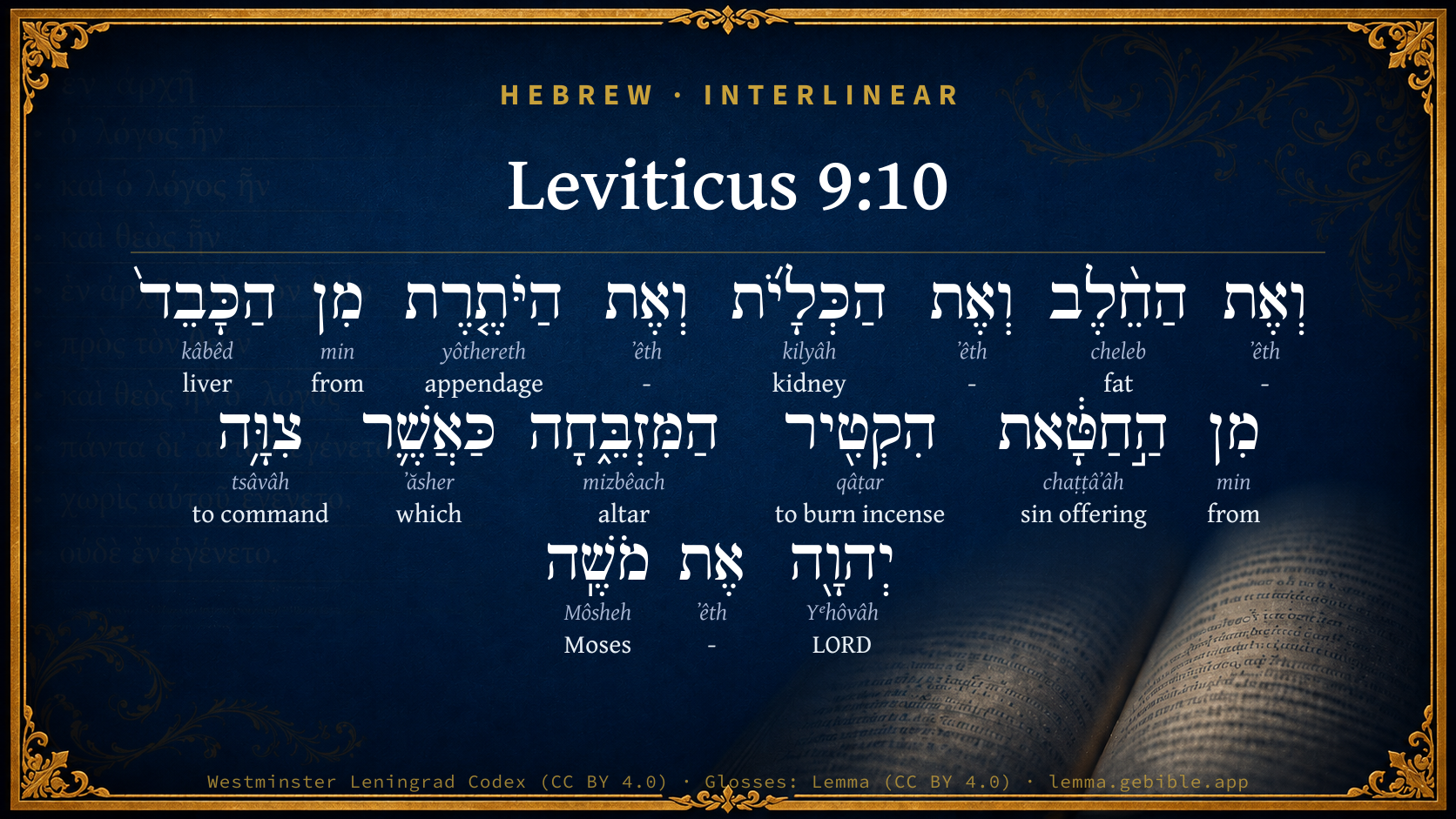
  1. וְאֶת ʼêth H853 “and · -” Conjunction + Particle, Direct Object
  2. הַחֵ֨לֶב cheleb H2459 “the · fat” Particle, Definite Article + Noun, Common, Masculine, Singular, Absolute
  3. וְאֶת ʼêth H853 “and · -” Conjunction + Particle, Direct Object
  4. הַכְּלָיֹ֜ת kilyâh H3629 “the · kidneys” Particle, Definite Article + Noun, Common, Feminine, Plural, Absolute
  5. וְאֶת ʼêth H853 “and · -” Conjunction + Particle, Direct Object
  6. מִן min H4480 “from” Preposition
  7. הַכָּבֵד֙ kâbêd H3516 “the · liver” Particle, Definite Article + Noun, Common, Feminine, Singular, Absolute
  8. מִן min H4480 “from” Preposition
  9. הַ֣חַטָּ֔את chaṭṭâʼâh H2403 “the · sin offering” Particle, Definite Article + Noun, Common, Feminine, Singular, Absolute
  10. הִקְטִ֖יר qâṭar H6999 “to burn incense” Verb, Hiphil, Perfect, 3rd Person, Masculine, Singular
  11. הַמִּזְבֵּ֑חָה mizbêach H4196 “the · altar · toward” Particle, Definite Article + Noun, Common, Masculine, Singular, Absolute + Suffix, Demonstrative
  12. כַּאֲשֶׁ֛ר ʼăsher H834 “like/as · which” Preposition + Particle, Relative
  13. צִוָּ֥ה tsâvâh H6680 “to command” Verb, Piel, Perfect, 3rd Person, Masculine, Singular
  14. יְהוָ֖ה Yᵉhôvâh H3068 “LORD” Noun, Proper
  15. אֶת ʼêth H853 “-” Particle, Direct Object
  16. מֹשֶֽׁה Môsheh H4872 “Moses” Noun, Proper

About this verse

These counts appear in no published source. They are computed here, from the morphology-tagged text and Lemma’s own curated glosses. What Lemma adds →

17
words
13
distinct lemmas
Pentateuch
section

Notable vocabulary

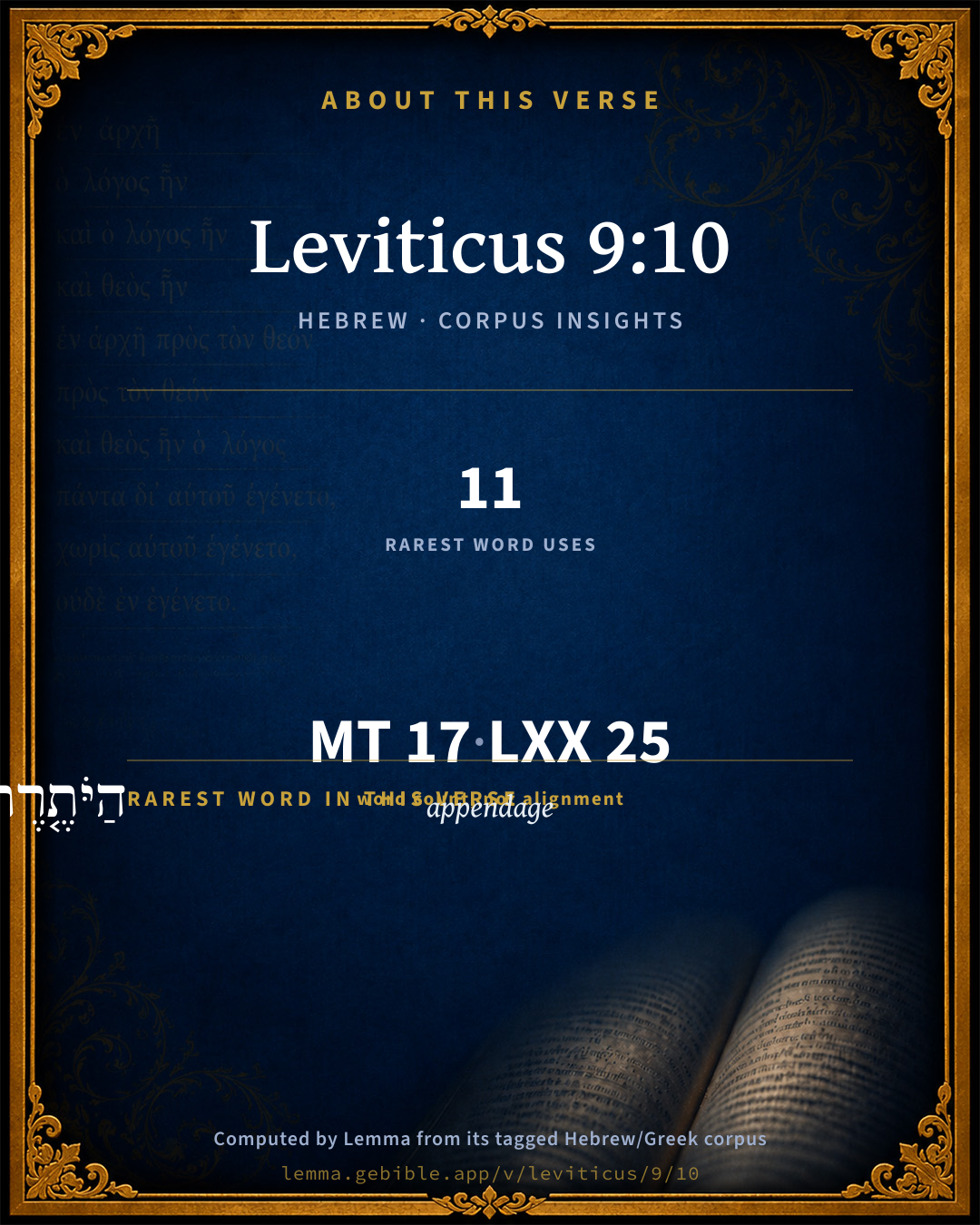
The rarest word here is הַיֹּתֶ֤רֶת appendage H3508 — appearing just 11 times in the whole Hebrew Bible.

Shared distinctive vocabulary

הַיֹּתֶ֤רֶת appendage H3508 occurs in 11 verses of the Hebrew Bible. Also found in:

Grammatical profile

  • 2 verbs
  • 8 nouns
  • 2 prepositions
  • 5 particles

Verb forms

  • הִקְטִ֖יר Hiphil · Perfect
  • צִוָּ֥ה Piel · Perfect

Repetition

A word recurs within this verse — often emphatic in Hebrew:

Hebrew & Septuagint length

In English translation the verse runs 25 words from the Hebrew and 27 from the Septuagint (LXX English) — closely comparable.

A rough comparison of the two English renderings, which tokenize alike — not a word-level alignment.

Word counts can differ between the Hebrew and the Greek without any difference in meaning — e.g. the Hebrew direct-object marker אֵת has no separate Greek word, and Greek often adds the article ὁ.

In the original languages it is 17 Hebrew tokens and 25 Greek tokens — but the two are counted differently (Hebrew bundles its prefixes and suffixes into one token; the Greek is in lemma form), so that isn’t a like-for-like length.

Cross-references

10

Topical passages linked to Leviticus 9:10 in the Treasury of Scripture Knowledge — connected by theme and wording, ordered by reader-vote popularity; previews shown in the World English Bible.

  • Leviticus 3:3–5 He shall offer of the sacrifice of peace offerings an offering made by fire to Yahweh; the fat that covers the innards, and all the fat that is on the innards,
  • Leviticus 3:9–11 He shall offer from the sacrifice of peace offerings an offering made by fire to Yahweh; its fat, the entire tail fat, he shall take away close to the backbone; and the fat that covers the inwards, and all the fat that is on the inwards,
  • Leviticus 4:8–12 He shall take all the fat of the bull of the sin offering off of it; the fat that covers the innards, and all the fat that is on the innards,
  • Leviticus 4:34–35 The priest shall take some of the blood of the sin offering with his finger, and put it on the horns of the altar of burnt offering; and all the rest of its blood he shall pour out at the base of the altar.
  • Leviticus 8:16–17 He took all the fat that was on the innards, and the cover of the liver, and the two kidneys, and their fat; and Moses burned it on the altar.
  • Psalms 51:17 The sacrifices of God are a broken spirit. A broken and contrite heart, O God, you will not despise.
  • Proverbs 23:26 My son, give me your heart; And let your eyes keep in my ways.
  • Isaiah 53:10 Yet it pleased Yahweh to bruise him; he has put him to grief: when you shall make his soul an offering for sin, he shall see [his] seed, he shall prolong his days, and the pleasure of Yahweh shall prosper in his hand.
  • Isaiah 57:15 For thus says the high and lofty One who inhabits eternity, whose name is Holy: I dwell in the high and holy place, with him also who is of a contrite and humble spirit, to revive the spirit of the humble, and to revive the heart of the contrite.
  • Isaiah 66:2 For all these things has my hand made, and [so] all these things came to be, says Yahweh: but to this man will I look, even to him who is poor and of a contrite spirit, and who trembles at my word.

Cross-references courtesy of OpenBible.info (CC BY 4.0).

Hebrew and Greek witnesses Masoretic Hebrew ↔ Greek Septuagint

The same verse in the two great witnesses to the Old Testament, shown verse-for-verse.

These are two independent witnesses, not word-aligned to each other, and the Septuagint is shown in lemma (dictionary) form.

Hebrew Leviticus 9:10 Masoretic · Westminster Leningrad Codex

וְאֶת הַחֵ֨לֶב וְאֶת הַכְּלָיֹ֜ת וְאֶת הַיֹּתֶ֤רֶת מִן הַכָּבֵד֙ מִן הַ֣חַטָּ֔את הִקְטִ֖יר הַמִּזְבֵּ֑חָה כַּאֲשֶׁ֛ר צִוָּ֥ה יְהוָ֖ה אֶת מֹשֶֽׁה

but the fat, and the kidneys, and the cover from the liver of the sin offering, he burned upon the altar; as Yahweh commanded Moses.

World English Bible · Public Domain

Greek LXX Leviticus 9:10 Septuagint · lemma form

καί ὁ στέαρ καί ὁ νεφρός καί ὁ λοβός ὁ ἧπαρ ὁ περί ὁ ἁμαρτία ἀναφέρω ἐπί ὁ θυσιαστήριον ὅς τρόπος ἐντέλλομαι κύριος ὁ μωυσῆς

And he offered up on the altar the fat and the kidneys and the lobe of the liver of the sin-offering, according as the Lord commanded Moses.

LXX2012 (modern English Septuagint) · Public Domain

On this verse, John Gill's Exposition discusses the Septuagint’s reading. Read the note in Commentary ↓

Hebrew: Westminster Leningrad Codex (CC BY 4.0). Greek: Septuagint (public domain); English from LXX2012 (modern English Septuagint) (Public Domain). How the Septuagint differs from the Hebrew →

Targum (Aramaic paraphrase)

2

The Targum is the ancient Jewish Aramaic paraphrase of the Hebrew Scriptures — an interpretive translation, not the Hebrew text itself. Onkelos (literal) and Pseudo-Jonathan (expansive) render the Torah, and Jonathan the Prophets. Coverage is partial: where no permissively-licensed English translation exists for a verse, only the Aramaic is shown. This is verse-level text, not a word-by-word alignment to the Hebrew.

  1. Targum Onkelos Torah (Genesis–Deuteronomy)
    וְיָת תַּרְבָּא וְיָת כָּלְיֵתָא וְיָת חִצְרָא מִן כַּבְדָא מִן חַטָאתָא אַסֵק לְמַדְבְּחָא כְּמָא דִי פַקִיד יְיָ יָת מֹשֶׁה

    (no public-domain English translation for this verse)

    Targum Onkelos — Aramaic: “Onkelos Genesis” (public domain); “Onkelos Exodus” (public domain); “Onkelos Leviticus” (public domain); “Onkelos Numbers” (public domain); “Onkelos Deuteronomy” (public domain). English: “Sefaria Community Translation” (CC0 1.0 (public-domain dedication)); “J.W. Etheridge. The Targums of Onkelos and Jonathan Ben Uzziel on the Pentateuch. London: Longmans, Green, 1862” (public domain). Text via Sefaria.

  2. Targum Pseudo-Jonathan Torah (Genesis–Deuteronomy)
    וְיַת תְּרֵיב וְיַת כּוֹלְיַין וְיַת חַצְרָא מִן כַּבְדָא מִן חַטָאתָא אַסִיק לְמַדְבְּחָא הֵי כְּמָא דְפַקֵד יְיָ יַת משֶׁה

    And the fat, and the kidneys, with the caul of the liver of the sin offering, he burned at the altar, as the Lord had commanded Mosheh.

    Targum Pseudo-Jonathan — Aramaic: “Targum Jonathan on Genesis” (public domain); “Targum Jonathan on Exodus” (public domain); “Targum Jonathan on Leviticus” (public domain); “Targum Jonathan on Numbers” (public domain); “Targum Jonathan on Deuteronomy” (public domain). English: “The Targum of Jonathan ben Uzziel, trans. J. W. Etheridge, London, 1862” (public domain). Text via Sefaria.

Commentary

Notes on Leviticus 9:10 from classic Christian and Jewish commentators (each source and its license shown beneath its notes). The classic Christian expositions comment on the surrounding passage and are grouped to its opening verse, so a note may address several verses; the Jewish commentaries on the Tanakh (Rashi and others) are per-verse, so they appear only where the commentator wrote on this verse.

Lemma curates 59 commentaries, every one of them public domain or Creative Commons licensed, each selected and text-cleaned for this edition rather than reprinted as found. About our sources →

Joseph Benson's Commentary

Lev 9:10. He burned it — By ordinary fire, which was used until the fire came down from heaven, (Lev 9:24,) though afterward it was forbidden. And if it had not been allowed otherwise, yet this being done by Aaron at the command of Moses, and consequently with God’s approbation, it was unquestionably lawful.

Joseph Benson's Commentary on the Old and New Testaments (1811–1818) — public domain. Text from a community e-Sword module.

Geneva Bible (1599)

Geneva Bible translators

That is, he laid them in order, and so they were burnt when the Lord sent down fire.

Geneva Bible (1599) marginal notes — public domain. Text via Bolls.life.

Ellicott's Commentary for English Readers

(10) But the fat . . . he burnt upon the altar.—The fat portions of this sin offering Aaron was still to burn upon the altar as Moses had done before (see Lev_8:14; Lev_8:21; Lev_8:28), since the miraculous fire from God did not issue forth till the burnt offering of the people was offered. (See Lev_9:24)

A Bible Commentary for English Readers, edited by Charles John Ellicott (1878–1897) — public domain. Text from a community e-Sword module.

John Gill's Exposition

But the fat, and the kidneys, and the caul above the liver of the sin offering, he burnt upon the altar,.... The Septuagint version is, "he offered them":

as the Lord commanded Moses; see Lev 4:8.

John Gill's Exposition of the Whole Bible (1746–1763) — public domain (CC PDM 1.0). Text via the HelloAO Bible API.

Haydock's Catholic Bible Commentary

Burnt, or placed in order to be burnt by the fire sent by God, ver. 24. (Menochius)

George Leo Haydock (1774–1849), Haydock's Catholic Family Bible and Commentary, 1859 edition — public domain. Excludes Psalms (Douay-Rheims chapter numbering differs from Protestant) and Deuterocanonical books (Catholic canon only).

Matthew Poole's English Annotations

Either,

1. Disposed it for the burning, i.e. laid it upon the altar where it was to be burnt by the heavenly fire, Lev 9:24. Thus interpreters generally understand the word here, as also Lev 9:13,17,20, by an anticipation; or the consequent is put for the antecedent, of which there are examples in Scripture. Or,

2. Properly burnt by ordinary fire, which was used and allowed until the fire came down from heaven, Lev 9:24, though afterwards it was forbidden. And if it had not been allowed otherwise, yet this being done by Aaron at the command of Moses, and consequently with God’s approbation, it was unquestionably lawful. And therefore there seems to be no necessity of departing from the proper sense of the word. Add to this, that there is nothing said to be consumed by that heavenly fire, but the burnt-offering with the fat belonging to it, namely, that burnt-offering mentioned Lev 9:16, which therefore is not there said to be burnt, as it is said of the other burnt-offering, Lev 9:13, and of the rest of the sacrifices in their places.

Matthew Poole's English Annotations on the Holy Bible (1683–1685) — public domain. Text from a community e-Sword/MySword module.

Whedon's Commentary on the Bible

Daniel D. Whedon

10. The fat — Suet. See notes on Lev_3:3; Lev_3:17.

Kidneys… caul — Lev_3:4, note.

Daniel D. Whedon (gen. ed.), Commentary on the Old and New Testaments (1874–1909) — public domain. Text from a community e-Sword module.

John Wesley's Explanatory Notes

He burnt it - By ordinary fire, which was used until the fire came down from heaven, ver. 24, though afterwards it was forbidden. And if it had not been allowed otherwise, yet this being done by Aaron at the command of Moses, and consequently with God's approbation, it was unquestionably lawful. Add to this, that there is nothing said to be consumed by that heavenly fire, but the burnt-offering with the fat belonging to it, namely, that burnt- offering mentioned ver. 16, which therefore is not there said to be burnt, as it is said of the other burnt-offering, ver. 13, and of the rest of the sacrifices in their places.

John Wesley, Explanatory Notes Upon the Whole Bible (1754–1765) — public domain. Text via the GEBible commentary corpus.

unfoldingWord translationNotes

Door43 World Missions Community

he burned

"Aaron burned"

kidneys ... liver

See how you translated these words in Leviticus 3:4.

the hide

This is the coat or skin of a herd animal. See how you translated this in Leviticus 7:8.

translationWords

altar

sin offering

Yahweh

command

Moses

unfoldingWord translationNotes — © Distant Shores Media and the Door43 World Missions Community, licensed CC BY-SA 4.0. Source: git.door43.org/Door43/en_tn.

Lesson kit

Teaching starters — assembled from the data on this page, not authored interpretation. Every prompt links to the verse data it draws on. Edit before teaching.

Leviticus, in the Pentateuch, opens this verse with 17 words (13 distinct Hebrew lemmas). Its most distinctive word is yôthereth (“appendage”). A historical commentator’s framing appears above. Read the whole chapter for the surrounding context.

Discussion questions

  1. What does “appendage” (yôthereth) contribute to the verse as a whole?
  2. Exodus 29:13 shares the word «appendage» with this verse. How do the two illuminate each other?
  3. “from” occurs 2× in this one verse. What is the effect of the repetition?
  4. These translations render this verse differently; the difference is in the English rendering, not the original. What questions does that raise?
  5. The verb «הִקְטִ֖יר» is Hiphil Perfect. How does its form color the action?
  6. Reading how Joseph Benson's Commentary and Geneva Bible (1599) read this verse, where do the two commentators agree and where do they part?

Things to notice

Reading settings

Reading text

Shown beneath each verse's original-language words.

Old Testament
Old Testament edition

Read the OT as the Masoretic Hebrew (MT) or the Greek Septuagint (LXX).

English shown for the Greek Septuagint (in the Hebrew ↔ Greek comparison).

Comparing translations? Open the Compare panel on any verse page to stack up to four side by side.