
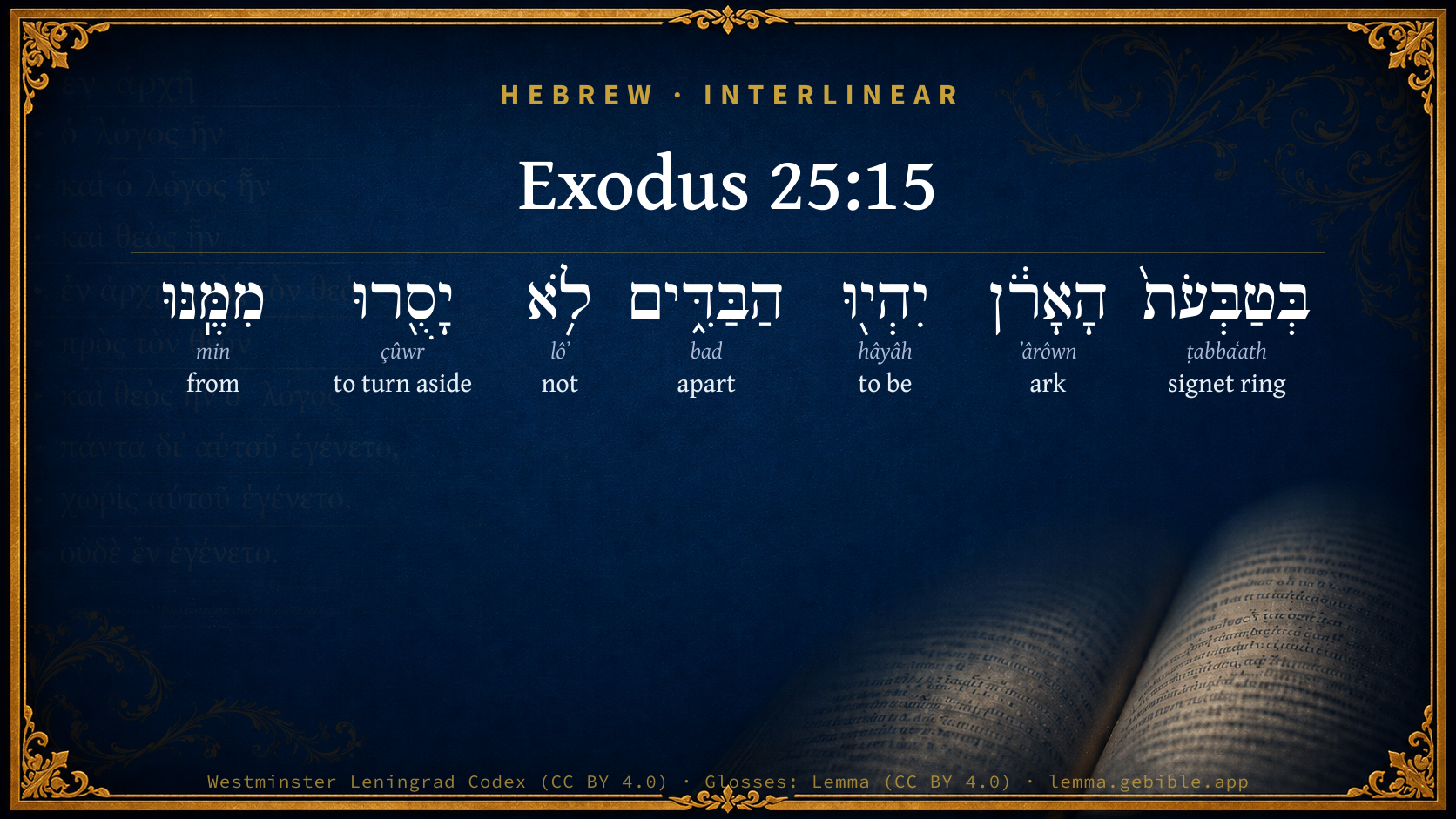
Exodus 25:15

Hebrew (Westminster Leningrad Codex) Exodus 25:15 appears in the Hebrew Old Testament. The text above is from the Westminster Leningrad Codex. Each word links to its Strong’s number, a concise gloss, and parsing drawn from the Open Scriptures Hebrew Bible morphology. Click any word for its full Brown-Driver-Briggs (BDB) entry.
Download image
Cite this verse

Exodus 25:15 (World English Bible). Public Domain. Lemma interlinear Bible study tool, https://lemma.gebible.app/v/exodus/25/15.

Show BibTeX & RIS
BibTeX
RIS
English Translation
The poles shall be in the rings of the ark. They shall not be taken from it.
World English Bible · Public Domain
Download a study sheet

One document with this verse’s original text, its word-by-word gloss line, the meaning frame, cross-references with their text, attributed commentary, and full source and license credits — printable, and it pastes into notes with its structure intact.

This verse Autodidact and up

Study sheet (.html) Plain text (.txt)

A passage Seminary Student

Up to 50 verses in one chapter. A passage sheet keeps up to 6 commentary sources and 12 cross-references per verse, in the order this page ranks them, and says so on the sheet whenever that leaves anything out. Ask for a single verse and you get the Autodidact verse sheet above.

Everything on this page stays free to read, with no account — the sheet is a download of what is already on screen, not access to it.

Want to remove ads? Support Godless Engineer
Compare translations 3

The same verse in 3 English versions, stacked beneath the original-language interlinear above. Click any original word for its lexicon entry.

Each is an independent rendering of the whole verse — the interlinear is not word-aligned to these translations.

Highlighted words mark where these versions differ — a whole-verse word diff, not a word-by-word alignment.

  • World English Bible Public Domain
    The poles shall be in the rings of the ark. They shall not be taken from it.
  • King James Version Public Domain
    The staves shall be in the rings of the ark: they shall not be taken from it.
  • unfoldingWord Literal Text CC BY-SA 4.0
    The poles shall be in the rings of the box; they shall not be removed from it.

unfoldingWord Literal Text — © unfoldingWord, licensed CC BY-SA 4.0. Word-aligned USFM3 via Door43 (git.door43.org/unfoldingWord/en_ult).

Versions to compare (up to 4)

3 of 4 selected

Show all 18 translations

Every available English version of this verse, each an independent rendering of the whole verse.

  • World English Bible Public Domain
    The poles shall be in the rings of the ark. They shall not be taken from it.
  • Berean Standard Bible Public Domain
    The poles are to remain in the rings of the ark; they must not be removed.
  • Majority Standard Bible Public Domain
    The poles are to remain in the rings of the ark; they must not be removed.
  • King James Version Public Domain
    The staves shall be in the rings of the ark: they shall not be taken from it.
  • American Standard Version (1901) Public Domain
    The staves shall be in the rings of the ark: they shall not be taken from it.
  • Revised Version (1885) Public Domain
    The staves shall be in the rings of the ark: they shall not be taken from it.
  • Geneva Bible (1599) Public Domain
    The barres shalbe in the rings of the Arke: they shall not be taken away from it.
  • Douay-Rheims (1899) Public Domain
    And they shall be always in the rings, neither shall they at any time be drawn out of them.
  • Young's Literal Translation Public Domain
    in the rings of the ark are the staves, they are not turned aside from it;
  • Literal Standard Version CC BY-SA 4.0
    the poles are in the rings of the Ark, they are not turned aside from it;
  • Unlocked Literal Bible CC BY-SA 4.0
    The poles must remain in the rings of the ark; they must not be taken from it.
  • unfoldingWord Literal Text CC BY-SA 4.0
    The poles shall be in the rings of the box; they shall not be removed from it.
  • Darby Bible Public Domain
    The staves shall be in the rings of the ark: they shall not come out from it.
  • World Messianic Bible Public Domain
    The poles shall be in the rings of the ark. They shall not be taken from it.
  • Webster's Bible Public Domain
    The staffs shall be in the rings of the ark: they shall not be taken from it.
  • Free Bible Version CC BY-SA 4.0
    The poles are to stay in the rings of the Ark; don't take them out.
  • Bible in Basic English Public Domain
    The rods are to be kept in the rings, and never taken out.
  • JPS Tanakh (1917) Public Domain
    The staves shall be in the rings of the ark; they shall not be taken from it.

Literal Standard Version (2020), Covenant Press — licensed CC BY-SA 4.0. Text via the HelloAO Bible API (eBible.org). Unlocked Literal Bible (unfoldingWord) — licensed CC BY-SA 4.0. Text via the HelloAO Bible API (eBible.org). unfoldingWord Literal Text — © unfoldingWord, licensed CC BY-SA 4.0. Word-aligned USFM3 via Door43 (git.door43.org/unfoldingWord/en_ult). Free Bible Version, Dr. Jonathan Gallagher — licensed CC BY-SA 4.0. Text via the HelloAO Bible API (eBible.org).

Word by word

More ways to search: Search by grammar → Find every occurrence → Compare this word →

Practice this passage: Drill this verse → Learn its vocabulary →

About this verse

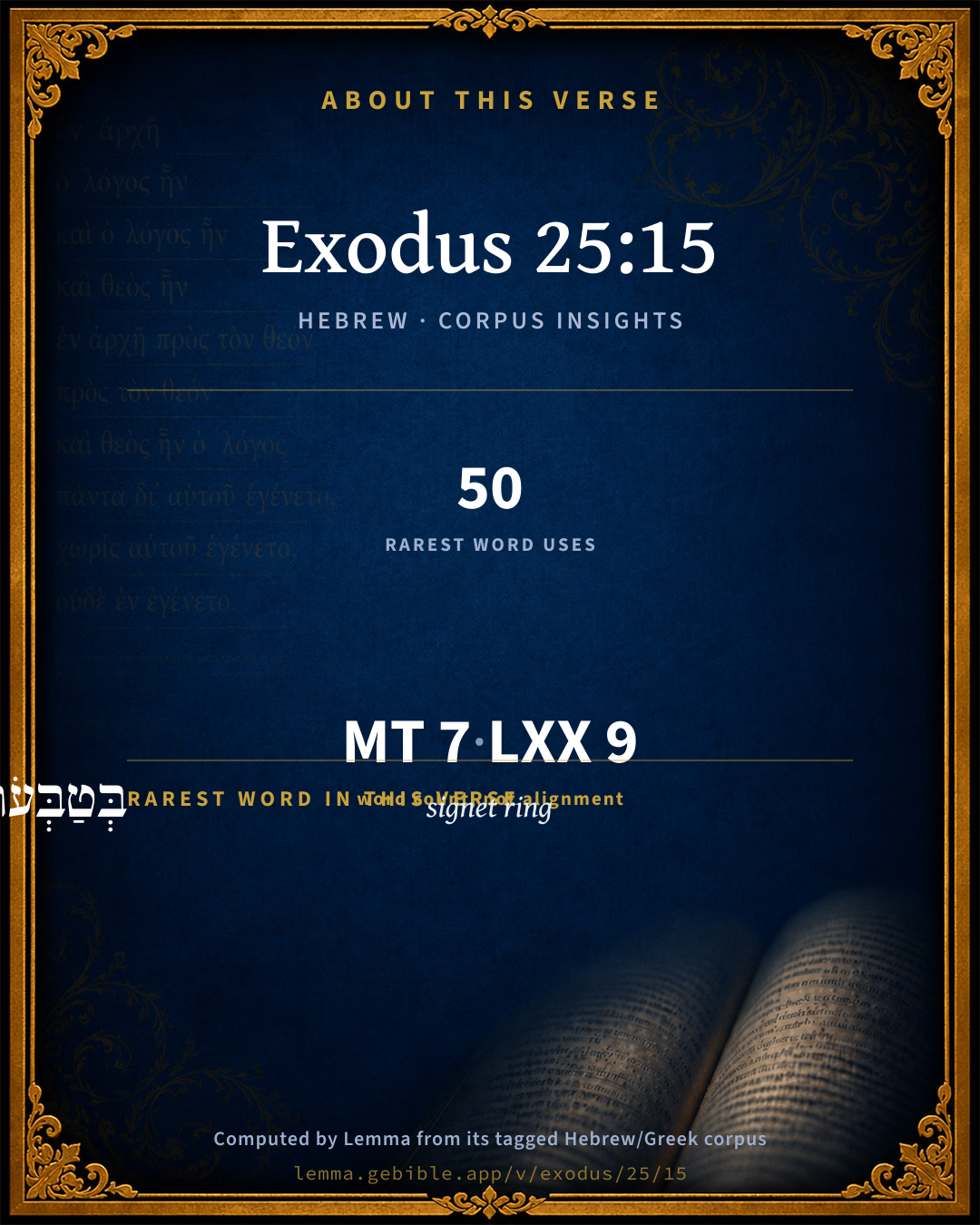
These counts appear in no published source. They are computed here, from the morphology-tagged text and Lemma’s own curated glosses. What Lemma adds →

7
words
7
distinct lemmas
Pentateuch
section

Shared distinctive vocabulary

בְּטַבְּעֹת֙ signet ring H2885 occurs in 38 verses of the Hebrew Bible. Also found in:

Grammatical profile

  • 2 verbs
  • 3 nouns
  • 1 preposition
  • 1 particle

Verb forms

  • יִהְי֖וּ Qal · Imperfect
  • יָסֻ֖רוּ Qal · Imperfect

Hebrew & Septuagint length

In English translation the verse runs 17 words from the Hebrew and 11 from the Septuagint (LXX English) — the Septuagint runs noticeably shorter here. See the side-by-side →

A rough comparison of the two English renderings, which tokenize alike — not a word-level alignment.

Word counts can differ between the Hebrew and the Greek without any difference in meaning — e.g. the Hebrew direct-object marker אֵת has no separate Greek word, and Greek often adds the article ὁ.

In the original languages it is 7 Hebrew tokens and 9 Greek tokens — but the two are counted differently (Hebrew bundles its prefixes and suffixes into one token; the Greek is in lemma form), so that isn’t a like-for-like length.

Cross-references

2

Topical passages linked to Exodus 25:15 in the Treasury of Scripture Knowledge — connected by theme and wording, ordered by reader-vote popularity; previews shown in the World English Bible.

  • 1 Kings 8:8 The poles were so long that the ends of the poles were seen from the holy place before the oracle; but they were not seen outside: and there they are to this day.
  • 2 Chronicles 5:9 The poles were so long that the ends of the poles were seen from the ark before the oracle; but they were not seen outside: and there it is to this day.

Cross-references courtesy of OpenBible.info (CC BY 4.0).

Hebrew and Greek witnesses Masoretic Hebrew ↔ Greek Septuagint

The same verse in the two great witnesses to the Old Testament, shown verse-for-verse.

Here the Septuagint runs noticeably shorter than the Hebrew — LXX2012 (modern English Septuagint) 11 words vs World English Bible 17. A rough length comparison of the two English translations, not a word-level alignment — read both below.

These are two independent witnesses, not word-aligned to each other, and the Septuagint is shown in lemma (dictionary) form.

Hebrew Exodus 25:15 Masoretic · Westminster Leningrad Codex

בְּטַבְּעֹת֙ הָאָרֹ֔ן יִהְי֖וּ הַבַּדִּ֑ים לֹ֥א יָסֻ֖רוּ מִמֶּֽנּוּ

The poles shall be in the rings of the ark. They shall not be taken from it.

World English Bible · Public Domain

Greek LXX Exodus 25:15 Septuagint · lemma form

ἐν ὁ δακτύλιος ὁ κιβωτός εἰμί ὁ ἀναφορεύς ἀκίνητος

The staves shall remain fixed in the rings of the ark.

LXX2012 (modern English Septuagint) · Public Domain

On this verse, John Gill's Exposition discusses the Septuagint’s reading. Read the note in Commentary ↓

Hebrew: Westminster Leningrad Codex (CC BY 4.0). Greek: Septuagint (public domain); English from LXX2012 (modern English Septuagint) (Public Domain). How the Septuagint differs from the Hebrew →

Targum (Aramaic paraphrase)

2

The Targum is the ancient Jewish Aramaic paraphrase of the Hebrew Scriptures — an interpretive translation, not the Hebrew text itself. Onkelos (literal) and Pseudo-Jonathan (expansive) render the Torah, and Jonathan the Prophets. Coverage is partial: where no permissively-licensed English translation exists for a verse, only the Aramaic is shown. This is verse-level text, not a word-by-word alignment to the Hebrew.

  1. Targum Onkelos Torah (Genesis–Deuteronomy)
    בְּעִזְקְתָא דַאֲרוֹנָא יְהוֹן אֲרִיחַיָא לָא יְעִדוּן מִנֵהּ:

    (no public-domain English translation for this verse)

    Targum Onkelos — Aramaic: “Onkelos Genesis” (public domain); “Onkelos Exodus” (public domain); “Onkelos Leviticus” (public domain); “Onkelos Numbers” (public domain); “Onkelos Deuteronomy” (public domain). English: “Sefaria Community Translation” (CC0 1.0 (public-domain dedication)); “J.W. Etheridge. The Targums of Onkelos and Jonathan Ben Uzziel on the Pentateuch. London: Longmans, Green, 1862” (public domain). Text via Sefaria.

  2. Targum Pseudo-Jonathan Torah (Genesis–Deuteronomy)
    בְּעִיזְקָתָא דַאֲרוֹנָא יְהוֹן מַחְתָן אֲרִיחַיָא לָא יַעֲדוּן מִנֵּיהּ

    The staves shall be inlaid in the rings of the ark, and not be removed from it.

    Targum Pseudo-Jonathan — Aramaic: “Targum Jonathan on Genesis” (public domain); “Targum Jonathan on Exodus” (public domain); “Targum Jonathan on Leviticus” (public domain); “Targum Jonathan on Numbers” (public domain); “Targum Jonathan on Deuteronomy” (public domain). English: “The Targum of Jonathan ben Uzziel, trans. J. W. Etheridge, London, 1862” (public domain). Text via Sefaria.

Commentary

Notes on Exodus 25:15 from classic Christian and Jewish commentators (each source and its license shown beneath its notes). The classic Christian expositions comment on the surrounding passage and are grouped to its opening verse, so a note may address several verses; the Jewish commentaries on the Tanakh (Rashi and others) are per-verse, so they appear only where the commentator wrote on this verse.

Lemma curates 59 commentaries, every one of them public domain or Creative Commons licensed, each selected and text-cleaned for this edition rather than reprinted as found. About our sources →

Trapp's Complete Commentary

John Trapp

Exo 25:15 The staves shall be in the rings of the ark: they shall not be taken from it.

Ver. 15. The staves shall be, &c.] That they might not touch it; for reverence’ sake, it being a visible sign of God himself among them.

John Trapp, A Commentary or Exposition upon All the Books of the Old and New Testament (1647–1656) — public domain. Text from a community e-Sword module.

Jamieson, Fausset & Brown

Robert Jamieson, A. R. Fausset & David Brown

staves shall be in the rings of the ark--that is, always remain in the rings, whether the ark be at rest or in motion.

Jamieson, Fausset & Brown — Commentary Critical and Explanatory on the Whole Bible (1871) — public domain (CC PDM 1.0). Text via the HelloAO Bible API.

Adam Clarke's Commentary

Verse 15. The staves - shall not be taken from it.] Because it should ever be considered as in readiness to be removed, God not having told them at what hour he should command them to strike their tents. If the staves were never to be taken out, how can it be said, as in Nu 4:6, that when the camp should set forward, they should put in the staves thereof, which intimates that when they encamped, they took out the staves, which appears to be contrary to what is here said? To reconcile these two places, it has been supposed, with great show of probability, that besides the staves which passed through the rings of the ark, and by which it was carried, there were two other staves or poles in the form of a bier or handbarrow, on which the ark was laid in order to be transported in their journeyings, when it and its own staves, still in their rings, had been wrapped up in the covering of what is called badgers' skins and blue cloth. The staves of the ark itself, which might be considered as its handles simply to lift it by, were never taken out of their rings; but the staves or poles which served as a bier were taken from under it when they encamped.

Adam Clarke's Commentary on the Bible (1810–1826) — public domain. Text from a community e-Sword/MySword module.

Ellicott's Commentary for English Readers

(15) The staves . . . Shall not be taken from it.—The staves were to remain always in the rings, whether the ark was in motion or at rest, that there might never at any time be a necessity for touching the ark itself, or even the rings. He who touched the ark imperilled his life. (See 2Sa_6:6-7.)

A Bible Commentary for English Readers, edited by Charles John Ellicott (1878–1897) — public domain. Text from a community e-Sword module.

John Gill's Exposition

And thou shall put into the ark the testimony that I shall give thee. Which was the principal use of it: by the "testimony" is meant the law, written on two tables of stone; so called, because it was a testification of the mind and will of God, what he would have done or omitted; and as the Israelites had declared their approbation of it, and assent unto it, and had promised obedience to it, therefore, should they transgress it, it would be a testimony against them: now this was put into the ark, and preserved there, see Deu 10:1, which may signify that the law was in the heart of Christ, and which he undertook to fulfil, and with pleasure did it; that he is become the fulfilling end of the law for righteousness to them that believe in him; and that it remains with him as a rule of walk and conversation to his people, so far as it is of a moral, holy, and spiritual nature.

, which may signify that the law was in the heart of Christ, and which he undertook to fulfil, and with pleasure did it; that he is become the fulfilling end of the law for righteousness to them that believe in him; and that it remains with him as a rule of walk and conversation to his people, so far as it is of a moral, holy, and spiritual nature.

Exodus 25:17

exo 25:17

exo 25:17

exo 25:17And thou shall make a mercy seat of pure gold,.... Or "covering" (n); so Jarchi and Aben Ezra; for so the word properly signifies; and what is meant was no more than a cover of the ark, which was open at the top, and this was the lid of it, and exactly answered to it, as appears by the dimensions afterwards given of it; and because the root of this word in one form signifies to propitiate or make atonement, some render it the "propitiatory" or "propitiation" (o); which is favoured by the apostle in Heb 9:5 and to which he seems to refer, Rom 3:25 and the rather since God is represented sitting on this, as showing himself propitious and well pleased with men, by his communing with them from hence; the Septuagint version takes in both senses, rendering it the "propitiatory covering" (p): this being called by what name it will, was typical of Christ; he is the seat of mercy, or, as it is in the New Testament expressed, the throne of grace; whereon, or in whom God shows himself to be gracious and merciful to the children of men; all the stores of mercy are in him, and all the vessels of mercy are put into his hands; the mercy of God is displayed in the mission of him as a Saviour, and is glorified by him in a way consistent with his justice and holiness; through him only special mercy is communicated to sinful men, to whom God is only merciful in Christ: and Christ himself is all mercy to his people; his ways of old were mercy and truth, and all his works, especially his great work of redemption, are done in mercy and pity to them; he shows himself to be merciful to them, by sympathizing with them, and supporting them under all their temptations and afflictions, in granting them all the necessary supplies of grace here, and by bestowing eternal life on them hereafter: he is their "covering", the covering of their persons by his righteousness, imputed to them, and of their sins, by his blood shed for them, and sprinkled on them, and of the law, by his satisfaction for the transgressions of it; whereby they are secured from the avenging justice of God, and wrath to come: and he is the "propitiation" or "propitiatory", who has made atonement and reconciliation for sin; and in and through whom God shows himself propitious to his people, he being pacified, his wrath appeased, and his justice satisfied by his obedience and sufferings: and this mercy seat, being of "pure gold", without any alloy or mixture in it, may denote the purity of Christ's obedience, righteousness, and sacrifice, in the completeness of salvation by him, without any works of righteousness of men; the worth and excellency of Christ, and of these blessings of his, and the preciousness of his blood, and the continued virtue and efficacy of it, and of his righteousness and sacrifice, by which the propitiation is made:

two cubits and a half shall be the length thereof, and a cubit and a half the breadth thereof: which are exactly the dimensions of the ark, to which this was a lid or cover, see Exo 25:10 in the mystical sense it intimates, that Christ, in his nature, obedience, sufferings, and death, is the end of the law for righteousness, which is entirely commensurate, and answers to all its demands: his holy nature is answerable to the holiness and spirituality of the law; his righteousness to all that obedience it requires, and his sufferings and death to the penalty of it; so that, through Christ, we have a righteousness to justify us before God, as long and as broad as the law is, though the commandment is exceeding broad, Psa 119:96. Aben Ezra observes, that there is no mention made of the thickness of the mercy seat; and the same Jarchi takes notice of, but adds, that, according to their Rabbins, it was an hand's breadth, and the Targum of Jonathan says,"and its thickness an hand's breadth.''

(n) "opertorium", Montanus; "tegmen sive operimentum", Vatablus; "operculum", Piscator. (o) "Propitiatorium", V. L. Pagninus, Munster, Tigurine version. (p) Sept. "operculum propitiatorium", Junius & Tremellius.

John Gill's Exposition of the Whole Bible (1746–1763) — public domain (CC PDM 1.0). Text via the HelloAO Bible API.

The Pulpit Commentary

The staves, when once inserted into the rings of the ark, were never to be taken from them. The object probably was that there might be no need of touching even the rings, when the ark was set down or taken up. The bearers took hold of the staves only, which were no part of the ark. On the danger of touching the ark itself, see 2Sa_6:6, 2Sa_6:7.

The Pulpit Commentary (1880–1919), ed. H.D.M. Spence-Jones & Joseph S. Exell — public domain. Text from a community e-Sword module.

unfoldingWord translationNotes

Door43 World Missions Community

General Information:

Yahweh continues to tell Moses what the people must do.

atonement lid

This is the lid that sits on top of the ark where the atonement offering was made.

two and a half cubits ... a cubit and a half

A cubit is 46 centimeters. AT: "2.5 cubits ... 1.5 cubits" or "115 centimeters ... 69 centimeters" (See: Biblical Distance and Fractions)

hammered gold

"beaten gold"

translationWords

ark of the covenant

atonement lid

gold

cherub

unfoldingWord translationNotes — © Distant Shores Media and the Door43 World Missions Community, licensed CC BY-SA 4.0. Source: git.door43.org/Door43/en_tn.

Rashi

Rabbi Shlomo Yitzchaki (Rashi)

לא יסרו ממנו THEY SHALL NOT DEPART THEREFROM for ever (cf. Yoma 72a).

Rashi on the Tanakh — English translations: “The Judaica Press complete Tanach with Rashi, translated by A. J. Rosenberg” (CC BY 4.0); “Pentateuch with Rashi's commentary by M. Rosenbaum and A.M. Silbermann, 1929-1934” (public domain); “The Metsudah Tanach series, Lakewood, N.J” (CC BY 4.0); and “The Book of Joshua, Metsudah Publications, 1997” (CC BY 4.0). Text via Sefaria.

Lesson kit

Teaching starters — assembled from the data on this page, not authored interpretation. Every prompt links to the verse data it draws on. Edit before teaching.

Exodus, in the Pentateuch, opens this verse with 7 words (7 distinct Hebrew lemmas). Its most distinctive word is ṭabbaʻath (“signet ring”). The Greek Septuagint runs shorter here. A historical commentator’s framing appears above. Read the whole chapter for the surrounding context.

Discussion questions

  1. What does “signet ring” (ṭabbaʻath) contribute to the verse as a whole?
  2. How does Genesis 41:42, which shares the word «signet ring», read alongside this verse?
  3. The Septuagint runs shorter here than the Hebrew. What might account for the difference?
  4. These translations render this verse differently. What is at stake in choosing one wording over another?
  5. «יִהְי֖וּ» is a Qal Imperfect verb. How does that grammatical form shape the action described?
  6. Compare how Trapp's Complete Commentary and Jamieson, Fausset & Brown read this verse. Where do they agree or differ?

Things to notice

Reading settings

Reading text

Shown beneath each verse's original-language words.

Old Testament
Old Testament edition

Read the OT as the Masoretic Hebrew (MT) or the Greek Septuagint (LXX).

English shown for the Greek Septuagint (in the Hebrew ↔ Greek comparison).

Comparing translations? Open the Compare panel on any verse page to stack up to four side by side.