
Genesis 22:15

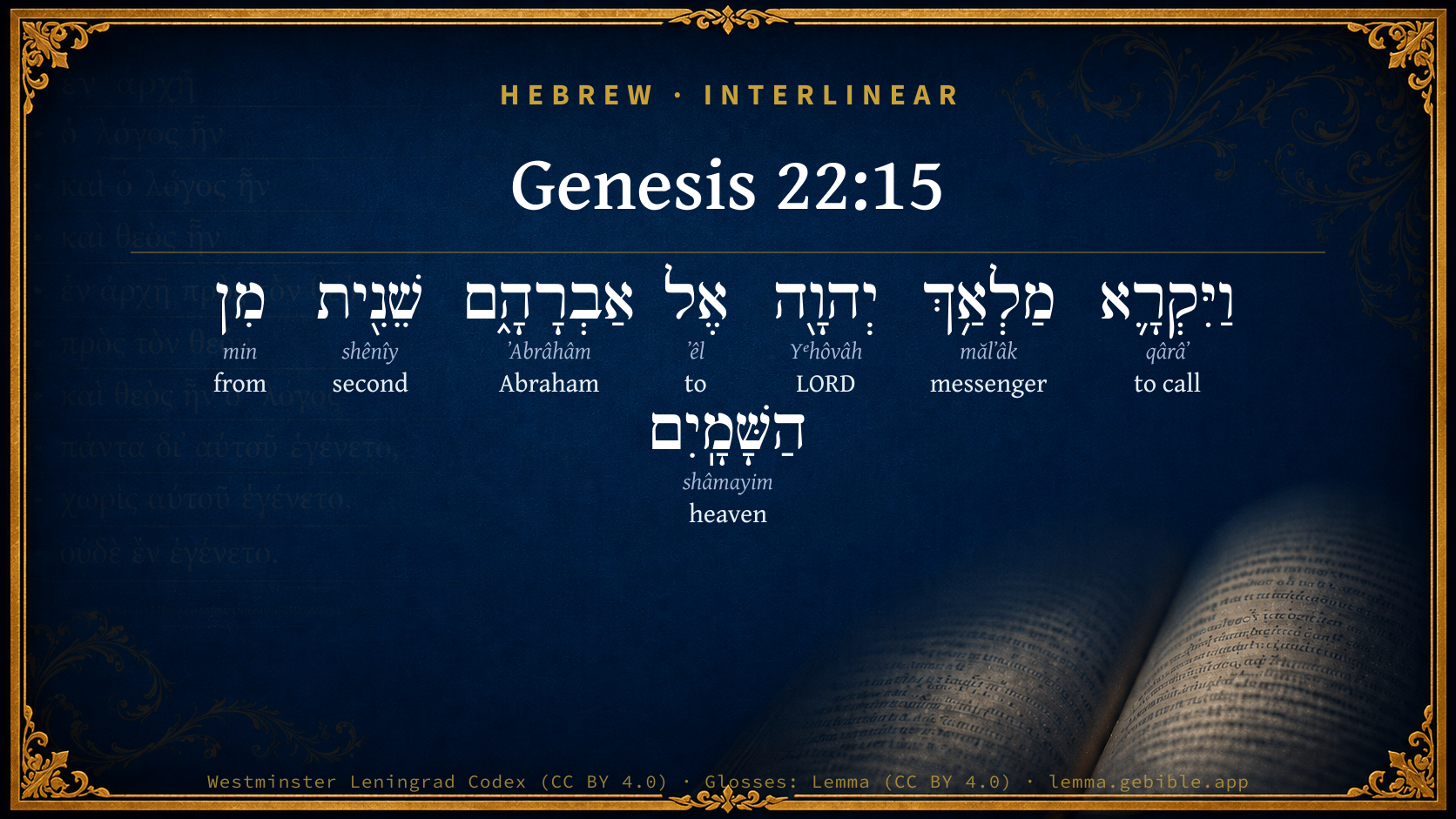
Hebrew (Westminster Leningrad Codex) Genesis 22:15 appears in the Hebrew Old Testament. The text above is from the Westminster Leningrad Codex. Each word links to its Strong’s number, a concise gloss, and parsing drawn from the Open Scriptures Hebrew Bible morphology. Click any word for its full Brown-Driver-Briggs (BDB) entry.
Download image
Cite this verse

Genesis 22:15 (World English Bible). Public Domain. Lemma interlinear Bible study tool, https://lemma.gebible.app/v/genesis/22/15.

Show BibTeX & RIS
BibTeX
RIS
English Translation
The angel of Yahweh called to Abraham a second time out of the sky,
World English Bible · Public Domain
Download a study sheet

One document with this verse’s original text, its word-by-word gloss line, the meaning frame, cross-references with their text, attributed commentary, and full source and license credits — printable, and it pastes into notes with its structure intact.

This verse Autodidact and up

Study sheet (.html) Plain text (.txt)

A passage Seminary Student

Up to 50 verses in one chapter. A passage sheet keeps up to 6 commentary sources and 12 cross-references per verse, in the order this page ranks them, and says so on the sheet whenever that leaves anything out. Ask for a single verse and you get the Autodidact verse sheet above.

Everything on this page stays free to read, with no account — the sheet is a download of what is already on screen, not access to it.

Want to remove ads? Support Godless Engineer
Compare translations 3

The same verse in 3 English versions, stacked beneath the original-language interlinear above. Click any original word for its lexicon entry.

Each is an independent rendering of the whole verse — the interlinear is not word-aligned to these translations.

Highlighted words mark where these versions differ — a whole-verse word diff, not a word-by-word alignment.

  • World English Bible Public Domain
    The angel of Yahweh called to Abraham a second time out of the sky,
  • King James Version Public Domain
    And the angel of the LORD called unto Abraham out of heaven the second time,
  • unfoldingWord Literal Text CC BY-SA 4.0
    Then the angel of Yahweh called to Abraham a second from heaven

unfoldingWord Literal Text — © unfoldingWord, licensed CC BY-SA 4.0. Word-aligned USFM3 via Door43 (git.door43.org/unfoldingWord/en_ult).

Versions to compare (up to 4)

3 of 4 selected

Show all 18 translations

Every available English version of this verse, each an independent rendering of the whole verse.

  • World English Bible Public Domain
    The angel of Yahweh called to Abraham a second time out of the sky,
  • Berean Standard Bible Public Domain
    And the angel of the LORD called to Abraham from heaven a second time,
  • Majority Standard Bible Public Domain
    And the angel of the LORD called to Abraham from heaven a second time,
  • King James Version Public Domain
    And the angel of the LORD called unto Abraham out of heaven the second time,
  • American Standard Version (1901) Public Domain
    And the angel of Jehovah called unto Abraham a second time out of heaven,
  • Revised Version (1885) Public Domain
    And the angel of the LORD called unto Abraham a second time out of heaven,
  • Geneva Bible (1599) Public Domain
    And the Angel of the Lord cryed vnto Abraham from heauen the second time,
  • Douay-Rheims (1899) Public Domain
    And the angel of the Lord called to Abraham a second time from heaven, saying:
  • Young's Literal Translation Public Domain
    And the messenger of Jehovah calleth unto Abraham a second time from the heavens,
  • Literal Standard Version CC BY-SA 4.0
    And the Messenger of YHWH calls to Abraham a second time from the heavens,
  • Unlocked Literal Bible CC BY-SA 4.0
    The angel of Yahweh called to Abraham a second time from heaven
  • unfoldingWord Literal Text CC BY-SA 4.0
    Then the angel of Yahweh called to Abraham a second from heaven
  • Darby Bible Public Domain
    And the Angel of Jehovah called to Abraham from the heavens a second time,
  • World Messianic Bible Public Domain
    The LORD’s angel called to Abraham a second time out of the sky,
  • Webster's Bible Public Domain
    And the angel of the LORD called to Abraham from heaven the second time,
  • Free Bible Version CC BY-SA 4.0
    The angel of the Lord shouted again to Abraham from heaven,
  • Bible in Basic English Public Domain
    And the voice of the angel of the Lord came to Abraham a second time from heaven,
  • JPS Tanakh (1917) Public Domain
    And the angel of the LORD called unto Abraham a second time out of heaven,

Literal Standard Version (2020), Covenant Press — licensed CC BY-SA 4.0. Text via the HelloAO Bible API (eBible.org). Unlocked Literal Bible (unfoldingWord) — licensed CC BY-SA 4.0. Text via the HelloAO Bible API (eBible.org). unfoldingWord Literal Text — © unfoldingWord, licensed CC BY-SA 4.0. Word-aligned USFM3 via Door43 (git.door43.org/unfoldingWord/en_ult). Free Bible Version, Dr. Jonathan Gallagher — licensed CC BY-SA 4.0. Text via the HelloAO Bible API (eBible.org).

Word by word

More ways to search: Search by grammar → Find every occurrence → Compare this word →

Practice this passage: Drill this verse → Learn its vocabulary →

About this verse

These counts appear in no published source. They are computed here, from the morphology-tagged text and Lemma’s own curated glosses. What Lemma adds →

8
words
8
distinct lemmas
Pentateuch
section

Grammatical profile

  • 1 verb
  • 4 nouns
  • 1 adjective
  • 2 prepositions

Verb forms

  • וַיִּקְרָ֛א Qal · Sequential Imperfect

Hebrew & Septuagint length

In English translation the verse runs 14 words from the Hebrew and 39 from the Septuagint (LXX English) — the Septuagint runs noticeably longer here. See the side-by-side →

A rough comparison of the two English renderings, which tokenize alike — not a word-level alignment.

Word counts can differ between the Hebrew and the Greek without any difference in meaning — e.g. the Hebrew direct-object marker אֵת has no separate Greek word, and Greek often adds the article ὁ.

In the original languages it is 8 Hebrew tokens and 10 Greek tokens — but the two are counted differently (Hebrew bundles its prefixes and suffixes into one token; the Greek is in lemma form), so that isn’t a like-for-like length.

Hebrew and Greek witnesses Masoretic Hebrew ↔ Greek Septuagint

The same verse in the two great witnesses to the Old Testament, shown verse-for-verse.

Here the Septuagint runs noticeably longer than the Hebrew — LXX2012 (modern English Septuagint) 39 words vs World English Bible 14. A rough length comparison of the two English translations, not a word-level alignment — read both below.

These are two independent witnesses, not word-aligned to each other, and the Septuagint is shown in lemma (dictionary) form.

Hebrew Genesis 22:15 Masoretic · Westminster Leningrad Codex

וַיִּקְרָ֛א מַלְאַ֥ךְ יְהוָ֖ה אֶל אַבְרָהָ֑ם שֵׁנִ֖ית מִן הַשָּׁמָֽיִם

The angel of Yahweh called to Abraham a second time out of the sky,

World English Bible · Public Domain

Greek LXX Genesis 22:15 Septuagint · lemma form

καί καλέω ἄγγελος κύριος ὁ αβρααμ δεύτερος ἐκ ὁ οὐρανός

And an angel of the Lord called Abraam the second time out of heaven, saying, I have sworn by myself, says the Lord, because you have done this thing, and on my account have not spared your beloved son,

LXX2012 (modern English Septuagint) · Public Domain

On this verse, The Pulpit Commentary discusses the Septuagint’s reading. Read the note in Commentary ↓

Hebrew: Westminster Leningrad Codex (CC BY 4.0). Greek: Septuagint (public domain); English from LXX2012 (modern English Septuagint) (Public Domain). How the Septuagint differs from the Hebrew →

Targum (Aramaic paraphrase)

2

The Targum is the ancient Jewish Aramaic paraphrase of the Hebrew Scriptures — an interpretive translation, not the Hebrew text itself. Onkelos (literal) and Pseudo-Jonathan (expansive) render the Torah, and Jonathan the Prophets. Coverage is partial: where no permissively-licensed English translation exists for a verse, only the Aramaic is shown. This is verse-level text, not a word-by-word alignment to the Hebrew.

  1. Targum Onkelos Torah (Genesis–Deuteronomy)
    וּקְרָא מַלְאָכָא דַּיְיָ לְאַבְרָהָם תִּנְיָנוּת מִן שְׁמַיָּא

    (no public-domain English translation for this verse)

    Targum Onkelos — Aramaic: “Onkelos Genesis” (public domain); “Onkelos Exodus” (public domain); “Onkelos Leviticus” (public domain); “Onkelos Numbers” (public domain); “Onkelos Deuteronomy” (public domain). English: “Sefaria Community Translation” (CC0 1.0 (public-domain dedication)); “J.W. Etheridge. The Targums of Onkelos and Jonathan Ben Uzziel on the Pentateuch. London: Longmans, Green, 1862” (public domain). Text via Sefaria.

  2. Targum Pseudo-Jonathan Torah (Genesis–Deuteronomy)
    וּקְרָא מַלְאָכָא דַיְיָ לְאַבְרָהָם תִּנְיָינוּת מִן שְׁמַיָא

    And the Angel of the Lord called to Abraham the second time from the heavens,

    Targum Pseudo-Jonathan — Aramaic: “Targum Jonathan on Genesis” (public domain); “Targum Jonathan on Exodus” (public domain); “Targum Jonathan on Leviticus” (public domain); “Targum Jonathan on Numbers” (public domain); “Targum Jonathan on Deuteronomy” (public domain). English: “The Targum of Jonathan ben Uzziel, trans. J. W. Etheridge, London, 1862” (public domain). Text via Sefaria.

Commentary

Notes on Genesis 22:15 from classic Christian and Jewish commentators (each source and its license shown beneath its notes). The classic Christian expositions comment on the surrounding passage and are grouped to its opening verse, so a note may address several verses; the Jewish commentaries on the Tanakh (Rashi and others) are per-verse, so they appear only where the commentator wrote on this verse.

Lemma curates 59 commentaries, every one of them public domain or Creative Commons licensed, each selected and text-cleaned for this edition rather than reprinted as found. About our sources →

The Cambridge Bible for Schools and Colleges

gen. ed. J. J. S. Perowne

15. Gen_22:15-18 are probably taken from another version of the same story. They are inferior in literary excellence, and probably represent a later amplification.

a second time] The renewal and ratification of the blessing to Abraham expresses the Divine recognition of the patriarch’s faith. The blessing, previously granted, is here renewed as a reward for obedience (Gen_22:18).

The Cambridge Bible for Schools and Colleges (gen. ed. J. J. S. Perowne; Cambridge University Press, 1878–1918) — public domain. Text from a community e-Sword module.

Trapp's Complete Commentary

John Trapp

Gen 22:15 And the angel of the LORD called unto Abraham out of heaven the second time,

Ver. 15. And the angel of the Lord.] Who stood, as a spectator and applauder of Abraham’s heroical faith and transcendent obedience. Spectant Dii magnos viros, cum calamitate colluctantes. Ecce spectaculum, ad quod respiciat operi suo intentus Deus , saith Seneca of Cato, {a} and other gallant Roman spirits. Jehovahjireh, in the precedent verse, signifies, the Lord doth see; as if it had been a sight, that God and his angels came down to look upon.

{a} Lib. de Provid., cap. 2.

John Trapp, A Commentary or Exposition upon All the Books of the Old and New Testament (1647–1656) — public domain. Text from a community e-Sword module.

Tyndale Open Study Notes

Tyndale Open Resources

22:15-19 After the event, God again confirmed his covenant with Abraham (cp. 15:5, 18-21; 17:3-8). His descendants would be numerous like the stars in the sky (cp. 26:4), like the sand on the seashore (cp. 32:12), and like the dust of the earth (cp. 13:16; 28:14).

Tyndale Open Study Notes — © Tyndale Open Resources, licensed CC BY-SA 4.0. Text via the HelloAO Bible API.

Matthew Henry's Commentary

Abraham's obedience was graciously accepted; but this was not all: here we have it recompensed, abundantly recompensed, before he stirred from the place; probably while the ram he had sacrificed was yet burning God sent him this gracious message, renewed and ratified his covenant with him. All covenants were made by sacrifice, so was this by the typical sacrifices of Isaac and the ram. Very high expressions of God's favour to Abraham are employed in this confirmation of the covenant with him, expressions exceeding any he had yet been blessed with. Note, Extraordinary services shall be crowned with extraordinary honours and comforts; and favours in the promise, though not yet performed, ought to be accounted real and valuable recompences. Observe, 1. God is pleased to make mention of Abraham's obedience as the consideration of the covenant; and he speaks of it with an encomium: Because thou hast done this thing, and hast not withheld thy son, thine only son, Gen 22:16. He lays a strong emphasis on this, and (Gen 22:18) praises it as an act of obedience: in it thou hast obeyed my voice, and to obey is better than sacrifice. Not that this was a proportionable consideration, but God graciously put this honour upon that by which Abraham had honoured him. 2. God now confirmed the promise with an oath. It was said and sealed before; but now it is sworn: By myself have I sworn; for he could swear by no greater, Heb 6:13. Thus he interposed himself by an oath, as the apostle expresses it, Heb 6:17. He did (to speak with reverence) even pawn his own life and being upon it (As I live), that by all those immutable things, in which it was impossible for God to lie, he and his might have strong consolation. Note, If we exercise faith, God will encourage it. Improve the promises, and God will ratify them. 3. The particular promise here renewed is that of a numerous offspring: Multiplying, I will multiply thee, Gen 22:17. Note, Those that are willing to part with any thing for God shall have it made up to them with unspeakable advantage. Abraham has but one son, and is willing to part with that one, in obedience to God. "Well," said God, "thou shalt be recompensed with thousands and millions." What a figure does the seed of Abraham make in history! How numerous, how illustrious, were his known descendants, who, to this day, triumph in this, that they have Abraham to their father! Thus he received a thousand-fold in this life, Mat 19:29. 4. The promise, doubtless, points at the Messiah, and the grace of the gospel. This is the oath sworn to our father Abraham, which Zacharias refers to, Luk 1:73, etc. And so here is a promise, (1.) Of the great blessing of the Spirit: In blessing, I will bless thee, namely, with that best of blessings the Gift of the Holy Ghost; the promise of the Spirit was that blessing of Abraham which was to come upon the Gentiles through Jesus Christ, Gal 3:14. (2.) Of the increase of the church that believers, his spiritual seed, should be numerous as the stars of heaven. (3.) Of spiritual victories: Thy seed shall possess the gate of his enemies. Believers, by their faith, overcome the world, and triumph over all the powers of darkness, and are more than conquerors. Probably Zacharias refers to this part of the oath (Luk 1:74), That we, being delivered out of the hand of our enemies, might serve him without fear. But the crown of all is the last promise. (4.) Of the incarnation of Christ: In thy see, one particular person that shall descend from thee (for he speaks not of many, but of one, as the apostle observers, Gal 3:16), shall all the nations of the earth be blessed, or shall bless themselves, as the phrase is, Isa 65:16. In him all may be happy if they will, and all that belong to him shall be so, and shall think themselves so. Christ is the great blessing of the world. Abraham was ready to give up his son for a sacrifice to the honour of God, and, on that occasion, God promised to give his Son a sacrifice for the salvation of man.

Matthew Henry's Commentary on the Whole Bible (1708–1710) — public domain (CC PDM 1.0). Text via the HelloAO Bible API.

John Calvin's Commentaries

15. And the angel of the Lord called unto Abraham. What God had promised to Abraham before Isaac was born, he now again confirms and ratifies, after Isaac was restored to life, and arose from the altar, — as if it had been from the sepulcher, — to achieve a more complete triumph. The angel speaks in the person of God; in order that, as we have before said, the embassy of those who bear his name, may have the greater authority, by their being clothed with his majesty. These two things, however, are thought to be hardly consistent with each other; that what before was gratuitously promised, should here be deemed a reward. For we know that grace and reward are incompatible. Now, however, since the benediction which is promised in the seed, contains the hope of salvation, it may seem to follow that eternal life is given in return for good works. And the Papists boldly seize upon this, and similar passages, in order to prove that works are deserving of all the good things which God confers upon us. But I most readily retort this subtle argument upon those who bring it. For if that promise was before gratuitous, which is now ascribed to a reward; it appears that whatever God grants to good works, ought to be received as from grace. Certainly, before Isaac was born, this same promise had been already given; and now it receives nothing more than confirmation. If Abraham deserved a compensation so great, on account of his own virtue, the grace of God, which anticipated him, will be of none effect. Therefore, in order that the truth of God, founded upon his gratuitous kindness, may stand firm, we must of necessity conclude, that what is freely given, is yet called the reward of works. Not that God would obscure the glory of his goodness, or in any way diminish it; but only that he may excite his own people to the love of well-doing, when they perceive that their acts of duty are so far pleasing to him, as to obtain a reward; while yet he pays nothing as a debt, but gives to his own benefits the title of a reward. And in this there is no inconsistency. For the Lord here shows himself doubly liberal; in that he, wishing to stimulate us to holy living, transfers to our works what properly belongs to his pure beneficence. The Papists, therefore, wrongfully distort those benignant invitations of God, by which he would correct our torpor, to a different purpose, in order that man may arrogate to his own merits, what is the mere gift of divine liberality.

John Calvin's Commentaries (1540-1563) — public domain. Text from the Calvin Translation Society English edition (1840s-50s) via the Christian Classics Ethereal Library (ccel.org). Calvin's coverage is partial (roughly two-thirds of the Bible); uncommented books and verses are honest gaps, never fabricated. The 19th-century editor's footnotes and remarks are omitted so the notes are faithfully Calvin's own voice.

John Gill's Exposition

And the Angel of the Lord called unto Abraham out of heaven the second time. The Angel having restrained him from slaying his son, and having provided another sacrifice, which he offered, calls to him again; having something more to say to him, which was to renew the covenant he had made with him, and confirm it by an oath.

And the Angel of the Lord called unto Abraham out of heaven the second time. The Angel having restrained him from slaying his son, and having provided another sacrifice, which he offered, calls to him again; having something more to say to him, which was to renew the covenant he had made with him, and confirm it by an oath.

Genesis 22:16

gen 22:16

gen 22:16

gen 22:16And said, by myself have I sworn, saith the Lord,.... Which Aben Ezra observes is a great oath, and abides for ever; for because he could swear by no greater, he swore by himself, his own nature, perfections, and life, Heb 6:13; hence it appears, that the Angel that called to Abraham was a divine Person, the true Jehovah:

for because thou hast done this thing, and hast not withheld thy son,

thine only son; that is, from the Lord, as in Gen 22:12; and is here repeated as being a most marvellous thing, a wonderful instance of faith in God, and fear of him, and of love and obedience to him; for, with respect to the will of Abraham, and as far as he was suffered to go, it was as much done as it was possible for him to do, and was looked upon as if actually done: yet this is not observed as meritorious of what follows; the promise of which had been made before, but is now repeated to show what notice God took of, and how well pleased he was with what had been done; and therefore renews the promise, which of his own grace and good will he had made, for the strengthening of Abraham's faith, and to encourage others to obey the Lord in whatsoever he commands them.

John Gill's Exposition of the Whole Bible (1746–1763) — public domain (CC PDM 1.0). Text via the HelloAO Bible API.

Whedon's Commentary on the Bible

Daniel D. Whedon

15. The Angel… called… second time — Once more will Jehovah speak to Abraham before he leaves this memorable spot, and by an oath confirm unto him all his previous promises.

Daniel D. Whedon (gen. ed.), Commentary on the Old and New Testaments (1874–1909) — public domain. Text from a community e-Sword module.

The Pulpit Commentary

Vers. 15-18. And the angel of the Lord called unto Abraham out of heaven the second time, the object of the first call having been to arrest the consummation of the fatal deed which threatened Isaac"s life, and to declare the Divine satisfaction with the patriarch"s complete spiritual surrender of his son, the purpose of the second was to renew the promise in reward for his fidelity and obedienceand said, By myself have I sworn, by my word (Onkelos); by my name (Arabic); equivalent to by himself, by his soul, (Jer_51:14) or by his holiness (Amo_4:2) an anthropomorphism by which God in the most solemn manner pledgesthe perfection of his Divine personality for the fulfillment of his promise; an act which he never again repeats in his intercourse with the patriarchs. The oath here given to Abraham (frequently referred to in later Scripture: Gen_24:7 Gen_26:3 Gen_50:24 Exo_32:13 Exo_33:1; Heb_6:13) is confirmed by the addition ofsaith the Lord, literally, the utterance of Jehovah; like the Latin air, inquit Dominus, the usual prophetic phrase accompanying Divine oracles (cf. Isa_3:15; Eze_5:11; Amo_6:8) though occurring in the Pentateuch only here and in Num_14:28for because thou hast done this thing, and hast not withheld thy son, thine only son (vide supra, Ver. 12; from which the LXX, Syriac, and Samaritan insert hero the words "from me"): that in blessing I will bless thee, and, multiplying, I will multiply thy seed as the stars of heaven, and as the sand which is upon the sea shore; literally, upon the lip of the sea; a repetition and accumulation of the promises previously made to the patriarch concerning his seed, (cf. Gen_12:2, 3 13:14-16 15:5 17:1-8) with the special amplification followingand thy seed shall possess (i.e. occupy by force) the gate of his enemies; shall conquer their armies and capture their cities (Keil, Murphy); though that the spiritual sense of entering in through the doorway of their susceptibilities in conversion (Lange) is not to be overlooked may be inferred from the appended predictionand in thy seed shall all the nations of the earth be blessed (vide; Gen_12:3, where "families of the ground" occur as the equivalent of "nations of the earth") because thou hast obeyed my voice. Originally unconditional in its grant, the promise is here distinctly declared to be renewed to him as one who, besides being justified and taken into covenant with Jehovah, had through trial and obedience attained to the spiritual patriarchate of a numerous posterity.

HOMILIES BY R.A. REDFORD Vers. 15-19.

The great trial and the great revelation.

In such a history the representative character of Abraham must be remembered. He was tried not only for his own sake, but that in him all the families of the earth might be blessed.

I The PREPARATION for this great grace God and Abraham recognizing each other; the servant called by name, responding with the profession of readiness for obedience.

II The COMMANDMENT is itself a secret communication, a covenant. Do this, and I will bless thee; follow me in this journey "as I tell thee," and thou shalt see my salvation.

III The simple, childlike OBEDIENCE of the patriarch is reflected in the quiet demeanor of Isaac bearing the wood of the burnt offering, type of Jesus bearing his cross, inquiring for the lamb with lamb-like innocence and patience. "They went both of them together" (Vers. 6 and 8) in the beginning of the journey, "together" in the end, in the trial and in the blessing.

IV FAITH which accepts the will of God and takes up the Divine mission WILL COMMIT THE FUTURE TO THE GRACIOUS PROVISION ON WHICH IT DEPENDS. "My son, God will provide himself a lamb for a burnt offering" (Ver. 8). Already Abraham was saying, "The Lord will provide." We say it sometimes with a fearful burden upon our heart; but when we go steadfastly and hopefully forward we say it at last with the remembrance of a great deliverance sending its glory along the way of our future.

V THE TRIAL OF THE TRUE HEART IS OFTEN STRETCHED OUT TO ITS LAST EXTREMITY, that the revelation which rewards faithfulness may be the more abundant and wonderful (Vers. 9, 10). We must take God at his word, otherwise we shall not experience the promised deliverance. "Take thy son, and offer him there" (Ver. 2). "And Abraham stretched forth his hand and took the knife to slay his son." What else could he do? The commandment must be obeyed. The obedience must be "good and perfect and acceptable" as the will of God.

VI AT THE POINT OF ENTIRE SURRENDER APPEARS THE ANGEL, is heard the voice of relief, the assurance of acceptance, the change in the method of obedience, the opened eyes, the provided sacrifice, THE RETURNING JOY OF SALVATION (Vers. 11-13). There is a blindness of self-sacrifice which leads to a sight of immeasurable joy. Abraham saw nothing before him but the plain path of obedience; he went on, and at last "lifted up his eyes, and looked, and behold" the self-sacrifice changed into peaceful offering of an appointed substitute (Ver. 13) in the stead of his son.

VII THE CLIMAX OF OUR EXPERIENCE AND OF DIVINE MERCY BECOMES TO US A NEW NAME OF JEHOVAH. We know him henceforth by that knowledge of fact. "Jehovah-jireh (the Lord will provide): as it is said to this day, in the mount of the Lord it shall be provided" (or seen) (Ver. 14).

1. Not before the mount, but in the mount; therefore go to the summit and wait.

2. What the Lord will provide will be better every way than what we could pro vide.

3. The offering on the mount is the great provision, the whole burnt offering for the sins of the world, by which the true humanity is redeemed and the true "joy" ("Isaac," laughter) is retained.

4. The last name of Jehovah which Abraham gave him was Jehovah the Everlasting; now he adds to that name that which brings the Everlasting into the sphere of daily lifeJehovah-jireh, the Lord will provide." We name that name when we reach the mount where the great sacrifice was provided Mount Moriah, Mount Calvary.

1. The end of the great trial and obedience was a renewal, a solemn republication, of the covenant. "God could swear by no greater; he swore by himself". (Heb_6:13) On the foundation of practical faith is built up the kingdom of heaven, which the Lord swears shall include all nations, and be supreme in all the earth. The notes of that kingdom are here in the history of the patriarch

1. acceptance of the word of God,

2. self-sacrifice,

3. faith instead of sight,

4. withholding nothin g,

5. perseverance to the end.

Beersheba became now a new place to Abraham, for he carried to the well and grove which he had named after the oaths of himself and Abimelech the remembrance of the Divine oath, on which henceforth he rested all his expectations. After this the man in whom all nations shall be blessed looks round and finds the promise being already fulfilled, and his kindred spreading widely in the earth. R.

The Pulpit Commentary (1880–1919), ed. H.D.M. Spence-Jones & Joseph S. Exell — public domain. Text from a community e-Sword module.

John Wesley's Explanatory Notes

And the Angel - Christ. Called unto Abraham - Probably while the ram was yet burning. Very high expressions are here of God's favour to Abraham, above any he had yet been blessed with.

John Wesley, Explanatory Notes Upon the Whole Bible (1754–1765) — public domain. Text via the GEBible commentary corpus.

Keil & Delitzsch

C. F. Keil & F. Delitzsch

After Abraham had offered the ram, the angel of the Lord called to him a second time from heaven, and with a solemn oath renewed the former promises, as a reward for this proof of his obedience of faith (cf. Gen 12:2-3). To confirm their unchangeableness, Jehovah swore by Himself (cf. Heb 6:13.), a thing which never occurs again in His intercourse with the patriarchs; so that subsequently not only do we find repeated references to this oath (Gen 24:7; Gen 26:3; Gen 50:24; Exo 13:5, Exo 13:11; Exo 33:1, etc.), but, as Luther observes, all that is said in Psa 89:36; Psa 132:11; Psa 110:4 respecting the oath given to David, is founded upon this. Sicut enim promissio seminis Abrahae derivata est in semen Davidis, ita Scriptura S. jusjurandum Abrahae datum in personam Davidis transfert. For in the promise upon which these psalms are based nothing is said about an oath (cf. 2 Sam 7; Ch1 17:1). The declaration on oath is still further confirmed by the addition of יהוה נאם "edict (Ausspruch) of Jehovah," which, frequently as it occurs in the prophets, is met with in the Pentateuch only in Num 14:28, and (without Jehovah) in the oracles of Balaam, Num 24:3, Num 24:15-16. As the promise was intensified in form, so was it also in substance. To express the innumerable multiplication of the seed in the strongest possible way, a comparison with the sand of the sea-shore is added to the previous simile of the stars. And this seed is also promised the possession of the gate of its enemies, i.e., the conquest of the enemy and the capture of his cities (cf. Gen 24:60).

This glorious result of the test so victoriously stood by Abraham, not only sustains the historical character of the event itself, but shows in the clearest manner that the trial was necessary to the patriarch's life of faith, and of fundamental importance to his position in relation to the history of salvation. The question, whether the true God could demand a human sacrifice, was settled by the fact that God Himself prevented the completion of the sacrifice; and the difficulty, that at any rate God contradicted Himself, if He first of all demanded a sacrifice and then prevented it from being offered, is met by the significant interchange of the names of God, since God, who commanded Abraham to offer up Isaac, is called Ha-Elohim, whilst the actual completion of the sacrifice is prevented by "the angel of Jehovah," who is identical with Jehovah Himself. The sacrifice of the heir, who had been both promised and bestowed, was demanded neither by Jehovah, the God of salvation or covenant God, who had given Abraham this only son as the heir of the promise, nor by Elohim, God as creator, who has the power to give life and take it away, but by He-Elohim, the true God, whom Abraham had acknowledged and adored as his personal God, and with whom he had entered into a personal relation. Coming from the true God whom Abraham served, the demand could have no other object than to purify and sanctify the feelings of the patriarch's heart towards his son and towards his God, in accordance with the great purpose of his call. It was designed to purify his love to the son of his body from all the dross of carnal self-love and natural selfishness which might still adhere to it, and so to transform it into love to God, from whom he had received him, that he should no longer love the beloved son as his flesh and blood, but simply and solely as a gift of grace, as belonging to his God-a trust committed to him, which he should be ready at any moment to give back to God. As he had left his country, kindred, and father's house at the call of God (Gen 12:1), so was he in his walk with God cheerfully to offer up even his only son, the object of all his longing, the hope of his life, the joy of his old age. And still more than this, not only did he possess and love in Isaac the heir of his possessions (Gen 15:2), but it was upon him that all the promises of God rested: in Isaac should his seed be called (Gen 21:12). By the demand that he should sacrifice to God this only son of his wife Sarah, in whom his seed was to grow into a multitude of nations (Gen 17:4, Gen 17:6, Gen 17:16), the divine promise itself seemed to be cancelled, and the fulfilment not only of the desires of his heart, but also of the repeated promises of his God, to be frustrated. And by this demand his faith was to be perfected into unconditional trust in God, into the firm assurance that God could even raise him up from the dead. - But this trial was not only one of significance to Abraham, by perfecting him, through the conquest of flesh and blood, to be the father of the faithful, the progenitor of the Church of God; Isaac also was to be prepared and sanctified by it for his vocation in connection with the history of salvation. In permitting himself to be bound and laid upon the altar without resistance, he gave up his natural life to death, to rise to a new life through the grace of God. On the altar he was sanctified to God, dedicated as the first beginning of the holy Church of God, and thus "the dedication of the first-born, which was afterwards enjoined in the law, was perfectly fulfilled in him." If therefore the divine command exhibits in the most impressive way the earnestness of the demand of God upon His people to sacrifice all to Him, not excepting the dearest of their possessions (cf. Mat 10:37, and Luk 14:26); the issue of the trial teaches that the true God does not demand a literal human sacrifice from His worshippers, but the spiritual sacrifice of an unconditional denial of the natural life, even to submission to death itself. By the sacrifice of a ram as a burnt-offering in the place of his son, under divine direction, not only was animal sacrifice substituted for human, and sanctioned as an acceptable symbol of spiritual self-sacrifice, but the offering of human sacrifices by the heathen was condemned and rejected as an ungodly ἐθελοθρησεία. And this was done by Jehovah, the God of salvation, who prevented the outward completion of the sacrifice. By this the event acquires prophetic importance for the Church of the Lord, to which the place of sacrifice points with peculiar clearness, viz., Mount Moriah, upon which under the legal economy all the typical sacrifices were offered to Jehovah; upon which also, in the fulness of time, God the Father gave up His only-begotten Son as an atoning sacrifice for the sins of the whole world, that by this one true sacrifice the shadows of the typical sacrifices might be rendered both real and true. If therefore the appointment of Moriah as the scene of the sacrifice of Isaac, and the offering of a ram in his stead, were primarily only typical in relation to the significance and intent of the Old Testament institution of sacrifice; this type already pointed to the antitype to appear in the future, when the eternal love of the heavenly Father would perform what it had demanded of Abraham; that is to say, when God would not spare His only Son, but give Him up to the real death, which Isaac suffered only in spirit, that we also might die with Christ spiritually, and rise with Him to everlasting life (Rom 8:32; Rom 6:5, etc.).

Keil & Delitzsch — Biblical Commentary on the Old Testament (1861–1891) — public domain (CC PDM 1.0). Text via the HelloAO Bible API. (Old Testament only.)

Scofield Reference Notes

C. I. Scofield

angel

(See Scofield "Heb 1:4").

The Scofield Reference Bible (1917 edition), notes by C. I. Scofield — public domain. Text from a community e-Sword module.

Kretzmann's Popular Commentary

Paul E. Kretzmann

The Blessing of the Lord Repeated

v. 15. And the Angel of the Lord called unto Abraham out of heaven the second time,

v. 16. and said, By Myself have I sworn, saith the Lord, for because thou hast done this thing, and hast not withheld thy son, thine only son,

v. 17. that in blessing I will bless thee, and in multiplying I will multiply thy seed as the stars of the heaven and as the sand which is upon the seashore; and thy seed shall possess the gate of his enemies;

v. 18. and in thy seed shall all the nations of the earth be blessed; because thou hast obeyed my voice. A solemn declaration and prophecy, supported by the strongest oath which the Lord may swear, by Himself. The extent of the promise, which points forward to a numberless progeny, to the complete overthrow of all enemies, and especially to the fact that in his Seed, in the one great Seed of the woman, all nations of the earth should be blessed, precludes the understanding of a mere temporal blessing. It is chiefly to this blessing that St. Paul refers when he writes: "He saith not, And to seeds, as of many; but as of one, ‘And to thy Seed,’ which is Christ," Gal 3:16. In Christ all nations of the earth are blessed; in His power the people of God, the spiritual descendants of Abraham, conquer all their enemies. That is the victory which overcometh the world, even our faith.

v. 19. So Abraham returned unto his young men, and they rose up and went together to Beersheba. And Abraham dwelt at Beersheba. Abraham’s faith had been fully vindicated; his trust had been rewarded in a most wonderful manner. He now, with Isaac, returned to the place where his servants were waiting for him, and together they journeyed back to Beersheba.

Paul E. Kretzmann, Popular Commentary of the Bible (1921–1924) — public domain. Text from a community e-Sword module.

unfoldingWord translationNotes

Door43 World Missions Community

The angel of Yahweh

Possible meanings are 1) Yahweh made himself look like an angel or 2) this was one of Yahweh's angels or 3) this was a special messenger from God (some scholars think it was Jesus). Since the phrase is not well understood, it is best to simply translate it as "The angel of Yahweh" using the normal word that you use for "angel." See the note about this phrase in Genesis 16:7.

a second time

The word "second" is the ordinal number for two. AT: "again" (See: Ordinal Numbers)

from heaven

Here the word "heaven" refers to the place where God lives.

said—this is Yahweh's declaration

"spoke this message from Yahweh" or "declared these words of Yahweh." This is a formal way of saying that the words that follow come directly from Yahweh.

by myself I have sworn

"I have promised and I am my witness." To swear means to use the name of something or someone as the basis or power on which the oath is made. There is nothing more powerful for Yahweh to swear by than himself.

you have done this thing

"you obeyed me"

have not withheld your son

"have not kept back your son." This can be stated in positive form. AT: "were willing to offer your son to me" (See: Double Negatives)

your son, your only son

It is implied that God knows that Abraham has another son, Ishmael. This emphasizes that Isaac is the son that God promised to give Abraham. See how you translated a similar phrase in Genesis 22:2. (See: Assumed Knowledge and Implicit Information)

surely bless

"certainly bless"

I will greatly multiply your descendants

"I will cause your descendants to increase again and again" or "I will cause your descendants to be very many"

as the stars of the heavens, and as the sand which is upon the seashore

God compared Abraham's descendants to the stars and the sand. Just as people cannot count the huge number of stars or the grains of sand, so there would be so many of Abraham's descendants that people would not be able to count them. AT: "beyond what you can count" (See: Simile)

as the stars of the heavens

Here the word "heavens" refers to everything we see above the earth, including the sun, moon, and stars.

will possess the gate of their enemies

Here "gate" represents the whole city. To "possess the gate of their enemies" means destroying their enemies. AT: "will completely triumph over their enemies" (See: Synecdoche and Metonymy)

translationWords

angel

Yahweh

Abraham

heaven

oath

bless

multiply

descend

gate

unfoldingWord translationNotes — © Distant Shores Media and the Door43 World Missions Community, licensed CC BY-SA 4.0. Source: git.door43.org/Door43/en_tn.

Radak

Rabbi David Kimhi (Radak)

ויקרא, He called him a second time to inform him that as compensation for what he had just been prepared to do, G’d would compensate his children when the occasion would arise to do so.

Radak on the Tanakh — English translations: “Sefaria Community Translation” (CC0 1.0 (public-domain dedication)); “Eliyahu Munk, HaChut Hameshulash” (CC BY 4.0); “Rabbi Mike Feuer, Jerusalem Anthology” (CC BY 4.0); and “R. David Kimhi on the first book of Psalms, Translated by R.G. Finch, London, 1919” (public domain). Text via Sefaria.

Lesson kit

Teaching starters — assembled from the data on this page, not authored interpretation. Every prompt links to the verse data it draws on. Edit before teaching.

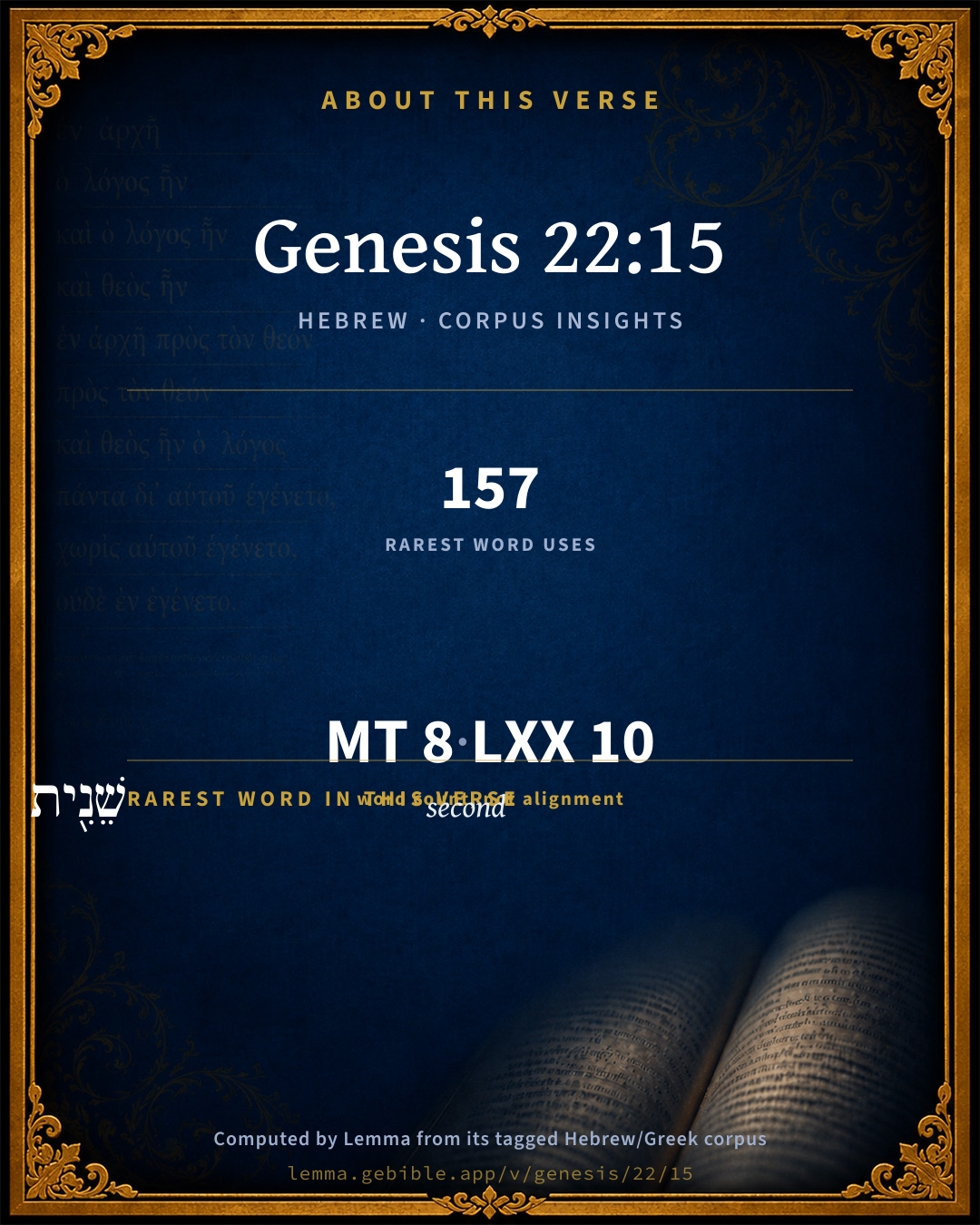
Genesis, in the Pentateuch, opens this verse with 8 words (8 distinct Hebrew lemmas). Its most distinctive word is shênîy (“second”). The Greek Septuagint runs longer here. A historical commentator’s framing appears above. Read the whole chapter for the surrounding context.

Discussion questions

  1. The word shênîy carries the sense “second.” How does it shape the verse?
  2. Compared with the Hebrew, the Septuagint runs longer here. What questions does that raise?
  3. These translations render this verse differently; the difference is in the English rendering, not the original. What questions does that raise?
  4. The verb «וַיִּקְרָ֛א» is Qal Sequential Imperfect. How does its form color the action?
  5. Reading how The Cambridge Bible for Schools and Colleges and Trapp's Complete Commentary read this verse, where do the two commentators agree and where do they part?

Things to notice

Reading settings

Reading text

Shown beneath each verse's original-language words.

Old Testament
Old Testament edition

Read the OT as the Masoretic Hebrew (MT) or the Greek Septuagint (LXX).

English shown for the Greek Septuagint (in the Hebrew ↔ Greek comparison).

Comparing translations? Open the Compare panel on any verse page to stack up to four side by side.