Genesis 41:40

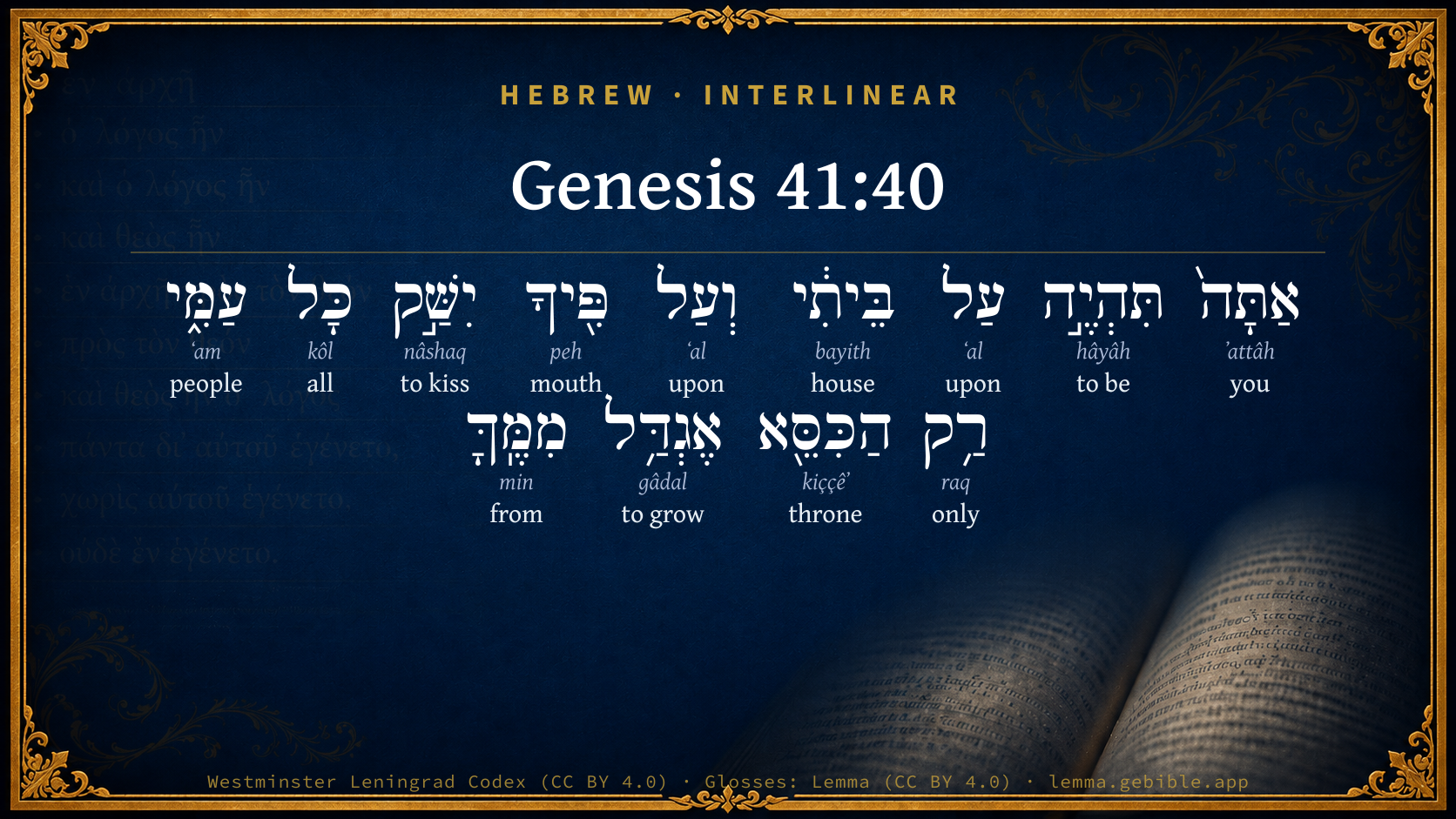
Hebrew (Westminster Leningrad Codex) Genesis 41:40 appears in the Hebrew Old Testament. The text above is from the Westminster Leningrad Codex. Each word links to its Strong’s number, a concise gloss, and parsing drawn from the Open Scriptures Hebrew Bible morphology. Click any word for its full Brown-Driver-Briggs (BDB) entry.
Download image
Cite this verse

Genesis 41:40 (World English Bible). Public Domain. Lemma interlinear Bible study tool, https://lemma.gebible.app/v/genesis/41/40.

Show BibTeX & RIS
BibTeX
RIS
English Translation
You shall be over my house, and according to your word will all my people be ruled. Only in the throne I will be greater than you."
World English Bible · Public Domain
Highlights
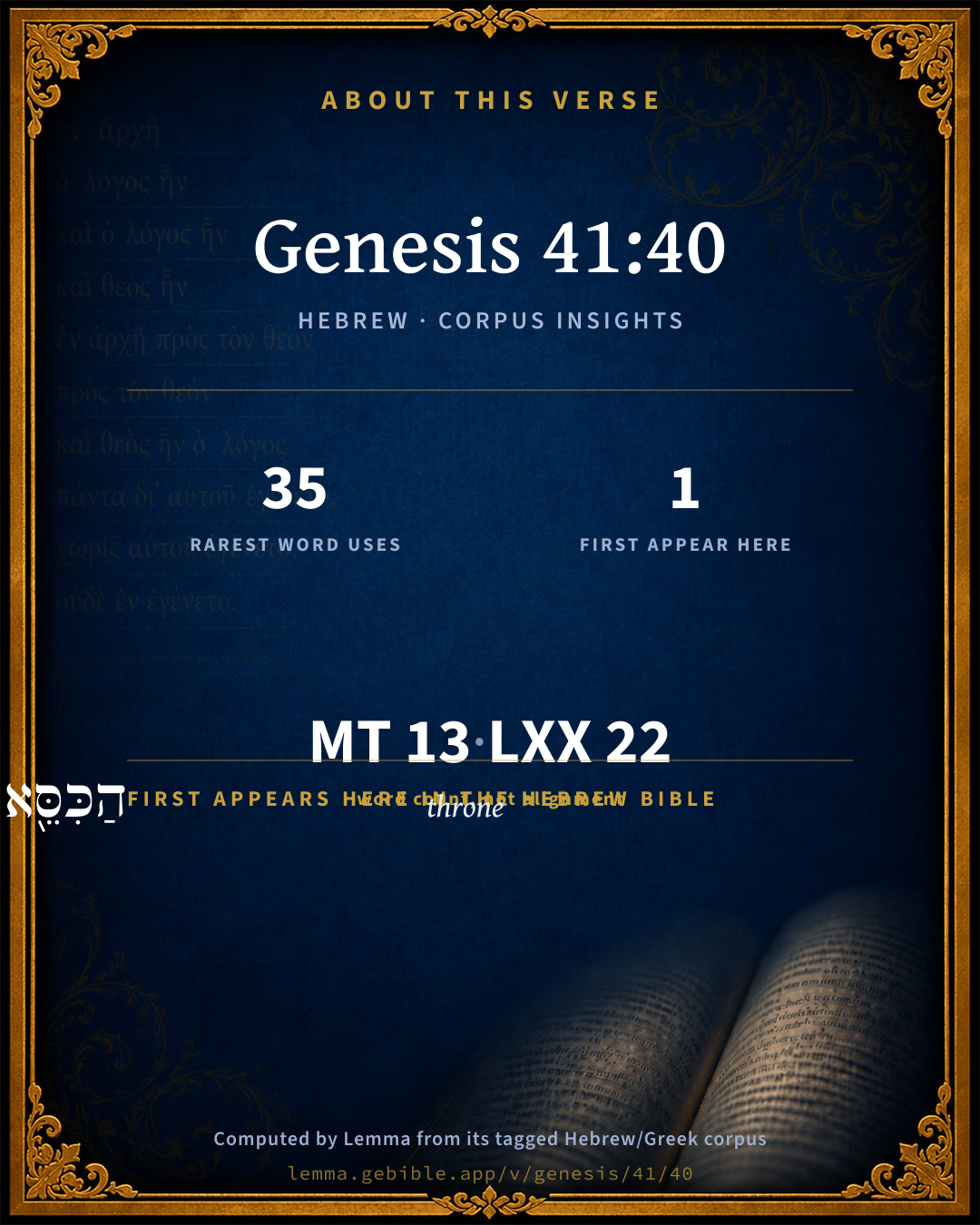
  • 1 first appearance in the Hebrew Bible
Full analysis ↓
Download a study sheet

One document with this verse’s original text, its word-by-word gloss line, the meaning frame, cross-references with their text, attributed commentary, and full source and license credits — printable, and it pastes into notes with its structure intact.

This verse Autodidact and up

Study sheet (.html) Plain text (.txt)

A passage Seminary Student

Up to 50 verses in one chapter. A passage sheet keeps up to 6 commentary sources and 12 cross-references per verse, in the order this page ranks them, and says so on the sheet whenever that leaves anything out. Ask for a single verse and you get the Autodidact verse sheet above.

Everything on this page stays free to read, with no account — the sheet is a download of what is already on screen, not access to it.

Want to remove ads? Support Godless Engineer
Compare translations 3

The same verse in 3 English versions, stacked beneath the original-language interlinear above. Click any original word for its lexicon entry.

Each is an independent rendering of the whole verse — the interlinear is not word-aligned to these translations.

Highlighted words mark where these versions differ — a whole-verse word diff, not a word-by-word alignment.

  • World English Bible Public Domain
    You shall be over my house, and according to your word will all my people be ruled. Only in the throne I will be greater than you."
  • King James Version Public Domain
    Thou shalt be over my house, and according unto thy word shall all my people be ruled: only in the throne will I be greater than thou.
  • unfoldingWord Literal Text CC BY-SA 4.0
    You will be over my house, and all my people will kiss on your mouth. Only I the throne will be greater than you.”

unfoldingWord Literal Text — © unfoldingWord, licensed CC BY-SA 4.0. Word-aligned USFM3 via Door43 (git.door43.org/unfoldingWord/en_ult).

Versions to compare (up to 4)

3 of 4 selected

Show all 18 translations

Every available English version of this verse, each an independent rendering of the whole verse.

  • World English Bible Public Domain
    You shall be over my house, and according to your word will all my people be ruled. Only in the throne I will be greater than you."
  • Berean Standard Bible Public Domain
    You shall be in charge of my house, and all my people are to obey your commands. Only with regard to the throne will I be greater than you.”
  • Majority Standard Bible Public Domain
    You shall be in charge of my house, and all my people are to obey your commands. Only with regard to the throne will I be greater than you.”
  • King James Version Public Domain
    Thou shalt be over my house, and according unto thy word shall all my people be ruled: only in the throne will I be greater than thou.
  • American Standard Version (1901) Public Domain
    thou shalt be over my house, and according unto thy word shall all my people be ruled: only in the throne will I be greater than thou.
  • Revised Version (1885) Public Domain
    thou shalt be over my house, and according unto thy word shall all my people be ruled: only in the throne will I be greater than thou.
  • Geneva Bible (1599) Public Domain
    Thou shalt be ouer mine house, and at thy word shall all my people be armed, onely in the kings throne will I be aboue thee.
  • Douay-Rheims (1899) Public Domain
    And he said to them: Can we find such another man, that is full of the spirit of God?
  • Young's Literal Translation Public Domain
    thou -- thou art over my house, and at thy mouth do all my people kiss; only in the throne I am greater than thou.'
  • Literal Standard Version CC BY-SA 4.0
    you are over my house, and at your mouth do all my people kiss; only in the throne I am greater than you.”
  • Unlocked Literal Bible CC BY-SA 4.0
    You will be over my house, and according to your word will all my people be ruled. Only in the throne will I be greater than you.”
  • unfoldingWord Literal Text CC BY-SA 4.0
    You will be over my house, and all my people will kiss on your mouth. Only I the throne will be greater than you.”
  • Darby Bible Public Domain
    Thou shalt be over my house, and according to thy commandment shall all my people regulate themselves; only concerning the throne will I be greater than thou.
  • World Messianic Bible Public Domain
    You shall be over my house. All my people will be ruled according to your word. Only in the throne I will be greater than you.”
  • Webster's Bible Public Domain
    Thou shalt be over my house, and according to thy word shall all my people be ruled: only in the throne will I be greater than thou.
  • Free Bible Version CC BY-SA 4.0
    you will be in charge of all my affairs, and all my people will obey your orders. Only I with my status as king will be greater than you.”
  • Bible in Basic English Public Domain
    You, then, are to be over my house, and all my people will be ruled by your word: only as king will I be greater than you.
  • JPS Tanakh (1917) Public Domain
    Thou shalt be over my house, and according unto thy word shall all my people be ruled; only in the throne will I be greater than thou.'

Literal Standard Version (2020), Covenant Press — licensed CC BY-SA 4.0. Text via the HelloAO Bible API (eBible.org). Unlocked Literal Bible (unfoldingWord) — licensed CC BY-SA 4.0. Text via the HelloAO Bible API (eBible.org). unfoldingWord Literal Text — © unfoldingWord, licensed CC BY-SA 4.0. Word-aligned USFM3 via Door43 (git.door43.org/unfoldingWord/en_ult). Free Bible Version, Dr. Jonathan Gallagher — licensed CC BY-SA 4.0. Text via the HelloAO Bible API (eBible.org).

Word by word

More ways to search: Search by grammar → Find every occurrence → Compare this word →

Practice this passage: Drill this verse → Learn its vocabulary →

יִשַּׁ֣ק
nâshaq
H5401
“to kiss”
Verb, Qal, Imperfect, 3rd Person, Masculine, Singular
Part of Speech
Verb
Stem
Qal
Form
Imperfect
Person
3rd Person
Gender
Masculine
Number
Singular
Full BDB Definition

Origin: a primitive root [identical with H5400 , through the idea of fastening up

TWOT: 1435 , 1436

to put together, kiss - (Qal) to kiss - (Piel) to kiss - (Hiphil) to touch gently - to handle, be equipped with - (Qal) to be equipped
  1. אַתָּה֙ ʼattâh H859 “you” Pronoun, Personal, 2nd Person, Masculine, Singular
  2. תִּהְיֶ֣ה hâyâh H1961 “to be” Verb, Qal, Imperfect, 2nd Person, Masculine, Singular
  3. עַל ʻal H5921 “upon” Preposition
  4. בֵּיתִ֔י bayith H1004 “house · my” Noun, Common, Masculine, Singular, Construct + Suffix, Personal, 1st Person, Common, Singular
  5. וְעַל ʻal H5921 “and · upon” Conjunction + Preposition
  6. פִּ֖יךָ peh H6310 “mouth · your” Noun, Common, Masculine, Singular, Construct + Suffix, Personal, 2nd Person, Masculine, Singular
  7. כָּל kôl H3605 “all of” Noun, Common, Masculine, Singular, Construct
  8. עַמִּ֑י ʻam H5971 “people · my” Noun, Common, Masculine, Singular, Construct + Suffix, Personal, 1st Person, Common, Singular
  9. רַ֥ק raq H7535 “only” Particle, Accusative
  10. הַכִּסֵּ֖א kiççêʼ H3678 “the · throne” Particle, Definite Article + Noun, Common, Masculine, Singular, Absolute
  11. אֶגְדַּ֥ל gâdal H1431 “to grow” Verb, Qal, Imperfect, 1st Person, Common, Singular
  12. מִמֶּֽךָּ min H4480 “from · you” Preposition + Suffix, Personal, 2nd Person, Masculine, Singular

About this verse

These counts appear in no published source. They are computed here, from the morphology-tagged text and Lemma’s own curated glosses. What Lemma adds →

13
words
12
distinct lemmas
Pentateuch
section

First appearance in Scripture

This word makes its first canonical appearance in the Hebrew Bible here:

  • הַכִּסֵּ֖א throne H3678

Shared distinctive vocabulary

יִשַּׁ֣ק to kiss H5401 occurs in 35 verses of the Hebrew Bible. Also found in:

Grammatical profile

  • 3 verbs
  • 5 nouns
  • 1 pronoun
  • 3 prepositions
  • 1 particle

Verb forms

  • תִּהְיֶ֣ה Qal · Imperfect
  • יִשַּׁ֣ק Qal · Imperfect
  • אֶגְדַּ֥ל Qal · Imperfect

Repetition

A word recurs within this verse — often emphatic in Hebrew:

Hebrew & Septuagint length

In English translation the verse runs 27 words from the Hebrew and 24 from the Septuagint (LXX English) — closely comparable.

A rough comparison of the two English renderings, which tokenize alike — not a word-level alignment.

Word counts can differ between the Hebrew and the Greek without any difference in meaning — e.g. the Hebrew direct-object marker אֵת has no separate Greek word, and Greek often adds the article ὁ.

In the original languages it is 13 Hebrew tokens and 22 Greek tokens — but the two are counted differently (Hebrew bundles its prefixes and suffixes into one token; the Greek is in lemma form), so that isn’t a like-for-like length.

Cross-references

12

Topical passages linked to Genesis 41:40 in the Treasury of Scripture Knowledge — connected by theme and wording, ordered by reader-vote popularity; previews shown in the World English Bible.

  • Proverbs 22:29 Do you see a man skilled in his work? He will serve kings; He won't serve obscure men.
  • Acts 7:10 and delivered him out of all his afflictions, and gave him favor and wisdom before Pharaoh, king of Egypt. He made him governor over Egypt and all his house.
  • Psalms 105:21–22 He made him lord of his house, And ruler of all of his possessions;
  • Genesis 39:4–6 Joseph found favor in his sight. He ministered to him, and he made him overseer over his house, and all that he had he put into his hand.
  • Genesis 45:8–9 So now it wasn't you who sent me here, but God, and he has made me a father to Pharaoh, lord of all his house, and ruler over all the land of Egypt.
  • Psalms 2:12 Kiss the son, lest he be angry, and you perish in the way, For his wrath will soon be kindled. Blessed are all those who take refuge in him.
  • Daniel 5:29 Then commanded Belshazzar, and they clothed Daniel with purple, and put a chain of gold about his neck, and made proclamation concerning him, that he should be the third ruler in the kingdom.
  • Genesis 45:26 They told him, saying, "Joseph is still alive, and he is ruler over all the land of Egypt." His heart fainted, for he didn't believe them.
  • Daniel 2:46–48 Then the king Nebuchadnezzar fell on his face, and worshiped Daniel, and commanded that they should offer an offering and sweet odors to him.
  • Daniel 6:3 Then this Daniel was distinguished above the presidents and the satraps, because an excellent spirit was in him; and the king thought to set him over the whole realm.
  • 1 Samuel 10:1 Then Samuel took the vial of oil, and poured it on his head, and kissed him, and said, Isn't it that Yahweh has anointed you to be prince over his inheritance?
  • Job 31:27 And my heart has been secretly enticed, My hand threw a kiss from my mouth:

Cross-references courtesy of OpenBible.info (CC BY 4.0).

Hebrew and Greek witnesses Masoretic Hebrew ↔ Greek Septuagint

The same verse in the two great witnesses to the Old Testament, shown verse-for-verse.

These are two independent witnesses, not word-aligned to each other, and the Septuagint is shown in lemma (dictionary) form.

Hebrew Genesis 41:40 Masoretic · Westminster Leningrad Codex

אַתָּה֙ תִּהְיֶ֣ה עַל בֵּיתִ֔י וְעַל פִּ֖יךָ יִשַּׁ֣ק כָּל עַמִּ֑י רַ֥ק הַכִּסֵּ֖א אֶגְדַּ֥ל מִמֶּֽךָּ

You shall be over my house, and according to your word will all my people be ruled. Only in the throne I will be greater than you."

World English Bible · Public Domain

Greek LXX Genesis 41:40 Septuagint · lemma form

σύ εἰμί ἐπί ὁ οἶκος ἐγώ καί ἐπί ὁ στόμα σύ ὑποἀκούω πᾶς ὁ λαός ἐγώ πλήν ὁ θρόνος ὑπεἔχω σύ ἐγώ

You shall be over my house, and all my people shall be obedient to your word; only in the throne will I excel you.

LXX2012 (modern English Septuagint) · Public Domain

On this verse, The Cambridge Bible for Schools and Colleges discusses the Septuagint’s reading. Read the note in Commentary ↓

Hebrew: Westminster Leningrad Codex (CC BY 4.0). Greek: Septuagint (public domain); English from LXX2012 (modern English Septuagint) (Public Domain). How the Septuagint differs from the Hebrew →

Targum (Aramaic paraphrase)

2

The Targum is the ancient Jewish Aramaic paraphrase of the Hebrew Scriptures — an interpretive translation, not the Hebrew text itself. Onkelos (literal) and Pseudo-Jonathan (expansive) render the Torah, and Jonathan the Prophets. Coverage is partial: where no permissively-licensed English translation exists for a verse, only the Aramaic is shown. This is verse-level text, not a word-by-word alignment to the Hebrew.

  1. Targum Onkelos Torah (Genesis–Deuteronomy)
    אַתְּ תְּהֵי מְמַנָּא עַל בֵּיתִי וְעַל מֵימְרָךְ יִתְּזַן כָּל עַמִּי לְחוֹד כָּרְסֵי מַלְכוּתָא הָדֵין אֵיהֵי יַקִּיר מִנָּךְ

    (no public-domain English translation for this verse)

    Targum Onkelos — Aramaic: “Onkelos Genesis” (public domain); “Onkelos Exodus” (public domain); “Onkelos Leviticus” (public domain); “Onkelos Numbers” (public domain); “Onkelos Deuteronomy” (public domain). English: “Sefaria Community Translation” (CC0 1.0 (public-domain dedication)); “J.W. Etheridge. The Targums of Onkelos and Jonathan Ben Uzziel on the Pentateuch. London: Longmans, Green, 1862” (public domain). Text via Sefaria.

  2. Targum Pseudo-Jonathan Torah (Genesis–Deuteronomy)
    אַנְתְּ תְּהִי אַפִּיטְרוֹפּוֹס עַל בֵּיתִי וְעַל גְזֵירַת מֵימַר פּוּמָךְ יִתְּזִינוּן כָּל עַמִי לְחוֹד כּוּרְסֵי מַלְכוּתָא אֱהֵא רַב מִינָךְ

    Thou shalt be superintendent over my house, and by the decree of thy mouth shall all my people be armed only in the throne of the kingdom will I be greater than thou.

    Targum Pseudo-Jonathan — Aramaic: “Targum Jonathan on Genesis” (public domain); “Targum Jonathan on Exodus” (public domain); “Targum Jonathan on Leviticus” (public domain); “Targum Jonathan on Numbers” (public domain); “Targum Jonathan on Deuteronomy” (public domain). English: “The Targum of Jonathan ben Uzziel, trans. J. W. Etheridge, London, 1862” (public domain). Text via Sefaria.

Commentary

Notes on Genesis 41:40 from classic Christian and Jewish commentators (each source and its license shown beneath its notes). The classic Christian expositions comment on the surrounding passage and are grouped to its opening verse, so a note may address several verses; the Jewish commentaries on the Tanakh (Rashi and others) are per-verse, so they appear only where the commentator wrote on this verse.

Lemma curates 59 commentaries, every one of them public domain or Creative Commons licensed, each selected and text-cleaned for this edition rather than reprinted as found. About our sources →

Trapp's Complete Commentary

John Trapp

Gen 41:40 Thou shalt be over my house, and according unto thy word shall all my people be ruled: only in the throne will I be greater than thou.

Ver. 40. Thou shalt be over my house, &c.] Pharaoh prefers him, because he found good parts in him. They that bestow places of charge in church or commonwealth upon undeserving persons, for by-consideration, shall have Pharaoh to rise up in judgment against them. In King Edward VI’s minority, dignity waited upon desert, saith the historian, which caused it again to be waited upon by respect {a} Order also was taken that no man should have any benefice from the king, but first he should preach before him. Tamerlane never bestowed his preferments upon such as ambitiously sought them; as deeming them, in so doing, unworthy thereof: but upon such as whose modesty or desert he thought worthy of those his great favours {b}

{a} The Life of King Edward VI, by Sir Jo. Heywood, pp. 6, 115.

{b} Turk. Hist., fol. 227.

John Trapp, A Commentary or Exposition upon All the Books of the Old and New Testament (1647–1656) — public domain. Text from a community e-Sword module.

Joseph Benson's Commentary

Gen 41:40. According to thy word — Thy direction and command, the word mouth, as the Hebrew is, being often put for command; shall all my people be ruled — Or be fed. They shall receive their provisions from thy hand, and according to thy disposal. But the Hebrew is, at thy mouth shall my people kiss, which may be understood literally; for inferiors used sometimes to kiss their superiors in token of their homage; or rather metaphorically, as the same phrase is used, Psa 2:12, and Pro 24:26, they shall receive all thy commands with reverence and submission.

Joseph Benson's Commentary on the Old and New Testaments (1811–1818) — public domain. Text from a community e-Sword module.

Geneva Bible (1599)

Geneva Bible translators

Hebrew, mouth.

Some read, the people shall kiss thy mouth, that is shall obey thee in all things.

Geneva Bible (1599) marginal notes — public domain. Text via Bolls.life.

Jamieson, Fausset & Brown

Robert Jamieson, A. R. Fausset & David Brown

Thou shalt be over my house--This sudden change in the condition of a man who had just been taken out of prison could take place nowhere, except in Egypt. In ancient as well as modern times, slaves have often risen to be its rulers. But the special providence of God had determined to make Joseph governor of Egypt; and the way was paved for it by the deep and universal conviction produced in the minds both of the king and his councillors, that a divine spirit animated his mind and had given him such extraordinary knowledge.

according unto thy word shall all my people be ruled--literally, "kiss." This refers to the edict granting official power to Joseph, to be issued in the form of a firman, as in all Oriental countries; and all who should receive that order would kiss it, according to the usual Eastern mode of acknowledging obedience and respect for the sovereign [WILKINSON].

Jamieson, Fausset & Brown — Commentary Critical and Explanatory on the Whole Bible (1871) — public domain (CC PDM 1.0). Text via the HelloAO Bible API.

Adam Clarke's Commentary

Verse 40. According unto thy word shall all my people be ruled] Literally, At thy mouth shall all my people kiss. In the eastern countries it is customary to kiss any thing that comes from a superior, and this is done by way of testifying respect and submission. In this sense the words in the text are to be understood: All the people shall pay the profoundest respect and obedience to all thy orders and commands.

Only in the throne will I be greater than thou.] This, in one word, is a perfect description of a prime minister. Thou shalt have the sole management, under me, of all state affairs.

Adam Clarke's Commentary on the Bible (1810–1826) — public domain. Text from a community e-Sword/MySword module.

John Calvin's Commentaries

40. Thou shalt be over my house. Not only is Joseph made governor of Egypt, but is adorned also with the insignia of royalty, that all may reverence him, and may obey his command. The royal signet is put upon his finger for the confirmation of decrees. He is clothed in robes of fine linen, which were then a luxury, and were not to be had at any common price. He is placed in the most honorable chariot. It may, however, be asked, whether it was lawful for the holy man to appear with so great pomp? I answer, although such splendor can scarcely ever be free from blame, and therefore frugality in external ornaments is best; yet all kind of splendor in kings and other princes of the world is not to be condemned, provided they neither too earnestly desire it, nor make an ostentatious display of it. Moderation is, indeed, always to be cultivated; but since it was not in Joseph’s power to prescribe the mode of investiture, and the royal authority would not have been granted to him without the accustomed pomp of state, he was at liberty to accept more than seemed in itself desirable. If the option be given to the servants of God, nothing is safer for them, than to cut off whatever they can of outward splendor. And where it is necessary for them to accommodate themselves to public custom, they must beware of all ostentation and vanity. With respect to the explanation of the words; whereas we render them, “At thy mouth all the people shall kiss,” others prefer to read, “shall be armed;” others, “shall be fed at thy will or commandment;” but as the proper signification of the verb נשק (nashak) is to kiss, I do not see why interpreters should twist it to another sense. Yet I do not think that here any special token of reverence is intended; but the phrase rather seems to be metaphorical, to the effect that the people should cordially receive and obediently embrace whatever might proceed from the mouth of Joseph: as if Pharaoh had said, “Whatever he may command, it is my will that the people shall receive with one consent, as if all should kiss him.” The second chariot, is read by the Hebrews in construction, for the chariot of the viceroy, who holds the second place from the king. The sense, however, is clear, that Joseph has the precedence of all the nobles of Egypt.

There are various opinions about the meaning of the word אברך(abraik). They who explain it by “tender father,” because Joseph, being yet in tender years, was endowed with the prudence and gravity of old age, seem to me to bring something from afar to correspond with their own fancy. They who render it “the father of the king,” as if the word were compounded of the Hebrew noun אב (ab,) and the Arabic רך (rak,) have little more color for their interpretation. If, indeed, the word be Hebrew, the meaning preferred by others, “Bow the knee,” seems to me more probable. But because I rather suppose that Egyptian terms are referred to by Moses, both in this place and shortly afterwards, I advise the readers not to distort them in vain. And truly those interpreters are ridiculously subtle, who suppose that a Hebrew name was given him by an Egyptian king, which they render either the “Redeemer of the world,” or the “Expounder of mysteries.” I prefer following the Greek interpreters, who, by leaving both words untouched, sufficiently prove that they thought them to be of a foreign language. That the father-in-law of Joseph was, as is commonly believed, a priest, is what I cannot refute, though I can scarcely be induced to believe it. Therefore, since כוהן (cohen) signifies a prince as well as a priest, it seems to me probable that he was one of the nobles of the court, who might also be the satrap or prefect of the city of On.

John Calvin's Commentaries (1540-1563) — public domain. Text from the Calvin Translation Society English edition (1840s-50s) via the Christian Classics Ethereal Library (ccel.org). Calvin's coverage is partial (roughly two-thirds of the Bible); uncommented books and verses are honest gaps, never fabricated. The 19th-century editor's footnotes and remarks are omitted so the notes are faithfully Calvin's own voice.

Ellicott's Commentary for English Readers

(40) Over my house.—The chief over the palace was in ancient times next in power to the sovereign, and under the Frankish kings the “major domi,” or mayor of the palace, first usurped the whole royal power, and finally Pepin, the son of Charles Martel, took the name of king as well as the reality.

According unto thy word shall all my people be ruled.—The general sense is easy, namely that all the people of Egypt should obey Joseph’s orders, but the translation of the phrase is difficult. The ordinary meaning of the verb is to kiss, and the translation would then be And on thy mouth shall all my people kiss, that is, they shall do thee homage (1Sa_10:1; Psa_2:12). The versions seem to have taken this sense, though they translate very loosely “shall obey thee;” or “shall receive judgment at thy mouth;” or “shall be governed by thee.” As however in 1Ch_12:2; 2Ch_17:17; Psa_78:9, the verb is used of bearing arms, Aben-Ezra translates “shall arm themselves,” and supposes that Joseph was made commander-in-chief. Others, again, form the verb used here from the same root as that which would give meshek in Gen_15:2 the meaning of “running about,” and translate at thy mouth, that is, according to thy command, shall all my people busy themselves. The first is the most natural and probable rendering.

In the throne.—Heb., as to the throne, in all that concerns my royal rank, dignity, and rights.

A Bible Commentary for English Readers, edited by Charles John Ellicott (1878–1897) — public domain. Text from a community e-Sword module.

The Cambridge Bible for Schools and Colleges

gen. ed. J. J. S. Perowne

40. over my house] Pharaoh exalts the Hebrew slave at one step to become his Grand Vizier; cf. Psa_105:21; 1Ma_2:53. Whether there was a vacancy in this office into which Joseph was promoted, or whether he displaced an existing official, the tradition does not record. “My house” seems to mean “my palace,” or “my court.” The elevation of a Syrian slave to such high rank is apparently not without example in the records of the Egyptian kings. See Appendix E on “Joseph as Vizier.” For the title of “governor of the palace,” cf. 1Ki_4:6; Isa_22:15.

be ruled] The meaning is very doubtful; possibly, as R.V. marg., order themselves, or, do homage. Lit. (if the text be correct) “and upon thy mouth shall all my people kiss.” In illustration of this expression some have quoted Hos_13:2; Pro_24:26. It is objected that “the kiss of homage” was not a kiss upon the mouth. Hence scholars have preferred a different rendering, “according to thy mouth,” i.e. “at thy command” (cf. Gen_45:21), “shall my people order, or dispose, themselves.” So, probably, LXX ἐπὶ τῷ στόματί σου ὑπακούσεται, Lat. obediet. Perhaps, however, the text is corrupt.

The Cambridge Bible for Schools and Colleges (gen. ed. J. J. S. Perowne; Cambridge University Press, 1878–1918) — public domain. Text from a community e-Sword module.

John Gill's Exposition

And he made him to ride in the second chariot which he had,.... By which it appeared that he was next to Pharaoh, but not above him; as kings were wont to have more chariots than one, those were distinguished by first, second, &c. being of greater state the one than the other, see Ch2 35:24,

and they cried before him, bow the knee; that is, his guard that attended him, when he rode out in his chariot, called to the people, as they passed along, to bow the knee to Joseph, as a token of veneration and respect; or they proclaimed him "Abrech", which Onkelos paraphrases, this is the father of the king; and so Jarchi, who observes, that "Rech" signifies a king in the Syriac language; and this agrees with what Joseph himself says, that God had made him a father to Pharaoh, Gen 45:8. Others render it a tender father; and the Targums of Jonathan and Jerusalem take in both senses,"this is the father of the king, (or let the father of the king live, so the Jerusalem,) who is great in wisdom, and tender in years:''though rather he may be so called, because he acted the part of a tender father to the country, in providing corn for them against a time of scarcity:

and he made him ruler over all the land of Egypt; appointed him to be governor of the whole land, and invested him with that office, and made him appear to be so, by the grandeur he raised him to.

John Gill's Exposition of the Whole Bible (1746–1763) — public domain (CC PDM 1.0). Text via the HelloAO Bible API.

Haydock's Catholic Bible Commentary

Obey. Hebrew Yishak; which may signify also "kiss" you, or their hand, in testimony of respect; or "shall be fed, governed, and led forth," &c. He made him master of his house, and ruler, &c. (Psalm civ. 21; Wisdom x. 14.)

George Leo Haydock (1774–1849), Haydock's Catholic Family Bible and Commentary, 1859 edition — public domain. Excludes Psalms (Douay-Rheims chapter numbering differs from Protestant) and Deuterocanonical books (Catholic canon only).

Matthew Poole's English Annotations

According unto thy word, i.e. direction and command, Heb. mouth, which is oft put for command, (as Exo 17:1; 38:21; Num 3:16,39, &c.,) shall all my poeple be ruled, or, be fed; they shall receive their provisions from thy hand, and according to thy disposal. Others, shall kiss, viz. the hand, as inferiors used to do, upon their address to or conference with great persons. See Job 31:27; Hos 13:2. But it was frivolous for Joseph to command them to do that which by the custom of the place they were obliged and wont to do. Some render the word thus, and that agreeable to the Hebrew, at thy mouth shall the people kiss; which may be understood either properly, as inferiors did sometimes kiss their superiors in token of their homage; see 1Sa 10:1; or rather metaphorically, as the same phrase is used Psa 2:12; Pro 24:26, receive all thy commands with reverence and submission.

In the throne, i.e. in sovereign power and dignity.

Matthew Poole's English Annotations on the Holy Bible (1683–1685) — public domain. Text from a community e-Sword/MySword module.

Whedon's Commentary on the Bible

Daniel D. Whedon

40. According unto thy word shall all my people be ruled — This gives the general sense, and is substantially that of the ancient versions; but the word rendered ruled is the ordinary word for kissing, and modern exegetes disagree as to its meaning. Gesenius renders: Upon thy mouth shall all my people kiss. So also Knobel and Furst. Allusion would thus be made to the custom of expressing homage by throwing a kiss. Keil, however, denies that this was a customary form of showing homage, and takes the word נשׁק in the sense of disposing or arranging one’s self: According to thy mouth (that is, thy command, Gen_45:21) shall my whole people arrange itself. The primary signification of נשׁק seems to be that of hanging upon or cleaving unto, (see Furst, Lex.,) and perhaps the simpler meaning here is: upon thy mouth (that is, word of command) shall all my people hang. That is, they will cleave to thy orders and all thy utterances with the greatest respect and reverence.

Only in the throne — Joseph is made the grand vizier, but Pharaoh retains all his essential royalty and kingly prerogatives.

Daniel D. Whedon (gen. ed.), Commentary on the Old and New Testaments (1874–1909) — public domain. Text from a community e-Sword module.

The Pulpit Commentary

HOMILIES BY F. HASTINGS Ver. 40.

Joseph as prime minister.

shalt be over my house, and according unto thy word shall all my people be ruled: only in the throne will I be greater than thou." Sudden elevations are often the precursors of sudden falls. It was not so with Joseph. He filled satisfactorily his position, retaining it to the end of life. He made himself indispensable to Pharaoh and to the country. He was a man of decision. Seeing what had to be done, he hesitated not in commencing it. Going from the presence of Pharaoh, he passed throughout the land, arranging for granaries and appointing officers to grapple with the seven years of famine which were imminent. Doubtless he felt the weight of responsibility resting upon him, and would have many restless nights in calculating how by means of the money then in the treasury and by forced loans to meet the expenditure for granaries, grain, and official salaries. He superintended everything. By method he mastered detail.

I CONSIDER THE POLICY OF THIS EGYPTIAN PRIME MINISTER. Many things we admire in Joseph, but we must not be blind to the fact that he thought more of binding the people to the throne than of benefiting the people themselves. He was the first statesman of that day. His policy determined in great measure what should be the standard of internal prosperity, and what position the country should hold in the eyes of other nations. He sought to make Pharaoh"s rule absolute. He gave no benefit without payment, no supplies without sacrifice. He took all the money first, (Gen_47:14) then the cattle (ibid. ver. 16), then the lands and their persons (ibid. ver. 23). He thus reduced the people of Egypt to the position of slaves. He made all the land crown lands. Thus the monarch was pleased, and the priests, being exempt, were flattered. It is possible that in this Joseph laid the foundation of that system of mismanagement, which has made the most flourishing spot in the world the basest of kingdoms. He seems also to have striven to give some sort of preeminence to his brethren, and to advance them. Exempt from the burdens pressing on others, they gained power, and would have become eventually the dominant race in Egypt, but that another Pharaoh arose who knew not Joseph, i.e. who, although he knew of his having lived and served the nation, yet recognized not his policy. The state to which Joseph reduced the Egyptians was that to which afterwards his own descendants were reduced. Thus our plans are overthrown. Time tries success, and by removing dimness from our vision enables us to test it better.

II CONSIDER THE PRIVATE LIFE OF THIS EGYPTIAN PRIME MINISTER, He was soon led to conform to the spirit and practice of an ungodly nation. He used a divining cup, (Gen_44:15, Gen_44:16) took his meals apart, (Gen_43:32) recognizing and sustaining class distinctions. He learned the mode of speech common among the Egyptians, swore by the life of Pharaoh, (Gen_42:15) and was affianced to an idolatress, probably a priestess. (Gen_41:45) He made no effort to return to his own land, or to the pastoral life of his fathers. It was in his power also for nine years to have sent to make search for his father, who was sorrowing for him as dead, but he sent not. Not until trouble, by an apparent chance, drove his brethren to him did he appear to think of them, or of home and Jacob. When they came he was very slow to make known himself, as though he feared it might compromise him in the eyes of the Egyptians to be known to have relatives who were shepherds, an occupation which was abominable to the Egyptians. (Gen_46:34) When he revealed himself to them, it was without the knowledge or presence of the Egyptians. He removed his brethren also to a distant part of Egypt: that they might not constantly, by their presence, remind him and others of his origin. We fancy that Joseph had weaknesses and imperfections such as other men had. He had dwelt in Egypt and caught its spirit. In the names he gave to his children there seems some indication of regret at his forgetfulness and wonder at his fruitfulness. Amid views that might depress there is some brightness. His forgiveness of his brethren was noble. His affection for his father returned. His faith in God was pure at last. Dying, he "gave commandment concerning his bones." He showed that though outwardly an Egyptian, he was inwardly an Israelite. H.

The Pulpit Commentary (1880–1919), ed. H.D.M. Spence-Jones & Joseph S. Exell — public domain. Text from a community e-Sword module.

Rashi

Rabbi Shlomo Yitzchaki (Rashi)

ישק —The Targum renders it by יתזן which means SHALL BE FED — all my people’s needs shall be provided through you. Similar are (15:2) “and the steward (ובן משק) of my house”, and (Psalms 2:12) “Provide yourselves (נשקו) with purity” old French garnison.

רק הכסא ONLY IN THE THRONE — only in the fact that they shall call me king.

כסא THRONE is a metaphorical term for royal rank, like (1 Kings 1:37) “And he has made his throne (כסאו) greater than the throne of my lord king”.

Rashi on the Tanakh — English translations: “The Judaica Press complete Tanach with Rashi, translated by A. J. Rosenberg” (CC BY 4.0); “Pentateuch with Rashi's commentary by M. Rosenbaum and A.M. Silbermann, 1929-1934” (public domain); “The Metsudah Tanach series, Lakewood, N.J” (CC BY 4.0); and “The Book of Joshua, Metsudah Publications, 1997” (CC BY 4.0). Text via Sefaria.

Radak

Rabbi David Kimhi (Radak)

ישק, a word derived from נשק, arms, as per Onkelos.

רק הכסא אגדל ממך, in matters relating to the throne I will rank as superior to you.

Radak on the Tanakh — English translations: “Sefaria Community Translation” (CC0 1.0 (public-domain dedication)); “Eliyahu Munk, HaChut Hameshulash” (CC BY 4.0); “Rabbi Mike Feuer, Jerusalem Anthology” (CC BY 4.0); and “R. David Kimhi on the first book of Psalms, Translated by R.G. Finch, London, 1919” (public domain). Text via Sefaria.

Lesson kit

Teaching starters — assembled from the data on this page, not authored interpretation. Every prompt links to the verse data it draws on. Edit before teaching.

Genesis, in the Pentateuch, opens this verse with 13 words (12 distinct Hebrew lemmas). Its most distinctive word is nâshaq (“to kiss”). A historical commentator’s framing appears above. Read the whole chapter for the surrounding context.

Discussion questions

  1. The word nâshaq carries the sense “to kiss.” How does it shape the verse?
  2. This is the first place “throne” appears in Scripture (first appears here). What does its debut here establish?
  3. How does Genesis 27:26, which shares the word «to kiss», read alongside this verse?
  4. What does the repetition of “upon” (2× in this one verse) do in this verse?
  5. These translations render this verse differently; the difference is in the English rendering, not the original. What questions does that raise?
  6. «תִּהְיֶ֣ה» is a Qal Imperfect verb. How does that grammatical form shape the action described?
  7. Compare how Trapp's Complete Commentary and Joseph Benson's Commentary read this verse. Where do they agree or differ?

Things to notice

Reading settings

Reading text

Shown beneath each verse's original-language words.

Old Testament
Old Testament edition

Read the OT as the Masoretic Hebrew (MT) or the Greek Septuagint (LXX).

English shown for the Greek Septuagint (in the Hebrew ↔ Greek comparison).

Comparing translations? Open the Compare panel on any verse page to stack up to four side by side.