Leviticus 3:6

Hebrew (Westminster Leningrad Codex) Leviticus 3:6 appears in the Hebrew Old Testament. The text above is from the Westminster Leningrad Codex. Each word links to its Strong’s number, a concise gloss, and parsing drawn from the Open Scriptures Hebrew Bible morphology. Click any word for its full Brown-Driver-Briggs (BDB) entry.
Download image
Cite this verse

Leviticus 3:6 (World English Bible). Public Domain. Lemma interlinear Bible study tool, https://lemma.gebible.app/v/leviticus/3/6.

Show BibTeX & RIS
BibTeX
RIS
English Translation
"'If his offering for a sacrifice of peace offerings to Yahweh is from the flock; male or female, he shall offer it without blemish.
World English Bible · Public Domain
Download a study sheet

One document with this verse’s original text, its word-by-word gloss line, the meaning frame, cross-references with their text, attributed commentary, and full source and license credits — printable, and it pastes into notes with its structure intact.

This verse Autodidact and up

Study sheet (.html) Plain text (.txt)

A passage Seminary Student

Up to 50 verses in one chapter. A passage sheet keeps up to 6 commentary sources and 12 cross-references per verse, in the order this page ranks them, and says so on the sheet whenever that leaves anything out. Ask for a single verse and you get the Autodidact verse sheet above.

Everything on this page stays free to read, with no account — the sheet is a download of what is already on screen, not access to it.

Want to remove ads? Support Godless Engineer
Compare translations 3

The same verse in 3 English versions, stacked beneath the original-language interlinear above. Click any original word for its lexicon entry.

Each is an independent rendering of the whole verse — the interlinear is not word-aligned to these translations.

Highlighted words mark where these versions differ — a whole-verse word diff, not a word-by-word alignment.

  • World English Bible Public Domain
    "'If his offering for a sacrifice of peace offerings to Yahweh is from the flock; male or female, he shall offer it without blemish.
  • King James Version Public Domain
    And if his offering for a sacrifice of peace offering unto the LORD be of the flock; male or female, he shall offer it without blemish.
  • unfoldingWord Literal Text CC BY-SA 4.0
    And if his offering for a sacrifice of peace offerings to Yahweh from the flock, male or female, perfect, he shall present it.

unfoldingWord Literal Text — © unfoldingWord, licensed CC BY-SA 4.0. Word-aligned USFM3 via Door43 (git.door43.org/unfoldingWord/en_ult).

Versions to compare (up to 4)

3 of 4 selected

Show all 18 translations

Every available English version of this verse, each an independent rendering of the whole verse.

  • World English Bible Public Domain
    "'If his offering for a sacrifice of peace offerings to Yahweh is from the flock; male or female, he shall offer it without blemish.
  • Berean Standard Bible Public Domain
    If, however, one’s peace offering to the LORD is from the flock, he must present a male or female without blemish.
  • Majority Standard Bible Public Domain
    If, however, one’s peace offering to the LORD is from the flock, he must present a male or female without blemish.
  • King James Version Public Domain
    And if his offering for a sacrifice of peace offering unto the LORD be of the flock; male or female, he shall offer it without blemish.
  • American Standard Version (1901) Public Domain
    And if his oblation for a sacrifice of peace-offerings unto Jehovah be of the flock; male or female, he shall offer it without blemish.
  • Revised Version (1885) Public Domain
    And if his oblation for a sacrifice of peace offerings unto the LORD be of the flock; male or female, he shall offer it without blemish.
  • Geneva Bible (1599) Public Domain
    Also if his oblation be a peace offring vnto the Lord out of ye flocke, whether it be male or female, he shall offer it without blemish.
  • Douay-Rheims (1899) Public Domain
    But if his oblation and the sacrifice of peace offering be of the flock, whether he offer male or female, they shall be without blemish.
  • Young's Literal Translation Public Domain
    `And if his offering `is' out of the flock for a sacrifice of peace-offerings to Jehovah, male or female, a perfect one he doth bring near;
  • Literal Standard Version CC BY-SA 4.0
    And if his offering [is] out of the flock for a sacrifice of peace-offerings to YHWH, male or female, he brings a perfect one near;
  • Unlocked Literal Bible CC BY-SA 4.0
    If the man's sacrifice of a fellowship offering to Yahweh is from the flock; male or female, he must offer a sacrifice without blemish.
  • unfoldingWord Literal Text CC BY-SA 4.0
    And if his offering for a sacrifice of peace offerings to Yahweh from the flock, male or female, perfect, he shall present it.
  • Darby Bible Public Domain
    And if his offering for a sacrifice of peace-offering to Jehovah be of small cattle, male or female, he shall present it without blemish.
  • World Messianic Bible Public Domain
    “‘If his offering for a sacrifice of peace offerings to the LORD is from the flock, either male or female, he shall offer it without defect.
  • Webster's Bible Public Domain
    And if his offering for a sacrifice of peace-offering to the LORD shall be of the flock, male or female; he shall offer it without blemish.
  • Free Bible Version CC BY-SA 4.0
    When you want to give a peace offering and you offer an animal from a flock of sheep or goats, either male or female, you must present one without any defects before the Lord.
  • Bible in Basic English Public Domain
    And if what he gives for a peace-offering to the Lord is of the flock, let him give a male or female, without any mark on it.
  • JPS Tanakh (1917) Public Domain
    And if his offering for a sacrifice of peace-offerings unto the LORD be of the flock, male or female, he shall offer it without blemish.

Literal Standard Version (2020), Covenant Press — licensed CC BY-SA 4.0. Text via the HelloAO Bible API (eBible.org). Unlocked Literal Bible (unfoldingWord) — licensed CC BY-SA 4.0. Text via the HelloAO Bible API (eBible.org). unfoldingWord Literal Text — © unfoldingWord, licensed CC BY-SA 4.0. Word-aligned USFM3 via Door43 (git.door43.org/unfoldingWord/en_ult). Free Bible Version, Dr. Jonathan Gallagher — licensed CC BY-SA 4.0. Text via the HelloAO Bible API (eBible.org).

Word by word

More ways to search: Search by grammar → Find every occurrence → Compare this word →

Practice this passage: Drill this verse → Learn its vocabulary →

נְקֵבָ֔ה
nᵉqêbâh
H5347
“woman”
Noun, Common, Feminine, Singular, Absolute
Part of Speech
Noun
Type
Common
Gender
Feminine
Number
Singular
State
Absolute
Full BDB Definition

Origin: from H5344

TWOT: 1409b

female - woman, female child - female animal
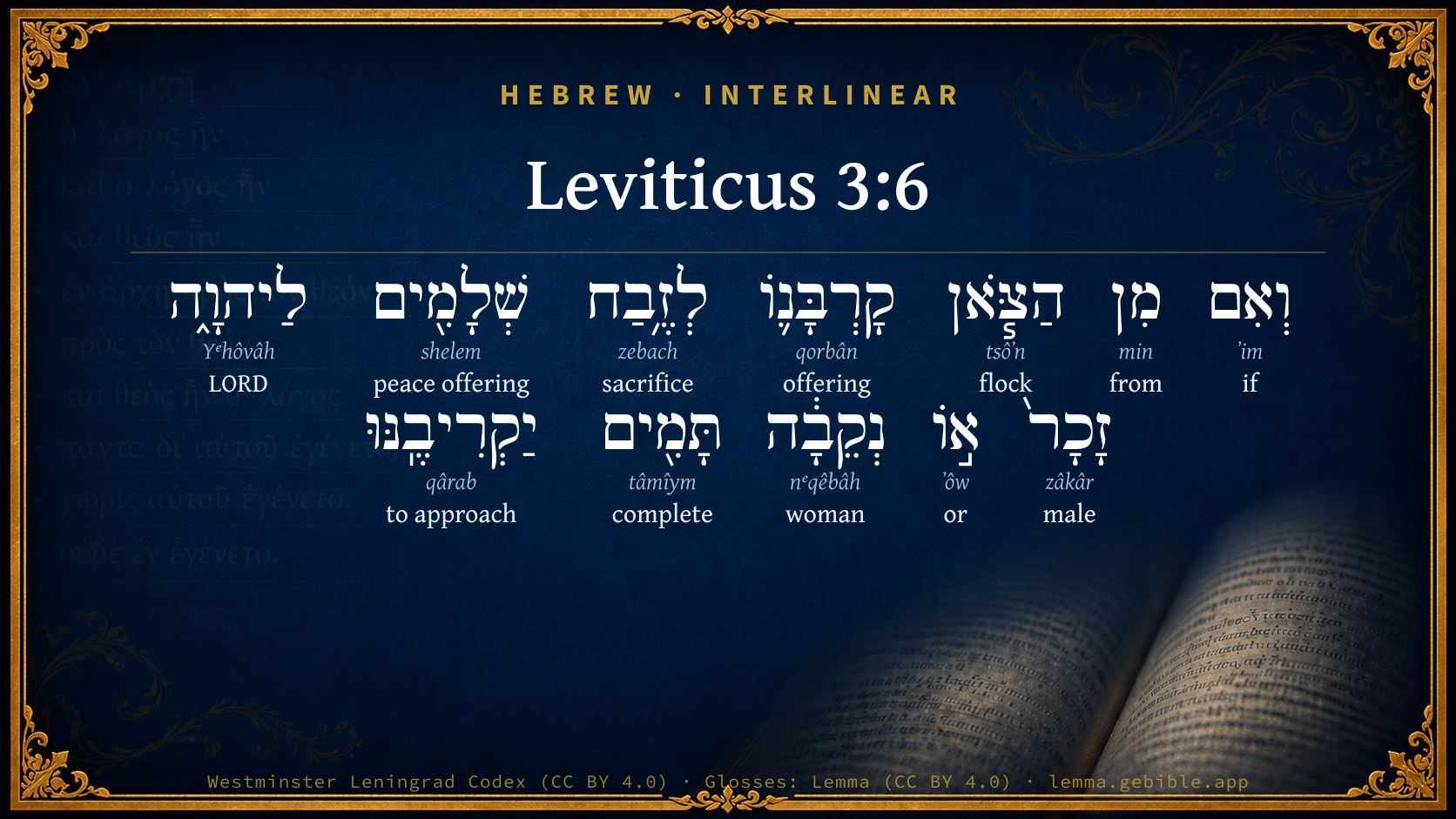
  1. וְאִם ʼim H518 “and · if” Conjunction + Conjunction
  2. מִן min H4480 “from” Preposition
  3. הַצֹּ֧אן tsôʼn H6629 “the · flock” Particle, Definite Article + Noun, Common, Both, Singular, Absolute
  4. קָרְבָּנ֛וֹ qorbân H7133 “offering · his” Noun, Common, Masculine, Singular, Construct + Suffix, Personal, 3rd Person, Masculine, Singular
  5. לְזֶ֥בַח zebach H2077 “to/for · sacrifice of” Preposition + Noun, Common, Masculine, Singular, Construct
  6. שְׁלָמִ֖ים shelem H8002 “peace offerings” Noun, Common, Masculine, Plural, Absolute
  7. לַיהוָ֑ה Yᵉhôvâh H3068 “to/for · LORD” Preposition + Noun, Proper
  8. זָכָר֙ zâkâr H2145 “male” Adjective, Adjective, Masculine, Singular, Absolute
  9. א֣וֹ ʼôw H176 “or” Conjunction
  10. תָּמִ֖ים tâmîym H8549 “complete” Adjective, Adjective, Masculine, Singular, Absolute
  11. יַקְרִיבֶֽנּוּ qârab H7126 “to approach · him” Verb, Hiphil, Imperfect, 3rd Person, Masculine, Singular + Suffix, Personal, 3rd Person, Masculine, Singular

About this verse

These counts appear in no published source. They are computed here, from the morphology-tagged text and Lemma’s own curated glosses. What Lemma adds →

12
words
12
distinct lemmas
Pentateuch
section

Notable vocabulary

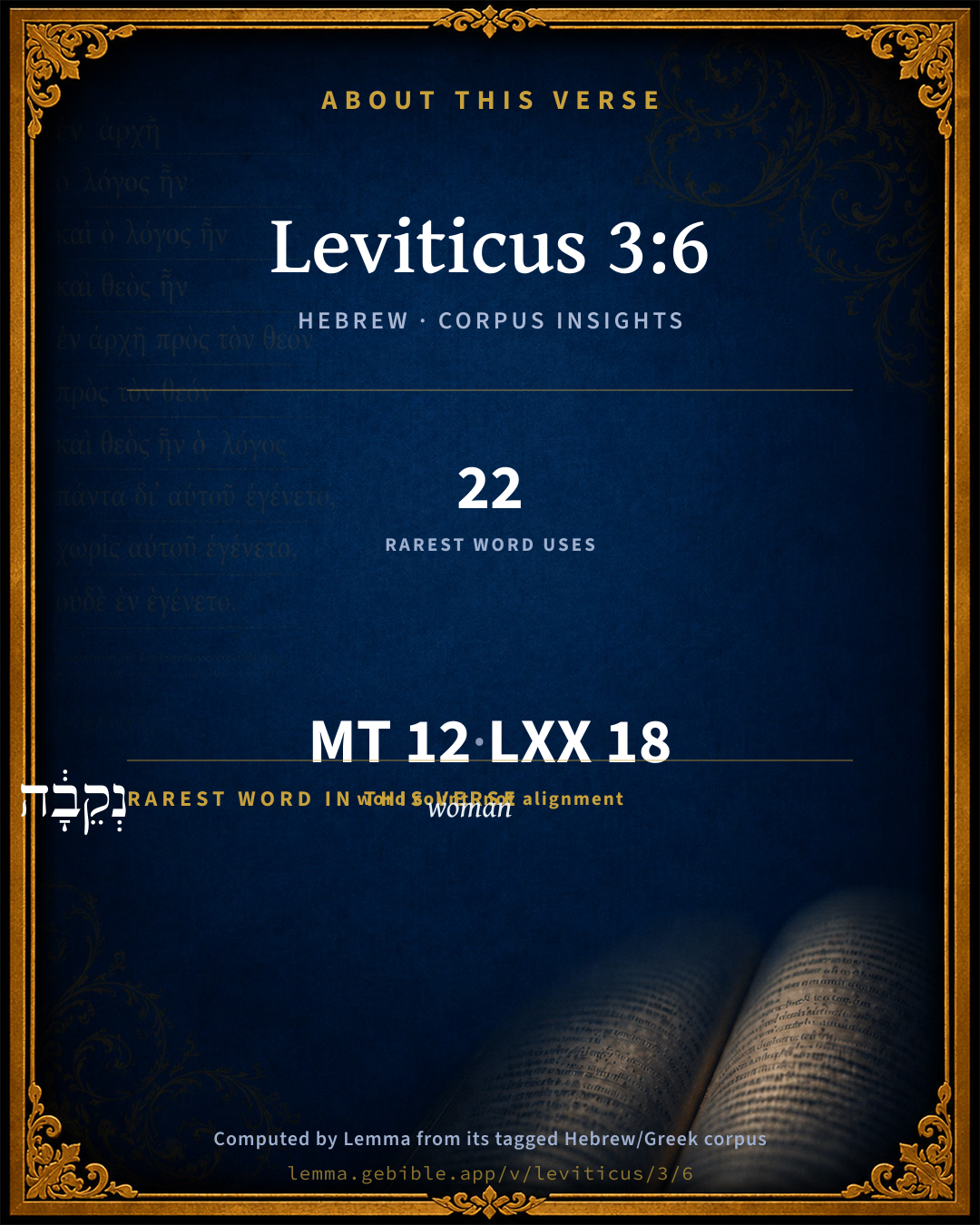
The rarest word here is נְקֵבָ֔ה woman H5347 — appearing just 22 times in the whole Hebrew Bible.

Shared distinctive vocabulary

נְקֵבָ֔ה woman H5347 occurs in 22 verses of the Hebrew Bible. Also found in:

Grammatical profile

  • 1 verb
  • 6 nouns
  • 2 adjectives
  • 1 preposition
  • 2 conjunctions

Verb forms

  • יַקְרִיבֶֽנּוּ Hiphil · Imperfect

Hebrew & Septuagint length

In English translation the verse runs 24 words from the Hebrew and 21 from the Septuagint (LXX English) — closely comparable.

A rough comparison of the two English renderings, which tokenize alike — not a word-level alignment.

Word counts can differ between the Hebrew and the Greek without any difference in meaning — e.g. the Hebrew direct-object marker אֵת has no separate Greek word, and Greek often adds the article ὁ.

In the original languages it is 12 Hebrew tokens and 18 Greek tokens — but the two are counted differently (Hebrew bundles its prefixes and suffixes into one token; the Greek is in lemma form), so that isn’t a like-for-like length.

Cross-references

11

Topical passages linked to Leviticus 3:6 in the Treasury of Scripture Knowledge — connected by theme and wording, ordered by reader-vote popularity; previews shown in the World English Bible.

  • Leviticus 3:1–17 "'If his offering is a sacrifice of peace offerings; if he offers it from the herd, whether male or female, he shall offer it without blemish before Yahweh.
  • Leviticus 1:2 "Speak to the children of Israel, and tell them, 'When anyone of you offers an offering to Yahweh, you shall offer your offering of the cattle, from the herd and from the flock.
  • Leviticus 1:10 "'If his offering is from the flock, from the sheep, or from the goats, for a burnt offering, he shall offer a male without blemish.
  • Isaiah 60:7 All the flocks of Kedar shall be gathered together to you, the rams of Nebaioth shall minister to you; they shall come up with acceptance on my altar; and I will glorify the house of my glory.
  • Acts 4:27 For truly, in this city against your holy servant, Jesus, whom you anointed, both Herod and Pontius Pilate, with the Gentiles and the people of Israel, were gathered together
  • Romans 12:1–2 Therefore I urge you, brothers, by the mercies of God, to present your bodies a living sacrifice, holy, acceptable to God, which is your spiritual service.
  • Galatians 3:28 There is neither Jew nor Greek, there is neither slave nor free man, there is neither male nor female; for you are all one in Christ Jesus.
  • Galatians 4:4 But when the fullness of the time came, God sent out his Son, born to a woman, born under the law,
  • Ephesians 1:10 to an administration of the fullness of the times, to sum up all things in Christ, the things in the heavens, and the things on the earth, in him;
  • Ephesians 2:13–22 But now in Christ Jesus you who once were far off are made near in the blood of Christ.
  • Titus 2:11–12 For the grace of God has appeared, bringing salvation to all men,

Cross-references courtesy of OpenBible.info (CC BY 4.0).

Hebrew and Greek witnesses Masoretic Hebrew ↔ Greek Septuagint

The same verse in the two great witnesses to the Old Testament, shown verse-for-verse.

These are two independent witnesses, not word-aligned to each other, and the Septuagint is shown in lemma (dictionary) form.

Hebrew Leviticus 3:6 Masoretic · Westminster Leningrad Codex

וְאִם מִן הַצֹּ֧אן קָרְבָּנ֛וֹ לְזֶ֥בַח שְׁלָמִ֖ים לַיהוָ֑ה זָכָר֙ א֣וֹ נְקֵבָ֔ה תָּמִ֖ים יַקְרִיבֶֽנּוּ

"'If his offering for a sacrifice of peace offerings to Yahweh is from the flock; male or female, he shall offer it without blemish.

World English Bible · Public Domain

Greek LXX Leviticus 3:6 Septuagint · lemma form

ἐάν δέ ἀπό ὁ πρόβατον ὁ δῶρον αὐτός θυσία σωτήριον ὁ κύριος ἄρσην ἤ θῆλυς ἄμωμος προςφέρω αὐτός

And if his gift be of the sheep, a peace-offering to the Lord, male or female, he shall bring it unblemished.

LXX2012 (modern English Septuagint) · Public Domain

Hebrew: Westminster Leningrad Codex (CC BY 4.0). Greek: Septuagint (public domain); English from LXX2012 (modern English Septuagint) (Public Domain). How the Septuagint differs from the Hebrew →

Targum (Aramaic paraphrase)

2

The Targum is the ancient Jewish Aramaic paraphrase of the Hebrew Scriptures — an interpretive translation, not the Hebrew text itself. Onkelos (literal) and Pseudo-Jonathan (expansive) render the Torah, and Jonathan the Prophets. Coverage is partial: where no permissively-licensed English translation exists for a verse, only the Aramaic is shown. This is verse-level text, not a word-by-word alignment to the Hebrew.

  1. Targum Onkelos Torah (Genesis–Deuteronomy)
    וְאִם מִן עָנָא קוּרְבָּנֵיהּ לְנִכְסַת קוּדְשַׁיָא קֳדָם יְיָ דְכַר אוֹ נוּקְבָא שְׁלִים יְקָרְבִינֵיהּ

    (no public-domain English translation for this verse)

    Targum Onkelos — Aramaic: “Onkelos Genesis” (public domain); “Onkelos Exodus” (public domain); “Onkelos Leviticus” (public domain); “Onkelos Numbers” (public domain); “Onkelos Deuteronomy” (public domain). English: “Sefaria Community Translation” (CC0 1.0 (public-domain dedication)); “J.W. Etheridge. The Targums of Onkelos and Jonathan Ben Uzziel on the Pentateuch. London: Longmans, Green, 1862” (public domain). Text via Sefaria.

  2. Targum Pseudo-Jonathan Torah (Genesis–Deuteronomy)
    וְאִין מִן עָנָא קוּרְבָּנֵיהּ לְנִכְסַת קוּדְשַׁיָא קֳדָם יְיָ דְכַר אוֹ נוּקְבָא שְׁלִים יְקַרְבִינֵיהּ

    And if his oblation of a consecrated offering before the Lord be from the flock, whether male or female, his oblation shall be perfect.

    Targum Pseudo-Jonathan — Aramaic: “Targum Jonathan on Genesis” (public domain); “Targum Jonathan on Exodus” (public domain); “Targum Jonathan on Leviticus” (public domain); “Targum Jonathan on Numbers” (public domain); “Targum Jonathan on Deuteronomy” (public domain). English: “The Targum of Jonathan ben Uzziel, trans. J. W. Etheridge, London, 1862” (public domain). Text via Sefaria.

Commentary

Notes on Leviticus 3:6 from classic Christian and Jewish commentators (each source and its license shown beneath its notes). The classic Christian expositions comment on the surrounding passage and are grouped to its opening verse, so a note may address several verses; the Jewish commentaries on the Tanakh (Rashi and others) are per-verse, so they appear only where the commentator wrote on this verse.

Lemma curates 59 commentaries, every one of them public domain or Creative Commons licensed, each selected and text-cleaned for this edition rather than reprinted as found. About our sources →

Trapp's Complete Commentary

John Trapp

Lev 3:6 And if his offering for a sacrifice of peace offering unto the LORD [be] of the flock; male or female, he shall offer it without blemish.

Ver. 6. Male or female.] See on Lev 3:1.

John Trapp, A Commentary or Exposition upon All the Books of the Old and New Testament (1647–1656) — public domain. Text from a community e-Sword module.

Tyndale Open Study Notes

Tyndale Open Resources

3:6-11 Sheep were smaller, easier to raise, and less expensive than cattle. Apart from the exceptions mentioned in these verses, offerings of sheep followed the same pattern as those of cattle.

Tyndale Open Study Notes — © Tyndale Open Resources, licensed CC BY-SA 4.0. Text via the HelloAO Bible API.

Geneva Bible (1599)

Geneva Bible translators

In the peace offering it was indifferent to offer either male or female, but in the burnt offering only the male: so here can be offered no birds, but in the burnt offering they might: all there was consumed with fire, and in the peace offering put apart.

Geneva Bible (1599) marginal notes — public domain. Text via Bolls.life.

Matthew Henry's Commentary

Directions are here given concerning the peace-offering, if it was a sheep or a goat. Turtle-doves or young pigeons, which might be brought for whole burnt offerings, were not allowed for peace-offerings, because they have no fat considerable enough to be burnt upon the altar; and they would be next to nothing if they were to be divided according to the law of the peace-offerings. The laws concerning a lamb or goat offered for a peace offering are much the same with those concerning a bullock, and little now occurs here; but, 1. The rump of the mutton was to be burnt with the fat of the inwards upon the altar, the whole rump (Lev 3:9), because in those countries it was very fat and large. Some observe from this that, be a thing ever so contemptible, God can make it honourable, by applying it to his service. Thus God is said to give more abundant honour to that part which lacked, Co1 12:23, Co1 12:24. 2. That which was burnt upon the altar is called the food of the offering, Lev 3:11, Lev 3:16. It fed the holy fire; it was acceptable to God as our food is to us; and since in the tabernacle God did, as it were, keep house among them, by the offerings on the altar he kept a good table, as Solomon in his court, Kg1 4:22, etc. 3. Here is a general rule laid down, that all the fat is the Lord's (Lev 3:16), and a law made thereupon, that they should eat neither fat nor blood, no, not in their private houses, Lev 3:17. (1.) As for the fat, it is not meant of that which is interlarded with the meat (that they might eat, Neh 8:10), but the fat of the inwards, the suet, which was always God's part out of the sacrificed beasts; and therefore they must not eat of it, no, not out of the beasts that they killed for their common use. Thus would God preserve the honour of that which was sacred to himself. They must not only not feed upon that fat which was to be the food of the altar, but not upon any like it, lest the table of the Lord (as the altar is called), if something were not reserved peculiar to it, should become contemptible, and the fruit thereof, even its meat, contemptible, Mal 1:7, Mal 1:12. (2.) The blood was universally forbidden likewise, for the same reason that the fat was, because it was God's part of every sacrifice. The heathen drank the blood of their sacrifices; hence we read of their drink-offerings of blood, Psa 16:4. But God would not permit the blood, that made atonement, to be used as a common thing (Heb 10:29), nor will he allow us, though we have the comfort of the atonement made, to assume to ourselves any share in the honour of making it. He that glories, let him glory in the Lord, and to his praise let all the blood be poured out.

Matthew Henry's Commentary on the Whole Bible (1708–1710) — public domain (CC PDM 1.0). Text via the HelloAO Bible API.

Ellicott's Commentary for English Readers

(6) Of the flock.—That is, of sheep or goats; they too might be either male or female, provided only that they were without organic defects.

A Bible Commentary for English Readers, edited by Charles John Ellicott (1878–1897) — public domain. Text from a community e-Sword module.

John Gill's Exposition

And if his offering, for a sacrifice of peace offering unto Lord, be of the flock,.... As it might be: and be either male or female; which he pleased:

he shall offer it without blemish; See Gill on Lev 3:1.

John Gill's Exposition of the Whole Bible (1746–1763) — public domain (CC PDM 1.0). Text via the HelloAO Bible API.

The Pulpit Commentary

Vers. 6-17. The peace offering of the flock.

The ceremony in relation to this is almost identical with that of the herd already described. Nevertheless, there are a few expressions in the course of the description which are not found in the former paragraph. We call attention to

1. THE DESCRIPTION OF THE FAT OF THE LAMB. Verses 8-10.

1. Note the expression, "The fat thereof, and the whole rump." The "and" here is expletive rather than copulative, thus, "The fat thereof, even the whole rump." But the "rump," as vulgarly understood among us, is muscle, not fat. The part here indicated is the tail. This is evident from what follows, viz." It shall be taken off hard by the back-bone." The tail of the sheep even in our climate is fat, but in the East it is remarkably so, some of them weighing from twelve to forty pounds.

2. The portions burnt were very inflammable.

(1) Here, in addition to the fat of the tail, was all the fat of the inwards, which in a sheep might weigh eight or ten pounds. This, when ignited, would be consumed, whatever else may have been laid upon the altar.

(2) These parts were considered to be the seat of the animal passions. In this view the lesson of their consumption upon the altar would be that our passions should be in complete subjection to God. Also to impress upon us that, if not consumed in the milder fires of his love, how obnoxious they are to the fierce fires of his wrath!

(3) The rapid consumption of the fat of lambs upon the altar is therefore appropriately used to describe the extermination of the wicked. "But the wicked shall perish, and the enemies of the Lord shall be as the fat of lambs: they shall consume; into smoke shall they consume away". (Psa_37:20) Fire, it would seem, will be the chief instrument which Providence will summon for the destruction of the threes of Antichrist. (Rev_17:16 Rev_18:9 Rev_19:8, 20 20:9, 14)

II THE EXPRESSION, "FOOD OF THE OFFERING MADE BY FIRE UNTO THE LORD" (verse 11).

1. Thus, what was consumed by fire is called God"s food.

(1) Some construe this to mean that what is consumed is food for the fire. But this is to give no information. Nor would this be a sufficient reason for the prohibition of the fat as food for an Israelite (see verses 16, 17). Note, the fat intermingled with the flesh was not forbidden, but those portions only which were prescribed to be offered upon the altar. (see Neh_8:10)

(2) But how could God be said to feast upon such food? Not literally, certainly. (see Psa_1:1-3) But figuratively. Thus his attributes of justice and mercy are, so to speak, hungry for satisfaction; and this satisfaction they find in that sacrifice of Christ, in virtue of which he is not only merciful, but just in justifying the ungodly. (Rom_3:24-26)

(3) To avail ourselves of this mercy of God, we must justify him, viz. by hearty repentance and true faith. While God magnifies his justice in his mercy, we, too, must magnify his justice in his mercy.

2. The portions of the peace offering not consumed upon the altar were eaten by men.

(1) Here, then, was the expression of a fellowship between God and men, which is established through sacrifice. This glorious privilege is set forth also in the Christian Eucharist. We feast with the Lord at his table. (1Co_10:21)

(2) Here also was fellowship between religious men. The priest had his portion, and the offerer his. That the offerer should feast with a Gentile would have been profanity. So the fellowship of Christians is with the holy universe. (Heb_12:22-24)

III THE NOTE PROHIBITING THE EATING OF BLOOD. Verse 17.

1. What are the reasons for this?

(1) The first is that the blood is the life of the flesh. The prohibition of blood as food is a Noachian precept, and this reason is given there. The object is to set a store upon life. (see Gen_9:4-6)

(2) The second is that blood is given upon the altar to make atonement for the soul, viz. life for the life. (Lev_17:10-14) The atoning blood of Christ must not be treated as a common thing. (Heb_10:29)

2. We may here refer to a circumstance in connection with the bleeding ofthe sacrifice.

(1) The Jews tell us that the animal, after the slaughtering, was suspended on hooks near the place of rings for the removing of the skin. How suggestive of the hanging of Jesus upon the tree of his cross!

(2) The next thing was the opening of the heart, to let the remaining blood escape. That this should happen to Christ was a special subject of prophecy. (Zec_12:10 Joh_19:34)

(3) To human appearance this prophecy seems to have been fulfilled as by accident. The same remark may be applied to the fulfillment of many prophecies. There are no mere accidents. The careful hand of an all-wise Providence is in everything. J.A.M.

Vers. 6-16. Varieties in the offerings unity in the sacrifice.

Whether from the herd or from the flock, an offering of larger or smaller value, the same principle applies the unblemished gift, the separation of the fat and of the blood, the observance of all prescribed order and detail

I Here is the TRUE RELIGIOUS LIBERTY. Obedience according to ability, "doing the will of God from the heart." The variety which is necessitated in God"s children by their different capabilities and circumstances is not displeasing to him. If we cannot bring an offering from the herd, then from the flock; if not a sheep, then a lamb; if neither, then the will for the deed. Yet all can do something. "Unto every one of us is given grace according to the measure of the gift of Christ". (Eph 4 and 1Co 12)

II Here is the secret of SOCIAL PEACE AND STRENGTH the only true equality; God"s altar bringing together rich and poor, high and low. All, offering what they can to him, find out each other"s nearness and worth. In the house of God the poor man may be a higher servant of the sanctuary than the rich. Society rests on religion as its basis. Mistake of philosophy, which gives us not brotherhood but altruism not family life but mere expediency. The true conception of a State is every one having a place, and every one in his place. None but the religious view, which makes the altar of God the center, really effects this union of the individual interest with that of the community. The true mother does not despise the sickly child. Philosophy exalts the great and depresses the little. Religion humbles the great and exalts the low. The revelation is to babes. The offering is accepted from the weakest hands. All are one in Christ. The perfect Sacrifice blends all together. R.

The Pulpit Commentary (1880–1919), ed. H.D.M. Spence-Jones & Joseph S. Exell — public domain. Text from a community e-Sword module.

Keil & Delitzsch

C. F. Keil & F. Delitzsch

The same rules apply to the peace-offerings of sheep and goats, except that, in addition to the fat portions, which were to be burned upon the altar in the case of the oxen (Lev 3:3, Lev 3:4) and goats (Lev 3:14, Lev 3:15), the fat tail of the sheep was to be consumed as well. תמימה האליה: "the fat tail whole" (Lev 3:9), cauda ovilla vel arietina eaque crassa et adiposa; the same in Arabic (Ges. thes. p. 102). The fat tails which the sheep have in Northern Africa and Egypt, also in Arabia, especially Southern Arabia, and Syria, often weigh 15 lbs. or more, and small carriages on wheels are sometimes placed under them to bear their weight (Sonnini, R. ii. p. 358; Bochart, Hieroz. i. pp. 556ff.). It consists of something between marrow and fat. Ordinary sheep are also found in Arabia and Syria; but in modern Palestine all the sheep are "of the broad-tailed species." The broad part of the tail is an excresence of fat, from which the true tail hangs down (Robinson, Pal. ii. 166). "Near the rump-bone shall he (the offerer) take it (the fat tail) away," i.e., separate it from the body. עצם, ἁπ. λεγ., is, according to Saad., os caudae s. coccygis, i.e., the rump or tail-bone, which passes over into the vertebrae of the tail (cf. Bochart, i. pp. 560-1). In Lev 3:11 and Lev 3:16 the fat portions which were burned are called "food of the firing for Jehovah," or "food of the firing for a sweet savour," i.e., food which served as a firing for Jehovah, or reached Jehovah by being burned; cf. Num 28:24, "food of the firing of a sweet savour for Jehovah." Hence not only are the daily burnt-offerings and the burnt and sin-offerings of the different feasts called "food of Jehovah" ("My bread," Num 28:2); but the sacrifices generally are described as "the food of God" ("the bread of their God," Lev 21:6, Lev 21:8, Lev 21:17, Lev 21:21-22, and Lev 22:25), as food, that is, which Israel produced and caused to ascend to its God in fire as a sweet smelling savour. - Nothing is determined here with regard to the appropriation of the flesh of the peace-offerings, as their destination for a sacrificial meal was already known from traditional custom. The more minute directions for the meal itself are given in Lev 7:11-36, where the meaning of these sacrifices is more fully explained. - In Lev 3:17 (Lev 3:16) the general rule is added, "all fat belongs to Jehovah," and the law, "eat neither fat nor blood," is enforced as "an eternal statute" for the generations of Israel (see at Exo 12:14, Exo 12:24) in all their dwelling-places (see Exo 10:23 and Exo 12:20).

Keil & Delitzsch — Biblical Commentary on the Old Testament (1861–1891) — public domain (CC PDM 1.0). Text via the HelloAO Bible API. (Old Testament only.)

Kretzmann's Popular Commentary

Paul E. Kretzmann

Of the Flock

v. 6. And if his offering for a sacrifice of peace-offering unto the Lord be of the flock, male or female, he shall offer it without blemish. The sex was immaterial, but the animal had to be perfect, as before.

v. 7. If he offer a lamb for his offering, then shall he offer it before the Lord, for the purpose of securing the good pleasure of the Lord.

v. 8. And he (the worshiper) shall lay his hand upon the head of his offering, and kill it before the Tabernacle of the Congregation, out in the open court; and Aaron’s sons shall sprinkle the blood thereof round about upon the altar, the act having the same significance as before.

v. 9. And he shall offer of the sacrifice of the peace-offering an offering made by fire unto the Lord, that portion of the sacrificial victim burned upon the altar being known as the food of Jehovah and signifying the communion between Him and the worshiper brought about by the sacrifice; the fat thereof and the whole rump, the heavy fat-tail which is characteristic of a certain variety of sheep in Arabia and Palestine, it shall he take off hard by the backbone; and the fat that covereth the inwards, and all the fat that is upon the inwards, as in the case of the larger animal. v. 3,

v. 10. and the two kidneys, and the fat that is upon them, which is by the flanks, and the caul above the liver, with the kidneys, that is, upon the kidneys, it shall he take away. Cf v. 4.

v. 11. And the priest shall burn it upon the altar; it is the food of the offering made by fire unto the Lord, a food offered by the believing Israelite by fire and rising up to the Lord in an odor well-pleasing to Him. In this manner the Lord partook of the sacrifice and entered in to fellowship with His people.

Paul E. Kretzmann, Popular Commentary of the Bible (1921–1924) — public domain. Text from a community e-Sword module.

unfoldingWord translationNotes

Door43 World Missions Community

offer it before Yahweh

"offer it in the presence of Yahweh" or "offer it to Yahweh"

lay his hand on the head

This is a symbolic action that identifies the person with the animal he is offering. In this way the person is offering himself to Yahweh through the animal. (See: Symbolic Action)

Aaron's sons will sprinkle its blood

It is implied that before they sprinkle the blood, they catch the blood in a bowl as it drains from the animal. (See: Assumed Knowledge and Implicit Information)

translationWords

fellowship offering

Yahweh

flocks

blemish

lamb

tent of meeting

Aaron

altar

unfoldingWord translationNotes — © Distant Shores Media and the Door43 World Missions Community, licensed CC BY-SA 4.0. Source: git.door43.org/Door43/en_tn.

Lesson kit

Teaching starters — assembled from the data on this page, not authored interpretation. Every prompt links to the verse data it draws on. Edit before teaching.

Leviticus, in the Pentateuch, opens this verse with 12 words (12 distinct Hebrew lemmas). Its most distinctive word is nᵉqêbâh (“woman”). A historical commentator’s framing appears above. Read the whole chapter for the surrounding context.

Discussion questions

  1. How does “woman” (nᵉqêbâh) shape what this verse is saying?
  2. How does Genesis 1:27, which shares the word «woman», read alongside this verse?
  3. These translations render this verse differently. What is at stake in choosing one wording over another?
  4. «יַקְרִיבֶֽנּוּ» is a Hiphil Imperfect verb. How does that grammatical form shape the action described?
  5. Compare how Trapp's Complete Commentary and Tyndale Open Study Notes read this verse. Where do they agree or differ?

Things to notice

Reading settings

Reading text

Shown beneath each verse's original-language words.

Old Testament
Old Testament edition

Read the OT as the Masoretic Hebrew (MT) or the Greek Septuagint (LXX).

English shown for the Greek Septuagint (in the Hebrew ↔ Greek comparison).

Comparing translations? Open the Compare panel on any verse page to stack up to four side by side.