Genesis 8:2

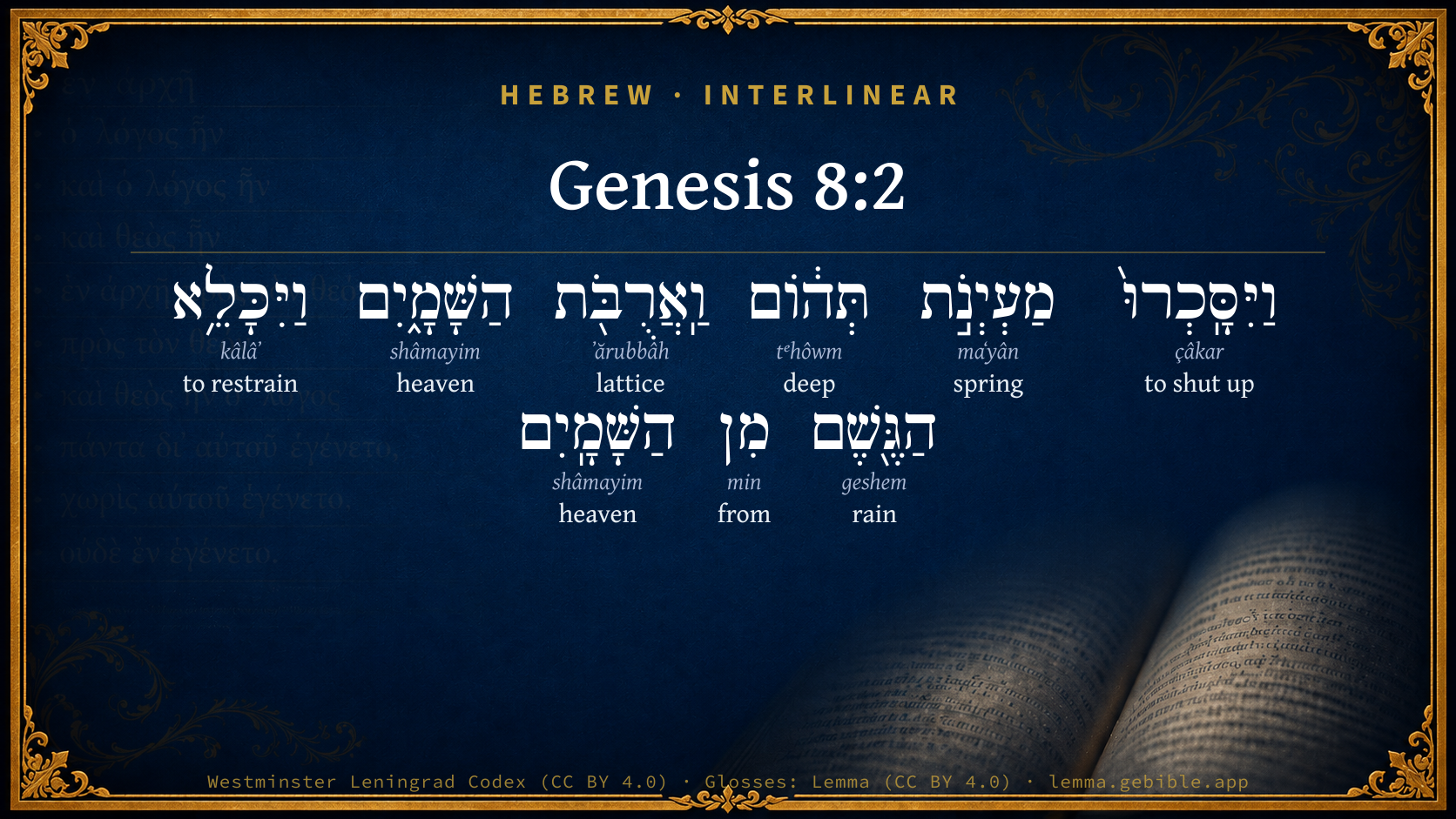
Hebrew (Westminster Leningrad Codex) Genesis 8:2 appears in the Hebrew Old Testament. The text above is from the Westminster Leningrad Codex. Each word links to its Strong’s number, a concise gloss, and parsing drawn from the Open Scriptures Hebrew Bible morphology. Click any word for its full Brown-Driver-Briggs (BDB) entry.
Download image
Cite this verse

Genesis 8:2 (World English Bible). Public Domain. Lemma interlinear Bible study tool, https://lemma.gebible.app/v/genesis/8/2.

Show BibTeX & RIS
BibTeX
RIS
English Translation
The deep's fountains and the sky's windows were also stopped, and the rain from the sky was restrained.
World English Bible · Public Domain
Highlights
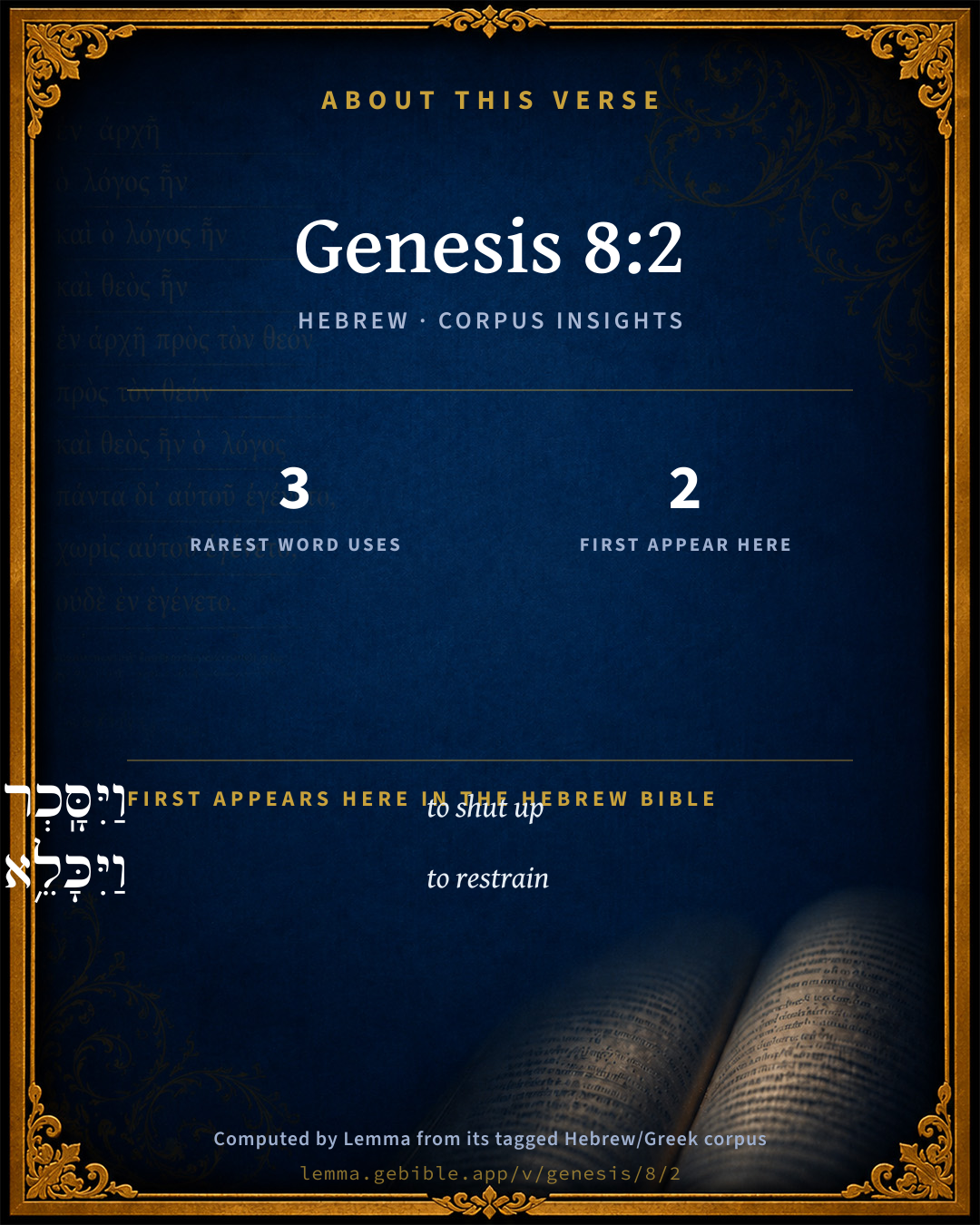
  • 2 first appearances in the Hebrew Bible
Full analysis ↓
Download a study sheet

One document with this verse’s original text, its word-by-word gloss line, the meaning frame, cross-references with their text, attributed commentary, and full source and license credits — printable, and it pastes into notes with its structure intact.

This verse Autodidact and up

Study sheet (.html) Plain text (.txt)

A passage Seminary Student

Up to 50 verses in one chapter. A passage sheet keeps up to 6 commentary sources and 12 cross-references per verse, in the order this page ranks them, and says so on the sheet whenever that leaves anything out. Ask for a single verse and you get the Autodidact verse sheet above.

Everything on this page stays free to read, with no account — the sheet is a download of what is already on screen, not access to it.

Want to remove ads? Support Godless Engineer
Compare translations 3

The same verse in 3 English versions, stacked beneath the original-language interlinear above. Click any original word for its lexicon entry.

Each is an independent rendering of the whole verse — the interlinear is not word-aligned to these translations.

Highlighted words mark where these versions differ — a whole-verse word diff, not a word-by-word alignment.

  • World English Bible Public Domain
    The deep's fountains and the sky's windows were also stopped, and the rain from the sky was restrained.
  • King James Version Public Domain
    The fountains also of the deep and the windows of heaven were stopped, and the rain from heaven was restrained;
  • unfoldingWord Literal Text CC BY-SA 4.0
    And the fountains of the deep and the windows of the heavens were closed, and the rain from the heavens was stopped.

unfoldingWord Literal Text — © unfoldingWord, licensed CC BY-SA 4.0. Word-aligned USFM3 via Door43 (git.door43.org/unfoldingWord/en_ult).

Versions to compare (up to 4)

3 of 4 selected

Show all 18 translations

Every available English version of this verse, each an independent rendering of the whole verse.

  • World English Bible Public Domain
    The deep's fountains and the sky's windows were also stopped, and the rain from the sky was restrained.
  • Berean Standard Bible Public Domain
    The springs of the deep and the floodgates of the heavens were closed, and the rain from the sky was restrained.
  • Majority Standard Bible Public Domain
    The springs of the deep and the floodgates of the heavens were closed, and the rain from the sky was restrained.
  • King James Version Public Domain
    The fountains also of the deep and the windows of heaven were stopped, and the rain from heaven was restrained;
  • American Standard Version (1901) Public Domain
    the fountains also of the deep and the windows of heaven were stopped, and the rain from heaven was restrained;
  • Revised Version (1885) Public Domain
    the fountains also of the deep and the windows of heaven were stopped, and the rain from heaven was restrained;
  • Geneva Bible (1599) Public Domain
    The fountaines also of the deepe and the windowes of heauen were stopped and the raine from heauen was restrained,
  • Douay-Rheims (1899) Public Domain
    The fountains also of the deep, and the flood gates of heaven were shut up, and the rain from heaven was restrained.
  • Young's Literal Translation Public Domain
    and closed are the fountains of the deep and the net-work of the heavens, and restrained is the shower from the heavens.
  • Literal Standard Version CC BY-SA 4.0
    and the fountains of the deep and the network of the heavens are closed, and the shower is restrained from the heavens.
  • Unlocked Literal Bible CC BY-SA 4.0
    The fountains of the deep and the windows of heaven were closed, and it stopped raining.
  • unfoldingWord Literal Text CC BY-SA 4.0
    And the fountains of the deep and the windows of the heavens were closed, and the rain from the heavens was stopped.
  • Darby Bible Public Domain
    And the fountains of the deep and the windows of heaven were closed, and the pour of rain from heaven was stopped.
  • World Messianic Bible Public Domain
    The deep’s fountains and the sky’s windows were also stopped, and the rain from the sky was restrained.
  • Webster's Bible Public Domain
    The fountains also of the deep, and the windows of heaven were stopped, and the rain from heaven was restrained;
  • Free Bible Version CC BY-SA 4.0
    The subterranean waters were closed off, and the heavy rainfall was stopped.
  • Bible in Basic English Public Domain
    And the fountains of the deep and the windows of heaven were shut, and the rain from heaven was stopped.
  • JPS Tanakh (1917) Public Domain
    the fountains also of the deep and the windows of heaven were stopped, and the rain from heaven was restrained.

Literal Standard Version (2020), Covenant Press — licensed CC BY-SA 4.0. Text via the HelloAO Bible API (eBible.org). Unlocked Literal Bible (unfoldingWord) — licensed CC BY-SA 4.0. Text via the HelloAO Bible API (eBible.org). unfoldingWord Literal Text — © unfoldingWord, licensed CC BY-SA 4.0. Word-aligned USFM3 via Door43 (git.door43.org/unfoldingWord/en_ult). Free Bible Version, Dr. Jonathan Gallagher — licensed CC BY-SA 4.0. Text via the HelloAO Bible API (eBible.org).

Word by word

More ways to search: Search by grammar → Find every occurrence → Compare this word →

Practice this passage: Drill this verse → Learn its vocabulary →

וַיִּסָּֽכְרוּ֙
çâkar
H5534
“and · to shut up”
Conjunction + Verb, Niphal, Sequential Imperfect, 3rd Person, Masculine, Plural
Part of Speech
Conjunction + Verb
Stem
Niphal
Form
Sequential Imperfect
Person
3rd Person
Gender
Masculine
Number
Plural
Full BDB Definition

Origin: a primitive root

TWOT: 1497 , 1498

to shut up, stop up - (Niphal) to be stopped, be shut up - (Piel) to shut up, give over
  1. מַעְיְנֹ֣ת maʻyân H4599 “springs of” Noun, Common, Masculine, Plural, Construct
  2. תְּה֔וֹם tᵉhôwm H8415 “deep” Noun, Common, Both, Singular, Absolute
  3. וַֽאֲרֻבֹּ֖ת ʼărubbâh H699 “and · lattices of” Conjunction + Noun, Common, Feminine, Plural, Construct
  4. הַשָּׁמָ֑יִם shâmayim H8064 “the · heaven(s)” Particle, Definite Article + Noun, Common, Masculine, Plural, Absolute
  5. וַיִּכָּלֵ֥א kâlâʼ H3607 “and · to restrain” Conjunction + Verb, Niphal, Sequential Imperfect, 3rd Person, Masculine, Singular
  6. הַגֶּ֖שֶׁם geshem H1653 “the · rain” Particle, Definite Article + Noun, Common, Masculine, Singular, Absolute
  7. מִן min H4480 “from” Preposition
  8. הַשָּׁמָֽיִם shâmayim H8064 “the · heaven(s)” Particle, Definite Article + Noun, Common, Masculine, Plural, Absolute

About this verse

These counts appear in no published source. They are computed here, from the morphology-tagged text and Lemma’s own curated glosses. What Lemma adds →

9
words
8
distinct lemmas
Pentateuch
section

Notable vocabulary

The rarest word here is וַיִּסָּֽכְרוּ֙ to shut up H5534 — appearing just 3 times in the whole Hebrew Bible.

First appearance in Scripture

These words make their first canonical appearance in the Hebrew Bible here:

  • וַיִּסָּֽכְרוּ֙ to shut up H5534
  • וַיִּכָּלֵ֥א to restrain H3607

Shared distinctive vocabulary

וַיִּסָּֽכְרוּ֙ to shut up H5534 occurs in 3 verses of the Hebrew Bible. Also found in:

Grammatical profile

  • 2 verbs
  • 6 nouns
  • 1 preposition

Verb forms

  • וַיִּסָּֽכְרוּ֙ Niphal · Sequential Imperfect
  • וַיִּכָּלֵ֥א Niphal · Sequential Imperfect

Repetition

A word recurs within this verse — often emphatic in Hebrew:

  • הַשָּׁמָ֑יִם heaven H8064 ×2

Hebrew & Septuagint length

In English translation the verse runs 18 words from the Hebrew and 21 from the Septuagint (LXX English) — closely comparable.

A rough comparison of the two English renderings, which tokenize alike — not a word-level alignment.

Word counts can differ between the Hebrew and the Greek without any difference in meaning — e.g. the Hebrew direct-object marker אֵת has no separate Greek word, and Greek often adds the article ὁ.

Cross-references

7

Topical passages linked to Genesis 8:2 in the Treasury of Scripture Knowledge — connected by theme and wording, ordered by reader-vote popularity; previews shown in the World English Bible.

  • Genesis 7:11 In the six hundredth year of Noah's life, in the second month, on the seventeenth day of the month, on the same day all the fountains of the great deep were burst open, and the sky's windows were opened.
  • Matthew 8:26–27 He said to them, "Why are you fearful, oh you of little faith?" Then he got up, rebuked the wind and the sea, and there was a great calm.
  • Proverbs 8:28 When he established the clouds above, When the springs of the deep became strong,
  • Job 37:11–13 Yes, he loads the thick cloud with moisture. He spreads abroad the cloud of his lightning.
  • Job 38:37 Who can number the clouds by wisdom? Or who can pour out the bottles of the sky,
  • Jonah 2:3 For you threw me into the depths, In the heart of the seas. The flood was all around me. All your waves and your billows passed over me.
  • Matthew 8:9 For I am also a man under authority, having under myself soldiers. I tell this one, 'Go,' and he goes; and tell another, 'Come,' and he comes; and tell my servant, 'Do this,' and he does it."

Cross-references courtesy of OpenBible.info (CC BY 4.0).

Hebrew and Greek witnesses Masoretic Hebrew ↔ Greek Septuagint

The same verse in the two great witnesses to the Old Testament, shown verse-for-verse.

These are two independent witnesses, not word-aligned to each other, and the Septuagint is shown in lemma (dictionary) form.

Hebrew Genesis 8:2 Masoretic · Westminster Leningrad Codex

וַיִּסָּֽכְרוּ֙ מַעְיְנֹ֣ת תְּה֔וֹם וַֽאֲרֻבֹּ֖ת הַשָּׁמָ֑יִם וַיִּכָּלֵ֥א הַגֶּ֖שֶׁם מִן הַשָּׁמָֽיִם

The deep's fountains and the sky's windows were also stopped, and the rain from the sky was restrained.

World English Bible · Public Domain

Greek LXX Genesis 8:2 Septuagint · lemma form

καί ἐπικαλύπτω ὁ πηγή ὁ ἄβυσσος καί ὁ καταρράκτης ὁ οὐρανός καί συνἔχω ὁ ὑετός ἀπό ὁ οὐρανός

And the fountains of the deep were closed up, and the flood-gates of heaven, and the rain from heaven was withheld.

LXX2012 (modern English Septuagint) · Public Domain

On this verse, The Pulpit Commentary discusses the Septuagint’s reading. Read the note in Commentary ↓

Hebrew: Westminster Leningrad Codex (CC BY 4.0). Greek: Septuagint (public domain); English from LXX2012 (modern English Septuagint) (Public Domain). How the Septuagint differs from the Hebrew →

Targum (Aramaic paraphrase)

2

The Targum is the ancient Jewish Aramaic paraphrase of the Hebrew Scriptures — an interpretive translation, not the Hebrew text itself. Onkelos (literal) and Pseudo-Jonathan (expansive) render the Torah, and Jonathan the Prophets. Coverage is partial: where no permissively-licensed English translation exists for a verse, only the Aramaic is shown. This is verse-level text, not a word-by-word alignment to the Hebrew.

  1. Targum Onkelos Torah (Genesis–Deuteronomy)
    וְאִסְתְּכָרוּ מַבּוּעֵי תְהוֹמָא וְכַוֵּי שְׁמַיָּא וְאִתְכְּלִי מִטְרָא מִן שְׁמַיָּא

    and the springs of the abyss were shut, and the windows of the heavens, and the rain from the heavens was restrained,

    Targum Onkelos — Aramaic: “Onkelos Genesis” (public domain); “Onkelos Exodus” (public domain); “Onkelos Leviticus” (public domain); “Onkelos Numbers” (public domain); “Onkelos Deuteronomy” (public domain). English: “Sefaria Community Translation” (CC0 1.0 (public-domain dedication)); “J.W. Etheridge. The Targums of Onkelos and Jonathan Ben Uzziel on the Pentateuch. London: Longmans, Green, 1862” (public domain). Text via Sefaria.

  2. Targum Pseudo-Jonathan Torah (Genesis–Deuteronomy)
    וְאִסְתַּגְרוּ מַבּוּעֵי תְּהוֹמָא וַחֲרַכֵּי שְׁמַיָא וְאִתְמְנַע מִטְרָא מִלְמֵיחַת מִן שְׁמַיָא

    And the fountains of the deep were shut up, and the windows of heaven, and the rain was forbidden to descend from heaven.

    Targum Pseudo-Jonathan — Aramaic: “Targum Jonathan on Genesis” (public domain); “Targum Jonathan on Exodus” (public domain); “Targum Jonathan on Leviticus” (public domain); “Targum Jonathan on Numbers” (public domain); “Targum Jonathan on Deuteronomy” (public domain). English: “The Targum of Jonathan ben Uzziel, trans. J. W. Etheridge, London, 1862” (public domain). Text via Sefaria.

Commentary

Notes on Genesis 8:2 from classic Christian and Jewish commentators (each source and its license shown beneath its notes). The classic Christian expositions comment on the surrounding passage and are grouped to its opening verse, so a note may address several verses; the Jewish commentaries on the Tanakh (Rashi and others) are per-verse, so they appear only where the commentator wrote on this verse.

Lemma curates 59 commentaries, every one of them public domain or Creative Commons licensed, each selected and text-cleaned for this edition rather than reprinted as found. About our sources →

Trapp's Complete Commentary

John Trapp

Gen 8:2 The fountains also of the deep and the windows of heaven were stopped, and the rain from heaven was restrained;

Ver. 2. And the rain from heaven was restrained.] These four keys, say the Rabbis, God keeps under his own belt: 1. Of the womb; 2. Of the grave; 3. Of the rain; 4. Of the heart. "He openeth, and no man shutteth; he shutteth and no man openeth". {Rev 3:7}

John Trapp, A Commentary or Exposition upon All the Books of the Old and New Testament (1647–1656) — public domain. Text from a community e-Sword module.

Tyndale Open Study Notes

Tyndale Open Resources

8:2 underground waters . . . torrential rains: See study note on 7:11-12.

Tyndale Open Study Notes — © Tyndale Open Resources, licensed CC BY-SA 4.0. Text via the HelloAO Bible API.

John Gill's Exposition

The fountains also of the deep, and the windows of heaven, were stopped,.... The passages which let out the subterraneous waters in great quantity upon the earth, and the clouds of heaven, which poured down water upon it like spouts, were stopped from sending forth any more, as they had from the first of the flood unto one hundred and fifty days from thence: Jarchi observes, that it is not said that "all" the fountains of the deep, as when they were broken up, Gen 7:11 because some of them were left open for the use and benefit of the world; besides, some must be left for the return of the waters:

and the rain from heaven was restrained: which seems to confirm what has been before observed, that after the rain of forty days and nights it ceased not to rain, more or less, though not so vehemently, until the end of an hundred and fifty days, and then it entirely ceased.

John Gill's Exposition of the Whole Bible (1746–1763) — public domain (CC PDM 1.0). Text via the HelloAO Bible API.

The Pulpit Commentary

The fountains also of the deep, and the windows of heaven were stopped. WrkSYiw, from rksrgs; to surround, to enclose; literally, were shut up; ejpekalufqhsan (LXX.). Their opening was described in Gen_7:11. And the rain from heaven was restrained. aleKYiw, literally, was shut up, from alK to close. Cf. kleiw, kwluw, kolouw, celo, occulo (Gesenius, Furst), sunesceqh (LXX). At the end of the forty; (Gen_7:12; Augustine, Willet) at the end of the 150 days (Aben Ezra, Murphy).

The Pulpit Commentary (1880–1919), ed. H.D.M. Spence-Jones & Joseph S. Exell — public domain. Text from a community e-Sword module.

Rashi

Rabbi Shlomo Yitzchaki (Rashi)

ויסכרו מעינות AND THE FOUNTAINS … WERE STOPPED –– When they were opened, it was stated that all fountains were opened (7:11), whilst here the word all is omitted: the reason is that such of them as were essential to the world were left unstopped, such as the hot springs of Tiberias and their like (Sanhedrin 108a).

ויכלא means was restrained. withheld, as (Psalms 40:12) “Thou wilt not withhold (תכלא) thy mercies” and (Genesis 23:6) “None of us will withhold (יכלה) from thee.’’

Rashi on the Tanakh — English translations: “The Judaica Press complete Tanach with Rashi, translated by A. J. Rosenberg” (CC BY 4.0); “Pentateuch with Rashi's commentary by M. Rosenbaum and A.M. Silbermann, 1929-1934” (public domain); “The Metsudah Tanach series, Lakewood, N.J” (CC BY 4.0); and “The Book of Joshua, Metsudah Publications, 1997” (CC BY 4.0). Text via Sefaria.

Radak

Rabbi David Kimhi (Radak)

ויסכרו, they were shut, i.e. prevented from adding further turbulence on the surface of the waters which had flooded the globe. As a result of the wind blowing, the earth gradually began to dry out, the moisture being blown away, gradually. However, these subterranean wells were not all of them shut off. This enabled some of the waters on the surface of the globe to flow back gradually into the bowels of the earth from which they had come forth. While it is true that at the time these waters had risen to the surface they had found many more apertures through which to rise, and their appearance on the surface had been rapid, now it seeped back at a much slower pace.

וארבות השמים, those “windows” of the heavens had already closed after the forty days of rainfall. Now no more water inundated the earth either from above or from below.

ויכלא הגשם, the Torah mentions this to tell us that not even normal rainfall still occurred during this period when the earth returned to normal.

ויסכרו, the word is spelled with the letter כ,.which in this instance is used instead of the customary letter ג, in the root סגר. The construction is not unique, as we also find it in Psalms 63,12 כי יסכר פי דובר שקר, “when the mouth of liars is stopped.”

Radak on the Tanakh — English translations: “Sefaria Community Translation” (CC0 1.0 (public-domain dedication)); “Eliyahu Munk, HaChut Hameshulash” (CC BY 4.0); “Rabbi Mike Feuer, Jerusalem Anthology” (CC BY 4.0); and “R. David Kimhi on the first book of Psalms, Translated by R.G. Finch, London, 1919” (public domain). Text via Sefaria.

Lesson kit

Teaching starters — assembled from the data on this page, not authored interpretation. Every prompt links to the verse data it draws on. Edit before teaching.

Genesis, in the Pentateuch, opens this verse with 9 words (8 distinct Hebrew lemmas). Its most distinctive word is çâkar (“to shut up”). A historical commentator’s framing appears above. Read the whole chapter for the surrounding context.

Discussion questions

  1. What does “to shut up” (çâkar) contribute to the verse as a whole?
  2. 2 words here appear for the first time in Scripture. What is being introduced at this debut?
  3. Psalms 63:11 shares the word «to shut up» with this verse. How do the two illuminate each other?
  4. “heaven” occurs 2× in this one verse. What is the effect of the repetition?
  5. The translations on this page render this verse differently — a whole-verse word diff, not a word-by-word alignment. What might account for the different wordings?
  6. The verb «וַיִּסָּֽכְרוּ֙» is Niphal Sequential Imperfect. How does its form color the action?
  7. Reading how Trapp's Complete Commentary and Tyndale Open Study Notes read this verse, where do the two commentators agree and where do they part?

Things to notice

  • 2 words make their first canonical appearance in Scripture here.
  • These translations choose different wording for 9 words in this verse.
  • “heaven” occurs 2× in this single verse.
  • 8 distinct Hebrew lemmas span 9 words in this verse.

Reading settings

Reading text

Shown beneath each verse's original-language words.

Old Testament
Old Testament edition

Read the OT as the Masoretic Hebrew (MT) or the Greek Septuagint (LXX).

English shown for the Greek Septuagint (in the Hebrew ↔ Greek comparison).

Comparing translations? Open the Compare panel on any verse page to stack up to four side by side.