
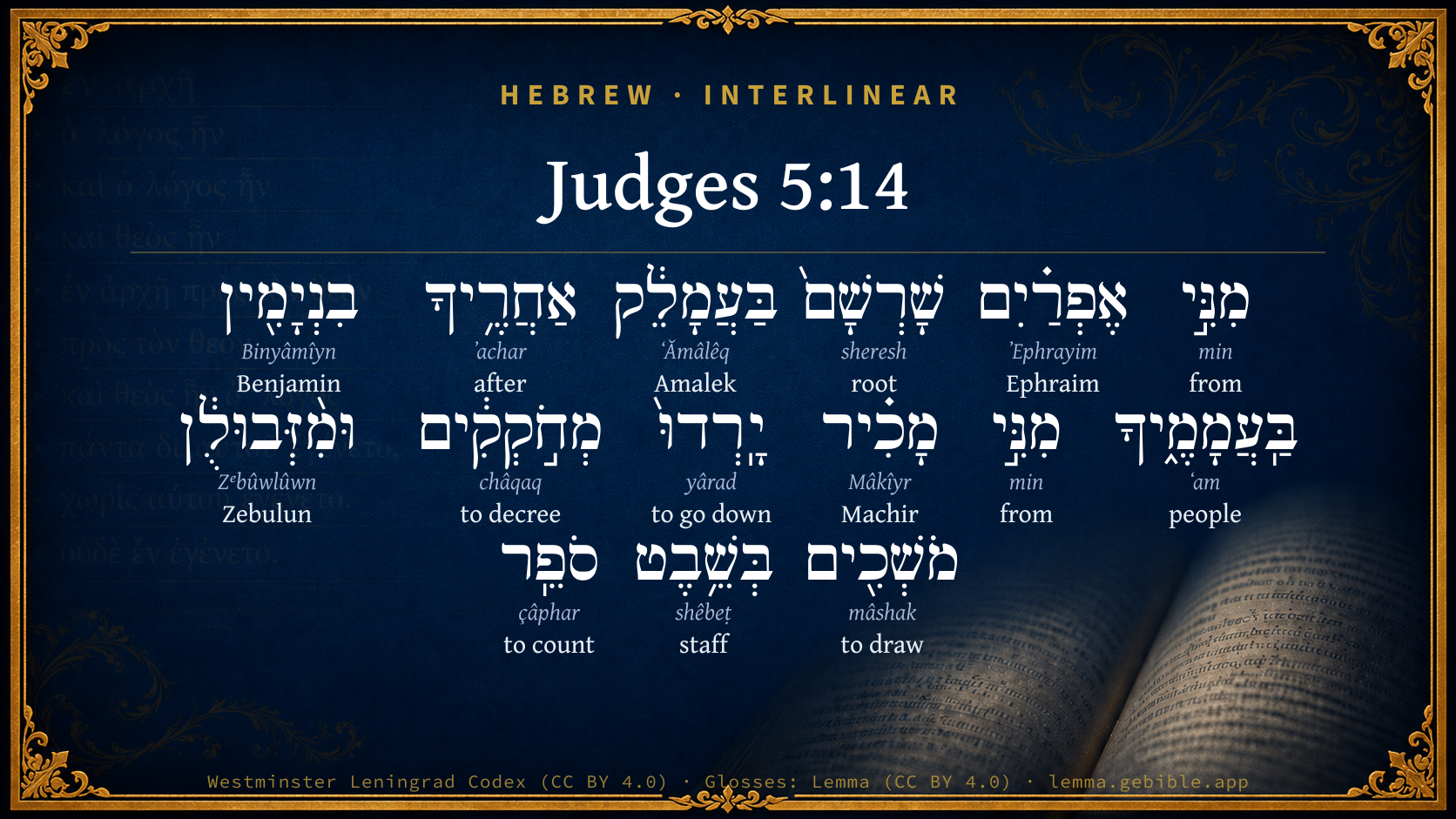
Judges 5:14

Hebrew (Westminster Leningrad Codex) Judges 5:14 appears in the Hebrew Old Testament. The text above is from the Westminster Leningrad Codex. Each word links to its Strong’s number, a concise gloss, and parsing drawn from the Open Scriptures Hebrew Bible morphology. Click any word for its full Brown-Driver-Briggs (BDB) entry.
Download image
Cite this verse

Judges 5:14 (World English Bible). Public Domain. Lemma interlinear Bible study tool, https://lemma.gebible.app/v/judges/5/14.

Show BibTeX & RIS
BibTeX
RIS
English Translation
Out of Ephraim [came down] they whose root is in Amalek; After you, Benjamin, among your peoples; Out of Machir came down governors, Out of Zebulun those who handle the marshal's staff.
World English Bible · Public Domain
Download a study sheet

One document with this verse’s original text, its word-by-word gloss line, the meaning frame, cross-references with their text, attributed commentary, and full source and license credits — printable, and it pastes into notes with its structure intact.

This verse Autodidact and up

Study sheet (.html) Plain text (.txt)

A passage Seminary Student

Up to 50 verses in one chapter. A passage sheet keeps up to 6 commentary sources and 12 cross-references per verse, in the order this page ranks them, and says so on the sheet whenever that leaves anything out. Ask for a single verse and you get the Autodidact verse sheet above.

Everything on this page stays free to read, with no account — the sheet is a download of what is already on screen, not access to it.

Want to remove ads? Support Godless Engineer
Compare translations 3

The same verse in 3 English versions, stacked beneath the original-language interlinear above. Click any original word for its lexicon entry.

Each is an independent rendering of the whole verse — the interlinear is not word-aligned to these translations.

Highlighted words mark where these versions differ — a whole-verse word diff, not a word-by-word alignment.

  • World English Bible Public Domain
    Out of Ephraim [came down] they whose root is in Amalek; After you, Benjamin, among your peoples; Out of Machir came down governors, Out of Zebulun those who handle the marshal's staff.
  • King James Version Public Domain
    Out of Ephraim was there a root of them against Amalek; after thee, Benjamin, among thy people; out of Machir came down governors, and out of Zebulun they that handle the pen of the writer.
  • unfoldingWord Literal Text CC BY-SA 4.0
    From Ephraim, their root in Amalek; after you, Benjamin, with your peoples; from Machir, commanders came down; and from Zebulun, the ones holding the scepter of a scribe.

unfoldingWord Literal Text — © unfoldingWord, licensed CC BY-SA 4.0. Word-aligned USFM3 via Door43 (git.door43.org/unfoldingWord/en_ult).

Versions to compare (up to 4)

3 of 4 selected

Show all 18 translations

Every available English version of this verse, each an independent rendering of the whole verse.

  • World English Bible Public Domain
    Out of Ephraim [came down] they whose root is in Amalek; After you, Benjamin, among your peoples; Out of Machir came down governors, Out of Zebulun those who handle the marshal's staff.
  • Berean Standard Bible Public Domain
    Some came from Ephraim, with their roots in Amalek; Benjamin came with your people after you. The commanders came down from Machir, the bearers of the marshal’s staff from Zebulun.
  • Majority Standard Bible Public Domain
    Some came from Ephraim, with their roots in Amalek; Benjamin came with your people after you. The commanders came down from Machir, the bearers of the marshal’s staff from Zebulun.
  • King James Version Public Domain
    Out of Ephraim was there a root of them against Amalek; after thee, Benjamin, among thy people; out of Machir came down governors, and out of Zebulun they that handle the pen of the writer.
  • American Standard Version (1901) Public Domain
    Out of Ephraim `came down' they whose root is in Amalek; After thee, Benjamin, among thy peoples; Out of Machir came down governors, And out of Zebulun they that handle the marshal's staff.
  • Revised Version (1885) Public Domain
    Out of Ephraim came down they whose root is in Amalek; after thee, Benjamin, among thy peoples; out of Machir came down governors, and out of Zebulun they that handle the marshal’s staff.
  • Geneva Bible (1599) Public Domain
    Of Ephraim their roote arose against Amalek: and after thee, Beniamin shall fight against thy people, O Amalek: of Machir came rulers, and of Zebulun they that handle the pen of the writer.
  • Douay-Rheims (1899) Public Domain
    Out of Ephraim he destroyed them into Amalec, and after him out of Benjamin into thy people, O Amalec: Out of Machir there came down princes, and out of Zabulon they that led the army to fight.
  • Young's Literal Translation Public Domain
    Out of Ephraim their root `is' against Amalek. After thee, Benjamin, among thy peoples. Out of Machir came down lawgivers, And out of Zebulun those drawing with the reed of a writer.
  • Literal Standard Version CC BY-SA 4.0
    From Ephraim [are] those whose root [is] in Amalek, || After you, Benjamin, among your peoples, || From Machir lawgivers came down, || And from Zebulun those drawing with the reed of a writer.
  • Unlocked Literal Bible CC BY-SA 4.0
    They came from Ephraim, whose root is in Amalek; the people of Benjamin followed you. From Machir commanders came down, and from Zebulun those who carry an officer's staff.
  • unfoldingWord Literal Text CC BY-SA 4.0
    From Ephraim, their root in Amalek; after you, Benjamin, with your peoples; from Machir, commanders came down; and from Zebulun, the ones holding the scepter of a scribe.
  • Darby Bible Public Domain
    From E'phraim they set out thither into the valley, following you, Benjamin, with your kinsmen; from Machir marched down the commanders, and from Zeb'ulun those who bear the marshal's staff;
  • World Messianic Bible Public Domain
    Those whose root is in Amalek came out of Ephraim, after you, Benjamin, among your peoples. Governors come down out of Machir. Those who handle the marshal’s staff came out of Zebulun.
  • Webster's Bible Public Domain
    Out of Ephraim was there a root of them against Amalek; after thee, Benjamin, among thy people; out of Machir came down governors, and out of Zebulun they that handle the pen of the writer.
  • Free Bible Version CC BY-SA 4.0
    Some came from Ephraim, a land that used to belong to the Amalekites; the tribe of Benjamin followed you with its men. Commanders came from Makir; from Zebulun came those who carry a military officer's staff.
  • Bible in Basic English Public Domain
    Out of Ephraim they came down into the valley; after you, Benjamin, among your tribesmen; from Machir came down the captains, and from Zebulun those in whose hand is the ruler's rod.
  • JPS Tanakh (1917) Public Domain
    Out of Ephraim came they whose root is in Amalek; after thee, Benjamin, among thy peoples; out of Machir came down governors, and out of Zebulun they that handle the marshal's staff.

Literal Standard Version (2020), Covenant Press — licensed CC BY-SA 4.0. Text via the HelloAO Bible API (eBible.org). Unlocked Literal Bible (unfoldingWord) — licensed CC BY-SA 4.0. Text via the HelloAO Bible API (eBible.org). unfoldingWord Literal Text — © unfoldingWord, licensed CC BY-SA 4.0. Word-aligned USFM3 via Door43 (git.door43.org/unfoldingWord/en_ult). Free Bible Version, Dr. Jonathan Gallagher — licensed CC BY-SA 4.0. Text via the HelloAO Bible API (eBible.org).

Word by word

More ways to search: Search by grammar → Find every occurrence → Compare this word →

Practice this passage: Drill this verse → Learn its vocabulary →

מְחֹ֣קְקִ֔ים
châqaq
H2710
“decreeing”
Verb, Poel, Participle Active, Masculine, Plural, Absolute
Part of Speech
Verb
Stem
Poel
Form
Participle Active
Gender
Masculine
Number
Plural
State
Absolute
Full BDB Definition

Origin: a primitive root

TWOT: 728

to cut out, decree, inscribe, set, engrave, portray, govern - (Qal) - to cut in - to cut in or on, cut upon, engrave, inscribe - to trace, mark out - to engrave, inscribe (of a law) - (Poel) - to inscribe, enact, decree - one who decrees, lawgiver (participle) - (Pual) something decreed, the law (participle) - (Hophal) to be inscribed
  1. מִנִּ֣י min H4480 “from” Preposition
  2. אֶפְרַ֗יִם ʼEphrayim H669 “Ephraim” Noun, Proper
  3. שָׁרְשָׁם֙ sheresh H8328 “root · their” Noun, Common, Masculine, Singular, Construct + Suffix, Personal, 3rd Person, Masculine, Plural
  4. בַּעֲמָלֵ֔ק ʻĂmâlêq H6002 “in/at · Amalek” Preposition + Noun, Proper
  5. אַחֲרֶ֥יךָ ʼachar H310 “after · you” Preposition + Suffix, Personal, 2nd Person, Masculine, Singular
  6. בִנְיָמִ֖ין Binyâmîyn H1144 “Benjamin” Noun, Proper
  7. בַּֽעֲמָמֶ֑יךָ ʻam H5971 “in/at · peoples · your” Preposition + Noun, Common, Masculine, Plural, Construct + Suffix, Personal, 2nd Person, Masculine, Singular
  8. מִנִּ֣י min H4480 “from” Preposition
  9. מָכִ֗יר Mâkîyr H4353 “Machir” Noun, Proper
  10. יָֽרְדוּ֙ yârad H3381 “to go down” Verb, Qal, Perfect, 3rd Person, Common, Plural
  11. וּמִ֨זְּבוּלֻ֔ן Zᵉbûwlûwn H2074 “and · from · Zebulun” Conjunction + Preposition + Noun, Proper
  12. מֹשְׁכִ֖ים mâshak H4900 “drawing” Verb, Qal, Participle Active, Masculine, Plural, Absolute
  13. בְּשֵׁ֥בֶט shêbeṭ H7626 “in/at · staff of” Preposition + Noun, Common, Masculine, Singular, Construct
  14. סֹפֵֽר çâphar H5608 “scribe” Noun, Common, Masculine, Singular, Absolute

About this verse

These counts appear in no published source. They are computed here, from the morphology-tagged text and Lemma’s own curated glosses. What Lemma adds →

15
words
14
distinct lemmas
Historical
section

Notable vocabulary

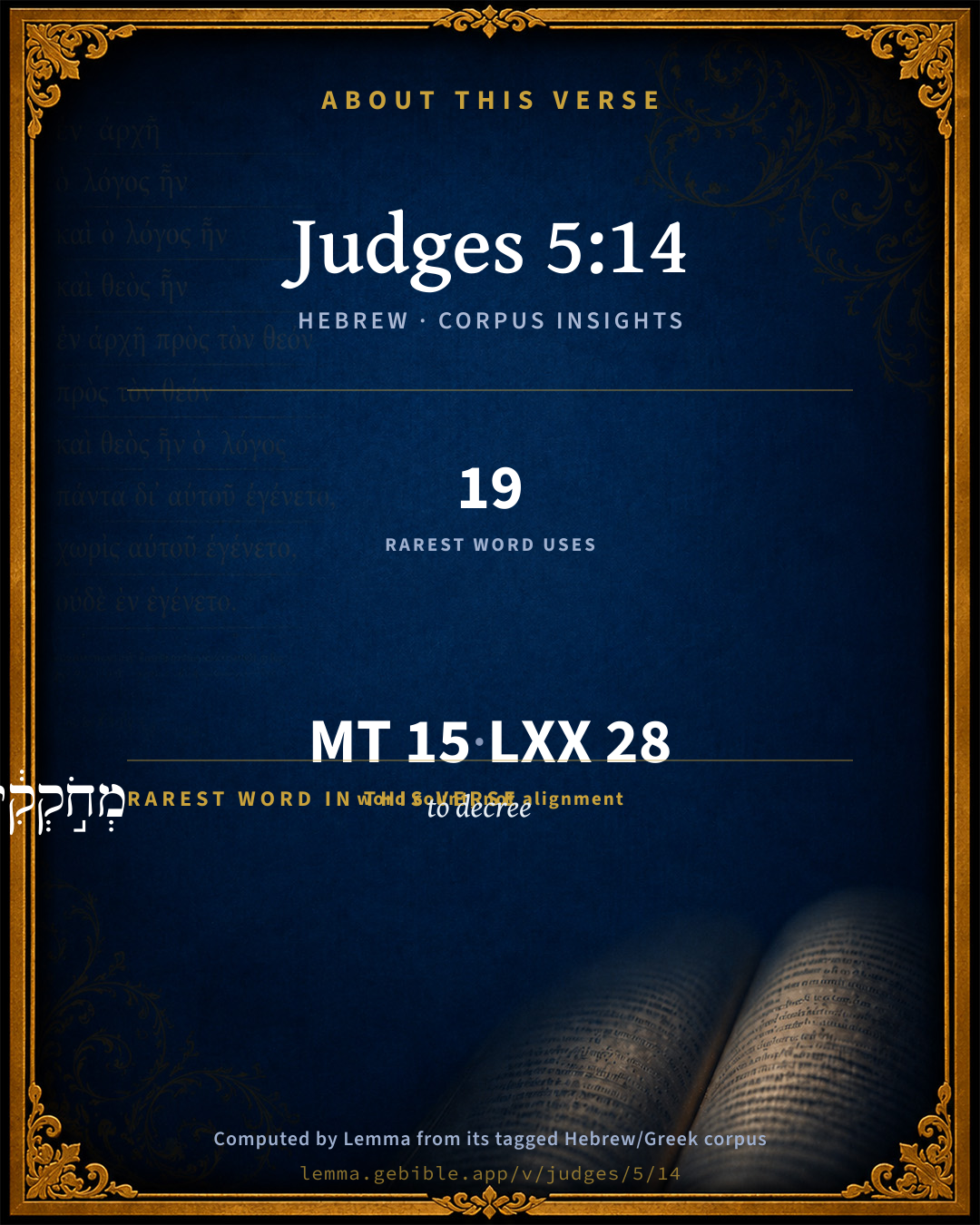
The rarest word here is מְחֹ֣קְקִ֔ים to decree H2710 — appearing just 19 times in the whole Hebrew Bible.

Shared distinctive vocabulary

מְחֹ֣קְקִ֔ים to decree H2710 occurs in 19 verses of the Hebrew Bible. Also found in:

Grammatical profile

  • 3 verbs
  • 9 nouns
  • 3 prepositions

Verb forms

  • יָֽרְדוּ֙ Qal · Perfect
  • מְחֹ֣קְקִ֔ים Poel · Participle Active
  • מֹשְׁכִ֖ים Qal · Participle Active

Repetition

A word recurs within this verse — often emphatic in Hebrew:

  • מִנִּ֣י from H4480 ×2

Hebrew & Septuagint length

In English translation the verse runs 32 words from the Hebrew and 38 from the Septuagint (LXX English) — closely comparable.

A rough comparison of the two English renderings, which tokenize alike — not a word-level alignment.

Word counts can differ between the Hebrew and the Greek without any difference in meaning — e.g. the Hebrew direct-object marker אֵת has no separate Greek word, and Greek often adds the article ὁ.

In the original languages it is 15 Hebrew tokens and 28 Greek tokens — but the two are counted differently (Hebrew bundles its prefixes and suffixes into one token; the Greek is in lemma form), so that isn’t a like-for-like length.

Cross-references

8

Topical passages linked to Judges 5:14 in the Treasury of Scripture Knowledge — connected by theme and wording, ordered by reader-vote popularity; previews shown in the World English Bible.

  • Numbers 32:39–40 The children of Machir the son of Manasseh went to Gilead, and took it, and dispossessed the Amorites who were therein.
  • Judges 3:13 He gathered to him the children of Ammon and Amalek; and he went and struck Israel, and they possessed the city of palm trees.
  • Judges 3:27 It happened, when he had come, that he blew a trumpet in the hill-country of Ephraim; and the children of Israel went down with him from the hill-country, and he before them.
  • Judges 12:15 Abdon the son of Hillel the Pirathonite died, and was buried in Pirathon in the land of Ephraim, in the hill-country of the Amalekites.
  • Exodus 17:8–16 Then Amalek came and fought with Israel in Rephidim.
  • Judges 4:5–6 She lived under the palm tree of Deborah between Ramah and Bethel in the hill-country of Ephraim: and the children of Israel came up to her for judgment.
  • Judges 4:10 Barak called Zebulun and Naphtali together to Kedesh; and there went up ten thousand men at his feet: and Deborah went up with him.
  • Judges 4:14 Deborah said to Barak, Up; for this is the day in which Yahweh has delivered Sisera into your hand; hasn't Yahweh gone out before you? So Barak went down from Mount Tabor, and ten thousand men after him.

Cross-references courtesy of OpenBible.info (CC BY 4.0).

Hebrew and Greek witnesses Masoretic Hebrew ↔ Greek Septuagint

The same verse in the two great witnesses to the Old Testament, shown verse-for-verse.

These are two independent witnesses, not word-aligned to each other, and the Septuagint is shown in lemma (dictionary) form.

Hebrew Judges 5:14 Masoretic · Westminster Leningrad Codex

מִנִּ֣י אֶפְרַ֗יִם שָׁרְשָׁם֙ בַּעֲמָלֵ֔ק אַחֲרֶ֥יךָ בִנְיָמִ֖ין בַּֽעֲמָמֶ֑יךָ מִנִּ֣י מָכִ֗יר יָֽרְדוּ֙ מְחֹ֣קְקִ֔ים וּמִ֨זְּבוּלֻ֔ן מֹשְׁכִ֖ים בְּשֵׁ֥בֶט סֹפֵֽר

Out of Ephraim [came down] they whose root is in Amalek; After you, Benjamin, among your peoples; Out of Machir came down governors, Out of Zebulun those who handle the marshal's staff.

World English Bible · Public Domain

Greek LXX Judges 5:14 Septuagint · lemma form

ἐκ ἐγώ ἐφράιμ ἐκῥίζω αὐτός ἐν ὁ αμαληκ ὀπίσω σύ βενιαμίν ἐν ὁ λαός σύ ἐν ἐγώ μαχιρ καταβαίνω ἐκἐρευνάω καί ἀπό ζαβουλων ἕλκω ἐν ῥάβδος διήγησις γραμματεύς

Ephraim rooted them out in Amalec, behind you was Benjamin among your people: the inhabitants of Machir came down with me searching out the enemy, and from Zabulon came they that draw with the scribe's pen of record.

LXX2012 (modern English Septuagint) · Public Domain

On this verse, Ellicott's Commentary for English Readers discusses the Septuagint’s reading. Read the note in Commentary ↓

Hebrew: Westminster Leningrad Codex (CC BY 4.0). Greek: Septuagint (public domain); English from LXX2012 (modern English Septuagint) (Public Domain). How the Septuagint differs from the Hebrew →

Targum (Aramaic paraphrase)

1

The Targum is the ancient Jewish Aramaic paraphrase of the Hebrew Scriptures — an interpretive translation, not the Hebrew text itself. Onkelos (literal) and Pseudo-Jonathan (expansive) render the Torah, and Jonathan the Prophets. Coverage is partial: where no permissively-licensed English translation exists for a verse, only the Aramaic is shown. This is verse-level text, not a word-by-word alignment to the Hebrew.

  1. Targum Jonathan Prophets (Joshua–Malachi)
    מִדְבֵית אֶפְרַיִם קָם יְהוֹשֻׁעַ בַּר נוּן בְּקַדְמֵיתָא אַגִיחַ קְרָבָא בִּדְבֵית עֲמָלֵק בַּתְרוֹהִי קָם מַלְכָּא שָׁאוּל מִדְבֵית בִּנְיָמִין וְקַטֵל יַת דְבֵית עֲמָלֵק וְאַגִיחַ קְרָבָא בִּשְׁאַר עַמְמַיָא מִדְבֵית מָכִיר נַחֲתוּ כַּד מְרַשְׁמִין בִּקְרָבָא מִשִׁבְטָא זְבוּלֻן כַּתְבִין בְּקוֹלְמוֹס דְסֵפֶר חָד:

    (no public-domain English translation for this verse)

    Targum Jonathan — Aramaic: “Mikraot Gedolot” (public domain). English: “Sefaria Community Translation” (CC0 1.0 (public-domain dedication)); “London "Chaldee Paraphrase," 1871” (public domain). Text via Sefaria.

Commentary

Notes on Judges 5:14 from classic Christian and Jewish commentators (each source and its license shown beneath its notes). The classic Christian expositions comment on the surrounding passage and are grouped to its opening verse, so a note may address several verses; the Jewish commentaries on the Tanakh (Rashi and others) are per-verse, so they appear only where the commentator wrote on this verse.

Lemma curates 59 commentaries, every one of them public domain or Creative Commons licensed, each selected and text-cleaned for this edition rather than reprinted as found. About our sources →

Trapp's Complete Commentary

John Trapp

Jdg 5:14 Out of Ephraim [was there] a root of them against Amalek; after thee, Benjamin, among thy people; out of Machir came down governors, and out of Zebulun they that handle the pen of the writer.

Ver. 14. Out of Ephraim was there a root {a} of them.] Deborah, an Ephraimite, was the root and rise of this expedition against the Canaanites, and the Amalakites their auxiliaries.

After thee, Benjamin,] i.e., After thee, O Ephraim, came Benjamin.

Out of Maehir,] i.e., Out of that half tribe of Manasseh which dwelt within Canaan: for the other half tribe beyond Jordan are afterwards, under the name of Gilead, blamed for their backwardness {Jdg 5:17}

That handle the pen of the writer.] Scribes and scholars took up arms to help the Lord against the mighty.

{a} By "root" some understand Joshua, and others the tribes of Judah and Simeon.

John Trapp, A Commentary or Exposition upon All the Books of the Old and New Testament (1647–1656) — public domain. Text from a community e-Sword module.

Joseph Benson's Commentary

Jdg 5:14. Out of Ephraim, &c. — The prophetess, having directed their praises to the Author of their deliverance, proceeds to speak with commendation of the instruments of it, and gives us the muster of those tribes which freely offered themselves to battle. She assigns the first place to the tribe of Benjamin; the second to those of her own tribe who were settled in Amalek; the third to the Manassites beyond Jordan; the fourth to the tribe of Zebulun; and the last to the tribe of Issachar. There was a root of them against Amalek — This translation is very obscure, and therefore it might be better rendered, and more agreeably to the Hebrew, Out of Ephraim came down those who were planted, or whose rest was in Amalek; meaning some of the tribe of Ephraim, who were settled in or about the mount of Amalek. See Jdg 12:15. And out of Zebulun they that handle the pen of the writer — Mr. Green has observed, and with great reason, that there is a manifest impropriety in penmen coming down to a battle; and that the word שׁבשׂ, shebet, which is here translated a pen, never signifies so throughout the Scriptures, but always a sceptre, or staff of command; and therefore he thinks our translation has mistaken the meaning here, and that it ought to be translated, And out of Zebulun those that rule or lead with the sceptre. The word ספר, soper, rendered writer, he thinks belongs to the next verse, and should be translated numbered. This certainly would make that verse more plain and significant. It would then be, And the princes of Issachar were numbered with Deborah; that is, these princes, together with Barak the general, were mustered along with Deborah herself.

Joseph Benson's Commentary on the Old and New Testaments (1811–1818) — public domain. Text from a community e-Sword module.

Geneva Bible (1599)

Geneva Bible translators

Joshua first fought against Amalek, and Saul destroyed him.

Even the learned did help to fight.

Geneva Bible (1599) marginal notes — public domain. Text via Bolls.life.

Adam Clarke's Commentary

Verse 14. Out of Ephraim - a root of them] Deborah probably means that out of Ephraim and Benjamin came eminent warriors. Joshua, who was of the tribe of Ephraim, routed the Amalekites a short time after the Israelites came out of Egypt, Ex 17:10. Ehud, who was of the tribe of Benjamin, slew Eglon, and defeated the Moabites, the friends and allies of the Ammonites and Amalekites. Machir, in the land of Gilead, produced eminent warriors; and Zebulun produced eminent statesmen, and men of literature. Probably Deborah speaks here of the past wars, and not of any thing that was done on this occasion; for we know that no persons from Gilead were present in the war between Jabin and Israel. See Jdg 5:17. Gilead abode beyond Jordan.

Adam Clarke's Commentary on the Bible (1810–1826) — public domain. Text from a community e-Sword/MySword module.

Ellicott's Commentary for English Readers

(14) Out of Ephraim was there a root of them against Amalek.—The LXX. and Vulgate render it, “Ephraim uprooted them in Amalek.” But the meaning seems to be, “Out of Ephraim (came down to the battle) those whose root is in Amalek,” or, “among the Amalekites.” Ephraim had firmly rooted himself (comp. Isa_27:6; Psa_80:10) in the country which had been the stronghold of the Amalekites. (See Jdg_12:15.)

After thee, Benjamin, among thy people.—Ephraim is here addressed by a sudden change of person (comp. Isa_1:29; Isa_42:20. &c). After thee, O Ephraim, came down Benjamin, mingled with thy people. The forces of “little Benjamin” are overshadowed by, and almost lost in, the crowded ranks of its powerful neighbour-tribe. In after days Benjamin clung to the skirts of Judah, but at this period his fortunes were more allied with those of Ephraim. “After thee, Benjamin,” seems to have become (perhaps from this allusion) a war-cry of the tribe (Hos_5:8).

Out of Machir came down governors.—Machir was the only son of Manasseh (Gen_1:23; Num_27:1), and is here used for the Western Manassites (Jos_17:5). The Eastern half-tribe, no doubt, held aloof with Gad and Reuben. The silence respecting Judah is remarkable. We may conjecture that Judah and Simeon were sufficiently occupied in keeping off the Philistines, or that, having secured their own territory, they remained in selfish isolation. The word rendered “governors” (LXX., “searchers out”; Vulgate, “princes “) is more strictly “law-givers” (Sym-machus, entassontes).

They that handle the pen of the writer.—Literally, they who draw with the staff (shçbet) of the scribe (sophçr). Sophçr may mean scribe (literally, “one who counts “), and the verb rendered “handle” is, literally, “draw;” but shçbet can hardly mean “pen”; nor is it easy to say of what special use “the pen of the writer” would be in the gathering of clans to battle; nor have we the faintest indication that Zebulon had any literary pre-eminence. There can be little doubt that the meaning is, “They who lead (so in Latin, traho sometimes has the meaning of duco) with the staff of the marshal.” The sophçr is the officer (2Ki_25:19) who musters, and therefore naturally counts and enrols, the host ( Jer_52:25), and the staff: is his natural “rod of power,” or ensign of office; just as it-was (vitis, Plin., H. N. xiv. 1, § 3) of Roman centurions (Vulgate, De Zebulon qui exercitum ducerent ad bel-landum).

A Bible Commentary for English Readers, edited by Charles John Ellicott (1878–1897) — public domain. Text from a community e-Sword module.

The Cambridge Bible for Schools and Colleges

gen. ed. J. J. S. Perowne

14. Out of Ephraim came down they whose root is in Amalek] i.e. those Ephraimites whose settled home was ‘in the hill country of the Amalekites,’ the latter term being used in Jdg_12:15 to describe the situation of Pirathon in the land of Ephraim. But the poet can hardly mean that only the Ephraimites of Pirathon came to the war, and there is no evidence that this district was the chief stronghold of Ephraim (Moore); moreover the Amalekites, though Jdg_12:15 implies a settlement of them in the north, belong properly to the deserts far S. of Judah (see on Jdg_1:16). Lit. the words mean ‘From E. their root (is) in Amalek,’ a singularly harsh expression. No doubt for Amalek we should read in the valley, with LXX. A, Luc., and other Verss.; for their root a verb is wanted, as in the third line of this verse; ‘they went’ shâru (cf. Isa_57:9, and the use of shâru = to pass along in Assyrian), suggested by Winckler, Altor. Forsch. i. 193, suits the context, but is no more than a guess.

After thee, Benjamin, among thy peoples] The pronoun thy evidently refers to Ephraim; but if the Benjamites came ‘after,’ they could not be ‘among’ the people of Ephraim; so correct after thee to thy brother (LXX. A). Thy brother Benjamin was among thy people seems to mean that, Benjamin, being too small to provide a contingent under its own chiefs, marched in the ranks of Ephraim.

Machir] probably stands here for Manasseh, of which it formed the chief clan; according to Jos_17:1 Machir was the eldest, according to Gen_50:23, Num_26:29 the only, son of Manasseh. The settlement of Machir in Gilead E. of Jordan (Num_32:39 ff., Deu_3:15) probably did not take place till later times. The context shews that governors denote military leaders, see on Jdg_5:9, and cf. Deu_33:21; in Gen_49:10, Num_21:18, Psa_60:7 the word is used of the staff or wand of a commander (translated sceptre in A. and RV.).

they that handle the marshal’s staff] or, that march with the marshal’s staff. Another designation of a chief, more exactly one who writes, enrols the muster of troops, cf. 2Ki_25:19, Jer_52:25, 2Ch_26:11 referring to the later organization of the army: he carried a baton as a badge of office.

The Cambridge Bible for Schools and Colleges (gen. ed. J. J. S. Perowne; Cambridge University Press, 1878–1918) — public domain. Text from a community e-Sword module.

John Gill's Exposition

Out of Ephraim was there a root of them against Amalek,.... In this and some following verses, Deborah makes mention of the tribes that were siding and assisting in this war, and of those that were not; and begins with Ephraim, where she herself dwelt, Jdg 4:5 who was the root, foundation, and source of this expedition, that under a divine influence directed, animated, and encouraged to it; and by whom, and from whence, a detachment was sent against the Amalekites, who upon all occasions were ready to assist the Canaanites, and now were about to do it; and to prevent their junction, a party was sent from Ephraim, and by the Ehpraimites; though the Targum, and the Jewish commentators in general, refer this to a past action, which Deborah here commemorates and celebrates; and understand by "root", Joshua, who was of that tribe, and who discomfited Amalek and his people with the edge of the sword, Exo 17:13.

after thee, Benjamin, among thy people; which the same Targum and the same writers interpret of a future fact, and as spoken of by way of prophecy; and suppose that Saul of the tribe of Benjamin is meant, and the people of Benjamin, the two hundred thousand footmen he took with him, and fought against Amalek, and destroyed them, Sa1 15:1 but it is rather to be understood of the tribe of Benjamin in general, which at this time went out against Amalek, to prevent their giving any assistance to Jabin king of Canaan, and who were followed in it by a party of the Ephraimites; so that Benjamin has the greatest honour given it, partly as it was first in this affair, and partly as it was general, the whole tribe engaged, whereas only a few in Ephraim, and those stimulated by the example of Benjamin:

out of Machir came down governors; Machir was the only son of Manasseh, and therefore this must respect that tribe, half of which was settled on the other side Jordan, and to which Jarchi and other Jewish writers ascribe this, and suppose it refers to the princes and great men of it, who subdued the Amorites, and took the sixty cities of Argob in the time of Moses; though Kimchi and Ben Gersom understand it of some of them that came from thence to assist in this war; but it is clearly suggested in Jdg 5:17 that they abode beyond Jordan, and gave no assistance at all; it therefore must be understood of the half tribe of Manasseh, within Jordan, from whence came great personages, with a number of men no doubt along with them, to lend an helping hand against the Canaanites, or to be employed as assistants under Barak in this expedition:

and out of Zebulun they that handle the pen of the writer; which being a maritime tribe, and employed in trade and navigation, had many clerks famous for their readiness in handling the pen; but these through a zeal for the common cause dropped their pens, and took to the sword, in vindication of the rights and liberties of themselves and their brethren; for which they are justly commended.

John Gill's Exposition of the Whole Bible (1746–1763) — public domain (CC PDM 1.0). Text via the HelloAO Bible API.

Albert Barnes' Notes on the Bible

Render “Of Ephraim (Deborah’s own tribe) came down those whose root is in Mount Amalek Jdg 12:15; after thee (O Ephraim) came Benjamin among thy people; of Machir (the west-Jordanic milies of Manasseh. See Jos 17:1-6) there came down the chiefs, and of Zebulon they that handle the staff of the officer” the military scribe, whose duty it was, like that of the Roman tribunes, to keep the muster roll, and superintend the recruiting of the army. (See 2Ki 25:19.)

Albert Barnes' Notes on the Bible (1834–1885) — public domain. Text from a community e-Sword/MySword module.

Haydock's Catholic Bible Commentary

Out of Ephraim, &c. The enemies struggling in their flight, were destroyed, as they were running through the land of Ephraim, and of Benjamin, which lies after, that is, beyond Ephraim; and so on the very confines of Amalec. Or, it alludes to former victories of the people of God, particularly that which was freshest in memory, when the men of Ephraim and Benjamin, with Aod at their head, overthrew their enemies, the Moabites, with the Amalecites their allies. See chap. iii. (Challoner) --- Fight. Debbora insinuates that the late victory had rendered Nephthali and Issachar as famous as these tribes, which had formerly sent forth the greatest generals; Josue, who conquered Amalec, (Exodus xvii. 10,) and Aod, of the tribe of Benjamin, (Calmet) who had so greatly signalized himself, and sounded the alarm in Mount Ephraim with success, chap. iii. 13, 27. (Haydock) --- Hebrew, "out of Ephraim he has torn them (Protestants, was there a root of them against, or) into Amalec, and after thee Benjamin among thy people." There was a mountain called Amalec, in the tribe of Ephraim, (chap. xii. 15,) where some victory may have been obtained, though we know not the particulars of it. (Calmet) --- They and the neighbouring tribes might have encountered Amalec, coming to assist Jabin. (Du Hamel) --- It is hardly probable that the army of Sisara would flee in that direction, as t hey would have had to encounter all the multitudes of Israel, and could have no prospect of saving themselves. Benjamin, who was farther off Debbora than Ephraim, is praised for expelling the king of Moab out of their city of Engaddi; (Haydock) or else the victories which this tribe obtained over the joint forces of the people of Israel are meant, (Calmet) as they shewed the valour of this tribe, though in so bad a cause. (Haydock) --- It is thought that the Moabites fell upon their territory only after most of the inhabitants were cut off, chap. xix., and xx. The Septuagint and Theodotion take no notice of Amalec, as they have read, Amok, a valley: "the people of Ephraim chastised them in the valley, and thy brother Benjamin, in his people." The Chaldean understands the whole verse, of the wars against Amalec, who had been routed by Josue, and would fall a prey to the arms of Saul, who was of the tribe of Benjamin. Many commentators follow this explanation. It does not appear that Barac received any aid from these tribes, nor from Machir, or any of those who lived at a distance. (Calmet) --- As for Zabulon, the Vulgate intimates that great generals were found among them but the Hebrew rather gives them the praise of learning: "They that handle the pen of the writer." (Haydock) --- Yet sopher is applied not only to writers, and to those who are learned in the law, as the scribes, Esdras, Baruch, &c., were, but also to commissaries, secretaries of state, and officers who were employed both in peace and war, 2 Paralipomenon xxvi. 11. Hence the Septuagint translate, "out of Zabulon, the powerful in the sceptre of learning;" (Calmet) (Grabe,) "of instruction." (Haydock) --- Some, without any proof, attribute the institution of these officers to Moses, others to David. We read of many who possessed this title under his reign; and ever after, the kings of Juda had scribes, as some great men had also. The kings of Persia kept secretaries to write their edicts, and some they sent, with greater authority, into the provinces. See 1 Esdras iv. 8. Ecclesiasticus (x. 5,) says, upon the person of the scribe God shall lay his honour. The scribes, or sopherim, seem therefore to have enjoyed an extensive authority, and the tribe of Zabulon used it on this occasion for the common good, (ver. 18.; Calmet) while many of the other tribes seem to be accused of backwardness in the cause of God.

George Leo Haydock (1774–1849), Haydock's Catholic Family Bible and Commentary, 1859 edition — public domain. Excludes Psalms (Douay-Rheims chapter numbering differs from Protestant) and Deuterocanonical books (Catholic canon only).

Matthew Poole's English Annotations

Now she relates the carriage and miscarriage of the several tribes in this expedition; and she begins with

Ephraim.

Was there a root of them; either, first, Of the Ephraimites; or, secondly, Of them that came forth to this expedition. By

root she seems to mean a

branch, as that word is sometimes used, as Isa 11:10; 53:2; by which also she may note the fewness of those that came out of Ephraim, that

fruitful bough consisting of many branches, Gen 49:22, yielding but one branch or a handful of men to this service.

Against Amalek, the constant and sworn enemy of the Israelites, who were confederate with their last oppressors the Moabites, Jdg 3:13, and in all probability took their advantage now against the Israelites in the southern or middle parts of Canaan, whilst their main force was drawn northward against Jabin and Sisera. Against these therefore Ephraim sent forth a party; and so did Benjamin, as it here follows; and these hindered their conjunction with Jabin’s forces, and gave their brethren the advantage of fighting with Sisera alone.

After thee, Benjamin: Benjamin followed Ephraim’s example. Or, after thee, O Benjamin; and thus the pre-eminence is here given to Benjamin in two respects: First, That he was first in this expedition, as indeed he lay near the Amalekites, and by his example encouraged the Ephraimites. Secondly, That the whole tribe of Benjamin, though now but small, came forth to this war, when the numerous tribe of Ephraim sent only a handful to it.

Among the people; either, first, Among the people of Benjamin, with whom those few Ephraimites united themselves in this expedition. Or, secondly, Among the people or tribes of Israel, to wit, those who engaged themselves in this war.

Out of Machir, i.e. out of the tribe of Manasseh, which are elsewhere called by the name of Machir, as Jos 13:31, to wit, out of the half tribe which was within Jordan; for of the other she speaks Jdg 5:17.

Governors; either civil governors, the princes and great persons, who were as ready to hazard themselves and their ample estates as the meanest; or military officers, valiant and expert commanders, such as some of Machir’s posterity are noted to have been.

They that handle the pen of the writer, i.e. even the scribes, who gave themselves to study and writing, whereby they were exempted from military service, did voluntarily enter into this service. Or, they that drew, to wit, the people after them, as that verb is used, Jdg 4:6. With the pen of the scribe or writer, i.e. who did not only go themselves, but by their letters invited and engaged others to go with them to the battle.

Matthew Poole's English Annotations on the Holy Bible (1683–1685) — public domain. Text from a community e-Sword/MySword module.

Whedon's Commentary on the Bible

Daniel D. Whedon

14. Out of Ephraim — We are here to supply in thought, they came down, from the preceding verse. That is, the heroes came out of Ephraim. The poetess goes on until Jdg_5:19 in specifying the action of the different tribes.

Whose root — Or, their root, that is, their fixed abode, their established dwelling or lot.

In Amalek — In Jdg_12:15, mention is made of “the land of Ephraim, in the mount of the Amalekites;” whence it appears that a colony of this people had migrated from the south of Palestine, and settled among the Canaanites, and given their name to the territory which afterwards became the possession of Ephraim.

After thee — After Ephraim.

Among thy people — Among Ephraim’s people. In approaching the Plain of Jezreel from the south, Benjamin, from his more southern location, would naturally follow after Ephraim; but as both advanced it would seem that the Benjamites became mixed with the more powerful Ephraimites.

Out of Machir — Machir was the only son of Manasseh, and through him were all the Manassites descended. Genesis 1, 23; Num_27:1. The name is here used poetically for that part of the tribe of Manasseh which was located on the west of the Jordan; just as Gilead, Manasseh’s grandson, is used, Jdg_5:17, for the eastern Manassites.

Those that draw the pencil of the writer — As the word here rendered pencil (שׁבשׂ) generally means rod, or sceptre, most modern scholars translate, the staff of the commander. But there seems no need of departing from the ordinary meaning of the words. The word משׁכים here represents the writer as drawing the letters with his pencil, and the pencil or style is metaphorically called the writer’s sceptre, as being the emblem of his power and worth. Zebulun’s location on the Phenician coast led his people to commercial enterprise, and to the cultivation of the art of writing. Clerks and accountants would therefore become numerous in that tribe. Deborah’s oracle and Ba-rak’s trumpet aroused even the literati to join the army. This was specially worthy of notice, since the quiet life and peaceful calling of the writer make him naturally averse to war.

Daniel D. Whedon (gen. ed.), Commentary on the Old and New Testaments (1874–1909) — public domain. Text from a community e-Sword module.

The Pulpit Commentary

They who spring (whose root is) from Ephraim went against Amalek, following thee, O Benjamin, with thy people; from Manasseh (Machir, son of Manasseh, Gen_50:23) came down governors (literally, lawgivers: cf. ver. 9), and out of Zebulun they that handle the baton of the commander, i.e. the military chiefs.

Vers. 14-23. National defence a common responsibility.

We have here an interesting glimpse of the behaviour of the various tribes in the war of freedom. Not all were summoned to battle; but of these only two answered to the call.

I WHO ARE SUMMONED TO THE GREAT WAR? All the tribes whose interests were threatened in the first place; but the others might have come from a feeling of brotherhood. Through Christ the solidarity of the race is revealed. We have nearer and further claims, a more and a less imperative call, yet the interest of each is involved in that of the whole. The debt we all owe to Christ binds us henceforth "not to live to ourselves." c, Am I my brother"s keeper?

II WHO RESPOND? Two tribes and a friendly alien. This showed a lack of public spirit, and of a true national conception. The Captain of our salvation calls. Who are willing? "Will ye also go away?" A few, all over. In every Church one or two have to bear the burden and heat of the day. Is this right?

III THE EXCUSES AND OCCUPATIONS OF THOSE WHO HOLD BACK. Very picturesque is the description not a little satirical. How sorry the figure cut by those who tarry at home when the battle rages I the excuses of those who were asked to follow Christ!

IV STRICT ACCOUNT WILL BE TAKEN OF THE CONDUCT OF EACH, AND THE REWARD WILL BE GIVEN ACCORDINGLY. The sharp eye of the prophetess scanned the host she accompanied. To each is apportioned the praise or blame. God sees the heart. M.

Literary occupations.

Whether these men of Zebulun were poets, chroniclers, or only merchants" clerks, their occupation was distinctly different from that of their brethren, and the peculiar duties attaching to it may serve to illustrate those which belong to a corresponding class of men in our own day.

I LITERATURE IS A FIELD OF HONOURABLE INDUSTRY. Iris a foolish misnomer which characterises handicraftsmen as the only "working men." Men can and do work at least as hard with their brains as with their hands; and such work is not the most unworthy of honourable effort. We cannot make a greater mistake than to confine the epithet "manly" to the exercise of brute force, an exercise in which a Hercules would be outmatched by a gorilla. True manliness is the right development of all the noblest powers of a man, among which the intellectual must take a high place.

II LITERATURE MAY BE MADE A SOURCE OF THE HIGHEST GOOD TO MANKIND. Writing is a means of expressing, preserving, and disseminating ideas. This means has been chosen by God for the promotion of religion, viz., in the Bible. Therefore it is foolish to despise literature as unpractical; it may be the most useful instrument for benefiting mankind. This should be remembered by those who have literary power, and should prevent them from wasting their talents on the selfish enjoyment of intellectual luxury. Literary ability is, like the gift of tongues, a Divine gift bestowed on men for the good of the whole world.

III IN ORDER THAT LITERATURE MAY EFFECT THE GREATEST GOOD, IT MUST BE ENLISTED IN THE SERVICE OF GOD. They who "handle the pen of the writer" must be among those who "willingly offer themselves" to the service of the Lord. God claims our best for his work. Men who have literary gifts should understand that they are not at liberty to write simply for occupation, for amusement, for money, or for fame, but for the honour of God and the good of men. Such considerations should secure more conscientiousness in writing; the observance of the great literary duties of truthfulness, fairness, purity, and charity; and the pursuit of elevating themes.

IV THEY WHO ARE CALLED TO LITERARY DUTIES MUST NOT FEEL THEMSELVES EXONERATED FROM MORE GENERAL OBLIGATIONS. The literary man must some times lay down the pen and draw the sword. The danger of sedentary and literary occupations is that they should lead to indolence and an unpractical habit of life. It will not do for any of us to live in the delicious seclusion of dream-land. There are stern tasks and serious burdens which all true men will have to encounter if the terrible realities of the world"s wickedness and misery are to be faced as the claims of God and humanity demand of us. While the trumpet sounds to war it is treason for the men of Zebulun to linger behind in learned leisure; and while God calls his people to do battle for him against the ignorance and sin of the world, there is no excuse for the most gifted, the most fastidious, or the most occupied to shirk their share of the dangers and toils of hard warfare. A.

The Pulpit Commentary (1880–1919), ed. H.D.M. Spence-Jones & Joseph S. Exell — public domain. Text from a community e-Sword module.

John Wesley's Explanatory Notes

Ephraim - Now she relates the carriage of the several tribes in the expedition; and she begins with Ephraim. A root - Of the Ephraimites. By root she seems to mean a branch, as that word is sometimes used. By which also she may note the fewness of those that came out of Ephraim, yielding but one branch or an handful of men to this service. Amalek - The constant enemy of the Israelites, who were confederate with their last oppressors the Moabites, chap. iii, 13, and in all probability took their advantage now against the Israelites in the southern or middle parts of Canaan, while their main force was drawn northward against Jabin and Sisera. Against these therefore Ephraim sent forth a party, and so did Benjamin. Benjamin - Benjamin followed Ephraim's example. The people - Among the people of Benjamin, with whom these few Ephraimites united themselves in this expedition. Machir - That is, out of the tribe of Manasseh, which are elsewhere called by the name of Machir, namely, out of the half tribe which was within Jordan; for of the other she speaks, ver.

John Wesley, Explanatory Notes Upon the Whole Bible (1754–1765) — public domain. Text via the GEBible commentary corpus.

Keil & Delitzsch

C. F. Keil & F. Delitzsch

"From (מנּי, poetical for מן) Ephraim," sc., there came fighting men; not the whole tribe, but only nobles or brave men, and indeed those whose roots were in Amalek, i.e., those who were rooted or had taken root, i.e., had settled and spread themselves out upon the tribe-territory of Ephraim, which had formerly been inhabited by Amalekites, the mount of the Amalekites, mentioned in Jdg 12:15 (for the figure itself, see Isa 27:6; Psa 80:10, and Job 5:3). "Behind thee," i.e., behind Ephraim, there followed Benjamin among thy (Ephraim's) people (עממים, a poetical form for עמּים, in the sense of hosts). Benjamin lived farther south than Ephraim, and therefore, when looked at from the stand-point of the plain of Jezreel, behind Ephraim; "but he came upon the scene of battle, either in subordination to the more powerful Ephraimites, or rushing on with the Ephraimitish hosts" (Bertheau). "From Machir," i.e., from western Manasseh, there came down leaders (see at Jdg 5:9), sc., with warriors in their train. Machir cannot refer to the Manassite family of Machir, to which Moses gave the northern part of Gilead, and Bashan, for an inheritance (comp. Jos 17:1 with Jos 13:29-31), but it stands poetically for Manasseh generally, as Machir was the only son of Manasseh, from whom all the Manassites were descended (Gen 50:23; Num 26:29., Num 27:1). The reference here, however, is simply to that portion of the tribe of Manasseh which had received its inheritance by the side of Ephraim, in the land to the west of the Jordan. This explanation of the word is required, not only by the fact that Machir is mentioned after Ephraim and Benjamin, and before Zebulun and Issachar, but still more decidedly by the introduction of Gilead beyond Jordan in connection with Reuben, in Jdg 5:17, which can only signify Gad and eastern Manasseh. Hence the two names Machir and Gilead, the names of Manasseh's son and grandson, are poetically employed to denote the two halves of the tribe of Manasseh; Machir signifying the western Manassites, and Gilead the eastern. "From Zebulun marchers (משׁך, to approach in long processions, as in Jdg 4:6) with the staff of the conductor." ספר, writer or numberer, was the technical name given to the musterer-general, whose duty it was to levy and muster the troops (Kg2 25:19; cf. Ch2 26:11); here it denotes the military leader generally.

Keil & Delitzsch — Biblical Commentary on the Old Testament (1861–1891) — public domain (CC PDM 1.0). Text via the HelloAO Bible API. (Old Testament only.)

unfoldingWord translationNotes

Door43 World Missions Community

from Ephraim, whose root is in Amalek

The people of Ephraim living in the land where the descendants of Amalek originally lived is spoken of as if the people of Ephraim were planted and their roots grew into the land. AT: "from Ephraim, that land where the descendants of Amalek once lived" (See: Metaphor)

followed you

Here "you" refers to the people of Ephraim. It can be stated in third person. AT: "followed them" (See: Forms of You and First, Second, or Third Person)

Machir

This is the place where the descendants of Machir live. Machir was the son of Manasseh and the grandson of Joseph. (See: How to Translate Names)

from Zebulun those who carry an officer's staff

Military leaders are described by the staff, a symbol of their authority. AT: "military leaders from Zebulun" (See: Metonymy)

translationWords

Ephraim

Amalek

people group

Benjamin

commander

Zebulun

staff

unfoldingWord translationNotes — © Distant Shores Media and the Door43 World Missions Community, licensed CC BY-SA 4.0. Source: git.door43.org/Door43/en_tn.

Rashi

Rabbi Shlomo Yitzchaki (Rashi)

In Ephraim. From Ephraim emerged the root of Yehoshua bin Nun's dominance over Amaleik when he debilitated them with the sword. This passage is related to the preceding one, as it explains "Adonoy empowered me over the mighty" by establishing Yehoshua's dominance over Amaleik.

Your successor shall arise from the tribe of Binyomin. Shaul ben Kish, who will batter them and extinguish them like flickering embers. Another interpretation: "with your people, referring to the army of two hundred thousand infantrymen which Shaul mobilized against them.

From Mochir descended warlords. Great lords who vanquished the Emorites. They captured sixty cities—the entire imperial zone conquered by Yair.

Rashi on the Tanakh — English translations: “The Judaica Press complete Tanach with Rashi, translated by A. J. Rosenberg” (CC BY 4.0); “Pentateuch with Rashi's commentary by M. Rosenbaum and A.M. Silbermann, 1929-1934” (public domain); “The Metsudah Tanach series, Lakewood, N.J” (CC BY 4.0); and “The Book of Joshua, Metsudah Publications, 1997” (CC BY 4.0). Text via Sefaria.

Radak

Rabbi David Kimhi (Radak)

Mini Ephraim: It is like Min (From), and the [letter,] yod is extra. Likewise is, "mini Machir."

Whose roots are in Amalek: Their roots fought against Amalek - and that is Yehoshua bin Nun, the root of Ephraim and its chieftain. And after Yehoshua, Binyamin fought with Amalek - and that is Shaul, who was from the tribe of Binaymin. And the [letter,] kaf (indicating, you) in, "after you," refers to Ephraim. And the [letter,] kaf in, "among your peoples," refers to Binyamin. And she said this by way of prophecy and mentioned those arousing themselves and strengthening themselves for the wars of the Lord. And now [she also mentioned] that the great ones and the sages of Machir came down to war. And even though they were on the other side of the Jordan, they aroused themselves and strengthened themselves to come to this war. And likewise did Zevulun go down, even their scribes and their sages. And it is not necessary to mention the rest of the nation.

Wielders of the scribe's staff: The explanation is the sages and the scribes.

Staff: The stylus. And likewise did Yonatan translate [it] (in the Targum), "With the scribe's quill." And so too did Yissachar’s leaders go down with Devorah.

Radak on the Tanakh — English translations: “Sefaria Community Translation” (CC0 1.0 (public-domain dedication)); “Eliyahu Munk, HaChut Hameshulash” (CC BY 4.0); “Rabbi Mike Feuer, Jerusalem Anthology” (CC BY 4.0); and “R. David Kimhi on the first book of Psalms, Translated by R.G. Finch, London, 1919” (public domain). Text via Sefaria.

Lesson kit

Teaching starters — assembled from the data on this page, not authored interpretation. Every prompt links to the verse data it draws on. Edit before teaching.

Judges, in the Historical, opens this verse with 15 words (14 distinct Hebrew lemmas). Its most distinctive word is châqaq (“to decree”). A historical commentator’s framing appears above. Read the whole chapter for the surrounding context.

Discussion questions

  1. The word châqaq carries the sense “to decree.” How does it shape the verse?
  2. Genesis 49:10 shares the word «to decree» with this verse. How do the two illuminate each other?
  3. “from” occurs 2× in this one verse. What is the effect of the repetition?
  4. These translations render this verse differently. What is at stake in choosing one wording over another?
  5. The verb «יָֽרְדוּ֙» is Qal Perfect. How does its form color the action?
  6. Reading how Trapp's Complete Commentary and Joseph Benson's Commentary read this verse, where do the two commentators agree and where do they part?

Things to notice

Reading settings

Reading text

Shown beneath each verse's original-language words.

Old Testament
Old Testament edition

Read the OT as the Masoretic Hebrew (MT) or the Greek Septuagint (LXX).

English shown for the Greek Septuagint (in the Hebrew ↔ Greek comparison).

Comparing translations? Open the Compare panel on any verse page to stack up to four side by side.