
Daniel 11:31

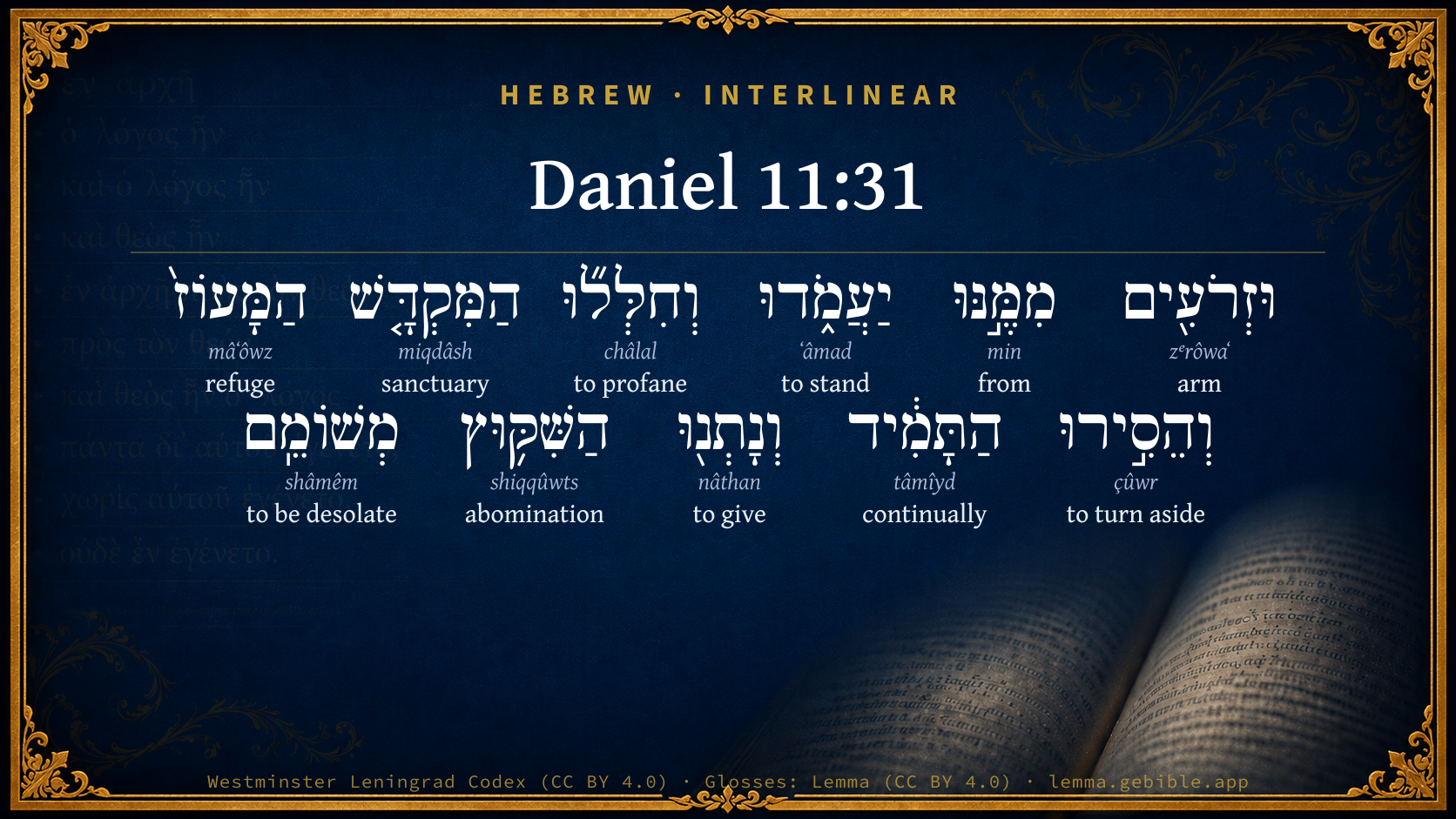
Hebrew (Westminster Leningrad Codex) Daniel 11:31 appears in the Hebrew Old Testament. The text above is from the Westminster Leningrad Codex. Each word links to its Strong’s number, a concise gloss, and parsing drawn from the Open Scriptures Hebrew Bible morphology. Click any word for its full Brown-Driver-Briggs (BDB) entry.
Download image
Cite this verse

Daniel 11:31 (World English Bible). Public Domain. Lemma interlinear Bible study tool, https://lemma.gebible.app/v/daniel/11/31.

Show BibTeX & RIS
BibTeX
RIS
English Translation
Forces shall stand on his part, and they shall profane the sanctuary, even the fortress, and shall take away the continual [burnt offering], and they shall set up the abomination that makes desolate.
World English Bible · Public Domain
Download a study sheet

One document with this verse’s original text, its word-by-word gloss line, the meaning frame, cross-references with their text, attributed commentary, and full source and license credits — printable, and it pastes into notes with its structure intact.

This verse Autodidact and up

Study sheet (.html) Plain text (.txt)

A passage Seminary Student

Up to 50 verses in one chapter. A passage sheet keeps up to 6 commentary sources and 12 cross-references per verse, in the order this page ranks them, and says so on the sheet whenever that leaves anything out. Ask for a single verse and you get the Autodidact verse sheet above.

Everything on this page stays free to read, with no account — the sheet is a download of what is already on screen, not access to it.

Want to remove ads? Support Godless Engineer
Compare translations 3

The same verse in 3 English versions, stacked beneath the original-language interlinear above. Click any original word for its lexicon entry.

Each is an independent rendering of the whole verse — the interlinear is not word-aligned to these translations.

Highlighted words mark where these versions differ — a whole-verse word diff, not a word-by-word alignment.

  • World English Bible Public Domain
    Forces shall stand on his part, and they shall profane the sanctuary, even the fortress, and shall take away the continual [burnt offering], and they shall set up the abomination that makes desolate.
  • King James Version Public Domain
    And arms shall stand on his part, and they shall pollute the sanctuary of strength, and shall take away the daily sacrifice, and they shall place the abomination that maketh desolate.
  • unfoldingWord Literal Text CC BY-SA 4.0
    Forces from him will rise up and profane the sanctuary fortress. They will take away the regular burnt offering, and they will set up the abomination that causes desolation.

unfoldingWord Literal Text — © unfoldingWord, licensed CC BY-SA 4.0. Word-aligned USFM3 via Door43 (git.door43.org/unfoldingWord/en_ult).

Versions to compare (up to 4)

3 of 4 selected

Show all 18 translations

Every available English version of this verse, each an independent rendering of the whole verse.

  • World English Bible Public Domain
    Forces shall stand on his part, and they shall profane the sanctuary, even the fortress, and shall take away the continual [burnt offering], and they shall set up the abomination that makes desolate.
  • Berean Standard Bible Public Domain
    His forces will rise up and desecrate the temple fortress. They will abolish the daily sacrifice and set up the abomination of desolation.
  • Majority Standard Bible Public Domain
    His forces will rise up and desecrate the temple fortress. They will abolish the daily sacrifice and set up the abomination of desolation.
  • King James Version Public Domain
    And arms shall stand on his part, and they shall pollute the sanctuary of strength, and shall take away the daily sacrifice, and they shall place the abomination that maketh desolate.
  • American Standard Version (1901) Public Domain
    And forces shall stand on his part, and they shall profane the sanctuary, even the fortress, and shall take away the continual `burnt-offering', and they shall set up the abomination that maketh desolate.
  • Revised Version (1885) Public Domain
    And arms shall stand on his part, and they shall profane the sanctuary, even the fortress, and shall take away the continual burnt offering; and they shall set up the abomination that maketh desolate.
  • Geneva Bible (1599) Public Domain
    And armes shall stand on his part, and they shall pollute the Sanctuarie of strength, and shall take away the dayly sacrifice, and they shall set vp the abominable desolation.
  • Douay-Rheims (1899) Public Domain
    And arms shall stand on his part, and they shall defile the sanctuary of strength, and shall take away the continual sacrifice, and they shall place there the abomination unto desolation.
  • Young's Literal Translation Public Domain
    And strong ones out of him stand up, and have polluted the sanctuary, the stronghold, and have turned aside the continual `sacrifice', and appointed the desolating abomination.
  • Literal Standard Version CC BY-SA 4.0
    And strong ones stand up out of him, and have defiled the sanctuary, the stronghold, and have turned aside the continual [sacrifice], and appointed the desolating abomination.
  • Unlocked Literal Bible CC BY-SA 4.0
    His forces will rise up and profane the fortress sanctuary. They will take away the regular burnt offering, and they will set up the abomination that causes desolation.
  • unfoldingWord Literal Text CC BY-SA 4.0
    Forces from him will rise up and profane the sanctuary fortress. They will take away the regular burnt offering, and they will set up the abomination that causes desolation.
  • Darby Bible Public Domain
    And forces shall stand on his part, and they shall profane the sanctuary, the fortress, and shall take away the continual [sacrifice], and they shall place the abomination that maketh desolate.
  • World Messianic Bible Public Domain
    “Forces from him will profane the sanctuary, even the fortress, and will take away the continual burnt offering. Then they will set up the abomination that makes desolate.
  • Webster's Bible Public Domain
    And arms shall stand on his part, and they shall pollute the sanctuary of strength, and shall take away the daily sacrifice, and they shall place the abomination that maketh desolate.
  • Free Bible Version CC BY-SA 4.0
    His forces will occupy and defile the Temple fortress. They will put a stop to the continual service, and set up a form of idolatry that causes devastation.
  • Bible in Basic English Public Domain
    And armies sent by him will take up their position and they will make unclean the holy place, even the strong place, and take away the regular burned offering and put in its place an unclean thing causing fear.
  • JPS Tanakh (1917) Public Domain
    And arms shall stand on his part, and they shall profane the sanctuary, even the stronghold, and shall take away the continual burnt-offering, and they shall set up the detestable thing that causeth appalment.

Literal Standard Version (2020), Covenant Press — licensed CC BY-SA 4.0. Text via the HelloAO Bible API (eBible.org). Unlocked Literal Bible (unfoldingWord) — licensed CC BY-SA 4.0. Text via the HelloAO Bible API (eBible.org). unfoldingWord Literal Text — © unfoldingWord, licensed CC BY-SA 4.0. Word-aligned USFM3 via Door43 (git.door43.org/unfoldingWord/en_ult). Free Bible Version, Dr. Jonathan Gallagher — licensed CC BY-SA 4.0. Text via the HelloAO Bible API (eBible.org).

Word by word

More ways to search: Search by grammar → Find every occurrence → Compare this word →

Practice this passage: Drill this verse → Learn its vocabulary →

הַשִּׁקּ֥וּץ
shiqqûwts
H8251
“the · abomination”
Particle, Definite Article + Noun, Common, Masculine, Singular, Absolute
Part of Speech
Particle + Noun
Type
Common
Gender
Masculine
Number
Singular
State
Absolute
Full BDB Definition

Origin: from H8262

TWOT: 2459b

detestable thing or idol, abominable thing, abomination, idol, detested thing
  1. וּזְרֹעִ֖ים zᵉrôwaʻ H2220 “and · arms” Conjunction + Noun, Common, Both, Plural, Absolute
  2. מִמֶּ֣נּוּ min H4480 “from · us” Preposition + Suffix, Personal, 1st Person, Common, Plural
  3. יַעֲמֹ֑דוּ ʻâmad H5975 “to stand” Verb, Qal, Imperfect, 3rd Person, Masculine, Plural
  4. וְחִלְּל֞וּ châlal H2490 “and · to profane” Conjunction + Verb, Piel, Sequential Perfect, 3rd Person, Common, Plural
  5. הַמִּקְדָּ֤שׁ miqdâsh H4720 “the · sanctuary” Particle, Definite Article + Noun, Common, Masculine, Singular, Absolute
  6. הַמָּעוֹז֙ mâʻôwz H4581 “the · refuge” Particle, Definite Article + Noun, Common, Masculine, Singular, Absolute
  7. וְהֵסִ֣ירוּ çûwr H5493 “and · to turn aside” Conjunction + Verb, Hiphil, Sequential Perfect, 3rd Person, Common, Plural
  8. הַתָּמִ֔יד tâmîyd H8548 “the · continually” Particle, Definite Article + Noun, Common, Masculine, Singular, Absolute
  9. וְנָתְנ֖וּ nâthan H5414 “and · to give” Conjunction + Verb, Qal, Sequential Perfect, 3rd Person, Common, Plural
  10. מְשׁוֹמֵֽם shâmêm H8074 “being desolate” Verb, Poel, Participle Active, Masculine, Singular, Absolute

About this verse

These counts appear in no published source. They are computed here, from the morphology-tagged text and Lemma’s own curated glosses. What Lemma adds →

11
words
11
distinct lemmas
Prophets
section

Shared distinctive vocabulary

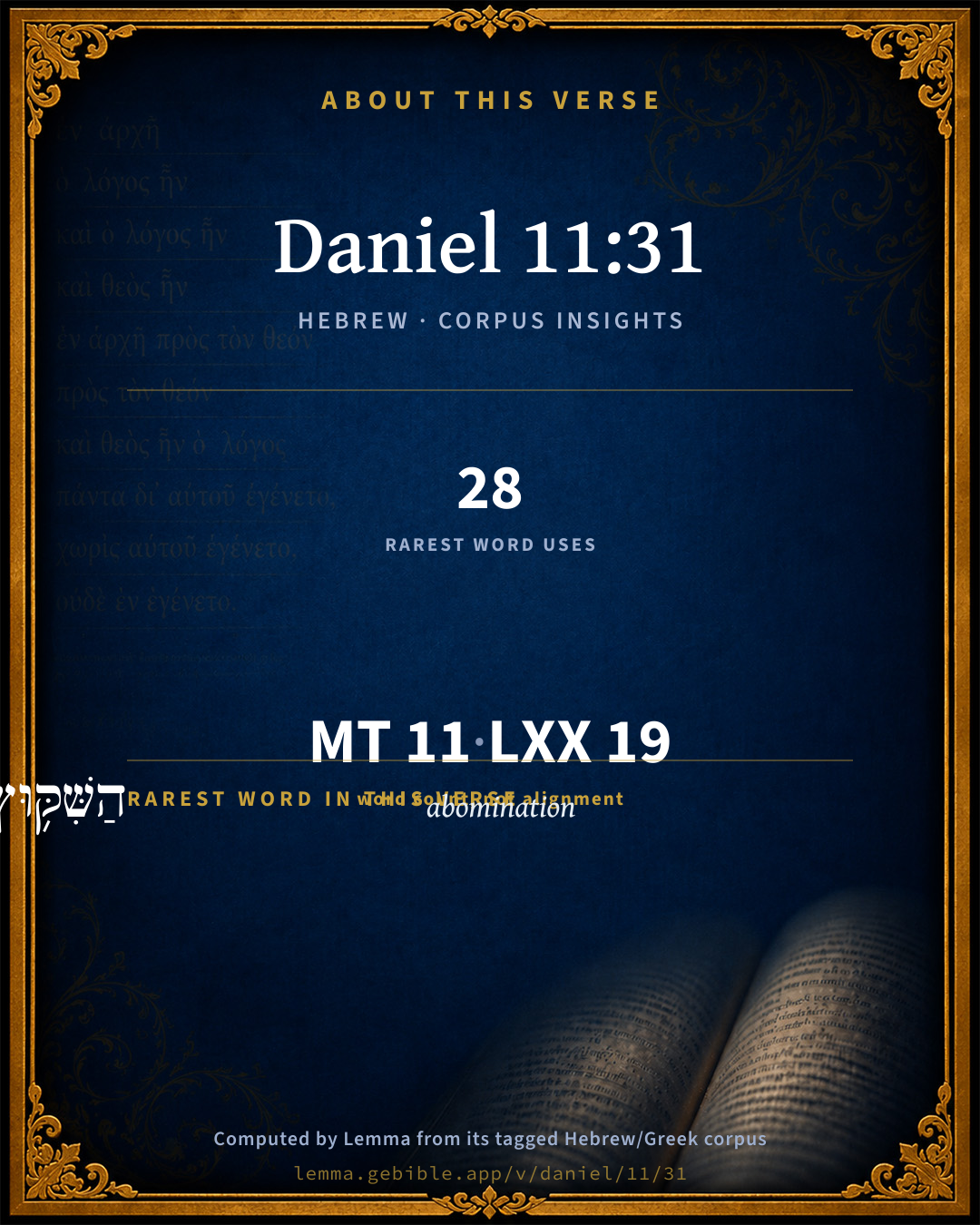
הַשִּׁקּ֥וּץ abomination H8251 occurs in 26 verses of the Hebrew Bible. Also found in:

Grammatical profile

  • 5 verbs
  • 5 nouns
  • 1 preposition

Verb forms

  • יַעֲמֹ֑דוּ Qal · Imperfect
  • וְחִלְּל֞וּ Piel · Sequential Perfect
  • וְהֵסִ֣ירוּ Hiphil · Sequential Perfect
  • וְנָתְנ֖וּ Qal · Sequential Perfect
  • מְשׁוֹמֵֽם Poel · Participle Active

Hebrew & Septuagint length

In English translation the verse runs 33 words from the Hebrew and 28 from the Septuagint (LXX English) — closely comparable.

A rough comparison of the two English renderings, which tokenize alike — not a word-level alignment.

Word counts can differ between the Hebrew and the Greek without any difference in meaning — e.g. the Hebrew direct-object marker אֵת has no separate Greek word, and Greek often adds the article ὁ.

In the original languages it is 11 Hebrew tokens and 19 Greek tokens — but the two are counted differently (Hebrew bundles its prefixes and suffixes into one token; the Greek is in lemma form), so that isn’t a like-for-like length.

Cross-references

15

Topical passages linked to Daniel 11:31 in the Treasury of Scripture Knowledge — connected by theme and wording, ordered by reader-vote popularity; previews shown in the World English Bible.

  • Daniel 12:11 From the time that the continual [burnt offering] shall be taken away, and the abomination that makes desolate set up, there shall be one thousand two hundred ninety days.
  • Daniel 9:27 He shall make a firm covenant with many for one week: and in the midst of the week he shall cause the sacrifice and the offering to cease; and on the wing of abominations [shall come] one who makes desolate; and even to the full end, and that determined, shall [wrath] be poured out on the desolate.
  • Matthew 24:15 "When, therefore, you see the abomination of desolation, which was spoken of through Daniel the prophet, standing in the holy place (let the reader understand),
  • Daniel 8:11–13 Yes, it magnified itself, even to the prince of the host; and it took away from him the continual [burnt offering], and the place of his sanctuary was cast down.
  • Mark 13:14 But when you see the abomination of desolation, spoken of by Daniel the prophet, standing where it ought not (let the reader understand), then let those who are in Judea flee to the mountains,
  • Ezekiel 24:21–22 Speak to the house of Israel, Thus says the Lord Yahweh: Behold, I will profane my sanctuary, the pride of your power, the desire of your eyes, and that which your soul pities; and your sons and your daughters whom you have left behind shall fall by the sword.
  • Luke 21:20 "But when you see Jerusalem surrounded by armies, then know that its desolation is at hand.
  • Acts 13:40–41 Beware therefore, lest that come on you which is spoken in the prophets:
  • Revelation 17:12 The ten horns that you saw are ten kings who have received no kingdom as yet, but they receive authority as kings, with the beast, for one hour.
  • Lamentations 1:10 The adversary has spread out his hand on all her pleasant things: For she has seen that the nations are entered into her sanctuary, Concerning whom you did command that they should not enter into your assembly.
  • Lamentations 2:7 The Lord has cast off his altar, he has abhorred his sanctuary; He has given up into the hand of the enemy the walls of her palaces: They have made a noise in the house of Yahweh, as in the day of a solemn assembly.
  • Ezekiel 7:20–21 As for the beauty of his ornament, he set it in majesty; but they made the images of their abominations [and] their detestable things therein: therefore have I made it to them as an unclean thing.
  • Ezekiel 9:7 He said to them, Defile the house, and fill the courts with the slain: go you forth. They went forth, and struck in the city.
  • Daniel 8:24 His power shall be mighty, but not by his own power; and he shall destroy wonderfully, and shall prosper and do [his pleasure]; and he shall destroy the mighty ones and the holy people.
  • Daniel 8:26 The vision of the evenings and mornings which has been told is true: but seal up the vision; for it belongs to many days [to come].

Cross-references courtesy of OpenBible.info (CC BY 4.0).

Hebrew and Greek witnesses Masoretic Hebrew ↔ Greek Septuagint

The same verse in the two great witnesses to the Old Testament, shown verse-for-verse.

These are two independent witnesses, not word-aligned to each other, and the Septuagint is shown in lemma (dictionary) form.

Hebrew Daniel 11:31 Masoretic · Westminster Leningrad Codex

וּזְרֹעִ֖ים מִמֶּ֣נּוּ יַעֲמֹ֑דוּ וְחִלְּל֞וּ הַמִּקְדָּ֤שׁ הַמָּעוֹז֙ וְהֵסִ֣ירוּ הַתָּמִ֔יד וְנָתְנ֖וּ הַשִּׁקּ֥וּץ מְשׁוֹמֵֽם

Forces shall stand on his part, and they shall profane the sanctuary, even the fortress, and shall take away the continual [burnt offering], and they shall set up the abomination that makes desolate.

World English Bible · Public Domain

Greek LXX Daniel 11:31 Septuagint · lemma form

καί βραχίων παρά αὐτός ἵστημι καί μιαίνω ὁ ἅγιος ὁ φόβος καί ἀποἵστημι ὁ θυσία καί δίδωμι βδέλυγμα ἐρήμωσις

And seeds shall spring up out of him, and they shall profane the sanctuary of strength, and they shall remove the perpetual sacrifice, and make the abomination desolate.

LXX2012 (modern English Septuagint) · Public Domain

On this verse, The Cambridge Bible for Schools and Colleges discusses the Septuagint’s reading. Read the note in Commentary ↓

Hebrew: Westminster Leningrad Codex (CC BY 4.0). Greek: Septuagint (public domain); English from LXX2012 (modern English Septuagint) (Public Domain). How the Septuagint differs from the Hebrew →

Commentary

Notes on Daniel 11:31 from classic Christian and Jewish commentators (each source and its license shown beneath its notes). The classic Christian expositions comment on the surrounding passage and are grouped to its opening verse, so a note may address several verses; the Jewish commentaries on the Tanakh (Rashi and others) are per-verse, so they appear only where the commentator wrote on this verse.

Lemma curates 59 commentaries, every one of them public domain or Creative Commons licensed, each selected and text-cleaned for this edition rather than reprinted as found. About our sources →

The Cambridge Bible for Schools and Colleges

gen. ed. J. J. S. Perowne

31. And arms—i.e. forces (Dan_11:15; Dan_11:22)—(coming) from him shall stand up] or (following the interpunction expressed by the Heb. accents), shall stand up at his instance (Isa_30:1, Heb.); ‘stand up,’ i.e. be set on foot, organized (cf. in the causative conj. Dan_11:11). The ‘arms’ are the armed force sent by Antiochus to take possession of Jerusalem (see the next note).

and they shall pollute the sanctuary (even) the stronghold] The Temple at this time was fortified with high walls, which were broken down by the soldiers of Antiochus, but afterwards rebuilt (1Ma_4:60; 1Ma_6:7): hence it is called a ‘stronghold.’ For the facts, see 1Ma_1:29 ff. Apollonius (2Ma_5:24), coming with an armed force, but lulling with friendly words the suspicions of the people, fell upon the city suddenly on a sabbath-day; and having obtained possession of it, took women and children prisoners, demolished many of the houses and fortifications, and strengthening the citadel (which overlooked the Temple), established in it a Syrian garrison. Cf. 1Ma_1:34; 1Ma_1:36-37, ‘And they put there [in the citadel] a sinful nation [the Syrian garrison], transgressors of the law (ἄνδρας παρανόμους), and they strengthened themselves therein.… And it became a place to lie in wait in against the sanctuary (ἔνεδρον τῷ ἁγιάσματι), and an evil adversary unto Israel continually. And they shed innocent blood round about the sanctuary, and defiled the sanctuary’ (comp. Dan_2:12).

and shall take away the continual (burnt-offering)] cf. Dan_8:11, where the expression is similar, and the reference is the same. Apollonius had not been long in possession of Jerusalem when Antiochus, wishing to unify his empire, and to assimilate as far as possible its different parts, determined to bring it all under the influence of Hellenic culture; and accordingly issued in Judah instructions to obliterate every trace of the ancient religion. All the Jewish sacrifices were to be abolished in the Temple; sabbaths and other festivals were to be disregarded; ceremonial observances (such as the prohibition to eat unclean food) were to be discontinued; the rite of circumcision was prohibited, under pain of death; books of the law were to be destroyed, and anyone found with them in his possession was to be punished with death. Special commissioners (ἐπίσκοποι) were appointed for the purpose of carrying out these directions. Not only, however, were Jewish institutions to be thrown aside, heathen ones were to take their place; the Temple was to be transformed into a sanctuary of Zeus Olympios (2Ma_6:2), heathen altars and shrines were to be set up, swine’s flesh and unclean beasts were to be sacrificed; and officers were appointed to see that all these injunctions were duly carried out (1Ma_1:41-53). The suspension of the Temple services (to which the words of the present verse allude) began in December, b.c. 168, and continued for rather more than three years (see p. 119).

and they shall set up the abomination that causeth appalment] i.e. the heathen altar erected on the altar of burnt-offering. See 1Ma_1:54, ‘And on the 15th day of Chisleu [December] they builded an abomination of desolation (βδέλυγμα ἐρημώσεως,—the same expression which is used in the LXX. here) upon the altar,’ and (1Ma_1:59) ‘on the 25th day of the month they sacrificed upon the (idol-) altar (βωμόν), which was upon the altar (of God) (θυσιαστήριον)’: cf. also Dan_6:7. A statue of Zeus Olympios was most probably associated with the altar[383]. On ‘causeth appalment,’ see on Dan_8:13; and cf. the parallel passages Dan_9:27, Dan_12:11.

[383] Cf. the tradition in the Mishna (Taanith iv. 6 העמיד צלם בהיכל), Euseb. (ap. Sync. 542, 21 καὶ τὸν ναὸν βεβηλοῖ Διὸς Ὀλυμπίου βδέλυγμα ἀναστηλώσας ἐν αὐτῷ), and Jerome (on Dan_11:31, ‘Jovis Olympii simulacrum’), referred to by Grätz, Gesch. 11. 2, p. 314 f.

In explanation of the somewhat peculiar expression used, an ingenious and probable suggestion has been made by Nestle (ZATW[384] 1884, p. 248; cf. Bevan, p. 293). The Heb. for ‘that causeth appalment’ is shômçm (Dan_8:13, Dan_12:11), or mĕshômçm (Dan_9:27, Dan_11:31); and according to Nestle, the ‘abomination that causeth appalment’ is a contemptuous allusion to בעל שמים Ba‘al shâmayim (‘Baal of heaven’), a title occurring often in Phœnician, and (with shâmîn for shâmayim) Aramaic inscriptions, and in the Syriac version of 2Ma_6:2 found actually for the Ζεὺς Ὀλύμπιος of the Greek; the altar (with probably the accompanying statue of Zeus) erected by Antiochus upon the altar of burnt offering being termed derisively by the Jews ‘the abomination that causeth appalment,’ the ‘abomination’ being the altar (and image?) of Zeus (Baal), and shômçm being a punning variation of shâmayim[385].

[384] ATW. Zeitschrift für die Alttestamentliche Wissenschaft, 1881 ff.

[385] ‘Abomination of desolation’ (Greek versions of Dan., 1Ma_1:54) is not a possible rendering of the Heb. ‘Abomination that maketh desolate’ is possible; and, if correct, must imply that the heathen emblem standing in the court of the Temple was regarded as bringing with it the desertion and desolation of the sanctuary (cf. 1Ma_4:38; and see also above, on Dan_8:13, and p. 151).

The Cambridge Bible for Schools and Colleges (gen. ed. J. J. S. Perowne; Cambridge University Press, 1878–1918) — public domain. Text from a community e-Sword module.

Trapp's Complete Commentary

John Trapp

Dan 11:31 And arms shall stand on his part, and they shall pollute the sanctuary of strength, and shall take away the daily [sacrifice], and they shall place the abomination that maketh desolate.

Ver. 31. And arms shall stand on his part,] i.e., Antiochus’s princes and commanders, whom he sent to spoil Jerusalem; such as were Philip the Phrygian, Andronicus, Apollonius, Bacchides, &c., who made havoc of God’s people, and revelled in their ruins.

And they shall place the abomination of desolation.] The abominable idol of Jupiter Olympius. The like whereunto was done here in England in those Marian times, of abhorred memory, which yet lasted no longer than those of Antiochus, scil., five or six years.

John Trapp, A Commentary or Exposition upon All the Books of the Old and New Testament (1647–1656) — public domain. Text from a community e-Sword module.

Joseph Benson's Commentary

Dan 11:31. And arms shall stand on his part — His arms shall so prevail as to make an entire conquest of the Jews, to profane the temple, and cause the daily service performed there to cease: see note Dan 8:11; and compare 1Ma 1:39; and 2Ma 5:2-5. The temple is here called the sanctuary of strength, either because it was fortified after the manner of a castle, or else because it was a token of the divine protection, as being the place God had chosen to be worshipped in. We are informed by Josephus, by the author of the Maccabees, and others, that Antiochus’s soldiers entered the temple and plundered it, and that afterward he ordered that the Jews should not be suffered to offer up the daily sacrifices, which, according to the law, they were accustomed to offer; that he compelled them also to omit their worship of the true God, and to pay divine honours to them whom he regarded as gods, and to make shrines in every city and village, and to build altars, and daily to sacrifice swine upon them: see Joseph. Antiq. lib. 12. cap. 5, sec. 4. And they shall place the abomination that maketh desolate — In the Scriptures, idols are commonly called abominations. This was a prediction of the great profanation Antiochus should cause to the temple, in placing an idol upon the altar of burnt- offerings: see 1Ma 6:54; 1Ma 6:59. It is probable, that the idol was Jupiter, because we find that they dedicated the temple anew to Jupiter Olympus: see 2Ma 6:2. It is here called the abomination that maketh desolate, because it banished the true worship of God, and his worshippers, from the place.

Joseph Benson's Commentary on the Old and New Testaments (1811–1818) — public domain. Text from a community e-Sword module.

Tyndale Open Study Notes

Tyndale Open Resources

11:31 the sacrilegious object that causes desecration: See study note on 9:27.

Tyndale Open Study Notes — © Tyndale Open Resources, licensed CC BY-SA 4.0. Text via the HelloAO Bible API.

Geneva Bible (1599)

Geneva Bible translators

A great faction of the wicked Jews shall hold with Antiochus.

So called because the power of God was nothing diminished, although this tyrant set up in the Temple the image of Jupiter Olympius, and so began to corrupt the pure service of God.

Geneva Bible (1599) marginal notes — public domain. Text via Bolls.life.

Jamieson, Fausset & Brown

Robert Jamieson, A. R. Fausset & David Brown

arms--namely, of the human body; not weapons; human forces.

they--Antiochus' hosts confederate with the apostate Israelites; these latter attain the climax of guilt, when they not only, as before, "forsake the covenant" (Dan 11:30), but "do wickedly against" it (Dan 11:32), turning complete heathens. Here Antiochus' actings are described in language which reach beyond him the type to Antichrist the antitype [JEROME] (just as in Psa. 72:1-20 many things are said of Solomon the type, which are only applicable to Christ the Antitype); including perhaps Rome, Mohammed, and the final personal Antichrist. SIR ISAAC NEWTON refers the rest of the chapter from this verse to the Romans, translating, "after him arms (that is, the Romans) shall stand up"; at the very time that Antiochus left Egypt, the Romans conquered Macedon, thus finishing the reign of Daniel's third beast; so here the prophet naturally proceeds to the fourth beast. JEROME'S view is simpler; for the narrative seems to continue the history of Antiochus, though with features only in type applicable to him, fully to Antichrist.

sanctuary of strength--not only naturally a place of strength, whence it held out to the last against the besiegers, but chiefly the spiritual stronghold of the covenant-people (Psa 48:1-3, Psa 48:12-14). Apollonius "polluted" it with altars to idols and sacrifices of swine's flesh, after having "taken away the daily sacrifice" (see on Dan 8:11).

place . . . abomination that maketh desolate--that is, that pollutes the temple (Dan 8:12-13). Or rather, "the abomination of the desolater," Antiochus Epiphanes (1 Maccabees 1:29, 37-49). Compare Dan 9:27, wherein the antitypical desolating abomination of Rome (the eagle standard, the bird of Jupiter, sacrificed to by Titus' soldiers within the sacred precincts, at the destruction of Jerusalem), of Mohammed and of the final Antichrist, is foretold. 1 Maccabees 1:54, uses the very phrase, "the fifteenth day of the month Casleu, in the hundred forty-fifth year, they set up the abomination of desolation on the altar"; namely, an idol-altar and image of Jupiter Olympius, erected upon Jehovah's altar of burnt offerings. "Abomination" is the common name for an idol in the Old Testament. The Roman emperor Adrian's erection of a temple to Jupiter Capitolinus where the temple of God had stood, A.D. 132; also the erection of the Mohammedan mosque of Omar in the same place (it is striking, Mohammedanism began to prevail in A.D. 610, only about three years of the time when Popery assumed the temporal power); and the idolatry of the Church of Rome in the spiritual temple, and the final blasphemy of the personal Antichrist in the literal temple (Th2 2:4) may all be antitypically referred to here under Antiochus the type, and the Old Testament Antichrist.

Jamieson, Fausset & Brown — Commentary Critical and Explanatory on the Whole Bible (1871) — public domain (CC PDM 1.0). Text via the HelloAO Bible API.

Adam Clarke's Commentary

Verse 31. And arms shall stand on his part] After Antiochus, arms, that is, the Romans, shall stand up: for arms in this prophecy every where denote military power; and standing up, the power in activity and conquering. Both Sir Isaac Newton and Bp. Newton agree, that what follows is spoken of the Romans. Hitherto Daniel has described the actions of the kings of the north and of the south, that of the kings of Syria and Egypt; but, upon the conquest of Macedon by the Romans, he has left off describing the actions of the Greeks, and begun to describe those of the Romans in Greece, who conquered Macedon, Illyricum, and Epirus, in the year of the era of Nabonassar, 580. Thirty-five years after, by the will of Attalus, they inherited all Asia westward of Mount Taurus; sixty-five years after they conquered the kingdom of Syria, and reduced it into a province; and thirty-four years after they did the same to Egypt. By all these steps the Roman arms stood up over the Greeks; and after ninety-five years more, by making war upon the Jews, they polluted the sanctuary of strength,-the temple, (so called by reason of its fortifications,) and took away the daily sacrifice and placed the abomination that maketh desolate, or of the desolator; for that this abomination was thus placed after the time of Christ, appears from Mt 24:15.

In the sixteenth year of the Emperor Adrian, A.D. 132, they placed this abomination by building a temple to Jupiter Capitolinus, where the temple of God in Jerusalem stood; upon which the Jews, under Barchocab, rose up against the Romans. But in this war they had fifty cities demolished, nine hundred and fifty of their best towns destroyed, and eighty thousand men were slain by the sword; and in the end of the war, A.D. 136, were banished Judea on pain of death; and thenceforth the land became desolate. See Observations on Daniel, and Bp. Newton on the Prophecies.

Adam Clarke's Commentary on the Bible (1810–1826) — public domain. Text from a community e-Sword/MySword module.

John Calvin's Commentaries

Here the angel describes the intestine evils of the Church, and more fully explains what he touched on in the last verse. He says, The arms shall stand up for Antiochus Some explain this of the garrison which that tyrant imposed on Jerusalem But it is seems too far-fetched. I do not hesitate to suppose the angel to refer here to the apostates and forsakers of the Law. Arms, then, shall stand up from him, meaning, he shall not contend in his own strength, but shall rely upon the people’s assistance. Many should offer themselves in obedience to him, and thus Antiochus would find a party devoted to himself at Jerusalem, which should willingly prostitute itself to his will. He afterwards adds, They shall profane the sanctuary of strength The angel here joins together Antiochus and these impious apostates. (2 Maccabees 5:2.) To favor him, the temple is said to be polluted, and this was fulfilled when the statue of Jupiter Olympius was erected there. The tyranny and violence of Antiochus continued long afterwards, as we shall see in its own place. He brought the statue of the Olympian Jove into the temple, for the purpose of overthrowing the worship of God, and then he introduced other corruption’s, which vitiated the purity of God’s service. He might in one moment have overthrown the whole Law, but he first tried to mingle many superstitions with God’s Law, and thus to estrange the Jews by degrees from true and sincere piety. The angel speaks of the sanctuary of power, to shew the faithful that Antiochus is not the conqueror of God, who was never deprived of his power, but continued the guardian and keeper of his temple even unto the end. He uses this epithet for the temple, to assure the pious that God had not given way to the violence of the tyrant. His authority stood untouched and untainted, although his temple was exposed to such foul pollution.

Lastly, he wished the faithful to retain by this teaching a sense of God’s unconquered power in choosing that temple for his dwelling-place, although for a time Antiochus was so insulting, and was permitted to profane it with his impious crew. This instruction urged the pious to look upon God’s power with the eye of faith, although it was then hidden from their view, and was trampled under foot by the impious in the pride of their audacity. Sorrowful indeed was the spectacle of this statue erected within the temple, for God, according to our previous statement, promised to be the defender of that sacred mountain. When the impious were raging thus insultingly, who would not have thought God to be altogether conquered and unable to defend his residence any longer? The angel then here encourages the faithful to cultivate far different thoughts from those suggested by the prospect before them. The temple, then, seemed weak and deprived of every protection, and yet with respect to God it was still a sanctuary of strength. He next adds, And they shall abolish the continual sacrifice, which really occurred; but I pass it over shortly now, as I shall have another opportunity of explaining it suitably and fully. And they shall place, or set up, that abomination which shall cause astonishment For who would not have been astonished when he saw the temple deserted by the Almighty? For if God cared for the temple services, why did he not resist rage like this? Why did he suffer himself to be subjected to such disgraceful indignity? The angel meets such temptations as these by saying, even if the very best men are astonished at such disgrace, yet nothing happens by chance; for God had already foreseen and decreed all things. They would not have been predicted, unless God had wished to prove the people’s faith, and to exact the penalty for their ingratitude. But I cannot complete the subject to-day.

John Calvin's Commentaries (1540-1563) — public domain. Text from the Calvin Translation Society English edition (1840s-50s) via the Christian Classics Ethereal Library (ccel.org). Calvin's coverage is partial (roughly two-thirds of the Bible); uncommented books and verses are honest gaps, never fabricated. The 19th-century editor's footnotes and remarks are omitted so the notes are faithfully Calvin's own voice.

Ellicott's Commentary for English Readers

(31) Arms.—A further statement of the assistance which the king obtains in his attacks upon all sacred institutions. The word “arms,” as in Dan_11:5, means “assistance,” especially military assistance, or some other aid, with which is contrasted in the next verse the help given by the apostates.

The sanctuary of strength.—In the Hebrew (see Theodotion) there are two nouns in apposition. Apparently the two words are a name for the Temple, which is so called because it was the spiritual support of God’s people, as well as a very powerful fortress. (See Isa_25:4, &c.; Psa_31:2-4; and compare 1Ma_1:44; 1Ma_6:7; 2Ma_6:4, which speak of the various deeds of Antiochus upon this occasion.) On the daily sacrifice, and on the abomination of desolation, see the Notes on Dan_8:13.

A Bible Commentary for English Readers, edited by Charles John Ellicott (1878–1897) — public domain. Text from a community e-Sword module.

John Gill's Exposition

And arms shall stand on his part,.... Powerful armies sent by him into Judea; garrisons of soldiers placed in Jerusalem; mighty generals and commanders who fought for him, as Lysias, Philip the Phrygian, Andronicus, Apollonius, Bacchides, and others:

and they shall pollute the sanctuary of strength; the temple, which stood in Jerusalem, a fortified city, and was itself a building strong and stable; and especially it was so called, because here the mighty God had his residence, the symbol of which was the ark of his strength, and here he gave strength unto his people: this holy place, sacred to his worship and service, the commanders and soldiers of Antiochus defiled by entering into it, who were men unholy and unclean; by making it a place of luxury and rioting, of whoredom, and all manner of uncleanness; by bringing things into it which were not lawful, and filling the altar with what was abominable, in the Apocrypha:

"4 For the temple was filled with riot and revelling by the Gentiles, who dallied with harlots, and had to do with women within the circuit of the holy places, and besides that brought in things that were not lawful. 5 The altar also was filled with profane things, which the law forbiddeth.'' (2 Maccabees 6)

particularly by erecting a high place upon the altar, and sacrificing swine upon it, as Josephus (f) relates; with which agrees what is said of Antiochus, in the Apocrypha in is written that he ordered:

"46 And pollute the sanctuary and holy people: 47 Set up altars, and groves, and chapels of idols, and sacrifice swine's flesh, and unclean beasts:'' (1 Maccabees 1)

and shall take away the daily sacrifice; the sacrifice of the lamb in the morning, and in the evening, which the priests were hindered from offering, by the crowds of Heathens in the temple; or prohibited by the order of Antiochus; for he forbad burnt offerings, sacrifice, and libation, to be made in the temple, in the Apocrypha:

"Set up altars, and groves, and chapels of idols, and sacrifice swine's flesh, and unclean beasts:'' (1 Maccabees 1:47)

and Josephus (g) expressly says, that he forbad the daily sacrifices to be offered, which were used to be offered to God, according to the law: and they shall place the abomination that maketh desolate; either a garrison of Heathen soldiers in the temple, which drove the priests and people from it, and made it desolate; or rather an idol in it, it being usual in Scripture to call idols abominations, as they are to God and all good men; the image of Jupiter Olympius, as is thought, which was placed upon the altar of God by Antiochus, on the fifteenth day of the month Cisieu, in the hundred and forty fifth year of the Seleucidae, and is called the abomination of desolations, in the Apocrypha:

"And whosoever was found with any the book of the testament, or if any committed to the law, the king's commandment was, that they should put him to death.'' (1 Maccabees 1:57)

and the temple itself was ordered to be called the temple of Jupiter Olympius, in the Apocrypha:

"And to pollute also the temple in Jerusalem, and to call it the temple of Jupiter Olympius; and that in Garizim, of Jupiter the Defender of strangers, as they did desire that dwelt in the place.'' (2 Maccabees 6:2)

and what with this and other things that were done, the temple and city were left desolate; for it is said in the Apocrypha:

"Now Jerusalem lay void as a wilderness, there was none of her children that went in or out: the sanctuary also was trodden down, and aliens kept the strong hold; the heathen had their habitation in that place; and joy was taken from Jacob, and the pipe with the harp ceased.'' (1 Maccabees 3:45)

It may be rendered, "the abomination that maketh astonished" (h); for it struck the people of the Jews with astonishment; it amazed and stupefied them, when they saw such an idol placed in their temple. The Karaite Jews, who by the others are called Sadducees, give a very foreign interpretation of this passage, which Aben Ezra observes:

"it is marvellous (says he) that the wise men of the Sadducees should explain this of future time, and say that this sanctuary is Mecca, where the Ishmaelites or Turks keep a feast; "the daily sacrifice", to be removed, their five prayers; and the "abomination" set up is their idolatrous worship.''

Sir Isaac Newton understands all this of the Romans, and their building a temple to Jupiter Capitolinus, where the temple in Jerusalem had stood.

(f) Antiqu. l. 12. c. 5. sect. 4. (g) lbid. (h) "abominationem obstupefacientem", Montanus; "quae obstupefaciet", Calvin.

John Gill's Exposition of the Whole Bible (1746–1763) — public domain (CC PDM 1.0). Text via the HelloAO Bible API.

Albert Barnes' Notes on the Bible

And arms shall stand on his part - Up to this verse there is a general agreement among commentators, that the reference is to Antiochus Epiphanes. From this verse, however, to the end of the chapter, there is no little diversity of opinion. One portion suppose that the description of Antiochus and his deeds continues still to be the design of the prophet; another, that the Romans are here introduced, and that a part of the predictions in the remainder of this chapter are yet to be fulfilled; another, as Jerome, and most of the Christian fathers, suppose that the reference is to Antiochus as the type of Antichrist, and that the description passes from the type to the antitype. In this last class are found Bishop Newton, Gill, Calvin, Prideaux, Wintle, Elliott (Apocalyapse, iv. 137, following), and others; in the former, Grotius, Lengerke, Bertholdt, Maurer .... In this same class is found the name of Porphyry - who maintained that the whole referred to Antiochus, and that the allusion was so clear as to prove that this portion of the book was written “after” the events had occurred.

The reason suggested for the change in the supposed reference, as alleged by Bishop Newton “on the Prophecies,” p. 296, is, substantially, that what follows can be applied only in part to Antiochus. Whether this portion of the chapter can be shown to refer to him, we shall be able to determine as we proceed. Nothing can be clearer than the allusion up to this point. The word rendered “arms,” in the verse before us (זרעים zero‛ı̂ym - singular זרוע zerôa‛), means, properly, the arm - especially the lower arm below the elbow; and then comes to denote strength, might, power; and thence, is applied to a military force, or an army. See Dan 11:15. Such is undoubtedly the meaning here, and the reference is to the military force which Antiochus would employ to wreak his vengeance on the Jews - particularly by the instrumentality of Apollonius. Others would apply this to the Romans, and suppose that they are introduced here; but this construction is forced and unnatural, for

(a) the reference in the previous verses was, undoubtedly, to Antiochus, and the narrative seems to proceed as if there were no change.

(b) There is nothing in the statement which does not agree with what was done by Antiochus.

As a matter of fact, as attested by all history, he detached Apollonius with twenty-two thousand men, on his mortified return to his own land, to attack and lay waste Jerusalem, and Apollonius did all that is here said would be done. Bishop Newton concedes (p. 294) that “this interpretation might be admitted, if the other parts were equally applicable to Antiochus; but,” says he, “the difficulty, or rather impossibility of applying them to Antiochus, or any of the Syrian kings, his successors, obliges us to look out for another interpretation.” Accordingly, he says that Jerome and the Christians of his time contend that these things apply to Antichrist; and he himself adopts the view proposed by Sir Isaac Newton, that it refers to the Romans, and that the allusion is to the fact that, at the very time when Antiochus retreated out of Egypt, the Romans conquered Macedonia, “putting an end to the reign of Daniel’s third beast,” and that the prophet here leaves off the description of the actions of the Greeks, and commences a description of those of the Romans in Greece. As, however, all that is “here” said is strictly applicable to what was done by Antiochus, such an interpretation is unnecessary.

And they shall pollute the sanctuary of strength - The “sanctuary of strength” seems to refer to the fortifications or defenses that had been set up to protect Jerusalem, or the temple. At various points the temple was defended in this manner, not only by the walls of the city, but by fortifications erected within, and so as to prevent an army from approaching the temple, even if they should penetrate the outer wall. Compare 1 Macc. 1:36. The temple itself might thus be regarded as fortified, or as a place of strength - and, as a matter of fact, when Titus ultimately destroyed the city, the chief difficulty was to obtain possession of the temple - a place that held out to the last. When it is said that they would “pollute the sanctuary of strength,” the reference is to what was done by Apollonius, at the command of Antiochus, to profane the temple, and to put an end to the sacrifices and worship there.

Compare 1 Macc. 1:29, 37-49; Jos. “Ant.” b. xii. ch. v. Section 4. The account in the book of Maccabees is as follows: “Thus they shed innocent blood on every side of the sanctuary and defiled it, insomuch that the inhabitants of Jerusalem fled because of them, wherefore the city was made a habitation of strangers, and became strange to those who were born in her, and her own children left her. Her sanctuary was laid waste like a wilderness, and her feasts were turned into mourning, her sabbaths into reproach, her honor into contempt. As had been her glory, so was her dishonor increased, and her excellency was turned into mourning. Moreover, king Antiochus wrote to his whole kingdom that all should be one people, and every one should leave his laws; so all the pagan agreed, according to the commandment of the king. Yea, many Israelites consented to his religion, and sacrificed unto idols, and profaned the Sabbath. For the king had sent letters by messengers unto Jerusalem and the cities of Judah, that they should follow the strange laws of the land, and forbid burnt-offerings, and sacrifices, and drink-offerings, in the temple; and that they should profane the sabbaths and festival days, and pollute the sanctuary and holy people; set up altars, and groves, and chapels of idols, and sacrifice swine’s flesh and unclean beasts; that they should also leave their children uncircumcised, and make their souls abominable with all manner of uncleanness and profanation, to the end they might forget the law, and change all the ordinances.”

And shall take away the daily sacrifice - That is, shall forbid it, and so pollute the temple and the altar as to prevent its being offered. See the quotation above. This occurred in the month of June, 167 b.c. See Jahn, “Heb. Commonwealth,” p. 267.

And they shall place the abomination that maketh desolate - Margin, or, “astonisheth.” The Hebrew word משׁמם meshomēm will bear either interpretation, though the usage of the word is in favor of the translation in the text. The passage will also admit of this translation - “the abomination of desolation of him who makes desolate,” or “of the desolater.” See Gesenius, “Lexicon” 3. The idea is, that somehow the thing here referred to would be connected with the “desolation,” or the laying waste of the city and temple; and the sense is not materially varied whether we regard it as “the abomination that makes desolate,” that is, that “indicates” the desolation, or, “the abomination of the desolater,” that is, of him who has laid the city and temple waste. On the meaning of the phrase “abomination of desolation,” see the notes at Dan 9:27. The reference here is, undoubtedly, to something that Antiochus set up in the temple that was an indication of desolation, or the result of his having laid the temple in ruins.

The very expression occurs in 1 Macc. 1:54: “Now, the fifteenth day of the month Casleu, in the hundred and forty-fifth year, they set up the “abomination of desolation” upon the altar, and builded idol-altars throughout the cities of Judah on every side.” This would seem, from 1 Macc. 1:59, to have been an idol-altar erected “over” or “upon” the altar of burnt-offerings. “They did sacrifice upon the idol-altar, which was upon the altar of God.” “At this time an old man, by the name of Athenaeus, was sent to Jerusalem to instruct the Jews in the Greek religion, and compel them to an observance of its rites. He dedicated the temple to Jupiter Olympius; and on the altar of Jehovah he placed a smaller altar, to be used in sacrificing to the pagan god.” - Jahn, “Heb. Commonwealth,” pp. 267, 268. The reference here is, probably, to this altar, as being in itself and in the situation where it was located an “abominable” thing in the eyes of the Hebrews, and as being placed there by a “desolater,” or “waster.” The same “language” which is used here is applied in Dan 9:27, and in the New Testament, with great propriety to what the Romans set up in the temple as an indication of its conquest and profanation; but that fact does not make it certain that it is so to be understood “here,” for it is as applicable to what Antiochus did as it is to what was done by the Romans. See the notes at Dan 9:27.

Albert Barnes' Notes on the Bible (1834–1885) — public domain. Text from a community e-Sword/MySword module.

Haydock's Catholic Bible Commentary

Arms, (brachia) or strong men, Apollonius, Philip, &c. (2 Machabees vi.) and likewise the senator from Antioch, who executed his decrees. (Calmet) --- Abomination. The idol of Jupiter Olympius, which Antiochus ordered to be set up in the sanctuary of the temple, which is here called the sanctuary of strength, from the Almighty that was worshipped there. (Challoner) --- Other idols were set up, and the people were compelled to sacrifice. (Calmet) --- Yet even in the hottest persecutions some remained faithful. (Worthington)

George Leo Haydock (1774–1849), Haydock's Catholic Family Bible and Commentary, 1859 edition — public domain. Excludes Psalms (Douay-Rheims chapter numbering differs from Protestant) and Deuterocanonical books (Catholic canon only).

Matthew Poole's English Annotations

Arms shall stand on his part, and they shall pollute the sanctuary of strength, i.e. Antiochus shall come with armed power to assist the deserters, and force the faithful Jews by his garrisons.

Shall take away the daily sacrifice; for he polluted the sanctuary by taking away the holy vessels, and forbidding the public worship; but he added a third pollution, by setting up in the temple the

abomination of desolation, i.e. the abominable idol of Jupiter Olympius, with many more, 1Ma 1:21-23,41, to the end; 2Mac v. 24.

Matthew Poole's English Annotations on the Holy Bible (1683–1685) — public domain. Text from a community e-Sword/MySword module.

Whedon's Commentary on the Bible

Daniel D. Whedon

31. R.V., “And arms shall stand on his part, and they shall profane the sanctuary, even the fortress, and shall take away the continual burnt offering, and they shall set up the abomination that maketh desolate.” (See notes Dan_7:24-25; Dan_8:11; Dan_8:13; Dan_9:27.)

Arms shall stand — That is, the force which the king sent against the city was sufficient.

The sanctuary of strength — Or, better as above, the sanctuary, even the fortress. The temple sanctuary was in any case the real fortress and strength of the city, and it may have literally been fortified at this time. The exact date at which this profanation of the temple by the invading soldiers and the apostate Jews took place is not known, but the abominable heathen altar which was erected on Jehovah’s altar was used for sacrificial purposes December 25, 168 B.C. (1Ma_1:54); while “indecent orgies” were carried on also in the courts of the temple after, and probably also before, this date. Recent discoveries suggest, however, that the phrase “abomination of desolation” may refer specifically to the Zeus worship (being a play on a well-known technical term designating this worship) rather than exclusively to the altar itself. As Nestle has pointed out there must have been an idol statue in front of this altar of Zeus and, as has long since been noticed, שׁקוצ is never used of an altar but is used of an idol (1Ki_11:5, etc.; and see Nestle, in Stade’s Zeitschrift, 1883).

Daniel D. Whedon (gen. ed.), Commentary on the Old and New Testaments (1874–1909) — public domain. Text from a community e-Sword module.

The Pulpit Commentary

And arms shall stand on hie part, and they shall pollute the sanctuary of strength, and shall take away the daily sacrifice, and they shall place the abomination that maketh desolate. The rendering of the LXX is close to the above, "And arms shall stand by him, and shall pollute the sanctuary of fear probably the LXX read rwOgm; (magor), "fear," instead of zwm (ma"oz), "fortress," a change probably due to the fact that sounded in Greek ears like W hard, Gaza for hz; ; and they shall take away the sacrifice and place (dwsousi give) the abomination of desolation." Theodotion, from a mistaken vocalization, renders, "And seeds reading z instead of spring up from him and shall pollute the sanctuary of power, and shall change the continual (sacrifice), and shall place (dwsousi) the abomination of things that have disappeared (hjfanismenwn)." The Peshitta is quite different in the firs; clause, "And their strong ones shall arise from them, and they pollute the sanctuary of strength, and they cause the sacrifice (qorban) to pass away, and they shall hang up the abomination in the temple." The Vulgate rendering is in accordance generally with the Massoretic, "And arms shall stand from him. and shall pollute the sanctuary of strength, and shall remove the continual (juge) sacrifice, and shall place the abomination of desolation." Arms shall stand on his part. This word "arms" here is not to be understood as weapons a misunderstanding possible in English. "Arms" here stands as the symbol of physical power generally. "On his part" is represented by the preposition mi, which means "with" or "from;" hence we find the Septuagint translating by para, and Theodotion by ejx. Probably the most natural view is to take the preposition as equivalent to "by," that is, he shall set physical forces in motion. And they shall pollute the sanctuary of strength. That the temple in Jerusalem had all the characteristics that fitted it to become a fortress, was proved in every one of the numerous sieges it has endured. It becomes still more a fortress, of course, when the Tower Antonia was erected overlooking the temple area. There may, however, have been a reference to the fact that the collectors of tribute sent by Antiochus fortified the city of David, and used it as a basis of operations from which to assail the temple and defile its courts with blood. (RAPC 1Ma 1:35-36) And take away the daily sacrifice. The Hebrew word here used means "continual," and the substantive "sacrifice" is supplied. In ver. 45 of the same chapter of 1 Macc. we are told that Antiochus forbade "burnt offerings, and sacrifices, and drink offerings in the temple." And they shall place the abomination that maketh desolate. One must note here the source of dwsousi which we find in both Greek versions, and dabit, which we find in the Vulgate. The Hebrew has Wntn; w (venathnoo), "and they shall give or set." It seems to refer to an altar to Jupiter, which was erected on the brazen altar. (RAPC 1Ma 1:59) This altar is spoken of in ver. 54 as the "abomination of desolation (bdelugma ejrhmwsewv)." The Hebrew phrase has been borrowed from Dan_9:27; hence the suggestion of Professor Bevan, to read here yyvlb, is not necessary.

The Pulpit Commentary (1880–1919), ed. H.D.M. Spence-Jones & Joseph S. Exell — public domain. Text from a community e-Sword module.

John Wesley's Explanatory Notes

And arms - Not only of his own army, but many Jews. The sanctuary - Even the holy of holies. The abomination - The statue of Jupiter placed in the temple.

John Wesley, Explanatory Notes Upon the Whole Bible (1754–1765) — public domain. Text via the GEBible commentary corpus.

Keil & Delitzsch

C. F. Keil & F. Delitzsch

Here is stated what he accomplished by the help of the apostate Jews. זרעים, arms, figuratively for help (Dan 11:5), are warlike forces, as Dan 11:15, Dan 11:22. That the plur. has here the masculine form, while in those verses it has the fem. form, furnishes no reason for a difference of meaning, since זרוע in its proper sense of arm occurs promiscue with both endings in the plur.; cf. for זרעים Gen 49:24; Isa 51:5; Kg2 9:24. מן in ממּנּוּ is not partitive, a part of him, i.e., the host as a part of the king (Hitzig), but out from him, or by his command. יעמדוּ, to stand up, not to stand still, as Hitzig, on the ground of the supposition that Antiochus on his return from Egypt placed a standing army-corps in Jerusalem, would interpret it, contrary to the usage of the word, since עמד does not signify to stand still in the sense of to remain behind, though it means to endure, to keep the ground (Dan 11:6, Dan 11:15). It is disputed whether these זרעים denote military forces, troops of the hostile king (Hvernick, v. Leng., Maur., Hitz., Klief.), or his accomplices of the apostate party of the Jews, and thus essentially identical with בּרית עזבי, Dan 11:30 (Calvin, Hengstb. Christol. iii. 1, p. 110, Kran., and others). In favour of the latter view, Kranichfeld argues that the בּרית עזבי (those that forsake the covenant), according to Dan 11:30, come under consideration as a support to the king, and the ממּנּוּ of this verse before us evidently refers to the king's own army, and therefore would be superfluous. But these two reasons prove nothing. The ממּנּוּ is not superfluous, even though it were used of the king's own army. Since in Dan 11:30, Dan 11:32 the king of the north is the subject of the clause, it was necessary in זרעים to define in what relation they stood to the king. But the other remark, that the בּרית עזבי come into view as a support to the king, does not prove that these are the same who desecrate the sanctuary and set up the abomination of desolation. On the contrary, if ממּנּוּ denotes the causal exit, the זרעים cannot be the apostate Jews, but only warlike forces which the king leads forth. If we refer זרעים to the apostate Jews, then we must, with Hengstenberg and Gesenius, take ממּנּוּ in the sense of eo jubente. Moreover, the זרעים manifestly stand in contrast to the בּרית מרשׁיעי of Dan 11:32. By his troops (military forces) the king lays waste the sanctuary, and he makes by means of smooth words those who sin against the covenant heathen. Kranichfeld himself recognises this contrast, and therefore will understand as the subject to וחלּלוּ not merely "those that forsake the covenant" (Dan 11:30), but these along with and including the warlike power of the hostile king. An expedient which the difficulty suggested. המקדּשׁ is the temple, and המעוז (the strength) is in apposition. This apposition, however, does not say that the temple was fortified (v. Leng., Hitzig, Ewald), but it points out the temple as the spiritual fortress of Israel. The temple is the "Feste Burg" (firm tower) of the holy covenant (Dan 11:28), as the dwelling-place of Jehovah, which is a firm fortress to His people; cf. Psa 31:4-5, (3, 4); Isa 25:4; Psa 18:3 (2). חלּלוּ is essentially identical with מקדּשׁו מכון השׁלך, Dan 8:11. The two following clauses state what the desecration consists in: in the taking away, the removal of the stated worship of Jehovah, and in the placing, setting up of the abomination of desolation, i.e., of the idol-altar on Jehovah's altar of burnt-offering; see under Dan 8:11. משׁמם is not the genitive, but an adjective to השּׁקּוּץ (without the article after the definite noun, as e.g., Dan 8:13): the desolating abomination, i.e., the abomination which effects the desolation. With reference to the fulfilment, cf. 1 Macc. 1:37, 45, 54.

Keil & Delitzsch — Biblical Commentary on the Old Testament (1861–1891) — public domain (CC PDM 1.0). Text via the HelloAO Bible API. (Old Testament only.)

Scofield Reference Notes

C. I. Scofield

abomination

This is historic -- the act of Antiochus Epiphanes. Mat 24:15 refers to Dan 12:11, (See Scofield "Dan 9:27").

The Scofield Reference Bible (1917 edition), notes by C. I. Scofield — public domain. Text from a community e-Sword module.

unfoldingWord translationNotes

Door43 World Missions Community

His forces will rise up

"His army will appear" or "His army will come." The word "His" refers to the king of the North. (See: Idiom)

the fortress sanctuary

"the sanctuary that the people use as a fortress"

They will take away the regular burnt offering

Taking away the offering represents preventing people from offering it. AT: "They will stop the priests from presenting the regular burnt offering" (See: Metaphor)

the abomination that causes desolation

This refers to an idol that will make the temple desolate, that is, that will cause God to leave his temple. AT: "the disgusting idol that will cause God to abandon the temple" or "the disgusting thing that will make the temple unclean" (See: Idiom)

acted wickedly against the covenant

"wickedly disobeyed the covenant"

corrupt them

"persuade them to do evil"

who know their God

Here "know" means "be faithful." AT: "who are faithful to their God" (See: Metonymy)

will be strong and will take action

"will be firm and resist them"

translationWords

profane

sanctuary

burnt offering

abomination

covenant

know

God

unfoldingWord translationNotes — © Distant Shores Media and the Door43 World Missions Community, licensed CC BY-SA 4.0. Source: git.door43.org/Door43/en_tn.

Rashi

Rabbi Shlomo Yitzchaki (Rashi)

And arms from him will stand He will send his officers and his mighty men to Jerusalem.

and they will profane the stronghold of the Temple.

Rashi on the Tanakh — English translations: “The Judaica Press complete Tanach with Rashi, translated by A. J. Rosenberg” (CC BY 4.0); “Pentateuch with Rashi's commentary by M. Rosenbaum and A.M. Silbermann, 1929-1934” (public domain); “The Metsudah Tanach series, Lakewood, N.J” (CC BY 4.0); and “The Book of Joshua, Metsudah Publications, 1997” (CC BY 4.0). Text via Sefaria.

Lesson kit

Teaching starters — assembled from the data on this page, not authored interpretation. Every prompt links to the verse data it draws on. Edit before teaching.

Daniel, in the Prophets, opens this verse with 11 words (11 distinct Hebrew lemmas). Its most distinctive word is shiqqûwts (“abomination”). A historical commentator’s framing appears above. Read the whole chapter for the surrounding context.

Discussion questions

  1. How does “abomination” (shiqqûwts) shape what this verse is saying?
  2. How does Deuteronomy 29:17, which shares the word «abomination», read alongside this verse?
  3. These translations render this verse differently; the difference is in the English rendering, not the original. What questions does that raise?
  4. «יַעֲמֹ֑דוּ» is a Qal Imperfect verb. How does that grammatical form shape the action described?
  5. Compare how The Cambridge Bible for Schools and Colleges and Trapp's Complete Commentary read this verse. Where do they agree or differ?

Things to notice

Reading settings

Reading text

Shown beneath each verse's original-language words.

Old Testament
Old Testament edition

Read the OT as the Masoretic Hebrew (MT) or the Greek Septuagint (LXX).

English shown for the Greek Septuagint (in the Hebrew ↔ Greek comparison).

Comparing translations? Open the Compare panel on any verse page to stack up to four side by side.