Exodus 12:46

Hebrew (Westminster Leningrad Codex) Exodus 12:46 appears in the Hebrew Old Testament. The text above is from the Westminster Leningrad Codex. Each word links to its Strong’s number, a concise gloss, and parsing drawn from the Open Scriptures Hebrew Bible morphology. Click any word for its full Brown-Driver-Briggs (BDB) entry.
Download image
Cite this verse

Exodus 12:46 (World English Bible). Public Domain. Lemma interlinear Bible study tool, https://lemma.gebible.app/v/exodus/12/46.

Show BibTeX & RIS
BibTeX
RIS
English Translation
In one house shall it be eaten; you shall not carry forth anything of the flesh abroad out of the house; neither shall you break a bone of it.
World English Bible · Public Domain
Download a study sheet

One document with this verse’s original text, its word-by-word gloss line, the meaning frame, cross-references with their text, attributed commentary, and full source and license credits — printable, and it pastes into notes with its structure intact.

This verse Autodidact and up

Study sheet (.html) Plain text (.txt)

A passage Seminary Student

Up to 50 verses in one chapter. A passage sheet keeps up to 6 commentary sources and 12 cross-references per verse, in the order this page ranks them, and says so on the sheet whenever that leaves anything out. Ask for a single verse and you get the Autodidact verse sheet above.

Everything on this page stays free to read, with no account — the sheet is a download of what is already on screen, not access to it.

Want to remove ads? Support Godless Engineer
Compare translations 3

The same verse in 3 English versions, stacked beneath the original-language interlinear above. Click any original word for its lexicon entry.

Each is an independent rendering of the whole verse — the interlinear is not word-aligned to these translations.

Highlighted words mark where these versions differ — a whole-verse word diff, not a word-by-word alignment.

  • World English Bible Public Domain
    In one house shall it be eaten; you shall not carry forth anything of the flesh abroad out of the house; neither shall you break a bone of it.
  • King James Version Public Domain
    In one house shall it be eaten; thou shalt not carry forth ought of the flesh abroad out of the house; neither shall ye break a bone thereof.
  • unfoldingWord Literal Text CC BY-SA 4.0
    It shall be eaten in one house. You shall not bring from the house from the flesh to the outside, and you shall not break its bone.

unfoldingWord Literal Text — © unfoldingWord, licensed CC BY-SA 4.0. Word-aligned USFM3 via Door43 (git.door43.org/unfoldingWord/en_ult).

Versions to compare (up to 4)

3 of 4 selected

Show all 18 translations

Every available English version of this verse, each an independent rendering of the whole verse.

  • World English Bible Public Domain
    In one house shall it be eaten; you shall not carry forth anything of the flesh abroad out of the house; neither shall you break a bone of it.
  • Berean Standard Bible Public Domain
    It must be eaten inside one house. You are not to take any of the meat outside the house, and you may not break any of the bones.
  • Majority Standard Bible Public Domain
    It must be eaten inside one house. You are not to take any of the meat outside the house, and you may not break any of the bones.
  • King James Version Public Domain
    In one house shall it be eaten; thou shalt not carry forth ought of the flesh abroad out of the house; neither shall ye break a bone thereof.
  • American Standard Version (1901) Public Domain
    In one house shall it be eaten; thou shalt not carry forth aught of the flesh abroad out of the house; neither shall ye break a bone thereof.
  • Revised Version (1885) Public Domain
    In one house shall it be eaten; thou shalt not carry forth aught of the flesh abroad out of the house; neither shall ye break a bone thereof.
  • Geneva Bible (1599) Public Domain
    In one house shall it bee eaten: thou shalt carie none of ye flesh out of the house, neither shall ye breake a bone thereof.
  • Douay-Rheims (1899) Public Domain
    In one house shall it be eaten, neither shall you carry forth of the flesh thereof out of the house, neither shall you break a bone thereof.
  • Young's Literal Translation Public Domain
    in one house it is eaten, thou dost not carry out of the house `any' of the flesh without, and a bone ye do not break of it;
  • Literal Standard Version CC BY-SA 4.0
    it is eaten in one house, you do not carry out of the house [any] of the flesh outside, and you do not break a bone of it;
  • Unlocked Literal Bible CC BY-SA 4.0
    The food must be eaten in one house. You must not carry any of the meat out of the house, and you must not break any bone of it.
  • unfoldingWord Literal Text CC BY-SA 4.0
    It shall be eaten in one house. You shall not bring from the house from the flesh to the outside, and you shall not break its bone.
  • Darby Bible Public Domain
    In one house shall it be eaten; thou shalt not carry forth any of the flesh abroad out of the house; neither shall ye break a bone thereof.
  • World Messianic Bible Public Domain
    It must be eaten in one house. You shall not carry any of the meat outside of the house. Do not break any of its bones.
  • Webster's Bible Public Domain
    In one house shall it be eaten; thou shalt not carry aught of the flesh abroad out of the house: neither shall ye break a bone of it.
  • Free Bible Version CC BY-SA 4.0
    It has to be eaten inside the house. You are not allowed to take any of the meat outside the house, or to break any of the bones.
  • Bible in Basic English Public Domain
    It is to be taken in one house; not a bit of the flesh is to be taken out of the house, and no bone of it may be broken.
  • JPS Tanakh (1917) Public Domain
    In one house shall it be eaten; thou shalt not carry forth aught of the flesh abroad out of the house; neither shall ye break a bone thereof.

Literal Standard Version (2020), Covenant Press — licensed CC BY-SA 4.0. Text via the HelloAO Bible API (eBible.org). Unlocked Literal Bible (unfoldingWord) — licensed CC BY-SA 4.0. Text via the HelloAO Bible API (eBible.org). unfoldingWord Literal Text — © unfoldingWord, licensed CC BY-SA 4.0. Word-aligned USFM3 via Door43 (git.door43.org/unfoldingWord/en_ult). Free Bible Version, Dr. Jonathan Gallagher — licensed CC BY-SA 4.0. Text via the HelloAO Bible API (eBible.org).

Word by word

More ways to search: Search by grammar → Find every occurrence → Compare this word →

Practice this passage: Drill this verse → Learn its vocabulary →

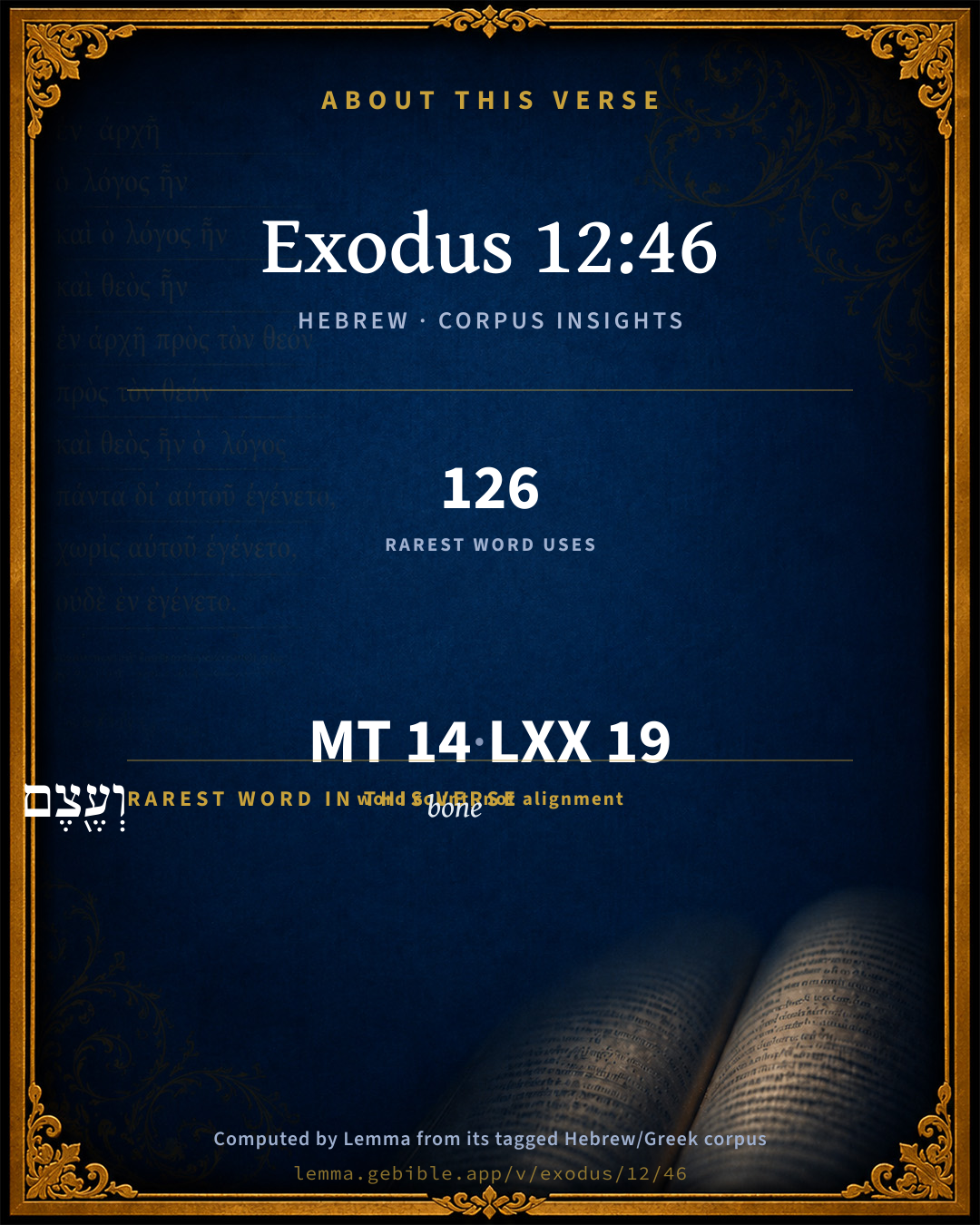
וְעֶ֖צֶם
ʻetsem
H6106
“and · bone”
Conjunction + Noun, Common, Feminine, Singular, Absolute
Part of Speech
Conjunction + Noun
Type
Common
Gender
Feminine
Number
Singular
State
Absolute
Full BDB Definition

Origin: from H6105

TWOT: 1673c

bone, essence, substance - bone - body, limbs, members, external body - bone (of animal) - substance, self
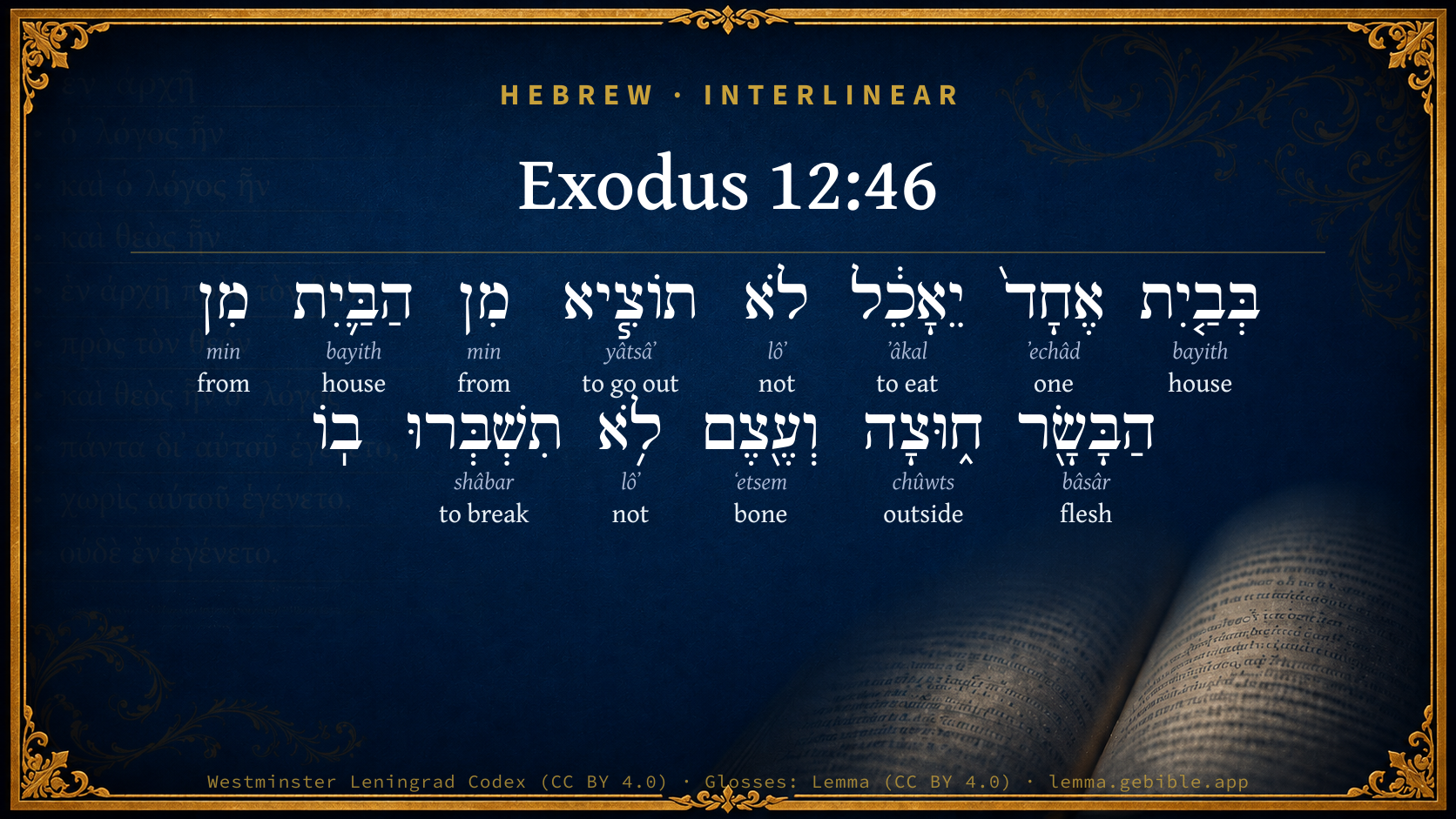
  1. בְּבַ֤יִת bayith H1004 “in/at · house” Preposition + Noun, Common, Masculine, Singular, Absolute
  2. אֶחָד֙ ʼechâd H259 “one” Adjective, Cardinal number, Masculine, Singular, Absolute
  3. יֵאָכֵ֔ל ʼâkal H398 “to eat” Verb, Niphal, Imperfect, 3rd Person, Masculine, Singular
  4. לֹא lôʼ H3808 “not” Particle, Negative
  5. תוֹצִ֧יא yâtsâʼ H3318 “to go out” Verb, Hiphil, Imperfect, 2nd Person, Masculine, Singular
  6. מִן min H4480 “from” Preposition
  7. הַבַּ֛יִת bayith H1004 “the · house” Particle, Definite Article + Noun, Common, Masculine, Singular, Absolute
  8. מִן min H4480 “from” Preposition
  9. הַבָּשָׂ֖ר bâsâr H1320 “the · flesh” Particle, Definite Article + Noun, Common, Masculine, Singular, Absolute
  10. ח֑וּצָה chûwts H2351 “outside · toward” Noun, Common, Masculine, Singular, Absolute + Suffix, Demonstrative
  11. לֹ֥א lôʼ H3808 “not” Particle, Negative
  12. תִשְׁבְּרוּ shâbar H7665 “to break” Verb, Qal, Imperfect, 2nd Person, Masculine, Plural

About this verse

These counts appear in no published source. They are computed here, from the morphology-tagged text and Lemma’s own curated glosses. What Lemma adds →

14
words
10
distinct lemmas
Pentateuch
section

Grammatical profile

  • 3 verbs
  • 5 nouns
  • 1 adjective
  • 3 prepositions
  • 2 particles

Verb forms

  • יֵאָכֵ֔ל Niphal · Imperfect
  • תוֹצִ֧יא Hiphil · Imperfect
  • תִשְׁבְּרוּ Qal · Imperfect

Repetition

Words recur within this verse — often emphatic in Hebrew:

  • בְּבַ֤יִת house H1004 ×2
  • לֹא not H3808 ×2
  • מִן from H4480 ×2

Hebrew & Septuagint length

In English translation the verse runs 29 words from the Hebrew and 28 from the Septuagint (LXX English) — closely comparable.

A rough comparison of the two English renderings, which tokenize alike — not a word-level alignment.

Word counts can differ between the Hebrew and the Greek without any difference in meaning — e.g. the Hebrew direct-object marker אֵת has no separate Greek word, and Greek often adds the article ὁ.

In the original languages it is 14 Hebrew tokens and 19 Greek tokens — but the two are counted differently (Hebrew bundles its prefixes and suffixes into one token; the Greek is in lemma form), so that isn’t a like-for-like length.

Cross-references

6

Topical passages linked to Exodus 12:46 in the Treasury of Scripture Knowledge — connected by theme and wording, ordered by reader-vote popularity; previews shown in the World English Bible.

  • John 19:36 For these things happened, that the Scripture might be fulfilled, "A bone of him will not be broken."
  • Numbers 9:12 They shall leave none of it until the morning, nor break a bone of it. According to all the statute of the Passover they shall keep it.
  • John 19:33 but when they came to Jesus, and saw that he was already dead, they didn't break his legs.
  • Ephesians 2:19–22 So then you are no longer strangers and foreigners, but you are fellow citizens with the saints, and of the household of God,
  • Psalms 34:20 He protects all of his bones. Not one of them is broken.
  • 1 Corinthians 12:12 For as the body is one, and has many members, and all the members of the body, being many, are one body; so also is Christ.

Cross-references courtesy of OpenBible.info (CC BY 4.0).

Hebrew and Greek witnesses Masoretic Hebrew ↔ Greek Septuagint

The same verse in the two great witnesses to the Old Testament, shown verse-for-verse.

These are two independent witnesses, not word-aligned to each other, and the Septuagint is shown in lemma (dictionary) form.

Hebrew Exodus 12:46 Masoretic · Westminster Leningrad Codex

בְּבַ֤יִת אֶחָד֙ יֵאָכֵ֔ל לֹא תוֹצִ֧יא מִן הַבַּ֛יִת מִן הַבָּשָׂ֖ר ח֑וּצָה וְעֶ֖צֶם לֹ֥א תִשְׁבְּרוּ בֽוֹ

In one house shall it be eaten; you shall not carry forth anything of the flesh abroad out of the house; neither shall you break a bone of it.

World English Bible · Public Domain

Greek LXX Exodus 12:46 Septuagint · lemma form

ἐν οἰκία εἷς βιβρώσκω καί οὐ ἐκφέρω ἐκ ὁ οἰκία ὁ κρέας ἔξω καί ὀστέον οὐ συντρίβω ἀπό αὐτός

In one house shall it be eaten, and you⌃ shall not carry of the flesh out from the house; and a bone of it you⌃ shall not break.

LXX2012 (modern English Septuagint) · Public Domain

Hebrew: Westminster Leningrad Codex (CC BY 4.0). Greek: Septuagint (public domain); English from LXX2012 (modern English Septuagint) (Public Domain). How the Septuagint differs from the Hebrew →

Targum (Aramaic paraphrase)

2

The Targum is the ancient Jewish Aramaic paraphrase of the Hebrew Scriptures — an interpretive translation, not the Hebrew text itself. Onkelos (literal) and Pseudo-Jonathan (expansive) render the Torah, and Jonathan the Prophets. Coverage is partial: where no permissively-licensed English translation exists for a verse, only the Aramaic is shown. This is verse-level text, not a word-by-word alignment to the Hebrew.

  1. Targum Onkelos Torah (Genesis–Deuteronomy)
    בַּחֲבוּרָא חֲדָא יִתְאָכֵל לָא תַפֵּיק מִן בֵּיתָא מִן בִּסְרָא לְבָרָא וְגַרְמָא לָא תִתְבְּרוּן בֵּהּ:

    (no public-domain English translation for this verse)

    Targum Onkelos — Aramaic: “Onkelos Genesis” (public domain); “Onkelos Exodus” (public domain); “Onkelos Leviticus” (public domain); “Onkelos Numbers” (public domain); “Onkelos Deuteronomy” (public domain). English: “Sefaria Community Translation” (CC0 1.0 (public-domain dedication)); “J.W. Etheridge. The Targums of Onkelos and Jonathan Ben Uzziel on the Pentateuch. London: Longmans, Green, 1862” (public domain). Text via Sefaria.

  2. Targum Pseudo-Jonathan Torah (Genesis–Deuteronomy)
    בַּחֲבוּרָא חָדָא יִתְאָכֵל לָא תִפְקוּן מִן בֵּיתָא מִן בִּשְרָא בַּר מֵחֲבוּרָתָא וְלָא לִמְשַׁדְרָא דוֹרוֹנִין גְּבַר לְחַבְרֵיהּ וּגְרָמָא לָא תְתַבְּרִין בֵּיהּ בְּדִיל לְמֵיכוּל מַה דִּבְגַוֵּיהּ

    In his own company he shall eat. Thou shalt not carry any of the flesh out of the house from (thy) company, nor send a gift one mail to his neighbour; and a bone of him shall not be broken for the sake of eating that which is within it.

    Targum Pseudo-Jonathan — Aramaic: “Targum Jonathan on Genesis” (public domain); “Targum Jonathan on Exodus” (public domain); “Targum Jonathan on Leviticus” (public domain); “Targum Jonathan on Numbers” (public domain); “Targum Jonathan on Deuteronomy” (public domain). English: “The Targum of Jonathan ben Uzziel, trans. J. W. Etheridge, London, 1862” (public domain). Text via Sefaria.

Commentary

Notes on Exodus 12:46 from classic Christian and Jewish commentators (each source and its license shown beneath its notes). The classic Christian expositions comment on the surrounding passage and are grouped to its opening verse, so a note may address several verses; the Jewish commentaries on the Tanakh (Rashi and others) are per-verse, so they appear only where the commentator wrote on this verse.

Lemma curates 59 commentaries, every one of them public domain or Creative Commons licensed, each selected and text-cleaned for this edition rather than reprinted as found. About our sources →

Trapp's Complete Commentary

John Trapp

Exo 12:46 In one house shall it be eaten; thou shalt not carry forth ought of the flesh abroad out of the house; neither shall ye break a bone thereof.

Ver. 46. In one house.] To teach them unity; which, indeed, is not anywhere found but in the Church. "My dove is but ore." {Son 6:9}

John Trapp, A Commentary or Exposition upon All the Books of the Old and New Testament (1647–1656) — public domain. Text from a community e-Sword module.

Tyndale Open Study Notes

Tyndale Open Resources

12:46 do not break any of its bones: The apostle John makes reference to this instruction regarding the Passover lambs when reporting that Jesus’ legs were not broken on the cross (John 19:36).

Tyndale Open Study Notes — © Tyndale Open Resources, licensed CC BY-SA 4.0. Text via the HelloAO Bible API.

Geneva Bible (1599)

Geneva Bible translators

John 29:36

Geneva Bible (1599) marginal notes — public domain. Text via Bolls.life.

Adam Clarke's Commentary

Verse 46. In one house shall it be eaten] In one family, if that be large enough; if not, a neighbouring family might be invited, Ex 12:4.

Thou shalt not carry forth aught of the flesh] Every family must abide within doors because of the destroying angel, none being permitted to go out of his house till the next day, Ex 12:22.

Neither shall ye break a bone thereof.] As it was to be eaten in haste, (Ex 12:11), there was no time either to separate the bones, or to break them in order to extract the marrow; and lest they should be tempted to consume time in this way, therefore this ordinance was given. It is very likely that, when the whole lamb was brought to table, they cut off the flesh without even separating any of the large joints, leaving the skeleton, with whatever flesh they could not eat, to be consumed with fire, Ex 12:10. This precept was also given to point out a most remarkable circumstance which 1500 years after was to take place in the crucifixion of the Saviour of mankind, who was the true Paschal Lamb, that Lamb of God that takes away the sin of the world; who, though he was crucified as a common malefactor, and it was a universal custom to break the legs of such on the cross, yet so did the providence of God order it that a bone of HIM was not broken. See the fulfilment of this wondrously expressive type, Joh 19:33; Joh 19:36.

Adam Clarke's Commentary on the Bible (1810–1826) — public domain. Text from a community e-Sword/MySword module.

Ellicott's Commentary for English Readers

(46) Neither shall ye break a bone thereof.—In the case of all other victims, the limbs were to be separated from the body. Here the victim was to be roasted whole, and to remain whole, as a symbol of unity, and a type of Him through whom men are brought into unity with each other and with God. (See Joh_19:33-36.)

A Bible Commentary for English Readers, edited by Charles John Ellicott (1878–1897) — public domain. Text from a community e-Sword module.

The Cambridge Bible for Schools and Colleges

gen. ed. J. J. S. Perowne

46. Three regulations designed to emphasize the unity of the company partaking of each passover (cf. vv. 4, 9; 1Co_10:17): one lamb was always to be eaten in one house; no part of the flesh was to be carried out of the house; and (in dressing the Paschal lamb) no bone in it was to be broken (cf. Num_9:12; also Joh_19:36, Psa_34:20).

The Cambridge Bible for Schools and Colleges (gen. ed. J. J. S. Perowne; Cambridge University Press, 1878–1918) — public domain. Text from a community e-Sword module.

John Gill's Exposition

Thus did all the children of Israel,.... They slew a lamb, and roasted and ate it, with unleavened bread, and bitter herbs, and took a bunch of hyssop, and dipped it in the blood, and struck the lintel and the side posts of the doors of their houses: this they did on the night of their deliverance out of Egypt:

as the Lord commanded Moses and Aaron, so did they; being instructed by them; which is an instance of their ready and cheerful obedience to the divine will, which they were under great obligation to perform, from a grateful sense of the wonderful mercy and favour they now were made partakers of.

John Gill's Exposition of the Whole Bible (1746–1763) — public domain (CC PDM 1.0). Text via the HelloAO Bible API.

Albert Barnes' Notes on the Bible

In one house - i. e. “in one company.” Each lamb was to be entirely consumed by the members of one company, whether they belonged to the same household or not.

Break a bone - The typical significance of this injunction is recognized by John, (see the margin reference.) It is not easy to assign any other satisfactory reason for it. This victim alone was exempt from the general law by which the limbs were ordered to be separated from the body.

Albert Barnes' Notes on the Bible (1834–1885) — public domain. Text from a community e-Sword/MySword module.

Matthew Poole's English Annotations

Partly, because they were all obliged not to go out of the house till the morning, Exo 12:22, and to leave none of it till that time, Exo 12:10; partly, lest it should be either superstitiously or profanely abused; and partly, to signify that Christ and salvation are not to be had out of God’s house or church.

To take out and eat the marrow of it. This was required, partly to mind them of their hasty departure out of Egypt, wherein they had no leisure to break and empty the bones; and principally, that it might be an evident type of the Lord Jesus, in whom this was literally fulfilled, Joh 19:36. The bones were burnt with the other remainders of the lamb.

Matthew Poole's English Annotations on the Holy Bible (1683–1685) — public domain. Text from a community e-Sword/MySword module.

The Pulpit Commentary

In one house shall it be eaten. Compare the directions in vers. 3-10, which imply this, and see the comment on ver. 10. Neither shall ye break a bone of it. Kalisch thinks that the lamb was a symbol of the unity of the nation, and was therefore not to have any of its bones broken. This view may be a true one, without being exhaustive. It may have been to mark the unity of the Church in Christ that his bones were not broken, and in view especially of that unity, that the type was made to correspond in this particular with the antitype. (see Joh_19:33-36)

The Pulpit Commentary (1880–1919), ed. H.D.M. Spence-Jones & Joseph S. Exell — public domain. Text from a community e-Sword module.

Rashi

Rabbi Shlomo Yitzchaki (Rashi)

בבית אחד יאכל IN ONE HOUSE SHALL IT BE EATEN — in one company (cf. שה לבית); meaning that those who have registered themselves for it (the Paschal offering) shall not form themselves afterwards into two companies and divide it. An objection was raised: You say that this means “in one company”, but perhaps this is not so, but it means “in one house” (or place) as it usually signifies, and it intends to teach that if they had begun to eat, for example, in the courtyard of a house and rain fell they may not enter the house to complete the eating of the offering? The reply was given: this cannot be so, because Scripture says, (v. 7) “[They shall put the blood] upon the houses (plural) wherein they shall eat it” — and from here it follows that one who is eating the Paschal offering may eat it in two places (consequently the only meaning of the term בית is “company”, as was suggested) (cf. Mekhilta and Onkelos).

לא תוציא מן הבית THOU SHALT NOT CARRY FORTH OUT OF THE HOUSE this must therefore mean away from the company (Mekhilta).

ועצם לא תשברו בו NEITHER SHALL YE BREAK A BONE THEREOF — any bone that is fitted for eating (for the purpose of the performing the command of eating the Paschal lamb) as, for instance, one upon which there is flesh of the size of an olive — to it there is (applies) the prohibition relating to the breaking of a bone, but if there is not upon it flesh of the size of an olive there does not apply to it the prohibition of breaking a bone (cf. Pesachim 84b).

Rashi on the Tanakh — English translations: “The Judaica Press complete Tanach with Rashi, translated by A. J. Rosenberg” (CC BY 4.0); “Pentateuch with Rashi's commentary by M. Rosenbaum and A.M. Silbermann, 1929-1934” (public domain); “The Metsudah Tanach series, Lakewood, N.J” (CC BY 4.0); and “The Book of Joshua, Metsudah Publications, 1997” (CC BY 4.0). Text via Sefaria.

Lesson kit

Teaching starters — assembled from the data on this page, not authored interpretation. Every prompt links to the verse data it draws on. Edit before teaching.

Exodus, in the Pentateuch, opens this verse with 14 words (10 distinct Hebrew lemmas). Its most distinctive word is ʻetsem (“bone”). A historical commentator’s framing appears above. Read the whole chapter for the surrounding context.

Discussion questions

  1. What does “bone” (ʻetsem) contribute to the verse as a whole?
  2. How does John 19:36, which shares this passage’s theme, read alongside this verse?
  3. What does the repetition of “house” (2× in this one verse) do in this verse?
  4. The translations on this page render this verse differently — a whole-verse word diff, not a word-by-word alignment. What might account for the different wordings?
  5. «יֵאָכֵ֔ל» is a Niphal Imperfect verb. How does that grammatical form shape the action described?
  6. Compare how Trapp's Complete Commentary and Tyndale Open Study Notes read this verse. Where do they agree or differ?

Things to notice

Reading settings

Reading text

Shown beneath each verse's original-language words.

Old Testament
Old Testament edition

Read the OT as the Masoretic Hebrew (MT) or the Greek Septuagint (LXX).

English shown for the Greek Septuagint (in the Hebrew ↔ Greek comparison).

Comparing translations? Open the Compare panel on any verse page to stack up to four side by side.