Leviticus 6:16

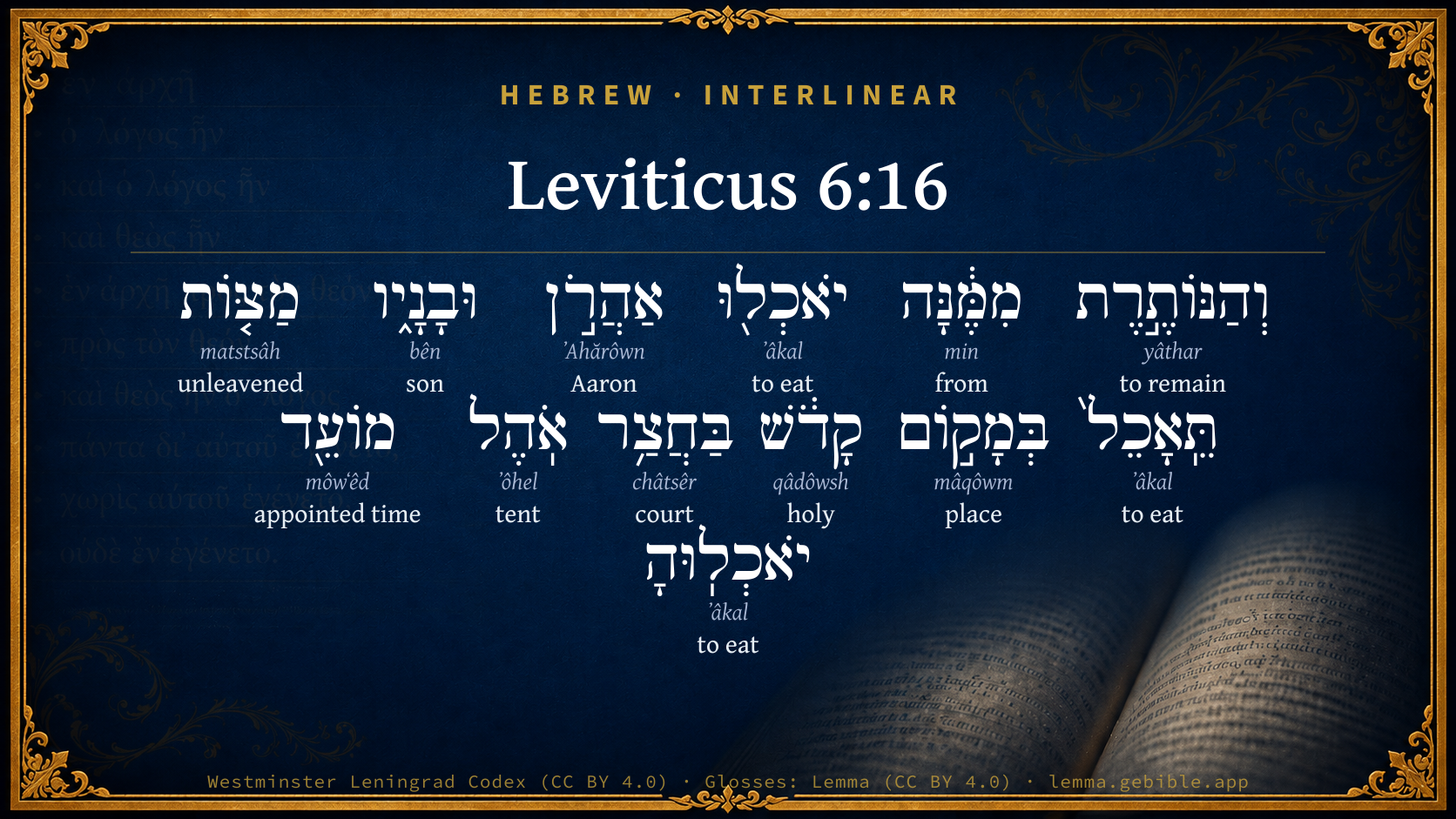
Hebrew (Westminster Leningrad Codex) Leviticus 6:16 appears in the Hebrew Old Testament. The text above is from the Westminster Leningrad Codex. Each word links to its Strong’s number, a concise gloss, and parsing drawn from the Open Scriptures Hebrew Bible morphology. Click any word for its full Brown-Driver-Briggs (BDB) entry.
Download image
Cite this verse

Leviticus 6:16 (World English Bible). Public Domain. Lemma interlinear Bible study tool, https://lemma.gebible.app/v/leviticus/6/16.

Show BibTeX & RIS
BibTeX
RIS
English Translation
That which is left of it Aaron and his sons shall eat. It shall be eaten without yeast in a holy place. They shall eat it in the court of the Tent of Meeting
World English Bible · Public Domain
Download a study sheet

One document with this verse’s original text, its word-by-word gloss line, the meaning frame, cross-references with their text, attributed commentary, and full source and license credits — printable, and it pastes into notes with its structure intact.

This verse Autodidact and up

Study sheet (.html) Plain text (.txt)

A passage Seminary Student

Up to 50 verses in one chapter. A passage sheet keeps up to 6 commentary sources and 12 cross-references per verse, in the order this page ranks them, and says so on the sheet whenever that leaves anything out. Ask for a single verse and you get the Autodidact verse sheet above.

Everything on this page stays free to read, with no account — the sheet is a download of what is already on screen, not access to it.

Want to remove ads? Support Godless Engineer
Compare translations 3

The same verse in 3 English versions, stacked beneath the original-language interlinear above. Click any original word for its lexicon entry.

Each is an independent rendering of the whole verse — the interlinear is not word-aligned to these translations.

Highlighted words mark where these versions differ — a whole-verse word diff, not a word-by-word alignment.

  • World English Bible Public Domain
    That which is left of it Aaron and his sons shall eat. It shall be eaten without yeast in a holy place. They shall eat it in the court of the Tent of Meeting
  • King James Version Public Domain
    And the remainder thereof shall Aaron and his sons eat: with unleavened bread shall it be eaten in the holy place; in the court of the tabernacle of the congregation they shall eat it.
  • unfoldingWord Literal Text CC BY-SA 4.0
    And the remainder from it Aaron and his sons shall eat: unleavened bread shall be eaten in a holy place; in the courtyard of the tent of meeting, they shall eat it.

unfoldingWord Literal Text — © unfoldingWord, licensed CC BY-SA 4.0. Word-aligned USFM3 via Door43 (git.door43.org/unfoldingWord/en_ult).

Versions to compare (up to 4)

3 of 4 selected

Show all 18 translations

Every available English version of this verse, each an independent rendering of the whole verse.

  • World English Bible Public Domain
    That which is left of it Aaron and his sons shall eat. It shall be eaten without yeast in a holy place. They shall eat it in the court of the Tent of Meeting
  • Berean Standard Bible Public Domain
    Aaron and his sons are to eat the remainder. It must be eaten without leaven in a holy place; they are to eat it in the courtyard of the Tent of Meeting.
  • Majority Standard Bible Public Domain
    Aaron and his sons are to eat the remainder. It must be eaten without leaven in a holy place; they are to eat it in the courtyard of the Tent of Meeting.
  • King James Version Public Domain
    And the remainder thereof shall Aaron and his sons eat: with unleavened bread shall it be eaten in the holy place; in the court of the tabernacle of the congregation they shall eat it.
  • American Standard Version (1901) Public Domain
    And that which is left thereof shall Aaron and his sons eat: it shall be eaten without leaven in a holy place; in the court of the tent of meeting they shall eat it.
  • Revised Version (1885) Public Domain
    And that which is left thereof shall Aaron and his sons eat: it shall be eaten without leaven in a holy place; in the court of the tent of meeting they shall eat it.
  • Geneva Bible (1599) Public Domain
    But the rest thereof shall Aaron and his sonnes eate: it shalbe eaten without leauen in the holy place: in the court of the Tabernacle of the Congregation they shall eate it.
  • Douay-Rheims (1899) Public Domain
    And the part of the flour that is left, Aaron and his sons shall eat, without leaven: and he shall eat it in the holy place of the court of the tabernacle.
  • Young's Literal Translation Public Domain
    `And the remnant of it do Aaron and his sons eat; `with' unleavened things it is eaten, in the holy place, in the court of the tent of meeting they do eat it.
  • Literal Standard Version CC BY-SA 4.0
    And Aaron and his sons eat the remnant of it; it is eaten [with] unleavened things in a holy place—they eat it in the court of the Tent of Meeting.
  • Unlocked Literal Bible CC BY-SA 4.0
    Aaron and his sons will eat whatever is left of the offering. It must be eaten without yeast in a holy place. They will eat it in the courtyard of the tent of meeting.
  • unfoldingWord Literal Text CC BY-SA 4.0
    And the remainder from it Aaron and his sons shall eat: unleavened bread shall be eaten in a holy place; in the courtyard of the tent of meeting, they shall eat it.
  • Darby Bible Public Domain
    And the remainder thereof shall Aaron and his sons eat: unleavened shall it be eaten in a holy place; in the court of the tent of meeting shall they eat it.
  • World Messianic Bible Public Domain
    That which is left of it Aaron and his sons shall eat. It shall be eaten without yeast in a holy place. They shall eat it in the court of the Tent of Meeting.
  • Webster's Bible Public Domain
    \\6:23\\For every meat-offering for the priest shall be wholly burnt: it shall not be eaten.
  • Free Bible Version CC BY-SA 4.0
    The rest is for Aaron and his sons to eat. It must be eaten without yeast in a holy place—the courtyard of the Tent of Meeting.
  • Bible in Basic English Public Domain
    Every meal offering offered for the priest is to be completely burned: nothing of it is to be taken for food.
  • JPS Tanakh (1917) Public Domain
    (6-9) And that which is left thereof shall Aaron and his sons eat; it shall be eaten without leaven in a holy place; in the court of the tent of meeting they shall eat it.

Literal Standard Version (2020), Covenant Press — licensed CC BY-SA 4.0. Text via the HelloAO Bible API (eBible.org). Unlocked Literal Bible (unfoldingWord) — licensed CC BY-SA 4.0. Text via the HelloAO Bible API (eBible.org). unfoldingWord Literal Text — © unfoldingWord, licensed CC BY-SA 4.0. Word-aligned USFM3 via Door43 (git.door43.org/unfoldingWord/en_ult). Free Bible Version, Dr. Jonathan Gallagher — licensed CC BY-SA 4.0. Text via the HelloAO Bible API (eBible.org).

Word by word

More ways to search: Search by grammar → Find every occurrence → Compare this word →

Practice this passage: Drill this verse → Learn its vocabulary →

מַצּ֤וֹת
matstsâh
H4682
“unleavened bread”
Noun, Common, Feminine, Plural, Absolute
Part of Speech
Noun
Type
Common
Gender
Feminine
Number
Plural
State
Absolute
Full BDB Definition

Origin: from H4711 in the sense of greedily devouring for sweetness

TWOT: None

unleavened (bread, cake), without leaven.
  1. וְהַנּוֹתֶ֣רֶת yâthar H3498 “and · the · remaining” Conjunction + Particle, Definite Article + Verb, Niphal, Participle Active, Feminine, Singular, Absolute
  2. מִמֶּ֔נָּה min H4480 “from · her” Preposition + Suffix, Personal, 3rd Person, Feminine, Singular
  3. יֹאכְל֖וּ ʼâkal H398 “to eat” Verb, Qal, Imperfect, 3rd Person, Masculine, Plural
  4. אַהֲרֹ֣ן ʼAhărôwn H175 “Aaron” Noun, Proper
  5. וּבָנָ֑יו bên H1121 “and · sons · his” Conjunction + Noun, Common, Masculine, Plural, Construct + Suffix, Personal, 3rd Person, Masculine, Singular
  6. תֵּֽאָכֵל֙ ʼâkal H398 “to eat” Verb, Niphal, Imperfect, 3rd Person, Feminine, Singular
  7. בְּמָק֣וֹם mâqôwm H4725 “in/at · place” Preposition + Noun, Common, Masculine, Singular, Absolute
  8. קָדֹ֔שׁ qâdôwsh H6918 “holy” Adjective, Adjective, Masculine, Singular, Absolute
  9. בַּחֲצַ֥ר châtsêr H2691 “in/at · court of” Preposition + Noun, Common, Both, Singular, Construct
  10. אֹֽהֶל ʼôhel H168 “tent of” Noun, Common, Masculine, Singular, Construct
  11. מוֹעֵ֖ד môwʻêd H4150 “appointed time” Noun, Common, Masculine, Singular, Absolute
  12. יֹאכְלֽוּהָ ʼâkal H398 “to eat · her” Verb, Qal, Imperfect, 3rd Person, Masculine, Plural + Suffix, Personal, 3rd Person, Feminine, Singular

About this verse

These counts appear in no published source. They are computed here, from the morphology-tagged text and Lemma’s own curated glosses. What Lemma adds →

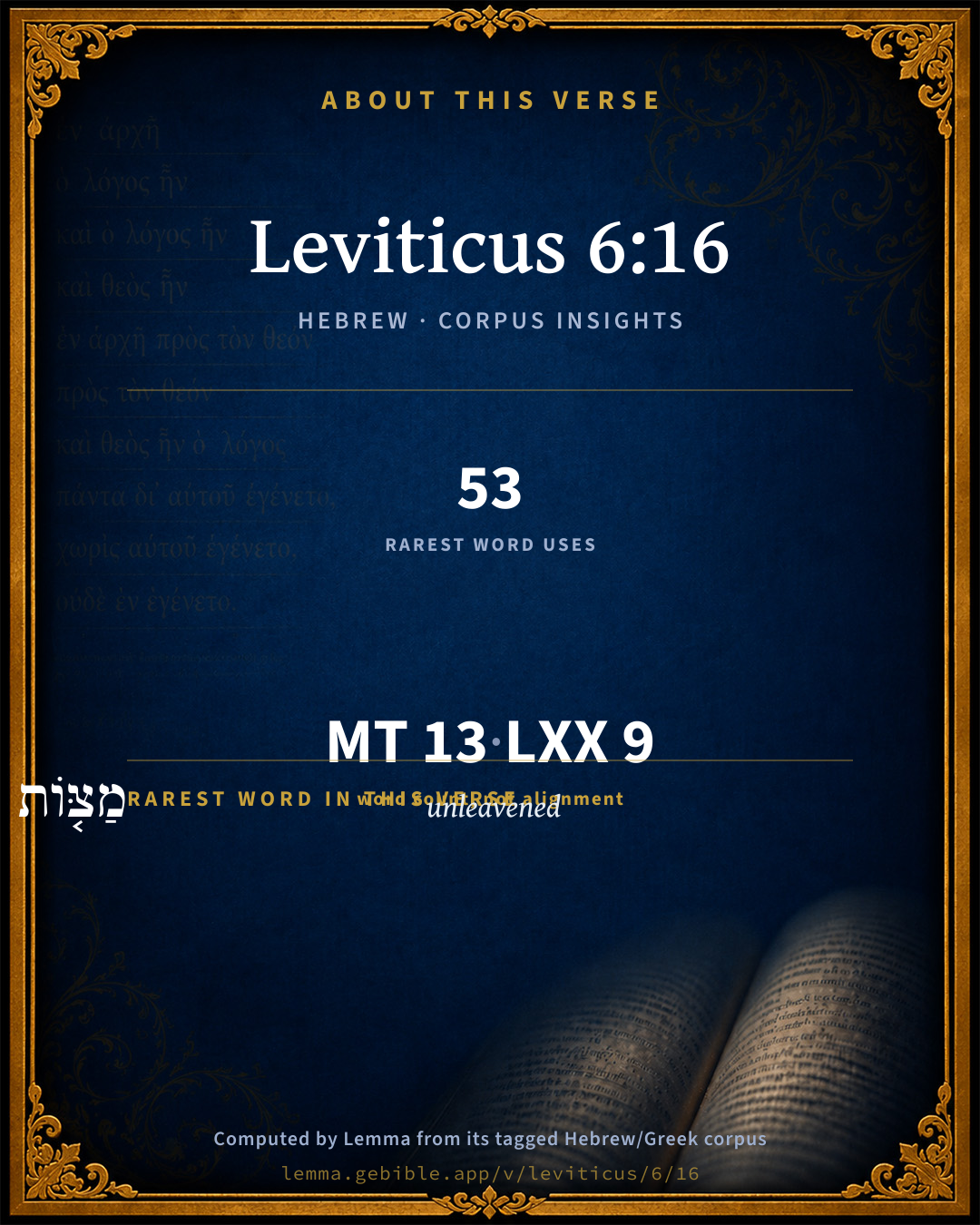
13
words
11
distinct lemmas
Pentateuch
section

Shared distinctive vocabulary

מַצּ֤וֹת unleavened H4682 occurs in 42 verses of the Hebrew Bible. Also found in:

Grammatical profile

  • 4 verbs
  • 7 nouns
  • 1 adjective
  • 1 preposition

Verb forms

  • וְהַנּוֹתֶ֣רֶת Niphal · Participle Active
  • יֹאכְל֖וּ Qal · Imperfect
  • תֵּֽאָכֵל֙ Niphal · Imperfect
  • יֹאכְלֽוּהָ Qal · Imperfect

Repetition

A word recurs within this verse — often emphatic in Hebrew:

  • יֹאכְל֖וּ to eat H398 ×3

Hebrew & Septuagint length

In English translation the verse runs 34 words from the Hebrew and 35 from the Septuagint (LXX English) — closely comparable.

A rough comparison of the two English renderings, which tokenize alike — not a word-level alignment.

Word counts can differ between the Hebrew and the Greek without any difference in meaning — e.g. the Hebrew direct-object marker אֵת has no separate Greek word, and Greek often adds the article ὁ.

In the original languages it is 13 Hebrew tokens and 9 Greek tokens — but the two are counted differently (Hebrew bundles its prefixes and suffixes into one token; the Greek is in lemma form), so that isn’t a like-for-like length.

Cross-references

10

Topical passages linked to Leviticus 6:16 in the Treasury of Scripture Knowledge — connected by theme and wording, ordered by reader-vote popularity; previews shown in the World English Bible.

  • Leviticus 2:3 That which is left of the meal offering shall be Aaron's and his sons'. It is a most holy thing of the offerings of Yahweh made by fire.
  • Ezekiel 44:29 They shall eat the meal-offering, and the sin-offering, and the trespass-offering; and every devoted thing in Israel shall be theirs.
  • Leviticus 10:12–13 Moses spoke to Aaron, and to Eleazar and to Ithamar, his sons who were left, "Take the meal offering that remains of the offerings of Yahweh made by fire, and eat it without yeast beside the altar; for it is most holy;
  • Exodus 12:8 They shall eat the flesh in that night, roasted with fire, and unleavened bread. They shall eat it with bitter herbs.
  • Leviticus 6:26 The priest who offers it for sin shall eat it. It shall be eaten in a holy place, in the court of the Tent of Meeting.
  • Leviticus 2:10–11 That which is left of the meal offering shall be Aaron's and his sons'. It is a thing most holy of the offerings of Yahweh made by fire.
  • Leviticus 5:13 The priest shall make atonement for him concerning his sin that he has sinned in any of these things, and he will be forgiven; and the rest shall be the priest's, as the meal offering.'"
  • Numbers 18:9–10 This shall be your of the most holy things, [reserved] from the fire: every offering of theirs, even every meal-offering of theirs, and every sin-offering of theirs, and every trespass-offering of theirs, which they shall render to me, shall be most holy for you and for your sons.
  • 1 Corinthians 5:8 Therefore let us keep the feast, not with old yeast, neither with the yeast of malice and wickedness, but with the unleavened bread of sincerity and truth.
  • 1 Corinthians 9:13–15 Don't you know that those who serve around sacred things eat from the things of the temple, and those who wait on the altar have their portion with the altar?

Cross-references courtesy of OpenBible.info (CC BY 4.0).

Hebrew and Greek witnesses Masoretic Hebrew ↔ Greek Septuagint

The same verse in the two great witnesses to the Old Testament, shown verse-for-verse.

These are two independent witnesses, not word-aligned to each other, and the Septuagint is shown in lemma (dictionary) form.

Hebrew Leviticus 6:16 Masoretic · Westminster Leningrad Codex

וְהַנּוֹתֶ֣רֶת מִמֶּ֔נָּה יֹאכְל֖וּ אַהֲרֹ֣ן וּבָנָ֑יו מַצּ֤וֹת תֵּֽאָכֵל֙ בְּמָק֣וֹם קָדֹ֔שׁ בַּחֲצַ֥ר אֹֽהֶל מוֹעֵ֖ד יֹאכְלֽוּהָ

That which is left of it Aaron and his sons shall eat. It shall be eaten without yeast in a holy place. They shall eat it in the court of the Tent of Meeting

World English Bible · Public Domain

Greek LXX Leviticus 6:16 Septuagint · lemma form

καί πᾶς θυσία ἱερεύς ὁλόκαυτος εἰμί καί οὐ βιβρώσκω

And Aaron and his sons shall eat that which is left of it: it shall be eaten without leaven in a holy place, they shall eat it in the court of the tabernacle of witness.

LXX2012 (modern English Septuagint) · Public Domain

Hebrew: Westminster Leningrad Codex (CC BY 4.0). Greek: Septuagint (public domain); English from LXX2012 (modern English Septuagint) (Public Domain). How the Septuagint differs from the Hebrew →

Targum (Aramaic paraphrase)

2

The Targum is the ancient Jewish Aramaic paraphrase of the Hebrew Scriptures — an interpretive translation, not the Hebrew text itself. Onkelos (literal) and Pseudo-Jonathan (expansive) render the Torah, and Jonathan the Prophets. Coverage is partial: where no permissively-licensed English translation exists for a verse, only the Aramaic is shown. This is verse-level text, not a word-by-word alignment to the Hebrew.

  1. Targum Onkelos Torah (Genesis–Deuteronomy)
    וְכָל מִנְחָתָא דְכַהֲנָא גְמִיר תְּהֵי לָא תִתְאֲכֵל

    (no public-domain English translation for this verse)

    Targum Onkelos — Aramaic: “Onkelos Genesis” (public domain); “Onkelos Exodus” (public domain); “Onkelos Leviticus” (public domain); “Onkelos Numbers” (public domain); “Onkelos Deuteronomy” (public domain). English: “Sefaria Community Translation” (CC0 1.0 (public-domain dedication)); “J.W. Etheridge. The Targums of Onkelos and Jonathan Ben Uzziel on the Pentateuch. London: Longmans, Green, 1862” (public domain). Text via Sefaria.

  2. Targum Pseudo-Jonathan Torah (Genesis–Deuteronomy)
    וְכָל מִנְחָתָא דְכַהֲנָא גְמִירָא תִּתְסַדֵר וְתִיהֱוֵי לָא תִתְאַכָל

    For every mincha of the priest shall be wholly set in order and consumed: it shall not be eaten.

    Targum Pseudo-Jonathan — Aramaic: “Targum Jonathan on Genesis” (public domain); “Targum Jonathan on Exodus” (public domain); “Targum Jonathan on Leviticus” (public domain); “Targum Jonathan on Numbers” (public domain); “Targum Jonathan on Deuteronomy” (public domain). English: “The Targum of Jonathan ben Uzziel, trans. J. W. Etheridge, London, 1862” (public domain). Text via Sefaria.

Commentary

Notes on Leviticus 6:16 from classic Christian and Jewish commentators (each source and its license shown beneath its notes). The classic Christian expositions comment on the surrounding passage and are grouped to its opening verse, so a note may address several verses; the Jewish commentaries on the Tanakh (Rashi and others) are per-verse, so they appear only where the commentator wrote on this verse.

Lemma curates 59 commentaries, every one of them public domain or Creative Commons licensed, each selected and text-cleaned for this edition rather than reprinted as found. About our sources →

Trapp's Complete Commentary

John Trapp

Lev 6:16 And the remainder thereof shall Aaron and his sons eat: with unleavened bread shall it be eaten in the holy place; in the court of the tabernacle of the congregation they shall eat it.

Ver. 16. Shall Aaron and his sons eat.] See 1Co 9:13-14. {See Trapp on "1Co 9:13"} {See Trapp on "1Co 9:14"}

John Trapp, A Commentary or Exposition upon All the Books of the Old and New Testament (1647–1656) — public domain. Text from a community e-Sword module.

Joseph Benson's Commentary

Lev 6:16. The remainder shall Aaron and his sons eat — Unless they had some legal uncleanness upon them, Lev 22:6. His sons — The males only might eat these, because they were most holy things; whereas the daughters of Aaron might eat other holy things. In the court — In some special room appointed for that purpose. The reason why this was to be eaten only by holy persons, and that in a holy place, is given, (Lev 6:17,) because it is most holy.

Joseph Benson's Commentary on the Old and New Testaments (1811–1818) — public domain. Text from a community e-Sword module.

The Expositor's Bible

THE PRIESTS PORTIONS

Lev_6:16-18; Lev_7:6-10; Lev_7:14; Lev_7:31-36

AFTER the law of the guilt offering follows a section {Lev_6:8-30; Lev_7:1-38} with regard to the offerings previously treated, but addressed especially to the priests, as the foregoing were specially directed to the people. Much of the contents of this section has already passed before us, in anticipation of its order in the book, as this has seemed necessary in order to a complete exposition of the several offerings. An important part of the section, however, relating to the portion of the offerings which was appointed for the priests, has been passed by until now, and must claim our brief attention.

In the verses indicated above, it is ordered that of the meal offerings, the sin offerings, and the guilt offerings, all that was not burnt, as also the wave breast and the heave shoulder of the peace offerings, should be for Aaron and his sons. In particular, it is directed that the priests portion of the sin offering and the guilt offering shall be eaten by "the priest that maketh atonement therewith"; {Lev_7:7} and that of the meal offerings prepared in the oven, the frying pan, or the baking pan, all that is not burned upon the altar, according to the law of chapter 2, shall be eaten by "the priest that offereth it"; and that of every meal offering mingled with oil, or dry, the same part "shall all the sons of Aaron have, one as well as another". {Lev_7:9-10} Of the burnt offering, all the flesh being burned, the hide alone fell to the officiating priest as his perquisite. {Lev_7:8}

These regulations are explained in the concluding verses of the section Lev_7:35-36 as follows, "This is the anointing portion of Aaron, and the anointing portion of his sons, out of the offerings of the Lord made by fire, in the day when he presented them to minister unto the Lord in the priests office; which the Lord commanded to be given them of the children of Israel, in the day that he anointed them. It is a due forever throughout their generations."

Hence, it is plain that this use which was to be made of certain parts of certain offerings does not touch the question of the consecration of the whole to God. The whole of each offering is none the less wholly accepted and appropriated by God, that He designates a part of it to the maintenance of the priesthood. That even as thus used by the priest it is used by him as something belonging to God, is indicated by the phrase used, "it is most"; {Lev_6:17} expressive words, which in the law of the offerings always have a technical use, as denoting those things of which only the sons of Aaron might partake, and that only in the holy place. In the case of the meal offering, its peculiarly sacred character as belonging, the whole of it, exclusively to God, is further marked by the additional injunctions that it, should be eaten without leaven in a holy place; {Lev_6:16} and that whosoever touched these offerings should be; {Lev_6:18} that is, he should be as a man separated to God, under all the restrictions (doubtless, without the privileges), which belonged to the priesthood, as men set apart for Gods service. In the eating of their portion of the various offerings by the priests, we are to recognise no official act: we simply see the servants of God supported by the bread of His table.

This last thought, which is absent in the case of no one of the offerings, is brought out with special clearness and fulness in the ceremonial connected with the peace offerings. {Lev_7:28-34} In this case, certain parts, the right thigh (or shoulder?) and the breast, are set apart as the due of the priest. The selection of these is determined by the principle which marks all the Levitical legislation: God and those who represent Him are to be honoured by the consecration of the best of everything. In the animals used upon the altar, these were regarded as the choice parts, and are indeed referred to as such in other Scriptures. But, in order that neither the priest nor the people may imagine that the priest receives these as a man from his fellowmen, but may understand that they are given to God, and that it is from God that the priest now receives them, as His servant, fed from His table; to this end, certain ceremonies were ordained to be used with these parts; the breast was to be "heaved," the thigh was to be "waved," before the Lord. What was the meaning of these actions?

The breast was to be "heaved"; that is, elevated heavenward. The symbolic meaning of this act can scarcely be missed. By it, the priest acknowledged his dependence upon God for the supply of this sacrificial food, and, again, by this act consecrated it anew to Him as the One that sitteth in the heavens.

But God is not only the One that "sitteth in the heavens"; He is the God who has condescended also to dwell among men, and especially in the tent of meeting in the midst of Israel. And thus, as by the elevation of the breast heavenward, God, the Giver, was recognised as the One enthroned in heaven, so by the "waving" of the thigh, which, as the rabbis tell us, was a movement backward and forward, to and from the altar, He was recognised also as Jehovah, who had condescended from heaven to dwell in the midst of His people. Like the "heaving," so the "waving," then, was an act of acknowledgment and consecration to God; the former, to God, as in heaven, the God of creation; the other, to God, as the God of the altar, the God of redemption. And that this is the true significance of these acts is illustrated by the fact that in the Pentateuch, in the account of the gold and silver brought by the people for the preparation of the tabernacle, {Exo_35:22} the same word is used to describe the presentation of these offerings which is here used of the wave offering.

And so in the peace offering the principle is amply illustrated upon which the priests received their dues. The worshippers bring their offerings, and present them, not to the priest, but through him to God; who, then, having used such parts as He will in the service of the sanctuary, gives again such parts of them as He pleases to the priests.

The lesson of these arrangements lies immediately before us. They were intended to teach Israel, and, according to the New Testament, are also designed to teach us, that it is the will of God that those who give up secular occupations to devote themselves to the ministry of His house should be supported by the freewill offerings of Gods people. Very strange indeed it is to hear a few small sects in our day denying this. For the Apostle Paul argues at length to this effect, and calls the attention of the Corinthians {1Co_9:13-14} to the fact that the principle expressed in this ordinance of the law of Moses has not been set aside, but holds good in this dispensation. "Know ye not that they which wait upon the altar have their portion with the altar? Even so did the Lord ordain that they which proclaim the Gospel should live of the Gospel." The principle plainly covers the case of all such as give up secular callings to devote themselves to the ministry of the Word, whether to proclaim the Gospel in any of the great mission fields, or to exercise the pastorate of the local church. Such are ever to be supported out of the consecrated offerings of Gods people. To point in disparagement of modern "hireling" ministers and missionaries, as some have done, to the case of Paul, who laboured with his own hands, that he might not be chargeable to those to whom he ministered, is singularly inapt, seeing that in the chapter above referred to he expressly vindicates his right to receive of the Corinthians his support, and in this Second Epistle to them even seems to express a doubt {2Co_12:13} whether in refusing, as he did, to receive support from them, he had not done them a "wrong," making them thus "inferior to the rest of the churches," from whom, in fact, he did receive such material aid. {Php_4:10; Php_4:16} And if ever claims of this kind upon our benevolence and liberality seem to be heavy, and if to nature the burden is sometimes irksome, we shall do well to remember that the requirement is not of man, and not of the Church, but of God. It comes to us with the double authority of the Old and New Testament, of the Law and the Gospel. And it will certainly help us all to give to these ends the more gladly, if we keep that in mind which the Levitical law so carefully kept before Israel, that the giving was to be regarded by them as not to the priesthood, but to the Lord, and that in our giving outwardly to support the ministry of Gods Word, we give, really, to the Lord Himself. And it stands written: {Mat_10:42} "Whosoever shall give to drink unto one of these little ones a cup of cold water only he shall in no wise lose his reward."

William Robertson Nicoll, ed., The Expositor's Bible (London: Hodder & Stoughton, 1887–1910) — public domain. 65 of 66 books (1 Corinthians is not separately keyed, as that volume carries no machine-parseable verse references); section-level commentary keyed to the opening verse. Introductory and overview sections not keyed to a specific passage are excluded.

Tyndale Open Study Notes

Tyndale Open Resources

6:16 In this context sacred place does not refer to the Holy Place at the heart of the Tabernacle but to any location within the Tabernacle complex, all of which were ceremonially clean and holy.

Tyndale Open Study Notes — © Tyndale Open Resources, licensed CC BY-SA 4.0. Text via the HelloAO Bible API.

Ellicott's Commentary for English Readers

(16) With unleavened bread shall it be eaten.—Better, unleavened shall it be eaten. That is, the remainder of the meal is to be made into unleavened cakes, and thus be eaten. (See Lev_10:12.) By adding the word with, which is not in the original, the Authorised Version says that the priests are to eat the meat offering with the addition of unleavened cakes.

A Bible Commentary for English Readers, edited by Charles John Ellicott (1878–1897) — public domain. Text from a community e-Sword module.

John Gill's Exposition

It shall not be baked with leaven,.... Which, as it was a type of Christ, may denote his sincerity both in doctrine, life, and conversation; and as it may respect the offerer, may signify his uprightness and integrity, and his being devoid of hypocrisy and insincerity:

I have given it unto thee for their portion of my offerings made by fire; this was part of the provision made for the maintenance of the priests, as it was but just that they that ministered at the altar should live of it; and the rather, as the priests and Levites had no portion and inheritance in the land of Israel, and therefore must be supported in another way, which the Lord took care of:

it is most holy, as the sin offering, and as the trespass offering; as they, so this being devoted to sacred uses, what were not consumed upon the altar belonged to the priests, and were their perquisites, nor might they be appropriated to the use of any other.

John Gill's Exposition of the Whole Bible (1746–1763) — public domain (CC PDM 1.0). Text via the HelloAO Bible API.

Haydock's Catholic Bible Commentary

He. Only the priests, who were actually officiating, could partake of it. (Calmet)

George Leo Haydock (1774–1849), Haydock's Catholic Family Bible and Commentary, 1859 edition — public domain. Excludes Psalms (Douay-Rheims chapter numbering differs from Protestant) and Deuterocanonical books (Catholic canon only).

Matthew Poole's English Annotations

The males only might eat these, because they were most holy things; whereas the daughters of Aaron might eat other holy things, Num 18:11.

With unleavened bread; or rather, unleavened, for with is not in the Hebrew, and it disturbs the sense; for since the meat-offering itself was fine flour, Lev 2:1, it is not likely that they eat it with unleavened bread.

In the court of the tabernacle of the congregation; in some special room appointed for that purpose. See Lev 8:31; 1Sa 3:3; Eze 42:13; 46:19,24. The reason why this was to be eaten only by holy persons, and that in a holy place, is given Lev 6:17, because it is most holy, and therefore to be treated with greater reverence.

Matthew Poole's English Annotations on the Holy Bible (1683–1685) — public domain. Text from a community e-Sword/MySword module.

Whedon's Commentary on the Bible

Daniel D. Whedon

16. The remainder… shall Aaron and his sons eat — The reason of this requirement is “because it is most holy.” For a discussion of the question whether the priests were able to eat all the most holy things commanded them, see Concluding Note, chap. 7.

Daniel D. Whedon (gen. ed.), Commentary on the Old and New Testaments (1874–1909) — public domain. Text from a community e-Sword module.

John Wesley's Explanatory Notes

His sons - The males only might eat these, because they were most holy things; whereas the daughters of Aaron might eat other holy things. In the court - In some special room appointed for that purpose. The reason why this was to be eaten only by holy persons, and that in an holy place, is given ver. 17, because it is most holy.

John Wesley, Explanatory Notes Upon the Whole Bible (1754–1765) — public domain. Text via the GEBible commentary corpus.

unfoldingWord translationNotes

Door43 World Missions Community

It must be eaten

This can be translated in active form. AT: "They must eat it" (See: Active or Passive)

It must not be baked with yeast

This can be translated in active form. AT: "Do not bake it with yeast" (See: Active or Passive)

offerings made by fire

This can be stated in active form. AT: "burnt offerings" (See: Active or Passive)

Whoever touches them will become holy

This is an implied warning that those who are not male descendants of Aaron should not touch this offering. The full meaning of this statement can be made clear. (See: Assumed Knowledge and Implicit Information)

translationWords

Aaron

sacrifice

yeast

holy

court

tent of meeting

fire

sin offering

guilt offering

people group

generation

Yahweh

unfoldingWord translationNotes — © Distant Shores Media and the Door43 World Missions Community, licensed CC BY-SA 4.0. Source: git.door43.org/Door43/en_tn.

Rashi

Rabbi Shlomo Yitzchaki (Rashi)

כליל (connected with כל, all) means, all of it belongs alike to the Most High God (i. e. no part of it is given to the priests).

Rashi on the Tanakh — English translations: “The Judaica Press complete Tanach with Rashi, translated by A. J. Rosenberg” (CC BY 4.0); “Pentateuch with Rashi's commentary by M. Rosenbaum and A.M. Silbermann, 1929-1934” (public domain); “The Metsudah Tanach series, Lakewood, N.J” (CC BY 4.0); and “The Book of Joshua, Metsudah Publications, 1997” (CC BY 4.0). Text via Sefaria.

Lesson kit

Teaching starters — assembled from the data on this page, not authored interpretation. Every prompt links to the verse data it draws on. Edit before teaching.

Leviticus, in the Pentateuch, opens this verse with 13 words (11 distinct Hebrew lemmas). Its most distinctive word is matstsâh (“unleavened”). A historical commentator’s framing appears above. Read the whole chapter for the surrounding context.

Discussion questions

  1. What does “unleavened” (matstsâh) contribute to the verse as a whole?
  2. How does Genesis 19:3, which shares the word «unleavened», read alongside this verse?
  3. What does the repetition of “to eat” (3× in this one verse) do in this verse?
  4. These translations render this verse differently; the difference is in the English rendering, not the original. What questions does that raise?
  5. «וְהַנּוֹתֶ֣רֶת» is a Niphal Participle Active verb. How does that grammatical form shape the action described?
  6. Compare how Trapp's Complete Commentary and Joseph Benson's Commentary read this verse. Where do they agree or differ?

Things to notice

Reading settings

Reading text

Shown beneath each verse's original-language words.

Old Testament
Old Testament edition

Read the OT as the Masoretic Hebrew (MT) or the Greek Septuagint (LXX).

English shown for the Greek Septuagint (in the Hebrew ↔ Greek comparison).

Comparing translations? Open the Compare panel on any verse page to stack up to four side by side.