
Genesis 27:45

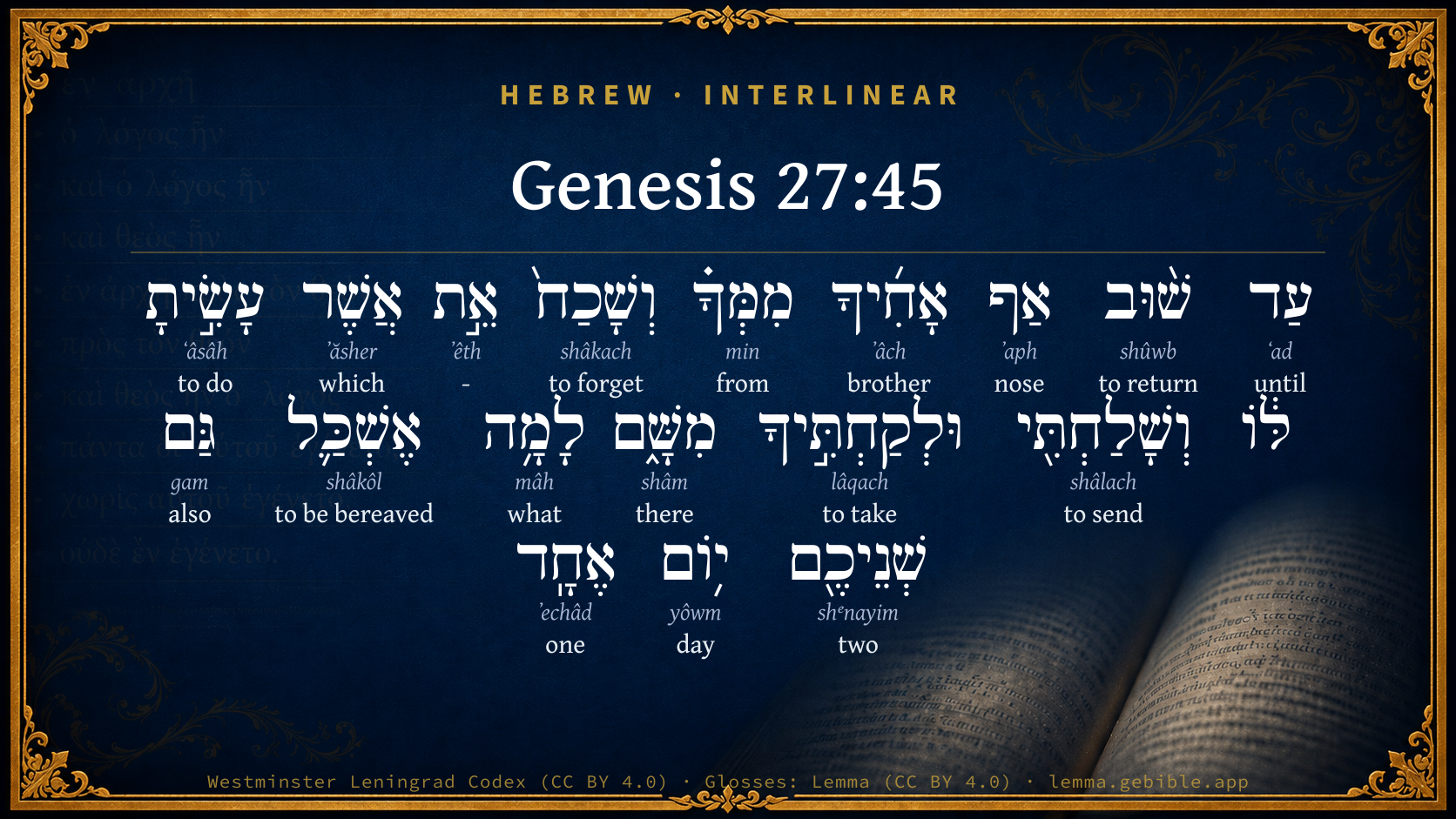
Hebrew (Westminster Leningrad Codex) Genesis 27:45 appears in the Hebrew Old Testament. The text above is from the Westminster Leningrad Codex. Each word links to its Strong’s number, a concise gloss, and parsing drawn from the Open Scriptures Hebrew Bible morphology. Click any word for its full Brown-Driver-Briggs (BDB) entry.
Download image
Cite this verse

Genesis 27:45 (World English Bible). Public Domain. Lemma interlinear Bible study tool, https://lemma.gebible.app/v/genesis/27/45.

Show BibTeX & RIS
BibTeX
RIS
English Translation
until your brother's anger turn away from you, and he forgets what you have done to him. Then I will send, and get you from there. Why should I be bereaved of you both in one day?"
World English Bible · Public Domain
Highlights
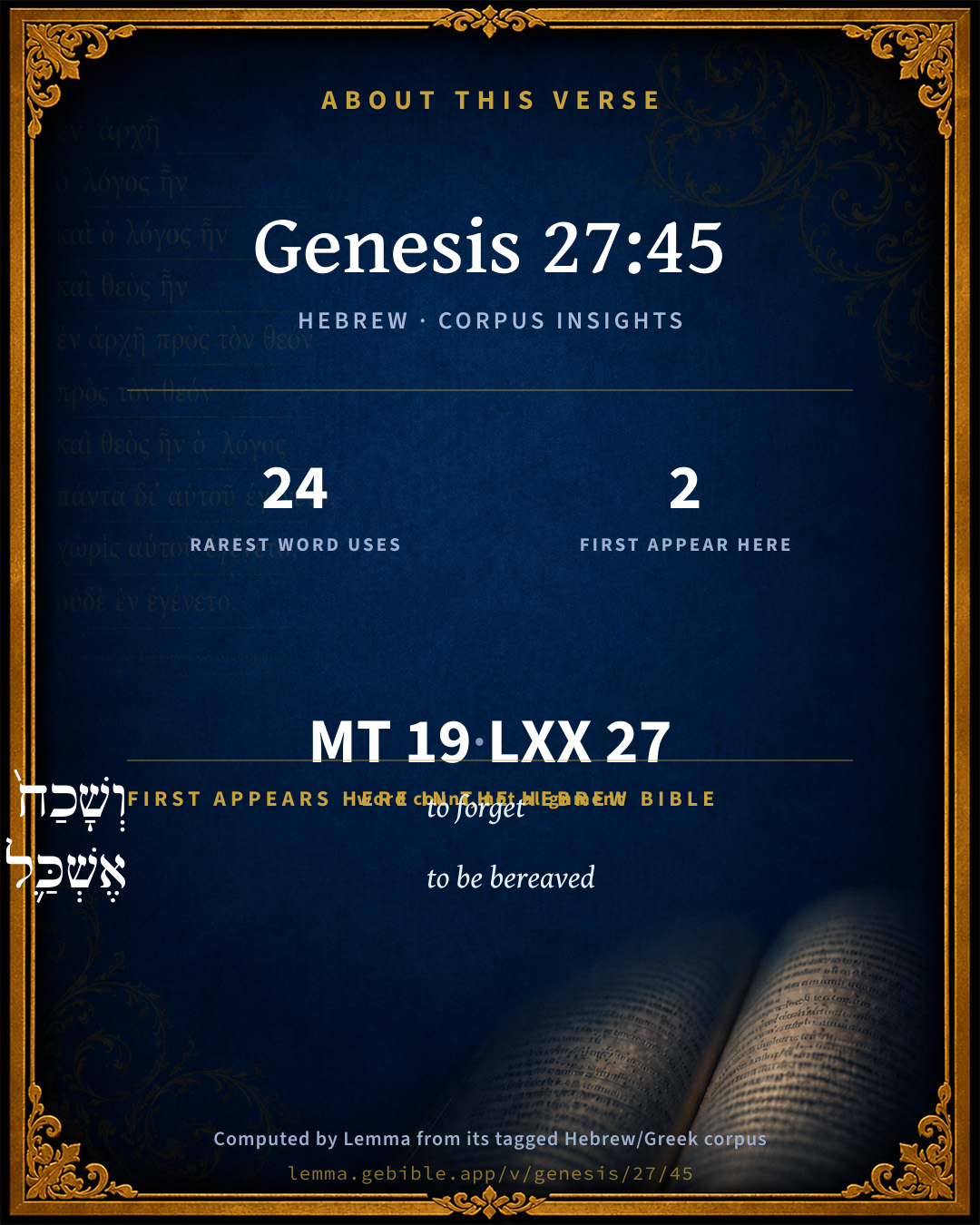
  • 2 first appearances in the Hebrew Bible
Full analysis ↓
Download a study sheet

One document with this verse’s original text, its word-by-word gloss line, the meaning frame, cross-references with their text, attributed commentary, and full source and license credits — printable, and it pastes into notes with its structure intact.

This verse Autodidact and up

Study sheet (.html) Plain text (.txt)

A passage Seminary Student

Up to 50 verses in one chapter. A passage sheet keeps up to 6 commentary sources and 12 cross-references per verse, in the order this page ranks them, and says so on the sheet whenever that leaves anything out. Ask for a single verse and you get the Autodidact verse sheet above.

Everything on this page stays free to read, with no account — the sheet is a download of what is already on screen, not access to it.

Want to remove ads? Support Godless Engineer
Compare translations 3

The same verse in 3 English versions, stacked beneath the original-language interlinear above. Click any original word for its lexicon entry.

Each is an independent rendering of the whole verse — the interlinear is not word-aligned to these translations.

Highlighted words mark where these versions differ — a whole-verse word diff, not a word-by-word alignment.

  • World English Bible Public Domain
    until your brother's anger turn away from you, and he forgets what you have done to him. Then I will send, and get you from there. Why should I be bereaved of you both in one day?"
  • King James Version Public Domain
    Until thy brother's anger turn away from thee, and he forget that which thou hast done to him: then I will send, and fetch thee from thence: why should I be deprived also of you both in one day?
  • unfoldingWord Literal Text CC BY-SA 4.0
    until the anger of your brother turns away from you and he forgets what you have done to him. Then I will send and get you from there. Why should I also lose both of you one day?”

unfoldingWord Literal Text — © unfoldingWord, licensed CC BY-SA 4.0. Word-aligned USFM3 via Door43 (git.door43.org/unfoldingWord/en_ult).

Versions to compare (up to 4)

3 of 4 selected

Show all 18 translations

Every available English version of this verse, each an independent rendering of the whole verse.

  • World English Bible Public Domain
    until your brother's anger turn away from you, and he forgets what you have done to him. Then I will send, and get you from there. Why should I be bereaved of you both in one day?"
  • Berean Standard Bible Public Domain
    until your brother’s rage against you wanes and he forgets what you have done to him. Then I will send for you and bring you back from there. Why should I lose both of you in one day?”
  • Majority Standard Bible Public Domain
    until your brother’s rage against you wanes and he forgets what you have done to him. Then I will send for you and bring you back from there. Why should I lose both of you in one day?”
  • King James Version Public Domain
    Until thy brother's anger turn away from thee, and he forget that which thou hast done to him: then I will send, and fetch thee from thence: why should I be deprived also of you both in one day?
  • American Standard Version (1901) Public Domain
    Until thy brother's anger turn away from thee, and he forget that which thou hast done to him. Then I will send, and fetch thee from thence. Why should I be bereaved of you both in one day?
  • Revised Version (1885) Public Domain
    until thy brother’s anger turn away from thee, and he forget that which thou hast done to him: then I will send, and fetch thee from thence: why should I be bereaved of you both in one day?
  • Geneva Bible (1599) Public Domain
    And till thy brothers wrath turne away from thee, and hee forget the thinges, which thou hast done to him: then will I sende and take thee from thence: why shoulde I bee depriued of you both in one day?
  • Douay-Rheims (1899) Public Domain
    And his indignation cease, and he forget the things thou hast done to him: afterwards I will send, and bring thee from thence hither. Why shall I be deprived of both my sons in one day?
  • Young's Literal Translation Public Domain
    till thy brother's anger turn back from thee, and he hath forgotten that which thou hast done to him, and I have sent and taken thee from thence; why am I bereaved even of you both the same day?'
  • Literal Standard Version CC BY-SA 4.0
    until your brother’s anger turns back from you, and he has forgotten that which you have done to him, and I have sent and taken you from there; why am I bereaved even of you both the same day?”
  • Unlocked Literal Bible CC BY-SA 4.0
    until your brother's anger turns away from you, and he forgets what you have done to him. Then I will send and bring you back from there. Why should I lose you both in one day?
  • unfoldingWord Literal Text CC BY-SA 4.0
    until the anger of your brother turns away from you and he forgets what you have done to him. Then I will send and get you from there. Why should I also lose both of you one day?”
  • Darby Bible Public Domain
    until thy brother's anger turn away from thee, and he forget what thou hast done to him; then I will send and fetch thee thence. Why should I be bereaved even of you both in one day?
  • World Messianic Bible Public Domain
    until your brother’s anger turns away from you, and he forgets what you have done to him. Then I will send, and get you from there. Why should I be bereaved of you both in one day?”
  • Webster's Bible Public Domain
    Till thy brother's anger shall turn away from thee, and he shall forget that which thou hast done to him: then I will send, and bring thee from thence. Why should I be deprived also of you both in one day?
  • Free Bible Version CC BY-SA 4.0
    Once he's cooled down and forgets what you did to him, I'll send for you to come back. Why should I lose both of you in a single day?”
  • Bible in Basic English Public Domain
    Till the memory of what you have done to him is past and he is no longer angry: then I will send word for you to come back; are the two of you to be taken from me in one day?
  • JPS Tanakh (1917) Public Domain
    until thy brother's anger turn away from thee, and he forget that which thou hast done to him; then I will send, and fetch thee from thence; why should I be bereaved of you both in one day?'

Literal Standard Version (2020), Covenant Press — licensed CC BY-SA 4.0. Text via the HelloAO Bible API (eBible.org). Unlocked Literal Bible (unfoldingWord) — licensed CC BY-SA 4.0. Text via the HelloAO Bible API (eBible.org). unfoldingWord Literal Text — © unfoldingWord, licensed CC BY-SA 4.0. Word-aligned USFM3 via Door43 (git.door43.org/unfoldingWord/en_ult). Free Bible Version, Dr. Jonathan Gallagher — licensed CC BY-SA 4.0. Text via the HelloAO Bible API (eBible.org).

Word by word

More ways to search: Search by grammar → Find every occurrence → Compare this word →

Practice this passage: Drill this verse → Learn its vocabulary →

אֶשְׁכַּ֛ל
shâkôl
H7921
“to be bereaved”
Verb, Qal, Imperfect, 1st Person, Common, Singular
Part of Speech
Verb
Stem
Qal
Form
Imperfect
Person
1st Person
Gender
Common
Number
Singular
Full BDB Definition

Origin: a primitive root

TWOT: 2385

to be bereaved, make childless, miscarry - (Qal) to be bereaved - (Piel) - to make childless - to cause barrenness, show barrenness or abortion - to miscarry - (Hiphil) miscarrying (participle)
  1. עַד ʻad H5704 “until” Preposition
  2. שׁ֨וּב shûwb H7725 “to return” Verb, Qal, Infinitive Construct
  3. אַף ʼaph H639 “nose” Particle, Accusative
  4. אָחִ֜יךָ ʼâch H251 “brother · your” Noun, Common, Masculine, Singular, Construct + Suffix, Personal, 2nd Person, Masculine, Singular
  5. מִמְּךָ֗ min H4480 “from · you” Preposition + Suffix, Personal, 2nd Person, Masculine, Singular
  6. וְשָׁכַח֙ shâkach H7911 “and · to forget” Conjunction + Verb, Qal, Sequential Perfect, 3rd Person, Masculine, Singular
  7. אֵ֣ת ʼêth H853 “-” Particle, Direct Object
  8. אֲשֶׁר ʼăsher H834 “which” Particle, Relative
  9. עָשִׂ֣יתָ ʻâsâh H6213 “to do” Verb, Qal, Perfect, 2nd Person, Masculine, Singular
  10. וְשָׁלַחְתִּ֖י shâlach H7971 “and · to send” Conjunction + Verb, Qal, Sequential Perfect, 1st Person, Common, Singular
  11. וּלְקַחְתִּ֣יךָ lâqach H3947 “and · to take · you” Conjunction + Verb, Qal, Sequential Perfect, 1st Person, Common, Singular + Suffix, Personal, 2nd Person, Masculine, Singular
  12. מִשָּׁ֑ם shâm H8033 “from · there” Preposition + Adverb
  13. לָמָ֥ה mâh H4100 “to/for · what” Preposition + Particle, Interrogative
  14. גַּם gam H1571 “also” Particle, Accusative
  15. שְׁנֵיכֶ֖ם shᵉnayim H8147 “two · your” Adjective, Cardinal number, Masculine, Dual, Construct + Suffix, Personal, 2nd Person, Masculine, Plural
  16. י֥וֹם yôwm H3117 “day” Noun, Common, Masculine, Singular, Absolute
  17. אֶחָֽד ʼechâd H259 “one” Adjective, Cardinal number, Masculine, Singular, Absolute

About this verse

These counts appear in no published source. They are computed here, from the morphology-tagged text and Lemma’s own curated glosses. What Lemma adds →

19
words
18
distinct lemmas
Pentateuch
section

Notable vocabulary

The rarest word here is אֶשְׁכַּ֛ל to be bereaved H7921 — appearing just 24 times in the whole Hebrew Bible.

First appearance in Scripture

These words make their first canonical appearance in the Hebrew Bible here:

  • וְשָׁכַח֙ to forget H7911
  • אֶשְׁכַּ֛ל to be bereaved H7921

Shared distinctive vocabulary

אֶשְׁכַּ֛ל to be bereaved H7921 occurs in 22 verses of the Hebrew Bible. Also found in:

Grammatical profile

  • 6 verbs
  • 2 nouns
  • 2 adjectives
  • 3 prepositions
  • 1 adverb
  • 5 particles

Verb forms

  • שׁ֨וּב Qal · Infinitive Construct
  • וְשָׁכַח֙ Qal · Sequential Perfect
  • עָשִׂ֣יתָ Qal · Perfect
  • וְשָׁלַחְתִּ֖י Qal · Sequential Perfect
  • וּלְקַחְתִּ֣יךָ Qal · Sequential Perfect
  • אֶשְׁכַּ֛ל Qal · Imperfect

Hebrew & Septuagint length

In English translation the verse runs 37 words from the Hebrew and 36 from the Septuagint (LXX English) — closely comparable.

A rough comparison of the two English renderings, which tokenize alike — not a word-level alignment.

Word counts can differ between the Hebrew and the Greek without any difference in meaning — e.g. the Hebrew direct-object marker אֵת has no separate Greek word, and Greek often adds the article ὁ.

In the original languages it is 19 Hebrew tokens and 27 Greek tokens — but the two are counted differently (Hebrew bundles its prefixes and suffixes into one token; the Greek is in lemma form), so that isn’t a like-for-like length.

Cross-references

8

Topical passages linked to Genesis 27:45 in the Treasury of Scripture Knowledge — connected by theme and wording, ordered by reader-vote popularity; previews shown in the World English Bible.

  • Genesis 4:8–16 Cain said to Abel, his brother, "Let's go into the field." It happened, when they were in the field, that Cain rose up against Abel, his brother, and killed him.
  • Genesis 9:5–6 I will surely require your blood of your lives. At the hand of every animal I will require it. At the hand of man, even at the hand of every man's brother, I will require the life of man.
  • Genesis 27:35 He said, "Your brother came with deceit, and has taken away your blessing."
  • 2 Samuel 14:6–7 Your handmaid had two sons, and they two strove together in the field, and there was none to part them, but the one struck the other, and killed him.
  • Proverbs 19:21 There are many plans in a man's heart, But Yahweh's counsel will prevail.
  • Lamentations 3:37 Who is he who says, and it comes to pass, when the Lord doesn't command it?
  • Acts 28:4 When the natives saw the creature hanging from his hand, they said one to another, "No doubt this man is a murderer, whom, though he has escaped from the sea, yet Justice has not allowed to live."
  • James 4:13–15 Come now, you who say, "Today or tomorrow let's go into this city, and spend a year there, trade, and make a profit."

Cross-references courtesy of OpenBible.info (CC BY 4.0).

Hebrew and Greek witnesses Masoretic Hebrew ↔ Greek Septuagint

The same verse in the two great witnesses to the Old Testament, shown verse-for-verse.

These are two independent witnesses, not word-aligned to each other, and the Septuagint is shown in lemma (dictionary) form.

Hebrew Genesis 27:45 Masoretic · Westminster Leningrad Codex

עַד שׁ֨וּב אַף אָחִ֜יךָ מִמְּךָ֗ וְשָׁכַח֙ אֵ֣ת אֲשֶׁר עָשִׂ֣יתָ לּ֔וֹ וְשָׁלַחְתִּ֖י וּלְקַחְתִּ֣יךָ מִשָּׁ֑ם לָמָ֥ה אֶשְׁכַּ֛ל גַּם שְׁנֵיכֶ֖ם י֥וֹם אֶחָֽד

until your brother's anger turn away from you, and he forgets what you have done to him. Then I will send, and get you from there. Why should I be bereaved of you both in one day?"

World English Bible · Public Domain

Greek LXX Genesis 27:45 Septuagint · lemma form

καί ὁ ὀργή ὁ ἀδελφός σύ ἀπό σύ καί ἐπιλανθάνω ὅς ποιέω αὐτός καί ἀποστέλλω μεταπέμπω σύ ἐκεῖθεν μήποτε ἀτεκνόω ἀπό ὁ δύο σύ ἐν ἡμέρα εἷς

and rage depart from you, and he forget what you have done to him; and I will send and fetch you thence, lest at any time I should be bereaved of you both in one day.

LXX2012 (modern English Septuagint) · Public Domain

Hebrew: Westminster Leningrad Codex (CC BY 4.0). Greek: Septuagint (public domain); English from LXX2012 (modern English Septuagint) (Public Domain). How the Septuagint differs from the Hebrew →

Targum (Aramaic paraphrase)

2

The Targum is the ancient Jewish Aramaic paraphrase of the Hebrew Scriptures — an interpretive translation, not the Hebrew text itself. Onkelos (literal) and Pseudo-Jonathan (expansive) render the Torah, and Jonathan the Prophets. Coverage is partial: where no permissively-licensed English translation exists for a verse, only the Aramaic is shown. This is verse-level text, not a word-by-word alignment to the Hebrew.

  1. Targum Onkelos Torah (Genesis–Deuteronomy)
    עַד דִּיתוּב רוּגְזָא דְאָחוּךְ מִנָּךְ וְיִתְנְשֵׁי יָת דִּי עֲבַדְתָּ לֵהּ וְאֶשְׁלַח וְאֶדְבְּרִנָּךְ מִתַּמָּן לְמָה אֶתְכַּל אַף תַּרְוֵיכוֹן יוֹמָא חָד

    (no public-domain English translation for this verse)

    Targum Onkelos — Aramaic: “Onkelos Genesis” (public domain); “Onkelos Exodus” (public domain); “Onkelos Leviticus” (public domain); “Onkelos Numbers” (public domain); “Onkelos Deuteronomy” (public domain). English: “Sefaria Community Translation” (CC0 1.0 (public-domain dedication)); “J.W. Etheridge. The Targums of Onkelos and Jonathan Ben Uzziel on the Pentateuch. London: Longmans, Green, 1862” (public domain). Text via Sefaria.

  2. Targum Pseudo-Jonathan Torah (Genesis–Deuteronomy)
    עַד דְנוּחַ רוּגְזָא דְאָחוּךְ מִינָךְ וְיִתְנְשֵׁי יַת מַה דְעָבַדְתָּ לֵיהּ וַאֲשַׁדֵר וְאִידְבְּרִינָךְ מִתַּמָן לָמָה אֶתְכַּל אוּף תַּרְוֵיכוֹן יוֹמָא חָד דְאַנְתְּ מִתְקְטֵיל וְהוּא מִטְרַד הֵיכְמָא דְאִתְכְּלַת חַוָה מִן הֶבֶל דְקַטְלֵיהּ קַיִן וְאִטְרִדָן תַּרְוֵיהוֹן מִן אַפֵּי אָדָם וְחַוָה כָּל יוֹמֵי חַיֵיהוֹם דְאָדָם וְחַוָה

    until thy brother's anger have quieted from thee, and he have forgotten what thou hast done to him; and I will send and take thee from thence. Why should I be bereaved of you both in one day: thou being slain, and he driven forth, as Hava was bereaved of Habel, whom Kain slew, and both were removed from before Adam and Hava all the days of the life of Adam and Hava?

    Targum Pseudo-Jonathan — Aramaic: “Targum Jonathan on Genesis” (public domain); “Targum Jonathan on Exodus” (public domain); “Targum Jonathan on Leviticus” (public domain); “Targum Jonathan on Numbers” (public domain); “Targum Jonathan on Deuteronomy” (public domain). English: “The Targum of Jonathan ben Uzziel, trans. J. W. Etheridge, London, 1862” (public domain). Text via Sefaria.

Commentary

Notes on Genesis 27:45 from classic Christian and Jewish commentators (each source and its license shown beneath its notes). The classic Christian expositions comment on the surrounding passage and are grouped to its opening verse, so a note may address several verses; the Jewish commentaries on the Tanakh (Rashi and others) are per-verse, so they appear only where the commentator wrote on this verse.

Lemma curates 59 commentaries, every one of them public domain or Creative Commons licensed, each selected and text-cleaned for this edition rather than reprinted as found. About our sources →

Trapp's Complete Commentary

John Trapp

Gen 27:45 Until thy brother’s anger turn away from thee, and he forget [that] which thou hast done to him: then I will send, and fetch thee from thence: why should I be deprived also of you both in one day?

Ver. 45. And he forget, &c.] While wrongs are remembered, they are not remitted. He forgives not, that forgets not. When an inconsiderate fellow had stricken Cato in the bath, and afterwards cried him mercy, he replied, I remember not that thou didst strike me. {a} Our Henry VI is said to have been of that happy memory, that he never forgot anything but injuries. Esau was none such: he was of that sort whom they call πικροχολοι, soon angry, but not soon pleased. His anger was like "coals of juniper," {Psa 120:4} which burn extremely, last long (a whole twelve month about, as some write), and though they seem extinct, revive again: -

“ Flamma redardescit, quae modo nullas fuit .” - Ovid.

{a} Sen., De Ira., lib. i.

John Trapp, A Commentary or Exposition upon All the Books of the Old and New Testament (1647–1656) — public domain. Text from a community e-Sword module.

Geneva Bible (1599)

Geneva Bible translators

For the wicked son will kill the godly: and the plague of God will afterward light on the wicked son.

Geneva Bible (1599) marginal notes — public domain. Text via Bolls.life.

Jamieson, Fausset & Brown

Robert Jamieson, A. R. Fausset & David Brown

Why should I be deprived of you both?--This refers to the law of Goelism, by which the nearest of kin would be obliged to avenge the death of Jacob upon his brother.

Jamieson, Fausset & Brown — Commentary Critical and Explanatory on the Whole Bible (1871) — public domain (CC PDM 1.0). Text via the HelloAO Bible API.

Adam Clarke's Commentary

Verse 45. Why should I be deprived also of you both] If Esau should kill Jacob, then the nearest akin to Jacob, who was by the patriarchial law, Ge 9:6, the avenger of blood, would kill Esau; and both these deaths might possibly take place in the same day. This appears to be the meaning of Rebekah. Those who are ever endeavouring to sanctify the means by the end, are full of perplexity and distress. God will not give his blessing to even a Divine service, if not done in his own way, on principles of truth and righteousness. Rebekah and her son would take the means out of God's hands; they compassed themselves with their own sparks, and warmed themselves with their own fire; and this had they at the hand of God, they lay down in sorrow. God would have brought about his designs in a way consistent with his own perfections; for he had fully determined that the elder should serve the younger, and that the Messiah should spring not from the family of Esau but from that of Jacob; and needed not the cunning craftiness or deceits of men to accomplish his purposes. Yet in his mercy he overruled all these circumstances, and produced good, where things, if left to their own operations and issues, would have produced nothing but evil. However, after this reprehensible transaction, we hear no more of Rebekah. The Holy Spirit mentions her no more, her burial excepted, Ge 49:31. See Clarke on Ge 35:8.

Adam Clarke's Commentary on the Bible (1810–1826) — public domain. Text from a community e-Sword/MySword module.

John Calvin's Commentaries

45. Why should I be deprived of you both in one day? Why does Rebekah fear a double privation? for there was no danger that Jacob, endued with a disposition so mild and placid, should rise up against his brother. We see, therefore, that Rebekah concluded that God would be the avenger of the iniquitous murder. Moreover, although God, for a time, might seem to overlook the deed, and to suspend his judgment, it would yet be necessary for him to withdraw from the parricide. Therefore, by this law of nature, Rebekah declares that she should be entirely bereaved; because she would be compelled to dread and to detest him who survived. But if Rebekah anticipated in her mind what the judgment of God would be, and devoted the murderer to destruction, because she was persuaded that wickedness so great would not be unpunished; much less ought we to close our eyes against the manifest chastisements of God.

John Calvin's Commentaries (1540-1563) — public domain. Text from the Calvin Translation Society English edition (1840s-50s) via the Christian Classics Ethereal Library (ccel.org). Calvin's coverage is partial (roughly two-thirds of the Bible); uncommented books and verses are honest gaps, never fabricated. The 19th-century editor's footnotes and remarks are omitted so the notes are faithfully Calvin's own voice.

The Cambridge Bible for Schools and Colleges

gen. ed. J. J. S. Perowne

45. I will send, and fetch thee] There is no mention of this part of Rebekah’s promise being fulfilled.

be bereaved of you both] The expression seems to be a reference to the custom of blood-revenge, as in 2Sa_14:7. The life of the murderer would be required by the family. He must either be banished from the family, or judicially put to death. In either case the parents would be “bereaved of both.”

Or, possibly, “you both” refers to Isaac, her husband, and Jacob, her favourite son. On the day of Isaac’s death, Esau intended to slay Jacob.

The Cambridge Bible for Schools and Colleges (gen. ed. J. J. S. Perowne; Cambridge University Press, 1878–1918) — public domain. Text from a community e-Sword module.

John Gill's Exposition

Until thy brother's anger turn away from thee,.... Which is repeated from the preceding verse, to carry on the connection:

and he forget that which thou hast done to him; in getting the blessing from him; being convinced that Jacob had done him no injury, and that he had no just cause of being angry with him, it being the will of God that he should have the blessing; and besides, having bought the birthright of him, the blessing belonged to him in course; or however would in time forgive and forget what he thought was an injury done him:

then I will send, and fetch thee from thence; send messengers to him that should acquaint him with the disposition of his brother towards him, and, if agreeable, bring him along with them to his mother again; this is said to encourage him to go:

why should I be deprived also of you both in one day? who might either in the quarrel kill one another; or however, as one would be murdered, so the other, the murderer, must die by the hand of the civil magistrate, according to the law in Gen 9:6; or should he escape justice being done him by men, yet the hand of God would find him; or if obliged to flee and hide himself, it would be as if he was not.

John Gill's Exposition of the Whole Bible (1746–1763) — public domain (CC PDM 1.0). Text via the HelloAO Bible API.

Haydock's Catholic Bible Commentary

Both my sons. Esau would have forfeited his life for murder, chap. ix. 6. (Haydock) --- Perhaps she might also fear that Jacob, in his own defence, should in the very agony of death, give the aggressor a mortal wound; or that Esau, at least, would be forced to flee his country. Indeed, she considered him already as a lost man, on account of his marriage with the two women of Chanaan, and his savage manners. (Calmet)

George Leo Haydock (1774–1849), Haydock's Catholic Family Bible and Commentary, 1859 edition — public domain. Excludes Psalms (Douay-Rheims chapter numbering differs from Protestant) and Deuterocanonical books (Catholic canon only).

Matthew Poole's English Annotations

Of thee by Esau’s bloody hands; and of Esau, who was likely to suffer death for his murder, either by the authority of the magistrate, as God commanded, Gen 9:6, or by the hand of God, who ofttimes supplies the magistrate’s defects in that particular, and in some extraordinary manner executes this vengeance. See Gen 4:11,16; Ac 28:4.

Matthew Poole's English Annotations on the Holy Bible (1683–1685) — public domain. Text from a community e-Sword/MySword module.

Whedon's Commentary on the Bible

Daniel D. Whedon

45. Both in one day — If Esau slew Jacob, the avenger of blood would speedily arise, (Gen_9:6,) and so both of them would perish as in a day. Or, perhaps, she refers to Isaac and Jacob both dying in a day.

Daniel D. Whedon (gen. ed.), Commentary on the Old and New Testaments (1874–1909) — public domain. Text from a community e-Sword module.

John Wesley's Explanatory Notes

Why should I be deprived of you both? - Not only of the murdered, but of the murderer, who either by the magistrate, or by the immediate hand of God would be sacrificed to justice.

John Wesley, Explanatory Notes Upon the Whole Bible (1754–1765) — public domain. Text via the GEBible commentary corpus.

Rashi

Rabbi Shlomo Yitzchaki (Rashi)

למה אשכל means WHY SHOULD I BE BEREAVED משניכם OF BOTH OF YOU? — The one who buries his children is termed שכול bereaved: so we find in the case of Jacob (43:14), “If I am to be bereaved (שכלתי) let me be bereaved”.

גם שניכם OF YOU BOTH — If he attacks you and you kill him his children will rise and kill you. The Holy Spirit poured itself forth upon her and she prophesied (had a presage) that they would both die on one day just as it is stated in the Chapter המקנה לאשתו (Sotah 13a).

Rashi on the Tanakh — English translations: “The Judaica Press complete Tanach with Rashi, translated by A. J. Rosenberg” (CC BY 4.0); “Pentateuch with Rashi's commentary by M. Rosenbaum and A.M. Silbermann, 1929-1934” (public domain); “The Metsudah Tanach series, Lakewood, N.J” (CC BY 4.0); and “The Book of Joshua, Metsudah Publications, 1997” (CC BY 4.0). Text via Sefaria.

Radak

Rabbi David Kimhi (Radak)

עד שוב...גם שניכם, one to include the other. We find a similar construction of lumping two people together when they share a single common denominator [such as death in this verse. Ed.] in Genesis 43,8 גם אנחנו גם אתה, “both we and you,” where the wordגם introduces two entities instead of merely adding one to another, and Yehudah tells his father that sending Binyamin with him will result in both his father and the brothers and their families being spared death from famine. The rationale of אשכול שניכם יום אחד, is simply that the death of one of the brothers will inevitably be followed immediately by the death of the other.

Radak on the Tanakh — English translations: “Sefaria Community Translation” (CC0 1.0 (public-domain dedication)); “Eliyahu Munk, HaChut Hameshulash” (CC BY 4.0); “Rabbi Mike Feuer, Jerusalem Anthology” (CC BY 4.0); and “R. David Kimhi on the first book of Psalms, Translated by R.G. Finch, London, 1919” (public domain). Text via Sefaria.

Lesson kit

Teaching starters — assembled from the data on this page, not authored interpretation. Every prompt links to the verse data it draws on. Edit before teaching.

Genesis, in the Pentateuch, opens this verse with 19 words (18 distinct Hebrew lemmas). Its most distinctive word is shâkôl (“to be bereaved”). A historical commentator’s framing appears above. Read the whole chapter for the surrounding context.

Discussion questions

  1. The word shâkôl carries the sense “to be bereaved.” How does it shape the verse?
  2. 2 words here appear for the first time in Scripture. What is being introduced at this debut?
  3. Genesis 31:38 shares the word «to be bereaved» with this verse. How do the two illuminate each other?
  4. These translations render this verse differently; the difference is in the English rendering, not the original. What questions does that raise?
  5. The verb «שׁ֨וּב» is Qal Infinitive Construct. How does its form color the action?
  6. Reading how Trapp's Complete Commentary and Geneva Bible (1599) read this verse, where do the two commentators agree and where do they part?

Things to notice

Reading settings

Reading text

Shown beneath each verse's original-language words.

Old Testament
Old Testament edition

Read the OT as the Masoretic Hebrew (MT) or the Greek Septuagint (LXX).

English shown for the Greek Septuagint (in the Hebrew ↔ Greek comparison).

Comparing translations? Open the Compare panel on any verse page to stack up to four side by side.