
Exodus 29:22

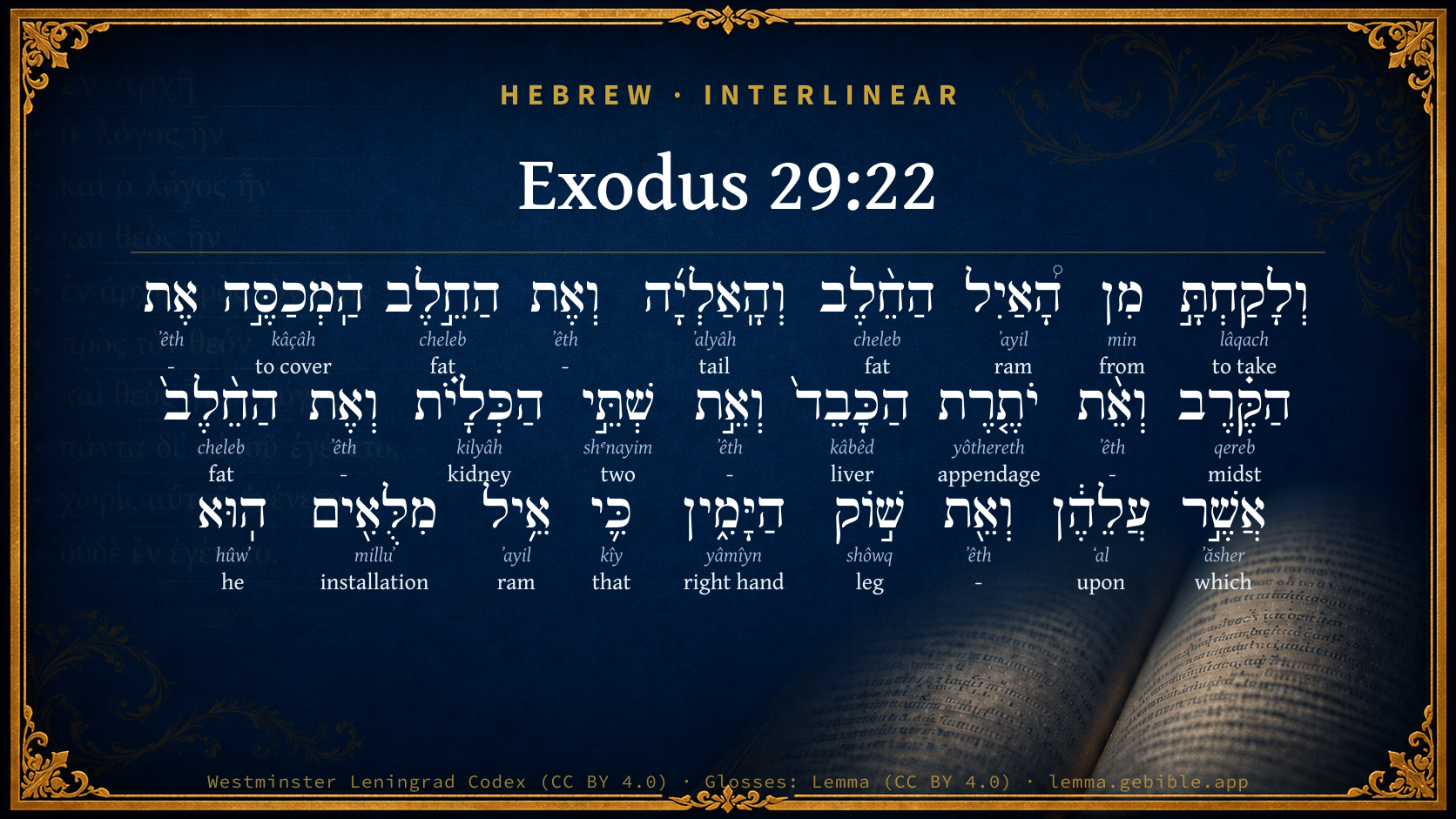
Hebrew (Westminster Leningrad Codex) Exodus 29:22 appears in the Hebrew Old Testament. The text above is from the Westminster Leningrad Codex. Each word links to its Strong’s number, a concise gloss, and parsing drawn from the Open Scriptures Hebrew Bible morphology. Click any word for its full Brown-Driver-Briggs (BDB) entry.
Download image
Cite this verse

Exodus 29:22 (World English Bible). Public Domain. Lemma interlinear Bible study tool, https://lemma.gebible.app/v/exodus/29/22.

Show BibTeX & RIS
BibTeX
RIS
English Translation
Also you shall take some of the ram's fat, the fat tail, the fat that covers the innards, the cover of the liver, the two kidneys, the fat that is on them, and the right thigh (for it is a ram of consecration),
World English Bible · Public Domain
Highlights
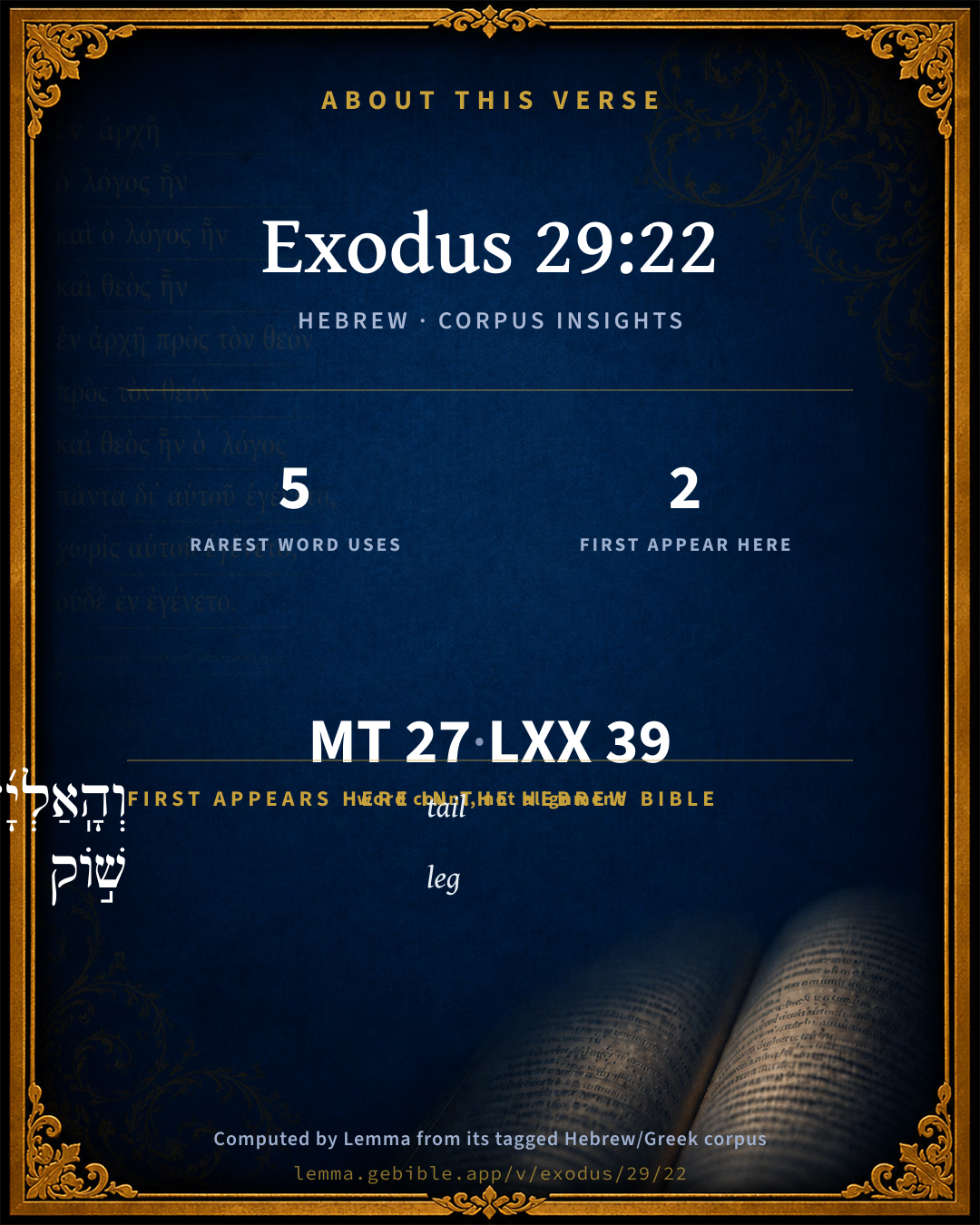
  • 2 first appearances in the Hebrew Bible
Full analysis ↓
Download a study sheet

One document with this verse’s original text, its word-by-word gloss line, the meaning frame, cross-references with their text, attributed commentary, and full source and license credits — printable, and it pastes into notes with its structure intact.

This verse Autodidact and up

Study sheet (.html) Plain text (.txt)

A passage Seminary Student

Up to 50 verses in one chapter. A passage sheet keeps up to 6 commentary sources and 12 cross-references per verse, in the order this page ranks them, and says so on the sheet whenever that leaves anything out. Ask for a single verse and you get the Autodidact verse sheet above.

Everything on this page stays free to read, with no account — the sheet is a download of what is already on screen, not access to it.

Want to remove ads? Support Godless Engineer
Compare translations 3

The same verse in 3 English versions, stacked beneath the original-language interlinear above. Click any original word for its lexicon entry.

Each is an independent rendering of the whole verse — the interlinear is not word-aligned to these translations.

Highlighted words mark where these versions differ — a whole-verse word diff, not a word-by-word alignment.

  • World English Bible Public Domain
    Also you shall take some of the ram's fat, the fat tail, the fat that covers the innards, the cover of the liver, the two kidneys, the fat that is on them, and the right thigh (for it is a ram of consecration),
  • King James Version Public Domain
    Also thou shalt take of the ram the fat and the rump, and the fat that covereth the inwards, and the caul above the liver, and the two kidneys, and the fat that is upon them, and the right shoulder; for it is a ram of consecration:
  • unfoldingWord Literal Text CC BY-SA 4.0
    And you shall take the fat from the ram and the fat tail and the fat covering the entrails and the lobe of the liver and the two kidneys and the fat that is on them and the right thigh—for this is a ram of consecration—

unfoldingWord Literal Text — © unfoldingWord, licensed CC BY-SA 4.0. Word-aligned USFM3 via Door43 (git.door43.org/unfoldingWord/en_ult).

Versions to compare (up to 4)

3 of 4 selected

Show all 18 translations

Every available English version of this verse, each an independent rendering of the whole verse.

  • World English Bible Public Domain
    Also you shall take some of the ram's fat, the fat tail, the fat that covers the innards, the cover of the liver, the two kidneys, the fat that is on them, and the right thigh (for it is a ram of consecration),
  • Berean Standard Bible Public Domain
    Take the fat from the ram, the fat tail, the fat covering the entrails, the lobe of the liver, both kidneys with the fat on them, and the right thigh (since this is a ram for ordination),
  • Majority Standard Bible Public Domain
    Take the fat from the ram, the fat tail, the fat covering the entrails, the lobe of the liver, both kidneys with the fat on them, and the right thigh (since this is a ram for ordination),
  • King James Version Public Domain
    Also thou shalt take of the ram the fat and the rump, and the fat that covereth the inwards, and the caul above the liver, and the two kidneys, and the fat that is upon them, and the right shoulder; for it is a ram of consecration:
  • American Standard Version (1901) Public Domain
    Also thou shalt take of the ram the fat, and the fat tail, and the fat that covereth the inwards, and the caul of the liver, and the two kidneys, and the fat that is upon them, and the right thigh (for it is a ram of consecration),
  • Revised Version (1885) Public Domain
    Also thou shalt take of the ram the fat, and the fat tail, and the fat that covereth the inwards, and the caul of the liver, and the two kidneys, and the fat that is upon them, and the right thigh; for it is a ram of consecration:
  • Geneva Bible (1599) Public Domain
    Also thou shalt take of the rammes ye fatte and the rumpe, euen the fat that couereth the inwards, and the kall of the liuer, and the two kidneis, and the fat that is vpon them, and the right shoulder, (for it is the ramme of consecration)
  • Douay-Rheims (1899) Public Domain
    Thou shalt take the fat of the ram, and the rump, and the fat that covereth the lungs, and the caul of the liver, and the two kidneys, and the fat that is upon them, and the right shoulder, because it is the ram of consecration.
  • Young's Literal Translation Public Domain
    `And thou hast taken from the ram the fat, and the fat tail, and the fat which is covering the inwards, and the redundance on the liver, and the two kidneys, and the fat which `is' on them, and the right leg, for it `is' a ram of consecration,
  • Literal Standard Version CC BY-SA 4.0
    And you have taken from the ram the fat, and the fat tail, and the fat which is covering the innards, and the redundance on the liver, and the two kidneys, and the fat which [is] on them, and the right leg, for it [is] a ram of consecration,
  • Unlocked Literal Bible CC BY-SA 4.0
    You must take the ram's fat, the fat tail, the fat that covers the inner parts, the covering of the liver, the two kidneys and the fat on them, and the right thigh—for this ram is for the priests' consecration to me.
  • unfoldingWord Literal Text CC BY-SA 4.0
    And you shall take the fat from the ram and the fat tail and the fat covering the entrails and the lobe of the liver and the two kidneys and the fat that is on them and the right thigh—for this is a ram of consecration—
  • Darby Bible Public Domain
    Also of the ram shalt thou take the fat, and the fat-tail, and the fat that covereth the inwards, and the net of the liver, and the two kidneys, and the fat that is upon them, and the right shoulder -- for it is a ram of consecration --
  • World Messianic Bible Public Domain
    Also you shall take some of the ram’s fat, the fat tail, the fat that covers the innards, the cover of the liver, the two kidneys, the fat that is on them, and the right thigh (for it is a ram of consecration),
  • Webster's Bible Public Domain
    Also thou shalt take of the ram the fat and the rump, and the fat that covereth the inwards, and the caul above the liver, and the two kidneys, and the fat that is upon them, and the right shoulder; for it is a ram of consecration:
  • Free Bible Version CC BY-SA 4.0
    Take the fat from the ram, including the fat of its broad tail, the fat covering the intestines, the best parts of the liver, the two kidneys with their fat, as well as the right thigh (because this is a ram for ordination).
  • Bible in Basic English Public Domain
    Then take the fat of the sheep, the fat tail, the fat covering the insides, and the fat joining the liver and the two kidneys with the fat round them, and the right leg; for by the offering of this sheep they are to be marked out as priests:
  • JPS Tanakh (1917) Public Domain
    Also thou shalt take of the ram the fat, and the fat tail, and the fat that covereth the inwards, and the lobe of the liver, and the two kidneys, and the fat that is upon them, and the right thigh; for it is a ram of consecration;

Literal Standard Version (2020), Covenant Press — licensed CC BY-SA 4.0. Text via the HelloAO Bible API (eBible.org). Unlocked Literal Bible (unfoldingWord) — licensed CC BY-SA 4.0. Text via the HelloAO Bible API (eBible.org). unfoldingWord Literal Text — © unfoldingWord, licensed CC BY-SA 4.0. Word-aligned USFM3 via Door43 (git.door43.org/unfoldingWord/en_ult). Free Bible Version, Dr. Jonathan Gallagher — licensed CC BY-SA 4.0. Text via the HelloAO Bible API (eBible.org).

Word by word

More ways to search: Search by grammar → Find every occurrence → Compare this word →

Practice this passage: Drill this verse → Learn its vocabulary →

וְהָֽאַלְיָ֜ה
ʼalyâh
H451
“and · the · tail”
Conjunction + Particle, Definite Article + Noun, Common, Feminine, Singular, Absolute
Part of Speech
Conjunction + Particle + Noun
Type
Common
Gender
Feminine
Number
Singular
State
Absolute
Full BDB Definition

Origin: from H422 (in the original sense of strength)

TWOT: 95a

tail, fat-tail (of sheep - an Eastern delicacy)
  1. וְלָקַחְתָּ֣ lâqach H3947 “and · to take” Conjunction + Verb, Qal, Sequential Perfect, 2nd Person, Masculine, Singular
  2. מִן min H4480 “from” Preposition
  3. הָ֠אַיִל ʼayil H352 “the · ram” Particle, Definite Article + Noun, Common, Masculine, Singular, Absolute
  4. הַחֵ֨לֶב cheleb H2459 “the · fat” Particle, Definite Article + Noun, Common, Masculine, Singular, Absolute
  5. וְאֶת ʼêth H853 “and · -” Conjunction + Particle, Direct Object
  6. הַחֵ֣לֶב cheleb H2459 “the · fat” Particle, Definite Article + Noun, Common, Masculine, Singular, Absolute
  7. הַֽמְכַסֶּ֣ה kâçâh H3680 “the · covering” Particle, Definite Article + Verb, Piel, Participle Active, Masculine, Singular, Absolute
  8. אֶת ʼêth H853 “-” Particle, Direct Object
  9. הַקֶּ֗רֶב qereb H7130 “the · midst” Particle, Definite Article + Noun, Common, Masculine, Singular, Absolute
  10. וְאֵ֨ת ʼêth H853 “and · -” Conjunction + Particle, Direct Object
  11. יֹתֶ֤רֶת yôthereth H3508 “appendage of” Noun, Common, Feminine, Singular, Construct
  12. הַכָּבֵד֙ kâbêd H3516 “the · liver” Particle, Definite Article + Noun, Common, Feminine, Singular, Absolute
  13. וְאֵ֣ת ʼêth H853 “and · -” Conjunction + Particle, Direct Object
  14. שְׁתֵּ֣י shᵉnayim H8147 “two” Adjective, Cardinal number, Feminine, Dual, Construct
  15. הַכְּלָיֹ֗ת kilyâh H3629 “the · kidneys” Particle, Definite Article + Noun, Common, Feminine, Plural, Absolute
  16. וְאֶת ʼêth H853 “and · -” Conjunction + Particle, Direct Object
  17. הַחֵ֨לֶב֙ cheleb H2459 “the · fat” Particle, Definite Article + Noun, Common, Masculine, Singular, Absolute
  18. אֲשֶׁ֣ר ʼăsher H834 “which” Particle, Relative
  19. עֲלֵהֶ֔ן ʻal H5921 “upon · them” Preposition + Suffix, Personal, 3rd Person, Feminine, Plural
  20. וְאֵ֖ת ʼêth H853 “and · -” Conjunction + Particle, Direct Object
  21. שׁ֣וֹק shôwq H7785 “leg of” Noun, Common, Feminine, Singular, Construct
  22. הַיָּמִ֑ין yâmîyn H3225 “the · right hand” Particle, Definite Article + Noun, Common, Feminine, Singular, Absolute
  23. כִּ֛י kîy H3588 “that” Conjunction
  24. אֵ֥יל ʼayil H352 “ram of” Noun, Common, Masculine, Singular, Construct
  25. מִלֻּאִ֖ים milluʼ H4394 “installations” Noun, Common, Masculine, Plural, Absolute
  26. הֽוּא hûwʼ H1931 “he” Pronoun, Personal, 3rd Person, Masculine, Singular

About this verse

These counts appear in no published source. They are computed here, from the morphology-tagged text and Lemma’s own curated glosses. What Lemma adds →

27
words
19
distinct lemmas
Pentateuch
section

Notable vocabulary

The rarest word here is וְהָֽאַלְיָ֜ה tail H451 — appearing just 5 times in the whole Hebrew Bible.

First appearance in Scripture

These words make their first canonical appearance in the Hebrew Bible here:

  • וְהָֽאַלְיָ֜ה tail H451
  • שׁ֣וֹק leg H7785

Shared distinctive vocabulary

וְהָֽאַלְיָ֜ה tail H451 occurs in 5 verses of the Hebrew Bible. Also found in:

Grammatical profile

  • 2 verbs
  • 13 nouns
  • 1 adjective
  • 1 pronoun
  • 2 prepositions
  • 1 conjunction
  • 7 particles

Verb forms

  • וְלָקַחְתָּ֣ Qal · Sequential Perfect
  • הַֽמְכַסֶּ֣ה Piel · Participle Active

Repetition

Words recur within this verse — often emphatic in Hebrew:

  • הַחֵ֨לֶב fat H2459 ×3
  • הָ֠אַיִל ram H352 ×2

Hebrew & Septuagint length

In English translation the verse runs 43 words from the Hebrew and 42 from the Septuagint (LXX English) — closely comparable.

A rough comparison of the two English renderings, which tokenize alike — not a word-level alignment.

Word counts can differ between the Hebrew and the Greek without any difference in meaning — e.g. the Hebrew direct-object marker אֵת has no separate Greek word, and Greek often adds the article ὁ.

In the original languages it is 27 Hebrew tokens and 39 Greek tokens — but the two are counted differently (Hebrew bundles its prefixes and suffixes into one token; the Greek is in lemma form), so that isn’t a like-for-like length.

Cross-references

9

Topical passages linked to Exodus 29:22 in the Treasury of Scripture Knowledge — connected by theme and wording, ordered by reader-vote popularity; previews shown in the World English Bible.

  • Exodus 29:13 You shall take all the fat that covers the innards, the cover of the liver, the two kidneys, and the fat that is on them, and burn them on the altar.
  • Leviticus 3:9 He shall offer from the sacrifice of peace offerings an offering made by fire to Yahweh; its fat, the entire tail fat, he shall take away close to the backbone; and the fat that covers the inwards, and all the fat that is on the inwards,
  • Leviticus 7:3 He shall offer all of its fat: the fat tail, and the fat that covers the innards,
  • Leviticus 7:32–33 The right thigh you shall give to the priest for a heave offering out of the sacrifices of your peace offerings.
  • Leviticus 8:25–27 He took the fat, and the fat tail, and all the fat that was on the innards, and the cover of the liver, and the two kidneys, and their fat, and the right thigh;
  • Leviticus 9:19 and the fat of the ox and of the ram, the fat tail, and that which covers the innards, and the kidneys, and the cover of the liver:
  • Leviticus 9:21 and the breasts and the right thigh Aaron waved for a wave offering before Yahweh, as Moses commanded.
  • Leviticus 10:14 The waved breast and the heaved thigh you shall eat in a clean place, you, and your sons, and your daughters with you: for they are given as your portion, and your sons' portion, out of the sacrifices of the peace offerings of the children of Israel.
  • Numbers 18:18 The flesh of them shall be your, as the wave-breast and as the right thigh, it shall be yours.

Cross-references courtesy of OpenBible.info (CC BY 4.0).

Hebrew and Greek witnesses Masoretic Hebrew ↔ Greek Septuagint

The same verse in the two great witnesses to the Old Testament, shown verse-for-verse.

These are two independent witnesses, not word-aligned to each other, and the Septuagint is shown in lemma (dictionary) form.

Hebrew Exodus 29:22 Masoretic · Westminster Leningrad Codex

וְלָקַחְתָּ֣ מִן הָ֠אַיִל הַחֵ֨לֶב וְהָֽאַלְיָ֜ה וְאֶת הַחֵ֣לֶב הַֽמְכַסֶּ֣ה אֶת הַקֶּ֗רֶב וְאֵ֨ת יֹתֶ֤רֶת הַכָּבֵד֙ וְאֵ֣ת שְׁתֵּ֣י הַכְּלָיֹ֗ת וְאֶת הַחֵ֨לֶב֙ אֲשֶׁ֣ר עֲלֵהֶ֔ן וְאֵ֖ת שׁ֣וֹק הַיָּמִ֑ין כִּ֛י אֵ֥יל מִלֻּאִ֖ים הֽוּא

Also you shall take some of the ram's fat, the fat tail, the fat that covers the innards, the cover of the liver, the two kidneys, the fat that is on them, and the right thigh (for it is a ram of consecration),

World English Bible · Public Domain

Greek LXX Exodus 29:22 Septuagint · lemma form

καί λαμβάνω ἀπό ὁ κριός ὁ στέαρ αὐτός καί ὁ στέαρ ὁ κατακαλύπτω ὁ κοιλία καί ὁ λοβός ὁ ἧπαρ καί ὁ δύο νεφρός καί ὁ στέαρ ὁ ἐπί αὐτός καί ὁ βραχίων ὁ δεξιός εἰμί γάρ τελείωσις οὗτος

And you shall take from the ram its fat, both the fat that covers the belly, and the lobe of the liver, and the two kidneys, and the fat that is upon them, and the right shoulder, for this is a consecration.

LXX2012 (modern English Septuagint) · Public Domain

Hebrew: Westminster Leningrad Codex (CC BY 4.0). Greek: Septuagint (public domain); English from LXX2012 (modern English Septuagint) (Public Domain). How the Septuagint differs from the Hebrew →

Targum (Aramaic paraphrase)

2

The Targum is the ancient Jewish Aramaic paraphrase of the Hebrew Scriptures — an interpretive translation, not the Hebrew text itself. Onkelos (literal) and Pseudo-Jonathan (expansive) render the Torah, and Jonathan the Prophets. Coverage is partial: where no permissively-licensed English translation exists for a verse, only the Aramaic is shown. This is verse-level text, not a word-by-word alignment to the Hebrew.

  1. Targum Onkelos Torah (Genesis–Deuteronomy)
    וְתִסַב מִן דִכְרָא תַּרְבָּא וְאַלִיתָא וְיָת תַּרְבָּא דְחָפֵי יָת גַוָא וְיָת חֲצַר כַּבְדָא וְיָת תַּרְתֵּן כָּלְיָן וְיָת תַּרְבָּא דִי עֲלֵיהֶן וְיָת שׁוֹקָא דְיַמִינָא אֲרֵי דְכַר קֻרְבָּנָא הוּא:

    (no public-domain English translation for this verse)

    Targum Onkelos — Aramaic: “Onkelos Genesis” (public domain); “Onkelos Exodus” (public domain); “Onkelos Leviticus” (public domain); “Onkelos Numbers” (public domain); “Onkelos Deuteronomy” (public domain). English: “Sefaria Community Translation” (CC0 1.0 (public-domain dedication)); “J.W. Etheridge. The Targums of Onkelos and Jonathan Ben Uzziel on the Pentateuch. London: Longmans, Green, 1862” (public domain). Text via Sefaria.

  2. Targum Pseudo-Jonathan Torah (Genesis–Deuteronomy)
    וְתִסַב מִן דִּכְרָא תַּרְבָּא וְאַלְיָתָא וְיַת תַּרְבָּא דְחָפֵי יַת בְּנֵי גַוָא וְיַת דְּמִשְׁתְּאַר עַל חֲצַר כַּבְדָא וְיַת תַּרְתֵּין כּוּלְּיַין וְיַת תַּרְבָּא דַּעֲלֵיהוֹן וְיַת שׁוֹקָא דְיַמִּינָא אֲרוּם דְּכַר קוּרְבָּנַיָא הוּא

    And thou shalt take of the ram, the fat and the tail, and the fat that covereth the inwards, and which remaineth upon the caul of the liver, and the two kidneys, and the fat that is upon them, and the right shoulder, for it is the ram of the oblation;

    Targum Pseudo-Jonathan — Aramaic: “Targum Jonathan on Genesis” (public domain); “Targum Jonathan on Exodus” (public domain); “Targum Jonathan on Leviticus” (public domain); “Targum Jonathan on Numbers” (public domain); “Targum Jonathan on Deuteronomy” (public domain). English: “The Targum of Jonathan ben Uzziel, trans. J. W. Etheridge, London, 1862” (public domain). Text via Sefaria.

Commentary

Notes on Exodus 29:22 from classic Christian and Jewish commentators (each source and its license shown beneath its notes). The classic Christian expositions comment on the surrounding passage and are grouped to its opening verse, so a note may address several verses; the Jewish commentaries on the Tanakh (Rashi and others) are per-verse, so they appear only where the commentator wrote on this verse.

Lemma curates 59 commentaries, every one of them public domain or Creative Commons licensed, each selected and text-cleaned for this edition rather than reprinted as found. About our sources →

Trapp's Complete Commentary

John Trapp

Exo 29:22 Also thou shalt take of the ram the fat and the rump, and the fat that covereth the inwards, and the caul [above] the liver, and the two kidneys, and the fat that [is] upon them, and the right shoulder; for it [is] a ram of consecration:

Ver. 22. A ram of consecration.] A thank offering to God for advancing Aaron to the priesthood. See the like in St Paul, 1Ti 1:12.

John Trapp, A Commentary or Exposition upon All the Books of the Old and New Testament (1647–1656) — public domain. Text from a community e-Sword module.

Whedon's Commentary on the Bible

Daniel D. Whedon

22-25. A wave offering before the Lord — This was a constant accompaniment of peace offerings, (comp. Lev_7:14, note,) and as a symbolical act was an acknowledgment of God’s rule in all the world around. (See below.) Ordinarily “the wave breast and the heave shoulder” were assigned to the priests to be eaten, (Exo_29:27; Lev_7:34-35,) but on the occasion of the consecration of Aaron and his sons, after the ceremonial of waving was performed by them, Moses received them of their hands, and offered them, with the several portions mentioned in Exo_29:22, and the unleavened bread (Exo_29:23) for a burnt offering, for a sweet savour before the Lord. So that in this ceremony of induction into office the priests appropriately consecrated every thing, by a symbolical act, unto Jehovah.

Daniel D. Whedon (gen. ed.), Commentary on the Old and New Testaments (1874–1909) — public domain. Text from a community e-Sword module.

Geneva Bible (1599)

Geneva Bible translators

Which is offered for the consecration of the high Priest.

Geneva Bible (1599) marginal notes — public domain. Text via Bolls.life.

Adam Clarke's Commentary

Verse 22. The fat and the rump] The rump or tail of some of the eastern sheep is the best part of the animal, and is counted a great delicacy. They are also very large, some of them weighing from twelve to forty pounds' weight; "so that the owners," says Mr. Ludolf, in his History of Ethiopia, "are obliged to tie a little cart behind them, whereon they put the tail of the sheep, as well for the convenience of carriage, and to ease the poor creature, as to preserve the wool from dirt, and the tail from being torn among the bushes and stones." An engraving of this kind of sheep, his tall, cart, &c., may be seen at p. 53 of the above work.

Adam Clarke's Commentary on the Bible (1810–1826) — public domain. Text from a community e-Sword/MySword module.

Ellicott's Commentary for English Readers

(22) Thou shalt take of the ram the fat . . . —These were the portions commonly burnt upon the altar in the case of peace offerings. (See Lev_3:9-11.) By “the rump” is meant the broad fat tail which characterises Oriental sheep, and which is said to weigh from six to twenty pounds. (Fellows, Asia Minor, p. 10. Comp. Herod. iii. 113; Leo African. 9 p. 293A.)

The caul above the liver.—See Note 2 on Exo_29:13.

A Bible Commentary for English Readers, edited by Charles John Ellicott (1878–1897) — public domain. Text from a community e-Sword module.

The Cambridge Bible for Schools and Colleges

gen. ed. J. J. S. Perowne

22. the fat, and] read with Sam. ‘the fat, (even)’: the fat tail, as Lev_3:9; Lev_7:3 shew, was part of the fat of the animal. So Di. (on Lev_8:25), Bä. &c.

the fat tail] Lev_3:9; Lev_7:3; Lev_8:25; Lev_9:19†; and probably to be restored in 1Sa_9:24 (for the ungrammatical ‘that which was upon it’). What is meant is the large tail of certain species of sheep, still bred in Palestine, and elsewhere, which was esteemed a delicacy. The tail is often so heavy as to need the support of a little cart (Hdt. iii. 113; EB. iv. 4441: see ill. in Jewish Encycl. xi. 50).

the caul] the appendix, as v. 13.

the right thigh] so rightly; not shoulder (RVm. = AV.). In the ordinary peace-offering this was the perquisite of the officiating priest (Lev_7:32 f.); here it is burnt ultimately (v. 25) upon the altar. The other parts mentioned were burnt regularly on the altar (Lev_3:9-11).

a ram of installation] lit. ‘of filling’ (sc. of hands): cf. the cognate verb in v. 9. ‘Consecration’ is not sufficiently distinctive. So vv. 26, 27, 31, 34; in the ║║, Lev_8:22; Lev_8:28-29; Lev_Exo_8:31; Lev_8:33; and Lev_7:37†.

22–25. Symbolical investiture of the priests with authority to offer sacrifice. Select portions of the offerings to be placed on their open hands, waved, as they lie there, forwards and backwards before the altar, and finally burnt upon it (Lev_8:25-28).

The Cambridge Bible for Schools and Colleges (gen. ed. J. J. S. Perowne; Cambridge University Press, 1878–1918) — public domain. Text from a community e-Sword module.

John Gill's Exposition

Also thou shalt take of the ram the fat and the rump,.... The fat which was upon it: the sheep in Arabia and about Judea were remarkable for their large tails; according to Rauwolff (z), they were half a span thick, and one and a half broad, and very fat; and so in Africa and Egypt were rams of large tails often and twenty pounds weight (a); and Aristotle (b) speaks of sheep in Syria that had tails a cubit broad; and Herodotus (c) makes mention of two sorts in Arabia, one sort have tails three cubits long, which if drawn upon the ground would ulcerate, wherefore the shepherds make little carts to bear them upon (d), and the other sort have tails a cubit broad; and Vartomanus (e) relates, how in Arabia are fat sheep whose tails weigh eleven, twelve, seventeen, nay, forty four pounds, and of a cubit long:

and the fat that covereth the inwards, and the caul of the liver, and the two kidneys, and the fat that is upon them: See Gill on Exo 29:13.

and the right shoulder; what was to be done with it is afterwards observed as well as with the rest:

for it is a ram of consecration; or "of fillings" (f); Jarchi says, the Scripture declares these fillings to be peace offerings, for they minister peace to the altar, and to him that does the service, and to the owners; wherefore the breast was necessarily his that did the service for his portion, and this was Moses, for he ministered in the fillings, and the rest Aaron and his sons ate, for they were the owners.

(z) Travels, p. 221. (a) Leo. African. Descript. Africae, l. 9. p. 753. (b) Hist. Animal. l. 8, c. 28. (c) Thalia sive, l. 3. c. 113. (d) The same is observed in T. Bab. Sabbat, fol. 54. 2. & Gloss. in. ib. (e) Navigat. l. 2. c. 5, 9, 15. (f) "impletionum", Montanus, Vatablus, Piscator.

John Gill's Exposition of the Whole Bible (1746–1763) — public domain (CC PDM 1.0). Text via the HelloAO Bible API.

Haydock's Catholic Bible Commentary

Rump, or tail, for which the sheep of Arabia were famed; some having tails three yards long, others a yard thick. (Herodotus, iii. 113.) They weighed from 12 to 30 pounds, and were almost all fat. (Calmet)

George Leo Haydock (1774–1849), Haydock's Catholic Family Bible and Commentary, 1859 edition — public domain. Excludes Psalms (Douay-Rheims chapter numbering differs from Protestant) and Deuterocanonical books (Catholic canon only).

Matthew Poole's English Annotations

Of the priests in their office. Therefore the right shoulder was burnt, which in other sacrifices was given to the priest.

Matthew Poole's English Annotations on the Holy Bible (1683–1685) — public domain. Text from a community e-Sword/MySword module.

The Pulpit Commentary

The rump. Rather, "the tail." Oriental sheep have very commonly a broad fat tail, which weighs from six to twenty pounds, and is sometimes laid upon a little cart with two wheels, which the sheep drags after it (Heb 3:113; Leo African. 9. p. 293 A; Fellows, Asia Minor, p. 10; Gesenius ad voc. hyla). There is no doubt that a "tail" of this kind is here meant. The caul. Rather, "the membrane." See the comment on ver 13. The right shoulder. Or "leg," according to some. The difference is not important.

The Pulpit Commentary (1880–1919), ed. H.D.M. Spence-Jones & Joseph S. Exell — public domain. Text from a community e-Sword module.

John Wesley's Explanatory Notes

Part of it was to be first waved before the Lord, and then burnt upon the altar, these were first put into the hands of Aaron to be waved to and fro in token of their being offered to God, and then they were to be burnt upon the altar, for the altar was to devour God's part of the sacrifice. Thus God admitted Aaron and his sons to wait at his table, taking the meat of his altar from their hands. Here, in a parenthesis as it were, comes in the law concerning the priests part of the peace-offerings afterwards, the breast and shoulder, which were now divided; Moses had the breast, and the shoulder was burnt on the altar with God's part.

John Wesley, Explanatory Notes Upon the Whole Bible (1754–1765) — public domain. Text via the GEBible commentary corpus.

unfoldingWord translationNotes

Door43 World Missions Community

General Information:

Yahweh continues speaking to Moses.

inner parts ... liver ... kidney

These refer to organs inside the body. See how you translated this in Exodus 29:13.

Take one loaf ... before Yahweh

For Exo 29:23 see how you translated similar words in Exodus 29:2.

that is before Yahweh

"that you have placed before Yahweh"

translationWords

ewe

priest

consecrate

bread

oil

basket

yeast

Yahweh

unfoldingWord translationNotes — © Distant Shores Media and the Door43 World Missions Community, licensed CC BY-SA 4.0. Source: git.door43.org/Door43/en_tn.

Rashi

Rabbi Shlomo Yitzchaki (Rashi)

החלב THE FAT — This means the fat of the gut, or, (according to the opinion of Rabbi Ishmael,) of the maw (Chullin 49b; cf. Rashi on Leviticus 3:3).

והאליה AND THE FAT TAIL — This is the portion of the animal from the kidneys and lower down, as is explained in Leviticus, (3:9) because it is said, “[the whole fat tail], he shall take it off hard by the back bone (עָצָה)” i. e. by the place where the kidneys give counsel (עָצָה) (Chullin 11a). In the case of the fat portions of the bullock the “fat tail” is not mentioned, for the “fat tail” was offered only in the case of a male or female lamb and a ram, but an ox and a goat do not require the “fat tail” to be offered.

ואת שוק הימין AND THE RIGHT SHOULDER — We do not find that burning if prescribed for the right shoulder together with the fat parts except in the case of this alone.

כי איל מלאים הוא FOR IT IS A RAM OF מלאים — of שלמים (usually translated peace-offerings): מלואים has the meaning of “perfection” (מלא meaning “full”, so that מלואים is synonymous with שלמים) — something that is perfect in all respects. Scripture informs us that the מלואים (consecration sacrifices) are to be regarded as שלמים-sacrifices, in that they, like the שלמים, promote peace (שלום) between the altar and him who carries out the sacrifical rite (the priest) and the owner of the animal (the worshipper who brings the sacrifice”). Therefore, says God, in this case I make it a condition that the breast shall belong as a portion to him who performs the sacrificial rite, viz., Moses, who officiated at the installation into office (cf. v. 26). — The remainder, Aaron and his sons ate because they were the “owners”, as is expressly set forth in this section (cf. Sifra, Vayikra Dibbura d'Nedavah, Chapter 16 2; Midrash Tanchuma, Tzav 4).

Rashi on the Tanakh — English translations: “The Judaica Press complete Tanach with Rashi, translated by A. J. Rosenberg” (CC BY 4.0); “Pentateuch with Rashi's commentary by M. Rosenbaum and A.M. Silbermann, 1929-1934” (public domain); “The Metsudah Tanach series, Lakewood, N.J” (CC BY 4.0); and “The Book of Joshua, Metsudah Publications, 1997” (CC BY 4.0). Text via Sefaria.

Lesson kit

Teaching starters — assembled from the data on this page, not authored interpretation. Every prompt links to the verse data it draws on. Edit before teaching.

Exodus, in the Pentateuch, opens this verse with 27 words (19 distinct Hebrew lemmas). Its most distinctive word is ʼalyâh (“tail”). A historical commentator’s framing appears above. Read the whole chapter for the surrounding context.

Discussion questions

  1. The word ʼalyâh carries the sense “tail.” How does it shape the verse?
  2. 2 words make their first appearance in Scripture here. What does this debut establish?
  3. How does Leviticus 3:9, which shares the word «tail», read alongside this verse?
  4. What does the repetition of “fat” (3× in this one verse) do in this verse?
  5. These translations render this verse differently; the difference is in the English rendering, not the original. What questions does that raise?
  6. «וְלָקַחְתָּ֣» is a Qal Sequential Perfect verb. How does that grammatical form shape the action described?
  7. Compare how Trapp's Complete Commentary and Whedon's Commentary on the Bible read this verse. Where do they agree or differ?

Things to notice

Reading settings

Reading text

Shown beneath each verse's original-language words.

Old Testament
Old Testament edition

Read the OT as the Masoretic Hebrew (MT) or the Greek Septuagint (LXX).

English shown for the Greek Septuagint (in the Hebrew ↔ Greek comparison).

Comparing translations? Open the Compare panel on any verse page to stack up to four side by side.