Ezekiel 24:16

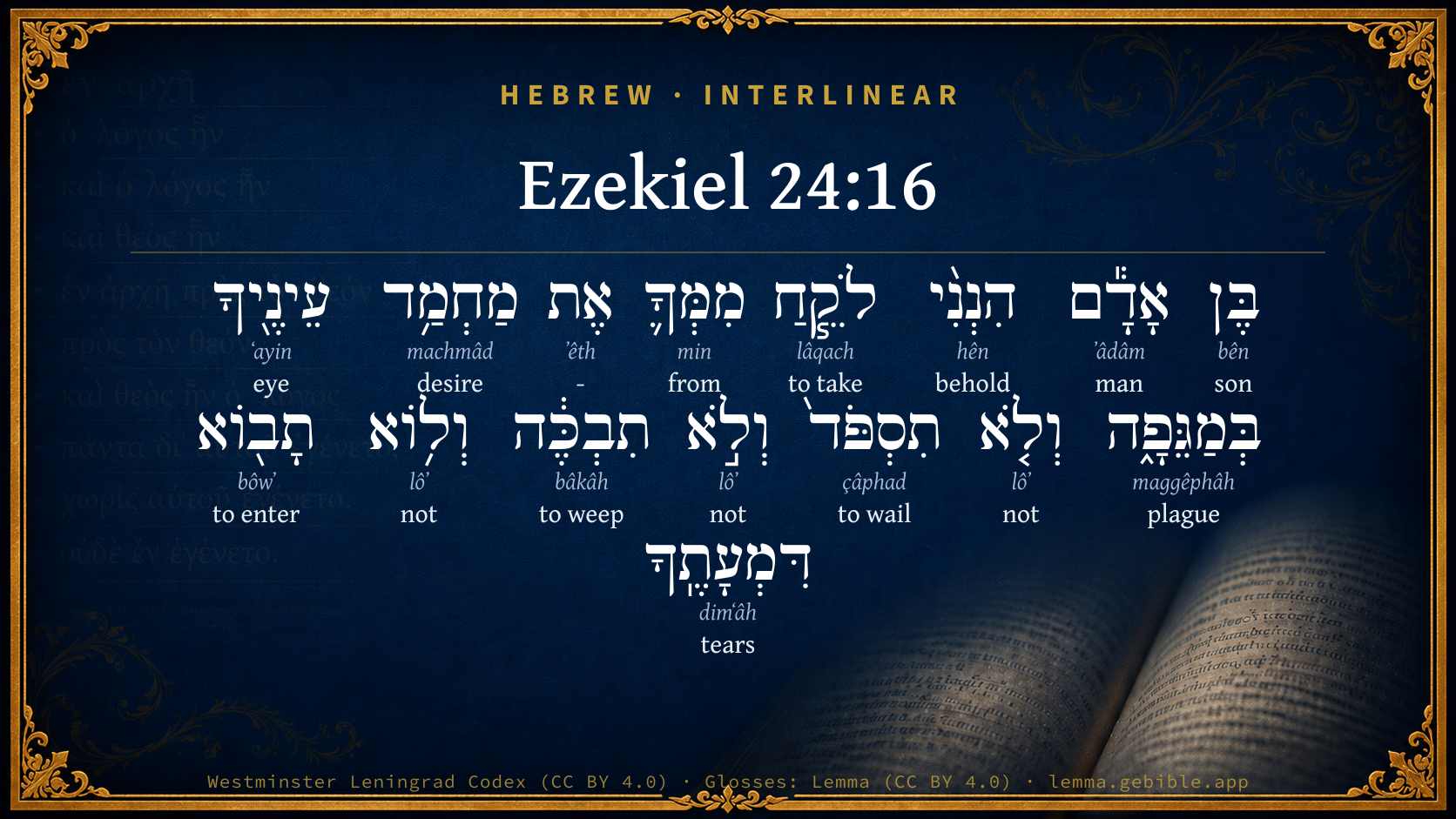
Hebrew (Westminster Leningrad Codex) Ezekiel 24:16 appears in the Hebrew Old Testament. The text above is from the Westminster Leningrad Codex. Each word links to its Strong’s number, a concise gloss, and parsing drawn from the Open Scriptures Hebrew Bible morphology. Click any word for its full Brown-Driver-Briggs (BDB) entry.
Download image
Cite this verse

Ezekiel 24:16 (World English Bible). Public Domain. Lemma interlinear Bible study tool, https://lemma.gebible.app/v/ezekiel/24/16.

Show BibTeX & RIS
BibTeX
RIS
English Translation
Son of man, behold, I take away from you the desire of your eyes with a stroke: yet you shall neither mourn nor weep, neither shall your tears run down.
World English Bible · Public Domain
Download a study sheet

One document with this verse’s original text, its word-by-word gloss line, the meaning frame, cross-references with their text, attributed commentary, and full source and license credits — printable, and it pastes into notes with its structure intact.

This verse Autodidact and up

Study sheet (.html) Plain text (.txt)

A passage Seminary Student

Up to 50 verses in one chapter. A passage sheet keeps up to 6 commentary sources and 12 cross-references per verse, in the order this page ranks them, and says so on the sheet whenever that leaves anything out. Ask for a single verse and you get the Autodidact verse sheet above.

Everything on this page stays free to read, with no account — the sheet is a download of what is already on screen, not access to it.

Want to remove ads? Support Godless Engineer
Compare translations 3

The same verse in 3 English versions, stacked beneath the original-language interlinear above. Click any original word for its lexicon entry.

Each is an independent rendering of the whole verse — the interlinear is not word-aligned to these translations.

Highlighted words mark where these versions differ — a whole-verse word diff, not a word-by-word alignment.

  • World English Bible Public Domain
    Son of man, behold, I take away from you the desire of your eyes with a stroke: yet you shall neither mourn nor weep, neither shall your tears run down.
  • King James Version Public Domain
    Son of man, behold, I take away from thee the desire of thine eyes with a stroke: yet neither shalt thou mourn nor weep, neither shall thy tears run down.
  • unfoldingWord Literal Text CC BY-SA 4.0
    “Son of man! Behold, I am taking the desire of your eyes from you with a plague, but you must not mourn nor weep, and your tears must not flow.

unfoldingWord Literal Text — © unfoldingWord, licensed CC BY-SA 4.0. Word-aligned USFM3 via Door43 (git.door43.org/unfoldingWord/en_ult).

Versions to compare (up to 4)

3 of 4 selected

Show all 18 translations

Every available English version of this verse, each an independent rendering of the whole verse.

  • World English Bible Public Domain
    Son of man, behold, I take away from you the desire of your eyes with a stroke: yet you shall neither mourn nor weep, neither shall your tears run down.
  • Berean Standard Bible Public Domain
    “Son of man, behold, I am about to take away the desire of your eyes with a fatal blow. But you must not mourn or weep or let your tears flow.
  • Majority Standard Bible Public Domain
    “Son of man, behold, I am about to take away the desire of your eyes with a fatal blow. But you must not mourn or weep or let your tears flow.
  • King James Version Public Domain
    Son of man, behold, I take away from thee the desire of thine eyes with a stroke: yet neither shalt thou mourn nor weep, neither shall thy tears run down.
  • American Standard Version (1901) Public Domain
    Son of man, behold, I take away from thee the desire of thine eyes with a stroke: yet thou shalt neither mourn nor weep, neither shall thy tears run down.
  • Revised Version (1885) Public Domain
    Son of man, behold, I take away from thee the desire of thine eyes with a stroke: yet neither shalt thou mourn nor weep, neither shall thy tears run down.
  • Geneva Bible (1599) Public Domain
    Sonne of man beholde, I take away from thee the pleasure of thine eyes with a plague: yet shalt thou neither mourne nor weepe, neither shall thy teares runne downe.
  • Douay-Rheims (1899) Public Domain
    Son of man, behold I take from thee the desire of thy eyes with a stroke: and thou shalt not lament, nor weep: neither shall thy tears run down.
  • Young's Literal Translation Public Domain
    `Son of man, lo, I am taking from thee the desire of thine eyes by a stroke, and thou dost not mourn, nor weep, nor let thy tear come.
  • Literal Standard Version CC BY-SA 4.0
    “Son of man, behold, I am taking the desire of your eyes from you by a stroke, and you do not mourn, nor weep, nor let your tear come.
  • Unlocked Literal Bible CC BY-SA 4.0
    “Son of man! Behold, I am taking the desire of your eyes from you with a plague, but you must not mourn nor weep, and your tears must not flow.
  • unfoldingWord Literal Text CC BY-SA 4.0
    “Son of man! Behold, I am taking the desire of your eyes from you with a plague, but you must not mourn nor weep, and your tears must not flow.
  • Darby Bible Public Domain
    Son of man, behold, I take away from thee the desire of thine eyes with a stroke; yet thou shalt not mourn nor weep, neither shall thy tears run down.
  • World Messianic Bible Public Domain
    “Son of man, behold, I will take away from you the desire of your eyes with one stroke; yet you shall neither mourn nor weep, neither shall your tears run down.
  • Webster's Bible Public Domain
    Son of man, behold, I take away from thee the desire of thy eyes with a stroke: yet neither shalt thou mourn nor weep, neither shall thy tears run down.
  • Free Bible Version CC BY-SA 4.0
    “Son of man, look, I'm about to take away the one you love the most. She will die. But you must not mourn or weep. Don't cry any tears.
  • Bible in Basic English Public Domain
    Son of man, see, I am taking away the desire of your eyes by disease: but let there be no sorrow or weeping or drops running from your eyes.
  • JPS Tanakh (1917) Public Domain
    'Son of man, behold, I take away from thee the desire of thine eyes with a stroke; yet neither shalt thou make lamentation nor weep, neither shall thy tears run down.

Literal Standard Version (2020), Covenant Press — licensed CC BY-SA 4.0. Text via the HelloAO Bible API (eBible.org). Unlocked Literal Bible (unfoldingWord) — licensed CC BY-SA 4.0. Text via the HelloAO Bible API (eBible.org). unfoldingWord Literal Text — © unfoldingWord, licensed CC BY-SA 4.0. Word-aligned USFM3 via Door43 (git.door43.org/unfoldingWord/en_ult). Free Bible Version, Dr. Jonathan Gallagher — licensed CC BY-SA 4.0. Text via the HelloAO Bible API (eBible.org).

Word by word

More ways to search: Search by grammar → Find every occurrence → Compare this word →

Practice this passage: Drill this verse → Learn its vocabulary →

מַחְמַ֥ד
machmâd
H4261
“desire of”
Noun, Common, Masculine, Singular, Construct
Part of Speech
Noun
Type
Common
Gender
Masculine
Number
Singular
State
Construct
Full BDB Definition

Origin: from H2530

TWOT: 673d , 673e

desire, desirable thing, pleasant thing
  1. בֶּן bên H1121 “son of” Noun, Common, Masculine, Singular, Construct
  2. אָדָ֕ם ʼâdâm H120 “man” Noun, Common, Masculine, Singular, Absolute
  3. הִנְנִ֨י hên H2005 “behold · me” Particle, Demonstrative + Suffix, Personal, 1st Person, Common, Singular
  4. לֹקֵ֧חַ lâqach H3947 “taking” Verb, Qal, Participle Active, Masculine, Singular, Absolute
  5. מִמְּךָ֛ min H4480 “from · you” Preposition + Suffix, Personal, 2nd Person, Masculine, Singular
  6. אֶת ʼêth H853 “-” Particle, Direct Object
  7. עֵינֶ֖יךָ ʻayin H5869 “eyes · your” Noun, Common, Both, Dual, Construct + Suffix, Personal, 2nd Person, Masculine, Singular
  8. בְּמַגֵּפָ֑ה maggêphâh H4046 “in/at · plague” Preposition + Noun, Common, Feminine, Singular, Absolute
  9. וְלֹ֤א lôʼ H3808 “and · not” Conjunction + Particle, Negative
  10. תִסְפֹּד֙ çâphad H5594 “to wail” Verb, Qal, Imperfect, 2nd Person, Masculine, Singular
  11. וְלֹ֣א lôʼ H3808 “and · not” Conjunction + Particle, Negative
  12. תִבְכֶּ֔ה bâkâh H1058 “to weep” Verb, Qal, Imperfect, 2nd Person, Masculine, Singular
  13. וְל֥וֹא lôʼ H3808 “and · not” Conjunction + Particle, Negative
  14. תָב֖וֹא bôwʼ H935 “to enter” Verb, Qal, Imperfect, 3rd Person, Feminine, Singular
  15. דִּמְעָתֶֽךָ dimʻâh H1832 “tears · your” Noun, Common, Feminine, Singular, Construct + Suffix, Personal, 2nd Person, Masculine, Singular

About this verse

These counts appear in no published source. They are computed here, from the morphology-tagged text and Lemma’s own curated glosses. What Lemma adds →

16
words
14
distinct lemmas
Prophets
section

Notable vocabulary

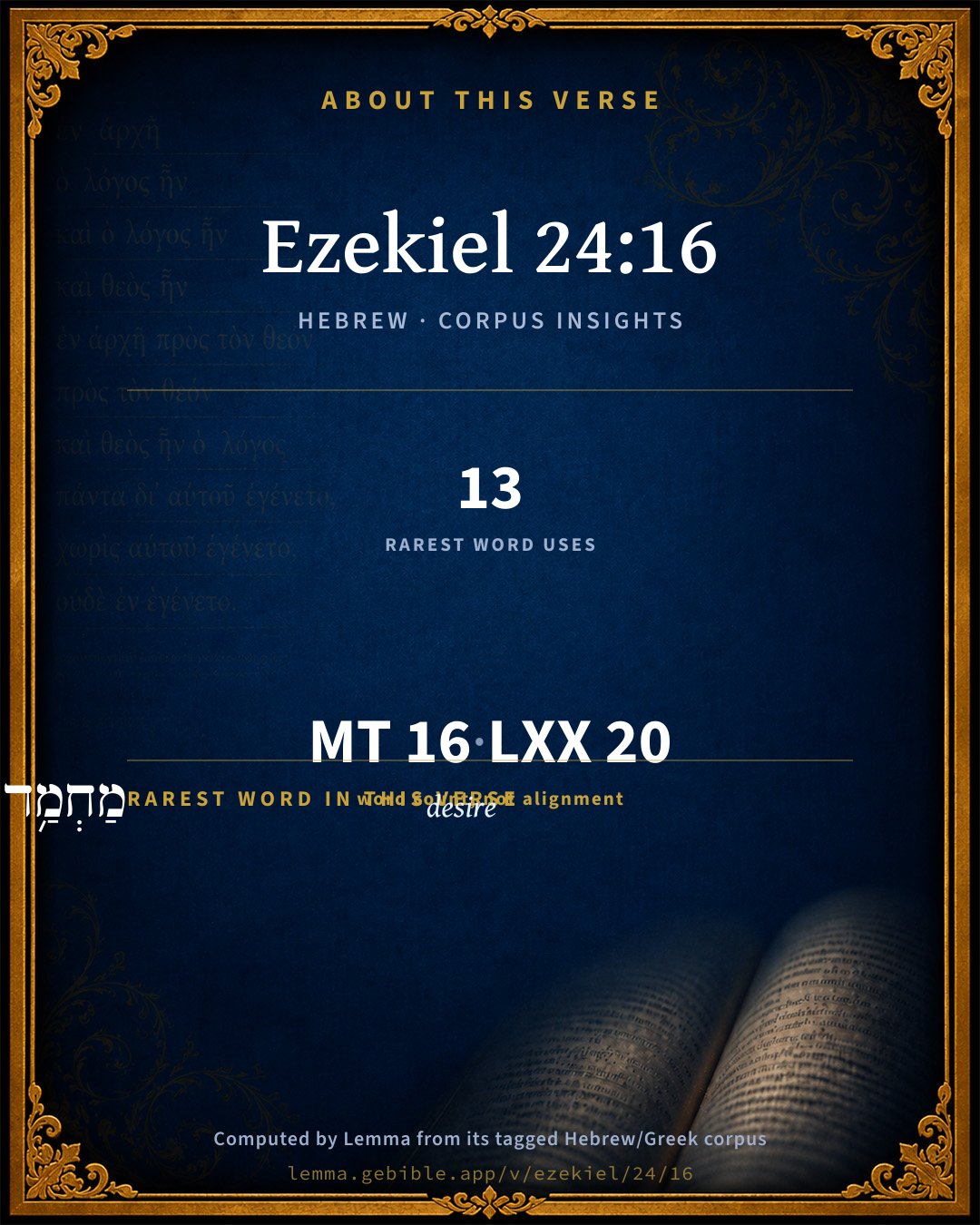
The rarest word here is מַחְמַ֥ד desire H4261 — appearing just 13 times in the whole Hebrew Bible.

Shared distinctive vocabulary

מַחְמַ֥ד desire H4261 occurs in 13 verses of the Hebrew Bible. Also found in:

Grammatical profile

  • 4 verbs
  • 6 nouns
  • 1 preposition
  • 5 particles

Verb forms

  • לֹקֵ֧חַ Qal · Participle Active
  • תִסְפֹּד֙ Qal · Imperfect
  • תִבְכֶּ֔ה Qal · Imperfect
  • תָב֖וֹא Qal · Imperfect

Repetition

A word recurs within this verse — often emphatic in Hebrew:

  • וְלֹ֤א not H3808 ×3

Hebrew & Septuagint length

In English translation the verse runs 30 words from the Hebrew and 23 from the Septuagint (LXX English) — closely comparable.

A rough comparison of the two English renderings, which tokenize alike — not a word-level alignment.

Word counts can differ between the Hebrew and the Greek without any difference in meaning — e.g. the Hebrew direct-object marker אֵת has no separate Greek word, and Greek often adds the article ὁ.

In the original languages it is 16 Hebrew tokens and 20 Greek tokens — but the two are counted differently (Hebrew bundles its prefixes and suffixes into one token; the Greek is in lemma form), so that isn’t a like-for-like length.

Cross-references

14

Topical passages linked to Ezekiel 24:16 in the Treasury of Scripture Knowledge — connected by theme and wording, ordered by reader-vote popularity; previews shown in the World English Bible.

  • Jeremiah 22:10 Don't you weep for the dead, neither bemoan him; but weep sore for him who goes away; for he shall return no more, nor see his native country.
  • Jeremiah 13:17 But if you will not hear it, my soul shall weep in secret for [your] pride; and my eye shall weep sore, and run down with tears, because Yahweh's flock is taken captive.
  • Song of Solomon 7:10 I am my beloved's. His desire is toward me.
  • Ezekiel 24:18 So I spoke to the people in the morning; and at even my wife died; and I did in the morning as I was commanded.
  • 1 Thessalonians 4:13 But we don't want you to be ignorant, brothers, concerning those who have fallen asleep, so that you don't grieve like the rest, who have no hope.
  • Leviticus 10:2–3 And fire came forth from before Yahweh, and devoured them, and they died before Yahweh.
  • Job 36:18 Don't let riches entice you to wrath, Neither let the great size of a bribe turn you aside.
  • Proverbs 5:19 A loving doe and a graceful deer-- Let her breasts satisfy you at all times. Be captivated always with her love.
  • Jeremiah 9:1 Oh that my head were waters, and my eyes a spring of tears, that I might weep day and night for the slain of the daughter of my people!
  • Jeremiah 9:18 and let them make haste, and take up a wailing for us, that our eyes may run down with tears, and our eyelids gush out with waters.
  • Jeremiah 16:5 For thus says Yahweh, Don't enter into the house of mourning, neither go to lament, neither bemoan them; for I have taken away my peace from this people, says Yahweh, even loving kindness and tender mercies.
  • Lamentations 2:18 Their heart cried to the Lord: wall of the daughter of Zion, let tears run down like a river day and night; Give yourself no respite; don't let the apple of your eye cease.
  • Ezekiel 24:21–25 Speak to the house of Israel, Thus says the Lord Yahweh: Behold, I will profane my sanctuary, the pride of your power, the desire of your eyes, and that which your soul pities; and your sons and your daughters whom you have left behind shall fall by the sword.
  • Jeremiah 22:18 Therefore thus says Yahweh concerning Jehoiakim the son of Josiah, king of Judah: they shall not lament for him, [saying], Ah my brother! or, Ah sister! They shall not lament for him, [saying] Ah lord! or, Ah his glory!

Cross-references courtesy of OpenBible.info (CC BY 4.0).

Hebrew and Greek witnesses Masoretic Hebrew ↔ Greek Septuagint

The same verse in the two great witnesses to the Old Testament, shown verse-for-verse.

These are two independent witnesses, not word-aligned to each other, and the Septuagint is shown in lemma (dictionary) form.

Hebrew Ezekiel 24:16 Masoretic · Westminster Leningrad Codex

בֶּן אָדָ֕ם הִנְנִ֨י לֹקֵ֧חַ מִמְּךָ֛ אֶת מַחְמַ֥ד עֵינֶ֖יךָ בְּמַגֵּפָ֑ה וְלֹ֤א תִסְפֹּד֙ וְלֹ֣א תִבְכֶּ֔ה וְל֥וֹא תָב֖וֹא דִּמְעָתֶֽךָ

Son of man, behold, I take away from you the desire of your eyes with a stroke: yet you shall neither mourn nor weep, neither shall your tears run down.

World English Bible · Public Domain

Greek LXX Ezekiel 24:16 Septuagint · lemma form

υἱός ἄνθρωπος ἰδού ἐγώ λαμβάνω ἐκ σύ ὁ ἐπιθύμημα ὁ ὀφθαλμός σύ ἐν παράταξις οὐ μή κόπτω οὐδέ μή κλαίω

Son of man, behold I take from you the desire of your eyes by violence: you shall not lament, neither shall you weep.

LXX2012 (modern English Septuagint) · Public Domain

On this verse, The Cambridge Bible for Schools and Colleges discusses the Septuagint’s reading. Read the note in Commentary ↓

Hebrew: Westminster Leningrad Codex (CC BY 4.0). Greek: Septuagint (public domain); English from LXX2012 (modern English Septuagint) (Public Domain). How the Septuagint differs from the Hebrew →

Targum (Aramaic paraphrase)

1

The Targum is the ancient Jewish Aramaic paraphrase of the Hebrew Scriptures — an interpretive translation, not the Hebrew text itself. Onkelos (literal) and Pseudo-Jonathan (expansive) render the Torah, and Jonathan the Prophets. Coverage is partial: where no permissively-licensed English translation exists for a verse, only the Aramaic is shown. This is verse-level text, not a word-by-word alignment to the Hebrew.

  1. Targum Jonathan Prophets (Joshua–Malachi)
    בַּר אָדָם הָא אֲנָא נָסֵיב מִנָךְ יַת רִגְגָא דְעֵינָךְ בְּמוֹתָא וְלָא תִסְפַּד וְלָא תִבְכֵּי וְלָא תְשַׁגַר דִמְעִין:

    (no public-domain English translation for this verse)

    Targum Jonathan — Aramaic: “Mikraot Gedolot” (public domain). English: “Sefaria Community Translation” (CC0 1.0 (public-domain dedication)); “London "Chaldee Paraphrase," 1871” (public domain). Text via Sefaria.

Commentary

Notes on Ezekiel 24:16 from classic Christian and Jewish commentators (each source and its license shown beneath its notes). The classic Christian expositions comment on the surrounding passage and are grouped to its opening verse, so a note may address several verses; the Jewish commentaries on the Tanakh (Rashi and others) are per-verse, so they appear only where the commentator wrote on this verse.

Lemma curates 59 commentaries, every one of them public domain or Creative Commons licensed, each selected and text-cleaned for this edition rather than reprinted as found. About our sources →

Trapp's Complete Commentary

John Trapp

Eze 24:16 Son of man, behold, I take away from thee the desire of thine eyes with a stroke: yet neither shalt thou mourn nor weep, neither shall thy tears run down.

Ver. 16. Behold, I take from thee the desire of thine eyes,] i.e., Thy wife, who is impendio dilecta et visu pergratiosa, thy dearly beloved and greatly delighted in.

With a stroke.] With pestilence, palsy, or some similar sudden death. This was no small trial of the prophet’s patience and obedience. Let us learn to hang loose to all outward comforts.

Yet neither shalt thou mourn nor weep.] Which, might he have done, would have been some ease to him; {a} for

“ Expletur lachrymis, egeriturque dolor. ”

As hinds by calving, so do men by weeping, cast out their sorrows. {Job 39:3}

{a} Est quaedam flere voluptas. - Ovid. Fletus aerumnas lennet. - Sen.

John Trapp, A Commentary or Exposition upon All the Books of the Old and New Testament (1647–1656) — public domain. Text from a community e-Sword module.

Joseph Benson's Commentary

Eze 24:16-18. Behold, I take away from thee the desire of thine eyes with a stroke — Behold, I take away from thee thy wife, the object of thy love and thy affection, by a sudden stroke from my own immediate hand, that is, by a sudden death. Observe, reader, we know not how soon the desire of our eyes may be removed from us. Death is a stroke from which the most pious, the most useful, the most amiable, are not exempted. Yet neither shalt thou mourn nor weep — Thou shall not show any signs of grief. This command was given to the prophet, to signify that the public calamity should be so great, that private ones would not appear worthy of notice, nor would they be at leisure to lament them, so much would those of a public nature distract and oppress them. Bind the tire of thy head upon thee — Use thy ordinary dress upon thy head; for in the time of mourning it was customary sometimes to shave the head, sometimes to cast dust upon it. Put on thy shoes upon thy feet — Going barefoot was usual in great sorrow and affliction; and therefore the prophet, who was to show no sign of sorrow, was commanded to put on his shoes. Cover not thy lips — Covering the lips, or face, was another token of mourning. And eat not the bread of men — Partake not of the mourning-feast, that relations used to prepare for the funerals of their friends: see note on Jer 16:7. So I spake to the people, &c., and at even my wife died — My wife accordingly died very suddenly in the evening of a day, on the morning of which I had been speaking to the people, concerning the intimations I had of her death; and the next morning I declared what commands God had laid upon me, not to make any outward show, or sign of mourning upon that occasion.

Joseph Benson's Commentary on the Old and New Testaments (1811–1818) — public domain. Text from a community e-Sword module.

Geneva Bible (1599)

Geneva Bible translators

Meaning, his wife, in whom he delighted, as verse 18.

Geneva Bible (1599) marginal notes — public domain. Text via Bolls.life.

Jamieson, Fausset & Brown

Robert Jamieson, A. R. Fausset & David Brown

desire of . . . eyes--his wife: representing the sanctuary (Eze 24:21) in which the Jews so much gloried. The energy and subordination of Ezekiel's whole life to his prophetic office is strikingly displayed in this narrative of his wife's death. It is the only memorable event of his personal history which he records, and this only in reference to his soul-absorbing work. His natural tenderness is shown by that graphic touch, "the desire of thine eyes." What amazing subjection, then, of his individual feeling to his prophetic duty is manifested in the simple statement (Eze 24:18), "So I spake . . . in the morning; and at even my wife died; and I did in the morning as I was commanded."

stroke--a sudden visitation. The suddenness of it enhances the self-control of Ezekiel in so entirely merging individual feeling, which must have been especially acute under such trying circumstances, in the higher claims of duty to God.

Jamieson, Fausset & Brown — Commentary Critical and Explanatory on the Whole Bible (1871) — public domain (CC PDM 1.0). Text via the HelloAO Bible API.

Adam Clarke's Commentary

Verse 16. Behold, I take away from thee the desire of thine eyes] Here is an intimation that the stroke he was to suffer was to be above all grief; that it would be so great as to prevent the relief of tears.

Curae leves loquuntur, graviores silent,

is a well-accredited maxim in such cases. Superficial griefs affect the more easily moved passions; great ones affect the soul itself, in its powers of reasoning, reflecting, comparing, recollecting, &c., when the sufferer feels all the weight of wo.

Neither shall thy tears run down.] Τουτο γαρ ιδιον των οφθαλμων εν τοις μεγαλοις κακοις· εν μεν γαρ ταις μετριαις συμφοραις αφθονως τα δακρυα καταρῥει, - εν δε τοις ὑπερβαλλουσι δεινοις φευγει και τα δακρυα και προδιδωσι και τους αφθαλμους· Achill. Tat. lib. 3. c. 11. For this is the case with the eyes in great calamities: in light misfortunes tears flow freely, but in heavy afflictions tears fly away, and betray the eyes.

Adam Clarke's Commentary on the Bible (1810–1826) — public domain. Text from a community e-Sword/MySword module.

The Cambridge Bible for Schools and Colleges

gen. ed. J. J. S. Perowne

15–27. The prophet’s abstention from mourning on the death of his wife—a symbol of the stupefaction of the people at the news of the fall of the city

16. with a stroke] The word need not be pressed to mean a sudden unexpected death, apart from all previous sickness.

thy tears run down] wanting in LXX.

The Cambridge Bible for Schools and Colleges (gen. ed. J. J. S. Perowne; Cambridge University Press, 1878–1918) — public domain. Text from a community e-Sword module.

John Gill's Exposition

Forbear to cry,.... Groan or howl, or make any doleful noise: or, "be silent" (x): which the Talmudists (y) interpret of not greeting any person:

make no mourning for the dead; use none of those rites and ceremonies commonly observed for deceased relations and friends, particularly and especially for a wife; who is one of the seven persons for whom mourning is to be made, according to the Jewish canons (z); and which the ties of nature, nearness of relation, and especially mutual and cordial affection, where that has taken place, require; and though a wife is not expressly mentioned among those, for whom a priest might defile himself by attending their funerals, yet must be included among those akin to him, if not solely designed, as Jarchi thinks; whose note on Lev 21:2, is, there are none his kin but his wife; so that Ezekiel, though a priest, was not exempted from the observation of funeral rites, but obliged to them, had he not been forbid by a special order from the Lord: the particulars of which follow:

bind the tire of thine head upon thee; cap or turban, wore on the head, as a covering of it, and ornament to it, as the word used signifies; and the priests' bonnets were for glory and beauty, Exo 28:40, and such was the tire about the prophet's head, since he was a priest; and which, in time of mourning, was taken off, and it was customary for mourners to be bare headed; and though the high priest might not uncover his head and rend his clothes for the dead, Lev 21:10, yet other priests might, unless they had a particular and special prohibition, as Ezekiel here; see Lev 10:6 and yet it seems, by some instances, particularly that of David's mourning for Absalom, that the head was covered at such a time, Sa2 19:5 and Kimchi on the place expressly says, that it was the way and custom of mourners to cover themselves; and certain it is, that in later times, however, it has been the usage of the Jews to cover their heads in mourning; for this is one of the things expressly forbid in the Jewish canons, as Maimonides (a) says, to be used in mourning for the dead, namely, making bare the head; and covering the head is what mourners are obliged to (b); this Gejerus (c) reconciles, by observing, that at the first of the mourning they used to take off of their heads what they wore for the sake of ornament, such as the tire, or bonnet here; but after a while covered themselves with veils when they went abroad, or others came to them. Jarchi interprets this of the "tephillim", or phylacteries the Jews wore about their heads; and so the Talmud (d); and the Targum is,

"let thy "totaphot" or frontlets be upon thee;''

of which interpretation Jerom makes mention; but these things do not appear to be in use in Ezekiel's time:

and put on thy shoes upon thy feet: which used to be taken off, and persons walked barefoot in times of mourning, Sa2 15:30, and this custom continues with the Jews to this day; and which they say is confirmed by this passage. One of their canons (e) runs thus,

"they do not rend garments, nor pluck off the shoe for any, until he is dead;''

which supposes they do, and should do, when he is dead: and this is one of the things, their writers (f) say, is forbidden a mourner for the dead, namely, to put on his shoes; and they ask, from whence it appears that a mourner is forbid to put on his shoes? the answer is, from what is said to Ezekiel, "put on thy shoes upon thy feet": which shows that in common it was not right nor usual to do it; and it is their custom now for mourners, when they return from the grave, to sit seven days on the ground with their feet naked (g):

and cover not thy lips; as the leper did in the time of his separation and distress, who put a covering upon his upper lip, Lev 13:45 and as mourners did, who put a veil upon their faces:

and eat not the bread of men: of other men; or "of mourners" (h), as the Targum; such as used to be sent to mourners by their friends, in order to refresh and revive their spirits; and who, they supposed, through their great grief, were not careful to provide food for themselves; and this they did to comfort them, and let them know that, though they had lost a relation, there were others left, who had a cordial respect for them, and heartily sympathized with them: and, according to the traditions of the Jews (i), a mourner might not eat of his own bread; but was obliged to eat the bread of others, at least his first meal, and on the first day of his mourning; though he might on the second, and on the following days; and this they endeavour to establish from this place of Scripture. What their friends used to send them at such a time were usually hard eggs and wine. Eggs, because round and spherical, and so a proper emblem of death, and might serve to put in mind of it, which goes round, is with one today, and with another tomorrow; and wine, to cheer their spirits, that they might forget their sorrow (k). They also used to eat at such times a sort of pulse, called lentiles, to show by what sort of food they lost their birthright, or firstborn (l) And such like things were used by the Romans in their funeral feasts, as beans, parsley, lettuce, lentiles, eggs, &c. (m), and as the Romans had their "parentalia", and the Greeks their so the Jews had also very sumptuous feasts on such occasions: not only great personages, as kings and nobles, made them; so Archelaus, made a magnificent one for the people, on the death of his father Herod (n), after the custom of the country; but even the common people were very profuse and lavish in them; and which, as Josephus (o) observes, was the cause of great poverty among them; for so prevalent was the custom, that there was a necessity of doing it, or otherwise a man would not have been reckoned a holy man; see Jer 16:7.

(x) "tace", Pagninus, Montanus, Vatablus. (y) T. Bab. Moed Katon, fol. 15. 1. (z) Maimon. Hilchot Ebel, c. 2. sect. 1. Buxtorf. Jud. Synagog. c. 49. p. 708. (a) Maimon. Hilchot Ebel, c. 5. sect. 1. (b) Schulchan Aruch, lib. Jore Dea, c. 380. sect. 1. c. 386. sect. 1, 2. (c) De luctu Ebr. c. 11. sect. 5. p. 250. (d) T. Bab. Beracot, fol. 11. 1. Moed Katon, fol. 15. 1. Succa, fol. 25. 2. (e) Messech, Semachot, c. 1. sect. 5. (f) Maimon. Hilchot Ebel, c. 5. sect. 1. Schulchan Aruch, lib. Jore Dea, c. 380. sect. 1. 382. sect. 1, 2. (g) Buxtorf. Jud. Synagog. c. 49. p. 706. (h) T. Bab. Beracot, fol. 11. 1. Moed Katon, fol. 15. 1. Succa, fol. 25. 2. (i) T. Bab. Moed Katan, fol. 27. 2. Maimon. Hilchot Ebel, c. 4. sect. 9. Schulchan Aruch, lib. Jore Dea, c. 378. sect. 1. (k) Buxtorf. Jud. Synagog. c. 49. p. 708. (l) Hieron. ad Paulam super obitu Blesillae, tom. 1. operam, fol. 54. L. (m) Vid. Kirchman. de Funer. Rom. l. 4. c. 7. p. 591. (n) Joesph Antiqu. l. 17. c. 8. sect. 4. (o) De Bello Jud. l. 2. c. 1. sect. 1.

John Gill's Exposition of the Whole Bible (1746–1763) — public domain (CC PDM 1.0). Text via the HelloAO Bible API.

Albert Barnes' Notes on the Bible

The death of Ezekiel’s wife took place in the evening of the same day that he delivered the foregoing prophecy. This event was to signify to the people that the Lord would take from them all that was most dear to them; and - owing to the extraordinary nature of the times - quiet lamentation for the dead, according to the usual forms of mourning, would be impossible.

Eze 24:17

The priest in general was to mourn for his dead (Lev 21:1 ff); but Ezekiel was to be an exception to the rule. The “tire” was the priest’s mitre.

Eat not the bread of men - Food supplied for the comfort of the mourners.

Eze 24:23

Pine away - Compare Lev 26:39. The outward signs of grief were a certain consolation. Their absence would indicate a heart-consuming sorrow.

Eze 24:27

Ezekiel had been employed four years in foretelling the calamities about to come to pass. He had been utterly disregarded by the inhabitants of Jerusalem, and received with apparent respect but with real incredulity by those in exile. Now until the city had been actually taken, the voice of prophecy should cease, so far as God’s people were concerned. Hence the intervening series of predictions relating to neighboring and foreign nations Ezek. 25–32. After which the prophet’s voice was again heard addressing his countrymen in their exile. This accounts for the apparently parenthetical character of the next eight chapters.

Albert Barnes' Notes on the Bible (1834–1885) — public domain. Text from a community e-Sword/MySword module.

Haydock's Catholic Bible Commentary

Stroke; pestilence, or sudden death. This would make the loss of a dear wife still more afflicting. Yet such distress will fall upon the whole nation, (Calmet) and misery shall increase so much, that a private loss will be almost forgotten. (Haydock) --- Curæ leves loquuntur, graviores silent. (Seneca, Troad.) --- When a loss is foreseen, it is more easily borne. Private calamities sink in public ones. (Worthington)

George Leo Haydock (1774–1849), Haydock's Catholic Family Bible and Commentary, 1859 edition — public domain. Excludes Psalms (Douay-Rheims chapter numbering differs from Protestant) and Deuterocanonical books (Catholic canon only).

Matthew Poole's English Annotations

Behold; consider what I tell, and will do.

I take away from thee; by death I take from thee, but it is I the Lord, and I take her to myself, though from thee.

The desire of thine eyes: whether it refer to the beauty of her person or no, it certainly refers to the amiableness of her disposition, and the agreeableness of her to the prophet.

With a stroke; a sudden stroke, whether pestilence or what else is not so much as hinted at; I think it was God’s own immediate hand.

Neither shalt thou mourn; make no solemn mourning for her, though it will look only in the sight of thy people.

Nor weep; let no lamenting voice be heard from thee, cry not out in bewailing thy loss.

Neither shall thy tears run down; neither let thy eyes pay any tribute to her, forbear even tears also, at least, let them not run down; if one chance to drop, check the rest.

Matthew Poole's English Annotations on the Holy Bible (1683–1685) — public domain. Text from a community e-Sword/MySword module.

Whedon's Commentary on the Bible

Daniel D. Whedon

16. The desire of thine eyes — A recently discovered cuneiform text speaks of a loved one as “the darling of mine eye.” Father Scheil has published a love letter of Abraham’s day, in which the prayer twice occurs, “May Shamash and Marduk allow thee, for my sake, to live forever.” (See also author’s Ancient Egypt, p. 132.) The Hebrews, however, excelled all nations in their home love. The marriage poem of Joseph Ezobi (fourteenth century) well represents the ancient feeling, closing: —

Rejoice with her, thy graceful tender dove.

God bless you twain, with love as angels love.

Daniel D. Whedon (gen. ed.), Commentary on the Old and New Testaments (1874–1909) — public domain. Text from a community e-Sword module.

The Pulpit Commentary

The desire of thine eyes.

I A PICTURE OF DOMESTIC LOVE. Ezekiel"s wife is called "the desire of his eyes." God has ordained marriage, and the blessedness of the true union of husband and wife is from him. It is in itself good and a source of further blessings. It is not the doctrine of the Bible that monkish celibacy is more holy than homely wedded love.

1. The blessedness of wedded love is a solace in trouble. If Ezekiel had a wife who could be described in the language of our text, it must have been refreshing for him to turn from the rancor of Jewish enmity to the sympathy of a true woman. The home is a sacred refuge from the storms of the world.

2. Wedded love is a type of Divine love. The Church is the bride of the Lamb. God loves his people as a true husband loves his wife.

3. Such a great blessing should be tenderly guarded. Wedded love may be hurt by want of thought as much as by want of heart. Small kindnesses constitute much of the happiness of life, and small negligences may make its cup very bitter. It needs care lest the bloom of love be ruthlessly brushed aside.

II A STROKE OF TEARFUL TROUBLE.

1. The desire of his eyes" is taken from Ezekiel. A prophet is not exempt from the greatest troubles that fall to the lot of men. Divine privileges do not save us from earthly sorrows. Love cannot hold the beloved forever. The pair who love much may yet be parted. This awful grief of widowhood may invade the happiest home. They who are never divided in love may yet be thrust asunder by "the dark divorce of death.

2. This trouble comes by a sudden stroke. Sudden death seems to be best for the victim, for it spares all the agonies of a protracted illness, and all the horrors of the act of dying. But to those who are left it comes as an awful blow! Still, as such events do occur in the most affectionate and most peaceful households, we should do well to be prepared for them. The sweet summer garden of today may be a waste, howling wilderness tomorrow.

3. The trouble comes from God. Therefore it must be irresistible. On the other hand, it must be right. We cannot understand why so fearful a blow should fall. We can only say, "It is the Lord.

III A REQUIREMENT OF UNNATURAL RETICENCE. Ezekiel is not to "mourn nor weep." Inwardly his grief cannot be stayed, for no man can escape from nature; but all outward signs of grief are to be suppressed. This is a hard requirement.

1. Public men must repress private emotion. Here is one of the penalties of a prominent position. The great duties must be performed as though nothing had happened. The leader of others must present a confident face to the foe, though his soul is wrung with despair. A smiling countenance must mask a breaking heart.

2. Private sorrow is buried in public calamity. The national disaster of Jerusalem is so huge that even the most terrible grief of sudden widowhood is not to be considered by the side of it. Grief is generally selfish; but what is one soul"s agony to the misery of mankind?

3. Divine judgments are not to be gainsaid. Ezekiel"s trouble is typical. Hengstenberg and others hold that he did not really lose his wife that the story is but a parable. Even though we take it as history, we see that it is used as an illustration of the fate of the Jews. This was unanswerable. The penalty was deserved by the guilty nation. Guilt is silent. In all sorrow we have no right to reply to God. The psalmist says, "I was dumb". (Psa_39:2) Christ went to his cross in silence. "As a sheep," etc. (Isa_53:7)

4. God has consolations for patient sorrow. Though the mourner is silent, God is not, and his voice whispers peace to all his trusting sons and daughters in their sorrow.

The Pulpit Commentary (1880–1919), ed. H.D.M. Spence-Jones & Joseph S. Exell — public domain. Text from a community e-Sword module.

John Wesley's Explanatory Notes

With a stroke - A sudden stroke, by my own immediate hand. We know not how soon the desire of our eyes may be removed from us. Death is a stroke, which the most pious, the most useful, the most amiable are not exempted from.

John Wesley, Explanatory Notes Upon the Whole Bible (1754–1765) — public domain. Text via the GEBible commentary corpus.

Rashi

Rabbi Shlomo Yitzchaki (Rashi)

the desire of your eyes Your wife, as the context proves at the end [of the episode].

Rashi on the Tanakh — English translations: “The Judaica Press complete Tanach with Rashi, translated by A. J. Rosenberg” (CC BY 4.0); “Pentateuch with Rashi's commentary by M. Rosenbaum and A.M. Silbermann, 1929-1934” (public domain); “The Metsudah Tanach series, Lakewood, N.J” (CC BY 4.0); and “The Book of Joshua, Metsudah Publications, 1997” (CC BY 4.0). Text via Sefaria.

Lesson kit

Teaching starters — assembled from the data on this page, not authored interpretation. Every prompt links to the verse data it draws on. Edit before teaching.

Ezekiel, in the Prophets, opens this verse with 16 words (14 distinct Hebrew lemmas). Its most distinctive word is machmâd (“desire”). A historical commentator’s framing appears above. Read the whole chapter for the surrounding context.

Discussion questions

  1. What does “desire” (machmâd) contribute to the verse as a whole?
  2. 1 Kings 20:6 shares the word «desire» with this verse. How do the two illuminate each other?
  3. “not” occurs 3× in this one verse. What is the effect of the repetition?
  4. These translations render this verse differently. What is at stake in choosing one wording over another?
  5. The verb «לֹקֵ֧חַ» is Qal Participle Active. How does its form color the action?
  6. Reading how Trapp's Complete Commentary and Joseph Benson's Commentary read this verse, where do the two commentators agree and where do they part?

Things to notice

Reading settings

Reading text

Shown beneath each verse's original-language words.

Old Testament
Old Testament edition

Read the OT as the Masoretic Hebrew (MT) or the Greek Septuagint (LXX).

English shown for the Greek Septuagint (in the Hebrew ↔ Greek comparison).

Comparing translations? Open the Compare panel on any verse page to stack up to four side by side.