
Genesis 21:15

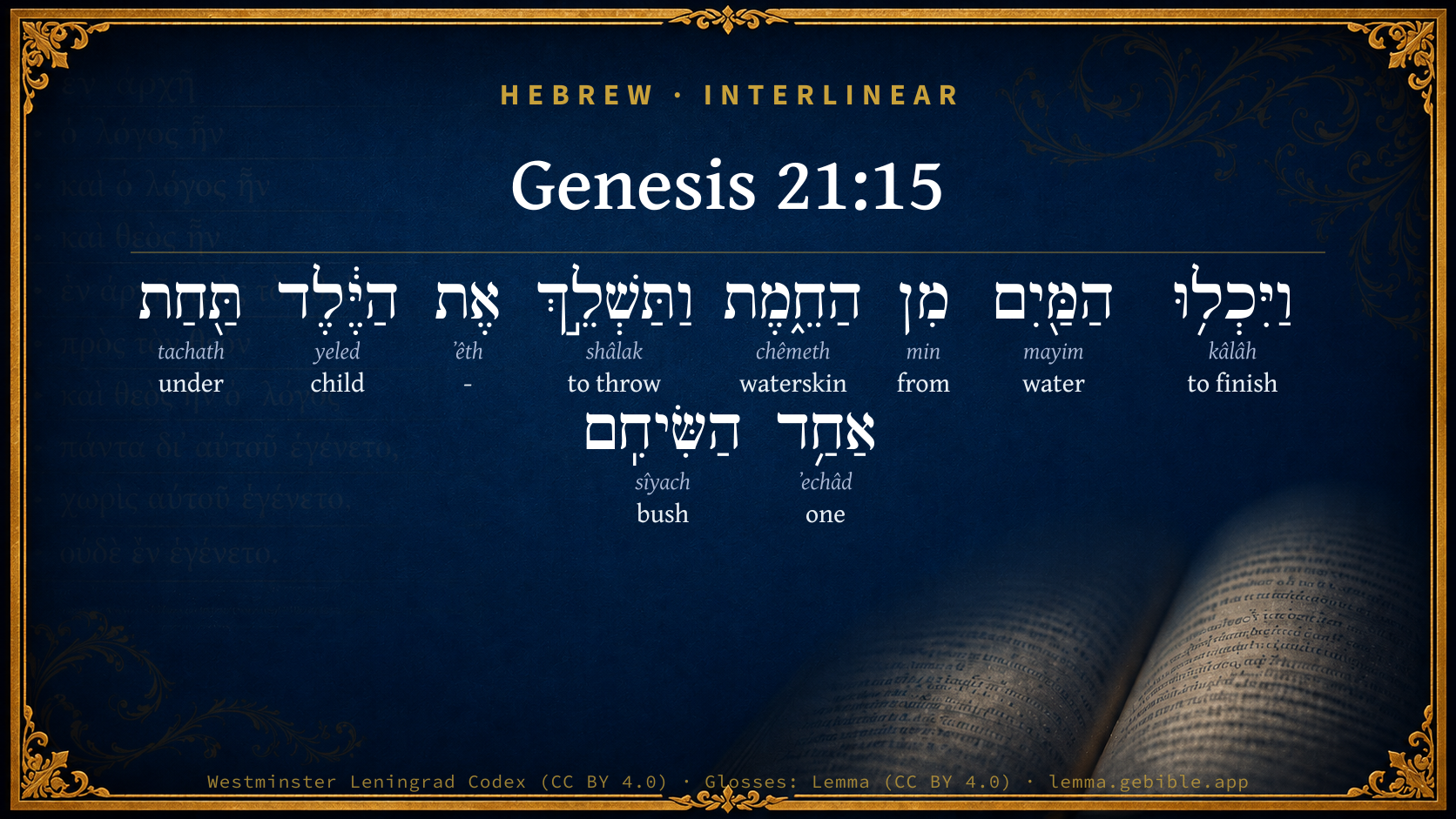
Hebrew (Westminster Leningrad Codex) Genesis 21:15 appears in the Hebrew Old Testament. The text above is from the Westminster Leningrad Codex. Each word links to its Strong’s number, a concise gloss, and parsing drawn from the Open Scriptures Hebrew Bible morphology. Click any word for its full Brown-Driver-Briggs (BDB) entry.
Download image
Cite this verse

Genesis 21:15 (World English Bible). Public Domain. Lemma interlinear Bible study tool, https://lemma.gebible.app/v/genesis/21/15.

Show BibTeX & RIS
BibTeX
RIS
English Translation
The water in the bottle was spent, and she cast the child under one of the shrubs.
World English Bible · Public Domain
Highlights
  • 1 first appearance in the Hebrew Bible
Full analysis ↓
Download a study sheet

One document with this verse’s original text, its word-by-word gloss line, the meaning frame, cross-references with their text, attributed commentary, and full source and license credits — printable, and it pastes into notes with its structure intact.

This verse Autodidact and up

Study sheet (.html) Plain text (.txt)

A passage Seminary Student

Up to 50 verses in one chapter. A passage sheet keeps up to 6 commentary sources and 12 cross-references per verse, in the order this page ranks them, and says so on the sheet whenever that leaves anything out. Ask for a single verse and you get the Autodidact verse sheet above.

Everything on this page stays free to read, with no account — the sheet is a download of what is already on screen, not access to it.

Want to remove ads? Support Godless Engineer
Compare translations 3

The same verse in 3 English versions, stacked beneath the original-language interlinear above. Click any original word for its lexicon entry.

Each is an independent rendering of the whole verse — the interlinear is not word-aligned to these translations.

Highlighted words mark where these versions differ — a whole-verse word diff, not a word-by-word alignment.

  • World English Bible Public Domain
    The water in the bottle was spent, and she cast the child under one of the shrubs.
  • King James Version Public Domain
    And the water was spent in the bottle, and she cast the child under one of the shrubs.
  • unfoldingWord Literal Text CC BY-SA 4.0
    And when the water from the skin was gone, then she threw the child under one of the bushes,

unfoldingWord Literal Text — © unfoldingWord, licensed CC BY-SA 4.0. Word-aligned USFM3 via Door43 (git.door43.org/unfoldingWord/en_ult).

Versions to compare (up to 4)

3 of 4 selected

Show all 18 translations

Every available English version of this verse, each an independent rendering of the whole verse.

  • World English Bible Public Domain
    The water in the bottle was spent, and she cast the child under one of the shrubs.
  • Berean Standard Bible Public Domain
    When the water in the skin was gone, she left the boy under one of the bushes.
  • Majority Standard Bible Public Domain
    When the water in the skin was gone, she left the boy under one of the bushes.
  • King James Version Public Domain
    And the water was spent in the bottle, and she cast the child under one of the shrubs.
  • American Standard Version (1901) Public Domain
    And the water in the bottle was spent, and she cast the child under one of the shrubs.
  • Revised Version (1885) Public Domain
    And the water in the bottle was spent, and she cast the child under one of the shrubs.
  • Geneva Bible (1599) Public Domain
    And when the water of the bottell was spent, she cast the childe vnder a certaine tree.
  • Douay-Rheims (1899) Public Domain
    And when the water in the bottle was spent, she cast the boy under one of the trees that were there.
  • Young's Literal Translation Public Domain
    and the water is consumed from the bottle, and she placeth the lad under one of the shrubs.
  • Literal Standard Version CC BY-SA 4.0
    and the water is consumed from the bottle, and she places the boy under one of the shrubs.
  • Unlocked Literal Bible CC BY-SA 4.0
    When the water in the waterskin was gone, she abandoned the child under one of the bushes.
  • unfoldingWord Literal Text CC BY-SA 4.0
    And when the water from the skin was gone, then she threw the child under one of the bushes,
  • Darby Bible Public Domain
    And the water was exhausted from the flask; and she cast the child under one of the shrubs,
  • World Messianic Bible Public Domain
    The water in the container was spent, and she put the child under one of the shrubs.
  • Webster's Bible Public Domain
    And the water was spent in the bottle, and she cast the child under one of the shrubs.
  • Free Bible Version CC BY-SA 4.0
    When the water ran out, she left the boy under one of the bushes.
  • Bible in Basic English Public Domain
    And when all the water in the skin was used up, she put the child down under a tree.
  • JPS Tanakh (1917) Public Domain
    And the water in the bottle was spent, and she cast the child under one of the shrubs.

Literal Standard Version (2020), Covenant Press — licensed CC BY-SA 4.0. Text via the HelloAO Bible API (eBible.org). Unlocked Literal Bible (unfoldingWord) — licensed CC BY-SA 4.0. Text via the HelloAO Bible API (eBible.org). unfoldingWord Literal Text — © unfoldingWord, licensed CC BY-SA 4.0. Word-aligned USFM3 via Door43 (git.door43.org/unfoldingWord/en_ult). Free Bible Version, Dr. Jonathan Gallagher — licensed CC BY-SA 4.0. Text via the HelloAO Bible API (eBible.org).

Word by word

More ways to search: Search by grammar → Find every occurrence → Compare this word →

Practice this passage: Drill this verse → Learn its vocabulary →

הַחֵ֑מֶת
chêmeth
H2573
“the · waterskin”
Particle, Definite Article + Noun, Common, Feminine, Singular, Absolute
Part of Speech
Particle + Noun
Type
Common
Gender
Feminine
Number
Singular
State
Absolute
Full BDB Definition

Origin: from the same as H2346

TWOT: TWOT- 689a

bottle, waterskin
  1. וַיִּכְל֥וּ kâlâh H3615 “and · to finish” Conjunction + Verb, Qal, Sequential Imperfect, 3rd Person, Masculine, Plural
  2. הַמַּ֖יִם mayim H4325 “the · water(s)” Particle, Definite Article + Noun, Common, Masculine, Plural, Absolute
  3. מִן min H4480 “from” Preposition
  4. וַתַּשְׁלֵ֣ךְ shâlak H7993 “and · to throw” Conjunction + Verb, Hiphil, Sequential Imperfect, 3rd Person, Feminine, Singular
  5. אֶת ʼêth H853 “-” Particle, Direct Object
  6. הַיֶּ֔לֶד yeled H3206 “the · child” Particle, Definite Article + Noun, Common, Masculine, Singular, Absolute
  7. תַּ֖חַת tachath H8478 “under” Preposition
  8. אַחַ֥ד ʼechâd H259 “one” Adjective, Cardinal number, Masculine, Singular, Absolute
  9. הַשִּׂיחִֽם sîyach H7880 “the · bushes” Particle, Definite Article + Noun, Common, Masculine, Plural, Absolute

About this verse

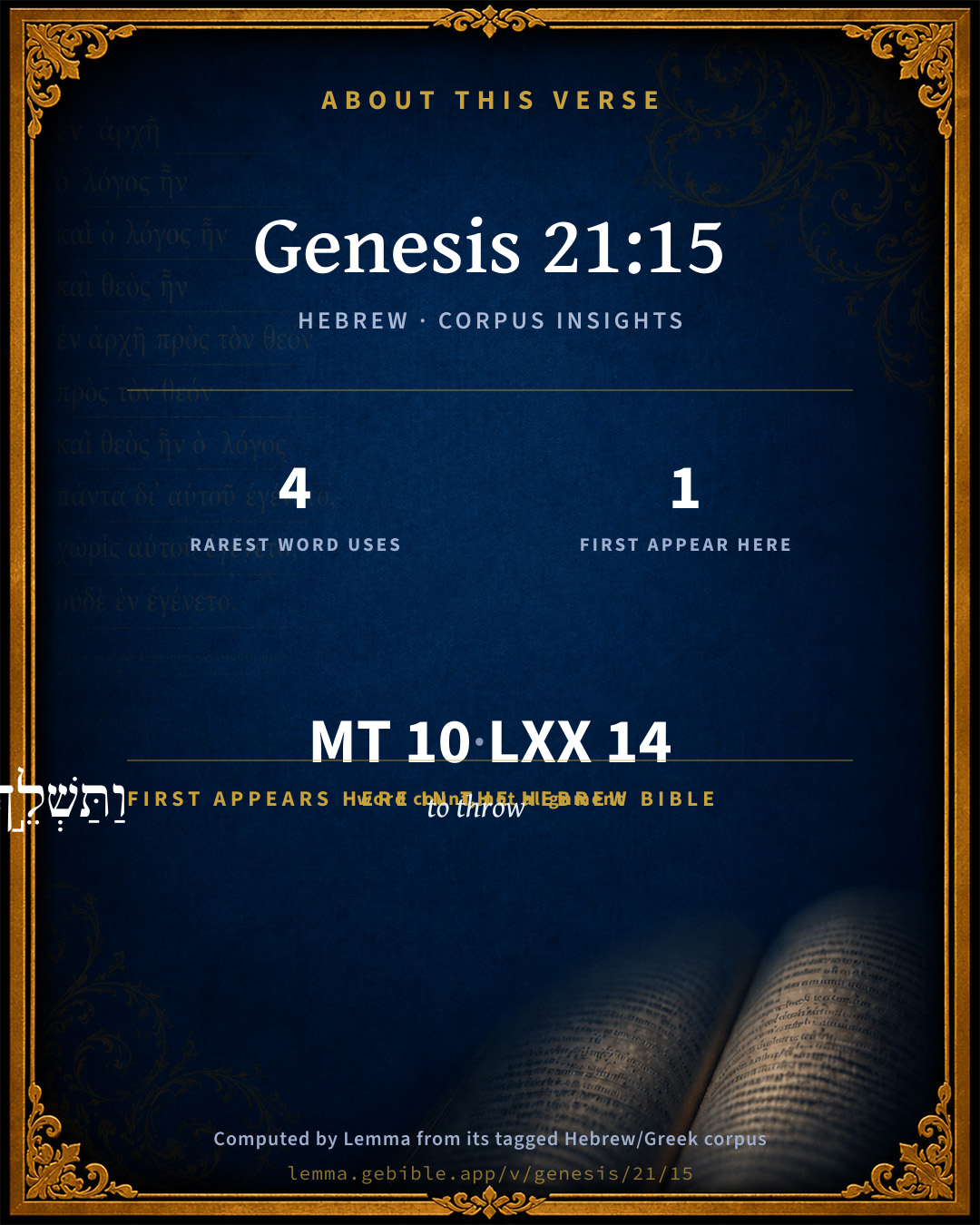
These counts appear in no published source. They are computed here, from the morphology-tagged text and Lemma’s own curated glosses. What Lemma adds →

10
words
10
distinct lemmas
Pentateuch
section

Notable vocabulary

The rarest word here is הַחֵ֑מֶת waterskin H2573 — appearing just 4 times in the whole Hebrew Bible.

First appearance in Scripture

This word makes its first canonical appearance in the Hebrew Bible here:

  • וַתַּשְׁלֵ֣ךְ to throw H7993

Shared distinctive vocabulary

הַחֵ֑מֶת waterskin H2573 occurs in 4 verses of the Hebrew Bible. Also found in:

Grammatical profile

  • 2 verbs
  • 4 nouns
  • 1 adjective
  • 2 prepositions
  • 1 particle

Verb forms

  • וַיִּכְל֥וּ Qal · Sequential Imperfect
  • וַתַּשְׁלֵ֣ךְ Hiphil · Sequential Imperfect

Hebrew & Septuagint length

In English translation the verse runs 17 words from the Hebrew and 17 from the Septuagint (LXX English) — the same length.

A rough comparison of the two English renderings, which tokenize alike — not a word-level alignment.

Word counts can differ between the Hebrew and the Greek without any difference in meaning — e.g. the Hebrew direct-object marker אֵת has no separate Greek word, and Greek often adds the article ὁ.

In the original languages it is 10 Hebrew tokens and 14 Greek tokens — but the two are counted differently (Hebrew bundles its prefixes and suffixes into one token; the Greek is in lemma form), so that isn’t a like-for-like length.

Cross-references

7

Topical passages linked to Genesis 21:15 in the Treasury of Scripture Knowledge — connected by theme and wording, ordered by reader-vote popularity; previews shown in the World English Bible.

  • Exodus 15:22–25 Moses led Israel onward from the Red Sea, and they went out into the wilderness of Shur; and they went three days in the wilderness, and found no water.
  • 2 Kings 3:9 So the king of Israel went, and the king of Judah, and the king of Edom; and they made a circuit of seven days' journey: and there was no water for the host, nor for the animals that followed them.
  • Psalms 63:1 God, you are my God. I will earnestly seek you. My soul thirsts for you, My flesh longs for you, In a dry and weary land, where there is no water.
  • Jeremiah 14:3 Their nobles send their little ones to the waters: they come to the cisterns, and find no water; they return with their vessels empty; they are disappointed and confounded, and cover their heads.
  • Genesis 21:14 Abraham rose up early in the morning, and took bread and a bottle of water, and gave it to Hagar, putting it on her shoulder, and gave her the child, and sent her away. She departed, and wandered in the wilderness of Beersheba.
  • Exodus 17:1–3 All the congregation of the children of Israel traveled from the wilderness of Sin, by their journeys, according to Yahweh's commandment, and encamped in Rephidim; but there was no water for the people to drink.
  • Isaiah 44:12 The smith [makes] an axe, and works in the coals, and fashions it with hammers, and works it with his strong arm: yes, he is hungry, and his strength fails; he drinks no water, and is faint.

Cross-references courtesy of OpenBible.info (CC BY 4.0).

Hebrew and Greek witnesses Masoretic Hebrew ↔ Greek Septuagint

The same verse in the two great witnesses to the Old Testament, shown verse-for-verse.

These are two independent witnesses, not word-aligned to each other, and the Septuagint is shown in lemma (dictionary) form.

Hebrew Genesis 21:15 Masoretic · Westminster Leningrad Codex

וַיִּכְל֥וּ הַמַּ֖יִם מִן הַחֵ֑מֶת וַתַּשְׁלֵ֣ךְ אֶת הַיֶּ֔לֶד תַּ֖חַת אַחַ֥ד הַשִּׂיחִֽם

The water in the bottle was spent, and she cast the child under one of the shrubs.

World English Bible · Public Domain

Greek LXX Genesis 21:15 Septuagint · lemma form

ἐκλείπω δέ ὁ ὕδωρ ἐκ ὁ ἀσκός καί ῥίπτω ὁ παιδίον ὑποκάτω εἷς ἐλάτη

And the water failed out of the skin, and she cast the child under a fir tree.

LXX2012 (modern English Septuagint) · Public Domain

On this verse, John Gill's Exposition discusses the Septuagint’s reading. Read the note in Commentary ↓

Hebrew: Westminster Leningrad Codex (CC BY 4.0). Greek: Septuagint (public domain); English from LXX2012 (modern English Septuagint) (Public Domain). How the Septuagint differs from the Hebrew →

Targum (Aramaic paraphrase)

2

The Targum is the ancient Jewish Aramaic paraphrase of the Hebrew Scriptures — an interpretive translation, not the Hebrew text itself. Onkelos (literal) and Pseudo-Jonathan (expansive) render the Torah, and Jonathan the Prophets. Coverage is partial: where no permissively-licensed English translation exists for a verse, only the Aramaic is shown. This is verse-level text, not a word-by-word alignment to the Hebrew.

  1. Targum Onkelos Torah (Genesis–Deuteronomy)
    וּשְׁלִימוּ מַיָּא מִן רָקְבָּא וּרְמַת יָת רַבְיָא תְּחוֹת חַד מִן אִילָנַיָּא

    (no public-domain English translation for this verse)

    Targum Onkelos — Aramaic: “Onkelos Genesis” (public domain); “Onkelos Exodus” (public domain); “Onkelos Leviticus” (public domain); “Onkelos Numbers” (public domain); “Onkelos Deuteronomy” (public domain). English: “Sefaria Community Translation” (CC0 1.0 (public-domain dedication)); “J.W. Etheridge. The Targums of Onkelos and Jonathan Ben Uzziel on the Pentateuch. London: Longmans, Green, 1862” (public domain). Text via Sefaria.

  2. Targum Pseudo-Jonathan Torah (Genesis–Deuteronomy)
    וַהֲווֹ כֵּיוַן דְמָטוּ לְפִיתְחָא דְמַדְבְּרָא אִדְכְּרוּ לְמִטְעֵי בָּתַר פּוּלְחָנָא נוּכְרָאָה וְלָקָה יִשְׁמָעֵאל בְּאֵישָׁא צְמִירְתָּא וּשְׁתִי כָּל מַיָא עַד דִי שְׁלִימוּ כָּל מַיָא מִן קִרְוָא וְאִתְחֲרִיךְ וְאִתְקְלִישׁ בִּשְרֵיהּ וְסוֹבְרָתֵיהּ וְאִשְׁתַּלְהִיאַת וּקְרָא לִדְחַלְתָּא דְאִיבָּא וְלָא עָנָא יָתָהּ וּמִן יַד טַלְקַת יַת רִיבָא תְּחוֹת חַד מִן אִלָנַיָא

    And it was when they came to the entrance of the desert, they remembered to wander after strange worship; and Ishmael was seized with a burning thirst, and drank of the water till all the water was consumed from the cruse. And he was dried up, and withered in his flesh; and she carried him, and was exhausted, and she cried unto the Fear of his father, and He answered her not; and she laid the youth down at once under one of the trees.

    Targum Pseudo-Jonathan — Aramaic: “Targum Jonathan on Genesis” (public domain); “Targum Jonathan on Exodus” (public domain); “Targum Jonathan on Leviticus” (public domain); “Targum Jonathan on Numbers” (public domain); “Targum Jonathan on Deuteronomy” (public domain). English: “The Targum of Jonathan ben Uzziel, trans. J. W. Etheridge, London, 1862” (public domain). Text via Sefaria.

Commentary

Notes on Genesis 21:15 from classic Christian and Jewish commentators (each source and its license shown beneath its notes). The classic Christian expositions comment on the surrounding passage and are grouped to its opening verse, so a note may address several verses; the Jewish commentaries on the Tanakh (Rashi and others) are per-verse, so they appear only where the commentator wrote on this verse.

Lemma curates 59 commentaries, every one of them public domain or Creative Commons licensed, each selected and text-cleaned for this edition rather than reprinted as found. About our sources →

Trapp's Complete Commentary

John Trapp

Gen 21:15 And the water was spent in the bottle, and she cast the child under one of the shrubs.

Ver. 15. And the water was spent in the bottle.] All creature comforts will fade and fail us; as the brook Cherith dried up while the prophet was drinking of it; as those pools about Jerusalem, that might be dried up, with the tramplings of horse and horsemen. {2Ki 19:24} But they that drink of Christ’s water shall never thirst; for it shall be in them (as the widow’s oil, or Aaron’s ointment) "a well of water springing up to eternal life". {Joh 4:14}

She cast the child, &c.] Whom till then she had led in her hand, faint, and ready to die for thirst; who while he lived at the full in his father’s house, but could not be contented. God loves to let us see the worth of his favours by the want of them; {a} to chasten men’s insolency with indigency, as he did the prodigal in the gospel.

{a} Carendo potius quam fruendo.

John Trapp, A Commentary or Exposition upon All the Books of the Old and New Testament (1647–1656) — public domain. Text from a community e-Sword module.

The Pulpit Commentary

CHAPTER 21:15-21

And the water was spent in (literally, from) the bottle, so that the wanderers became exhausted, and were in danger of fainting through thirstand she cast the child a translation which certainly conveys an erroneous impression, first of Ishmael, who was not an infant, but a grown lad (vide supra, Ver. 14), and secondly of Ishmael"s mother, whom it represents as acting with violence, if not with inhumanity; whereas the sense probably is that, having, as long as her rapidly diminishing strength permitted, supported her fainting son, she at length suddenly, through feebleness, released his nerveless hand as he fell, and in despair, finding herself unable to give him further assistance, left him, as she believed, to die where he had flung himself in his intolerable anguishunder one of the shrubs.

Vers. 15-21.

Hagar and Ishmael, or the fortunes of the outcasts.

I THE LONELY WANDERERS.

1. Banished from home. Hitherto the household of Abraham had been to Hagar and her boy such a pleasant and doubtless much-prized abode; henceforth their connection with the patriarch"s encampment was to be completely severed. So God in his mysterious providence and in many different ways frequently bereaves men of the shelter and society of home.

2. Separated from the Church. Practically the expulsion of this Egyptian slave-mother and her son from the household of Abraham, if it did not involve a casting off from God"s mercy, amounted to extrusion from the patriarchal Church.

3. Lost in the wilderness. Whether because the region through which they traveled was unfamiliar, or because, impelled by indignation and excitement, they simply drifted on with aimless feet, the narrative depicts the unhappy pair as having "wandered," turned aside into unfrequented paths, and become lost; in that touchingly portraying the sad condition of thousands or homeless and churchless wanderers to-day, roaming purposeless and perplexed across the trackless waste of life.

II THE FAINTING YOUTH.

1. Perishing through thirst. Extreme thirst one of the most excruciating torments to which the physical frame can be subjected, and a fellow

2. creature dying for lack of water, one of the commonest of God"s mercies, as sad a spectacle as any on which the eye of man can gaze.

3. Sobbing in anguish. Too exhausted to weep aloud, the poor disheartened lad moans out his misery. Happy they who, if they cannot relieve, can at least understand and be affected by their necessities. To recognize and make complaint of one"s spiritual destitution is better than to be callous and indifferent to one"s dying condition.

4. Praying to God. Though not certain that the "voice" of the lad meant more than the rude cry of his distress, charity may hope that in the day of his calamity he directed his prayer to God. Prayer generally precedes deliverance.

III THE WEEPING MOTHER.

1. The voice of heathen, superstition. "Let me not see the death of the lad." To a Christian mother Hagar"s behavior is simply inexplicable. It is doubtful if Sarah would hate been a bow-shot removed from Isaac had he been expiring. But then Hagar, though she had been Abraham"s wife, was still a poor untutored slave-girl. It rosy assist us to understand our indebtedness to the humanizing influences of Christ"s religion.

2. The cry of material affection "She sat over against her boy, and lifted up her voice and wept." Even in the breast of this Egyptian bondmaid nature asserted her supremacy. Everywhere beautiful and sacred is a mother"s love, worthy of being cherished and reciprocated by those who know its sweetness and strength, never failing to bring down retribution on those by whom it is rejected and despised.

IV THE COMFORTING GOD.

1. Sympathizing with the sorrowful. "What aileth thee, Hagar?" What a glimpse into the infinite pitifulness of the Divine nature! Only when Christ came was it surpassed in clearness and fullness.

2. Listening to the suppliant. As the prayer of Ishmael came up into the wakeful ear of God, so the cries of dying men and perishing souls never fail to do.

3. Consoling the dejected. As to Hagar the angel spoke words of encouragement, and renewed the formerly-given assurance concerning the future greatness of her son, so God revives the drooping spirits of his people by directing them to his exceeding great and precious promises.

4. Providing for the destitute. "God opened her eyes, and she saw a well of water." And so by the leadings of his providence, the teachings of his word, and the illumination of his Spirit does God guide the meek to the wells of salvation.

5. Abiding with the homeless. "God was with the lad." Ejected from Abraham"s house, he was not deserted by Abraham"s God. Happy they who amid life"s wanderings can count on God"s companionship. For desertions of friends and deprivations of goods it will prove ample compensation.

Learn

1. To prize the blessing of a home and the privilege of a Church.

2. To commiserate and succor those who have neither.

3. To use God in all the revealed aspects of his gracious character.

The Pulpit Commentary (1880–1919), ed. H.D.M. Spence-Jones & Joseph S. Exell — public domain. Text from a community e-Sword module.

Jamieson, Fausset & Brown

Robert Jamieson, A. R. Fausset & David Brown

the water was spent, &c.--Ishmael sank exhausted from fatigue and thirst--his mother laid his head under one of the bushes to smell the damp while she herself, unable to witness his distress, sat down at a little distance in hopeless sorrow.

Jamieson, Fausset & Brown — Commentary Critical and Explanatory on the Whole Bible (1871) — public domain (CC PDM 1.0). Text via the HelloAO Bible API.

Adam Clarke's Commentary

Verse 15. And she cast the child] ותשלך את הילד vattashlech eth haiyeled, and she sent the lad under one of the shrubs, viz., to screen him from the intensity of the heat. Here Ishmael appears to be utterly helpless, and this circumstance seems farther to confirm the opinion that he was now in a state of infancy; but the preceding observations do this supposition entirely away, and his present helplessness will be easily accounted for on this ground:

1. Young persons can bear much less fatigue than those who are arrived at mature age.

2. They require much more fluid from the greater quantum of heat in their bodies, strongly marked by the impetuosity of the blood; because from them a much larger quantity of the fluids is thrown off by sweat and insensible perspiration, than from grown up or aged persons.

3. Their digestion is much more rapid, and hence they cannot bear hunger and thirst as well as the others. On these grounds Ishmael must be much more exhausted with fatigue than his mother.

Adam Clarke's Commentary on the Bible (1810–1826) — public domain. Text from a community e-Sword/MySword module.

Ellicott's Commentary for English Readers

(15) She cast the child under one of the shrubs.—The act was one of despair. Ishmael, though seventeen years of age, had not yet come to his strength, and at a time when human life was so prolonged that forty was the usual age for marriage, was probably not as capable of bearing fatigue as a young man nearly grown up would be in our days. He thus became exhausted, and apparently fainted; and his mother, after trying in vain to support him, cast him down in anguish, and abandoned herself to her grief.

A Bible Commentary for English Readers, edited by Charles John Ellicott (1878–1897) — public domain. Text from a community e-Sword module.

The Cambridge Bible for Schools and Colleges

gen. ed. J. J. S. Perowne

15. cast the child] This expression taken with the mention of the child in Gen_21:14; Gen_21:18 (“hold him in thine hand”), 20 (“and he grew”) implies that Ishmael is regarded in this story as a little boy, who could be carried by his mother.

under one of the shrubs] We should probably understand by this word the low scrub such as grows in the desert, like the broom, under which Elijah rested, 1Ki_19:4. The word used occurs also in Gen_2:5 in a general sense; see note.

The Cambridge Bible for Schools and Colleges (gen. ed. J. J. S. Perowne; Cambridge University Press, 1878–1918) — public domain. Text from a community e-Sword module.

John Gill's Exposition

And she went and sat her down over against him, a good way off,.... Not being able to bear the sight of her child in his agonies, and, as she apprehended, ready to expire, she went from the place where she had laid him, and sat down under one of the shrubs or trees to shade herself, right over against that where her child was, though at some distance, which is next expressed:

as it were a bowshot; about as far off from him as an arrow can be shot, or is usually shot out of a bow; according to the Jews this was about half a mile, for they say (i) two bowshots make a mile; here she sat waiting what would be the issue, whether life or death, which last she expected:

for she said, let me not see the death of the child; she could not bear to hear his dying groans, and see him in his dying agonies:

and she sat over against him, and lift up her voice and wept; on account of her desolate and forlorn condition, being in a wilderness, where she could get no water, and her child, as she thought, dying with thirst: the Septuagint version is, "and the child cried and wept"; and certain it is, from Gen 21:17, that the child did lift up its voice and cry, but that is not expressed in the text; it is quite clear in the original that it was Hagar and not her son that is said to weep, since the verb is feminine.

(i) Bereshit Rabba, ut supra. (sect. 53. fol. 47. 4.)

John Gill's Exposition of the Whole Bible (1746–1763) — public domain (CC PDM 1.0). Text via the HelloAO Bible API.

Matthew Poole's English Annotations

Not as if she carried him in her arms, or upon her shoulders, for he was now about eighteen years old; but being weak and faint, and no doubt much dejected in spirit upon the prospect of his desolate and distressed condition, she was forced to support and lead him by the hand; but now, despairing of his life, she lays him down under a shrub.

Matthew Poole's English Annotations on the Holy Bible (1683–1685) — public domain. Text from a community e-Sword/MySword module.

Whedon's Commentary on the Bible

Daniel D. Whedon

15. Cast the child — From this it has been inferred that Ishmael could not have been a youth of over fifteen years. But neither the word lad (נער) (Gen_21:12) nor child (ילד) implies that Ishmael was an infant, nor does the word cast (שׁלךְ) necessarily imply that she hurled him from her arms. “The boy was young, but he was old enough to give offence to Sarah by mocking. At a time when human life was much longer than it now is, (Ishmael himself died at 137, Gen_25:17,) fifteen or sixteen would be little removed from childhood. The growing lad would be easily exhausted with the heat and wandering; whilst the hardy habits of the Egyptian handmaid would enable her to endure much greater fatigue. She had hitherto led the boy by the hand; now she left him, fainting and prostrate, under the shelter of a tree.” — Speaker’s Commentary.

Daniel D. Whedon (gen. ed.), Commentary on the Old and New Testaments (1874–1909) — public domain. Text from a community e-Sword module.

Kretzmann's Popular Commentary

Paul E. Kretzmann

Ishmael’s Life Saved

v. 15. And the water was spent in the bottle, and she cast the child under one of the shrubs. Apparently Hagar lost her way, or some miscalculation interfered, for the water in the skin was exhausted before she reached a spring. The ensuing suffering soon became so great that the boy was unable to support himself. For a while his mother supported him, drawing him along and half carrying him, in the hope of finding water. But at last she was obliged to let him sink down, her mother-love, however, selecting a shady place under a bush.

v. 16. And she went and sat her down over against him a good way off, as it were a bow-shot; for she said, Let me not see the death of the child. And she sat over against him, and lift up her voice and wept. Here are further traits of a mother’s undying love. She would not abandon the lad entirely, even if she might have gotten help; she could not bear to see him suffer and probably die before her eyes of thirst. So she sat down at a distance equal to that usually taken by bowmen shooting at a target, and wept out loud in full abandonment to her grief.

v. 17. And God heard the voice of the lad; and the Angel of God called to Hagar out of heaven and said unto her, What aileth thee, Hagar? Fear not; for God hath heard the voice of the lad where he Isaiah

v. 18. Arise, lift up the lad, and hold him in thine hand; for I will make him a great nation. In this great extremity Ishmael forgot all his mocking and turned to the prayers which he had learned in his father’s house. In answer to this prayer the Angel of God in the specific sense, the Son of God, who had appeared to her once before, Gen 16:9-13, bade her not to fear, but to arise, to lift up her son, and to support him, since he was not to die, but to live, and to become the ancestor of a great people.

v. 19. And God opened her eyes, and she saw a well of water. And she went and filled the bottle with water, and gave the lad drink. Help had been so near at hand, but Hagar, in her own exhausted condition, had not noticed the spring which welled forth at a small distance. Now she filled the skin which she carried and refreshed her son, thus saving his life.

v. 20. And God was with the lad; and he grew, and dwelt in the wilderness, and became an archer.

v. 21. And he dwelt in the wilderness of Paran; and his mother took him a wife out of the land of Egypt. Ishmael grew up as a true son of the desert, living in the great wilderness which extends on the southern boundary of Canaan from Egypt to Arabia. The blessing of God rested upon him. He became very skilful with the bow and married an Egyptian woman whom his mother selected for him. This fact, unfortunately, strengthened the heathen element in the Ishmaelites and probably caused their abandoning of the true God in a very short time.

Paul E. Kretzmann, Popular Commentary of the Bible (1921–1924) — public domain. Text from a community e-Sword module.

Rashi

Rabbi Shlomo Yitzchaki (Rashi)

ויכלו המים AND THE WATER WAS SPENT, because it is the nature of sick people to drink much (Genesis Rabbah 53:13).

Rashi on the Tanakh — English translations: “The Judaica Press complete Tanach with Rashi, translated by A. J. Rosenberg” (CC BY 4.0); “Pentateuch with Rashi's commentary by M. Rosenbaum and A.M. Silbermann, 1929-1934” (public domain); “The Metsudah Tanach series, Lakewood, N.J” (CC BY 4.0); and “The Book of Joshua, Metsudah Publications, 1997” (CC BY 4.0). Text via Sefaria.

Ramban (Nachmanides)

Rabbi Moshe ben Nachman (Ramban / Nachmanides)

AND SHE CAST THE CHILD. Thirst overtook him and he was unable to walk, and so his mother laid him under the tree, cast away and abandoned. It may be that the word vatashleich (and she cast) is similar in sense to the verses: And He cast them into another land; Cast me not away from Thy presence, meaning “sending away.”Rabbi Abraham ibn Ezra said: “And she cast for she had taken him onto her lap when he was weakened by thirst, [and seeing that he was expiring from thirst, she cast him from her].”Our Rabbis have said that he was sick at the time he sent him away, and therefore he put the child on her shoulder. This is the sense of the word vatashleich (and she cast) him: [until that point she had carried him].All this occurred to Abraham because he had been commanded to do whatever Sarah said, and she commanded that he send him away immediately, and it was at her command that he did not give them silver and gold, servants, and camels to bear them.

Ramban (Nachmanides) on the Tanakh — English translation: “Commentary on the Torah by Ramban (Nachmanides). Translated and annotated by Charles B. Chavel. New York, Shilo Pub. House, 1971-1976” (CC BY 4.0). Text via Sefaria.

Radak

Rabbi David Kimhi (Radak)

ויכלו, Hagar’s problems became ever more acute. The reason why the Torah writes all this detail, is to teach that if man is confident that G’d will help him overcome his difficulties in the end, then his troubles do not multiply in order to teach him to appeal to G’d for help. The detail here has also been written in order to show how G’d deals with people who love His name. He appeared to Hagar on two separate occasions rescuing her from acute distress, performing miracles on behalf of her son.

ותשלך את הילד, whom she had been carrying, seeing that she had become too tired to carry on. When she saw that she had been unable to locate any water, she threw him from her lap under a shrub. According to Onkelos שיחים are small trees. [it was doubly frustrating to know that there must have been a source of water nearby, how else could these trees exist? Ed.]

Radak on the Tanakh — English translations: “Sefaria Community Translation” (CC0 1.0 (public-domain dedication)); “Eliyahu Munk, HaChut Hameshulash” (CC BY 4.0); “Rabbi Mike Feuer, Jerusalem Anthology” (CC BY 4.0); and “R. David Kimhi on the first book of Psalms, Translated by R.G. Finch, London, 1919” (public domain). Text via Sefaria.

Lesson kit

Teaching starters — assembled from the data on this page, not authored interpretation. Every prompt links to the verse data it draws on. Edit before teaching.

Genesis, in the Pentateuch, opens this verse with 10 words (10 distinct Hebrew lemmas). Its most distinctive word is chêmeth (“waterskin”). A historical commentator’s framing appears above. Read the whole chapter for the surrounding context.

Discussion questions

  1. How does “waterskin” (chêmeth) shape what this verse is saying?
  2. This is the first place “to throw” appears in Scripture (first appears here). What does its debut here establish?
  3. How does Genesis 21:14, which shares the word «waterskin», read alongside this verse?
  4. These translations render this verse differently. What is at stake in choosing one wording over another?
  5. «וַיִּכְל֥וּ» is a Qal Sequential Imperfect verb. How does that grammatical form shape the action described?
  6. Compare how Trapp's Complete Commentary and The Pulpit Commentary read this verse. Where do they agree or differ?

Things to notice

Reading settings

Reading text

Shown beneath each verse's original-language words.

Old Testament
Old Testament edition

Read the OT as the Masoretic Hebrew (MT) or the Greek Septuagint (LXX).

English shown for the Greek Septuagint (in the Hebrew ↔ Greek comparison).

Comparing translations? Open the Compare panel on any verse page to stack up to four side by side.