
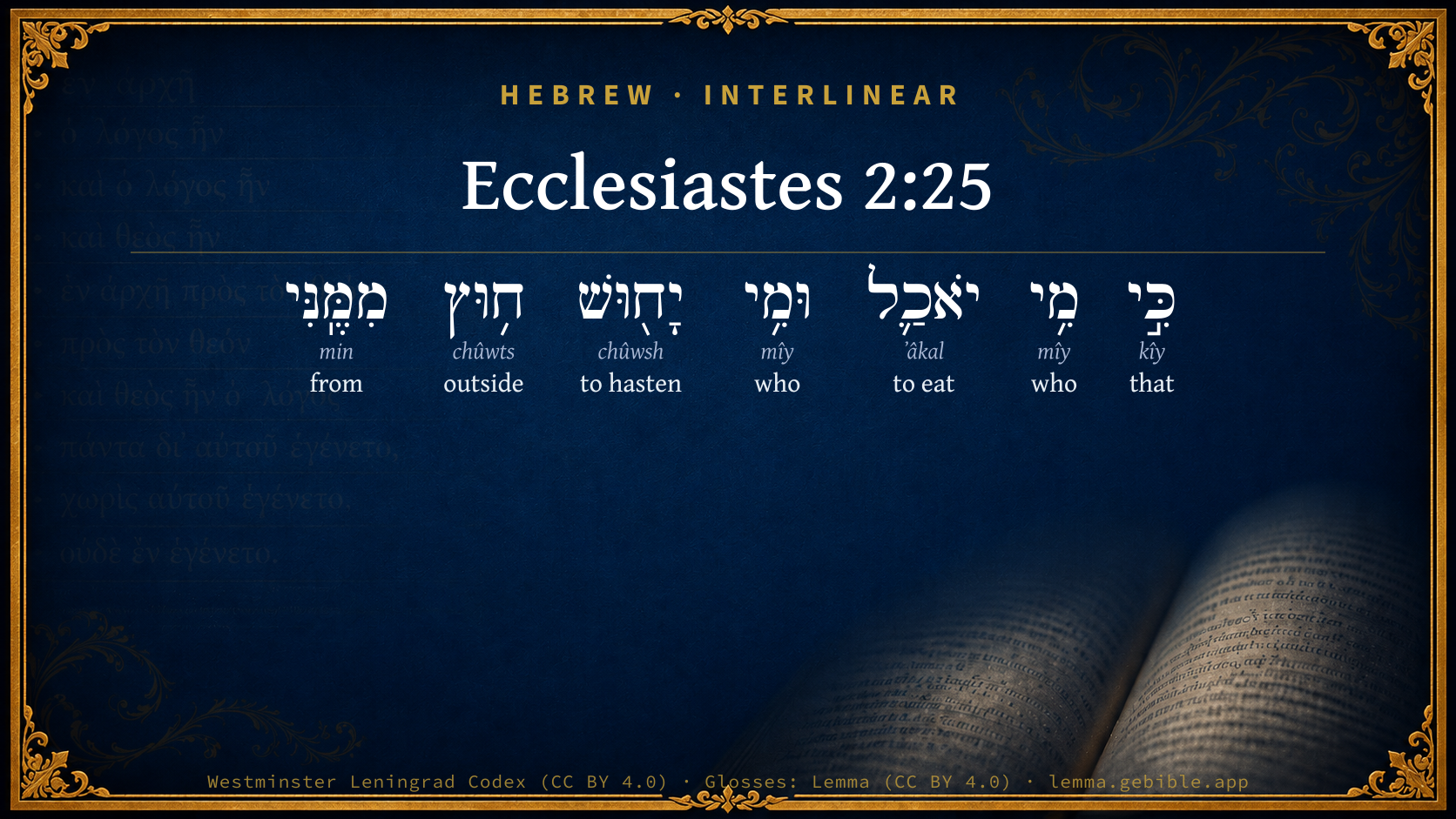
Ecclesiastes 2:25

Hebrew (Westminster Leningrad Codex) Ecclesiastes 2:25 appears in the Hebrew Old Testament. The text above is from the Westminster Leningrad Codex. Each word links to its Strong’s number, a concise gloss, and parsing drawn from the Open Scriptures Hebrew Bible morphology. Click any word for its full Brown-Driver-Briggs (BDB) entry.
Download image
Cite this verse

Ecclesiastes 2:25 (World English Bible). Public Domain. Lemma interlinear Bible study tool, https://lemma.gebible.app/v/ecclesiastes/2/25.

Show BibTeX & RIS
BibTeX
RIS
English Translation
For who can eat, or who can have enjoyment, more than I?
World English Bible · Public Domain
Download a study sheet

One document with this verse’s original text, its word-by-word gloss line, the meaning frame, cross-references with their text, attributed commentary, and full source and license credits — printable, and it pastes into notes with its structure intact.

This verse Autodidact and up

Study sheet (.html) Plain text (.txt)

A passage Seminary Student

Up to 50 verses in one chapter. A passage sheet keeps up to 6 commentary sources and 12 cross-references per verse, in the order this page ranks them, and says so on the sheet whenever that leaves anything out. Ask for a single verse and you get the Autodidact verse sheet above.

Everything on this page stays free to read, with no account — the sheet is a download of what is already on screen, not access to it.

Want to remove ads? Support Godless Engineer
Compare translations 3

The same verse in 3 English versions, stacked beneath the original-language interlinear above. Click any original word for its lexicon entry.

Each is an independent rendering of the whole verse — the interlinear is not word-aligned to these translations.

Highlighted words mark where these versions differ — a whole-verse word diff, not a word-by-word alignment.

  • World English Bible Public Domain
    For who can eat, or who can have enjoyment, more than I?
  • King James Version Public Domain
    For who can eat, or who else can hasten hereunto, more than I?
  • unfoldingWord Literal Text CC BY-SA 4.0
    for who will eat and who will enjoy apart from him?

unfoldingWord Literal Text — © unfoldingWord, licensed CC BY-SA 4.0. Word-aligned USFM3 via Door43 (git.door43.org/unfoldingWord/en_ult).

Versions to compare (up to 4)

3 of 4 selected

Show all 18 translations

Every available English version of this verse, each an independent rendering of the whole verse.

  • World English Bible Public Domain
    For who can eat, or who can have enjoyment, more than I?
  • Berean Standard Bible Public Domain
    For apart from Him, who can eat and who can find enjoyment?
  • Majority Standard Bible Public Domain
    For apart from Him, who can eat and who can find enjoyment?
  • King James Version Public Domain
    For who can eat, or who else can hasten hereunto, more than I?
  • American Standard Version (1901) Public Domain
    For who can eat, or who can have enjoyment, more than I?
  • Revised Version (1885) Public Domain
    For who can eat, or who can have enjoyment, more than I?
  • Geneva Bible (1599) Public Domain
    For who could eate, and who could haste to outward things more then I?
  • Douay-Rheims (1899) Public Domain
    Who shall so feast and abound with delights as I?
  • Young's Literal Translation Public Domain
    For who eateth and who hasteth out more than I?
  • Literal Standard Version CC BY-SA 4.0
    For who eats and who hurries out more than I?
  • Unlocked Literal Bible CC BY-SA 4.0
    For who can eat or who can have any kind of pleasure apart from God?
  • unfoldingWord Literal Text CC BY-SA 4.0
    for who will eat and who will enjoy apart from him?
  • Darby Bible Public Domain
    For who can eat, or who be eager, more than I?
  • World Messianic Bible Public Domain
    For who can eat, or who can have enjoyment, more than I?
  • Webster's Bible Public Domain
    For who can eat, or who else can hasten to it more than I?
  • Free Bible Version CC BY-SA 4.0
    for who can eat or enjoy life apart from him?
  • Bible in Basic English Public Domain
    Who may take food or have pleasure without him?
  • JPS Tanakh (1917) Public Domain
    For who will eat, or who will enjoy, if not I?

Literal Standard Version (2020), Covenant Press — licensed CC BY-SA 4.0. Text via the HelloAO Bible API (eBible.org). Unlocked Literal Bible (unfoldingWord) — licensed CC BY-SA 4.0. Text via the HelloAO Bible API (eBible.org). unfoldingWord Literal Text — © unfoldingWord, licensed CC BY-SA 4.0. Word-aligned USFM3 via Door43 (git.door43.org/unfoldingWord/en_ult). Free Bible Version, Dr. Jonathan Gallagher — licensed CC BY-SA 4.0. Text via the HelloAO Bible API (eBible.org).

Word by word

More ways to search: Search by grammar → Find every occurrence → Compare this word →

Practice this passage: Drill this verse → Learn its vocabulary →

About this verse

These counts appear in no published source. They are computed here, from the morphology-tagged text and Lemma’s own curated glosses. What Lemma adds →

7
words
6
distinct lemmas
Wisdom
section

Notable vocabulary

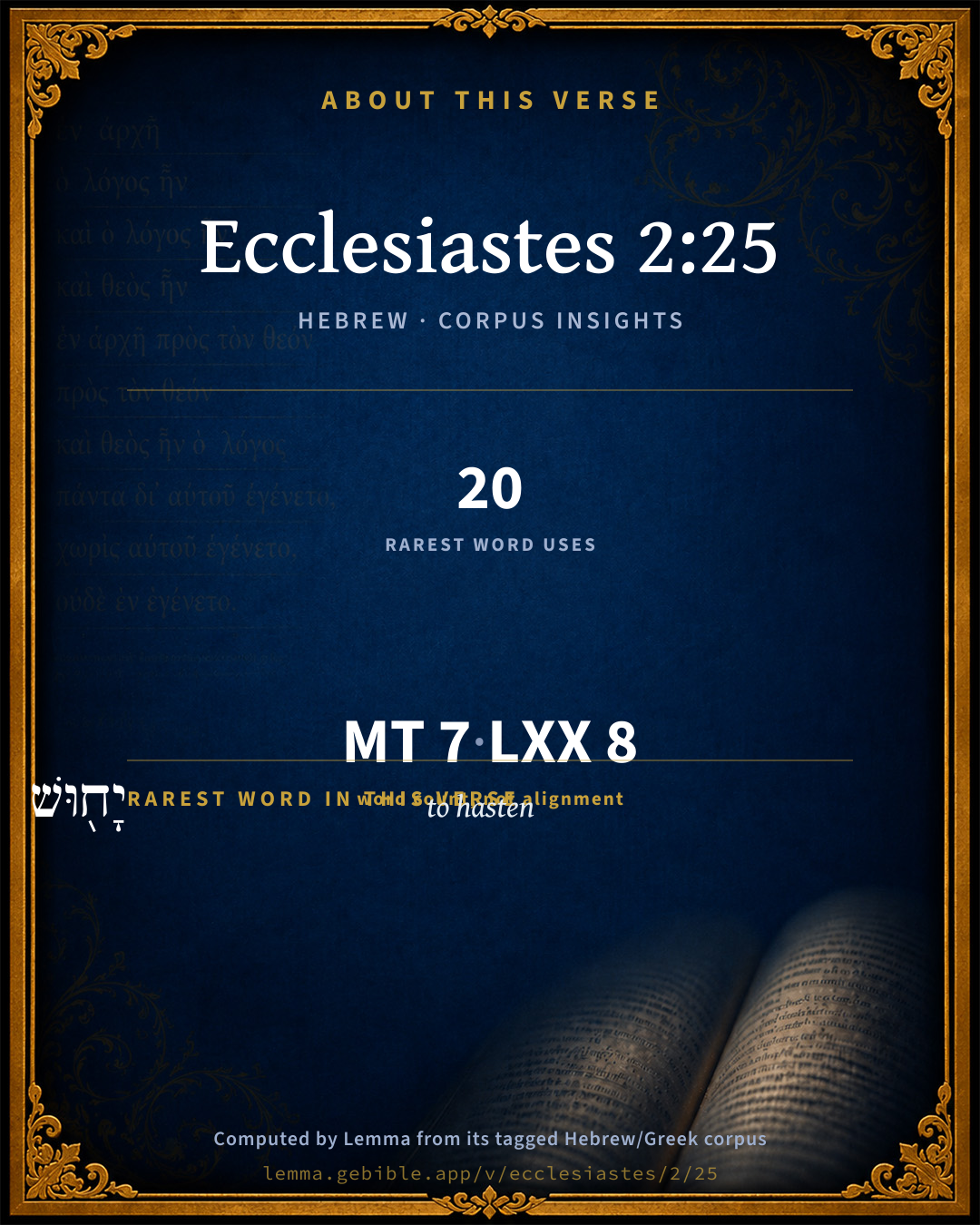
The rarest word here is יָח֖וּשׁ to hasten H2363 — appearing just 20 times in the whole Hebrew Bible.

Shared distinctive vocabulary

יָח֖וּשׁ to hasten H2363 occurs in 20 verses of the Hebrew Bible. Also found in:

Grammatical profile

  • 2 verbs
  • 1 noun
  • 1 preposition
  • 1 conjunction
  • 2 particles

Verb forms

  • יֹאכַ֛ל Qal · Imperfect
  • יָח֖וּשׁ Qal · Imperfect

Repetition

A word recurs within this verse — often emphatic in Hebrew:

Hebrew & Septuagint length

In English translation the verse runs 12 words from the Hebrew and 10 from the Septuagint (LXX English) — closely comparable.

A rough comparison of the two English renderings, which tokenize alike — not a word-level alignment.

Word counts can differ between the Hebrew and the Greek without any difference in meaning — e.g. the Hebrew direct-object marker אֵת has no separate Greek word, and Greek often adds the article ὁ.

In the original languages it is 7 Hebrew tokens and 8 Greek tokens — but the two are counted differently (Hebrew bundles its prefixes and suffixes into one token; the Greek is in lemma form), so that isn’t a like-for-like length.

Cross-references

2

Topical passages linked to Ecclesiastes 2:25 in the Treasury of Scripture Knowledge — connected by theme and wording, ordered by reader-vote popularity; previews shown in the World English Bible.

  • Ecclesiastes 2:1–12 I said in my heart, "Come now, I will test you with mirth: therefore enjoy pleasure;" and, behold, this also was vanity.
  • 1 Kings 4:21–24 Solomon ruled over all the kingdoms from the River to the land of the Philistines, and to the border of Egypt: they brought tribute, and served Solomon all the days of his life.

Cross-references courtesy of OpenBible.info (CC BY 4.0).

Hebrew and Greek witnesses Masoretic Hebrew ↔ Greek Septuagint

The same verse in the two great witnesses to the Old Testament, shown verse-for-verse.

These are two independent witnesses, not word-aligned to each other, and the Septuagint is shown in lemma (dictionary) form.

Hebrew Ecclesiastes 2:25 Masoretic · Westminster Leningrad Codex

כִּ֣י מִ֥י יֹאכַ֛ל וּמִ֥י יָח֖וּשׁ ח֥וּץ מִמֶּֽנִּי

For who can eat, or who can have enjoyment, more than I?

World English Bible · Public Domain

Greek LXX Ecclesiastes 2:25 Septuagint · lemma form

ὅτι τίς ἐσθίω καί τίς φείδομαι πάρεξ αὐτός

For who shall eat, or who shall drink, without him?

LXX2012 (modern English Septuagint) · Public Domain

On this verse, Keil & Delitzsch discusses the Septuagint’s reading. Read the note in Commentary ↓

Hebrew: Westminster Leningrad Codex (CC BY 4.0). Greek: Septuagint (public domain); English from LXX2012 (modern English Septuagint) (Public Domain). How the Septuagint differs from the Hebrew →

Commentary

Notes on Ecclesiastes 2:25 from classic Christian and Jewish commentators (each source and its license shown beneath its notes). The classic Christian expositions comment on the surrounding passage and are grouped to its opening verse, so a note may address several verses; the Jewish commentaries on the Tanakh (Rashi and others) are per-verse, so they appear only where the commentator wrote on this verse.

Lemma curates 59 commentaries, every one of them public domain or Creative Commons licensed, each selected and text-cleaned for this edition rather than reprinted as found. About our sources →

Trapp's Complete Commentary

John Trapp

Ecc 2:25 For who can eat, or who else can hasten [hereunto], more than I?

Ver. 25. For who can eat, or who can hasten? &c.] And yet I have found - and so shall you - that tranquillity and true happiness, the kingdom of God, doth not consist in meats and drinks. A Turk may believe sensualities in his fool’s paradise, but no servant of God is a slave to his palate.

John Trapp, A Commentary or Exposition upon All the Books of the Old and New Testament (1647–1656) — public domain. Text from a community e-Sword module.

Joseph Benson's Commentary

Ecc 2:25. For who can eat, &c. — For the truth of this you may rely upon my experience: for who can more freely and fully enjoy the comforts of this life than I did? Or who else can hasten hereunto more than I? — Who can pursue them with more diligence, obtain them with more readiness, or embrace them with more greediness? And yet, (as his words imply,) I had not comfort in these things till God was pleased to impart it unto me; till he gave me grace to see and consider that they were his gifts, to acknowledge his goodness in bestowing them upon me, and to use and enjoy them with prudence and moderation according to his will, not seeking my happiness in them, or in any creatures, but in himself, above all creatures. For this verse is evidently added to confirm, from his own experience, what he said in the foregoing verse: and surely no man’s experience, in such a case, was ever greater; no man was ever a more capable judge in these matters: none could either have more creature-comforts, or more addict himself to the enjoyment of them, or improve them to better advantage than he did; and therefore he could best tell what was the greatest good to be found in them, and whether they were able of themselves, without God’s special gift, to yield a man satisfaction.

Joseph Benson's Commentary on the Old and New Testaments (1811–1818) — public domain. Text from a community e-Sword module.

Keil & Delitzsch

C. F. Keil & F. Delitzsch

"For who can eat, and who can have enjoyment, without [= except from Him?]" Also here the traditional text is tenable: we have to read ממנו חוץ, after the lxx (which Jerome follows in his Comm.) and the Syr. If we adopt the text as it lies before us, then the meaning would be, as given by Gumpel,

(Note: Vid., regarding his noteworthy Comm. on Koheleth, my Jesurun, pp. 183 and 195. The author bears the name among Christians of Professor Levisohn.)

and thus translated by Jerome: Quis ita devorabit et deliciis effluet ut ego? But (1) the question thus understood would require ממּנּי יותר, which Gumpel and others silently substitute in place of חוץ ם; (2) this question, in which the king adjudicates to himself an unparalleled right to eat and to enjoy himself, would stand out of connection with that which precedes and follows.

Even though with Ginsburg, after Rashi, Aben Ezra, and Rashbam, we find in Ecc 2:25 the thought that the labourer has the first and nearest title to the enjoyment of the fruit of his labour (חוץ ם thus exemplif. as Ecc 4:8, ע ... למי), the continuation with כּי, Ecc 2:26, is unsuitable; for the natural sequence of the thoughts would then be this: But the enjoyment, far from being connected with the labour as its self-consequence and fruit, is a gift of God, which He gives to one and withholds from another. If we read ממּנּוּ, then the sequence of the thoughts wants nothing in syllogistic exactness. חוּשׁ .ssen here has nothing in common with חוּשׁ = Arab. ḥât, to proceed with a violent, impetuous motion, but, as at Job 20:2, is = Arab. ḥss, stringere (whence hiss, a sensible impression); the experience here meant is one mediated by means of a pleasant external enjoyment. The lxx, Theod., and Syr. translate: (and who can) drink, which Ewald approves of, for he compares (Arab.) ḥasa (inf. ḥasy), to drink, to sip. But this Arab. verb is unheard of in Heb.; with right, Heiligst. adheres to the Arab., and at the same time the modern Heb. ḥass, חושׁ, sentire, according to which Schultens, quis sensibus indulserit. ממנו חוּץ is not = ולא ם, "except from him" (Hitz., Zckl.), but מן חוץ together mean "except;" cf. e.g., the Mishnic לאמנה וחוץ לם, beyond the time and place suitable for the thank-offering, חוץ מאחד מהם, excepting one of the same, Menachoth vii. 3, for which the old Heb. would in the first case use בלא, and in the second זולא or מן לבד (= Aram. מן בּר) (vid., p. 637). Accordingly ממנו חוץ means practer cum (Deum), i.e., unless he will it and make it possible, Old Heb. מבּ, Gen 41:44.

In enjoyment man is not free, it depends not on his own will: labour and the enjoyment of it do not stand in a necessary connection; but enjoyment is a gift which God imparts, according as He regards man as good, or as a sinner.

Keil & Delitzsch — Biblical Commentary on the Old Testament (1861–1891) — public domain (CC PDM 1.0). Text via the HelloAO Bible API. (Old Testament only.)

Geneva Bible (1599)

Geneva Bible translators

Meaning, to pleasures.

Geneva Bible (1599) marginal notes — public domain. Text via Bolls.life.

Jamieson, Fausset & Brown

Robert Jamieson, A. R. Fausset & David Brown

hasten--after indulgences (Pro 7:23; Pro 19:2), eagerly pursue such enjoyments. None can compete with me in this. If I, then, with all my opportunities of enjoyment, failed utterly to obtain solid pleasure of my own making, apart from God, who else can? God mercifully spares His children the sad experiment which Solomon made, by denying them the goods which they often desire. He gives them the fruits of Solomon's experience, without their paying the dear price at which Solomon bought it.

Jamieson, Fausset & Brown — Commentary Critical and Explanatory on the Whole Bible (1871) — public domain (CC PDM 1.0). Text via the HelloAO Bible API.

Adam Clarke's Commentary

Verse 25. For who can eat - more than I?] But instead of חוץ ממני chuts mimmenni, more than I; חוץ ממנו chuts mimmennu, without HIM, is the reading of eight of Kennicott's and De Rossi's MSS., as also of the Septuagint, Syriac, and Arabic.

"For who maye eat, drynke, or bring enythinge to pass without him?" - COVERDALE.

I believe this to be the true reading. No one can have a true relish of the comforts of life without the Divine blessing. This reading connects all the sentences: "This also I saw, that it was from the hand of God;-for who can eat, and who can relish without HIM? For God giveth to man that is good." It is through his liberality that we have any thing to eat or drink; and it is only through his blessing that we can derive good from the use of what we possess.

Adam Clarke's Commentary on the Bible (1810–1826) — public domain. Text from a community e-Sword/MySword module.

Ellicott's Commentary for English Readers

(25) Hasten.—Hab_1:8.

More than I.—There is a various rendering, which has the authority of the LXX., and which has every appearance of being right: “without Him.”

A Bible Commentary for English Readers, edited by Charles John Ellicott (1878–1897) — public domain. Text from a community e-Sword module.

The Cambridge Bible for Schools and Colleges

gen. ed. J. J. S. Perowne

25. For who can eat] The sequence of thought is obscure, and many commentators follow the LXX. and the Syriac version, as implying an original text which gives a better meaning, Who can eat and who can hasten (i.e. be eager in this pursuit of pleasure), or, as some take the words, have enjoyment, without Him, i.e. without God. This, it is obvious, follows on the thought of the preceding verse, that the calm enjoyment of which it speaks as “good,” is “from the hand of God.” Those who keep to the received text give it very different meanings, of which the two most prominent are: (1) that we have, as it were, the words of the labourer whose lot the Debater here admired, “Who has a right to eat and enjoy himself, if not I?” the thought being parallel to that of 2Ti_2:6 (“The husbandman that laboureth must be first partaker of the fruits”); and (2) that the Debater speaks in his own person, “Who could eat or enjoy more than I? Who therefore can better attest that it is all in vain without the gift of God.” On the assumption that the writer was one who had come into contact with Greek thought, we may trace in this utterance partly the old faith of Israel reasserting itself and giving a higher sanction to the life of regulated enjoyment which the Greek teachers counselled, partly, perhaps, the mingling of Stoic and Epicurean counsels natural in a mind that had listened to both and attached himself definitely to neither. So in the Meditations of Aurelius we have like thoughts: πάντα γὰρ ταῦτα θεῶν βοηθῶν καὶ τύχης δειται (“all these things require the help of the Gods and of Fortune”); and again τὰ τῶν Θεῶν προνίας μεστὰ (“the works of the Gods are full of Providence” (Meditt. ii. 3). Koheleth, of course, as an Israelite, used the language of the wiser Stoics, like Cleanthes, and spoke of one God only.

The Cambridge Bible for Schools and Colleges (gen. ed. J. J. S. Perowne; Cambridge University Press, 1878–1918) — public domain. Text from a community e-Sword module.

John Gill's Exposition

For who can eat?.... Who should eat, but such a man that has laboured for it? or, who has a power to eat, that is, cheerfully, comfortably, and freely to enjoy the good things of life he is possessed of, unless it be given him of God? see Ecc 6:1;

or who else can hasten hereunto more than I? the word "chush", in Rabbinical language, is used of the five senses, seeing, hearing, feeling, smelling, and tasting: and R. Elias says (c), there are some that so interpret it here, "who has his sense better than I?" a quicker sense, particularly of smelling and tasting what be eats, in which lies much of the pleasure of eating; and this is of God; which interpretation is not to be despised. Or, "who can prepare?" according to the Arabic sense of the word (d); that is, a better table than I? No man had a greater affluence of good things than Solomon, or had a greater variety of eatables and drinkables; or had it in the power of his hands to live well, and cause his soul to enjoy good; or was more desirous to partake of pleasure, and hasten more to make the experiment of it in a proper manner; and yet he found, that a heart to do this was from the Lord; that this was a gift of his; and that though he abounded in the blessings of life, yet if God had not given him a heart to use them, he never should have really enjoyed them.

(c) In Tishbi, p. 109. (d) Vid. Rambachium in loc.

John Gill's Exposition of the Whole Bible (1746–1763) — public domain (CC PDM 1.0). Text via the HelloAO Bible API.

Matthew Poole's English Annotations

Who can more freely and fully enjoy the comforts of this life than I did? This verse is added to confirm what he said in the foregoing verse from his own experience, which was the more considerable, because no man ever was a more capable judge of these matters, none could either have more creature-comforts, or more addict himself to the enjoyment of them, or to improve them to better advantage, than he did; and therefore he could best tell what was the greatest good to be found in them, and whether they were able of themselves, without God’s special gilt, to yield a man satisfaction.

Who else can hasten hereunto, to wit, to the procuring and enjoying of them? who can pursue them with more diligence, or obtain them with more speed and readiness, or embrace them with more greediness and alacrity?

Matthew Poole's English Annotations on the Holy Bible (1683–1685) — public domain. Text from a community e-Sword/MySword module.

Whedon's Commentary on the Bible

Daniel D. Whedon

25. More than I — Better, Except myself. “The husbandman that laboureth must be first partaker of the fruits,” and Koheleth has the first right to the good which he gathers. The feast of firstfruits and the joy of harvest were gladsome occasions with the Jews.

Daniel D. Whedon (gen. ed.), Commentary on the Old and New Testaments (1874–1909) — public domain. Text from a community e-Sword module.

The Pulpit Commentary

For who can eat, or who else can hasten hereunto, more than I? This is the translation of the received text. "Eat" means enjoy one"s self, as in the preceding verse; "hasten hereunto" implies eager pursuit of pleasure; and Koheleth asks Who had better opportunity than he for verifying the principle that all depends upon the gift of God? Vulgate, Quis ita devorabit, et deliciis affluet ut ego? The Septuagint had a different reading, which obtains also in the Syriac and Arabic versions, and has been adopted by many modern critics. Instead of yNiMmi, they read Wnm,mi, "without him," i.e. except from God. "For who shall eat or who shall drink without him (parex aujtou)?" This merely repeats the thought of the last verse, in agreement with the saying of St. James, (Jam_1:17) "Every good gift and every perfect boon is from above, coming down from the Father" of lights." But the received reading, if it admits the rendering of the Authorized Version (which is somewhat doubtful), stands in close connection with the personal remark just preceding, "This also I saw," etc., and is a more sensible confirmation thereof than a tautological observation can be. The next verse carries on the thought that substantial enjoyment is entirely the gift of God, and granted by him as the moral Governor of the world.

The Pulpit Commentary (1880–1919), ed. H.D.M. Spence-Jones & Joseph S. Exell — public domain. Text from a community e-Sword module.

John Wesley's Explanatory Notes

More than I - Therefore he could best tell whether they were able of themselves, without God's special gift, to yield a man content, in the enjoying of them. Who can pursue them with more diligence, obtain them with more readiness, or embrace them with more greediness?

John Wesley, Explanatory Notes Upon the Whole Bible (1754–1765) — public domain. Text via the GEBible commentary corpus.

Rashi

Rabbi Shlomo Yitzchaki (Rashi)

For who will eat, etc. Why shall I not rejoice with my portion in eating and drinking? Who is fit to eat what I toiled for, and who will hasten to swallow it, except me?

except me lit. outside of me. This is the trait of the wicked, who gather for others [i.e., they gather wealth that will ultimately go to others.

Rashi on the Tanakh — English translations: “The Judaica Press complete Tanach with Rashi, translated by A. J. Rosenberg” (CC BY 4.0); “Pentateuch with Rashi's commentary by M. Rosenbaum and A.M. Silbermann, 1929-1934” (public domain); “The Metsudah Tanach series, Lakewood, N.J” (CC BY 4.0); and “The Book of Joshua, Metsudah Publications, 1997” (CC BY 4.0). Text via Sefaria.

Lesson kit

Teaching starters — assembled from the data on this page, not authored interpretation. Every prompt links to the verse data it draws on. Edit before teaching.

Ecclesiastes, in the Wisdom, opens this verse with 7 words (6 distinct Hebrew lemmas). Its most distinctive word is chûwsh (“to hasten”). A historical commentator’s framing appears above. Read the whole chapter for the surrounding context.

Discussion questions

  1. What does “to hasten” (chûwsh) contribute to the verse as a whole?
  2. How does Numbers 32:17, which shares the word «to hasten», read alongside this verse?
  3. What does the repetition of “who” (2× in this one verse) do in this verse?
  4. These translations render this verse differently. What is at stake in choosing one wording over another?
  5. «יֹאכַ֛ל» is a Qal Imperfect verb. How does that grammatical form shape the action described?
  6. Compare how Trapp's Complete Commentary and Joseph Benson's Commentary read this verse. Where do they agree or differ?

Things to notice

Reading settings

Reading text

Shown beneath each verse's original-language words.

Old Testament
Old Testament edition

Read the OT as the Masoretic Hebrew (MT) or the Greek Septuagint (LXX).

English shown for the Greek Septuagint (in the Hebrew ↔ Greek comparison).

Comparing translations? Open the Compare panel on any verse page to stack up to four side by side.