Leviticus 7:14

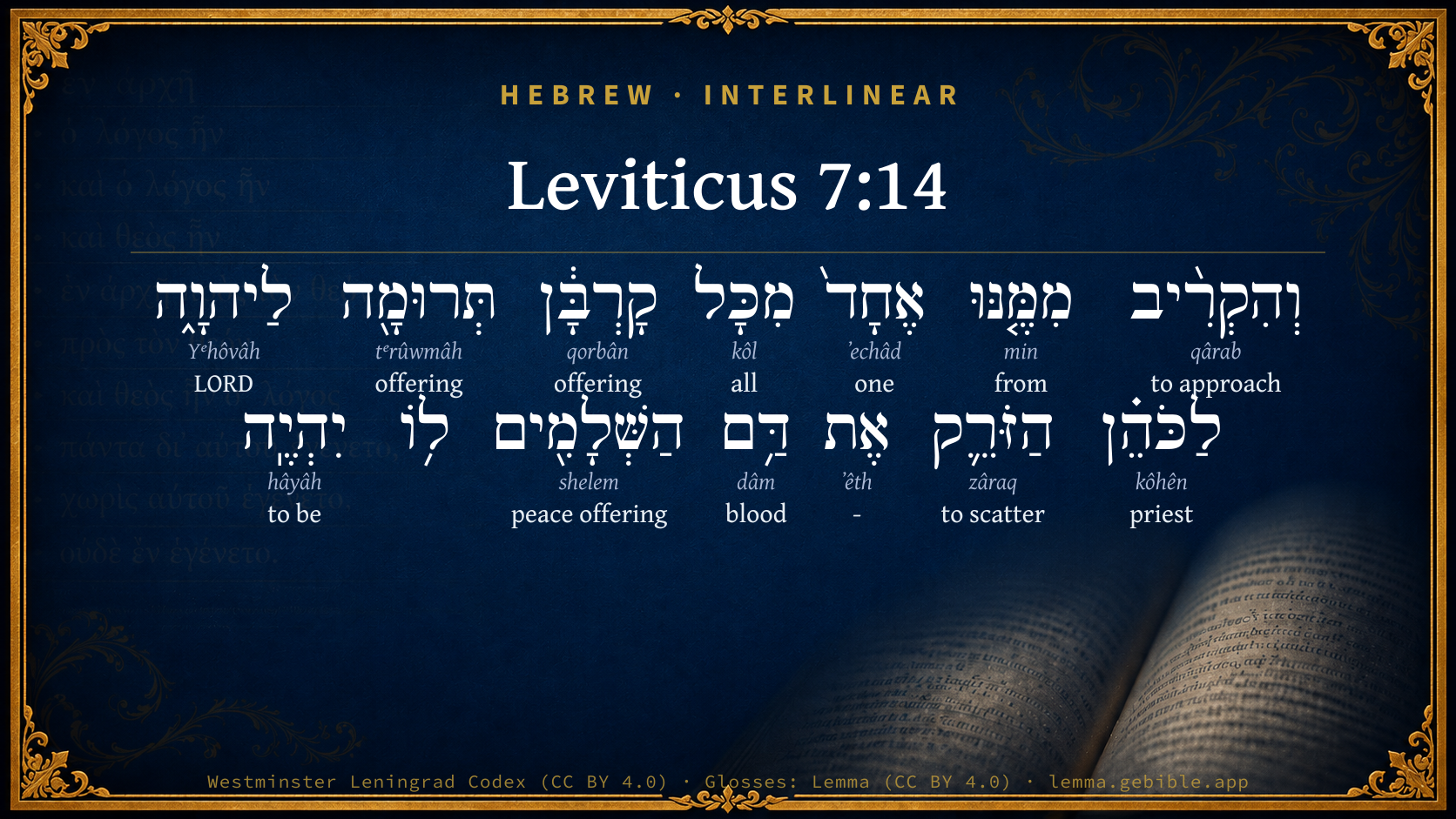
Hebrew (Westminster Leningrad Codex) Leviticus 7:14 appears in the Hebrew Old Testament. The text above is from the Westminster Leningrad Codex. Each word links to its Strong’s number, a concise gloss, and parsing drawn from the Open Scriptures Hebrew Bible morphology. Click any word for its full Brown-Driver-Briggs (BDB) entry.
Download image
Cite this verse

Leviticus 7:14 (World English Bible). Public Domain. Lemma interlinear Bible study tool, https://lemma.gebible.app/v/leviticus/7/14.

Show BibTeX & RIS
BibTeX
RIS
English Translation
Of it he shall offer one out of each offering for a heave offering to Yahweh. It shall be the priest's who sprinkles the blood of the peace offerings.
World English Bible · Public Domain
Download a study sheet

One document with this verse’s original text, its word-by-word gloss line, the meaning frame, cross-references with their text, attributed commentary, and full source and license credits — printable, and it pastes into notes with its structure intact.

This verse Autodidact and up

Study sheet (.html) Plain text (.txt)

A passage Seminary Student

Up to 50 verses in one chapter. A passage sheet keeps up to 6 commentary sources and 12 cross-references per verse, in the order this page ranks them, and says so on the sheet whenever that leaves anything out. Ask for a single verse and you get the Autodidact verse sheet above.

Everything on this page stays free to read, with no account — the sheet is a download of what is already on screen, not access to it.

Want to remove ads? Support Godless Engineer
Compare translations 3

The same verse in 3 English versions, stacked beneath the original-language interlinear above. Click any original word for its lexicon entry.

Each is an independent rendering of the whole verse — the interlinear is not word-aligned to these translations.

Highlighted words mark where these versions differ — a whole-verse word diff, not a word-by-word alignment.

  • World English Bible Public Domain
    Of it he shall offer one out of each offering for a heave offering to Yahweh. It shall be the priest's who sprinkles the blood of the peace offerings.
  • King James Version Public Domain
    And of it he shall offer one out of the whole oblation for an heave offering unto the LORD, and it shall be the priest's that sprinkleth the blood of the peace offerings.
  • unfoldingWord Literal Text CC BY-SA 4.0
    And he shall present from it one from each offering as a contribution to Yahweh. For the priest, the one splashing the blood of the peace offerings, it shall be for him.

unfoldingWord Literal Text — © unfoldingWord, licensed CC BY-SA 4.0. Word-aligned USFM3 via Door43 (git.door43.org/unfoldingWord/en_ult).

Versions to compare (up to 4)

3 of 4 selected

Show all 18 translations

Every available English version of this verse, each an independent rendering of the whole verse.

  • World English Bible Public Domain
    Of it he shall offer one out of each offering for a heave offering to Yahweh. It shall be the priest's who sprinkles the blood of the peace offerings.
  • Berean Standard Bible Public Domain
    From the cakes he must present one portion of each offering as a contribution to the LORD. It belongs to the priest who sprinkles the blood of the peace offering.
  • Majority Standard Bible Public Domain
    From the cakes he must present one portion of each offering as a contribution to the LORD. It belongs to the priest who sprinkles the blood of the peace offering.
  • King James Version Public Domain
    And of it he shall offer one out of the whole oblation for an heave offering unto the LORD, and it shall be the priest's that sprinkleth the blood of the peace offerings.
  • American Standard Version (1901) Public Domain
    And of it he shall offer one out of each oblation for a heave-offering unto Jehovah; it shall be the priest's that sprinkleth the blood of the peace-offerings.
  • Revised Version (1885) Public Domain
    And of it he shall offer one out of each oblation for an heave offering unto the LORD; it shall be the priest’s that sprinkleth the blood of the peace offerings.
  • Geneva Bible (1599) Public Domain
    And of all the sacrifice he shall offer one cake for an heaue offering vnto the Lord, and it shalbe the Priestes that sprinckleth the blood of the peace offrings.
  • Douay-Rheims (1899) Public Domain
    Of which one shall be offered to the Lord for firstfruits, and shall be the priest's that shall pour out the blood of the victim.
  • Young's Literal Translation Public Domain
    and he hath brought near out of it one of the whole offering -- a heave-offering to Jehovah; to the priest who is sprinkling the blood of the peace-offerings -- it is his;
  • Literal Standard Version CC BY-SA 4.0
    and he has brought near from it one [cake] from every offering [as] a raised-offering to YHWH for the priest who is sprinkling the blood of the peace-offerings; it is for him;
  • Unlocked Literal Bible CC BY-SA 4.0
    He is to offer one of each kind of these sacrifices as an offering presented to Yahweh. It will belong to the priests who sprinkle the blood of the peace offerings onto the altar.
  • unfoldingWord Literal Text CC BY-SA 4.0
    And he shall present from it one from each offering as a contribution to Yahweh. For the priest, the one splashing the blood of the peace offerings, it shall be for him.
  • Darby Bible Public Domain
    And of it he shall present one out of the whole offering as a heave-offering to Jehovah; to the priest that sprinkleth the blood of the peace-offering, to him it shall belong.
  • World Messianic Bible Public Domain
    Of it he shall offer one out of each offering for a heave offering to the LORD. It shall be the priest’s who sprinkles the blood of the peace offerings.
  • Webster's Bible Public Domain
    And of it he shall offer one out of the whole oblation for a heave-offering to the LORD, and it shall be the priest's that sprinkleth the blood of the peace-offerings.
  • Free Bible Version CC BY-SA 4.0
    Present one of each kind of bread of the offering as a contribution to the Lord. It is for the priest who sprinkles the blood of the peace offering.
  • Bible in Basic English Public Domain
    And let him give one out of every offering to be lifted up before the Lord; that it may be for the priest who puts the blood of the peace-offering on the altar.
  • JPS Tanakh (1917) Public Domain
    And of it he shall present one out of each offering for a gift unto the LORD; it shall be the priest's that dasheth the blood of the peace-offerings against the altar.

Literal Standard Version (2020), Covenant Press — licensed CC BY-SA 4.0. Text via the HelloAO Bible API (eBible.org). Unlocked Literal Bible (unfoldingWord) — licensed CC BY-SA 4.0. Text via the HelloAO Bible API (eBible.org). unfoldingWord Literal Text — © unfoldingWord, licensed CC BY-SA 4.0. Word-aligned USFM3 via Door43 (git.door43.org/unfoldingWord/en_ult). Free Bible Version, Dr. Jonathan Gallagher — licensed CC BY-SA 4.0. Text via the HelloAO Bible API (eBible.org).

Word by word

More ways to search: Search by grammar → Find every occurrence → Compare this word →

Practice this passage: Drill this verse → Learn its vocabulary →

הַזֹּרֵ֛ק
zâraq
H2236
“the · scattering”
Particle, Definite Article + Verb, Qal, Participle Active, Masculine, Singular, Absolute
Part of Speech
Particle + Verb
Stem
Qal
Form
Participle Active
Gender
Masculine
Number
Singular
State
Absolute
Full BDB Definition

Origin: a primitive root

TWOT: 585

to scatter, sprinkle, toss, throw, scatter abundantly, strew - (Qal) to scatter, sprinkle, toss - (Pual) to be sprinkled
  1. וְהִקְרִ֨יב qârab H7126 “and · to approach” Conjunction + Verb, Hiphil, Sequential Perfect, 3rd Person, Masculine, Singular
  2. מִמֶּ֤נּוּ min H4480 “from · us” Preposition + Suffix, Personal, 1st Person, Common, Plural
  3. אֶחָד֙ ʼechâd H259 “one” Adjective, Cardinal number, Masculine, Singular, Absolute
  4. מִכָּל kôl H3605 “from · all of” Preposition + Noun, Common, Masculine, Singular, Construct
  5. קָרְבָּ֔ן qorbân H7133 “offering” Noun, Common, Masculine, Singular, Absolute
  6. תְּרוּמָ֖ה tᵉrûwmâh H8641 “offering” Noun, Common, Feminine, Singular, Absolute
  7. לַיהוָ֑ה Yᵉhôvâh H3068 “to/for · LORD” Preposition + Noun, Proper
  8. לַכֹּהֵ֗ן kôhên H3548 “to/for the · priest” Preposition, Determined + Noun, Common, Masculine, Singular, Absolute
  9. אֶת ʼêth H853 “-” Particle, Direct Object
  10. דַּ֥ם dâm H1818 “blood of” Noun, Common, Masculine, Singular, Construct
  11. הַשְּׁלָמִ֖ים shelem H8002 “the · peace offerings” Particle, Definite Article + Noun, Common, Masculine, Plural, Absolute
  12. יִהְיֶֽה hâyâh H1961 “to be” Verb, Qal, Imperfect, 3rd Person, Masculine, Singular

About this verse

These counts appear in no published source. They are computed here, from the morphology-tagged text and Lemma’s own curated glosses. What Lemma adds →

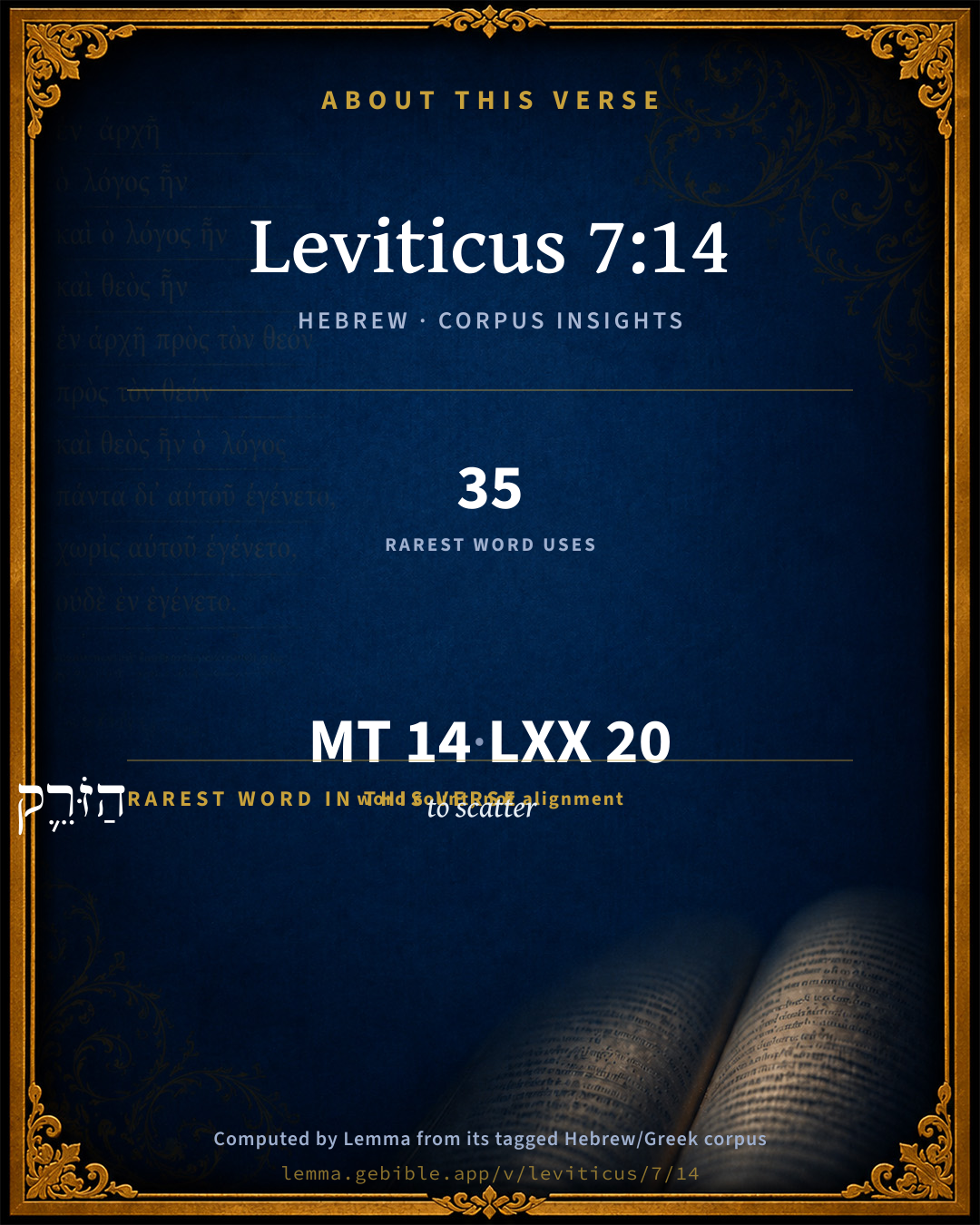
14
words
13
distinct lemmas
Pentateuch
section

Shared distinctive vocabulary

הַזֹּרֵ֛ק to scatter H2236 occurs in 33 verses of the Hebrew Bible. Also found in:

Grammatical profile

  • 3 verbs
  • 7 nouns
  • 1 adjective
  • 2 prepositions
  • 1 particle

Verb forms

  • וְהִקְרִ֨יב Hiphil · Sequential Perfect
  • הַזֹּרֵ֛ק Qal · Participle Active
  • יִהְיֶֽה Qal · Imperfect

Hebrew & Septuagint length

In English translation the verse runs 29 words from the Hebrew and 31 from the Septuagint (LXX English) — closely comparable.

A rough comparison of the two English renderings, which tokenize alike — not a word-level alignment.

Word counts can differ between the Hebrew and the Greek without any difference in meaning — e.g. the Hebrew direct-object marker אֵת has no separate Greek word, and Greek often adds the article ὁ.

In the original languages it is 14 Hebrew tokens and 20 Greek tokens — but the two are counted differently (Hebrew bundles its prefixes and suffixes into one token; the Greek is in lemma form), so that isn’t a like-for-like length.

Cross-references

8

Topical passages linked to Leviticus 7:14 in the Treasury of Scripture Knowledge — connected by theme and wording, ordered by reader-vote popularity; previews shown in the World English Bible.

  • Numbers 18:19 All the heave-offerings of the holy things, which the children of Israel offer to Yahweh, have I given you, and your sons and your daughters with you, as a portion forever: it is a covenant of salt forever before Yahweh to you and to your seed with you.
  • Exodus 29:27–28 You shall sanctify the breast of the wave-offering, and the thigh of the heave-offering, which is waved, and which is heaved up, of the ram of consecration, even of that which is for Aaron, and of that which is for his sons:
  • Leviticus 6:26 The priest who offers it for sin shall eat it. It shall be eaten in a holy place, in the court of the Tent of Meeting.
  • Numbers 15:19–21 then it shall be that when you eat of the bread of the land, you shall offer up a heave-offering to Yahweh.
  • Numbers 18:8–11 Yahweh spoke to Aaron, I, behold, I have given you the charge of my heave-offerings, even all the holy things of the children of Israel; to you have I given them by reason of the anointing, and to your sons, as a portion forever.
  • Numbers 18:24–32 For the tithe of the children of Israel, which they offer as a heave-offering to Yahweh, I have given to the Levites for an inheritance: therefore I have said to them, Among the children of Israel they shall have no inheritance.
  • Numbers 31:29 take it of their half, and give it to Eleazar the priest, for Yahweh's heave-offering.
  • Numbers 31:41 Moses gave the tribute, which was Yahweh's heave-offering, to Eleazar the priest, as Yahweh commanded Moses.

Cross-references courtesy of OpenBible.info (CC BY 4.0).

Hebrew and Greek witnesses Masoretic Hebrew ↔ Greek Septuagint

The same verse in the two great witnesses to the Old Testament, shown verse-for-verse.

These are two independent witnesses, not word-aligned to each other, and the Septuagint is shown in lemma (dictionary) form.

Hebrew Leviticus 7:14 Masoretic · Westminster Leningrad Codex

וְהִקְרִ֨יב מִמֶּ֤נּוּ אֶחָד֙ מִכָּל קָרְבָּ֔ן תְּרוּמָ֖ה לַיהוָ֑ה לַכֹּהֵ֗ן הַזֹּרֵ֛ק אֶת דַּ֥ם הַשְּׁלָמִ֖ים ל֥וֹ יִהְיֶֽה

Of it he shall offer one out of each offering for a heave offering to Yahweh. It shall be the priest's who sprinkles the blood of the peace offerings.

World English Bible · Public Domain

Greek LXX Leviticus 7:14 Septuagint · lemma form

καί προςἄγω εἷς ἀπό πᾶς ὁ δῶρον αὐτός ἀφαίρεμα κύριος ὁ ἱερεύς ὁ προςχέω ὁ αἷμα ὁ σωτήριον αὐτός εἰμί

And the fat of such animals as have died of themselves, or have been seized of beasts, may be employed for any work; but it shall not be eaten for food.

LXX2012 (modern English Septuagint) · Public Domain

Hebrew: Westminster Leningrad Codex (CC BY 4.0). Greek: Septuagint (public domain); English from LXX2012 (modern English Septuagint) (Public Domain). How the Septuagint differs from the Hebrew →

Targum (Aramaic paraphrase)

2

The Targum is the ancient Jewish Aramaic paraphrase of the Hebrew Scriptures — an interpretive translation, not the Hebrew text itself. Onkelos (literal) and Pseudo-Jonathan (expansive) render the Torah, and Jonathan the Prophets. Coverage is partial: where no permissively-licensed English translation exists for a verse, only the Aramaic is shown. This is verse-level text, not a word-by-word alignment to the Hebrew.

  1. Targum Onkelos Torah (Genesis–Deuteronomy)
    וִיקָרֵב מִנֵהּ חַד מִכָּל קוּרְבַּן אַפְרָשׁוּתָא קֳדָם יְיָ לְכַהֲנָא דְיִזְרַק יָת דַם נִכְסַת קוּדְשַׁיָא דִילֵהּ יְהֵי

    (no public-domain English translation for this verse)

    Targum Onkelos — Aramaic: “Onkelos Genesis” (public domain); “Onkelos Exodus” (public domain); “Onkelos Leviticus” (public domain); “Onkelos Numbers” (public domain); “Onkelos Deuteronomy” (public domain). English: “Sefaria Community Translation” (CC0 1.0 (public-domain dedication)); “J.W. Etheridge. The Targums of Onkelos and Jonathan Ben Uzziel on the Pentateuch. London: Longmans, Green, 1862” (public domain). Text via Sefaria.

  2. Targum Pseudo-Jonathan Torah (Genesis–Deuteronomy)
    וְיַקְרִיב מִנֵיהּ חַד מִכָּל קוּרְבָּנָא אַפְרָשׁוּתָא קֳדָם יְיָ לְכַהֲנָא דְזָרִיק יַת אֲדַם נִכְסַת קוּדְשַׁיָא דִילֵיהּ יְהֵי

    And of it he shall present one as a seperation before the Lord; the priest who sprinkleth the blood of the hallowed sacrifice shall have it.

    Targum Pseudo-Jonathan — Aramaic: “Targum Jonathan on Genesis” (public domain); “Targum Jonathan on Exodus” (public domain); “Targum Jonathan on Leviticus” (public domain); “Targum Jonathan on Numbers” (public domain); “Targum Jonathan on Deuteronomy” (public domain). English: “The Targum of Jonathan ben Uzziel, trans. J. W. Etheridge, London, 1862” (public domain). Text via Sefaria.

Commentary

Notes on Leviticus 7:14 from classic Christian and Jewish commentators (each source and its license shown beneath its notes). The classic Christian expositions comment on the surrounding passage and are grouped to its opening verse, so a note may address several verses; the Jewish commentaries on the Tanakh (Rashi and others) are per-verse, so they appear only where the commentator wrote on this verse.

Lemma curates 59 commentaries, every one of them public domain or Creative Commons licensed, each selected and text-cleaned for this edition rather than reprinted as found. About our sources →

Trapp's Complete Commentary

John Trapp

Lev 7:14 And of it he shall offer one out of the whole oblation [for] an heave offering unto the LORD, [and] it shall be the priest’s that sprinkleth the blood of the peace offerings.

Ver. 14. For a heave offering.] So called, because it was heaved and lifted up before the Lord, in token that they received all from him, and did acknowledge all to be due to him.

John Trapp, A Commentary or Exposition upon All the Books of the Old and New Testament (1647–1656) — public domain. Text from a community e-Sword module.

Ellicott's Commentary for English Readers

(14) And of it he shall offer one out of the whole.—Better, and he shall offer of it one out of each. That is, the officiating priest waves one of each of the four kinds of cakes before the Lord as a heave offering (see Exo_29:24; Exo_29:28), and is to have these four loaves as his portion, while the rest or the remaining thirty-six cakes belonged to the owner of the sacrifice.

A Bible Commentary for English Readers, edited by Charles John Ellicott (1878–1897) — public domain. Text from a community e-Sword module.

The Cambridge Bible for Schools and Colleges

gen. ed. J. J. S. Perowne

14. one out of each oblation] According to the practice in the second temple, ten of each of the three kinds of unleavened cakes and ten leavened cakes were brought. The priest took one out of each ten, and the remainder belonged to the bringer of the sacrifice, to be eaten along with his share of the flesh of the Peace-Offering. These cakes were not treated as Meal-Offerings, for the priests claimed the whole of such offerings (Lev_2:3; Lev_2:10), but as an accompaniment of the Peace-Offering. Thus four of them were given as ‘Tĕrûmah’ to the Lord for the priest that threw the blood against the altar (see note on Lev_1:5). ‘Tĕrûmah,’ ‘heave-offering,’ does not, however, indicate throwing, as the English word suggests, but something lifted or ‘taken off from a larger mass, and so separated from it for sacred purposes,’ and hence dedicated to God through His ministers. Driver on Exo_25:2, where see his full note. See also App. IV, Wave-Offering (end).

The Cambridge Bible for Schools and Colleges (gen. ed. J. J. S. Perowne; Cambridge University Press, 1878–1918) — public domain. Text from a community e-Sword module.

John Gill's Exposition

And the flesh of the sacrifice of his peace offerings for thanksgiving,.... Having given directions about the cakes and bread that went along with the peace offerings, offered in thankfulness for mercies received; instructions are next given about eating the flesh of them; and the order is, that that

shall be eaten the same day that it is offered; partly by him that brought them, and his family, and partly by the poor he was to invite to eat thereof; and also by the priests and Levites, who were to have their share of it; see Deu 12:11.

he shall not leave any of it until the morning; which was ordered to encourage liberality to the priests, Levites, and others, since all must be eaten up before morning: according to the Jewish canons, they might eat it no longer than midnight; by that time it was to be all consumed; and it is said (k), the wise men made an hedge to the law to keep men from sin.

(k) Misn. Zebachim, c. 5. sect. 3.

John Gill's Exposition of the Whole Bible (1746–1763) — public domain (CC PDM 1.0). Text via the HelloAO Bible API.

Albert Barnes' Notes on the Bible

Out of the whole oblation - Rather, out of each offering. That is, one loaf or cake out of each kind of meat-offering was to be a heave-offering Lev 7:32 for the officiating priest. According to Jewish tradition, there were to be ten cakes of each kind of bread in every thank-offering. The other cakes were returned to the sacrificer.

Albert Barnes' Notes on the Bible (1834–1885) — public domain. Text from a community e-Sword/MySword module.

Haydock's Catholic Bible Commentary

Of which leavened bread, one, representing all the rest, shall be offered for first-fruits. Hebrew, "a heave-offering," not as a sacrifice. (Menochius) --- Others maintain that a loaf, without leaven, was laid upon the altar; and all the rest given to the priest. (Calmet)

George Leo Haydock (1774–1849), Haydock's Catholic Family Bible and Commentary, 1859 edition — public domain. Excludes Psalms (Douay-Rheims chapter numbering differs from Protestant) and Deuterocanonical books (Catholic canon only).

Matthew Poole's English Annotations

Of it, i.e. either of the loaves of leavened bread mentioned Lev 7:13, or of the offering, one of each part of the whole oblation, as it follows; it being most probable, and agreeable to the rules and laws laid down before and afterward that the priest should have a share in the unleavened cakes and wafers, as well as in the leavened bread.

Concerning the heave-offerings, see Exo 29:24,28.

Matthew Poole's English Annotations on the Holy Bible (1683–1685) — public domain. Text from a community e-Sword/MySword module.

Whedon's Commentary on the Bible

Daniel D. Whedon

14. Heave offering — According to rabbinical tradition, the manner of heaving was to lay the oblation on the hands of the offerer, the priest putting his hands underneath and then moving them upwards and downwards. The import of heaving in sacrifices is supposed to be a presentation to God, who rules in heaven above and in the earth beneath. It was given to the priest as his representative.

Daniel D. Whedon (gen. ed.), Commentary on the Old and New Testaments (1874–1909) — public domain. Text from a community e-Sword module.

The Pulpit Commentary

Vers. 14, 28-34. The kingdom of God: lessons from the heave offering.

The ceremony of the heave offering and wave offering was a striking incident in the rite of the peace offering. "According to Jewish tradition it was performed by laying the parts on the hands of the offerer, and the priest, putting his hands again underneath, then moving them in a horizontal direction for the waving and in a vertical one for the heaving... the waving was peculiarly connected with the breast, which is thence called the wave breast (verse 34), and the heaving with the shoulder, for this reason called the heave shoulder" (verse 34). The main truth to which this symbolic act pointed was probably

I GOD"S UNIVERSAL SOVEREIGNTY. As these parts of the animal were solemnly directed upwards and downwards and laterally, in all directions, the offerer intimated his belief that the realm of Jehovah was a boundless kingdom, reaching to the heavens above, to the dark regions below, to every corner and quarter of the earth. We do well to meditate on the truth thus pictorially presented; bat in so doing we are necessarily reminded how much more we have learned both from revelation and human science of the wide reach of his reign. We may think of his Divine kingdom as including:

1. Heaven and all its worlds and inhabitants.

2. Hades the grave and those who have "gone to the grave.

3. The earth and all that is thereon:

a. all human Beings;

b. all unintelligent creatures;

c. all vegetable life;

d. all inanimate treasure gold, silver, etc.

We are reminded of the propriety of

II OUR FORMAL RECOGNITION OF THIS FACT. The Hebrew worshipper was encouraged to bring his peace offering to the altar, and then to go through this simple but suggestive ceremony, thus formally acknowledging the truth. No similar provision is made for our utterance of it; but it is open to us to declare it in sacred words and in most solemn forms:

1. In adoration. "Thine, O Lord, is the greatness and the power... for all that is in the heaven and in the earth is thine," etc. (1Ch_29:10, 11 1Ti_1:17 Deu_10:14 Psa_24:1)

2. In praise. When we "sing unto the Lord," there should be full and frequent ascription of everything "in the heavens above and. the earth beneath" to him as the Author and Owner and Ruler of all. We also see

III OUR APPROPRIATE ACTION THEREUPON. The Jewish worshipper was directed to "wave" and "heave" the breast and shoulder; these joints in particular and in preference to any other, "probably from their being considered the more excellent parts." When the fat had been burned upon the altar (verse 30, these joints were reserved "unto Aaron the priest and unto his sons for ever" (verse 34). We gather therefrom that we are to make practical recognition of the truth that God"s kingdom extends everywhere, and includes every one, by:

1. Dedicating our best to his service: our affections (suggested by the breast); our strength (suggested by the shoulder).

2. Bringing our offerings to his cause for the support of those who minister in holy things, and for the maintenance of those various agencies which are working for the glory of his Name. C.

The Pulpit Commentary (1880–1919), ed. H.D.M. Spence-Jones & Joseph S. Exell — public domain. Text from a community e-Sword module.

John Wesley's Explanatory Notes

Of it - That is, of the offering, one of each part of the whole: it being most agreeable to the rules laid down before and afterward, that the priest should have a share in the unleavened cakes and wafers, as well as in the leavened bread.

John Wesley, Explanatory Notes Upon the Whole Bible (1754–1765) — public domain. Text via the GEBible commentary corpus.

Rashi

Rabbi Shlomo Yitzchaki (Rashi)

אחד מכל קרבן [AND OF IT SHALL HE OFFER] ONE OUT OF EACH OFFERING [FOR A HEAVE OFFERING UNTO THE LORD] — one bread (piece) of each of these different kinds shall he take as a heave offering for the priest who performs the rite connected with it (the קרבן), and the rest may be eaten by the owner (Menachot 77b). The flesh of the sacrifice also belongs to the owner with the exception of the breast and the shoulder of it, just as the waving of the breast and the shoulder is expressly prescribed later on, (Leviticus 7:31 Leviticus 7:32) in the case of the “peace offerings”, thus making them become the portion of the priests (cf. Leviticus 7:31 Leviticus 7:32), and the sacrifice of acknowledgement comes under the term שלמים (Zevachim 4a).

Rashi on the Tanakh — English translations: “The Judaica Press complete Tanach with Rashi, translated by A. J. Rosenberg” (CC BY 4.0); “Pentateuch with Rashi's commentary by M. Rosenbaum and A.M. Silbermann, 1929-1934” (public domain); “The Metsudah Tanach series, Lakewood, N.J” (CC BY 4.0); and “The Book of Joshua, Metsudah Publications, 1997” (CC BY 4.0). Text via Sefaria.

Ramban (Nachmanides)

Rabbi Moshe ben Nachman (Ramban / Nachmanides)

AND OF IT HE SHALL PRESENT ONE OUT OF EACH OFFERING — one whole cake [for a heave-offering unto the Eternal]. Thus he takes as a heave-offering four cakes [and gives them to the priest].But I wonder! When Scripture excluded [first-fruits] from the prohibition against burning leaven [on the altar], by stating, as an offering of first-fruits ye may bring them, 12. [which means that “the two loaves” of the Festival of Shevuoth were to be brought of leavened dough, as clearly mentioned further on in Scripture], why did it not say that [the ten leavened cakes of] the thanks-offering [are also an exception]? But this is not really a question. For Scripture states, and unto the altar they [i.e., leaven and honey] shall not come up for a sweet savor, 12. and of the [forty] breads of the thanks-offering, none came up on the altar at all, for they require only waving., Verse 18), and such is the case also with the thanks-offering. So the question recurs: Why did Scripture not call attention to the exception of the breads of the thanks-offering? The Tur answers that Scripture called attention only to an obligatory offering, such being the case of “the two loaves” on the Festival of Shevuoth, but not to a thanks-offering, which is a freewill offering. See further my Hebrew commentary pp. 33-34. Even though in the case of the showbread He did say that one commits a transgression if one brought it in a leaven state ’ (any) meal-offering, which ye shall bring unto the Eternal, shall not be made with leaven (above, 2:11), the word kol includes the showbread, that it too must not be leavened” (Menachoth 57 a). [although there too none of the loaves are burnt on the altar], that is because of the frankincense that was on it which was to the bread for a memorial, even an offering made by fire unto the Eternal. But of the bread of the thanks-offering, nothing at all came up on the altar [hence the Torah permitted the ten loaves to be leavened]. Perhaps Scripture only had to mention that exception [as an offering of first-fruits ye may bring them], 12. because of the honey, since it was not clearly stated concerning the first-fruits [which were brought of “the seven kinds”] that they may be brought from honey [and it therefore had to be explicitly stated in that verse], and thus He also included leaven with it, saying of both of them, as an offering of first-fruits ye may bring them., 12. With reference to leaven, however, since it is clearly explained in its correct place [that the “two loaves” of the Festival of Shevuoth constitute an exception to the usual negative commandment], there was no need any more to mention it as an exception [when mentioning the general negative commandment], just as Scripture has not specified the exception to the rule about the Sabbath, when stating every one that profaneth it shall be put to death, [by saying] “except for the Service of the offerings” [which may be done on the Sabbath], or in the case of thou shalt not uncover the nakedness of thy brother’s wife, [by saying] “except for a brother’s childless wife” [whom he is to marry].. For various reasons the practice now established is to grant the widow chalitzah, and she is then free to marry.

Ramban (Nachmanides) on the Tanakh — English translation: “Commentary on the Torah by Ramban (Nachmanides). Translated and annotated by Charles B. Chavel. New York, Shilo Pub. House, 1971-1976” (CC BY 4.0). Text via Sefaria.

Lesson kit

Teaching starters — assembled from the data on this page, not authored interpretation. Every prompt links to the verse data it draws on. Edit before teaching.

Leviticus, in the Pentateuch, opens this verse with 14 words (13 distinct Hebrew lemmas). Its most distinctive word is zâraq (“to scatter”). A historical commentator’s framing appears above. Read the whole chapter for the surrounding context.

Discussion questions

  1. The word zâraq carries the sense “to scatter.” How does it shape the verse?
  2. Exodus 9:8 shares the word «to scatter» with this verse. How do the two illuminate each other?
  3. These translations render this verse differently; the difference is in the English rendering, not the original. What questions does that raise?
  4. The verb «וְהִקְרִ֨יב» is Hiphil Sequential Perfect. How does its form color the action?
  5. Reading how Trapp's Complete Commentary and Ellicott's Commentary for English Readers read this verse, where do the two commentators agree and where do they part?

Things to notice

Reading settings

Reading text

Shown beneath each verse's original-language words.

Old Testament
Old Testament edition

Read the OT as the Masoretic Hebrew (MT) or the Greek Septuagint (LXX).

English shown for the Greek Septuagint (in the Hebrew ↔ Greek comparison).

Comparing translations? Open the Compare panel on any verse page to stack up to four side by side.