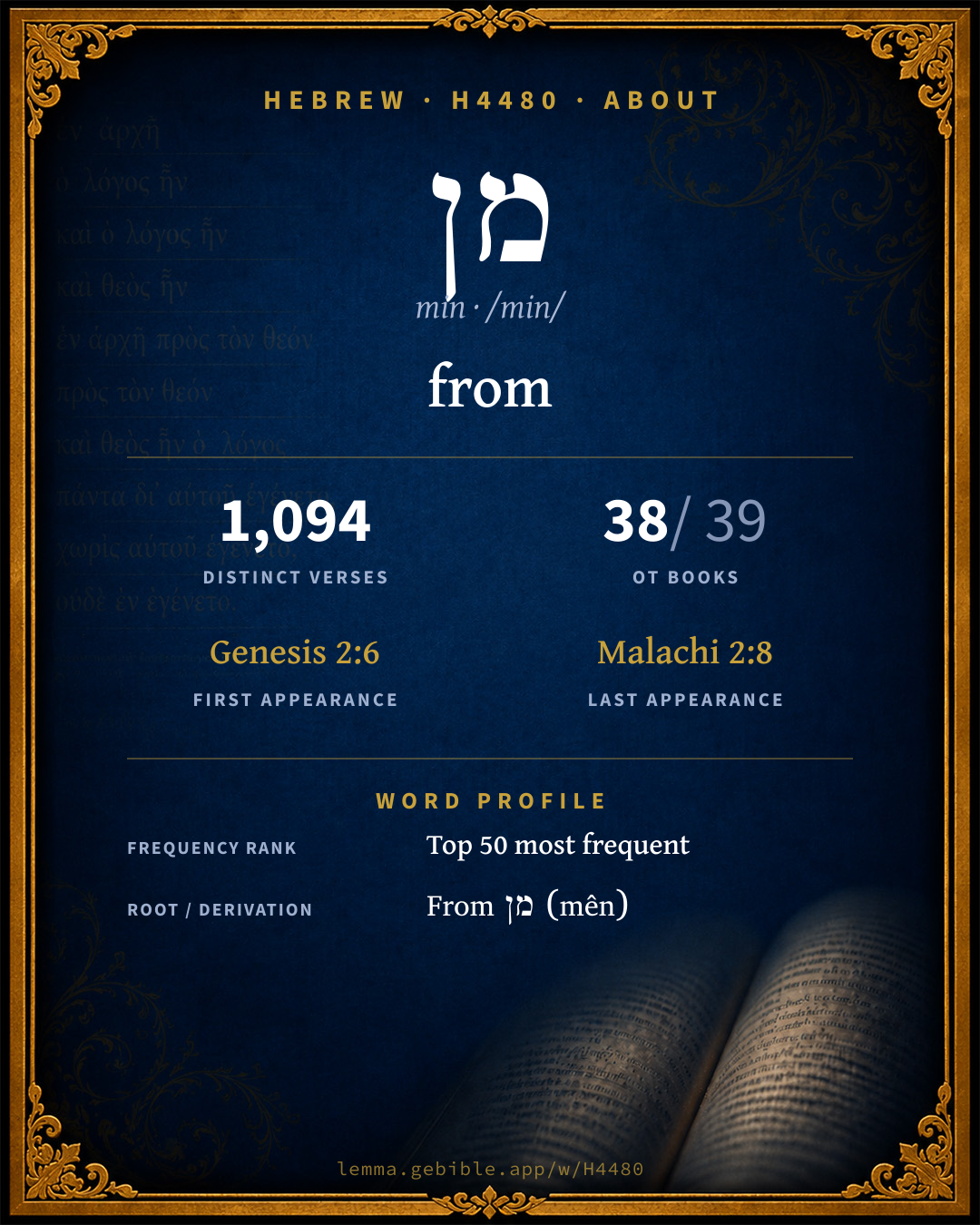
מן
from
also: out of, on account of, off, since fuller range ↓
Full lexicon entry — Brown-Driver-Briggs (BDB)
From Brown-Driver-Briggs (BDB)
Where this word appears
Grammar key — what these labels mean
Part of speech
- Preposition
- A relational word (e.g. “in,” “to,” “from”) governing a noun.
- Noun
- A naming word — a person, place, thing, or idea.
Noun type
- Common
- A common noun — a general class of person, place, or thing (“king,” “city,” “water”), not a specific name.
State
- Construct
- A noun bound to a following noun in a possessive / “of” relationship (the construct chain).
Gender
- Masculine
- Grammatically masculine.
Number
- Singular
- One.
Every verse where H4480 appears in the Book of Joshua — 40 distinct verses. Click any verse to open its interlinear word-by-word view. Verse text shown in the World English Bible for context — . Each verse’s Hebrew form is shown with its reference; the English is not keyword-highlighted, since the data carries no word-level English alignment. Use “Compare translations” on any verse to read it across multiple English versions. This concordance covers the Hebrew Bible; Septuagint (Greek Old Testament) occurrences are not indexed here.
Joshua
- Joshua 1:7 מִמֶּ֖/נּוּ prep + sfx pers 1cp Only be strong and very courageous, to observe to do according to all the law, which Moses my servant commanded you: don't turn from it to the right hand or to the left, that you may have good success wherever you go.
- Joshua 2:1 מִֽן prep Joshua the son of Nun sent out of Shittim two men as spies secretly, saying, Go, view the land, and Jericho. They went and came into the house of a prostitute whose name was Rahab, and lay there.
- Joshua 4:2 מִן prep Take twelve men out of the people, out of every tribe a man,
- Joshua 4:16 מִן prep Command the priests who bear the ark of the testimony, that they come up out of the Jordan.
- Joshua 4:17 מִן prep Joshua therefore commanded the priests, saying, Come up out of the Jordan.
- Joshua 4:19 מִן prep The people came up out of the Jordan on the tenth day of the first month, and encamped in Gilgal, on the east border of Jericho.
- Joshua 4:20 מִן prep Those twelve stones, which they took out of the Jordan, did Joshua set up in Gilgal.
- Joshua 6:18 מִן מִן prep prep But as for you, only keep yourselves from the devoted thing, lest when you have devoted it, you take of the devoted thing; so would you make the camp of Israel accursed, and trouble it.
- Joshua 7:1 מִן prep But the children of Israel committed a trespass in the devoted thing; for Achan, the son of Carmi, the son of Zabdi, the son of Zerah, of the tribe of Judah, took of the devoted thing: and the anger of Yahweh was kindled against the children of Israel.
- Joshua 7:4 מִן prep So there went up there of the people about three thousand men: and they fled before the men of Ai.
- Joshua 7:9 מִן prep For the Canaanites and all the inhabitants of the land will hear of it, and will compass us round, and cut off our name from the earth: and what will you do for your great name?
- Joshua 7:11 מִן prep Israel has sinned; yes, they have even transgressed my covenant which I commanded them: yes, they have even taken of the devoted thing, and have also stolen, and dissembled also; and they have even put it among their own stuff.
- Joshua 7:19 מִמֶּֽ/נִּי prep + sfx pers 1cs Joshua said to Achan, My son, please give glory to Yahweh, the God of Israel, and make confession to him; and tell me now what you have done; don't hide it from me.
- Joshua 8:4 מִן prep He commanded them, saying, Behold, you shall lie in ambush against the city, behind the city; don't go very far from the city, but be all ready:
- Joshua 8:6 מִן prep and they will come out after us, until we have drawn them away from the city; for they will say, They flee before us, as at the first: so we will flee before them;
- Joshua 8:16 מִן prep All the people who were in the city were called together to pursue after them: and they pursued after Joshua, and were drawn away from the city.
- Joshua 8:22 מִן prep The others came forth out of the city against them; so they were in the midst of Israel, some on this side, and some on that side: and they struck them, so that they let none of them remain or escape.
- Joshua 8:29 מִן prep The king of Ai he hanged on a tree until the evening: and at the going down of the sun Joshua commanded, and they took his body down from the tree, and cast it at the entrance of the gate of the city, and raised thereon a great heap of stones, to this day.
- Joshua 9:22 מִ/כֶּם֙ prep + sfx pers 2mp Joshua called for them, and he spoke to them, saying, Why have you deceived us, saying, We are very far from you; when you dwell among us?
- Joshua 9:23 מִ/כֶּ֜ם prep + sfx pers 2mp Now therefore you are cursed, and there shall never fail to be of you bondservants, both wood cutters and drawers of water for the house of my God.
- Joshua 10:2 מִן prep that they feared greatly, because Gibeon was a great city, as one of the royal cities, and because it was greater than Ai, and all the men of it were mighty.
- Joshua 10:7 מִן prep So Joshua went up from Gilgal, he, and all the people of war with him, and all the mighty men of valor.
- Joshua 10:9 מִן prep Joshua therefore came on them suddenly; [for] he went up from Gilgal all the night.
- Joshua 10:11 מִן prep It happened, as they fled from before Israel, while they were at the descent of Beth Horon, that Yahweh cast down great stones from the sky on them to Azekah, and they died: they were more who died with the hailstones than they whom the children of Israel killed with the sword.
- Joshua 10:22 מִן prep Then said Joshua, Open the mouth of the cave, and bring forth those five kings to me out of the cave.
- Joshua 10:23 מִן prep They did so, and brought forth those five kings to him out of the cave, the king of Jerusalem, the king of Hebron, the king of Jarmuth, the king of Lachish, the king of Eglon.
- Joshua 11:17 מִן prep from Mount Halak, that goes up to Seir, even to Baal Gad in the valley of Lebanon under Mount Hermon: and all their kings he took, and struck them, and put them to death.
- Joshua 11:21 מִן מִן מִן מִן prep prep prep prep Joshua came at that time, and cut off the Anakim from the hill-country, from Hebron, from Debir, from Anab, and from all the hill-country of Judah, and from all the hill-country of Israel: Joshua utterly destroyed them with their cities.
- Joshua 13:3 מִֽן prep from the Shihor, which is before Egypt, even to the border of Ekron northward, [which] is reckoned to the Canaanites; the five lords of the Philistines; the Gazites, and the Ashdodites, the Ashkelonites, the Gittites, and the Ekronites; also the Avvim,
- Joshua 13:6 מִֽן prep all the inhabitants of the hill-country from Lebanon to Misrephoth Maim, even all the Sidonians; them will I drive out from before the children of Israel: only allot you it to Israel for an inheritance, as I have commanded you.
- Joshua 15:2 מִן prep Their south border was from the uttermost part of the Salt Sea, from the bay that looks southward;
- Joshua 18:12 מִן prep Their border on the north quarter was from the Jordan; and the border went up to the side of Jericho on the north, and went up through the hill-country westward; and the goings out of it were at the wilderness of Beth Aven.
- Joshua 18:14 מִן prep The border extended [there], and turned about on the west quarter southward, from the mountain that lies before Beth Horon southward; and the goings out of it were at Kiriath Baal (the same is Kiriath Jearim), a city of the children of Judah: this was the west quarter.
- Joshua 21:4 מִן prep The lot came out for the families of the Kohathites: and the children of Aaron the priest, who were of the Levites, had by lot out of the tribe of Judah, and out of the tribe of the Simeonites, and out of the tribe of Benjamin, thirteen cities.
- Joshua 22:17 מִמֶּ֔/נּוּ prep + sfx pers 1cp Is the iniquity of Peor too little for us, from which we have not cleansed ourselves to this day, although there came a plague on the congregation of Yahweh,
- Joshua 22:29 מִמֶּ֜/נּוּ prep + sfx pers 1cp Far be it from us that we should rebel against Yahweh, and turn away this day from following Yahweh, to build an altar for burnt-offering, for meal-offering, or for sacrifice, besides the altar of Yahweh our God that is before his tent.
- Joshua 23:4 מִן prep Behold, I have allotted to you these nations that remain, to be an inheritance for your tribes, from the Jordan, with all the nations that I have cut off, even to the great sea toward the going down of the sun.
- Joshua 23:6 מִמֶּ֖/נּוּ prep + sfx pers 1cp Therefore be you very courageous to keep and to do all that is written in the book of the law of Moses, that you not turn aside from it to the right hand or to the left;
- Joshua 23:10 מִ/כֶּ֖ם prep + sfx pers 2mp One man of you shall chase a thousand; for Yahweh your God, he it is who fights for you, as he spoke to you.
- Joshua 23:14 מִמֶּ֖/נּוּ prep + sfx pers 1cp Behold, this day I am going the way of all the earth: and you know in all your hearts and in all your souls, that not one thing has failed of all the good things which Yahweh your God spoke concerning you; all are happen to you, not one thing has failed of it.
About this entry
At a glance — auto-summarized from this page’s data, not written by a person. Every figure links to its source below. This summary describes the numbers; it doesn’t interpret them.
“from” is the headline sense of the Hebrew word מן (min). Scripture first uses it in Genesis 2:6. It appears 1,094 verses across 38 books of the Hebrew Bible, among its most common vocabulary. Not a single-sense word, it carries 2 senses, among them “out of”, “on account of”, and “off”. It shares a root with מן, מן and מנית. See the sense tree, 1,094-verse concordance, and the renderings breakdown below.
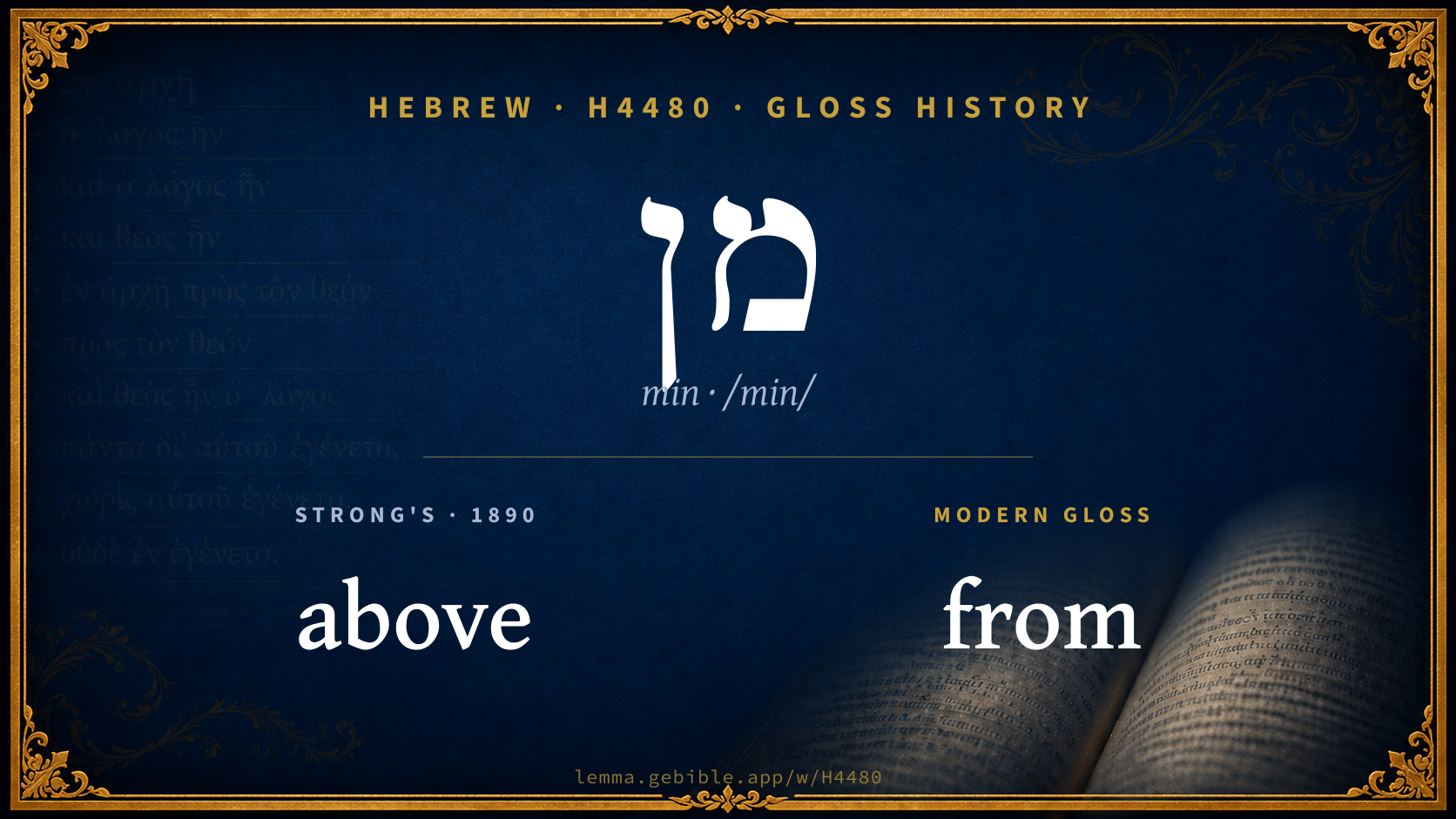
Gloss history
Strong's 1890 vs modern scholarship
About this word
Strong's H4480 catalogs a Hebrew word from the Hebrew Old Testament.
These counts are not copied from any lexicon or concordance. They are computed here, from the morphology-tagged Hebrew Old Testament. What Lemma adds →
- 1,094
- distinct verses
- The word appears in 1,094 distinct verses.
- 38 / 39
- OT books
- The word appears in 38 of 39 Old Testament books.
- #29
- by frequency
- Top 50 most frequent Hebrew words (rank 29 of 8,640 Hebrew words by occurrence).
View all 1,094 occurrences in the concordance →
By section of the Old Testament
By traditional corpus
Conventional, traditional groupings — biblical authorship is debated, so this is a traditional corpus grouping, not an authorship claim. Each share is this word’s portion of its verses in that division of the Hebrew canon. Each figure is a share of the word’s 1,094 distinct verses.
- Prophets (Nevi'im) 421 verses · 38%
- Writings (Ketuvim) 340 verses · 31%
- Torah (Pentateuch) 333 verses · 30%
How translations render this word
Counts come from each version’s own published word-to-Strong’s tagging or interlinear alignment — an approximate guide to how each version renders this word, not a word-level alignment the data otherwise carries. Because each total is that version’s own tagged count, the per-version totals vary from one another and need not match the appearance or distinct-verse counts above. These counts may also differ from a printed concordance because Lemma counts each distinctly tagged rendering and does not collapse phrase taggings into a single head-word total. This is a fixed set of word-tagged versions (KJV, ASV, BSB, ULT) and does not change with the reading translation you choose elsewhere. Each version’s license is shown beside its name below (and on Sources).
BDB lists this Strong’s number as 2 distinct words (homographs). Each count above pools all of them and is not split by sense — see the Senses section below. A low-frequency rendering may belong to a different one of those words, not the primary meaning.
- King James Version†: From 2×, Of 2×
- American Standard Version†: From 3×, Of 2×
- Berean Standard Bible†: From 380×, Of 91×, Me 61×
- unfoldingWord Literal Text†: From 617×, It 83×, You 80×
King James Version Public Domain
Renders H4480 across 25† tagged occurrences — most commonly:
Plus 21 renderings that appear only once — usually multi-word phrases or single function words the recovered tagging swept in, not distinct renderings.
American Standard Version Public Domain
Renders H4480 across 24† tagged occurrences — most commonly:
Plus 19 renderings that appear only once — usually multi-word phrases or single function words the recovered tagging swept in, not distinct renderings.
Berean Standard Bible Public Domain
Renders H4480 across 983† tagged occurrences — most commonly:
Plus other, less common renderings. Plus 82 renderings that appear only once — usually multi-word phrases or single function words the recovered tagging swept in, not distinct renderings. Not rendered by a distinct English word in 199 further occurrences.
unfoldingWord Literal Text CC BY-SA 4.0
Renders H4480 across 1,217† tagged occurrences — most commonly:
Plus other, less common renderings. Plus 68 renderings that appear only once — usually multi-word phrases or single function words the recovered tagging swept in, not distinct renderings.
Senses in the full BDB
What do BDB’s symbols mean?
BDB uses these scholarly abbreviations:
| Symbol | Meaning |
|---|---|
| 𝔊 | the Septuagint (the ancient Greek translation, LXX) |
| 𝔙 | the Vulgate (the Latin translation) |
| 𝔖 | the Syriac version (the Peshitta) |
| 𝔗 | the Targum (the Aramaic translation) |
| ψ | the Psalms |
| √ | root (the underlying root or stem) |
| ‖ | parallel passage (a synonymous or contrasted parallel) |
| † | the dagger: every passage where the word occurs is cited |
The 0 senses and sub-senses the full Brown-Driver-Briggs lexicon distinguishes for this word, in lexicon order (not ranked by frequency), with BDB’s own verbatim wording and sub-sense lettering. Shown in Hebrew script with BDB’s own scholarly abbreviations. The condensed entry is in the Lexicon Entry tab. See also the Forms in the corpus table below.
מן I div. Menî, god of fate (award, apportionment
מן II region of Armenia
Senses from the full Brown-Driver-Briggs lexicon (Brown, Driver, Briggs; Oxford 1906 — public domain), digitized via Sefaria, supplemented by the OpenScriptures HebrewLexicon (CC BY 4.0). Full attribution on Sources.
Word origin
I. n.pr.div. Menî, god of fate (award, apportionment; cf. Arabic n.pr. div. Maniyyat, and perhaps Manât, WeSkizzen iii. 22 f. 189, مَنَوَاتٌ NöZMG xl. 1886, 709; in Nab. מנותו EutNab. No. 2, 1. 5, etc.);—מִלֵּא לַמְנִי מִמְסָךְ Is 65:11 (‖ לַגַּד)—v. Che Di BaeSem. Rel. 79.
I. n.pr.terr. region of Armenia;—Je 51:27 (‖ אֲרָרָט, אַשְׁכְּנַז);=Assyrian Mannai Schr.COT ad loc.; KGF 174, 212, 520.
— Brown-Driver-Briggs (Oxford 1906, public domain), digitized via Sefaria, supplemented by the OpenScriptures HebrewLexicon (CC BY 4.0). See Sources.
Derived from מן (mên) (H4482) — string.
Jastrow Dictionary
A second Hebrew/Aramaic lexicon for comparison, covering Aramaic and post-biblical (Talmudic, Targumic, Midrashic) usage that the biblical-Hebrew BDB does not. Matched by lemma rather than by Strong’s number, so a lemma may carry more than one Jastrow headword (shown separately below), and the entries cover usage well beyond the Bible.
מִן
- (b. h.) from, of; more (or less) than. Ab. Zar. 18ᵃ מן השמים ירחמו from heaven they will have mercy (on me), i.e. I trust in God. Sabb. 21ᵇ המהדרין מן המהדרין v. הָדַר.—מן המובחר, v. בָּחַר; מן המומחה, v. מוּמְחֶה.—Tem. 28ᵃ מן הבהמה להוציא וכ׳ ‘of the cattle’ (Lev. I, 2) intimates the exclusion of &c.; a. v. fr.—Prefix מִ־, מָי־, מֵ־, מֵי־ q. v.—מִנַּיִן, מִנַּיִין, מִינַּיִין (= b. h. מֵאַיִן, v. אַיִן) whence?, whence is it proven?—Yoma 32ᵃ מ׳ לחמש וכ׳ whence is derived the regulation about five immersions &c.? Ib. ומ׳ שכל טבילה וכ׳ and whence is the rule derived that each immersion requires &c.? Ib. 44ᵃ אין לי אלא … מ׳ this would prove to me only in favor of …, whence do you derive that the same applies to …?; a. v. fr. e.g. Leviticus 1:2
מִן ²
- Targ. Gen. I, 2; a. v. fr.—With suffixes of pers. pron. מִנִּי, מִי׳ from me; מִנָּךְ, מִי׳ from thee; מִנֵּיה, מִי׳ from him, it &c. Ib. XXII, 12. Ib. III, 3; a. fr.—Y. Ber. II, 5ᵃ bot. מן הן דסלק to where he had come from. Sabb. 80ᵇ מן דיליה דא ליה this came to him from his own doing. Sot. 40ᵃ ומאי נפקא ליך מִינָּהּ and what difference does it make? מִנִּי ומִנֵּיה יתקלס וכ׳ through myself and him the Most High is exalted. B. Kam. 18ᵃ קאזיל מיניה מיניה it was lost through its (the chicken’s) action alone. Y. Peah VII, 20ᵇ מיניה וביה הוא (the sweetness) is entirely its own (no honey has been added). Snh. 39ᵇ, v. אִבָּא; a. fr.—לא כולא מיניה, לא כל כמיניה it is not at all in his power; v. כּוֹלָא.—מן ד־ from the time that, after; from the fact that; when; because. Lam. R. to II, 2 מן דאכלון after they had eaten; a. v. fr.; v. מִדְּ־.
מָן I
- portion, food. Num. R. s. 12 (play on א̇ר̇ג̇מ̇ן̇) the sun שיצרו הקב"ה לארוג מן וכ׳ whom the Lord has created to weave (ripen) food for creatures; ואין מן אלא פירות וכ׳ man means fruits and food (with ref. to וימן, Dan. I, 5).—Esp. מָּן(הַ) the manna of the desert. Ex. R. s. 25. Tanḥ. B’shall. 20; Mekh. ib., Vayassa, s. 2 אוכלי המן those eating manna (not troubling themselves about to-morrow). Yoma 75ᵃ; a. fr. e.g. Daniel 1:5
מַן I
- (a day’s) support. Succ. 39ᵇ בכדי מן for as much only as is needed for the day. Ib. דהאי מ׳ וכ׳ that man means support, v. preced.—Esp. מַנָּא the manna. Targ. Ex. XVI, 31. Targ. Y. ib. 27; a. e. (some ed. מָנָא).
מַן
- who?, what?, v. מַאן. Targ. Gen. XXIV, 23. Ib. XXXIII, 8 (ed. Berl. מָא; oth. ed. מאן); a. fr.—Emphatic. (מָנָא) מְנָא. Targ. Ps. XXXIX, 5. Targ. Prov. IV, 19; a. fr.
מָן III
- thing, vessel, garment; coulter, v. מָאן.
A Dictionary of the Targumim, the Talmud Babli and Yerushalmi, and the Midrashic Literature (Marcus Jastrow; London, Luzac, 1903) — Public Domain. Digitized via Sefaria. Digitized via Sefaria. Full attribution on Sources.
Forms in the corpus
The 115 distinct written forms H4480 takes in the Hebrew Bible, most frequent first — each parse links to that state’s occurrences in the concordance. Hebrew forms include their vowel points and cantillation, so a single lemma takes many written forms.
| Form | Parsing | Example | Uses |
|---|---|---|---|
| מִן | Preposition | Amos 3:5 | 607 |
| וּ/מִן | Preposition | Daniel 1:3 | 95 |
| מִמֶּ֖/נּוּ | Preposition | Deuteronomy 22:3 | 35 |
| מִמֶּֽ/נּוּ | Preposition | Deuteronomy 9:14 | 31 |
| מִמֶּ֔/נּוּ | Preposition | Amos 5:11 | 25 |
| מִמֶּ֑/נּוּ | Preposition | Deuteronomy 2:36 | 25 |
| מִמֶּֽ/נִּי | Preposition | Ecclesiastes 2:25 | 23 |
| מִנִּי | Preposition | Isaiah 46:3 | 23 |
| מִמֶּ֑/נִּי | Preposition | Deuteronomy 7:17 | 20 |
| מִמֶּ֨/נּוּ֙ | Preposition | Deuteronomy 26:14 | 16 |
| מִמֶּֽ/נָּה | Preposition | Esther 1:19 | 15 |
| מִֽן | Preposition | Ecclesiastes 6:8 | 12 |
| לְ/מִן | Preposition | Deuteronomy 4:32 | 11 |
| מִמֶּ֖/נָּה | Preposition | Ezekiel 14:13 | 11 |
| מִמֶּֽ/ךָּ | Preposition | Deuteronomy 7:1 | 11 |
| מִמְּ/ךָ֖ | Preposition | Deuteronomy 4:38 | 10 |
| מִמֶּ֛/נּוּ | Preposition | Exodus 12:10 | 9 |
| מִ/כֶּ֖ם | Preposition | Hosea 5:13 | 8 |
| מִמֶּ֑/נָּה | Preposition | Exodus 25:35 | 8 |
| מִמֶּ֔/נִּי | Preposition | Genesis 23:13 | 8 |
| מִמֶּ֔/נָּה | Preposition | Ecclesiastes 7:26 | 8 |
| מִמֶּ֣/נּוּ | Preposition | Daniel 11:31 | 8 |
| מִמֶּ֗/נּוּ | Preposition | Deuteronomy 26:14 | 7 |
| מִ/כֶּ֔ם | Preposition | Deuteronomy 1:17 | 6 |
| מִ/כֶּֽם | Preposition | Deuteronomy 11:23 | 6 |
| מִ/כֶּם֙ | Preposition | Deuteronomy 1:23 | 6 |
| מִמְּ/ךָ֙ | Preposition | Deuteronomy 14:24 | 6 |
| מִ֝מֶּ֗/נִּי | Preposition | Job 7:16 | 5 |
| מִ֝מֶּ֗/נּוּ | Preposition | Proverbs 4:23 | 5 |
| מִמֵּ֖/ךְ | Preposition | Ezekiel 21:3 | 5 |
| מִמֶּ֑/ךָּ | Preposition | Deuteronomy 9:1 | 5 |
| מִמֶּ֨/נִּי֙ | Preposition | Deuteronomy 9:14 | 5 |
| מִ֭מֶּ/נִּי | Preposition | Job 13:13 | 4 |
| מִמְּ/ךָ֛ | Preposition | Ezekiel 24:16 | 4 |
| מִמְּ/ךָ֣ | Preposition | 1 Chronicles 29:14 | 4 |
| מִמְּ/ךָ֥ | Preposition | Genesis 17:6 | 4 |
| מִמֵּ֑/ךְ | Preposition | Ezekiel 16:42 | 4 |
| מִמֵּ֔/ךְ | Preposition | Ezekiel 16:61 | 4 |
| מִמֶּ֛/נָּה | Preposition | Genesis 17:16 | 4 |
| מִמֶּ֥/נָּה | Preposition | Exodus 25:31 | 4 |
| הֲ/מִן | Preposition | Genesis 3:11 | 3 |
| וּ/מִ֨ן | Preposition | Genesis 7:8 | 3 |
| וּ/מִֽן | Preposition | Ezra 10:23 | 3 |
| מִ/כֶּ֗ם | Preposition | Ezekiel 20:38 | 3 |
| מִ/כֶּ֜ם | Preposition | Amos 4:7 | 3 |
| מִ֭מְּ/ךָ | Preposition | Job 15:11 | 3 |
| מִמְּ/ךָ֔ | Preposition | Deuteronomy 20:1 | 3 |
| מִמֶּ֖/נִּי | Preposition | Exodus 8:8 | 3 |
| מִמֶּ֗/נִּי | Preposition | Job 30:1 | 3 |
| מִמֶּ֜/נּוּ | Preposition | 1 Chronicles 18:4 | 3 |
| מִמֶּ֣/נִּי | Preposition | Judges 16:17 | 3 |
| מִמֶּ֤/נּוּ | Preposition | Judges 15:19 | 3 |
| מִמֶּ֥/נִּי | Preposition | Jeremiah 44:28 | 3 |
| מִנִּ֣י | Preposition | Judges 5:14 | 3 |
| מֶֽ/נִּי | Preposition | Job 21:16 | 3 |
| מִ/כֶּ֛ם | Preposition | 1 Samuel 22:8 | 2 |
| מִ/נִּ֖י | Preposition | Isaiah 22:4 | 2 |
| מִ֥ן | Preposition | Job 38:1 | 2 |
| מִ֫מֶּ֥/נִּי | Preposition | Psalms 28:1 | 2 |
| מִמְּ/ךָ֗ | Preposition | Genesis 27:45 | 2 |
The 60 most common forms are shown; 55 rarer forms follow in the full concordance.
Same root — word family
Other BDB entries built from the same root as H4480, grouped by Strong’s listed origin. These share a root / origin per the lexicon — not necessarily a shared meaning. Each links to that word’s own entry.
Derives from
Derived from this word
Proper names from this root
People and places named from this root — a name, not an additional meaning of the word.
Compare all same-root words → Showing 4 of 5 — not the complete family. 2 of the same-root words are proper names (people or places). They share a root, not necessarily a meaning.
Septuagint verse parallels
This word appears in 1,027 verses that also exist in the Greek Old Testament (Septuagint), out of the 1,094 Hebrew verses it occurs in. You can read those verses in Greek by switching the Old Testament edition to the Septuagint.
Read these verses in the Septuagint
- Genesis 2:6
- Exodus 1:9
- Leviticus 1:2
- Numbers 5:2
- Deuteronomy 1:17
- Joshua 1:7
- Judges 1:13
- Ruth 1:7
- 1 Samuel 1:1
- 2 Samuel 1:2
- 1 Kings 1:39
- 2 Kings 1:4
This is a verse-level parallel only — the same verses exist in both the Hebrew and Greek Old Testaments. No word-level Hebrew↔Greek correspondence is claimed: the data carries no such alignment, so no Greek word is shown as this Hebrew word’s translation. Coverage is not total — the Septuagint omits the deuterocanon and renumbers the Psalms, so some Hebrew verses have no direct Greek parallel.