
Leviticus 2:11

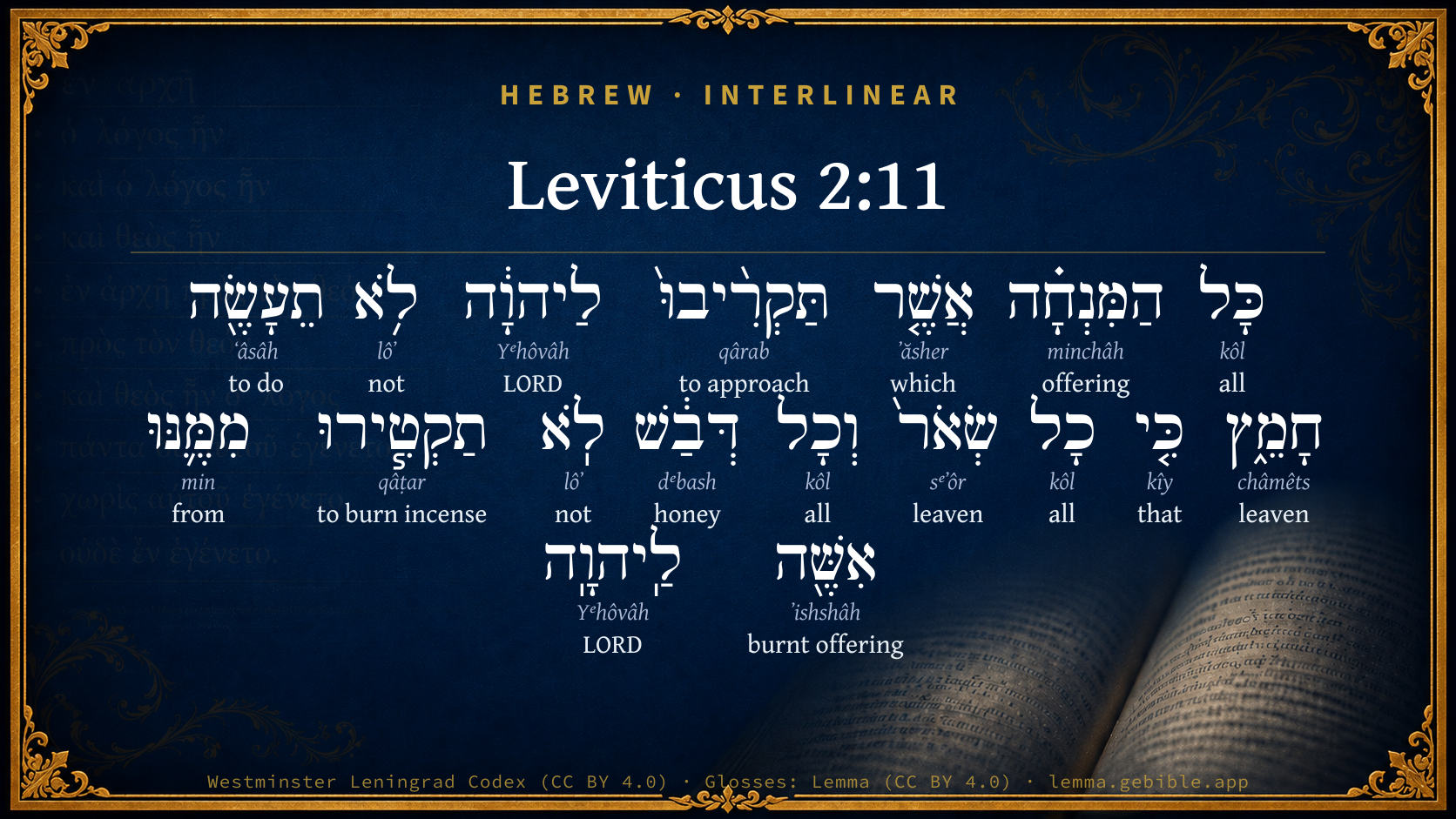
Hebrew (Westminster Leningrad Codex) Leviticus 2:11 appears in the Hebrew Old Testament. The text above is from the Westminster Leningrad Codex. Each word links to its Strong’s number, a concise gloss, and parsing drawn from the Open Scriptures Hebrew Bible morphology. Click any word for its full Brown-Driver-Briggs (BDB) entry.
Download image
Cite this verse

Leviticus 2:11 (World English Bible). Public Domain. Lemma interlinear Bible study tool, https://lemma.gebible.app/v/leviticus/2/11.

Show BibTeX & RIS
BibTeX
RIS
English Translation
"'No meal offering, which you shall offer to Yahweh, shall be made with yeast; for you shall burn no yeast, nor any honey, as an offering made by fire to Yahweh.
World English Bible · Public Domain
Download a study sheet

One document with this verse’s original text, its word-by-word gloss line, the meaning frame, cross-references with their text, attributed commentary, and full source and license credits — printable, and it pastes into notes with its structure intact.

This verse Autodidact and up

Study sheet (.html) Plain text (.txt)

A passage Seminary Student

Up to 50 verses in one chapter. A passage sheet keeps up to 6 commentary sources and 12 cross-references per verse, in the order this page ranks them, and says so on the sheet whenever that leaves anything out. Ask for a single verse and you get the Autodidact verse sheet above.

Everything on this page stays free to read, with no account — the sheet is a download of what is already on screen, not access to it.

Want to remove ads? Support Godless Engineer
Compare translations 3

The same verse in 3 English versions, stacked beneath the original-language interlinear above. Click any original word for its lexicon entry.

Each is an independent rendering of the whole verse — the interlinear is not word-aligned to these translations.

Highlighted words mark where these versions differ — a whole-verse word diff, not a word-by-word alignment.

  • World English Bible Public Domain
    "'No meal offering, which you shall offer to Yahweh, shall be made with yeast; for you shall burn no yeast, nor any honey, as an offering made by fire to Yahweh.
  • King James Version Public Domain
    No meat offering, which ye shall bring unto the LORD, shall be made with leaven: for ye shall burn no leaven, nor any honey, in any offering of the LORD made by fire.
  • unfoldingWord Literal Text CC BY-SA 4.0
    Any grain offering that you present to Yahweh shall not be made leaven; for any leaven culture or any honey you shall not cause to become smoke from it, a gift to Yahweh.

unfoldingWord Literal Text — © unfoldingWord, licensed CC BY-SA 4.0. Word-aligned USFM3 via Door43 (git.door43.org/unfoldingWord/en_ult).

Versions to compare (up to 4)

3 of 4 selected

Show all 18 translations

Every available English version of this verse, each an independent rendering of the whole verse.

  • World English Bible Public Domain
    "'No meal offering, which you shall offer to Yahweh, shall be made with yeast; for you shall burn no yeast, nor any honey, as an offering made by fire to Yahweh.
  • Berean Standard Bible Public Domain
    No grain offering that you present to the LORD may be made with leaven, for you are not to burn any leaven or honey as an offering made by fire to the LORD.
  • Majority Standard Bible Public Domain
    No grain offering that you present to the LORD may be made with leaven, for you are not to burn any leaven or honey as a food offering to the LORD.
  • King James Version Public Domain
    No meat offering, which ye shall bring unto the LORD, shall be made with leaven: for ye shall burn no leaven, nor any honey, in any offering of the LORD made by fire.
  • American Standard Version (1901) Public Domain
    No meal-offering, which ye shall offer unto Jehovah, shall be made with leaven; for ye shall burn no leaven, nor any honey, as an offering made by fire unto Jehovah.
  • Revised Version (1885) Public Domain
    No meal offering, which ye shall offer unto the LORD, shall be made with leaven: for ye shall burn no leaven, nor any honey, as an offering made by fire unto the LORD.
  • Geneva Bible (1599) Public Domain
    All the meate offrings which ye shall offer vnto the Lord, shalbe made without leauen: for ye shall neither burne leauen nor honie in any offring of the Lord made by fire.
  • Douay-Rheims (1899) Public Domain
    Every oblation that is offered to the Lord shall be made without leaven, neither shall any leaven or honey be burnt in the sacrifice to the Lord.
  • Young's Literal Translation Public Domain
    No present which ye bring near to Jehovah is made fermented, for with any leaven or any honey ye perfume no fire-offering to Jehovah.
  • Literal Standard Version CC BY-SA 4.0
    No present which you bring near to YHWH is made fermented, for you do not make incense [as] a fire-offering to YHWH with any leaven or any honey.
  • Unlocked Literal Bible CC BY-SA 4.0
    No grain offering that you offer to Yahweh is to be made with yeast, for you must burn no leaven, nor any honey, as an offering made by fire to Yahweh.
  • unfoldingWord Literal Text CC BY-SA 4.0
    Any grain offering that you present to Yahweh shall not be made leaven; for any leaven culture or any honey you shall not cause to become smoke from it, a gift to Yahweh.
  • Darby Bible Public Domain
    No oblation which ye shall present to Jehovah shall be made with leaven; for no leaven and no honey shall ye burn [in] any fire-offering to Jehovah.
  • World Messianic Bible Public Domain
    “‘No meal offering which you shall offer to the LORD shall be made with yeast; for you shall burn no yeast, nor any honey, as an offering made by fire to the LORD.
  • Webster's Bible Public Domain
    No meat-offering which ye shall bring to the LORD shall be made with leaven: for ye shall burn no leaven, nor any honey, in any offering of the LORD made by fire.
  • Free Bible Version CC BY-SA 4.0
    No grain offering that you give to the Lord may be made using yeast. Don't burn any yeast or honey as a food offering to the Lord.
  • Bible in Basic English Public Domain
    No meal offering which you give to the Lord is to be made with leaven; no leaven or honey is to be burned as an offering made by fire to the Lord.
  • JPS Tanakh (1917) Public Domain
    No meal-offering, which ye shall bring unto the LORD, shall be made with leaven; for ye shall make no leaven, nor any honey, smoke as an offering made by fire unto the LORD.

Literal Standard Version (2020), Covenant Press — licensed CC BY-SA 4.0. Text via the HelloAO Bible API (eBible.org). Unlocked Literal Bible (unfoldingWord) — licensed CC BY-SA 4.0. Text via the HelloAO Bible API (eBible.org). unfoldingWord Literal Text — © unfoldingWord, licensed CC BY-SA 4.0. Word-aligned USFM3 via Door43 (git.door43.org/unfoldingWord/en_ult). Free Bible Version, Dr. Jonathan Gallagher — licensed CC BY-SA 4.0. Text via the HelloAO Bible API (eBible.org).

Word by word

More ways to search: Search by grammar → Find every occurrence → Compare this word →

Practice this passage: Drill this verse → Learn its vocabulary →

שְׂאֹר֙
sᵉʼôr
H7603
“leaven”
Noun, Common, Masculine, Singular, Absolute
Part of Speech
Noun
Type
Common
Gender
Masculine
Number
Singular
State
Absolute
Full BDB Definition

Origin: from H7604

TWOT: 2229a

leaven
  1. כָּל kôl H3605 “all of” Noun, Common, Masculine, Singular, Construct
  2. הַמִּנְחָ֗ה minchâh H4503 “the · offering” Particle, Definite Article + Noun, Common, Feminine, Singular, Absolute
  3. אֲשֶׁ֤ר ʼăsher H834 “which” Particle, Relative
  4. תַּקְרִ֨יבוּ֙ qârab H7126 “to approach” Verb, Hiphil, Imperfect, 2nd Person, Masculine, Plural
  5. לַיהוָ֔ה Yᵉhôvâh H3068 “to/for · LORD” Preposition + Noun, Proper
  6. לֹ֥א lôʼ H3808 “not” Particle, Negative
  7. תֵעָשֶׂ֖ה ʻâsâh H6213 “to do” Verb, Niphal, Imperfect, 3rd Person, Feminine, Singular
  8. חָמֵ֑ץ châmêts H2557 “leaven” Noun, Common, Masculine, Singular, Absolute
  9. כִּ֤י kîy H3588 “that” Conjunction
  10. כָל kôl H3605 “all of” Noun, Common, Masculine, Singular, Construct
  11. וְכָל kôl H3605 “and · all of” Conjunction + Noun, Common, Masculine, Singular, Construct
  12. דְּבַ֔שׁ dᵉbash H1706 “honey” Noun, Common, Masculine, Singular, Absolute
  13. לֹֽא lôʼ H3808 “not” Particle, Negative
  14. תַקְטִ֧ירוּ qâṭar H6999 “to burn incense” Verb, Hiphil, Imperfect, 2nd Person, Masculine, Plural
  15. מִמֶּ֛נּוּ min H4480 “from · us” Preposition + Suffix, Personal, 1st Person, Common, Plural
  16. אִשֶּׁ֖ה ʼishshâh H801 “burnt offering” Noun, Common, Masculine, Singular, Absolute
  17. לַֽיהוָֽה Yᵉhôvâh H3068 “to/for · LORD” Preposition + Noun, Proper

About this verse

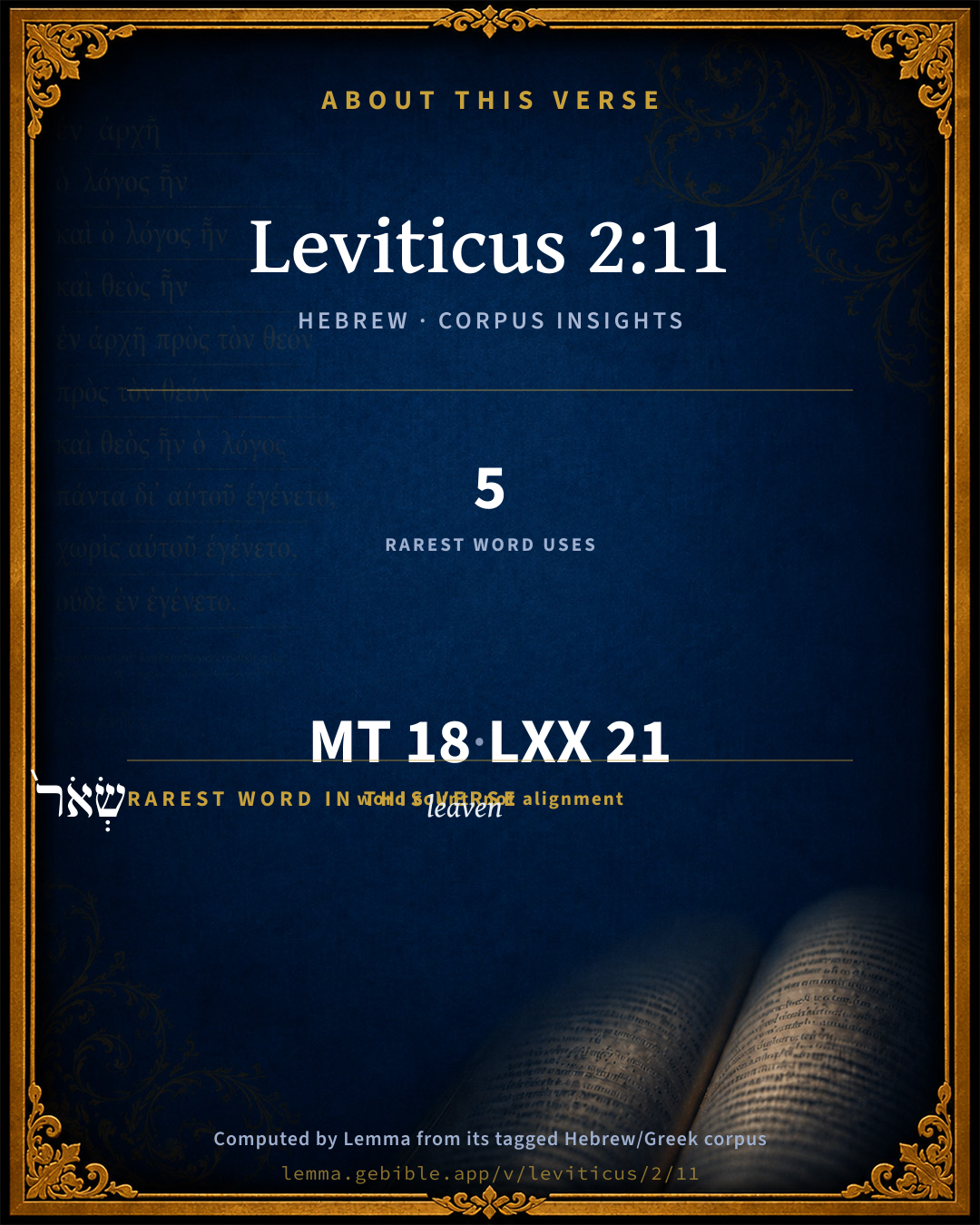
These counts appear in no published source. They are computed here, from the morphology-tagged text and Lemma’s own curated glosses. What Lemma adds →

18
words
14
distinct lemmas
Pentateuch
section

Notable vocabulary

The rarest word here is שְׂאֹר֙ leaven H7603 — appearing just 5 times in the whole Hebrew Bible.

Shared distinctive vocabulary

שְׂאֹר֙ leaven H7603 occurs in 5 verses of the Hebrew Bible. Also found in:

Grammatical profile

  • 3 verbs
  • 10 nouns
  • 1 preposition
  • 1 conjunction
  • 3 particles

Verb forms

  • תַּקְרִ֨יבוּ֙ Hiphil · Imperfect
  • תֵעָשֶׂ֖ה Niphal · Imperfect
  • תַקְטִ֧ירוּ Hiphil · Imperfect

Repetition

Words recur within this verse — often emphatic in Hebrew:

  • כָּל all H3605 ×3
  • לַיהוָ֔ה LORD H3068 ×2
  • לֹ֥א not H3808 ×2

Hebrew & Septuagint length

In English translation the verse runs 31 words from the Hebrew and 34 from the Septuagint (LXX English) — closely comparable.

A rough comparison of the two English renderings, which tokenize alike — not a word-level alignment.

Word counts can differ between the Hebrew and the Greek without any difference in meaning — e.g. the Hebrew direct-object marker אֵת has no separate Greek word, and Greek often adds the article ὁ.

In the original languages it is 18 Hebrew tokens and 21 Greek tokens — but the two are counted differently (Hebrew bundles its prefixes and suffixes into one token; the Greek is in lemma form), so that isn’t a like-for-like length.

Cross-references

16

Topical passages linked to Leviticus 2:11 in the Treasury of Scripture Knowledge — connected by theme and wording, ordered by reader-vote popularity; previews shown in the World English Bible.

  • Luke 12:1 Meanwhile, when a multitude of many thousands had gathered together, so much so that they trampled on each other, he began to tell his disciples first of all, "Beware of the yeast of the Pharisees, which is hypocrisy.
  • Galatians 5:9 A little yeast grows through the whole lump.
  • Exodus 23:18 "You shall not offer the blood of my sacrifice with leavened bread, neither shall the fat of my feast remain all night until the morning.
  • Exodus 12:19–20 Seven days shall there be no yeast found in your houses, for whoever eats that which is leavened, that soul shall be cut off from the congregation of Israel, whether he be a foreigner, or one who is born in the land.
  • Leviticus 6:16–17 That which is left of it Aaron and his sons shall eat. It shall be eaten without yeast in a holy place. They shall eat it in the court of the Tent of Meeting
  • Proverbs 24:13 My son, eat honey, for it is good; The droppings of the honeycomb, which are sweet to your taste:
  • Proverbs 25:16 Have you found honey? Eat as much as is sufficient for you, Lest you eat too much, and vomit it.
  • Proverbs 25:27 It is not good to eat much honey; Nor is it honorable to seek one's own honor.
  • Mark 8:15 He charged them, saying, "Take heed: beware of the yeast of the Pharisees and the yeast of Herod."
  • Luke 21:34 "So be careful, or your hearts will be loaded down with carousing, drunkenness, and cares of this life, and that day will come on you suddenly.
  • 1 Peter 4:2 that you no longer should live the rest of your time in the flesh for the lusts of men, but for the will of God.
  • Exodus 34:25 "You shall not offer the blood of my sacrifice with leavened bread; neither shall the sacrifice of the feast of the Passover be left to the morning.
  • Matthew 16:6 Jesus said to them, "Take heed and beware of the yeast of the Pharisees and Sadducees."
  • Matthew 16:11–12 How is it that you don't perceive that I didn't speak to you concerning bread? But beware of the yeast of the Pharisees and Sadducees."
  • Acts 14:22 confirming the souls of the disciples, exhorting them to continue in the faith, and that through many afflictions we must enter into the Kingdom of God.
  • 1 Corinthians 5:6–8 Your boasting is not good. Don't you know that a little yeast leavens the whole lump?

Cross-references courtesy of OpenBible.info (CC BY 4.0).

Hebrew and Greek witnesses Masoretic Hebrew ↔ Greek Septuagint

The same verse in the two great witnesses to the Old Testament, shown verse-for-verse.

These are two independent witnesses, not word-aligned to each other, and the Septuagint is shown in lemma (dictionary) form.

Hebrew Leviticus 2:11 Masoretic · Westminster Leningrad Codex

כָּל הַמִּנְחָ֗ה אֲשֶׁ֤ר תַּקְרִ֨יבוּ֙ לַיהוָ֔ה לֹ֥א תֵעָשֶׂ֖ה חָמֵ֑ץ כִּ֤י כָל שְׂאֹר֙ וְכָל דְּבַ֔שׁ לֹֽא תַקְטִ֧ירוּ מִמֶּ֛נּוּ אִשֶּׁ֖ה לַֽיהוָֽה

"'No meal offering, which you shall offer to Yahweh, shall be made with yeast; for you shall burn no yeast, nor any honey, as an offering made by fire to Yahweh.

World English Bible · Public Domain

Greek LXX Leviticus 2:11 Septuagint · lemma form

πᾶς θυσία ὅς ἄν προςφέρω κύριος οὐ ποιέω ζυμωτός πᾶς γάρ ζυμή καί πᾶς μέλι οὐ προςφέρω ἀπό αὐτός καρπόω κύριος

You⌃ shall not leaven any sacrifice which you⌃ shall bring to the Lord; for as to any leaven, or any honey, you⌃ shall not bring of it to offer a gift to the Lord.

LXX2012 (modern English Septuagint) · Public Domain

Hebrew: Westminster Leningrad Codex (CC BY 4.0). Greek: Septuagint (public domain); English from LXX2012 (modern English Septuagint) (Public Domain). How the Septuagint differs from the Hebrew →

Targum (Aramaic paraphrase)

2

The Targum is the ancient Jewish Aramaic paraphrase of the Hebrew Scriptures — an interpretive translation, not the Hebrew text itself. Onkelos (literal) and Pseudo-Jonathan (expansive) render the Torah, and Jonathan the Prophets. Coverage is partial: where no permissively-licensed English translation exists for a verse, only the Aramaic is shown. This is verse-level text, not a word-by-word alignment to the Hebrew. Some Onkelos verses here show an unreviewed machine translation (clearly flagged), not a published edition.

  1. Targum Onkelos Torah (Genesis–Deuteronomy)
    כָּל מִנְחָתָא דִי תְקַרְבוּן קֳדָם יְיָ לָא תִתְעֲבֵיד חֲמִיעַ אֲרֵי כָּל חֲמִיר וְכָל דְבַשׁ לָא תַסְקוּן מִנֵיהּ קוּרְבָּנָא קֳדָם יְיָ

    Unreviewed machine translation (Claude Sonnet 5) — not public domain confidence: high

    Every meal offering that you bring near before the Lord shall not be made leavened; for you shall not offer up from it any leaven or any honey as an offering before the Lord.

    Generated by an AI translate-then-audit pipeline and checked against an independent public-domain English translation of the underlying Hebrew for drift only. Not a published edition; pending human review.

    Aramaic base: public-domain Targum Onkelos (via Sefaria). The English above is the unreviewed machine translation, not public domain.

  2. Targum Pseudo-Jonathan Torah (Genesis–Deuteronomy)
    כָּל מִנְחָתָא דִי תְקַרְבוּן קֳדָם יְיָ לָא תִתְעֲבֵיד חָמִיעַ אֲרוּם כָּל חֲמִיר וְכָל דְבַשׁ לָא תְקַרְבוּן מִינֵיהּ קָרְבָּנָא קֳדָם יְיָ

    But no mincha which thou offerest to the Lord shalt thou make with leaven; for neither leaven nor honey mayest thou offer as an oblation before the Lord.

    Targum Pseudo-Jonathan — Aramaic: “Targum Jonathan on Genesis” (public domain); “Targum Jonathan on Exodus” (public domain); “Targum Jonathan on Leviticus” (public domain); “Targum Jonathan on Numbers” (public domain); “Targum Jonathan on Deuteronomy” (public domain). English: “The Targum of Jonathan ben Uzziel, trans. J. W. Etheridge, London, 1862” (public domain). Text via Sefaria.

Commentary

Notes on Leviticus 2:11 from classic Christian and Jewish commentators (each source and its license shown beneath its notes). The classic Christian expositions comment on the surrounding passage and are grouped to its opening verse, so a note may address several verses; the Jewish commentaries on the Tanakh (Rashi and others) are per-verse, so they appear only where the commentator wrote on this verse.

Lemma curates 59 commentaries, every one of them public domain or Creative Commons licensed, each selected and text-cleaned for this edition rather than reprinted as found. About our sources →

Matthew Henry's Commentary

Here, I. Leaven and honey are forbidden to be put in any of their meat-offerings: No leaven, nor any honey, in any offering made by fire, Lev 2:11. 1. The leaven was forbidden in remembrance of the unleavened bread they ate when they came out of Egypt. So much despatch was required in the offerings they made that it was not convenient they should stay for the leavening of them. The New Testament comparing pride and hypocrisy to leaven because they swell like leaven, comparing also malice and wickedness to leaven because they sour like leaven, we are to understand and improve this as a caution to take heed of those sins which will certainly spoil the acceptableness of our spiritual sacrifices. Pure hands must be lifted up without wrath, and all our gospel feasts kept with the unleavened bread of sincerity and truth. 2. Honey was forbidden, though Canaan flowed with it, because to eat much honey is not good (Pro 25:16, Pro 25:27); it turns to choler and bitterness in the stomach, though luscious to the taste. Some think the chief reason why those two things, leaven and honey, were forbidden, was because the Gentiles used them very much in their sacrifices, and God's people must not learn or use the way of the heathen, but his services must be the reverse of their idolatrous services; see Deu 12:30, Deu 12:31. Some make this application of this double prohibition: leaven signifies grief and sadness of spirit (Psa 73:21), My heart was leavened; honey signifies sensual pleasure and mirth. In our service of God both these must be avoided, and a mean observed between those extremes; for the sorrow of the world worketh death, and a love to the delights of sense is a great enemy to holy love.

II. Salt is required in all their offerings, Lev 2:13. The altar was the table of the Lord; and therefore, salt being always set on our tables, God would have it always used at his. It is called the salt of the covenant, because, as men confirmed their covenants with each other by eating and drinking together, at all which collations salt was used, so God, by accepting his people's gifts and feasting them upon his sacrifices, supping with them and they with him (Rev 3:20), did confirm his covenant with them. Among the ancients salt was a symbol of friendship. The salt for the sacrifice was not brought by the offerers, but was provided at the public charge, as the wood was, Ezr 7:20-22. And there was a chamber in the court of the temple called the chamber of salt, in which they laid it up. Can that which is unsavoury be eaten without salt? God would hereby intimate to them that their sacrifices in themselves were unsavoury. The saints, who are living sacrifices to God, must have salt in themselves, for every sacrifice must be salted with salt (Mar 9:49, Mar 9:50), and our speech must be always with grace (Col 4:6), so must all our religious performances be seasoned with that salt. Christianity is the salt of the earth.

III. Directions are given about the first-fruits. 1. The oblation of their first-fruits at harvest, of which we read, Deu 26:2. These were offered to the Lord, not to be burnt upon the altar, but to be given to the priests as perquisites of their office, Lev 2:12. And you shall offer them (that is, leaven and honey) in the oblation of the first-fruits, though they were forbidden in other meat-offerings; for they were proper enough to be eaten by the priests, though not to be burnt upon the altar. The loaves of the first-fruits are particularly ordered to be baked with leaven, Lev 23:17. And we read of the first-fruits of honey brought to the house of God, Ch2 31:5. 2. A meat-offering of their first-fruits. The former was required by the law; this was a free-will offering, Lev 2:14-16. If a man, with a thankful sense of God's goodness to him in giving him hopes of a plentiful crop, was disposed to bring an offering in kind immediately out of his field, and present it to God, owning thereby his dependence upon God and obligations to him, (1.) Let him be sure to bring the first ripe and full ears, not such as were small and half-withered. Whatever was brought for an offering to God must be the best in its kind, though it were but green ears of corn. We mock God, and deceive ourselves, if we think to put him off with a corrupt thing while we have in our flock a male, Mal 1:14. (2.) These green ears must be dried by the fire, that the corn, such as it was, might be beaten out of them. That is not expected from green ears which one may justly look for from those that have been left to grow fully ripe. If those that are young do God's work as well as they can, they shall be accepted, though they cannot do it so well as those that are aged and experienced. God makes the best of green ears of corn, and so must we. (3.) Oil and frankincense must be put upon it. Thus (as some allude to this) wisdom and humility must soften and sweeten the spirits and services of young people, and then their green ears of corn shall be acceptable. God takes a particular delight in the first ripe fruits of the Spirit and the expressions of early piety and devotion. Those that can but think and speak as children, yet, if they think and speak well, God will be well pleased with their buds and blossoms, and will never forget the kindness of their youth. (4.) It must be used as other meat-offerings, Lev 2:16, compare Lev 2:9. He shall offer all the frankincense; it is an offering made by fire. The fire and the frankincense seem to have had a special significancy. [1.] The fire denotes the fervency of spirit which ought to be in all our religious services. In every good thing we must be zealously affected. Holy love to God is the fire by which all our offerings must be made; else they are not of a sweet savour to God. [2.] The frankincense denotes the mediation and intercession of Christ, by which all our services are perfumed and recommended to God's gracious acceptance. Blessed be God that we have the substance of which all these observances were but shadows, the fruit that was hid under these leaves.

Matthew Henry's Commentary on the Whole Bible (1708–1710) — public domain (CC PDM 1.0). Text via the HelloAO Bible API.

Ellicott's Commentary for English Readers

(11) No meat offering.—Lev_2:11-13 add some general rules respecting meat offerings. As honey was used in olden times to produce fermentation, it is excluded, like fermented dough, from these offerings. (See Lev_11:20.)

A Bible Commentary for English Readers, edited by Charles John Ellicott (1878–1897) — public domain. Text from a community e-Sword module.

John Gill's Exposition

No meat offering which ye shall bring unto the Lord shall be made with leaven,.... It might be used in peace offerings, and in the wave loaves, Lev 7:13 but not in meat offerings; not only in the handful that was burnt, but in the rest that was eaten by Aaron and his sons; for so is the rule (p),"all meat offerings are kneaded in hot water, and are kept that they might not be leavened; and if what is left of them be leavened, a negative precept is transgressed, Lev 2:11.''It denoted in Christ, the antitype of the meat offering, freedom from hypocrisy and all false doctrines, which were the leaven of the Scribes and Pharisees, Luk 12:1 and in his people that feed upon him by faith, that they should be clear of malice and wickedness, and of communion with profane and scandalous persons, Co1 5:6 so the Jews (q) say, the corruption of nature is like to leaven, and therefore forbid:

for ye shall burn no leaven, nor any honey, in any offering of the Lord made by fire; as leaven was used in some offerings, so honey was brought with the first fruits, Ch2 31:5 but neither of them might be used in offerings made by fire; they are forbidden to be burnt: the reason why they were forbidden, some think is, because they were used by the Heathens in their sacrifices, so Maimonides (r), whose customs were not to be followed; and certain it is that honey was used in Heathen sacrifices: Homer speaks of honey as the sweet food of the gods (s), and what they desire; and so Pausanias (t) relates of the Eleans, that, according to an ancient custom, they used to offer on the altar frankincense, and wheat mixed with honey: Porphyry (u) observes, that the ancient sacrifices with most were sober, the libations of water; after these, libations of honey, ready prepared by the bees, the first of moist fruits, next libations of oil, and, last of all, libations of wine; the Egyptians used honey in their sacrifices (w); or the reason is, because it was much of the same fermenting nature with leaven, as Aben Ezra, and when burnt gave an ill smell, which was not proper in offerings made by tire, of a sweet savour to the Lord; or rather because a symbol of sin and sinful pleasures. Baal Hatturim on the place says, the corruption of nature is sweet to a man as honey, and intimates that that is the reason of its prohibition: it denotes unto us that such as would feed by faith on Christ ought to relinquish sinful lusts and pleasures; and that those that will live godly in Christ Jesus must not expect their sweets, but bitters, even afflictions, reproaches, and persecutions, for Christ's sake, in this life.

(p) Misn. Menachot, c. 5. sect. 2. (q) Baal Hatturim in loc. (r) Moreh Nevochim, par. 3. c. 46, p. 481. (s) ----- , &c. Hymn. in Mercur. prope finem. , &c. Batrachomyo. (t) Eliac. 1. sive l. 5. p. 316. (u) De Abstinentia, l. 2. c. 20, 21. (w) Herodot. Euterpe, sive l. 2. c. 40.

John Gill's Exposition of the Whole Bible (1746–1763) — public domain (CC PDM 1.0). Text via the HelloAO Bible API.

Trapp's Complete Commentary

John Trapp

Lev 2:11 No meat offering, which ye shall bring unto the LORD, shall be made with leaven: for ye shall burn no leaven, nor any honey, in any offering of the LORD made by fire.

Ver. 11. Nor any honey.] Which hath a leavening virtue in it. Sweet sins are to be abandoned there will be bitterness in the end. {Pro 26:26-27}

John Trapp, A Commentary or Exposition upon All the Books of the Old and New Testament (1647–1656) — public domain. Text from a community e-Sword module.

Albert Barnes' Notes on the Bible

As for the oblation of the firstfruits - Rather, As an oblation of firstfruits. The words refer to the leaven and honey mentioned in Lev 2:11 which might be offered among the firstfruits and tithes (Deu 26:2, Deu 26:12; compare 2Ch 31:5). Honey, being used to produce fermentation, and leaven (or, a small piece of fermented dough) were excluded because fermentation was an apt symbol of the working of corruption in the human heart.

Albert Barnes' Notes on the Bible (1834–1885) — public domain. Text from a community e-Sword/MySword module.

Joseph Benson's Commentary

Lev 2:11. No leaven — Namely, in that which is offered of free-will; for in other offerings it might be used, Lev 7:13; Lev 23:17. This was forbidden, partly to remind them of their deliverance out of Egypt, when they were forced through haste to bring away their meal or dough (which was the matter of this oblation) unleavened; partly to signify what Christ would be, and what they should be, pure and free from all error in the faith and worship of God, and from all hypocrisy, and malice or wickedness, all which are signified by leaven. Nor any honey — Either, 1st, Because it hath the same effect with leaven in paste or dough, making it sour, and swelling. Or, 2d, In opposition to the sacrifices of the Gentiles, in which the use of honey was most frequent. Or, 3d, To teach us that God’s worship is not to be governed by men’s fancies and appetites, but by God’s will.

Joseph Benson's Commentary on the Old and New Testaments (1811–1818) — public domain. Text from a community e-Sword module.

Tyndale Open Study Notes

Tyndale Open Resources

2:11 yeast: The bread commonly eaten in biblical times was comparable to modern sourdough. The substance that is often called “leaven” consisted of wild yeast spores mixed into moist dough or a flour mixture. The yeast would grow and cause the dough to ferment, souring and raising it. A reserved portion of the sour dough would be kneaded into subsequent batches (Matt 13:33). Unleavened bread was required for the Passover (Exod 12:8), in remembrance of Israel’s bondage in Egypt (Deut 16:3) and their speedy departure from that land (Exod 12:34; 13:3). Following the Exodus, unleavened bread acquired the status of altar bread. Leavened bread was not to be burned on the altar. • honey: The Hebrew word (debash) can also refer to fruit nectar. The reason for its exclusion is not stated, but perhaps the frequent use of honey in pagan offerings, particularly to gods of the underworld, was a contributing reason. If the word refers to fruit nectar, its association with wine and fermentation may have linked it with yeast, making it ineligible to be burned on the altar. However, both honey and yeast were allowed as part of an offering of first crops (Lev 2:12). Loaves of bread made with yeast were to be presented with thank offerings (7:13) and as a gift to the priest in the Festival of Harvest (23:17). In the New Testament, yeast becomes a spiritual metaphor, playing on its sour taste and on its tendency to spread (Matt 16:6, 11, 12; 1 Cor 5:6-8; cp. Matt 13:33).

Tyndale Open Study Notes — © Tyndale Open Resources, licensed CC BY-SA 4.0. Text via the HelloAO Bible API.

Jamieson, Fausset & Brown

Robert Jamieson, A. R. Fausset & David Brown

ye shall burn no leaven, nor any honey, in any offering of the Lord--Nothing sweet or sour was to be offered. In the warm climates of the East leavened bread soon spoils, and hence it was regarded as the emblem of hypocrisy or corruption. Some, however, think that the prohibition was that leaven and honey were used in the idolatrous rites of the heathen.

Jamieson, Fausset & Brown — Commentary Critical and Explanatory on the Whole Bible (1871) — public domain (CC PDM 1.0). Text via the HelloAO Bible API.

Adam Clarke's Commentary

Verse 11. No meat-offering - shall be made with leaven] See the reason of this prohibition in the note on Ex 12:8. See Clarke on Ex 12:8.

Nor any honey] Because it was apt to produce acidity, as some think, when wrought up with flour paste; or rather because it was apt to gripe and prove purgative. On this latter account the College of Physicians have totally left it out of all medicinal preparations. This effect which it has in most constitutions was a sufficient reason why it should be prohibited here, as a principal part of all these offerings was used by the priests as a part of their ordinary diet; and these offerings, being those of the poorer sort, were in greater abundance than most others. On this account, the griping, and purgative quality of the honey must render it extremely improper. As leaven was forbidden because producing fermentation, it was considered a species of corruption, and was therefore used to signify hypocrisy, malice, c., which corrupt the soul it is possible that honey might have had a moral reference, also, and have signified, as St. Jerome thought, carnal pleasures and sensual gratifications. Some suppose that the honey mentioned here was a sort of saccharine matter extracted from dates. Leaven and honey might be offered with the first-fruits, as we learn from the next verse; but they were forbidden to be burnt on the altar,

Adam Clarke's Commentary on the Bible (1810–1826) — public domain. Text from a community e-Sword/MySword module.

The Cambridge Bible for Schools and Colleges

gen. ed. J. J. S. Perowne

11. Leaven and honey are not to be mixed with any offering made by fire; they shall be offered as an oblation of firstfruits (Heb. rçshîth) but not on the altar (Lev_2:12). See Driver (C. B.) on Am. iv. 5. By ‘honey’ is meant not only that prepared by bees, but a syrup made from grapes, called by the Arabs dibs, the same as Heb. dĕbásh.

Both leaven and honey produce fermentation, a process which has been associated in thought with the working of unruly desires, and considered as a symbol of evil. The idea of corruption in connexion with leaven was familiar to the Romans. Plutarch (Quaest. Rom. 109) says: ‘Leaven is born of corruption, and corrupts that with which it is mixed … all fermentation is a kind of putrefaction.’ The Flamen Dialis, a priest of Jupiter in one of the oldest Roman cults, among many other restrictions of ancient date, was not allowed to touch leavened bread (Sir J. G. Frazer, Golden Bough3, Pt II. 13 and his references on p. 14, note 3, to Aulus Gellius x. 15, Pliny, Nat. Hist. xxviii. 146, and other writers: see also Pauly’s Real Encyc. (ed. G. Wissowa) vi. 2485 ff.). This idea is in the N.T., where ‘leaven’ is used figuratively of the corrupt doctrine of the Pharisees and Sadducees (Mat_16:16; Luk_12:1), and by St Paul as representing ‘malice and wickedness’ in contrast with ‘the unleavened bread of sincerity and truth’ (1Co_5:7-8). But there is no such contrast implied in the prohibition of leaven at the feast of the Passover (Exo_12:15; Exo_12:19; Exo_13:7). The unleavened bread is regarded as ‘bread of affliction’ (Deu_16:3), less pleasant than ordinary leavened bread, reminding the Israelites of bondage as well as deliverance.

The Cambridge Bible for Schools and Colleges (gen. ed. J. J. S. Perowne; Cambridge University Press, 1878–1918) — public domain. Text from a community e-Sword module.

Haydock's Catholic Bible Commentary

Without leaven or honey. No leaven or honey was to be used in the sacrifice offered to God: to signify that we are to exclude from the pure worship of the gospel, all double-dealing and affection to carnal pleasures. (Challoner) --- The prohibition of leaven regarded these sacrifices. It was offered with the first-fruits, (chap. xxiii. 17,) and perhaps also in peace-offerings, chap. vii. 13. Honey is here rejected, as incompatible with the other ingredients, to admonish us to lead a penitential life, and to keep at a greater distance from the customs of the pagans, who generally accompanied their oblations with honey, Ezechiel xvi. 18. Herodotus (B. ii.) says, the Egyptians used honey in sacrifice. (Calmet) --- By unleavened bread, the Hebrews were reminded of their flight out of Egypt; and by refraining from honey, they were taught to act like men. (Menochius)

George Leo Haydock (1774–1849), Haydock's Catholic Family Bible and Commentary, 1859 edition — public domain. Excludes Psalms (Douay-Rheims chapter numbering differs from Protestant) and Deuterocanonical books (Catholic canon only).

Matthew Poole's English Annotations

No meat offering, to wit, which is offered of free will; for in other offerings it might be used, Lev 7:13; 23:17.

Shall be made with leaven: this was forbidden, partly to mind them of their deliverance out of Egypt, when they were forced through haste to bring away their meal or dough (which was the matter of this oblation) unleavened; partly to signify what Christ would be, and what they should be, pure and free from all error in the faith and worship of God, and from all hypocrisy and malice or wickedness, all which are signified by

leaven, Mat 16:12; Mar 8:15; Luk 12:1; 1Co 5:8; Gal 5:9.

Nor any honey; either,

1. Because it hath the same effect with leaven in paste or dough, making it sour, and swelling. Or,

2. In opposition to the sacrifices of the Gentiles, in which the use of honey was most frequent. Or,

3. To teach us that God’s worship is not to be governed by men’s fancies and appetites, to which honey might have been grateful, but by God’s will. The Jews conceive, that under the name of honey all sweet fruits, as figs, dates, &c., are contained and forbidden.

Matthew Poole's English Annotations on the Holy Bible (1683–1685) — public domain. Text from a community e-Sword/MySword module.

Whedon's Commentary on the Bible

Daniel D. Whedon

11. Burn no leaven — See note on Lev_2:4.

Nor any honey — This prohibition is surprising. There must be a good reason. We cannot accept that assigned by Fairbairn, that it was “to indicate that what is peculiarly pleasing to the flesh is distasteful to God, and must be renounced by his faithful servants.” This contains the essence of all asceticism — abstinence from a harmless thing simply because it is pleasing. A sufficient ground for excluding honey from the altar is suggested by its mention with leaven. It is capable of fermentation, turning sour, and even forming vinegar. Hence the active principle of corruption is in its very nature. It was also a wild product, and did not involve the notion of property which was requisite to sacrifices. As an article of food it was lawful, but it does not suit every one’s taste, nor conduce to the health of all persons. This may be another reason why it was prohibited. The priest should be required to eat only perfectly healthful food.

Daniel D. Whedon (gen. ed.), Commentary on the Old and New Testaments (1874–1909) — public domain. Text from a community e-Sword module.

The Pulpit Commentary

Vers. 11, 12. Ye shall burn no leaven nor any honey, in any offering of the Lord made by fire. Leaven and honey are not forbidden to be offered to the Lord; on the contrary, in the next verse they are commanded to be offered. The prohibition only extends to their being burnt on the altar, owing, no doubt, to the effect of fire upon them in making them swell and froth, thus creating a repulsive appearance which, as we shall see, throughout the Mosaic legislation, represents moral evil. The firstfruits of honey are to be offered, (cf. Exo_22:29) and leaven is to be used in the two wave loaves offered at the Feast of Pentecost as firstfruits. (Lev_23:17) the words translated, As for the oblation of the firstfruits, ye shall offer them unto the Lord, should be rendered, As an oblation of firstfruits ye shall offer them (that is, leaven and honey), but they shall not be burnt on the altar . The mark in A.V denoting a new paragraph at the beginning of verse 12, should be removed.

Vers. 11-13. Notable things.

After describing the minchah under sundry forms, and before proceeding to the meat offering of the firstfruits, certain notable things are mentioned which the minchah has in common with sacrifices in general. These now claim attention, viz.

I THE PROHIBITION OF LEAVEN (verse. 11). The reasons of this appear to be:

1. Because of its fermenting properties.

(1) These, which, under the action of heat, throw the lump into commotion, represent the evil passions of the heart. (see 1Co_5:6-8) But since the meat offering is taken as a type of Christ, it was most fitting that everything suggestive of these should be excluded. In him was no ferment of anger or discontent when he was subjected to the fiercest fires of the wrath of God. (Isa_53:7) What an example has he left tous!

(2) By its fermenting properties, leaven tended to reduce substances to corruption. But since our "Bread of Life," our "Firstfruit" of the resurrection, could not "see corruption," because he was the "Holy One," it was most proper that leaven should be absent from his type. (Psa_16:10 Act_2:31)

2. That the Hebrews might be reminded of their deliverance from Egypt.

(1) For they were, at the time of the Exodus, so hurried that they had to take their dough as it was without being leavened. (Exo_12:39) It was most salutary to keep alive the remembrance of such mercies as they then experienced, and of the stupendous works with which they were associated.

(2) But since those things were all typical of gospel blessings, so must it be most edifying to us to remember the spiritual bondage and darkness from which we have been emancipated by the hand of that great Prophet "like unto Moses," to whom it is our duty to hearken in preference to him.

II THE PROHIBITION OF HONEY (verse 11). The reasons of this appear to be:

1. Because honey was a symbol of carnal pleasures.

(1) It was in this light viewed by Philo and by Jerome: and certainly the similitude is apt. Though luscious to the palate, it is bitter to the stomach. Be evermore is sensual gratification. (see Pro_25:16, Pro_25:27)

(2) The exclusion of honey from the sacrifices and offerings of the altar will, therefore, convey important morals, viz.

(a) considering these as types of Christ,

(b) considering them also as types of such spiritual sacrifices as we can present acceptably to God through Christ. Another reason may be:

2. Because honey was offered with the abominations of the heathen.

(1) Honey was offered to Bacchus and to the dii superi, the dii inferi, and departed heroes. Hence Orpheus, in beginning his hymns, calls the infernal gods meilicioi yeoi , and the souls of the dead, melissai . The origin of which custom is thus explained by Porphyry, "They made honey a symbol of death; and therefore poured out a libation of honey to the terrestrial gods" (see Brown"s "Antiquities," volume 1, page 381).

(2) The Hebrews were instructed scrupulously to avoid the customs of the pagans. (see Deu_12:29-31) Let Protestants studiously avoid the abominations of the Romish Antichrist. (Rev_18:4)

(3) Leaven and honey might be offered with the oblation of the firstfruits; but they must not come upon God"s altar. This is the teaching of verse 12. The loaves of the firstfruits, which were perquisites of the priests, were even ordered to be baken with leaven (chapter 23:17). So in like manner honey was to be offered to them. (2Ch_31:5) There are things which may be lawfully offered to man that may not be offered to God. As leaven and honey mingled with. the bread, even of the priests, so human conversation, at its best, is but imperfect.

III THE REQUISITION OF SALT (verse 13). The reason of this appears in the many excellent things of which salt was the symbol.

1. It was a symbol of purity.

(1) Hence it is described as "the salt of the covenant of God." The Hebrew term for covenant (tyrb, berith) literally signifies purification; and the covenant of God is the gospel which is instituted of God for our purification from sin.

(2) Perhaps it was religiously, viz. in relation to the covenant, rather than for hygienic purposes, that infants were rubbed with salt. (see Eze_16:4)

2. It was a symbol of friendship.

(1) The effect of a covenant to the faithful is friendship. So, in token of friendship, the ancient Greeks ate bread and salt together. And the Russian emperors had a custom, derived to them from antiquity, of sending bread and salt from their tables to persons they intended to honour.

(2) The delights of friendship are also set forth in this symbol. The following is rendered by Dr. A. Clarke from Pliny: "So essentially necessary is salt that without it human life cannot be preserved: and even the pleasures and endowments of the mind are expressed by it; the delights of life, repose, and the highest mental serenity are expressed by no other term than sales among the Latins. It has also been applied to designate the honourable rewards given to soldiers, which are called salarii or salaries. But its importance may be further understood by its use in sacred things, as no sacrifice was offered to the gods without the salt-cake.

(3) But that "conversation" of Christians is best "seasoned" that has the "salt of the covenant". (see Job_6:6 Col_4:5, Col_4:6)

3. It was a symbol of perpetuity.

(1) This is suggested by its preserving properties. It is used to preserve meat and other things from decomposing. It is in this the very opposite of leaven; so, the reason which includes the one excludes the other.

(2) Hence by the symbol of salt the perpetuity of God"s covenant is expressed. Thus, "It is a covenant of salt for ever before the Lord". (Num_18:19; see also 2Ch_13:5)

(3) Christians, who are the people of the covenant, are the preservers of the earth. (see Mat_5:13) Take the Christians out of the world, and it will rot.

4. The qualities of salt should distinguish all sacrifices.

(1) They do distinguish the Great Sacrifice of Calvary.

(2) All Christian offerings should resemble that. In allusion to the salting of sacrifices preparatory to their being offered up in the flames of the altar, our Lord says," Every one shall be salted with fire," or rather, "salted for the fire," viz. of the altar, "and," or rather, "as every sacrifice is salted with salt". (Mar_9:49, 50) "We may reasonably infer, that as salt has two qualities the one to season meat, the other to preserve it from corruption; so it fitly denotes that integrity and incorruptness which season every sacrifice, and render men"s persons and services grateful to God" (Old Bible). J.A.M.

Vers. 11-13. Purity in worship.

When the Hebrew worshipper had presented his burnt offering, had sought forgiveness of sin, and had dedicated himself to God in sacred symbolism, he then brought of the produce of the land, of that which constituted his food; and by presenting flour, oil, and wine, with frankincense, he owned his indebtedness to Jehovah. In engaging in this last act of worship, he was to do that which spoke emphatically of purity in approaching the Holy One of Israel. By Divine direction he was

I CAREFULLY TO EXCLUDE THAT IN WHICH THERE WAS ANY ELEMENT OF IMPURITY, Leaven is "a substance in a state of putrefaction;" honey "soon turns sour, and even forms vinegar." These were, therefore, expressly interdicted; they might not be laid on the altar of God. But so important was this feature that positive as well as negative rules were laid down. The offerer was

II CONSTANTLY TO INTRODUCE THE CORRECTIVE OF IMPURITY, "Neither shalt thou suffer the salt... to be lacking;" "with all thine offerings thou shalt offer salt." Salt is the great preservative from putrefaction, fitting type of all that makes pure in symbolic worship.

When we come up to the house of the Lord to "offer the sacrifice of praise" or to engage in any act of devotion, we must remember that

I GOD LAYS GREAT STRESS ON THE PURITY OF OUR HEART IN WORSHIP. Only the pure in heart can see God. (Mat_5:8) Without holiness no man shall see him. (Heb_12:14) They must be clean who bear the vessels of the Lord. (Isa_52:11) None may ascend his holy hill but "he that hath clean hands and a pure heart." "If we regard iniquity in our heart, the Lord will not hear us". (Psa_66:18) We have not now laid down for us any precise directions as to what words we shall use, what forms we shall adopt, what gifts we shall devote, but we know that the chief thing to bring, that without which all is vain, is a right spirit, a pure heart, a soul that is seeking God and longing for his likeness. The interdiction of the leaven and honey, and the requirement of salt, suggest that

II GOD DESIRES A VIGILANT EXCLUSION OF EVERY UNHOLY THOUGHT WHEN WE DRAW NIGH TO HIM. We may be tempted to allow corruption to enter into and our worship or our Christian work, in the form of:

1. An unworthy spirit of rivalry.

2. An ostentation of piety.

3. Self-seeking by securing the favour of man.

4. Sensuous enjoyment (mere artistic appreciation, etc.).

5. A spirit of dislike or resentment towards fellow-worshippers or fellow-workers.

Such spiritual "leaven" must not be brought to the altar; such sentiments must be shut out from the soul. We must strenuously resist when these evil thoughts would enter. We must vigorously and energetically expel them if they find their way within the heart. (Pro_4:23)

III GOD DESIRES THE PRESENCE OF THE PURIFYING THOUGHT IN DEVOTION. There must not only be the absence of leaven, but the presence of salt; not only the absence of that which corrupts and spoils, but the presence of that which purifies. There must be the active presence of sanctifying thoughts. Such are:

1. A profound sense of the nearness of God to us.

2. A lively sense of our deep indebtedness to Jesus Christ.

Let these convictions fill the soul, and the lower and ignobler sentiments will fail to enter or will quickly leave. If we feel our own feebleness and incapacity, we may fall back on the truth that

IV GOD HAS PROMISED THE AID OF HIS CLEANSING SPIRIT. We must pray for "the renewing of the Holy Ghost"; (Tit_3:5) that he will "cleanse us from our sin;" will give us "truth in the inward parts;" will make us "clean," "whiter than snow;" will "create in us a clean heart, and renew a right spirit within us". (Ps 51; and see Psa_19:12-14 Psa_139:23, Psa_139:24) C.

The Pulpit Commentary (1880–1919), ed. H.D.M. Spence-Jones & Joseph S. Exell — public domain. Text from a community e-Sword module.

John Wesley's Explanatory Notes

No leaven - Namely, in that which is offered of free-will; for in other offerings it might be used, chap. vii, xxiii. This was forbidden, partly to mind them of their deliverance out of Egypt, when they were forced thro' haste to bring away their meal or dough (which was the matter of this oblation) unleavened; partly to signify what Christ would be, and what they should be, pure and free from all error in the faith and worship of God, and from all hypocrisy, and malice or wickedness, all which are signified by leaven. Nor any honey - Either,

1. because it hath the same effect with leaven in paste or dough, making it sour, and swelling. Or,

2. in opposition to the sacrifices of the Gentiles, in which the use of honey was most frequent. Or,

3. to teach us, that God's worship is not to be governed by men's fancies and appetites but by God's will.

John Wesley, Explanatory Notes Upon the Whole Bible (1754–1765) — public domain. Text via the GEBible commentary corpus.

Scofield Reference Notes

C. I. Scofield

leaven

honey

For meanings of leaven see Mat 13:33. Also Lev 7:13, (See Scofield "Lev 7:13")

2 Honey is mere natural sweetness and could not symbolize the divine graciousness of the Lord Jesus.

The Scofield Reference Bible (1917 edition), notes by C. I. Scofield — public domain. Text from a community e-Sword module.

unfoldingWord translationNotes

Door43 World Missions Community

General Information:

Yahweh continues telling Moses what the people must do so that their offerings will be acceptable to him.

No grain offering that you offer to Yahweh is to be made with yeast

This can be stated in active form. AT: "Do not use yeast in a grain offering that you offer to Yahweh" (See: Active or Passive)

as an offering made by fire

This can be stated in active form. AT: "as a burnt offering" (See: Active or Passive)

You will offer them

"You will offer the grain offerings made with leaven or honey"

they will not be used to produce a sweet aroma on the altar

This can be stated in active form. AT: "you will not use them to produce a sweet aroma on the altar" or "you will not burn them on the altar" (See: Active or Passive)

the salt of the covenant of your God

It is implied that the salt is a symbol that represents the covenant with God. (See: Assumed Knowledge and Implicit Information)

translationWords

grain offering

Yahweh

yeast

honey

firstfruits

altar

covenant

unfoldingWord translationNotes — © Distant Shores Media and the Door43 World Missions Community, licensed CC BY-SA 4.0. Source: git.door43.org/Door43/en_tn.

Rashi

Rabbi Shlomo Yitzchaki (Rashi)

וכל דבש [YE SHALL NOT CAUSE TO ASCEND IN FUMES] ANY HONEY – Any sweet juice of a fruit is called “honey”).

Rashi on the Tanakh — English translations: “The Judaica Press complete Tanach with Rashi, translated by A. J. Rosenberg” (CC BY 4.0); “Pentateuch with Rashi's commentary by M. Rosenbaum and A.M. Silbermann, 1929-1934” (public domain); “The Metsudah Tanach series, Lakewood, N.J” (CC BY 4.0); and “The Book of Joshua, Metsudah Publications, 1997” (CC BY 4.0). Text via Sefaria.

Ramban (Nachmanides)

Rabbi Moshe ben Nachman (Ramban / Nachmanides)

NO MEAL-OFFERING, WHICH YE SHALL BRING UNTO THE ETERNAL, SHALL BE MADE WITH LEAVEN. Here He prohibited the bringing of a meal-offering in leaven form. After that He said, Ye shall not ‘thaktiru’ (cause to ascend in fumes) either any leaven or honey, in order to prohibit the leavening of the handful and burning it upon the altar, this being included in the expression ye shall not cause to ascend in fumes … All terms of haktarah are expressions of burning aromatics, for druggists say 12:4. that honey would have been appropriate for the incense,. For since honey is mentioned in the verse, and honey would have improved the scent of the incense, Scripture uses a term which is applicable to the burning of aromatics. but the Torah prohibited it. Scripture states any of it in order to prohibit [leaven or honey] even as a part of it, that is to say, even in one half of the handful. Similarly, one is liable to the punishment of stripes for mixing [leaven or honey with the handful in such a way that it is not recognized], because Scripture included it in saying, for ye shall not cause to ascend in fumes ‘any’ leaven or ‘any’ honey, as is explained in Tractate Menachoth and in Tractate Pesachim. The reason why Scripture mentions here minchah hi [hei-vav-alef, which is the masculine third person pronoun], but it is read hi [hei-yod-alef, which is the equivalent feminine pronoun]. Ramban intends to explain why it is written in the masculine when the word minchah is in the feminine, and hence Scripture should have written minchah hi. [in the feminine] while it is written hu [in the masculine], and similarly in all places, [will be understood] from the section, Behold, I send a messenger before thee. (Abusaula). The implication is that here too one gender is included in the other, namely, the feminine hi in the masculine hu, as explained in the text. So also ‘ha’ishah hahi’ (that woman) [is written hahu in the masculine, while it is read hahi in the feminine], because the feminine is potentially included in the masculine.It is possible that the reason why we are forbidden to bring leaven and honey [upon the altar] is as the Rabbi [Moshe ben Maimon] states in the Moreh Nebuchim, where he says that he found it written in their books that the custom among the idolaters was to offer all their meal-offerings only in leavened form, and to season all their sacrifices with honey; therefore He forbade bringing them on His altar. Our Rabbis have similarly said with reference to monuments [of one stone raised in order to sacrifice on it], that this was a favored mode of worship in the days of the patriarchs, and afterwards G-d hated it because [the Canaanites] had made it an ordinance of an idolatrous character, as He said, which the Eternal thy G-d hatheth. Concerning the reason why we were commanded to offer salt with every offering, [Rabbi Moshe ben Maimon] also said that it is because the idolaters rejected it and did not offer it at all to their idols; [therefore He commanded us to have salt in every offering]. It is possible that [we are commanded to offer salt because] it is not respectful that the food which is offered up to G-d should have no flavoring, being without salt, similar to that which is written, Present it now unto thy governor; will he be pleased with thee? That is why the Sages excluded wood and blood from the requirement of being offered with salt [since they are not edible]. Or it may be that there is in all these matters some secret hidden from us.In the case of leaven and honey Scripture speaks in the plural [for ‘ye’ shall not cause to ascend in fumes, either any leaven or honey] because it speaks to Aaron and his sons. After that it says, And every meal-offering of ‘thine’ shalt ‘thou’ season with salt, because it refers to him who brings the meal-offering, concerning whom it said at the beginning of the section, And if thy offering be a meal-offering of the stewing-pan; and the reason [why it refers to salting by the person who brings the offering, is because] it is valid if done by a non-priest, just as pouring the oil and mingling it with the flour are [as explained above in Verse 2]. Upon all thine ‘offering’ thou shalt offer salt (thine offering) is in the singular. Since this might be interpreted to refer only to the meal-offering mentioned in this verse, Ramban proceeds to explain that it means here “offerings” in the plural, for all offerings etc. means “upon all thine offerings” [in the plural], for all offerings have to be offered with salt, just as the meal-offering.

Ramban (Nachmanides) on the Tanakh — English translation: “Commentary on the Torah by Ramban (Nachmanides). Translated and annotated by Charles B. Chavel. New York, Shilo Pub. House, 1971-1976” (CC BY 4.0). Text via Sefaria.

Lesson kit

Teaching starters — assembled from the data on this page, not authored interpretation. Every prompt links to the verse data it draws on. Edit before teaching.

Leviticus, in the Pentateuch, opens this verse with 18 words (14 distinct Hebrew lemmas). Its most distinctive word is sᵉʼôr (“leaven”). A historical commentator’s framing appears above. Read the whole chapter for the surrounding context.

Discussion questions

  1. How does “leaven” (sᵉʼôr) shape what this verse is saying?
  2. Exodus 12:15 shares the word «leaven» with this verse. How do the two illuminate each other?
  3. “all” occurs 3× in this one verse. What is the effect of the repetition?
  4. These translations render this verse differently. What is at stake in choosing one wording over another?
  5. The verb «תַּקְרִ֨יבוּ֙» is Hiphil Imperfect. How does its form color the action?
  6. Reading how Matthew Henry's Commentary and Ellicott's Commentary for English Readers read this verse, where do the two commentators agree and where do they part?

Things to notice

Reading settings

Reading text

Shown beneath each verse's original-language words.

Old Testament
Old Testament edition

Read the OT as the Masoretic Hebrew (MT) or the Greek Septuagint (LXX).

English shown for the Greek Septuagint (in the Hebrew ↔ Greek comparison).

Comparing translations? Open the Compare panel on any verse page to stack up to four side by side.