
Hosea 5:13

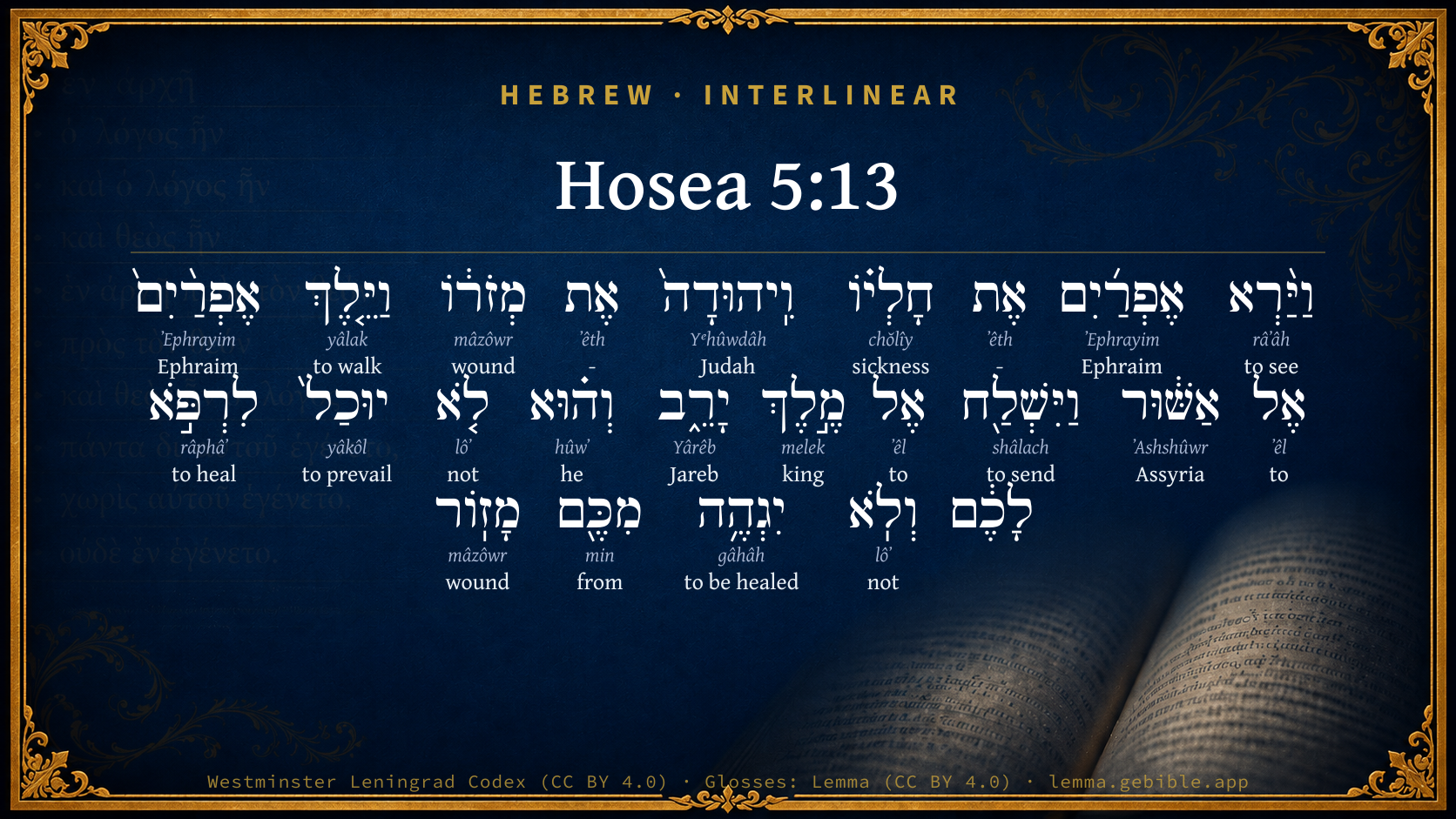
Hebrew (Westminster Leningrad Codex) Hosea 5:13 appears in the Hebrew Old Testament. The text above is from the Westminster Leningrad Codex. Each word links to its Strong’s number, a concise gloss, and parsing drawn from the Open Scriptures Hebrew Bible morphology. Click any word for its full Brown-Driver-Briggs (BDB) entry.
Download image
Cite this verse

Hosea 5:13 (World English Bible). Public Domain. Lemma interlinear Bible study tool, https://lemma.gebible.app/v/hosea/5/13.

Show BibTeX & RIS
BibTeX
RIS
English Translation
When Ephraim saw his sickness, And Judah his wound, Then Ephraim went to Assyria, And sent to king Jareb: But he is not able to heal you, Neither will he cure you of your wound.
World English Bible · Public Domain
Highlights
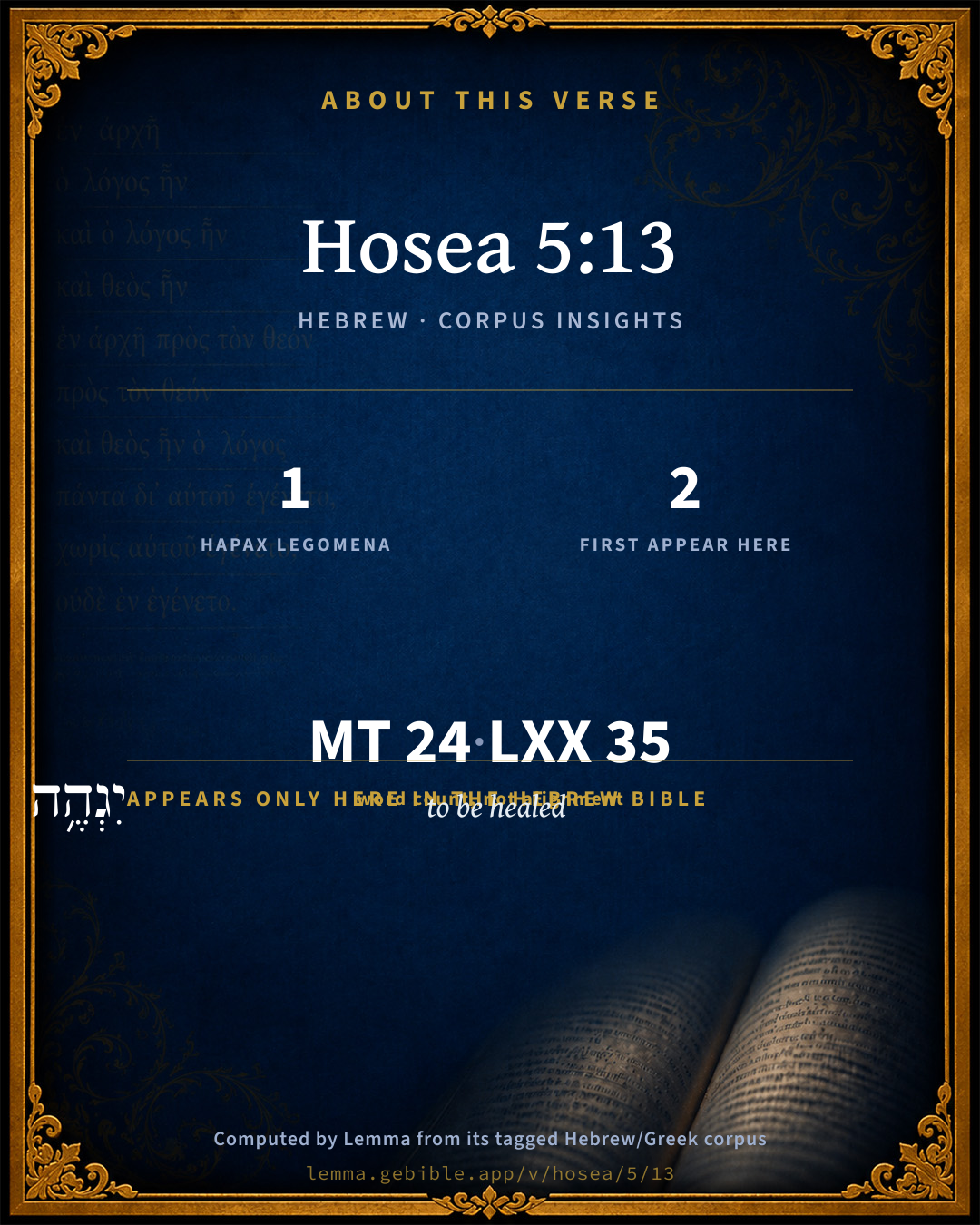
  • 1 hapax legomenon — only here in the Hebrew Bible
  • 2 first appearances in the Hebrew Bible
Full analysis ↓
Download a study sheet

One document with this verse’s original text, its word-by-word gloss line, the meaning frame, cross-references with their text, attributed commentary, and full source and license credits — printable, and it pastes into notes with its structure intact.

This verse Autodidact and up

Study sheet (.html) Plain text (.txt)

A passage Seminary Student

Up to 50 verses in one chapter. A passage sheet keeps up to 6 commentary sources and 12 cross-references per verse, in the order this page ranks them, and says so on the sheet whenever that leaves anything out. Ask for a single verse and you get the Autodidact verse sheet above.

Everything on this page stays free to read, with no account — the sheet is a download of what is already on screen, not access to it.

Want to remove ads? Support Godless Engineer
Compare translations 3

The same verse in 3 English versions, stacked beneath the original-language interlinear above. Click any original word for its lexicon entry.

Each is an independent rendering of the whole verse — the interlinear is not word-aligned to these translations.

Highlighted words mark where these versions differ — a whole-verse word diff, not a word-by-word alignment.

  • World English Bible Public Domain
    When Ephraim saw his sickness, And Judah his wound, Then Ephraim went to Assyria, And sent to king Jareb: But he is not able to heal you, Neither will he cure you of your wound.
  • King James Version Public Domain
    When Ephraim saw his sickness, and Judah saw his wound, then went Ephraim to the Assyrian, and sent to king Jareb: yet could he not heal you, nor cure you of your wound.
  • unfoldingWord Literal Text CC BY-SA 4.0
    And Ephraim saw his sickness, and Judah his wound, then Ephraim went to Assyria and sent to the king of Yareb. But he, he is not able to heal you, and he will not remove the wound from you.

unfoldingWord Literal Text — © unfoldingWord, licensed CC BY-SA 4.0. Word-aligned USFM3 via Door43 (git.door43.org/unfoldingWord/en_ult).

Versions to compare (up to 4)

3 of 4 selected

Show all 18 translations

Every available English version of this verse, each an independent rendering of the whole verse.

  • World English Bible Public Domain
    When Ephraim saw his sickness, And Judah his wound, Then Ephraim went to Assyria, And sent to king Jareb: But he is not able to heal you, Neither will he cure you of your wound.
  • Berean Standard Bible Public Domain
    When Ephraim saw his sickness and Judah his wound, then Ephraim turned to Assyria and sent to the great king. But he cannot cure you or heal your wound.
  • Majority Standard Bible Public Domain
    When Ephraim saw his sickness and Judah his wound, then Ephraim turned to Assyria and sent to the great king. But he cannot cure you or heal your wound.
  • King James Version Public Domain
    When Ephraim saw his sickness, and Judah saw his wound, then went Ephraim to the Assyrian, and sent to king Jareb: yet could he not heal you, nor cure you of your wound.
  • American Standard Version (1901) Public Domain
    When Ephraim saw his sickness, and Judah `saw' his wound, then went Ephraim to Assyria, and sent to king Jareb: but he is not able to heal you, neither will he cure you of your wound.
  • Revised Version (1885) Public Domain
    When Ephraim saw his sickness, and Judah saw his wound, then went Ephraim to Assyria, and sent to king Jareb: but he is not able to heal you, neither shall he cure you of your wound.
  • Geneva Bible (1599) Public Domain
    When Ephraim sawe his sickenes, and Iudah his wound, then went Ephraim vnto Asshur, and sent vnto King Iareb: yet coulde hee not heale you, nor cure you of your wound.
  • Douay-Rheims (1899) Public Domain
    And Ephraim saw his sickness, and Juda his band: and Ephraim went to the Assyrian, and sent to the avenging king: and he shall not be able to heal you, neither shall he be able to take off the band from you.
  • Young's Literal Translation Public Domain
    And see doth Ephraim his sickness, and Judah his wound, And Ephraim goeth unto Asshur, And sendeth unto a warlike king, And he is not able to give healing to you, Nor doth he remove from you a scar.
  • Literal Standard Version CC BY-SA 4.0
    And Ephraim sees his sickness, and Judah his wound, || And Ephraim goes to Asshur, || And sends to a warlike king, || And he is not able to give healing to you, || Nor does he remove a scar from you.
  • Unlocked Literal Bible CC BY-SA 4.0
    When Ephraim saw his sickness, and Judah saw his wound, then Ephraim went to Assyria, and Judah sent messengers to the great king. But he was not able to cure you people or heal your wound.
  • unfoldingWord Literal Text CC BY-SA 4.0
    And Ephraim saw his sickness, and Judah his wound, then Ephraim went to Assyria and sent to the king of Yareb. But he, he is not able to heal you, and he will not remove the wound from you.
  • Darby Bible Public Domain
    When Ephraim saw his sickness, and Judah his sore, then went Ephraim to the Assyrian, and sent to king Jareb; but he was unable to heal you, nor hath he removed your sore.
  • World Messianic Bible Public Domain
    “When Ephraim saw his sickness, and Judah his wound, then Ephraim went to Assyria, and sent to King Jareb: but he is not able to heal you, neither will he cure you of your wound.
  • Webster's Bible Public Domain
    When Ephraim saw his sickness, and Judah saw his wound, then Ephraim went to the Assyrian, and sent to king Jareb: yet he could not heal you, nor cure you of your wound.
  • Free Bible Version CC BY-SA 4.0
    When Ephraim saw how sick they were, and Judah saw how wounded they were, Ephraim turned to the great king of Assyria for help, but he could not heal them or cure their wounds.
  • Bible in Basic English Public Domain
    When Ephraim saw his disease and Judah his wound, then Ephraim went to Assyria and sent to the great king; but he is not able to make you well or give you help for your wound.
  • JPS Tanakh (1917) Public Domain
    And when Ephraim saw his sickness, and Judah his wound, Ephraim went to Assyria, and sent to King Contentious; but he is not able to heal you, neither shall he cure you of your wound.

Literal Standard Version (2020), Covenant Press — licensed CC BY-SA 4.0. Text via the HelloAO Bible API (eBible.org). Unlocked Literal Bible (unfoldingWord) — licensed CC BY-SA 4.0. Text via the HelloAO Bible API (eBible.org). unfoldingWord Literal Text — © unfoldingWord, licensed CC BY-SA 4.0. Word-aligned USFM3 via Door43 (git.door43.org/unfoldingWord/en_ult). Free Bible Version, Dr. Jonathan Gallagher — licensed CC BY-SA 4.0. Text via the HelloAO Bible API (eBible.org).

Word by word

More ways to search: Search by grammar → Find every occurrence → Compare this word →

Practice this passage: Drill this verse → Learn its vocabulary →

יִגְהֶ֥ה
gâhâh
H1455
“to be healed”
Verb, Qal, Imperfect, 3rd Person, Masculine, Singular
Part of Speech
Verb
Stem
Qal
Form
Imperfect
Person
3rd Person
Gender
Masculine
Number
Singular
Full BDB Definition

Origin: a primitive root

TWOT: 321

(Qal) to depart - to be cured, healed (metonymy)
  1. וַיַּ֨רְא râʼâh H7200 “and · to see” Conjunction + Verb, Qal, Sequential Imperfect, 3rd Person, Masculine, Singular
  2. אֶפְרַ֜יִם ʼEphrayim H669 “Ephraim” Noun, Proper
  3. אֶת ʼêth H853 “-” Particle, Direct Object
  4. חָלְי֗וֹ chŏlîy H2483 “sickness · his” Noun, Common, Masculine, Singular, Construct + Suffix, Personal, 3rd Person, Masculine, Singular
  5. וִֽיהוּדָה֙ Yᵉhûwdâh H3063 “and · Judah” Conjunction + Noun, Proper
  6. אֶת ʼêth H853 “-” Particle, Direct Object
  7. מְזֹר֔וֹ mâzôwr H4205 “wound · his” Noun, Common, Masculine, Singular, Construct + Suffix, Personal, 3rd Person, Masculine, Singular
  8. וַיֵּ֤לֶךְ yâlak H3212 “and · to walk” Conjunction + Verb, Qal, Sequential Imperfect, 3rd Person, Masculine, Singular
  9. אֶפְרַ֨יִם֙ ʼEphrayim H669 “Ephraim” Noun, Proper
  10. אֶל ʼêl H413 “to” Preposition
  11. אַשּׁ֔וּר ʼAshshûwr H804 “Assyria” Noun, Proper
  12. וַיִּשְׁלַ֖ח shâlach H7971 “and · to send” Conjunction + Verb, Qal, Sequential Imperfect, 3rd Person, Masculine, Singular
  13. אֶל ʼêl H413 “to” Preposition
  14. מֶ֣לֶךְ melek H4428 “king” Noun, Common, Masculine, Singular, Absolute
  15. יָרֵ֑ב Yârêb H3377 “Jareb” Noun, Proper
  16. וְה֗וּא hûwʼ H1931 “and · he” Conjunction + Pronoun, Personal, 3rd Person, Masculine, Singular
  17. לֹ֤א lôʼ H3808 “not” Particle, Negative
  18. יוּכַל֙ yâkôl H3201 “to prevail” Verb, Qal, Imperfect, 3rd Person, Masculine, Singular
  19. לִרְפֹּ֣א râphâʼ H7495 “to heal” Preposition + Verb, Qal, Infinitive Construct
  20. וְלֹֽא lôʼ H3808 “and · not” Conjunction + Particle, Negative
  21. מִכֶּ֖ם min H4480 “from · you” Preposition + Suffix, Personal, 2nd Person, Masculine, Plural
  22. מָזֽוֹר mâzôwr H4205 “wound” Noun, Common, Masculine, Singular, Absolute

About this verse

These counts appear in no published source. They are computed here, from the morphology-tagged text and Lemma’s own curated glosses. What Lemma adds →

24
words
18
distinct lemmas
Prophets
section

Notable vocabulary

1 hapax legomenon — a word that appears only here in the entire Hebrew Bible:

  • יִגְהֶ֥ה to be healed H1455

First appearance in Scripture

These words make their first canonical appearance in the Hebrew Bible here:

  • יָרֵ֑ב Jareb H3377
  • יִגְהֶ֥ה to be healed H1455

Shared distinctive vocabulary

יָרֵ֑ב Jareb H3377 occurs in 2 verses of the Hebrew Bible. Also found in:

Grammatical profile

  • 6 verbs
  • 9 nouns
  • 1 pronoun
  • 4 prepositions
  • 4 particles

Verb forms

  • וַיַּ֨רְא Qal · Sequential Imperfect
  • וַיֵּ֤לֶךְ Qal · Sequential Imperfect
  • וַיִּשְׁלַ֖ח Qal · Sequential Imperfect
  • יוּכַל֙ Qal · Imperfect
  • לִרְפֹּ֣א Qal · Infinitive Construct
  • יִגְהֶ֥ה Qal · Imperfect

Repetition

Words recur within this verse — often emphatic in Hebrew:

  • אֶפְרַ֜יִם Ephraim H669 ×2
  • מְזֹר֔וֹ wound H4205 ×2
  • אֶל to H413 ×2
  • לֹ֤א not H3808 ×2

Hebrew & Septuagint length

In English translation the verse runs 35 words from the Hebrew and 36 from the Septuagint (LXX English) — closely comparable.

A rough comparison of the two English renderings, which tokenize alike — not a word-level alignment.

Word counts can differ between the Hebrew and the Greek without any difference in meaning — e.g. the Hebrew direct-object marker אֵת has no separate Greek word, and Greek often adds the article ὁ.

In the original languages it is 24 Hebrew tokens and 35 Greek tokens — but the two are counted differently (Hebrew bundles its prefixes and suffixes into one token; the Greek is in lemma form), so that isn’t a like-for-like length.

Cross-references

13

Topical passages linked to Hosea 5:13 in the Treasury of Scripture Knowledge — connected by theme and wording, ordered by reader-vote popularity; previews shown in the World English Bible.

  • Hosea 7:11 "Ephraim is like an easily deceived dove, without understanding. They call to Egypt. They go to Assyria.
  • Jeremiah 30:12 For thus says Yahweh, Your hurt is incurable, and your wound grievous.
  • Hosea 10:6 It also will be carried to Assyria for a present to a great king. Ephraim will receive shame, And Israel will be ashamed of his own counsel.
  • Hosea 12:1 Ephraim feeds on wind, And chases the east wind. He continually multiplies lies and desolation. They make a covenant with Assyria, And oil is carried into Egypt.
  • 2 Kings 15:19 There came against the land Pul the king of Assyria; and Menahem gave Pul one thousand talents of silver, that his hand might be with him to confirm the kingdom in his hand.
  • Hosea 8:9 For they have gone up to Assyria, Like a wild donkey wandering alone. Ephraim has hired lovers for himself.
  • 2 Kings 15:29 In the days of Pekah king of Israel came Tiglath Pileser king of Assyria, and took Ijon, and Abel Beth Maacah, and Janoah, and Kedesh, and Hazor, and Gilead, and Galilee, all the land of Naphtali; and he carried them captive to Assyria.
  • 2 Chronicles 28:20–21 Tilgath Pilneser king of Assyria came to him, and distressed him, but didn't strengthen him.
  • Jeremiah 30:14–15 All your lovers have forgotten you; they don't seek you: for I have wounded you with the wound of an enemy, with the chastisement of a cruel one, for the greatness of your iniquity, because your sins were increased.
  • 2 Kings 16:7 So Ahaz sent messengers to Tiglath Pileser king of Assyria, saying, I am your servant and your son: come up, and save me out of the hand of the king of Syria, and out of the hand of the king of Israel, who rise up against me.
  • 2 Chronicles 28:16–18 At that time did king Ahaz send to the kings of Assyria to help him.
  • Hosea 14:3 Assyria can't save us. We won't ride on horses; Neither will we say any more to the work of our hands, 'Our gods!' For in you the fatherless finds mercy."
  • Micah 1:9 For her wounds are incurable; For it has come even to Judah. It reaches to the gate of my people, Even to Jerusalem.

Cross-references courtesy of OpenBible.info (CC BY 4.0).

Hebrew and Greek witnesses Masoretic Hebrew ↔ Greek Septuagint

The same verse in the two great witnesses to the Old Testament, shown verse-for-verse.

These are two independent witnesses, not word-aligned to each other, and the Septuagint is shown in lemma (dictionary) form.

Hebrew Hosea 5:13 Masoretic · Westminster Leningrad Codex

וַיַּ֨רְא אֶפְרַ֜יִם אֶת חָלְי֗וֹ וִֽיהוּדָה֙ אֶת מְזֹר֔וֹ וַיֵּ֤לֶךְ אֶפְרַ֨יִם֙ אֶל אַשּׁ֔וּר וַיִּשְׁלַ֖ח אֶל מֶ֣לֶךְ יָרֵ֑ב וְה֗וּא לֹ֤א יוּכַל֙ לִרְפֹּ֣א לָכֶ֔ם וְלֹֽא יִגְהֶ֥ה מִכֶּ֖ם מָזֽוֹר

When Ephraim saw his sickness, And Judah his wound, Then Ephraim went to Assyria, And sent to king Jareb: But he is not able to heal you, Neither will he cure you of your wound.

World English Bible · Public Domain

Greek LXX Hosea 5:13 Septuagint · lemma form

καί ὁράω ἐφράιμ ὁ νόσος αὐτός καί ἰούδας ὁ ὀδύνη αὐτός καί πορεύομαι ἐφράιμ πρός ἀσσύριος καί ἀποστέλλω πρέσβις πρός βασιλεύς ιαριμ καί αὐτός οὐ δύναμαι ἰάομαι σύ καί οὐ μή διαπαύω ἐκ σύ ὀδύνη

And Ephraim saw his disease, and Judas his pain; then Ephraim went to the Assyrians, and sent ambassadors to king Jarim: but he could not heal you, and your pain shall in nowise cease from you.

LXX2012 (modern English Septuagint) · Public Domain

On this verse, Joseph Benson's Commentary discusses the Septuagint’s reading. Read the note in Commentary ↓

Hebrew: Westminster Leningrad Codex (CC BY 4.0). Greek: Septuagint (public domain); English from LXX2012 (modern English Septuagint) (Public Domain). How the Septuagint differs from the Hebrew →

Targum (Aramaic paraphrase)

1

The Targum is the ancient Jewish Aramaic paraphrase of the Hebrew Scriptures — an interpretive translation, not the Hebrew text itself. Onkelos (literal) and Pseudo-Jonathan (expansive) render the Torah, and Jonathan the Prophets. Coverage is partial: where no permissively-licensed English translation exists for a verse, only the Aramaic is shown. This is verse-level text, not a word-by-word alignment to the Hebrew.

  1. Targum Jonathan Prophets (Joshua–Malachi)
    וַחֲזָא אֶפְרַיִם יַת מַרְעֵיהּ וִיהוּדָה יַת מַכְאוֹבֵיהּ וַאֲזָלוּ דְבֵית אֶפְרַיִם לְאַתּוּר וּשְׁלָחוּ לְמַלְכָּא דְיֵיתֵי לְאִתְפְּרַע לְהוֹן נְבִיָא אֱמַר לְהוֹן הוּא לָא יָכִיל לְאַסָאָה לְכוֹן וְלָא יְנִיחַ מִנְכוֹן מַכְאוֹב:

    (no public-domain English translation for this verse)

    Targum Jonathan — Aramaic: “Mikraot Gedolot” (public domain). English: “Sefaria Community Translation” (CC0 1.0 (public-domain dedication)); “London "Chaldee Paraphrase," 1871” (public domain). Text via Sefaria.

Commentary

Notes on Hosea 5:13 from classic Christian and Jewish commentators (each source and its license shown beneath its notes). The classic Christian expositions comment on the surrounding passage and are grouped to its opening verse, so a note may address several verses; the Jewish commentaries on the Tanakh (Rashi and others) are per-verse, so they appear only where the commentator wrote on this verse.

Lemma curates 59 commentaries, every one of them public domain or Creative Commons licensed, each selected and text-cleaned for this edition rather than reprinted as found. About our sources →

Ellicott's Commentary for English Readers

(13) To the Assyrian.—Their adversity leads Ephraim to seek protection from their formidable foe instead of turning to the Lord. (On “Jareb,” see Excursus.)

EXCURSUS A: ON JAREB (Hosea 5:13).

Schrader, in his “Cuneiform Inscriptions and the Old Testament,” has the following note:—“King Combat, or Contention (Jareb), is not a proper name—none such being found in the Assyrian lists. In the prevailing uncertainty respecting Biblical chronology, it is hard to determine what Assyrian monarch is meant by this appellative. If we are to understand Salmanassar III. (781-772) as the king in Hos_10:14, under the name Salman, the allusion here may be to Assur-dan-ilu (771-754), who conducted a series of expeditions to the West.” But when we turn to Schrader’s comment on Hos_10:14, we find that he abandons the theory that Salman is Salmanassar III. (see ad. Loc.). On the other hand, Tiglath-pileser, whom Schrader and Sir H. Rawlinson identify with the Pul of Scripture, was a warrior of great prowess, to whom such a designation as “King Combat” from Hosea and his contemporaries would admirably apply. The verse might then be taken to refer to the events of the reign of Menahem (2Ki_15:19, see also Introduction). But this explanation, probable as it is, is complicated with questions of Biblical chronology. (See Introduction).

A Bible Commentary for English Readers, edited by Charles John Ellicott (1878–1897) — public domain. Text from a community e-Sword module.

Trapp's Complete Commentary

John Trapp

Hos 5:13 When Ephraim saw his sickness, and Judah [saw] his wound, then went Ephraim to the Assyrian, and sent to king Jareb: yet could he not heal you, nor cure you of your wound.

Ver. 13. When Ephraim saw his sickness] i.e. felt himself moth-eaten, hard-driven, and at a very great under, as those must needs be whom God setteth against.

And Judah his wound] Heb. his ulcer, that needeth crushing to get out the filth, Jer 30:13 Oba 1:7. Ephraim was sick (God hath made him sick in smiting him, Mic 6:13) and Judah was sore, yet ulcerated, imposthumated, and they were both aware of it; but none otherwise than brute beasts, which, when they are smitten or sick, feel it, and howl out, but have not the reason to think whence the pain comes, what may be the cause and cure of it. Ephraim and Judah make out indeed for help, but they run to wrong remedies and refuges; they turn not to him that smote them, neither do they seek the Lord of hosts; therefore is not his anger turned away, but his hand is stretched out still, Isa 9:12-13. If God be angry, no other help can relieve us, no creature comfort us, no combination with King Jareb secure us. In a mine, if a damp come, it is vain to trust to your lights; they will burn blue and dim, and at last vanish: you must make haste to be drawn upward if you would be safe. So must men make to God; fleeing from his anger to his grace. Blood letting is a cure of bleeding, and a burn a cure against a burn; and the running to God is the way to escape him; as to close and get in with him that would strike you doth avoid the blow. In a tempest at sea it is very dangerous to strike the shore; the safest way is to have sea room, and to keep in the main, still, &c. Jareb cannot be a defender (according to the import of his name) if God come against a people or person. Brass and iron can fence a man against a bullet or a sword; but if he were to be cast into a furnace of fire it would help to torment him; if into a pit of water, to sink him. Now our God is a "consuming fire," and his breath a stream of brimstone, Isa 30:33, as a reverend man maketh the comparison (Dr Reynolds’ Sermon before Parliament, July 27, 1642).

Then went Ephraim to the Assyrian, and Judah sent to king Jareb] Or, to the king of Jareb, or to the king that should plead, and revenge his cause and quarrel. Ad regem propugnaturum, saith Junins. Help, O king, said she in the holy history. Kings should be helpers, propugnaters, protectors; sanctuaries of safety to the oppressed, whether subjects or neighbours; such as the late king of Sweden was to the oppressed princes of Germany; and before him, Queen Elizabeth to the Low Countrymen; whose protection when she undertook, the king of Sweden that then was said, that she had taken the crown off her own head, and set it upon the head of fortune. But what a madness was it in Ephraim and Judah to call in the Assyrians to their help, as they did, 2Ki 16:7 2Ch 28:16; 2Ch 28:21; but especially 2Ki 15:19-20; 2Ki 17:3. This was to invite the enemy into their kingdom, and to show gold-thirsty Babel where she might have her full draught. Thus Judea was (after the return from Babylon) lost again to the Romans, by their calling Pompey to decide the controversy between the disagreeing brethren. And such an ungainly course was attempted by John, king of England, when, being overlaid in his barons’ wars, he sent to the monarch of Morocco for aid, offering to hold his kingdom for him, and to receive the law of Mahomet; but he was rejected with scorn. Afterwards, he passed away his kingdom to the pope, in hope of help; but had so little joy of it, that he was heard to complain, Postquam me ac men regna (proh dolor) Rom. subieci Ecclesiae, nulla mihi prospera, sod omnia contraria advenerunt, I never prospered since I subjected myself and my kingdoms to the see of Rome. No more did the Greek Churches, as above hath been mentioned. "By iniquity," saith Solomon, "shall no man be established," Pro 12:3. "Shall they escape by iniquity?" saith David. What! no better means and ways to help themselves by? "In thine anger cast down such a people, O God," Psa 56:7. It is not more a prayer than a prophecy; and it was fulfilled upon this people.

Yet could he not heal you, nor cure you of your wound] Kings have their names in Greek from healing (’Aναξ from ακος, medela , cure); they should be physicians, and binders-up of wounds, as Isa 3:7. (See Corn. a Lapide on that text.) But King Jareb proved a physician of no value: instead of healing the wound, he made it wider; instead of helping King Ahaz, "he distressed him," saith the text, 2Ch 28:20. The creature was never true to those that trusted to it. Such are sure to be frustrated, Jer 14:3; subjected to God’s wrath, Psa 78:22; cursed with a curse, Jer 17:5-6; pointed at as forlorn fools, Psa 52:7.

John Trapp, A Commentary or Exposition upon All the Books of the Old and New Testament (1647–1656) — public domain. Text from a community e-Sword module.

The Biblical Illustrator

Joseph S. Exell

Hos_5:13

When Ephraim saw his sickness . . . then went Ephraim to the Assyrian.

The folly of creature-confidence

Men continually provoke God to chastise them, but rarely make a due improvement of His chastisements. Instead of turning to God, they dishonour Him more by applying to the creature under their distress rather than to Him.

I. Men, in times of trouble, are prone to look to the creature for help rather than to God.

1. In troubles of a temporal nature. Sickness of body Distress of mind. Straitened circumstances. God is invariably our last refuge.

2. In spiritual troubles. Under conviction of sin. In seasons of temptation or desertion. Though foiled ten thousand times, we cannot bring ourselves to lie as clay in the potters hands.

II. The creature cannot afford us any effectual succour. There are circumstances wherein friends may be instrumental to our relief; but they can do--

1. Nothing effectual; and

2. Nothing of themselves.

Apply

(1) Let us guard against this sinful propensity, both in our national and personal concerns.

(2) Let us especially rely on Christ as the healer of our souls. To Him then look with humble, uniform, unshaken affiance. (Sketches of Sermons.)

Wrong methods of relief

Under a grievous sense of their disease and weakness, instead of applying to Jehovah, Ephraim and Judah went to the Assyrian, and sent to King Jareb. The Assyrian king was ever ready for his own aggrandisement to mix himself up with the affairs of neighbouring states.

I. Men are often made conscious of their spiritual malady. Depravity is a disease of the heart. It impairs the energies, mars the enjoyments of the soul, and incapacitates it for the right discharge of the duties of life. A great point is gained when a man becomes conscious of his disease, and the sinner of his sin.

II. Men frequently resort to wrong means of relief. The Assyrians had neither the power nor the disposition to effect the restoration of Ephraim to political health. Sometimes men go--

1. To scenes of carnal amusement; or

2. To sceptical philosophisings; or

3. To false religions. These are all miserable comforters, broken cisterns.

III. Resorting to wrong methods of relief will prove utterly ineffective. What can worldly amusements, sceptical reasonings, and false religions do towards healing a sin-sick soul? Like anodyne, they may deaden the pain for a minute only, that the anguish may return with intenser acuteness. There is but one Physician of souls. (Homilist.)

Christ as physician of the spiritually sick

Wherever we look, or wherever we go, we are met by one or another of Gods loving mercies. In the extremity of their distress, Ephraim and Judah chose the most unholy and unlawful means for their deliverance. They had no bright confidence in the fountain of living waters.

I. The entire Israel of God suffers more or less from heart and soul sickness. There is not a prophet under the old dispensation, nor an apostle under the new, but speaks without one qualifying term of the sinfulness of man. Does not Gods Word, however, seem to contradict the saying that the spiritual sickness of a guilty soul is universal? Is not this inferred--that some souls are nut in this lapsed condition--when Jesus said, They which be whole need not a physician? Those words were directly addressed to the Pharisees, and were meant as a rebuke to that proud, self-righteous seed, whose thoughts were always running upon their own moral excellency. No sinner, with the taint and defilement of sin upon him, can possibly be whole in the scriptural acceptation of the word.

II. We are often driven in our distress to unavailable sources for our relief. Assyria was, at that time, a mighty nation, and apparently held in her large grasp the destinies of the house of Israel: nevertheless, when that distressed people came to her king for succour, his hands were tied and his instruments were powerless. Yet they took the best wisdom of the children of this world. The heart of man is a very insufficient, I had nearly said the worst of all imaginable counsellors. And men have no knowledge of their true Physician, or no taste for His medicines; they have no life to seek the grace of salvation, or no love freely to embrace it. There is a class of professors who accept the invitations of Jesus, but only in a qualified sense. They receive Him as a great Prophet, an intercessory Priest, an everlasting King. But only the sick care to hear of Him as the Great Physician.

III. He who cures our malady must himself be free from it. Christ and none but Christ is pointed at in these words, For He who knew no sin was made sin for us. After what manner did He cure?

1. By changing the appearance of sin, and showing what we thought mere little scars to be large wounds.

2. By giving a new channel to the thoughts when they have beheld enough of corruption to alarm, to disturb, and to humble the whole man.

3. By teaching a praying penitent songs of praise, and testifying so strongly to the length and breadth and height of His mercy, that he shall have no depth of desire for anything else. When the heart is cured, how can it do otherwise than sing? When the will is cured, its principal delight is to search the revealed counsels of the Most High; the cure is effectual; the thanks-offering must not be less than cordial. (F. G. Crossman.)

Sin and sorrow

I. Sin, however rejoiced in, brings many sorrows in its train. Ephraim saw his sickness, and Judah his wound. Sin is the disease of the soul; bitter to bear, difficult to cure. Like the leprosy over the body, it overspread the entire framework of the mind. Conscience itself is either blind or dumb; blind, that it does not see our danger, or dumb, that it does not sound an alarm. Sometimes it is a silenced preacher, or an ambassador in bonds. The disease of the body may be known by various symptoms, so may that of the soul. The taste is vitiated. Disease produces want of rest. It prostrates the strength. It darkens and obscures the beauty of the outward frame. Some diseases rob the soul of reason. Sinners are described as mad upon their idols.

II. Men, when involved in suffering, often have recourse to wrong sources of belief.

1. They do so in worldly trials. Illustrate by Ephraim sending to King Jareb. So with men now. The creature is everything and God nothing.

2. In spiritual distress. Men are often sorry for their troubles, not for their transgressions. When conscience is aroused men try partial repentance and amendment; sacraments, etc.

III. A succession of trials may be needed to convince men of their sin and danger, and drive them off from false refuges. Various are the means God employs. If lighter judgments fail, heavier are sent.

IV. The ultimate design of Gods procedure with His own people is not destruction but salvation. They will seek Me early. Come, and let us return. (S. T.)

Storm-signals--a caution for sin-sick souls

There is a tendency in the heart of man to want something to look to rather than something to trust to. Looking at the fallacy of Ephraim as illustrative of a common tendency of mankind, and using the text as the picture of a sinner in a peculiar state of mental anxiety, notice--

I. The sinners partial discovery of his lost estate. It is here but a partial discovery. Ephraim felt his sickness, but he did not know the radical disease that lurked within. He only perceived the symptoms. How many men there are who have got just far enough to know there is something the matter with them. They little reck that they are totally ruined. They still cling with some hope to their own devices.

II. The wrong means which he takes to be cured of his evil. He tries to make himself better. All that man can do apart from the blood and righteousness of Jesus Christ is utterly in vain. Matthew Wilks used to say you might as well hope to Sail to America on a sere leaf as hope to go to heaven by your own doings.

III. The right means of finding healing and deliverance. Whoever will be saved must know that Jesus Christ, the Son of God, came down from heaven, lived a life of sanctity and suffering, and at last became obedient unto death. He is a Divinely ordained Saviour. You must believe He is willing to save. There must be a leaning on Him, a dependency on Him. God requires nothing of you but that you should depend for all on Christ. (C. H. Spurgeon.)

Israel and King Jareb

So Ephraim and Judah went to the wrong person, and did not gain much by their application. It seemed to them an excellent policy. Israel could not choose to be independent. Neither can we be independent. Where is there a man that seriously reflects upon our earthly lot that does not feel there is a secret sickness, a hidden wound, somewhere? Man is the great sufferer the wide world over. Either man has been unduly and abnormally elevated, or else he must needs be fallen. Mans distresses and disappointments spring from his fall. He is not what God intended him to be, and therefore he does not enjoy what God intended him to enjoy. He is out of harmony with God, and therefore out of harmony with nature. Besides outward evils, there is the prevalence of moral evil, which in many cases proves the very worst evil of all. When Ephraim and Judah saw that things were not all right with them, they fell back upon the Assyrian, instead of throwing themselves upon God. And even so when men begin to be conscious of the disappointments of life, and feel an inward discontent, like a disease preying upon their hearts, how often do they follow the example of Israel, and seek in the creature what can only be found in the Creator! Some take refuge in the pre-occupations of business. Others fly to more intoxicating excitements. There is the distinct attempt of human perversity to get away from its inward sense of want, and emptiness, and helpless misery, by falling back upon the world, instead of turning to God. How shall God deal with us when we show ourselves so perverse and froward? What course do we force upon Him by our folly? The appearance that God bears to us will ever be determined by the attitude that we assume towards Him. It was a terrible and startling part that the God of Israel undertook to maintain in dealing with His ancient people. It would have been no true kindness on Gods part if He had granted them prosperity when they were apostate from Him. This must have led them to feel the more satisfied with their apostasy, and the less disposed to repent. As it was, the prophets could point to each fresh disaster as a proof that the nation was under the judgment of God, and that their sin was proving their ruin. It is no less His love to us that makes Him deal with us in a similar manner. He has to thwart us just that He may show us how little King Jareb can do for us. (W. Hay Aitken, M. A.)

Help sought from the creature

Carnal hearts seek to the creature for help in time of difficulty. They saw their sickness, their wound, and they sent to King Jareb. They look to no higher causes of their trouble than second causes, therefore they seek to no higher means for their relief than second causes. They regard their troubles as such as befall other men as well as them, and so look not up to God. They are led by sense, and the second causes are before them, and near to them, but God is above them and beyond them, and His ways are often contrary to sense. They little mind God in their straits, but send for help unto the creature. (Jeremiah Burroughs.)

The wrong physician

A poor fisherman in the town of Nairn, on the Moray Firth, had for some years been afflicted with a troublesome cough, and, having consulted many doctors, was nothing bettered, but rather grew worse. He had heard, however, that there were very skilful men in Edinburgh, and he decided to go. During the voyage, he told some of the sailors his object in going to Edinburgh, and they advised him to see Sir James Simpson. It was often a very difficult matter to get an interview with Sir James, but, to his surprise, he was at once admitted to the consulting-room, stated his case, and after a short examination Sir James said, Youve applied to many doctors already, you said? Yes, sir, a good many. Have you gone to the Great Physician? The man was silent. Well, my good man, resumed Sir James, I advise you to go to Him; I am sorry I can do you little good. You had better go home, and just take as good care of yourself as you can. The man was very much affected, for he now understood that his case appeared hopeless. Putting his hand in his pocket and taking out a few coins, he said, What have I to pay you, doctor? My friend, said Sir James, putting his hand kindly on his shoulder, I dont want any money from you. I ask only an interest in your prayers. Good-bye. Dont forget to go to the Great Physician. After thanking the doctor, he returned home, sought and found Christ as his spiritual Physician and Saviour, and soon afterwards died.

The Biblical Illustrator, edited by Joseph S. Exell (c. 1880s–1900s) — public domain. Text from a community e-Sword module.

Joseph Benson's Commentary

Hos 5:13-14. When Ephraim, saw his sickness — When the king of Israel, namely, Menahem, saw himself too weak to contend with Pul, king of Assyria, he sent an embassy to him to make him his ally, and, in order to do it, became his tributary, that his hand might be with him to confirm his kingdom to him, 2Ki 15:15. And Judah his wound — Hebrew, his ulcer, or corrupted sore. So in like manner shall Ahaz, king of Judah, implore the assistance of Tiglath-pileser against his enemies. For, after the words, then went Ephraim to the Assyrian, the word Judah should be supplied, and the clause should be read, And Judah sent, (or, shall send,)

to King Jareb. Thus Secker and Pocock understand the passage. The word Jareb means one that will plead for a person, and defend his cause against any that may oppose him, or an avenger, or helper. And it does not appear to be here a proper name. Bishop Horsley renders it, The king who takes up all quarrels, and observes, “This describes some powerful monarch who took upon him to interfere in all quarrels between inferior powers, to arbitrate between them, and compel them to make up their differences upon such terms as he thought proper to dictate: whose alliance was, of course, anxiously courted by weaker states. Such was the Assyrian monarch in the times to which the prophecy relates. His friendship was purchased by Menahem king of Israel,” (as observed above,) “and in a later period solicited by Ahaz, 2Ki 16:5-9.” Yet could he not heal you, nor cure you of your wound — Those foreign alliances proved to be of no benefit either to Israel or Judah. It is expressly said of Tiglath-pileser, 2Ch 28:20, that when he came to Ahaz, under colour of helping him according to the terms of their agreement, at a time when Judah was brought low, he distressed him, but strengthened him not. And though Ahaz gave him presents out of the house of the Lord, out of the house of the king, and of the princes, still he helped him not. And as to the ten tribes, the Assyrian kings were so far from helping them really, that they destroyed numbers of them from time to time, and at last carried them all away into captivity. So weak often is human policy! I will be unto Ephraim as a lion — The Vulgate reads, leœna, a lioness, and the LXX. a panther. The sense of the verse is, that it was in vain for either Israel or Judah to expect help from men, since God had determined to destroy or take them away, as with the impetuosity of a panther flying upon his prey, or the fury of a lion, tearing it in pieces.

Joseph Benson's Commentary on the Old and New Testaments (1811–1818) — public domain. Text from a community e-Sword module.

The Preacher's Complete Homiletical Commentary

Joseph S. Exell (gen. ed.)

CRITICAL NOTES.—

Hos_5:13. Sick.] Not civil war between the two kingdoms, for both were wounded. Apostasy with its train of moral corruptions was the disease of the body politic (Isa_1:6). Eph.] with whom the prophecy has chiefly to do, sought help and found none from Assyria.

Hos_5:14. Lion] A fierce, roaring lion. Young lion] An emblem of strength and ferocity. They can no more defend themselves from God’s judgments than from fierce lions which attack. Tear] to pieces. Go away] leisurely back into its cave with its prey.

Hos_5:15. Acknowledge] i.e. feel the guilt and punishment of sin; repent and return to God. The Heb. includes the idea of suffering. Afflict.] awakens the need of mercy, and urges to God. Seek] most earnestly and urgently (cf. Hos_2:9; Deu_4:29-30).

HOMILETICS

NATIONAL SICKNESS AND SPURIOUS REMEDIES.—Hos_5:13

At length Ephraim saw the sickness within and felt the wounds inflicted from without. But instead of returning to God, they sought help from Assyria, “sent to King Jared,” but were grievously disappointed. Idolatry and corruption, apostasy from God, could not be cured with earthly bandages. The whole head was sick, and the heart faint. The wounds and bruises and putrefying sores could not be closed, bound up, nor mollified with worldly alliance. God had stricken them, and he only could cure them, but they refused to return (cf. Isa_1:6; Jer_5:3). In the moral condition of Israel we have a picture of humanity.

I. Men are morally sick. The heart is depraved, “deceitful above all things, and desperately wicked.” Sin impairs the energy of the mind, and robs the soul of enjoyment and bliss. The political head and the moral heart of nations are sick and wounded. The politics, the philosophy, and the religion of the world require moral purity and spiritual health. Ceaseless activity without and unspirituality within crave for satisfaction and God. The life-blood is impure, the very heart is diseased, and the evils of the day are the expressions, the signs of its moral maladies. Everywhere we have sighs of the heart, efforts of the mind, and strivings for forms of liberty, states of life, and conditions of happiness which are considered the true harmony of moral being, the panacea for moral ills.

1. This sickness must be seen. Ephraim did not at first discern his condition. Men are often insensible to disease, take little warning of Divine judgments, until they are roused by some sudden stroke. Men may fancy themselves healthy because insensible; but apathy may suppress the natural feeling and cravings of the heart. A sound body suffers pain, if injured; but a frame benumbed by sickness or death has lost all feeling. “Health has no feeling of sickness,” says Augustine, “but yet it feels pain when it is wounded. But stupidity feels no pain; it has lost the feeling of pain; and the more insensible, so much the worse.”

2. This sickness must be seen in its true light. According to our view of afflictions so we think and act. They are designed to teach reflection and humility; to strengthen penitence, faith, and patience; to promote the health and sanctification of the soul. But if we see the distress and not the causes of it; if we feel no guilt, no need of a physician; then our temper is soured, our lot embittered, we forsake the true remedy, and pine away and die.

II. Men morally sick often seek wrong remedies. “Then sent Ephraim to the Assyrian.” This only invited the enemy into their kingdom and increased their distress. After they had paid money and spent all they had they were no better, but worse. Mar_5:26.

1. Individuals often fly to wrong sources. Music and merry company, novels and scenes of amusement, are tried in vain, and found to be miserable comforters with all their attractions. Impressions remain, the conscience is still wounded and disappointment is the result.

2. Nations suffering heavy calamities trust to impotent remedies. Commercial prosperity, military prowess, political liberty, and intellectual culture, may uphold the outward show, but can never cure the inward disorders of a kingdom. In national judgments, amid general dissolution of manners, reliance on arts and arms, wealth and allies, will not save us. The experience of Ephraim will be the result of all application to an arm of flesh. “Yet could he not heal you, nor cure you of your wound.”

III. When men in moral sickness apply to wrong means for relief they will be disappointed. Human aid will be useless when God is slighted; the philosopher and the legislator, the warrior and the poet, will not avail. “Thy bruise is incurable, and thy wound is grievous.” Scripture is emphatic on this point. “Lo, thou trustest in the staff of this broken reed, on Egypt; whereon if a man lean, it will go into his hand and pierce it” (Isa_36:6; Eze_29:6-7). “Cease ye from man, whose breath is in his nostrils; for wherein is he to be accounted of?” (Isa_2:22.) “It is better to trust in the Lord than to put confidence in princes.” “Put not your confidence in princes, nor in the son of man, in whom there is no help.” History gives warning sufficient. Nations that have relied upon human genius, arms and confederacies, have failed in efforts to remedy their evils. Unholy alliance with Egypt and Assyria could not preserve Israel from their doom. Policy without principle, alliance without God, shall be broken. Moral maladies can only be cured by moral means. There is but one physician, all others are physicians of no value. “I kill, and I make alive; I wound, and I heal: neither is there any that can deliver out of my hand.”

DESTRUCTION OPEN AND VIOLENT.—Hos_5:14-15

God, who had been as a “moth” gradually eating away and destroying the nation, would now change his procedure, and attack as a fierce lion, tear to pieces, and none could rescue. If nations take no heed to small judgments they cannot escape great ones. The lion, an image of strength, seizes its prey, and carries it away in safety (Isa_5:29). As the lion withdraws into its cave, so God withdraws his help, and retires from Israel until they repent and seek his face.

I. God’s judgments are often severe. “I, even I will tear.” Here are no soft metaphors. The destruction is most painful and severe. Like a lion or an eagle God tears to pieces; tears the garment, tears body and soul. Punishment sometimes falls upon men like wild beasts upon their victims, to crush and destroy. The lion is cruel and ferocious; rends its prey (Deu_33:20; Psa_7:2); and carries it in triumph to its den (Nah_2:12). This is not an overdrawn picture of danger and the anger of God against presumptuous sins. “Consider this, ye that forget God, lest I tear you in pieces, and there be none to deliver.”

II. God’s judgments are often irresistble. “None shall rescue him.” The shepherd can neither defend nor interfere. In a trial of strength God is omnipotent and cannot be overcome. Assyria was no protection to Israel. In national calamity none can plead. At the day of wrath no hope, no refuge can be found without God.

III. God’s judgments are often irrevocable. “I will go and return to my place.” None can ward off Divine judgments; none can bring back when God retires from men. When God deserts a society or a people, the mightiest and most learned are no defence. Noble institutions, religious ordinances, and great men, wealthy citizens and abundant revenues, are not the chief strength, the real power of a nation. God can consume these like a flower, and no fasting nor penitence can purchase favours once withdrawn. Riches melt, power decays, and happiness turns to misery before the wrath of God. Nothing can revive a nation when God destroys it; nothing can change his purpose when carried out in his providence. To be forsaken of God at any time is awful woe; but in trouble to have his countenance turned from us and against us, to have frowns instead of smiles, must be hell, and not heaven. “When distress and anguish cometh upon you. Then shall they call upon me, but I will not answer; they shall seek me early, but they shall not find me.”

HOMILETIC HINTS AND OUTLINES

Hos_5:13. Man cannot have two objects of trust—God and himself, or fellow-man. Half of salvation cannot be ascribed to one and half to the other. To put confidence in man, and expect him to do what God alone can do, is idolatry or departure from God, cleaving to the cistern and forsaking the fountain, leaning upon a broken reed which will fail and pierce the hand. The power, the kindness, and the faithfulness of man are helpless. God alone should be our hope and trust (Jer_17:7).

Hos_5:14. When we strengthen ourselves in sin by outward helps against the providence and corrections of God, we challenge him to a trial of strength, turn the “moth” into a “lion,” and bring greater judgments upon ourselves. God can tear a nation to pieces by sword, famine, and civil discord. “What is stronger than a lion?” “It is a fearful thing to fall into the hands of the living God.”

Hos_5:15. God’s retirement from men. I. The cause. Offended at sin, driven away by men forgetting and forsaking him. Sin separates between God and man, and hides his face from us. II. The design. “Till they acknowledge their offence,” &c.

1. To lead to repentance, sorrow, confession and forsaking of sin.

2. To bring back to God. “In their affliction they will seek me early.” The desertion is not always final nor total. God withdraws his aid in duty and his comforts in life not to cast off entirely, but to beget penitence and hope, to induce return and amendment of life. “We smart under dreadful desertions. Some of us have had to cry with the Master on the cross, ‘My God, my God, why hast thou forsaken me?’ We know why he has forsaken us: it is because we have forsaken him, and therefore he has hidden the light of his countenance from us until we could scarcely believe ourselves to be his children at all. We have turned to prayer, and found words and even desires fail us when on our knees. We have searched the Scriptures with no consolatory result: every text of Scripture has looked black upon us; every promise blockaded its ports against us. We have tried to raise a single thought heavenward, but have been so distracted under a sense of the Lord’s wrath, which lay heavy upon us, that we could not even aspire for a moment; we could only say, ‘Why art thou cast down, O my soul? Why art thou disquieted within me?’ Such suffering of soul will often be to the erring Christian the very best thing that could befall him. He has walked contrary to his God, and if his God did not walk contrary to him he would be at peace in his sin; and remember, no condition can be more dangerous, not to say damnable, than for a man who is no longer agreed with his God to believe that all is well, and go on softly and delicately in the way which tends to destruction” [Spurgeon].

True repentance, in its first step, leads to conviction of sin, confession of guilt, and acceptance of punishment as due to our sin. Then to seek the face of God. “Without the latter, despair, not repentance, would be the result, as in the case of Judah’s remorse. Without the former step, to seek God’s face would be presumption.” Unsanctified affliction only hardens, but blessed, will lead the chastened penitent earnestly and diligently to seek and serve God.

True seekers after God.

1. They seek him, sensible of their distance and their guilt.

2. They seek him when they do not enjoy him. 3 They seek him (a). early, i.e. diligently. Former negligence is followed by double diligence; (b) earnestly intent on finding God; (c) perseveringly, though he has withdrawn from them. They seek until they find him. “All these duties required in right seeking of God ought to be especially set about in sad times. Times wherein affliction press men hard on all hands ought to be times of seeking God indeed, and ought to put an edge on diligence and duties, otherwise it may draw to a sad account” [Hutcheson].

ILLUSTRATIONS TO CHAPTER 5

Hos_5:11-14. Vice is sometimes punished instantly and sometimes gradually. This seems to be the method of Divine procedure. We have slow and rapid consumption in the bodies of men. We have the gradual decay and the sudden overthrow of empires, the seed-time of evil and the harvest of judgment. The changes of circumstances are so various and frequent, so great and sudden, that the same person, the same people, afford an example of the greatest prosperity and the greatest misery. Henry the Fourth of France was despatched by a sacrilegious hand in his carriage, in the midst of popular applause and the triumphs of peace. Like Herod, the grandson of Herod the Great, he found but one step between adoration and oblivion. The ruin which God inflicts upon the impenitent and presumptuous sinners is often beyond precedent most sudden and most fearful. What folly, then, to trust in man, when God can easily destroy him!

Hos_5:15. To afflictions, instrumentally, many have to date the awakening and conversion of their souls. “Happy is that condition which forces us to trust in God only, and to be in the hand of his providence. Afflictions dispose us to pray; and we are sure to want nothing if we find God in prayer” [Bishop Wilson].

The Preacher's Complete Homiletical Commentary (gen. ed. Joseph S. Exell; Funk & Wagnalls, c. 1892) — public domain (pre-1929). A full-Bible homiletical/sermon-outline anthology covering 65 of 66 books (2 John is absent from the source module). Text from a community e-Sword module.

Keil & Delitzsch

C. F. Keil & F. Delitzsch

The two kingdoms could not defend themselves against this chastisement by the help of any earthly power. Hos 5:13. "And Ephraim saw his sickness, and Judah his abscess; and Ephraim went to Asshur, and sent to king Jareb (striver): but he cannot cure you, nor drive the abscess away from you." By the imperfects, with Vav rel., ויּלך, ויּרא, the attempts of Ephraim and Judah to save themselves from destruction are represented as the consequence of the coming of God to punish, referred to in Hos 5:12. Inasmuch as this is to be seen, so far as the historical fulfilment is concerned, not in the present, but in the past and future, the attempts to obtain a cure for the injuries also belong to the present (? past) and future. Mâzōr does not mean a bandage or the cure of injuries (Ges., Dietr.), but is derived from זוּר, to squeeze out (see Del. on Isa 1:6), and signifies literally that which is pressed out, i.e., a festering wound, an abscess. It has this meaning not only here, but also in Jer 30:13, from which the meaning bandage has been derived. On the figure employed, viz., the disease of the body politic, see Delitzsch on Isa 1:5-6. That this disease is not to be sought for specially in anarchy and civil war (Hitzig), is evident from the simple fact, that Judah, which was saved from these evils, is described as being just as sick as Ephraim. The real disease of the two kingdoms was apostasy from the Lord, or idolatry with its train of moral corruption, injustice, crimes, and vices of every kind, which destroyed the vital energy and vital marrow of the two kingdoms, and generated civil war and anarchy in the kingdom of Israel. Ephraim sought for help from the Assyrians, viz., from king Jareb, but without obtaining it. The name Jareb, i.e., warrior, which occurs here and at Hos 10:6, is an epithet formed by the prophet himself, and applied to the king of Assyria, not of Egypt, as Theodoret supposes. The omission of the article from מלך may be explained from the fact that Jârēbh is, strictly speaking, an appellative, as in למוּאל מלך in Pro 31:1. We must not supply Yehūdâh as the subject to vayyishlach. The omission of any reference to Judah in the second half of the verse, may be accounted for from the fact that the prophecy had primarily and principally to do with Ephraim, and that Judah was only cursorily mentioned. The ἅπ. λεγ. יגהה from גּהה, in Syriac to by shy, to flee, is used with min in the tropical sense of removing or driving away.

Keil & Delitzsch — Biblical Commentary on the Old Testament (1861–1891) — public domain (CC PDM 1.0). Text via the HelloAO Bible API. (Old Testament only.)

MacLaren's Expositions of Holy Scripture

Alexander MacLaren

Hosea

‘PHYSICIANS OF NO VALUE’

Hos 5:13.

The long tragedy which ended in the destruction of the Northern Kingdom by Assyrian invasion was already beginning to develop in Hosea’s time. The mistaken politics of the kings of Israel led them to seek an ally where they should have dreaded an enemy. As Hosea puts it in figurative fashion, Ephraim’s discovery of his ‘sickness’ sent him in the vain quest for help to the apparent source of the ‘sickness,’ that is to Assyria, whose king in the text is described by a name which is not his real name, but is a significant epithet, as the margin puts it, ‘a king that should contend’; and who, of course, was not able to heal nor to cure the wounds which he had inflicted. Ephraim’s suicidal folly is but one illustration of a universal madness which drives men to seek for the healing of their misery, and the alleviation of their discomfort, in the repetition of the very acts which brought these about. The attempt to get relief in such a fashion, of course, fails; for as the verse before our text emphatically proclaims, it is God who has been ‘as a moth unto Ephraim,’ gnawing away his strength: and it is only He who can heal, since in reality it is He, and not the quarrelsome king of Assyria, who has inflicted the sickness.

Thus understood, the text carries wide lessons, and may serve us as a starting-point for considering man’s discovery of his ‘sickness,’ man’s mad way of seeking healing, God’s way of giving it.

I. First, then, man’s discovery of his sickness.

The greater part of most lives is spent in mechanical, unreflecting repetition of daily duties and pleasures. We are all apt to live on the surface, and it requires an effort, which we are too indolent to make except under the impulse of some arresting motive, to descend into the depths of our own souls, and there to face the solemn facts of our own personality. The last place with which most of us are familiar, is our innermost self. Men are dimly conscious that things within are not well with them; but it is only one here and there that says so distinctly to himself, and takes the further step of thoroughly investigating the cause. But that superficial life is at the mercy of a thousand accidents, each one of which may break through the thin film, and lay bare the black depths.

But there is another aspect of this discovery of sickness, far graver than the mere consciousness of unrest. Ephraim does not see his sickness unless he sees his sin. The greater part of every life is spent without that deep, all-pervading sense of discord between itself and God. Small and recurrent faults may evoke recurring remonstrances of conscience, but that is a very different thing from the deep tones and the clear voice of condemnation in respect to one’s whole life and character which sounds in a heart that has learned how ‘deceitful and desperately wicked’ it is. Such a conviction may flash upon a man at any moment, and from a hundred causes. A sorrow, a sunset-sky, a grave, a sermon, may produce it.

But even when we have come to recognise clearly our unrest, we have gone but part of the way, we have become conscious of a symptom, not of the disease. Why is it that man is alone among the creatures in that discontent with externals, and that dissatisfaction with himself? ‘Foxes have holes, and the birds of the air have roosting-places’: why is it that amongst all God’s happy creatures, and God’s shining stars, men stand ‘strangers in a strange land,’ and are cursed with a restlessness which has not ‘where to lay its head’? The consciousness of unrest is but the agitation of the limbs which indicates disease. That disease is the twitching paralysis of sin. Like ‘the pestilence that walketh in darkness,’ it has a fell power of concealing itself, and the man whose sins are the greatest is always the least conscious of them. He dwells in a region where the malaria is so all-pervading that the inhabitants do not know what the sweetness of an unpoisoned atmosphere is. If there is a ‘worst man’ in the world, we may be very sure that no conscience is less troubled than his is.

So the question may well be urged on those so terribly numerous amongst us, whose very unconsciousness of their true condition is the most fatal symptom of their fatal disease. What is the worth of a peace which is only secured by ignoring realities, and which can be shattered into fragments by anything that compels a man to see himself as he is? In such a fool’s paradise thousands of us live. ‘Use and wont,’ the continual occupation with the trifles of our daily lives, the fleeting satisfactions of our animal nature, the shallow wisdom which bids us ‘let sleeping dogs lie,’ all conspire to mask, to many consciences, their unrest and their sin. We abstain from lifting the curtain behind which the serpent lies coiled in our hearts, because we dread to see its loathly length, and to rouse it to lift its malignant head, and to strike with its forked tongue. But sooner or later-may it not be too late-we shall be set face to face with the dark recess, and discover the foul reptile that has all the while been coiled there.

II. Man’s mad way of seeking healing.

Can there be a more absurd course of action than that recorded in our text? ‘When Ephraim saw his sickness, then went Ephraim to Assyria.’ The Northern Kingdom sought for the healing of their national calamities from the very cause of their national calamities, and in repetition of their national sin. A hopeful policy, and one which speedily ended in the only possible result! But that insanity was but a sample of the infatuation which besets us all. When we are conscious of our unrest, are we not all tempted to seek to conceal it with what has made it? Take examples from the grosser forms of animal indulgence. The drunkard’s vulgar proverb recommending ‘a hair of the dog that bit you,’ is but a coarse expression of a common fault. He is wretched until ‘another glass’ steadies, for a moment, his trembling hand, and gives a brief stimulus to his nerves. They say that the Styrian peasants, who habitually eat large quantities of arsenic, show symptoms of poison if they leave it off suddenly. These are but samples, in the physical region, of a tendency which runs through all lire, and leads men to drown thought by plunging into the thick of the worldly absorptions that really cause their unrest. The least persistent of men is strangely obstinate in his adherence to old ways, in spite of all experience of their crooked slipperiness. We wonder at the peasants who have their cottages and vineyards on the slopes of Vesuvius, and who build them, and plant them, over and over again after each destructive eruption. The tragedy of Israel is repeated in many of our lives; and the summing up of the abortive efforts of one of its kings to recover power by following the gods that had betrayed him, might be the epitaph of the infatuated men who see their sickness and seek to heal it by renewed devotion to the idols who occasioned it: ‘They were the ruin of him and of all Israel.’ The experience of the woman who had ‘spent all her living on physicians, and was nothing the better, but rather the worse,’ sums up the sad story of many a life.

But again the sense of sin sometimes seeks to conceal itself by repetition of sin. When the dormant snake begins to stir, it is lulled to sleep again by absorption of occupations, or by an obstinate refusal to look inwards, and often by plunging once more into the sin which has brought about the sickness. To seek thus for ease from the stings of conscience, is like trying to silence a buzzing in the head by standing beside Niagara thundering in our ears. They used to beat the drums when a martyr died, in order to drown his testimony; and so foolish men seek to silence the voice of conscience by letting passions shout their loudest. It needs no words to demonstrate the incurable folly of such conduct; but alas, it takes many words far stronger than mine to press home the folly upon men. The condition of such a half-awakened conscience is very critical if it is soothed by any means by which it is weakened and its possessor worsened. In the sickness of the soul homoeopathic treatment is a delusion. Ephraim may go to Assyria, but there is no healing of him there.

III. God’s way of giving true healing.

Ephraim thought that, because the wounds were inflicted by Assyria, it was the source to which to apply for bandages and balm. If it had realised that Assyria was but the battle-axe wherewith the hand of God struck it, it would have learned that from God alone could come healing and health. The unrest which betrays the presence in our souls of a deep-seated sin, is a divine messenger. We terribly misinterpret the true source of all that disturbs us when we attribute it only to the occasions which bring it about; for the one purpose of all our restlessness is to drive us nearer to God, and to wrench us away from our Assyria. The true issue of Ephraim’s sickness would have been the penitent cry, ‘Come, let us return to the Lord our God, for He hath smitten, and He will bind us up.’ It is in the consciousness of loving nearness to Him that all our unrest is soothed, and the heaving ocean in our hearts becomes as a summer’s sea and ‘birds of peace sit brooding on the charmed waves.’ It is in that same consciousness that conscience ceases to condemn, and loses its sting. The prophet from whom our text is taken ends his wonderful ministry, that had been full of fiery denunciations and dark prophecies, with words that are only surpassed in their tenderness and the outpouring of the heart of God, by the fuller revelation in Jesus Christ: ‘O Israel, return unto the Lord thy God. Take with you words, and return unto the Lord, and say unto Him: Assyria shall not save us, for in Thee the fatherless findeth mercy.’ The divine answer which he was commissioned to bring to the penitent Israel-’I will heal their backslidings, I will love them freely; if Mine anger is turned away from Me’-is, in all its wealth of forgiving love but an imperfect prophecy of the great Physician, from the hem of whose garment flowed out power to one who ‘had spent all her living on physicians and could not be healed of any,’ and who confirmed to her the power which she had thought to steal from Him unawares by the gracious words which bound her to Him for ever-’Daughter, thy faith hath made thee whole; go in peace.’

Alexander MacLaren, Expositions of Holy Scripture (1904–1910) — public domain. Text from a community e-Sword module.

Tyndale Open Study Notes

Tyndale Open Resources

5:13 In a final effort to avoid complete destruction, the Israelites overthrew King Pekah and placed a new king, Hoshea, on the throne. Hoshea then appealed to the Assyrian king Shalmaneser for peace (2 Kgs 15:29-30; 17:3), but these diplomatic maneuvers could neither help nor cure Israel—they would soon be destroyed by Assyria.

Tyndale Open Study Notes — © Tyndale Open Resources, licensed CC BY-SA 4.0. Text via the HelloAO Bible API.

Geneva Bible (1599)

Geneva Bible translators

Instead of seeking for remedy at God’s hand.

Who was king of the Assyrians.

Geneva Bible (1599) marginal notes — public domain. Text via Bolls.life.

Jamieson, Fausset & Brown

Robert Jamieson, A. R. Fausset & David Brown

wound--literally, "bandage"; hence a bandaged wound (Isa 1:6; Jer 30:12). "Saw," that is, felt its weakened state politically, and the dangers that threatened it. It aggravates their perversity, that, though aware of their unsound and calamitous state, they did not inquire into the cause or seek a right remedy.

went . . . to the Assyrian--First, Menahem (Kg2 15:19) applied to Pul; again, Hoshea to Shalmaneser (Kg2 17:3).

sent to King Jareb--Understand Judah as the nominative to "sent." Thus, as "Ephraim saw his sickness" (the first clause) answers in the parallelism to "Ephraim went to the Assyrian" (the third clause), so "Judah saw his wound" (the second clause) answers to (Judah) "sent to King Jareb" (the fourth clause). Jareb ought rather to be translated, "their defender," literally, "avenger" [JEROME]. The Assyrian "king," ever ready, for his own aggrandizement, to mix himself up with the affairs of neighboring states, professed to undertake Israel's and Judah's cause; in Jdg 6:32, Jerub, in Jerub-baal is so used, namely, "plead one's cause." Judah, under Ahaz, applied to Tiglath-pileser for aid against Syria and Israel (Kg2 16:7-8; Ch2 28:16-21); the Assyrian "distressed him, but strengthened him not," fulfiling the prophecy here, "he could not heal your, nor cure you of your wound.

Jamieson, Fausset & Brown — Commentary Critical and Explanatory on the Whole Bible (1871) — public domain (CC PDM 1.0). Text via the HelloAO Bible API.

Adam Clarke's Commentary

Verse 13. When Ephraim saw his sickness] When both Israel and Judah felt their own weakness to resist their enemies, instead of calling upon and trusting in me, they sought sinful alliances, and trusted in their idols.

King Jareb] This name occurs nowhere in Scripture but here and in Ho 10:6. The Vulgate and Targum render ירב yareb, an avenger, a person whom they thought able to save them from their enemies. It is well known that Menahem, king of Israel, sought alliance with Pul and Tiglath-pileser, kings of Assyria, and Ahaz, king of Judah. These were the protectors that Ephraim sought after. See 2Kg 15; 2Kg 15. But far from healing them by making them tributary, the Assyrians made their wound more dangerous.

Adam Clarke's Commentary on the Bible (1810–1826) — public domain. Text from a community e-Sword/MySword module.

John Calvin's Commentaries

Here the Lord complains that he had in vain chastised the Israelites by the usual means, for they thought that they had remedies ready for themselves, and turned their minds to vain hopes. This is usually done by most men; for when the Lord deals mildly with us, we perceive not his hand, but think that what evils happen to us come by chance. Then, as if we had nothing to do with God, we seek remedies, and turn our minds and thoughts to other quarters. This then is what God now reproves in the Jews and the Israelites: Ephraim, he says, saw his disease, and Judah his wound What then did he do? Ephraim went to Assyria, he says, and sent to king Jareb, that is, “They returned not to me, but thought that they had remedies in their own hand; and thus vain became the labour which I have taken to correct them.” This is the meaning.

He says that Ephraim had seen his disease, and Judah his wound: but it is not right so to take this, as if they well considered the causes of these; for the ungodly are blind to the causes of evils, and only attend to their present grief. They are like intemperate men, who, when disease seizes them, feel heat, feel pain in the head, and other symptoms, at the same time there is no concern for the disease, neither do they inquire how they procured these pains for themselves, that they might seek fit remedies.

So Ephraim knew his disease, but at the same time overlooked the cause of his disease, and was only affected by his present pain. So also Judah knew his wound; but he understood not that he was struck and wounded by the hand of God; but was only affected with his pain, like brute beasts who feel the stroke and sigh, while they have, in the meantime, neither reason nor judgment to understand whence, or for what cause the evil has come to them. In a word, the Prophet here condemns this brutish stupidity in both people; for they did not so far profit under God’s rod as to return to him, but, on the contrary, they sought other remedies; because stupor had taken such hold on their minds, that they did not consider that they were chastised by God, and that this was done for just reasons. As then no such thing came to their mind, but they only felt themselves ill and grieved as brutes do, they went to the Assyrian, and sent to king Jareb.

The Prophet seems here to inveigh only against the ten tribes; but though he expressly speaks of the kingdom of Israel, there is no doubt but that he accused also the Jews in common with them. Why then does he name only Ephraim? Even because the beginning of this evil commenced in the kingdom of Israel: for they were the first who went to the king of Assur, that they might, by his help, resist their neighbors, the Syrians: the Jews afterwards followed their example. Since then the Israelites afforded a precedent to the Jews to send for aids of this kind, the Prophet expressly confines his discourse to them. But there is no doubt, as I have already said, but that the accusation was common.

We now perceive what the Prophet meant: Ephraim, he says, saw his disease, and Judah his wound; that is, “Though I have, like a moth and a worm, consumed the kingdom of Israel as well as the kingdom of Judah, and they have felt themselves to be, as it were, decaying, and though their disease ought to have led them to repentance, they have yet turned their thoughts elsewhere; they have even supposed that they could be made whole by seeking a remedy either from the Assyrians or some others: thus it happened that they hastened to Assyria, and sought help from king Jareb.” We then see, in short, that the stupidity and hardness of the people are here reproved, because they were not turned by these evils to repentance.

Some think Jareb to have been a city in Assyria; but there is no ground for this conjecture. Others suppose that Jareb was a neighboring king to the Assyrian, and was sent to when the Assyrian, from a friend and a confederate, became an enemy, and invaded the kingdom of Israel; but this conjecture also has no solid grounds. It may have been the proper name of a man, and I prefer so to take it. For it seemed not necessary for the Prophet to speak here of many auxiliaries; but after the manner of the Hebrews, he repeats the same thing twice. Some render it, “to revenge;” because they sent for that king, even the Assyrian, as a revenger. But this exposition also is forced. More simple appears to me what I have already said, that they sent for the Assyrian, that is, for king Jareb.

Then it follows, Yet could he not heal you, nor will he cure you of your wound Here God declares that whatever the Israelites might seek would be in vain. “Ye think,” he says, “that you can escape my hand by these remedies; but your folly will at length betray itself, for he will avail you nothing; that is, king Jareb will not heal you.” In this clause the Prophet shows, that unless we immediately return to God, when he warns us by his scourges, it will be in vain for us to look here and there for remedies: for in this world many allurements come in our way; but when we hope for any relief, the Lord will at length show that we have been deluded. There is, then, but one remedy, — to go directly to God; and this is what the Prophet means, and this is the application of the present doctrine. He had said before that Ephraim had felt his disease and Judah his wounds; that is, “I have led them thus far, that they have acknowledged themselves to be ill; but they have not gone on as they ought to have done, so as to return to me: on the contrary, they have turned aside to king Jareb and to other delusions.” Then it follows, “But these remedies have turned ant rather for harm to you; they certainly have not profited you.” A confirmation of this sentence follows —

John Calvin's Commentaries (1540-1563) — public domain. Text from the Calvin Translation Society English edition (1840s-50s) via the Christian Classics Ethereal Library (ccel.org). Calvin's coverage is partial (roughly two-thirds of the Bible); uncommented books and verses are honest gaps, never fabricated. The 19th-century editor's footnotes and remarks are omitted so the notes are faithfully Calvin's own voice.

The Cambridge Bible for Schools and Colleges

gen. ed. J. J. S. Perowne

13. Both states are conscious of the destroying cancer, but neither of them adopts the only possible means of arresting its progress.

his sickness … his wound] The ordinary figure for corruption of the body politic; comp. Isa_1:5-6; Jer_30:12-13.

and sent to king Jareb] Some have thought that as Ephraim and Judah are both mentioned in the first line, the subject of the second verb in this second line must be Judah. As the text stands, however, this is impossible, and if ‘Judah’ once stood in the text as the subject of ‘sent’, it is not easy to conjecture how it dropped out. None of the ancient versions contains the word. But who is ‘king Jareb’, or rather the fighting king (a nickname for the king of Assyria), to whom Ephraim sent? Sennacherib has been thought of, as if there were a playful interpretation of a shortened form of this name, but the short for Sennacherib (on the analogy of Baladan for Merodach-Baladan, Sharezer for Nergal-Sharezer) would be akhirib, not irib. Schrader thinks that the king meant is Asurdan, who in 755 and 754 made expeditions against Khatarik (the Hadrach of Zec_9:1) and Arpadda (Arpad); Nowack prefers Tiglath-Pileser II., to whom the epithet ‘fighter’ would accurately apply. In the uncertainty of the Israelitish chronology of this period, a decision is difficult. Indeed, it is becoming more and more evident that the intercourse between Assyria and Israel was more frequent than the fragmentary Bible notices had led us to suppose.

yet could he not …] Rather, though be will not he able to heal you, nor shall ye be relieved (or, with other points, shall he relieve you) of your wound. Delitzsch fully explains the passage in his note on Pro_17:22. The word rendered ‘wound’ means both bandage and ulcer, and the verb is used in Syriac for ‘to be delivered, or, removed.’ How completely the politicians of Israel miscalculated, appears from Hos_10:6.

The Cambridge Bible for Schools and Colleges (gen. ed. J. J. S. Perowne; Cambridge University Press, 1878–1918) — public domain. Text from a community e-Sword module.

John Gill's Exposition

When Ephraim saw his sickness, and Judah saw his wound,.... That their civil state were in a sickly condition, very languid, weak, feeble, and tottering, just upon the brink of ruin; see Isa 1:6;

then went Ephraim to the Assyrian, and sent to King Jareb; that is, the ten tribes, or the king of them, went and met the Assyrian king; and Judah the two tribes, or the king of them, sent ambassadors to King Jareb; which sense the order of the words, in connection with the preceding clause, seems to require: by the Assyrian and King Jareb we are to understand one and the same, as appears from the following words, "yet could he not heal &c.", whereas, if they were different, it would have been expressed, "yet could they not heal &c.", and the king of Assyria is meant, who: also is called King Jareb, or rather king of Jareb (n); see Hos 10:6; for this does not seem to be the name of the king of Assyria himself; though it may be that Pul, or Tiglathpileser, or Shalmaneser, might have more names than one, whoever is meant; but rather it is the name of some place in Assyria, as Aben Ezra, Kimchi, and Ben Melech, from which the country may be here denominated; though the Targum takes it to be, not the proper name of a man or place, but an appellative, paraphrasing it,

"and sent to the king that shall come to avenge them;''

and so other interpreters (o) understand it, rendering it, either the king that should defend, as Tremellius; or the king the adversary, or litigator, as Cocceius, Hillerus (p), and Gussetius (q); a court adversary, that litigates a point, contends with one, and is an advocate for another; or, as Hiller elsewhere (r) renders it, the king that lies in wait: this was fulfilled with respect to Ephraim, when Menahem king of Israel, or the ten tribes, often meant by Ephraim, went and met Pul king of Assyria, and gave him a thousand talents to depart out of his land; perceiving his own weakness to withstand him, and in order to strengthen and confirm the kingdom in his hand, Kg2 15:19; or when Hoshea king of Israel gave presents to Shalmaneser king of Assyria, and became a servant to him, till he could get stronger, and shake off his yoke, Kg2 17:3; and with respect to Judah it had its accomplishment when Ahaz king of Judah sent messengers to Tiglathpileser king of Assyria to come and help him against the kings of Syria and Israel, finding he was not strong enough to oppose them himself, Kg2 16:7; now all this was highly provoking to the Lord, that when both Israel and Judah found themselves in a weak condition, and unable to resist their enemies, instead of seeking to him for help they applied to a foreign prince, and which proved unsuccessful to them:

yet could he not heal you, nor cure you of your wound; but, on the contrary, afflicted them, hurt and destroyed them; there being a "meiosis" in the words, which expresses less than is designed; for though, with respect to Ephraim or Israel, Pul king of Assyria desisted from doing any damage to Israel, yet a successor of his, TiglathPileser, came and took several places of Israel, and carried the inhabitants captive; and at last came Shalmaneser, and took Samaria, the metropolis of the land, and carried all the ten tribes captive, Kg2 15:29; and so, with respect to Judah, Tiglathpileser, whom Ahaz sent unto for help, not only did not help and strengthen him, but afflicted him, Ch2 28:20; thus when sensible sinners see their spiritual maladies, and feel the smart of their wounds, and make a wrong application for relief, to their tears, repentance, and humiliation, and to works of: righteousness, or to anything or person short of Christ the great Physician, they meet with no success, find no relief until better directed.

(n) "ad regem", Jarchi, Zanchius, Liveleus, Drusius; so Luther in Tarnovius. (o) "altorem", V. L. "qui eum vindicaret", Tigurine version; "propugnaturum", Junius & Tremellius; "qui litigaret", Piscator. (p) Onomast. Sacr. p. 219. (q) Ebr. Comment. p. 780. (r) Onomast. Sacr. p. 430.

John Gill's Exposition of the Whole Bible (1746–1763) — public domain (CC PDM 1.0). Text via the HelloAO Bible API.

Albert Barnes' Notes on the Bible

When Ephraim saw his sickness - Literally, “And Ephraim saw,” i. e., perceived it. God proceeds to tell them, how they acted when they felt those lighter afflictions, the decline and wasting of their power. The “sickness” may further mean the gradual inward decay; the “wound,” blows received from without.

And sent to king Jareb - Or, as in the English margin “a king who should plead, or, an avenging king.” The “hostile king” is, probably, the same Assyrian Monarch, whom both Israel and Judah courted, who was the destruction of Israel and who weakened Judah. Ahaz king of Judah did send to Tiglath-Pileser king of Assyria to come and save him, when “the Lord brought Judah low; and Tiglath-Pileser king of Assyria came unto him and distressed him, but strengthened him not” 2Ch 28:19-20. He who held his throne from God sent to a pagan king, “I am thy servant and thy son; come up and save me out of the hand of the king of Syria, and out of the hand of the king of Israel, which rise up against me” 2Ki 16:7-8. He emptied his own treasures, and pillaged the house of God, in order to buy the help of the Assyrian, and he taught him an evil lesson against himself, of his wealth and his weakness. God had said that, if they were faithful, “five shall chase an hundred, and an hundred put ten thousand to flight” Lev 26:8. He had pronounced him cursed, who trusted in man, and made flesh his arm, and whose heart departed from the Lord” Jer 17:5. But Judah sought man’s help, not only apart from God, but against God. God was bringing them down, and they, by man’s aid, would lift themselves up. “The king” became an “avenger,” for , “whoso, when God is angry, striveth to gain man as his helper, findeth him God’s avenger, who leadeth into captivity God’s deserters, as though he were sworn to avenge God.”

Albert Barnes' Notes on the Bible (1834–1885) — public domain. Text from a community e-Sword/MySword module.

Haydock's Catholic Bible Commentary

Avenging. Hebrew and Septuagint Jareb, (St. Jerome) which some explain of the king of Egypt; others understand the Assyrian; (chap. x. 6.) while most suppose that Ephraim applied to Phul, and Juda sent to a protecting king, Theglathphalassar, 4 Kings xvi. 7., and xvii. 4. (Calmet)

George Leo Haydock (1774–1849), Haydock's Catholic Family Bible and Commentary, 1859 edition — public domain. Excludes Psalms (Douay-Rheims chapter numbering differs from Protestant) and Deuterocanonical books (Catholic canon only).

Matthew Poole's English Annotations

When, Heb. And, after that. Ephraim; the king, and council, and kingdom of the ten tribes; Menahem is surely meant: see 2 Kings 15.

Saw his sickness; weakness, like a consumption, threatening death. Though Menahem had killed Shallun, and got into the throne, yet he found himself unable to hold it against the opposite faction, and therefore sent for assistance from Assyria, 2Ki 15:19, or at least purchased the friendship of Pul, who was come out as an enemy.

Judah, the other kingdom of the two tribes, saw his wound; a deep and festering wound; or a corrupting imposthume, which needs be opened, cleansed, and bound up: such was the state of the two tribes at that day, ulcerous and full of danger, for Ahaz had done very wickedly, and wounded the kingdom.

Then went, made application,

Ephraim to the Assyrian; particularly to Pul, as 2Ki 15:19,20. Not one word of their going to God, he was not in all their thoughts: he did afflict leisurely that they might seek him, but they forgot him still.

And sent ambassadors and presents to entreat and procure his help,

to king Jareb: whilst interpreters agree not who this Jareb was, while some will have it be a proper, others an appellative name, of a person or place, I think it will be a surer course’ to compare times, who was king of Assyria when Ephraim was sick and Judah was wounded, and both felt it, for whoever this will prove to be, he it is that is meant by Jareb: Pul in Menahem’s time, Tiglath-pileser in Ahaz’s time. Or what if Jareb be the sum of what Ephraim and Judah desired of this Assyrian king; they complained of wrong received, and sent to this foreign king their complaint, and requested that he would judge, or, in our modern terms, be arbitrator; so the word will bear.

Yet could he not heal you; Ephraim’s sickness grew worse by it, Israel was sicker for it.

Nor cure you, Judah, Ahaz, and his wounded state, of your wound; the Assyrian king was either unable or unwilling to heal the wound, which he knew would as much profit him as hurt his patient.

Matthew Poole's English Annotations on the Holy Bible (1683–1685) — public domain. Text from a community e-Sword/MySword module.

Whedon's Commentary on the Bible

Daniel D. Whedon

13. The eyes of the two kingdoms could not remain closed forever to this condition of affairs, but they failed to seek help where alone it could be found. “It is the old but ever-repeated attempt to remove evil within by the use of external means instead of putting within the decaying frame new and sound powers; to rely upon the external cult and upon politics rather than upon religion and ethics” (Marti).

Sickness… wound — Figures, not of corruption but of disaster resulting from corruption (Isa_1:5).

The Assyrian [“Assyria”] — The great world empire having its seat between the Euphrates and the Tigris. Only a few years previous to this prophecy, in 745, it had entered upon the most flourishing period of its history, when Tiglath-pileser III came upon the throne.

And sent — Who? As the text stands there can be but one answer, Ephraim. Comparing 13a with 13b, some supply Judah. To do this makes the line too long; therefore they omit the verb, so that the clauses read, “Then went Ephraim to Assyria, and Judah to King Jareb.” The character of Hebrew parallelism favors the insertion of the subject, but there are difficulties in the way of making it Judah (see next comment).

King Jareb — The last word is apparently a form of the verb strive, contend; margin, R.V., “a king that should contend”; Hos_10:6, makes it clear that it is an epithet of the king of Assyria. As such it has been variously rendered by translators, “combatant,” “combative,” “striver,” “pick-quarrel,” “fighting cock,” etc. Any one of these would make a suitable nickname for several Assyrian kings. Who is in the mind of Hosea? That the prophet is referring to an actual historical event cannot be doubted; that he is thinking of a recent event is quite likely. 2Ki_15:19-20, mentions Menahem as sending a present to Pul of Assyria in order to win his support. This was in the period of anarchy following the death of Jeroboam II. The prophecy of Hosea comes from that period; it is therefore very probable that the reference is to this appeal. Pul is universally identified with Tiglath-pileser III, a fighter through and through. Judah was not involved in the event recorded in 2Ki_15:19-20; so far as we know, no appeal was sent from Judah to Assyria until the time of Ahaz (2Ki_16:7-8), about four years after Menahem’s appeal, and subsequent to the date of Hosea’s prophecy (see Introduction, p. 17). For this reason it is not likely that Judah should be supplied as the subject; it is better to leave the text as it is; if it is thought necessary to mention the subject, why not Israel? (Compare Hos_5:3; Hos_5:5; Hos_5:9, etc.) The interpretation of Jareb suggested above is based upon the supposition that the present Hebrew text is correct. Other interpretations need but to be mentioned. Hommel, also following the present Hebrew text, translates “king of Aribi,” a district in northern Arabia; Winckler, with a slight change, “king of Yathrib-Medina,” that is, North Arabia; in view of Hos_10:6, these interpretations are improbable. Maintaining that the reference is to the king of Assyria, some have suggested a slight alteration so as to read “the great king,” identical with the Assyrian sharru rabu found frequently in the inscriptions (compare Isa_36:4, where a different word is used). LXX. presupposes a still different reading, which may be intended for “the high king.” He is unable to render effective assistance since one mightier than he has caused the disease.

In Hos_5:14 the fierceness of the judgment and the impotence of all human helpers are pictured once more. Jehovah likens himself to a lion who seizes his prey, tears it, carries it off, and no one has the power to prevent it (Hos_13:7; Isa_5:29; Isa_31:4).

I — Emphatic, to call attention to the fact that Jehovah himself is the lion.

Lion… young lion — The Hebrew has several words for lion which, though originally having distinct meanings, are used interchangeably. The root meaning of the two words used here is uncertain; it is thought that the first calls attention to the lion’s roar, the second to his mane. Lions are found no longer in Palestine.

Hos_5:15 is the continuation of 14; by some it is thought to be a later expansion of that verse, but this supposition is not necessary; it may well come from Hosea. As a lion withdraws into his den, so Jehovah, having executed judgment, will retire; this will make it impossible for the torn prey to find a deliverer or healer. Only when he is sought earnestly will he come forth from his hiding place.

My place — The heavenly dwelling place of Jehovah (Mic_1:3).

Acknowledge their offense — R.V., “have borne their guilt,” that is, have suffered the punishment for their guilt, LXX., “they become startled.” The ordinary rendering is to be preferred, though it might be intensified by translating, “become conscious of their guilt.”

Seek my face — To plead for his return and favor. Jehovah knows that they will soon do it.

In their affliction — Affliction will be a sign of the divine displeasure and a proof of the people’s inability to help themselves; therefore they will turn to Jehovah (Amo_8:12).

Seek me early — The R.V. translation “earnestly” rests upon a misinterpretation of Hos_6:1-3, which is taken wrongly as an expression of genuine repentance. The verb is derived from a noun, dawn, morning, and means to seek early, or soon; it is used here in a temporal sense. G.A. Smith reproduces the thought correctly, “they will soon enough seek me.”

Daniel D. Whedon (gen. ed.), Commentary on the Old and New Testaments (1874–1909) — public domain. Text from a community e-Sword module.

The Pulpit Commentary

Then went Ephraim to the Assyrian, and sent to King Jareb. Both kingdoms became conscious of their disease and decline; Ephraim felt its sickness or internal consumption, Judah its wound or external corruption (mazor, a festering wound, from zur, to squeeze out); they were both conscious of rottenness in their condition. That diseased condition was rather spiritual apostasy than political adversity, though these were connected as cause and effect. But, instead of applying to Jehovah, Ephraim had recourse to Assyria and its king for health and help, but in vain; for no earthly power could avert the Divine judgments. The punishment threatened in the twelfth verse prompts the efforts to obtain succor mentioned in this. The general sense of the verse is given by Kimchi as follows: "When Ephraim and Judah saw that the enemies were constantly invading and plundering them, they seek help from the King of Assyria; but turn not back to me, nor seek help from me, but from flesh and blood, which, however, cannot help them when it is not my pleasure.

(1) Some, as the Jewish interpreters, refer the first clause as a matter of course to Ephraim, but the second to Judah; thus, Jerome in like manner understands Ephraim"s visit of that to Pul, recorded in 2Ki 15, and the message of Judah to Tiglath-pileser; (2Ki 16) but an interval of thirty years lay between the two events thus described as synchronous. Rashi explains the former clause of Hoshea"s visit to Shalmaneser the King of Assyria, and the second of Ahaz"s to Tiglath-pileser; Kimchi, again, refers the former to Menahem visiting Pul, and the second of Ahaz to Tiglathpileser. (comp. 2Ch_28:21) But

(2) Ephraim is the subject in both clauses, so that there is no need of a supposed reference to Judah in the second. Calvin correctly restricts them both to Ephraim, and accounts for the restriction as follows: "Why, then, does he name only Ephraim? Even because the beginning of this evil commenced in the kingdom of Israel; for they were the first who went to the King of Assur, that they might, by his help, resist their neighbors, the Syrians; the Jews afterwards followed their example. Since, then, the Israelites afforded a precedent to the Jews to send for aids of this kind, the prophet expressly confines his discourse to them." He admits, however, that the accusation had respect to both in common; or Ephraim may have applied on behalf of Judah as well as for herself. There is much diversity of opinion with regard to the word "Jareb." Some take it

(1) for a proper name, either of an Assyrian king or of some place or city in the country of Assyria. as the LXX, Aben Ezra, and Kimchi; but the absence of the article is opposed to this, neither is Jer_37:1, "and Zechariah reigned as king" (vayyimloch melech), a proper parallel. Others

(2) more correctly explain as a qualifying epithet to "king," that is, "pleader," "striver," or "warrior," in ether words, a warlike or champion king, like the epithet of swthr among the Greeks. The indefiniteness in this case gives the idea of majesty or might, as in Arabic; thus, "a champion king, and such a king!" Yet could he not (yet shall he not be able to) heal you (plural, and so Ephraim and Judah), nor cure you of your wound. Whatever the distress was, whether arising from hostile invasion or domestic troubles, those degenerate kings had recourse to foreigners for aid. With the profitlessness as well as the sinfulness of such attempts they are hero sharply rebuked. Thus Calvin: Here God declares that whatever the Israelites might seek would be in vain. "Ye think," he says, "that you can escape my hand by these remedies; but your folly will at length betray itself, for he will avail you nothing; that is, King Jareb will not heal you.

Human physicians helpless.

The reference here is to both Israel and Judah; for both kingdoms were alike suffering, alike guilty of reliance on human help and deliverance, and alike in their experience of its utter vanity.

I NATIONAL DISEASE AND SUFFERING. The language is, of course, figurative, but it is very expressive. Whoever reads the chronicles of the chosen people must become familiar with the civil troubles, afflictions, and disasters they were called upon to endure. Had they been faithful to God and to one another they would have been spared very much which they brought upon themselves of sorrow and of disaster.

II THE APPEAL TO POLITICAL PHYSICIANS. It was to Assyria that the Israelites were often so foolish as to appeal. Beset by Babylon on the cast and Egypt on the south, the Hebrews were often at a loss how to steer their course. Their danger was lest they should rely for healing and for safety upon "an arm of flesh." It was not unnatural that they should do so; but it was wrong and foolish policy, as the event always proved.

III THE POWERLESSNESS OF THE NATIONS TO HEAL THE MALADIES AND WOUNDS OF ISRAEL. The children of the covenant gained nothing by going after other gods or by courting the alliance of heathen kings. These physicians, when called in, could effect no cure and could afford no relief. In this we discern a symbol of the powerlessness of all human friends and helpers to bring deliverance to the captive soul, health to the spiritually sick and suffering, relief to the burdened. I have tried, and tried in vain, Other ways to ease my pain.

IV THE LESSON OF THIS EXPERIENCE. It is an easy one to understand, but a difficult one to practice. We are summoned to cast aside all confidence in human helpers, and to rely simply and only upon the Divine Physician. In him is salvation. "There is balm in Gilead; there is a physician there." Christ is the Healer alike of body and of soul, of individuals and of nations; and his healing is both for time and for eternity. T.

Wrong methods of relief.

"When Ephraim saw his sickness, and Judah saw his wound, then went Ephraim to the Assyrian, and sent to King Jareb: yet could he not heal you, nor cure you of your wound." The" moth" had so far eaten into the political heart of Ephraim and Judah that they began to feel the wound and to grow conscious of their weakness. They felt, it may be, that from the sole of the foot to the crown of the head there was no soundness in them, but wounds and bruises and putrefied sores. Under a grievous sense of their disease and weakness, instead of applying to Jehovah for help, they went "to the Assyrian, and sent to King Jareb." The Assyrian king was ever ready for his own aggrandizement to mix himself up with the affairs of neighboring states, and profess to undertake Israel and Judah"s cause. As the real disease of the two kingdoms was apostasy to the Lord, which ever gives rise to all the evils that destroy political states as well as individual souls, we are justified in giving the text a spiritual application; and we raise from it the following remarks:

I Men are OFTEN MADE CONSCIOUS of their spiritual malady. Depravity is a disease of the heart; it is often represented as such in the Bible, and it is so. As a disease it impairs the energies, mars the enjoyment of the soul, and incapacitates it for the right discharge of the duties of life. Often men remain insensible to this disease, but the time comes when they become deeply conscious of it. As "Ephraim saw his sickness, and Judah saw his wound," they see their moral wretchedness, and cry out, "Who shall deliver us from the bondage of this sin and death?" A great point is gained when the sinner becomes conscious of his sins.

II Men under a consciousness of their spiritual malady FREQUENTLY RESORT TO WRONG MEANS OF RELIEF. Ephraim now went to the Assyrian, and sent to King Jareb." The Assyrians had neither the power nor the disposition to effect their restoration to political health. How often men whose consciences are touched by the events of providence and the truths of the gospel appeal for help to some moral Assyrian! Sometimes they go to scenes of carnal amusement ; sometimes to skeptical philosophizings; sometimes to false religion"s. These are all "miserable comforters," "broken cisterns.

III That resorting to wrong methods of relief WILL PROW UTTERLY INEFFECTIVE. "Yet could he not heal you, nor cure you of your wound." What can worldly amusements, skeptical reasonings, and false religions do towards healing a sin-sick soul? Nothing. Like anodyne, they may deaden the pain for a minute only, that the anguish may return with intenser acuteness. There is but one Physician, and that is Christ. Public amusers, skeptical philosophers, entertaining novelists, ceremonial priests, these have been tried a thousand times, and have failed signally failed. Christ only can bind up the broken-hearted. Come unto me, all ye that labor and are heavy laden, and I will give you rest. D.T.

Vers. 13-15. The false physician and the true.

The aid of the King of Assyria was, when times became troublous, freely sought by both Ephraim and Judah. Ephraim, however, was the chief offender. The relations between Israel and Assyria were at this time very close.

I THE FATAL SICKNESS. (Ver. 13) "When Ephraim saw his sickness, and Judah saw his wound," etc. The sickness was a deadly one. Its diagnosis is not difficult. "The real disease," one has said, "was apostasy from the Lord, or idolatry, with its train of moral corruption, injustice, crimes, and vices of every kind, which destroyed the vital energy and vital marrow of the two kingdoms, and generated civil war and anarchy in the kingdom of Israel." It was the disease of sin, which in more or less aggravated forms afflicts us all. "The whole head is sick, and the whole heart faint". (Isa_1:5)

II THE PHYSICIAN THAT COULD NOT HELP. (Vers. 13, 14) "Then went Ephraim to the Assyrian, and sent to King Jareb the warlike king," etc.

1. The sinner will apply to any helper rather than to God. Israel had God to come to, but he would not avail himself of this aid. He preferred to send to the Assyrian. The reason was that he did not believe much in God"s help. He knew, too, that, did he come to God, he would require to acknowledge his offence" (ver. 15) and give up his evil ways. For this he was not prepared. In like manner, the sinner"s first resort is usually to earthly helpers. He neglects the great Physician. He looks to man for his comfort, counsel, strength, assistance, and happiness. He tries the "broken cisterns". (Jer_2:13) He seeks remedies, not in the gospel, but in science, philosophy, politics, literature, and art. It is in vain. The physician is not to be found there.

2. No helper other than God can heal the sickness. Yet could he not heal you, nor cure you of your wound." "King Jareb" could not heal Israel, and neither can these earthly physicians we speak of heal the trouble of the sinner. It passes their skill. The Assyrian could not heal Israel; for:

(1) The cause of the trouble lay, not in anything outward, but in the moral state. Social, moral, and political evils need a deeper remedy than any earthly helper knows how to apply. Unless a cure can be discovered for sin, other remedies will fail. The seat of the mischief is in the heart. It is that which needs healing.

(2) God"s hand was against Israel. For I will be unto Ephraim as a lion, and as a young lion to the house of Judah," etc. So long as God had this "controversy" with the people it was vain to look for healing. God being against them, no human being could make things go well. They might heal, but he would rend again. They might rescue, but he would take away. They might gather, but he would scatter. There is no help so long as God is angry with us.

(3) After all, the Assyrian was not honest in his help. He did not really mean to help Israel. He sought only his own ends. Once he got the nation in his power, he would turn and rend it. Instead of helping, Assyria became the chief instrument in God"s hand in inflicting the threatened punishment. Equally vain is the help we seek from earthly physicians. They cannot render it, even supposing they were willing, and they often are not willing. Our own age finds no real balm for its wounds in its theories and systems. It needs Christ. He is the only true Physician.

III THE PHYSICIAN THAT COULD HELP. (Ver. 15) This was Jehovah. But him, as yet, Israel would not seek.

1. Only on one condition could his help be bestowed. This was that they should "acknowledge their offence, and seek his face." It was the indisposition to do this which kept Israel back.

2. Till Israel was brought to this point of acknowledgment God would hide himself in chastisements. "I will go and return to my place," etc. It is the sinner that must change. God cannot.

3. There remained the hope that affliction might ultimately lead them to seek him. "In their affliction they will seek me early. J.O.

The Pulpit Commentary (1880–1919), ed. H.D.M. Spence-Jones & Joseph S. Exell — public domain. Text from a community e-Sword module.

John Wesley's Explanatory Notes

His sickness - Weakness, like a consumption, threatening death. Then went - Made application. The Assyrian - Particularly to Israel or Pul.

John Wesley, Explanatory Notes Upon the Whole Bible (1754–1765) — public domain. Text via the GEBible commentary corpus.

Rashi

Rabbi Shlomo Yitzchaki (Rashi)

his pain Heb. מְזֹרוֹ, an expression of illness.

and Ephraim went to Assyria This is Hosea son of Elah, who was his vassal and then rebelled against him (II Kings 17:4).

and he sent i.e., Judah sent.

to the king of Yarev This refers to Ahaz, who gave a bribe to Tiglath-pileser to assist him against Rezin the king of Aram and Pekah son of Remaliah (II Kings 16:8).

but he will not be able to heal you from the many bands of Philistines and Arabs that attacked Ahaz, as is related in Chronicles (II 28:21): “For Ahaz divided the house of the Lord etc. and he gave it to the king of Assyria, but he did not help him.”

and he will not remove the pain from you Heb. וְלֹא יִגְהֶה מִכֶּם מָזוֹר. And I say that it is one of the words whose radicals are transposed. This is an expression similar to (II Sam. 20:13) “When he was removed (הוֹגָה) from the highway”; (Isaiah 59:13) “sprouting and giving forth (והוֹגוֹ) from the heart”; (Prov. 25:4), “take away (הָגוֹ) the dross from the silver.”

Rashi on the Tanakh — English translations: “The Judaica Press complete Tanach with Rashi, translated by A. J. Rosenberg” (CC BY 4.0); “Pentateuch with Rashi's commentary by M. Rosenbaum and A.M. Silbermann, 1929-1934” (public domain); “The Metsudah Tanach series, Lakewood, N.J” (CC BY 4.0); and “The Book of Joshua, Metsudah Publications, 1997” (CC BY 4.0). Text via Sefaria.

Lesson kit

Teaching starters — assembled from the data on this page, not authored interpretation. Every prompt links to the verse data it draws on. Edit before teaching.

Hosea, in the Prophets, opens this verse with 24 words (18 distinct Hebrew lemmas). Its most distinctive word is gâhâh (“to be healed”). A historical commentator’s framing appears above. Read the whole chapter for the surrounding context.

Discussion questions

  1. The word gâhâh carries the sense “to be healed.” How does it shape the verse?
  2. 1 word here appears nowhere else in the Hebrew Bible. Why might the author reach for such rare wording?
  3. 2 words make their first appearance in Scripture here. What does this debut establish?
  4. How does Hosea 10:6, which shares the word «Jareb», read alongside this verse?
  5. What does the repetition of “Ephraim” (2× in this one verse) do in this verse?
  6. These translations render this verse differently; the difference is in the English rendering, not the original. What questions does that raise?
  7. «וַיַּ֨רְא» is a Qal Sequential Imperfect verb. How does that grammatical form shape the action described?
  8. Compare how Ellicott's Commentary for English Readers and Trapp's Complete Commentary read this verse. Where do they agree or differ?

Things to notice

  • 1 word in this verse appears nowhere else in the Hebrew Bible.
  • 2 words make their first canonical appearance in Scripture here.
  • This verse counts 24 Hebrew ↔ 35 Greek words.
  • These translations choose different wording for 11 words in this verse.
  • “Ephraim” occurs 2× in this single verse.

Reading settings

Reading text

Shown beneath each verse's original-language words.

Old Testament
Old Testament edition

Read the OT as the Masoretic Hebrew (MT) or the Greek Septuagint (LXX).

English shown for the Greek Septuagint (in the Hebrew ↔ Greek comparison).

Comparing translations? Open the Compare panel on any verse page to stack up to four side by side.