
Deuteronomy 22:3

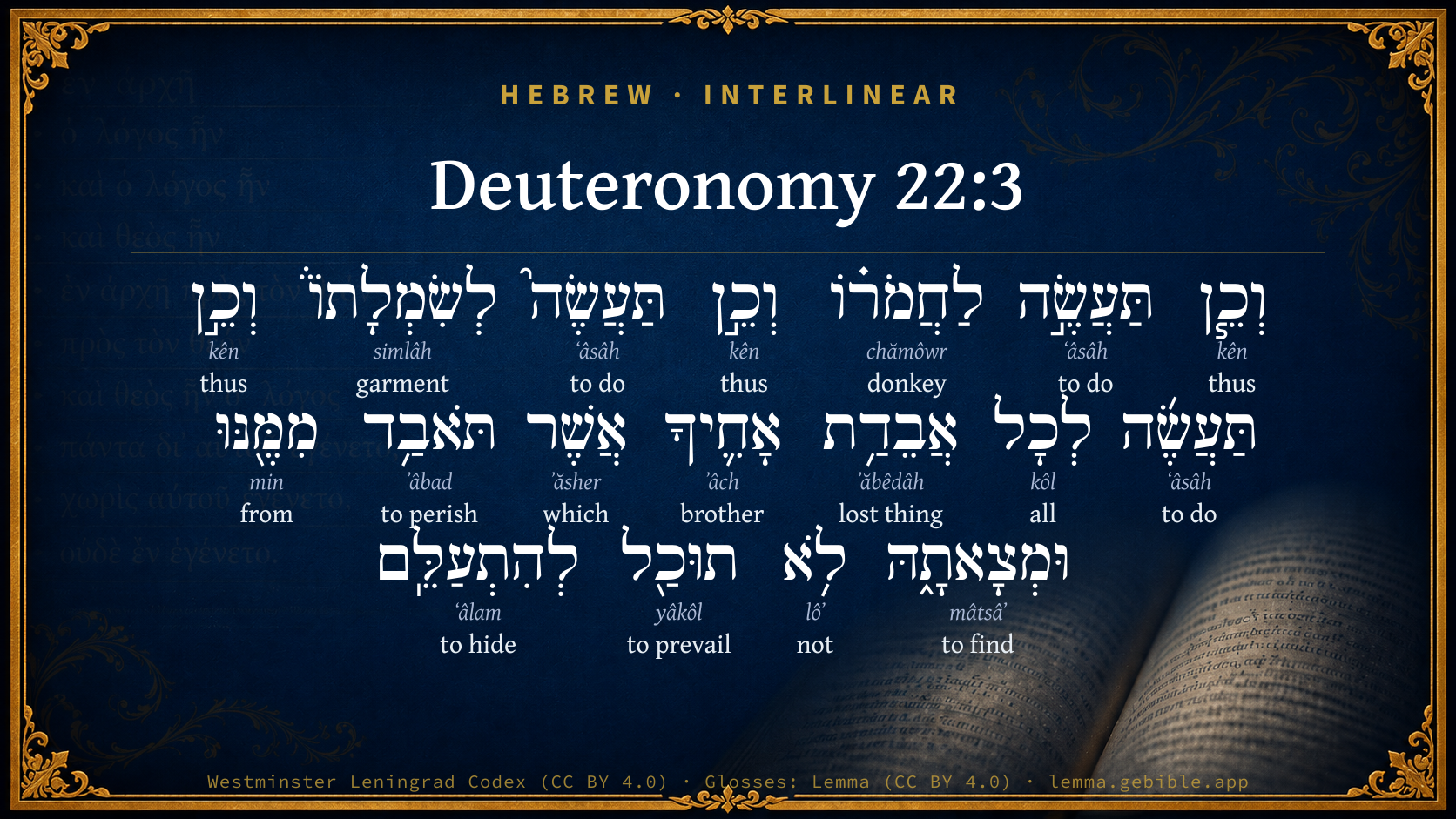
Hebrew (Westminster Leningrad Codex) Deuteronomy 22:3 appears in the Hebrew Old Testament. The text above is from the Westminster Leningrad Codex. Each word links to its Strong’s number, a concise gloss, and parsing drawn from the Open Scriptures Hebrew Bible morphology. Click any word for its full Brown-Driver-Briggs (BDB) entry.
Download image
Cite this verse

Deuteronomy 22:3 (World English Bible). Public Domain. Lemma interlinear Bible study tool, https://lemma.gebible.app/v/deuteronomy/22/3.

Show BibTeX & RIS
BibTeX
RIS
English Translation
So shall you do with his donkey; and so shall you do with his garment; and so shall you do with every lost thing of your brother's, which he has lost, and you have found: you may not hide yourself.
World English Bible · Public Domain
Download a study sheet

One document with this verse’s original text, its word-by-word gloss line, the meaning frame, cross-references with their text, attributed commentary, and full source and license credits — printable, and it pastes into notes with its structure intact.

This verse Autodidact and up

Study sheet (.html) Plain text (.txt)

A passage Seminary Student

Up to 50 verses in one chapter. A passage sheet keeps up to 6 commentary sources and 12 cross-references per verse, in the order this page ranks them, and says so on the sheet whenever that leaves anything out. Ask for a single verse and you get the Autodidact verse sheet above.

Everything on this page stays free to read, with no account — the sheet is a download of what is already on screen, not access to it.

Want to remove ads? Support Godless Engineer
Compare translations 3

The same verse in 3 English versions, stacked beneath the original-language interlinear above. Click any original word for its lexicon entry.

Each is an independent rendering of the whole verse — the interlinear is not word-aligned to these translations.

Highlighted words mark where these versions differ — a whole-verse word diff, not a word-by-word alignment.

  • World English Bible Public Domain
    So shall you do with his donkey; and so shall you do with his garment; and so shall you do with every lost thing of your brother's, which he has lost, and you have found: you may not hide yourself.
  • King James Version Public Domain
    In like manner shalt thou do with his ass; and so shalt thou do with his raiment; and with all lost thing of thy brother's, which he hath lost, and thou hast found, shalt thou do likewise: thou mayest not hide thyself.
  • unfoldingWord Literal Text CC BY-SA 4.0
    And thus you shall do for his donkey; and thus you shall do for his clothing; and thus you shall do for every lost thing of your brother, which is lost from him and you have found it; you shall not hide yourself.

unfoldingWord Literal Text — © unfoldingWord, licensed CC BY-SA 4.0. Word-aligned USFM3 via Door43 (git.door43.org/unfoldingWord/en_ult).

Versions to compare (up to 4)

3 of 4 selected

Show all 18 translations

Every available English version of this verse, each an independent rendering of the whole verse.

  • World English Bible Public Domain
    So shall you do with his donkey; and so shall you do with his garment; and so shall you do with every lost thing of your brother's, which he has lost, and you have found: you may not hide yourself.
  • Berean Standard Bible Public Domain
    And you shall do the same for his donkey, his cloak, or anything your brother has lost and you have found. You must not ignore it.
  • Majority Standard Bible Public Domain
    And you shall do the same for his donkey, his cloak, or anything your brother has lost and you have found. You must not ignore it.
  • King James Version Public Domain
    In like manner shalt thou do with his ass; and so shalt thou do with his raiment; and with all lost thing of thy brother's, which he hath lost, and thou hast found, shalt thou do likewise: thou mayest not hide thyself.
  • American Standard Version (1901) Public Domain
    And so shalt thou do with his ass; and so shalt thou do with his garment; and so shalt thou do with every lost thing of thy brother's, which he hath lost, and thou hast found: thou mayest not hide thyself.
  • Revised Version (1885) Public Domain
    And so shalt thou do with his ass; and so shalt thou do with his garment; and so shalt thou do with every lost thing of thy brother’s, which he hath lost, and thou hast found: thou mayest not hide thyself.
  • Geneva Bible (1599) Public Domain
    In like maner shalt thou do with his asse, and so shalt thou do with his rayment, and shalt so doe with all lost things of thy brother, which he hath lost: if thou hast found them, thou shalt not withdraw thy selfe from them.
  • Douay-Rheims (1899) Public Domain
    Thou shalt do in like manner with his ass, and with his raiment, and with every thing that is thy brother's, which is lost: if thou find it, neglect it not as pertaining to another.
  • Young's Literal Translation Public Domain
    and so thou dost to his ass, and so thou dost to his garment, and so thou dost to any lost thing of thy brother's, which is lost by him, and thou hast found it; thou art not able to hide thyself.
  • Literal Standard Version CC BY-SA 4.0
    and so you do to his donkey, and so you do to his garment, and so you do to any lost thing of your brother’s, which is lost by him, and you have found it; you are not able to hide yourself.
  • Unlocked Literal Bible CC BY-SA 4.0
    You must do the same with his donkey; you must do the same with his garment; you must do the same with every lost thing of your fellow Israelite's, anything that he has lost and you have found; you must not hide yourself.
  • unfoldingWord Literal Text CC BY-SA 4.0
    And thus you shall do for his donkey; and thus you shall do for his clothing; and thus you shall do for every lost thing of your brother, which is lost from him and you have found it; you shall not hide yourself.
  • Darby Bible Public Domain
    And so shalt thou do with his ass; and so shalt thou do with his clothing; and so shalt thou do with everything that is lost of thy brother, which he loseth, and thou findest: thou mayest not hide thyself.
  • World Messianic Bible Public Domain
    So you shall do with his donkey. So you shall do with his garment. So you shall do with every lost thing of your brother’s, which he has lost and you have found. You may not hide yourself.
  • Webster's Bible Public Domain
    In like manner shalt thou do with his ass; and so shalt thou do with his raiment; and with all lost things of thy brother's, which he hath lost, and thou hast found, shalt thou do likewise: thou mayest not hide thyself.
  • Free Bible Version CC BY-SA 4.0
    Do the same for whatever else you find that someone has lost—a donkey, a cloak, anything. Don't just ignore it.
  • Bible in Basic English Public Domain
    Do the same with his ass or his robe or anything which has gone from your brother's keeping and which you have come across: do not keep it to yourself.
  • JPS Tanakh (1917) Public Domain
    And so shalt thou do with his ass; and so shalt thou do with his garment; and so shalt thou do with every lost thing of thy brother's, which he hath lost, and thou hast found; thou mayest not hide thyself.

Literal Standard Version (2020), Covenant Press — licensed CC BY-SA 4.0. Text via the HelloAO Bible API (eBible.org). Unlocked Literal Bible (unfoldingWord) — licensed CC BY-SA 4.0. Text via the HelloAO Bible API (eBible.org). unfoldingWord Literal Text — © unfoldingWord, licensed CC BY-SA 4.0. Word-aligned USFM3 via Door43 (git.door43.org/unfoldingWord/en_ult). Free Bible Version, Dr. Jonathan Gallagher — licensed CC BY-SA 4.0. Text via the HelloAO Bible API (eBible.org).

Word by word

More ways to search: Search by grammar → Find every occurrence → Compare this word →

Practice this passage: Drill this verse → Learn its vocabulary →

אֲבֵדַ֥ת
ʼăbêdâh
H9
“lost thing of”
Noun, Common, Feminine, Singular, Construct
Part of Speech
Noun
Type
Common
Gender
Feminine
Number
Singular
State
Construct
Full BDB Definition

Origin: from H6

TWOT: 2b

a lost thing, something lost
  1. וְכֵ֧ן kên H3651 “and · thus” Conjunction + Particle, Demonstrative
  2. תַּעֲשֶׂ֣ה ʻâsâh H6213 “to do” Verb, Qal, Imperfect, 2nd Person, Masculine, Singular
  3. לַחֲמֹר֗וֹ chămôwr H2543 “to/for · donkey · his” Preposition + Noun, Common, Both, Singular, Construct + Suffix, Personal, 3rd Person, Masculine, Singular
  4. וְכֵ֣ן kên H3651 “and · thus” Conjunction + Particle, Demonstrative
  5. תַּעֲשֶׂה֮ ʻâsâh H6213 “to do” Verb, Qal, Imperfect, 2nd Person, Masculine, Singular
  6. לְשִׂמְלָתוֹ֒ simlâh H8071 “to/for · garment · his” Preposition + Noun, Common, Feminine, Singular, Construct + Suffix, Personal, 3rd Person, Masculine, Singular
  7. וְכֵ֣ן kên H3651 “and · thus” Conjunction + Particle, Demonstrative
  8. תַּעֲשֶׂ֜ה ʻâsâh H6213 “to do” Verb, Qal, Imperfect, 2nd Person, Masculine, Singular
  9. לְכָל kôl H3605 “to/for · all of” Preposition + Noun, Common, Masculine, Singular, Construct
  10. אָחִ֛יךָ ʼâch H251 “brother · your” Noun, Common, Masculine, Singular, Construct + Suffix, Personal, 2nd Person, Masculine, Singular
  11. אֲשֶׁר ʼăsher H834 “which” Particle, Relative
  12. תֹּאבַ֥ד ʼâbad H6 “to perish” Verb, Qal, Imperfect, 3rd Person, Feminine, Singular
  13. מִמֶּ֖נּוּ min H4480 “from · us” Preposition + Suffix, Personal, 1st Person, Common, Plural
  14. וּמְצָאתָ֑הּ mâtsâʼ H4672 “and · to find · her” Conjunction + Verb, Qal, Sequential Perfect, 2nd Person, Masculine, Singular + Suffix, Personal, 3rd Person, Feminine, Singular
  15. לֹ֥א lôʼ H3808 “not” Particle, Negative
  16. תוּכַ֖ל yâkôl H3201 “to prevail” Verb, Qal, Imperfect, 2nd Person, Masculine, Singular
  17. לְהִתְעַלֵּֽם ʻâlam H5956 “to hide” Preposition + Verb, Hithpael, Infinitive Construct

About this verse

These counts appear in no published source. They are computed here, from the morphology-tagged text and Lemma’s own curated glosses. What Lemma adds →

18
words
14
distinct lemmas
Pentateuch
section

Notable vocabulary

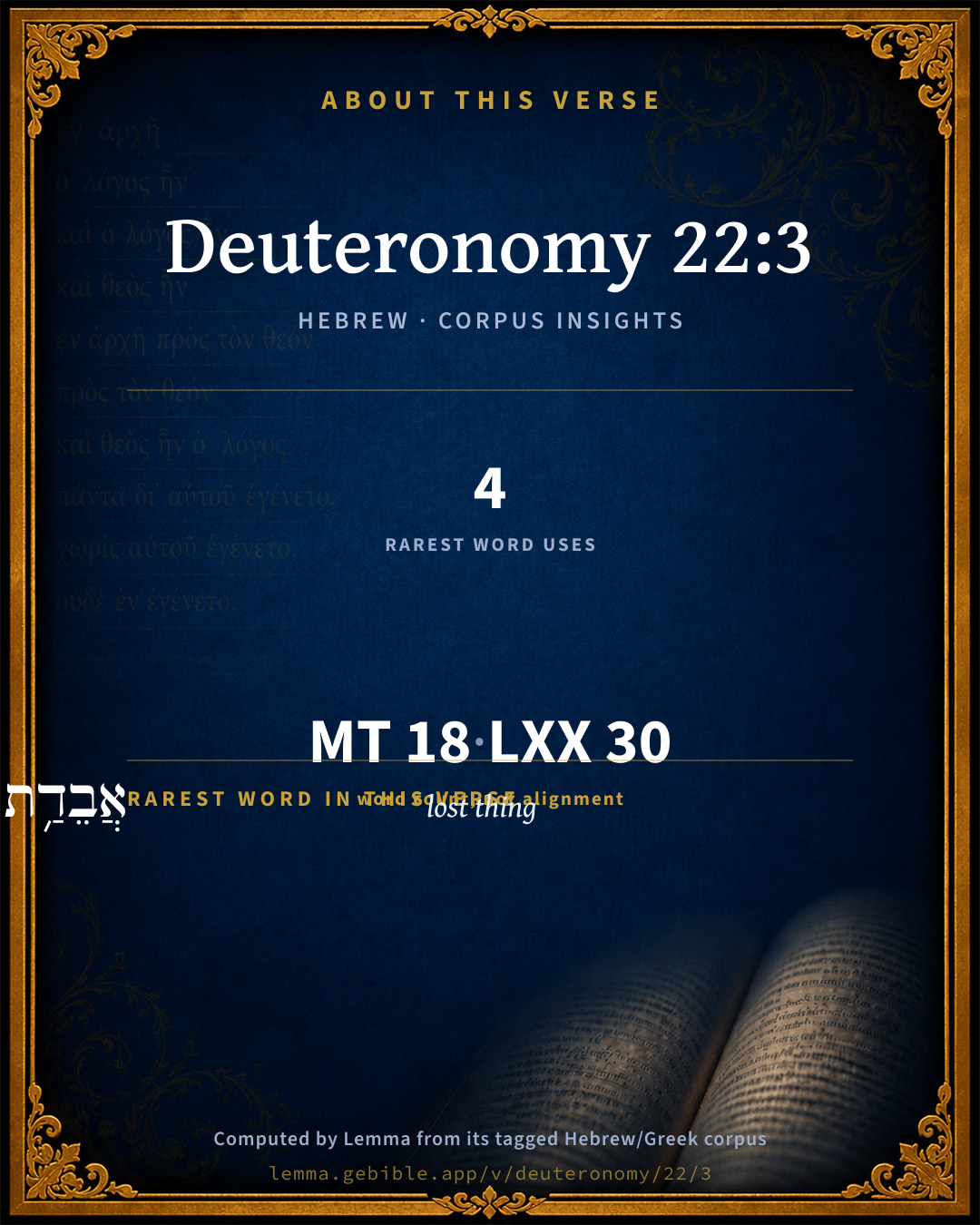
The rarest word here is אֲבֵדַ֥ת lost thing H9 — appearing just 4 times in the whole Hebrew Bible.

Shared distinctive vocabulary

אֲבֵדַ֥ת lost thing H9 occurs in 4 verses of the Hebrew Bible. Also found in:

Grammatical profile

  • 7 verbs
  • 5 nouns
  • 1 preposition
  • 5 particles

Verb forms

  • תַּעֲשֶׂ֣ה Qal · Imperfect
  • תַּעֲשֶׂה֮ Qal · Imperfect
  • תַּעֲשֶׂ֜ה Qal · Imperfect
  • תֹּאבַ֥ד Qal · Imperfect
  • וּמְצָאתָ֑הּ Qal · Sequential Perfect
  • תוּכַ֖ל Qal · Imperfect
  • לְהִתְעַלֵּֽם Hithpael · Infinitive Construct

Repetition

Words recur within this verse — often emphatic in Hebrew:

  • וְכֵ֧ן thus H3651 ×3
  • תַּעֲשֶׂ֣ה to do H6213 ×3

Hebrew & Septuagint length

In English translation the verse runs 40 words from the Hebrew and 47 from the Septuagint (LXX English) — closely comparable.

A rough comparison of the two English renderings, which tokenize alike — not a word-level alignment.

Word counts can differ between the Hebrew and the Greek without any difference in meaning — e.g. the Hebrew direct-object marker אֵת has no separate Greek word, and Greek often adds the article ὁ.

In the original languages it is 18 Hebrew tokens and 30 Greek tokens — but the two are counted differently (Hebrew bundles its prefixes and suffixes into one token; the Greek is in lemma form), so that isn’t a like-for-like length.

Hebrew and Greek witnesses Masoretic Hebrew ↔ Greek Septuagint

The same verse in the two great witnesses to the Old Testament, shown verse-for-verse.

These are two independent witnesses, not word-aligned to each other, and the Septuagint is shown in lemma (dictionary) form.

Hebrew Deuteronomy 22:3 Masoretic · Westminster Leningrad Codex

וְכֵ֧ן תַּעֲשֶׂ֣ה לַחֲמֹר֗וֹ וְכֵ֣ן תַּעֲשֶׂה֮ לְשִׂמְלָתוֹ֒ וְכֵ֣ן תַּעֲשֶׂ֜ה לְכָל אֲבֵדַ֥ת אָחִ֛יךָ אֲשֶׁר תֹּאבַ֥ד מִמֶּ֖נּוּ וּמְצָאתָ֑הּ לֹ֥א תוּכַ֖ל לְהִתְעַלֵּֽם

So shall you do with his donkey; and so shall you do with his garment; and so shall you do with every lost thing of your brother's, which he has lost, and you have found: you may not hide yourself.

World English Bible · Public Domain

Greek LXX Deuteronomy 22:3 Septuagint · lemma form

οὕτως ποιέω ὁ ὄνος αὐτός καί οὕτως ποιέω ὁ ἱμάτιον αὐτός καί οὕτως ποιέω κατά πᾶς ἀπώλεια ὁ ἀδελφός σύ ὅσος ἐάν ἀποὀλλύω παρά αὐτός καί εὑρίσκω οὐ δύναμαι ὑπερὁράω

Thus shall you do to his ass, and thus shall you do to his garment, and thus shall you do to every thing that your brother has lost; whatever shall have been lost by him, and you shall have found, you shall not have power to overlook.

LXX2012 (modern English Septuagint) · Public Domain

Hebrew: Westminster Leningrad Codex (CC BY 4.0). Greek: Septuagint (public domain); English from LXX2012 (modern English Septuagint) (Public Domain). How the Septuagint differs from the Hebrew →

Targum (Aramaic paraphrase)

2

The Targum is the ancient Jewish Aramaic paraphrase of the Hebrew Scriptures — an interpretive translation, not the Hebrew text itself. Onkelos (literal) and Pseudo-Jonathan (expansive) render the Torah, and Jonathan the Prophets. Coverage is partial: where no permissively-licensed English translation exists for a verse, only the Aramaic is shown. This is verse-level text, not a word-by-word alignment to the Hebrew.

  1. Targum Onkelos Torah (Genesis–Deuteronomy)
    וְכֵן תַּעְבֵּד לַחֲמָרֵהּ וְכֵן תַּעְבֵּד לִכְסוּתֵהּ וְכֵן תַּעְבֵּד לְכָל אֲבֵדַת אֲחוּךְ דִי תֵיבַד מִנֵהּ וְתַשְׁכְּחִנַהּ לֵית לָךְ רְשׁוּ לְאִתְכַּסָאָה

    (no public-domain English translation for this verse)

    Targum Onkelos — Aramaic: “Onkelos Genesis” (public domain); “Onkelos Exodus” (public domain); “Onkelos Leviticus” (public domain); “Onkelos Numbers” (public domain); “Onkelos Deuteronomy” (public domain). English: “Sefaria Community Translation” (CC0 1.0 (public-domain dedication)); “J.W. Etheridge. The Targums of Onkelos and Jonathan Ben Uzziel on the Pentateuch. London: Longmans, Green, 1862” (public domain). Text via Sefaria.

  2. Targum Pseudo-Jonathan Torah (Genesis–Deuteronomy)
    וְהֵיכְדֵין תַּעֲבֵיד לְחַמְרֵיהּ וְהֵיכְדֵין תַּעֲבֵיד לִכְסוּתֵיהּ וְהֵיכְדֵין תַּעֲבֵיד לְכָל אֲבֵידְתָּא דְּאָחוּךְ דִּי מִתְבְּדָא מִנֵּיהּ וְתַשְׁכְּחָהּ לֵית לָךְ רְשׁוּ לְכַסָּאָהּ מִינֵיהּ אַכְרִיז עֲלָהּ וּתְהַדְרִינָהּ

    So shalt thou do with his ass, with his garment, and with any lost thing of thy brother’s. If thou find, it is not lawful for thee to hide it from him; thou shalt cry it, and restore it.

    Targum Pseudo-Jonathan — Aramaic: “Targum Jonathan on Genesis” (public domain); “Targum Jonathan on Exodus” (public domain); “Targum Jonathan on Leviticus” (public domain); “Targum Jonathan on Numbers” (public domain); “Targum Jonathan on Deuteronomy” (public domain). English: “The Targum of Jonathan ben Uzziel, trans. J. W. Etheridge, London, 1862” (public domain). Text via Sefaria.

Commentary

Notes on Deuteronomy 22:3 from classic Christian and Jewish commentators (each source and its license shown beneath its notes). The classic Christian expositions comment on the surrounding passage and are grouped to its opening verse, so a note may address several verses; the Jewish commentaries on the Tanakh (Rashi and others) are per-verse, so they appear only where the commentator wrote on this verse.

Lemma curates 59 commentaries, every one of them public domain or Creative Commons licensed, each selected and text-cleaned for this edition rather than reprinted as found. About our sources →

Geneva Bible (1599)

Geneva Bible translators

Much more art thou bound to do for thy neighbor’s person.

Geneva Bible (1599) marginal notes — public domain. Text via Bolls.life.

Adam Clarke's Commentary

Verse 3. Thou mayest not hide thyself.] Thou shalt not keep out of the way of affording help, nor pretend thou didst not see occasion to render thy neighbour any service. The priest and the Levite, when they saw the wounded man, passed by on the other side of the way, Lu 10:31-32. This was a notorious breach of the merciful law mentioned above.

Adam Clarke's Commentary on the Bible (1810–1826) — public domain. Text from a community e-Sword/MySword module.

The Cambridge Bible for Schools and Colleges

gen. ed. J. J. S. Perowne

3. thou mayest not] As in Deu_12:17, q.v., etc.

The Cambridge Bible for Schools and Colleges (gen. ed. J. J. S. Perowne; Cambridge University Press, 1878–1918) — public domain. Text from a community e-Sword module.

John Gill's Exposition

In like manner shall thou do with his ass,.... As with his ox or sheep when astray, and found, keep it until it is owned, and then restore it; this is expressly mentioned in Exo 23:4.

and so shalt thou do with his raiment; if that is lost and found, it must be restored to the owner, he describing it; a garment is particularly mentioned, it is said (a), because in every garment there is a mark or sign by which the owners can inquire about it; for it is made by the hands of men, and does not come from anything common:

and with all lost things of thy brother's, which he hath lost, and thou hast found, shalt thou do likewise: this comprehends everything that is lost, that is properly so; it is asked (b);"what is a lost thing? if a man finds an ox or a cow feeding in the way, this is not a lost thing; an ass whose instruments are inverted, and a cow running among the vineyards, this is a lost thing:"

thou mayest not hide thyself: from seeing it and taking care of it, in order to restore it to the right owner; or dissemble a sight of it, and pretend he never saw it, and so entirely neglect it. In some instances the Jews allow they were not obliged to take any notice or care of it, as,"if a man find a cow in a cow house (which is not shut), he is not obliged (to take care of it); if in a public place, he is obliged; if it is in a burying ground he may not defile himself for it (c).''

(a) Bartenora in Misn. Bava Metzia, c. 2. sect. 5. (b) Misn. ib. sect. 9. (c) Ib. sect. 10.

John Gill's Exposition of the Whole Bible (1746–1763) — public domain (CC PDM 1.0). Text via the HelloAO Bible API.

Haydock's Catholic Bible Commentary

If, &c. Hebrew, "thou must not hide thyself," so as to pass it by, nor yet conceal it from the right owner. When a thing is certainly abandoned by him, it belongs to the person who seizes it first; but if it be only lost it, must surely be restored, if possible, (Grotius, Jur. ii. 10,) as nature forbids us to take advantage of another’s misfortune. (Cicero) --- The Rabbins have corrupted this law, like so many others, by their evil interpretations. They pretend that a Jew must restore what he has found belonging to another true believer, if it have certain marks by which it may be known, but not if it belonged to a prevaricator or infidel. In the former supposition, they got the thing cried on a high stone near Jerusalem four times, and if the owner did not then claim his property, the finder might keep it. (Selden, Jur. vi. 4.) --- The inhabitants of Cumæ condemned the next neighbour to restore what had been lost; as Hesiod (op. 348,) very well remarks, that things would not easily be lost, if the neighbours were not ill-disposed.

George Leo Haydock (1774–1849), Haydock's Catholic Family Bible and Commentary, 1859 edition — public domain. Excludes Psalms (Douay-Rheims chapter numbering differs from Protestant) and Deuterocanonical books (Catholic canon only).

Matthew Poole's English Annotations

i.e. Dissemble that thou hast found it. Or, hide it, i.e. conceal the thing lost.

Matthew Poole's English Annotations on the Holy Bible (1683–1685) — public domain. Text from a community e-Sword/MySword module.

John Wesley's Explanatory Notes

Hide thyself - Dissemble that thou hast found it. Or, hide it, that is, conceal the thing lost.

John Wesley, Explanatory Notes Upon the Whole Bible (1754–1765) — public domain. Text via the GEBible commentary corpus.

unfoldingWord translationNotes

Door43 World Missions Community

General Information:

Moses speaks to the Israelites as if they were one man, so the words "you" and "your" here are singular. (See: Forms of You)

You must do the same with his donkey

"You must return his donkey in the same way"

you must do the same with his garment

"you must return his clothing in the same way"

you must not hide yourself

This is an idiom. AT: "you must not act as if you do not see that he has lost something" or "you must not go away without doing anything" (See: Idiom)

you must surely help him to lift it up again

"you must help your fellow Israelite lift the animal back up onto its feet"

translationWords

donkey

Israel

cow

unfoldingWord translationNotes — © Distant Shores Media and the Door43 World Missions Community, licensed CC BY-SA 4.0. Source: git.door43.org/Door43/en_tn.

Rashi

Rabbi Shlomo Yitzchaki (Rashi)

לא תוכל להתעלם THOU MAYEST NOT HIDE THYSELF — i.e. You must not cover your eyes, pretending not to see it.

Rashi on the Tanakh — English translations: “The Judaica Press complete Tanach with Rashi, translated by A. J. Rosenberg” (CC BY 4.0); “Pentateuch with Rashi's commentary by M. Rosenbaum and A.M. Silbermann, 1929-1934” (public domain); “The Metsudah Tanach series, Lakewood, N.J” (CC BY 4.0); and “The Book of Joshua, Metsudah Publications, 1997” (CC BY 4.0). Text via Sefaria.

Lesson kit

Teaching starters — assembled from the data on this page, not authored interpretation. Every prompt links to the verse data it draws on. Edit before teaching.

Deuteronomy, in the Pentateuch, opens this verse with 18 words (14 distinct Hebrew lemmas). Its most distinctive word is ʼăbêdâh (“lost thing”). A historical commentator’s framing appears above. Read the whole chapter for the surrounding context.

Discussion questions

  1. What does “lost thing” (ʼăbêdâh) contribute to the verse as a whole?
  2. Exodus 22:9 shares the word «lost thing» with this verse. How do the two illuminate each other?
  3. “thus” occurs 3× in this one verse. What is the effect of the repetition?
  4. The translations on this page render this verse differently — a whole-verse word diff, not a word-by-word alignment. What might account for the different wordings?
  5. The verb «תַּעֲשֶׂ֣ה» is Qal Imperfect. How does its form color the action?
  6. Reading how Geneva Bible (1599) and Adam Clarke's Commentary read this verse, where do the two commentators agree and where do they part?

Things to notice

Reading settings

Reading text

Shown beneath each verse's original-language words.

Old Testament
Old Testament edition

Read the OT as the Masoretic Hebrew (MT) or the Greek Septuagint (LXX).

English shown for the Greek Septuagint (in the Hebrew ↔ Greek comparison).

Comparing translations? Open the Compare panel on any verse page to stack up to four side by side.