
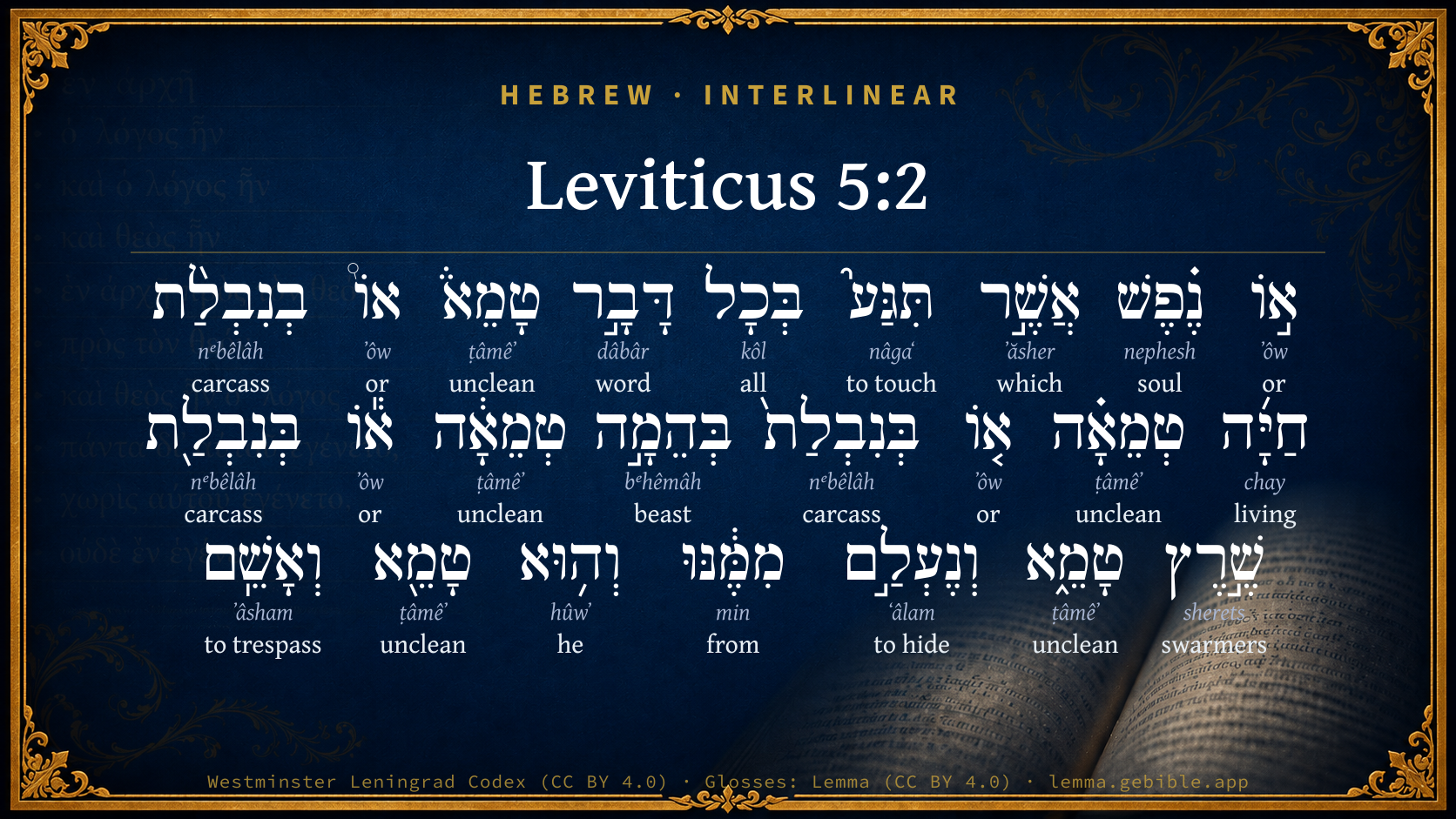
Leviticus 5:2

Hebrew (Westminster Leningrad Codex) Leviticus 5:2 appears in the Hebrew Old Testament. The text above is from the Westminster Leningrad Codex. Each word links to its Strong’s number, a concise gloss, and parsing drawn from the Open Scriptures Hebrew Bible morphology. Click any word for its full Brown-Driver-Briggs (BDB) entry.
Download image
Cite this verse

Leviticus 5:2 (World English Bible). Public Domain. Lemma interlinear Bible study tool, https://lemma.gebible.app/v/leviticus/5/2.

Show BibTeX & RIS
BibTeX
RIS
English Translation
"'Or if anyone touches any unclean thing, whether it is the carcass of an unclean animal, or the carcass of unclean cattle, or the carcass of unclean creeping things, and it is hidden from him, and he is unclean, then he shall be guilty.
World English Bible · Public Domain
Highlights
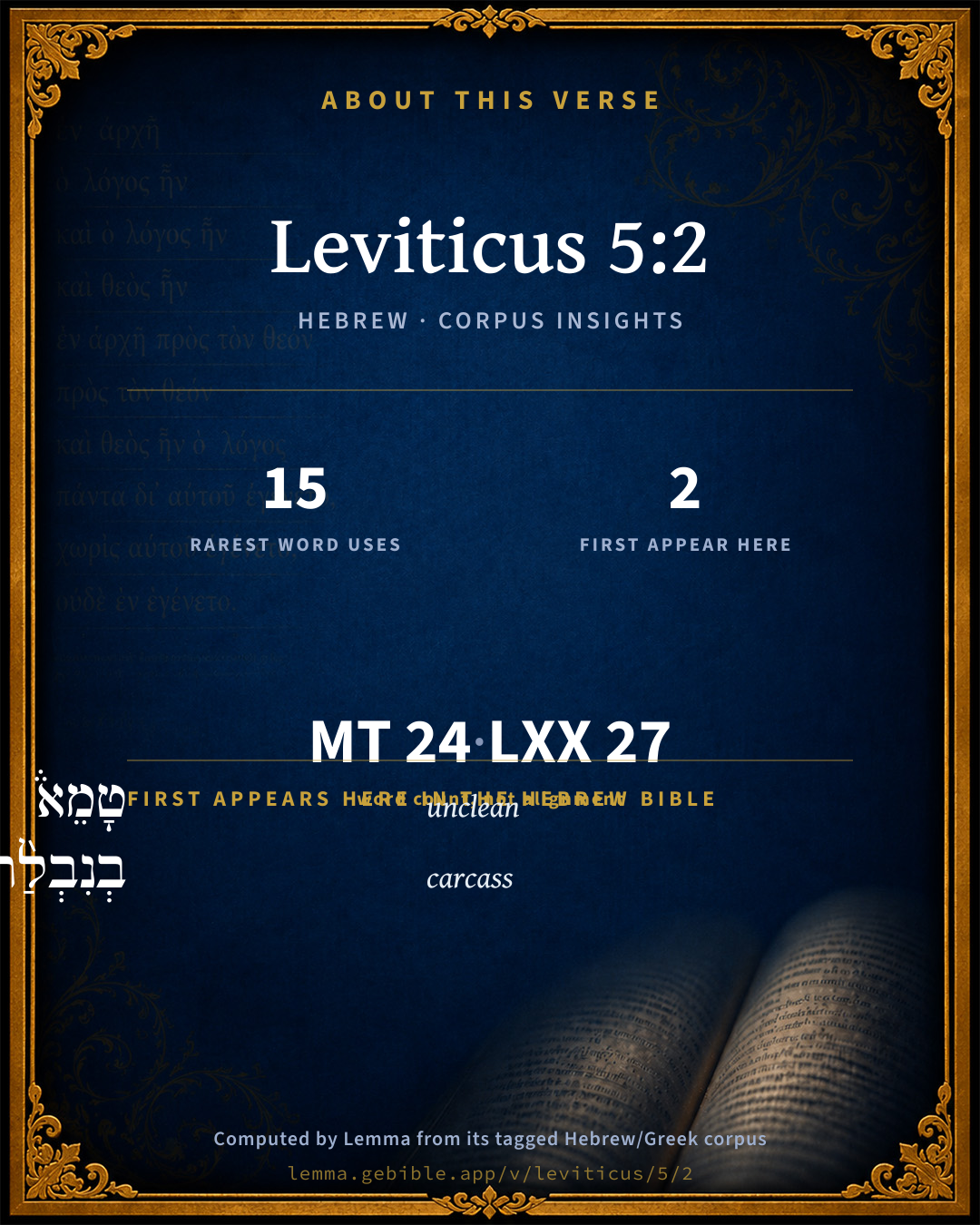
  • 2 first appearances in the Hebrew Bible
Full analysis ↓
Download a study sheet

One document with this verse’s original text, its word-by-word gloss line, the meaning frame, cross-references with their text, attributed commentary, and full source and license credits — printable, and it pastes into notes with its structure intact.

This verse Autodidact and up

Study sheet (.html) Plain text (.txt)

A passage Seminary Student

Up to 50 verses in one chapter. A passage sheet keeps up to 6 commentary sources and 12 cross-references per verse, in the order this page ranks them, and says so on the sheet whenever that leaves anything out. Ask for a single verse and you get the Autodidact verse sheet above.

Everything on this page stays free to read, with no account — the sheet is a download of what is already on screen, not access to it.

Want to remove ads? Support Godless Engineer
Compare translations 3

The same verse in 3 English versions, stacked beneath the original-language interlinear above. Click any original word for its lexicon entry.

Each is an independent rendering of the whole verse — the interlinear is not word-aligned to these translations.

Highlighted words mark where these versions differ — a whole-verse word diff, not a word-by-word alignment.

  • World English Bible Public Domain
    "'Or if anyone touches any unclean thing, whether it is the carcass of an unclean animal, or the carcass of unclean cattle, or the carcass of unclean creeping things, and it is hidden from him, and he is unclean, then he shall be guilty.
  • King James Version Public Domain
    Or if a soul touch any unclean thing, whether it be a carcass of an unclean beast, or a carcass of unclean cattle, or the carcass of unclean creeping things, and if it be hidden from him; he also shall be unclean, and guilty.
  • unfoldingWord Literal Text CC BY-SA 4.0
    Or a person, when he touches any unclean thing, whether the unclean carcass of an animal or the unclean carcass of livestock or the carcass of an unclean creeping animal, and it is hidden from him, then he unclean and he will be guilty.

unfoldingWord Literal Text — © unfoldingWord, licensed CC BY-SA 4.0. Word-aligned USFM3 via Door43 (git.door43.org/unfoldingWord/en_ult).

Versions to compare (up to 4)

3 of 4 selected

Show all 18 translations

Every available English version of this verse, each an independent rendering of the whole verse.

  • World English Bible Public Domain
    "'Or if anyone touches any unclean thing, whether it is the carcass of an unclean animal, or the carcass of unclean cattle, or the carcass of unclean creeping things, and it is hidden from him, and he is unclean, then he shall be guilty.
  • Berean Standard Bible Public Domain
    Or if a person touches anything unclean—whether the carcass of any unclean wild animal or livestock or crawling creature—even if he is unaware of it, he is unclean and guilty.
  • Majority Standard Bible Public Domain
    Or if a person touches anything unclean—whether the carcass of any unclean wild animal or livestock or crawling creature—even if he is unaware of it, he is unclean and guilty.
  • King James Version Public Domain
    Or if a soul touch any unclean thing, whether it be a carcass of an unclean beast, or a carcass of unclean cattle, or the carcass of unclean creeping things, and if it be hidden from him; he also shall be unclean, and guilty.
  • American Standard Version (1901) Public Domain
    Or if any one touch any unclean thing, whether it be the carcass of an unclean beast, or the carcass of unclean cattle, or the carcass of unclean creeping things, and it be hidden from him, and he be unclean, then he shall be guilty.
  • Revised Version (1885) Public Domain
    or if any one touch any unclean thing, whether it be the carcase of an unclean beast, or the carcase of unclean cattle, or the carcase of unclean creeping things, and it be hidden from him, and he be unclean, then he shall be guilty:
  • Geneva Bible (1599) Public Domain
    Either if one touche any vncleane thing, whether it be a carion of an vncleane beast, or a carion of vncleane cattel, or a carion of vncleane creeping things, and is not ware of it, yet he is vncleane, and hath offended:
  • Douay-Rheims (1899) Public Domain
    Whosoever toucheth any unclean thing, either that which hath been killed by a beast, or died of itself, or any other creeping thing: and forgetteth his uncleanness, he is guilty, and hath offended:
  • Young's Literal Translation Public Domain
    `Or when a person cometh against any thing unclean, or against a carcase of an unclean beast, or against a carcase of unclean cattle, or against a carcase of an unclean teeming creature, and it hath been hidden from him, and he unclean, and guilty;
  • Literal Standard Version CC BY-SA 4.0
    Or when a person comes against anything unclean, or against a carcass of an unclean beast, or against a carcass of unclean livestock, or against a carcass of an unclean teeming creature, and it has been hidden from him, then he [is] unclean and guilty;
  • Unlocked Literal Bible CC BY-SA 4.0
    Or if anyone touches anything God has designated as unclean, whether it be the carcass of an unclean wild animal or the carcass of any livestock that has died, or creeping animal, even if the person did not intend to touch it, he is unclean and guilty.
  • unfoldingWord Literal Text CC BY-SA 4.0
    Or a person, when he touches any unclean thing, whether the unclean carcass of an animal or the unclean carcass of livestock or the carcass of an unclean creeping animal, and it is hidden from him, then he unclean and he will be guilty.
  • Darby Bible Public Domain
    Or if any one touch any unclean thing, whether it be the carcase of an unclean beast, or the carcase of unclean cattle, or the carcase of an unclean crawling thing, and it be hid from him, -- he also is unclean and guilty;
  • World Messianic Bible Public Domain
    “‘Or if anyone touches any unclean thing, whether it is the carcass of an unclean animal, or the carcass of unclean livestock, or the carcass of unclean creeping things, and it is hidden from him, and he is unclean, then he shall be guilty.
  • Webster's Bible Public Domain
    Or if a soul shall touch any unclean thing, whether a carcass of an unclean beast, or a carcass of unclean cattle, or the carcass of unclean creeping animals, and it shall be hidden from him; he also shall be unclean, and guilty.
  • Free Bible Version CC BY-SA 4.0
    If you touch anything unclean such as the dead body of any unclean wild animal or farm animal or vermin, even if you're unaware of it, you become unclean and guilty.
  • Bible in Basic English Public Domain
    If anyone becomes unclean through touching unconsciously some unclean thing, such as the dead body of an unclean beast or of unclean cattle or of any unclean animal which goes flat on the earth, he will be responsible:
  • JPS Tanakh (1917) Public Domain
    or if any one touch any unclean thing, whether it be the carcass of an unclean beast, or the carcass of unclean cattle, or the carcass of unclean swarming things, and be guilty, it being hidden from him that he is unclean;

Literal Standard Version (2020), Covenant Press — licensed CC BY-SA 4.0. Text via the HelloAO Bible API (eBible.org). Unlocked Literal Bible (unfoldingWord) — licensed CC BY-SA 4.0. Text via the HelloAO Bible API (eBible.org). unfoldingWord Literal Text — © unfoldingWord, licensed CC BY-SA 4.0. Word-aligned USFM3 via Door43 (git.door43.org/unfoldingWord/en_ult). Free Bible Version, Dr. Jonathan Gallagher — licensed CC BY-SA 4.0. Text via the HelloAO Bible API (eBible.org).

Word by word

More ways to search: Search by grammar → Find every occurrence → Compare this word →

Practice this passage: Drill this verse → Learn its vocabulary →

שֶׁ֣רֶץ
sherets
H8318
“swarmers”
Noun, Common, Masculine, Singular, Absolute
Part of Speech
Noun
Type
Common
Gender
Masculine
Number
Singular
State
Absolute
Full BDB Definition

Origin: from H8317

TWOT: 2467a

teeming or swarming things, creepers, swarmers - of insects, animals, small reptiles, quadrupeds
  1. א֣וֹ ʼôw H176 “or” Conjunction
  2. נֶ֗פֶשׁ nephesh H5315 “soul” Noun, Common, Both, Singular, Absolute
  3. אֲשֶׁ֣ר ʼăsher H834 “which” Particle, Relative
  4. תִּגַּע֮ nâgaʻ H5060 “to touch” Verb, Qal, Imperfect, 3rd Person, Feminine, Singular
  5. בְּכָל kôl H3605 “in/at · all of” Preposition + Noun, Common, Masculine, Singular, Construct
  6. דָּבָ֣ר dâbâr H1697 “word” Noun, Common, Masculine, Singular, Absolute
  7. טָמֵא֒ ṭâmêʼ H2931 “unclean” Adjective, Adjective, Masculine, Singular, Absolute
  8. אוֹ֩ ʼôw H176 “or” Conjunction
  9. בְנִבְלַ֨ת nᵉbêlâh H5038 “in/at · carcass of” Preposition + Noun, Common, Feminine, Singular, Construct
  10. חַיָּ֜ה chay H2416 “living” Noun, Common, Feminine, Singular, Absolute
  11. טְמֵאָ֗ה ṭâmêʼ H2931 “unclean” Adjective, Adjective, Feminine, Singular, Absolute
  12. א֤וֹ ʼôw H176 “or” Conjunction
  13. בְּנִבְלַת֙ nᵉbêlâh H5038 “in/at · carcass of” Preposition + Noun, Common, Feminine, Singular, Construct
  14. בְּהֵמָ֣ה bᵉhêmâh H929 “beast” Noun, Common, Feminine, Singular, Absolute
  15. טְמֵאָ֔ה ṭâmêʼ H2931 “unclean” Adjective, Adjective, Feminine, Singular, Absolute
  16. א֕וֹ ʼôw H176 “or” Conjunction
  17. בְּנִבְלַ֖ת nᵉbêlâh H5038 “in/at · carcass of” Preposition + Noun, Common, Feminine, Singular, Construct
  18. טָמֵ֑א ṭâmêʼ H2931 “unclean” Adjective, Adjective, Masculine, Singular, Absolute
  19. וְנֶעְלַ֣ם ʻâlam H5956 “and · to hide” Conjunction + Verb, Niphal, Sequential Perfect, 3rd Person, Masculine, Singular
  20. מִמֶּ֔נּוּ min H4480 “from · us” Preposition + Suffix, Personal, 1st Person, Common, Plural
  21. וְה֥וּא hûwʼ H1931 “and · he” Conjunction + Pronoun, Personal, 3rd Person, Masculine, Singular
  22. טָמֵ֖א ṭâmêʼ H2931 “unclean” Adjective, Adjective, Masculine, Singular, Absolute
  23. וְאָשֵֽׁם ʼâsham H816 “and · to trespass” Conjunction + Verb, Qal, Sequential Perfect, 3rd Person, Masculine, Singular

About this verse

These counts appear in no published source. They are computed here, from the morphology-tagged text and Lemma’s own curated glosses. What Lemma adds →

24
words
15
distinct lemmas
Pentateuch
section

Notable vocabulary

The rarest word here is שֶׁ֣רֶץ swarmers H8318 — appearing just 15 times in the whole Hebrew Bible.

First appearance in Scripture

These words make their first canonical appearance in the Hebrew Bible here:

  • טָמֵא֒ unclean H2931
  • בְנִבְלַ֨ת carcass H5038

Shared distinctive vocabulary

שֶׁ֣רֶץ swarmers H8318 occurs in 15 verses of the Hebrew Bible. Also found in:

Grammatical profile

  • 3 verbs
  • 9 nouns
  • 5 adjectives
  • 1 pronoun
  • 1 preposition
  • 4 conjunctions
  • 1 particle

Verb forms

  • תִּגַּע֮ Qal · Imperfect
  • וְנֶעְלַ֣ם Niphal · Sequential Perfect
  • וְאָשֵֽׁם Qal · Sequential Perfect

Repetition

Words recur within this verse — often emphatic in Hebrew:

  • טָמֵא֒ unclean H2931 ×5
  • בְנִבְלַ֨ת carcass H5038 ×3
  • א֣וֹ or H176 ×4

Hebrew & Septuagint length

In English translation the verse runs 44 words from the Hebrew and 34 from the Septuagint (LXX English) — closely comparable.

A rough comparison of the two English renderings, which tokenize alike — not a word-level alignment.

Word counts can differ between the Hebrew and the Greek without any difference in meaning — e.g. the Hebrew direct-object marker אֵת has no separate Greek word, and Greek often adds the article ὁ.

In the original languages it is 24 Hebrew tokens and 27 Greek tokens — but the two are counted differently (Hebrew bundles its prefixes and suffixes into one token; the Greek is in lemma form), so that isn’t a like-for-like length.

Cross-references

13

Topical passages linked to Leviticus 5:2 in the Treasury of Scripture Knowledge — connected by theme and wording, ordered by reader-vote popularity; previews shown in the World English Bible.

  • Leviticus 5:17 "If anyone sins, and does any of the things which Yahweh has commanded not to be done; though he didn't know it, yet he is guilty, and shall bear his iniquity.
  • Deuteronomy 14:8 The pig, because it has a split hoof but doesn't chew the cud, is unclean to you: of their flesh you shall not eat, and their carcasses you shall not touch.
  • Leviticus 11:11 and you detest them. You shall not eat of their flesh, and you shall detest their carcasses.
  • Leviticus 11:24–40 "'By these you will become unclean: whoever touches the carcass of them shall be unclean until the evening.
  • Numbers 19:11–16 He who touches the dead body of any man shall be unclean seven days:
  • Haggai 2:13 Then Haggai said, "If one who is unclean by reason of a dead body touch any of these, will it be unclean?" The priests answered, "It will be unclean."
  • Leviticus 4:13 "'If the whole congregation of Israel sins, and the thing is hidden from the eyes of the assembly, and they have done any of the things which Yahweh has commanded not to be done, and are guilty;
  • Leviticus 5:4 "'Or if anyone swears rashly with his lips to do evil, or to do good, whatever it is that a man might utter rashly with an oath, and it is hidden from him; when he knows of it, then he shall be guilty of one of these.
  • Leviticus 7:21 When anyone touches any unclean thing, the uncleanness of man, or an unclean animal, or any unclean abomination, and eats some of the flesh of the sacrifice of peace offerings, which belong to Yahweh, that soul shall be cut off from his people.'"
  • Psalms 19:12 Who can discern his errors? Forgive me from hidden errors.
  • Isaiah 52:11 Depart you, depart you, go you out from there, touch no unclean thing; go you out of the midst of her; cleanse yourselves, you who bear the vessels of Yahweh.
  • Luke 11:44 Woe to you, scribes and Pharisees, hypocrites! For you are like hidden graves, and the men who walk over them don't know it."
  • 2 Corinthians 6:17 Therefore, "'Come out from among them, And be separate,' says the Lord, 'Touch no unclean thing. I will receive you.

Cross-references courtesy of OpenBible.info (CC BY 4.0).

Hebrew and Greek witnesses Masoretic Hebrew ↔ Greek Septuagint

The same verse in the two great witnesses to the Old Testament, shown verse-for-verse.

These are two independent witnesses, not word-aligned to each other, and the Septuagint is shown in lemma (dictionary) form.

Hebrew Leviticus 5:2 Masoretic · Westminster Leningrad Codex

א֣וֹ נֶ֗פֶשׁ אֲשֶׁ֣ר תִּגַּע֮ בְּכָל דָּבָ֣ר טָמֵא֒ אוֹ֩ בְנִבְלַ֨ת חַיָּ֜ה טְמֵאָ֗ה א֤וֹ בְּנִבְלַת֙ בְּהֵמָ֣ה טְמֵאָ֔ה א֕וֹ בְּנִבְלַ֖ת שֶׁ֣רֶץ טָמֵ֑א וְנֶעְלַ֣ם מִמֶּ֔נּוּ וְה֥וּא טָמֵ֖א וְאָשֵֽׁם

"'Or if anyone touches any unclean thing, whether it is the carcass of an unclean animal, or the carcass of unclean cattle, or the carcass of unclean creeping things, and it is hidden from him, and he is unclean, then he shall be guilty.

World English Bible · Public Domain

Greek LXX Leviticus 5:2 Septuagint · lemma form

ἤ ψυχή ὅστις ἐάν ἅπτομαι πᾶς πρᾶγμα ἀκάθαρτος ἤ θνησιμαῖος ἤ θηριάλωτος ἀκάθαρτος ἤ ὁ θνησιμαῖος ἤ ὁ βδέλυγμα ὁ ἀκάθαρτος ἤ ὁ θνησιμαῖος κτῆνος ὁ ἀκάθαρτος

That soul which shall touch any unclean thing, or carcass, or that which is unclean being taken of beasts, or the dead bodies of abominable reptiles which are unclean, or carcasses of unclean cattle,

LXX2012 (modern English Septuagint) · Public Domain

On this verse, Ellicott's Commentary for English Readers discusses the Septuagint’s reading. Read the note in Commentary ↓

Hebrew: Westminster Leningrad Codex (CC BY 4.0). Greek: Septuagint (public domain); English from LXX2012 (modern English Septuagint) (Public Domain). How the Septuagint differs from the Hebrew →

Targum (Aramaic paraphrase)

2

The Targum is the ancient Jewish Aramaic paraphrase of the Hebrew Scriptures — an interpretive translation, not the Hebrew text itself. Onkelos (literal) and Pseudo-Jonathan (expansive) render the Torah, and Jonathan the Prophets. Coverage is partial: where no permissively-licensed English translation exists for a verse, only the Aramaic is shown. This is verse-level text, not a word-by-word alignment to the Hebrew.

  1. Targum Onkelos Torah (Genesis–Deuteronomy)
    אוֹ אֱנַשׁ דִי יִקְרַב בְּכָל מִדַעַם מְסָאָב אוֹ בְּנִבְלַת חַיְתָא מְסָאָבָא אוֹ בְּנִבְלַת בְּעִירָא מְסָאָבָא אוֹ בְּנִבְלַת רִחֲשָׁא מְסָאָב וִיהֵי מְכַסָא מִנֵהּ וְהוּא מְסָאָב וְחָב

    (no public-domain English translation for this verse)

    Targum Onkelos — Aramaic: “Onkelos Genesis” (public domain); “Onkelos Exodus” (public domain); “Onkelos Leviticus” (public domain); “Onkelos Numbers” (public domain); “Onkelos Deuteronomy” (public domain). English: “Sefaria Community Translation” (CC0 1.0 (public-domain dedication)); “J.W. Etheridge. The Targums of Onkelos and Jonathan Ben Uzziel on the Pentateuch. London: Longmans, Green, 1862” (public domain). Text via Sefaria.

  2. Targum Pseudo-Jonathan Torah (Genesis–Deuteronomy)
    אוֹ בַר נַשׁ דִי יִקְרַב בְּכָל מִדַעַם דִמְסָאֵיב אוֹ בְּנִיבְלַת חֵיוָא מְסָאַבְתָּא אוֹ בְּנִיבְלַת בְּעִירָא מְסָאַבְתָּא אוֹ בְּנִיבְלַת רְחֵישׁ מְסָאַב וְיִתְכַסֵי מִנֵּיהּ וְהוּא מְסָאֵב וְיִקְרַב בְּכָל קוּדְשַׁיָא וְיִתְחַיֵיב

    Or if a man touch anything, unclean, whether the carcase of an unclean beast, or a carcase of unclean cattle, or the carcase of an unclean reptile, and it be hidden from him, and he, being unclean, shall touch any consecrated thing, he is guilty.

    Targum Pseudo-Jonathan — Aramaic: “Targum Jonathan on Genesis” (public domain); “Targum Jonathan on Exodus” (public domain); “Targum Jonathan on Leviticus” (public domain); “Targum Jonathan on Numbers” (public domain); “Targum Jonathan on Deuteronomy” (public domain). English: “The Targum of Jonathan ben Uzziel, trans. J. W. Etheridge, London, 1862” (public domain). Text via Sefaria.

Commentary

Notes on Leviticus 5:2 from classic Christian and Jewish commentators (each source and its license shown beneath its notes). The classic Christian expositions comment on the surrounding passage and are grouped to its opening verse, so a note may address several verses; the Jewish commentaries on the Tanakh (Rashi and others) are per-verse, so they appear only where the commentator wrote on this verse.

Lemma curates 59 commentaries, every one of them public domain or Creative Commons licensed, each selected and text-cleaned for this edition rather than reprinted as found. About our sources →

Jamieson, Fausset & Brown

Robert Jamieson, A. R. Fausset & David Brown

TOUCHING ANY THING UNCLEAN. (Lev 5:2-3)

if a soul touch any unclean thing--A person who, unknown to himself at the time, came in contact with any thing unclean, and either neglected the requisite ceremonies of purification or engaged in the services of religion while under the taint of ceremonial defilement, might be afterwards convinced that he had committed an offense.

Jamieson, Fausset & Brown — Commentary Critical and Explanatory on the Whole Bible (1871) — public domain (CC PDM 1.0). Text via the HelloAO Bible API.

The Cambridge Bible for Schools and Colleges

gen. ed. J. J. S. Perowne

2, 3. The second case—when anyone unwittingly touches an unclean thing. By ‘beast’ is meant a wild animal, by ‘cattle’ one of the herd or of the flock (Lev_1:2).

unclean creeping things] swarming things; cp. Lev_11:29; Lev_11:31. On the distinction between ‘creeping’ and ‘swarming’ things, and the confusion in the renderings of EVV, see Intr. to Pent. App. II, pp. 209 f., and HDB. i. 518.

the uncleanness of man] Particular cases are specified in chs. 12–15. For all contact with uncleanness, washing the clothes and bathing the body in water are prescribed in the chapters referred to and also in Lev_11:24-40. The same purification is ordered for eating unclean food in Lev_17:15, and in the following verse is added—if he does not wash and bathe, he shall bear his iniquity, i.e. if the proper purification is omitted he is liable to punishment. The cases supposed in Lev_5:2-3 are those where, through ignorance, the purification has been omitted, and a sacrifice is necessary to avert punishment. The traditional explanation is that a Sin-Offering is necessary if, while unclean, a person has done something which may be done only by those who are clean, such as eating of the holy things etc., but there is nothing in the text to support this view. The Sin-Offering seems to be required from anyone in the condition described in Lev_17:16, of whom it may be said ‘he shall bear his iniquity.’

The Cambridge Bible for Schools and Colleges (gen. ed. J. J. S. Perowne; Cambridge University Press, 1878–1918) — public domain. Text from a community e-Sword module.

Trapp's Complete Commentary

John Trapp

Lev 5:2 Or if a soul touch any unclean thing, whether [it be] a carcase of an unclean beast, or a carcase of unclean cattle, or the carcase of unclean creeping things, and [if] it be hidden from him; he also shall be unclean, and guilty.

Ver. 2. And if it be hidden from him.] Debt is debt, whether a man know of it or not.

John Trapp, A Commentary or Exposition upon All the Books of the Old and New Testament (1647–1656) — public domain. Text from a community e-Sword module.

The Biblical Illustrator

Joseph S. Exell

Lev_5:2

He also shall be unclean.

Moral contagion

This avoidance of unclean animals and places is not without practical illustration in our own personal experience and action. To-day, for example, we avoid places that are known to be fever-stricken. We are alarmed lest we should bring ourselves within the influence of contagion. The strongest man might fear if he knew that a letter were put into his hand which had come from a house where fever was fatally raging. However heroic he might be in sentiment, and however inclined to boast of the solidity of his nervous system, it is not impossible that even the strongest man might shrink from taking the hand of a fever-stricken friend. All this is natural and all this is justifiable, and, in fact, any defiance of this would be unnatural and unjustifiable. Is there, then, no suggestion in all such rational caution that there may be moral danger from moral contagion? Can a body emit pestilence and a soul dwell in all evil and riot in all wantonness without giving out an effluvium fatal to moral vigour and to spiritual health? The suggestion is preposterous. They are the unwise and most reprehensible men who being afraid of a fever have no fear of a moral pestilence; who running away in mortal terror from influences leading towards small-pox, cholera, and other fatal diseases, rush into companionships, and actions, and servitudes which are positively steeped and saturated with moral pollution. That we are more affected by the one than by the other only shows that we are more body than soul. Literally, the text does not refer in all probability to a purely spiritual action, yet not the less is the suggestion justified by experience that even the soul considered in its most spiritual sense may touch things that are unclean and may be defiled by them. A poor thing indeed that the hand has kept itself away from pollution and defilement if the mind has opened wide all the points of access to the influence of evil. Sin may not only be in the hand, it may be roiled as a sweet morsel under the tongue. There may be a chamber of imagery in the heart, i man may be utterly without offence in any social acceptation of that term--actually a friend of magistrates and judges, and himself a high interpreter of the law of social morality and honour, and yet all the while may be hiding a very perdition in his heart. It is the characteristic mystery of the salvation of Jesus Christ that it does not come to remove stains upon the flesh or spots upon the garments, but to work out an utter and eternal cleansing in the secret places of the soul, so that the heart itself may in the event be without spot or wrinkle or any such thing--pure, holy, radiant, even dazzling with light, fit to be looked upon by the very eye of God. (J. Parker, D. D.)

Dread of defilement

Pierius Valerianus, in his book of Egyptian Hieroglyphics, maketh mention of a kind of white mouse, called the Armenian mouse, being of such a cleanly disposition, that it will rather die than be any way defiled, so that the passage into her hole being besmeared with any filth, she will rather expose herself to the mercy of her cruel enemy, than any way seek to save her life by passing so foul an entrance. (J. Spencer.)

Defilement to be avoided

Men have looked into the crater of a volcano to see what was there, and going down to explore, without coming back to report progress. Many and many a man has gone to see what was in hell, that did see it. Many and many a man has looked to see what was in the cup, and routed a viper coiled up therein. Many and many a man has gone into the house of lust, and found that the ends thereof were death--bitter, rotten death. Many and many a man has sought to learn something of the evils of gambling, and learned it to his own ruin. And I say to every man, the more you know about these things the more you ought to be ashamed of knowing; a knowledge of them is not necessary to education or manhood; and they ought to be avoided, because when a man has once fallen into them, the way out is so steep and hard. (H. W. Beecher.)

The Biblical Illustrator, edited by Joseph S. Exell (c. 1880s–1900s) — public domain. Text from a community e-Sword module.

Joseph Benson's Commentary

Lev 5:2-3. If it be hidden from him — If he did it unawares, yet that would not excuse him, because he should have been more circumspect to avoid all unclean things. Hereby God designed to awaken men to watchfulness against, and repentance for, their unknown, or unobserved sins. He shall be unclean — Not morally, for the conscience was not directly polluted by these things, but ceremonially. When he knoweth — As soon as he knoweth it, he must not delay to make his peace with God. Otherwise he shall be guilty — For his violation and contempt of God’s authority and command.

Joseph Benson's Commentary on the Old and New Testaments (1811–1818) — public domain. Text from a community e-Sword module.

Whedon's Commentary on the Bible

Daniel D. Whedon

INVOLUNTARY VIOLATION OF CEREMONIAL PURITY, Lev_5:2-3.

2. If a soul touch — The soul is here put for the entire man.

Any unclean thing — It is difficult for those who have not been ceremonially trained from infancy to group together things differing so widely as the moral turpitude just mentioned and the accidental and innocent contact with a dead mouse or snail, (Lev_11:23-43;) yet in the religious development and discipline of the Hebrews there was a perpetual commingling of offences, arbitrary, factitious, and temporal, with immutable and eternal moral principles. It is not for us to deny that this period of ceremonial pupilage was necessary. Things which would be unsuited to the Gospel dispensation, and even ridiculous in contrast with its spiritual sublimities, have their proper place in a law of temporal sanctions, chiefly or solely affecting the present life only.

Shall be unclean — He was cut off for the time from certain religious and social privileges, and his citizenship in Israel was in abeyance. From these disadvantages, certain ritualistic acts alone could free him. These were not required in order to magnify the office of the priest, but to impress upon the people a sense of the personality and holiness of God, and of the reality of his covenant. In shadow they suggested the necessity of a spiritual cleansing from moral pollution.

Guilty — The verb asham here expresses a different idea from the iniquity committed by the silent witness of wrong. It signifies primarily to be desert, to lie waste; hence, as applied to man, to fail in duty.

Daniel D. Whedon (gen. ed.), Commentary on the Old and New Testaments (1874–1909) — public domain. Text from a community e-Sword module.

Tyndale Open Study Notes

Tyndale Open Resources

5:2 ceremonially unclean: “Clean” and “unclean” did not pertain to hygiene (see 11:1–15:33) but to suitability for participating in worship or, in the case of animals, suitability for sacrifice or human consumption. A list of clean and unclean animals is found in 11:1-47. The requirement for becoming clean after touching an unclean animal was merely to wash one’s clothes and remain apart from the community until evening (11:25). Most likely, therefore, the requirement of this sin offering indicates that the person had failed to follow the prescription for cleansing (11:27-28).

Tyndale Open Study Notes — © Tyndale Open Resources, licensed CC BY-SA 4.0. Text via the HelloAO Bible API.

Adam Clarke's Commentary

Verse 2. Any unclean thing] Either the dead body of a clean animal, or the living or dead carcass of any unclean creature. All such persons were to wash their clothes and themselves in clean water, and were considered as unclean till the evening, Le 11:24-31. But if this had been neglected, they were obliged to bring a trespass-offering. What this meant, see in Clarke's notes on "Le 7:38".

Adam Clarke's Commentary on the Bible (1810–1826) — public domain. Text from a community e-Sword/MySword module.

Ellicott's Commentary for English Readers

(2) Or if a soul touch any unclean thing.—The second instance adduced which requires this sacrifice is the case of any one touching the dead body of a clean animal, or the living or dead body of an unclean animal or reptile.

And if it be hidden from him.—That is, if he, through carelessness, forgot all about it that he had contracted this defilement; as the Vulgate rightly paraphrases it, “and forgetteth his uncleanness.” The touching of a carcase simply entailed uncleanness till evening, which the washing of the person and his garments thus defiled sufficed to remove (Lev_11:24; Lev_11:31). It was only when thoughtlessness made him forget his duty, and when reflection brought to his mind and conscience the violation of the law, that he was required to confess his sin, and bring a trespass offering.

He also shall be unclean, and guilty.—Better, and he is unclean, and acknowledgeth that he is guilty. (See Lev_4:13; Lev_4:22.) The Greek Version, called the Septuagint, which is the most ancient translation of the Hebrew Scriptures, omits altogether the latter part of this verse, which is represented in the Authorised Version by “and if it be hidden from him, he also shall be unclean and guilty,” thus showing that the Hebrew manuscript, or manuscripts, from which this old version was made, had not this clause. This is, moreover, supported by the fact that it needlessly anticipates the summary formula of the next verse, which continues the subject, and where it appears in its proper place.

A Bible Commentary for English Readers, edited by Charles John Ellicott (1878–1897) — public domain. Text from a community e-Sword module.

John Gill's Exposition

Or if a soul touch any unclean thing,.... Meaning an Israelite, for only such were bound by this law, which pronounced a person unclean that touched anything that was so in a ceremonial sense; this is the general, including whatsoever by the law was unclean; the particulars follow:

whether it be a carcass of an unclean beast, as the camel, the coney, the hare, and the swine, Lev 11:2.

or a carcass of unclean cattle; as the horse, and the ass, which were unclean for food, and their dead carcasses not to be touched, Lev 11:26.

or the carcass of unclean creeping things: such as are mentioned in Lev 11:29.

and if it be hidden from him; that he has touched them; or the uncleanness contracted by touching, he having inadvertently done it; or being ignorant of the law concerning such uncleanness:

he also shall be unclean; in a ceremonial sense, by thus touching them:

and guilty; of a breach of the command which forbids the touching of them: this is by way of prolepsis or anticipation; for as yet the law concerning unclean beasts, and creeping things, and pollution by touching them, was not given: Jarchi and Gersom interpret this guilt, of eating of holy things, and going into the sanctuary when thus defiled: in the Jewish Misnah (w) it is said, the word "hidden" is twice used, to show that he is guilty, for the ignorance of uncleanness, and for the ignorance of the sanctuary.

(w) Misn. Shebuot, c. 2. sect. 5.

John Gill's Exposition of the Whole Bible (1746–1763) — public domain (CC PDM 1.0). Text via the HelloAO Bible API.

Haydock's Catholic Bible Commentary

Beast. All wild beasts were deemed unclean; but domestic clean cattle, though slain, did not defile; (Calmet) while some of the unclean did, even alive, chap. xi. 26, 31. (Haydock) --- Fishes are comprised under the name reptiles; yet some were not unclean, chap. xi. 9. The Septuagint neglect reptiles, and put "the carcasses of impure abominations;" by which they probably mean dogs, and such things as the Egyptians adored. This verse does not regard those who had only touched something unclean, as such were to be purified at night, by washing their garments; but it refers to those who, having neglected that ordinance, had still ventured to touch something sacred, and were therefore required to offer the sacrifice, assom, (Calmet) as for an irreligious behaviour towards God. (Tirinus)

George Leo Haydock (1774–1849), Haydock's Catholic Family Bible and Commentary, 1859 edition — public domain. Excludes Psalms (Douay-Rheims chapter numbering differs from Protestant) and Deuterocanonical books (Catholic canon only).

Matthew Poole's English Annotations

Touch any unclean thing, to wit, ceremonially; of which see more fully Lev 11:24, &c.; Deu 14.

If it be hidden from him; if he do it unwittingly, yet that would not excuse him, because he should have been more diligent and circumspect to avoid all unclean things. Hereby God designed to awaken men to watchfulness against, and repentance for, their unknown or unobserved sins. See Psa 19:12; 1Jo 3:20.

Guilty; not morally, for the conscience was not directly polluted by these things, Mat 15:11,18, but ceremonially.

Matthew Poole's English Annotations on the Holy Bible (1683–1685) — public domain. Text from a community e-Sword/MySword module.

The Pulpit Commentary

Vers. 2, 3. Two eases of a man ceremonially defiled. If he had touched a dead body or any other substance conveying uncleanness, and it were hidden from him, that is, if he had done it unwittingly, or from forgetfulness or neglect, had failed to purify himself immediately, he must offer his sin offering, as above.

Vers. 2, 3. Shunning the impure.

We naturally ask, Why such stringent regulations as to everything of man or beast that was "unclean"? We may understand

I THE EXPLANATION (THE RATIONALE) OF THESE REQUIREMENTS.

1. The two main truths God was teaching his people were the divine unity, and purity of heart and life. The state of surrounding heathendom made these two lessons emphatically and particularly necessary.

2. God"s method of teaching was pictorial: it was by rite, symbol, illustration. The world was in its religious childhood.

3. Under this method bodily ills naturally stood for spiritual evils; as wholeness of the body stood for health of the soul, so the sickness of the body answered to the malady of the soul, and the uncleanness of the one to the impurity of the other.

4. Hence would result the fact that the careful avoidance of the one would be an instructive lesson in the shunning of the other. Associating the two things so closely in their minds, commanded to shun most scrupulously all bodily uncleanness, taught to look at the least defilement as a transgression of the law, they would necessarily feel, with all desirable intensity, that every moral and spiritual impurity must be most sensitively avoided. Therefore such enactments as those of the text.

II THEIR MORAL SIGNIFICANCE. They say to us:

1. That we should avoid all that is suggestive of impurity..

2. That we should shun everything which can, in any way or in the least degree, be communicative of spiritual evil.

3. That a stain upon the soul may be contracted without our own knowledge; "if it be hidden from him." This may be through books, friends, habits of speech.

4. That we should point out to the unwary their danger or their error.

5. That on the first intimation of error we should penitently return on our way. C.

The Pulpit Commentary (1880–1919), ed. H.D.M. Spence-Jones & Joseph S. Exell — public domain. Text from a community e-Sword module.

John Wesley's Explanatory Notes

If it be hidden from him - If he do it unawares, yet that would not excuse him, because he should have been more circumspect to avoid all unclean things. Hereby God designed to awaken men to watchfulness against, and repentance for, their unknown, or unobserved sins. He shall be clean - Not morally, for the conscience was not directly polluted by these things, but ceremonially.

John Wesley, Explanatory Notes Upon the Whole Bible (1754–1765) — public domain. Text via the GEBible commentary corpus.

Rashi

Rabbi Shlomo Yitzchaki (Rashi)

'או נפש אשר תגע וגו‎‎ OR IF A SOUL TOUCH [ANY UNCLEAN THING] etc., and after acquiring this uncleanness eats holy things or enters the Sanctuary, this being something which if done willfully is subject to the penalty of excision — thus is it explained in Treatise Shevuot 14b.

עלם ממנו‎ונ AND IT WAS HIDDEN FROM HIM — the uncleanness was hidden from him (escaped his notice, not the fact that the things he ate were holy or that the place he entered was the Sanctuary. The translation therefore is “and it — the fact that he was unclean — escaped his notice, but he actually was unclean”) (Sifra, Vayikra Dibbura d'Chovah, Chapter 13 7; cf. Shevuot 14b).

‎ם‎‎‏ואש AND HE INCUR GUILT through eating sacred food or entering the Sanctuary.

Rashi on the Tanakh — English translations: “The Judaica Press complete Tanach with Rashi, translated by A. J. Rosenberg” (CC BY 4.0); “Pentateuch with Rashi's commentary by M. Rosenbaum and A.M. Silbermann, 1929-1934” (public domain); “The Metsudah Tanach series, Lakewood, N.J” (CC BY 4.0); and “The Book of Joshua, Metsudah Publications, 1997” (CC BY 4.0). Text via Sefaria.

Ramban (Nachmanides)

Rabbi Moshe ben Nachman (Ramban / Nachmanides)

AND IT IS HIDDEN FROM HIM — “that is, he had forgotten his state of uncleanness. AND HE INCURRED GUILT — by eating holy food or by entering the Sanctuary.” This is Rashi’s language. Now [Rashi’s] intent is not that the [requirement of] eating the holy food or entering the Sanctuary is derived from the word v’asheim (and he incurred guilt), for this word is used with reference to all the sin-offerings mentioned previously. But this section deals in a brief manner with those points which are self-understood. For there is no sin involved in touching a carcass of an unclean beast or swarming thing [which defiles the person]. Even the priests have not been warned against it. So it is impossible that Scripture should require a person to bring an offering just because he touched them and thereby became defiled. Rather, Scripture is stating that when a person becomes defiled and forgets his state of uncleanness, or when he swears [an “oath of utterance”] and forgets the oath, and he incurs guilt by violating it — for either of these sins committed through forgetfulness, he is required to bring an offering. Now it is self-understood that the mere forgetfulness of his state of uncleanness involves no sin, except [if in that state] he ate holy food or entered the Sanctuary. Nor is there any sin in the mere forgetfulness of an oath, except if he violated it. This is the literal explanation of the verses in this section. Our Rabbis have further interpretations on this section strengthening this explanation.

Ramban (Nachmanides) on the Tanakh — English translation: “Commentary on the Torah by Ramban (Nachmanides). Translated and annotated by Charles B. Chavel. New York, Shilo Pub. House, 1971-1976” (CC BY 4.0). Text via Sefaria.

Lesson kit

Teaching starters — assembled from the data on this page, not authored interpretation. Every prompt links to the verse data it draws on. Edit before teaching.

Leviticus, in the Pentateuch, opens this verse with 24 words (15 distinct Hebrew lemmas). Its most distinctive word is sherets (“swarmers”). A historical commentator’s framing appears above. Read the whole chapter for the surrounding context.

Discussion questions

  1. What does “swarmers” (sherets) contribute to the verse as a whole?
  2. 2 words make their first appearance in Scripture here. What does this debut establish?
  3. How does Genesis 1:20, which shares the word «swarmers», read alongside this verse?
  4. What does the repetition of “unclean” (5× in this one verse) do in this verse?
  5. These translations render this verse differently; the difference is in the English rendering, not the original. What questions does that raise?
  6. «תִּגַּע֮» is a Qal Imperfect verb. How does that grammatical form shape the action described?
  7. Compare how Jamieson, Fausset & Brown and The Cambridge Bible for Schools and Colleges read this verse. Where do they agree or differ?

Things to notice

Reading settings

Reading text

Shown beneath each verse's original-language words.

Old Testament
Old Testament edition

Read the OT as the Masoretic Hebrew (MT) or the Greek Septuagint (LXX).

English shown for the Greek Septuagint (in the Hebrew ↔ Greek comparison).

Comparing translations? Open the Compare panel on any verse page to stack up to four side by side.