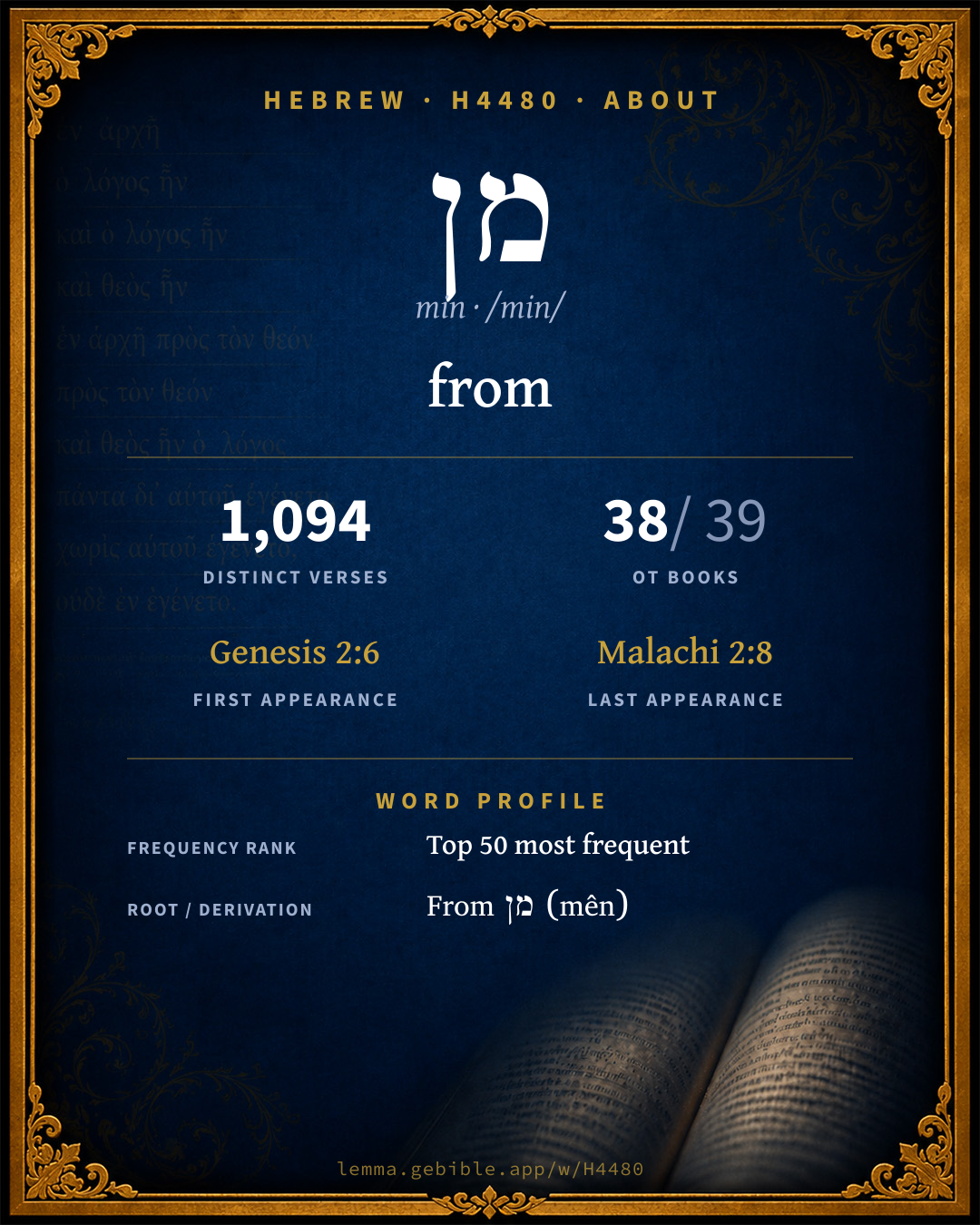
מן
from
also: out of, on account of, off, since fuller range ↓
Full lexicon entry — Brown-Driver-Briggs (BDB)
From Brown-Driver-Briggs (BDB)
Where this word appears
Grammar key — what these labels mean
Part of speech
- Preposition
- A relational word (e.g. “in,” “to,” “from”) governing a noun.
- Noun
- A naming word — a person, place, thing, or idea.
Noun type
- Common
- A common noun — a general class of person, place, or thing (“king,” “city,” “water”), not a specific name.
State
- Construct
- A noun bound to a following noun in a possessive / “of” relationship (the construct chain).
Gender
- Masculine
- Grammatically masculine.
Number
- Singular
- One.
Every verse where H4480 appears in the Book of Judges — 46 distinct verses. Click any verse to open its interlinear word-by-word view. Verse text shown in the World English Bible for context — . Each verse’s Hebrew form is shown with its reference; the English is not keyword-highlighted, since the data carries no word-level English alignment. Use “Compare translations” on any verse to read it across multiple English versions. This concordance covers the Hebrew Bible; Septuagint (Greek Old Testament) occurrences are not indexed here.
Judges
- Judges 1:13 מִמֶּ֑/נּוּ prep + sfx pers 1cp Othniel the son of Kenaz, Caleb's younger brother, took it: and he gave him Achsah his daughter as wife.
- Judges 1:24 מִן prep The watchers saw a man come forth out of the city, and they said to him, Show us, we pray you, the entrance into the city, and we will deal kindly with you.
- Judges 2:1 מִן prep The angel of Yahweh came up from Gilgal to Bochim. He said, I made you to go up out of Egypt, and have brought you to the land which I swore to your fathers; and I said, I will never break my covenant with you:
- Judges 2:17 מִן prep Yet they didn't listen to their judges; for they played the prostitute after other gods, and bowed themselves down to them: they turned aside quickly out of the way in which their fathers walked, obeying the commandments of Yahweh; [but] they didn't do so.
- Judges 2:21 מִן prep I also will not henceforth drive out any from before them of the nations that Joshua left when he died;
- Judges 3:9 מִמֶּֽ/נּוּ prep + sfx pers 3ms When the children of Israel cried to Yahweh, Yahweh raised up a savior to the children of Israel, who saved them, even Othniel the son of Kenaz, Caleb's younger brother.
- Judges 3:19 מִן prep But he himself turned back from the quarries that were by Gilgal, and said, I have a secret errand to you, king. He said, Keep silence. All who stood by him went out from him.
- Judges 3:27 מִן prep It happened, when he had come, that he blew a trumpet in the hill-country of Ephraim; and the children of Israel went down with him from the hill-country, and he before them.
- Judges 5:14 מִנִּ֣י מִנִּ֣י prep prep Out of Ephraim [came down] they whose root is in Amalek; After you, Benjamin, among your peoples; Out of Machir came down governors, Out of Zebulun those who handle the marshal's staff.
- Judges 5:20 מִן prep From the sky the stars fought, From their courses they fought against Sisera.
- Judges 6:21 מִן prep Then the angel of Yahweh put forth the end of the staff that was in his hand, and touched the flesh and the unleavened cakes; and there went up fire out of the rock, and consumed the flesh and the unleavened cakes; and the angel of Yahweh departed out of his sight.
- Judges 6:38 מִן prep It was so; for he rose up early on the next day, and pressed the fleece together, and wrung the dew out of the fleece, a bowl full of water.
- Judges 7:3 מִן prep Now therefore proclaim in the ears of the people, saying, Whoever is fearful and trembling, let him return and depart from Mount Gilead. There returned of the people twenty-two thousand; and there remained ten thousand.
- Judges 7:5 מִן prep So he brought down the people to the water: and Yahweh said to Gideon, Everyone who laps of the water with his tongue, as a dog laps, him shall you set by himself; likewise everyone who bows down on his knees to drink.
- Judges 7:17 מִמֶּ֥/נִּי prep + sfx pers 1cs He said to them, Look on me, and do likewise: and, behold, when I come to the outermost part of the camp, it shall be that, as I do, so shall you do.
- Judges 7:23 וּ/מִן וּ/מִן conj + prep conj + prep The men of Israel were gathered together out of Naphtali, and out of Asher, and out of all Manasseh, and pursued after Midian.
- Judges 8:13 מִן prep Gideon the son of Joash returned from the battle from the ascent of Heres.
- Judges 8:24 מִ/כֶּם֙ prep + sfx pers 2mp Gideon said to them, I would make a request of you, that you would give me every man the ear-rings of his spoil. (For they had golden ear-rings, because they were Ishmaelites.)
- Judges 8:26 מִן מִן prep prep The weight of the golden ear-rings that he requested was one thousand and seven hundred [shekels] of gold, besides the crescents, and the pendants, and the purple clothing that was on the kings of Midian, and besides the chains that were about their camels' necks.
- Judges 9:15 מִן prep The bramble said to the trees, If in truth you anoint me king over you, then come and take refuge in my shade; and if not, let fire come out of the bramble, and devour the cedars of Lebanon.
- Judges 9:35 מִן prep Gaal the son of Ebed went out, and stood in the entrance of the gate of the city: and Abimelech rose up, and the people who were with him, from the ambush.
- Judges 9:43 מִן prep He took the people, and divided them into three companies, and laid wait in the field; and he looked, and, behold, the people came forth out of the city; He rose up against them, and struck them.
- Judges 10:11 וּ/מִן וּ/מִן וּ/מִן conj + prep conj + prep conj + prep Yahweh said to the children of Israel, Didn't I save you from the Egyptians, and from the Amorites, from the children of Ammon, and from the Philistines?
- Judges 11:22 וּ/מִן conj + prep They possessed all the border of the Amorites, from the Arnon even to the Jabbok, and from the wilderness even to the Jordan.
- Judges 11:34 מִמֶּ֛/נּוּ prep + sfx pers 1cp Jephthah came to Mizpah to his house; and, behold, his daughter came out to meet him with tambourines and with dances: and she was his only child; besides her he had neither son nor daughter.
- Judges 11:37 מִמֶּ֜/נִּי prep + sfx pers 1cs She said to her father, Let this thing be done for me: let me alone two months, that I may depart and go down on the mountains, and bewail my virginity, I and my companions.
- Judges 12:9 מִן prep He had thirty sons; and thirty daughters he sent abroad, and thirty daughters he brought in from abroad for his sons. He judged Israel seven years.
- Judges 13:5 מִן prep for, behold, you shall conceive, and bear a son; and no razor shall come on his head; for the child shall be a Nazirite to God from the womb: and he shall begin to save Israel out of the hand of the Philistines.
- Judges 13:7 מִן prep but he said to me, Behold, you shall conceive, and bear a son; and now drink no wine nor strong drink, and eat not any unclean thing; for the child shall be a Nazirite to God from the womb to the day of his death.
- Judges 15:2 מִמֶּ֔/נָּה prep + sfx pers 3fs Her father said, I most assuredly thought that you had utterly hated her; therefore I gave her to your companion: isn't her younger sister more beautiful than she? Please take her, instead.
- Judges 15:13 מִן prep They spoke to him, saying, No; but we will bind you fast, and deliver you into their hand: but surely we will not kill you. They bound him with two new ropes, and brought him up from the rock.
- Judges 15:19 מִמֶּ֤/נּוּ prep + sfx pers 1cp But God split the hollow place that is in Lehi, and water came out of it. When he had drunk, his spirit came again, and he revived: therefore the name of it was called En Hakkore, which is in Lehi, to this day.
- Judges 16:17 מִמֶּ֣/נִּי prep + sfx pers 1cs He told her all his heart, and said to her, "No razor has ever come on my head; for I have been a Nazirite to God from my mother's womb. If I am shaved, then my strength will go from me, and I will become weak, and be like any other man."
- Judges 18:26 מִמֶּ֔/נּוּ prep + sfx pers 1cp The children of Dan went their way: and when Micah saw that they were too strong for him, he turned and went back to his house.
- Judges 19:16 מִֽן מִן prep prep Behold, there came an old man from his work out of the field at even: now the man was of the hill-country of Ephraim, and he sojourned in Gibeah; but the men of the place were Benjamites.
- Judges 20:14 מִן prep The children of Benjamin gathered themselves together out of the cities to Gibeah, to go out to battle against the children of Israel.
- Judges 20:21 מִן prep The children of Benjamin came forth out of Gibeah, and destroyed down to the ground of the Israelites on that day Twenty-two thousand men.
- Judges 20:25 מִֽן prep Benjamin went forth against them out of Gibeah the second day, and destroyed down to the ground of the children of Israel again eighteen thousand men; all these drew the sword.
- Judges 20:31 מִן prep The children of Benjamin went out against the people, and were drawn away from the city; and they began to strike and kill of the people, as at other times, in the highways, of which one goes up to Bethel, and the other to Gibeah, in the field, about thirty men of Israel.
- Judges 20:32 מִן prep The children of Benjamin said, They are struck down before us, as at the first. But the children of Israel said, Let us flee, and draw them away from the city to the highways.
- Judges 20:38 מִן prep Now the appointed sign between the men of Israel and the liers-in-wait was that they should make a great cloud of smoke rise up out of the city.
- Judges 20:40 מִן prep But when the cloud began to arise up out of the city in a pillar of smoke, the Benjamites looked behind them; and, behold, the whole of the city went up in smoke to the sky.
- Judges 20:45 מִמֶּ֖/נּוּ prep + sfx pers 1cp They turned and fled toward the wilderness to the rock of Rimmon: and they gleaned of them in the highways five thousand men, and followed hard after them to Gidom, and struck of them two thousand men.
- Judges 21:1 מִמֶּ֔/נּוּ prep + sfx pers 1cp Now the men of Israel had sworn in Mizpah, saying, There shall not any of us give his daughter to Benjamin as wife.
- Judges 21:21 מִן prep and see, and, behold, if the daughters of Shiloh come out to dance in the dances, then come you out of the vineyards, and catch you every man his wife of the daughters of Shiloh, and go to the land of Benjamin.
- Judges 21:23 מִן prep The children of Benjamin did so, and took them wives, according to their number, of those who danced, whom they carried off: and they went and returned to their inheritance, and built the cities, and lived in them.
About this entry
At a glance — auto-summarized from this page’s data, not written by a person. Every figure links to its source below. This summary describes the numbers; it doesn’t interpret them.
“from” is the headline sense of the Hebrew word מן (min). Scripture first uses it in Genesis 2:6. It appears 1,094 verses across 38 books of the Hebrew Bible, among its most common vocabulary. Not a single-sense word, it carries 2 senses, among them “out of”, “on account of”, and “off”. It shares a root with מן, מן and מנית. See the sense tree, 1,094-verse concordance, and the renderings breakdown below.
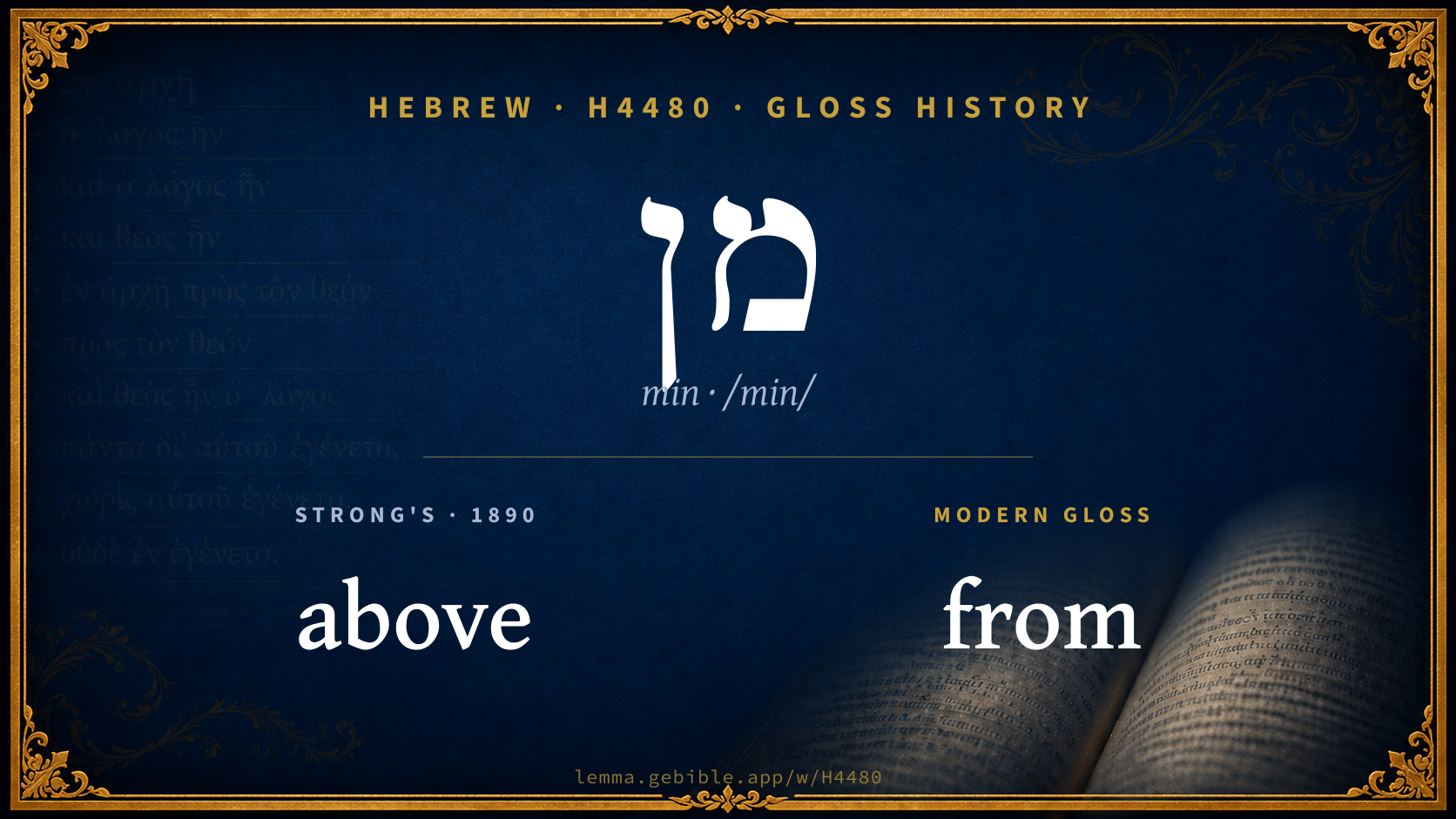
Gloss history
Strong's 1890 vs modern scholarship
About this word
Strong's H4480 catalogs a Hebrew word from the Hebrew Old Testament.
These counts are not copied from any lexicon or concordance. They are computed here, from the morphology-tagged Hebrew Old Testament. What Lemma adds →
- 1,094
- distinct verses
- The word appears in 1,094 distinct verses.
- 38 / 39
- OT books
- The word appears in 38 of 39 Old Testament books.
- #29
- by frequency
- Top 50 most frequent Hebrew words (rank 29 of 8,640 Hebrew words by occurrence).
View all 1,094 occurrences in the concordance →
By section of the Old Testament
By traditional corpus
Conventional, traditional groupings — biblical authorship is debated, so this is a traditional corpus grouping, not an authorship claim. Each share is this word’s portion of its verses in that division of the Hebrew canon. Each figure is a share of the word’s 1,094 distinct verses.
- Prophets (Nevi'im) 421 verses · 38%
- Writings (Ketuvim) 340 verses · 31%
- Torah (Pentateuch) 333 verses · 30%
How translations render this word
Counts come from each version’s own published word-to-Strong’s tagging or interlinear alignment — an approximate guide to how each version renders this word, not a word-level alignment the data otherwise carries. Because each total is that version’s own tagged count, the per-version totals vary from one another and need not match the appearance or distinct-verse counts above. These counts may also differ from a printed concordance because Lemma counts each distinctly tagged rendering and does not collapse phrase taggings into a single head-word total. This is a fixed set of word-tagged versions (KJV, ASV, BSB, ULT) and does not change with the reading translation you choose elsewhere. Each version’s license is shown beside its name below (and on Sources).
BDB lists this Strong’s number as 2 distinct words (homographs). Each count above pools all of them and is not split by sense — see the Senses section below. A low-frequency rendering may belong to a different one of those words, not the primary meaning.
- King James Version†: From 2×, Of 2×
- American Standard Version†: From 3×, Of 2×
- Berean Standard Bible†: From 380×, Of 91×, Me 61×
- unfoldingWord Literal Text†: From 617×, It 83×, You 80×
King James Version Public Domain
Renders H4480 across 25† tagged occurrences — most commonly:
Plus 21 renderings that appear only once — usually multi-word phrases or single function words the recovered tagging swept in, not distinct renderings.
American Standard Version Public Domain
Renders H4480 across 24† tagged occurrences — most commonly:
Plus 19 renderings that appear only once — usually multi-word phrases or single function words the recovered tagging swept in, not distinct renderings.
Berean Standard Bible Public Domain
Renders H4480 across 983† tagged occurrences — most commonly:
Plus other, less common renderings. Plus 82 renderings that appear only once — usually multi-word phrases or single function words the recovered tagging swept in, not distinct renderings. Not rendered by a distinct English word in 199 further occurrences.
unfoldingWord Literal Text CC BY-SA 4.0
Renders H4480 across 1,217† tagged occurrences — most commonly:
Plus other, less common renderings. Plus 68 renderings that appear only once — usually multi-word phrases or single function words the recovered tagging swept in, not distinct renderings.
Senses in the full BDB
What do BDB’s symbols mean?
BDB uses these scholarly abbreviations:
| Symbol | Meaning |
|---|---|
| 𝔊 | the Septuagint (the ancient Greek translation, LXX) |
| 𝔙 | the Vulgate (the Latin translation) |
| 𝔖 | the Syriac version (the Peshitta) |
| 𝔗 | the Targum (the Aramaic translation) |
| ψ | the Psalms |
| √ | root (the underlying root or stem) |
| ‖ | parallel passage (a synonymous or contrasted parallel) |
| † | the dagger: every passage where the word occurs is cited |
The 0 senses and sub-senses the full Brown-Driver-Briggs lexicon distinguishes for this word, in lexicon order (not ranked by frequency), with BDB’s own verbatim wording and sub-sense lettering. Shown in Hebrew script with BDB’s own scholarly abbreviations. The condensed entry is in the Lexicon Entry tab. See also the Forms in the corpus table below.
מן I div. Menî, god of fate (award, apportionment
מן II region of Armenia
Senses from the full Brown-Driver-Briggs lexicon (Brown, Driver, Briggs; Oxford 1906 — public domain), digitized via Sefaria, supplemented by the OpenScriptures HebrewLexicon (CC BY 4.0). Full attribution on Sources.
Word origin
I. n.pr.div. Menî, god of fate (award, apportionment; cf. Arabic n.pr. div. Maniyyat, and perhaps Manât, WeSkizzen iii. 22 f. 189, مَنَوَاتٌ NöZMG xl. 1886, 709; in Nab. מנותו EutNab. No. 2, 1. 5, etc.);—מִלֵּא לַמְנִי מִמְסָךְ Is 65:11 (‖ לַגַּד)—v. Che Di BaeSem. Rel. 79.
I. n.pr.terr. region of Armenia;—Je 51:27 (‖ אֲרָרָט, אַשְׁכְּנַז);=Assyrian Mannai Schr.COT ad loc.; KGF 174, 212, 520.
— Brown-Driver-Briggs (Oxford 1906, public domain), digitized via Sefaria, supplemented by the OpenScriptures HebrewLexicon (CC BY 4.0). See Sources.
Derived from מן (mên) (H4482) — string.
Jastrow Dictionary
A second Hebrew/Aramaic lexicon for comparison, covering Aramaic and post-biblical (Talmudic, Targumic, Midrashic) usage that the biblical-Hebrew BDB does not. Matched by lemma rather than by Strong’s number, so a lemma may carry more than one Jastrow headword (shown separately below), and the entries cover usage well beyond the Bible.
מִן
- (b. h.) from, of; more (or less) than. Ab. Zar. 18ᵃ מן השמים ירחמו from heaven they will have mercy (on me), i.e. I trust in God. Sabb. 21ᵇ המהדרין מן המהדרין v. הָדַר.—מן המובחר, v. בָּחַר; מן המומחה, v. מוּמְחֶה.—Tem. 28ᵃ מן הבהמה להוציא וכ׳ ‘of the cattle’ (Lev. I, 2) intimates the exclusion of &c.; a. v. fr.—Prefix מִ־, מָי־, מֵ־, מֵי־ q. v.—מִנַּיִן, מִנַּיִין, מִינַּיִין (= b. h. מֵאַיִן, v. אַיִן) whence?, whence is it proven?—Yoma 32ᵃ מ׳ לחמש וכ׳ whence is derived the regulation about five immersions &c.? Ib. ומ׳ שכל טבילה וכ׳ and whence is the rule derived that each immersion requires &c.? Ib. 44ᵃ אין לי אלא … מ׳ this would prove to me only in favor of …, whence do you derive that the same applies to …?; a. v. fr. e.g. Leviticus 1:2
מִן ²
- Targ. Gen. I, 2; a. v. fr.—With suffixes of pers. pron. מִנִּי, מִי׳ from me; מִנָּךְ, מִי׳ from thee; מִנֵּיה, מִי׳ from him, it &c. Ib. XXII, 12. Ib. III, 3; a. fr.—Y. Ber. II, 5ᵃ bot. מן הן דסלק to where he had come from. Sabb. 80ᵇ מן דיליה דא ליה this came to him from his own doing. Sot. 40ᵃ ומאי נפקא ליך מִינָּהּ and what difference does it make? מִנִּי ומִנֵּיה יתקלס וכ׳ through myself and him the Most High is exalted. B. Kam. 18ᵃ קאזיל מיניה מיניה it was lost through its (the chicken’s) action alone. Y. Peah VII, 20ᵇ מיניה וביה הוא (the sweetness) is entirely its own (no honey has been added). Snh. 39ᵇ, v. אִבָּא; a. fr.—לא כולא מיניה, לא כל כמיניה it is not at all in his power; v. כּוֹלָא.—מן ד־ from the time that, after; from the fact that; when; because. Lam. R. to II, 2 מן דאכלון after they had eaten; a. v. fr.; v. מִדְּ־.
מָן I
- portion, food. Num. R. s. 12 (play on א̇ר̇ג̇מ̇ן̇) the sun שיצרו הקב"ה לארוג מן וכ׳ whom the Lord has created to weave (ripen) food for creatures; ואין מן אלא פירות וכ׳ man means fruits and food (with ref. to וימן, Dan. I, 5).—Esp. מָּן(הַ) the manna of the desert. Ex. R. s. 25. Tanḥ. B’shall. 20; Mekh. ib., Vayassa, s. 2 אוכלי המן those eating manna (not troubling themselves about to-morrow). Yoma 75ᵃ; a. fr. e.g. Daniel 1:5
מַן I
- (a day’s) support. Succ. 39ᵇ בכדי מן for as much only as is needed for the day. Ib. דהאי מ׳ וכ׳ that man means support, v. preced.—Esp. מַנָּא the manna. Targ. Ex. XVI, 31. Targ. Y. ib. 27; a. e. (some ed. מָנָא).
מַן
- who?, what?, v. מַאן. Targ. Gen. XXIV, 23. Ib. XXXIII, 8 (ed. Berl. מָא; oth. ed. מאן); a. fr.—Emphatic. (מָנָא) מְנָא. Targ. Ps. XXXIX, 5. Targ. Prov. IV, 19; a. fr.
מָן III
- thing, vessel, garment; coulter, v. מָאן.
A Dictionary of the Targumim, the Talmud Babli and Yerushalmi, and the Midrashic Literature (Marcus Jastrow; London, Luzac, 1903) — Public Domain. Digitized via Sefaria. Digitized via Sefaria. Full attribution on Sources.
Forms in the corpus
The 115 distinct written forms H4480 takes in the Hebrew Bible, most frequent first — each parse links to that state’s occurrences in the concordance. Hebrew forms include their vowel points and cantillation, so a single lemma takes many written forms.
| Form | Parsing | Example | Uses |
|---|---|---|---|
| מִן | Preposition | Amos 3:5 | 607 |
| וּ/מִן | Preposition | Daniel 1:3 | 95 |
| מִמֶּ֖/נּוּ | Preposition | Deuteronomy 22:3 | 35 |
| מִמֶּֽ/נּוּ | Preposition | Deuteronomy 9:14 | 31 |
| מִמֶּ֔/נּוּ | Preposition | Amos 5:11 | 25 |
| מִמֶּ֑/נּוּ | Preposition | Deuteronomy 2:36 | 25 |
| מִמֶּֽ/נִּי | Preposition | Ecclesiastes 2:25 | 23 |
| מִנִּי | Preposition | Isaiah 46:3 | 23 |
| מִמֶּ֑/נִּי | Preposition | Deuteronomy 7:17 | 20 |
| מִמֶּ֨/נּוּ֙ | Preposition | Deuteronomy 26:14 | 16 |
| מִמֶּֽ/נָּה | Preposition | Esther 1:19 | 15 |
| מִֽן | Preposition | Ecclesiastes 6:8 | 12 |
| לְ/מִן | Preposition | Deuteronomy 4:32 | 11 |
| מִמֶּ֖/נָּה | Preposition | Ezekiel 14:13 | 11 |
| מִמֶּֽ/ךָּ | Preposition | Deuteronomy 7:1 | 11 |
| מִמְּ/ךָ֖ | Preposition | Deuteronomy 4:38 | 10 |
| מִמֶּ֛/נּוּ | Preposition | Exodus 12:10 | 9 |
| מִ/כֶּ֖ם | Preposition | Hosea 5:13 | 8 |
| מִמֶּ֑/נָּה | Preposition | Exodus 25:35 | 8 |
| מִמֶּ֔/נִּי | Preposition | Genesis 23:13 | 8 |
| מִמֶּ֔/נָּה | Preposition | Ecclesiastes 7:26 | 8 |
| מִמֶּ֣/נּוּ | Preposition | Daniel 11:31 | 8 |
| מִמֶּ֗/נּוּ | Preposition | Deuteronomy 26:14 | 7 |
| מִ/כֶּ֔ם | Preposition | Deuteronomy 1:17 | 6 |
| מִ/כֶּֽם | Preposition | Deuteronomy 11:23 | 6 |
| מִ/כֶּם֙ | Preposition | Deuteronomy 1:23 | 6 |
| מִמְּ/ךָ֙ | Preposition | Deuteronomy 14:24 | 6 |
| מִ֝מֶּ֗/נִּי | Preposition | Job 7:16 | 5 |
| מִ֝מֶּ֗/נּוּ | Preposition | Proverbs 4:23 | 5 |
| מִמֵּ֖/ךְ | Preposition | Ezekiel 21:3 | 5 |
| מִמֶּ֑/ךָּ | Preposition | Deuteronomy 9:1 | 5 |
| מִמֶּ֨/נִּי֙ | Preposition | Deuteronomy 9:14 | 5 |
| מִ֭מֶּ/נִּי | Preposition | Job 13:13 | 4 |
| מִמְּ/ךָ֛ | Preposition | Ezekiel 24:16 | 4 |
| מִמְּ/ךָ֣ | Preposition | 1 Chronicles 29:14 | 4 |
| מִמְּ/ךָ֥ | Preposition | Genesis 17:6 | 4 |
| מִמֵּ֑/ךְ | Preposition | Ezekiel 16:42 | 4 |
| מִמֵּ֔/ךְ | Preposition | Ezekiel 16:61 | 4 |
| מִמֶּ֛/נָּה | Preposition | Genesis 17:16 | 4 |
| מִמֶּ֥/נָּה | Preposition | Exodus 25:31 | 4 |
| הֲ/מִן | Preposition | Genesis 3:11 | 3 |
| וּ/מִ֨ן | Preposition | Genesis 7:8 | 3 |
| וּ/מִֽן | Preposition | Ezra 10:23 | 3 |
| מִ/כֶּ֗ם | Preposition | Ezekiel 20:38 | 3 |
| מִ/כֶּ֜ם | Preposition | Amos 4:7 | 3 |
| מִ֭מְּ/ךָ | Preposition | Job 15:11 | 3 |
| מִמְּ/ךָ֔ | Preposition | Deuteronomy 20:1 | 3 |
| מִמֶּ֖/נִּי | Preposition | Exodus 8:8 | 3 |
| מִמֶּ֗/נִּי | Preposition | Job 30:1 | 3 |
| מִמֶּ֜/נּוּ | Preposition | 1 Chronicles 18:4 | 3 |
| מִמֶּ֣/נִּי | Preposition | Judges 16:17 | 3 |
| מִמֶּ֤/נּוּ | Preposition | Judges 15:19 | 3 |
| מִמֶּ֥/נִּי | Preposition | Jeremiah 44:28 | 3 |
| מִנִּ֣י | Preposition | Judges 5:14 | 3 |
| מֶֽ/נִּי | Preposition | Job 21:16 | 3 |
| מִ/כֶּ֛ם | Preposition | 1 Samuel 22:8 | 2 |
| מִ/נִּ֖י | Preposition | Isaiah 22:4 | 2 |
| מִ֥ן | Preposition | Job 38:1 | 2 |
| מִ֫מֶּ֥/נִּי | Preposition | Psalms 28:1 | 2 |
| מִמְּ/ךָ֗ | Preposition | Genesis 27:45 | 2 |
The 60 most common forms are shown; 55 rarer forms follow in the full concordance.
Same root — word family
Other BDB entries built from the same root as H4480, grouped by Strong’s listed origin. These share a root / origin per the lexicon — not necessarily a shared meaning. Each links to that word’s own entry.
Derives from
Derived from this word
Proper names from this root
People and places named from this root — a name, not an additional meaning of the word.
Compare all same-root words → Showing 4 of 5 — not the complete family. 2 of the same-root words are proper names (people or places). They share a root, not necessarily a meaning.
Septuagint verse parallels
This word appears in 1,027 verses that also exist in the Greek Old Testament (Septuagint), out of the 1,094 Hebrew verses it occurs in. You can read those verses in Greek by switching the Old Testament edition to the Septuagint.
Read these verses in the Septuagint
- Genesis 2:6
- Exodus 1:9
- Leviticus 1:2
- Numbers 5:2
- Deuteronomy 1:17
- Joshua 1:7
- Judges 1:13
- Ruth 1:7
- 1 Samuel 1:1
- 2 Samuel 1:2
- 1 Kings 1:39
- 2 Kings 1:4
This is a verse-level parallel only — the same verses exist in both the Hebrew and Greek Old Testaments. No word-level Hebrew↔Greek correspondence is claimed: the data carries no such alignment, so no Greek word is shown as this Hebrew word’s translation. Coverage is not total — the Septuagint omits the deuterocanon and renumbers the Psalms, so some Hebrew verses have no direct Greek parallel.