
Genesis 40:14

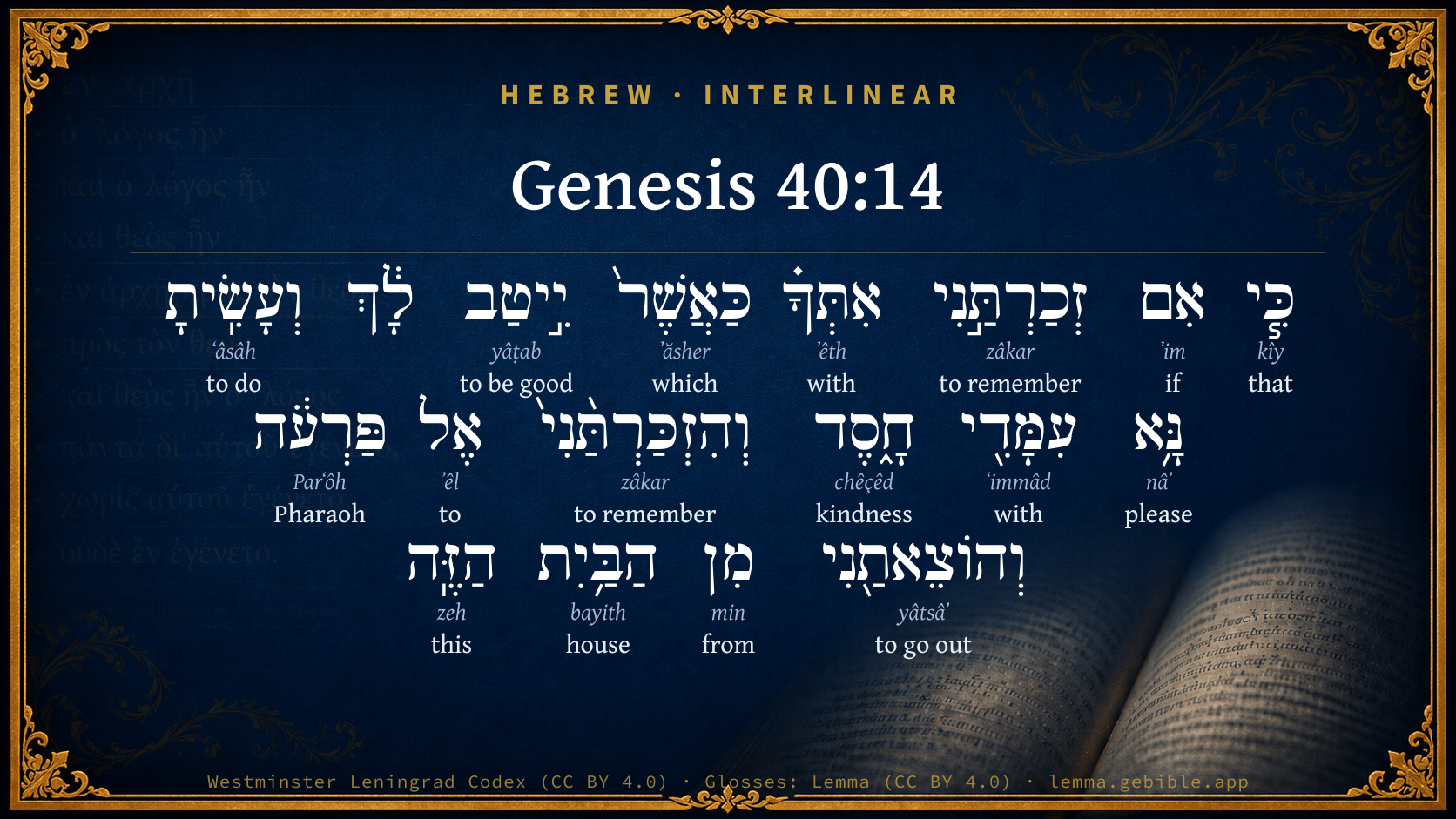
Hebrew (Westminster Leningrad Codex) Genesis 40:14 appears in the Hebrew Old Testament. The text above is from the Westminster Leningrad Codex. Each word links to its Strong’s number, a concise gloss, and parsing drawn from the Open Scriptures Hebrew Bible morphology. Click any word for its full Brown-Driver-Briggs (BDB) entry.
Download image
Cite this verse

Genesis 40:14 (World English Bible). Public Domain. Lemma interlinear Bible study tool, https://lemma.gebible.app/v/genesis/40/14.

Show BibTeX & RIS
BibTeX
RIS
English Translation
But remember me when it will be well with you, and show kindness, please, to me, and make mention of me to Pharaoh, and bring me out of this house.
World English Bible · Public Domain
Download a study sheet

One document with this verse’s original text, its word-by-word gloss line, the meaning frame, cross-references with their text, attributed commentary, and full source and license credits — printable, and it pastes into notes with its structure intact.

This verse Autodidact and up

Study sheet (.html) Plain text (.txt)

A passage Seminary Student

Up to 50 verses in one chapter. A passage sheet keeps up to 6 commentary sources and 12 cross-references per verse, in the order this page ranks them, and says so on the sheet whenever that leaves anything out. Ask for a single verse and you get the Autodidact verse sheet above.

Everything on this page stays free to read, with no account — the sheet is a download of what is already on screen, not access to it.

Want to remove ads? Support Godless Engineer
Compare translations 3

The same verse in 3 English versions, stacked beneath the original-language interlinear above. Click any original word for its lexicon entry.

Each is an independent rendering of the whole verse — the interlinear is not word-aligned to these translations.

Highlighted words mark where these versions differ — a whole-verse word diff, not a word-by-word alignment.

  • World English Bible Public Domain
    But remember me when it will be well with you, and show kindness, please, to me, and make mention of me to Pharaoh, and bring me out of this house.
  • King James Version Public Domain
    But think on me when it shall be well with thee, and show kindness, I pray thee, unto me, and make mention of me unto Pharaoh, and bring me out of this house:
  • unfoldingWord Literal Text CC BY-SA 4.0
    But if you remember me with you, when it goes well for you, then please show kindness to me, and mention me to Pharaoh, and get me out from this house.

unfoldingWord Literal Text — © unfoldingWord, licensed CC BY-SA 4.0. Word-aligned USFM3 via Door43 (git.door43.org/unfoldingWord/en_ult).

Versions to compare (up to 4)

3 of 4 selected

Show all 18 translations

Every available English version of this verse, each an independent rendering of the whole verse.

  • World English Bible Public Domain
    But remember me when it will be well with you, and show kindness, please, to me, and make mention of me to Pharaoh, and bring me out of this house.
  • Berean Standard Bible Public Domain
    But when it goes well for you, please remember me and show me kindness by mentioning me to Pharaoh, that he might bring me out of this prison.
  • Majority Standard Bible Public Domain
    But when it goes well for you, please remember me and show me kindness by mentioning me to Pharaoh, that he might bring me out of this prison.
  • King James Version Public Domain
    But think on me when it shall be well with thee, and show kindness, I pray thee, unto me, and make mention of me unto Pharaoh, and bring me out of this house:
  • American Standard Version (1901) Public Domain
    But have me in thy remembrance when it shall be well with thee, and show kindness, I pray thee, unto me, and make mention of me unto Pharaoh, and bring me out of this house:
  • Revised Version (1885) Public Domain
    But have me in thy remembrance when it shall be well with thee, and shew kindness, I pray thee, unto me, and make mention of me unto Pharaoh, and bring me out of this house:
  • Geneva Bible (1599) Public Domain
    But haue me in remembrance with thee, when thou art in good case, and shew mercie, I pray thee, vnto me, and make mention of me to Pharaoh, that thou mayest bring me out of this house.
  • Douay-Rheims (1899) Public Domain
    Only remember me, when it shall be well with thee, and do me this kindness: to put Pharao in mind to take me out of this prison:
  • Young's Literal Translation Public Domain
    `Surely if thou hast remembered me with thee, when it is well with thee, and hast done (I pray thee) kindness with me, and hast made mention of me unto Pharaoh, then hast thou brought me out from this house,
  • Literal Standard Version CC BY-SA 4.0
    Surely if you have remembered me with you, when it is well with you, and have please done kindness with me, and have made mention of me to Pharaoh, then you have brought me out from this house,
  • Unlocked Literal Bible CC BY-SA 4.0
    But think of me when it goes well with you, and please show kindness to me. Mention me to Pharaoh and bring me out of this prison.
  • unfoldingWord Literal Text CC BY-SA 4.0
    But if you remember me with you, when it goes well for you, then please show kindness to me, and mention me to Pharaoh, and get me out from this house.
  • Darby Bible Public Domain
    Only bear a remembrance with thee of me when it goes well with thee, and deal kindly, I pray thee, with me, and make mention of me to Pharaoh, and bring me out of this house;
  • World Messianic Bible Public Domain
    But remember me when it is well with you. Please show kindness to me, and make mention of me to Pharaoh, and bring me out of this house.
  • Webster's Bible Public Domain
    But think on me when it shall be well with thee, and show kindness to me, I pray thee, and make mention of me to Pharaoh, and bring me out of this house:
  • Free Bible Version CC BY-SA 4.0
    But when things go well for you, please remember me with kindness and speak to Pharaoh on my behalf, and please get me out of this prison.
  • Bible in Basic English Public Domain
    But keep me in mind when things go well for you, and be good to me and say a good word for me to Pharaoh and get me out of this prison:
  • JPS Tanakh (1917) Public Domain
    But have me in thy remembrance when it shall be well with thee, and show kindness, I pray thee, unto me, and make mention of me unto Pharaoh, and bring me out of this house.

Literal Standard Version (2020), Covenant Press — licensed CC BY-SA 4.0. Text via the HelloAO Bible API (eBible.org). Unlocked Literal Bible (unfoldingWord) — licensed CC BY-SA 4.0. Text via the HelloAO Bible API (eBible.org). unfoldingWord Literal Text — © unfoldingWord, licensed CC BY-SA 4.0. Word-aligned USFM3 via Door43 (git.door43.org/unfoldingWord/en_ult). Free Bible Version, Dr. Jonathan Gallagher — licensed CC BY-SA 4.0. Text via the HelloAO Bible API (eBible.org).

Word by word

More ways to search: Search by grammar → Find every occurrence → Compare this word →

Practice this passage: Drill this verse → Learn its vocabulary →

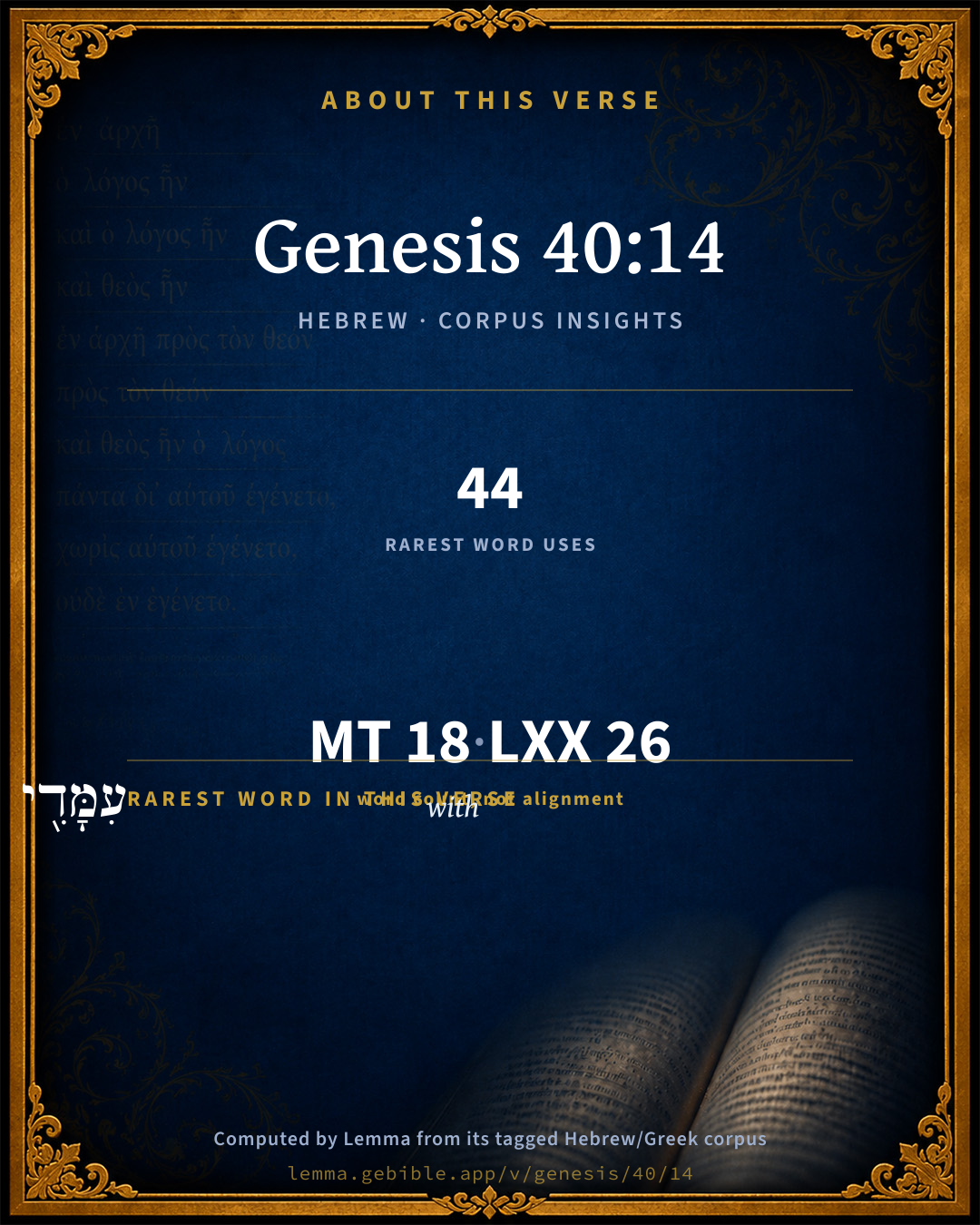
עִמָּדִ֖י
ʻimmâd
H5978
“with · me”
Preposition + Suffix, Personal, 1st Person, Common, Singular
Part of Speech
Preposition
Full BDB Definition

Origin: prol for H5973

TWOT: 1640b

with
  1. כִּ֧י kîy H3588 “that” Conjunction
  2. אִם ʼim H518 “if” Conjunction
  3. זְכַרְתַּ֣נִי zâkar H2142 “to remember · me” Verb, Qal, Perfect, 2nd Person, Masculine, Singular + Suffix, Personal, 1st Person, Common, Singular
  4. אִתְּךָ֗ ʼêth H854 “with · you” Preposition + Suffix, Personal, 2nd Person, Masculine, Singular
  5. כַּאֲשֶׁר֙ ʼăsher H834 “like/as · which” Preposition + Particle, Relative
  6. יִ֣יטַב yâṭab H3190 “to be good” Verb, Qal, Imperfect, 3rd Person, Masculine, Singular
  7. וְעָשִֽׂיתָ ʻâsâh H6213 “and · to do” Conjunction + Verb, Qal, Sequential Perfect, 2nd Person, Masculine, Singular
  8. נָּ֥א nâʼ H4994 “please” Particle, Interjection
  9. חָ֑סֶד chêçêd H2617 “kindness” Noun, Common, Masculine, Singular, Absolute
  10. וְהִזְכַּרְתַּ֨נִי֙ zâkar H2142 “and · to remember · me” Conjunction + Verb, Hiphil, Sequential Perfect, 2nd Person, Masculine, Singular + Suffix, Personal, 1st Person, Common, Singular
  11. אֶל ʼêl H413 “to” Preposition
  12. פַּרְעֹ֔ה Parʻôh H6547 “Pharaoh” Noun, Proper
  13. וְהוֹצֵאתַ֖נִי yâtsâʼ H3318 “and · to go out · me” Conjunction + Verb, Hiphil, Sequential Perfect, 2nd Person, Masculine, Singular + Suffix, Personal, 1st Person, Common, Singular
  14. מִן min H4480 “from” Preposition
  15. הַבַּ֥יִת bayith H1004 “the · house” Particle, Definite Article + Noun, Common, Masculine, Singular, Absolute
  16. הַזֶּֽה zeh H2088 “the · this” Particle, Definite Article + Pronoun, Demonstrative, Masculine, Singular

About this verse

These counts appear in no published source. They are computed here, from the morphology-tagged text and Lemma’s own curated glosses. What Lemma adds →

18
words
16
distinct lemmas
Pentateuch
section

Shared distinctive vocabulary

עִמָּדִ֖י with H5978 occurs in 44 verses of the Hebrew Bible. Also found in:

Grammatical profile

  • 5 verbs
  • 3 nouns
  • 1 pronoun
  • 5 prepositions
  • 2 conjunctions
  • 2 particles

Verb forms

  • זְכַרְתַּ֣נִי Qal · Perfect
  • יִ֣יטַב Qal · Imperfect
  • וְעָשִֽׂיתָ Qal · Sequential Perfect
  • וְהִזְכַּרְתַּ֨נִי֙ Hiphil · Sequential Perfect
  • וְהוֹצֵאתַ֖נִי Hiphil · Sequential Perfect

Repetition

A word recurs within this verse — often emphatic in Hebrew:

  • זְכַרְתַּ֣נִי to remember H2142 ×2

Hebrew & Septuagint length

In English translation the verse runs 30 words from the Hebrew and 38 from the Septuagint (LXX English) — closely comparable.

A rough comparison of the two English renderings, which tokenize alike — not a word-level alignment.

Word counts can differ between the Hebrew and the Greek without any difference in meaning — e.g. the Hebrew direct-object marker אֵת has no separate Greek word, and Greek often adds the article ὁ.

In the original languages it is 18 Hebrew tokens and 26 Greek tokens — but the two are counted differently (Hebrew bundles its prefixes and suffixes into one token; the Greek is in lemma form), so that isn’t a like-for-like length.

Cross-references

7

Topical passages linked to Genesis 40:14 in the Treasury of Scripture Knowledge — connected by theme and wording, ordered by reader-vote popularity; previews shown in the World English Bible.

  • Joshua 2:12 Now therefore, please swear to me by Yahweh, since I have dealt kindly with you, that you also will deal kindly with my father's house, and give me a true token;
  • 1 Samuel 20:14–15 You shall not only while yet I live show me the loving kindness of Yahweh, that I not die;
  • Luke 23:42 He said to Jesus, "Lord, remember me when you come into your Kingdom."
  • 1 Kings 2:7 But show kindness to the sons of Barzillai the Gileadite, and let them be of those who eat at your table; for so they came to me when I fled from Absalom your brother.
  • 1 Samuel 25:31 that this shall be no grief to you, nor offense of heart to my lord, either that you have shed blood without cause, or that my lord has avenged himself. When Yahweh shall have dealt well with my lord, then remember your handmaid.
  • 2 Samuel 9:1 David said, Is there yet any who is left of the house of Saul, that I may show him kindness for Jonathan's sake?
  • 1 Corinthians 7:21 Were you called being a bondservant? Don't let that bother you, but if you get an opportunity to become free, use it.

Cross-references courtesy of OpenBible.info (CC BY 4.0).

Hebrew and Greek witnesses Masoretic Hebrew ↔ Greek Septuagint

The same verse in the two great witnesses to the Old Testament, shown verse-for-verse.

These are two independent witnesses, not word-aligned to each other, and the Septuagint is shown in lemma (dictionary) form.

Hebrew Genesis 40:14 Masoretic · Westminster Leningrad Codex

כִּ֧י אִם זְכַרְתַּ֣נִי אִתְּךָ֗ כַּאֲשֶׁר֙ יִ֣יטַב לָ֔ךְ וְעָשִֽׂיתָ נָּ֥א עִמָּדִ֖י חָ֑סֶד וְהִזְכַּרְתַּ֨נִי֙ אֶל פַּרְעֹ֔ה וְהוֹצֵאתַ֖נִי מִן הַבַּ֥יִת הַזֶּֽה

But remember me when it will be well with you, and show kindness, please, to me, and make mention of me to Pharaoh, and bring me out of this house.

World English Bible · Public Domain

Greek LXX Genesis 40:14 Septuagint · lemma form

ἀλλά μιμνήσκω ἐγώ διά σεαυτοῦ ὅταν εὖ σύ γίγνομαι καί ποιέω ἐν ἐγώ ἔλεος καί μιμνήσκω περί ἐγώ φαραώ καί ἐκἄγω ἐγώ ἐκ ὁ ὀχύρωμα οὗτος

But remember me of yourself, when it shall be well with you, and you shall deal mercifully with me, and you shall make mention of me to Pharao, and you shall bring me forth out of this dungeon.

LXX2012 (modern English Septuagint) · Public Domain

Hebrew: Westminster Leningrad Codex (CC BY 4.0). Greek: Septuagint (public domain); English from LXX2012 (modern English Septuagint) (Public Domain). How the Septuagint differs from the Hebrew →

Targum (Aramaic paraphrase)

2

The Targum is the ancient Jewish Aramaic paraphrase of the Hebrew Scriptures — an interpretive translation, not the Hebrew text itself. Onkelos (literal) and Pseudo-Jonathan (expansive) render the Torah, and Jonathan the Prophets. Coverage is partial: where no permissively-licensed English translation exists for a verse, only the Aramaic is shown. This is verse-level text, not a word-by-word alignment to the Hebrew.

  1. Targum Onkelos Torah (Genesis–Deuteronomy)
    אֶלָּהֵן תִּדְכְּרִנַּנִי עִמָּךְ כַּד יֵיטַב לָךְ וְתַעְבֵּד כְּעַן עִמִּי טִיבוּ וְתִדְכַּר עָלַי קֳדָם פַּרְעֹה וְתַפְּקִנַּנִי מִן בֵּית אֲסִירָא הָדֵין

    (no public-domain English translation for this verse)

    Targum Onkelos — Aramaic: “Onkelos Genesis” (public domain); “Onkelos Exodus” (public domain); “Onkelos Leviticus” (public domain); “Onkelos Numbers” (public domain); “Onkelos Deuteronomy” (public domain). English: “Sefaria Community Translation” (CC0 1.0 (public-domain dedication)); “J.W. Etheridge. The Targums of Onkelos and Jonathan Ben Uzziel on the Pentateuch. London: Longmans, Green, 1862” (public domain). Text via Sefaria.

  2. Targum Pseudo-Jonathan Torah (Genesis–Deuteronomy)
    שְׁבַק יוֹסֵף יַת רוֹחֲצָנֵיהּ דִלְעֵיל וְנָקַט רוֹחֲצָנֵיהּ דְבַר נַשׁ וַאֲמַר לְרַב מְזוֹגַיָא אֱלָהֵן תִּדְכְּרִינַנִי עִמָךְ כַּד יִיטַב לָךְ וְתֶעֱבַד כְּדוֹן עִמִי טִיבוּ וְתִידְכַּר עָלַי קֳדָם פַּרְעה וּתְהַנְפְקִינַנִי מִן בֵּית אֲסִירֵי הָדֵין

    Joseph, leaving his higher trust and retaining confidence in a man, said to the chief butler, But be thou mindful of me when it shall be well with thee, and act kindly by me, and remember me before Paharoh and obtain my deliverance from this prison house.

    Targum Pseudo-Jonathan — Aramaic: “Targum Jonathan on Genesis” (public domain); “Targum Jonathan on Exodus” (public domain); “Targum Jonathan on Leviticus” (public domain); “Targum Jonathan on Numbers” (public domain); “Targum Jonathan on Deuteronomy” (public domain). English: “The Targum of Jonathan ben Uzziel, trans. J. W. Etheridge, London, 1862” (public domain). Text via Sefaria.

Commentary

Notes on Genesis 40:14 from classic Christian and Jewish commentators (each source and its license shown beneath its notes). The classic Christian expositions comment on the surrounding passage and are grouped to its opening verse, so a note may address several verses; the Jewish commentaries on the Tanakh (Rashi and others) are per-verse, so they appear only where the commentator wrote on this verse.

Lemma curates 59 commentaries, every one of them public domain or Creative Commons licensed, each selected and text-cleaned for this edition rather than reprinted as found. About our sources →

Trapp's Complete Commentary

John Trapp

Gen 40:14 But think on me when it shall be well with thee, and shew kindness, I pray thee, unto me, and make mention of me unto Pharaoh, and bring me out of this house:

Ver. 14. But think on me, &c.] Liberty is sweet, and should be sought by all lawful means. {1Co 7:21} The Jews censure Joseph for requesting this favour of the butler; and say, he was therefore two years longer imprisoned. But this is a hard saying. Possible it is, that Joseph might trust too much to this man, and be too hasty to set God this time, and no other; and so might be justly crossed of his expectation. It is hard and happy so to use the means as not to trust to them; and so to wait God’s good leisure, as not to "limit the Holy One of Israel." We trust a skilful workman to go his own way to work, and to take his own time. Shall we not do as much for God! He oft goes a way by himself, and gives a blessing to those times and means whereof we despair.

John Trapp, A Commentary or Exposition upon All the Books of the Old and New Testament (1647–1656) — public domain. Text from a community e-Sword module.

Joseph Benson's Commentary

Gen 40:14-15. Think on me — Though the respect paid to Joseph made the prison as easy to him as a prison could be, yet none can blame him for being desirous of liberty. See what a modest representation he makes of his own case. He doth not reflect upon his brethren that sold him, he only saith, I was stolen out of the land of the Hebrews. Nor doth he reflect on the wrong done him in this imprisonment by his mistress, that was his prosecutor, and his master, that was his judge, but mildly avers his own innocence. Here have I done nothing, that they should put me into the dungeon — When we are called to vindicate ourselves, we should carefully avoid, as much as may be, speaking ill of others. Let us be content to prove ourselves innocent, and not fond of upbraiding others with their guilt.

Joseph Benson's Commentary on the Old and New Testaments (1811–1818) — public domain. Text from a community e-Sword module.

Tyndale Open Study Notes

Tyndale Open Resources

40:14-15 Because he knew that the chief cup-bearer was going back into Pharaoh’s personal service, Joseph saw an opportunity to seek his own release from prison.

Tyndale Open Study Notes — © Tyndale Open Resources, licensed CC BY-SA 4.0. Text via the HelloAO Bible API.

Geneva Bible (1599)

Geneva Bible translators

He refused not the means to be delivered, which he thought God had appointed.

Geneva Bible (1599) marginal notes — public domain. Text via Bolls.life.

Adam Clarke's Commentary

Verse 14. Make mention of me unto Pharaoh] One would have supposed that the very circumstance of his restoration, according to the prediction of Joseph, would have almost necessarily prevented him from forgetting so extraordinary a person. But what have mere courtiers to do either with gratitude or kindness?

Adam Clarke's Commentary on the Bible (1810–1826) — public domain. Text from a community e-Sword/MySword module.

John Calvin's Commentaries

14. Show kindness I pray thee unto me Although the expression show kindness is used among the Hebrews to describe the common exercise of humanity; there is yet no doubt that Joseph spoke simply as his own sad and afflicted condition suggested, for the purpose of inclining the mind of the butler to procure him help. He insists, however, chiefly on this, that he had been thrust into prison for no crime, in order that the butler might not refuse his assistance to an innocent man. For although they who are most wicked find patrons; yet commendation elicited by importunity, which rescues a wicked man from deserved punishment, is in itself an odious and infamous thing. It is, however, probable that Joseph explained his whole cause, so that he fully convinced the butler of his innocence.

John Calvin's Commentaries (1540-1563) — public domain. Text from the Calvin Translation Society English edition (1840s-50s) via the Christian Classics Ethereal Library (ccel.org). Calvin's coverage is partial (roughly two-thirds of the Bible); uncommented books and verses are honest gaps, never fabricated. The 19th-century editor's footnotes and remarks are omitted so the notes are faithfully Calvin's own voice.

The Cambridge Bible for Schools and Colleges

gen. ed. J. J. S. Perowne

14. But have me, &c.] Joseph claims no reward for his interpretation beyond that of an act of kindness.

The Cambridge Bible for Schools and Colleges (gen. ed. J. J. S. Perowne; Cambridge University Press, 1878–1918) — public domain. Text from a community e-Sword module.

John Gill's Exposition

But think on me, when it shall be well with thee,.... He desires no reward for the interpretation of his dream, only that he would remember him in adversity, when he should be in prosperity in Pharaoh's court, and speak a good word for him, which was the least he could do; and though Joseph knew by his own dreams that he should be raised from his low estate to a very high and advanced one, yet he thought proper, in a dependence on God, to make use of all lawful means for his deliverance; nor is he to be blamed, as if he sought help of man and not of God, as he is by some writers, both Christian and Jewish, particularly by the Targum of Jonathan,"Joseph lost his superior confidence, and retained the confidence of men;''whereas means are always to be used in order to the end, in subordination to the divine will; and what Joseph asked of the butler was but reasonable, and what he ought to have done for him, and was prudently moved by Joseph, as a rational method of his deliverance, and in which he was, no doubt, guided and directed by the providence of God, as the event shows:

and show kindness, I pray thee, unto me; he pleads no merit for what he had done in interpreting his dream, but puts the good office he desires him to do for him upon the foot of kindness to a man in distress, and asks it as a favour, by way of entreaty and request:

and make mention of me and bring me out of this house: the prison in which he was; for though he had much favour shown him, and had more liberty granted him than other prisoners had, yet a prisoner he was, and a prison he dwelt in, and deliverance from it was desirable, could it be had; and this was a likely way to obtain it, if the butler would speak a good word for him to Pharaoh, which he would have an opportunity to do, being often in his presence, and frequently when cheerful.

John Gill's Exposition of the Whole Bible (1746–1763) — public domain (CC PDM 1.0). Text via the HelloAO Bible API.

Haydock's Catholic Bible Commentary

Prison, after examining into the justice of my cause.

George Leo Haydock (1774–1849), Haydock's Catholic Family Bible and Commentary, 1859 edition — public domain. Excludes Psalms (Douay-Rheims chapter numbering differs from Protestant) and Deuterocanonical books (Catholic canon only).

Matthew Poole's English Annotations

Though he patiently endures his prison, yet he prudently useth all lawful means to get his freedom.

Matthew Poole's English Annotations on the Holy Bible (1683–1685) — public domain. Text from a community e-Sword/MySword module.

Whedon's Commentary on the Bible

Daniel D. Whedon

14. Think on me — Here we note how Joseph longs for liberty.

Daniel D. Whedon (gen. ed.), Commentary on the Old and New Testaments (1874–1909) — public domain. Text from a community e-Sword module.

John Wesley's Explanatory Notes

Think on me, when it shall be well with thee - Though the respect paid to Joseph, made the prison as easy to him as a prison could be, yet none can blame him to be desirous of liberty. See what a modest representation he makes of his own case. He doth not reflect upon his brethren that sold him, only saith, I was stolen out of the land of the Hebrews. Nor doth he reflect on the wrong done him in this imprisonment by his mistress that was his persecutor, and his master that was his judge, but mildly avers his own innocency. Here have I done nothing that they should put me into the dungeon - When we are called to vindicate ourselves, we should carefully avoid as much as may be speaking ill of others. Let us be content to prove ourselves innocent, and not fond of upbraiding others with their guilt.

John Wesley, Explanatory Notes Upon the Whole Bible (1754–1765) — public domain. Text via the GEBible commentary corpus.

unfoldingWord translationNotes

Door43 World Missions Community

please show kindness to me

"please be kind to me"

Mention me to Pharaoh and bring me out of this prison

Joseph means for the cupbearer to tell Pharaoh about him so that Pharaoh will release him from prison. AT: "Help me get out of this prison by telling Pharaoh about me" (See: Assumed Knowledge and Implicit Information)

For indeed I was abducted

This can be stated in active form. AT: "For indeed people took me" or "For indeed the Ishmaelites took me" (See: Active or Passive)

the land of the Hebrews

"the land where the Hebrew people live"

Here also have I done nothing that they should put me in this dungeon

"and also while I have been here in Egypt, I have done nothing for which I deserved to be put in prison"

translationWords

Pharaoh

Hebrew

unfoldingWord translationNotes — © Distant Shores Media and the Door43 World Missions Community, licensed CC BY-SA 4.0. Source: git.door43.org/Door43/en_tn.

Rashi

Rabbi Shlomo Yitzchaki (Rashi)

כי אם זכרתני אתך means: You will be restored to your post and will have great influence (cf. Nehemia’s position as cupbearer at the Persian court), so that. (כי) if (אם) thou at all bear me in mind after it is well with thee as I have interpreted.

ועשית נא עמדי חסד THEN SHOW KINDNESS I PRAY THEE UNTO ME — The word נא is an expression of entreaty.

Rashi on the Tanakh — English translations: “The Judaica Press complete Tanach with Rashi, translated by A. J. Rosenberg” (CC BY 4.0); “Pentateuch with Rashi's commentary by M. Rosenbaum and A.M. Silbermann, 1929-1934” (public domain); “The Metsudah Tanach series, Lakewood, N.J” (CC BY 4.0); and “The Book of Joshua, Metsudah Publications, 1997” (CC BY 4.0). Text via Sefaria.

Ramban (Nachmanides)

Rabbi Moshe ben Nachman (Ramban / Nachmanides)

BUT HAVE ME IN THY REMEMBRANCE. “If you will remember me when it will be well with you, I now pray for the kindness and truth you will do to me by making mention of me to Pharaoh.” And if the word na. In the explanation above the Hebrew word na was understood in the sense of ‘now’: “If you will remember me then… I now pray for the kindness and truth you would show me.” But according to the second interpretation, the word na is understood as supplication, as explained in the text. is to be understood as expressing supplication, the sense of the verse is: “If you will remember me and would, in your mercy, do me a kindness, I beg that you remember me to Pharaoh.”The sense of the word itcha (with thee) is that “you should remember to show me mercy in the very same way that it has been shown to you, i.e., that you went out from prison.” The interpretation may be that “you should remember me in your heart as if I am with you.”The purport of mentioning him before Pharaoh is that he should praise him by saying, “Now in the house of the chief of the officers there is an excellent servant fit to enter the service of kings.”It further appears to me correct that Joseph is saying: “If you will remember me to be with you when all goes well with you and you return to your high position, and you should want to do me this kindness, then make mention of me to Pharaoh, saying to him, ‘I remember a lad who served me in the prison; give him to me to be my servant.’ And bring me out of this house for it is a great sin to those who retain me here.”It may be that the meaning of the expression, And make mention of me to Pharaoh, is that “Pharaoh saw me when I was a servant to his minister, in charge of all he had and performing my duties before him, and if you will remember me before him you will bring about my release from here. I have committed no sin, and it is befitting the king to release me and thereby save me from the hands of my oppressors, for there is no matter hid from the king if he desires.”

Ramban (Nachmanides) on the Tanakh — English translation: “Commentary on the Torah by Ramban (Nachmanides). Translated and annotated by Charles B. Chavel. New York, Shilo Pub. House, 1971-1976” (CC BY 4.0). Text via Sefaria.

Radak

Rabbi David Kimhi (Radak)

כי אם זכרתני, the same as כי אם תזכרני. אתך כאשר ייטב לך, when you will experience that you are being treated fairly, it is no more than fair that you should do me a favour, seeing that through my interpretation you had the good news of your approaching release and re-instatement. When my interpretation will have proven itself I expect you in turn to do a kindness for me namely to mention my case to Pharaoh so that he will release me also. I want you to do me a second favour, i.e. not merely mention me to him, but to lobby on my behalf. He will listen to you for two reasons. 1) You are an influential minister; 2) I have been jailed although I am totally innocent.

Radak on the Tanakh — English translations: “Sefaria Community Translation” (CC0 1.0 (public-domain dedication)); “Eliyahu Munk, HaChut Hameshulash” (CC BY 4.0); “Rabbi Mike Feuer, Jerusalem Anthology” (CC BY 4.0); and “R. David Kimhi on the first book of Psalms, Translated by R.G. Finch, London, 1919” (public domain). Text via Sefaria.

Lesson kit

Teaching starters — assembled from the data on this page, not authored interpretation. Every prompt links to the verse data it draws on. Edit before teaching.

Genesis, in the Pentateuch, opens this verse with 18 words (16 distinct Hebrew lemmas). Its most distinctive word is ʻimmâd (“with”). A historical commentator’s framing appears above. Read the whole chapter for the surrounding context.

Discussion questions

  1. How does “with” (ʻimmâd) shape what this verse is saying?
  2. How does Genesis 3:12, which shares the word «with», read alongside this verse?
  3. What does the repetition of “to remember” (2× in this one verse) do in this verse?
  4. These translations render this verse differently. What is at stake in choosing one wording over another?
  5. «זְכַרְתַּ֣נִי» is a Qal Perfect verb. How does that grammatical form shape the action described?
  6. Compare how Trapp's Complete Commentary and Joseph Benson's Commentary read this verse. Where do they agree or differ?

Things to notice

Reading settings

Reading text

Shown beneath each verse's original-language words.

Old Testament
Old Testament edition

Read the OT as the Masoretic Hebrew (MT) or the Greek Septuagint (LXX).

English shown for the Greek Septuagint (in the Hebrew ↔ Greek comparison).

Comparing translations? Open the Compare panel on any verse page to stack up to four side by side.